Make sure you are up-to-date on all routine vaccines before every trip. Some of these vaccines include Chickenpox (Varicella) Diphtheria-Tetanus-Pertussis (DTaP, Tdap, or Td) Flu (influenza) Measles-Mumps-Rubella (MMR) Polio Shingles
Maximum Alerts / South Sudan
Level published by the State Department on 16.05.2026 · read 16 October 2026 · source checked daily
South Sudan — official level as of 16 October 2026: Level 4/4 ("Do Not Travel"), from the U.S. Department of State. Maximum Insurance covers this country: hospital settled directly, unlimited repatriation, EUR 1.5M, certificate on payment.
Every country has its own scale, so we ask them all the same question: is the whole country advised against?
An advisory covering only areas of the country does not raise the answer: it stays “No”, and the area is shown in the relevant column.
The level shown on this page — and across this site — is the one published by the U.S. State Department, from 1 (normal precautions) to 4 (do not travel). France and the United Kingdom publish their own advisories, with their own rules: they add to that level, they do not replace it.
You will be alerted only on the day the official level of this country changes.
9 recorded incidents (UCDP)hover, click to open it in the briefing
In a life-threatening emergency, call local emergency services first, then Maximum: +41 22 ••• •• •• — 24/7 support number, an adviser stays with you to the end.
The 207 country pages — hospitals, pharmacies, police, embassies, emergency numbers, official advice from four governments, health, safety in figures, events in progress — read around the city you name. Your policy — benefits, the six steps, claims, articles. The site — prices, certificate, subscription. Nothing else: what it does not know, it says so and hands you to an adviser.
What I say on the phone
What to do, in this order
In immediate danger, call local emergency services first. Then contact assistance without delay; before engaging a service, seek approval under your policy. Cover is confirmed by the insurer.
Ask assistance where to get care and whether direct cover can be arranged. It confirms the facility and seeks the insurer's approval under your policy. In immediate danger, call local emergency services first.
Even for a pain you meant to shrug off. Without a medical certificate written on the spot, the same day, the insurer cannot cover the event — a certificate written after you return does not count.
The hospital desk sends the request to assistance. Direct payment depends on the insurer's approval and the policy; the call alone does not guarantee it. Have the response confirmed before relying on no up-front payment.
In a life-threatening emergency, call local emergency services immediately. For an arranged transfer or repatriation, contact assistance: the insurer's medical team decides on measures under the policy. A medical flight booked without approval may not be reimbursed.
Even if everything went well on the ground. Send your invoices and the medical report within 30 days; after that, compensation may be reduced or refused.
Reading hospitals, doctors and pharmacies around this point…
List read from OpenStreetMap on 14.10.2026, not read again since: these facilities may have changed.
Country dial code: +211
OpenStreetMap list read on 14.10.2026, straight-line distances. In an emergency: +41 22 ••• •• ••.
near Airport Road
near Gudele Road
near 25th Street
near Gudele Road
near Kees Road
near 38th Street
near 14th Street
Juba
gynaecology;general;radiology;dental_oral_maxillo_facial_surgery
24/7
near Jebel Road
near Unity Avenue
near South Sudan Red Cross Road
near 38th Street
near Bilpam Road
near Gudele Road
near Unity Avenue
near Unity Avenue
near Kokora Road
near Kokora Road
Unity Avenue Juba
near Unity Avenue
near Adis Ababa Street
near Bou Nemer Boulevard
near Annacurra Street
near Gudele Road
near Gudele Road
near Gudele Road
near Zungbe Street
near Bilpam Road
Kololo Road Juba
Kololo Road Juba
Kololo Road Juba
Mo-Th 08:30-17:15 open "By appointment only"; Fr 08:30- 13:30 open "By appointme
Kololo Road Juba
Kololo Road Juba
Mo-Th 8:00-17:15; Fr 8:00-13:00
Kololo Road Juba
Mo-Fr 08:30-17:00
28 DDR Avenue Juba
CPA Avenue Juba
Mo-Fr 09:00-13:00, 13:30-17:30
Scoop Boulevard Juba
880-881 Hai Matar Juba
Mo-Fr 09:00-17:00
near Airport Road
Juba University Road Hai Buluk
Hai Buluk
24/7
Yei Road
24/7
near Adis Ababa Street
near Airport Road
Juba Bypass
Juba Bypass
Forecast: MET Norway (Norwegian Meteorological Institute, CC BY 4.0), grouped by day and formatted by Maximum.
10-16 2516.7 · 10-17 2510.9 · 10-18 2510.9 · 10-19 2522.5 · 10-20 2540.0 · 10-21 2545.8 · 10-22 2551.7 m³/s
Simulated discharge: Open-Meteo.com (CC BY 4.0), data rounded and formatted by Maximum. Contains modified Copernicus Emergency Management Service information 2026. For information only: this is not a flood warning; only national or regional authorities issue those.
No geolocated event in this country at this reading.
9 incidents recorded in the country, all pinned on the map above (zoom out) — the 9 closest to Juba are listed here, nearest first.
Source: UCDP — GEDEvent_v26_01_26_06.csv. Closed period, Clear coding, precise location.
No news located around Juba in this reading.
National numbers (Wikidata, 2026 reading). On site, call local emergency services first, then Maximum: the insurer sends its payment guarantee to the hospital.
Make sure you are up-to-date on all routine vaccines before every trip. Some of these vaccines include Chickenpox (Varicella) Diphtheria-Tetanus-Pertussis (DTaP, Tdap, or Td) Flu (influenza) Measles-Mumps-Rubella (MMR) Polio Shingles
All eligible travelers should be up to date with their COVID-19 vaccines. Please see Your COVID-19 Vaccination for more information.
Active cholera transmission is widespread in South Sudan. Cholera is rare in travelers. Certain factors may increase the risk of getting cholera or having severe disease ( more information ). Avoiding unsafe food and water and washing your hands can also help prevent cholera. Vaccination may be considered for children and adults who are traveling to areas of active cholera transmission.
Recommended for unvaccinated travelers one year old or older going to South Sudan. Infants 6 to 11 months old should also be vaccinated against Hepatitis A. The dose does not count toward the routine 2-dose series. Travelers allergic to a vaccine component should receive a single dose of immune globulin, which provides effective protection for up to 2 months depending on dosage given.
Recommended for unvaccinated travelers of all ages traveling to South Sudan.
CDC recommends that travelers going to South Sudan take prescription medicine to prevent malaria. Depending on the medicine you take, you will need to start taking this medicine multiple days before your trip, as well as during and after your trip. Talk to your doctor about which malaria medication you should take. Transmission areas All Drug resistance 1 Chloroquine Species P. falciparum (primarily) P.
Cases of measles are on the rise worldwide. Travelers are at risk of measles if they have not been fully vaccinated at least two weeks prior to departure, or have not had measles in the past, and travel internationally to areas where measles is spreading.
Recommended for travelers 2 months old or older traveling to areas of South Sudan that are part of the meningitis belt during the dry season (roughly December to June).
Monkeypox vaccination is recommended for any adult who anticipates any of the following activities during travel: Sexual or intimate contact with a new partner Sexual or intimate contact at a commercial sex venue, like a sex club or bathhouse Sexual or intimate contact in exchange for money, goods, drugs, or other trade Sexual or intimate contact in association with a large public event, such as a rave, party, or…
In South Sudan, poliovirus has been identified in the past year. Travelers to South Sudan are at increased risk of exposure to poliovirus.
Dogs infected with rabies are commonly found in South Sudan. If rabies exposures occur while in South Sudan, rabies vaccines may only be available in larger suburban/urban medical facilities.
Recommended for most travelers. Typhoid vaccine is not 100% effective. Practicing safe food and water habits , including washing hands at key times , can also help prevent typhoid fever .
CDC recommendations: Vaccine is recommended for all travelers ≥9 months old. Country entry requirements: Vaccine is required for all arriving travelers ≥9 months old Updated April 23, 2025
CDC Travelers' Health, re-read weekly — the recommendation depends on your age, vaccines and itinerary: confirm it with a doctor or a travel clinic 4 to 6 weeks before departure.CDC ↗read 10.10.2026
High incidence: a long stay or time in care settings warrants a test on return.
Coverage too low to stop the virus circulating: check your two MMR doses before leaving.
Strong transmission: discuss preventive treatment with a doctor before leaving; bed net and repellent on site.
World Bank — latest published valuedata.worldbank.org ↗read 10.10.2026
Source: France Diplomatie (health advice, in French).
Faithful summary of the official texts below, which prevail.
WHO: no outbreak reported for this country in the last 24 months (Disease Outbreak News).who.int ↗read 16.10.2026
France Diplomatiesource ↗updated 12.03.2026 · read 16.10.2026
Consulter si besoin son médecin traitant ou un centre de vaccinations internationales (médecine des voyages) pour faire une évaluation de son état de santé et bénéficier de recommandations sanitaires, notamment sur les vaccinations. Consulter éventuellement son dentiste avant le départ.
Constituer sa pharmacie personnelle en conséquence et n’emporter dans ses bagages que les médicaments strictement nécessaires ; ne jamais consommer de médicaments achetés dans la rue (risque de contrefaçons). Les médicaments doivent être dans leur emballage d’origine avec les étiquettes originales, accompagnés d’une ordonnance portant le nom des médicaments en dénomination commune internationale (DCI). Il est indispensable de vérifier que les médicaments concernés sont autorisés dans le pays visité : pour plus d’informations, consulter la fiche Informations pratiques .
Pour les personnes suivant un traitement médicamenteux spécifique, il est impératif de constituer sa pharmacie personnelle en conséquence et de prévoir un stock suffisant pour toute la durée du séjour.
Les vaccins recommandés en France sont également indispensables lors d’un séjour à l’étranger : les maladies qu’ils préviennent circulent partout dans le monde, parfois même plus fréquemment qu’en France. Avant tout départ, le voyageur (adulte et enfant) doit donc d’abord s’assurer d’être à jour du calendrier vaccinal français, en particulier des vaccins contre la diphtérie, le tétanos, la poliomyélite, la coqueluche mais aussi contre la rougeole. Le carnet de vaccination peut être demandé à l’arrivée de certains pays.
Des vaccinations complémentaires peuvent être nécessaires :
Il est donc conseillé de consulter son médecin traitant ou un centre de vaccinations internationales (médecine des voyages)…
La chikungunya est une maladie virale transmise par l’intermédiaire de moustiques infectés. Cette maladie se manifeste par l’apparition de symptômes grippaux (fièvre, douleurs musculaires et articulaires). En cas de signes cliniques, il est impératif de consulter immédiatement un médecin ; le traitement est uniquement symptomatique. Les moyens de prévention reposent sur la vaccination et la protection contre les piqûres de moustiques. Il est conseillé avant le départ de se référer à son médecin traitant et/ou à un centre de vaccination internationale.
Pour plus d’informations , consulter la rubrique risques sanitaires .
Des cas de transmission du chikungunya ont été rapportés.
La dengue est une maladie virale transmise par piqûres de moustiques. Les symptômes sont de type grippal (fièvre, maux de tête, courbatures, parfois éruption cutanée). En cas de signes cliniques, il est impératif de consulter immédiatement un médecin. Il n’existe pas de traitement curatif. La prise en charge médicale repose uniquement sur le traitement des symptômes. Il faut impérativement éviter la prise d’anti-inflammatoire. La prévention individuelle repose essentiellement sur les moyens de protection contre les piqûres de moustiques. La vaccination des voyageurs peut être indiquée dans certains cas. Il est conseillé de se référer, avant son départ, à son médecin traitant et /ou à un centre de vaccination internationale.
Pour plus d’informations, consulter le site du ministère de la Santé et le site de l’Organisation mondiale de la Santé .
Des cas de transmission de la dengue ont été rapportés.
La fièvre de la vallée du Rift est une maladie principalement animale due à un virus qui peut occasionnellement infecter les…
Le choléra est une infection digestive bactérienne qui se transmet par ingestion d’aliments mal cuits (fruits de mer, par exemple) ou souillés (fruits et légumes) et/ ou ingestion d’eau contaminée. Cette maladie, dite « des mains sales », se traduit par des troubles digestifs sévères (diarrhée liquide abondante, crampes abdominales, vomissements), un état de faiblesse générale et parfois de la fièvre.
La prévention repose sur la vaccination et le respect des règles d’hygiène alimentaire (se laver régulièrement les mains, ne consommer que de l’eau en bouteille, peler les fruits et légumes, manger de la nourriture cuite ; utilisation des installations sanitaires). Les personnes présentant les signes de la maladie doivent consulter un médecin en urgence.
Pour plus d’informations, consulter le site Santé publique France et le site du ministère de la Santé .
La fièvre typhoïde est une maladie infectieuse causée par des bactéries présentes dans l’eau contaminée par des matières fécales d’origine humaine. L’infection résulte le plus souvent de l’ingestion d’eau ou d’aliments contaminés, ou d’une transmission directe de personne à personne. Les symptômes surviennent en moyenne 3 semaines après la contamination et associent fièvre, maux de tête, perte d’appétit, douleurs abdominales avec diarrhée ou constipation, fatigue et parfois, éruption cutanée. Dans les formes plus graves, la fièvre typhoïde peut être fatale en l’absence de traitement.
Les mesures de prévention reposent sur les règles élémentaires d’hygiène générale vis-à-vis de l’eau, des aliments et du lavage des mains ainsi que sur la vaccination.
Pour plus d’informations , consulter le site de l'Institut Pasteur .
L’hépatite A est une maladie virale du foie…
Pour plus d’informations, consulter le site du ministère en charge de la Santé et le site de l'Assurance Maladie .
Pour plus d’informations, consulter le site du ministère en charge de la Santé .
Health — Foreign OfficeForeign Office ↗updated 25.08.2026 · read 16.10.2026
Before you travel check that:
This is particularly important if you have a health condition or are pregnant.
South Sudan does not have an emergency medical public phone number. There are limited private ambulance services, but you will have to register with a private clinic first.
Contact your insurance company quickly if you’re referred to a medical facility for treatment.
At least 8 weeks before your trip:
See what health risks you’ll face in South Sudan , including:
The risk of malaria in South Sudan is high. You can find more information about malaria on TravelHealthPro .
The South Sudanese Ministry of Health has issued a statement about the outbreak of cholera. You can find more information on cholera on TravelHealthPro .
Altitude sickness is a risk in Eastern Equatoria near the border with Uganda, where there are mountains of over 3,000 metres. Read more about altitude sickness on TravelHealthPro .
The legal status and regulation of some medicines prescribed or bought in the UK can be different in other countries.
Read best practice when travelling with medicines on TravelHealthPro .
Health facilities are extremely limited throughout South Sudan. Many medical issues require medical evacuation to neighbouring hubs (Nairobi, Kenya, and Kampala, Uganda, are the most common). During the rainy season, flights are often forced to remain on the ground for hours. Make sure you have adequate travel health insurance and accessible funds to cover the cost of any treatment abroad, medical evacuation and repatriation.
FCDO has a list of medical providers in South Sudan where some staff will speak English.
Read FCDO guidance on travel and mental health . There is also mental health guidance on TravelHealthPro .
Places read from OpenStreetMap, within a circle of about 12 km: phone, email, address, website and hours when the source publishes them. No customer reviews, that source has none. Straight-line distances.
Notices vary by bank and vintage — yours prevails. On the right: the Maximum contract (public documents).
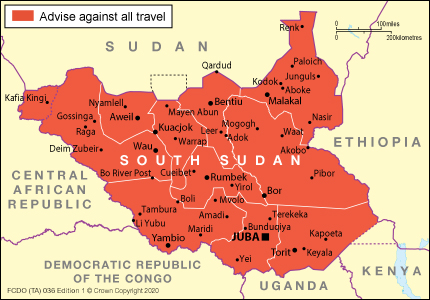
At least one official reading covers the whole country; no region is singled out.
Faithful summary of the official texts below, which prevail.
Global Affairs Canada — advises against all travel to the whole country.
Foreign Office — advises against all travel to the whole country.
an official reading covers the whole country; every trip calls for a written management decision, justified by a pressing reason, with reinforced conditions.
Global Affairs Canada — Open Government Licence – Canada (02.10.2026) · Foreign Office — Open Government Licence v3.0 · France Diplomatie (12.03.2026) · Natural Earth
No located event in this reading.
Last change: Updated information about Ebola ('Entry requirements' page).
Updated 16.05.2026
Do not travel to South Sudan due to risk of unrest , crime , kidnapping , landmines , and health risks .
The U.S. government has limited ability to provide emergency consular services to U.S. citizens in South Sudan due to the health and security situation
Health
The U.S. Centers for Disease Control and Prevention (CDC) has issued a Travel Health Notice for Ebola for the Democratic Republic of the Congo (DRC).
On May 17, the World Health Organization (WHO) declared the Ebola outbreak in the DRC and Uganda a Public Health Emergency of International Concern.
Medical services in South Sudan are extremely limited. Adequate medical treatment, as well as access to routine and emergency procedures, is often unavailable and even minor health issues could require medical evacuation.
All medical services, including medical evacuation, are at your expense.
If you purchase additional medical insurance, be sure to keep records of all medical services paid for and provided.
Unrest
Armed conflict is ongoing and includes fighting between various political and ethnic groups. Weapons are readily available to the population. In addition, cattle raids occur throughout the country, often leading to violence.
Journalists regularly report being harassed in South Sudan. Many have been killed while covering the conflict. Reporting in South Sudan without the proper documentation from the South Sudanese Media Authority is illegal. Any journalistic work there is very dangerous.
Crime
Violent crime is common throughout South Sudan, including Juba. This includes carjackings, shootings, ambushes, assaults, robberies, and kidnappings.
Foreign nationals have been the victims of rape, sexual assault, armed robberies, and other violent crimes.
Kidnapping
Criminal groups have kidnapped and threatened to kill or hurt people to force a third party, like a government, to act or abstain from doing something as a condition of release.
Kidnapping for ransom happens occasionally in…
South Sudan: Floods - Jul 2025ReliefWeb ↗read 16.10.20262025-07-31
South Sudan: Cholera Outbreak - Oct 2024ReliefWeb ↗read 16.10.20262024-10-28
Source: ReliefWeb (OCHA), via HDX — CC BY
10-16 2516.7 · 10-17 2510.9 · 10-18 2510.9 · 10-19 2522.5 · 10-20 2540.0 · 10-21 2545.8 · 10-22 2551.7 m³/s
Simulated discharge: Open-Meteo.com (CC BY 4.0), data rounded and formatted by Maximum. Contains modified Copernicus Emergency Management Service information 2026. For information only: this is not a flood warning; only national or regional authorities issue those.
The level is national. Risk areas are in the state advisories below.
No major event in progress is located in this country at this morning's check.
Over 1 January 2026 → 30 June 2026, UCDP (Uppsala University) recorded 9 geolocated violent incidents in this country, for 131 documented deaths.
Most affected areas
Jonglei state 3 · East Equatoria state 1 · Unity state 1 · Upper Nile state 1 · Lakes state 1 · Warap state 1
Most recent incidents
Source: UCDP Georeferenced Event Dataset (Uppsala Conflict Data Program), file GEDEvent_v26_01_26_06.csv, CC BY 4.0 licence. We keep only incidents UCDP codes as "Clear" and whose location is precise enough to be placed — about 58% of the dataset. An incident may be revised, moved or withdrawn by UCDP in a later release: these figures describe a closed period, not a live situation.
Reading: On the road, 17 times more deaths than in Switzerland: road crashes are the leading cause of death of healthy travellers (CDC) — seat belt, no night driving, a driver or a taxi from a rank.
World Bank (UNODC for homicides, WHO for roads) — latest published valuedata.worldbank.org ↗read 10.10.2026
What we locate on the map are events in progress that have real coordinates: USGS earthquakes, GDACS disasters, NOAA storms and open NASA EONET events. Hover a dot for details, click to open it in this briefing.
French passport — France Diplomatie
Faithful summary of the official texts below, which prevail.
Some areas of the country are formally advised against.France Diplomatie ↗updated 12.03.2026 · read 16.10.2026
Vigilance areas — France Diplomatie (in French) updated 12.03.2026official map ↗updated 12.03.2026 · read 16.10.2026
- Présentation du Soudan du Sud
-
-
-
-
-
-
-
-
-
Dernière actualisation le 12/03/2026, information toujours valable à la date du jour
L’ensemble du territoire sud-soudanais, à l’exception de sa capitale et des villes de Wau, Yambio et Aweil, est placé en zone formellement déconseillée.
La situation sécuritaire globale constitue un risque pour les voyageurs dans un pays dont l’État n’est en mesure d’assurer ni la sécurité des biens et des personnes sur un territoire qu’il ne contrôle pas intégralement, ni le fonctionnement des services essentiels (eau, électricité, hôpitaux, forces de sécurité), alors que la majorité de la population vit en dessous du seuil de pauvreté et se trouve en situation de forte insécurité alimentaire.
À Djouba, ainsi que dans les villes de Wau, Yambio et Aweil, la situation est dans l’ensemble calme et le niveau de criminalité est contenu. Les déplacements pour motifs professionnels peuvent être envisagés, sous réserve de se rendre dans ces villes exclusivement par voie aérienne et d’appliquer des règles strictes de sécurité.
Dans ces zones, il est recommandé de veiller à la sécurité de ses lieux de vie et de travail et de ne se déplacer qu’en véhicules motorisés (les deux-roues sont à exclure). Il convient d’éviter les déplacements de nuit, où les accidents de la route sont plus nombreux et les risques d’incidents plus fréquents. La situation aux nombreux points de contrôle mis en place la nuit peut en outre dégénérer à tout moment (menaces, extorsion etc.).
Le Soudan du Sud est en proie à un conflit interne depuis 2013. L’accord de paix du 12 septembre 2018 s’est traduit par une baisse significative des affrontements violents entre les forces gouvernementales et celles de l’opposition ou des milices locales. Toutefois, cette stabilisation est fragile, et le contexte social, politique et sécuritaire demeure très volatile dans la mesure où les forces belligérantes n’ont pas encore été désarmées et qu’un grand nombre d’armes circulent dans le pays.
De nombreux conflits locaux, d’origine ethnique ou liés à des luttes pour des ressources, en particulier le bétail, débouchent régulièrement sur des violences.
Les déplacements par voie terrestre au Soudan du Sud sont formellement déconseillés.
Il est recommandé de :
La criminalité touche l’ensemble du pays. Des agressions sont régulièrement rapportées (vols à main armée, vols avec effraction, enlèvements etc). Les étrangers ne sont pas spécifiquement visés mais peuvent être victimes de ces attaques.
Il convient de maintenir une vigilance élevée à tout moment et de limiter au maximum les déplacements, particulièrement de nuit. Il est recommandé d’éviter tout signe ostentatoire de richesse et de laisser ses objets de valeur dans des lieux sécurisés.
Des enlèvements surviennent occasionnellement et pourraient se multiplier sur la plupart des axes routiers, en raison de la détérioration de la situation socio-économique du pays. Il est recommandé de suivre des trajets et des horaires imprévisibles et irréguliers, afin d’éviter le repérage des véhicules et de constituer une cible pré-identifiée, ainsi que de prévenir des personnes de confiance des dates, trajets et horaires de déplacement dans les zones risquées et/ou isolées.
Le réseau routier, principalement constitué de pistes, est en mauvais état. Durant la saison des pluies (d’avril à octobre), les conditions de circulation se détériorent rapidement et la plupart des routes en dehors de Djouba deviennent impraticables.
Les accidents de la route sont fréquents, notamment sur l’axe principal reliant Djouba à l’Ouganda. Les habitudes de conduite sont imprévisibles, les véhicules sont vétustes et peu entretenus. La présence de piétons, de charrettes et d’animaux errants sur les routes constitue un danger supplémentaire.
Compte tenu des tensions prévalant dans une grande partie du pays, les coupeurs de routes prolifèrent. Tous les axes de circulation sont affectés par de nombreux barrages érigés par des hommes en armes. Plus de 70 barrages et points de contrôle existent entre Djouba et Bentiu sur ce qui constitue l’axe de communication nord-sud principal. La plupart exigent le versement d’une somme pouvant être supérieure à 1000 USD pour autoriser le passage. De nombreux incidents mortels tels que des tirs d’armes automatiques non motivés sur des véhicules ont lieu, notamment dans les zones sud de l’Equatoria central et de l’Equatoria oriental.
En ville, et notamment dans la capitale Djouba, les points de contrôle armés (officiels ou illégaux) sont nombreux et rendent les déplacements difficiles, particulièrement le soir. Les véhicules y sont généralement fouillés et leurs occupants financièrement sollicités.
Des pénuries de carburant sont apparues depuis mars 2021.
Les transports collectifs sont peu développés et régulièrement impliqués dans des accidents graves de la route. Il est préférable de disposer de son propre véhicule, autant que possible à quatre roues motrices.
Des mines et autres engins explosifs sont présents dans plusieurs régions du pays, y compris aux alentours de Djouba. Il convient de circuler sur les routes principales et de se renseigner auprès des autorités locales avant tout déplacement.
Même s’il demeure limité, le risque terroriste ne peut être totalement écarté compte tenu du contexte régional.
De manière générale, il est recommandé de :
Les Français de passage au Soudan du Sud sont vivement invités à signaler leur présence au ministère de l’Europe et des Affaires étrangères par l’intermédiaire de la plateforme Ariane .
Full text of the Security pagediplomatie.gouv.fr ↗updated 12.03.2026 · read 16.10.2026
Swiss passport — FDFA (Switzerland), in French
Faithful summary of the official texts below, which prevail.
FDFA update note — Le chapitre Situation générale a été actualisé. Toujours valable: Les voyages à destination du Soudan du Sud ainsi que les séjours de tout genre dans ce pays sont déconseillés. (published 04.02.2026)
Les voyages à destination du Soudan du Sud ainsi que les séjours de tout genre dans ce pays sont déconseillés. La situation est extrêmement instable et il y a des risques sécuritaires considérables dans tout le pays, y compris dans la capitale Djouba. Dans plusieurs régions du pays, en particulier dans l’Upper Nile, l’Unity et le Jonglei, des affrontements armés ainsi que des frappes aériennes font de nombreuses victimes et blessés. Dans les régions du Western Equatoria, du Central Equatoria et de l’Eastern Equatoria, y compris les zones frontalières, des combats entre groupes armés ont également été signalés plus fréquemment. Des conflits intercommunautaires violents éclatent en outre dans tout le pays, aggravant encore une situation sécuritaire déjà fragile. Les tensions dans la région frontalière avec le Soudan s’intensifient en raison des graves combats au Soudan. Le risque d’enlèvement est très élevé; il existe tant pour la population autochtone que pour les personnes de nationalité étrangère. Le taux de criminalité est très élevé. Il existe un risque d’être pris dans une fusillade ou risque d’être victime d’une agression criminelle violente. Dans tout le pays, les risques relatifs aux mines ne doivent pas être négligés. La rubrique terrorisme et enlèvements attire l'attention sur les risques liés au terrorisme. Terrorisme et enlèvements Les personnes de nationalité suisse, qui se rendent au Soudan du Sud en dépit des recommandations du DFAE doivent être conscients que la Suisse n'a que des possibilités limitées, voire aucune, d'apporter de l'aide en cas d'urgence.
FDFA travel advice, in French, valid on 16.10.2026eda.admin.ch ↗updated 04.02.2026 · read 16.10.2026
British passport — Foreign Office (UK)
Faithful summary of the official texts below, which prevail.
Regions covered by the Foreign Officegov.uk ↗updated 25.08.2026 · read 16.10.2026

Warnings — Foreign OfficeForeign Office ↗updated 25.08.2026 · read 16.10.2026
Your travel insurance could be invalidated if you travel against advice from the Foreign, Commonwealth & Development Office (FCDO).
## FCDO advises against all travel to South Sudan
FCDO advises against all travel to South Sudan due to the risk of armed violence and criminality.
See more about safety and security in South Sudan.
The political and security situation remains unpredictable. Political tensions are high and the security situation across the country could deteriorate rapidly and unpredictably.
If the unstable security situation deteriorates, routes into and out of South Sudan may be blocked. Juba airport may close or be inaccessible. Flights may be cancelled at short notice.
Regional developments may also affect international transport. For example, in 2019 and 2023, events in Sudan caused South Sudan’s airspace to close temporarily.
Consular assistance to British nationals is severely limited in South Sudan. In person consular assistance is not available.
FCDO continues to advise against all travel to South Sudan. If you choose to remain in South Sudan, you do so at your own risk. You should have a personal emergency plan that does not rely on the UK government. This includes the ability to leave the country or to shelter in place, if you judge that to be the safer choice. Make sure to keep all travel documentation up to date, stock up on essential supplies, and monitor the local situation.
You should not assume that FCDO will be able to provide assistance to leave the country in the event of serious unrest or crisis.
If there is civil disorder, stay somewhere safe and limit your movements as much as possible. Avoid all protests, political rallies and large gatherings, and follow the instructions of local authorities and security services.
If you choose to travel, research your destinations and get appropriate travel insurance . Insurance should cover your itinerary, planned activities and expenses in an emergency.
Safety — Foreign OfficeForeign Office ↗updated 25.08.2026 · read 16.10.2026
There is a high threat of terrorist attack globally affecting UK interests and British nationals, including from groups and individuals who view the UK and British nationals as targets. Stay aware of your surroundings at all times.
UK Counter Terrorism Policing has information and advice on staying safe and what to do in the event of a terrorist attack. Find out how to reduce your risk from terrorism while abroad .
Although there’s no recent history of terrorism in South Sudan, attacks cannot be ruled out.
Attacks could be indiscriminate including in places visited by foreigners. Stay aware of your surroundings, keep up to date with local media reports and follow the advice of local authorities.
The political and security situation remains unpredictable. Political tensions are high and the security situation across the country could deteriorate rapidly and unpredictably.
If the unstable security situation deteriorates, routes into and out of South Sudan may be blocked. Juba airport may close or be inaccessible. Flights may be cancelled at short notice.
Regional developments may also affect international transport. For example, in 2019 and 2023, events in Sudan caused South Sudan’s airspace to close temporarily.
FCDO continues to advise against all travel to South Sudan. If you choose to remain in South Sudan, you do so at your own risk. You should have a personal emergency plan that does not rely on the UK government. This includes the ability to leave the country or to shelter in place, if you judge that to be the safer choice. Make sure to keep all travel documentation up to date, stock up on essential supplies, and monitor the local situation.
If there is civil disorder, stay somewhere safe and limit your movements as much as possible. Avoid all protests, political rallies and large gatherings, and follow the instructions of local authorities and security services.
There is a high risk of serious crime such as robbery and assault in Juba and other urban areas, particularly at night and on public transport. There are drive-by robberies by individuals or groups on motorbikes.
There are regular attacks by armed groups and accidents on the Juba-Nimule road, the main supply route from Uganda into South Sudan.
Criminals in South Sudan are often armed.
It is extremely difficult for businesses and non-governmental organisations to work in South Sudan. Although the number of aid workers killed in targeted attacks has fallen in recent years, South Sudan remains one of the most dangerous environments in the world for aid workers. There are incidents of criminal kidnapping, violence, intimidation and arbitrary detention.
Checkpoints operated by soldiers or other armed men are common in and around Juba, particularly after dark. Armed men at checkpoints have been known to demand money from drivers and abuse people, especially women. Roadblocks can create volatile and dangerous situations and are often put up after sunset, so it advisable not to travel after dark.
Armed conflict, including violence targeting civilians is common throughout South Sudan. Fighting often starts quickly and unpredictably. Follow instructions from local authorities.
On 4 March 2025, there were reports of intense fighting in Nasir, Upper Nile State.
On the 16 and 17 January 2025, there was sporadic gunfire and looting…
American passport — U.S. Department of State
Faithful summary of the official texts below, which prevail.
South Sudan - Level 4: Do Not Travel 2026-05-16travel.state.gov ↗updated 16.05.2026 · read 16.10.2026
Do not travel to South Sudan due to risk of unrest , crime , kidnapping , landmines , and health risks .
The U.S. government has limited ability to provide emergency consular services to U.S. citizens in South Sudan due to the health and security situation
Health
The U.S. Centers for Disease Control and Prevention (CDC) has issued a Travel Health Notice for Ebola for the Democratic Republic of the Congo (DRC).
On May 17, the World Health Organization (WHO) declared the Ebola outbreak in the DRC and Uganda a Public Health Emergency of International Concern.
Medical services in South Sudan are extremely limited. Adequate medical treatment, as well as access to routine and emergency procedures, is often unavailable and even minor health issues could require medical evacuation.
All medical services, including medical evacuation, are at your expense.
If you purchase additional medical insurance, be sure to keep records of all medical services paid for and provided.
Unrest
Armed conflict is ongoing and includes fighting between various political and ethnic groups. Weapons are readily available to the population. In addition, cattle raids occur throughout the country, often leading to violence.
Journalists regularly report being harassed in South Sudan. Many have been killed while covering the conflict. Reporting in South Sudan without the proper documentation from the South Sudanese Media Authority is illegal. Any journalistic work there is very dangerous.
Crime
Violent crime is common throughout South Sudan, including Juba. This includes carjackings, shootings, ambushes, assaults, robberies, and kidnappings.
Foreign nationals have been the victims of rape, sexual assault, armed robberies, and other violent crimes.
Kidnapping
Criminal groups have kidnapped and threatened to kill or hurt people to force a third party, like a government, to act or abstain from doing something as a condition of release.
Kidnapping for ransom happens occasionally in…
Global Affairs Canada — additional reading
Avoid all travel
Avoid all travel to South Sudan, due to the ongoing volatile security situation, armed conflicts, inter-ethnic violence and high levels of violent crime.
Open Government Licence – Canada · October 2, 2026 14:02 EDTtravel.gc.ca ↗updated 02.10.2026 · read 16.10.2026
Faithful summary of the official texts below, which prevail.
Global Affairs Canada — written for Canadian travellers, valid for all
You must abide by local laws. Learn about what you should do and how we can help if you are arrested or detained abroad.
Penalties for possession, use or trafficking of illegal drugs are severe. Convicted offenders can expect lengthy prison sentences or heavy fines. Drugs, alcohol and travel
The death penalty applies to serious crimes such as murder, drug trafficking and treason.
A permit is required for photography, including on a mobile phone. Permits can be obtained at the Ministry of Information. Even with a photography permit, it is prohibited to photograph:
The Hague Convention on the Civil Aspects of International Child Abduction is an international treaty. It can help parents with the return of children who have been removed to or retained in certain countries in violation of custody rights. It does not apply between Canada and South Sudan. If your child was wrongfully taken to, or is being held in South Sudan by an abducting parent:
If your child was removed from a country other than Canada, consult a lawyer to determine if The Hague Convention applies. Be aware that Canadian consular officials cannot interfere in private legal matters or in another country's judicial affairs.
You should carry an International Driving Permit. International Driving Permit
South Sudan is a traditional, conservative society. Women should dress conservatively and avoid:
The currency of South Sudan is the South Sudan pound (SSP). The Sudanese pound (SDG) is not recognized as legal tender. It is difficult to transfer U.S. or Canadian dollars into the country. Currency exchange houses and merchants do not accept U.S. currency dated before 2006 and will reject notes with any marks. Credit cards are only accepted in South Sudan in limited locations such as:
Automated teller machines (ATMs) are available but are unreliable and dispense only South Sudanese pounds. You must pay in cash for larger expenses, such as hotel bills. There is a vast and growing disparity between the official exchange rate and black-market rates for South Sudanese pounds. It is illegal to exchange currency except in authorized locations, such as banks and exchange bureaus.
Open Government Licence – Canada · October 2, 2026 14:02 EDTtravel.gc.ca ↗updated 02.10.2026 · read 16.10.2026
Foreign Office — laws and cultural differences
Police can ask to see photo ID. Always carry a colour copy of your passport with you.
There are severe penalties for using or trafficking drugs in South Sudan, including the death penalty and life imprisonment.
Do not take photographs close to government buildings, military installations, bridges, airports, public utilities (including petrol stations) and other sensitive areas. Plainclothes public security officers operate in Juba and across South Sudan.
Same-sex relationships are not culturally accepted. Same-sex sexual activity between men is illegal and punishable by a prison sentence of up to 14 years. LGBT+ travellers are at risk of discrimination and violence. Read more advice for LGBT+ travellers.
International credit and debit cards are not widely accepted, although some of the newer hotels and supermarkets are starting to. ATMs are hard to find, and it is often not possible to use international cards. You can use your credit or debit card to withdraw money in some supermarkets. Bring large denomination US dollars (clean, unblemished notes dated 2017 onwards). Dollars are acceptable currency in many places, but shops and restaurants are likely to refuse notes that are marked in any way.
Open Government Licence v3.0gov.uk ↗updated 25.08.2026 · read 16.10.2026
What it changes for you: Air acceptable at this hour: nothing special to plan. Very high UV: sunscreen, hat and shade between 11 am and 4 pm; sunstroke and dehydration are travellers' first reasons to see a doctor.
Reading 10:00 (Africa/Juba)Open-Meteo ↗updated 16.10.2026 · read 16.10.2026
Air quality and UV: Open-Meteo.com (CC BY 4.0), data rounded and formatted by Maximum. Contains modified Copernicus Atmosphere Monitoring Service information 2026. Neither the European Commission nor ECMWF is responsible for any use that may be made of the Copernicus information or data it contains.
No value published by the World Bank in the last eight years for South Sudan: hospital beds per 1,000 people.
Reading: With 0.0 physicians per 1,000 people (100% fewer than Switzerland), the nearest hospital does not always have the capacity for a serious case: evacuation to an adequate centre is the rule, not the exception — that is what unlimited evacuation and repatriation cover. Health spending of 73 USD per person (Switzerland: 11,784) goes with private hospitals that bill foreigners in hard currency and ask for a guarantee before admission: the direct payment guarantee is what avoids the deposit.
World Bank — latest published value, year per indicatordata.worldbank.org ↗read 10.10.2026
French passport — France Diplomatie
Faithful summary of the official texts below, which prevail.
- Présentation du Soudan du Sud
-
-
-
-
-
-
-
-
-
Pour entrer sur le territoire sud-soudanais, les ressortissants français doivent être en possession d’un visa, être vaccinés contre la fièvre jaune et munis d’un carnet de vaccination. Pour tout séjour de plus de trois jours, il est nécessaire de se faire enregistrer dès son arrivée sur le territoire sud-soudanais auprès du Département de l’immigration.
Dans la mesure où la délivrance d’un visa à l’aéroport de Djouba est aléatoire, les compagnies aériennes peuvent refuser d’embarquer les personnes qui ne sont pas en possession d’un visa valide avant leur départ pour le Soudan du Sud.
Pour les personnes résidant en France, la demande peut être faite auprès de l’ambassade du Soudan du Sud à Paris (cf. onglet Contacts utiles / Annuaire des représentations du Soudan du Sud en France).
Les ambassades du Soudan du Sud à Nairobi, Addis Abeba et Kampala peuvent également délivrer des visas sous 24 heures.
Entry and stay pagediplomatie.gouv.fr ↗updated 12.03.2026 · read 16.10.2026
Swiss passport — FDFA (Switzerland)
The FDFA does not publish entry requirements: they are set out by the destination's embassy or consulate in Switzerland — check them before booking, passport in hand. As a guide, the French and British requirements below describe the same rules as seen by two other governments.eda.admin.ch ↗updated 04.02.2026 · read 16.10.2026
British passport — Foreign Office (UK)
Faithful summary of the official texts below, which prevail.
Entry requirements — rules for a British passportForeign Office ↗updated 25.08.2026 · read 16.10.2026
This information is for people travelling on a full ‘British citizen’ passport from the UK who choose to travel against Foreign, Commonwealth and Development Office ( FCDO ) advice. It is based on the UK government’s understanding of South Sudan’s current rules for the most common types of travel.
The authorities in South Sudan set and enforce entry rules. If you’re not sure how these requirements apply to you, contact the South Sudanese Embassy in the UK .
To enter South Sudan, your passport must have an ‘expiry date’ at least 6 months after the day you arrive and have at least 2 blank pages.
Check with your travel provider that your passport and other travel documents meet requirements. Renew your passport if you need to.
You will be denied entry if you do not have a valid travel document or try to use a passport that has been reported lost or stolen.
When returning to the UK, British citizens must carry a valid British passport or certificate of entitlement . See Dual citizenship .
You must have a visa to enter or travel through South Sudan.
You can:
If you want to extend your visa, contact the Ministry of the Interior in person:
Ministry of the Interior, Airport Road, Juba
Phone: +211 (0)926 388 499
Email: info@mol.gov.ss
If you plan to work in South Sudan, see information on work permits from the Ministry of Labour.
You must register at a local police station if you’re in South Sudan for 5 days or more.
To enter South Sudan, you must have a certificate to prove you’ve had a yellow fever vaccination.
For details about medical entry requirements and recommended vaccinations, see TravelHealthPro’s South Sudan guide .
In May 2026, neighbouring countries ( Democratic Republic of Congo and Uganda ) reported Ebola cases, including in areas close to the border with South Sudan (Western Equatoria State). If crossing a land border from DRC or Uganda into South Sudan, you may encounter health screening measures such as temperature checks and a request to provide a brief travel history.
At Juba International Airport, some airlines are now asking passengers departing the country to complete a health declaration form. Some countries have heightened health screening for travellers coming from South Sudan. Check entry requirements for the country you’re travelling to or transiting.
The UK’s Returning Workers Scheme has been activated, due to the outbreak of Ebola disease. Returning health and humanitarian workers should check the latest at UK’s Returning Workers Scheme before returning to the UK. Due to the proximity of South Sudan to affected areas, South Sudan is also covered by the scheme.
UK Health Security Agency has Ebola information for humanitarian or healthcare workers .
On rare occasions, some travellers have been asked to show proof of their COVID-19 vaccination. You can get proof of vaccination:
American passport — U.S. Department of State
The State Department publishes the requirements ("Entry, Exit and Visa Requirements") on its country page, which our servers cannot read. Read it before you go; as a guide, the French and British requirements below describe the same rules as seen by two other governments.travel.state.gov ↗updated 16.05.2026 · read 16.10.2026
For each risk, the official texts themselves: what is happening, then, where they say so, what to do.
What the texts say · There is a high risk of serious crime such as robbery and assault in Juba and other urban areas, particularly at night and on public transport. Criminals in South Sudan are often armed.
What the texts say · It is extremely dangerous to drive in South Sudan due to armed robbery, violent attacks and poor driving standards. Checkpoints operated by soldiers or other armed men are common in and around Juba, particularly after dark.
What the texts say · During the rainy season from April to November, most roads outside of Juba become impassable. There is a risk from landmines or unexploded cluster bombs in some areas of South Sudan.
What the texts say · There are severe penalties for using or trafficking drugs in South Sudan, including the death penalty and life imprisonment. Same-sex sexual activity between men is illegal and punishable by a prison sentence of up to 14 years.
What the texts say · The political and security situation remains unpredictable. Political tensions have intensified since the 2018 peace agreement was renewed, extending the transitional period until February 2027.
Sentences copied word for word from the official texts cited, chosen for the destination; the level is our reading. The full texts, at each source:Foreign Office ↗updated 25.08.2026 · read 16.10.2026 (updated 25.08.2026 · read 28.09.2026)Global Affairs Canada ↗updated 02.10.2026 · read 16.10.2026 (updated 02.10.2026 · read 28.09.2026)
Reading: On the road, 17 times more deaths than in Switzerland: road crashes are the leading cause of death of healthy travellers (CDC) — seat belt, no night driving, a driver or a taxi from a rank.
World Bank (UNODC for homicides, WHO for roads) — latest published valuedata.worldbank.org ↗read 10.10.2026
Time zone: IANA and timezone-boundary-builder (ODbL) · RESTCountries · EmergencyNumberAPI · Wikidata · European Central Bank
Places: © OpenStreetMap contributors (ODbL), Photon search by komoot.
Maximum policyholder: before paying anything, call the 24/7 number. If you are admitted for more than 24 h, Maximum sends its direct payment guarantee to the hospital (art. 2.12).
+41 22 ••• •• •• — Full number in your client areaNone of these facilities is a Maximum Insurance “partner”, and none is presented as waiving upfront payment: this list is a reading of public map data, nothing more. A direct payment guarantee is arranged CASE BY CASE by our assistance desk, facility by facility and when the need arises — one number, +41 22 ••• •• ••.
List read from OpenStreetMap on 14.10.2026, not read again since: these facilities may have changed.
CDC Travelers' Health recommendations, most important first. They depend on your age, vaccines and itinerary: confirm them with a doctor or a travel clinic 4 to 6 weeks before departure. Details, disease by disease ↗cdc.gov ↗read 10.10.2026
The health system — With 0.0 physicians per 1,000 people (100% fewer than Switzerland), the nearest hospital does not always have the capacity for a serious case: evacuation to an adequate centre is the rule, not the exception — that is what unlimited evacuation and repatriation cover. Health spending of 73 USD per person (Switzerland: 11,784) goes with private hospitals that bill foreigners in hard currency and ask for a guarantee before admission: the direct payment guarantee is what avoids the deposit.
Back home — a fever in the following weeks should be told to a doctor, naming the country.
Forecast: MET Norway (Norwegian Meteorological Institute, CC BY 4.0), grouped by day and formatted by Maximum.
French passport — French embassy and consulates
Kololo Road, Juba
OpenStreetMap
Swiss passport — Swiss embassy and consulates
phone not published
Représentations suisses à l’étranger: En cas de situation d’urgence à l’étranger, vous pouvez vous adresser à la représentation suisse la plus proche ou à la Helpline DFAE. Ambassade de Suisse en Ethiopie Helpline DFAE
OpenStreetMap · DFAE
British passport — British embassy and consulates
Kololo Road, Juba
phone not published
https://www.gov.uk/world/organisations/bri ↗updated 25.08.2026 · read 16.10.2026
OpenStreetMap
American passport — U.S. embassy and consulates
Kololo Road, Juba
Inmarsat +870-77-233-0202
https://ss.usembassy.gov/ ↗updated 16.05.2026 · read 16.10.2026
OpenStreetMap
OpenStreetMap
Getting help — Foreign OfficeForeign Office ↗updated 25.08.2026 · read 16.10.2026
The Foreign, Commonwealth & Development Office ( FCDO ) cannot provide tailored advice for individual trips. Read this travel advice and carry out your own research before deciding whether to travel.
There are no central emergency numbers in South Sudan.
Your travel insurance could be invalidated if you travel against advice from FCDO.
Contact your travel provider and your insurer if you are involved in a serious incident or emergency abroad. They will tell you if they can help and what you need to do.
See how to get help from the UK government abroad including in an emergency.
You can call FCDO in London if you need urgent help because something has happened to a friend or relative abroad.
Telephone: 020 7008 5000 (24 hours)
Find out about call charges
English is an official language in South Sudan: no translated phrases here.
Actions to take before each professional trip abroad.
Live alerts and level changes, each with its official source. Continuously updated.
La situation sécuritaire demeure instable au Soudan du Sud, notamment en raison de tensions politiques liées aux affrontements meurtriers dans le nord-est du pays. Sauf raison impérative, il est déconseillé de se rendre dans les villes de Djouba, Aweil, Way et Yambio (zone orange). Tout déplacement est formellement déconseillé dans le reste du pays (zone rouge). Pour les Français résidents, il est recommandé : d’éviter tout déplacement non impérieux, notamment ceux à pied ;…
France Diplomatie (in French) · posted 4 March 2026 · updated 18 September 2026diplomatie.gouv.fr ↗updated 12.03.2026 · read 16.10.2026Le 17 mai, l’OMS a déclaré une urgence de santé publique de portée internationale et Africa CDC une urgence de santé publique de sécurité continentale face à l’épidémie d’Ebola touchant la République démocratique du Congo et l’Ouganda. Les pays qui partagent des frontières terrestres avec la République démocratique du Congo sont considérés comme exposés à un risque élevé de propagation régionale du fait des mouvements transfrontaliers importants, du contexte sécuritaire…
France Diplomatie (in French) · posted 22 May 2026diplomatie.gouv.fr ↗updated 12.03.2026 · read 16.10.2026No level change recorded for this country since the log opened. The live alerts above are updated continuously.
Level 4/4 — Do Not Travel, U.S. Department of State, retrieved on 16 October 2026.
Sourcestravel.state.gov · updated 16.05 · read 16.10France Diplomatie · updated 12.03 · read 16.10DFAE · updated 04.02 · read 16.10207-country comparison
An area advised against does not rule out the country.
SourcesFrance Diplomatie · updated 12.03 · read 16.10Foreign Office · updated 25.08 · read 16.10State Department · updated 16.05 · read 16.10
The rules depend on the passport, not on the destination alone.
SourcesFrance Diplomatie · updated 12.03 · read 16.10Foreign Office · updated 25.08 · read 16.10State Department · updated 16.05 · read 16.10
For a Schengen visa, yes: at least €30,000 of travel medical insurance (Regulation (EC) No 810/2009, art. 15).
SourcesRegulation (EC) 810/2009, art. 15General conditions, policy 20 00 479
VIP Pack — €990 for twelve months, unlimited trips.
SourcesGeneral conditions, policy 20 00 479OpenStreetMap · read 13.10
From 45 000 € to 140 000 € depending on severity and distance (Diversified Quotes, 2026).
SourcesDiversified Quotes, 2026General conditions, policy 20 00 479
Six steps, in this order.
SourcesSpecial conditions 01.26General conditions, policy 20 00 479
Local emergency services: single number 911
SourcesEmergencyNumberAPI · Wikidata · read 08.10OpenStreetMap · read 13.10
At today's level 4/4, card by card:
SourcesAmex Platinum France T&Cs, 01.2025 — general exclusion n° 11BNP Paribas Visa Infinite notice (policy PT7), 04.2025 — comFortuneo World Elite Mastercard notice, 01.2026 — art. 5.5 '
A health plan reimburses at home; here, the hospital asks for a payment guarantee before admission.
SourcesGeneral conditions, policy 20 00 479
Around Juba: 80 hospitals and clinics, 8 with a 24/7 emergency room, 19 pharmacies, 40 doctors' practices (OpenStreetMap, hospital list read on 14.10.2026).
The sourced detail is under Medical network › Health: vaccines, diseases present, altitude, outbreaks.
SourcesCDC Travelers' Health · read 10.10France Diplomatie · updated 12.03 · read 16.10OMS · read 16.10Foreign Office · updated 25.08 · read 16.10
0.0 physicians per 1,000 people (2022) versus 4.5 in Switzerland.
SourcesWorld Bank · read 10.10General conditions, policy 20 00 479
Comparable figures (homicides, roads, incidents) are under Safety & risks › Incidents.
The nearest representations, by passport (OpenStreetMap):
SourcesOpenStreetMap · read 13.10DFAE · updated 04.02 · read 16.10
At least one official reading covers the whole country; no region is singled out.
SourcesGlobal Affairs Canada · updated 02.10 · read 16.10Foreign Office · updated 25.08 · read 16.10France Diplomatie · updated 12.03 · read 16.10
Local laws apply to every traveller; here is what the official texts say.
SourcesGlobal Affairs Canada · updated 02.10 · read 16.10Foreign Office · updated 25.08 · read 16.10
Every foreign ministry runs a 24/7 emergency line for its nationals.
Sourcesdiplomatie.gouv.fr · updated 12.03 · read 16.10eda.admin.ch · updated 04.02 · read 16.10
Keep the entry stamp, the invoices, the prescriptions and the medical report.
SourcesGeneral conditions, policy 20 00 479
Cancellation or change up to EUR 20,000, special risk EUR 5,000 per person, crisis management and security, optional Kidnap & Ransom.
SourcesGeneral conditions, policy 20 00 479
A question not answered here? Ask Maximum below, or call the support number: every question gets a clear, actionable answer.
In a life-threatening emergency, call local emergency services first, then Maximum: +41 22 ••• •• •• — 24/7 support number, an adviser stays with you to the end.
The 207 country pages — hospitals, pharmacies, police, embassies, emergency numbers, official advice from four governments, health, safety in figures, events in progress — read around the city you name. Your policy — benefits, the six steps, claims, articles. The site — prices, certificate, subscription. Nothing else: what it does not know, it says so and hands you to an adviser.
The published advisory level is national, but risk is not: business hubs (Djouba) do not share the profile of border areas. The medical network shown on this page is computed around Juba — real hospitals, evacuation airport and live alerts. Before a specific trip, always cross-check your country of residence's advisory: that is what your policy cites.
Same advisory level: Haiti · Iraq · Iran · Lebanon · Libya · Mali
The displayed level comes from the State Department, checked every morning. Before departure, always cross-check your country of residence's advisory: that is what your policy cites.
The level shown is the official U.S. Department of State level, checked daily. Maximum Insurance is an insurance distributor — general information, not personal advice.
The destination is already Juba. A few choices, then the reading of your cover, here.
Destination · Juba
Travel Insurtech. 24/7 worldwide.
Swiss insurer · Worldwide medical network