Maximum Alerts / Lebanon
LebanonLevel 4/4
Level published by the State Department on 20.08.2026 · read 16 October 2026 · source checked daily
Lebanon — official level as of 16 October 2026: Level 4/4 ("Do Not Travel"), from the U.S. Department of State. Maximum Insurance covers this country: hospital settled directly, unlimited repatriation, EUR 1.5M, certificate on payment.
How we read these four advisories
Every country has its own scale, so we ask them all the same question: is the whole country advised against?
An advisory covering only areas of the country does not raise the answer: it stays “No”, and the area is shown in the relevant column.
The level shown on this page — and across this site — is the one published by the U.S. State Department, from 1 (normal precautions) to 4 (do not travel). France and the United Kingdom publish their own advisories, with their own rules: they add to that level, they do not replace it.
120 recorded incidents (UCDP)hover, click to open it in the briefing
In a life-threatening emergency, call local emergency services first, then Maximum: +41 22 ••• •• •• — 24/7 support number, an adviser stays with you to the end.
What Maximum knows
The 207 country pages — hospitals, pharmacies, police, embassies, emergency numbers, official advice from four governments, health, safety in figures, events in progress — read around the city you name. Your policy — benefits, the six steps, claims, articles. The site — prices, certificate, subscription. Nothing else: what it does not know, it says so and hands you to an adviser.
What I say on the phone
- I am insured with Maximum, here is my policy number. Where should I go? Send me to a hospital in the Maximum network.
- Send the payment guarantee to the hospital: I do not want to pay anything up front.
- For non-urgent transport or repatriation, tell me what you authorise and arrange. In a life-threatening emergency, I call local emergency services immediately.
What to do, in this order
1Contact assistance without delay›
In immediate danger, call local emergency services first. Then contact assistance without delay; before engaging a service, seek approval under your policy. Cover is confirmed by the insurer.
2Ask where to get care›
Ask assistance where to get care and whether direct cover can be arranged. It confirms the facility and seeks the insurer's approval under your policy. In immediate danger, call local emergency services first.
3See a doctor the same day›
Even for a pain you meant to shrug off. Without a medical certificate written on the spot, the same day, the insurer cannot cover the event — a certificate written after you return does not count.
4Admitted? Have the hospital front desk call Maximum›
The hospital desk sends the request to assistance. Direct payment depends on the insurer's approval and the policy; the call alone does not guarantee it. Have the response confirmed before relying on no up-front payment.
5For non-urgent transport, seek assistance approval›
In a life-threatening emergency, call local emergency services immediately. For an arranged transfer or repatriation, contact assistance: the insurer's medical team decides on measures under the policy. A medical flight booked without approval may not be reimbursed.
6Once home, report the claim within 30 days›
Even if everything went well on the ground. Send your invoices and the medical report within 30 days; after that, compensation may be reduced or refused.
Places read from OpenStreetMap, within a circle of about 12 km: phone, email, address, website and hours when the source publishes them. No customer reviews, that source has none. Straight-line distances.
What is your current insurance?
Notices vary by bank and vintage — yours prevails. On the right: the Maximum contract (public documents).
Where to go, where not to
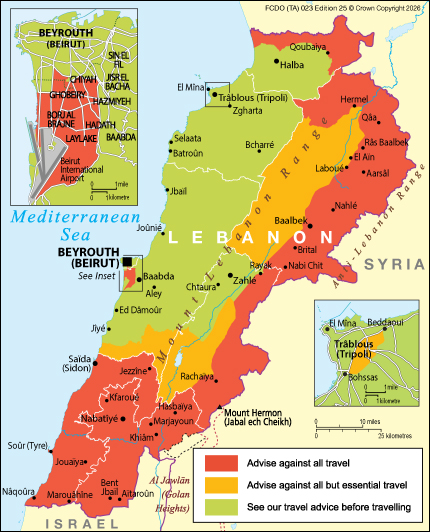
At least one official reading covers the whole country; 4 regions are also named, fully or partly.
- Avoid all travel to Lebanon due to volatile security situation in the region. Global Affairs Canada
- Foreign Office advises against all travel to South and Nabatiyeh Governorates, Beqaa Governorate, Baalbek-Hermel Governorate, Akkar Governorate, and all 12 Palestinian refugee camps. Foreign Office
- Foreign Office advises against all travel to specific Beirut areas: Tariq el Jdideh, Ghobeiry, Haret Hraik, Burj Al Barajneh, Mraije, Laylaki, Jnah, and areas west of Camil Chamoun Boulevard south of Forn el Chebbak. Foreign Office
- Foreign Office advises against all but essential travel to Tripoli east of Bechara El Khoury road, including Abou Samra, Tabbaneh, Jessrin, Qoubbeh and Zaytoun neighbourhoods. Foreign Office
- France Diplomatie advises against all travel to Palestinian camps and surroundings nationwide, and to North Lebanon north of Abdeh-Mechmech road, Beqaa plain including Baalbek and Anjar, and South Lebanon axis Saïda-Jezzine-Machghara. France Diplomatie
- France Diplomatie advises against except for pressing reasons: North Lebanon triangle Tripoli-Abdeh-Mechmech, Tripoli city excluding coastal area, South Lebanon to Saïda at coast level and Qaraoun lake, and central country Tripoli to Saïda. France Diplomatie
Faithful summary of the official texts below, which prevail.
Global Affairs Canada — advises against all travel to the whole country.
France Diplomatie — rates the rest of the country “advised against except for imperative reasons”.
“(France Diplomatie)”: the level comes from its text, in French, quoted below region by region.
an official reading covers the whole country; every trip calls for a written management decision, justified by a pressing reason, with reinforced conditions.
The official text, region by region
Advised against — all travel4 regions
BeirutGB
Foreign Office
FCDO advises against all travel to the following areas of Beirut and its southern suburbs, excluding Route 51 from central Beirut to Rafic Hariri International Airport:
BeqaaFR
France Diplomatie (in French)
Dans la plaine de la Béqaa, y compris à Baalbek et Anjar.
NorthGBFR
Foreign Office
FCDO advises against all but essential travel to the area of Tripoli to the east of the Bechara El Khoury road from Bohssas in the south to Beddaoui in the north – including the neighbourhoods of Abou Samra, Tabbaneh, Jessrin, Qoubbeh and Zaytoun.
France Diplomatie (in French)
Dans le Liban-Nord, au nord de la route reliant Abdeh à Mechmech (ou Mish Mish selon certains sites internet).
SouthGB
Foreign Office
FCDO advises against all travel to South and Nabatiyeh Governorates.
Official passages not placed on the map5
Foreign Office — Advised against — all travel
FCDO advises against all travel to the 12 Palestinian refugee camps. See Palestinian refugee camp locations on the UN Relief and Works Agency website.
France Diplomatie (in French) — Advised against — all travel
Dans le Sud du Liban sur un axe Saïda (ville exclue) - Jezzine et Machghara
France Diplomatie (in French) — Advised against — all but essential travel
La ville de Tripoli, à l’exception de sa partie littorale. La périphérie nord de l’agglomération où les conditions de sécurité restent précaires, notamment les quartiers de Jabal Moshen et de Bab el Tebbaneh où des incidents sécuritaires récurrents sont à déplorer. Ces quartiers peuvent être considérés comme étant déconseillés.
France Diplomatie (in French) — Advised against — all but essential travel
Au Sud du Liban : jusqu’à Saïda (ville incluse) au niveau du littoral et le lac de Qaraoun à l’est.
France Diplomatie (in French) — Advised against — all but essential travel
Dans la partie centrale du pays, de Tripoli jusqu’à Saïda.
Global Affairs Canada — Open Government Licence – Canada (15.10.2026) · Foreign Office — Open Government Licence v3.0 · France Diplomatie (13.03.2026) · Natural Earth
Last change: FCDO has changed the areas of Lebanon where it advises against all travel or all but essential travel. FCDO no longer advises against all travel or all but essential travel to some parts of Lebanon. FCDO continues to advise against all trav
Lebanon - Level 4: Do Not TravelState Department ↗updated 20.08.2026 · read 16.10.2026
Updated 20.08.2026
Do not travel to Lebanon due to the risk of crime, terrorism, unrest, kidnapping, landmines , and armed conflict.
Do not travel to Lebanon for any reason.
The U.S. government has limited ability to offer emergency services to U.S. citizens in Lebanon due to the safety risks.
U.S. government employee travel restrictions
- U.S. Embassy Beirut personnel are restricted from personal travel throughout Lebanon without advance permission.
- Additional travel restrictions may be imposed on U.S. personnel under Chief of Mission security responsibility, with little to no notice due to increased security issues or threats.
- The Lebanese government cannot guarantee the safety of U.S. citizens against sudden outbreaks of violence and armed conflict.
U.S. citizens in Lebanon are advised to take similar precautions.
Due to safety risks, only family members 21 years of age or older may join U.S. government employees who work in Lebanon.
Aviation Safety
- The Federal Aviation Administration (FAA) advises caution for flights operating in the airspace within 200 nautical miles of the Damascus Flight Information Region (FIR) due to heightened military activity in or around Syria.
- For more information U.S. citizens should consult the Federal Aviation Administration’s Prohibitions, Restrictions and Notices .
Crime
- There is risk of non-violent crime throughout Lebanon.
- Most crimes against foreigners are crimes of opportunity, like purse snatching and pickpocketing.
Terrorism
There is risk of terrorist violence, including terrorist attacks and other activity in Lebanon. Visit the U.S. Department of State’s country reports on terrorism to learn more.
- Terrorist groups, including Hizballah, IRGC, ISIS, and Hamas, continue plotting possible attacks in Lebanon.
- Terrorists may conduct attacks with little or no warning targeting tourist locations, transportation hubs, markets/shopping malls, and local government facilities.
Kidnapping and hostage-taking
There is an ongoing risk of kidnapping and hostage-taking in Lebanon. Local authorities have warned that foreign nationals may be targeted.
- Americans and other travelers – including tourists, humanitarian workers, journalists, and business professionals – may be viewed as targets of opportunity. If you are kidnapped or taken hostage, the reason for your being in Lebanon is unlikely to offer…
Nearest river dischargeOpen-Meteo ↗updated 16.10.2026 · read 16.10.2026
10-16 0.3 · 10-17 0.3 · 10-18 0.3 · 10-19 0.3 · 10-20 0.2 · 10-21 0.2 · 10-22 0.2 m³/s
Simulated discharge: Open-Meteo.com (CC BY 4.0), data rounded and formatted by Maximum. Contains modified Copernicus Emergency Management Service information 2026. For information only: this is not a flood warning; only national or regional authorities issue those.
What the national level does not tell you
The level is national. Risk areas are in the state advisories below.
- U.S. State Department — the full advisory details the regions concerned and the reasons (crime, terrorism, kidnapping, civil unrest) (read the advisory)
- Foreign, Commonwealth & Development Office (United Kingdom) — the United Kingdom advises against all travel to PARTS of the country and advises against all but essential travel to parts · reviewed 10 August 2026
Last announced change : « FCDO has changed the areas of Lebanon where it advises against all travel or all but essential travel. FCDO no longer advises against all travel or all but essential travel to some parts of Lebanon. FCDO continues to advise against all trav » (read the advisory) - France Diplomatie — France classifies SOME AREAS of the country as red (travel formally advised against) — the advisory is geographic, check it for your exact destination (read the Security advisory)
1 event located on the map
- Lebanon — Do Not Travel — level 4/4, U.S. State Department (source)
Over 1 January 2026 → 30 June 2026, UCDP (Uppsala University) recorded 457 geolocated violent incidents in this country, for 1,391 documented deaths.
Most affected areas
Nabatiye province 209 · South Lebanon province 169 · Beirut province 28 · Beqaa province 19 · Baalbek-Hermel province 14 · Mount Lebanon province 8
Most recent incidents
- 28 June 2026 · Southern Lebanon
Israeli army: Officer killed and soldier wounded in fighting in southern Lebanon · 1 deathSource: elnashra · 28 June 2026 · IDF · UCDP #634093 ↗ - 27 June 2026 · Nabatiye province · Nabatiye El Faouqa village
Health Ministry: One martyr and two wounded in an Israeli raid on the town of Nabatieh al-Fawqa · 1 deathSource: elnashra · 27 June 2026 · Ministry of Health · UCDP #634094 ↗ - 25 June 2026 · Nabatiye province · Mifidoun village
Three martyrs as a result of the occupation's bombing of a vehicle in southern Lebanon · 3 deathsSource: Wafa · 25 June 2026 · Lebanese News Agency · UCDP #633579 ↗ - 24 June 2026 · Nabatiye province · Tallet al-Dabsha village
Two martyrs in the Israeli raid on a car on the road to Tell al-Dabsha towards Doha Kafr Rumman · 2 deathsSource: elnashra · 24 June 2026 · NNA · UCDP #634095 ↗ - 23 June 2026 · Nabatiye province · Nabatiye El Faouqa village
Health Ministry: Two martyrs and one wounded in Israeli enemy gunfire on the town of Nabatieh al-Fawqa · 2 deathsSource: elnashra · 23 June 2026 · Ministry of Health · UCDP #634096 ↗ - 21 June 2026 · Nabatiye province · Marjayoun county
Civil defense teams recovered the bodies of 13 martyrs and reopened roads in the Nabatieh and Marjeyoun regions. · 7 deaths (range 7–6)Source: elnashra · 22 June 2026 · Civil Defense · UCDP #634160 ↗
Source: UCDP Georeferenced Event Dataset (Uppsala Conflict Data Program), file GEDEvent_v26_01_26_06.csv, CC BY 4.0 licence. We keep only incidents UCDP codes as "Clear" and whose location is precise enough to be placed — about 58% of the dataset. An incident may be revised, moved or withdrawn by UCDP in a later release: these figures describe a closed period, not a live situation.
Reading: The homicide rate is 4 times Switzerland's: violence is a real risk there, concentrated in the areas named by the official advisories. On the road, 7 times more deaths than in Switzerland: road crashes are the leading cause of death of healthy travellers (CDC) — seat belt, no night driving, a driver or a taxi from a rank.
World Bank (UNODC for homicides, WHO for roads) — latest published valuedata.worldbank.org ↗read 10.10.2026
What we locate on the map are events in progress that have real coordinates: USGS earthquakes, GDACS disasters, NOAA storms and open NASA EONET events. Hover a dot for details, click to open it in this briefing.
French passport — France Diplomatie
- French nationals must avoid the Bekaa plain including Baalbek and Anjar, northern Lebanon north of the Abdeh-Mechmech road, and southern Lebanon on the Saïda-Jezzine-Machghara axis, as these zones are formally advised against. France Diplomatie
- Palestinian camps and their surroundings across Lebanon are off-limits; Lebanese authorities prohibit access, and areas near Saïda camps are especially dangerous. France Diplomatie
- Terrorist threats remain constant; Islamic State cells have been disrupted since August 2020, and violent clashes occurred in Tayouneh (October 2021) and Ain El Helwé camp (summer 2023). France Diplomatie
- Use the Beirut-Saïda highway for airport transfers; avoid southern Beirut quarters. Use only registered taxis with company names on illuminated signs, not collective services or private offers at the airport. France Diplomatie
- Southern Lebanon contains numerous mines and unexploded ordnance causing regular civilian casualties; since 7 October 2023, this threat extends to the Bekaa and southern Beirut suburbs. France Diplomatie
- Celebratory gunfire is frequent and causes deaths and serious injuries from falling projectiles; remain indoors and away from windows when shooting occurs. France Diplomatie
Faithful summary of the official texts below, which prevail.
Some areas of the country are formally advised against.France Diplomatie ↗updated 15.09.2026 · read 16.10.2026
Vigilance areas — France Diplomatie (in French) updated 13.03.2026official map ↗updated 15.09.2026 · read 16.10.2026
- Dans le Liban-Nord, au nord de la route reliant Abdeh à Mechmech (ou Mish Mish selon certains sites internet).
- Dans la plaine de la Béqaa, y compris à Baalbek et Anjar.
- Dans le Sud du Liban sur un axe Saïda (ville exclue) - Jezzine et Machghara
- Les camps palestiniens et leurs abords, sur l’ensemble du territoire. Il est rappelé que l’accès à ces camps est interdit par les autorités libanaises. Les abords des camps palestiniens proches de Saïda sont tout spécialement à proscrire.
- Au Nord-Liban : dans le triangle délimité par Tripoli au sud, Abdeh au Nord et l’entrée de Mechmech à l’est (Mish Mish). Le village de Mechmech étant strictement exclu.
- La ville de Tripoli, à l’exception de sa partie littorale. La périphérie nord de l’agglomération où les conditions de sécurité restent précaires, notamment les quartiers de Jabal Moshen et de Bab el Tebbaneh où des incidents sécuritaires récurrents sont à déplorer. Ces quartiers peuvent être considérés comme étant déconseillés.
- Au Sud du Liban : jusqu’à Saïda (ville incluse) au niveau du littoral et le lac de Qaraoun à l’est.
- Dans la partie centrale du pays, de Tripoli jusqu’à Saïda.
Liban
-
-
-
-
-
-
-
-
-
-
-
Zones de vigilance
Dernière actualisation le 13/03/2026, information toujours valable à la date du jour
Zones formellement déconseillées (en rouge sur la carte)
- Dans le Liban-Nord, au nord de la route reliant Abdeh à Mechmech (ou Mish Mish selon certains sites internet).
- Dans la plaine de la Béqaa, y compris à Baalbek et Anjar.
- Dans le Sud du Liban sur un axe Saïda (ville exclue) - Jezzine et Machghara
- Les camps palestiniens et leurs abords, sur l’ensemble du territoire. Il est rappelé que l’accès à ces camps est interdit par les autorités libanaises. Les abords des camps palestiniens proches de Saïda sont tout spécialement à proscrire.
Zones déconseillées sauf raison impérative (en orange sur la carte)
Compte tenu de la dégradation de la situation sécuritaire régionale, il est déconseillé, sauf raison impérative, de se rendre dans le reste du territoire.
- Au Nord-Liban : dans le triangle délimité par Tripoli au sud, Abdeh au Nord et l’entrée de Mechmech à l’est (Mish Mish). Le village de Mechmech étant strictement exclu.
- La ville de Tripoli, à l’exception de sa partie littorale. La périphérie nord de l’agglomération où les conditions de sécurité restent précaires, notamment les quartiers de Jabal Moshen et de Bab el Tebbaneh où des incidents sécuritaires récurrents sont à déplorer. Ces quartiers peuvent être considérés comme étant déconseillés.
- Au Sud du Liban : jusqu’à Saïda (ville incluse) au niveau du littoral et le lac de Qaraoun à l’est.
- Dans la partie centrale du pays, de Tripoli jusqu’à Saïda.
Terrorisme et attentats ciblés
La menace terroriste reste constante au Liban bien qu’aucun attentat ne soit à déplorer depuis 2016. Les services de sécurité libanais ont déjoué plusieurs attentats pilotés par des membres de l’État islamique (E.I.) depuis le Liban et la Syrie en août 2020 et au cours des années suivantes. La priorité des services de sécurité libanais demeure le suivi d’éventuelles cellules terroristes implantées sur le territoire.
Par ailleurs, la crise économique et politique a contribué à renforcer les tensions confessionnelles dans certaines régions du pays. Cette situation a mené à des explosions de violence à l’instar des affrontements armés mortels qui ont eu lieu dans le quartier de Tayouneh (Beyrouth-Est) en octobre 2021. Dans cette même logique, à la suite de l’explosion d’un dépôt d’essence survenue dans le camp palestinien de Bourj al Chemali (Tyr – Sud Liban) en décembre 2021, des affrontements ont éclaté entre des membres du Hamas et du Fatah faisant plusieurs morts.
Le camp palestinien de Ain El Helwé situé à Saida et imbriqué dans la ville même, a été le théâtre de très violents affrontements à l’été 2023 entre le Fatah et des mouvements radicaux islamiques liés au Hamas. Les abords des camps palestiniens sont également à éviter.
Il convient de se tenir à l’écart des zones déconseillées (cf. paragraphe « Zones de vigilance ») et de ne pas se rendre sur les lieux où un incident ou un attentat vient d’avoir lieu.
Par ailleurs, des enlèvements et séquestrations à caractère terroriste ou criminel peuvent également se produire.
Contexte régional
À la suite du déclenchement de la crise à Gaza en octobre 2023 et de la montée des tensions régionales depuis cette date, il est recommandé aux ressortissants français d’éviter les rassemblements qui pourraient avoir lieu et de faire preuve de la plus grande vigilance et de se tenir informé de l’évolution de la situation sécuritaire.
Risques liés au transport
Pour se rendre en voiture à l’aéroport et de l’aéroport à la capitale, il est fortement recommandé d’emprunter l’autoroute qui relie Beyrouth à Saïda. Il est très vivement déconseillé d’emprunter la route traversant les quartiers sud de Beyrouth (cf. paragraphe « Zones de vigilance »).
Il est par ailleurs recommandé aux personnes devant voyager de s’informer au préalable de la situation (risques notamment d’embouteillages, de routes bloquées ou de manifestations) et, si nécessaire, de partir suffisamment tôt pour prendre l’avion.
Il est prudent d’éviter de recourir aux "taxis services" collectifs et, notamment à l’aéroport international de Beyrouth, aux personnes qui proposent leurs services avec un véhicule privé. Les cas d’escroquerie ou d’agression ne sont pas rares. Il convient, si l’on doit se déplacer en taxi, de s’adresser aux taxis portant le nom d’une société sur leur borne lumineuse.
À l’approche d’un barrage routier des forces de sécurité, il convient de ralentir visiblement et de s’arrêter à la hauteur du représentant des forces de l’ordre. La nuit, il est nécessaire d’allumer le plafonnier du véhicule afin de permettre une identification visuelle. En journée, les lunettes de soleil doivent être ôtées. En toute circonstance, il est important de conserver son calme.
La nuit, il est recommandé de privilégier les axes principaux dans les déplacements en voiture.
Il est recommandé d’être très vigilant au volant. Le nombre de morts dans des accidents de la route (1 000 par an) est 4 fois plus élevé que la moyenne européenne en rapport au nombre d’habitants.
Les dépassements ont lieu sans préavis à droite comme à gauche et les véhicules roulant à contre-sens sont fréquents. En cas d’accrochage ou d’accident, il convient de rester calme afin d’éviter une…
Risques sismiques
Le Liban présente des risques sismiques importants du fait de la présence de plusieurs failles, dont celle du Levant qui traverse le pays dans l’axe Nord-Sud. . Un puissant séisme, dont l’épicentre est situé dans le sud de la Turquie près de la ville de Gaziantep, a été fortement ressenti à travers le Liban dans la nuit du 6 février 2023. Une forte secousse peut entrainer la rupture des lignes de communication – téléphone, mobile, internet, voie aérienne et terrestre. Les Français de passage sont vivement invités, avant tout déplacement, à se familiariser avec les réflexes à adopter en consultant la fiche Séismes .
Risques liés aux engins explosifs (mines ou sous-munitions)
Dans le sud du pays, la présence de très nombreux engins explosifs (mines ou sous-munitions) constitue un grave danger. Des accidents sont régulièrement déplorés, faisant des victimes civiles.
En raison des frappes depuis le 7 octobre 2023, cette menace existe aussi dans d’autres régions, comme la Bekaa et la banlieue Sud de Beyrouth.
Délinquance
Le nombre d’actes de délinquance est en hausse (vols, cambriolage, vols de véhicule, vols par effraction) sur tout le territoire, et de plus en plus fréquemment aux abords ou au sein des quartiers de Beyrouth habituellement fréquentés par les touristes ou les communautés expatriées. Des étrangers ont été récemment victimes de vols à main armée dans des taxis collectifs ou par des individus sur scooter. Il importe donc d’être prudent, notamment le soir et la nuit, en évitant de marcher seul(e) dans des rues peu fréquentées et peu éclairées. Il importe également, en cas d’agression visant des biens matériels (sacs à main, portefeuille) de prendre conscience que les malfaiteurs sont souvent armés (armes blanches/armes à feu) et que les situations sont susceptibles de dégénérer. Il est recommandé, dans ces hypothèses, de ne pas résister à l’agression.
Divers
Les tirs en l’air (ou de célébration) sont fréquents. Ils provoquent régulièrement des décès ou blessures graves dus aux retombées de projectiles. Lorsque de tels tirs se produisent, il est indispensable de rester confiné et d’éviter la proximité des fenêtres.
Recommandations générales
La situation sécuritaire peut se détériorer rapidement. Il est important de se tenir régulièrement informé de son évolution dans les différentes régions du pays. À cet égard, il existe deux quotidiens francophones (L’Orient-Le Jour et Ici Beyrouth) et Radio Liban qui reprend les bulletins d’informations de RFI en français sur 96.2 FM, dans la matinée, à la mi-journée et durant la nuit.
Il est interdit de photographier des installations militaires ou des bâtiments et sites devant lesquels stationnent des militaires ou membres des forces de l’ordre. Il est conseillé d’éviter de photographier des personnes sans leur consentement formel. Il est, de plus, recommandé d’être prudent avant de photographier bâtiments privés, paysages, scènes de rue, à plus forte raison les lieux où vient de se produire un attentat. Il est arrivé à plusieurs reprises, dans la Bekaa et à Beyrouth, que des ressortissants français soient interpellés, voire retenus plusieurs heures, par des personnes n’ayant pas autorité, en dehors de toute légalité, parce qu’ils avaient éveillé leur suspicion en prenant des photos.
Il est rappelé que l’ambassade de France en Syrie est fermée et que le consulat général de France à Beyrouth n’est pas en mesure d’assurer la protection consulaire des personnes qui se rendent en Syrie.
Activités sportives à risque
De nombreux accidents sont recensés chaque année. Il est important d’être bien équipé selon le sport pratiqué (sports de montagne d’été ou d’hiver, parapente, grande randonnée, jet-ski, sports motorisés, etc.) et de respecter les consignes habituelles de prudence (prévenir des proches des trajets de randonnées, veiller à ce que les assurances adaptées soient souscrites, tenir compte de ses réelles capacités physiques, etc.).
Navigation de plaisance
Avant d’entrer dans les eaux territoriales, il est nécessaire de contacter Oscar Charlie (Marine nationale libanaise) sur la VHF, canal 16/11. S’identifier, préciser sa position, le type et les caractéristiques du bateau. Des instructions sont alors données. Si le skipper n’est pas le propriétaire, il doit être en possession d’un mandat. Il est recommandé de contacter la capitainerie du port ou de la marina d’escale avant le voyage afin de se faire confirmer les conditions de navigation et d’arrivée dans les eaux et ports libanais.
Full text of the Security pagediplomatie.gouv.fr ↗updated 15.09.2026 · read 16.10.2026
Swiss passport — FDFA (Switzerland), in French
- Travel to Lebanon is not recommended due to ongoing military escalation and deteriorating security, particularly in the south. DFAE
- Airspace and airport closures are possible; further restrictions on tourist traffic cannot be excluded. DFAE
- Swiss nationals in Lebanon wishing to leave should use available commercial transport and contact airlines directly for information. DFAE
- Swiss nationals remaining in or travelling to Lebanon despite DFAE warnings must understand that Switzerland may provide only limited or no assistance in emergencies. DFAE
- Avoid crowds and demonstrations, minimise internal travel, verify security conditions beforehand, and stay in contact with the Swiss Embassy in Beirut or DFAE Helpline. DFAE
Faithful summary of the official texts below, which prevail.
FDFA update note — Ces conseils pour les voyages ont été publiés avec des modifications marginales. Toujours valable: Les voyages à destination du Liban sont déconseillés. (published 02.04.2026)
General assessment
Les voyages à destination du Liban sont déconseillés. Escalade militaire dans la région D’autres restrictions dans le trafic touristique ne peuvent être exclues. L'espace aérien et l’aéroport peuvent être fermés. En raison des opérations militaires en cours, la situation sécuritaire est susceptible de continuer à se détériorer, notamment dans le sud, mais aussi dans le reste du pays. L'évolution de la situation est incertaine. Tenez-vous informé de l'évolution de la situation et suivez les instructions des autorités locales. Pour les personnes de nationalité suisse qui se trouvent au Liban: Si vous souhaitez quitter le pays, utilisez les moyens de transport commerciaux disponibles . Pour tout renseignement, adressez-vous aux compagnies aériennes. Conformez-vous aux prescriptions des autorités locales et prenez les précautions nécessaires. La décision de quitter le pays est prise volontairement, aux risques et aux frais de la personne qui quitte le pays. Restez en contact avec vos proches et avec l’ambassade de Suisse à Beyrouth et informez-les de votre départ. Les personnes suisses qui décident de rester dans le pays ou de se rendre au Liban malgré les recommandations du DFAE doivent être conscientes qu’en cas d’aggravation de la situation sécuritaire, la Suisse ne pourrait fournir que des services limités, voire aucun, et qu’elle n’aurait que des possibilités limitées de porter assistance en cas d’urgence. Tenez-vous au courant de l'évolution de la situation. Tenez-vous à l’écart des rassemblements de foule et manifestations de tout genre et conformez-vous aux directives des autorités locales. Limitez vos déplacements à l'intérieur du pays au minimum indispensable et vérifiez au préalable les conditions de sécurité. Les personnes de nationalité suisse qui ont besoin d'assistance peuvent s'adresser à l'ambassade de Suisse à Beyrouth ou à la Helpline DFAE. Veuillez informer l'un de ces services lorsque vous quittez le pays. Ambassade de Suisse au Liban Helpline DFAE
FDFA travel advice, in French, valid on 15.10.2026eda.admin.ch ↗updated 02.04.2026 · read 15.10.2026
British passport — Foreign Office (UK)
- Travel insurance may be invalidated if you travel against Foreign Office advice. Consular support is severely limited in areas where the Foreign Office advises against travel. Foreign Office
- The Foreign Office advises against all travel to southern suburbs of Beirut, South and Nabatiyeh Governorates, most of Beqaa Governorate, northern Baalbek-Hermel Governorate, and all 12 Palestinian refugee camps. Foreign Office
- The Foreign Office advises against all but essential travel to southern Mount Lebanon Governorate, parts of Baalbek-Hermel Governorate, and east Tripoli including Abou Samra, Tabbaneh, Jessrin, Qoubbeh and Zaytoun. Foreign Office
Faithful summary of the official texts below, which prevail.
Regions covered by the Foreign Officegov.uk ↗updated 10.08.2026 · read 16.10.2026
- Areas in Beirut and Mount Lebanon Governorate — FCDO advises against all travel to the following areas of Beirut and its southern suburbs, excluding Route 51 from central Beirut to Rafic Hariri International Airport: Tariq el Jdideh and the area east of Tariq el Jdideh, south of Jalloul Street, west of Hourch and the war cemetery (not including the war cemetery), and south of the Soulieman Bastani Ghobeir
- Areas in the South and Nabatiyeh Governorates — FCDO advises against all travel to South and Nabatiyeh Governorates.
- Areas in the Beqaa Governorate — FCDO advises against all travel to:
- Areas in the Baalbek-Hermel Governorate — FCDO advises against all travel to:
- Areas in the Akkar Governorate — FCDO advises against all travel to:
- Palestinian refugee camps — FCDO advises against all travel to the 12 Palestinian refugee camps. See Palestinian refugee camp locations on the UN Relief and Works Agency website.
- Areas in Beirut and Mount Lebanon Governorate — FCDO advises against all but essential travel to:
- Areas in the Beqaa Governorate — FCDO advises against all but essential travel to:
- Areas in the Baalbek-Hermel Governorate — FCDO advises against all but essential travel to the rest of the Baalbek-Hermel Governate:
- Areas in the North Governorate — FCDO advises against all but essential travel to the area of Tripoli to the east of the Bechara El Khoury road from Bohssas in the south to Beddaoui in the north – including the neighbourhoods of Abou Samra, Tabbaneh, Jessrin, Qoubbeh and Zaytoun.
Warnings — Foreign OfficeForeign Office ↗updated 10.08.2026 · read 16.10.2026
Warnings — Foreign Office
Your travel insurance could be invalidated if you travel against advice from the Foreign, Commonwealth & Development Office (FCDO). Consular support is also severely limited where FCDO advises against travel.
Areas in Beirut and Mount Lebanon Governorate
FCDO advises against all travel to the following areas of Beirut and its southern suburbs, excluding Route 51 from central Beirut to Rafic Hariri International Airport:
- Tariq el Jdideh and the area east of Tariq el Jdideh, south of Jalloul Street, west of Hourch and the war cemetery (not including the war cemetery), and south of the Soulieman Bastani
- Ghobeiry and the area north of Ghobeiry but south of Yarmouk street, the war cemetery and Horsh park (not including Horsh park and the cemetery and Yarmouk street)
- Chiyah (south and west of the Rizkallah Semaan road)
- Haret Hraik
- Burj Al Barajneh
- Mraije
- Laylaki
- Jnah, south of El Imam Mousa El Sader street
- The Golf Club of Lebanon
- all other areas west of the Camil Chamoun Boulevard (south of Forn el Chebbak) that becomes the Old Saida Road through Hadath to Beirut airport
FCDO advises against all but essential travel to:
The area of Mount Lebanon Governorate south of (but excluding) the road from Wadi El Zayni in the west (and extending to the Mediterranean Sea), which travels through the villages of Aanout, Gharifeh, Ainbal, Boqaata, Moukhtara, Maaser El Chouf to the Mount Lebanon-Beqaa Governorate boundary in the east
Areas in the South and Nabatiyeh Governorates
FCDO advises against all travel to South and Nabatiyeh Governorates.
Areas in the Beqaa Governorate
FCDO advises against all travel to:
The area of Beqaa Governorate to the east of (but not including) the Masnaa-Rachaiya Road from Masnaa, Dahr El Ahmar to the Beqaa-Nabatiyeh boundary in the south.
FCDO advises against all but essential travel to:
The area of Beqaa Governorate to the south of (but not including) the road from Kafraiya to Joub Jannine, east of (but not including) the road from Joub Jannine to Bar Elias and south of the road from Bar Elias to Deir Zenoun.
Areas in the Baalbek-Hermel Governorate
FCDO advises against all travel to:
The area of Baalbek-Hermel Governorate north of (but not including) the Danniyeh-Hermel Road from the Baalbek-Hermel Governate boundary in the west to Hermel in the east.
The area north of (but not including) the Hermel-Ras Baalbek Road from Hermel to the Baalbek-Qaa Highway, and the entire area east of the Baalbek–Qaa Highway (excluding the highway itself), extending south to the Beqaa Governorate boundary.
FCDO advises against all but essential travel to the rest of the Baalbek-Hermel Governate:
Areas in the North Governorate
FCDO advises against all but essential travel to the area of Tripoli to the east of the Bechara El Khoury road from Bohssas in the south to Beddaoui in the north – including the neighbourhoods of Abou Samra, Tabbaneh, Jessrin, Qoubbeh and Zaytoun.
Areas in the Akkar Governorate
FCDO advises against all travel to:
The area of Akkar Governorate north of (but excluding) the road from Qlayaat in the west (and extending to the Mediterranean Sea) to Tal Keri, Kouaikhat, Aamriyeh, and Qoubaiyat. And east of the same road and from Qoubaiyat to Qatlabah to the boundary of Akkar and Baalbek-Hermel Governorates in the south.
Palestinian refugee camps
FCDO advises against all travel to the 12 Palestinian refugee camps. See Palestinian refugee camp locations on the UN Relief and Works Agency website.
Regional tensions
The situation in the Middle East remains unpredictable.
British nationals should:
- read If you’re affected by a crisis abroad - GOV.UK . This includes guidance on “how to prepare for a crisis” with suggestions on what you might include in your emergency supplies and “what to do in a crisis”
- follow advice from the local authorities
- sign up to FCDO Travel Advice email alerts
- monitor local and international media for the latest information
- stay away from areas around security or military facilities
- keep your departure plans under review, and ensure your travel documents are up to date
- if you are advised to take shelter, stay indoors or find the nearest safe building or designated shelter. An interior stairwell or a room with as few external walls or windows as possible may provide additional protection. The greatest risk is from falling debris caused by intercepts, and you are safest inside a secure structure
Leaving Lebanon
Keep your departure plans under review and ensure your travel documents are up to date, including any visas required for onward travel. Make sure you have access to emergency supplies and essential medication. Travel to or within Lebanon is at your own risk. and you should have a personal emergency plan which does not rely on the UK government.
Conflict affecting Lebanon
Since 2 March, conflict in Lebanon escalated in response to regional events. Airstrikes and rocket attacks between Israel and Lebanese Hizballah increased. Widespread evacuation warnings led to a mass movement of people from conflict-affected…
Regional risks — Foreign OfficeForeign Office ↗updated 10.08.2026 · read 16.10.2026
Regional risks — Foreign Office
This section has safety advice for regions of Lebanon. It only covers regions where FCDO has specific advice.
You should also read FCDO ’s overall travel advice and safety and security advice .
Southern suburbs of Beirut
FCDO advises against all travel to the southern suburbs of Beirut due to the presence of armed groups and heightened risk of organised crime including kidnapping.
Weapons are common in these areas and groups such as Lebanese Hizballah have arms that are beyond state control. There have been Israeli airstrikes in the southern suburbs of Beirut in 2026. Future airstrikes cannot be ruled out.
Areas in the South and Nabatiyeh Governorates
Since 2023, there has been frequent artillery fire and airstrikes in Lebanon, particularly in the South and Nabatiyeh Governorates. There is a risk of further strikes in the area.
There is a UN peacekeeping presence in the area south of the Litani River due to tensions between Lebanon and Israel.
The Israeli Defence Forces currently retain a presence in southern Lebanon . British Nationals should be aware that Israeli Defences Forces have fired at civilians who have ignored their instructions to leave these areas.
See Conflict affecting Lebanon for further information.
Areas in the Beqaa Governorate, including the Beqaa Valley
FCDO advises against all travel and all but essential travel to areas in the Beqaa Governorate (as described in ‘Warnings and insurance’ page) due to risks from Israeli airstrikes and criminal activity in these areas.
Since 2024, there have been several Israeli airstrikes in the Beqaa Valley. There is a risk of further strikes in the area.
Areas in the Baalbek-Hermel Governorate
There have also been Israeli airstrikes in Baalbek-Hermel Governorate, including the town of Baalbek.
In addition, British nationals should be vigilant to heightened risks from criminal activity in the Baalbek-Hermel Governorate. Since 2025, there have been several instances of deadly armed clashes between Lebanese and Syrian groups in border towns near Hermel. Further clashes cannot be ruled out.
The Lebanese Armed Forces have conducted raids against narcotics factories in Baalbek, resulting in the death of numerous soldiers. Since 2024, there have been airstrikes close to the highway and near to the border with Syria. Further strikes cannot be ruled out in this area.
Palestinian refugee camps
FCDO advises against all travel to the 12 Palestinian refugee camps. See Palestinian refugee camp locations on the UN Relief and Works Agency website.
Palestinian refugee camps are volatile environments where the Lebanese state has limited capacity to impose law and order. There has been a long pattern of violent clashes.
In September 2023, Ain el Hilweh camp witnessed intense violence resulting in a number of casualties. There were reports of bullets reaching as far as Ghaziyeh Town (2km south). The situation remains volatile and tensions could escalate without warning. There have been Israeli airstrikes on Palestinian refugee camps, including strikes on Ain el Hilweh camp in November 2025, February 2026 and March 2026, which resulted in casualties.
Akkar Governorate including the city of Tripoli
FCDO advises against all travel to the area of Akkar Governate close to the Syrian border due to the unstable security situation in Syria.
FCDO advises against all but essential travel to some areas of the city of Tripoli due to the risk of criminality, localised armed disputes, and public disorder.
Safety — Foreign OfficeForeign Office ↗updated 10.08.2026 · read 16.10.2026
Terrorism
There is a high threat of terrorist attack globally affecting UK interests and British nationals, including from groups and individuals who view the UK and British nationals as targets. Stay aware of your surroundings at all times.
UK Counter Terrorism Policing has information and advice on staying safe and what to do in the event of a terrorist attack. Find out how to reduce your risk from terrorism while abroad .
Terrorism in Lebanon
Terrorists are likely to try to carry out attacks in Lebanon.
Islamist terrorist groups seek to target the Lebanese state, security services, and civilians, and intend to target foreigners in Lebanon. Groups within Lebanon, including Lebanese Hizballah, are proscribed under the Terrorism Act 2000 and the Counter Terrorism (Sanctions) (EU Exit) Regulations 2019. Offences committed under the act – including funding and supporting proscribed organisations – may be liable to prosecution in the UK.
Terrorist groups have particularly operated in:
- Tripoli
- Palestinian refugee camps
- areas close to the Syrian border, including around Hermel and Aarsal
- Southern suburbs of Beirut
Recent terrorist-related incidents include a firearm attack which targeted the US embassy in 2024:
There is a heightened risk of terrorism against aviation. Additional security measures have been in place on flights departing from Lebanon to the UK since March 2017. You should co-operate fully with security officials.
If you notice or suspect a security incident is underway, leave the area immediately. Suspects have detonated explosives to avoid arrest. Keep clear of affected areas immediately after any attacks.
Terrorist kidnap
There’s a threat of kidnapping in Lebanon. The Lebanese authorities have warned that foreigners could be targeted.
British nationals are seen as legitimate targets, including tourists, humanitarian aid workers, journalists and business travellers. If you are kidnapped, the reason for your presence is unlikely to protect you or secure your safe release.
The long-standing policy of the British Government is not to make substantive concessions to hostage takers. The British Government considers that paying ransoms and releasing prisoners builds the capability of terrorist groups and finances their activities. This can, in turn, increase the risk of further hostage-taking. The Terrorism Act (2000) makes payments to terrorists illegal.
Security situation
The security situation in Lebanon is volatile and can deteriorate quickly.
Violence may occur:
- as a result of the conflict affecting Lebanon
- between security forces and protestors
- between supporters of political groups
- over scarce or subsidised resources
Confrontations often happen without warning and can result in large numbers of casualties. Security forces may use tear gas and rubber bullets during clashes.
Weapons are common in Lebanon and groups such as Lebanese Hizballah have arms that are beyond state control. Arguments can quickly escalate into violence, including the use of weapons, typically firearms and bladed weapons.
Celebratory gunfire is illegal in Lebanon but remains widespread. Every year there are reported casualties.
Regional and international developments such as in Iran, Israel, Syria and Iraq can have an impact on the local security situation. Monitor the regional situation whilst in Lebanon.
Security advice for British nationals
You should:
- avoid large crowds and political gatherings
- take cover in a building and move away from windows in areas where there’s celebratory…
American passport — U.S. Department of State
- Do not travel to Lebanon for any reason due to risks of crime, terrorism, unrest, kidnapping, landmines, and armed conflict; U.S. citizens have limited emergency support there. State Department
- U.S. government employees in Lebanon may travel only with advance permission and face additional restrictions without notice due to security threats. State Department
- Only family members aged 21 or older may join U.S. government employees working in Lebanon due to safety risks. State Department
- Avoid airspace within 200 nautical miles of the Damascus Flight Information Region (FIR) due to heightened military activity; consult FAA Prohibitions, Restrictions and Notices for details. State Department
- Expect risks of non-violent crime such as purse snatching and pickpocketing throughout Lebanon, primarily targeting foreigners. State Department
- Terrorist groups including Hizballah, IRGC, ISIS, and Hamas may conduct attacks with little or no warning in tourist locations, transport hubs, markets, and government facilities. State Department
Faithful summary of the official texts below, which prevail.
Lebanon - Level 4: Do Not Travel 2026-08-20travel.state.gov ↗updated 20.08.2026 · read 16.10.2026
Advisory summary
Do not travel to Lebanon due to the risk of crime, terrorism, unrest, kidnapping, landmines , and armed conflict.
Do not travel to Lebanon for any reason.
The U.S. government has limited ability to offer emergency services to U.S. citizens in Lebanon due to the safety risks.
U.S. government employee travel restrictions
- U.S. Embassy Beirut personnel are restricted from personal travel throughout Lebanon without advance permission.
- Additional travel restrictions may be imposed on U.S. personnel under Chief of Mission security responsibility, with little to no notice due to increased security issues or threats.
- The Lebanese government cannot guarantee the safety of U.S. citizens against sudden outbreaks of violence and armed conflict.
U.S. citizens in Lebanon are advised to take similar precautions.
Due to safety risks, only family members 21 years of age or older may join U.S. government employees who work in Lebanon.
Aviation Safety
- The Federal Aviation Administration (FAA) advises caution for flights operating in the airspace within 200 nautical miles of the Damascus Flight Information Region (FIR) due to heightened military activity in or around Syria.
- For more information U.S. citizens should consult the Federal Aviation Administration’s Prohibitions, Restrictions and Notices .
Crime
- There is risk of non-violent crime throughout Lebanon.
- Most crimes against foreigners are crimes of opportunity, like purse snatching and pickpocketing.
Terrorism
There is risk of terrorist violence, including terrorist attacks and other activity in Lebanon. Visit the U.S. Department of State’s country reports on terrorism to learn more.
- Terrorist groups, including Hizballah, IRGC, ISIS, and Hamas, continue plotting possible attacks in Lebanon.
- Terrorists may conduct attacks with little or no warning targeting tourist locations, transportation hubs, markets/shopping malls, and local government facilities.
Kidnapping and hostage-taking
There is an ongoing risk of kidnapping and hostage-taking in Lebanon. Local authorities have warned that foreign nationals may be targeted.
- Americans and other travelers – including tourists, humanitarian workers, journalists, and business professionals – may be viewed as targets of opportunity. If you are kidnapped or taken hostage, the reason for your being in Lebanon is unlikely to offer…
Global Affairs Canada — additional reading
Avoid all travel
Avoid all travel to Lebanon due to the volatile security situation in the region.
- LEBANON — Avoid all travel to Lebanon due to the volatile security situation in the region.
Open Government Licence – Canada · October 15, 2026 08:15 EDTtravel.gc.ca ↗updated 15.10.2026 · read 15.10.2026
- You must carry an international driving permit to drive in Lebanon; ensure your travel insurance covers driving there. Global Affairs Canada
- Penalties for possessing, using or trafficking illegal drugs include heavy fines and jail sentences; bail is denied during judicial process, which often lasts years. Global Affairs Canada
- During Ramadan 2027, expected to begin on or around February 7, avoid eating, drinking or smoking in public between sunrise and sunset. Global Affairs Canada
- Do not photograph government buildings, military personnel, equipment or facilities; avoid photographing individuals without permission. Global Affairs Canada
- Family law matters, including custody, are settled under local religious laws; Canadian custody documents may not be recognized or enforceable in Lebanon. Global Affairs Canada
- The Lebanese pound (LBP) is the official currency, but US dollars are widely accepted; exchange foreign currency only at licensed bureaus, not banks. Global Affairs Canada
Faithful summary of the official texts below, which prevail.
Global Affairs Canada — written for Canadian travellers, valid for all
Local laws
You must abide by local laws. Learn about what you should do and how we can help if you are arrested or detained abroad.
Photography
It is prohibited to photograph or film government buildings or military personnel, equipment and facilities. Avoid photographing individuals without their permission.
Drugs
Penalties for possession, use or trafficking of illegal drugs are severe. Convicted offenders can expect jail sentences and heavy fines. Individuals charged with drug offences can expect to remain in jail and to be denied bail throughout the judicial process. This process often takes years. Drugs, alcohol and travel
Dress and behaviour
The dress code in Lebanon is more relaxed than in most Middle Eastern countries. However, to avoid offending local sensitivities:
- dress conservatively
- behave discreetly
- respect religious and social traditions
Driving
Ensure your travel insurance is valid for driving in Lebanon. You must carry an international driving permit. International Driving Permit
Ramadan
In 2027, the lunar month of Ramadan is expected to begin on or around February 7. In public, between sunrise and sunset, be discreet when:
- drinking
- eating
- smoking
Family law
Family law matters in Lebanon, including child custody and divorce-related decisions, are settled according to local religious laws. Canadian custody documents, including Canadian court orders pertaining to custody, may not be automatically recognized or enforceable in Lebanon. Relatives frequently place travel bans on Canadians. If you are involved in custody or other family disputes, consult a lawyer for advice on how religious law in Lebanon may affect your family situation.
International Child Abduction
The Hague Convention on the Civil Aspects of International Child Abduction is an international treaty. It can help parents with the return of children who have been removed to or retained in certain countries in violation of custody rights. It does not apply between Canada and Lebanon. If your child was wrongfully taken to, or is being held in Lebanon by an abducting parent:
- act as quickly as you can
- consult a lawyer in Canada and in Lebanon to explore all the legal options for the return of your child
- report the situation to the nearest Canadian government office abroad or to Global Affairs Canada by calling the Emergency Watch and Response Centre
If your child was removed from a country other than Canada, consult a lawyer to determine if The Hague Convention applies. Be aware that Canadian consular officials cannot interfere in private legal matters or in another country's judicial affairs.
Money
The currency of Lebanon is the Lebanese pound (LBP), but the US dollar is widely accepted. The economy is mainly cash-based in Lebanon. Many stores and companies accept credit/debit cards. Foreign currencies, especially US dollars, can be exchanged at licensed money exchange bureaus, but not at banks. While ATMs are generally stocked with Lebanese pounds and US dollars, there may be limits on daily withdrawals imposed by certain banks.
Open Government Licence – Canada · October 15, 2026 08:15 EDTtravel.gc.ca ↗updated 15.10.2026 · read 15.10.2026
Foreign Office — laws and cultural differences
Using cameras and drones in secure areas
Avoid photography in Lebanese Hizballah areas, including the southern suburbs of Beirut, the Beqaa Valley and areas in southern Lebanon. You may be detained if you are observed taking photographs. Only take photographs in tourist sites. You could be arrested for photographing military sites. Flying drone cameras without permission is illegal.
Ramadan
Ramadan is a holy month for Muslims. The dates vary by year and country. During this time, be aware of:
- eating, drinking, smoking or chewing gum in public in the daytime, including in your car
- playing loud music or dance
- swearing in public
Get more advice when you arrive from your tour guide, hotel or business contacts. You should also:
- check opening hours of shops and restaurants
- follow local dress codes – clothing that does not meet local dress codes may cause more offence at this time
Diversity
Lebanon’s people are diverse, with many different Muslim and Christian sects represented. Respect local traditions, customs, laws and religions at all times and make sure your actions do not offend.
Dress code
In many areas you will find dress codes more relaxed than in other countries of the region, but you should still dress modestly when visiting religious sites.
Illegal drugs and prison sentences
Possessing, using and trafficking illegal drugs (including small quantities) are all serious offences, punishable with prison sentences.
LGBT+ travellers
The Lebanese Criminal Code includes a general provision concerning ‘every sexual act against nature’. Lebanese courts might consider that this includes same sex sexual activity. A criminal offence under this provision is punishable by a prison sentence of up to a year. The Lebanese Medical Association for Sexual Health has resources for LGBT+ people. Read more advice for LGBT+ travellers.
Child abduction and travel bans
If you have concerns about child custody, get legal advice before travelling to Lebanon about ‘travel bans’ that can be imposed by male heads of family. Even if you or your child holds a British passport you may be subject to Lebanese laws and regulations. In Lebanon a father or husband can legally arrange for a travel ban to be placed on their wife or children. If a travel ban is placed on you or your children, you will not be able to travel. If that does happen a parent should seek legal assistance to check if the travel ban can be lifted. Lebanese family law is very different from UK law and particular care is needed if child custody becomes an issue. If you’re a British national involved in international parental child abductions or custody disputes, contact the Foreign, Commonwealth & Development Office (FCDO) for assistance or call +44 (0) 2070 085 000. FCDO has information on international parental child abduction, including how we can help. FCDO strongly advises against attempting to move your child yourself. This may be considered abduction (or ‘re-abduction’). This may be illegal and can put your child at risk.
Open Government Licence v3.0gov.uk ↗updated 10.08.2026 · read 16.10.2026
What it changes for you: Air acceptable at this hour: nothing special to plan.
Reading 10:00 (Asia/Beirut)Open-Meteo ↗updated 16.10.2026 · read 16.10.2026
Air quality and UV: Open-Meteo.com (CC BY 4.0), data rounded and formatted by Maximum. Contains modified Copernicus Atmosphere Monitoring Service information 2026. Neither the European Commission nor ECMWF is responsible for any use that may be made of the Copernicus information or data it contains.
Reading: With 2.7 physicians per 1,000 people (40% fewer than Switzerland), the nearest hospital does not always have the capacity for a serious case: evacuation to an adequate centre is the rule, not the exception — that is what unlimited evacuation and repatriation cover. Health spending of 261 USD per person (Switzerland: 11,784) goes with private hospitals that bill foreigners in hard currency and ask for a guarantee before admission: the direct payment guarantee is what avoids the deposit.
World Bank — latest published value, year per indicatordata.worldbank.org ↗read 10.10.2026
What is happening in Lebanon right now
Live alerts and level changes, each with its official source. Continuously updated.
What governments have just written
En dépit de l’annonce d’un cessez-le-feu, la situation sécuritaire au Liban reste incertaine et volatile sur l’ensemble du territoire. L’armée israélienne poursuit des opérations militaires dans le sud du pays, où des affrontements peuvent survenir. Des frappes restent susceptibles d’intervenir, notamment dans le sud et dans l’est du pays ainsi que dans la banlieue sud de Beyrouth. Des troubles à l’ordre public peuvent survenir dans Beyrouth et d’autres régions du Liban. Les…
France Diplomatie (in French) · posted 16 July 2026diplomatie.gouv.fr ↗updated 15.09.2026 · read 16.10.2026The Need help? section was updated.
October 15, 2026 08:15 EDTtravel.gc.ca ↗updated 15.10.2026 · read 15.10.2026No level change recorded for this country since the log opened. The live alerts above are updated continuously.
Frequently asked questions — travel insurance Lebanon
What is the official risk level in Lebanon today?
Level 4/4 — Do Not Travel, U.S. Department of State, retrieved on 16 October 2026.
- Is the whole country advised against? United States: yes · France: no · United Kingdom: no · Switzerland: yes (reading of 27 September 2026).
- Switzerland’s FDFA advises against all travel to the country (published 02.04.2026).
- The FDFA advises against the trip: art. 18.1 (Module A) opens cancellation, change and curtailment costs.
- At this level most bank cards and standard policies exclude the trip: read My cover before booking, and only leave with cover that says so in writing.
- We check these sources every morning and e-mail you the day one changes (Alerts button).
Sourcestravel.state.gov · updated 20.08 · read 16.10France Diplomatie · updated 15.09 · read 16.10DFAE · updated 02.04 · read 15.10207-country comparison
Is the whole of Lebanon advised against, or only some areas?
An area advised against does not rule out the country.
- Official answers: United States: yes · France: no · United Kingdom: no · Switzerland: yes.
- Foreign Office, regional risks: “This section has safety advice for regions of Lebanon. It only covers regions where FCDO has specific advice. You should also read FCDO ’s overall travel advice and safety and security advice . Southern suburbs of Beirut FCDO advises against all travel to the…”
- Keep your country of residence's advisory on booking day and on departure day: that is what your policy's clauses cite.
SourcesFrance Diplomatie · updated 15.09 · read 16.10Foreign Office · updated 10.08 · read 16.10State Department · updated 20.08 · read 16.10
What are the entry requirements for Lebanon with my passport?
The rules depend on the passport, not on the destination alone.
- French passport (France Diplomatie): French nationals require a visa for Lebanon. A one-month renewable short-stay visa is issued on arrival with a passport valid for at least six months beyond entry. Passports bearing Israeli visas, entry or exit stamps, or flight tickets to Israel will result in denial of entry; documents about Israeli stays found in luggage may have the same effect. French nationals working, interning, or volunteering in Lebanon, even briefly, must obtain a multiple-entry long-stay visa from Lebanon's embassy in Paris or consulate in Marseille before arrival.
- British passport (Foreign Office): British passport must be valid for at least three months from entry date to Lebanon; renewal required if insufficient validity remains. Passports bearing Israeli stamps may result in entry refusal to Lebanon regardless of valid Lebanese visa status. British citizens receive free single-entry tourist visa on arrival at Beirut airport, valid one month from entry, extendable to three months at General Security offices.
- American passport: the requirements are on the State Department country page (travel.state.gov).
- Swiss passport: the FDFA refers you to the destination's embassy in Switzerland.
- Pick your passport at the top of Before you go › Entry: the official text that concerns you comes first, with its “In brief” summary.
SourcesFrance Diplomatie · updated 15.09 · read 16.10Foreign Office · updated 10.08 · read 16.10State Department · updated 20.08 · read 16.10
Do I need an insurance certificate for a Lebanon visa?
For a Schengen visa, yes: at least €30,000 of travel medical insurance (Regulation (EC) No 810/2009, art. 15).
- Many other countries ask for it on entry or for a visa, case by case: check Before you go › Entry, with your passport.
- Subscribe: the named certificate arrives by e-mail on payment, with your name, dates and limits (EUR 1.5M medical expenses, unlimited evacuation and repatriation) — the ones consulates check.
- Attach it to the visa file; if in doubt about the format, write to us.
SourcesRegulation (EC) 810/2009, art. 15General conditions, policy 20 00 479
What does Maximum Insurance do in Lebanon, concretely?
VIP Pack — €990 for twelve months, unlimited trips.
- EUR 1.5M emergency medical expenses, unlimited medical evacuation and repatriation, search and rescue EUR 50,000, cancellation or change EUR 5,000.
- One 24/7 number, +41 22 ••• •• ••: Maximum sends its direct payment guarantee to the hospital (art. 2.12).
- Network of 45,000 providers (art. 6.9); evacuation is decided, organised and paid by Maximum's medical team if the local facility is not enough (art. 6.2.2).
- Around Beirut, the nearest hospital read from OpenStreetMap: طراد · 1.0 km · +9611369494 · 24/7 emergency room.
- Named certificate by e-mail on payment, no medical questionnaire.
SourcesGeneral conditions, policy 20 00 479OpenStreetMap · read 12.10
How much does a medical repatriation from Lebanon cost?
From 50 000 € to 185 000 € depending on severity and distance (Air Traveler Club, 2026).
- Without cover: the hospital asks for a deposit before admission, and the medical flight is paid up front.
- With the VIP Pack: the evacuation is decided and settled by Maximum (art. 6.2.2) — no advance, no cap.
SourcesAir Traveler Club, 2026General conditions, policy 20 00 479
What should I do if hospitalised in Lebanon?
Six steps, in this order.
- 1. Call +41 22 ••• •• •• before paying anything, or have the front desk call: it is the condition for full cover (otherwise: reduced or refused benefits).
- 2. Ask for a hospital in the Maximum network (art. 6.9) — the nearest: طراد · 1.0 km · +9611369494 · 24/7 emergency room.
- 3. See a doctor the same day and leave with the certificate: without an on-the-spot finding, nothing is covered (art. 33).
- 4. Admitted for more than 24 h? The front desk calls Maximum: direct payment guarantee, no deposit (art. 2.12).
- 5. Book no ambulance or flight yourself (art. 6.2.2).
- 6. Once home, file within 30 days (art. 35.7).
- Local emergency services: police 160 / 112 · ambulance 140 · fire 175.
SourcesSpecial conditions 01.26General conditions, policy 20 00 479
Which emergency numbers in Lebanon?
Local emergency services: police 160 / 112 · ambulance 140 · fire 175
- Maximum, 24/7, before any payment: +41 22 ••• •• ••.
- France — Ambassade de France (1.7 km) · +961 1 420 000
- Switzerland — Ambassade de Suisse (0.7 km) · +9611324129
- United Kingdom — Ambassade du Royaume-Uni (0.3 km)
- United States — Ambassade des États-Unis D'Amérique (10.2 km) · +961 4 543 600
- Save these numbers before leaving; in immediate danger, call local emergency services first, then Maximum.
SourcesEmergencyNumberAPI · Wikidata · read 08.10OpenStreetMap · read 12.10
Is an Amex, Visa or Mastercard enough in Lebanon?
At today's level 4/4, card by card:
- Amex Platinum — Your Amex Platinum expressly excludes this trip: the T&Cs rule out travel to countries your government has advised against visiting.
- Visa — Your Visa may not cover here: the notice excludes the consequences of war, notorious political instability and terrorism — precisely the risks of an advised-against area.
- Mastercard — Your Mastercard World Elite expressly excludes this trip: areas 'formally advised against' by the French foreign ministry are ruled out, assessed at departure date.
- Three lines to read in your notice: the duration (often 90 days per trip), the settlement (reimbursement afterwards or direct payment of the hospital) and the area exclusion at level 4/4.
SourcesAmex Platinum France T&Cs, 01.2025 — general exclusion n° 11BNP Paribas Visa Infinite notice (policy PT7), 04.2025 — comFortuneo World Elite Mastercard notice, 01.2026 — art. 5.5 '
Are a health plan or a travel policy enough in Lebanon?
A health plan reimburses at home; here, the hospital asks for a payment guarantee before admission.
- Health plan — A health plan treats you at home. Here the hospital asks for a guarantee before admission — not a later reimbursement.
- Travel policy — The clause is a market standard: the reference policy excludes trips to areas 'formally advised against by government authorities' — at this level most classic policies no longer cover.
- A travel policy often has a territorial clause at level 4/4 and a 90-day limit per trip.
- Have your IPID number or the PDF of the terms and ask an expert to call you back: the answer is in the document, not in the brochure.
SourcesGeneral conditions, policy 20 00 479
How do I use the medical network on this page?
Around Beirut: 80 hospitals and clinics, 57 with a 24/7 emergency room, 40 pharmacies, 9 doctors' practices (OpenStreetMap, hospital list read on 14.10.2026).
- Type your city, hotel or beach: the map re-centres, 24/7 emergency rooms come first.
- Each row gives the phone when the source publishes it, the nearest street, directions and the Google Maps listing.
- The PDF briefing repeats the same places, numbered on a printable map.
- No customer reviews: OpenStreetMap has none, and we invent none.
Which vaccines and health precautions for Lebanon?
The sourced detail is under Medical network › Health: vaccines, diseases present, altitude, outbreaks.
- CDC (Travelers' Health), depending on the trip: Routine vaccines, COVID-19, Hepatitis A, Hepatitis B, Measles, Monkeypox, Rabies.
- See a doctor or a travel clinic 8 weeks before departure (Foreign Office).
- Carry your medicines in their packaging, with a prescription using international non-proprietary names (France Diplomatie).
SourcesCDC Travelers' Health · read 10.10France Diplomatie · updated 15.09 · read 16.10OMS · read 15.10Foreign Office · updated 10.08 · read 16.10
Can I be treated in Lebanon, or will I be evacuated?
2.7 physicians per 1,000 people (2020) versus 4.5 in Switzerland.
- 2.7 hospital beds per 1,000 people versus 4.4 in Switzerland (World Bank).
- With 2.7 physicians per 1,000 people (40% fewer than Switzerland), the nearest hospital does not always have the capacity for a serious case: evacuation to an adequate centre is the rule, not the exception — that is what unlimited evacuation and repatriation cover. Health spending of 261 USD per person (Switzerland: 11,784) goes with private hospitals that bill foreigners in hard currency and ask for a guarantee before admission: the direct payment guarantee is what avoids the deposit.
- When the local facility is not enough, Maximum's medical team decides the evacuation to a suitable centre, and pays for it (art. 6.2.2).
SourcesWorld Bank · read 10.10General conditions, policy 20 00 479
Lebanon: safety, in figures?
2.2 homicides per 100,000 people (2020) versus 0.6 in Switzerland and 1.3 in France.
- 16.4 road deaths per 100,000 people versus 2.2 in Switzerland (World Bank, WHO).
- UCDP (Uppsala University): 457 geolocated violent incidents, 1,391 deaths over the last closed period, each placed on the map.
- The homicide rate is 4 times Switzerland's: violence is a real risk there, concentrated in the areas named by the official advisories. On the road, 7 times more deaths than in Switzerland: road crashes are the leading cause of death of healthy travellers (CDC) — seat belt, no night driving, a driver or a taxi from a rank.
Where is my embassy in Lebanon, and why register?
The nearest representations, by passport (OpenStreetMap):
- France — Ambassade de France (1.7 km) · +961 1 420 000
- Switzerland — Ambassade de Suisse (0.7 km) · +9611324129
- United Kingdom — Ambassade du Royaume-Uni (0.3 km)
- United States — Ambassade des États-Unis D'Amérique (10.2 km) · +961 4 543 600
- Register before leaving: France: Ariane · Switzerland: Travel Admin · United Kingdom: Foreign Office alerts · United States: STEP.
- Two minutes, and in a crisis your country's authorities can reach you and count you in an evacuation.
- Pick your passport at the top of Contacts: your embassy comes first.
SourcesOpenStreetMap · read 12.10DFAE · updated 02.04 · read 15.10
Which regions of Lebanon should I avoid, precisely?
At least one official reading covers the whole country; 4 regions are also named, fully or partly.
- Your point (Beirut): advised against — all travel.
- Advised against — all travel: Beirut, Beqaa, North, South.
- Global Affairs Canada covers the whole country.
- France Diplomatie rates the rest of the country “advised against except for imperative reasons”.
- Maximum does not exclude these areas: the VIP Pack covers care and repatriation there (sanctions, embargoes and a country already at war at departure remain enforceable).
SourcesGlobal Affairs Canada · updated 15.10 · read 15.10Foreign Office · updated 10.08 · read 16.10France Diplomatie · updated 15.09 · read 16.10
Which laws and customs should I know in Lebanon?
Local laws apply to every traveller; here is what the official texts say.
- You must carry an international driving permit to drive in Lebanon; ensure your travel insurance covers driving there.
- Penalties for possessing, using or trafficking illegal drugs include heavy fines and jail sentences; bail is denied during judicial process, which often lasts years.
- During Ramadan 2027, expected to begin on or around February 7, avoid eating, drinking or smoking in public between sunrise and sunset.
- Do not photograph government buildings, military personnel, equipment or facilities; avoid photographing individuals without permission.
- Family law matters, including custody, are settled under local religious laws; Canadian custody documents may not be recognized or enforceable in Lebanon.
SourcesGlobal Affairs Canada · updated 15.10 · read 15.10Foreign Office · updated 10.08 · read 16.10
Who can I call at any hour from Lebanon?
Every foreign ministry runs a 24/7 emergency line for its nationals.
- France — Crisis and Support Centre — French Ministry for Europe and Foreign Affairs: +33 1 53 59 11 00. 24/7 emergency line, standard rate. First contact abroad: the French embassy or consulate.
- Switzerland — FDFA Helpline: +41 58 465 33 33 · +41 800 24 7 365. 24/7, 365 days a year — helpline@eda.admin.ch. Beware of scam calls spoofing these numbers.
- United Kingdom — Foreign, Commonwealth & Development Office: +44 20 7008 5000. 24 hours, for British nationals.
- United States — Overseas Citizens Services — U.S. Department of State: +1 202 501 4444 · +1 888 407 4747. From abroad; the second number from the U.S. and Canada.
- On site, Ambassade de France: +961 1 420 000.
Sourcesdiplomatie.gouv.fr · updated 15.09 · read 16.10eda.admin.ch · updated 02.04 · read 15.10
A few useful phrases in Arabic for Lebanon?
Emergency phrases, transliterated; the original script, to show if pronunciation fails, is under Useful phrases.
- Help! → an-najda!
- Call an ambulance! → ittasilu bil-is'af!
- I need a doctor. → ahtaju ila tabib.
- Where is the nearest hospital? → ayna aqrab mustashfa?
- Call the police! → ittasilu bish-shurta!
SourcesMaximum Insurance
What should I keep after leaving Lebanon, and how do I file a claim?
Keep the entry stamp, the invoices, the prescriptions and the medical report.
- File within 30 days (art. 35.7) from your client area, with the documents; the official forms are pre-filled.
- Costs advanced on site are reimbursed against receipts.
- Fever, persistent diarrhoea or a rash in the following weeks? See a doctor and say where you have been.
SourcesGeneral conditions, policy 20 00 479
What does the Pack VIP Extreme add?
Cancellation or change up to EUR 20,000, special risk EUR 5,000 per person, crisis management and security, optional Kidnap & Ransom.
- Special risk (Module A): political event, attack, epidemic, natural disaster — opens when the FDFA, the FOPH or WHO advise against the trip (art. 18.1).
- Epidemic: assistance must be requested within 7 days of the WHO or FDFA qualification (art. 36.2).
- Crisis management and security: trip registration, monitoring, extraction, evacuation in case of riot, war, terrorism or disaster; Kidnap & Ransom subject to eligibility (art. 18.4).
- €2,290 a year, unlimited trips.
SourcesGeneral conditions, policy 20 00 479
A question not answered here? Ask Maximum below, or call the support number: every question gets a clear, actionable answer.
In a life-threatening emergency, call local emergency services first, then Maximum: +41 22 ••• •• •• — 24/7 support number, an adviser stays with you to the end.
What Maximum knows
The 207 country pages — hospitals, pharmacies, police, embassies, emergency numbers, official advice from four governments, health, safety in figures, events in progress — read around the city you name. Your policy — benefits, the six steps, claims, articles. The site — prices, certificate, subscription. Nothing else: what it does not know, it says so and hands you to an adviser.
Travelling to Beyrouth: what changes
The published advisory level is national, but risk is not: business hubs (Beyrouth) do not share the profile of border areas. The medical network shown on this page is computed around Beirut — real hospitals, evacuation airport and live alerts. Before a specific trip, always cross-check your country of residence's advisory: that is what your policy cites.
Same advisory level: Mali · Niger · Uganda · Russia · Central African Republic · Somalia
The displayed level comes from the State Department, checked every morning. Before departure, always cross-check your country of residence's advisory: that is what your policy cites.
The level shown is the official U.S. Department of State level, checked daily. Maximum Insurance is an insurance distributor — general information, not personal advice.