Maximum Alerts / Somalia
Level published by the State Department on 20.05.2026 · read 16 October 2026 · source checked daily
Somalia — official level as of 16 October 2026: Level 4/4 ("Do Not Travel"), from the U.S. Department of State. Maximum Insurance covers this country: hospital settled directly, unlimited repatriation, EUR 1.5M, certificate on payment.
Every country has its own scale, so we ask them all the same question: is the whole country advised against?
An advisory covering only areas of the country does not raise the answer: it stays “No”, and the area is shown in the relevant column.
The level shown on this page — and across this site — is the one published by the U.S. State Department, from 1 (normal precautions) to 4 (do not travel). France and the United Kingdom publish their own advisories, with their own rules: they add to that level, they do not replace it.
You will be alerted only on the day the official level of this country changes.
120 recorded incidents (UCDP)hover, click to open it in the briefing
In a life-threatening emergency, call local emergency services first, then Maximum: +41 22 ••• •• •• — 24/7 support number, an adviser stays with you to the end.
The 207 country pages — hospitals, pharmacies, police, embassies, emergency numbers, official advice from four governments, health, safety in figures, events in progress — read around the city you name. Your policy — benefits, the six steps, claims, articles. The site — prices, certificate, subscription. Nothing else: what it does not know, it says so and hands you to an adviser.
What I say on the phone
What to do, in this order
In immediate danger, call local emergency services first. Then contact assistance without delay; before engaging a service, seek approval under your policy. Cover is confirmed by the insurer.
Ask assistance where to get care and whether direct cover can be arranged. It confirms the facility and seeks the insurer's approval under your policy. In immediate danger, call local emergency services first.
Even for a pain you meant to shrug off. Without a medical certificate written on the spot, the same day, the insurer cannot cover the event — a certificate written after you return does not count.
The hospital desk sends the request to assistance. Direct payment depends on the insurer's approval and the policy; the call alone does not guarantee it. Have the response confirmed before relying on no up-front payment.
In a life-threatening emergency, call local emergency services immediately. For an arranged transfer or repatriation, contact assistance: the insurer's medical team decides on measures under the policy. A medical flight booked without approval may not be reimbursed.
Even if everything went well on the ground. Send your invoices and the medical report within 30 days; after that, compensation may be reduced or refused.
Reading hospitals, doctors and pharmacies around this point…
Via Tanzania
Makka Al-mukarama مكة المكرمة Mogadishu
dermatology;skincareproducts
Mo-Su 08:00-23:00
W. Afgooye
W. Nasiib Buunde
طريق الشاطئ Muqdisho مقديشو
Su-Th 08:30-14:00; Sa 09:00-13:00
near Wadada Sarifyaraha شارع ساريياراها
مقديشو
near Via Gesire طريق جيسير
near Via Mahmoud Harbi شارع محمود حربي
near Wadada Wadnaha طريق وادناها
near Wadada Howlwadaag طريق العمل
near Wadada Makkah طريق مكة
near Wadada Karan طريق كاران
near Via Mahmoud Harbi شارع محمود حربي
Forecast: MET Norway (Norwegian Meteorological Institute, CC BY 4.0), grouped by day and formatted by Maximum.
No geolocated event in this country at this reading.
120 incidents recorded in the country, all pinned on the map above (zoom out) — the 40 closest to Mogadishu are listed here, nearest first.
Source: UCDP — GEDEvent_v26_01_26_06.csv. Closed period, Clear coding, precise location.
National numbers (Wikidata, 2026 reading). On site, call local emergency services first, then Maximum: the insurer sends its payment guarantee to the hospital.
Make sure you are up-to-date on all routine vaccines before every trip. Some of these vaccines include Chickenpox (Varicella) Diphtheria-Tetanus-Pertussis (DTaP, Tdap, or Td) Flu (influenza) Measles-Mumps-Rubella (MMR) Polio Shingles
All eligible travelers should be up to date with their COVID-19 vaccines. Please see Your COVID-19 Vaccination for more information.
All travelers should take steps to prevent mosquito bites. Chikungunya vaccination is generally not recommended. Travelers who wish to consider vaccination can visit “What to consider before traveling” on the chikungunya vaccines page to learn more.
Active cholera transmission is widespread in Somalia. Cholera is rare in travelers. Certain factors may increase the risk of getting cholera or having severe disease ( more information ). Avoiding unsafe food and water and washing your hands can also help prevent cholera. Vaccination may be considered for children and adults who are traveling to areas of active cholera transmission.
Recommended for unvaccinated travelers one year old or older going to Somalia. Infants 6 to 11 months old should also be vaccinated against Hepatitis A. The dose does not count toward the routine 2-dose series. Travelers allergic to a vaccine component should receive a single dose of immune globulin, which provides effective protection for up to 2 months depending on dosage given.
Recommended for unvaccinated travelers of all ages traveling to Somalia.
CDC recommends that travelers going to Somalia take prescription medicine to prevent malaria. Depending on the medicine you take, you will need to start taking this medicine multiple days before your trip, as well as during and after your trip. Talk to your doctor about which malaria medication you should take. Transmission areas All Drug resistance 1 Chloroquine Species P. falciparum (90%) P. vivax (5–10%) P.
Cases of measles are on the rise worldwide. Travelers are at risk of measles if they have not been fully vaccinated at least two weeks prior to departure, or have not had measles in the past, and travel internationally to areas where measles is spreading.
Monkeypox vaccination is recommended for any adult who anticipates any of the following activities during travel: Sexual or intimate contact with a new partner Sexual or intimate contact at a commercial sex venue, like a sex club or bathhouse Sexual or intimate contact in exchange for money, goods, drugs, or other trade Sexual or intimate contact in association with a large public event, such as a rave, party, or…
In Somalia, poliovirus has been identified in the past year. Travelers to Somalia are at increased risk of exposure to poliovirus.
Dogs infected with rabies are commonly found in Somalia. If rabies exposures occur while in Somalia, rabies vaccines are typically not readily available.
Recommended for most travelers. Typhoid vaccine is not 100% effective. Practicing safe food and water habits , including washing hands at key times , can also help prevent typhoid fever .
CDC recommendations: Vaccine is generally not recommended for travel to the regions of Bakool, Banaadir, Bay, Galguduud, Gedo, Hiiraan (also spelled Hiran), Lower Juba (also known as Jubbada Hoose), Middle Juba (also known as Jubbada Dhexe), Lower Shabelle (also known as Shabeellaha Hoose), or Middle Shabelle (also known as Shabeellaha Dhexe). Vaccine is not recommended for travel to areas not listed above.
CDC Travelers' Health, re-read weekly — the recommendation depends on your age, vaccines and itinerary: confirm it with a doctor or a travel clinic 4 to 6 weeks before departure.CDC ↗read 10.10.2026
High incidence: a long stay or time in care settings warrants a test on return.
Coverage too low to stop the virus circulating: check your two MMR doses before leaving.
Strong transmission: discuss preventive treatment with a doctor before leaving; bed net and repellent on site.
World Bank — latest published valuedata.worldbank.org ↗read 10.10.2026
Source: France Diplomatie (health advice, in French).
Faithful summary of the official texts below, which prevail.
WHO: no outbreak reported for this country in the last 24 months (Disease Outbreak News).who.int ↗read 15.10.2026
France Diplomatiesource ↗updated 12.03.2026 · read 15.10.2026
Consulter si besoin son médecin traitant ou un centre de vaccinations internationales (médecine des voyages) pour faire une évaluation de son état de santé et bénéficier de recommandations sanitaires, notamment sur les vaccinations. Consulter éventuellement son dentiste avant le départ.
Constituer sa pharmacie personnelle en conséquence et n’emporter dans ses bagages que les médicaments strictement nécessaires ; ne jamais consommer de médicaments achetés dans la rue (risque de contrefaçons). Les médicaments doivent être dans leur emballage d’origine avec les étiquettes originales, accompagnés d’une ordonnance portant le nom des médicaments en dénomination commune internationale (DCI). Il est indispensable de vérifier que les médicaments concernés sont autorisés dans le pays visité : pour plus d’informations, consulter la fiche Informations pratiques .
Pour les personnes suivant un traitement médicamenteux spécifique, vérifier avant le départ que les médicaments sont disponibles sur place ou bien en emporter un stock suffisant, accompagné de l’ordonnance médicale correspondante.
Les vaccins recommandés en France sont également indispensables lors d’un séjour à l’étranger : les maladies qu’ils préviennent circulent partout dans le monde, parfois même plus fréquemment qu’en France. Avant tout départ, le voyageur (adulte et enfant) doit donc d’abord s’assurer d’être à jour du calendrier vaccinal français, en particulier des vaccins contre la diphtérie, le tétanos, la poliomyélite, la coqueluche mais aussi contre la rougeole. Le carnet de vaccination peut être demandé à l’arrivée de certains pays.
Des vaccinations complémentaires peuvent être nécessaires :
Il est donc conseillé de consulter son médecin traitant ou un centre de vaccinations internationales (médecine des voyages) suffisamment de temps avant le voyage.
La chikungunya est une maladie virale transmise par l’intermédiaire de moustiques infectés. Cette maladie se manifeste par l’apparition de symptômes grippaux (fièvre, douleurs musculaires et articulaires). En cas de signes cliniques, il est impératif de consulter immédiatement un médecin ; le traitement est uniquement symptomatique. Les moyens de prévention reposent sur la vaccination et la protection contre les piqûres de moustiques. Il est conseillé avant le départ de se référer à son médecin traitant et/ou à un centre de vaccination internationale.
Pour plus d’informations , consulter la rubrique risques sanitaires .
La dengue est une maladie virale transmise par piqûres de moustiques. Les symptômes sont de type grippal (fièvre, maux de tête, courbatures, parfois éruption cutanée). En cas de signes cliniques, il est impératif de consulter immédiatement un médecin. Il n’existe pas de traitement curatif. La prise en charge médicale repose uniquement sur le traitement des symptômes. Il faut impérativement éviter la prise d’anti-inflammatoire. La prévention individuelle repose essentiellement sur les moyens de protection contre les piqûres de moustiques. La vaccination des voyageurs peut être indiquée dans certains cas. Il est conseillé de se référer, avant son départ, à son médecin traitant et /ou à un centre de vaccination internationale.
Pour plus d’informations, consulter le site du ministère de la Santé et le site de l’Organisation mondiale de la Santé .
La fièvre de la vallée du Rift est une maladie principalement animale due à un virus qui peut occasionnellement infecter les humains. La transmission résulte d’un contact direct ou indirect avec des fluides corporels d’animaux contaminés mais peut…
Le choléra est une infection digestive bactérienne qui se transmet par ingestion d’aliments mal cuits (fruits de mer, par exemple) ou souillés (fruits et légumes) et/ ou ingestion d’eau contaminée. Cette maladie, dite « des mains sales », se traduit par des troubles digestifs sévères (diarrhée liquide abondante, crampes abdominales, vomissements), un état de faiblesse générale et parfois de la fièvre.
La prévention repose sur la vaccination et le respect des règles d’hygiène alimentaire (se laver régulièrement les mains, ne consommer que de l’eau en bouteille, peler les fruits et légumes, manger de la nourriture cuite ; utilisation des installations sanitaires). Les personnes présentant les signes de la maladie doivent consulter un médecin en urgence.
Pour plus d’informations, consulter le site Santé publique France et le site du ministère de la Santé .
La fièvre typhoïde est une maladie infectieuse causée par des bactéries présentes dans l’eau contaminée par des matières fécales d’origine humaine. L’infection résulte le plus souvent de l’ingestion d’eau ou d’aliments contaminés, ou d’une transmission directe de personne à personne. Les symptômes surviennent en moyenne 3 semaines après la contamination et associent fièvre, maux de tête, perte d’appétit, douleurs abdominales avec diarrhée ou constipation, fatigue et parfois, éruption cutanée. Dans les formes plus graves, la fièvre typhoïde peut être fatale en l’absence de traitement.
Les mesures de prévention reposent sur les règles élémentaires d’hygiène générale vis-à-vis de l’eau, des aliments et du lavage des mains ainsi que sur la vaccination.
Pour plus d’informations , consulter le site de l'Institut Pasteur .
L’hépatite A est une maladie virale du foie…
Pour plus d’informations, consulter le site du ministère en charge de la Santé et le site de l'Assurance Maladie .
Pour plus d’informations, consulter le site du ministère en charge de la Santé .
Health — Foreign OfficeForeign Office ↗updated 04.06.2026 · read 15.10.2026
Before you travel check that:
This is particularly important if you have a health condition or are pregnant.
Call 999 and ask for an ambulance.
If that number does not work, call the Somali Red Crescent on 445 for emergency services.
Contact your insurance company quickly if you’re referred to a medical facility for treatment.
At least 8 weeks before your trip:
See what health risks you’ll face in Somalia , including:
The humanitarian situation in Somalia has led to a large displacement of people, and a growth in refugee camps which are overpopulated. This has led to health insecurity and an increase of exposure to disease, particularly around the refugee camps.
The legal status and regulation of some medicines prescribed or bought in the UK can be different in other countries.
Read best practice when travelling with medicines on TravelHealthPro .
There are basic hospital facilities in Hargeisa. Elsewhere, medical facilities are extremely limited and often at great distances. Make sure you have adequate travel health insurance and accessible funds to cover the cost of any medical treatment abroad, evacuation by air ambulance and repatriation.
FCDO has a list of medical providers in Somalia where some staff will speak English.
Read FCDO guidance on travel and mental health . There is also mental health guidance on TravelHealthPro .
TravelHealthPro ↗ · CDC ↗read 10.10.2026
Level 2 - Global PolioCDC ↗read 10.10.2026Some international destinations have circulating poliovirus. Before any international travel, make sure you are up to date on your polio vaccines. Country List : Afghanistan, Algeria, Benin, Cameroon, Chad, Côte d'Ivoire (Ivory Coast), Democratic Republic of the Congo, Niger, Nigeria, Pakistan, Somalia, Yemen, Sudan,…
Level 1 - Diphtheria in Sub-Saharan AfricaCDC ↗read 10.10.2026There are outbreaks of diphtheria in several countries in Africa. Vaccination against diphtheria is essential to protect against the disease. Country List : Chad, Guinea, Niger, Nigeria, Mali, Mauritania, Somalia Country List : Chad, Guinea, Niger, Nigeria, Mali, Mauritania, Somalia Country List : Chad, Guinea, Niger,…
Places read from OpenStreetMap, within a circle of about 12 km: phone, email, address, website and hours when the source publishes them. No customer reviews, that source has none. Straight-line distances.
Notices vary by bank and vintage — yours prevails. On the right: the Maximum contract (public documents).
At least one official reading covers the whole country; no region is singled out.
Faithful summary of the official texts below, which prevail.
Global Affairs Canada — advises against all travel to the whole country.
an official reading covers the whole country; every trip calls for a written management decision, justified by a pressing reason, with reinforced conditions.
Foreign Office — Advised against — all but essential travel
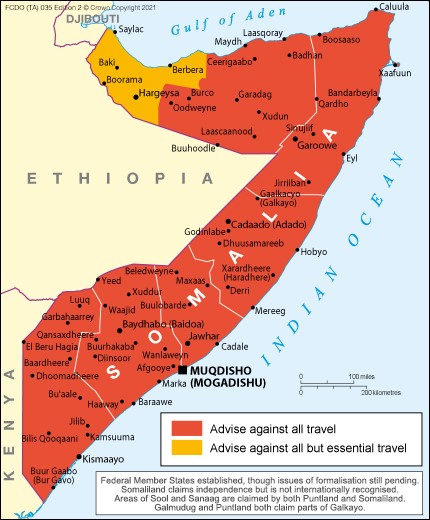
FCDO advises against all but essential travel to the regions of Awdal, Maroodijeh, and Sahil.
France Diplomatie (in French) — Advised against — all travel
Centre et sud du pays
France Diplomatie (in French) — Advised against — all travel
Puntland
France Diplomatie (in French) — Advised against — all travel
Somaliland — La situation sécuritaire dans la province sécessionniste du Somaliland est précaire. […] Les déplacements dans cette zone demeurent formellement déconseillés en-dehors de l’axe Hargeisa-Berbera.
France Diplomatie (in French) — Advised against — all but essential travel
Hargeisa et Berbera — Les villes d’Hargeisa et Berbera ainsi que l’axe reliant les deux villes sont déconseillées sauf raison impérative.
Global Affairs Canada — Open Government Licence – Canada (15.10.2026) · Foreign Office — Open Government Licence v3.0 · France Diplomatie (12.03.2026) · Natural Earth
No located event in this reading.
Last change: Updated information about the political situation ('Safety and security' page).
Updated 20.05.2026
Do not travel to Somalia due to risk of crime, kidnapping, terrorism, unrest, health, landmines, systematic mistreatment of women, systematic mistreatment of gay and lesbian individuals, piracy, abuse of residents in rehabilitation centers, and confiscation of passports by family members .
Do not travel to Somalia for any reason.
The U.S. government has limited ability to offer emergency services to Americans in Somalia due to the safety risks.
U.S. government employees working in Somalia are not allowed to travel outside the Mogadishu International Airport complex, where the U.S. embassy is located, due to security risks. When they do travel within the complex they are accompanied by armed security. Family members cannot join U.S. government employees who work in Somalia.
Aviation safety
The Federal Aviation Administration (FAA) has issued a Notice to Airmen (NOTAM) and a Special Federal Aviation Regulation (SFAR). This is due to risks to civil aviation operating within or nearby Somalia. For more information U.S. citizens should consult the Federal Aviation Administration’s Prohibitions, Restrictions and Notices .
Crime
Violent crime is common throughout Somalia, including homicide and kidnapping. Illegal roadblocks by armed individuals are widespread.
Kidnapping
Terrorists, criminal gangs, and other armed groups frequently kidnap for ransom. Local law enforcement officials are not equipped or trained to handle the threat of kidnapping or to respond to such crimes.
Terrorism
There is a notable risk of terrorist violence, including terrorist attacks and other activity. Visit the U.S. Department of State’s country reports on terrorism to learn more.
Terrorists plot kidnappings, bombings, and other attacks in Somalia. Terrorists attack without warning. They may target:
Attack methods can include car bombs, suicide bombers, individual attackers, and rocket or mortar fire.
Unrest
Protests and demonstrations occur throughout Somalia. They can turn violent quickly.
Health
Medical services in Somalia are extremely limited. They are often…
Somalia: Dengue Outbreak - Feb 2026ReliefWeb ↗read 15.10.20262026-03-16
Somalia: Diphtheria Outbreak - Jul 2025ReliefWeb ↗read 15.10.20262025-08-19
Somalia: Measles Outbreak - 2016-2026ReliefWeb ↗read 15.10.20262016-12-13
Somalia: Cholera Outbreak - 2016-2026ReliefWeb ↗read 15.10.20262016-04-29
Source: ReliefWeb (OCHA), via HDX — CC BY
The level is national. Risk areas are in the state advisories below.
No major event in progress is located in this country at this morning's check.
Over 1 January 2026 → 30 June 2026, UCDP (Uppsala University) recorded 168 geolocated violent incidents in this country, for 1,909 documented deaths.
Most affected areas
Lower Shabelle region 41 · Middle Shabelle region 26 · Bay region 26 · Hiran region 23 · Middle Juba region 19 · Lower Juba region 19
Most recent incidents
Source: UCDP Georeferenced Event Dataset (Uppsala Conflict Data Program), file GEDEvent_v26_01_26_06.csv, CC BY 4.0 licence. We keep only incidents UCDP codes as "Clear" and whose location is precise enough to be placed — about 58% of the dataset. An incident may be revised, moved or withdrawn by UCDP in a later release: these figures describe a closed period, not a live situation.
Reading: On the road, 12 times more deaths than in Switzerland: road crashes are the leading cause of death of healthy travellers (CDC) — seat belt, no night driving, a driver or a taxi from a rank.
World Bank (UNODC for homicides, WHO for roads) — latest published valuedata.worldbank.org ↗read 10.10.2026
What we locate on the map are events in progress that have real coordinates: USGS earthquakes, GDACS disasters, NOAA storms and open NASA EONET events. Hover a dot for details, click to open it in this briefing.
French passport — France Diplomatie
Faithful summary of the official texts below, which prevail.
Some areas of the country are formally advised against.France Diplomatie ↗updated 12.03.2026 · read 15.10.2026
Vigilance areas — France Diplomatie (in French) updated 12.03.2026official map ↗updated 12.03.2026 · read 15.10.2026
- Présentation de la Somalie
-
-
-
-
-
-
Dernière actualisation le 12/03/2026, information toujours valable à la date du jour
La milice islamiste Al Shabaab, liée à Al Qaida, contrôle une part importante du Sud et du centre de la Somalie : la moitié Est des provinces de Gedo et Bas-Djouba, la totalité du Moyen-Djouba, de larges portions des provinces de Bay, Bakool, Bas et Moyen-Shabelle, Hiran et Galgadud. Tout ressortissant français qui tenterait de pénétrer dans les territoires sous contrôle d’Al Shabaab s’exposerait immédiatement à un risque maximum d’enlèvement ou d’assassinat. Dans les zones et villes sous le contrôle du gouvernement, des administrations et milices locales alliées et de l’AUSSOM, des opérations de guérilla et de harcèlement sont lancées quotidiennement par les parties belligérantes. Des actes de terrorisme sont commis quotidiennement par Al Shabaab dans les principales localités du sud et du centre de la Somalie, en particulier à Mogadiscio : assassinats ciblés, engins explosifs improvisés, jets de grenade, attentats à la voiture piégée, commandos suicide. Le risque d’enlèvement, notamment de travailleurs humanitaires et de journalistes, est extrêmement élevé à Mogadiscio comme dans l’ensemble du sud et du centre de la Somalie.
La situation au Puntland reste très volatile, en raison de la présence de miliciens d’Al Shabaab et de l’Etat Islamique, d’affrontements entre milices locales et de criminalité liée à la piraterie et aux trafics d’êtres humains. L’émergence d’une branche locale de Daech dans la région de Bari a considérablement renforcé le niveau de menace terroriste au Puntland, notamment à l’encontre des ressortissants étrangers. Le risque d’enlèvement est très élevé, notamment de la part de gangs liés à la piraterie et à des organisations terroristes.
La situation sécuritaire dans la province…
Les villes d’Hargeisa et Berbera ainsi que l’axe reliant les deux villes sont déconseillées sauf raison impérative. Les déplacements dans cette zone doivent s’accompagner de mesures de sécurité adaptées : escortes, réduction de la durée de séjour en zone orange, hébergements sécurisés. Il convient de rester discret sur les itinéraires empruntés et les lieux de destination de ces déplacements. Il est recommandé de s’assurer que les lieux fréquentés (hôtels, restaurants, bars) sont suffisamment sécurisés : sas à l’entrée rigoureusement fermés, gardes armés, murs d’enceinte, issues de secours facilement accessibles. Avant tout déplacement dans cette zone, il est recommandé de se signaler auprès de l’ambassade de France à Nairobi.
La menace terroriste, visant aussi bien des bâtiments officiels que des lieux publics, notamment ceux fréquentés par les étrangers (hôtels, restaurants), est permanente en Somalie. Les risques d’enlèvements de ressortissants français par des organisations liées à des entités terroristes sont également très importants.
Les actes de piraterie restent d’actualité au large des côtes somaliennes. Les navires de commerce et de plaisance peuvent faire l’objet d’attaques violentes avec prises d’otages. Les navires dont la vitesse est inférieure à 18 nœuds et dont le franc-bord est bas sur l’eau (hauteur de franc-bord inférieure à 8 mètres) représentent des proies de choix pour les pirates. La navigation de plaisance est formellement déconseillée dans la zone. Pour plus de détails, vous pouvez vous référer à la fiche thématique Piraterie maritime . Les armateurs et commandants de bâtiments doivent impérativement déclarer leurs mouvements auprès de l’opération de l’Union européenne EUNAVFOR-Atalanta et auprès du Contrôle naval volontaire français en océan Indien. En cas de présence dans la zone, il est recommandé de se signaler impérativement au MSCIO (The Maritime Security Centre for the Idian Ocean) contrôle naval volontaire mis en place dans le cadre de l’Opération Atalanta/ +33 (0) 298 220 220 ou +33 0 298 220 170) et à la cellule de permanence de l’autorité française sur cette zone maritime (Alindien : +971 265 74 265).
Il est extrêmement difficile et donc formellement déconseillé aux personnes isolées de se déplacer dans la totalité du pays, où aucune garantie de sécurité ne peut être donnée et aucune protection systématique ne peut être assurée en cas de besoin. Les assassinats, enlèvements et tentatives d’enlèvement sont fréquents et peuvent être le fait d’individus prétendument en charge de missions de protection (gardes et escortes privés, partenaires locaux, chauffeurs, fixeurs, représentants des autorités, milices locales, etc.). Les journalistes peuvent être visés par les actes terroristes et les assassinats. Les membres des ONG et des agences des Nations Unies opérant dans le pays se trouvent constamment en situation de risque.
Les intérêts français sont suivis par l’ambassade de France à Nairobi.
Conseils aux missionnaires des ONG et aux journalistes qui, malgré les risques extrêmement élevés et les mises en garde de ce site, décideraient de se rendre dans le pays :
Full text of the Security pagediplomatie.gouv.fr ↗updated 12.03.2026 · read 15.10.2026
Swiss passport — FDFA (Switzerland), in French
Faithful summary of the official texts below, which prevail.
FDFA update note — Ces conseils pour les voyages ont été contrôlés et publiés avec des changements rédactionnels. Toujours valable: Les voyages à destination de la Somalie ainsi que les séjours de tout genre dans ce pays sont déconseillés. (published 24.03.2026)
Les voyages à destination de la Somalie ainsi que les séjours de tout genre dans ce pays sont déconseillés. Les personnes de nationalité suisse qui voyagent en Somalie en dépit des recommandations du DFAE doivent être conscients que la Suisse n’a pratiquement aucun moyen de porter assistance aux personnes suisses ou de leur porter secours en cas d’urgence. Dans tout le pays, les risques sécuritaires sont élevés. Dans de nombreuses régions, des opérations militaires sont menées contre l'organisation terroriste islamiste Al-Shabaab et d'autres groupes armés. Al‑Shabaab contrôle de vastes parties du centre et du sud de la Somalie et perpètre régulièrement des attentats, y compris dans des zones urbaines. De plus, des affrontements armés entre des clans et des milices locales ont lieu régulièrement. Dans tout le pays, il existe un risque considérable lié aux mines, aux engins explosifs improvisés (EEI) et aux munitions non explosées . Le risque d’enlèvement est très élevé et concerne aussi bien les personnes locales que les personnes de nationalité étrangère, en particulier le personnel des organisations internationales et des organisations d’entraide. Le risque d'attentats terroristes est élevé dans tout le pays . Les attentats sont particulièrement fréquents à Mogadiscio ainsi que dans le sud et le centre du pays. Outre les institutions publiques et les forces de sécurité, des cibles civiles sont régulièrement visées, notamment les marchés, les carrefours, les transports publics ainsi que les lieux fréquentés par des personnes étrangères, tels que les hôtels, les restaurants et les environs de l'aéroport international. Ces attaques causent régulièrement de nombreuses victimes et blessés. La rubrique terrorisme et enlèvements attire l'attention sur les risques liés au terrorisme . Terrorisme et enlèvements La criminalité violente est répandue. L’océan Indien et les eaux somaliennes sont régulièrement le théâtre d’ actes de piraterie . Consultez les informations spécifiques: Risques maritimes et piraterie
FDFA travel advice, in French, valid on 15.10.2026eda.admin.ch ↗updated 24.03.2026 · read 15.10.2026
British passport — Foreign Office (UK)
Faithful summary of the official texts below, which prevail.
Regions covered by the Foreign Officegov.uk ↗updated 04.06.2026 · read 15.10.2026

Warnings — Foreign OfficeForeign Office ↗updated 04.06.2026 · read 15.10.2026
Your travel insurance could be invalidated if you travel against advice from the Foreign, Commonwealth & Development Office (FCDO).
FCDO advises against all travel to Somalia, including Somaliland, except for the regions of Awdal, Maroodijeh, and Sahil.
FCDO advises against all but essential travel to the regions of Awdal, Maroodijeh, and Sahil.
This is due to the threat from terrorist groups and continuing violence. If you choose to remain in Somalia, you do so at your own risk. You should have a personal emergency plan that does not rely on the UK government.
Find out more about why FCDO advises against travel . There has recently been an increase in fighting between al-Shabaab and the Somali Government close to the capital Mogadishu. Please see the Terrorism section for more information.
Support from FCDO is severely limited in Somalia, including Somaliland, with no support in person from staff at the British Embassy Mogadishu or the British Office Hargeisa.
If you need urgent help from the UK government, for example if you’ve been arrested or you’re concerned about forced marriage, contact:
If you’re in the UK and are concerned about a British national in Somalia, including Somaliland, call FCDO on 020 7008 5000.
The government of Somalia and the authorities in Somaliland will consider any British national of Somali (including Somaliland) descent to be a dual national. FCDO can offer only limited consular support in these cases.
Regional risks — Foreign OfficeForeign Office ↗updated 04.06.2026 · read 15.10.2026
This section has safety advice for regions of Somalia. It only covers regions where the Foreign, Commonwealth & Development Office ( FCDO ) has specific advice.
You should also read FCDO ’s overall travel advice and safety and security advice .
The Foreign, Commonwealth & Development Office ( FCDO ) advises against all travel to the regions of Toghdeer, Sanaag and Sool in eastern Somaliland. There has been an increase in violent clashes in recent months and the situation remains volatile, so if you do travel, exercise extreme caution.
FCDO advises against all but essential travel to the 3 western regions of Somaliland – Awdal (including Boorama), Maroodijeh (including Hargeisa) and Sahil (including Berbera).
Check with local authorities before travelling to the border, and monitor travel advice for your destination: Ethiopia, Kenya or Djibouti. If you try to cross the border without the correct documents, officials may stop you.
Land borders with countries neighbouring Somalia may close at short notice. You may get a fine or detention for illegally crossing borders. The land border with Kenya is currently closed due to recent cross border terrorist activity. There have been reports that foreign nationals have been prevented from crossing the Djiboutian border into Somalia, though the border remains open.
FCDO advises against all travel to the rest of Somalia. There is ongoing, serious violence between opposing factions in many parts of the country. Civilians of all ages have been killed in fighting, which often involves heavy weapons.
Safety — Foreign OfficeForeign Office ↗updated 04.06.2026 · read 15.10.2026
This guide also has safety advice for regions of Somalia, including Somaliland .
There is a high threat of terrorist attack globally affecting UK interests and British nationals, including from groups and individuals who view the UK and British nationals as targets. Stay aware of your surroundings at all times.
UK Counter Terrorism Policing has information and advice on staying safe and what to do in the event of a terrorist attack. Find out how to reduce your risk from terrorism while abroad .
Terrorists are very likely to try to carry out attacks in Somalia, including Somaliland.
The terrorist group Al Shabaab, and other groups opposed to the Federal Government, continue to carry out frequent attacks, including in the capital Mogadishu. Terrorist groups operating in Somalia have made threats against westerners and those working for western organisations in Somalia, including Somaliland.
Attacks could be indiscriminate and occur at any time, including in places visited by foreigners such as:
Stay aware of your surroundings, keep up to date with local media reports and follow the advice of local authorities. The Somali Security Forces regularly carry out counter-terrorist operations against Al-Shabaab, mainly in central and southern Somalia. There has recently been a significant increase in conflict between al-Shabaab and Somali Security Forces in the Middle Shabelle region, and increased threats against Mogadishu security.
Examples of previous significant attacks include:
While attacks occur less frequently in Somaliland, terrorists are still very likely to try to carry out attacks.
The risk of attacks in Somalia, including Somaliland, may be further heightened during religious holidays.
There is a high threat of kidnapping throughout Somalia, including in regions bordering Kenya and Ethiopia, and in Somaliland. Terrorists and criminal groups, including piracy groups, are involved in kidnapping. A number of western nationals, including British nationals, have been kidnapped in Somalia and some have been killed.
British nationals are seen as legitimate targets, including tourists, humanitarian aid workers, journalists and business travellers. If you are…
American passport — U.S. Department of State
Faithful summary of the official texts below, which prevail.
Somalia - Level 4: Do Not Travel 2026-05-20travel.state.gov ↗updated 20.05.2026 · read 16.10.2026
Do not travel to Somalia due to risk of crime, kidnapping, terrorism, unrest, health, landmines, systematic mistreatment of women, systematic mistreatment of gay and lesbian individuals, piracy, abuse of residents in rehabilitation centers, and confiscation of passports by family members .
Do not travel to Somalia for any reason.
The U.S. government has limited ability to offer emergency services to Americans in Somalia due to the safety risks.
U.S. government employees working in Somalia are not allowed to travel outside the Mogadishu International Airport complex, where the U.S. embassy is located, due to security risks. When they do travel within the complex they are accompanied by armed security. Family members cannot join U.S. government employees who work in Somalia.
Aviation safety
The Federal Aviation Administration (FAA) has issued a Notice to Airmen (NOTAM) and a Special Federal Aviation Regulation (SFAR). This is due to risks to civil aviation operating within or nearby Somalia. For more information U.S. citizens should consult the Federal Aviation Administration’s Prohibitions, Restrictions and Notices .
Crime
Violent crime is common throughout Somalia, including homicide and kidnapping. Illegal roadblocks by armed individuals are widespread.
Kidnapping
Terrorists, criminal gangs, and other armed groups frequently kidnap for ransom. Local law enforcement officials are not equipped or trained to handle the threat of kidnapping or to respond to such crimes.
Terrorism
There is a notable risk of terrorist violence, including terrorist attacks and other activity. Visit the U.S. Department of State’s country reports on terrorism to learn more.
Terrorists plot kidnappings, bombings, and other attacks in Somalia. Terrorists attack without warning. They may target:
Attack methods can include car bombs, suicide bombers, individual attackers, and rocket or mortar fire.
Unrest
Protests and demonstrations occur throughout Somalia. They can turn violent quickly.
Health
Medical services in Somalia are extremely limited. They are often…
Global Affairs Canada — additional reading
Avoid all travel
Avoid all travel to Somalia due to the volatile security situation and the high threat of domestic terrorism.
Open Government Licence – Canada · October 15, 2026 08:42 EDTtravel.gc.ca ↗updated 15.10.2026 · read 15.10.2026
Faithful summary of the official texts below, which prevail.
Global Affairs Canada — written for Canadian travellers, valid for all
You must abide by local laws. Learn about what you should do and how we can help if you are arrested or detained abroad.
Penalties for possession, use or trafficking of illegal drugs and alcohol are severe. Drugs, alcohol and travel
Local authorities may request to see your identification at any time.
To avoid offending local sensitivities:
In 2027, the lunar month of Ramadan is expected to begin on or around February 7. In public, between sunrise and sunset, refrain from:
Photography of sensitive installations is prohibited. This includes:
Always ask permission before photographing official buildings or individuals.
The Hague Convention on the Civil Aspects of International Child Abduction is an international treaty. It can help parents with the return of children who have been removed to or retained in certain countries in violation of custody rights. It does not apply between Canada and Somalia. If your child was wrongfully taken to, or is being held in Somalia by an abducting parent:
If your child was removed from a country other than Canada, consult a lawyer to determine if The Hague Convention applies. Be aware that Canadian consular officials cannot interfere in private legal matters or in another country's judicial affairs.
The currency is the Somali shilling (SOS), except in Somaliland, which uses the Somaliland shilling. U.S. dollars are widely accepted. Credit cards are generally not accepted in Somalia. ATMs are available in major cities and are usually located in hotels, malls and other secure areas.
Open Government Licence – Canada · October 15, 2026 08:42 EDTtravel.gc.ca ↗updated 15.10.2026 · read 15.10.2026
Foreign Office — laws and cultural differences
Always carry your passport and visa with you as ID. Somali nationals should consult local authorities in Somalia on personal ID requirements.
Ramadan is a holy month for Muslims. The dates vary by year and country. During this time, do not:
Get more advice when you arrive from your tour guide, hotel or business contacts. You should also:
Somalia has adopted Sharia law but is yet to implement it throughout the country. Al-Shabaab and other insurgent groups often have an extreme view on how to apply Sharia law. It’s illegal for Somali Muslims to convert to another religion or promote any religion other than Islam.
The drinking and sale of alcohol is banned in Somalia.
Drug offences, including drug use, possession and trafficking, are treated seriously in Somalia and are punishable by law. Possible punishments include a lengthy prison sentence without bail.
Same-sex sexual activity is illegal in Somalia. LGBT+ partners should not show affection in public. Read more advice for LGBT+ travellers.
Credit cards are not widely accepted in Somalia and it is not possible to get currency advances using a credit card. You should take cash with you into the country. The US dollar is the main currency for exchanging in Somalia. In Hargeisa you can withdraw US dollars from ATMs using international credit and debit cards.
Open Government Licence v3.0gov.uk ↗updated 04.06.2026 · read 15.10.2026
What it changes for you: Air acceptable at this hour: nothing special to plan. High UV at midday: sun protection.
Reading 08:00 (Africa/Mogadishu)Open-Meteo ↗updated 16.10.2026 · read 16.10.2026
Air quality and UV: Open-Meteo.com (CC BY 4.0), data rounded and formatted by Maximum. Contains modified Copernicus Atmosphere Monitoring Service information 2026. Neither the European Commission nor ECMWF is responsible for any use that may be made of the Copernicus information or data it contains.
No value published by the World Bank in the last eight years for Somalia: physicians per 1,000 people.
Reading: Health spending of 22 USD per person (Switzerland: 11,784) goes with private hospitals that bill foreigners in hard currency and ask for a guarantee before admission: the direct payment guarantee is what avoids the deposit.
World Bank — latest published value, year per indicatordata.worldbank.org ↗read 10.10.2026
French passport — France Diplomatie
- Présentation de la Somalie
-
-
-
-
-
-
Entry and stay pagediplomatie.gouv.fr ↗updated 12.03.2026 · read 15.10.2026
Swiss passport — FDFA (Switzerland)
The FDFA does not publish entry requirements: they are set out by the destination's embassy or consulate in Switzerland — check them before booking, passport in hand. As a guide, the French and British requirements below describe the same rules as seen by two other governments.eda.admin.ch ↗updated 24.03.2026 · read 15.10.2026
British passport — Foreign Office (UK)
Faithful summary of the official texts below, which prevail.
Entry requirements — rules for a British passportForeign Office ↗updated 04.06.2026 · read 15.10.2026
This information is for people travelling on a full ‘British citizen’ passport from the UK, who choose to travel despite FCDO advice. It is based on the UK government’s understanding of Somalia’s current rules for the most common types of travel.
The authorities in Somalia set and enforce entry rules. If you’re not sure how these requirements apply to you, contact the Somalian Embassy in the UK .
To enter Somalia, including Somaliland, your passport must have an ‘expiry date’ at least 6 months after the date you arrive.
Check with your travel provider that your passport and other travel documents meet requirements. Renew your passport if you need to.
You will be denied entry if you do not have a valid travel document or try to use a passport that has been reported lost or stolen.
When returning to the UK, British citizens must carry a valid British passport or certificate of entitlement . See Dual citizenship .
You must have a visa to enter Somalia, including Somaliland.
There are reports of a data breach affecting Somalia’s eVisa system
Leaked data from the breach includes visa applicants’ names, photos, dates and places of birth, email addresses, marital status, and home addresses. This data breach is ongoing and could expose any personal data you enter into the system,
An eVisa is required before travelling to Somalia. Consider the risks before applying.
US Embassy in Somalia have also issued an alert to US citizens. See - Alert: Federal Republic of Somalia (FGS) Electronic Visa (E-Visa) Data Breach - U.S. Embassy in Somalia .
If you are travelling to Mogadishu International Airport, you will need to apply for an eVisa prior to your arrival.
If you are travelling to Hargeisa International Airport, you may still be asked to present this eVisa in order to board your flight but it will not be considered valid for entry when you arrive in Hargeisa.
You will need to purchase a single-entry visa upon arrival at Hargeisa International Airport, which will be valid for one month.
It is not clear if you’ll be given a visa on arrival at other points of entry. Get confirmation from local authorities or your sponsoring organisation.
You may also need to provide a letter of invitation when you arrive, outlining the reason for your visit. You can usually get this from your place of work. Without this letter, you may not be allowed to enter.
For details about medical entry requirements and recommended vaccinations, see TravelHealthPro’s Somalia guide .
There are strict rules about goods you can take into or out of Somalia, including Somaliland. You must declare anything that may be prohibited or subject to tax or duty.
Khat is a legal drug in Somalia, but it is an offence to take it out of the country. Officials regularly search bags at Hargeisa and Mogadishu airports, and anyone found to be in possession of khat is likely to face criminal prosecution.
In Somaliland you must declare cash or travellers cheques if the value is 10,000…
American passport — U.S. Department of State
The State Department publishes the requirements ("Entry, Exit and Visa Requirements") on its country page, which our servers cannot read. Read it before you go; as a guide, the French and British requirements below describe the same rules as seen by two other governments.travel.state.gov ↗updated 20.05.2026 · read 16.10.2026
For each risk, the official texts themselves: what is happening, then, where they say so, what to do.
What the texts say · Terrorists are very likely to try to carry out attacks in Somalia, including Somaliland. There is a high threat of kidnapping throughout Somalia, including in regions bordering Kenya and Ethiopia, and in Somaliland.
What the texts say · Travelling by road in Somalia is dangerous and you should get advice from a security firm or a sponsoring organisation. Government forces, militias and other armed groups operate checkpoints on roads across Somalia.
What the texts say · The rainy season usually extends from April to June and then again from October to December. Seasonal flooding, including flash flooding, can hamper overland travel and reduce the provision of essential services, even in larger cities.
What the texts say · The drinking and sale of alcohol is banned in Somalia. Same-sex sexual activity is illegal in Somalia.
What the texts say · Somalia may see an increased risk of politically motivated unrest in the period around 15 May 2026. Demonstrations can occur with little warning and turn violent at any time.
Sentences copied word for word from the official texts cited, chosen for the destination; the level is our reading. The full texts, at each source:Foreign Office ↗updated 04.06.2026 · read 15.10.2026 (updated 04.06.2026 · read 04.10.2026)Global Affairs Canada ↗updated 15.10.2026 · read 15.10.2026 (updated 15.10.2026 · read 04.10.2026)
Reading: On the road, 12 times more deaths than in Switzerland: road crashes are the leading cause of death of healthy travellers (CDC) — seat belt, no night driving, a driver or a taxi from a rank.
World Bank (UNODC for homicides, WHO for roads) — latest published valuedata.worldbank.org ↗read 10.10.2026
Time zone: IANA and timezone-boundary-builder (ODbL) · RESTCountries · EmergencyNumberAPI · Wikidata · European Central Bank
Places: © OpenStreetMap contributors (ODbL), Photon search by komoot.
Maximum policyholder: before paying anything, call the 24/7 number. If you are admitted for more than 24 h, Maximum sends its direct payment guarantee to the hospital (art. 2.12).
+41 22 ••• •• •• — Full number in your client areaThe hospital list has not been read from OpenStreetMap for this page yet: the medical-network map loads it when opened. Maximum's assistance directs you to the right facility, 24/7. The medical-network map ↗
CDC Travelers' Health recommendations, most important first. They depend on your age, vaccines and itinerary: confirm them with a doctor or a travel clinic 4 to 6 weeks before departure. Details, disease by disease ↗cdc.gov ↗read 10.10.2026
The health system — Health spending of 22 USD per person (Switzerland: 11,784) goes with private hospitals that bill foreigners in hard currency and ask for a guarantee before admission: the direct payment guarantee is what avoids the deposit.
Back home — a fever in the following weeks should be told to a doctor, naming the country.
Forecast: MET Norway (Norwegian Meteorological Institute, CC BY 4.0), grouped by day and formatted by Maximum.
Swiss passport — Swiss embassy and consulates
Représentations suisses à l’étranger: En cas de situation d’urgence à l’étranger, vous pouvez vous adresser à la représentation suisse la plus proche ou à la Helpline DFAE. Ambassade de Suisse au Kenya Helpline DFAE
OpenStreetMap · DFAE
British passport — British embassy and consulates
مقديشو
phone not published
https://www.gov.uk/world/organisations/bri ↗updated 04.06.2026 · read 15.10.2026
OpenStreetMap
OpenStreetMap
Getting help — Foreign OfficeForeign Office ↗updated 04.06.2026 · read 15.10.2026
The Foreign, Commonwealth & Development Office ( FCDO ) cannot provide tailored advice for individual trips. Read this travel advice and carry out your own research before deciding whether to travel.
Ambulance: 999
Fire: 555
Police: 888
These emergency numbers can be unreliable. The Somali Red Crescent operates a free number for all emergency services on 446.
Contact your travel provider and your insurer if you are involved in a serious incident or emergency abroad. They will tell you if they can help and what you need to do.
See how to get help from the UK government abroad including in an emergency.
You can call FCDO in London if you need urgent help because something has happened to a friend or relative abroad.
Telephone: 020 7008 5000 (24 hours)
Find out about call charges
For emergencies. If pronunciation fails, show the screen — or the printed page.
| Help! | النجدة!an-najda! |
| Call an ambulance! | اتصلوا بالإسعاف!ittasilu bil-is'af! |
| I need a doctor. | أحتاج إلى طبيب.ahtaju ila tabib. |
| Where is the nearest hospital? | أين أقرب مستشفى؟ayna aqrab mustashfa? |
| Call the police! | اتصلوا بالشرطة!ittasilu bish-shurta! |
| I am allergic to penicillin. | عندي حساسية من البنسلين.'indi hassasiyya min al-binisilin. |
| I have international medical insurance. | لدي تأمين طبي دولي.ladayya ta'min tibbi dawli. |
| I want to contact my embassy. | أريد الاتصال بسفارتي.urid al-ittisal bi-safarati. |
| Please take me to this address. | خذني إلى هذا العنوان من فضلك.khudhni ila hadha al-'unwan min fadlak. |
| Do you speak English? | هل تتكلم الإنجليزية؟hal tatakallam al-injiliziya? |
Translations by Maximum Insurance, original script and transliteration.
Actions to take before each professional trip abroad.
Live alerts and level changes, each with its official source. Continuously updated.
Natural disasters and climate section – added information on El Niño
October 15, 2026 08:42 EDTtravel.gc.ca ↗updated 15.10.2026 · read 15.10.2026No level change recorded for this country since the log opened. The live alerts above are updated continuously.
Level 4/4 — Do Not Travel, U.S. Department of State, retrieved on 16 October 2026.
Sourcestravel.state.gov · updated 20.05 · read 16.10France Diplomatie · updated 12.03 · read 15.10DFAE · updated 24.03 · read 15.10207-country comparison
An area advised against does not rule out the country.
SourcesFrance Diplomatie · updated 12.03 · read 15.10Foreign Office · updated 04.06 · read 15.10State Department · updated 20.05 · read 16.10
The rules depend on the passport, not on the destination alone.
SourcesFrance Diplomatie · updated 12.03 · read 15.10Foreign Office · updated 04.06 · read 15.10State Department · updated 20.05 · read 16.10
For a Schengen visa, yes: at least €30,000 of travel medical insurance (Regulation (EC) No 810/2009, art. 15).
SourcesRegulation (EC) 810/2009, art. 15General conditions, policy 20 00 479
VIP Pack — €990 for twelve months, unlimited trips.
SourcesGeneral conditions, policy 20 00 479OpenStreetMap · read 12.10
From 45 000 € to 140 000 € depending on severity and distance (Diversified Quotes, 2026).
SourcesDiversified Quotes, 2026General conditions, policy 20 00 479
Six steps, in this order.
SourcesSpecial conditions 01.26General conditions, policy 20 00 479
Local emergency services: police 888 · ambulance 555 · fire 999
SourcesEmergencyNumberAPI · Wikidata · read 08.10OpenStreetMap · read 12.10
At today's level 4/4, card by card:
SourcesAmex Platinum France T&Cs, 01.2025 — general exclusion n° 11BNP Paribas Visa Infinite notice (policy PT7), 04.2025 — comFortuneo World Elite Mastercard notice, 01.2026 — art. 5.5 '
A health plan reimburses at home; here, the hospital asks for a payment guarantee before admission.
SourcesGeneral conditions, policy 20 00 479
The page reads hospitals, pharmacies and doctors from OpenStreetMap, around the point you choose.
The sourced detail is under Medical network › Health: vaccines, diseases present, altitude, outbreaks.
SourcesCDC Travelers' Health · read 10.10France Diplomatie · updated 12.03 · read 15.10OMS · read 15.10Foreign Office · updated 04.06 · read 15.10
The compared figures are under Safety & risks › Health system.
SourcesWorld Bank · read 10.10General conditions, policy 20 00 479
Comparable figures (homicides, roads, incidents) are under Safety & risks › Incidents.
The nearest representations, by passport (OpenStreetMap):
SourcesOpenStreetMap · read 12.10DFAE · updated 24.03 · read 15.10
At least one official reading covers the whole country; no region is singled out.
SourcesGlobal Affairs Canada · updated 15.10 · read 15.10Foreign Office · updated 04.06 · read 15.10France Diplomatie · updated 12.03 · read 15.10
Local laws apply to every traveller; here is what the official texts say.
SourcesGlobal Affairs Canada · updated 15.10 · read 15.10Foreign Office · updated 04.06 · read 15.10
Every foreign ministry runs a 24/7 emergency line for its nationals.
Sourcesdiplomatie.gouv.fr · updated 12.03 · read 15.10eda.admin.ch · updated 24.03 · read 15.10
Emergency phrases, transliterated; the original script, to show if pronunciation fails, is under Useful phrases.
SourcesMaximum Insurance
Keep the entry stamp, the invoices, the prescriptions and the medical report.
SourcesGeneral conditions, policy 20 00 479
Cancellation or change up to EUR 20,000, special risk EUR 5,000 per person, crisis management and security, optional Kidnap & Ransom.
SourcesGeneral conditions, policy 20 00 479
A question not answered here? Ask Maximum below, or call the support number: every question gets a clear, actionable answer.
In a life-threatening emergency, call local emergency services first, then Maximum: +41 22 ••• •• •• — 24/7 support number, an adviser stays with you to the end.
The 207 country pages — hospitals, pharmacies, police, embassies, emergency numbers, official advice from four governments, health, safety in figures, events in progress — read around the city you name. Your policy — benefits, the six steps, claims, articles. The site — prices, certificate, subscription. Nothing else: what it does not know, it says so and hands you to an adviser.
The published advisory level is national, but risk is not: business hubs (Mogadiscio) do not share the profile of border areas. The medical network shown on this page is computed around Mogadishu — real hospitals, evacuation airport and live alerts. Before a specific trip, always cross-check your country of residence's advisory: that is what your policy cites.
Same advisory level: Afghanistan · Myanmar · Belarus · Burkina Faso · DR Congo · North Korea
The displayed level comes from the State Department, checked every morning. Before departure, always cross-check your country of residence's advisory: that is what your policy cites.
The level shown is the official U.S. Department of State level, checked daily. Maximum Insurance is an insurance distributor — general information, not personal advice.
The destination is already Mogadishu. A few choices, then the reading of your cover, here.
Destination · Mogadishu
Travel Insurtech. 24/7 worldwide.
Swiss insurer · Worldwide medical network