Maximum Alerts / North Korea
North KoreaLevel 4/4
Level published by the State Department on 28.04.2025 · read 13 October 2026 · source checked daily
North Korea — official level as of 13 October 2026: Level 4/4 ("Do Not Travel"), from the U.S. Department of State. Maximum Insurance covers this country: hospital settled directly, unlimited repatriation, USD 1.5M, certificate on payment.
How we read these four advisories
Every country has its own scale, so we ask them all the same question: is the whole country advised against?
An advisory covering only areas of the country does not raise the answer: it stays “No”, and the area is shown in the relevant column.
The level shown on this page — and across this site — is the one published by the U.S. State Department, from 1 (normal precautions) to 4 (do not travel). France and the United Kingdom publish their own advisories, with their own rules: they add to that level, they do not replace it.
In a life-threatening emergency, call local emergency services first, then Maximum: +41 22 ••• •• •• — 24/7 support number, an adviser stays with you to the end.
What Maximum knows
The 207 country pages — hospitals, pharmacies, police, embassies, emergency numbers, official advice from four governments, health, safety in figures, events in progress — read around the city you name. Your policy — benefits, the six steps, claims, articles. The site — prices, certificate, subscription. Nothing else: what it does not know, it says so and hands you to an adviser.
What I say on the phone
- I am insured with Maximum, here is my policy number. Where should I go? Send me to a hospital in the Maximum network.
- Send the payment guarantee to the hospital: I do not want to pay anything up front.
- For non-urgent transport or repatriation, tell me what you authorise and arrange. In a life-threatening emergency, I call local emergency services immediately.
What to do, in this order
1Contact assistance without delay›
In immediate danger, call local emergency services first. Then contact assistance without delay; before engaging a service, seek approval under your policy. Cover is confirmed by the insurer.
2Ask where to get care›
Ask assistance where to get care and whether direct cover can be arranged. It confirms the facility and seeks the insurer's approval under your policy. In immediate danger, call local emergency services first.
3See a doctor the same day›
Even for a pain you meant to shrug off. Without a medical certificate written on the spot, the same day, the insurer cannot cover the event — a certificate written after you return does not count.
4Admitted? Have the hospital front desk call Maximum›
The hospital desk sends the request to assistance. Direct payment depends on the insurer's approval and the policy; the call alone does not guarantee it. Have the response confirmed before relying on no up-front payment.
5For non-urgent transport, seek assistance approval›
In a life-threatening emergency, call local emergency services immediately. For an arranged transfer or repatriation, contact assistance: the insurer's medical team decides on measures under the policy. A medical flight booked without approval may not be reimbursed.
6Once home, report the claim within 30 days›
Even if everything went well on the ground. Send your invoices and the medical report within 30 days; after that, compensation may be reduced or refused.
Places read from OpenStreetMap, within a circle of about 12 km: phone, email, address, website and hours when the source publishes them. No customer reviews, that source has none. Straight-line distances.
What is your current insurance?
Notices vary by bank and vintage — yours prevails. On the right: the Maximum contract (public documents).
Where to go, where not to
At least one official reading covers the whole country; no region is singled out.
- Avoid all travel to North Korea due to risks of arbitrary detention and uncertain security from nuclear weapons development and repressive regime. Global Affairs Canada
Faithful summary of the official texts below, which prevail.
Global Affairs Canada — advises against all travel to the whole country.
Foreign Office — advises against all but essential travel to the whole country.
an official reading covers the whole country; every trip calls for a written management decision, justified by a pressing reason, with reinforced conditions.
Global Affairs Canada — Open Government Licence – Canada (24.09.2026) · Foreign Office — Open Government Licence v3.0 · France Diplomatie (05.03.2026) · Natural Earth
Last change: New information about dual nationals returning to the UK (‘Entry requirements’ page).
North Korea - Level 4: Do Not TravelState Department ↗updated 28.04.2025 · read 13.10.2026
Updated 28.04.2025
Do not travel to North Korea due to wrongful detention and other risks .
Do not travel to North Korea due to the continuing serious risk of arrest, long-term detention, and the threat of wrongful detention of U.S. citizens.
Do not travel to the Democratic People’s Republic of Korea for any reason.
- U.S. passports cannot be used to travel to, in, or through the Democratic People's Republic of Korea (DPRK or North Korea) unless they are specially validated for such travel by the Secretary of State.
- Special validations are granted only in very limited circumstances. Review the information on how to apply for the special validation .
Because the U.S. government does not have diplomatic relations with North Korea, it cannot provide direct help to U.S. citizens in North Korea in emergencies.
- Sweden serves as the U.S. protecting power in North Korea through its Embassy in Pyongyang and provides limited consular services to U.S. citizens. Additionally, the North Korean government has often delayed or denied Swedish officials access to U.S. citizens who are detained.
- The Federal Aviation Administration (FAA) has issued a Notice to Airmen (NOTAM) or a Special Federal Aviation Regulation (SFAR). This is due to the risks to civil aviation operating within or in the vicinity of North Korea.
- For more information U.S. citizens should consult the Federal Aviation Administration’s Prohibitions, Restrictions and Notices .
Nearest river dischargeOpen-Meteo ↗updated 14.10.2026 · read 13.10.2026
10-13 62.7 · 10-14 54.2 · 10-15 54.3 · 10-16 132.3 · 10-17 348.9 · 10-18 421.7 · 10-19 541.0 m³/s
Simulated discharge: Open-Meteo.com (CC BY 4.0), data rounded and formatted by Maximum. Contains modified Copernicus Emergency Management Service information 2026. For information only: this is not a flood warning; only national or regional authorities issue those.
What the national level does not tell you
The level is national. Risk areas are in the state advisories below.
- U.S. State Department — the full advisory details the regions concerned and the reasons (crime, terrorism, kidnapping, civil unrest) (read the advisory)
- Foreign, Commonwealth & Development Office (United Kingdom) — the United Kingdom advises against all but essential travel to the whole country · reviewed 10 December 2025
Last announced change : « New information about dual nationals returning to the UK (‘Entry requirements’ page). » (read the advisory) - France Diplomatie — the French advisory covers the WHOLE country: « L’intégralité du territoire nord-coréen est formellement déconseillée (rouge sur la carte des Conseils aux voyageurs). » (read the advisory)
1 event located on the map
- North Korea — Do Not Travel — level 4/4, U.S. State Department (source)
Reading: On the road, 11 times more deaths than in Switzerland: road crashes are the leading cause of death of healthy travellers (CDC) — seat belt, no night driving, a driver or a taxi from a rank.
World Bank (UNODC for homicides, WHO for roads) — latest published valuedata.worldbank.org ↗read 10.10.2026
What we locate on the map are events in progress that have real coordinates: USGS earthquakes, GDACS disasters, NOAA storms and open NASA EONET events. Hover a dot for details, click to open it in this briefing.
French passport — France Diplomatie
- France formally advises against all travel to North Korea due to the repressive regime and unpredictable climate. France Diplomatie
- French nationals facing difficulties in North Korea can seek assistance from the French Embassy in China, subject to North Korean authorities' constraints. France Diplomatie
- Travelers must avoid criticizing the political system or its leader, as even minor gestures can be deemed disrespectful and lead to severe penalties. France Diplomatie
- Foreigners may face arrest for unauthorized political or religious activities, including possessing religious texts, or for shopping or exchanging currency in unofficial locations. France Diplomatie
- It is strongly advised to avoid using Air Koryo due to recurring incidents and violations of international safety standards. France Diplomatie
- Evacuation possibilities in a crisis are limited, with poor road conditions and insufficient air links posing significant challenges. France Diplomatie
Faithful summary of the official texts below, which prevail.
L’intégralité du territoire nord-coréen est formellement déconseillée (rouge sur la carte des Conseils aux voyageurs).France Diplomatie ↗updated 15.09.2026 · read 13.10.2026
Corée du Nord
- Présentation de la Corée du Nord
-
-
-
-
-
-
-
-
-
Zones de vigilance
Dernière actualisation le 05/03/2026, information toujours valable à la date du jour
L’intégralité du territoire nord-coréen est formellement déconseillée (rouge sur la carte des Conseils aux voyageurs).
La France n’a pas de relations diplomatiques avec la République populaire démocratique de Corée (RPDC) . En cas de difficulté, l’ambassade de France en Chine est compétente pour porter assistance aux Français se trouvant en Corée du Nord, sous réserve des contraintes pouvant être imposées par les autorités nord-coréennes.
Le caractère répressif du régime nord-coréen, le non-respect des droits et des libertés des individus, la poursuite de tirs balistiques et d’essais nucléaires et l’attitude de provocation vis-à-vis de la communauté internationale créent un climat d’incertitude et d’imprévisibilité.
Les déplacements en Corée du Nord sont formellement déconseillés jusqu’à nouvel ordre.
Recommandations et interdictions
Les voyageurs doivent veiller à ne pas exprimer de critiques et d’observations relatives au système politique et son dirigeant. Des gestes en apparence bénins peuvent être considérés par les autorités nord-coréennes comme un manque de respect et un crime grave passible de lourdes peines.
Les motifs de détention ne sont pas systématiquement notifiés et les procédures prévues par la loi ne sont généralement pas respectées. En cas d’arrestation, aucune assistance juridique n’est prévue pour les ressortissants étrangers ; les autorités nord-coréennes se réservent le droit de refuser les visites consulaires.
Toute activité non autorisée de nature politique ou religieuse, y compris la possession de bibles ou autres documents à caractère religieux, risque d’entraîner une interpellation.
Les étrangers peuvent être verbalisés, voire arrêtés, s’ils sont surpris en train d’effectuer des achats dans des magasins non autorisés aux touristes ou des opérations de change de devises dans des bureaux non-officiels. Les autorités nord-coréennes cherchent à décourager tout contact entre les Coréens du Nord et les étrangers.
Voyage en avion à destination de la Corée du Nord
Pyongyang est desservie depuis Pékin par Air China et Air Koryo, compagnie aérienne nationale de Corée du Nord. Air Koryo exploite également des lignes régulières vers Shenyang et Vladivostok et des vols occasionnels vers d’autres villes de Corée du Nord. Tous les aéronefs exploités par Air Koryo, à l’exception de deux Tupolev 204, se sont vu refuser l’autorisation d’exploiter des services vers l’UE pour violation des normes de sécurité internationales. Des incidents récurrents affectent les vols de cette compagnie. Les dispositifs de prise en charge et d’accompagnement des voyageurs ne sont pas suffisants . Il est conseillé aux voyageurs étrangers d’éviter d’utiliser Air Koryo tant que les conditions de sécurité essentielles ne seront pas respectées.
Situation d’urgence
En cas de crise ouverte, les possibilités d’évacuation sont limitées. Les liaisons aériennes sont peu nombreuses et insatisfaisantes en termes de sécurité. Les routes menant aux frontières chinoises ou russes sont en mauvais état et susceptibles de devenir rapidement congestionnées. Des autorisations de circulation sont nécessaires.
Risques naturels
La mousson s’étend de la fin juin à août. Les pluies diluviennes peuvent causer des inondations et des glissements de terrain. Les typhons peuvent se produire en août et en septembre. Ces tempêtes peuvent être très meurtrières et endommager considérablement les infrastructures. Les voyageurs doivent se tenir informés des prévisions météorologiques régionales avant un déplacement en Corée du Nord et sont invités à consulter la rubrique Risques naturels.
Produits stupéfiants
La possession, la consommation et le trafic de produits stupéfiants entraînent des sanctions sévères. Les personnes reconnues coupables peuvent être condamnées à des amendes élevées ainsi qu’à des peines d’emprisonnement.
Full text of the Security pagediplomatie.gouv.fr ↗updated 15.09.2026 · read 13.10.2026
Swiss passport — FDFA (Switzerland), in French
- Tensions persist in the Korean peninsula due to missile tests and military drills, potentially affecting security.
- Foreign nationals risk arrest, interrogation, and detention without apparent reason, possibly leading to long sentences.
- Travel to North Korea is restricted to state-organized tours, requiring accompaniment by an official guide outside special zones.
- Foreigners cannot drive unless they reside in North Korea and have no access to the internet or national mobile networks.
- Flooding and typhoons are common in summer, potentially disrupting transportation and causing damage.
- Stay informed about the evolving situation and follow instructions from local authorities and guides.
Faithful summary of the official texts below, which prevail.
FDFA update note — Ces conseils pour les voyages ont été publiés avec des modifications marginales. (published 01.05.2026)
General assessment
Les tensions sont vives dans la péninsule coréenne. Certains incidents, comme des essais de missiles et des manœuvres militaires, peuvent influer à court terme sur la situation sécuritaire. En raison de la situation économique difficile, des difficultés d'approvisionnement en produits de première nécessité (médicaments et matériel médical compris) ne peuvent être exclues. La Corée du Nord ne peut être visitée que dans le cadre d'un tour organisé par l'agence de voyage de l'Etat. En dehors des zones spéciales, les personnes en voyage sont toujours accompagnées d’une ou un guide officiel et ne peuvent pas se déplacer seules. Pour les personnes étrangères, il existe un risque d’être arrêtées, interrogées et détenues sans motif apparent ; de longues peines de détention peuvent être prononcées. Dans ce pays comme ailleurs, le risque d’attentats terroristes ne peut être exclu. Prenez également en considération la rubrique Terrorisme et enlèvements Avant et pendant le voyage, informez-vous sur l'évolution de la situation. Suivez les instructions des autorités locales, du ou de la guide et évitez à tout prix les discussions à caractère politique.
Natural hazards
En été, les inondations sont fréquentes. Les typhons peuvent non seulement causer des ravages à la campagne, mais aussi déclencher des raz-de-marée. La circulation peut s’en trouver temporairement perturbée. Les tsunamis provoqués par des éruptions volcaniques ou des tremblements de terre dans la région du Pacifique peuvent également atteindre la Corée du Nord. Des tremblements de terre de moindre intensité se produisent parfois. Consultez les prévisions météorologiques et suivez les avertissements et les instructions des autorités locales. Organisation météorologique mondiale (OMM)
FDFA travel advice, in French, valid on 13.10.2026eda.admin.ch ↗updated 01.05.2026 · read 13.10.2026
British passport — Foreign Office (UK)
- The Foreign, Commonwealth & Development Office advises British nationals against all but essential travel to North Korea due to high tensions and unpredictable security situations.
- North Korea’s borders remain largely closed since 2020 COVID-19 restrictions, with limited tourism and some embassy operations resuming, but not all passenger routes.
- British nationals detained in North Korea may be denied access to support from their government, with FCDO support severely limited, especially without an embassy presence.
- While terrorism is not a recent concern, attacks cannot be ruled out; however, crime against foreign nationals is rare, but fire safety awareness may be low.
- British travellers must show respect for the North Korean political system and leadership, as trivial offences can incur severe penalties, including for not treating leader images with care.
- Always ask tour guides for permission before taking photographs and avoid pointing cameras at officials or guarded buildings.
Faithful summary of the official texts below, which prevail.
Regions covered by the Foreign Officegov.uk ↗updated 10.12.2025 · read 13.10.2026
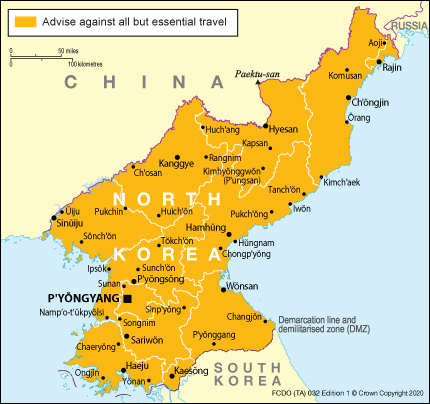
Warnings — Foreign OfficeForeign Office ↗updated 10.12.2025 · read 13.10.2026
Warnings — Foreign Office
Your travel insurance could be invalidated if you travel against advice from the Foreign, Commonwealth & Development Office (FCDO).
## FCDO advises against all but essential travel to North Korea
The level of tension on the Korean Peninsula remains high. While daily life in the capital city, Pyongyang, may appear calm, the security situation in North Korea can change quickly with no advance warning about possible actions by the authorities. This poses significant risks to British visitors and residents. See Safety and security .
Border restrictions
North Korea’s borders have been closed to general entry since the government imposed COVID-19 border restrictions in 2020.
The government has recently started to relax the COVID restrictions. As a result, some embassies have resumed normal operations and some limited tourism has restarted.
However, the North Korean government has not resumed all passenger routes into and out of North Korea. Many embassies – including the British Embassy in Pyongyang – remain closed.
Support from the UK government
The North Korean authorities have previously detained foreign nationals for allegedly violating local laws and have denied them access to support from their governments.
The few British people who visit North Korea are usually part of an organised tour. If you decide to visit North Korea against FCDO advice, follow the guidance of your tour operator and the local authorities. Failure to do so could put your personal safety at risk.
Support from FCDO is severely limited, especially while there is no British Embassy presence. Remote support is available if you’re able to contact us online or by phone. However, the routine lack of access to internet and mobile networks makes it almost impossible to communicate outside of North Korea. See Getting help .
Safety — Foreign OfficeForeign Office ↗updated 10.12.2025 · read 13.10.2026
Terrorism
There is a high threat of terrorist attack globally affecting UK interests and British nationals, including from groups and individuals who view the UK and British nationals as targets. Stay aware of your surroundings at all times.
UK Counter Terrorism Policing has information and advice on staying safe and what to do in the event of a terrorist attack. Find out how to reduce your risk from terrorism while abroad .
Terrorism in North Korea
Although there’s no recent history of terrorism in North Korea, attacks cannot be ruled out.
Political situation
The level of tension on the Korean peninsula remains high. Political negotiations between North Korea and the United States in 2018 to 2019 broke down and have not resumed. North and South Korea agreed a set of security guidelines in 2019 to reduce the risk of accidental cross-border conflict, but both sides have now withdrawn from this agreement.
In late 2023, the North Korean government changed its reunification policy, leading to increased tensions with South Korea. North Korea continues to develop nuclear weapons and ballistic missiles, although these are banned by UN Security Council resolutions. North Korea’s material and political support for Russia’s illegal invasion of Ukraine has further strained relations with much of the international community.
Inter-Korean tensions usually rise around the time of South Korean-US military exercises, often held in the spring and autumn.
Nuclear and missile tests
North Korea carried out 6 underground nuclear tests between 2006 and 2017 and has stated that it reserves the right to carry out further tests.
North Korea also regularly conducts ballistic missile test launches, sometimes without giving the required notice to international aviation authorities, and against UN Security Council resolutions.
Crime
Crime against foreign nationals in North Korea is rare. Take sensible precautions to protect your belongings.
Fire safety
Levels of fire safety awareness may be low. Check hotel fire procedures with the hotel reception or consult your tour operator.
Laws and cultural differences
Take care with your words and actions during your stay. Insults or jokes about the North Korean political system and its leadership are taken very seriously. Offences that would be considered trivial in other countries can incur very severe penalties in North Korea. This includes the promotion of other religions or beliefs.
Arrests and trials
Foreign nationals may face arrest for not paying sufficient respect, including not treating images of the current and former North Korean leaders with care.
The North Korean authorities have previously arrested visitors with or without specified charges, including 4 US citizens and one Canadian citizen. Some have faced public trials and imprisonment.
In 2016 a US national was convicted of ‘crimes against the state’ and sentenced to 15 years of hard labour. The court had found him guilty of attempting to steal a political banner from the staff quarters of a tourist hotel. He fell into a coma while in detention and was released in 2017, but died soon after his return to the US.
If arrested, you are not guaranteed access to phone calls with family and friends or the British Embassy, or to independent legal advice or interpretation services.
Taking photos or videos
Ask permission from your tour guide before taking any photographs. Avoid pointing cameras at North Korean officials or guarded buildings.
LGBT+ travellers
Although there’s no specific legislation outlawing…
American passport — U.S. Department of State
- U.S. citizens are advised not to travel to North Korea due to the serious risk of arrest and wrongful detention. State Department
- U.S. passports are invalid for travel to North Korea unless specially validated by the Secretary of State. State Department
- Special validations for U.S. passports are granted only in very limited circumstances. State Department
- The U.S. government cannot provide direct emergency assistance to citizens in North Korea due to a lack of diplomatic relations. State Department
- Sweden offers limited consular services through its embassy in Pyongyang, but access to detained U.S. citizens is often delayed or denied. State Department
- The Federal Aviation Administration has issued a Notice to Airmen due to risks to civil aviation operating near North Korea. State Department
Faithful summary of the official texts below, which prevail.
North Korea - Level 4: Do Not Travel 2025-04-28travel.state.gov ↗updated 28.04.2025 · read 13.10.2026
Advisory summary
Do not travel to North Korea due to wrongful detention and other risks .
Do not travel to North Korea due to the continuing serious risk of arrest, long-term detention, and the threat of wrongful detention of U.S. citizens.
Do not travel to the Democratic People’s Republic of Korea for any reason.
- U.S. passports cannot be used to travel to, in, or through the Democratic People's Republic of Korea (DPRK or North Korea) unless they are specially validated for such travel by the Secretary of State.
- Special validations are granted only in very limited circumstances. Review the information on how to apply for the special validation .
Because the U.S. government does not have diplomatic relations with North Korea, it cannot provide direct help to U.S. citizens in North Korea in emergencies.
- Sweden serves as the U.S. protecting power in North Korea through its Embassy in Pyongyang and provides limited consular services to U.S. citizens. Additionally, the North Korean government has often delayed or denied Swedish officials access to U.S. citizens who are detained.
- The Federal Aviation Administration (FAA) has issued a Notice to Airmen (NOTAM) or a Special Federal Aviation Regulation (SFAR). This is due to the risks to civil aviation operating within or in the vicinity of North Korea.
- For more information U.S. citizens should consult the Federal Aviation Administration’s Prohibitions, Restrictions and Notices .
Global Affairs Canada — additional reading
Avoid all travel
Avoid all travel to North Korea due to the risk of arbitrary detention and the uncertain security situation caused by its nuclear weapons development program and highly repressive regime.
- NORTH KOREA — Avoid all travel to North Korea due to the risk of arbitrary detention and the uncertain security situation caused by its nuclear weapons development program and highly repressive regime.
Open Government Licence – Canada · September 24, 2026 08:53 EDTtravel.gc.ca ↗updated 24.09.2026 · read 13.10.2026
- You must be accompanied by an official guide at all times and follow their instructions to avoid fines, arrest, or detention for inappropriate behaviour.
- Importing satellite telephones and shortwave radios is prohibited; these items will be confiscated upon entry and usually returned upon departure.
- It is prohibited to photograph airports, roads, bridges, seaports, rail stations, or military personnel and facilities; seek permission from your tour guide before taking any photographs.
- Penalties for drug possession, use, or trafficking are severe, with convicted offenders facing jail sentences and heavy fines, and the death penalty may be applied for various offenses.
- You could face imprisonment for remarks considered critical of the state and its leadership, including discussions about the ruling Kim family.
- Foreigners are expected to use the Euro, Chinese renminbi, or U.S. dollar for payments, as local currency cannot be brought into or out of the country and banking facilities are limited.
Faithful summary of the official texts below, which prevail.
Global Affairs Canada — written for Canadian travellers, valid for all
Local laws
You must abide by local laws. Learn about what you should do and how we can help if you are arrested or detained abroad. North Korea is subject to international and Canadian sanctions. These sanctions could be relevant to and affect your travel. Canadian Sanctions Related to North Korea
Tourist laws
Foreigners will be met by a guide from the host organization upon arrival. You must be accompanied by an official guide at all times. Follow all instructions from your guide. Any behaviour deemed inappropriate by North Korea could lead to fines, arrest or detention, including everyday interactions such as:
- unauthorized conversations with locals
- currency exchange
- making a purchase in a store not designated for foreigners
Foreigners are prohibited from using public transportation.
Drugs
Penalties for possession, use or trafficking of illegal drugs are severe. Convicted offenders can expect jail sentences and heavy fines.
- Pack your own luggage and monitor it closely at all times
- Never transport other people’s packages, bags or suitcases
Drugs, alcohol and travel
Imports and exports
Importation of satellite telephones and shortwave radios is prohibited. Such items are confiscated upon entry and usually returned upon departure. You cannot enter or leave North Korea with local currency. Authorities may seize any material that they deem to be pornographic, political or intended for religious proselytizing. The same applies to any material or literature printed in South Korea. If you plan to bring material written in the Korean language, ensure that it will not be interpreted by local authorities as being against the interests of the North Korean regime. You could be arrested and detained if you are involved in unsanctioned political or religious activity.
Photography
It is prohibited to photograph:
- airports
- roads
- bridges
- seaports
- rail stations
- military personnel/facilities
Any photos or videos taken outside of tourist areas could result in the confiscation of your equipment or detention. Seek permission from your tour guide before taking photographs.
International Child Abduction
The Hague Convention on the Civil Aspects of International Child Abduction is an international treaty. It can help parents with the return of children who have been removed to or retained in certain countries in violation of custody rights. It does not apply between Canada and North Korea. If your child was wrongfully taken to, or is being held in North Korea by an abducting parent:
- act as quickly as you can
- consult a lawyer in Canada and in North Korea to explore all the legal options for the return of your child
- report the situation to the nearest Canadian government office abroad or to Global Affairs Canada by calling the Emergency Watch and Response Centre
If your child was removed from a country other than Canada, consult a lawyer to determine if The Hague Convention applies. Be aware that Canadian consular officials cannot interfere in private legal matters or in another country's judicial affairs.
Political criticism
You could face imprisonment for remarks considered to be critical of the state and its leadership. You should be careful when discussing the country’s political system or the ruling Kim family, including:
- Kim Il Sung
- Kim Jong Il
- Kim Jong Un
2SLGBTQI+ persons
The status of 2SLGBTQI+ persons in North Korea is uncertain. North Korean law does not mention sexual orientation, gender identity, gender expression and sex characteristics. 2SLGBTQI+ persons are neither discriminated against nor protected under North Korean law. Homosexuality is not widely accepted in North Korean society. 2SLGBTQI+ persons have experienced harassment and verbal abuse. Travel and your sexual orientation, gender identity, gender expression and sex characteristics
Money
The currency of North Korea is the North Korean won (KPW). Cash is the most accepted form of payment. Foreigners are expected to use the Euro or, alternatively, the Chinese renminbi or U.S. dollar. Change in foreign currency is often unavailable. Banking facilities are limited. There are no ATMs. Some hotels accept credit cards if you give them advance notice.
Open Government Licence – Canada · September 24, 2026 08:53 EDTtravel.gc.ca ↗updated 24.09.2026 · read 13.10.2026
Foreign Office — laws and cultural differences
Local laws
Take care with your words and actions during your stay. Insults or jokes about the North Korean political system and its leadership are taken very seriously. Offences that would be considered trivial in other countries can incur very severe penalties in North Korea. This includes the promotion of other religions or beliefs.
Arrests and trials
Foreign nationals may face arrest for not paying sufficient respect, including not treating images of the current and former North Korean leaders with care. The North Korean authorities have previously arrested visitors with or without specified charges, including 4 US citizens and one Canadian citizen. Some have faced public trials and imprisonment. In 2016 a US national was convicted of ‘crimes against the state’ and sentenced to 15 years of hard labour. The court had found him guilty of attempting to steal a political banner from the staff quarters of a tourist hotel. He fell into a coma while in detention and was released in 2017, but died soon after his return to the US. If arrested, you are not guaranteed access to phone calls with family and friends or the British Embassy, or to independent legal advice or interpretation services.
Taking photos or videos
Ask permission from your tour guide before taking any photographs. Avoid pointing cameras at North Korean officials or guarded buildings.
LGBT+ travellers
Although there’s no specific legislation outlawing same-sex relationships in North Korea, the authorities do not recognise same-sex rights and consider same-sex relationships and behaviours unacceptable. Read more advice for LGBT+ travellers.
Open Government Licence v3.0gov.uk ↗updated 10.12.2025 · read 13.10.2026
FDFA (Switzerland) — laws and customs, in French
Specific legal provisions
Les violations de la loi sont passibles de longues peines de détention ou en camps de travail. Cela concerne, par exemple, des vols ainsi que des actes ou des déclarations qui peuvent être interprétés comme critiques du gouvernement ou du dirigeant. Abstenez-vous d'exprimer des points de vue et de mener des discussions politiques de tout genre. Il est interdit de photographier des personnes en uniforme, des installations militaires et des bâtiments ou ouvrages publics (aéroports, ponts, etc.). De manière générale, lors de prises de vue, il convient de respecter strictement les instructions des autorités et des guides. Les infractions à la loi sur les stupéfiants, y compris la détention de minimes quantités de drogue quelle qu'elle soit, sont sévèrement réprimées. La Corée du Nord applique la peine de mort pour différents délits. Les conditions de détention sont très difficiles.
Cultural specificities
Ne photographiez des personnes qu'avec leur consentement. Renseignez-vous dans les guides de voyages, auprès de votre agence ou directement sur place, sur les codes de conduite et les conventions à respecter.
FDFA travel advice, in Frencheda.admin.ch ↗updated 01.05.2026 · read 13.10.2026
What it changes for you: Air acceptable at this hour: nothing special to plan.
Reading 07:00 (Asia/Pyongyang)Open-Meteo ↗updated 14.10.2026 · read 13.10.2026
Air quality and UV: Open-Meteo.com (CC BY 4.0), data rounded and formatted by Maximum. Contains modified Copernicus Atmosphere Monitoring Service information 2026. Neither the European Commission nor ECMWF is responsible for any use that may be made of the Copernicus information or data it contains.
No value published by the World Bank in the last eight years for North Korea: health spending per person (USD).
Reading: Medical density comparable to Switzerland: the local network handles most cases; repatriation remains a question of convalescence and cost.
World Bank — latest published value, year per indicatordata.worldbank.org ↗read 10.10.2026
What is happening in North Korea right now
Live alerts and level changes, each with its official source. Continuously updated.
What governments have just written
Health – editorial change
September 24, 2026 08:53 EDTtravel.gc.ca ↗updated 24.09.2026 · read 13.10.2026No level change recorded for this country since the log opened. The live alerts above are updated continuously.
Frequently asked questions — travel insurance North Korea
What is the official risk level in North Korea today?
Level 4/4 — Do Not Travel, U.S. Department of State, retrieved on 13 October 2026.
- Is the whole country advised against? United States: yes · France: yes · United Kingdom: except for imperative reasons · Switzerland: no (reading of 27 September 2026).
- Contractually, only an FDFA, FOPH or WHO advisory against the trip opens Module A (art. 18.1) — that is not the case today.
- At this level most bank cards and standard policies exclude the trip: read My cover before booking, and only leave with cover that says so in writing.
- We check these sources every morning and e-mail you the day one changes (Alerts button).
Sourcestravel.state.gov · updated 28.04 · read 13.10France Diplomatie · updated 15.09 · read 13.10DFAE · updated 01.05 · read 13.10207-country comparison
Is the whole of North Korea advised against, or only some areas?
An area advised against does not rule out the country.
- Official answers: United States: yes · France: yes · United Kingdom: except for imperative reasons · Switzerland: no.
- Keep your country of residence's advisory on booking day and on departure day: that is what your policy's clauses cite.
SourcesFrance Diplomatie · updated 15.09 · read 13.10Foreign Office · updated 10.12 · read 13.10State Department · updated 28.04 · read 13.10
What are the entry requirements for North Korea with my passport?
The rules depend on the passport, not on the destination alone.
- French passport (France Diplomatie): French nationals require a visa for North Korea, obtainable from the DPRK General Delegation in Paris at 3 rue Asseline, 75014 Paris. Ensure the North Korean visa includes a valid date; registration with the local foreign ministry is required for stays over 24 hours. Travelers entering North Korea from China must ensure their Chinese visa allows for at least a double entry.
- British passport (Foreign Office): British citizens must have a visa and a passport valid for their entire stay to enter North Korea. Tourists typically require an organised tour; independent travellers need a sponsor and Ministry of Foreign Affairs permission. Yellow fever vaccination certificates are mandatory if arriving from a listed country with transmission risk.
- American passport: the requirements are on the State Department country page (travel.state.gov).
- Swiss passport: the FDFA refers you to the destination's embassy in Switzerland.
- Pick your passport at the top of Before you go › Entry: the official text that concerns you comes first, with its “In brief” summary.
SourcesFrance Diplomatie · updated 15.09 · read 13.10Foreign Office · updated 10.12 · read 13.10State Department · updated 28.04 · read 13.10
Do I need an insurance certificate for a North Korea visa?
For a Schengen visa, yes: at least €30,000 of travel medical insurance (Regulation (EC) No 810/2009, art. 15).
- Many other countries ask for it on entry or for a visa, case by case: check Before you go › Entry, with your passport.
- Subscribe: the named certificate arrives by e-mail on payment, with your name, dates and limits (CHF 1.5M medical expenses, unlimited evacuation and repatriation) — the ones consulates check.
- Attach it to the visa file; if in doubt about the format, write to us.
SourcesRegulation (EC) 810/2009, art. 15General conditions, policy 20 00 479
What does Maximum Insurance do in North Korea, concretely?
VIP Pack — $990 for twelve months, unlimited trips.
- CHF 1.5M emergency medical expenses, unlimited medical evacuation and repatriation, search and rescue CHF 50,000, cancellation or change CHF 5,000.
- One 24/7 number, +41 22 ••• •• ••: Maximum sends its direct payment guarantee to the hospital (art. 2.12).
- Network of 45,000 providers (art. 6.9); evacuation is decided, organised and paid by Maximum's medical team if the local facility is not enough (art. 6.2.2).
- Named certificate by e-mail on payment, no medical questionnaire.
SourcesGeneral conditions, policy 20 00 479OpenStreetMap · read 12.10
What should I do if hospitalised in North Korea?
Six steps, in this order.
- 1. Call +41 22 ••• •• •• before paying anything, or have the front desk call: it is the condition for full cover (otherwise: reduced or refused benefits).
- 2. Ask for a hospital in the Maximum network (art. 6.9).
- 3. See a doctor the same day and leave with the certificate: without an on-the-spot finding, nothing is covered (art. 33).
- 4. Admitted for more than 24 h? The front desk calls Maximum: direct payment guarantee, no deposit (art. 2.12).
- 5. Book no ambulance or flight yourself (art. 6.2.2).
- 6. Once home, file within 30 days (art. 35.7).
SourcesSpecial conditions 01.26General conditions, policy 20 00 479
Which emergency numbers in North Korea?
Local numbers are under Before you go › On site.
- Maximum, 24/7, before any payment: +41 22 ••• •• ••.
- France — Bureau français de coopération en Corée du Nord (3.5 km) · +850 02 381 7777
- Switzerland — Bureau de coopération suisse en Corée du Nord (2.6 km) · +850-23-81-76-45
- United Kingdom — Ambassade du Royaume-Uni (3.5 km)
- Save these numbers before leaving; in immediate danger, call local emergency services first, then Maximum.
SourcesEmergencyNumberAPI · Wikidata · read 08.10OpenStreetMap · read 12.10
Is an Amex, Visa or Mastercard enough in North Korea?
At today's level 4/4, card by card:
- Amex Platinum — Your Amex Platinum expressly excludes this trip: the T&Cs rule out travel to countries your government has advised against visiting.
- Visa — Your Visa may not cover here: the notice excludes the consequences of war, notorious political instability and terrorism — precisely the risks of an advised-against area.
- Mastercard — Your Mastercard World Elite expressly excludes this trip: areas 'formally advised against' by the French foreign ministry are ruled out, assessed at departure date.
- Three lines to read in your notice: the duration (often 90 days per trip), the settlement (reimbursement afterwards or direct payment of the hospital) and the area exclusion at level 4/4.
SourcesAmex Platinum France T&Cs, 01.2025 — general exclusion n° 11BNP Paribas Visa Infinite notice (policy PT7), 04.2025 — comFortuneo World Elite Mastercard notice, 01.2026 — art. 5.5 '
Are a health plan or a travel policy enough in North Korea?
A health plan reimburses at home; here, the hospital asks for a payment guarantee before admission.
- Health plan — A health plan treats you at home. Here the hospital asks for a guarantee before admission — not a later reimbursement.
- Travel policy — The clause is a market standard: the reference policy excludes trips to areas 'formally advised against by government authorities' — at this level most classic policies no longer cover.
- A travel policy often has a territorial clause at level 4/4 and a 90-day limit per trip.
- Have your IPID number or the PDF of the terms and ask an expert to call you back: the answer is in the document, not in the brochure.
SourcesGeneral conditions, policy 20 00 479
How do I use the medical network on this page?
The page reads hospitals, pharmacies and doctors from OpenStreetMap, around the point you choose.
- Type your city, hotel or beach: the map re-centres, 24/7 emergency rooms come first.
- Each row gives the phone when the source publishes it, the nearest street, directions and the Google Maps listing.
- The PDF briefing repeats the same places, numbered on a printable map.
- No customer reviews: OpenStreetMap has none, and we invent none.
Which vaccines and health precautions for North Korea?
The sourced detail is under Medical network › Health: vaccines, diseases present, altitude, outbreaks.
- CDC (Travelers' Health), depending on the trip: Routine vaccines, COVID-19, Hepatitis A, Hepatitis B, Japanese Encephalitis, Malaria, Measles.
- France Diplomatie reports in the country: malaria — mosquito protection day and night.
- See a doctor or a travel clinic 8 weeks before departure (Foreign Office).
- Carry your medicines in their packaging, with a prescription using international non-proprietary names (France Diplomatie).
SourcesCDC Travelers' Health · read 10.10France Diplomatie · updated 15.09 · read 13.10OMS · read 13.10Foreign Office · updated 10.12 · read 13.10
Can I be treated in North Korea, or will I be evacuated?
3.6 physicians per 1,000 people (2017) versus 4.5 in Switzerland.
- 12.8 hospital beds per 1,000 people versus 4.4 in Switzerland (World Bank).
- Medical density comparable to Switzerland: the local network handles most cases; repatriation remains a question of convalescence and cost.
- When the local facility is not enough, Maximum's medical team decides the evacuation to a suitable centre, and pays for it (art. 6.2.2).
SourcesWorld Bank · read 10.10General conditions, policy 20 00 479
North Korea: safety, in figures?
Comparable figures (homicides, roads, incidents) are under Safety & risks › Incidents.
- 24.2 road deaths per 100,000 people versus 2.2 in Switzerland (World Bank, WHO).
- On the road, 11 times more deaths than in Switzerland: road crashes are the leading cause of death of healthy travellers (CDC) — seat belt, no night driving, a driver or a taxi from a rank.
Where is my embassy in North Korea, and why register?
The nearest representations, by passport (OpenStreetMap):
- France — Bureau français de coopération en Corée du Nord (3.5 km) · +850 02 381 7777
- Switzerland — Bureau de coopération suisse en Corée du Nord (2.6 km) · +850-23-81-76-45
- United Kingdom — Ambassade du Royaume-Uni (3.5 km)
- Register before leaving: France: Ariane · Switzerland: Travel Admin · United Kingdom: Foreign Office alerts · United States: STEP.
- Two minutes, and in a crisis your country's authorities can reach you and count you in an evacuation.
- Pick your passport at the top of Contacts: your embassy comes first.
SourcesOpenStreetMap · read 12.10DFAE · updated 01.05 · read 13.10
Which regions of North Korea should I avoid, precisely?
At least one official reading covers the whole country; no region is singled out.
- Your point (Pyongyang): advised against — all travel.
- Global Affairs Canada covers the whole country.
- Foreign Office covers the whole country.
- Maximum does not exclude these areas: the VIP Pack covers care and repatriation there (sanctions, embargoes and a country already at war at departure remain enforceable).
SourcesGlobal Affairs Canada · updated 24.09 · read 13.10Foreign Office · updated 10.12 · read 13.10France Diplomatie · updated 15.09 · read 13.10
Which laws and customs should I know in North Korea?
Local laws apply to every traveller; here is what the official texts say.
- You must be accompanied by an official guide at all times and follow their instructions to avoid fines, arrest, or detention for inappropriate behaviour.
- Importing satellite telephones and shortwave radios is prohibited; these items will be confiscated upon entry and usually returned upon departure.
- It is prohibited to photograph airports, roads, bridges, seaports, rail stations, or military personnel and facilities; seek permission from your tour guide before taking any photographs.
- Penalties for drug possession, use, or trafficking are severe, with convicted offenders facing jail sentences and heavy fines, and the death penalty may be applied for various offenses.
- You could face imprisonment for remarks considered critical of the state and its leadership, including discussions about the ruling Kim family.
SourcesGlobal Affairs Canada · updated 24.09 · read 13.10Foreign Office · updated 10.12 · read 13.10
Who can I call at any hour from North Korea?
Every foreign ministry runs a 24/7 emergency line for its nationals.
- France — Crisis and Support Centre — French Ministry for Europe and Foreign Affairs: +33 1 53 59 11 00. 24/7 emergency line, standard rate. First contact abroad: the French embassy or consulate.
- Switzerland — FDFA Helpline: +41 58 465 33 33 · +41 800 24 7 365. 24/7, 365 days a year — helpline@eda.admin.ch. Beware of scam calls spoofing these numbers.
- United Kingdom — Foreign, Commonwealth & Development Office: +44 20 7008 5000. 24 hours, for British nationals.
- United States — Overseas Citizens Services — U.S. Department of State: +1 202 501 4444 · +1 888 407 4747. From abroad; the second number from the U.S. and Canada.
Sourcesdiplomatie.gouv.fr · updated 15.09 · read 13.10eda.admin.ch · updated 01.05 · read 13.10
A few useful phrases in Korean for North Korea?
Emergency phrases, to show if pronunciation fails:
- Help! → 도와주세요! (Dowajuseyo!)
- Call an ambulance! → 구급차를 불러 주세요! (Gugeupchareul bulleo juseyo!)
- I need a doctor. → 의사가 필요해요. (Uisaga piryohaeyo.)
- Where is the nearest hospital? → 가장 가까운 병원이 어디예요? (Gajang gakkaun byeongwoni eodiyeyo?)
- Call the police! → 경찰을 불러 주세요! (Gyeongchareul bulleo juseyo!)
SourcesMaximum Insurance
What should I keep after leaving North Korea, and how do I file a claim?
Keep the entry stamp, the invoices, the prescriptions and the medical report.
- File within 30 days (art. 35.7) from your client area, with the documents; the official forms are pre-filled.
- Costs advanced on site are reimbursed against receipts.
- Fever, persistent diarrhoea or a rash in the following weeks? See a doctor and say where you have been — malaria circulate in the country (France Diplomatie).
SourcesGeneral conditions, policy 20 00 479
What does the Pack VIP Extreme add?
Cancellation or change up to CHF 20,000, special risk CHF 5,000 per person, crisis management and security, optional Kidnap & Ransom.
- Special risk (Module A): political event, attack, epidemic, natural disaster — opens when the FDFA, the FOPH or WHO advise against the trip (art. 18.1).
- Epidemic: assistance must be requested within 7 days of the WHO or FDFA qualification (art. 36.2).
- Crisis management and security: trip registration, monitoring, extraction, evacuation in case of riot, war, terrorism or disaster; Kidnap & Ransom subject to eligibility (art. 18.4).
- $2,290 a year, unlimited trips.
SourcesGeneral conditions, policy 20 00 479
A question not answered here? Ask Maximum below, or call the support number: every question gets a clear, actionable answer.
In a life-threatening emergency, call local emergency services first, then Maximum: +41 22 ••• •• •• — 24/7 support number, an adviser stays with you to the end.
What Maximum knows
The 207 country pages — hospitals, pharmacies, police, embassies, emergency numbers, official advice from four governments, health, safety in figures, events in progress — read around the city you name. Your policy — benefits, the six steps, claims, articles. The site — prices, certificate, subscription. Nothing else: what it does not know, it says so and hands you to an adviser.
Same advisory level: Haiti · Iraq · Iran · Lebanon · Libya · Mali
The displayed level comes from the State Department, checked every morning. Before departure, always cross-check your country of residence's advisory: that is what your policy cites.
The level shown is the official U.S. Department of State level, checked daily. Maximum Insurance is an insurance distributor — general information, not personal advice.