Maximum Alerts / Mali
MaliLevel 4/4
Level published by the State Department on 07.06.2026 · read 16 October 2026 · source checked daily
Mali — official level as of 16 October 2026: Level 4/4 ("Do Not Travel"), from the U.S. Department of State. Maximum Insurance covers this country: hospital settled directly, unlimited repatriation, EUR 1.5M, certificate on payment.
How we read these four advisories
Every country has its own scale, so we ask them all the same question: is the whole country advised against?
An advisory covering only areas of the country does not raise the answer: it stays “No”, and the area is shown in the relevant column.
The level shown on this page — and across this site — is the one published by the U.S. State Department, from 1 (normal precautions) to 4 (do not travel). France and the United Kingdom publish their own advisories, with their own rules: they add to that level, they do not replace it.
120 recorded incidents (UCDP)hover, click to open it in the briefing
In a life-threatening emergency, call local emergency services first, then Maximum: +41 22 ••• •• •• — 24/7 support number, an adviser stays with you to the end.
What Maximum knows
The 207 country pages — hospitals, pharmacies, police, embassies, emergency numbers, official advice from four governments, health, safety in figures, events in progress — read around the city you name. Your policy — benefits, the six steps, claims, articles. The site — prices, certificate, subscription. Nothing else: what it does not know, it says so and hands you to an adviser.
What I say on the phone
- I am insured with Maximum, here is my policy number. Where should I go? Send me to a hospital in the Maximum network.
- Send the payment guarantee to the hospital: I do not want to pay anything up front.
- For non-urgent transport or repatriation, tell me what you authorise and arrange. In a life-threatening emergency, I call local emergency services immediately.
What to do, in this order
1Contact assistance without delay›
In immediate danger, call local emergency services first. Then contact assistance without delay; before engaging a service, seek approval under your policy. Cover is confirmed by the insurer.
2Ask where to get care›
Ask assistance where to get care and whether direct cover can be arranged. It confirms the facility and seeks the insurer's approval under your policy. In immediate danger, call local emergency services first.
3See a doctor the same day›
Even for a pain you meant to shrug off. Without a medical certificate written on the spot, the same day, the insurer cannot cover the event — a certificate written after you return does not count.
4Admitted? Have the hospital front desk call Maximum›
The hospital desk sends the request to assistance. Direct payment depends on the insurer's approval and the policy; the call alone does not guarantee it. Have the response confirmed before relying on no up-front payment.
5For non-urgent transport, seek assistance approval›
In a life-threatening emergency, call local emergency services immediately. For an arranged transfer or repatriation, contact assistance: the insurer's medical team decides on measures under the policy. A medical flight booked without approval may not be reimbursed.
6Once home, report the claim within 30 days›
Even if everything went well on the ground. Send your invoices and the medical report within 30 days; after that, compensation may be reduced or refused.
Places read from OpenStreetMap, within a circle of about 12 km: phone, email, address, website and hours when the source publishes them. No customer reviews, that source has none. Straight-line distances.
What is your current insurance?
Notices vary by bank and vintage — yours prevails. On the right: the Maximum contract (public documents).
Where to go, where not to
At least one official reading covers the whole country; no region is singled out.
- Avoid all travel to Mali due to terrorism, kidnapping, banditry and fuel shortages; Canadian embassy consular services may be limited if security deteriorates. Global Affairs Canada
- The Foreign Office advises against all travel to Mali due to unpredictable security conditions. Foreign Office
- French journalists are advised to avoid travelling to Mali as current conditions are unfavourable for press travel. France Diplomatie
Faithful summary of the official texts below, which prevail.
Global Affairs Canada — advises against all travel to the whole country.
Foreign Office — advises against all travel to the whole country.
an official reading covers the whole country; every trip calls for a written management decision, justified by a pressing reason, with reinforced conditions.
Global Affairs Canada — Open Government Licence – Canada (09.10.2026) · Foreign Office — Open Government Licence v3.0 · France Diplomatie (11.03.2026) · Natural Earth
Last change: Updated information about recent terrorist attacks in Mali (‘Safety and security’ page).
Mali - Level 4: Do Not TravelState Department ↗updated 07.06.2026 · read 16.10.2026
Updated 07.06.2026
Do not travel to Mal i for any reason . Due to safety risks, family members cannot join U.S. government employees who work in Mali.
Crime
Violent crime is common throughout Mali. Crimes include kidnapping, assault, armed robbery, home invasion, and carjacking.
- Violent crime is a major concern in Bamako especially during local holidays and seasonal events.
- Roadblocks, including by armed groups, occur throughout the country.
- In cities, police checkpoints are possible, especially at night.
- Highways across the country often face attacks on government, civilian, and commercial targets.
Terrorism
There is risk of terrorist violence, including terrorist attacks and other activity in Mali. Visit the U.S. Department of State's country reports on terrorism to learn more.
Terrorist and armed groups target foreigners to kidnap for ransom.
Terrorists may attack without warning:
- Spots frequented by foreigners anywhere in the country
- Night clubs
- Hotels
- Restaurants
- Places of worship
- International diplomatic missions
- Local security forces and civilians
Kidnapping
- The threat of kidnapping of U.S. citizens and other foreign nationals by criminal or terrorist groups remains high throughout the region. Extortion and kidnapping for ransom are significant sources of financing for terrorist and criminal groups.
Unrest
- Periodic street demonstrations occur throughout Mali. Although some are planned and peaceful, demonstrations can occur without notice and turn violent. The majority of these demonstrations are managed by security forces, but U.S. citizens should avoid street demonstrations. Always stay aware of your surroundings.
Armed Conflict
- Armed conflict between the Malian government and armed groups is common throughout Mali. Many terrorist and separatist armed groups are active throughout the country. These groups may plan and carry out deadly attacks against Malian government and military facilities, including in and around Bamako. Conflict between these groups often results in civilian casualties.
Air Travel
- The Federal Aviation Administration (FAA) has issued a Notice to Airmen (NOTAM) and/or a Special Federal Aviation Regulation (SFAR). This is due to risks to civil aviation operating within or nearby Mali. For more information U.S. citizens should consult the Federal Aviation Administration’s…
Nearest river dischargeOpen-Meteo ↗updated 16.10.2026 · read 16.10.2026
10-16 4384.3 · 10-17 4225.7 · 10-18 4120.0 · 10-19 4063.4 · 10-20 4007.7 · 10-21 3925.4 · 10-22 3836.1 m³/s
Simulated discharge: Open-Meteo.com (CC BY 4.0), data rounded and formatted by Maximum. Contains modified Copernicus Emergency Management Service information 2026. For information only: this is not a flood warning; only national or regional authorities issue those.
What the national level does not tell you
The level is national. Risk areas are in the state advisories below.
- U.S. State Department — the full advisory details the regions concerned and the reasons (crime, terrorism, kidnapping, civil unrest) (read the advisory)
- Foreign, Commonwealth & Development Office (United Kingdom) — the United Kingdom advises against ALL travel to the whole country · reviewed 10 July 2026
Last announced change : « Updated information about recent terrorist attacks in Mali (‘Safety and security’ page). » (read the advisory) - France Diplomatie — the French advisory covers the WHOLE country: « L’ensemble du territoire est classé en zone rouge. » (read the advisory)
1 event located on the map
- Mali — Do Not Travel — level 4/4, U.S. State Department (source)
Over 1 January 2026 → 30 June 2026, UCDP (Uppsala University) recorded 162 geolocated violent incidents in this country, for 517 documented deaths.
Most affected areas
Mopti region 37 · Tombouctou region 26 · Segou region 23 · Koulikoro region 21 · Kayes region 15 · Sikasso region 13
Most recent incidents
- 23 June 2026 · Mopti region · Mopti town
Mali · 2 deathsSource: Africa corps · 25 June 2026 · Africa Corps · UCDP #634536 ↗ - 15 June 2026 · Koulikoro region · Mourdiah village
Mali · 1 deathSource: Africa corps · 17 June 2026 · Africa Corps · UCDP #634463 ↗ - 12 June 2026 · Segou region · Niono town
A group of terrorists · 3 deathsSource: @TheAfricaCorps on Telegram · 15 June 2026 · Africa Corps · UCDP #631940 ↗ - 11 June 2026 · Tombouctou region · Echell town
Mali: At least 12 civilians killed by the army and the Russian Africa Corps in the Timbuktu region;Mali;Mali · 12 deaths (range 12–17)Source: Pressafrik;@Wamaps_news;@AgMohamed60 · 12 June 2026 · several local sources, including the human rights organization CD-DPA (Collective for the · UCDP #631975 ↗ - 10 June 2026 · Segou region · Bélédaga village
FLASH INFOSource: FAMA · 11 June 2026 · FAMa · UCDP #631947 ↗ - 7 June 2026 · Segou region · Niono town
As a result of joint reconnaissance and search operations · 2 deathsSource: @TheAfricaCorps on Telegram · 10 June 2026 · Africa Corps · UCDP #631937 ↗
Source: UCDP Georeferenced Event Dataset (Uppsala Conflict Data Program), file GEDEvent_v26_01_26_06.csv, CC BY 4.0 licence. We keep only incidents UCDP codes as "Clear" and whose location is precise enough to be placed — about 58% of the dataset. An incident may be revised, moved or withdrawn by UCDP in a later release: these figures describe a closed period, not a live situation.
Reading: On the road, 10 times more deaths than in Switzerland: road crashes are the leading cause of death of healthy travellers (CDC) — seat belt, no night driving, a driver or a taxi from a rank.
World Bank (UNODC for homicides, WHO for roads) — latest published valuedata.worldbank.org ↗read 09.10.2026
What we locate on the map are events in progress that have real coordinates: USGS earthquakes, GDACS disasters, NOAA storms and open NASA EONET events. Hover a dot for details, click to open it in this briefing.
French passport — France Diplomatie
- All of Mali is classified as a red zone; travel is formally advised against for all purposes, including tourism and family visits. France Diplomatie
- Multiple terrorist groups operate throughout Mali, including within 100 kilometres of Bamako, targeting security forces and conducting attacks with improvised explosive devices and mines on roads outside the capital. France Diplomatie
- The risk of kidnapping is high, particularly in central and northern Mali but also in Bamako and surroundings; several Western nationals, including French citizens, have been kidnapped in recent years. France Diplomatie
- French nationals must register their mobile phone number on their Ariane account and pre-programme emergency numbers: police 80 00 11 15 and gendarmerie 80 00 11 14. France Diplomatie
- Stay in secured hotels with filtered access, avoid night driving in Bamako, keep vehicle doors locked and windows closed, and park only in supervised locations. France Diplomatie
- French journalists are advised to avoid travelling to Mali given the current context is unfavourable for press activities. France Diplomatie
Faithful summary of the official texts below, which prevail.
L’ensemble du territoire est classé en zone rouge.France Diplomatie ↗updated 15.09.2026 · read 16.10.2026
Vigilance areas — France Diplomatie (in French) updated 11.03.2026official map ↗updated 15.09.2026 · read 16.10.2026
- Il est également recommandé aux journalistes français d’éviter de se rendre au Mali, le contexte actuel n’étant pas favorable aux voyages de presse.
Mali
-
-
-
-
-
-
-
-
-
-
-
Zones de vigilance
Dernière actualisation le 11/03/2026, information toujours valable à la date du jour
Zones formellement déconseillées (en rouge sur la carte)
L’ensemble du territoire est classé en zone rouge.
Dans le contexte actuel de fortes tensions régionales et compte tenu de la présence de groupes terroristes et des risques d’attentat et d’enlèvement, tout déplacement au Mali est formellement déconseillé, y compris pour des raisons touristiques et familiales.
Les ressortissants français au Mali sont appelés à la plus grande vigilance : il est essentiel de se tenir à l’écart de tout rassemblement et de rester régulièrement informé de la situation.
Il est également recommandé aux journalistes français d’éviter de se rendre au Mali, le contexte actuel n’étant pas favorable aux voyages de presse.
Risque terroriste
Plusieurs groupes terroristes opèrent au Mali. Leurs attaques, qui sont susceptibles d’être conduites sur tout le territoire malien, ciblent en priorité les implantations et les convois des forces de sécurité maliennes (attaques multiples sur tout le territoire, y compris dans un rayon inférieur à 100 kms autour de Bamako). La présence possible d’engins explosifs improvisés (EEI) ou de mines, ainsi que les attaques fréquentes sur les axes routiers, interdisent toute circulation par la route en dehors de Bamako.
Le risque d’attentat à Bamako (attaque à main armée, véhicule piégé, kamikaze) et dans ses alentours, notamment visant des lieux publics fréquentés par les Occidentaux (restaurants, hôtels, lieux de loisirs, magasins), reste élevé.
Risque d’enlèvement
La menace d’enlèvement est élevée au Mali. Plusieurs enlèvements de ressortissants occidentaux, y compris français, ont eu lieu ces dernières années. Le risque est particulièrement élevé dans le centre et le nord du pays. Cette menace existe également à Bamako et dans ses alentours.
Criminalité
La présence insuffisante des services de l’État dans une grande partie du centre et du nord du Mali a conduit à une augmentation importante du banditisme et de la criminalité. Les atteintes aux biens et aux personnes y sont très fréquentes. Il est déconseillé de se rendre dans les zones concernées.
Recommandations générales
Il est impératif de disposer d’un numéro de téléphone portable afin de pouvoir communiquer facilement et d’enregistrer ce numéro sur votre compte Ariane.
Sur place
- Séjourner dans les hôtels sécurisés dont les accès sont filtrés.
- Respecter les règles de sécurité données par les services de sécurité maliens et les messages éventuels diffusés en cas d’urgence par l’ambassade et / ou le centre de crise et de soutien.
- Pré-enregistrer sur son téléphone portable les numéros d’urgence des services de police ou de gendarmerie (police : 80 00 11 15 ; gendarmerie : 80 00 11 14).
- Être particulièrement attentif à toute attitude inhabituelle ou suspecte compte tenu des usages locaux.
- Éviter de porter des objets de valeur de manière ostentatoire, les signes extérieurs de richesse pouvant accroître les risques de vol à la tire.
- Limiter autant que possible les déplacements à pied.
- Être très prudent la nuit et à proximité des bars et discothèques à Bamako, en particulier à l’égard des chauffeurs de taxi.
- Circuler en ville portes verrouillées et fenêtres fermées.
- Garer les véhicules dans des endroits surveillés, vérifier leur fermeture et contrôler leur aspect extérieur avant utilisation (bas de caisse, capot, coffre, traces d’effraction).
- La circulation de nuit à Bamako est à éviter.
- Adopter une attitude prudente lors des contrôles de sécurité fréquents mis en place, notamment la nuit, dans la capitale. Rouler lentement à l’approche des barrages, s’arrêter et laisser contrôler le contenu du véhicule (habituellement le coffre). La nuit, réduire l’intensité des phares et allumer le plafonnier dans l’habitacle. Refuser l’accès à l’intérieur du véhicule (la réglementation malienne l’interdit). Se munir toujours de ses pièces d’identité. En cas de doute, demander la présentation de la carte professionnelle des policiers opérant le contrôle, vérifier que la photographie correspond à son détenteur. En cas de difficulté…
Full text of the Security pagediplomatie.gouv.fr ↗updated 15.09.2026 · read 16.10.2026
Swiss passport — FDFA (Switzerland), in French
- Swiss nationals are strongly advised against all travel to Mali and any stays there; the security risk is high and kidnapping risk is very high nationwide. DFAE
- Switzerland cannot provide emergency assistance to Swiss citizens in Mali due to the extremely difficult security situation, particularly since MINUSMA withdrawal ended December 2023. DFAE
- Terrorist attacks occur regularly throughout Mali; armed groups control vast areas in the north, northeast and centre, with expanded activity in the south and west. DFAE
- Improvised explosive devices are placed along major roads; armed clashes between groups and security forces occur countrywide, affecting infrastructure and military installations. DFAE
- Bamako faces direct threats from Islamist and armed groups in surrounding areas; armed units may block strategic access routes, causing persistent fuel and essential goods shortages. DFAE
- Potential terrorist targets include state infrastructure, busy markets, shopping centres, public transport, schools and cultural events where civilian casualties are common. DFAE
Faithful summary of the official texts below, which prevail.
FDFA update note — Le chapitre Situation générale a été actualisé. Toujours valable: Les voyages à destination du Mali ainsi que les séjours de tout genre dans ce pays sont déconseillés. (published 25.11.2025)
General assessment
Les voyages à destination du Mali ainsi que les séjours de tout genre dans ce pays sont déconseillés. Les risques sécuritaires sont élevés et le risque d’enlèvement est très élevé sur l’ensemble du territoire malien. Les personnes de nationalité suisse qui séjournent ou voyagent au Mali malgré les recommandations du DFAE, doivent être conscientes qu’il est très difficile pour la Suisse, voire impossible, de leur porter assistance en cas d’urgence. Il existe des risques élevés en matière de sécurité dans tout le pays. Des attaques terroristes ont lieu régulièrement et le risque d’enlèvements est très élevé. Depuis le retrait des forces de la mission de stabilisation de l’ONU (MINUSMA) fin 2023, la situation sécuritaire dans le pays s’est encore détériorée . La situation politique est extrêmement tendue. Il faut s’attendre à des grèves et des manifestations qui pourraient également viser les intérêts étrangers. Des blocages des axes routiers importants et des jets de pierres sur des véhicules peuvent se produire. Des personnes sont régulièrement tuées ou blessées lors de tels incidents. Des conflits entre différents groupes de la population font régulièrement des victimes. Des groupes islamistes et autres groupes armés opèrent dans tout le pays. Ils contrôlent de vastes zones du nord, du nord-est et du centre et ont étendu leurs activités au sud et à l'ouest du pays. Des affrontements armés entre ces groupes et les forces de sécurité, de même que des attaques contre des installations militaires et policières, ainsi que contre des infrastructures de l’aviation, se produisent dans tout le pays. Le danger représenté par les engins explosifs improvisés (IED) placés le long des grands axes routiers est également élevé. La capitale Bamako est directement touchée par la présence de groupes islamistes et autres groupes armés dans les environs de la ville. Bien qu'il n'y ait pas de contrôle direct à l'intérieur de la ville, il est possible que des unités armées bloquent des voies d'accès stratégiques, notamment en menant des attaques armées contre des convois de camions. Cela entraîne des pénuries persistantes de carburant et d'autres biens de première nécessité. Les actes de violence commis par des groupes terroristes et criminels font un grand nombre de victimes et de blessés parmi les civils. Parmi les cibles potentielles d’attaques terroristes figurent également les infrastructures étatiques ainsi que les lieux de grands rassemblements comme, par exemple, les marchés animés, les centres commerciaux, les transports publics, les écoles, les évènements culturels,…
FDFA travel advice, in French, valid on 15.10.2026eda.admin.ch ↗updated 25.11.2025 · read 15.10.2026
British passport — Foreign Office (UK)
- The Foreign Office advises against all travel to Mali due to unpredictable security conditions and high terrorist threat. Travel insurance may be invalidated if you travel against this advice. Foreign Office
- If in Mali, leave immediately by commercial flight if safe to do so. Do not attempt overland routes to neighbouring countries as terrorist attacks occur along national highways. Foreign Office
- The terrorist group JNIM has implemented blockades on key routes in Southern and Western Mali, including Bamako, targeting fuel trucks and enforcing checkpoints. Attacks can occur at any time. Foreign Office
- There is a high threat of kidnapping and criminal activity across Mali, including in Bamako. UK government support is severely limited, especially outside Bamako. Foreign Office
- Terrorist groups JNIM and ISSP conduct attacks on military bases, government buildings, transport hubs, airports, hotels and crowded places. Recent coordinated attacks occurred on 25 April 2026 near Bamako International Airport. Foreign Office
- Take particular care during elections, public holidays and periods of national or religious significance. Stay aware of surroundings, monitor local media and comply with access restrictions imposed by authorities. Foreign Office
Faithful summary of the official texts below, which prevail.
Regions covered by the Foreign Officegov.uk ↗updated 10.07.2026 · read 15.10.2026
- FCDO advises against all travel to the whole of the Mali due to the unpredictable security conditions. Find out more about why FCDO advises against travel.
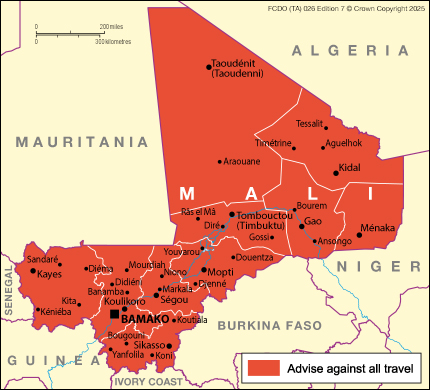
Warnings — Foreign OfficeForeign Office ↗updated 10.07.2026 · read 15.10.2026
Warnings — Foreign Office
Your travel insurance could be invalidated if you travel against advice from the Foreign, Commonwealth & Development Office (FCDO).
## FCDO advises against all travel to Mali
FCDO advises against all travel to the whole of the Mali due to the unpredictable security conditions.
If you’re in Mali, you should leave immediately by commercial flight if you judge it safe to do so.
Do not try to leave Mali by overland routes to neighbouring countries as this is too dangerous. This is due to terrorist attacks along national highways.
Terrorist group Jama’a Nusrat ul-Islam wa al-Muslimin (JNIM) has implemented blockades on key routes throughout Southern and Western Mali, including the capital city of Bamako. These blockades are targeting fuel trucks and are enforcing checkpoints for individuals attempting to pass through them. Attacks can occur at any time.
There is a high threat of kidnapping and criminal activity across Mali, including in the capital, Bamako.
If you choose to remain in Mali, you do so at your own risk. You should have a personal emergency plan that does not rely on the UK government.
For more detail see Fuel shortages and Terrorism in Mali in the Safety and security page.
If you are a British national already in Mali, either resident or visitor, carefully consider your presence there and the risks you take by staying.
Find out more about why FCDO advises against travel .
UK government support
Support for British nationals is severely limited in Mali, especially outside Bamako.
Do not rely on FCDO being able to help you to evacuate in an emergency.
If you are in Mali and need emergency help from the UK government, contact the British Embassy in Bamako .
Travel insurance
If you choose to travel, research your destinations and get appropriate travel insurance . Insurance should cover your itinerary, planned activities and expenses in an emergency.
Safety — Foreign OfficeForeign Office ↗updated 10.07.2026 · read 15.10.2026
Terrorism
There is a high threat of terrorist attack globally affecting UK interests and British nationals, including from groups and individuals who view the UK and British nationals as targets. Stay aware of your surroundings at all times.
UK Counter Terrorism Policing has information and advice on staying safe and what to do in the event of a terrorist attack. Find out how to reduce your risk from terrorism while abroad .
Terrorism in Mali
Terrorists are very likely to try to carry out attacks in Mali.
Several terrorist groups operate in Mali, including Jama’a Nusrat ul-Islam wa al-Muslimin ( JNIM ) and Islamic State Sahel Province ( ISSP ). Whilst the regions most affected by terrorist activity are central and northern Mali, JNIM has increasingly conducted attacks in southern Mali and has the capability and intent to target the capital, Bamako.
The security situation in Mali has deteriorated amid an upsurge of terrorist attacks following the December 2023 withdrawal of the UN peacekeeping mission. Terrorists have increasingly attacked military bases and personnel, sometimes including foreign military personnel, as well as government and official buildings, including in Bamako. Such attacks often lead to the deaths of soldiers, civilians and others. Attempts to carry out similar attacks remain very likely.
Terrorist group Jama’a Nusrat ul-Islam wa al-Muslimin ( JNIM ) has implemented blockades on key routes throughout Southern and Western Mali, including the capital city of Bamako. These blockades are targeting fuel trucks and are enforcing checkpoints for individuals attempting to pass through them. Attacks can occur at any time.
Take particular care during elections and public holidays, and periods of national or religious significance. Stay aware of your surroundings, keep up to date with local media reports and follow the advice of local authorities, including by complying with access restrictions imposed by authorities.
Attacks could be indiscriminate and occur at any time, including in places frequented by foreign nationals, such as:
- national infrastructure
- military sites and institutions
- government and official buildings
- international institutions
- transport hubs, including airports and major roads
- embassies
- international businesses, including mining companies and operations
- religious sites and places of worship
- sporting and cultural events
- shopping centres and crowded places
- hotels, restaurants and bars
See also road safety
Examples of recent significant attacks include:
- on 4 July, further coordinated attacks targetting military installations were carried out across multiple cities including Anefis, Aguelhoc, Gao, Sevare and Kenioroba
- on 25 April 2026, a series of coordinated attacks occurred in multiple locations including Kidal, Gao, Kati, Severe and in the vicinity of Bamako International Airport (leading to the airport’s temporary closure)
- since September 2025, there has been an increase in attacks targeting fuel convoys in Mali, particularly in southern and western Mali
- in June 2025, JNIM claimed to kill more than 150 soldiers, in multiple attacks targeting military bases in Boulkessi, Timbuktu and Mahou
- in March and May 2025, there were two separate attacks against a police station and a military base which damaged vehicles and infrastructure in Kati, approximately 15km from Bamako city centre
- in February 2025, a roadside bomb killed two people and injured others in a convoy that was travelling on the road linking Kati to Soribougou
This continues a…
American passport — U.S. Department of State
- The United States advises against all travel to Mali due to crime, terrorism, kidnapping, unrest and health risks. State Department
- Violent crime including kidnapping, armed robbery, and carjacking is common throughout Mali, particularly in Bamako during holidays and seasonal events. State Department
- Terrorist groups target foreigners for kidnapping at hotels, restaurants, nightclubs, places of worship and diplomatic missions anywhere in the country. State Department
- Armed roadblocks by armed groups occur throughout Mali, and highways face frequent attacks on government, civilian and commercial targets. State Department
- U.S. government employees in Mali are restricted to Bamako only due to safety risks, and family members cannot join them. State Department
- Avoid street demonstrations in Mali as they can turn violent without notice, and remain aware of police checkpoints especially at night in cities. State Department
Faithful summary of the official texts below, which prevail.
Mali - Level 4: Do Not Travel 2026-06-07travel.state.gov ↗updated 07.06.2026 · read 16.10.2026
Advisory summary
Do not travel to Mal i for any reason . Due to safety risks, family members cannot join U.S. government employees who work in Mali.
Crime
Violent crime is common throughout Mali. Crimes include kidnapping, assault, armed robbery, home invasion, and carjacking.
- Violent crime is a major concern in Bamako especially during local holidays and seasonal events.
- Roadblocks, including by armed groups, occur throughout the country.
- In cities, police checkpoints are possible, especially at night.
- Highways across the country often face attacks on government, civilian, and commercial targets.
Terrorism
There is risk of terrorist violence, including terrorist attacks and other activity in Mali. Visit the U.S. Department of State's country reports on terrorism to learn more.
Terrorist and armed groups target foreigners to kidnap for ransom.
Terrorists may attack without warning:
- Spots frequented by foreigners anywhere in the country
- Night clubs
- Hotels
- Restaurants
- Places of worship
- International diplomatic missions
- Local security forces and civilians
Kidnapping
- The threat of kidnapping of U.S. citizens and other foreign nationals by criminal or terrorist groups remains high throughout the region. Extortion and kidnapping for ransom are significant sources of financing for terrorist and criminal groups.
Unrest
- Periodic street demonstrations occur throughout Mali. Although some are planned and peaceful, demonstrations can occur without notice and turn violent. The majority of these demonstrations are managed by security forces, but U.S. citizens should avoid street demonstrations. Always stay aware of your surroundings.
Armed Conflict
- Armed conflict between the Malian government and armed groups is common throughout Mali. Many terrorist and separatist armed groups are active throughout the country. These groups may plan and carry out deadly attacks against Malian government and military facilities, including in and around Bamako. Conflict between these groups often results in civilian casualties.
Air Travel
- The Federal Aviation Administration (FAA) has issued a Notice to Airmen (NOTAM) and/or a Special Federal Aviation Regulation (SFAR). This is due to risks to civil aviation operating within or nearby Mali. For more information U.S. citizens should consult the Federal Aviation Administration’s…
Global Affairs Canada — additional reading
Avoid all travel
Avoid all travel to Mali due to the threat of terrorism, kidnapping, banditry and fuel shortages. If the security situation in Mali deteriorates, the ability of the Embassy of Canada to Mali, in Bamako, to provide consular services may be limited.
- MALI — Avoid all travel to Mali due to the threat of terrorism, kidnapping, banditry and fuel shortages. If the security situation in Mali deteriorates, the ability of the Embassy of Canada to Mali, in Bamako, to provide consular services may be limited.
Open Government Licence – Canada · October 9, 2026 10:15 EDTtravel.gc.ca ↗updated 09.10.2026 · read 16.10.2026
- Carry your original passport at all times as a foreign national to avoid difficulties during security checks. Foreign Office
- Do not photograph military, government installations, or local people without explicit permission beforehand. Foreign Office
- Homosexuality is illegal in Mali; the December 2024 Penal Code criminalises same-sex relationships with penalties up to seven years imprisonment and fines of 500,000 francs. Foreign Office
- During Ramadan (expected to begin around February 7, 2027), do not eat, drink, smoke or chew gum in public between sunrise and sunset, including in your car. Global Affairs Canada
- Dress conservatively and behave discreetly to respect Islamic practices; credit cards are rarely accepted outside major hotels, and ATM access is limited outside Bamako. Global Affairs Canada
- Carry an International Driving Permit; exchange currency at the Central Bank of West African States on Koulikoro Road in Bamako, as exchange facilities elsewhere are slow with outdated rates. Global Affairs Canada
Faithful summary of the official texts below, which prevail.
Global Affairs Canada — written for Canadian travellers, valid for all
Local laws
You must abide by local laws. Learn about what you should do and how we can help if you are arrested or detained abroad.
Drugs
Penalties for possession, use or trafficking of illegal drugs are severe. Convicted offenders can expect jail sentences and heavy fines. Drugs, alcohol and travel
Photography
Photography of military personnel and installations is prohibited. Cultural and religious factors influence the interpretation of what subjects may be photographed. Ask permission before taking photographs.
International Child Abduction
The Hague Convention on the Civil Aspects of International Child Abduction is an international treaty. It can help parents with the return of children who have been removed to or retained in certain countries in violation of custody rights. It does not apply between Canada and Mali. If your child was wrongfully taken to, or is being held in Mali by an abducting parent:
- act as quickly as you can
- consult a lawyer in Canada and in Mali to explore all the legal options for the return of your child
- report the situation to the nearest Canadian government office abroad or to Global Affairs Canada by calling the Emergency Watch and Response Centre
If your child was removed from a country other than Canada, consult a lawyer to determine if The Hague Convention applies. Be aware that Canadian consular officials cannot interfere in private legal matters or in another country's judicial affairs.
2SLGBTQI+ persons
The law of Mali doesn’t prohibit sexual acts between individuals of the same sex. However, homosexuality is not widely socially accepted. 2SLGBTQI+ persons could face other sanctions. 2SLGBTQI+ persons should carefully consider the risks of travelling to Mali. Travel and your sexual orientation, gender identity, gender expression and sex characteristics
Exports
Mali restricts the export of certain Malian archaeological objects, particularly those from the Niger River Valley. Under Malian law, visitors seeking to export such items require an export authorization from the National Museum of Mali in Bamako.
Dress and behaviour
Mali’s customs, laws and regulations closely adhere to Islamic practices. Dress conservatively, behave discreetly and respect Malian religious and social traditions to avoid offending local sensitivities.
Ramadan
In 2027, the lunar month of Ramadan is expected to begin on or around February 7. In public, between sunrise and sunset, be discreet when:
- drinking
- eating
- smoking
Driving
You should carry an International Driving Permit. International Driving Permit
Money
The currency is the African Financial Community franc, or CFA franc (XOF). Credit cards are rarely accepted outside a few major hotels. The Central Bank of West African States has a foreign exchange bureau on Koulikoro Road in Bamako, close to the Grand Hôtel. Exchange facilities are often slow and offer rates that are out of date. Access to ATMs is limited outside of Bamako.
Open Government Licence – Canada · October 9, 2026 10:15 EDTtravel.gc.ca ↗updated 09.10.2026 · read 16.10.2026
Foreign Office — laws and cultural differences
Local laws
Mali is a secular country, but the people are predominantly Muslim. The country’s laws and customs are very different to those in the UK. Respect local traditions, customs, laws and religions. Make sure your actions do not offend religious beliefs, especially during Ramadan or in religious areas. French is the official language in Mali and not many officials or healthcare workers speak English. You may have difficulty communicating if you cannot speak any French. Make sure you can use translation apps in case of an emergency.
Personal ID
As a foreign national, you must carry ID such as a passport. You could face difficulties with security checks if you do not have the original document on you.
Ramadan
Ramadan is a holy month for Muslims. The dates vary by year and country. During this time, do not:
- eat, drink, smoke or chew gum in public in the daytime, including in your car
- play loud music or dance
- swear in public
Get more advice when you arrive from your tour guide, hotel or business contacts. You should also:
- check opening hours of shops and restaurants
- be aware that if hotels and restaurants are providing food or drink in fasting hours, they may separate you from Islamic guests, for example with screens
- follow local dress codes – clothing that does not meet local dress codes may cause more offence at this time
- be aware that fasting can cause tiredness, particularly during the later afternoon and early evening
- be patient and show tolerance
Using cameras
Do not take pictures of military or government installations. Always ask permission before taking photographs that include local people.
Commercial disputes
If you’re involved in or connected to a business or civil dispute in Mali, the Malian authorities may detain you, prosecute you or prevent you from leaving Mali until the matter is resolved.
LGBT+ travellers
Homosexuality is illegal in Mali. In December 2024, Mali’s National Transitional Council promulgated a new Penal Code which criminalises the promotion or participation in consensual same-sex relationships. The legislation introduced penalties of up to seven years imprisonment and fines of up to 500,000 francs. There is an increased risk of violence and threats, such as blackmail and intimidation, against anyone being thought to be part of the LGBT+ community or perceived to be supporting their rights. There have been arrests for ‘immoral behaviour’, and LGBT+ individuals have experienced physical, psychological, and sexual violence. Read more advice for LGBT+ travellers.
Open Government Licence v3.0gov.uk ↗updated 10.07.2026 · read 15.10.2026
What it changes for you: Air acceptable at this hour: nothing special to plan. Very high UV: sunscreen, hat and shade between 11 am and 4 pm; sunstroke and dehydration are travellers' first reasons to see a doctor.
Reading 05:00 (Africa/Bamako)Open-Meteo ↗updated 16.10.2026 · read 16.10.2026
Air quality and UV: Open-Meteo.com (CC BY 4.0), data rounded and formatted by Maximum. Contains modified Copernicus Atmosphere Monitoring Service information 2026. Neither the European Commission nor ECMWF is responsible for any use that may be made of the Copernicus information or data it contains.
Reading: With 0.2 physicians per 1,000 people (96% fewer than Switzerland), the nearest hospital does not always have the capacity for a serious case: evacuation to an adequate centre is the rule, not the exception — that is what unlimited evacuation and repatriation cover. Health spending of 34 USD per person (Switzerland: 11,784) goes with private hospitals that bill foreigners in hard currency and ask for a guarantee before admission: the direct payment guarantee is what avoids the deposit.
World Bank — latest published value, year per indicatordata.worldbank.org ↗read 09.10.2026
What is happening in Mali right now
Live alerts and level changes, each with its official source. Continuously updated.
What governments have just written
La situation sécuritaire au Mali demeure très dégradée. Il est formellement déconseillé de se rendre au Mali, quel que soit le motif. Pour mémoire, il est également recommandé aux ressortissants français de prévoir un départ temporaire du Mali dès que possible par les vols commerciaux encore disponibles. Dans ce contexte, les ressortissants français encore présents au Mali sont appelés à faire preuve de la plus grande prudence lors de leurs déplacements, à éviter…
France Diplomatie (in French) · posted 25 April 2026 · updated 30 July 2026diplomatie.gouv.fr ↗updated 15.09.2026 · read 16.10.2026The Need help? section was updated.
October 9, 2026 10:15 EDTtravel.gc.ca ↗updated 09.10.2026 · read 16.10.2026No level change recorded for this country since the log opened. The live alerts above are updated continuously.
Frequently asked questions — travel insurance Mali
What is the official risk level in Mali today?
Level 4/4 — Do Not Travel, U.S. Department of State, retrieved on 16 October 2026.
- Is the whole country advised against? United States: yes · France: yes · United Kingdom: yes · Switzerland: yes (reading of 27 September 2026).
- Switzerland’s FDFA advises against all travel to the country (published 25.11.2025).
- The FDFA advises against the trip: art. 18.1 (Module A) opens cancellation, change and curtailment costs.
- At this level most bank cards and standard policies exclude the trip: read My cover before booking, and only leave with cover that says so in writing.
- We check these sources every morning and e-mail you the day one changes (Alerts button).
Sourcestravel.state.gov · updated 07.06 · read 16.10France Diplomatie · updated 15.09 · read 16.10DFAE · updated 25.11 · read 15.10207-country comparison
Is the whole of Mali advised against, or only some areas?
An area advised against does not rule out the country.
- Official answers: United States: yes · France: yes · United Kingdom: yes · Switzerland: yes.
- France Diplomatie, areas formally advised against: “L’ensemble du territoire est classé en zone rouge. Dans le contexte actuel de fortes tensions régionales et compte tenu de la présence de groupes terroristes et des risques d’attentat et d’enlèvement, tout déplacement au Mali est formellement déconseillé, y…”
- Keep your country of residence's advisory on booking day and on departure day: that is what your policy's clauses cite.
SourcesFrance Diplomatie · updated 15.09 · read 16.10Foreign Office · updated 10.07 · read 15.10State Department · updated 07.06 · read 16.10
What are the entry requirements for Mali with my passport?
The rules depend on the passport, not on the destination alone.
- French passport (France Diplomatie): Franco-Malian dual nationals without a French visa must enter Mali with a valid Malian passport only; expired Malian passports are no longer accepted as of 14 January 2024. Malian identity cards, NINA cards, birth certificates, safe-conducts and laissez-passers are rejected; passengers with these documents will be denied entry and immediately returned on the next flight. French nationals require a Mali visa issued by consulates in Paris or Lyon for thirty days, renewable locally; a valid passport and yellow fever vaccination certificate are mandatory.
- British passport (Foreign Office): Your passport must be valid for the entire duration of your stay in Mali; entry will be denied if it is invalid, lost, or stolen. You must obtain a visa to enter Mali through the fully online application process via the Malian Ministry of Foreign Affairs website; an electronic entry permit will be issued once approved. You must present a certificate proving yellow fever vaccination to enter Mali.
- American passport: the requirements are on the State Department country page (travel.state.gov).
- Swiss passport: the FDFA refers you to the destination's embassy in Switzerland.
- Pick your passport at the top of Before you go › Entry: the official text that concerns you comes first, with its “In brief” summary.
SourcesFrance Diplomatie · updated 15.09 · read 16.10Foreign Office · updated 10.07 · read 15.10State Department · updated 07.06 · read 16.10
Do I need an insurance certificate for a Mali visa?
For a Schengen visa, yes: at least €30,000 of travel medical insurance (Regulation (EC) No 810/2009, art. 15).
- Many other countries ask for it on entry or for a visa, case by case: check Before you go › Entry, with your passport.
- Subscribe: the named certificate arrives by e-mail on payment, with your name, dates and limits (EUR 1.5M medical expenses, unlimited evacuation and repatriation) — the ones consulates check.
- Attach it to the visa file; if in doubt about the format, write to us.
SourcesRegulation (EC) 810/2009, art. 15General conditions, policy 20 00 479
What does Maximum Insurance do in Mali, concretely?
VIP Pack — €990 for twelve months, unlimited trips.
- EUR 1.5M emergency medical expenses, unlimited medical evacuation and repatriation, search and rescue EUR 50,000, cancellation or change EUR 5,000.
- One 24/7 number, +41 22 ••• •• ••: Maximum sends its direct payment guarantee to the hospital (art. 2.12).
- Network of 45,000 providers (art. 6.9); evacuation is decided, organised and paid by Maximum's medical team if the local facility is not enough (art. 6.2.2).
- Named certificate by e-mail on payment, no medical questionnaire.
SourcesGeneral conditions, policy 20 00 479OpenStreetMap · read 12.10
How much does a medical repatriation from Mali cost?
From 30 000 € to 200 000 € depending on severity and distance (Le Ciel Africain, 2026).
- Without cover: the hospital asks for a deposit before admission, and the medical flight is paid up front.
- With the VIP Pack: the evacuation is decided and settled by Maximum (art. 6.2.2) — no advance, no cap.
SourcesLe Ciel Africain, 2026General conditions, policy 20 00 479
What should I do if hospitalised in Mali?
Six steps, in this order.
- 1. Call +41 22 ••• •• •• before paying anything, or have the front desk call: it is the condition for full cover (otherwise: reduced or refused benefits).
- 2. Ask for a hospital in the Maximum network (art. 6.9).
- 3. See a doctor the same day and leave with the certificate: without an on-the-spot finding, nothing is covered (art. 33).
- 4. Admitted for more than 24 h? The front desk calls Maximum: direct payment guarantee, no deposit (art. 2.12).
- 5. Book no ambulance or flight yourself (art. 6.2.2).
- 6. Once home, file within 30 days (art. 35.7).
- Local emergency services: single number 112 · police 17 · ambulance 15 · fire 18.
SourcesSpecial conditions 01.26General conditions, policy 20 00 479
Which emergency numbers in Mali?
Local emergency services: single number 112 · police 17 · ambulance 15 · fire 18
- Maximum, 24/7, before any payment: +41 22 ••• •• ••.
- France — Ambassade de France (3.7 km) · +223 44 97 57 57
- Switzerland — Swiss Cooperation Office and Consular Agency (3.0 km) · +223 20 21 73 62
- United Kingdom — Ambassade de Grande-Bretagne (3.1 km) · +223 44 97 69 13
- United States — Ambassade des États-Unis (5.3 km) · +223 20 70 23 00
- Save these numbers before leaving; in immediate danger, call local emergency services first, then Maximum.
SourcesEmergencyNumberAPI · Wikidata · read 08.10OpenStreetMap · read 12.10
Is an Amex, Visa or Mastercard enough in Mali?
At today's level 4/4, card by card:
- Amex Platinum — Your Amex Platinum expressly excludes this trip: the T&Cs rule out travel to countries your government has advised against visiting.
- Visa — Your Visa may not cover here: the notice excludes the consequences of war, notorious political instability and terrorism — precisely the risks of an advised-against area.
- Mastercard — Your Mastercard World Elite expressly excludes this trip: areas 'formally advised against' by the French foreign ministry are ruled out, assessed at departure date.
- Three lines to read in your notice: the duration (often 90 days per trip), the settlement (reimbursement afterwards or direct payment of the hospital) and the area exclusion at level 4/4.
SourcesAmex Platinum France T&Cs, 01.2025 — general exclusion n° 11BNP Paribas Visa Infinite notice (policy PT7), 04.2025 — comFortuneo World Elite Mastercard notice, 01.2026 — art. 5.5 '
Are a health plan or a travel policy enough in Mali?
A health plan reimburses at home; here, the hospital asks for a payment guarantee before admission.
- Health plan — A health plan treats you at home. Here the hospital asks for a guarantee before admission — not a later reimbursement.
- Travel policy — The clause is a market standard: the reference policy excludes trips to areas 'formally advised against by government authorities' — at this level most classic policies no longer cover.
- A travel policy often has a territorial clause at level 4/4 and a 90-day limit per trip.
- Have your IPID number or the PDF of the terms and ask an expert to call you back: the answer is in the document, not in the brochure.
SourcesGeneral conditions, policy 20 00 479
How do I use the medical network on this page?
The page reads hospitals, pharmacies and doctors from OpenStreetMap, around the point you choose.
- Type your city, hotel or beach: the map re-centres, 24/7 emergency rooms come first.
- Each row gives the phone when the source publishes it, the nearest street, directions and the Google Maps listing.
- The PDF briefing repeats the same places, numbered on a printable map.
- No customer reviews: OpenStreetMap has none, and we invent none.
Which vaccines and health precautions for Mali?
The sourced detail is under Medical network › Health: vaccines, diseases present, altitude, outbreaks.
- CDC (Travelers' Health), depending on the trip: Routine vaccines, COVID-19, Chikungunya, Hepatitis A, Hepatitis B, Malaria, Measles.
- France Diplomatie reports in the country: dengue, malaria, chikungunya — mosquito protection day and night.
- See a doctor or a travel clinic 8 weeks before departure (Foreign Office).
- Carry your medicines in their packaging, with a prescription using international non-proprietary names (France Diplomatie).
SourcesCDC Travelers' Health · read 09.10France Diplomatie · updated 15.09 · read 16.10OMS · read 15.10Foreign Office · updated 10.07 · read 15.10
Can I be treated in Mali, or will I be evacuated?
0.2 physicians per 1,000 people (2023) versus 4.5 in Switzerland.
- 0.2 hospital beds per 1,000 people versus 4.4 in Switzerland (World Bank).
- With 0.2 physicians per 1,000 people (96% fewer than Switzerland), the nearest hospital does not always have the capacity for a serious case: evacuation to an adequate centre is the rule, not the exception — that is what unlimited evacuation and repatriation cover. Health spending of 34 USD per person (Switzerland: 11,784) goes with private hospitals that bill foreigners in hard currency and ask for a guarantee before admission: the direct payment guarantee is what avoids the deposit.
- When the local facility is not enough, Maximum's medical team decides the evacuation to a suitable centre, and pays for it (art. 6.2.2).
SourcesWorld Bank · read 09.10General conditions, policy 20 00 479
Mali: safety, in figures?
Comparable figures (homicides, roads, incidents) are under Safety & risks › Incidents.
- 22.7 road deaths per 100,000 people versus 2.2 in Switzerland (World Bank, WHO).
- UCDP (Uppsala University): 162 geolocated violent incidents, 517 deaths over the last closed period, each placed on the map.
- On the road, 10 times more deaths than in Switzerland: road crashes are the leading cause of death of healthy travellers (CDC) — seat belt, no night driving, a driver or a taxi from a rank.
Where is my embassy in Mali, and why register?
The nearest representations, by passport (OpenStreetMap):
- France — Ambassade de France (3.7 km) · +223 44 97 57 57
- Switzerland — Swiss Cooperation Office and Consular Agency (3.0 km) · +223 20 21 73 62
- United Kingdom — Ambassade de Grande-Bretagne (3.1 km) · +223 44 97 69 13
- United States — Ambassade des États-Unis (5.3 km) · +223 20 70 23 00
- Register before leaving: France: Ariane · Switzerland: Travel Admin · United Kingdom: Foreign Office alerts · United States: STEP.
- Two minutes, and in a crisis your country's authorities can reach you and count you in an evacuation.
- Pick your passport at the top of Contacts: your embassy comes first.
SourcesOpenStreetMap · read 12.10DFAE · updated 25.11 · read 15.10
Which regions of Mali should I avoid, precisely?
At least one official reading covers the whole country; no region is singled out.
- Your point (Bamako): advised against — all travel.
- Global Affairs Canada covers the whole country.
- Foreign Office covers the whole country.
- Maximum does not exclude these areas: the VIP Pack covers care and repatriation there (sanctions, embargoes and a country already at war at departure remain enforceable).
SourcesGlobal Affairs Canada · updated 09.10 · read 16.10Foreign Office · updated 10.07 · read 15.10France Diplomatie · updated 15.09 · read 16.10
Which laws and customs should I know in Mali?
Local laws apply to every traveller; here is what the official texts say.
- Carry your original passport at all times as a foreign national to avoid difficulties during security checks.
- Do not photograph military, government installations, or local people without explicit permission beforehand.
- Homosexuality is illegal in Mali; the December 2024 Penal Code criminalises same-sex relationships with penalties up to seven years imprisonment and fines of 500,000 francs.
- During Ramadan (expected to begin around February 7, 2027), do not eat, drink, smoke or chew gum in public between sunrise and sunset, including in your car.
- Dress conservatively and behave discreetly to respect Islamic practices; credit cards are rarely accepted outside major hotels, and ATM access is limited outside Bamako.
SourcesGlobal Affairs Canada · updated 09.10 · read 16.10Foreign Office · updated 10.07 · read 15.10
Who can I call at any hour from Mali?
Every foreign ministry runs a 24/7 emergency line for its nationals.
- France — Crisis and Support Centre — French Ministry for Europe and Foreign Affairs: +33 1 53 59 11 00. 24/7 emergency line, standard rate. First contact abroad: the French embassy or consulate.
- Switzerland — FDFA Helpline: +41 58 465 33 33 · +41 800 24 7 365. 24/7, 365 days a year — helpline@eda.admin.ch. Beware of scam calls spoofing these numbers.
- United Kingdom — Foreign, Commonwealth & Development Office: +44 20 7008 5000. 24 hours, for British nationals.
- United States — Overseas Citizens Services — U.S. Department of State: +1 202 501 4444 · +1 888 407 4747. From abroad; the second number from the U.S. and Canada.
- On site, Ambassade de France: +223 44 97 57 57.
Sourcesdiplomatie.gouv.fr · updated 15.09 · read 16.10eda.admin.ch · updated 25.11 · read 15.10
A few useful phrases in French for Mali?
Emergency phrases, to show if pronunciation fails:
- Help! → Au secours !
- Call an ambulance! → Appelez une ambulance !
- I need a doctor. → J'ai besoin d'un médecin.
- Where is the nearest hospital? → Où est l'hôpital le plus proche ?
- Call the police! → Appelez la police !
SourcesMaximum Insurance
What should I keep after leaving Mali, and how do I file a claim?
Keep the entry stamp, the invoices, the prescriptions and the medical report.
- File within 30 days (art. 35.7) from your client area, with the documents; the official forms are pre-filled.
- Costs advanced on site are reimbursed against receipts.
- Fever, persistent diarrhoea or a rash in the following weeks? See a doctor and say where you have been — dengue, malaria, chikungunya circulate in the country (France Diplomatie).
SourcesGeneral conditions, policy 20 00 479
What does the Pack VIP Extreme add?
Cancellation or change up to EUR 20,000, special risk EUR 5,000 per person, crisis management and security, optional Kidnap & Ransom.
- Special risk (Module A): political event, attack, epidemic, natural disaster — opens when the FDFA, the FOPH or WHO advise against the trip (art. 18.1).
- Epidemic: assistance must be requested within 7 days of the WHO or FDFA qualification (art. 36.2).
- Crisis management and security: trip registration, monitoring, extraction, evacuation in case of riot, war, terrorism or disaster; Kidnap & Ransom subject to eligibility (art. 18.4).
- €2,290 a year, unlimited trips.
SourcesGeneral conditions, policy 20 00 479
A question not answered here? Ask Maximum below, or call the support number: every question gets a clear, actionable answer.
In a life-threatening emergency, call local emergency services first, then Maximum: +41 22 ••• •• •• — 24/7 support number, an adviser stays with you to the end.
What Maximum knows
The 207 country pages — hospitals, pharmacies, police, embassies, emergency numbers, official advice from four governments, health, safety in figures, events in progress — read around the city you name. Your policy — benefits, the six steps, claims, articles. The site — prices, certificate, subscription. Nothing else: what it does not know, it says so and hands you to an adviser.
Travelling to Bamako: what changes
The published advisory level is national, but risk is not: business hubs (Bamako) do not share the profile of border areas. The medical network shown on this page is computed around Bamako — real hospitals, evacuation airport and live alerts. Before a specific trip, always cross-check your country of residence's advisory: that is what your policy cites.
Same advisory level: Russia · Central African Republic · Somalia · Sudan · South Sudan · Syria
The displayed level comes from the State Department, checked every morning. Before departure, always cross-check your country of residence's advisory: that is what your policy cites.
The level shown is the official U.S. Department of State level, checked daily. Maximum Insurance is an insurance distributor — general information, not personal advice.