Make sure you are up-to-date on all routine vaccines before every trip. Some of these vaccines include Chickenpox (Varicella) Diphtheria-Tetanus-Pertussis (DTaP, Tdap, or Td) Flu (influenza) Measles-Mumps-Rubella (MMR) Polio Shingles
Maximum Alerts / Russia
Level published by the State Department on 28.12.2025 · read 13 October 2026 · source checked daily
Russia — official level as of 13 October 2026: Level 4/4 ("Do Not Travel"), from the U.S. Department of State. Maximum Insurance covers this country: hospital settled directly, unlimited repatriation, USD 1.5M, certificate on payment.
Every country has its own scale, so we ask them all the same question: is the whole country advised against?
An advisory covering only areas of the country does not raise the answer: it stays “No”, and the area is shown in the relevant column.
The level shown on this page — and across this site — is the one published by the U.S. State Department, from 1 (normal precautions) to 4 (do not travel). France and the United Kingdom publish their own advisories, with their own rules: they add to that level, they do not replace it.
You will be alerted only on the day the official level of this country changes.
100 recorded incidents (UCDP)hover, click to open it in the briefing
In a life-threatening emergency, call local emergency services first, then Maximum: +41 22 ••• •• •• — 24/7 support number, an adviser stays with you to the end.
The 207 country pages — hospitals, pharmacies, police, embassies, emergency numbers, official advice from four governments, health, safety in figures, events in progress — read around the city you name. Your policy — benefits, the six steps, claims, articles. The site — prices, certificate, subscription. Nothing else: what it does not know, it says so and hands you to an adviser.
What I say on the phone
What to do, in this order
In immediate danger, call local emergency services first. Then contact assistance without delay; before engaging a service, seek approval under your policy. Cover is confirmed by the insurer.
Ask assistance where to get care and whether direct cover can be arranged. It confirms the facility and seeks the insurer's approval under your policy. In immediate danger, call local emergency services first.
Even for a pain you meant to shrug off. Without a medical certificate written on the spot, the same day, the insurer cannot cover the event — a certificate written after you return does not count.
The hospital desk sends the request to assistance. Direct payment depends on the insurer's approval and the policy; the call alone does not guarantee it. Have the response confirmed before relying on no up-front payment.
In a life-threatening emergency, call local emergency services immediately. For an arranged transfer or repatriation, contact assistance: the insurer's medical team decides on measures under the policy. A medical flight booked without approval may not be reimbursed.
Even if everything went well on the ground. Send your invoices and the medical report within 30 days; after that, compensation may be reduced or refused.
Reading hospitals, doctors and pharmacies around this point…
List read from OpenStreetMap on 30.09.2026, not read again since: these facilities may have changed.
Country dial code: +7
OpenStreetMap list read on 30.09.2026, straight-line distances. In an emergency: +41 22 ••• •• ••.
22А улица Покровка
near Гончарный проезд
near Домниковский переулок
near улица Щепкина
near Донская улица
Mo-Sa 09:00-20:00; Su "по записи"
near улица Гиляровского
near улица Анны Северьяновой
trauma
near 1-я улица Ямского Поля
Mo-Fr 07:00-23:00; Sa-Su 08:00-22:00
near Трифоновская улица
near проектируемый проезд № 6023
24/7
near проектируемый проезд № 6023
Mo-Fr 08:00-20:00; Sa 09:00-15:00
near 2-й Красносельский переулок
Mo-Fr 08:00-20:00; Sa 09:00-18:00; Su 09:00-16:00
8 Переведеновский переулок
trauma
24/7
near Большая Почтовая улица
Mo-Sa 08:00-20:00; Su 08:00-18:00
near Варшавское шоссе
65/68 Бутырская улица Москва
near 3-я Мытищинская улица
Mo-Sa 09:00-21:00; Su 09:00-18:00
near Юрьевский переулок
psychiatry
Mo-Fr 08:00-20:00; Sa 09:00-16:00
3/1 Семёновская набережная Москва
Mo-Fr 08:00-20:00; Sa 09:00-16:00
near Юрьевский переулок
24/7
near Малая Семёновская улица
psychiatry
Mo-Su 09:00-22:00
near Маломосковская улица
Mo-Fr 08:00-20:00; Sa,Su 09:00-18:00
near проспект Будённого
Mo-Fr 08:00-20:00; Sa 09:00-15:00
near улица Большая Полянка
near Большой Афанасьевский переулок
24/7
near улица Новый Арбат
Mo-Fr 08:00-21:00; Sa-Su 09:00-21:00
34/2 с1 Большая Татарская улица
Mo-Su 08:00-22:00
near Мамоновский переулок
24/7
near Денежный переулок
Mo-Su 08:00-23:00
near Лепёхинский тупик
near Садовая-Сухаревская улица
Mo-Su 08:00-20:00
near Зубовский бульвар
24/7
near 1-й Неопалимовский переулок
24/7
near Зубовский бульвар (дублёр)
Mo-Fr 08:00-23:00; Sa-Su 09:00-23:00
near Садовая-Сухаревская улица
Mo-Su 09:00-22:00
near Смоленский бульвар
Mo-Fr 08:00-21:00, Sa 09:00-20:00, Su 10:00-18:00
near Ананьевский переулок
24/7
near Люсиновская улица
Mo-Su 08:00-22:00
near Боярский переулок
Mo-Fr 08:00-21:00; Su 10:00-18:00
near 1-й Тверской-Ямской переулок
Mo-Fr 08:00-22:00; Sa 09:00-22:00; Su 10:00-22:00
near 1-й переулок Тружеников
Mo-Fr 08:00-21:00; Sa 09:00-20:00; Su 10:00-18:00
near Дубининская улица
Mo-Fr 08:00-22:00; Sa,Su 09:00-21:00
near Большая Серпуховская улица
Mo-Su 09:00-22:00
9 к1 Оболенский переулок
24/7
near Протопоповский переулок
24/7
1 Ленинградский проспект Москва
Mo-Fr 08:00-22:00; Sa,Su 10:00-21:00
near Комсомольский проспект
Mo-Fr 08:00-22:00; Sa-Su 09:00-22:00
near Новорязанская улица
Mo-Su 08:00-23:00
near улица Шаболовка
Mo-Fr 08:00-22:00; Sa 09:00-20:00; Su 10:00-18:00
near Комсомольский проспект
24/7
near Комсомольский проспект
24/7
near Комсомольский проспект
24/7
near улица Симоновский Вал
near Мытная улица
Mo-Su 09:00-22:00
near Трифоновская улица
Mo-Fr 08:00-21:00; Sa,Su 09:00-21:00
near Усачёва улица
Mo-Su 08:00-22:00
near Дальний переулок
24/7
near Олимпийский проспект
24/7
near улица 10-летия Октября
Mo-Fr 08:00-21:30; Sa,Su 09:00-21:00
near Малая Тульская улица
Mo-Fr 08:00-22:00; Sa-Su 09:00-22:00
near Волгоградский проспект
Mo-Fr 08:00-21:00; Sa-Su 09:00-21:00
near улица 10-летия Октября
24/7
47 Комсомольский проспект Москва
Mo-Su 09:00-21:00
17/6 с1 улица Маросейка Москва
9 Курсовой переулок
1А Крапивенский переулок Москва
Mo-Fr 09:30-12:00,13:30-15:30
near Чистый переулок
3А Чистопрудный бульвар Москва
near улица Малая Дмитровка
2/5 переулок Огородная Слобода Москва
56 улица Большая Ордынка
7 Денежный переулок
14 Садовая-Самотёчная улица
12 Погорельский переулок
4 2-й Троицкий переулок Москва
near Кривоарбатский переулок
near улица 10-летия Октября
near Можайский переулок
near Комсомольский проспект
near Моховая улица
Mo-Su 05:30-01:00
near Никольская улица
Mo-Su 05:30-01:00
near улица Воздвиженка
Mo-Su 05:30-01:00
near улица Охотный Ряд
Mo-Su 05:30-01:00
Mo-Su 05:30-01:00
near Староваганьковский переулок
Mo-Su 05:30-01:00
near Староваганьковский переулок
Mo-Su 05:30-01:00
near Пушечная улица
Mo-Su 05:30-01:00
Forecast: MET Norway (Norwegian Meteorological Institute, CC BY 4.0), grouped by day and formatted by Maximum.
10-13 6.8 · 10-14 8.8 · 10-15 19.3 · 10-16 16.2 · 10-17 10.0 · 10-18 7.3 · 10-19 6.2 m³/s
Simulated discharge: Open-Meteo.com (CC BY 4.0), data rounded and formatted by Maximum. Contains modified Copernicus Emergency Management Service information 2026. For information only: this is not a flood warning; only national or regional authorities issue those.
No geolocated event in this country at this reading.
100 incidents recorded in the country, all pinned on the map above (zoom out) — the 40 closest to Moscow are listed here, nearest first.
Source: UCDP — GEDEvent_v26_01_26_06.csv. Closed period, Clear coding, precise location.
No news located around Moscow in this reading.
National numbers (Wikidata, 2026 reading). On site, call local emergency services first, then Maximum: the insurer sends its payment guarantee to the hospital.
Make sure you are up-to-date on all routine vaccines before every trip. Some of these vaccines include Chickenpox (Varicella) Diphtheria-Tetanus-Pertussis (DTaP, Tdap, or Td) Flu (influenza) Measles-Mumps-Rubella (MMR) Polio Shingles
All eligible travelers should be up to date with their COVID-19 vaccines. Please see Your COVID-19 Vaccination for more information.
Recommended for unvaccinated travelers one year old or older going to Russia. Infants 6 to 11 months old should also be vaccinated against Hepatitis A. The dose does not count toward the routine 2-dose series. Travelers allergic to a vaccine component should receive a single dose of immune globulin, which provides effective protection for up to 2 months depending on dosage given.
Recommended for unvaccinated travelers younger than 60 years old traveling to Russia. Unvaccinated travelers 60 years and older may get vaccinated before traveling to Russia.
Recommended for travelers who Are moving to an area with Japanese encephalitis to live Spend long periods of time, such as a month or more, in areas with Japanese encephalitis Frequently travel to areas with Japanese encephalitis Consider vaccination for travelers Spending less than a month in areas with Japanese encephalitis but will be doing activities that increase risk of infection, such as visiting rural areas,…
Cases of measles are on the rise worldwide. Travelers are at risk of measles if they have not been fully vaccinated at least two weeks prior to departure, or have not had measles in the past, and travel internationally to areas where measles is spreading.
Monkeypox vaccination is recommended for any adult who anticipates any of the following activities during travel: Sexual or intimate contact with a new partner Sexual or intimate contact at a commercial sex venue, like a sex club or bathhouse Sexual or intimate contact in exchange for money, goods, drugs, or other trade Sexual or intimate contact in association with a large public event, such as a rave, party, or…
Dogs infected with rabies are sometimes found in Russia. Rabies is also present in some terrestrial wildlife species. If rabies exposures occur while in Russia, rabies vaccines may only be available in larger suburban/urban medical facilities.
For travelers moving or traveling to TBE-endemic areas TBE vaccine is recommended for persons who will have extensive exposure to ticks based on their planned outdoor activities and itinerary. TBE vaccine may be considered for persons who might engage in outdoor activities in areas ticks are likely to be found.
CDC recommendations: Vaccine is not recommended. Country entry requirements: Vaccine is not required. Updated April 23, 2025
CDC Travelers' Health, re-read weekly — the recommendation depends on your age, vaccines and itinerary: confirm it with a doctor or a travel clinic 4 to 6 weeks before departure.CDC ↗read 10.10.2026
Moderate incidence: nothing special for a short stay.
High coverage.
World Bank — latest published valuedata.worldbank.org ↗read 10.10.2026
Source: France Diplomatie (health advice, in French).
Faithful summary of the official texts below, which prevail.
WHO — outbreaks reported for this country (last 24 months)
France Diplomatiesource ↗updated 15.09.2026 · read 13.10.2026
Consulter si besoin son médecin traitant ou un centre de vaccinations internationales (médecine des voyages) pour faire une évaluation de son état de santé et bénéficier de recommandations sanitaires, notamment sur les vaccinations. Consulter éventuellement son dentiste avant le départ.
Constituer sa pharmacie personnelle en conséquence et n’emporter dans ses bagages que les médicaments strictement nécessaires ; ne jamais consommer de médicaments achetés dans la rue (risque de contrefaçons). Les médicaments doivent être dans leur emballage d’origine avec les étiquettes originales, accompagnés d’une ordonnance portant le nom des médicaments en dénomination commune internationale (DCI). Il est indispensable de vérifier que les médicaments concernés sont autorisés dans le pays visité : pour plus d’informations, consulter la fiche Informations pratiques .
En raison de l’ampleur prise par la contrefaçon de médicaments en Russie, il est recommandé aux voyageurs d’emporter avec eux les médicaments achetés en France et appropriés à leur état ou à leur traitement.
Les vaccins recommandés en France sont également indispensables lors d’un séjour à l’étranger : les maladies qu’ils préviennent circulent partout dans le monde, parfois même plus fréquemment qu’en France. Avant tout départ, le voyageur (adulte et enfant) doit donc d’abord s’assurer d’être à jour du calendrier vaccinal français, en particulier des vaccins contre la diphtérie, le tétanos, la poliomyélite, la coqueluche mais aussi contre la rougeole. Le carnet de vaccination peut être demandé à l’arrivée de certains pays.
Des vaccinations complémentaires peuvent être nécessaires :
Il est donc conseillé de consulter son médecin traitant ou un centre de vaccinations internationales (médecine des voyages) suffisamment de temps avant le voyage.
L’encéphalite japonaise est une infection virale grave principalement transmise à l’humain par la piqûre de moustiques infectés, qui se reproduisent dans les zones rurales, notamment les rizières. Les porcs et les oiseaux aquatiques servent de réservoirs naturels pour le virus.
Les symptômes de l’encéphalite japonaise apparaissent après une période d’incubation de 4 à 15 jours. La plupart des infections restent bénignes, se manifestant par une simple fièvre ou des céphalées. Dans environ 1 cas sur 250, les personnes touchées peuvent présenter une forte fièvre, une raideur de la nuque, une désorientation, un coma, des convulsions et une paralysie. La mortalité peut atteindre 30%. Beaucoup de survivants souffrent de séquelles neurologiques.
Il n’existe pas de traitement curatif. La prévention repose sur la protection contre les piqures de moustiques et la vaccination.
Pour plus d’informations, consulter le site de l'Organisation mondiale de la Santé et le site de l'Institut Pasteur .
La fièvre du Nil occidental ( West Nile Virus ) est une maladie des oiseaux transmise à l’humain par l’intermédiaire de piqûres de moustiques infectés.
La maladie est souvent asymptomatique ou bénigne (fièvre, maux de tête, douleurs musculaires, frissons, éruption cutanée) mais dans de rares cas, des complications de type neurologique peuvent survenir (méningite, encéphalite) et entrainer des séquelles voire le décès.
Il n’existe pas de vaccin contre cette maladie pour les humains, la prévention repose uniquement sur la protection contre les piqûres de moustiques.
Pour plus d’informations, consulter le site de l'Institut Pasteur et le site du ministère de la Santé .
La « fièvre du Nil » peut toucher certaines…
L’encéphalite à tique (TBE) est une maladie virale transmise par la morsure de tiques infestées, surtout au printemps et en été. La consommation de lait cru ou de produits laitiers contaminés est aussi un mode de transmission bien que plus rare.
Les symptômes se présentent généralement en deux phases : d’abord un syndrome grippal associant fièvre, fatigue et courbatures puis des troubles neurologiques graves tels que méningite ou encéphalite (maux de tête, paralysie et confusion).
Il n’existe pas de traitement et la prise en charge est uniquement symptomatique. La prévention repose sur la protection contre les piqures de tiques et la vaccination en cas de séjour en zone rurale ou boisée. Il est recommandé de se renseigner avant son départ auprès de son médecin traitant ou d’un centre de vaccinations internationales.
Pour plus d’informations, consulter le site Santé Publique France et le site du ministère de la Santé .
Le retour des températures estivales favorise l’apparition dans les forêts russes, de tiques porteuses d’arbovirus (régions de Rostovskaya, sud-est et sud-ouest du pays, forêt sibérienne).
La fièvre typhoïde est une maladie infectieuse causée par des bactéries présentes dans l’eau contaminée par des matières fécales d’origine humaine. L’infection résulte le plus souvent de l’ingestion d’eau ou d’aliments contaminés, ou d’une transmission directe de personne à personne. Les symptômes surviennent en moyenne 3 semaines après la contamination et associent fièvre, maux de tête, perte d’appétit, douleurs abdominales avec diarrhée ou constipation, fatigue et parfois, éruption cutanée. Dans les formes plus graves, la fièvre typhoïde peut être fatale en l’absence de traitement.
Les mesures de prévention reposent…
Pour plus d’informations, consulter le site du ministère en charge de la Santé et le site de l'Assurance Maladie .
Pour plus d’informations, consulter le site du ministère en charge de la Santé .
Health — Foreign OfficeForeign Office ↗updated 18.09.2026 · read 13.10.2026
Before you travel check that:
This is particularly important if you have a health condition or are pregnant.
Dial 112 and ask for an ambulance.
Contact your insurance or medical assistance company quickly if you’re referred to a medical facility for treatment.
At least 8 weeks before your trip:
See what health risks you’ll face in Russia .
Altitude sickness is a risk in parts of Russia, including in the Western Caucasus mountains. Read more about altitude sickness on TravelHealthPro .
There is a higher rate of HIV and AIDS in Russia than in the UK. Take normal precautions to avoid exposure.
Air quality can worsen in some weather conditions. Monitor local media and the regional websites for the Ministry of Emergencies for more information.
If you’re in Russia for more than 90 days, you must have a regular comprehensive health examination. This applies to foreign nationals who are:
The examination includes tests for sexually transmitted infections and chest X-rays. You will have to submit fingerprints and other biometric data.
If you are working or on a highly qualified specialist visa, you must complete the first health check within 30 days of arrival in Russia.
If you’re visiting, or in any other category, you must complete the first health check within 90 days of arrival.
Check with your employers and the Ministry of the Interior for the latest requirements.
The legal status and regulation of some medicines prescribed or bought in the UK can be different in other countries.
If your medication contains narcotic or psychoactive substances, you must carry a prescription in your name, translated into Russian, and notarised. Notarisation services are available in the UK from a notary public.
Read best practice when travelling with medicines on TravelHealthPro .
Russia does not have a reciprocal health agreement with the UK. European and Global Health Insurance Cards ( EHIC and GHIC ) are not valid in Russia. Any foreign national has a legal right to free medical care in life-threatening circumstances.
Medical care may not meet western standards. Hospitals do not accept all health cases and may request payments before treatment.
In remote areas, hospitals may not use disposable intravenous (IV) supplies, syringes and needles as standard practice. You may want to have your own supply.
FCDO has a list of medical providers in Russia where some staff will speak English.
Read FCDO guidance on travel and mental health . There is also mental health guidance on TravelHealthPro .
Places read from OpenStreetMap, within a circle of about 12 km: phone, email, address, website and hours when the source publishes them. No customer reviews, that source has none. Straight-line distances.
Notices vary by bank and vintage — yours prevails. On the right: the Maximum contract (public documents).
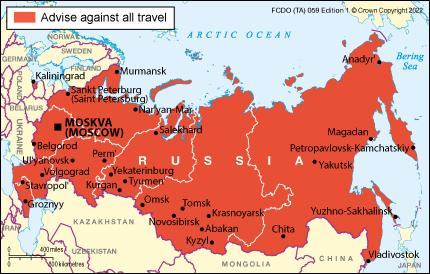
At least one official reading covers the whole country; no region is singled out.
Faithful summary of the official texts below, which prevail.
Global Affairs Canada — advises against all travel to the whole country.
Foreign Office — advises against all travel to the whole country.
an official reading covers the whole country; every trip calls for a written management decision, justified by a pressing reason, with reinforced conditions.
Global Affairs Canada — Open Government Licence – Canada (24.09.2026) · Foreign Office — Open Government Licence v3.0 · France Diplomatie (12.03.2026) · Natural Earth
No located event in this reading.
Last change: Updated information about drone attacks leading to short-notice restrictions on airspace use and airport operations (‘Warnings and insurance’ and ‘Safety and security’ pages).
Updated 28.12.2025
Do not travel to Russia for any reason due to terrorism , unrest , wrongful detention and other risks .
U.S. citizens in Russia should leave immediately
The U.S. government has limited ability to help U.S. citizens in Russia, especially outside of Moscow. The U.S. Embassy in Moscow has reduced its staff. The Russian government has also restricted travel for embassy personnel. All U.S. consulates in Russia have suspended operations, including consular services.
Do not travel to Russia for any reason
The U.S. Embassy in Moscow has limited ability to assist in the case of a detention of a U.S. citizen. There is no guarantee that the Russian government will grant the U.S. Embassy consular access to detained U.S. citizens. U.S. citizens may serve their entire prison sentence without release. The risk of wrongful detention of U.S. citizens remains high. Even if a case is determined wrongful, there is no guarantee of release.
Russian officials often question and threaten U.S. citizens without reason. Russian security services have arrested U.S. citizens on false charges. They have denied them fair treatment and convicted them without credible evidence. Russian authorities have opened questionable investigations against U.S. citizens for their religious activities.
There have been drone attacks and explosions near the border with Ukraine, and in Moscow, Kazan, St. Petersburg, and other large cities. In 2024, ISIS Khorasan claimed responsibility for the attack at Crocus Music Hall in Moscow. This attack killed 130 people. They also targeted places of worship in Dagestan. In an emergency, you should follow instructions from local authorities and seek shelter.
Dual citizenship
Russia will not recognize your U.S. citizenship if you are a dual U.S.-Russian citizen or have a claim to Russian citizenship.
Demonstrations
In Russia, peaceful assembly and freedom of speech are not protected rights. U.S. citizens should avoid protests and taking photos of…
10-13 6.8 · 10-14 8.8 · 10-15 19.3 · 10-16 16.2 · 10-17 10.0 · 10-18 7.3 · 10-19 6.2 m³/s
Simulated discharge: Open-Meteo.com (CC BY 4.0), data rounded and formatted by Maximum. Contains modified Copernicus Emergency Management Service information 2026. For information only: this is not a flood warning; only national or regional authorities issue those.
The level is national. Risk areas are in the state advisories below.
No major event in progress is located in this country at this morning's check.
Over 1 January 2026 → 30 June 2026, UCDP (Uppsala University) recorded 100 geolocated violent incidents in this country, for 173 documented deaths.
Most affected areas
Belgorod oblast 56 · Kursk oblast 15 · Bryansk oblast 11 · Krasnodar krai 6 · Rostov oblast 5 · Samara oblast 2
Most recent incidents
Source: UCDP Georeferenced Event Dataset (Uppsala Conflict Data Program), file GEDEvent_v26_01_26_06.csv, CC BY 4.0 licence. We keep only incidents UCDP codes as "Clear" and whose location is precise enough to be placed — about 58% of the dataset. An incident may be revised, moved or withdrawn by UCDP in a later release: these figures describe a closed period, not a live situation.
Reading: The homicide rate is 11 times Switzerland's: violence is a real risk there, concentrated in the areas named by the official advisories. On the road, 5 times more deaths than in Switzerland: road crashes are the leading cause of death of healthy travellers (CDC) — seat belt, no night driving, a driver or a taxi from a rank.
World Bank (UNODC for homicides, WHO for roads) — latest published valuedata.worldbank.org ↗read 10.10.2026
What we locate on the map are events in progress that have real coordinates: USGS earthquakes, GDACS disasters, NOAA storms and open NASA EONET events. Hover a dot for details, click to open it in this briefing.
French passport — France Diplomatie
Faithful summary of the official texts below, which prevail.
il est formellement déconseillé de se rendre dans l’ensemble du territoire de la Russie.France Diplomatie ↗updated 15.09.2026 · read 13.10.2026
- Présentation de la Russie
-
-
-
-
-
-
-
-
-
-
Dernière actualisation le 12/03/2026, information toujours valable à la date du jour
Dans le contexte de la guerre d’agression menée par la Russie en Ukraine, il est formellement déconseillé de se rendre dans l’ensemble du territoire de la Russie.
De nombreuses villes en Russie présentent un risque industriel majeur. Les normes russes diffèrent des normes européennes de type SEVESO et sont considérées moins contraignantes.
En cas d’accident industriel, il est essentiel de suivre rigoureusement les instructions diffusées par le ministère des Situations d’urgence ou EMERCOM .
La Russie n’est pas épargnée par la menace terroriste.
Suite à l’attentat survenu au Crocus City Hall, à Moscou, le 22 mars 2024, et dans le contexte de menaces terroristes réitérées par l’Etat islamique, il est conseillé de maintenir une vigilance accrue dans les lieux publics et les transports en commun, à proximité des lieux de rassemblement et événements de masse, notamment à l’égard de personnes au comportement suspect ou d’éventuels bagages abandonnés.
La situation générale sécuritaire en Russie varie d’une région à l’autre. La région de Moscou connait une forte diminution de la petite délinquance envers les touristes compte tenu du déploiement de la vidéo-surveillance. Toutefois la vigilance d’usage reste de rigueur.
Le chantage en ligne, les blocages informatiques et l’espionnage via Internet sont de plus en plus répandus. Le voyageur internaute est invité à la plus grande prudence lors de connexions à des réseaux publics et à la plus grande vigilance s’agissant des messages reçus durant le séjour.
Inondations, tempêtes, incendies, glissements de terrain, séismes sont autant de menaces à prendre en considération lors d’un séjour en Russie, en fonction de la destination.
Il convient, avant tout déplacement en Russie, de consulter les pages du site Conseils aux Voyageurs consacrées aux risques naturels .
En matière de transports, les accidents de la route constituent aujourd’hui le principal risque en Russie. Grâce aux campagnes menées par les autorités, la sécurité des transports s’est améliorée à Moscou, notamment pour les piétons, mais il convient de rester prudent.
Dans les régions reculées ou mal desservies la circulation automobile hors des axes récents peut être difficile en raison de la détérioration des chaussées et des risques climatiques. En cas d’accidents corporels et de blessures, le temps d’attente de l’assistance médicale peut être long.
Des groupes de hooligans sont susceptibles d’agir violemment à l’occasion de certains matchs de clubs du championnat de football russe. Il convient de rester vigilant lors des matchs.
Il est déconseillé d’évoquer les questions politiques, en particulier les questions liées à la guerre en Ukraine, en public ou avec des personnes inconnues.
Il est recommandé de :
La conduite automobile sur les lacs gelés en hiver est une pratique dangereuse qui requiert impérativement d’être accompagné d’un guide professionnel et d’un chauffeur expérimenté. Chaque année se produisent des accidents mortels. Les accidents sont plus nombreux à partir de mars, lorsque la température remonte. Il en est de même du trekking sur les lacs gelés qui nécessite un équipement et une préparation comparables à ce qui est nécessaire pour un trekking sur glacier.
Full text of the Security pagediplomatie.gouv.fr ↗updated 15.09.2026 · read 13.10.2026
Swiss passport — FDFA (Switzerland), in French
Faithful summary of the official texts below, which prevail.
FDFA update note — La description de la situation a été actualisée. Les recommandations restent valables de manière inchangée: Les voyages ainsi que les séjours non urgents à destination de la Russie sont déconseillés. (published 18.05.2026)
Les voyages ainsi que les séjours non urgents à destination de la Russie sont déconseillés. La situation en Russie est imprévisible en raison de la guerre contre l’Ukraine. À la suite de l'incursion des forces armées ukrainiennes sur le territoire russe en août 2024, des attaques visant les régions occidentales du pays et des cibles situées à Moscou et dans ses environs ainsi qu’une recrudescence des attaques contre les infrastructures énergétiques ont lieu. Les ports de chargement de pétrole, les raffineries et les dépôts de stockage et les cibles industrielles sont particulièrement touchés. Ces attaques font des victimes et des blessés. Le développement de la situation est incertain et une dégradation ultérieure ne peut être exclue. De nombreuses compagnies aériennes ont réduit ou suspendu leurs vols à destination de la Russie . Il n'y a pas de vols directs entre la Suisse et la Russie. Il faut s'attendre à des fermetures des aéroports de Moscou pouvant durer plusieurs heures. Certaines frontières avec la Russie sont également fermées par intermittence. Depuis le 1er décembre 2024, les aéroports de Moscou établissent des profils digitaux de ressortissants étrangers. Veuillez consulter le site de l'autorité : MID Russie Les retraits d'argent liquide ne sont parfois plus possibles. Les cartes de crédit les plus connues dans les pays occidentaux (p. ex. American Express, Mastercard, Visa) ne peuvent pas être utilisées pour le trafic des paiements quotidiens en Russie. Si vous voyagez en Russie avec une carte SIM étrangère , il est possible que l’accès à l'Internet mobile, aux SMS ou à d'autres services n’est pas possible pendant un certain temps après votre arrivée, voire pas du tout. L'achat d'une carte SIM pour le réseau local en Russie est soumis à diverses conditions pour les visiteurs étrangers et avère difficile. L’accès à certains sites Internet étrangers (y compris des médias) ainsi qu’aux médias sociaux étrangers a été bloqué. L'accès à Internet peut être temporairement bloqué dans certains quartiers ou certaines régions, ou le débit internet peut être réduit. Des affrontements violents sont possibles lors de manifestations sporadiques , en particulier à Moscou et à Saint-Pétersbourg. Les forces de sécurité répriment durement les manifestants. Des arrestations peuvent survenir. Les voyageurs étrangers courent le risque d'être arrêtés, interrogés ou détenus sans raison apparente. Ce risque existe également pour les ressortissants suisses et les doubles nationaux russes et suisses. Les autorités russes considèrent les personnes avec la double…
FDFA travel advice, in French, valid on 13.10.2026eda.admin.ch ↗updated 18.05.2026 · read 13.10.2026
British passport — Foreign Office (UK)
Faithful summary of the official texts below, which prevail.
Regions covered by the Foreign Officegov.uk ↗updated 18.09.2026 · read 13.10.2026

Warnings — Foreign OfficeForeign Office ↗updated 18.09.2026 · read 13.10.2026
Your travel insurance could be invalidated if you travel against advice from the Foreign, Commonwealth & Development Office (FCDO).
## FCDO advises against all travel to Russia
FCDO advises against all travel to Russia due to the risks and threats from its continuing invasion of Ukraine, including:
There is an increased risk of British nationals being detained in Russia, including if the Russian authorities suspect you of engaging in or supporting activities against Russian law, even if activities took place outside Russia. See ‘Risk of arrest and detention’ on ‘Safety and security’ .
Russia has a track record of targeting foreign nationals and holding them in detention as leverage over other countries. FCDO ’s ability to assist you in these circumstances is extremely limited.
There is also a high likelihood terrorists will try to carry out attacks, including in major cities. See ‘Safety and security’ .
Ongoing drone attacks and associated Russian air-defence activity may increase risks to civilian aviation and can lead to short-notice restrictions on airspace use and airport operations. See ‘Safety and security’
The British Embassy in Moscow and British Consulate in Ekaterinburg are open, but the situation could change at short notice.
In-person UK government support in Russia is limited. It is very limited in parts of Russia because of the security situation and the size of the country, particularly in the North Caucasus.
If you need support, call our 24-hour helpline +7 495 956 7200 and select the option for consular services for British nationals.
Contact the Russian emergency services on 112.
If you hold both British and Russian nationality, Russian authorities will treat you as a Russian citizen. This limits the consular assistance the UK government can provide. If you are arrested or detained, Russian authorities are unlikely to allow UK consular staff to visit or assist you.
Russian nationals are required to notify Russian authorities of any second nationality, including British, within 60 days of acquiring that nationality, or within 60 days of returning to Russia if the British/ foreign nationality was obtained outside of Russia. Parents are responsible for notification on behalf of their children aged under 18. Failure to comply can result in criminal liability. Your British passport may be confiscated by the Russian authorities and not returned. Penalties can include a fine of up to 200,000 Russian rubles (or up to one year of income) and/or compulsory work for up to 400 hours.
Russia operates a conscription-based military system. Men aged 18 to 30 with Russian citizenship may be called up for two-year compulsory military service. Conscription campaigns continue throughout the year.
Russian law prevents eligible individuals from leaving Russia once their draft notice appears on the federal electronic draft register.
If you receive a conscription notice via your account on the Russian State Services portal, you will be prohibited from leaving Russia. Failure to report to the conscription point within seven days of receiving the notice may result in penalties, restrictions on your rights, or detention.
In addition to regular conscription, Russia has declared a partial mobilisation. Military recruitment is ongoing, and anyone with Russian citizenship may be drafted.
If you choose to travel, research your destinations and get appropriate travel insurance . Insurance should cover your itinerary, planned activities and expenses in an emergency.
Safety — Foreign OfficeForeign Office ↗updated 18.09.2026 · read 13.10.2026
There is a high threat of terrorist attack globally affecting UK interests and British nationals, including from groups and individuals who view the UK and British nationals as targets. Stay aware of your surroundings at all times.
UK Counter Terrorism Policing has information and advice on staying safe and what to do in the event of a terrorist attack. Find out how to reduce your risk from terrorism while abroad .
Terrorists are very likely to try to carry out attacks in Russia.
Terrorist attacks could be indiscriminate, including in places visited by foreign nationals, such as:
Terrorist attacks have taken place in Moscow and St Petersburg and other Russian cities in recent years, resulting in large numbers of casualties. Russia’s aviation has also been targeted.
Examples of recent attacks include:
Additional counter-terrorism procedures and restrictions may still be in place across the country. Stay aware of your surroundings, keep up to date with local media reports and follow the advice of local authorities.
Terrorists are active in the North Caucasus. They have carried out a number of attacks mainly in Russia’s Dagestan region.
Security services carry out regular counter-terrorism operations in the North Caucasus and across Russia. These can happen at short notice and may lead to travel restrictions.
Examples of recent attacks include:
The Russian invasion of Ukraine continues. There are reports of drone attacks and explosions in Russia, particularly near the Russian border with Ukraine, but also in and near large cities and infrastructure sites across Western and Central Russia. Associated Russian air defence activity may pose a threat to civilian aviation. Air space may close during drone attacks. This has led to frequent and unpredictable delays, diversions and cancellations to flights in and out of Russian airports. There have been several shootings in Moscow, often near to apartment blocks. There has also been a bombing near to a Moscow railway station.
Check local media for the latest information. Be vigilant and avoid any political demonstrations or gatherings.
The situation remains unpredictable and could escalate without warning.
If you do not need to be in Russia, the FCDO strongly advises you to consider leaving.
You cannot fly directly from Russia to the UK or through EU countries. There are limited commercial airlines with indirect flights including through the Middle East, Serbia, Azerbaijan, Central Asia, Georgia and Turkey. Check the latest information with your airline or travel provider.
Land borders may be busy or closed. Be prepared for a long wait to exit Russia. Officials may question you at the border. During periods of unrest, check the local media for updates before travelling.
Check entry requirements in:
These and other European countries have restricted or…
American passport — U.S. Department of State
Faithful summary of the official texts below, which prevail.
Russia - Level 4: Do Not Travel 2025-12-28travel.state.gov ↗updated 28.12.2025 · read 13.10.2026
Do not travel to Russia for any reason due to terrorism , unrest , wrongful detention and other risks .
U.S. citizens in Russia should leave immediately
The U.S. government has limited ability to help U.S. citizens in Russia, especially outside of Moscow. The U.S. Embassy in Moscow has reduced its staff. The Russian government has also restricted travel for embassy personnel. All U.S. consulates in Russia have suspended operations, including consular services.
Do not travel to Russia for any reason
The U.S. Embassy in Moscow has limited ability to assist in the case of a detention of a U.S. citizen. There is no guarantee that the Russian government will grant the U.S. Embassy consular access to detained U.S. citizens. U.S. citizens may serve their entire prison sentence without release. The risk of wrongful detention of U.S. citizens remains high. Even if a case is determined wrongful, there is no guarantee of release.
Russian officials often question and threaten U.S. citizens without reason. Russian security services have arrested U.S. citizens on false charges. They have denied them fair treatment and convicted them without credible evidence. Russian authorities have opened questionable investigations against U.S. citizens for their religious activities.
There have been drone attacks and explosions near the border with Ukraine, and in Moscow, Kazan, St. Petersburg, and other large cities. In 2024, ISIS Khorasan claimed responsibility for the attack at Crocus Music Hall in Moscow. This attack killed 130 people. They also targeted places of worship in Dagestan. In an emergency, you should follow instructions from local authorities and seek shelter.
Dual citizenship
Russia will not recognize your U.S. citizenship if you are a dual U.S.-Russian citizen or have a claim to Russian citizenship.
Demonstrations
In Russia, peaceful assembly and freedom of speech are not protected rights. U.S. citizens should avoid protests and taking photos of…
Global Affairs Canada — additional reading
Avoid all travel
Avoid all travel to Russia due to the impacts of the armed conflict with Ukraine and the risk of terrorism.
Open Government Licence – Canada · September 24, 2026 08:53 EDTtravel.gc.ca ↗updated 24.09.2026 · read 13.10.2026
Faithful summary of the official texts below, which prevail.
Global Affairs Canada — written for Canadian travellers, valid for all
You must abide by local laws. Learn about what you should do and how we can help if you are arrested or detained abroad.
Certain Canadian institutions, including NGOs, community organizations and educational institutions are considered “undesirable” by the Russian authorities. If you have a current or previous affiliation with these groups, you may be denied entry to Russia or face increased scrutiny at the border or in the country. You may face deportation if you are already in Russia.
Authorities frequently perform random identity checks in public places. You must carry the following identification documents at all times:
You may be fined or detained if you cannot provide proper documentation to Russian authorities. Only the special police of the Federal Migration Bureau have the authority to arrest, detain and impose fines on improperly documented foreigners. If you are stopped in the street and requested to pay a fine, ask to see the officer’s name and identification, and to contact the Embassy of Canada to Russia in Moscow.
Penalties for possession, use or trafficking of illegal drugs are severe. Convicted offenders can expect jail sentences and heavy fines. Drugs, alcohol and travel
It is illegal for minors (those under 18) to participate in unauthorized protests. Adults who involve minors in such protests could face up to 15 days in jail and fines of up to RUB1 million.
Although the laws of Russia do not prohibit homosexual activity, Russian federal law prohibits public actions that are described as promoting homosexuality and “non-traditional sexual relations.” Since January 2024, Russian law treats organizations advocating for 2SLGBTQI+ persons or issues as “extremist.” Previous laws banning “LGBT propaganda” and “the international LGBT movement” reflect an increasingly restrictive environment for 2SLGBTQI+ persons and their allies. Actions that contravene or appear to contravene this law may lead to arrest, a fine, jail time and deportation. Examples of such actions include:
Same sex marriage is not recognized in Russia. Homosexuality isn’t socially accepted. Travel and your sexual orientation, gender identity, gender expression and sex characteristics
The Hague Convention on the Civil Aspects of International Child Abduction is an international treaty. It can help parents with the return of children who have been removed to or retained in certain countries in violation of custody rights. It does not apply between Canada and Russia. If your child was wrongfully taken to, or is being held in Russia by an abducting parent:
If your child was removed from a country other than Canada, consult a lawyer to determine if The Hague Convention applies. Be aware that Canadian consular officials cannot interfere in private legal matters or in another country's judicial affairs.
Religious activity is heavily regulated in Russia. If you plan to engage in religious activity, such as missionary work, make sure you do not break local laws.
You should carry an international driving permit. You may drive with a Canadian driver’s licence if you carry a notarized Russian translation. You must obtain a local permit if you stay longer than 6 months. The legal blood alcohol content limit is significantly lower than in Canada. Those found guilty of drinking and driving can expect heavy fines, suspension of their driving permit and immediate detention. Repeat offenders may face prison sentences. The traffic police can impose fines on drivers for traffic violations. They can conduct identity checks on pedestrians, but they are not authorized to impose fines. The same is true of police in the underground metro systems. International Driving Permit
The importation and use of electronic equipment are strictly controlled. Foreigners have faced charges of espionage for possessing improperly certified GPS devices, such as those used for geological mapping. You must obtain a certificate from the Ministry of Culture to export items that appear old (prior to 1945) or may have cultural value. Customs officials may conduct thorough baggage searches and can arrest you if you don’t have the necessary certificate. Contact the nearest Russian embassy or consulate or consult the Federal Customs Service prior to departure for up-to-date information on customs requirements. Foreign diplomatic missions and consulates in Canada
The currency of Russia is the Russian ruble (RUB). Following the Russian invasion of Ukraine, major Western-issued credit card corporations no longer operate in Russia. Credit and debit cards from outside of Russia will not work at banks, businesses, or ATMs within Russia. ATMs are common in major cities and will accept cards issued in Russia. It is illegal to pay for goods and services in foreign currency. You can exchange U.S. dollars at any exchange bureau. Carry new, crisp bills as worn or used U.S. banknotes may not be accepted. In major cities, you can usually exchange Euros and U.S. dollars at various banks.
Open Government Licence – Canada · September 24, 2026 08:53 EDTtravel.gc.ca ↗updated 24.09.2026 · read 13.10.2026
Foreign Office — laws and cultural differences
Always carry your passport with you as ID. Police carry out random checks, especially during periods of high security. You could get a fine or be detained for up to 48 hours if you cannot show your passport when asked. Copies are not accepted.
You can be prosecuted for possessing even small quantities of any drugs, including cannabis. You should expect a long jail sentence and heavy fines for possessing, using or smuggling illegal drugs, including when transiting through the airport. Airports in Russia have excellent technology and security for detecting illegal items. This is also used to scan the baggage of transiting passengers.
Access to some areas, such as military and border zones, is restricted. You must get permission from local authorities before entering. If you do not have permission, the authorities may arrest, fine or deport you. You can find a list of restricted areas online (in Russian, you may not be able access the site from outside of Russia). Check with your tour operator or the Russian Embassy in the UK if you’re unsure whether a tour or excursion will take you into a restricted area.
Photography is illegal at any military, secure or official sites, including airports. There may not be warning signs in locations where photography is banned. You could be detained or arrested if you break the law.
Due to current military activities, it is illegal to use drones in some regions. Check restrictions with the local authorities. You must get permission from the Russian aviation authority (in Russian) before using any unmanned aircraft systems (drones) in Russian airspace. You must tell them the flight route at least 24 hours in advance and keep in regular contact with them before and during the flight. You will get a fine if you do not comply.
If you travel to Russia with a non-Russian SIM card, you may not be able to access mobile internet, SMS or other services. Buying a local-network SIM card in Russia can be difficult for visitors and could take up to 2 weeks to complete. Make sure your friends and relatives know how to contact you if your mobile phone does not work. You need to present your passport or other ID and pass biometric checks to buy a Russian sim card from local providers in Russia. You may be asked to perform these checks even if you have had a local SIM for some time. You can continue using your UK SIM in Russia without any local identity checks as long as your UK mobile company provides roaming service for Russia. Any SIM which has not been connected to the Russian network for 72 hours will not be able to connect to the internet or send SMS when they are first switched on. You may have to wait for some time for the services to resume. This may vary from several hours to several days. Some networks may allow you to complete a set of actions to get your access restored quicker. Make sure friends and relatives know how to contact you if your mobile phone does not work.
There are increasing restrictions to limit access to content posted on the internet, including social media platforms. Meta (Facebook and Instagram), X and LinkedIn are blocked in Russia. Access to other websites can be unreliable. More information is available from the Federal Service for Surveillance of Communications, Information Technology and Mass Media (in Russian).
Most visitors experience no problems, but racial discrimination can happen in some areas. If you’re of African, Asian or Caribbean descent, you may receive unwanted attention in public places. Take care, particularly when travelling late at night.
Homosexuality is not illegal in Russia but there are considerable legislative restrictions which target the LGBT+ community. In January 2024 a Russian Supreme Court judgement came into force banning the so-called ‘international LGBT movement’ and designating it as ‘extremist’. ‘LGBT propaganda’ legislation bans people from promoting ‘non-traditional sexual relations’. If charged, foreign citizens could face:
Attitudes towards the LGBT+ community and LGBT+ issues are less tolerant than in the UK and vary in different locations. Government officials have made derogatory comments to LGBT+ individuals. Same-sex couples showing affection in public may receive negative attention. There are no laws to protect LGBT+ people from discrimination on the grounds of sexual orientation or gender identity. Recent laws targeting LGBT+ communities include:
In November 2023, the Russian Supreme Court banned the so-called ‘international LGBT movement’, designating it as ‘extremist’. The court provided no definition of ‘international LGBT movement’. Displaying ‘extremist’ symbols and being a member of and donating money to ‘extremist’ organisations are criminal offences. This decision came in to force in January 2024. It is unclear how the authorities will implement the ruling but there have been reports of persecution for displaying the rainbow flag, considered by the authorities as a ‘symbol of an extremist organisation’. Harassment, threats and
Russia has banned surrogacy for all foreign nationals except those married to Russian citizens. Read about surrogacy arrangements in foreign countries.
Some religious activities are restricted, including preaching and distributing religious materials. Jehovah’s Witnesses are considered an extremist organisation in Russia. They can face harassment from authorities, including detention, particularly at places of worship. Some other minority religious groups, like Scientologists, also face discrimination.
Open Government Licence v3.0gov.uk ↗updated 18.09.2026 · read 13.10.2026
What it changes for you: Air acceptable at this hour: nothing special to plan.
Reading 01:00 (Europe/Moscow)Open-Meteo ↗updated 14.10.2026 · read 13.10.2026
Air quality and UV: Open-Meteo.com (CC BY 4.0), data rounded and formatted by Maximum. Contains modified Copernicus Atmosphere Monitoring Service information 2026. Neither the European Commission nor ECMWF is responsible for any use that may be made of the Copernicus information or data it contains.
Reading: Medical density comparable to Switzerland: the local network handles most cases; repatriation remains a question of convalescence and cost. Health spending of 1,003 USD per person (Switzerland: 11,784) goes with private hospitals that bill foreigners in hard currency and ask for a guarantee before admission: the direct payment guarantee is what avoids the deposit.
World Bank — latest published value, year per indicatordata.worldbank.org ↗read 10.10.2026
French passport — France Diplomatie
Faithful summary of the official texts below, which prevail.
- Présentation de la Russie
-
-
-
-
-
-
-
-
-
-
Les ressortissants français doivent être munis d’un visa pour transiter par la Fédération de Russie ou pour y séjourner. Les demandes de visa doivent être présentées aux autorités consulaires russes du pays de résidence.
En savoir plus sur le site de l’ambassade de Russie en France .
A titre expérimental, à compter du 1er décembre 2024 et jusqu’au 30 juin 2026, au moment du contrôle aux frontières, les ressortissants étrangers arrivant en Russie (ou la quittant) par les aéroports internationaux de Cheremetievo, Domodedovo et Vnoukovo et de Joukovski (région de Moscou) et par le poste frontière Machtakovo (région d’Orenbourg) seront soumis à l’enregistrement de leurs données biométriques. Une photographie sera prise au moment du contrôle aux frontières et leurs empreintes digitales seront relevées à plat et numérisées.
Ces mesures ne s’appliqueront pas aux :
Un passeport en cours de validité, comportant au moins deux pages vierges accolées, est nécessaire pour se rendre en Russie. La date d’expiration du passeport doit être postérieure d’au moins 6 mois à la date de validité du visa demandé. En cas de vol (ou de perte) de passeport et de documents d’identité, il convient de faire une déclaration au poste de police le plus proche. La déclaration de vol est nécessaire à la délivrance par les autorités consulaires françaises d’un laissez-passer sur présentation d’une photo d’identité, d’une photocopie d’une pièce d’identité et de l’équivalent de 55€ en roubles.
Tous les étrangers arrivant en Russie doivent obligatoirement remplir une carte de migration. Ce document, visé par les gardes-frontières, certifie le passage légal de la frontière russe. En cas de détérioration ou de perte de la carte, il est nécessaire d’en faire la déclaration sous trois jours auprès d’une représentation locale du ministère de l’Intérieur (MVD) pour en obtenir gratuitement un duplicata. La carte migratoire est rendue aux gardes-frontières à la sortie du territoire russe.
Il est interdit aux voyageurs de nationalité non-russe et non-biélorusse de franchir la frontière terrestre entre la République de Biélorussie et la Fédération de Russie, que ce soit par la route ou en train. Les contrevenants s’exposent à des poursuites. Le franchissement de la frontière est possible en avion.
Les autorités russes ne délivrent pas de carte migratoire aux voyageurs arrivant de Biélorussie par voie aérienne. Les passagers en transit doivent impérativement la solliciter auprès des gardes-frontières en arrivant sur le sol biélorusse, où ce document n’est plus délivré systématiquement. La carte migratoire est un document obligatoire en Russie, le voyageur ne pouvant pas la présenter se verra refuser l’accès des hôtels et risque une amende et une interdiction de territoire.
Les autorités finlandaises ont prorogé la fermeture des points de passage frontaliers avec la Russie à Vaalimaa, Niirala, Imatra, Kuusamo, Nuijamaa, Salla, Vartius et Raja-Joosepi jusqu’à nouvel ordre et autant que jugé nécessaire. Pour plus d’informations, voir le site officiel des autorités finlandaises . Par ailleurs, le ministère estonien des Affaires étrangères a annoncé la fermeture à la circulation routière, à compter du 1er février 2024 du poste frontière de Narva-Ivangorod en raison de travaux de rénovation de celui-ci menés du côté russe. Ces travaux devraient durer jusqu’à la fin de l’année 2025. Le poste-frontière de Narva-Ivangorod restera cependant ouvert aux piétons. Les autres postes frontières avec la Russie, situés au sud de l’Estonie, resteront ouverts. Pour plus d’informations, voir le site de la police des frontières .
À l’arrivée sur son lieu de séjour, le ressortissant étranger présente à son établissement d’accueil (hôtel, propriétaire de logement, …) son passeport et sa carte de migration en vue de procéder à son enregistrement. Lorsque le voyageur est hébergé dans un hôtel, c’est l’hôtel qui notifie son arrivée aux autorités russes. L’établissement d’accueil remet au ressortissant étranger la partie détachable de la notification. La possession par un ressortissant étranger de la partie détachable de la notification visée par les autorités russes atteste de son enregistrement.
Pour quitter la Fédération de Russie, il faut être muni d’un visa en cours de validité. En cas de dépassement du temps de séjour autorisé ou d’absence d’enregistrement auprès des autorités russes, le voyageur n’est pas autorisé à quitter le territoire tant que sa situation n’est pas régularisée (prolongation de visa - paiement d’une amende). Cette formalité peut prendre plusieurs heures. Si les motifs invoqués ne sont pas considérés comme légitimes, une mesure d’expulsion peut être prise, accompagnée d’une interdiction du territoire d’une durée maximum de 5 ans.
Le voyageur est invité à respecter rigoureusement la durée du séjour qui lui a été accordé par les services consulaires russes.
Les voyageurs français se rendant dans les différentes Républiques de la Communauté des États Indépendants (pays du Caucase et Asie centrale) et transitant par la Fédération de Russie doivent obligatoirement être détenteurs d’un visa de transit russe. Le visa du pays de destination n’est pas valable pour transiter par la Russie. En cas de retour en France via la Russie, un visa deux entrées ou à entrées multiples est nécessaire.
La police est autorisée à vérifier à tout moment l’identité d’une personne. Le voyageur doit toujours être en possession d’une copie de son passeport et de son visa en cours de validité. À défaut, le voyageur peut être placé en garde à vue pour une durée maximum de 3 heures afin d’établir son identité. En cas de contrôle, le policier doit alors décliner son identité, son rang et le motif de l’interpellation. Toute résistance peut se traduire par un allongement de la garde à vue. En tant que ressortissant étranger, le voyageur dispose du droit de demander un interprète, un avocat, ainsi qu’un appel à un proche. Il peut demander à ce que son consulat soit informé.
Il peut également refuser de signer un document s’il ne le comprend pas. Pour en savoir plus sur la loi fédérale sur la police sur le site du ministère des Affaires intérieures .
Entry and stay pagediplomatie.gouv.fr ↗updated 15.09.2026 · read 13.10.2026
Swiss passport — FDFA (Switzerland)
The FDFA does not publish entry requirements: they are set out by the destination's embassy or consulate in Switzerland — check them before booking, passport in hand. As a guide, the French and British requirements below describe the same rules as seen by two other governments.eda.admin.ch ↗updated 18.05.2026 · read 13.10.2026
British passport — Foreign Office (UK)
Faithful summary of the official texts below, which prevail.
Entry requirements — rules for a British passportForeign Office ↗updated 18.09.2026 · read 13.10.2026
This information is for people travelling on a full ‘British citizen’ passport from the UK who choose to travel against Foreign, Commonwealth & Development Office ( FCDO ) advice. It is based on the UK government’s understanding of Russia’s current rules for the most common types of travel.
The authorities in Russia set and enforce entry rules. If you’re not sure how these requirements apply to you, contact the Russian Embassy or a consulate in the UK .
Foreigners entering Russia will be required to register, on arrival, their biometric details such as fingerprints and photographs.
To enter Russia, your passport must have an ‘expiry date’ at least 6 months after the date your visa expires.
You cannot enter Russia using a visa in an expired passport, even if you’re also carrying a new, valid passport. You will need to apply for a new visa or visa transfer.
Sign your passport before you travel if it was issued after January 2017. Some British nationals have been denied entry for not signing their passports.
Check with your travel provider that your passport and other travel documents meet requirements. Renew your passport if you need to.
You will be denied entry if you do not have a valid travel document or try to use a passport that has been reported lost or stolen.
Children under 18 years old must carry a notarised travel permission from one of their parents or legal guardians if they’re travelling out of Russia without their parent or legal guardian.
When returning to the UK, British citizens must carry a valid British passport or certificate of entitlement . See Dual citizenship .
If you have dual British-Russian nationality and travel to Russia to renew your Russian passport, it may take up to 4 months to get your new passport. You will not be able to leave Russia on your British passport if you entered Russia on your Russian passport. You will have to stay in Russia until your new Russian passport is issued.
Children born outside of Russia and added to their parents’ Russian passports may need their own passport to leave Russia. Check with the Russian Embassy in the UK before you travel.
See Warnings and insurance page for information about severely limited UK government support and compulsory military service for British-Russian dual nationals.
You must get a visa before you travel.
See the Russia Visa Centre for further information on how to apply for a visa, including processing time and fast track services.
If you live in the UK and are aged 12 or over, you must go to a visa application centre in London, Manchester or Edinburgh to submit biometric data (fingerprints).
If you’re a British national with a Russian national in your immediate family, you can apply for a multi-entry private visa for up to one year. Check what you need for your stay with the Russian Embassy in the UK .
The Russian authorities strictly enforce visa and immigration laws. Before you travel, check:
American passport — U.S. Department of State
The State Department publishes the requirements ("Entry, Exit and Visa Requirements") on its country page, which our servers cannot read. Read it before you go; as a guide, the French and British requirements below describe the same rules as seen by two other governments.travel.state.gov ↗updated 28.12.2025 · read 13.10.2026
For each risk, the official texts themselves: what is happening, then, where they say so, what to do.
What the texts say · Terrorists are very likely to try to carry out attacks in Russia. Violent crime occurs frequently, sometimes targeting foreigners of non-European descent.
What the texts say · There have been several shootings in Moscow, often near to apartment blocks.
What the texts say · Forest fires are common between July and September, particularly in Siberia. Heavy rains, particularly during spring and summer, can cause flooding and landslides.
What the texts say · Homosexuality is not illegal in Russia but there are considerable legislative restrictions which target the LGBT+ community.
What the texts say · Local authorities scrutinize communications.
Sentences copied word for word from the official texts cited, chosen for the destination; the level is our reading. The full texts, at each source:Foreign Office ↗updated 18.09.2026 · read 13.10.2026 (updated 18.09.2026 · read 27.09.2026)Global Affairs Canada ↗updated 24.09.2026 · read 13.10.2026 (updated 24.09.2026 · read 27.09.2026)
Reading: The homicide rate is 11 times Switzerland's: violence is a real risk there, concentrated in the areas named by the official advisories. On the road, 5 times more deaths than in Switzerland: road crashes are the leading cause of death of healthy travellers (CDC) — seat belt, no night driving, a driver or a taxi from a rank.
World Bank (UNODC for homicides, WHO for roads) — latest published valuedata.worldbank.org ↗read 10.10.2026
Time zone: IANA and timezone-boundary-builder (ODbL) · RESTCountries · EmergencyNumberAPI · Wikidata · European Central Bank
Places: © OpenStreetMap contributors (ODbL), Photon search by komoot.
Maximum policyholder: before paying anything, call the 24/7 number. If you are admitted for more than 24 h, Maximum sends its direct payment guarantee to the hospital (art. 2.12).
+41 22 ••• •• •• — Full number in your client areaNone of these facilities is a Maximum Insurance “partner”, and none is presented as waiving upfront payment: this list is a reading of public map data, nothing more. A direct payment guarantee is arranged CASE BY CASE by our assistance desk, facility by facility and when the need arises — one number, +41 22 ••• •• ••.
List read from OpenStreetMap on 30.09.2026, not read again since: these facilities may have changed.
CDC Travelers' Health recommendations, most important first. They depend on your age, vaccines and itinerary: confirm them with a doctor or a travel clinic 4 to 6 weeks before departure. Details, disease by disease ↗cdc.gov ↗read 10.10.2026
The health system — Medical density comparable to Switzerland: the local network handles most cases; repatriation remains a question of convalescence and cost. Health spending of 1,003 USD per person (Switzerland: 11,784) goes with private hospitals that bill foreigners in hard currency and ask for a guarantee before admission: the direct payment guarantee is what avoids the deposit.
Back home — a fever in the following weeks should be told to a doctor, naming the country.
Forecast: MET Norway (Norwegian Meteorological Institute, CC BY 4.0), grouped by day and formatted by Maximum.
French passport — French embassy and consulates
phone not published
https://ru.ambafrance.org/-Consulat-genera ↗
phone not published
https://ru.ambafrance.org/-Konsul-stvo-v-S ↗
37 переулок Журавлёва, Ростов-на-Дону
phone not published
phone not published
Useful contacts listed by France Diplomatie (in French)diplomatie.gouv.fr ↗updated 15.09.2026 · read 13.10.2026
Updated: 15 September 2026
OpenStreetMap
Swiss passport — Swiss embassy and consulates
2/5 переулок Огородная Слобода, 101000, Москва
phone not published
191123
+7 812 3270817
https://www.eda.admin.ch/stpetersburg ↗updated 18.05.2026 · read 13.10.2026
phone not published
Numéro d'urgence général: 112 (depuis un téléphone mobile), russe et anglais Numéro d’urgence de la police: 102 (depuis un téléphone mobile) / 02 (depuis un téléphone fixe) Numéro d’urgence du service d'ambulance: 103 (depuis un téléphone mobile) / 03 (depuis un téléphone fixe) Dispositions douanières Russes: Federal Custom Service Représentations suisses à l’étranger: En cas de situation d’urgence à l’étranger, vous pouvez vous adresser à la Représentation Suisse la plus proche ou à la Helpline DFAE. Ambassade de Suisse en Russie Helpline DFAE
OpenStreetMap · DFAE
British passport — British embassy and consulates
phone not published
10 Смоленская набережная, 121099, Москва
phone not published
https://www.gov.uk/world/organisations/bri ↗updated 18.09.2026 · read 13.10.2026
5 Лафонская улица, 191124
phone not published
https://www.gov.uk/world/organisations/bri ↗updated 18.09.2026 · read 13.10.2026
15A улица Гоголя, 620075, Екатеринбург
phone not published
https://www.gov.uk/world/organisations/bri ↗updated 18.09.2026 · read 13.10.2026
OpenStreetMap
American passport — U.S. embassy and consulates
10 с1 Спасопесковская площадь, Москва
phone not published
http://moscow.usembassy.gov/spaso.html ↗updated 28.12.2025 · read 13.10.2026
1 с1 площадь Донецкой Народной Республики, 121099, Москва
+7 495 7285000
https://ru.usembassy.gov/ ↗updated 28.12.2025 · read 13.10.2026
1 площадь Донецкой Народной Республики, 121069, Москва
phone not published
1 с2 площадь Донецкой Народной Республики, 121099, Москва
phone not published
32 Пушкинская улица, Владивосток
phone not published
OpenStreetMap
OpenStreetMap
Getting help — Foreign OfficeForeign Office ↗updated 18.09.2026 · read 13.10.2026
The Foreign, Commonwealth & Development Office ( FCDO ) cannot provide tailored advice for individual trips. Read this travel advice and carry out your own research before deciding whether to travel.
Telephone: 112 (ambulance, fire, police)
Contact your travel provider and your insurer if you are involved in a serious incident or emergency abroad. They will tell you if they can help and what you need to do.
See how to get help from the UK government abroad including in an emergency.
You can call FCDO in London if you need urgent help because something has happened to a friend or relative abroad.
Telephone: 020 7008 5000 (24 hours)
Find out about call charges
For emergencies. If pronunciation fails, show the screen — or the printed page.
| Help! | Помогите!Pomogite! |
| Call an ambulance! | Вызовите скорую помощь!Vyzovite skoruyu pomoshch! |
| I need a doctor. | Мне нужен врач.Mne nuzhen vrach. |
| Where is the nearest hospital? | Где ближайшая больница?Gde blizhayshaya bolnitsa? |
| Call the police! | Вызовите полицию!Vyzovite politsiyu! |
| I am allergic to penicillin. | У меня аллергия на пенициллин.U menya allergiya na penitsillin. |
| I have international medical insurance. | У меня есть международная медицинская страховка.U menya yest mezhdunarodnaya meditsinskaya strakhovka. |
| I want to contact my embassy. | Я хочу связаться со своим посольством.Ya khochu svyazatsya so svoim posolstvom. |
| Please take me to this address. | Отвезите меня по этому адресу, пожалуйста.Otvezite menya po etomu adresu, pozhaluysta. |
| Do you speak English? | Вы говорите по-английски?Vy govorite po-angliyski? |
Translations by Maximum Insurance, original script and transliteration.
Actions to take before each professional trip abroad.
Live alerts and level changes, each with its official source. Continuously updated.
Les déplacements en Russie sont formellement déconseillés. Le contexte sécuritaire en Russie est en effet caractérisé d’une part par la poursuite de la guerre d’agression russe contre l’Ukraine et d’autre part par le durcissement de la législation pénale russe et le risque d’arrestation et de détention arbitraires de ressortissants de pays déclarés « inamicaux » par les autorités russes. Les régions russes frontalières de l’Ukraine (oblasts de Koursk, Belgorod, Briansk,…
France Diplomatie (in French) · posted 30 March 2026 · updated 9 September 2026diplomatie.gouv.fr ↗updated 15.09.2026 · read 13.10.2026Health – editorial change
September 24, 2026 08:53 EDTtravel.gc.ca ↗updated 24.09.2026 · read 13.10.2026No level change recorded for this country since the log opened. The live alerts above are updated continuously.
Level 4/4 — Do Not Travel, U.S. Department of State, retrieved on 13 October 2026.
Sourcestravel.state.gov · updated 28.12 · read 13.10France Diplomatie · updated 15.09 · read 13.10DFAE · updated 18.05 · read 13.10207-country comparison
An area advised against does not rule out the country.
SourcesFrance Diplomatie · updated 15.09 · read 13.10Foreign Office · updated 18.09 · read 13.10State Department · updated 28.12 · read 13.10
The rules depend on the passport, not on the destination alone.
SourcesFrance Diplomatie · updated 15.09 · read 13.10Foreign Office · updated 18.09 · read 13.10State Department · updated 28.12 · read 13.10
For a Schengen visa, yes: at least €30,000 of travel medical insurance (Regulation (EC) No 810/2009, art. 15).
SourcesRegulation (EC) 810/2009, art. 15General conditions, policy 20 00 479
VIP Pack — $990 for twelve months, unlimited trips.
SourcesGeneral conditions, policy 20 00 479OpenStreetMap · read 10.10
Six steps, in this order.
SourcesSpecial conditions 01.26General conditions, policy 20 00 479
Local emergency services: single number 112 · police 02 / 102 · ambulance 03 / 103 · fire 101
SourcesEmergencyNumberAPI · Wikidata · read 08.10OpenStreetMap · read 10.10
At today's level 4/4, card by card:
SourcesAmex Platinum France T&Cs, 01.2025 — general exclusion n° 11BNP Paribas Visa Infinite notice (policy PT7), 04.2025 — comFortuneo World Elite Mastercard notice, 01.2026 — art. 5.5 '
A health plan reimburses at home; here, the hospital asks for a payment guarantee before admission.
SourcesGeneral conditions, policy 20 00 479
Around Moscow: 80 hospitals and clinics, 7 with a 24/7 emergency room, 40 pharmacies, 40 doctors' practices (OpenStreetMap, hospital list read on 30.09.2026).
The sourced detail is under Medical network › Health: vaccines, diseases present, altitude, outbreaks.
SourcesCDC Travelers' Health · read 10.10France Diplomatie · updated 15.09 · read 13.10OMS · updated 10.10 · read 13.10Foreign Office · updated 18.09 · read 13.10
5.1 physicians per 1,000 people (2022) versus 4.5 in Switzerland.
SourcesWorld Bank · read 10.10General conditions, policy 20 00 479
6.8 homicides per 100,000 people (2021) versus 0.6 in Switzerland and 1.3 in France.
The nearest representations, by passport (OpenStreetMap):
SourcesOpenStreetMap · read 10.10DFAE · updated 18.05 · read 13.10
At least one official reading covers the whole country; no region is singled out.
SourcesGlobal Affairs Canada · updated 24.09 · read 13.10Foreign Office · updated 18.09 · read 13.10France Diplomatie · updated 15.09 · read 13.10
Local laws apply to every traveller; here is what the official texts say.
SourcesGlobal Affairs Canada · updated 24.09 · read 13.10Foreign Office · updated 18.09 · read 13.10
Every foreign ministry runs a 24/7 emergency line for its nationals.
Sourcesdiplomatie.gouv.fr · updated 15.09 · read 13.10eda.admin.ch · updated 18.05 · read 13.10
Emergency phrases, to show if pronunciation fails:
SourcesMaximum Insurance
Keep the entry stamp, the invoices, the prescriptions and the medical report.
SourcesGeneral conditions, policy 20 00 479
Cancellation or change up to CHF 20,000, special risk CHF 5,000 per person, crisis management and security, optional Kidnap & Ransom.
SourcesGeneral conditions, policy 20 00 479
A question not answered here? Ask Maximum below, or call the support number: every question gets a clear, actionable answer.
In a life-threatening emergency, call local emergency services first, then Maximum: +41 22 ••• •• •• — 24/7 support number, an adviser stays with you to the end.
The 207 country pages — hospitals, pharmacies, police, embassies, emergency numbers, official advice from four governments, health, safety in figures, events in progress — read around the city you name. Your policy — benefits, the six steps, claims, articles. The site — prices, certificate, subscription. Nothing else: what it does not know, it says so and hands you to an adviser.
Same advisory level: Afghanistan · Myanmar · Belarus · Burkina Faso · DR Congo · North Korea
The displayed level comes from the State Department, checked every morning. Before departure, always cross-check your country of residence's advisory: that is what your policy cites.
The level shown is the official U.S. Department of State level, checked daily. Maximum Insurance is an insurance distributor — general information, not personal advice.
The destination is already Moscow. A few choices, then the reading of your cover, here.
Destination · Moscow
Travel Insurtech. 24/7 worldwide.
Swiss insurer · Worldwide medical network