Maximum Alerts / DR Congo
DR CongoLevel 4/4
Level published by the State Department on 14.07.2026 · read 13 October 2026 · source checked daily
DR Congo — official level as of 13 October 2026: Level 4/4 ("Do Not Travel"), from the U.S. Department of State. Maximum Insurance covers this country: hospital settled directly, unlimited repatriation, USD 1.5M, certificate on payment.
How we read these four advisories
Every country has its own scale, so we ask them all the same question: is the whole country advised against?
An advisory covering only areas of the country does not raise the answer: it stays “No”, and the area is shown in the relevant column.
The level shown on this page — and across this site — is the one published by the U.S. State Department, from 1 (normal precautions) to 4 (do not travel). France and the United Kingdom publish their own advisories, with their own rules: they add to that level, they do not replace it.
120 recorded incidents (UCDP)hover, click to open it in the briefing
In a life-threatening emergency, call local emergency services first, then Maximum: +41 22 ••• •• •• — 24/7 support number, an adviser stays with you to the end.
What Maximum knows
The 207 country pages — hospitals, pharmacies, police, embassies, emergency numbers, official advice from four governments, health, safety in figures, events in progress — read around the city you name. Your policy — benefits, the six steps, claims, articles. The site — prices, certificate, subscription. Nothing else: what it does not know, it says so and hands you to an adviser.
What I say on the phone
- I am insured with Maximum, here is my policy number. Where should I go? Send me to a hospital in the Maximum network.
- Send the payment guarantee to the hospital: I do not want to pay anything up front.
- For non-urgent transport or repatriation, tell me what you authorise and arrange. In a life-threatening emergency, I call local emergency services immediately.
What to do, in this order
1Contact assistance without delay›
In immediate danger, call local emergency services first. Then contact assistance without delay; before engaging a service, seek approval under your policy. Cover is confirmed by the insurer.
2Ask where to get care›
Ask assistance where to get care and whether direct cover can be arranged. It confirms the facility and seeks the insurer's approval under your policy. In immediate danger, call local emergency services first.
3See a doctor the same day›
Even for a pain you meant to shrug off. Without a medical certificate written on the spot, the same day, the insurer cannot cover the event — a certificate written after you return does not count.
4Admitted? Have the hospital front desk call Maximum›
The hospital desk sends the request to assistance. Direct payment depends on the insurer's approval and the policy; the call alone does not guarantee it. Have the response confirmed before relying on no up-front payment.
5For non-urgent transport, seek assistance approval›
In a life-threatening emergency, call local emergency services immediately. For an arranged transfer or repatriation, contact assistance: the insurer's medical team decides on measures under the policy. A medical flight booked without approval may not be reimbursed.
6Once home, report the claim within 30 days›
Even if everything went well on the ground. Send your invoices and the medical report within 30 days; after that, compensation may be reduced or refused.
Places read from OpenStreetMap, within a circle of about 12 km: phone, email, address, website and hours when the source publishes them. No customer reviews, that source has none. Straight-line distances.
What is your current insurance?
Notices vary by bank and vintage — yours prevails. On the right: the Maximum contract (public documents).
Where to go, where not to
At least one official reading covers the whole country; 6 regions are also named, fully or partly.
- Avoid all travel to the Democratic Republic of the Congo due to fragile security and Ebola outbreak. Global Affairs Canada
- The Foreign Office advises against all travel to eastern provinces: Haut-Uélé, Ituri, North Kivu, South Kivu, Maniema, Tanganyika, and Haut-Lomami. Foreign Office
- Avoid all travel within 50 kilometres of the DRC-Central African Republic border. Foreign Office
- The Foreign Office advises against all but essential travel to N'djili and Kimbanseke districts south of N'djili airport and the N1 road between Menkao and Kenge in Kinshasa Province. Foreign Office
- Avoid all travel to Kwamouth territory in Mai-Ndombe Province between Kwamouth, Bandundu and the southern border. Foreign Office
- The Foreign Office advises against all but essential travel to Bangoka International Airport in Kisangani due to multiple drone attacks. Foreign Office
Faithful summary of the official texts below, which prevail.
Global Affairs Canada — advises against all travel to the whole country.
France Diplomatie — rates the rest of the country “advised against except for imperative reasons”.
an official reading covers the whole country; every trip calls for a written management decision, justified by a pressing reason, with reinforced conditions.
The official text, region by region
Advised against — all travel6 regions
BandunduGB
Foreign Office
FCDO advises against all travel to the Kwamouth territory of Mai-Ndombe Province. This is between, and including, the towns of Kwamouth, Bandundu and the southern border of Mai-Ndombe province.
KinshasaGB
Foreign Office
The districts of N’djili and Kimbanseke in Kinshasa city south of the main access road to N’djili airport, in Nsele commune
Kongo CentralFR
France Diplomatie (in French)
Province du Mai-Ndombe — Des incursions ont également été constatées au Kongo Central. Il est déconseillé aux ressortissants français, sauf raison impérative, de se déplacer dans ces zones et dans les sites touristiques qui s’y trouvent.
ManiemaGB
Foreign Office
Maniema
North KivuGB
Foreign Office
North Kivu
South KivuGB
Foreign Office
South Kivu
Official passages not placed on the map13
Foreign Office — Advised against — all travel
FCDO advises against all travel to within 50km of the border with the Central African Republic.
Foreign Office — Advised against — all travel
Haut-Uélé and Ituri, including the entire DRC-South Sudan border
Foreign Office — Advised against — all travel
Tanganyika
Foreign Office — Advised against — all travel
Haut-Lomami
Foreign Office — Advised against — all but essential travel
FCDO advises against all but essential travel to Upemba National Park. If you choose to travel to Upemba National Park against FCDO advise, notify the park authorities about your travel plans.
Foreign Office — Advised against — all but essential travel
FCDO advises against all but essential travel to Bangoka International Airport, Kisangani due to multiple drone attacks in the area of Kisangani airport.
France Diplomatie (in French) — Advised against — all travel
Est du pays — Il convient donc d’éviter de se rendre, quel qu’en soit le motif, dans ces régions, formellement déconseillées.
France Diplomatie (in French) — Advised against — all travel
Est du pays — Il est formellement déconseillé de se rendre dans le parc national des Virunga, le parc de Kahuzi-Biega et le parc de la Garamba, des enlèvements étant régulièrement signalés.
France Diplomatie (in French) — Advised against — all travel
Est du pays — Compte tenu de la présence de groupes armés (Maï-Maï) et d’affrontements avec les FARDC, la province du Tanganyika, est formellement déconseillée.
France Diplomatie (in French) — Advised against — all travel
Est du pays — Il est formellement déconseillé de se rendre dans les provinces du Kwilu et du Kwango en raison de la présence de milices armées.
France Diplomatie (in French) — Advised against — all travel
Est du pays — Il est formellement déconseillé de se rendre sur le territoire du Kwamouth dans la province du Maï-Ndombe.
France Diplomatie (in French) — Advised against — all travel
Est du pays — Les plateaux des Bateke, le parc de Bombo-Lumene, la RN1 en direction de Kikwit se situent dans le champ d’action de ces miliciens. Il est formellement déconseillé aux ressortissants français de se déplacer dans ces zones et dans les sites touristiques qui s’y trouvent.
France Diplomatie (in French) — Advised against — all but essential travel
Il est déconseillé sauf raison impérative de se rendre dans les trois provinces du Kasaï où des affrontements peuvent opposer des milices armées encore présentes dans la zone.
Global Affairs Canada — Open Government Licence – Canada (28.09.2026) · Foreign Office — Open Government Licence v3.0 · France Diplomatie (12.03.2026) · Natural Earth
Last change: New information and guidance about the ongoing Ebola outbreak in DRC (see 'Warnings and insurance' and 'Health' pages).
Democratic Republic of the Congo - Level 4: Do Not TravelState Department ↗updated 14.07.2026 · read 13.10.2026
Updated 14.07.2026
Do not travel to the Democratic Republic of the Congo (DRC) due to health , crime , unrest , terrorism , and kidnapping
Due to the Ebola outbreak in the DRC, the Department of Homeland Security has implemented new restrictions under Title 49 of the U.S. Code which prevent U.S. citizens and nationals who have been in the DRC within a 21-day period from boarding commercial flights into the United States.
Travelers who have been in the DRC within 21 days of their flight will not be allowed to board flights with U.S. destinations. All U.S. citizens and U.S. nationals who have been in the DRC must remain outside the DRC for 21 days before boarding flights to the United States.
Visit the Centers for Disease Control’s Information for Travelers Returning from Ebola-affected Areas for more information.
The U.S. government has limited ability to provide in-person emergency consular services to U.S. citizens in the Democratic Republic of the Congo (DRC), especially those outside of Kinshasa, due to the health and security situation.
Health
The U.S. Centers for Disease Control and Prevention (CDC) has issued a Travel Health Notice for Ebola for the Democratic Republic of the Congo (DRC).
On May 17, the World Health Organization (WHO) declared the Ebola outbreak in the DRC and Uganda a Public Health Emergency of International Concern .
Outbreaks of serious infectious diseases are common in the Democratic Republic of the Congo. Visit the Centers for Disease Control and Prevention (CDC) website for the latest Travel Health Information before you travel.
The local health infrastructure is inadequate. Health services, hygiene, and quality control do not meet U.S. standards of care. Pharmacies are not well regulated. Locally available medications may be unsafe.
Central/Eastern Africa: Ebola Outbreak - May 2026ReliefWeb ↗read 13.10.20262026-05-18
DR Congo: Floods and Landslides - Nov 2025ReliefWeb ↗read 13.10.20262026-01-14
DR Congo: Cholera and Measles Outbreaks - 2013-2026ReliefWeb ↗read 13.10.20262013-01-01
Source: ReliefWeb (OCHA), via HDX — CC BY
Nearest river dischargeOpen-Meteo ↗updated 13.10.2026 · read 13.10.2026
10-13 19141.6 · 10-14 19141.6 · 10-15 19185.7 · 10-16 19229.9 · 10-17 19363.2 · 10-18 19587.4 · 10-19 19814.3 m³/s
Simulated discharge: Open-Meteo.com (CC BY 4.0), data rounded and formatted by Maximum. Contains modified Copernicus Emergency Management Service information 2026. For information only: this is not a flood warning; only national or regional authorities issue those.
What the national level does not tell you
The level is national. Risk areas are in the state advisories below.
- U.S. State Department — the full advisory details the regions concerned and the reasons (crime, terrorism, kidnapping, civil unrest) (read the advisory)
- Foreign, Commonwealth & Development Office (United Kingdom) — the United Kingdom advises against all travel to PARTS of the country and advises against all but essential travel to parts · reviewed 8 October 2026
Last announced change : « New information and guidance about the ongoing Ebola outbreak in DRC (see 'Warnings and insurance' and 'Health' pages). » (read the advisory) - France Diplomatie — France classifies SOME AREAS of the country as red (travel formally advised against) — the advisory is geographic, check it for your exact destination (read the Security advisory)
1 event located on the map
- DR Congo — Do Not Travel — level 4/4, U.S. State Department (source)
Over 1 January 2026 → 30 June 2026, UCDP (Uppsala University) recorded 216 geolocated violent incidents in this country, for 1,223 documented deaths.
Most affected areas
Nord Kivu province 88 · Ituri province 60 · Sud Kivu province 51 · Haut-Uélé province 4 · Kinshasa province 3 · Bas-Uélé province 2
Most recent incidents
- 29 June 2026 · Nord Kivu province · Bibwe location
Violent clashes between M23 and Wazalendo in Masisi and Kalehe;Congo War Security Review: July 3, 2026;The coalition forces of the #Kinshasa regime · 1 deathSource: Radio Okapi;Critical Threats;@M23_ARC on X · 1 July 2026 · Civil society, local sources, M23 · UCDP #633940 ↗ - 27 June 2026 · Nord Kivu province · Luke town
North Kivu: FARDC–Wazalendo coalition progresses towards Ngungu and Rubaya;Update on the War Imposed by the Kinshasa Regime 27 June 2026Source: Radio Okapi;@LawrenceKanyuka on X · 29 June 2026 · M23, local sources · UCDP #633700 ↗ - 26 June 2026 · Nord Kivu province · Bibwe location
North Kivu: FARDC–Wazalendo coalition progresses towards Ngungu and Rubaya;Update on the War Imposed by the Kinshasa Regime 27 June 2026Source: Radio Okapi;@LawrenceKanyuka on X · 29 June 2026 · M23, local sources · UCDP #633707 ↗ - 23 June 2026 · Sud Kivu province · Minembwe town
Violents affrontements entre les FARDC et le groupe armé Twirwaneho à Minembwe sur fond de crise humanitaire;Congo War Security Review: June 26, 2026 Source: Radio Okapi;Critical Threats;Kivu Morning Post;Kivu Morning · 27 June 2026 · CT, M23 · UCDP #634182 ↗ - 23 June 2026 · Nord Kivu province · Kiseguru village
At least two dead and 10 people abducted in 48 hours in Rusthuru (NGO);#Rutshuru: A Woman and Her Child Killed by #M23 Rebels in Her Field Near Kisegu · 2 deaths (range 0–2)Source: Radio Okapi;@michombero on X;La Prunelle DRC · 26 June 2026 · @michombero on X, local sources, local humanitarian organizations · UCDP #633568 ↗ - 22 June 2026 · Sud Kivu province · Bidegu I (Itombwe secteur)
Congo War Security Review: June 26, 2026 ;UPDATE ON THE WAR IMPOSED BY THE KINSHASA REGIME June 23, 2026;UPDATE ON THE WAR IMPOSED BY THE #KINSHASA RSource: Critical Threats;@LawrenceKanyuka on X;@M23_ARC on X · 26 June 2026 · M23 · UCDP #633538 ↗
Source: UCDP Georeferenced Event Dataset (Uppsala Conflict Data Program), file GEDEvent_v26_01_26_06.csv, CC BY 4.0 licence. We keep only incidents UCDP codes as "Clear" and whose location is precise enough to be placed — about 58% of the dataset. An incident may be revised, moved or withdrawn by UCDP in a later release: these figures describe a closed period, not a live situation.
Reading: On the road, 16 times more deaths than in Switzerland: road crashes are the leading cause of death of healthy travellers (CDC) — seat belt, no night driving, a driver or a taxi from a rank.
World Bank (UNODC for homicides, WHO for roads) — latest published valuedata.worldbank.org ↗read 10.10.2026
What we locate on the map are events in progress that have real coordinates: USGS earthquakes, GDACS disasters, NOAA storms and open NASA EONET events. Hover a dot for details, click to open it in this briefing.
French passport — France Diplomatie
- Touristic travel is discouraged throughout the country due to security concerns, especially in eastern DRC.
- French nationals are strongly advised against travelling to eastern provinces, including North and South Kivu, due to armed groups and violence.
- Travel to Mai-Ndombe, Kwilu, and Kwango provinces is formally discouraged due to the presence of armed militias.
- The rest of the country is discouraged unless for imperative reasons, with specific warnings for the Kasaï provinces.
- French nationals in DRC are urged to register their presence via the Ariane platform.
- Avoid travelling alone on foot, especially at night, and do not display signs of wealth to prevent targeted crime.
Faithful summary of the official texts below, which prevail.
Some areas of the country are formally advised against.France Diplomatie ↗updated 15.09.2026 · read 13.10.2026
Vigilance areas — France Diplomatie (in French) updated 12.03.2026official map ↗updated 15.09.2026 · read 13.10.2026
- Est du pays — Il convient donc d’éviter de se rendre, quel qu’en soit le motif, dans ces régions, formellement déconseillées.
- Est du pays — Il est formellement déconseillé de se rendre dans le parc national des Virunga, le parc de Kahuzi-Biega et le parc de la Garamba, des enlèvements étant régulièrement signalés.
- Est du pays — Compte tenu de la présence de groupes armés (Maï-Maï) et d’affrontements avec les FARDC, la province du Tanganyika, est formellement déconseillée.
- Est du pays — Il est formellement déconseillé de se rendre dans les provinces du Kwilu et du Kwango en raison de la présence de milices armées.
- Est du pays — Il est formellement déconseillé de se rendre sur le territoire du Kwamouth dans la province du Maï-Ndombe.
- Est du pays — Les plateaux des Bateke, le parc de Bombo-Lumene, la RN1 en direction de Kikwit se situent dans le champ d’action de ces miliciens. Il est formellement déconseillé aux ressortissants français de se déplacer dans ces zones et dans les sites touristiques qui s’y trouvent.
- Il est déconseillé sauf raison impérative de se rendre dans les trois provinces du Kasaï où des affrontements peuvent opposer des milices armées encore présentes dans la zone.
- Province du Mai-Ndombe — Des incursions ont également été constatées au Kongo Central. Il est déconseillé aux ressortissants français, sauf raison impérative, de se déplacer dans ces zones et dans les sites touristiques qui s’y trouvent.
République démocratique du Congo
- Présentation de la République démocratique du Congo
-
-
-
-
-
-
-
-
-
-
Zones de vigilance
Dernière actualisation le 12/03/2026, information toujours valable à la date du jour
Les voyages touristiques sont déconseillés sur l’ensemble du territoire. Bien que le pays compte plusieurs parcs nationaux inscrits au patrimoine mondial de l’UNESCO, les conditions de sécurité ne sont pas réunies, a fortiori dans l’est de la RDC.
Zones formellement déconseillées (en rouge)
Est du pays
La prise de Goma (Nord Kivu) puis Bukavu (Sud Kivu) par la rébellion du M23, soutenu par les forces armées rwandaises, a entrainé une dégradation de la sécurité liée à la dissémination d’armes à feu, à la présence de nombreux groupes armés et une situation humanitaire catastrophique affectant la population locale.
Bukavu et Goma connaissent aussi un regain de violences liées à un moindre contrôle de ces villes par le M23.
Il convient donc d’éviter de se rendre, quel qu’en soit le motif, dans ces régions, formellement déconseillées.
Il est formellement déconseillé de se rendre dans le parc national des Virunga, le parc de Kahuzi-Biega et le parc de la Garamba, des enlèvements étant régulièrement signalés. Le risque d’enlèvement contre rançon existe dans tout l’est du pays.
Compte tenu de la présence de groupes armés (Maï-Maï) et d’affrontements avec les FARDC, la province du Tanganyika, est formellement déconseillée.
Provinces du Mai-Ndombe, Kwilu et Kwango
Il est formellement déconseillé de se rendre dans les provinces du Kwilu et du Kwango en raison de la présence de milices armées.
Il est formellement déconseillé de se rendre sur le territoire du Kwamouth dans la province du Maï-Ndombe. Ce territoire comprend les villes de Kwamouth, Bandundu et la frontière sud de la province du Maï-Ndombe.
Les plateaux des Bateke, le parc de Bombo-Lumene, la RN1 en direction de Kikwit se situent dans le champ d’action de ces miliciens. Il est formellement déconseillé aux ressortissants français de se déplacer dans ces zones et dans les sites touristiques qui s’y trouvent.
Zones déconseillées sauf raison impérative (en orange)
En raison de l’instabilité politique et de l’insécurité générale, le reste du pays est placé en zone déconseillée sauf raison impérative.
Provinces du Kasaï, Kasaï central et Kasaï oriental
Il est déconseillé sauf raison impérative de se rendre dans les trois provinces du Kasaï où des affrontements peuvent opposer des milices armées encore présentes dans la zone.
Les villes de Kananga, Bunkonde, Tshimbulu et Tshikapa peuvent être le lieu d’attaques visant les représentants de l’autorité centrale congolaise.
Province du Mai-Ndombe
La province du Mai-Ndombe fait régulièrement l’objet d’attaques de miliciens armés. L’ensemble de la région du grand Bandundu est aujourd’hui affectée par l’activisme de la milice MOBONDO.
Des incursions ont également été constatées au Kongo Central. Il est déconseillé aux ressortissants français, sauf raison impérative, de se déplacer dans ces zones et dans les sites touristiques qui s’y trouvent.
Risques liés au contexte politique
Après la fin du dernier cycle électoral, la situation s’est globalement apaisée. Des tensions peuvent toutefois avoir lieu entre formations politiques à Kinshasa et dans les autres villes du pays ainsi que des manifestations liées à la situation économique et sociale.
Des manifestations peuvent avoir lieu, en amont des journées de commémoration, de fêtes nationales ou à la suite d’appels à la mobilisation populaire. Il est recommandé de limiter ses déplacements, d’éviter les rassemblements et de se renseigner sur les lieux visités.
Risques liés aux groupes armés
L’est du pays, en particulier les provinces des Kivu et de l’Ituri, demeure marqué par la présence de nombreux groupes armés, notamment le groupe islamique des Forces démocratiques alliées (ADF), présent dans la province du Nord-Kivu et de l’Ituri, dont les dernières attaques ont été revendiquées par l’« État islamique ». Les Forces armées de RDC (FARDC) et celles d’Ouganda (UPDF) ont lancé contre ce groupe plusieurs offensives qui se poursuivent toujours et qui ont eu notamment pour conséquence de diffuser la menace.
L’attaque du 22 février 2021 au cours de laquelle l’Ambassadeur italien, son garde du corps et le chauffeur du Programme alimentaire mondial ont été tués témoigne du niveau d’insécurité important dès la sortie de la ville de Goma.
Criminalité
Le niveau d’insécurité déjà élevé dans la capitale tend à se dégrader avec la situation économique. Il augmente en province, notamment dans les villes de Goma, Bukavu, Kisangani, Matadi et Lubumbashi.
Des agressions violentes sont régulièrement rapportées (vols à main armée, vols avec effraction, enlèvements, exactions, agressions sexuelles, etc.). Les cambriolages de domicile, les vols à la roulotte (vol commis dans un véhicule) et les « car-jackings » (vol de voiture avec violence) constituent les menaces les plus courantes. De faux contrôles, commis par des individus se faisant passer pour des policiers qui embarquent parfois de force leur victime dans un véhicule, sont également signalés régulièrement.
Les étrangers de passage se déplaçant seuls à pied sont particulièrement ciblés par les délinquants. Il est donc fortement déconseillé de se déplacer seul à pied .
Des chantages sur la base de fausses accusations ont été également signalés. Les étrangers fréquentant seuls les lieux de nuit constituent à cet égard des cibles privilégiées.
En cas d’agression, il est recommandé de ne pas résister, de se signaler aussitôt aux services de l’ambassade de France et aux services de la police nationale congolaise, et de consulter un médecin si la situation l’exige.
À son domicile, il est fortement conseillé de disposer d’un gardiennage permanent (privé ou société de sécurité).
Risque terroriste
La menace terroriste est avérée dans plusieurs territoires des provinces de l’Ituri (territoires de Mambasa et d’Irumu) ainsi que dans le grand Nord Kivu (territoire de Beni et Lubero). Suite à plusieurs attaques, visant notamment des lieux de culte, il est recommandé de faire preuve de prudence dans les endroits fréquentés (lieux de culte, marchés, bars, hôtels etc..) en particulier aux heures et jours d’affluence.
Risques liés aux transports
Lors de déplacements, il est conseillé :
- d’éviter les trajets de nuit ;
- de varier ses trajets et ses horaires afin d’éviter le repérage des véhicules ;
- de prévenir des personnes de confiance des dates, trajets et horaires de déplacement dans les zones risquées et/ou isolées ;
- de ne pas montrer de signe ostentatoire de richesse et de laisser ses objets de valeur dans des lieux sécurisés.
Le parc automobile est très vétuste, le réseau routier est en mauvais état et peu de routes sont asphaltées, ce qui rend les déplacements à l’intérieur du pays difficiles voire dangereux. Il importe d’être attentif aux véhicules qui se déportent inopinément ainsi qu’aux véhicules en panne dans des zones à risque (sorties de virage, montées ou descentes, etc.).
Le niveau de formation des forces de sécurité étant disparate, une grande prudence est à observer lors des contrôles. Des points de contrôle illégaux sont fréquents sur l’ensemble du territoire.
Il est fortement recommandé de verrouiller systématiquement les portes du véhicule et de circuler vitres fermées.
En raison du risque élevé d’accidents, il est fortement déconseillé d’employer les transports en commun. Les transports ferroviaires sont également peu sûrs et très aléatoires. Les transports fluviaux sont également fréquemment marqués par de graves accidents.
Lors des déplacements en taxi, il est recommandé de se déplacer de jour et à bord de véhicules dont les conducteurs sont connus et si possibles privatisés, pour éviter la présence d’autres passagers pouvant être complices. Les agressions de passagers, et plus particulièrement de jeunes femmes avec des taxis inconnus et de nuit, sont récurrentes.
À Kinshasa , l’état de la circulation s’est considérablement dégradé suite aux travaux d’aménagement…
Risques naturels
Risque sismique
Le risque sismique est élevé dans l’est du pays, qui subit régulièrement des secousses d’intensité moyenne (4 à 6 sur l’échelle de Richter). Plusieurs séismes ont été recensés au sud du lac Kivu ces dernières années.
Pour plus d’informations sur les comportements à adopter en cas de tremblement de terre, consulter la fiche dédiée au risque sismique .
Risque volcanique
La région du Nord-Kivu est particulièrement exposée au risque volcanique. Le volcan Nyiragongo, situé à une vingtaine de kilomètres au nord de Goma, est un des plus actifs et dangereux d’Afrique. Lors de son éruption en 2002, ses coulées de lave ont détruit près de 20 % de la ville. Son éruption soudaine le 22 mai 2021, accompagnée de secousses, a causé de nombreux dégâts matériels et provoqué l’évacuation de dix quartiers de Goma. Le Nyamulagira, situé dans le parc national des Virunga et à quelques dizaines de kilomètres du lac Kivu, est également très actif (dernière éruption datant de 2010). Les randonnées sur les pentes du volcan ne sont pas sécurisées. En outre, plusieurs groupes armés sont installés à proximité et les enlèvements sont fréquents.
Pour plus d’informations sur les comportements à adopter, consulter la page dédiée au risque volcanique .
Recommandations générales
De manière générale, il est recommandé de :
- limiter ses déplacements et se tenir informé de la situation dans les différentes villes du pays ;
- privilégier les déplacements en voiture, portes verrouillées et vitres fermées, avec des conducteurs locaux (qui sont plus habitués aux conditions de circulation, et capables de parler la langue locale en cas d’incident) ;
- ne pas se déplacer seul ou de nuit ;
- ne montrer aucun signe ostentatoire de richesse et laisser tout objet de valeur dans un lieu sécurisé (ex : coffre des hôtels) ;
- laisser ses documents de voyage et d’identité en lieu sûr et se munir de photocopies lors de déplacements dans le périmètre du lieu de séjour ;
- se tenir à l’écart des manifestations et autres rassemblements ;
- ne pas opposer de résistance en cas d’agression.
Les Français de passage en RDC sont vivement invités à signaler leur présence au ministère de l’Europe et des Affaires étrangères par l’intermédiaire de la plateforme Ariane .
Full text of the Security pagediplomatie.gouv.fr ↗updated 15.09.2026 · read 13.10.2026
Swiss passport — FDFA (Switzerland), in French
- Travel to the Democratic Republic of Congo is not recommended for tourism or non-urgent purposes due to a tense and volatile security situation.
- Avoid travel to the northeastern and eastern provinces, including Bas-Uele, Haut-Uele, Ituri, Nord-Kivu, Sud-Kivu, and Maniema.
- Armed groups are active in many provinces, and violent clashes occur regularly between these groups and the Congolese army.
- Demonstrations can escalate unexpectedly into violence, and may target foreign nationals or interests.
- Landmines and unexploded ordnance pose a risk in certain regions of the country.
- High crime rates include armed robbery and violent vehicle theft, with ransom kidnappings occurring in Kinshasa.
Faithful summary of the official texts below, which prevail.
FDFA update note — Ces conseils pour les voyages ont été publiés avec des modifications marginales. Toujours valable: Les voyages touristiques et non urgents à destination de la République démocratique du Congo sont déconseillés. Il est de manière générale déconseillé de se rendre dans certaines parties du pays. (published 05.06.2026)
General assessment
Il est déconseillé de se rendre en République démocratique du Congo pour des voyages touristiques et tout autre voyage qui ne présente pas un caractère d'urgence. De manière générale, il est déconseillé de se rendre dans certaines parties du pays. Voir le chapitre Risques régionaux spécifiques. La situation sécuritaire est très tendue dans tout le pays et extrêmement volatile à l'est. Dans la capitale Kinshasa, divers incidents sécuritaires ont entraîné une multiplication des barrages routiers ainsi qu'un renforcement de la présence policière et militaire. Des manifestations et même des événements mineurs peuvent rapidement dégénérer de façon inopinée et donner lieu à des actes de violence; des affrontements violents peuvent se produire - en particulier entre manifestants et forces de l’ordre – ainsi que des pillages. Des manifestations ont également lieu, qui sont parfois dirigées contre des personnes ou des intérêts étrangers. En cas de troubles, l’interruption temporaire de vols et le blocage de l’unique route menant à l’aéroport international N’Djili (Kinshasa) ne peuvent pas être exclus. De nombreux groupes armés sont actifs dans plusieurs provinces et des combats d’intensité variable ont régulièrement lieu entre les groupes et l’armée congolaise. Depuis l'escalade ultérieure du conflit dans l'est du Congo, la situation sécuritaire s'est encore aggravée. L'évolution de la situation est incertaine. En cas de nouvelle détérioration, l'Ambassade de Suisse à Kinshasa n'a que des possibilités très limitées de fournir des prestations d'assistance en cas d'urgence. En cas de troubles, le gouvernement peut déclarer l'état d'urgence dans certaines régions à bref délai. L'état d'urgence autorise les autorités, entre autres, à restreindre la liberté de réunion ou de mouvement et à imposer des couvre-feux . Dans certaines régions du pays, il existe un risque de mines terrestres et les munitions non explosées. Il y a un risque d’attentats terroristes dans tout le pays. Dans les régions en conflit, le risque d’attentat et d’enlèvement est particulièrement élevé. Voir le chapitre Risques régionaux spécifiques. Prenez également en considération la rubrique Terrorisme et enlèvements Des tensions intercommunautaires existent entre différentes catégories de la population qui dégénèrent régulièrement en violents conflits locaux. Faites preuve de la plus grande prudence si vous devez vous rendre en République démocratique du Congo pour des voyages urgents. Avant le départ et pendant le voyage, informez-vous au travers des médias et par le biais de votre personne de…
Specific regional risks
La description des zones à risques repose sur des données approximatives; les risques ne peuvent se restreindre à des zones délimitées. Nord-est et est du pays Il est déconseillé de se rendre dans les provinces de Bas-Uele, Haut-Uele, Ituri, Nord- et Sud-Kivu et Maniema. Dans les provinces du Nord-Kivu et du Sud-Kivu , les rebelles du M23, soutenus par l'armée rwandaise, ont pris le contrôle de diverses villes, dont les capitales provinciales de Goma et Bukavu. De violents combats peuvent avoir lieu. La situation sécuritaire a entraîné des pertes humaines tant parmi les forces de maintien de la paix que parmi les membres du personnel international et local des organisations humanitaires. Des difficultés d'approvisionnement se produisent et le trafic aérien et routier est limité. La situation sécuritaire dans les provinces du Nord-Kivu et Sud-Kivu est très volatile. Tout le nord-est et l'est du pays (y compris le parc national des Virunga ) est régulièrement le théâtre d'affrontements armés. Outre les forces de sécurité congolaises, de nombreux autres acteurs sont impliqués, parmi lesquels la mission de maintien de la paix de l’ONU (MONUSCO), des groupes armés provenant de pays voisins, des mouvements rebelles, des milices locales ainsi que des groupes civils armés. De plus, des forces de sécurité de la région sont également impliquées, directement ou indirectement. Des combats opposant différentes parties armées ont lieu régulièrement, et des attaques ainsi que des attentats font souvent de nombreuses victimes. Des enlèvements sont également signalés. Zone frontalière avec la République Centrafricaine Il est déconseillé de se rendre dans la zone frontalière avec la République Centrafricaine qui est à éviter largement. La situation sécuritaire précaire en République Centrafricaine influence la sécurité dans la zone frontalière avec la République démocratique du Congo. Des groupes armés et violents font de fréquentes incursions. Le risque d'agressions par des voleurs usant de violence est particulièrement élevé. Il y existe également un risque d'enlèvement. Provinces de Mai-Ndombe et Kwilu Il est déconseillé de se rendre dans les régions Kwamouth (province Mai-Ndombe) et Bagata (province Kwilu). Des fortes tensions intercommunautaires entre deux ethnies opposées sont la cause de violents conflits dans les provinces de Mai-Ndombe et Kwilu. Les régions dans l’ouest sont particulièrement touchées. Il arrive souvent que des villages soient la cible d’attaques à caractère ethnique. De nombreuses personnes ont été tuées, blessées ou enlevées lors de tels actes…
Crime
Le taux de criminalité est élevé. Des attaques à main armée et des vols de véhicules sous la menace ou avec recours à la violence se produisent, entraînant parfois la mort. Des gangs de jeunes opèrent souvent dans des endroits très animés et parfois avec la collaboration de la police. Des enlèvements contre rançon se produisent également à Kinshasa. Les victimes d’enlèvements express sont dévalisées et contraintes à effectuer des prélèvements d’argent liquide au moyen de leur carte de crédit. Il est notamment recommandé d'observer les précautions suivantes:
- confiez l'organisation de votre voyage à une personne locale de confiance et suivez ses recommandations.
- si vous devez impérativement vous déplacer dans le pays, faites-le exclusivement de jour, en convoi de plusieurs véhicules.
- ne sortez jamais à pied une fois la nuit tombée.
- ne portez pas sur vous des objets de valeur (montre, bijoux, etc.) ou de grosses sommes d'argent.
- à de multiples reprises, des personnes en voyage d’affaires ont été victimes d'escroqueries. Il est recommandé de choisir avec soin ses relations d'affaires et de recourir si possible aux services d'une agence ou d'une entreprise expérimentée et digne de confiance.
- soyez conscients que la corruption est répandue, tant dans le secteur public que privé. Une grande prudence est de mise.
Natural hazards
Des tremblements de terre sont à craindre dans la région de la vallée du Rift, à l'est du pays. C'est là que se trouvent également deux volcans en activité, le Nyiragongo et le Nyamuragira. En cas de tremblement de terre ou d'éruption volcanique, des dommages aux infrastructures et des perturbations du trafic touristique sont possibles. Il faut s'attendre à de fortes pluies. Ces intempéries peuvent provoquer des inondations et des glissements de terrain, pouvant endommager les infrastructures. La circulation peut s’en trouver temporairement perturbée. Si une catastrophe naturelle devait se produire durant votre séjour, prenez immédiatement contact avec vos proches et avec l’Ambassade de Suisse à Kinshasa. Suivez sur place les instructions des autorités locales (barrages, ordres d’évacuation, etc.). Météo RDCongo
FDFA travel advice, in French, valid on 13.10.2026eda.admin.ch ↗updated 05.06.2026 · read 13.10.2026
British passport — Foreign Office (UK)
- The FCDO advises against all travel to North Kivu, South Kivu, Haut-Uélé, Ituri, Maniema, Tanganyika, and Haut Lomami provinces.
- British nationals should avoid all travel within 50km of the border with the Central African Republic.
- Travel to the districts of N’djili and Kimbanseke in Kinshasa, and the N1 road between Menkao and Kenge, is advised against except for essential travel.
- The FCDO advises against all but essential travel to Bangoka International Airport in Kisangani due to drone attacks.
- British nationals in North or South Kivu should leave if they judge it safe and routes are available, as M23 rebels and Rwandan Defence Forces control Goma and Bukavu.
- Travel insurance may be invalidated if you travel against FCDO advice, and UK government support is severely limited outside Kinshasa.
Faithful summary of the official texts below, which prevail.
Regions covered by the Foreign Officegov.uk ↗updated 08.10.2026 · read 13.10.2026
- DRC-Central African Republic border — FCDO advises against all travel to within 50km of the border with the Central African Republic.
- Eastern DRC — FCDO advises against all travel to the provinces of: Haut-Uélé and Ituri, including the entire DRC-South Sudan border North Kivu South Kivu
- Territory in Mai-Ndombe Province — FCDO advises against all travel to the Kwamouth territory of Mai-Ndombe Province. This is between, and including, the towns of Kwamouth, Bandundu and the southern border of Mai-Ndombe province.
- Kisangani airport — See details about why FCDO advises against travel.
- Areas in Kinshasa Province — FCDO advises against all but essential travel to: The districts of N’djili and Kimbanseke in Kinshasa city south of the main access road to N’djili airport, in Nsele commune The N1 road in Kinshasa Province, between and including Menkao to the west, Kenge to the east, the border of Mai-Ndombe province to the north, and 10km to the south
- South-East DRC — FCDO advises against all but essential travel to Upemba National Park. If you choose to travel to Upemba National Park against FCDO advise, notify the park authorities about your travel plans.
- Kisangani airport — FCDO advises against all but essential travel to Bangoka International Airport, Kisangani due to multiple drone attacks in the area of Kisangani airport.
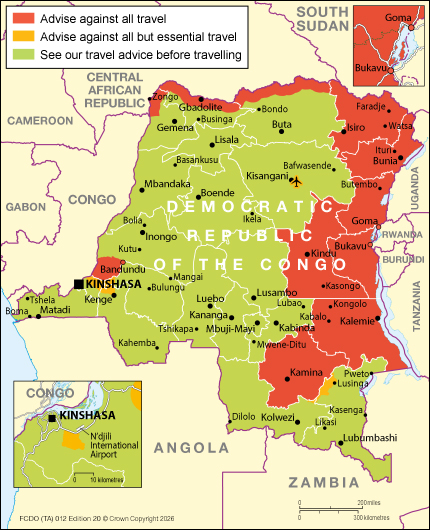
Warnings — Foreign OfficeForeign Office ↗updated 08.10.2026 · read 13.10.2026
Warnings — Foreign Office
Your travel insurance could be invalidated if you travel against advice from the Foreign, Commonwealth & Development Office (FCDO).
Areas in Kinshasa Province
FCDO advises against all but essential travel to:
- The districts of N’djili and Kimbanseke in Kinshasa city south of the main access road to N’djili airport, in Nsele commune
- The N1 road in Kinshasa Province, between and including Menkao to the west, Kenge to the east, the border of Mai-Ndombe province to the north, and 10km to the south
DRC-Central African Republic border
FCDO advises against all travel to within 50km of the border with the Central African Republic.
Eastern DRC
FCDO advises against all travel to the provinces of:
- Haut-Uélé and Ituri, including the entire DRC-South Sudan border
- North Kivu
- South Kivu
- Maniema
- Tanganyika
- Haut-Lomami
South-East DRC
FCDO advises against all but essential travel to Upemba National Park. If you choose to travel to Upemba National Park against FCDO advise, notify the park authorities about your travel plans.
Territory in Mai-Ndombe Province
FCDO advises against all travel to the Kwamouth territory of Mai-Ndombe Province. This is between, and including, the towns of Kwamouth, Bandundu and the southern border of Mai-Ndombe province.
Kisangani airport
FCDO advises against all but essential travel to Bangoka International Airport, Kisangani due to multiple drone attacks in the area of Kisangani airport.
See details about why FCDO advises against travel .
North and South Kivu
If you are in North or South Kivu and judge it safe to do so, and if routes are available, you should leave.
M23 rebels and Rwanda Defence Forces (RDF) have captured the cities of Goma and Bukavu and the surrounding areas in North and South Kivu. M23 rebels and RDF captured the city of Uvira in December 2025, and then withdrew from the city in January 2026, though clashes continue in the surrounding areas. The situation remains highly unstable and unpredictable. Routes to depart Uvira, Goma and Bukavu are limited and may change at short notice.
The border crossings between Rwanda and the DRC at Gisenyi-Goma and Ruzizi-Bukavu could close at short notice.
Goma and Bukavu airports have been attacked and commercial flights are no longer operating from the airports.
Support from the UK government is severely limited outside Kinshasa. You should not assume that FCDO will be able to provide assistance to leave the country in the event of serious unrest or crisis.
Tshopo Province
On 23 May, there were multiple drone attacks in the area of Kisangani airport. These incidents have led to disruption to flights. The security situation remains unpredictable, and further disruption is possible.
Ebola
On 17 May, the World Health Organization (WHO) declared the Ebola (Bundibugyo virus disease) outbreak in DRC a Public Health Emergency of International Concern . The outbreak is highly active, evolving and geographically widespread.
Before you travel to DRC read Ebola Disease in DRC and general information on Ebola and similar diseases .
If you are in DRC read how to reduce your risk from Ebola .
Some countries have additional health screening requirements or entry restrictions for travellers arriving from, or who have recently visited the DRC. Check entry requirements for any destination or transit country before travelling.
Help and support in DRC
Read FCDO advice on how to deal with a crisis overseas.
Contact your travel provider and insurer
Contact your travel provider and your insurer. They will tell you if they can help and what you need to do.
Getting help in DRC
For help in an emergency from the British government, telephone: +243815566200
Read ‘Getting help’ for more information on other ways to get help in DRC.
Contact FCDO in London
Telephone: 020 7008 5000 (24 hours)
Regional risks — Foreign OfficeForeign Office ↗updated 08.10.2026 · read 13.10.2026
Regional risks — Foreign Office
This section has safety advice for regions of the Democratic Republic of Congo. It only covers regions where the Foreign, Commonwealth & Development Office ( FCDO ) has specific advice.
You should also read FCDO ’s overall travel advice and safety and security advice .
Eastern DRC
FCDO advises against all travel to the provinces of:
- North Kivu, including the city of Goma
- South Kivu, including the city of Bukavu
- Haut-Uélé and Ituri, including the entire DRC-South Sudan border
- Maniema
- Tanganyika
- Haut Lomami
The security situation in eastern DRC remains unstable. Armed groups are active and intercommunal violence can affect the political, security and humanitarian situation. Large numbers of civilians remain displaced as a result of the conflict. Acts of violence, including killing, rape and looting continue against civilians.
There are continued reports of towns in eastern DRC being attacked by or falling under temporary control of armed groups. There are continued reports of attacks and kidnappings, including against staff from NGOs and international organisations. Be prepared to leave at short notice via available routes. If you are in an area against FCDO advice, you should be vigilant at all times and keep your security situation under constant review.
Foreign nationals travelling in eastern DRC have been left vulnerable, without escorted transport. The risk of kidnap or injury remains high.
While British government staff do visit areas of eastern DRC, the British Embassy’s ability to offer support is severely limited.
Peacekeeping forces
A United Nations peacekeeping presence is deployed in eastern DRC. The Congolese army is carrying out operations against foreign and domestic armed groups operating in North and South Kivu and Ituri provinces. Foreign, regional forces are also present in eastern DRC.
Goma and Bukavu
FCDO advises against all travel to Goma in North Kivu and Bukavu in South Kivu in eastern DRC. The situation in eastern DRC is unpredictable, and there is a high risk of ongoing instability, particularly in Goma and Bukavu.
The armed group M23 and Rwanda Defence Forces (RDF) have captured and taken control of Goma. Fighting in Goma and the surrounding areas has intensified. Goma airport is currently not operational and is under the control of RDF and M23.
On 16 February, RDF and M23 forces captured and took control of Bukavu, the main city in South Kivu. This follows advances south from Goma. On Friday 14 February, M23 and RDF forces captured Kavuma airport, approximately 30km north of the city. Commercial flights are not operating from the airport.
The Ruzizi border crossing in Bukavu is under RDF and M23 control and appears open, but the situation remain highly unpredictable and may change at short notice.
There is an ongoing risk of protests in the east, particularly in Goma, North Kivu province. These could be directed at foreign nationals.
A ‘state of siege’ is in place in the provinces of Ituri and North Kivu. Military administrations with extended security powers have replaced the civilian administrations. On 20 February 2024, the Governor of North Kivu banned vehicles from driving in the province with tinted windows (this includes the city of Goma).
The situation in Goma, Bukavu, and the surrounding areas remains uncertain, unstable and can change quickly. British nationals should be prepared to leave at short notice and have adequate supplies of food, water, medicine etc in case of the need to lock down.
Tshopo Province
The security situation in and around Bangoka International Airport, Kisangani, remains unpredictable following recent drone attacks against DRC military assets at the airport. These attacks have been claimed by the M23. Commercial flights are operating as usual, but availability can change at short notice. These border crossings are controlled by RDF and M23.
Border crossings with Rwanda
The border crossings between Rwanda and the DRC at Gisenyi/Goma and Cyangugu/Bukavu may close at short notice. These border crossings are controlled by RDF and M23.
Following the Ebola outbreak, transit from the Democratic Republic of the Congo through Rwanda is only permitted in exceptional circumstances related to humanitarian missions and essential travel, and is subject to health risk assessment, destination-country, transport operator, and public health requirements, and approval by the Rwandan authorities.
Territory in Mai-Ndombe Province
FCDO advises against all travel to the Kwamouth territory of Mai-Ndombe Province. This is between, and including, the towns of Kwamouth, Bandundu and the southern border of Mai-Ndombe Province.
There is ongoing intercommunal violence between ethnic groups over land. The government has deployed a military force to the area. We are not aware of any direct threat against the international community or British nationals. Be aware of the increased violence and potential threat.
Areas in Kinshasa Province
Due to the risk of violent crime, FCDO advises against all but essential travel in the districts of:
- N’djili and Kimbanseke in Kinshasa city, south of the main access road to…
Safety — Foreign OfficeForeign Office ↗updated 08.10.2026 · read 13.10.2026
Safety — Foreign Office
This guide also has safety advice for regions of the Democratic Republic of the Congo (DRC) .
Terrorism
There is a high threat of terrorist attack globally affecting UK interests and British nationals, including from groups and individuals who view the UK and British nationals as targets. Stay aware of your surroundings at all times.
UK Counter Terrorism Policing has information and advice on staying safe and what to do in the event of a terrorist attack. Find out how to reduce your risk from terrorism while abroad .
Terrorism in DRC
Terrorists are very likely to try to carry out attacks in DRC.
ADF, a militant group with links to Daesh, carry out regular attacks in North Kivu and Ituri provinces, eastern DRC. The majority of its attacks target villages in rural areas, but it has attacked military targets – primarily Ugandan and Congolese armed forces personnel. Attacks have also targeted bars, places of worship, markets and vehicle convoys.
Attacks could be indiscriminate including in places visited by foreign nationals. Stay aware of your surroundings, keep up to date with local media reports and follow the advice of local authorities.
Protests and demonstrations
A range of military and peacekeeping forces are deployed in eastern DRC. Tensions about the presence of these forces and the role of international actors can cause protests in Goma and Kinshasa. There have been large protests against the UN peacekeeping mission known as the United Nations Organization Stabilization Mission (MONUSCO). In February 2024 there were protests outside the British Embassy and other western embassies. Similar protests cannot be ruled out in future. These could be directed at foreign nationals or target UN vehicles and premises.
On 28 January 2025, there were large and violent protests outside multiple embassies in Kinshasa, in response to the fighting in eastern DRC. This resulted in an increased security presence and there is an ongoing risk of sporadic protests, which can involve gun fire.
Public gatherings and demonstrations can occur with little or no notice and can quickly turn violent.
Protests may result in:
- the closure of shops and public services
- restrictions on movement
In the event of serious unrest:
- commercial flights may be suspended
- roads may be blocked
- international borders may be closed at short notice, particularly those with Rwanda, at Gisenyi/Goma and Cyangugu/Bukavu
- internet connections and mobile phone networks may have reduced services or be cut off
- military and police presence in Kinshasa and other major cities may increase - this may include stop-and-search checkpoints, especially after dark
To minimise your personal risk:
- follow local media for news of any planned protests
- leave quickly and do not attempt to watch or photograph any demonstration or disturbance
- consider making contingency plans
- keep a stock of essential supplies
- keep your travel documents up-to-date, including appropriate visas
- be prepared to move or go into curfew at short notice if told to by the authorities
- see how to prepare for a crisis overseas
Stay away from areas where protests are planned, particularly in Kinshasa, Goma and other large cities. This may include:
- N’Djili airport, Kinshasa
- Churches and other religious buildings and institutions
- large sporting stadiums or music venues
- universities
- political party headquarters
- foreign embassies
- government and parliament buildings
- offices of the Electoral Commission
Do not assume FCDO will be…
American passport — U.S. Department of State
- U.S. citizens and nationals who have been in the Democratic Republic of the Congo within 21 days cannot board commercial flights to the United States. State Department
- U.S. citizens and nationals must remain outside the Democratic Republic of the Congo for 21 days before boarding flights to the United States. State Department
- The U.S. government has limited ability to provide emergency consular services to U.S. citizens in the Democratic Republic of the Congo, particularly outside Kinshasa. State Department
- The World Health Organization declared the Ebola outbreak in the Democratic Republic of the Congo and Uganda a Public Health Emergency of International Concern on May 17. State Department
- Outbreaks of serious infectious diseases are common in the Democratic Republic of the Congo, and local health infrastructure is inadequate. State Department
Faithful summary of the official texts below, which prevail.
Democratic Republic of the Congo - Level 4: Do Not Travel 2026-07-14travel.state.gov ↗updated 14.07.2026 · read 13.10.2026
Advisory summary
Do not travel to the Democratic Republic of the Congo (DRC) due to health , crime , unrest , terrorism , and kidnapping
Due to the Ebola outbreak in the DRC, the Department of Homeland Security has implemented new restrictions under Title 49 of the U.S. Code which prevent U.S. citizens and nationals who have been in the DRC within a 21-day period from boarding commercial flights into the United States.
Travelers who have been in the DRC within 21 days of their flight will not be allowed to board flights with U.S. destinations. All U.S. citizens and U.S. nationals who have been in the DRC must remain outside the DRC for 21 days before boarding flights to the United States.
Visit the Centers for Disease Control’s Information for Travelers Returning from Ebola-affected Areas for more information.
The U.S. government has limited ability to provide in-person emergency consular services to U.S. citizens in the Democratic Republic of the Congo (DRC), especially those outside of Kinshasa, due to the health and security situation.
Health
The U.S. Centers for Disease Control and Prevention (CDC) has issued a Travel Health Notice for Ebola for the Democratic Republic of the Congo (DRC).
On May 17, the World Health Organization (WHO) declared the Ebola outbreak in the DRC and Uganda a Public Health Emergency of International Concern .
Outbreaks of serious infectious diseases are common in the Democratic Republic of the Congo. Visit the Centers for Disease Control and Prevention (CDC) website for the latest Travel Health Information before you travel.
The local health infrastructure is inadequate. Health services, hygiene, and quality control do not meet U.S. standards of care. Pharmacies are not well regulated. Locally available medications may be unsafe.
Global Affairs Canada — additional reading
Avoid all travel
Avoid all travel to the Democratic Republic of the Congo (DRC) due to the fragile security situation and the outbreak of Ebola disease.
- DEMOCRATIC REPUBLIC OF THE CONGO — Avoid all travel to the Democratic Republic of the Congo (DRC) due to the fragile security situation and the outbreak of Ebola disease.
Open Government Licence – Canada · September 28, 2026 13:56 EDTtravel.gc.ca ↗updated 28.09.2026 · read 13.10.2026
- You must carry a certified copy of your passport and visa at all times and keep the original in a secure location.
- Taking photographs of government buildings, airports, or military installations is forbidden and may lead to arrest.
- Public displays of affection are not socially acceptable; dress conservatively and behave with discretion.
- US dollar banknotes must be in good condition and issued after 2009 to be accepted.
- You must declare any sum equivalent to more than US$10,000 upon arrival and any foreign currency upon exit.
- Motorists and pedestrians must stop for the raising and lowering of the national flag daily at approximately 7:30 a.m. and 6 p.m.
Faithful summary of the official texts below, which prevail.
Global Affairs Canada — written for Canadian travellers, valid for all
Local laws
You must abide by local laws. Learn about what you should do and how we can help if you are arrested or detained abroad.
Drugs
Persons convicted of the possession, use or trafficking of illegal drugs can expect prison terms and heavy fines. Drugs, alcohol and travel
Identification
Local authorities may ask you to present your passport and visa at any time. In such situations, you should remain calm and cooperative. Failure to comply could result in expulsion.
- Always carry a certified copy of your passport and visa with you
- Always keep your original passport in a secure place
Photographs
It is forbidden to take photographs, under penalty of arrest or detention, of the following places:
- government buildings
- airports
- military installations
Dress and behavior
The DRC is a conservative society. Public displays of affection, including holding hands or kissing, are not socially acceptable. To avoid offending local residents:
- dress conservatively
- behave with discretion
- respect social and religious traditions
- ask permission before taking their photos
Lèse-majesté
The law forbids disrespecting the head of state, as well as making remarks alleged to threaten national security and malicious comments in public. Local authorities have sometimes intimidated, harassed, and arrested journalists, activists, and politicians when they have publicly criticized the government, president or state security forces. Penalties can be severe, including imprisonment.
Driving
You should carry an International Driving Permit. International Driving Permit
Other traffic laws
Motorists and pedestrians are required to stop for the raising and the lowering of the national flag at approximately 7:30 a.m. and 6 p.m. every day. Failure to do so may result in a fine.
International Child Abduction
The Hague Convention on the Civil Aspects of International Child Abduction is an international treaty. It can help parents with the return of children who have been removed to or retained in certain countries in violation of custody rights. It does not apply between Canada and the DRC. If your child was wrongfully taken to, or is being held in the DRC by an abducting parent:
- act as quickly as you can
- consult a lawyer in Canada and in the DRC to explore all the legal options for the return of your child
- report the situation to the nearest Canadian government office abroad or to Global Affairs Canada by calling the Emergency Watch and Response Centre
If your child was removed from a country other than Canada, consult a lawyer to determine if The Hague Convention applies. Be aware that Canadian consular officials cannot interfere in private legal matters or in another country's judicial affairs.
Money
The currency is the Congolese franc (CDF). The DRC is a cash-based economy. The US dollar is widely accepted. Shopkeepers and foreign exchange dealers require banknotes to be in good condition (without tears and of recent issue, i.e. US dollars printed after 2009). Credit cards are generally not accepted, except in certain hotels, restaurants and department stores. Large hotels have ATMs where cash advances can be made using certain credit cards, but these are not always in operation.
Currency declaration
You must declare:
- any sum equivalent to more than US$10,000 upon arrival in the country
- any foreign currency upon exit from the country
Open Government Licence – Canada · September 28, 2026 13:56 EDTtravel.gc.ca ↗updated 28.09.2026 · read 13.10.2026
Foreign Office — laws and cultural differences
Justice process
The DRC authorities rarely meet their international obligations to notify embassies when foreign nationals have been detained. Even if requested, adequate consular access is not always granted. Keep in close touch with family or friends and ask them to notify the British Embassy in Kinshasa immediately if you are arrested in DRC.
Using cameras in secure areas
Taking photographs of some government and military buildings is illegal, particularly borders or military installations. You risk being arrested and detained. Journalists should not conduct interviews or film without the necessary local permits.
LGBT+ travellers
Same-sex sexual activity is not illegal in DRC but is frowned upon by many. There is no legal recognition of same-sex couples or same-sex marriage, and there are no specific anti-discrimination laws protecting LBGT+ people. Members of the LGBT+ community are known to be harassed. Individuals may be charged under DRC’s Penal Code for ‘crimes against family life’. Read more advice for LGBT+ travellers.
Adopting children from DRC
FCDO advises against adopting from DRC. The UK does not recognise adoptions made in DRC as DRC is not a signatory to the Hague Convention on Protection of Children and Co-operation in Respect of Intercountry Adoption. The DRC government has not issued exit permits for children adopted by foreign nationals in DRC since 2013 and many are still unable to leave the country. It is illegal for same-sex or trans-sexual couples to adopt Congolese children.
Camouflage clothing
If you wear any military-style clothing you could be misidentified as military personnel and be vulnerable to attack or detention.
Money
Credit cards are only accepted in a limited number of places in Kinshasa and other cities. US dollars are widely used alongside the local currency and a number of ATMs dispense US dollars in Kinshasa. Notes should be in good condition and issued after 2001. Elsewhere in DRC, cash is needed for transactions. Make sure you have access to money, or have arrangements in place for it to be sent to you in an emergency, before leaving the UK.
Open Government Licence v3.0gov.uk ↗updated 08.10.2026 · read 13.10.2026
FDFA (Switzerland) — laws and customs, in French
Specific legal provisions
Il est interdit de photographier des personnes en uniforme, des installations militaires et des ouvrages ou bâtiments publics (aéroports, ponts, etc.). À Kinshasa, les journalistes ne peuvent généralement pas prendre de photos ni filmer sans autorisation officielle. Les automobilistes peuvent être sanctionnés s'ils ne dégagent pas immédiatement la route et ne s'arrêtent pas lors d'une rencontre avec le convoi présidentiel . Les infractions à la loi sur les stupéfiants, y compris la détention de minimes quantités de drogue quelle qu'elle soit, sont durement réprimées. La peine capitale peut être prononcée pour certains délits. Les conditions de détention sont précaires.
Cultural specificities
Les relations homosexuelles et la transsexualité sont réprouvées de manière générale.
FDFA travel advice, in Frencheda.admin.ch ↗updated 05.06.2026 · read 13.10.2026
What it changes for you: Air acceptable at this hour: nothing special to plan. Very high UV: sunscreen, hat and shade between 11 am and 4 pm; sunstroke and dehydration are travellers' first reasons to see a doctor.
Reading 23:00 (Africa/Kinshasa)Open-Meteo ↗updated 13.10.2026 · read 13.10.2026
Air quality and UV: Open-Meteo.com (CC BY 4.0), data rounded and formatted by Maximum. Contains modified Copernicus Atmosphere Monitoring Service information 2026. Neither the European Commission nor ECMWF is responsible for any use that may be made of the Copernicus information or data it contains.
No value published by the World Bank in the last eight years for the DR Congo: hospital beds per 1,000 people.
Reading: With 0.2 physicians per 1,000 people (96% fewer than Switzerland), the nearest hospital does not always have the capacity for a serious case: evacuation to an adequate centre is the rule, not the exception — that is what unlimited evacuation and repatriation cover. Health spending of 23 USD per person (Switzerland: 11,784) goes with private hospitals that bill foreigners in hard currency and ask for a guarantee before admission: the direct payment guarantee is what avoids the deposit.
World Bank — latest published value, year per indicatordata.worldbank.org ↗read 10.10.2026
What is happening in DR Congo right now
Live alerts and level changes, each with its official source. Continuously updated.
What governments have just written
La République démocratique du Congo (RDC) est actuellement confrontée à une épidémie de maladie à virus Ebola. L’organisation mondiale de la santé a classé cette épidémie en urgence de santé publique de portée internationale. A ce jour, sept provinces sont affectées : Ituri, Nord-Kivu, Haut-Uélé, Tshopo, Sud-Kivu, Bas-Uélé et Sud-Ubangi. Il est recommandé de suivre strictement les consignes de prévention suivantes : • se tenir régulièrement informé de possibles nouveaux…
France Diplomatie (in French) · posted 16 January 2026 · updated 18 September 2026diplomatie.gouv.fr ↗updated 15.09.2026 · read 13.10.2026Une manifestation non autorisée est annoncée aux alentours de l’hôtel de ville, à La Gombe, vendredi 4 septembre. Il convient d’éviter de se déplacer dans ce secteur et de se tenir éloigné de tout rassemblement.
France Diplomatie (in French) · posted 3 September 2026diplomatie.gouv.fr ↗updated 15.09.2026 · read 13.10.2026Suite à de fortes pluies en 2025, une épidémie de choléra a fait son apparition à Kinshasa au début de l’été 2025 et celle-ci s’étend désormais dans plusieurs quartiers de la ville. Depuis début 2026, quelques décès en rapport avec le cholera sont identifiés et l’épidémie continue de s’amplifier. Il est fortement recommandé d’éviter les zones de Maluku et Nsele le weekend et de façon plus générale les bars ou restaurants de quartier. Le risque majeur du choléra étant la…
France Diplomatie (in French) · posted 16 January 2026 · updated 7 April 2026diplomatie.gouv.fr ↗updated 15.09.2026 · read 13.10.2026Risk level section – extended end date of Canadian border measures related to Ebola for travellers from the Democratic Republic of the Congo
September 28, 2026 13:56 EDTtravel.gc.ca ↗updated 28.09.2026 · read 13.10.2026No level change recorded for this country since the log opened. The live alerts above are updated continuously.
Frequently asked questions — travel insurance DR Congo
What is the official risk level in DR Congo today?
Level 4/4 — Do Not Travel, U.S. Department of State, retrieved on 13 October 2026.
- Is the whole country advised against? United States: yes · France: no · United Kingdom: no · Switzerland: except for imperative reasons (reading of 27 September 2026).
- Switzerland’s FDFA advises against tourist travel (published 05.06.2026).
- Contractually, only an FDFA, FOPH or WHO advisory against the trip opens Module A (art. 18.1) — that is not the case today.
- At this level most bank cards and standard policies exclude the trip: read My cover before booking, and only leave with cover that says so in writing.
- We check these sources every morning and e-mail you the day one changes (Alerts button).
Sourcestravel.state.gov · updated 14.07 · read 13.10France Diplomatie · updated 15.09 · read 13.10DFAE · updated 05.06 · read 13.10207-country comparison
Is the whole of DR Congo advised against, or only some areas?
An area advised against does not rule out the country.
- Official answers: United States: yes · France: no · United Kingdom: no · Switzerland: except for imperative reasons.
- Foreign Office, regional risks: “This section has safety advice for regions of the Democratic Republic of Congo. It only covers regions where the Foreign, Commonwealth & Development Office ( FCDO ) has specific advice. You should also read FCDO ’s overall travel advice and safety and…”
- Keep your country of residence's advisory on booking day and on departure day: that is what your policy's clauses cite.
SourcesFrance Diplomatie · updated 15.09 · read 13.10Foreign Office · updated 08.10 · read 13.10State Department · updated 14.07 · read 13.10
What are the entry requirements for DR Congo with my passport?
The rules depend on the passport, not on the destination alone.
- French passport (France Diplomatie): French nationals require a visa for the Democratic Republic of Congo, obtainable online or from the RDC embassy in Paris. A passport valid for at least six months beyond the entry date and a yellow fever vaccination certificate are mandatory for entry. All COVID-19 related health restrictions for entering the DRC have been lifted.
- British passport (Foreign Office): British citizens must ensure their passport expires at least six months after their arrival date in the Democratic Republic of the Congo. All travellers require a visa for the Democratic Republic of the Congo, which must be applied for through the DRC Embassy in the UK, allowing two to three weeks for processing. Travellers may face health screening measures upon arrival, including passenger locator forms and temperature checks, due to Ebola concerns.
- American passport: the requirements are on the State Department country page (travel.state.gov).
- Swiss passport: the FDFA refers you to the destination's embassy in Switzerland.
- Pick your passport at the top of Before you go › Entry: the official text that concerns you comes first, with its “In brief” summary.
SourcesFrance Diplomatie · updated 15.09 · read 13.10Foreign Office · updated 08.10 · read 13.10State Department · updated 14.07 · read 13.10
Do I need an insurance certificate for a DR Congo visa?
For a Schengen visa, yes: at least €30,000 of travel medical insurance (Regulation (EC) No 810/2009, art. 15).
- Many other countries ask for it on entry or for a visa, case by case: check Before you go › Entry, with your passport.
- Subscribe: the named certificate arrives by e-mail on payment, with your name, dates and limits (CHF 1.5M medical expenses, unlimited evacuation and repatriation) — the ones consulates check.
- Attach it to the visa file; if in doubt about the format, write to us.
SourcesRegulation (EC) 810/2009, art. 15General conditions, policy 20 00 479
What does Maximum Insurance do in DR Congo, concretely?
VIP Pack — $990 for twelve months, unlimited trips.
- CHF 1.5M emergency medical expenses, unlimited medical evacuation and repatriation, search and rescue CHF 50,000, cancellation or change CHF 5,000.
- One 24/7 number, +41 22 ••• •• ••: Maximum sends its direct payment guarantee to the hospital (art. 2.12).
- Network of 45,000 providers (art. 6.9); evacuation is decided, organised and paid by Maximum's medical team if the local facility is not enough (art. 6.2.2).
- Around Kinshasa, the nearest hospital read from OpenStreetMap: Vitorial médical centre · 1.0 km · +243906952087 · 24/7 emergency room.
- Named certificate by e-mail on payment, no medical questionnaire.
SourcesGeneral conditions, policy 20 00 479OpenStreetMap · read 10.10
How much does a medical repatriation from DR Congo cost?
From 45 000 € to 140 000 € depending on severity and distance (Diversified Quotes, 2026).
- Without cover: the hospital asks for a deposit before admission, and the medical flight is paid up front.
- With the VIP Pack: the evacuation is decided and settled by Maximum (art. 6.2.2) — no advance, no cap.
SourcesDiversified Quotes, 2026General conditions, policy 20 00 479
What should I do if hospitalised in DR Congo?
Six steps, in this order.
- 1. Call +41 22 ••• •• •• before paying anything, or have the front desk call: it is the condition for full cover (otherwise: reduced or refused benefits).
- 2. Ask for a hospital in the Maximum network (art. 6.9) — the nearest: Vitorial médical centre · 1.0 km · +243906952087 · 24/7 emergency room.
- 3. See a doctor the same day and leave with the certificate: without an on-the-spot finding, nothing is covered (art. 33).
- 4. Admitted for more than 24 h? The front desk calls Maximum: direct payment guarantee, no deposit (art. 2.12).
- 5. Book no ambulance or flight yourself (art. 6.2.2).
- 6. Once home, file within 30 days (art. 35.7).
- Local emergency services: police 114 / 118 · fire 113.
SourcesSpecial conditions 01.26General conditions, policy 20 00 479
Which emergency numbers in DR Congo?
Local emergency services: police 114 / 118 · fire 113
- Maximum, 24/7, before any payment: +41 22 ••• •• ••.
- France — Ambassade de France (4.5 km) · +33 5 16 44 00 67
- Switzerland — Embassy of Switzerland (5.2 km)
- United Kingdom — Ambassade de Grande-Bretagne (4.9 km)
- United States — Embassy of the United States (3.0 km)
- Save these numbers before leaving; in immediate danger, call local emergency services first, then Maximum.
SourcesEmergencyNumberAPI · Wikidata · read 08.10OpenStreetMap · read 10.10
Is an Amex, Visa or Mastercard enough in DR Congo?
At today's level 4/4, card by card:
- Amex Platinum — Your Amex Platinum expressly excludes this trip: the T&Cs rule out travel to countries your government has advised against visiting.
- Visa — Your Visa may not cover here: the notice excludes the consequences of war, notorious political instability and terrorism — precisely the risks of an advised-against area.
- Mastercard — Your Mastercard World Elite expressly excludes this trip: areas 'formally advised against' by the French foreign ministry are ruled out, assessed at departure date.
- Three lines to read in your notice: the duration (often 90 days per trip), the settlement (reimbursement afterwards or direct payment of the hospital) and the area exclusion at level 4/4.
SourcesAmex Platinum France T&Cs, 01.2025 — general exclusion n° 11BNP Paribas Visa Infinite notice (policy PT7), 04.2025 — comFortuneo World Elite Mastercard notice, 01.2026 — art. 5.5 '
Are a health plan or a travel policy enough in DR Congo?
A health plan reimburses at home; here, the hospital asks for a payment guarantee before admission.
- Health plan — A health plan treats you at home. Here the hospital asks for a guarantee before admission — not a later reimbursement.
- Travel policy — The clause is a market standard: the reference policy excludes trips to areas 'formally advised against by government authorities' — at this level most classic policies no longer cover.
- A travel policy often has a territorial clause at level 4/4 and a 90-day limit per trip.
- Have your IPID number or the PDF of the terms and ask an expert to call you back: the answer is in the document, not in the brochure.
SourcesGeneral conditions, policy 20 00 479
How do I use the medical network on this page?
Around Kinshasa: 80 hospitals and clinics, 51 with a 24/7 emergency room, 40 pharmacies, 40 doctors' practices (OpenStreetMap, hospital list read on 01.10.2026).
- Type your city, hotel or beach: the map re-centres, 24/7 emergency rooms come first.
- Each row gives the phone when the source publishes it, the nearest street, directions and the Google Maps listing.
- The PDF briefing repeats the same places, numbered on a printable map.
- No customer reviews: OpenStreetMap has none, and we invent none.
Which vaccines and health precautions for DR Congo?
The sourced detail is under Medical network › Health: vaccines, diseases present, altitude, outbreaks.
- France Diplomatie reports in the country: dengue, malaria, chikungunya — mosquito protection day and night.
- WHO: 5 outbreak alert(s) for this country in the last 24 months, including “Ebola disease caused by Bundibugyo virus - Democratic Republic of the Congo” (8 October 2026).
- See a doctor or a travel clinic 8 weeks before departure (Foreign Office).
- Carry your medicines in their packaging, with a prescription using international non-proprietary names (France Diplomatie).
SourcesCDC Travelers' HealthFrance Diplomatie · updated 15.09 · read 13.10OMS · updated 08.10 · read 13.10Foreign Office · updated 08.10 · read 13.10
Can I be treated in DR Congo, or will I be evacuated?
0.2 physicians per 1,000 people (2022) versus 4.5 in Switzerland.
- With 0.2 physicians per 1,000 people (96% fewer than Switzerland), the nearest hospital does not always have the capacity for a serious case: evacuation to an adequate centre is the rule, not the exception — that is what unlimited evacuation and repatriation cover. Health spending of 23 USD per person (Switzerland: 11,784) goes with private hospitals that bill foreigners in hard currency and ask for a guarantee before admission: the direct payment guarantee is what avoids the deposit.
- When the local facility is not enough, Maximum's medical team decides the evacuation to a suitable centre, and pays for it (art. 6.2.2).
SourcesWorld Bank · read 10.10General conditions, policy 20 00 479
DR Congo: safety, in figures?
Comparable figures (homicides, roads, incidents) are under Safety & risks › Incidents.
- 34.9 road deaths per 100,000 people versus 2.2 in Switzerland (World Bank, WHO).
- UCDP (Uppsala University): 216 geolocated violent incidents, 1,223 deaths over the last closed period, each placed on the map.
- On the road, 16 times more deaths than in Switzerland: road crashes are the leading cause of death of healthy travellers (CDC) — seat belt, no night driving, a driver or a taxi from a rank.
Where is my embassy in DR Congo, and why register?
The nearest representations, by passport (OpenStreetMap):
- France — Ambassade de France (4.5 km) · +33 5 16 44 00 67
- Switzerland — Embassy of Switzerland (5.2 km)
- United Kingdom — Ambassade de Grande-Bretagne (4.9 km)
- United States — Embassy of the United States (3.0 km)
- Register before leaving: France: Ariane · Switzerland: Travel Admin · United Kingdom: Foreign Office alerts · United States: STEP.
- Two minutes, and in a crisis your country's authorities can reach you and count you in an evacuation.
- Pick your passport at the top of Contacts: your embassy comes first.
SourcesOpenStreetMap · read 10.10DFAE · updated 05.06 · read 13.10
Which regions of DR Congo should I avoid, precisely?
At least one official reading covers the whole country; 6 regions are also named, fully or partly.
- Your point (Kinshasa): advised against — all travel.
- Advised against — all travel: Bandundu, Kinshasa, Kongo Central, Maniema, North Kivu, South Kivu.
- Global Affairs Canada covers the whole country.
- France Diplomatie rates the rest of the country “advised against except for imperative reasons”.
- Maximum does not exclude these areas: the VIP Pack covers care and repatriation there (sanctions, embargoes and a country already at war at departure remain enforceable).
SourcesGlobal Affairs Canada · updated 28.09 · read 13.10Foreign Office · updated 08.10 · read 13.10France Diplomatie · updated 15.09 · read 13.10
Which laws and customs should I know in DR Congo?
Local laws apply to every traveller; here is what the official texts say.
- You must carry a certified copy of your passport and visa at all times and keep the original in a secure location.
- Taking photographs of government buildings, airports, or military installations is forbidden and may lead to arrest.
- Public displays of affection are not socially acceptable; dress conservatively and behave with discretion.
- US dollar banknotes must be in good condition and issued after 2009 to be accepted.
- You must declare any sum equivalent to more than US$10,000 upon arrival and any foreign currency upon exit.
SourcesGlobal Affairs Canada · updated 28.09 · read 13.10Foreign Office · updated 08.10 · read 13.10
Who can I call at any hour from DR Congo?
Every foreign ministry runs a 24/7 emergency line for its nationals.
- France — Crisis and Support Centre — French Ministry for Europe and Foreign Affairs: +33 1 53 59 11 00. 24/7 emergency line, standard rate. First contact abroad: the French embassy or consulate.
- Switzerland — FDFA Helpline: +41 58 465 33 33 · +41 800 24 7 365. 24/7, 365 days a year — helpline@eda.admin.ch. Beware of scam calls spoofing these numbers.
- United Kingdom — Foreign, Commonwealth & Development Office: +44 20 7008 5000. 24 hours, for British nationals.
- United States — Overseas Citizens Services — U.S. Department of State: +1 202 501 4444 · +1 888 407 4747. From abroad; the second number from the U.S. and Canada.
- On site, Ambassade de France: +33 5 16 44 00 67.
Sourcesdiplomatie.gouv.fr · updated 15.09 · read 13.10eda.admin.ch · updated 05.06 · read 13.10
A few useful phrases in French for DR Congo?
Emergency phrases, to show if pronunciation fails:
- Help! → Au secours !
- Call an ambulance! → Appelez une ambulance !
- I need a doctor. → J'ai besoin d'un médecin.
- Where is the nearest hospital? → Où est l'hôpital le plus proche ?
- Call the police! → Appelez la police !
SourcesMaximum Insurance
What should I keep after leaving DR Congo, and how do I file a claim?
Keep the entry stamp, the invoices, the prescriptions and the medical report.
- File within 30 days (art. 35.7) from your client area, with the documents; the official forms are pre-filled.
- Costs advanced on site are reimbursed against receipts.
- Fever, persistent diarrhoea or a rash in the following weeks? See a doctor and say where you have been — dengue, malaria, chikungunya circulate in the country (France Diplomatie).
SourcesGeneral conditions, policy 20 00 479
What does the Pack VIP Extreme add?
Cancellation or change up to CHF 20,000, special risk CHF 5,000 per person, crisis management and security, optional Kidnap & Ransom.
- Special risk (Module A): political event, attack, epidemic, natural disaster — opens when the FDFA, the FOPH or WHO advise against the trip (art. 18.1).
- Epidemic: assistance must be requested within 7 days of the WHO or FDFA qualification (art. 36.2).
- Crisis management and security: trip registration, monitoring, extraction, evacuation in case of riot, war, terrorism or disaster; Kidnap & Ransom subject to eligibility (art. 18.4).
- $2,290 a year, unlimited trips.
SourcesGeneral conditions, policy 20 00 479
A question not answered here? Ask Maximum below, or call the support number: every question gets a clear, actionable answer.
In a life-threatening emergency, call local emergency services first, then Maximum: +41 22 ••• •• •• — 24/7 support number, an adviser stays with you to the end.
What Maximum knows
The 207 country pages — hospitals, pharmacies, police, embassies, emergency numbers, official advice from four governments, health, safety in figures, events in progress — read around the city you name. Your policy — benefits, the six steps, claims, articles. The site — prices, certificate, subscription. Nothing else: what it does not know, it says so and hands you to an adviser.
Travelling to Kinshasa, Lubumbashi: what changes
The published advisory level is national, but risk is not: business hubs (Kinshasa, Lubumbashi) do not share the profile of border areas. The medical network shown on this page is computed around Kinshasa — real hospitals, evacuation airport and live alerts. Before a specific trip, always cross-check your country of residence's advisory: that is what your policy cites.
Same advisory level: Central African Republic · Somalia · Sudan · South Sudan · Syria · Chad
The displayed level comes from the State Department, checked every morning. Before departure, always cross-check your country of residence's advisory: that is what your policy cites.
The level shown is the official U.S. Department of State level, checked daily. Maximum Insurance is an insurance distributor — general information, not personal advice.