Maximum Alerts / Chad
Level published by the State Department on 27.04.2026 · read 13 October 2026 · source checked daily
Chad — official level as of 13 October 2026: Level 4/4 ("Do Not Travel"), from the U.S. Department of State. Maximum Insurance covers this country: hospital settled directly, unlimited repatriation, USD 1.5M, certificate on payment.
Every country has its own scale, so we ask them all the same question: is the whole country advised against?
An advisory covering only areas of the country does not raise the answer: it stays “No”, and the area is shown in the relevant column.
The level shown on this page — and across this site — is the one published by the U.S. State Department, from 1 (normal precautions) to 4 (do not travel). France and the United Kingdom publish their own advisories, with their own rules: they add to that level, they do not replace it.
You will be alerted only on the day the official level of this country changes.
10 recorded incidents (UCDP)hover, click to open it in the briefing
In a life-threatening emergency, call local emergency services first, then Maximum: +41 22 ••• •• •• — 24/7 support number, an adviser stays with you to the end.
The 207 country pages — hospitals, pharmacies, police, embassies, emergency numbers, official advice from four governments, health, safety in figures, events in progress — read around the city you name. Your policy — benefits, the six steps, claims, articles. The site — prices, certificate, subscription. Nothing else: what it does not know, it says so and hands you to an adviser.
What I say on the phone
What to do, in this order
In immediate danger, call local emergency services first. Then contact assistance without delay; before engaging a service, seek approval under your policy. Cover is confirmed by the insurer.
Ask assistance where to get care and whether direct cover can be arranged. It confirms the facility and seeks the insurer's approval under your policy. In immediate danger, call local emergency services first.
Even for a pain you meant to shrug off. Without a medical certificate written on the spot, the same day, the insurer cannot cover the event — a certificate written after you return does not count.
The hospital desk sends the request to assistance. Direct payment depends on the insurer's approval and the policy; the call alone does not guarantee it. Have the response confirmed before relying on no up-front payment.
In a life-threatening emergency, call local emergency services immediately. For an arranged transfer or repatriation, contact assistance: the insurer's medical team decides on measures under the policy. A medical flight booked without approval may not be reimbursed.
Even if everything went well on the ground. Send your invoices and the medical report within 30 days; after that, compensation may be reduced or refused.
Reading hospitals, doctors and pharmacies around this point…
near Avenue Gaourang شارع كورانك
near École شارع المدرسة
Avenue Bokassa
08:00-16:00
near Avenue Pompidou شارع بومبيدو
842 3252 انجمينا
near Rue de la Gendarmerie زنقة الدرك
شارع 40 متر انجمينا
انجمينا
near Avenue Goukouni Wedeye شارع قوقوني عويدي
شارع ٤٠ متر انجمينا
24/7
Rond Point 100 ans
24/7
شارع تمبلباي Boulevard Tombalbaye انجمينا
general;gynaecology;ophthalmology;paediatrics;cardiology
24/7
Boulevard des Sao شارع الساو
Mo-Th 09:00-18:00; Fr-Su 00:00-24:00
انجمينا
near طريق تمبلباي Boulevard François Tombalbaye
انجمينا
laboratory
Mo-Sa 08:00-17:00
انجمينا
near Chari Birmil شارع بيرميل
Avenue Matthias Ngarteri
انجمينا
انجمينا
near Avenue du 10 Octobre 2003 شارع 10 أكتوبر
انجمينا
near Avenue Charles de Gaulle شارع شارل ديغول
near شارع موبوتو Avenue Mubutu
near Rue du Chérif
near Rue Schœlcher
near Rue Schœlcher
near Rue Argapt El Jammal شارع أرغابت الجمل
near Avenue Bokassa شارع بوكاسا
Avenue de Braza
near Avenue Zezerty شارع زيزرتي
12:00-22:00
near Avenue Zezerty شارع زيزرتي
انجمينا
انجمينا
شارع جبرين خير الله انجمينا
انجمينا
شارع جبرين خير الله انجمينا
08:00-23:00
near Rond Point Adoum Tcheré دوار 40 متر
شارع جبرين خير الله انجمينا
near Avenue Charles de Gaulle شارع شارل ديغول
انجمينا
N'Djaména
near Avenue Charles de Gaulle شارع شارل ديغول
near Rue de 30m شارع 30 متر
انجمينا
Mo-Th 08:00-17:00; Fr-Sa 08:00-15:00
near طريق تمبلباي Boulevard François Tombalbaye
Avenue Moboutou N'Djaména
Mo-Su 07:30-23:00
near Maroua-Kousséri
near Boulevard des Sao شارع الساو
near طريق تمبلباي Boulevard François Tombalbaye
انجمينا
زنقة مرسيليا انجمينا
انجمينا
انجمينا
انجمينا
انجمينا
انجمينا
زنقة مرسيليا انجمينا
Mo-Fr 08:30-13:00
انجمينا
انجمينا
Avenue Colonel Nelde Rigobert شارع العقيد نيلد ريكوبيرت انجمينا
near Rond-Point de la Mairie دوار قاعة المدينة
near Rue 3022
near Route Digeul Lamadji
near Rue d'Amdam شارع عمدام
near زنقة العقيد مول Rue du Colonel Moll
انجمينا
near Boulevard des Sao شارع الساو
انجمينا
انجمينا
near Rue 1011 زنقة
near انجامينا - موندو N'Djamena - Moundou
near شارع سارة Sarh
near Avenue du 10 Octobre 2003 شارع 10 أكتوبر
near Autoroute transafricaine N'Djaména - Tripoli / Khartoum
Forecast: MET Norway (Norwegian Meteorological Institute, CC BY 4.0), grouped by day and formatted by Maximum.
10-13 0.1 · 10-14 0.1 · 10-15 0.1 · 10-16 0.1 · 10-17 0.1 · 10-18 0.1 · 10-19 0.0 m³/s
Simulated discharge: Open-Meteo.com (CC BY 4.0), data rounded and formatted by Maximum. Contains modified Copernicus Emergency Management Service information 2026. For information only: this is not a flood warning; only national or regional authorities issue those.
No geolocated event in this country at this reading.
10 incidents recorded in the country, all pinned on the map above (zoom out) — the 10 closest to N'Djamena are listed here, nearest first.
Source: UCDP — GEDEvent_v26_01_26_06.csv. Closed period, Clear coding, precise location.
National numbers (Wikidata, 2026 reading). On site, call local emergency services first, then Maximum: the insurer sends its payment guarantee to the hospital.
Make sure you are up-to-date on all routine vaccines before every trip. Some of these vaccines include Chickenpox (Varicella) Diphtheria-Tetanus-Pertussis (DTaP, Tdap, or Td) Flu (influenza) Measles-Mumps-Rubella (MMR) Polio Shingles
All eligible travelers should be up to date with their COVID-19 vaccines. Please see Your COVID-19 Vaccination for more information.
All travelers should take steps to prevent mosquito bites. Chikungunya vaccination is generally not recommended. Travelers who wish to consider vaccination can visit “What to consider before traveling” on the chikungunya vaccines page to learn more.
Areas of active cholera transmission are localized to the province of Guéra (last case reported 6-9 months ago), Lac (last case reported in the past 3 months), Hadjer Lamis (last case reported 6-9 months ago), N’Djamena (last case reported in the past 3 months), Ouaddaï (last case reported 6-9 months ago), and Sila (last case reported 6-9 months ago) in Chad. Cholera is rare in travelers.
Recommended for unvaccinated travelers one year old or older going to Chad. Infants 6 to 11 months old should also be vaccinated against Hepatitis A. The dose does not count toward the routine 2-dose series. Travelers allergic to a vaccine component should receive a single dose of immune globulin, which provides effective protection for up to 2 months depending on dosage given.
Recommended for unvaccinated travelers of all ages traveling to Chad.
CDC recommends that travelers going to Chad take prescription medicine to prevent malaria. Depending on the medicine you take, you will need to start taking this medicine multiple days before your trip, as well as during and after your trip. Talk to your doctor about which malaria medication you should take. Transmission areas All Drug resistance 1 Chloroquine Species P. falciparum (primarily) P. malariae , P.
Cases of measles are on the rise worldwide. Travelers are at risk of measles if they have not been fully vaccinated at least two weeks prior to departure, or have not had measles in the past, and travel internationally to areas where measles is spreading.
Recommended for travelers 2 months old or older traveling to areas of Chad that are part of the meningitis belt during the dry season (roughly December to June).
Monkeypox vaccination is recommended for any adult who anticipates any of the following activities during travel: Sexual or intimate contact with a new partner Sexual or intimate contact at a commercial sex venue, like a sex club or bathhouse Sexual or intimate contact in exchange for money, goods, drugs, or other trade Sexual or intimate contact in association with a large public event, such as a rave, party, or…
In Chad, poliovirus has been identified in the past year. Travelers to Chad are at increased risk of exposure to poliovirus.
Dogs infected with rabies are commonly found in Chad. If rabies exposures occur while in Chad, rabies vaccines may only be available in larger suburban/urban medical facilities.
Recommended for most travelers. Typhoid vaccine is not 100% effective. Practicing safe food and water habits , including washing hands at key times , can also help prevent typhoid fever .
CDC recommendations: Vaccine is recommended for all travelers ≥9 months old going to areas south of the Sahara Desert. Vaccine is not recommended for travel limited to areas in the Sahara Desert. Country entry requirements: Direct travel from United States: Vaccine is not required. Travel from countries with risk for YF virus transmission: Vaccine is required for travelers ≥9 months old.
CDC Travelers' Health, re-read weekly — the recommendation depends on your age, vaccines and itinerary: confirm it with a doctor or a travel clinic 4 to 6 weeks before departure.CDC ↗read 10.10.2026
High incidence: a long stay or time in care settings warrants a test on return.
Coverage too low to stop the virus circulating: check your two MMR doses before leaving.
Strong transmission: discuss preventive treatment with a doctor before leaving; bed net and repellent on site.
World Bank — latest published valuedata.worldbank.org ↗read 10.10.2026
Source: France Diplomatie (health advice, in French).
Faithful summary of the official texts below, which prevail.
WHO: no outbreak reported for this country in the last 24 months (Disease Outbreak News).who.int ↗read 13.10.2026
France Diplomatiesource ↗updated 15.09.2026 · read 13.10.2026
Consulter si besoin son médecin traitant ou un centre de vaccinations internationales (médecine des voyages) pour faire une évaluation de son état de santé et bénéficier de recommandations sanitaires, notamment sur les vaccinations. Consulter éventuellement son dentiste avant le départ.
Constituer sa pharmacie personnelle en conséquence et n’emporter dans ses bagages que les médicaments strictement nécessaires ; ne jamais consommer de médicaments achetés dans la rue (risque de contrefaçons). Les médicaments doivent être dans leur emballage d’origine avec les étiquettes originales, accompagnés d’une ordonnance portant le nom des médicaments en dénomination commune internationale (DCI). Il est indispensable de vérifier que les médicaments concernés sont autorisés dans le pays visité : pour plus d’informations, consulter la fiche Informations pratiques .
Les vaccins recommandés en France sont également indispensables lors d’un séjour à l’étranger : les maladies qu’ils préviennent circulent partout dans le monde, parfois même plus fréquemment qu’en France. Avant tout départ, le voyageur (adulte et enfant) doit donc d’abord s’assurer d’être à jour du calendrier vaccinal français, en particulier des vaccins contre la diphtérie, le tétanos, la poliomyélite, la coqueluche mais aussi contre la rougeole. Le carnet de vaccination peut être demandé à l’arrivée de certains pays.
Des vaccinations complémentaires peuvent être nécessaires :
Il est donc conseillé de consulter son médecin traitant ou un centre de vaccinations internationales (médecine des voyages) suffisamment de…
La chikungunya est une maladie virale transmise par l’intermédiaire de moustiques infectés. Cette maladie se manifeste par l’apparition de symptômes grippaux (fièvre, douleurs musculaires et articulaires). En cas de signes cliniques, il est impératif de consulter immédiatement un médecin ; le traitement est uniquement symptomatique. Les moyens de prévention reposent sur la vaccination et la protection contre les piqûres de moustiques. Il est conseillé avant le départ de se référer à son médecin traitant et/ou à un centre de vaccination internationale.
Pour plus d’informations , consulter la rubrique risques sanitaires .
La dengue est une maladie virale transmise par piqûres de moustiques. Les symptômes sont de type grippal (fièvre, maux de tête, courbatures, parfois éruption cutanée). En cas de signes cliniques, il est impératif de consulter immédiatement un médecin. Il n’existe pas de traitement curatif. La prise en charge médicale repose uniquement sur le traitement des symptômes. Il faut impérativement éviter la prise d’anti-inflammatoire. La prévention individuelle repose essentiellement sur les moyens de protection contre les piqûres de moustiques. La vaccination des voyageurs peut être indiquée dans certains cas. Il est conseillé de se référer, avant son départ, à son médecin traitant et /ou à un centre de vaccination internationale.
Pour plus d’informations, consulter le site du ministère de la Santé et le site de l’Organisation mondiale de la Santé .
Une recrudescence des cas de dengue est observée chaque année en saison des pluies.
Il s’agit d’une maladie virale transmise par piqûres de moustiques. Les symptômes sont variables, allant du syndrome pseudo-grippal (fièvre, frissons, douleurs musculaires, maux de…
La bilharziose ou schistosomiase est une maladie parasitaire fréquente causée par des vers plats. La transmission se fait par contact avec des eaux douces contaminées ou des larves du parasite pénètrent la peau. Leurs œufs sont ensuite excrétés par l’urine ou les selles, contaminant à nouveau l’environnement. Dans sa forme aiguë, la maladie peut provoquer des démangeaisons cutanées, de la fièvre, des douleurs musculaires et abdominales. Lorsqu’elle devient chronique, elle entraîne des complications plus graves de type urogénital (sang dans les urines) et/ou de type intestinal (diarrhée, douleurs abdominales). En l’absence de traitement, la bilharziose peut entrainer des lésions graves et invalidantes, un cancer de la vessie ou une atteinte hépatique, voire même le décès. Le traitement repose sur la prise d’un antiparasitaire, administré par voie orale. Il est recommandé de consulter un médecin au moindre signe évocateur. Pour prévenir cette maladie, il est essentiel d’éviter le contact avec des eaux suspectes.
Pour plus d’informations , consulter le site de l'Organisation mondiale de la Santé .
Pour éviter d’être contaminé par ce parasite, il est recommandé d’éviter de se baigner dans les fleuves et les lacs tchadiens.
Le choléra est une infection digestive bactérienne qui se transmet par ingestion d’aliments mal cuits (fruits de mer, par exemple) ou souillés (fruits et légumes) et/ ou ingestion d’eau contaminée. Cette maladie, dite « des mains sales », se traduit par des troubles digestifs sévères (diarrhée liquide abondante, crampes abdominales, vomissements), un état de faiblesse générale et parfois de la fièvre.
La prévention repose sur la vaccination et le respect des règles d’hygiène alimentaire (se laver régulièrement les mains,…
Pour plus d’informations, consulter le site du ministère en charge de la Santé et le site de l'Assurance Maladie .
Pour plus d’informations, consulter le site du ministère en charge de la Santé .
Health — Foreign OfficeForeign Office ↗updated 06.08.2026 · read 13.10.2026
Before you travel check that:
This is particularly important if you have a health condition or are pregnant.
Call 1212 and ask for an ambulance.
Contact your insurance company quickly if you’re referred to a medical facility for treatment.
At least 8 weeks before your trip:
See what health risks you’ll face in Chad , including cholera.
Altitude sickness is a risk in parts of Chad. Read more about altitude sickness on TravelHealthPro .
You should drink or use only boiled or bottled water and avoid ice in drinks.
According to UNAIDS, in 2018, the number of adults aged 15 or over in Chad living with HIV was estimated to be around 120,000; the prevalence percentage was estimated at around 1.3% of the adult population compared to the prevalence percentage in adults in the UK of around 0.2%. You should exercise normal precautions to avoid exposure to HIV/AIDS.
The legal status and regulation of some medicines prescribed or bought in the UK can be different in other countries.
Read best practice when travelling with medicines on TravelHealthPro .
Medical facilities in Chad are poor. Even in N’Djamena hospitals are stretched and sometimes affected by strikes. Make sure you have adequate travel health insurance and accessible funds to cover the cost of any medical treatment abroad and repatriation.
FCDO has a list of medical providers in Chad where some staff will speak English.
Read FCDO guidance on travel and mental health . There is also mental health guidance on TravelHealthPro .
TravelHealthPro ↗ · CDC ↗read 10.10.2026
Level 2 - Global PolioCDC ↗read 10.10.2026Some international destinations have circulating poliovirus. Before any international travel, make sure you are up to date on your polio vaccines. Country List : Afghanistan, Algeria, Benin, Cameroon, Chad, Côte d'Ivoire (Ivory Coast), Democratic Republic of the Congo, Niger, Nigeria, Pakistan, Somalia, Yemen, Sudan,…
Level 1 - Diphtheria in Sub-Saharan AfricaCDC ↗read 10.10.2026There are outbreaks of diphtheria in several countries in Africa. Vaccination against diphtheria is essential to protect against the disease. Country List : Chad, Guinea, Niger, Nigeria, Mali, Mauritania, Somalia Country List : Chad, Guinea, Niger, Nigeria, Mali, Mauritania, Somalia Country List : Chad, Guinea, Niger,…
Places read from OpenStreetMap, within a circle of about 12 km: phone, email, address, website and hours when the source publishes them. No customer reviews, that source has none. Straight-line distances.
Notices vary by bank and vintage — yours prevails. On the right: the Maximum contract (public documents).
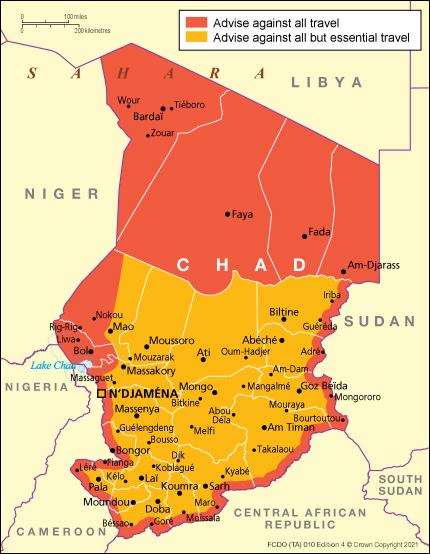
At least one official reading covers the whole country; 9 regions are also named, fully or partly.
Faithful summary of the official texts below, which prevail.
Global Affairs Canada — advises against all but essential travel to the whole country.
an official reading covers the whole country; every trip calls for a written management decision, justified by a pressing reason, with reinforced conditions.
Global Affairs Canada
the northern regions of Tibesti, Ennedi and Borkou (except the town of Faya Largeau)
Foreign Office
Borkou Province
France Diplomatie (in French)
Les déplacements dans les provinces du Borkou et du Wadi Fira sont déconseillés sauf raison impérative.
Global Affairs Canada
the northern regions of Tibesti, Ennedi and Borkou (except the town of Faya Largeau)
Foreign Office
Ennedi Ouest Province
France Diplomatie (in French)
Province du Tibesti, province de l’Ennedi et est de la province du Borkou
Global Affairs Canada
West of Mao in the region of Kanem
Foreign Office
FCDO advises against all travel to the western part of Kanem Province, including the town of Nokou.
Global Affairs Canada
the region of Lac
Global Affairs Canada
the regions of Sila, Wadi Fira and Ouaddaï (except the town of Abéché)
Global Affairs Canada
the regions of Sila, Wadi Fira and Ouaddaï (except the town of Abéché)
Global Affairs Canada
the northern regions of Tibesti, Ennedi and Borkou (except the town of Faya Largeau)
Foreign Office
Tibesti Province
France Diplomatie (in French)
Province du Tibesti, province de l’Ennedi et est de la province du Borkou
Global Affairs Canada
the regions of Sila, Wadi Fira and Ouaddaï (except the town of Abéché)
France Diplomatie (in French)
Les déplacements dans les provinces du Borkou et du Wadi Fira sont déconseillés sauf raison impérative.
Foreign Office
FCDO advises against all but essential travel to the rest of Chad, including the capital, N’Djamena.
Global Affairs Canada — Advised against — all travel
within 30 km of all international borders
Foreign Office — Advised against — all travel
FCDO advises against all travel to the Lake Chad region.
Foreign Office — Advised against — all travel
FCDO advises against all travel to within 30km of all of Chad’s other borders.
France Diplomatie (in French) — Advised against — all travel
Des opérations militaires sont régulièrement menées dans ces zones frontalières de la Libye, depuis août 2018, en vue de contrôler les incursions armées de groupes rebelles. S’y ajoutent de nombreux trafics transfrontaliers, la présence de mines et le développement de sites d’orpaillage illégal. Les déplacements dans ces zones (hormis Bardaï) sont formelleme
France Diplomatie (in French) — Advised against — all travel
Lac Tchad — Cette région, qui fait l’objet d’attaques régulières de Boko Haram, est formellement déconseillée (hormis la ville de Bol).
France Diplomatie (in French) — Advised against — all travel
Zones frontalières — En raison de l’incursion potentielle de groupes armés et d’opérations militaires, les zones frontalières avec les pays voisins sont formellement déconseillées.
France Diplomatie (in French) — Advised against — all but essential travel
Les villes de Bardaï, Fada, Amdjarass et Bol au nord et d’Abéché et Bongor au centre et au sud
Global Affairs Canada — Open Government Licence – Canada (24.09.2026) · Foreign Office — Open Government Licence v3.0 · France Diplomatie (13.03.2026) · Natural Earth
No located event in this reading.
Last change: Updated information about health risks you’ll face in Chad (‘Health’ page).
Updated 27.04.2026
Do not travel in Chad for any reason due to risk of crime , terrorism , unrest , inadequate health infrastructure, kidnapping , and landmines .
Outside of N’Djamena, the U.S. government has extremely limited ability to provide emergency services to U.S. citizens in Chad. U.S. government employees working in Chad need special authorization to travel outside of the capital due to safety risks. Embassy N’Djamena has implemented in-city restrictions for U.S. government employees, to include limits on areas acceptable for night driving and requirements for mandatory armored vehicle use.
Both violent and petty crime are a real danger in Chad. Violent crimes include muggings, purse snatching, armed robbery, home invasion, carjacking, and sexual assault. Common petty crime includes pickpocketing. Both visitors and residents face these threats.
There is risk of terrorist violence, including terrorist attacks and other activity in Chad. Visit the U.S. Department of State's country reports on terrorism to learn more.
Terrorist groups have targeted:
##…
Chad: Cholera Outbreak - Jun 2026ReliefWeb ↗read 13.10.20262026-07-20
Source: ReliefWeb (OCHA), via HDX — CC BY
10-13 0.1 · 10-14 0.1 · 10-15 0.1 · 10-16 0.1 · 10-17 0.1 · 10-18 0.1 · 10-19 0.0 m³/s
Simulated discharge: Open-Meteo.com (CC BY 4.0), data rounded and formatted by Maximum. Contains modified Copernicus Emergency Management Service information 2026. For information only: this is not a flood warning; only national or regional authorities issue those.
The level is national. Risk areas are in the state advisories below.
No major event in progress is located in this country at this morning's check.
Over 1 January 2026 → 30 June 2026, UCDP (Uppsala University) recorded 10 geolocated violent incidents in this country, for 129 documented deaths.
Most affected areas
Lac region 5 · Wadi Fira region 3 · Chari-Baguirmi region 1 · Mayo-Kebbi Est region 1
Most recent incidents
Source: UCDP Georeferenced Event Dataset (Uppsala Conflict Data Program), file GEDEvent_v26_01_26_06.csv, CC BY 4.0 licence. We keep only incidents UCDP codes as "Clear" and whose location is precise enough to be placed — about 58% of the dataset. An incident may be revised, moved or withdrawn by UCDP in a later release: these figures describe a closed period, not a live situation.
Reading: On the road, 15 times more deaths than in Switzerland: road crashes are the leading cause of death of healthy travellers (CDC) — seat belt, no night driving, a driver or a taxi from a rank.
World Bank (UNODC for homicides, WHO for roads) — latest published valuedata.worldbank.org ↗read 10.10.2026
What we locate on the map are events in progress that have real coordinates: USGS earthquakes, GDACS disasters, NOAA storms and open NASA EONET events. Hover a dot for details, click to open it in this briefing.
French passport — France Diplomatie
Faithful summary of the official texts below, which prevail.
Some areas of the country are formally advised against.France Diplomatie ↗updated 15.09.2026 · read 13.10.2026
Vigilance areas — France Diplomatie (in French) updated 13.03.2026official map ↗updated 15.09.2026 · read 13.10.2026
-
-
-
-
-
-
-
-
-
-
-
Dernière actualisation le 13/03/2026, information toujours valable à la date du jour
Des opérations militaires sont régulièrement menées dans ces zones frontalières de la Libye, depuis août 2018, en vue de contrôler les incursions armées de groupes rebelles. S’y ajoutent de nombreux trafics transfrontaliers, la présence de mines et le développement de sites d’orpaillage illégal. Les déplacements dans ces zones (hormis Bardaï) sont formellement déconseillés.
Cette région, qui fait l’objet d’attaques régulières de Boko Haram, est formellement déconseillée (hormis la ville de Bol). Des opérations militaires y sont régulièrement conduites par l’armée tchadienne.
En raison de l’incursion potentielle de groupes armés et d’opérations militaires, les zones frontalières avec les pays voisins sont formellement déconseillées. La frontière avec la Libye est actuellement fermée, et toute la zone frontalière a été déclarée « zone d’opérations militaires » en janvier 2017. Il en est de même de certaines zones du Lac Tchad depuis 2020. En raison du conflit en cours au Soudan, la zone frontalière avec le Darfour connaît un afflux important de réfugiés et de rapatriés. Elle est le théâtre de nombreux trafics et est susceptible de connaître des incursions de groupes armés. La présence militaire y a été renforcée. Au sud, la situation sécuritaire dégradée en République centrafricaine peut entraîner des mouvements de groupes armés dans la zone frontalière et la présence militaire tchadienne y a été renforcée. Le sud-ouest du Tchad (frontière avec le Cameroun) est fortement touché par le phénomène des enlèvements contre rançons.
La ville de Bardaï, chef-lieu de la région du Tibesti, les villes de Fada et Amdjarass dans l’Ennedi (Ouest et est), ainsi que la ville de Bol dans la région du Lac font l’objet d’une attention particulière de la part des forces de sécurité tchadiennes. Compte tenu de la dangerosité des voies d’accès terrestres (présence de mines au nord du pays notamment), il est néanmoins recommandé de s’y rendre exclusivement par voie aérienne. Les villes de Bongor dans la région de Mayo Kebbi Est et d’Abéché dans le Ouaddaï font également l’objet d’une attention particulière des forces de sécurité. L’accès en reste possible par la route.
Les déplacements dans les provinces du Borkou et du Wadi Fira sont déconseillés sauf raison impérative.
Les provinces du nord, aux territoires immenses, sont très difficiles à sécuriser et abritent divers trafics. Dans le Borkou, la présence de très nombreuses mines résiduelles constitue un danger supplémentaire lors des déplacements.
Outre les éléments relatifs aux conditions de sécurité, cette zone reste très difficile d’accès et dépourvue de toute infrastructure, notamment sanitaire. Elle est située dans une des régions les plus chaudes du monde, notamment à partir du mois de février / mars (les températures, en journée, peuvent atteindre 50°). Entre décembre et fin février, il peut y avoir des vents de sable qui perturbent l’orientation et compliquent les interventions des secours.
Le groupe Boko Haram est toujours actif dans la région du Lac Tchad, ainsi que dans les autres pays riverains (Nigéria, Niger et Cameroun). Il mène régulièrement des actions de prédation (aux abords du Lac et sur les îles). Des attaques ciblées contre les membres des ONG internationales, ne peuvent être totalement exclues. Le risque d’enlèvement visant les Occidentaux est également particulièrement élevé. Les déplacements interurbains dans cette zone sont formellement déconseillés.
Malgré l’adoption par les autorités tchadiennes de mesures fortes pour renforcer la sécurité (mise en place de nombreux contrôles, multiplication des patrouilles, actions militaires dans la région du Lac), des tentatives d’attentats sont possibles dans les villes au sud du pays, y compris à N’Djamena. Dans ces conditions, il est déconseillé de se rendre dans des lieux très fréquentés (marchés, lieux de culte, etc.) qui pourraient constituer une cible.
Des groupes rebelles tchadiens armés restent susceptibles de procéder à des incursions sur le territoire à partir des pays voisins. Des opérations militaires en réaction à ces incursions peuvent être conduites dans les régions frontalières concernées.
La délinquance de droit commun (vols, agressions, cambriolages, parfois avec violences) est en hausse régulière dans la capitale depuis quelques années. Il convient de se tenir informé régulièrement de son évolution. Les déplacements à pied sont à éviter, de jour comme de nuit en dehors du centre-ville, et la nuit dans l’ensemble de la ville. La nuit, les quartiers populaires, majoritairement situés à l’est de la capitale (Moursal, Sabangali Chagoua) doivent en particulier être évités. Le port d’armes à feu ou d’armes blanches est fréquent.
La menace d’enlèvement visant des Occidentaux demeure élevée au Tchad. Tout déplacement dans les zones formellement déconseillées (en rouge) est à exclure. Dans les zones déconseillées sauf raison impérative (en orange), il convient, si le déplacement ou le séjour s’avère indispensable, de faire preuve d’une extrême vigilance et de prendre des mesures de sécurité renforcées, en particulier concernant les trajets (notamment la mise en place d’une escorte) et les hébergements (qui doivent être sécurisés).
Dans un contexte de tensions socio-économiques toujours fortes, des manifestations restent possibles, en particulier dans le grand est de la capitale (Moursal, Sabangali et Chagoua). Il est alors recommandé de limiter ses déplacements au strict nécessaire dans ces quartiers, de se renseigner sur les manifestations organisées et de se tenir à l’écart des rassemblements, même lorsqu’ils sont autorisés.
A N’Djamena, la circulation sur l’avenue du Général Kerim Nassour, sur la portion longeant le palais présidentiel, est très strictement réglementée, à sens unique, pendant les heures de journée uniquement. Tout arrêt, ralentissement, prise de vue ou approche des abords du palais présidentiel, a fortiori toute circulation de nuit, est formellement interdit et peut susciter de vives réactions des forces de sécurité. Il est très fortement recommandé, pour éviter toute incompréhension, d’éviter cet axe, quelle que soit l’heure. Malgré des travaux d’aménagement des infrastructures, l’usage des voies de communication terrestres reste difficile sur l’ensemble du territoire (à l’exception de N’Djamena et de certaines villes secondaires dont les principales artères sont bitumées). Le code de la route étant très peu respecté, la plus grande vigilance s’impose dans la conduite automobile, en ville comme lors des trajets interurbains. A l’extérieur de la capitale et des villes secondaires, le réseau est essentiellement composé de routes en mauvais état ou de pistes, souvent impraticables pendant la saison des pluies (de mai à octobre), notamment dans le sud du pays. Au nord, les quelques pistes à usage commercial ou logistique (tronçons Libye - Ounianga Kebir / Faya-Largeau -N’Djamena / Faya-Largeau, Fada et Abéché) sont en mauvais état et la présence de mines résiduelles constitue un danger important.
Les coupeurs de route sont toujours actifs. Armés, potentiellement très violents et bien organisés, leurs agressions peuvent aller jusqu’à l’enlèvement de leurs victimes.
L’intégralité du territoire est soit en zone orange, soit en zone rouge. Les déplacements, qui présentent un risque, doivent être limités au strict nécessaire, et préparés avec soin. La voie aérienne doit être privilégiée dans toute la mesure du possible. En cas de voyage par voie terrestre, se déplacer uniquement de jour, tout déplacement nocturne étant à proscrire.
Quel que soit le mode de déplacement, il est nécessaire de respecter les recommandations suivantes :
En cas de déplacement par voie terrestre, veiller en outre à :
Les déplacements en région sont fortement déconseillés aux enfants mineurs et aux personnes âgées. Une bonne condition physique est nécessaire. Tout déplacement en zone orange présente, outre le risque sécuritaire, un risque sanitaire. La consultation préalable d’un médecin est fortement recommandée, en raison de la faiblesse des infrastructures médicales dans les régions.
Il est recommandé de :
La baignade dans les fleuves (Chari ou Logone) est non seulement déconseillée en raison des risques de bilharziose (cf. onglet santé), mais également interdite à N’Djamena. Dans le contexte de la lutte contre Boko Haram, le fleuve fait en effet l’objet d’une stricte surveillance.
Full text of the Security pagediplomatie.gouv.fr ↗updated 15.09.2026 · read 13.10.2026
Swiss passport — FDFA (Switzerland), in French
Faithful summary of the official texts below, which prevail.
FDFA update note — Ces conseils pour les voyages ont été publiés avec des modifications marginales. Toujours valable: Les voyages au Tchad sont déconseillés. (published 21.10.2025)
II est déconseillé de se rendre au Tchad. La situation politique, économique et sociale est très tendue. Le 8 janvier 2025, 19 personnes ont été tuées et six autres blessées lors d'une attaque contre le palais présidentiel. Des violences politiques, des affrontements armés et des fusillades ont également eu lieu en février 2024 et autour des élections présidentielles de mai 2024, faisant plusieurs morts et blessés. Des manifestations et des débordements peuvent se produire à tout moment, surtout à N'Djamena. Des barrages routiers et des actes de vandalisme sont notamment possibles. À plusieurs reprises, les forces de sécurité ont utilisé des munitions réelles pour disperser des manifestations. Des contrôles de sécurité peuvent avoir lieu à N'Djamena ainsi que dans d'autres régions du pays. La situation sécuritaire reste incertaine et peut changer rapidement. Il arrive que l’accès à Internet ne soit temporairement pas assuré. Des bandes armées et des groupes terroristes, qui vivent de contrebande et d'enlèvements contre rançon, sévissent dans une grande partie du Sahara et du Sahel. Ils sont bien organisés, opèrent sans tenir compte des frontières, et ont des contacts avec des groupes criminels locaux. Des personnes étrangères sont régulièrement enlevées dans la région du Sahara et du Sahel. Les touristes, les personnes travaillant pour des organisations internationales, des organisations d’entraide ou des entreprises étrangères ainsi que les personnes appartenant à des institutions religieuses sont particulièrement menacées. Le risque d’enlèvement est très élevé dans certaines régions. Le risque d’attentats et d'attaques terroristes existe dans tout le pays; il est le plus élevé dans la région du lac Tchad . Dans cette région, les attaques, les homicides et les enlèvements par des groupes terroristes sont fréquents, de même que les interventions armées des forces de sécurité contre ces groupes. Par exemple, fin octobre 2024, 40 membres de l'armée ont été tués lors d'une attaque à Barkaram, dans la région du Lac. Consultez les informations sur les pages Internet spécifiques: Risque d’enlèvement dans le Sahara et le Sahel Terrorisme et enlèvements Des tensions intercommunautaires latentes existent entre différentes catégories de la population qui dégénèrent régulièrement en violents conflits locaux. Des combats entre des groupes rebelles et les forces de sécurité se produisent également. Exemples:
FDFA travel advice, in French, valid on 13.10.2026eda.admin.ch ↗updated 21.10.2025 · read 13.10.2026
British passport — Foreign Office (UK)
Faithful summary of the official texts below, which prevail.
Regions covered by the Foreign Officegov.uk ↗updated 06.08.2026 · read 13.10.2026

Warnings — Foreign OfficeForeign Office ↗updated 06.08.2026 · read 13.10.2026
Your travel insurance could be invalidated if you travel against advice from the Foreign, Commonwealth & Development Office (FCDO).
FCDO advises against all travel to the northern provinces of Chad:
FCDO advises against all travel to the western part of Kanem Province, including the town of Nokou.
FCDO advises against all travel to the Lake Chad region.
FCDO advises against all travel to within 30km of all of Chad’s other borders.
FCDO advises against all but essential travel to the rest of Chad, including the capital, N’Djamena.
Find out more about why FCDO advises against travel .
Regional risks — Foreign OfficeForeign Office ↗updated 06.08.2026 · read 13.10.2026
This section has safety advice for regions of Chad. It only covers regions where FCDO has specific advice.
You should also read FCDO ’s overall travel advice and safety and security advice .
FCDO advises against all travel to the northern provinces of Chad:
There are many landmines near the Chad-Libya border in these provinces. The northern provinces are also unsafe due to the presence of rebel groups and contested gold mines.
FCDO advises against all travel to the western part of Kanem Province, including the town of Nokou due to the risk of terrorism. See Terrorism in Chad .
FCDO advises against all travel to the Lake Chad region. There is a high risk of terrorist kidnapping in the Lake Chad region. See Terrorism in Chad .
FCDO advises against all travel to within 30km of all of Chad’s other borders.
The Chad-Sudan border is closed to travellers, with limited humanitarian exceptions. The Government of Chad closed the border on 23 February 2026 following repeated cross-border incidents linked to the conflict in Sudan. Since late 2025, there has been increased insecurity along the eastern border, including armed clashes and reports of aerial attacks near towns such as Tiné.
The Central African Republic is unstable and the border area is highly insecure, with limited government presence and active armed groups. In 2021, armed groups reportedly entered south-western Chad from the Central African Republic before Chadian forces repelled them. Chadian rebel groups remain active and could launch attacks in Chad without warning.
FCDO advises against all but essential travel to the rest of Chad, including the capital, N’Djamena.
In 2021 and 2022 protesters and security forces clashed violently in N’Djamena and southern Chad. A number of people were killed.
There is a high risk of terrorist kidnapping in the Sahel region, which includes Chad, Mauritania, Mali, Burkina Faso and Niger. See Terrorism in Chad .
Safety — Foreign OfficeForeign Office ↗updated 06.08.2026 · read 13.10.2026
This guide also has safety advice for regions of Chad .
There is a high threat of terrorist attack globally affecting UK interests and British nationals, including from groups and individuals who view the UK and British nationals as targets. Stay aware of your surroundings at all times.
UK Counter Terrorism Policing has information and advice on staying safe and what to do in the event of a terrorist attack. Find out how to reduce your risk from terrorism while abroad .
Terrorists are very likely to try to carry out attacks in Chad.
Terrorist attacks could be indiscriminate and occur without warning, including in places visited by foreign nationals, such as:
Stay aware of your surroundings, keep up to date with local media reports and follow the advice of local authorities. Avoid all large gatherings, including:
Be extra cautious during elections, festivities, and religious and public holidays.
The terrorist groups Islamic State West Africa and Boko Haram remain active in the Lake Chad region. In an attack in 2022, Boko Haram killed at least 30 Chadian soldiers near Baga Sola, Lac Province. A state of emergency is in place in the Lac and Kanem provinces with Chadian security forces conducting military operations. In October 2024, at least 40 soldiers were killed in an attack by Boko Haram on a Chadian military base in Barkaram, Lake Chad region.
There is a high risk of terrorist kidnapping in the Lake Chad Basin and the border areas with Cameroon, Sudan and the Central African Republic.
British nationals are seen as legitimate targets, including tourists, humanitarian aid workers, journalists and business travellers. If you are kidnapped, the reason for your presence is unlikely to protect you or secure your safe release.
There is also a high risk of terrorist kidnapping in the Sahel region, which includes Chad, Mauritania, Mali, Burkina Faso, Niger and Mali. Over the last 10 years, terrorist groups in the Sahel have kidnapped western nationals, including tourists, non-governmental organisation (NGO) workers and diplomats, and are still holding several hostages. Kidnappers have killed some hostages, including several British nationals.
Terrorist groups active in the Lake Chad Basin and the Sahel region include Jamaat Nusrat al-Islam wal Muslimeen ( JNIM ), Islamic State West Africa ( ISWA ), Islamic State Greater Sahara (ISGS), Al-Qaida in the Islamic Maghreb (AQIM), Al Murabitoun, Ansar Dine and Boko Haram. These groups can carry out attacks and kidnappings over long distances. Boko Haram and ISWA also take hostages from neighbouring Cameroon, northern Nigeria and the Diffa region of Niger. Kidnapping for ransom is the main source of finance for JNIM . Criminal gangs also carry out kidnappings for terrorist groups in return for financial rewards.
You should always stay alert, especially when travelling and in crowded public places, including camps for displaced people, religious gatherings and insecure spaces such as places of worship, markets, shopping areas, hotels, bars, nightclubs, restaurants and transport hubs. Make sure you have carefully considered the threat and have reasonable,…
American passport — U.S. Department of State
Faithful summary of the official texts below, which prevail.
Chad - Level 4: Do Not Travel 2026-04-27travel.state.gov ↗updated 27.04.2026 · read 13.10.2026
Do not travel in Chad for any reason due to risk of crime , terrorism , unrest , inadequate health infrastructure, kidnapping , and landmines .
Outside of N’Djamena, the U.S. government has extremely limited ability to provide emergency services to U.S. citizens in Chad. U.S. government employees working in Chad need special authorization to travel outside of the capital due to safety risks. Embassy N’Djamena has implemented in-city restrictions for U.S. government employees, to include limits on areas acceptable for night driving and requirements for mandatory armored vehicle use.
Both violent and petty crime are a real danger in Chad. Violent crimes include muggings, purse snatching, armed robbery, home invasion, carjacking, and sexual assault. Common petty crime includes pickpocketing. Both visitors and residents face these threats.
There is risk of terrorist violence, including terrorist attacks and other activity in Chad. Visit the U.S. Department of State's country reports on terrorism to learn more.
Terrorist groups have targeted:
##…
Global Affairs Canada — additional reading
Avoid non-essential travel (with regional advisories)
Avoid non-essential travel to Chad, including the capital, N’Djamena, due to the threat of terrorism, the incidences of violent crime and of civil unrest.
Avoid all travel to the following areas:
Open Government Licence – Canada · September 24, 2026 08:53 EDTtravel.gc.ca ↗updated 24.09.2026 · read 13.10.2026
Faithful summary of the official texts below, which prevail.
Global Affairs Canada — written for Canadian travellers, valid for all
You must abide by local laws. Learn about what you should do and how we can help if you are arrested or detained abroad.
Penalties for possession, use or trafficking of illegal drugs are severe. Convicted offenders can expect lengthy jail sentences. Drugs, alcohol and travel
You are required to have a government permit for all photography. It is prohibited to photograph :
Film and cameras may be confiscated without notice.
You must carry an International Driving Permit. International Driving Permit
The Hague Convention on the Civil Aspects of International Child Abduction is an international treaty. It can help parents with the return of children who have been removed to or retained in certain countries in violation of custody rights. It does not apply between Canada and Chad. If your child was wrongfully taken to, or is being held in Chad by an abducting parent:
If your child was removed from a country other than Canada, consult a lawyer to determine if The Hague Convention applies. Be aware that Canadian consular officials cannot interfere in private legal matters or in another country's judicial affairs.
The majority of the population is Muslim. Exercise common sense and discretion in dress and behaviour. Respect religious and social traditions to avoid offending local sensitivities.
In 2027, the lunar month of Ramadan is expected to begin on or around February 7. In public, between sunrise and sunset, be discreet when:
The laws of Chad prohibit sexual acts between individuals of the same sex. Those convicted can face fines and jail sentences. 2SLGBTQI+ persons should carefully consider the risks of travelling to Chad. Travel and your sexual orientation, gender identity, gender expression and sex characteristics
The currency is the Central African Franc (CFA). There are no import restrictions on local or foreign currencies, provided they are declared upon arrival. The export of local currency is prohibited and the export of foreign currency is limited to the amount declared upon arrival. Proof of entry of money must be processed through one of the local commercial banks. ATMs are rare. Credit cards are accepted only at major hotels in N’Djamena. Small amounts of local currency can be negotiated on major credit cards from several banks.
Open Government Licence – Canada · September 24, 2026 08:53 EDTtravel.gc.ca ↗updated 24.09.2026 · read 13.10.2026
Foreign Office — laws and cultural differences
Respect local traditions, customs, laws and religions. Make sure you do not offend local cultures or religious beliefs, especially during the holy month of Ramadan or if you plan to visit religious areas.
Always carry a certified copy of your passport. If you cannot show ID, the police could detain you. You could also face delays if you have to leave the country. If you live in Chad, always carry your residence permit.
Ramadan is a holy month for Muslims. The dates vary by year and country. During this time, do not:
Get more advice when you arrive from your tour guide, hotel or business contacts. You should also:
Penalties for drug use and possession are severe and usually include a prison sentence. Conditions in local prisons are harsh.
It is illegal to photograph military sites, government buildings or airports without a permit.
Same-sex sexual activity is illegal in Chad, with penalties of imprisonment ranging from 3 months to 2 years and a fine of between 50,000 and 500,000 CFA francs. Same-sex relationships are not widely accepted by Chadian society. Read more advice for LGBT+ travellers.
Open Government Licence v3.0gov.uk ↗updated 06.08.2026 · read 13.10.2026
What it changes for you: Air acceptable at this hour: nothing special to plan. Very high UV: sunscreen, hat and shade between 11 am and 4 pm; sunstroke and dehydration are travellers' first reasons to see a doctor.
Reading 21:00 (Africa/Ndjamena)Open-Meteo ↗updated 13.10.2026 · read 13.10.2026
Air quality and UV: Open-Meteo.com (CC BY 4.0), data rounded and formatted by Maximum. Contains modified Copernicus Atmosphere Monitoring Service information 2026. Neither the European Commission nor ECMWF is responsible for any use that may be made of the Copernicus information or data it contains.
Reading: With 0.1 physicians per 1,000 people (98% fewer than Switzerland), the nearest hospital does not always have the capacity for a serious case: evacuation to an adequate centre is the rule, not the exception — that is what unlimited evacuation and repatriation cover. Health spending of 47 USD per person (Switzerland: 11,784) goes with private hospitals that bill foreigners in hard currency and ask for a guarantee before admission: the direct payment guarantee is what avoids the deposit.
World Bank — latest published value, year per indicatordata.worldbank.org ↗read 10.10.2026
French passport — France Diplomatie
Faithful summary of the official texts below, which prevail.
-
-
-
-
-
-
-
-
-
-
-
Toutes les mesures de restriction sanitaire pour l’entrée sur le territoire ont été levées.
L’accès au territoire tchadien est subordonné à l’apposition d’un visa qui est obtenu auprès d’une représentation diplomatique ou consulaire tchadienne. Aucun visa tchadien ne peut être délivré à la frontière.
Il est impératif de se munir de son passeport lors des déplacements interurbains. Pour les déplacements professionnels, un ordre de mission est fortement recommandé.
Il est fortement recommandé d’entrer au Tchad au poste frontière de N’Djamena, par voie aérienne.
Entry and stay pagediplomatie.gouv.fr ↗updated 15.09.2026 · read 13.10.2026
Swiss passport — FDFA (Switzerland)
The FDFA does not publish entry requirements: they are set out by the destination's embassy or consulate in Switzerland — check them before booking, passport in hand. As a guide, the French and British requirements below describe the same rules as seen by two other governments.eda.admin.ch ↗updated 21.10.2025 · read 13.10.2026
British passport — Foreign Office (UK)
Faithful summary of the official texts below, which prevail.
Entry requirements — rules for a British passportForeign Office ↗updated 06.08.2026 · read 13.10.2026
This information is for people travelling on a full ‘British citizen’ passport from the UK. It is based on the UK government’s understanding of Chad’s current rules for the most common types of travel.
The authorities in Chad set and enforce entry rules. If you’re not sure how these requirements apply to you, contact the Chadian Embassy in Belgium or the Chadian Embassy in France, which does not have a website:
65 Rue des Belles Feuilles, 75116, Paris Email: ambatchad-paris@libertysurf.fr Telephone: +33 (0)1 45 53 36 75 Fax: +33 (0)1 45 53 16 09
To enter Chad, your passport must have an ‘expiry date’ at least 6 months after the date you arrive.
Check with your travel provider that your passport and other travel documents meet requirements. Renew your passport if you need to.
You will be denied entry if you do not have a valid travel document or try to use a passport that has been reported lost or stolen.
When returning to the UK, British citizens must carry a valid British passport or certificate of entitlement . See Dual Citizenship .
You must have a visa to visit Chad.
To apply for a visa contact the Chadian Embassy in Belgium .
Or contact the Chadian Embassy in France, which does not have a website:
65 Rue des Belles Feuilles, 75116, Paris Email: ambatchad-paris@libertysurf.fr Telephone: +33 (0)1 45 53 36 75 Fax: +33 (0)1 45 53 16 09
If you stay in Chad more than 72 hours, you must register with the police. The immigration officer will tell you to go to the Commissariat Central (police headquarters) on Avenue General Kerim Nassour (formerly Boulevard de Strasbourg). You must bring a passport photograph.
To enter Chad, you must have a certificate to prove you’ve had a yellow fever vaccination if you’re coming from a country listed as a transmission risk .
For full details about medical entry requirements and recommended vaccinations, including yellow fever, see TravelHealthPro’s Chad guide .
There are strict rules about goods you can take into or out of Chad. You must declare anything that may be prohibited or subject to tax or duty.
American passport — U.S. Department of State
The State Department publishes the requirements ("Entry, Exit and Visa Requirements") on its country page, which our servers cannot read. Read it before you go; as a guide, the French and British requirements below describe the same rules as seen by two other governments.travel.state.gov ↗updated 27.04.2026 · read 13.10.2026
For each risk, the official texts themselves: what is happening, then, where they say so, what to do.
What the texts say · Armed robbery is common in some residential areas of N’Djamena, particularly from cars. Terrorist attacks have been committed in N’Djamena.
What the texts say · There is a high risk of carjacking on roads outside N’Djamena, including during the daytime. Road travel can be dangerous due to road conditions and the standard of driving.
What the texts say · The rainy season extends from May to October in the south and from June to September in central Chad. Seasonal flooding can hamper overland travel and reduce the provision of essential services.
What the texts say · Penalties for possession, use or trafficking of illegal drugs are severe. The laws of Chad prohibit sexual acts between individuals of the same sex.
What the texts say · Public demonstrations, including anti-government protests, are common in Chad. Demonstrations take place regularly. Even peaceful demonstrations can turn violent at any time.
Sentences copied word for word from the official texts cited, chosen for the destination; the level is our reading. The full texts, at each source:Foreign Office ↗updated 06.08.2026 · read 13.10.2026 (updated 06.08.2026 · read 28.09.2026)Global Affairs Canada ↗updated 24.09.2026 · read 13.10.2026 (updated 24.09.2026 · read 28.09.2026)
Reading: On the road, 15 times more deaths than in Switzerland: road crashes are the leading cause of death of healthy travellers (CDC) — seat belt, no night driving, a driver or a taxi from a rank.
World Bank (UNODC for homicides, WHO for roads) — latest published valuedata.worldbank.org ↗read 10.10.2026
Time zone: IANA and timezone-boundary-builder (ODbL) · RESTCountries · EmergencyNumberAPI · Wikidata · European Central Bank
Places: © OpenStreetMap contributors (ODbL), Photon search by komoot.
Maximum policyholder: before paying anything, call the 24/7 number. If you are admitted for more than 24 h, Maximum sends its direct payment guarantee to the hospital (art. 2.12).
+41 22 ••• •• •• — Full number in your client areaThe hospital list has not been read from OpenStreetMap for this page yet: the medical-network map loads it when opened. Maximum's assistance directs you to the right facility, 24/7. The medical-network map ↗
CDC Travelers' Health recommendations, most important first. They depend on your age, vaccines and itinerary: confirm them with a doctor or a travel clinic 4 to 6 weeks before departure. Details, disease by disease ↗cdc.gov ↗read 10.10.2026
The health system — With 0.1 physicians per 1,000 people (98% fewer than Switzerland), the nearest hospital does not always have the capacity for a serious case: evacuation to an adequate centre is the rule, not the exception — that is what unlimited evacuation and repatriation cover. Health spending of 47 USD per person (Switzerland: 11,784) goes with private hospitals that bill foreigners in hard currency and ask for a guarantee before admission: the direct payment guarantee is what avoids the deposit.
Back home — a fever in the following weeks should be told to a doctor, naming the country.
Forecast: MET Norway (Norwegian Meteorological Institute, CC BY 4.0), grouped by day and formatted by Maximum.
French passport — French embassy and consulates
Useful contacts listed by France Diplomatie (in French)diplomatie.gouv.fr ↗updated 15.09.2026 · read 13.10.2026
Updated: 15 September 2026
OpenStreetMap
Swiss passport — Swiss embassy and consulates
انجمينا
+235 22 51 73 14
https://www.eda.admin.ch/tchad ↗updated 21.10.2025 · read 13.10.2026
Représentations suisses à l'étranger: En cas de situation d'urgence à l'étranger, vous pouvez vous adresser à la représentation suisse la plus proche. Ambassade de Suisse au Nigéria Bureau de coopération suisse et agence consulaire au Tchad Helpline DFAE
OpenStreetMap · DFAE
British passport — British embassy and consulates
1002 Avenue Général Kerim Nassour, N'Djaména
phone not published
OpenStreetMap
American passport — U.S. embassy and consulates
انجمينا
phone not published
http://ndjamena.usembassy.gov/ ↗updated 27.04.2026 · read 13.10.2026
Rond Point de Chagoua, انجمينا
phone not published
https://td.usembassy.gov ↗updated 27.04.2026 · read 13.10.2026
OpenStreetMap
OpenStreetMap
Getting help — Foreign OfficeForeign Office ↗updated 06.08.2026 · read 13.10.2026
The Foreign, Commonwealth & Development Office ( FCDO ) cannot provide tailored advice for individual trips. Read this travel advice and carry out your own research before deciding whether to travel.
Ambulance and fire: 1212
Police: 2020
Contact your travel provider and your insurer if you are involved in a serious incident or emergency abroad. They will tell you if they can help and what you need to do.
See how to get help from the UK government abroad including in an emergency.
You can call FCDO in London if you need urgent help because something has happened to a friend or relative abroad.
Telephone: 020 7008 5000 (24 hours)
Find out about call charges
For emergencies. If pronunciation fails, show the screen — or the printed page.
| Help! | النجدة!an-najda! |
| Call an ambulance! | اتصلوا بالإسعاف!ittasilu bil-is'af! |
| I need a doctor. | أحتاج إلى طبيب.ahtaju ila tabib. |
| Where is the nearest hospital? | أين أقرب مستشفى؟ayna aqrab mustashfa? |
| Call the police! | اتصلوا بالشرطة!ittasilu bish-shurta! |
| I am allergic to penicillin. | عندي حساسية من البنسلين.'indi hassasiyya min al-binisilin. |
| I have international medical insurance. | لدي تأمين طبي دولي.ladayya ta'min tibbi dawli. |
| I want to contact my embassy. | أريد الاتصال بسفارتي.urid al-ittisal bi-safarati. |
| Please take me to this address. | خذني إلى هذا العنوان من فضلك.khudhni ila hadha al-'unwan min fadlak. |
| Do you speak English? | هل تتكلم الإنجليزية؟hal tatakallam al-injiliziya? |
Translations by Maximum Insurance, original script and transliteration.
Actions to take before each professional trip abroad.
Live alerts and level changes, each with its official source. Continuously updated.
Le ministère de la santé du Tchad a informé de la survenue de cas de choléra à N’Djamena. Des mesures sont prises pour contrer l’éventuelle propagation de nouveaux cas. Il convient néanmoins de rester vigilant. Le choléra est une infection digestive bactérienne qui se transmet par ingestion d'aliments mal cuits (fruits de mer, par exemple) ou souillés (fruits et légumes) et/ ou ingestion d'eau contaminée. Cette maladie se traduit par des troubles digestifs sévères (diarrhée…
France Diplomatie (in French) · posted 22 June 2026 · updated 25 July 2026diplomatie.gouv.fr ↗updated 15.09.2026 · read 13.10.2026Health – editorial change
September 24, 2026 08:53 EDTtravel.gc.ca ↗updated 24.09.2026 · read 13.10.2026No level change recorded for this country since the log opened. The live alerts above are updated continuously.
Level 4/4 — Do Not Travel, U.S. Department of State, retrieved on 13 October 2026.
Sourcestravel.state.gov · updated 27.04 · read 13.10France Diplomatie · updated 15.09 · read 13.10DFAE · updated 21.10 · read 13.10207-country comparison
An area advised against does not rule out the country.
SourcesFrance Diplomatie · updated 15.09 · read 13.10Foreign Office · updated 06.08 · read 13.10State Department · updated 27.04 · read 13.10
The rules depend on the passport, not on the destination alone.
SourcesFrance Diplomatie · updated 15.09 · read 13.10Foreign Office · updated 06.08 · read 13.10State Department · updated 27.04 · read 13.10
For a Schengen visa, yes: at least €30,000 of travel medical insurance (Regulation (EC) No 810/2009, art. 15).
SourcesRegulation (EC) 810/2009, art. 15General conditions, policy 20 00 479
VIP Pack — $990 for twelve months, unlimited trips.
SourcesGeneral conditions, policy 20 00 479OpenStreetMap · read 12.10
From 30 000 € to 200 000 € depending on severity and distance (Le Ciel Africain, 2026).
SourcesLe Ciel Africain, 2026General conditions, policy 20 00 479
Six steps, in this order.
SourcesSpecial conditions 01.26General conditions, policy 20 00 479
Local emergency services: police 17 · ambulance 18 · fire 2251-4242
SourcesEmergencyNumberAPI · Wikidata · read 08.10OpenStreetMap · read 12.10
At today's level 4/4, card by card:
SourcesAmex Platinum France T&Cs, 01.2025 — general exclusion n° 11BNP Paribas Visa Infinite notice (policy PT7), 04.2025 — comFortuneo World Elite Mastercard notice, 01.2026 — art. 5.5 '
A health plan reimburses at home; here, the hospital asks for a payment guarantee before admission.
SourcesGeneral conditions, policy 20 00 479
The page reads hospitals, pharmacies and doctors from OpenStreetMap, around the point you choose.
The sourced detail is under Medical network › Health: vaccines, diseases present, altitude, outbreaks.
SourcesCDC Travelers' Health · read 10.10France Diplomatie · updated 15.09 · read 13.10OMS · read 13.10Foreign Office · updated 06.08 · read 13.10
0.1 physicians per 1,000 people (2023) versus 4.5 in Switzerland.
SourcesWorld Bank · read 10.10General conditions, policy 20 00 479
Comparable figures (homicides, roads, incidents) are under Safety & risks › Incidents.
The nearest representations, by passport (OpenStreetMap):
SourcesOpenStreetMap · read 12.10DFAE · updated 21.10 · read 13.10
At least one official reading covers the whole country; 9 regions are also named, fully or partly.
SourcesGlobal Affairs Canada · updated 24.09 · read 13.10Foreign Office · updated 06.08 · read 13.10France Diplomatie · updated 15.09 · read 13.10
Local laws apply to every traveller; here is what the official texts say.
SourcesGlobal Affairs Canada · updated 24.09 · read 13.10Foreign Office · updated 06.08 · read 13.10
Every foreign ministry runs a 24/7 emergency line for its nationals.
Sourcesdiplomatie.gouv.fr · updated 15.09 · read 13.10eda.admin.ch · updated 21.10 · read 13.10
Emergency phrases, transliterated; the original script, to show if pronunciation fails, is under Useful phrases.
SourcesMaximum Insurance
Keep the entry stamp, the invoices, the prescriptions and the medical report.
SourcesGeneral conditions, policy 20 00 479
Cancellation or change up to CHF 20,000, special risk CHF 5,000 per person, crisis management and security, optional Kidnap & Ransom.
SourcesGeneral conditions, policy 20 00 479
A question not answered here? Ask Maximum below, or call the support number: every question gets a clear, actionable answer.
In a life-threatening emergency, call local emergency services first, then Maximum: +41 22 ••• •• •• — 24/7 support number, an adviser stays with you to the end.
The 207 country pages — hospitals, pharmacies, police, embassies, emergency numbers, official advice from four governments, health, safety in figures, events in progress — read around the city you name. Your policy — benefits, the six steps, claims, articles. The site — prices, certificate, subscription. Nothing else: what it does not know, it says so and hands you to an adviser.
The published advisory level is national, but risk is not: business hubs (N'Djaména) do not share the profile of border areas. The medical network shown on this page is computed around N'Djamena — real hospitals, evacuation airport and live alerts. Before a specific trip, always cross-check your country of residence's advisory: that is what your policy cites.
Same advisory level: Belarus · Burkina Faso · DR Congo · North Korea · Haiti · Iraq
The displayed level comes from the State Department, checked every morning. Before departure, always cross-check your country of residence's advisory: that is what your policy cites.
The level shown is the official U.S. Department of State level, checked daily. Maximum Insurance is an insurance distributor — general information, not personal advice.
The destination is already N'Djamena. A few choices, then the reading of your cover, here.
Destination · N'Djamena
Travel Insurtech. 24/7 worldwide.
Swiss insurer · Worldwide medical network