Maximum Alerts / Haiti
HaitiLevel 4/4
Level published by the State Department on 09.07.2026 · read 16 October 2026 · source checked daily
Haiti — official level as of 16 October 2026: Level 4/4 ("Do Not Travel"), from the U.S. Department of State. Maximum Insurance covers this country: hospital settled directly, unlimited repatriation, EUR 1.5M, certificate on payment.
How we read these four advisories
Every country has its own scale, so we ask them all the same question: is the whole country advised against?
An advisory covering only areas of the country does not raise the answer: it stays “No”, and the area is shown in the relevant column.
The level shown on this page — and across this site — is the one published by the U.S. State Department, from 1 (normal precautions) to 4 (do not travel). France and the United Kingdom publish their own advisories, with their own rules: they add to that level, they do not replace it.
In a life-threatening emergency, call local emergency services first, then Maximum: +41 22 ••• •• •• — 24/7 support number, an adviser stays with you to the end.
What Maximum knows
The 207 country pages — hospitals, pharmacies, police, embassies, emergency numbers, official advice from four governments, health, safety in figures, events in progress — read around the city you name. Your policy — benefits, the six steps, claims, articles. The site — prices, certificate, subscription. Nothing else: what it does not know, it says so and hands you to an adviser.
What I say on the phone
- I am insured with Maximum, here is my policy number. Where should I go? Send me to a hospital in the Maximum network.
- Send the payment guarantee to the hospital: I do not want to pay anything up front.
- For non-urgent transport or repatriation, tell me what you authorise and arrange. In a life-threatening emergency, I call local emergency services immediately.
What to do, in this order
1Contact assistance without delay›
In immediate danger, call local emergency services first. Then contact assistance without delay; before engaging a service, seek approval under your policy. Cover is confirmed by the insurer.
2Ask where to get care›
Ask assistance where to get care and whether direct cover can be arranged. It confirms the facility and seeks the insurer's approval under your policy. In immediate danger, call local emergency services first.
3See a doctor the same day›
Even for a pain you meant to shrug off. Without a medical certificate written on the spot, the same day, the insurer cannot cover the event — a certificate written after you return does not count.
4Admitted? Have the hospital front desk call Maximum›
The hospital desk sends the request to assistance. Direct payment depends on the insurer's approval and the policy; the call alone does not guarantee it. Have the response confirmed before relying on no up-front payment.
5For non-urgent transport, seek assistance approval›
In a life-threatening emergency, call local emergency services immediately. For an arranged transfer or repatriation, contact assistance: the insurer's medical team decides on measures under the policy. A medical flight booked without approval may not be reimbursed.
6Once home, report the claim within 30 days›
Even if everything went well on the ground. Send your invoices and the medical report within 30 days; after that, compensation may be reduced or refused.
Places read from OpenStreetMap, within a circle of about 12 km: phone, email, address, website and hours when the source publishes them. No customer reviews, that source has none. Straight-line distances.
What is your current insurance?
Notices vary by bank and vintage — yours prevails. On the right: the Maximum contract (public documents).
Where to go, where not to
At least one official reading covers the whole country; 1 region is also named, fully or partly.
- Avoid all travel to Haiti due to kidnappings, gang violence and civil unrest throughout the country. Global Affairs Canada
- The Foreign Office advises against all travel to Haiti; no British consular officials are present and in-person assistance cannot be provided. Foreign Office
- Do not enter or exit Port-au-Prince by road due to gang activity and the general security situation. France Diplomatie
- Avoid the Artibonite department due to violent group activity. France Diplomatie
- Do not travel to Tortuga Island. France Diplomatie
Faithful summary of the official texts below, which prevail.
Global Affairs Canada — advises against all travel to the whole country.
Foreign Office — advises against all travel to the whole country.
“(France Diplomatie)”: the level comes from its text, in French, quoted below region by region.
an official reading covers the whole country; every trip calls for a written management decision, justified by a pressing reason, with reinforced conditions.
The official text, region by region
Advised against — all travel1 region
ArtiboniteFR
France Diplomatie (in French)
En province : le département de l’Artibonite est formellement déconseillé en raison de l’activité de groupes violents.
Official passages not placed on the map2
France Diplomatie (in French) — Advised against — all travel
En raison du contexte sécuritaire général et de l’activité des gangs dans le pays et la région de Port-au-Prince en particulier, l’entrée ou la sortie de la capitale par voie routière est formellement déconseillée.
France Diplomatie (in French) — Advised against — all travel
Il est également formellement déconseillé de se rendre sur l’île de la Tortue.
Global Affairs Canada — Open Government Licence – Canada (24.09.2026) · Foreign Office — Open Government Licence v3.0 · France Diplomatie (07.04.2026) · Natural Earth
Last change: New information about dual nationals returning to the UK (‘Entry requirements’ page).
Haiti - Level 4: Do Not TravelState Department ↗updated 09.07.2026 · read 16.10.2026
Updated 09.07.2026
Do not travel to Haiti due to the risk of crime , kidnapping , terrorism , unrest , and limited health care . Read the entire Travel Advisory.
Haiti has been under a national state of emergency since March 2024. This state of emergency remains in effect.
U.S. government employee travel restrictions
U.S. government employees working in Haiti are not allowed to travel away from the U.S. embassy for non-essential reasons due to safety risks. The U.S. government has an extremely limited ability to provide emergency services to U.S. citizens in Haiti because of security-related travel restrictions.
Due to safety risks, family members cannot join U.S. government employees who work in Haiti.
Air Travel
U.S. commercial flights are not currently operating to or from Port-au-Prince. The Federal Aviation Administration (FAA) issued a Notice to Airmen (NOTAM) that prohibits U.S. air carrier flights to Port-au-Prince due to ongoing instability. For more information, U.S. citizens should consult the Federal Aviation Administration’s Prohibitions, Restrictions and Notices.
Crime
Violent crime is rampant in Haiti, especially in Port-au-Prince. There has been an increase in gangs, organized crime, and terrorist activities.
- Crimes involving firearms are common.
- Crimes include robbery, carjackings, sexual assault, and kidnappings for ransom.
- The escalation of fighting between armed groups has led to a rise in random gunfire incidents. There is risk of being struck by stray bullets, even for people not directly involved in the violence.
- Local law enforcement has an extremely limited ability to respond to serious crimes, particularly outside Port-au-Prince and Cap-Haitien.
Kidnapping
Kidnapping is widespread. U.S. citizen victims of kidnapping have been hurt or killed.
- Kidnappers often demand ransoms. Ransom demands are typically in the tens of thousands to hundreds of thousands of dollars.
- Kidnappers target and attack vehicles, including commercial busses. They can also attack convoys.
Terrorism
Terrorist violence, including attacks on citizens and other violent gang activity, happens frequently in Haiti. Some Haitian gangs are designated by the U.S. Department of State as terrorist organizations. Visit the U.S. Department of State’s country reports on terrorism to learn more.
Unrest
Protests, demonstrations, and roadblocks are…
Hurricane Melissa - Oct 2025ReliefWeb ↗read 16.10.20262025-10-24
Source: ReliefWeb (OCHA), via HDX — CC BY
Nearest river dischargeOpen-Meteo ↗updated 16.10.2026 · read 16.10.2026
10-16 1.7 · 10-17 1.1 · 10-18 0.9 · 10-19 0.8 · 10-20 0.8 · 10-21 0.9 · 10-22 3.8 m³/s
Simulated discharge: Open-Meteo.com (CC BY 4.0), data rounded and formatted by Maximum. Contains modified Copernicus Emergency Management Service information 2026. For information only: this is not a flood warning; only national or regional authorities issue those.
What the national level does not tell you
The level is national. Risk areas are in the state advisories below.
- U.S. State Department — the full advisory details the regions concerned and the reasons (crime, terrorism, kidnapping, civil unrest) (read the advisory)
- Foreign, Commonwealth & Development Office (United Kingdom) — the United Kingdom advises against ALL travel to the whole country · reviewed 10 December 2025
Last announced change : « New information about dual nationals returning to the UK (‘Entry requirements’ page). » (read the advisory) - France Diplomatie — the French advisory covers the WHOLE country: « L’ensemble du pays est formellement déconseillé en raison de la présence de gangs armés violents et actifs, de l’important taux de criminalité et du risque très élevé d’enlèvement. » (read the advisory)
1 event located on the map
- Haiti — Do Not Travel — level 4/4, U.S. State Department (source)
Over 1 January 2026 → 30 June 2026, UCDP (Uppsala University) recorded 28 geolocated violent incidents in this country, for 167 documented deaths.
Most affected areas
Ouest department 23 · L'Artibonite department 4 · Centre department 1
Most recent incidents
- 14 June 2026 · Ouest department · Cité Soleil town
Haiti - News : Zapping...;Après Haiti-Ecosse : Le sang a coulé à Belekou;Guerre de gangs à Cité Soleil : la PNH déploie des blindés à Belekou après de · 10 deaths (range 9–11)Source: Haiti Libre;Vant Bef Info;Vant Bef Info · 17 June 2026 · Haiti Libre; Vant Bef Info · UCDP #633963 ↗ - 1 June 2026 · Ouest department · Port-au-Prince city
Haïti : opération policière de grande envergure à Village de Dieu, plusieurs bandits tués et des armes saisies;Port-au-Prince : opération policière à · 3 deaths (range 2–3)Source: Vant Bef Info;Vant Bef Info · 2 June 2026 · Haitian National Police (PNH) · UCDP #631620 ↗ - 26 May 2026 · Ouest department · Port-au-Prince city
Zapping Haiti of May 27, 2026;Assassinat de Germain Roger : le propriétaire de GAMA abattu à Bourdon lors d’une tentative d’enlèvement · 1 deathSource: Haiti Libre;Vant Bef Info · 27 May 2026 · Haiti Libre · UCDP #631404 ↗ - 13 May 2026 · Ouest department · Santo locality
Intensification of PNH's operations in the West and Artibonite departments · 3 deaths (range 2–3)Source: ICI Haiti · 14 May 2026 · Haitian National Police (PNH) · UCDP #631645 ↗ - 8 May 2026 · L'Artibonite department · Saint-Marc town
Haiti : Violence and displacement in Artibonite - Flash Update No. 2 (as of 15 May 2026) · 6 deathsSource: OCHA · 15 May 2026 · OCHA · UCDP #631326 ↗ - 24 April 2026 · Ouest department · Bercy town
Zapping Haiti of April 25, 2026;Arcahaie sous le feu des gangs : deux morts, des blessés, et l’État toujours absent · 2 deathsSource: Haiti Libre;Vant Bef Info · 25 April 2026 · Haiti Libre; Mayor Wilner René, contacted by Radio and Television Galaxie · UCDP #628456 ↗
Source: UCDP Georeferenced Event Dataset (Uppsala Conflict Data Program), file GEDEvent_v26_01_26_06.csv, CC BY 4.0 licence. We keep only incidents UCDP codes as "Clear" and whose location is precise enough to be placed — about 58% of the dataset. An incident may be revised, moved or withdrawn by UCDP in a later release: these figures describe a closed period, not a live situation.
Reading: The homicide rate is 68 times Switzerland's: violence is a real risk there, concentrated in the areas named by the official advisories. On the road, 9 times more deaths than in Switzerland: road crashes are the leading cause of death of healthy travellers (CDC) — seat belt, no night driving, a driver or a taxi from a rank.
World Bank (UNODC for homicides, WHO for roads) — latest published valuedata.worldbank.org ↗read 10.10.2026
What we locate on the map are events in progress that have real coordinates: USGS earthquakes, GDACS disasters, NOAA storms and open NASA EONET events. Hover a dot for details, click to open it in this briefing.
French passport — France Diplomatie
- The entire country of Haiti is formally advised against due to violent active armed gangs, high crime rates, and very high kidnapping risk. France Diplomatie
- Road entry and exit from Port-au-Prince is formally advised against because of gang activity in the capital and surrounding region. France Diplomatie
- Specific neighbourhoods in Port-au-Prince are particularly exposed to threats: west side areas and disadvantaged zones from Leclerk Bidonville to Cité Soleil, including Jalousie, Delmas 2 to Delmas 18, and others listed. France Diplomatie
- Artibonite department is formally advised against due to violent group activity; the Saint Marc to Les Gonaïves route via RN1 is also formally advised against. France Diplomatie
- Hurricanes strike Haiti from June to November annually, causing deaths through precipitation, flooding and surges; earthquakes are frequent, with a 7.2 magnitude earthquake occurring on 14 August 2021. France Diplomatie
- Never withdraw cash from ATMs or bank branches due to very high aggression risk; always lock vehicle doors; night driving is strongly advised against; never use motorcycle taxis or walk at night. France Diplomatie
Faithful summary of the official texts below, which prevail.
L’ensemble du pays est formellement déconseillé en raison de la présence de gangs armés violents et actifs, de l’important taux de criminalité et du risque très élevé d’enlèvement.France Diplomatie ↗updated 21.09.2026 · read 15.10.2026
Vigilance areas — France Diplomatie (in French) updated 07.04.2026official map ↗updated 21.09.2026 · read 15.10.2026
- En raison du contexte sécuritaire général et de l’activité des gangs dans le pays et la région de Port-au-Prince en particulier, l’entrée ou la sortie de la capitale par voie routière est formellement déconseillée.
- En province : le département de l’Artibonite est formellement déconseillé en raison de l’activité de groupes violents.
- Il est également formellement déconseillé de se rendre sur l’île de la Tortue.
Haïti
- Présentation d'Haïti
-
-
-
-
-
-
-
-
-
-
Zones de vigilance
Dernière actualisation le 07/04/2026, information toujours valable à la date du jour
Zones formellement déconseillées
L’ensemble du pays est formellement déconseillé en raison de la présence de gangs armés violents et actifs, de l’important taux de criminalité et du risque très élevé d’enlèvement.
En raison du contexte sécuritaire général et de l’activité des gangs dans le pays et la région de Port-au-Prince en particulier, l’entrée ou la sortie de la capitale par voie routière est formellement déconseillée.
Les quartiers situés à l’ouest de la ville ainsi que dans l’ensemble des zones défavorisées (de Leclerk Bidonville à Cité Soleil, en incluant Jalousie à l’est, Miron, Fort Mercredi, Fontamara, Bolosse, Lelio, Cité de l’Eternel, Cité de Dieu, Portail Léogane, Morne à Tuf, Centre-ville, Bicentenaire, Saint-Joseph, Croix des Bossales, La Saline, Saint-Martin, Sans Fil, Delmas 2 à Delmas 18 inclus) sont particulièrement exposés à ces menaces.
À Port-au-Prince, il est recommandé d’éviter de se déplacer aux abords de l’aéroport de Port-au-Prince sans mesures de sécurité appropriées (cf. les recommandations spécifiques incluses dans le paragraphe criminalité ci-dessus).
La traversée des quartiers de Martissant, Carrefour, Gressier et Léogane est également très dangereuse.
En province : le département de l’Artibonite est formellement déconseillé en raison de l’activité de groupes violents. Le trajet Saint Marc – Les Gonaïves par la RN1 est également formellement déconseillé. Aux Gonaïves, de nombreux affrontements entre bandes rivales sont signalés. La zone située entre Croix des Bouquets et l’Etang Saumâtre, incluant Thomazeau et Ganthier, est formellement déconseillée. Des gangs y sont très actifs. Il est donc totalement déconseillé de se rendre par voie terrestre jusqu’au point frontière de Malpasse.
Il est également formellement déconseillé de se rendre sur l’île de la…
Criminalité
La violence criminelle est très importante, notamment dans les deux principales villes du pays, Port-au-Prince et Cap-Haïtien, où les armes à feu circulent en abondance. Bien que la population locale soit la principale touchée, les étrangers peuvent également en être les victimes.
Des périodes de regain d’actes de brigandage sont constatées dans l’ensemble des zones de la capitale, à tout moment de la journée, y compris à Pétionville. Sont particulièrement visées les femmes seules, en particulier lorsque le véhicule est à l’arrêt dans un embouteillage. Il est donc recommandé d’éviter de circuler seul(e) et de ne pas laisser d’objets (sacs main, paquets, etc.) visibles dans la voiture. Pour les sorties, il est recommandé de privilégier les restaurants, cafés, bars et magasins avec parking clos et gardé, de faire preuve de la plus grande vigilance et discrétion, de proscrire les signes ostentatoires de richesse et de ne se déplacer à pied en aucun cas.
Enlèvements
Des enlèvements contre rançon ont lieu régulièrement. Les étrangers peuvent en être la cible. Il est donc vivement conseillé de suivre les recommandations suivantes :
- éviter d’emprunter des routes ou des rues isolées et rester sur les grands axes de circulations. Ne pas se fier aux itinéraires suggérés par les applications d’orientation et système de guidage ;
- limiter ses déplacements et éviter dans la mesure du possible de circuler seul ;
- stationner son véhicule dans des zones protégées (cf. également la rubrique « infos utiles ») ;
- ne pas emprunter les transports publics et les taxis locaux et ne pas circuler à pied sur la chaussée ou les trottoirs (cf. également la rubrique « infos utiles ») ;
- en cas d’agression, n’opposer aucune résistance et ne faire aucun geste, mouvement ou action…
Risques naturels
Ouragans
Chaque année, de juin à novembre, Haïti est touchée par des ouragans qui peuvent être d’une grande violence. Plus que les vents, ce sont les précipitations, les inondations et les crues qui entraînent des pertes en vies humaines.
Il convient de consulter les recommandations de base , de s’informer des prévisions météorologiques et de suivre les instructions des autorités locales.
En octobre 2016 et 2017, les ouragans Matthew et Irma ont dévasté le sud et l’ouest du pays et causé de fortes inondations dans le nord. Les services essentiels n’ont pas encore été parfaitement rétablis et l’accès à certaines zones peut encore être limité, notamment dans les régions rurales.
Séismes
Comme la plupart des îles des Caraïbes, Haïti est située dans une zone à fort risque sismique. Le pays a été frappé, le 12 janvier 2010, par un séisme de magnitude 7 sur l’échelle de Richter, qui a fait des centaines de milliers de morts et de blessés. Le 14 août 2021 à 8 h 30, un séisme d’une magnitude de 7,2, a était causé par un déplacement de la faille « Enriquillo-Plaintain garden » qui traverse l’île d’ouest en est, et qui avait déjà causé le séisme de 2010. Il a était suivi de nombreuses répliques. Il convient d’appliquer les recommandations de base .
Manifestations
Port-au-Prince, comme les grandes villes du pays, peut être le théâtre de manifestations, parfois très soudaines et pouvant donner lieu à des violences. Celles-ci sont régulièrement accompagnées de barrages sur les principaux axes routiers. La Police nationale d’Haïti (PNH) est en charge du maintien de l’ordre. Il est recommandé de se tenir à l’écart des rassemblements, de se mettre à l’abri dans un lieu protégé dès qu’éclatent des troubles et de s’assurer d’avoir toujours accès à des provisions pour…
Recommandations générales
De manière générale, il est recommandé :
- de manier avec précaution ses moyens de paiement. Les retraits en numéraire auprès des distributeurs automatiques de billets situés dans des lieux publics et les agences bancaires sont à proscrire absolument, en raison du très fort risque d’agression.
- de ne pas opposer de résistance en cas d’attaque à main armée, de nombreuses armes à feu étant en circulation en Haïti ; il convient de demeurer calme et courtois en toute circonstance.
- de renoncer à l’utilisation de motos-taxis et aux déplacements à pied, notamment la nuit.
- de toujours verrouiller les portières de son véhicule. Les déplacements automobiles de nuit sont fortement déconseillés. Si un tel déplacement était nécessaire, il est recommandé de ne pas être seul dans son véhicule, de conduire avec une grande prudence, d’informer son entourage du trajet envisagé et de programmer un rendez-vous téléphonique à l’arrivée à destination.
- de se tenir à l’écart des mouvements de foule et des manifestations.
- de toujours prévenir ses contacts sur place afin qu’ils organisent un accueil, du fait des déficiences des services de bus et de taxis dans les deux aéroports internationaux du pays.
- de se montrer vigilant vis-à-vis des offres touristiques incluant des randonnées pédestres en montagne. Il est déconseillé de camper ou de bivouaquer dans les zones montagneuses (« mornes ») considérées comme des zones de non droit.
Les Français de passage en Haïti sont vivement invités à s’enregistrer sur la plateforme Ariane .
Full text of the Security pagediplomatie.gouv.fr ↗updated 21.09.2026 · read 15.10.2026
Swiss passport — FDFA (Switzerland), in French
- Travel to Haiti is not recommended due to ongoing political, economic and humanitarian crises with no state security guarantees. DFAE
- Armed criminal groups control Port-au-Prince; the Artibonite and Centre departments also face precarious security situations. DFAE
- Murder, kidnapping, arson and violent crime rates are very high, particularly in Port-au-Prince; police cannot provide assistance. DFAE
- Armed clashes between criminal groups and with law enforcement occur regularly, injuring, displacing or killing bystanders. DFAE
- Demonstrations may rapidly escalate into violence; expect roadblocks, strikes and armed confrontations between protesters and security forces. DFAE
- If departing, use available commercial transport; expect flight suspensions and temporary airport closures. Land borders with Dominican Republic are closed. DFAE
Faithful summary of the official texts below, which prevail.
FDFA update note — La description de la situation a été actualisée. Les recommandations restent valables de manière inchangée: il est déconseillé de se rendre à Haïti. (published 06.07.2026)
General assessment
Il est déconseillé de se rendre à Haïti. Depuis des années, le pays est touché par des crises politiques, économiques et humanitaires. La sécurité n’est pas garantie par les structures étatiques existantes; la situation reste malgré le soutien multinational des forces de police extrêmement précaire. Les groupes criminels lourdement armés ont pris le contrôle de l’agglomération de Port-au-Prince. La situation sécuritaire est également précaire dans les départements de l'Artibonite et du Centre. Le nombre de meurtres, d’enlèvements, d’incendies volontaires et de crimes violents est très élevé, en particulier à Port-au-Prince. La police n'est pas en mesure d'apporter son assistance en cas de besoin. Le danger existe aussi bien pour les personnes haïtiennes que pour les personnes de nationalité étrangère. Des affrontements armés entre groupes criminels et entre ces groupes et les forces de l’ordre ont lieu régulièrement. Des personnes non impliquées y sont blessés, déplacées ou tuées. Des manifestations peuvent rapidement dégénérer de façon inopinée et donner lieu à des actes de violence. Des troubles violents, grèves, barrages routiers et des affrontements entre manifestants et forces de sécurité peuvent avoir lieu. Des dommages à la propriété et des pillages peuvent se produire, des armes à feu sont utilisés. L’évolution de la situation est très incertaine. La Suisse est pratiquement dans l’incapacité de fournir des services ou une aide en cas d’urgence. Si vous souhaitez quitter le pays, utilisez les moyens de transport commerciaux disponibles. Il faut s'attendre à ce que les vols soient suspendus. Les aéroports peuvent être temporairement fermés. Les compagnies aériennes délivrent des renseignements sur les liaisons aériennes. Renseignez-vous sur les possibilités de les transport locaux. La décision de quitter le pays est prise volontairement, aux risques et aux frais de la personne qui quitte le pays. Les frontières terrestres avec la République dominicaine sont fermées. Il n'est pas recommandé de tenter d'entrer en République dominicaine par voie terrestre. Pour plus d'informations, veuillez contacter les autorités frontalières compétentes en République dominicaine.
FDFA travel advice, in French, valid on 15.10.2026eda.admin.ch ↗updated 06.07.2026 · read 15.10.2026
British passport — Foreign Office (UK)
- The Foreign Office advises against all travel to Haiti due to volatile security. Travel insurance may be invalidated if you travel against this advice. Foreign Office
- No British consular officials are in Haiti; consular assistance is severely limited and cannot be delivered in person. British nationals may seek help at the diplomatic mission in the Dominican Republic. Foreign Office
- The Haiti-Dominican Republic border is closed to travellers and may change at short notice; monitor local media for updates. Foreign Office
- Criminal kidnapping poses a high threat throughout Haiti, particularly in Port-au-Prince metropolitan area and major road routes. Gangs target vehicles, public transit and individuals, including children and aid workers. Foreign Office
- Armed robbery is common, especially by criminals on motorcycles targeting people at ATMs, banks and in traffic. Avoid cash withdrawals at public ATMs; use supermarkets or hotels with security guards instead. Foreign Office
- Crime increases before December holidays, February or March Carnival, and late August or early September school year start. Avoid Bel Air, Carrefour, Cité Soleil, downtown Port-au-Prince, Martissant and Petion-Ville. Foreign Office
Faithful summary of the official texts below, which prevail.
Regions covered by the Foreign Officegov.uk ↗updated 10.12.2025 · read 15.10.2026
- FCDO advises against all travel to Haiti due to the volatile security situation. There are currently no British consular officials in Haiti and our ability to provide consular assistance is severely limited and cannot be delivered in person in Haiti.
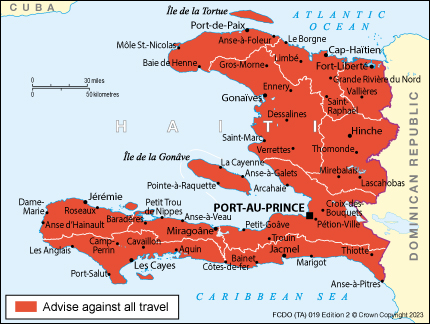
Warnings — Foreign OfficeForeign Office ↗updated 10.12.2025 · read 15.10.2026
Warnings — Foreign Office
Your travel insurance could be invalidated if you travel against advice from the Foreign, Commonwealth & Development Office (FCDO). Consular support is also severely limited where FCDO advises against travel.
## FCDO advises against all travel to Haiti
FCDO advises against all travel to Haiti due to the volatile security situation. There are currently no British consular officials in Haiti and our ability to provide consular assistance is severely limited and cannot be delivered in person in Haiti.
British nationals may get consular services assistance at our diplomatic mission in the Dominican Republic .
If you choose to travel to or stay in Haiti against FCDO advice, try to avoid all crowds and public events, and take appropriate security precautions.
Travel insurance
If you choose to travel, research your destinations and get appropriate travel insurance . Insurance should cover your itinerary, planned activities and expenses in an emergency.
Safety — Foreign OfficeForeign Office ↗updated 10.12.2025 · read 15.10.2026
Terrorism
There is a high threat of terrorist attack globally affecting UK interests and British nationals, including from groups and individuals who view the UK and British nationals as targets. Stay aware of your surroundings at all times.
UK Counter Terrorism Policing has information and advice on staying safe and what to do in the event of a terrorist attack. Find out how to reduce your risk from terrorism while abroad .
Terrorism in Haiti
Although there’s no recent history of terrorism in Haiti, attacks cannot be ruled out.
Haiti-Dominican Republic border closure
The border between Haiti and the Dominican Republic is closed to travellers. The status of the border remains subject to change at short notice. Monitor local media for updates.
Political situation
There are sometimes violent demonstrations, protests and roadblocks. Stay away from political rallies and crowds. Public transport is often disrupted because of blocked roads and security incidents, which can lead to fuel and food shortages.
Crime
If you choose to travel to or stay in Haiti against FCDO advice, check local media and make sure you have contingency plans in place. Be vigilant at all times, tell family and friends about your travel plans and carefully consider your movements in advance, taking the safest routes available.
The security situation is unpredictable and crime levels are high. There is usually an increase in crime leading up to the:
- holiday season in December
- Carnival (in February or March)
- beginning of the school year (late August/early September)
Criminal and gang activity
Theft, including armed robbery, purse snatching and pickpocketing, is common in Haiti. Criminal and gang activity is especially common in:
- Bel Air
- Carrefour
- Cité Soleil
- downtown Port-au-Prince
- Martissant
- Petion-Ville
People using cash machines have been targeted by criminals. Gangs, often on motorbikes, target people making withdrawals or leaving banks, particularly those travelling on foot. Take care when withdrawing money at public ATMs and use supermarkets or hotels with security guards.
Armed robbery is common. Victims are often attacked in the daytime by armed thieves on motorcycles. Some attacks have resulted in fatalities. Single women drivers in traffic have been targeted.
Criminal kidnaps
There is a high threat of criminal kidnaps in Haiti. Incidents of criminal kidnap can occur in any part of the country, at any time.
Criminal groups often use firearms and extreme violence to kidnap victims. Kidnappers regularly target vehicles, using other vehicles or improvised barriers to stop traffic and snatch individuals at gunpoint. Public and mass transit services are targeted in addition to private vehicles. These can be both opportunistic or targeted towards specific individuals.
There is a high threat particularly throughout the metropolitan area of Port-au-Prince and across major road routes entering/leaving the city.
Criminal groups may target whole communities or individuals, including children. Missionary and humanitarian aid workers are viewed as legitimate targets. If you’re kidnapped, the reason for your presence is unlikely to protect you or secure your safe release.
Most victims have been released after the payment of a ransom. In some exceptional cases, however, victims have disappeared or been killed.
Be alert to the threat of kidnap and pay attention to local government announcements and media reporting. Be vigilant across the country, remaining alert to small groups, especially near where you’re…
American passport — U.S. Department of State
- U.S. citizens should not travel to Haiti due to risks of crime, kidnapping, terrorism, unrest, and limited healthcare.
- A national state of emergency has been in effect in Haiti since March 2024 and remains active.
- U.S. government employees in Haiti face travel restrictions, and the U.S. government has limited ability to provide emergency services.
- U.S. commercial flights to Port-au-Prince are prohibited by the FAA due to ongoing instability.
- Violent crime, including robbery, carjacking, sexual assault, and kidnapping for ransom, is rampant, especially in Port-au-Prince.
- Kidnappings are widespread, with ransom demands often ranging from tens of thousands to hundreds of thousands of dollars.
Faithful summary of the official texts below, which prevail.
Haiti - Level 4: Do Not Travel 2026-07-09travel.state.gov ↗updated 09.07.2026 · read 16.10.2026
Advisory summary
Do not travel to Haiti due to the risk of crime , kidnapping , terrorism , unrest , and limited health care . Read the entire Travel Advisory.
Haiti has been under a national state of emergency since March 2024. This state of emergency remains in effect.
U.S. government employee travel restrictions
U.S. government employees working in Haiti are not allowed to travel away from the U.S. embassy for non-essential reasons due to safety risks. The U.S. government has an extremely limited ability to provide emergency services to U.S. citizens in Haiti because of security-related travel restrictions.
Due to safety risks, family members cannot join U.S. government employees who work in Haiti.
Air Travel
U.S. commercial flights are not currently operating to or from Port-au-Prince. The Federal Aviation Administration (FAA) issued a Notice to Airmen (NOTAM) that prohibits U.S. air carrier flights to Port-au-Prince due to ongoing instability. For more information, U.S. citizens should consult the Federal Aviation Administration’s Prohibitions, Restrictions and Notices.
Crime
Violent crime is rampant in Haiti, especially in Port-au-Prince. There has been an increase in gangs, organized crime, and terrorist activities.
- Crimes involving firearms are common.
- Crimes include robbery, carjackings, sexual assault, and kidnappings for ransom.
- The escalation of fighting between armed groups has led to a rise in random gunfire incidents. There is risk of being struck by stray bullets, even for people not directly involved in the violence.
- Local law enforcement has an extremely limited ability to respond to serious crimes, particularly outside Port-au-Prince and Cap-Haitien.
Kidnapping
Kidnapping is widespread. U.S. citizen victims of kidnapping have been hurt or killed.
- Kidnappers often demand ransoms. Ransom demands are typically in the tens of thousands to hundreds of thousands of dollars.
- Kidnappers target and attack vehicles, including commercial busses. They can also attack convoys.
Terrorism
Terrorist violence, including attacks on citizens and other violent gang activity, happens frequently in Haiti. Some Haitian gangs are designated by the U.S. Department of State as terrorist organizations. Visit the U.S. Department of State’s country reports on terrorism to learn more.
Unrest
Protests, demonstrations, and roadblocks are…
Global Affairs Canada — additional reading
Avoid all travel
Avoid all travel to Haiti due to the threat posed by kidnappings, gang violence and the potential for civil unrest throughout the country.
- HAITI — Avoid all travel to Haiti due to the threat posed by kidnappings, gang violence and the potential for civil unrest throughout the country.
Open Government Licence – Canada · September 24, 2026 08:53 EDTtravel.gc.ca ↗updated 24.09.2026 · read 16.10.2026
- Canadian citizens face severe penalties for drug offenses, including lengthy legal proceedings, jail sentences, and fines, with prison conditions being extremely difficult and overcrowded.
- Canadian citizens may drive in Haiti with their Canadian driver's licence for up to three months; longer stays require a Haitian driver's permit.
- Canadian citizens should obtain permission before photographing individuals, as people may feel insulted or exploited, especially in poorer or urban areas.
- Donations entering Haiti are subject to import rules and may be seized and taxed; contact the Haitian Embassy or consulates before sending goods.
- Canadian citizens should carry proof of identity and keep a separate copy of their passport's photo page and visa stamp.
- While same-sex sexual activity is legal in Haiti, 2SLGBTQI+ individuals may face discrimination, and public displays of affection are uncommon for any couples.
Faithful summary of the official texts below, which prevail.
Global Affairs Canada — written for Canadian travellers, valid for all
Local laws
You must abide by local laws. Learn about what you should do and how we can help if you are arrested or detained abroad. Legal fees can be very high and judicial procedures are slow. Some Canadians have experienced an over a year detention period before being sent to trial. Prison conditions are extremely difficult. Penal facilities are overcrowded, unsanitary and under-resourced.
Drugs
Penalties for possession, use or trafficking of illegal drugs are severe. Convicted offenders can expect lengthy legal proceedings, heavy jail sentences and fines. Drugs, alcohol and travel
International Child Abduction
The Hague Convention on the Civil Aspects of International Child Abduction is an international treaty. It can help parents with the return of children who have been removed to or retained in certain countries in violation of custody rights. It does not apply between Canada and Haiti. If your child was wrongfully taken to, or is being held in Haiti by an abducting parent:
- act as quickly as you can
- consult a lawyer in Canada and in Haiti to explore all the legal options for the return of your child
- report the situation to the nearest Canadian government office abroad or to Global Affairs Canada by calling the Emergency Watch and Response Centre
If your child was removed from a country other than Canada, consult a lawyer to determine if The Hague Convention applies. Be aware that Canadian consular officials cannot interfere in private legal matters or in another country's judicial affairs.
2SLGBTQI+ persons
Haitian law does not prohibit sexual acts between individuals of the same sex. However, 2SLGBTQI+ persons could be discriminated against based on their sexual orientation, gender identity, gender expression or sex characteristics. Travel and your sexual orientation, gender identity, gender expression and sex characteristics
Driving
In order to fight insecurity, local authorities have temporarily forbidden to drive vehicles with tinted windows throughout the country. You may use your Canadian driver’s licence to drive in Haiti for up to 3 months. For stays of 3 months or more, you will require a Haitian driver’s permit. You should carry an international driving permit. International Driving Permit
Photography
People may feel exploited or insulted by being subjects of photography in poor or urban areas. Obtain permission before photographing individuals.
Donations
Donations entering the country are subject to import rules. They could be seized and taxed in accordance with local legislation. This includes:
- clothing
- new or used material goods
- personal care products
- medications
Contact the Embassy of the Republic of Haiti or one of its consulates before sending goods to Haiti.
Money
The currency in Haiti is the Haitian gourde (HTG). Although all prices should be in gourde since March 2018, they are still often quoted in Haitian dollars (5 gourdes = 1 Haitian dollar) or in U.S. dollars. Canadian currency is not accepted. Most leading hotels accept major credit cards. You can also use your Canadian bank cards to access funds from some ATMs, but the withdrawal limit is much lower than in Canada. Haitian ATMs are unreliable and you should not depend upon them in emergency situations. Make sure to have sufficient cash in case you’re unable to access an ATM or use your credit card.
Open Government Licence – Canada · September 24, 2026 08:53 EDTtravel.gc.ca ↗updated 24.09.2026 · read 16.10.2026
Foreign Office — laws and cultural differences
Illegal drugs and prison sentences
Penalties for possession, use or trafficking of illegal drugs are severe. Convicted offenders can expect lengthy legal proceedings, jail sentences and fines. Pack all luggage yourself and do not carry items through customs for anyone else. If you’re caught in possession of drugs or suspected of drug trafficking, you may be arrested and jailed for weeks or months before appearing in court. Prison conditions in Haiti are very poor.
Personal ID
You should always carry proof of your identity. Keep a copy of the photo page of your passport and visa stamp separately in a safe place.
LGBT+
Local attitudes towards the LGBT+ community are mostly conservative throughout the Caribbean. In Haiti, same-sex sexual activity is legal. However, the attitude of many Haitians to the LGBT+ community is hostile. LGBT+ travellers should be mindful of local attitudes and be aware that showing affection in public could result in unwanted and negative attention. It is uncommon for opposite or same-sex couples to show affection in public. Read more advice for LGBT+ travellers.
Open Government Licence v3.0gov.uk ↗updated 10.12.2025 · read 15.10.2026
What it changes for you: Poor air: asthma, COPD, allergies — bring your prescription and regular treatment, limit outdoor exertion; persistent breathing trouble goes to a doctor, or to the 24/7 number. Very high UV: sunscreen, hat and shade between 11 am and 4 pm; sunstroke and dehydration are travellers' first reasons to see a doctor.
Reading 01:00 (America/Port-au-Prince)Open-Meteo ↗updated 16.10.2026 · read 16.10.2026
Air quality and UV: Open-Meteo.com (CC BY 4.0), data rounded and formatted by Maximum. Contains modified Copernicus Atmosphere Monitoring Service information 2026. Neither the European Commission nor ECMWF is responsible for any use that may be made of the Copernicus information or data it contains.
Reading: With 0.3 physicians per 1,000 people (93% fewer than Switzerland), the nearest hospital does not always have the capacity for a serious case: evacuation to an adequate centre is the rule, not the exception — that is what unlimited evacuation and repatriation cover. Health spending of 54 USD per person (Switzerland: 11,784) goes with private hospitals that bill foreigners in hard currency and ask for a guarantee before admission: the direct payment guarantee is what avoids the deposit.
World Bank — latest published value, year per indicatordata.worldbank.org ↗read 10.10.2026
What is happening in Haiti right now
Live alerts and level changes, each with its official source. Continuously updated.
What governments have just written
La situation sécuritaire reste toujours aussi préoccupante, tant dans la zone métropolitaine de Port-au-Prince que dans le reste du pays. Aucune zone n’est exempte de risques. Le risque d’enlèvement est particulièrement élevé, imprévisible et est actuellement en nette recrudescence. Pour ces raisons, il reste fortement conseillé de différer tout voyage en Haïti. Pour rappel, l’ensemble du territoire haïtien est formellement déconseillé. Pour les personnes qui se trouveraient…
France Diplomatie (in French) · posted 17 October 2025 · updated 8 September 2026diplomatie.gouv.fr ↗updated 21.09.2026 · read 15.10.2026Health – editorial change
September 24, 2026 08:53 EDTtravel.gc.ca ↗updated 24.09.2026 · read 16.10.2026No level change recorded for this country since the log opened. The live alerts above are updated continuously.
Frequently asked questions — travel insurance Haiti
What is the official risk level in Haiti today?
Level 4/4 — Do Not Travel, U.S. Department of State, retrieved on 16 October 2026.
- Is the whole country advised against? United States: yes · France: yes · United Kingdom: yes · Switzerland: yes (reading of 27 September 2026).
- Switzerland’s FDFA advises against all travel to the country (published 06.07.2026).
- The FDFA advises against the trip: art. 18.1 (Module A) opens cancellation, change and curtailment costs.
- At this level most bank cards and standard policies exclude the trip: read My cover before booking, and only leave with cover that says so in writing.
- We check these sources every morning and e-mail you the day one changes (Alerts button).
Sourcestravel.state.gov · updated 09.07 · read 16.10France Diplomatie · updated 21.09 · read 15.10DFAE · updated 06.07 · read 15.10207-country comparison
Is the whole of Haiti advised against, or only some areas?
An area advised against does not rule out the country.
- Official answers: United States: yes · France: yes · United Kingdom: yes · Switzerland: yes.
- France Diplomatie, areas formally advised against: “L’ensemble du pays est formellement déconseillé en raison de la présence de gangs armés violents et actifs, de l’important taux de criminalité et du risque très élevé d’enlèvement. En raison du contexte sécuritaire général et de l’activité des gangs dans le…”
- Keep your country of residence's advisory on booking day and on departure day: that is what your policy's clauses cite.
SourcesFrance Diplomatie · updated 21.09 · read 15.10Foreign Office · updated 10.12 · read 15.10State Department · updated 09.07 · read 16.10
What are the entry requirements for Haiti with my passport?
The rules depend on the passport, not on the destination alone.
- French passport (France Diplomatie): French nationals need a passport valid for six months beyond their planned return date to enter Haiti. All non-residents must pay a tourist tax upon arrival: USD 10, CAD 10, or EUR 10. Land and sea borders with the Dominican Republic are closed; commercial air services operate only from Cap-Haïtien airport.
- British passport (Foreign Office): Your passport must be valid for at least six months beyond your arrival date in Haiti, or you will be denied entry. British citizens do not need a visa to visit Haiti for up to ninety days. You must pay an entry fee of ten US dollars in cash upon arrival in Haiti.
- American passport: the requirements are on the State Department country page (travel.state.gov).
- Swiss passport: the FDFA refers you to the destination's embassy in Switzerland.
- Pick your passport at the top of Before you go › Entry: the official text that concerns you comes first, with its “In brief” summary.
SourcesFrance Diplomatie · updated 21.09 · read 15.10Foreign Office · updated 10.12 · read 15.10State Department · updated 09.07 · read 16.10
Do I need an insurance certificate for a Haiti visa?
For a Schengen visa, yes: at least €30,000 of travel medical insurance (Regulation (EC) No 810/2009, art. 15).
- Many other countries ask for it on entry or for a visa, case by case: check Before you go › Entry, with your passport.
- Subscribe: the named certificate arrives by e-mail on payment, with your name, dates and limits (EUR 1.5M medical expenses, unlimited evacuation and repatriation) — the ones consulates check.
- Attach it to the visa file; if in doubt about the format, write to us.
SourcesRegulation (EC) 810/2009, art. 15General conditions, policy 20 00 479
What does Maximum Insurance do in Haiti, concretely?
VIP Pack — €990 for twelve months, unlimited trips.
- EUR 1.5M emergency medical expenses, unlimited medical evacuation and repatriation, search and rescue EUR 50,000, cancellation or change EUR 5,000.
- One 24/7 number, +41 22 ••• •• ••: Maximum sends its direct payment guarantee to the hospital (art. 2.12).
- Network of 45,000 providers (art. 6.9); evacuation is decided, organised and paid by Maximum's medical team if the local facility is not enough (art. 6.2.2).
- Named certificate by e-mail on payment, no medical questionnaire.
SourcesGeneral conditions, policy 20 00 479OpenStreetMap · read 10.10
How much does a medical repatriation from Haiti cost?
From 15 000 € to 200 000 € depending on severity and distance (Travel Care Air, 2026).
- Without cover: the hospital asks for a deposit before admission, and the medical flight is paid up front.
- With the VIP Pack: the evacuation is decided and settled by Maximum (art. 6.2.2) — no advance, no cap.
SourcesTravel Care Air, 2026General conditions, policy 20 00 479
What should I do if hospitalised in Haiti?
Six steps, in this order.
- 1. Call +41 22 ••• •• •• before paying anything, or have the front desk call: it is the condition for full cover (otherwise: reduced or refused benefits).
- 2. Ask for a hospital in the Maximum network (art. 6.9).
- 3. See a doctor the same day and leave with the certificate: without an on-the-spot finding, nothing is covered (art. 33).
- 4. Admitted for more than 24 h? The front desk calls Maximum: direct payment guarantee, no deposit (art. 2.12).
- 5. Book no ambulance or flight yourself (art. 6.2.2).
- 6. Once home, file within 30 days (art. 35.7).
- Local emergency services: police 122 / 114 · ambulance 116 · fire 115.
SourcesSpecial conditions 01.26General conditions, policy 20 00 479
Which emergency numbers in Haiti?
Local emergency services: police 122 / 114 · ambulance 116 · fire 115
- Maximum, 24/7, before any payment: +41 22 ••• •• ••.
- France — French Embassy (0.6 km) · +509 29999000
- Switzerland — Embassy of Switzerland (6.6 km) · +509 2941 05 01
- United Kingdom — Ambassade du Royaume-Uni (5.0 km)
- United States — Ambassade des États-Unis d'Amérique (9.7 km) · +509 22 29 8000
- Save these numbers before leaving; in immediate danger, call local emergency services first, then Maximum.
SourcesEmergencyNumberAPI · Wikidata · read 08.10OpenStreetMap · read 10.10
Is an Amex, Visa or Mastercard enough in Haiti?
At today's level 4/4, card by card:
- Amex Platinum — Your Amex Platinum expressly excludes this trip: the T&Cs rule out travel to countries your government has advised against visiting.
- Visa — Your Visa may not cover here: the notice excludes the consequences of war, notorious political instability and terrorism — precisely the risks of an advised-against area.
- Mastercard — Your Mastercard World Elite expressly excludes this trip: areas 'formally advised against' by the French foreign ministry are ruled out, assessed at departure date.
- Three lines to read in your notice: the duration (often 90 days per trip), the settlement (reimbursement afterwards or direct payment of the hospital) and the area exclusion at level 4/4.
SourcesAmex Platinum France T&Cs, 01.2025 — general exclusion n° 11BNP Paribas Visa Infinite notice (policy PT7), 04.2025 — comFortuneo World Elite Mastercard notice, 01.2026 — art. 5.5 '
Are a health plan or a travel policy enough in Haiti?
A health plan reimburses at home; here, the hospital asks for a payment guarantee before admission.
- Health plan — A health plan treats you at home. Here the hospital asks for a guarantee before admission — not a later reimbursement.
- Travel policy — The clause is a market standard: the reference policy excludes trips to areas 'formally advised against by government authorities' — at this level most classic policies no longer cover.
- A travel policy often has a territorial clause at level 4/4 and a 90-day limit per trip.
- Have your IPID number or the PDF of the terms and ask an expert to call you back: the answer is in the document, not in the brochure.
SourcesGeneral conditions, policy 20 00 479
How do I use the medical network on this page?
The page reads hospitals, pharmacies and doctors from OpenStreetMap, around the point you choose.
- Type your city, hotel or beach: the map re-centres, 24/7 emergency rooms come first.
- Each row gives the phone when the source publishes it, the nearest street, directions and the Google Maps listing.
- The PDF briefing repeats the same places, numbered on a printable map.
- No customer reviews: OpenStreetMap has none, and we invent none.
Which vaccines and health precautions for Haiti?
The sourced detail is under Medical network › Health: vaccines, diseases present, altitude, outbreaks.
- CDC (Travelers' Health), depending on the trip: Routine vaccines, COVID-19, Cholera, Hepatitis A, Hepatitis B, Malaria, Measles.
- France Diplomatie reports in the country: dengue, malaria, chikungunya — mosquito protection day and night.
- See a doctor or a travel clinic 8 weeks before departure (Foreign Office).
- Carry your medicines in their packaging, with a prescription using international non-proprietary names (France Diplomatie).
SourcesCDC Travelers' Health · read 10.10France Diplomatie · updated 21.09 · read 15.10OMS · read 15.10Foreign Office · updated 10.12 · read 15.10
Can I be treated in Haiti, or will I be evacuated?
0.3 physicians per 1,000 people (2022) versus 4.5 in Switzerland.
- 4.9 hospital beds per 1,000 people versus 4.4 in Switzerland (World Bank).
- With 0.3 physicians per 1,000 people (93% fewer than Switzerland), the nearest hospital does not always have the capacity for a serious case: evacuation to an adequate centre is the rule, not the exception — that is what unlimited evacuation and repatriation cover. Health spending of 54 USD per person (Switzerland: 11,784) goes with private hospitals that bill foreigners in hard currency and ask for a guarantee before admission: the direct payment guarantee is what avoids the deposit.
- When the local facility is not enough, Maximum's medical team decides the evacuation to a suitable centre, and pays for it (art. 6.2.2).
SourcesWorld Bank · read 10.10General conditions, policy 20 00 479
Haiti: safety, in figures?
41.1 homicides per 100,000 people (2023) versus 0.6 in Switzerland and 1.3 in France.
- 18.8 road deaths per 100,000 people versus 2.2 in Switzerland (World Bank, WHO).
- UCDP (Uppsala University): 28 geolocated violent incidents, 167 deaths over the last closed period, each placed on the map.
- The homicide rate is 68 times Switzerland's: violence is a real risk there, concentrated in the areas named by the official advisories. On the road, 9 times more deaths than in Switzerland: road crashes are the leading cause of death of healthy travellers (CDC) — seat belt, no night driving, a driver or a taxi from a rank.
Where is my embassy in Haiti, and why register?
The nearest representations, by passport (OpenStreetMap):
- France — French Embassy (0.6 km) · +509 29999000
- Switzerland — Embassy of Switzerland (6.6 km) · +509 2941 05 01
- United Kingdom — Ambassade du Royaume-Uni (5.0 km)
- United States — Ambassade des États-Unis d'Amérique (9.7 km) · +509 22 29 8000
- Register before leaving: France: Ariane · Switzerland: Travel Admin · United Kingdom: Foreign Office alerts · United States: STEP.
- Two minutes, and in a crisis your country's authorities can reach you and count you in an evacuation.
- Pick your passport at the top of Contacts: your embassy comes first.
SourcesOpenStreetMap · read 10.10DFAE · updated 06.07 · read 15.10
Which regions of Haiti should I avoid, precisely?
At least one official reading covers the whole country; 1 region is also named, fully or partly.
- Your point (Ouest): advised against — all travel.
- Advised against — all travel: Artibonite.
- Global Affairs Canada covers the whole country.
- Foreign Office covers the whole country.
- Maximum does not exclude these areas: the VIP Pack covers care and repatriation there (sanctions, embargoes and a country already at war at departure remain enforceable).
SourcesGlobal Affairs Canada · updated 24.09 · read 16.10Foreign Office · updated 10.12 · read 15.10France Diplomatie · updated 21.09 · read 15.10
Which laws and customs should I know in Haiti?
Local laws apply to every traveller; here is what the official texts say.
- Canadian citizens face severe penalties for drug offenses, including lengthy legal proceedings, jail sentences, and fines, with prison conditions being extremely difficult and overcrowded.
- Canadian citizens may drive in Haiti with their Canadian driver's licence for up to three months; longer stays require a Haitian driver's permit.
- Canadian citizens should obtain permission before photographing individuals, as people may feel insulted or exploited, especially in poorer or urban areas.
- Donations entering Haiti are subject to import rules and may be seized and taxed; contact the Haitian Embassy or consulates before sending goods.
- Canadian citizens should carry proof of identity and keep a separate copy of their passport's photo page and visa stamp.
SourcesGlobal Affairs Canada · updated 24.09 · read 16.10Foreign Office · updated 10.12 · read 15.10
Who can I call at any hour from Haiti?
Every foreign ministry runs a 24/7 emergency line for its nationals.
- France — Crisis and Support Centre — French Ministry for Europe and Foreign Affairs: +33 1 53 59 11 00. 24/7 emergency line, standard rate. First contact abroad: the French embassy or consulate.
- Switzerland — FDFA Helpline: +41 58 465 33 33 · +41 800 24 7 365. 24/7, 365 days a year — helpline@eda.admin.ch. Beware of scam calls spoofing these numbers.
- United Kingdom — Foreign, Commonwealth & Development Office: +44 20 7008 5000. 24 hours, for British nationals.
- United States — Overseas Citizens Services — U.S. Department of State: +1 202 501 4444 · +1 888 407 4747. From abroad; the second number from the U.S. and Canada.
- On site, French Embassy: +509 29999000.
Sourcesdiplomatie.gouv.fr · updated 21.09 · read 15.10eda.admin.ch · updated 06.07 · read 15.10
A few useful phrases in French for Haiti?
Emergency phrases, to show if pronunciation fails:
- Help! → Au secours !
- Call an ambulance! → Appelez une ambulance !
- I need a doctor. → J'ai besoin d'un médecin.
- Where is the nearest hospital? → Où est l'hôpital le plus proche ?
- Call the police! → Appelez la police !
SourcesMaximum Insurance
What should I keep after leaving Haiti, and how do I file a claim?
Keep the entry stamp, the invoices, the prescriptions and the medical report.
- File within 30 days (art. 35.7) from your client area, with the documents; the official forms are pre-filled.
- Costs advanced on site are reimbursed against receipts.
- Fever, persistent diarrhoea or a rash in the following weeks? See a doctor and say where you have been — dengue, malaria, chikungunya circulate in the country (France Diplomatie).
SourcesGeneral conditions, policy 20 00 479
What does the Pack VIP Extreme add?
Cancellation or change up to EUR 20,000, special risk EUR 5,000 per person, crisis management and security, optional Kidnap & Ransom.
- Special risk (Module A): political event, attack, epidemic, natural disaster — opens when the FDFA, the FOPH or WHO advise against the trip (art. 18.1).
- Epidemic: assistance must be requested within 7 days of the WHO or FDFA qualification (art. 36.2).
- Crisis management and security: trip registration, monitoring, extraction, evacuation in case of riot, war, terrorism or disaster; Kidnap & Ransom subject to eligibility (art. 18.4).
- €2,290 a year, unlimited trips.
SourcesGeneral conditions, policy 20 00 479
A question not answered here? Ask Maximum below, or call the support number: every question gets a clear, actionable answer.
In a life-threatening emergency, call local emergency services first, then Maximum: +41 22 ••• •• •• — 24/7 support number, an adviser stays with you to the end.
What Maximum knows
The 207 country pages — hospitals, pharmacies, police, embassies, emergency numbers, official advice from four governments, health, safety in figures, events in progress — read around the city you name. Your policy — benefits, the six steps, claims, articles. The site — prices, certificate, subscription. Nothing else: what it does not know, it says so and hands you to an adviser.
Travelling to Port-au-Prince: what changes
The published advisory level is national, but risk is not: business hubs (Port-au-Prince) do not share the profile of border areas. The medical network shown on this page is computed around Port-au-Prince — real hospitals, evacuation airport and live alerts. Before a specific trip, always cross-check your country of residence's advisory: that is what your policy cites.
Same advisory level: Central African Republic · Somalia · Sudan · South Sudan · Syria · Chad
The displayed level comes from the State Department, checked every morning. Before departure, always cross-check your country of residence's advisory: that is what your policy cites.
The level shown is the official U.S. Department of State level, checked daily. Maximum Insurance is an insurance distributor — general information, not personal advice.