Maximum Alerts / Iran
IranLevel 4/4
Level published by the State Department on 04.12.2025 · read 16 October 2026 · source checked daily
Iran — official level as of 16 October 2026: Level 4/4 ("Do Not Travel"), from the U.S. Department of State. Maximum Insurance covers this country: hospital settled directly, unlimited repatriation, EUR 1.5M, certificate on payment.
How we read these four advisories
Every country has its own scale, so we ask them all the same question: is the whole country advised against?
An advisory covering only areas of the country does not raise the answer: it stays “No”, and the area is shown in the relevant column.
The level shown on this page — and across this site — is the one published by the U.S. State Department, from 1 (normal precautions) to 4 (do not travel). France and the United Kingdom publish their own advisories, with their own rules: they add to that level, they do not replace it.
In a life-threatening emergency, call local emergency services first, then Maximum: +41 22 ••• •• •• — 24/7 support number, an adviser stays with you to the end.
What Maximum knows
The 207 country pages — hospitals, pharmacies, police, embassies, emergency numbers, official advice from four governments, health, safety in figures, events in progress — read around the city you name. Your policy — benefits, the six steps, claims, articles. The site — prices, certificate, subscription. Nothing else: what it does not know, it says so and hands you to an adviser.
What I say on the phone
- I am insured with Maximum, here is my policy number. Where should I go? Send me to a hospital in the Maximum network.
- Send the payment guarantee to the hospital: I do not want to pay anything up front.
- For non-urgent transport or repatriation, tell me what you authorise and arrange. In a life-threatening emergency, I call local emergency services immediately.
What to do, in this order
1Contact assistance without delay›
In immediate danger, call local emergency services first. Then contact assistance without delay; before engaging a service, seek approval under your policy. Cover is confirmed by the insurer.
2Ask where to get care›
Ask assistance where to get care and whether direct cover can be arranged. It confirms the facility and seeks the insurer's approval under your policy. In immediate danger, call local emergency services first.
3See a doctor the same day›
Even for a pain you meant to shrug off. Without a medical certificate written on the spot, the same day, the insurer cannot cover the event — a certificate written after you return does not count.
4Admitted? Have the hospital front desk call Maximum›
The hospital desk sends the request to assistance. Direct payment depends on the insurer's approval and the policy; the call alone does not guarantee it. Have the response confirmed before relying on no up-front payment.
5For non-urgent transport, seek assistance approval›
In a life-threatening emergency, call local emergency services immediately. For an arranged transfer or repatriation, contact assistance: the insurer's medical team decides on measures under the policy. A medical flight booked without approval may not be reimbursed.
6Once home, report the claim within 30 days›
Even if everything went well on the ground. Send your invoices and the medical report within 30 days; after that, compensation may be reduced or refused.
Places read from OpenStreetMap, within a circle of about 12 km: phone, email, address, website and hours when the source publishes them. No customer reviews, that source has none. Straight-line distances.
What is your current insurance?
Notices vary by bank and vintage — yours prevails. On the right: the Maximum contract (public documents).
Where to go, where not to
At least one official reading covers the whole country; no region is singled out.
- Avoid all travel to Iran due to volatile security situation in the region. If already there, leave now if you can do so safely. Global Affairs Canada
- Some airlines have suspended flights to and from Iran, though commercial flights and overland crossing options remain available. Global Affairs Canada
- British nationals in Iran, whether resident or visitor, should carefully consider their presence there and the risks of staying. Foreign Office
Faithful summary of the official texts below, which prevail.
Global Affairs Canada — advises against all travel to the whole country.
Foreign Office — advises against all travel to the whole country.
an official reading covers the whole country; every trip calls for a written management decision, justified by a pressing reason, with reinforced conditions.
Global Affairs Canada — Open Government Licence – Canada (13.10.2026) · Foreign Office — Open Government Licence v3.0 · France Diplomatie (09.03.2026) · Natural Earth
Last change: Removal of information on temporary withdrawal of UK staff from Iran and the embassy operating remotely (‘Warnings and insurance’ page).
Iran - Level 4: Do Not TravelState Department ↗updated 04.12.2025 · read 16.10.2026
Updated 04.12.2025
Do not travel to Iran due to the risk of terrorism , unrest , kidnapping , arbitrary arrest of U.S. citizens, and wrongful detention .
Do not travel to Iran for any reason. U.S. citizens in Iran should leave immediately. There is no U.S. Embassy in Iran. Review our information on Travel to High-Risk Areas .
U.S. citizens in Iran face serious dangers including terrorism , unrest , kidnapping , arbitrary arrest , and wrongful detention . Some U.S. nationals have been held for years on false charges, subjected to torture, and even sentenced to death.
No U.S. embassy in Iran
The U.S. government does not have diplomatic or consular relations with the Islamic Republic of Iran. The Swiss government, acting through its Embassy in Tehran, serves as the protecting power for United States interests in Iran.
The Embassy of Switzerland’s Foreign Interests Section in Tehran is temporarily closed due to the security situation in Iran until further notice. U.S. citizens in Iran in need of help should contact the U.S. Embassy in Bern, Switzerland by email at BernACS@state.gov or by phone at +41-31-357-7011 . This change reinforces the travel advice to U.S. citizens: Do Not Travel to Iran .
For routine consular services, U.S. citizens should visit the nearest U.S. embassy or consulate or return to the United States.
Detention, kidnapping, and hostage-taking
The U.S. Department of State has determined that U.S. nationals are at serious risk of wrongful detention by the Government of Iran:
- Iranian authorities continue to unjustly detain U.S. nationals without warning or any evidence they committed a crime. This includes dual U.S.-Iranian nationals, students, journalists, business travelers, academics, and people with U.S. military or government experience. Charges include espionage and posing a threat to national security.
- U.S. nationals are at significant risk of questioning, arrest, and detention in Iran.
- Having a U.S. passport or connections to the United States can be reason enough for Iranian authorities to detain someone.
- Iranian law allows authorities to punish individuals for “collaboration with a hostile state.” This includes having any real or perceived connection with a government or organization that Iranian authorities consider as acting against Iranian interests.
- Prior travel to Israel by an Iranian citizen can result in a prison sentence…
Nearest river dischargeOpen-Meteo ↗updated 16.10.2026 · read 16.10.2026
10-16 0.0 · 10-17 0.0 · 10-18 0.0 · 10-19 0.0 · 10-20 0.0 · 10-21 0.0 · 10-22 0.0 m³/s
Simulated discharge: Open-Meteo.com (CC BY 4.0), data rounded and formatted by Maximum. Contains modified Copernicus Emergency Management Service information 2026. For information only: this is not a flood warning; only national or regional authorities issue those.
What the national level does not tell you
The level is national. Risk areas are in the state advisories below.
- U.S. State Department — the full advisory details the regions concerned and the reasons (crime, terrorism, kidnapping, civil unrest) (read the advisory)
- Foreign, Commonwealth & Development Office (United Kingdom) — the United Kingdom advises against ALL travel to the whole country · reviewed 13 August 2026
Last announced change : « Removal of information on temporary withdrawal of UK staff from Iran and the embassy operating remotely (‘Warnings and insurance’ page). » (read the advisory) - France Diplomatie — the French advisory covers the WHOLE country: « Il est donc formellement déconseillé aux ressortissants français, y compris binationaux, de se rendre en Iran, quel qu’en soit le motif. » (read the advisory)
1 event located on the map
- Iran — Do Not Travel — level 4/4, U.S. State Department (source)
Over 1 January 2026 → 30 June 2026, UCDP (Uppsala University) recorded 41 geolocated violent incidents in this country, for 211 documented deaths.
Most affected areas
Tehran province 16 · Kordestan province 4 · West Azarbaijan province 3 · Hormozgan province 3 · Esfahan province 2 · Sistan and Baluchestan province 2
Most recent incidents
- 30 June 2026 · West Azarbaijan province · Qazqapan village
Six Kurdish fighters killed in clashes in western Iran: opposition group;Iranian media reported several militants killed · 6 deathsSource: Agence France Presse;Rudaw · 2 July 2026 · Revolutionary Guards ' Hamza headquarters · UCDP #633771 ↗ - 27 June 2026 · West Azarbaijan province · Mahabad town
The Kurdistan Defense Units (YPG) announced the death of four guerrillas;Hengaw report on deadly armed clashes in multiple cities · 4 deathsSource: Rudaw;Hengaw · 30 June 2026 · East Kurdistan Defense Units (YRK), Hengaw · UCDP #633772 ↗ - 26 June 2026 · Kordestan province · Sabadly village
Two policemen were killed in an armed attack in Sanaa;Hengaw report on deadly armed clashes in multiple cities · 2 deathsSource: Rudaw;Hengaw · 27 June 2026 · police · UCDP #633775 ↗ - 23 June 2026 · Kordestan province · Marivan county
PJAK: The Revolutionary Guards attacked our forces with drones in Bana · 1 deathSource: Rudaw · 26 June 2026 · Faraj Rostami, director of the border guard communications department in Sanaa province; · UCDP #633782 ↗ - 17 June 2026 · Sistan and Baluchestan province · Saravan town
IRGC forces fatally shoot Baloch youth Farzad Mollazehi in Saravan · 1 deathSource: Hengaw · 18 June 2026 · Hengaw · UCDP #635424 ↗ - 11 June 2026 · West Azarbaijan province · Chaldoran county
An Iranian border guard has been killed in Urmia province · 3 deathsSource: Rudaw · 14 June 2026 · Mohammad Ahmadi, the commander of the border guards in Urmieh province · UCDP #633820 ↗
Source: UCDP Georeferenced Event Dataset (Uppsala Conflict Data Program), file GEDEvent_v26_01_26_06.csv, CC BY 4.0 licence. We keep only incidents UCDP codes as "Clear" and whose location is precise enough to be placed — about 58% of the dataset. An incident may be revised, moved or withdrawn by UCDP in a later release: these figures describe a closed period, not a live situation.
Reading: The homicide rate is 4 times Switzerland's: violence is a real risk there, concentrated in the areas named by the official advisories. On the road, 10 times more deaths than in Switzerland: road crashes are the leading cause of death of healthy travellers (CDC) — seat belt, no night driving, a driver or a taxi from a rank.
World Bank (UNODC for homicides, WHO for roads) — latest published valuedata.worldbank.org ↗read 10.10.2026
What we locate on the map are events in progress that have real coordinates: USGS earthquakes, GDACS disasters, NOAA storms and open NASA EONET events. Hover a dot for details, click to open it in this briefing.
French passport — France Diplomatie
- French nationals, including dual citizens, are formally advised against all travel to Iran for any reason. France Diplomatie
- French visitors face significant risk of arbitrary arrest, detention, and unfair trial, including tourists. The French embassy's ability to provide consular protection is severely limited. France Diplomatie
- Dual French-Iranian nationals entering with an Iranian passport cannot request French consular protection, as Iran does not recognize dual nationality. France Diplomatie
- Iran is in a high seismic activity zone. A terrorist attack occurred in Kerman on 3 January 2024; avoid all gatherings. France Diplomatie
- Road conditions are dangerous due to undisciplined driving, poor maintenance, and weak emergency services. Avoid night driving outside cities. France Diplomatie
- Dual nationals over 17 years old not current with Iranian military service face difficulties during stays in Iran. France Diplomatie
Faithful summary of the official texts below, which prevail.
Il est donc formellement déconseillé aux ressortissants français, y compris binationaux, de se rendre en Iran, quel qu’en soit le motif.France Diplomatie ↗updated 09.03.2026 · read 16.10.2026
Iran
- Présentation de l'Iran
-
-
-
-
-
-
-
-
-
Zones de vigilance
Dernière actualisation le 09/03/2026, information toujours valable à la date du jour
Risques et recommandations associées
L’ensemble du territoire iranien est placé en rouge sur la carte des conseils aux voyageurs. Il est donc formellement déconseillé aux ressortissants français, y compris binationaux, de se rendre en Iran, quel qu’en soit le motif. Les ressortissants français encore présents en Iran et qui ne souhaiteraient pas quitter le pays sont invités à faire preuve de la plus grande vigilance et à prendre les précautions indispensables pour assurer leur sécurité. Il leur est notamment fortement conseillé de limiter leurs déplacements à l’intérieur du pays, d’éviter impérativement tout type de rassemblement et de se faire connaître auprès de l’Ambassade et du Consulat de France à Téhéran.
Risque d’arrestation, de détention arbitraire et de jugement inéquitable
Tout visiteur français, y compris binational, s’expose à un risque significatif d’arrestation, de détention arbitraire et de jugement inéquitable. Ce risque concerne également les personnes effectuant une simple visite touristique. En cas d’arrestation ou de détention, le respect des droits fondamentaux et la sécurité des personnes ne sont pas garantis. Dans ce contexte, la capacité de l’ambassade de France à Téhéran à assurer la protection consulaire des ressortissants arrêtés ou détenus en Iran est des plus limitée.
L’ambassade de France ne sera pas nécessairement informée de l’arrestation ou de la détention d’un citoyen français, a fortiori s’il s’agit d’un ressortissant franco-iranien, l’Iran ne reconnaissant pas la double nationalité. Les demandes de visites consulaires formulées par l’ambassade engendrent de longs délais d’instruction de la part des autorités iraniennes, et ne sont accordées que rarement, de manière aléatoire et avec un préavis très court.
En outre, une présence consulaire aux audiences lors d’un éventuel procès n’est pas garantie et les avocats sollicités peuvent être soumis à de fortes contraintes.
Il est donc rappelé qu’il est formellement déconseillé de se rendre en Iran, quel qu’en soit le motif.
Les Français déjà présents en Iran sont invités à se faire connaître de l’ambassade de France.
Compte tenu du risque d’arrestation arbitraire , il convient d’éviter tout différend potentiel avec les services de sécurité. Cela signifie en particulier :
- de se conformer scrupuleusement à la réglementation iranienne, et aux usages locaux (cf onglet informations utiles), notamment s’agissant des tenues vestimentaires et des attitudes à adopter dans l’espace public ;
- de se tenir à l’écart de tous les rassemblements (en particulier les…
Risques naturels
Le pays est dans une région de forte activité sismique. Pour obtenir plus d’informations sur la conduite à tenir en cas de séisme, consulter la fiche Séismes . Si un tremblement de terre se produisait, il est recommandé aux ressortissants français de prendre immédiatement contact avec leur famille ou leurs proches afin de les rassurer sur leur sort ou, le cas échéant, en cas de problème de communication avec l’extérieur, avec l’ambassade de France.
Terrorisme
Dans un contexte régional troublé, l’attentat du 3 janvier 2024 à Kerman a rappelé l’existence d’un risque de nature terroriste en Iran. Les autorités iraniennes ont revu à la hausse leur évaluation du risque terroriste et communiqué de manière régulière depuis sur des opérations de démantèlement de cellules terroristes (zones frontalières et capitale). Les recommandations générales de vigilance s’agissant des rassemblements aux abords desquels les visiteurs peuvent se trouver amenés à circuler doivent dans ce contexte faire l’objet d’une attention particulière.
Risque routier
Si l’état général des routes est bon, malgré quelques déformations et dégradations de chaussée non signalées, la circulation est dangereuse en raison des comportements peu disciplinés des conducteurs, des motocyclistes et des piétons, du mauvais entretien et de la surcharge fréquente des véhicules, de la signalisation incertaine et de la faiblesse des secours d’urgence. Aussi convient-il de conduire avec prudence et d’éviter, autant que possible, de rouler la nuit hors des villes. Les cartes routières contiennent parfois de sérieuses erreurs ou approximations, tout particulièrement en matière de routes non asphaltées.
Recommandations générales
- Les autorités iraniennes ne reconnaissent pas la double nationalité. Les binationaux franco-iraniens qui entreraient en Iran avec leur passeport iranien ne seront donc pas en mesure de solliciter la protection consulaire. Il est par ailleurs rappelé que les binationaux de plus de 17 ans qui ne seraient pas à jour de leur service militaire iranien s’exposent à des difficultés lors d’un séjour en Iran.
- Il est rappelé aux voyageurs qui souhaitent se rendre en Afghanistan , au Pakistan ou en Irak depuis l’Iran que les déplacements dans ces pays sont formellement déconseillés. Le risque en matière de sécurité, et notamment d’enlèvement, y est très important. Les informations diffusées sur les réseaux sociaux ou via le bouche-à-oreille par d’autres voyageurs, faisant état de déplacements sans encombres ou de l’hospitalité des populations locales, ne sont ni fiables, ni représentatives de la réalité des risques.
Full text of the Security pagediplomatie.gouv.fr ↗updated 09.03.2026 · read 16.10.2026
Swiss passport — FDFA (Switzerland), in French
- Travel to Iran is not recommended; airspace may close completely and airports may shut without notice. DFAE
- Internet, telephone networks, WhatsApp, Instagram and VPNs are frequently unavailable; supply shortages may occur. DFAE
- Foreign travellers risk arrest, interrogation or detention without apparent cause; long prison sentences are possible. DFAE
- Swiss nationals and dual Swiss-Iranian citizens may be arrested; Iran restricts Swiss consular protection and often withholds information about detentions from embassies. DFAE
- Swiss citizens already in Iran should use available commercial transport to leave; departure is voluntary and at personal risk and expense. DFAE
- Those remaining in Iran or travelling there despite DFAE warnings must understand Switzerland has severely limited capacity to provide emergency assistance. DFAE
Faithful summary of the official texts below, which prevail.
FDFA update note — Ces conseils pour les voyages ont été actualisés. Toujours valable: Les voyages à destination de l'Iran sont déconseillés. (published 04.05.2026)
General assessment
Les voyages à destination de l'Iran sont déconseillés. Le risque d'escalade reste très élevé dans toute la région. L'espace aérien peut être complètement fermé et les aéroports peuvent être fermés. Des difficultés d'approvisionnement peuvent survenir. L'accès à Internet et au réseau téléphonique est souvent interrompu. Cela vaut également pour des services tels que WhatsApp, Instagram et VPNs. Les personnes en voyage étrangères courent le risque d'être arrêtées, interrogées ou détenues sans raison apparente; de longues peines de prison peuvent être prononcées. Le nombre d'arrestations de personnes étrangères en voyage a augmenté. Les autorités iraniennes n'autorisent que de manière limitée, voire pas du tout, l'octroi d'une protection consulaire par la Suisse en cas de détention. Dans de nombreux cas, les autorités iraniennes n'informent pas les ambassades étrangères de l'arrestation, ni des charges retenues contre les personnes détenues, ni de leur lieu de détention. Le risque d’arrestation existe également pour les personnes de nationalité suisse ainsi que les doubles nationaux iraniens et suisses. Les double-nationaux sont considérés comme des citoyennes et citoyens iraniens . Pour les personnes de nationalité suisse qui se trouvent en Iran: Si vous souhaitez quitter le pays, utilisez les moyens de transport commerciaux disponibles . Renseignez-vous sur place sur les moyens de transport. Conformez-vous aux prescriptions des autorités locales et prenez les précautions nécessaires. La décision de quitter le pays est prise volontairement, aux risques et aux frais de la personne qui quitte le pays. Restez en contact avec vos proches. Les personnes suisses qui décident de rester dans le pays ou de se rendre en Iran malgré les recommandations du DFAE doivent être conscientes que la Suisse n’aura que des possibilités limitées de porter assistance en cas d’urgence. Tenez-vous au courant de l'évolution de la situation. Limitez vos déplacements à l'intérieur du pays au minimum indispensable et vérifiez au préalable les conditions de sécurité.
FDFA travel advice, in French, valid on 16.10.2026eda.admin.ch ↗updated 04.05.2026 · read 16.10.2026
British passport — Foreign Office (UK)
- The Foreign Office advises against all travel to Iran. Travel insurance may be invalidated if you travel against this advice. Foreign Office
- British nationals and British-Iranian dual nationals face very high risk of arrest, detention, and questioning in Iran; holding a British passport alone can trigger detention. Foreign Office
- If detained in Iran, you could face months or years of imprisonment, significant fines, travel bans, or death sentences for security-related offences. Foreign Office
- Iranian airspace and borders may close at short notice; the UK government cannot evacuate you or provide face-to-face assistance in emergencies. Foreign Office
- To cross the Turkey-Iran border, British nationals must request facilitation from the British Embassy in Ankara via the FCDO before travelling, providing name, date of birth, travel document details, and intended border point. Foreign Office
- Terrorist attacks in Iran are likely and have been indiscriminate; in January 2024, at least 84 people were killed in suicide bombings in Kerman by Islamic State Khorasan Province. Foreign Office
Faithful summary of the official texts below, which prevail.
Regions covered by the Foreign Officegov.uk ↗updated 13.08.2026 · read 16.10.2026
- FCDO advises against all travel to Iran. If you are a British national already in Iran, either resident or visitor, carefully consider your presence there and the risks you take by staying. Find out more about why FCDO advises against travel.
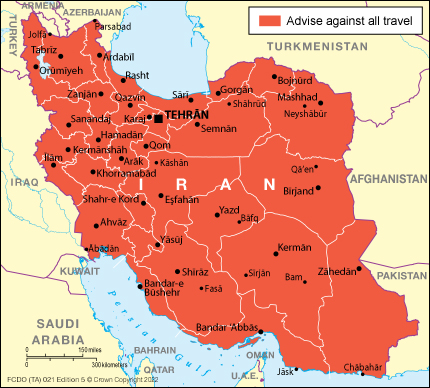
Warnings — Foreign OfficeForeign Office ↗updated 13.08.2026 · read 16.10.2026
Warnings — Foreign Office
Your travel insurance could be invalidated if you travel against advice from the Foreign, Commonwealth & Development Office (FCDO).
## FCDO advises against all travel to Iran
FCDO advises against all travel to Iran. If you are a British national already in Iran, either resident or visitor, carefully consider your presence there and the risks you take by staying.
British and British-Iranian dual nationals are at significant risk of arrest, questioning or detention. Having a British passport or connections to the UK can be reason enough for the Iranian authorities to detain you.
Find out more about why FCDO advises against travel .
Regional tensions
The US and Iran announced a memorandum of understanding (MOU) on 17 June in relation to the conflict in the Middle East, however the situation in the Middle East remains unpredictable. Since 8 July there have been strikes and retaliatory attacks by Iran in a number of locations across the region against US military and civilian infrastructure. There is a risk of more attacks and unforeseen escalation in the region.
British nationals currently in the Middle East should be prepared for possible flight cancellations, periodic airspace closures, and potential travel disruptions, and should:
- read If you’re affected by a crisis abroad - GOV.UK . This includes guidance on “how to prepare for a crisis” with suggestions on what you might include in your emergency supplies and “what to do in a crisis”
- sign up to FCDO Travel Advice email alerts
- monitor local and international media for the latest information
- stay away from areas around security or military facilities
- keep your departure plans under review, and ensure your travel documents are up to date
- if you are advised to take shelter, stay indoors or find the nearest safe building or designated shelter. An interior stairwell or a room with as few external walls or windows as possible may provide additional protection. The greatest risk is from falling debris caused by intercepts, and you are safest inside a secure structure
If you are in Iran
Air, sea and land routes are under the control of the Iranian authorities. Ports and borders may close at short notice. There is ongoing disruption to communications across Iran, with limitations on internet access.
The US and Israel have struck infrastructure across Iran. There are reports that suggest ports, roads, railways, bridges, energy facilities, oil production sites, water systems, and airports have been affected.
British nationals and British-Iranian dual nationals face a very high risk of arrest, detention and questioning.
Holding a British passport or having perceived connections to the UK can be reason enough for the Iranian authorities to detain you.
If you are detained in Iran, you could face months or years of imprisonment.
Travel by air
Iranian airspace may close at short notice.
Travel by land
Iran’s borders with neighbouring countries may have restrictions for foreign travellers and may close at short notice. If you plan to depart Iran across a land border and consider it safe to do so, check the travel advice of the country you intend to enter before travelling to the border, including visa requirements. Entry requirements may change at short notice.
Entry to countries bordering Iran is not straightforward, and some countries will ask for additional paperwork for British passport holders. If you intend to leave overland you do so at your own risk. Should you require assistance, including with additional paperwork, contact the FCDO .
Armenia-Iran border crossing
British nationals do not need a visa for Armenia for stays of up to 180 days per year. Check our travel advice for Armenia for the latest information.
Azerbaijan-Iran border crossing
To cross this border, FCDO must register your details with the Azerbaijani authorities in advance so that we can provide you with a registration code. You will also require a visa to enter Azerbaijan. Read travel advice for Azerbaijan for the latest information.
Turkey-Iran border crossing
The border remains open visa-free for people travelling on UK or Iranian passports (for stays of up to 90 days). If you are a British national intending to cross the land border from Iran into Turkey, you must request facilitation from the British Embassy in Ankara by contacting the FCDO before travelling to the border. You must state which border point you intend to use and provide personal details (name, date of birth, details of travel document used to enter Turkey). Also indicate whether you are contacting from Iran or from the UK on behalf of a relative.
The Turkish authorities advise that the Iranians have closed the crossing point at Esendere-Serow on the Iranian side to daily traders entering and exiting over the course of a day.
Check our travel advice for Turkey for the latest information.
Turkmenistan-Iran border crossing
To cross this border, you require special permission from the Turkmenistan authorities in advance. This can be facilitated by the British Embassy in Ashgabat by contacting the FCDO
Safety — Foreign OfficeForeign Office ↗updated 13.08.2026 · read 16.10.2026
Terrorism
There is a high threat of terrorist attack globally affecting UK interests and British nationals, including from groups and individuals who view the UK and British nationals as targets. Stay aware of your surroundings at all times.
UK Counter Terrorism Policing has information and advice on staying safe and what to do in the event of a terrorist attack. Find out how to reduce your risk from terrorism while abroad .
Terrorism in Iran
Terrorists are likely to try to carry out attacks in Iran.
Terrorist attacks could be indiscriminate, including in places frequented by foreign nationals. Stay aware of your surroundings, keep up to date with local media reports and follow the advice of local authorities.
Examples of recent attacks include:
- in January 2024, at least 84 people were killed and more than 200 wounded in suicide bombing attacks in Kerman, southern Iran, carried out by Islamic State Khorasan Province (ISKP)
- in 2023, one person was killed and 8 wounded in a terrorist attack at the Shah Cheragh mausoleum, a Shia holy site in Shiraz southern Iran
- in 2022, 15 people were killed in a shooting attack at the Shah Cheragh mausoleum, Shiraz, in an attack claimed by ISKP
Baluchistan separatist groups have targeted government buildings and infrastructure in the Sistan-Baluchistan region of Iran resulting in casualties.
Leaving Iran in an emergency
In an emergency, for example if there is serious violence, unrest or a deterioration in the security situation, the UK government will not be able to evacuate you, provide face-to-face assistance or help you if you get into difficulty. In these situations, it may become more difficult to leave safely. If you are a British national already in Iran, either resident or visitor, carefully consider your presence there and the risks you take by staying.
You should have a contingency plan to leave Iran in an emergency situation. Air, sea and land routes are under the control of the Iranian authorities. You should not assume that ports and borders will remain open if there is a crisis. If your contingency plan involves direct travel to the UK from Iran, you may need to prove to the Iranian authorities that you have the right to enter the UK. You must be able to produce your British passport or a valid UK visa in your Iranian passport on request. You cannot apply for a British passport from Iran.
Risk of arrest, detention and a death sentence
There is a very high risk of arrest, questioning and detention for British nationals and British-Iranian dual nationals. If the Iranian authorities accuse you of security related offences as a British national in Iran, there is a risk that you will be sentenced to death.
Holding a British passport or having perceived connections to the UK can be reason enough for the Iranian authorities to detain you. If you are detained in Iran, you could face:
- months or years of imprisonment
- a fine, which in some cases can be a significant amount
- imprisonment until any fines owed are paid
- strict bail conditions, including a travel ban or your (or your family’s) assets being used as security
British nationals, including British-Iranian dual nationals, and other foreign nationals, have been unfairly detained in Iran. They are often made to serve long prison sentences. In 2023, Iran executed some foreign national detainees, including a British-Iranian national. The criminal justice process in these cases falls below international standards.
Consular, welfare and family access while in detention
If you are detained in Iran,…
American passport — U.S. Department of State
- The United States advises against all travel to Iran due to terrorism, civil unrest, kidnapping, arbitrary arrest, and wrongful detention of U.S. citizens. State Department
- No U.S. Embassy operates in Iran; the Swiss Embassy in Tehran handles protecting power functions for U.S. interests. State Department
- As of October 15, 2025, routine consular services for U.S. citizens in Iran have ceased, including passport applications and notarial services. State Department
- The Swiss Protecting Power continues providing emergency services only, including emergency passports and assistance to detained U.S. nationals when security permits. State Department
- U.S. nationals face serious risk of wrongful detention by Iranian authorities on charges including espionage, affecting dual nationals, students, journalists, academics, and business travelers. State Department
Faithful summary of the official texts below, which prevail.
Iran - Level 4: Do Not Travel 2025-12-04travel.state.gov ↗updated 04.12.2025 · read 16.10.2026
Advisory summary
Do not travel to Iran due to the risk of terrorism , unrest , kidnapping , arbitrary arrest of U.S. citizens, and wrongful detention .
Do not travel to Iran for any reason. U.S. citizens in Iran should leave immediately. There is no U.S. Embassy in Iran. Review our information on Travel to High-Risk Areas .
U.S. citizens in Iran face serious dangers including terrorism , unrest , kidnapping , arbitrary arrest , and wrongful detention . Some U.S. nationals have been held for years on false charges, subjected to torture, and even sentenced to death.
No U.S. embassy in Iran
The U.S. government does not have diplomatic or consular relations with the Islamic Republic of Iran. The Swiss government, acting through its Embassy in Tehran, serves as the protecting power for United States interests in Iran.
The Embassy of Switzerland’s Foreign Interests Section in Tehran is temporarily closed due to the security situation in Iran until further notice. U.S. citizens in Iran in need of help should contact the U.S. Embassy in Bern, Switzerland by email at BernACS@state.gov or by phone at +41-31-357-7011 . This change reinforces the travel advice to U.S. citizens: Do Not Travel to Iran .
For routine consular services, U.S. citizens should visit the nearest U.S. embassy or consulate or return to the United States.
Detention, kidnapping, and hostage-taking
The U.S. Department of State has determined that U.S. nationals are at serious risk of wrongful detention by the Government of Iran:
- Iranian authorities continue to unjustly detain U.S. nationals without warning or any evidence they committed a crime. This includes dual U.S.-Iranian nationals, students, journalists, business travelers, academics, and people with U.S. military or government experience. Charges include espionage and posing a threat to national security.
- U.S. nationals are at significant risk of questioning, arrest, and detention in Iran.
- Having a U.S. passport or connections to the United States can be reason enough for Iranian authorities to detain someone.
- Iranian law allows authorities to punish individuals for “collaboration with a hostile state.” This includes having any real or perceived connection with a government or organization that Iranian authorities consider as acting against Iranian interests.
- Prior travel to Israel by an Iranian citizen can result in a prison sentence…
Global Affairs Canada — additional reading
Avoid all travel
Avoid all travel to Iran due to the volatile security situation in the region. If you’re in Iran, you should leave now if you can do so safely. Some airlines have suspended flights to and from Iran. However, commercial flights and overland crossing options remain available.
- IRAN — Avoid all travel to Iran due to the volatile security situation in the region. If you’re in Iran, you should leave now if you can do so safely. Some airlines have suspended flights to and from Iran. However, commercial flights and overland crossing options remain available.
Open Government Licence – Canada · October 13, 2026 14:25 EDTtravel.gc.ca ↗updated 13.10.2026 · read 16.10.2026
- Canadians face high risk of arbitrary arrest and detention in Iran; holding a Canadian passport alone can trigger detention, and Canada has no embassy there to assist. Global Affairs Canada
- Drug possession, use or trafficking carry severe penalties including the death penalty; alcohol is completely banned with no exceptions for public consumption. Global Affairs Canada
- Women must wear a hijab at all times in public by law; police use surveillance cameras to identify non-compliant women, and violations result in arrest, detention, jail, fines, or restricted access to services. Global Affairs Canada
- Extramarital relationships and public displays of affection carry severe penalties including the death penalty; same-sex relationships are criminalized with death penalty as punishment. Global Affairs Canada
- Canadian women who register marriage with Iranian authorities automatically become Iranian citizens; Iranian husbands can prevent wives and children from leaving Iran regardless of foreign nationality. Global Affairs Canada
- Iran is not a signatory to The Hague Convention; children of Iranian fathers require paternal permission to leave, and Canadian divorce certificates are not automatically recognized without Iranian court sanction. Global Affairs Canada
Faithful summary of the official texts below, which prevail.
Global Affairs Canada — written for Canadian travellers, valid for all
Local laws
You must abide by local laws. Learn about what you should do and how we can help if you are arrested or detained abroad. Iran is under international and Canadian sanctions. While these sanctions don’t prohibit travel to Iran, they could be relevant to your travel.
Legal system
The Iranian legal system differs from the one in Canada. You may be held for lengthy periods without access to legal counsel or consular officials if you are suspected of or witness to offences.
Risk of arbitrary arrest and detention, and the death penalty
Canadians, including those with dual Canadian-Iranian citizenship, are at high risk of arbitrary arrest and detention in Iran. Holding a Canadian passport can be reason enough for Iranian authorities to detain you. The Government of Canada has no embassy or consulate in Iran, which significantly limits our ability to assist you in that context. Iranian law criminalizes all forms of collaboration with individuals or organizations considered enemies of the state, and allows for the death penalty as punishment. Iranian authorities have wrongfully arrested and detained foreign nationals over charges related to espionage and/or national security, without concrete evidence they committed a crime. Following the hostilities between Iran and Israel in June 2025, Iranian authorities have heightened the military’s presence throughout the country and intensified their targeting of individuals suspected of espionage or threatening national security.
Drugs
Penalties for possession, use or trafficking of illegal drugs and alcohol are severe. Convicted offenders can expect severe penalties, including the death penalty. Drugs, alcohol and travel
Religion
Iran is an Islamic theocratic republic. A conservative interpretation of Islamic practices and beliefs is closely adhered to in the country’s customs, laws, and regulations. Islamic law is strictly enforced. Breach of public morality, non-compliance with dress-code and making disparaging remarks about Islam, the clergy and religious symbols, including on social networks, are considered serious offences. They are punished severely. Former Muslims who have converted to other religions have been subject to arrest and prosecution.
- Respect local traditions, customs, laws and religion at all times
- Be aware of your actions and behaviour
Ramadan
In 2027, the lunar month of Ramadan is expected to begin on or around February 7. In public, between sunrise and sunset, refrain from:
- drinking
- eating
- smoking
Dress and behaviour
Iranian customs, laws and regulations reflect the conservative interpretation of traditional and Islamic practices and beliefs adhered to by the Iranian authorities. To avoid offending local sensitivities:
- dress conservatively
- behave discreetly
- respect religious and social traditions
Shorts are considered inappropriate attire for both men and women. Women should carry a headscarf to cover their head at all times while travelling in Iran. There are reports indicating that the police are using surveillance cameras to identify and monitor women who don’t wear the hijab in public places, as required by Iranian law. Employers and owners of businesses such as stores, restaurants, cafés and shopping malls face closure and prosecution if they don’t enforce the hijab law. If you promote unveiling while you are in Iran, you could face criminal charges. Women who fail to comply with the law may face:
- arrest and detention
- jail sentences
- restricted access to public institutions such as hospitals, schools, airports and other social services.
- restricted access to mobile phones and Internet
- fines
Intimate and extramarital relations
Public displays of affection between two people of the opposite sex, especially between a non-Muslim man and a Muslim woman, is not well socially accepted. If you engage in extramarital relationships, you may be subject to severe penalties, including the death penalty.
Marriage
Canadian women who register their marriage with the Iranian authorities automatically become Iranian citizens. They are treated as such by Iranian law. Marriage between an Iranian and a foreigner is subject to the rules of conduct and Islamic laws. As such, an Iranian husband may prevent his wife and children from leaving Iran, even if they are of foreign nationality. Marriage Overseas
Family law
Iranian and Canadian family law systems are significantly different. Iran doesn’t automatically recognize the orders of Canadian courts in matters of family law.
Divorce
A Canadian divorce certificate is not automatically recognized in Iran. You must get the Canadian divorce certificate authenticated by a Canadian Embassy prior to have it sanctioned by an Iranian Court for it to be recognized under Iranian law. If an Iranian court doesn’t sanction your divorce, and you return to Iran as a woman, your ex-husband may request the Iranian authorities to confiscate your passport. As a husband, authorities may not allow you to leave Iran if you have not paid the dowry to your wife after divorce.
Children custody
Iran isn’t a signatory to The Hague Convention on the Civil Aspects of International Child Abduction. Children of a male Iranian national, including Canadian-Iranian citizens, are in the sole custody of their father. They require their father’s permission to leave Iran. To avoid any difficulties in Iran, consult a Canadian and an Iranian lawyer before travelling. If you're involved in local legal proceedings such as divorce or custody, seek legal advice regarding your rights and responsibilities.
International Child Abduction
The Hague Convention on the Civil Aspects of International Child Abduction is an international treaty. It can help parents with the return of children who have been removed to or retained in certain countries in violation of custody rights. It does not apply between Canada and Iran. If your child was wrongfully taken to, or is being held in Iran by an abducting parent:
- act as quickly as you can
- consult a lawyer in Canada and in Iran to explore all the legal options for the return of your child
- report the situation to the nearest Canadian government office abroad or to Global Affairs Canada by calling the Emergency Watch and Response Centre
If your child was removed from a country other than Canada, consult a lawyer to determine if The Hague Convention applies. Be aware that Canadian consular officials cannot interfere in private legal matters or in another country's judicial affairs.
2SLGBTQI+ persons
Iranian law criminalizes sexual acts and relationships between persons of the same sex. 2SLGBTQI+ persons could also be discriminated against or detained based on their sexual orientation, gender identity, gender expression, or sex characteristics. If you are convicted, you could face corporal punishment, imprisonment or the death penalty. 2SLGBTQI+ persons should carefully consider the risks of travelling to Iran. Travel and your sexual orientation, gender identity, gender expression and sex characteristics
Open Government Licence – Canada · October 13, 2026 14:25 EDTtravel.gc.ca ↗updated 13.10.2026 · read 16.10.2026
Foreign Office — laws and cultural differences
Ramadan
Ramadan is a holy month for Muslims. The dates vary by year and country. During this time, do not eat, drink, smoke or chew gum in public in the daytime, including in your car. You should also:
- check opening hours of shops and restaurants
- be aware that if hotels and restaurants are providing food or drink in fasting hours, they may separate you from Islamic guests, for example with screens
- be aware that fasting can cause tiredness, particularly during the later afternoon and early evening
- be patient and show tolerance
Get more advice when you arrive from your tour guide, hotel or business contacts.
Dress codes
Islamic codes of behaviour and dress are strictly enforced. In public places women must cover their heads with a headscarf, wear trousers or a floor-length skirt, and a long-sleeved tunic or coat that reaches to mid-thigh or knee. Men should wear long trousers and long-sleeved shirts in public. There are extra dress requirements at religious sites. Women may be asked to put on a chador (a garment that covers the whole body except the face) before entering. The Iranian authorities have arrested, detained and in some cases committed serious acts of violence against women and girls for not properly following dress codes. Enforcement ‘crackdowns’ can lead to large-scale arrests across the country at any time.
Relationships between men and women
Adultery and sex outside marriage are illegal under Iranian law and carry the death penalty. Relationships between non-Muslim men and Muslim women are illegal, although few westerners have been prosecuted. If a Muslim woman is found in a relationship with a non-Muslim man, she may be sentenced to be whipped. Unmarried partners and friends of the opposite sex travelling together should be extremely cautious. Sex outside marriage and same-sex relations are against the law in Iran, with the death penalty as the defined punishment. Iranian hotel managers could insist on seeing a marriage certificate before allowing couples to share a hotel room.
LGBT+ relationships
Same-sex relationships are illegal under Iranian law and can carry the death penalty. Read more advice for LGBT+ travellers.
Female travellers
Women should take extra care, particularly when travelling alone or with friends of the opposite sex. Women face a range of issues, from enforced hijab wearing to harassment due to there being relatively few foreign women in Iran. Respect local customs and avoid isolated areas. See more advice for women travelling abroad.
Streaming service bans
Many western streaming services including Netflix and Prime are banned in Iran.
Alcohol ban
It is illegal to import, sell, manufacture or drink alcohol in Iran. This is on religious grounds, with exceptions only for certain recognised Iranian religious minorities. Drinking alcohol in public is not allowed, with no exceptions. Penalties can be severe.
Using cameras and electronic devices
Photography near military and other government installations is strictly prohibited. You can be detained and charged with breaking national security laws. Sensitive government buildings and facilities are often difficult to identify. Take extreme care when taking photographs in any area. The Iranian authorities have arrested foreign nationals for possessing photographic equipment near sensitive sites. Using a laptop or other electronic equipment in public places can be misinterpreted, especially if your device contains photographs. You may be arrested and detained on serious criminal charges, including espionage. It’s better to ask before taking photographs of people.
Illegal drugs penalties
It is illegal to import, sell, manufacture or consume drugs in Iran. Penalties for importing and possessing drugs are severe and enforced. Many people convicted of drug offences, including foreign nationals, have been executed.
Personal ID
You must carry copies of your passport photo page and visa for identification. Make sure you have a copy of the emergency contact details.
Satellite phones and drones
You need permission from the Iranian authorities to import or use equipment like drones or satellite phones. Using them without permission is illegal and you could be arrested.
Mobile phones, internet access and communications
Iranian authorities have blocked, significantly slowed or shut down landline, internet and mobile services without warning in the past. This can be nationwide or localised. This can affect communication and location services on smartphones and other devices. You should:
- not rely on mobile data, non-Iranian mobile apps or international calls for personal safety
- always keep an alternative means of communication and navigation with you
- make sure friends and family know where you are
Business travellers
Individuals involved in commercial disputes with Iranian companies risk being stopped from leaving the country until disputes are resolved. Representatives of British or western companies may receive particular attention. British businesspeople travelling to Iran against our advice should take steps to protect commercially sensitive information, including password protection of electronic devices and not carrying unnecessary information. Electronic devices may be screened by customs officials on arrival and departure. See Overseas business risk in Iran for more information.
Open Government Licence v3.0gov.uk ↗updated 13.08.2026 · read 16.10.2026
What it changes for you: Air acceptable at this hour: nothing special to plan. High UV at midday: sun protection.
Reading 08:30 (Asia/Tehran)Open-Meteo ↗updated 16.10.2026 · read 16.10.2026
Air quality and UV: Open-Meteo.com (CC BY 4.0), data rounded and formatted by Maximum. Contains modified Copernicus Atmosphere Monitoring Service information 2026. Neither the European Commission nor ECMWF is responsible for any use that may be made of the Copernicus information or data it contains.
Reading: With 1.8 physicians per 1,000 people (60% fewer than Switzerland), the nearest hospital does not always have the capacity for a serious case: evacuation to an adequate centre is the rule, not the exception — that is what unlimited evacuation and repatriation cover. Health spending of 267 USD per person (Switzerland: 11,784) goes with private hospitals that bill foreigners in hard currency and ask for a guarantee before admission: the direct payment guarantee is what avoids the deposit.
World Bank — latest published value, year per indicatordata.worldbank.org ↗read 10.10.2026
What is happening in Iran right now
Live alerts and level changes, each with its official source. Continuously updated.
What governments have just written
Un protocole d’accord a été signé entre les États-Unis et l’Iran le 17 juin. L’évolution de la situation en Iran et dans la région doit faire l’objet d’une attention constante et soutenue. Il est formellement déconseillé aux ressortissants français de se rendre en Iran, compte tenu notamment du risque de détention arbitraire. Pour ceux qui y seraient déjà de passage, il est recommandé de quitter le territoire iranien immédiatement. Il est recommandé aux ressortissants…
France Diplomatie (in French) · posted 24 June 2026diplomatie.gouv.fr ↗updated 09.03.2026 · read 16.10.2026L’Iran met en œuvre une politique délibérée de prise d’otages occidentaux et cible des ressortissants français de passage qu’il accuse d’espionnage. Il est recommandé aux ressortissants français de ne pas se rendre en Iran ; pour ceux qui y seraient déjà de passage, il est recommandé de quitter le territoire iranien immédiatement en raison des risques d’arrestation et de détention arbitraire.
France Diplomatie (in French) · posted 10 January 2025 · updated 7 April 2026diplomatie.gouv.fr ↗updated 09.03.2026 · read 16.10.2026En raison du risque accru d’escalade militaire régionale et compte tenu du risque de fermeture inopinée de l’espace aérien et des aéroports iraniens, il est recommandé à ceux des Français résidant en Iran qui en ont la possibilité de quitter temporairement le pays. Il est rappelé qu’il reste formellement déconseillé aux Français de passage de se rendre en Iran, quel qu’en soit le motif. Pour ceux qui s’y trouveraient malgré tout, il est recommandé de limiter ses…
France Diplomatie (in French) · posted 3 October 2024 · updated 7 April 2026diplomatie.gouv.fr ↗updated 09.03.2026 · read 16.10.2026Les ressortissants français de passage en Iran sont invités à quitter le pays dans les plus brefs délais compte tenu des risques de détention arbitraire auxquels ils s’exposent. Tout visiteur français, y compris binational, s’expose à un risque élevé d’arrestation, de détention arbitraire et de jugement inéquitable. Ce risque concerne également les personnes effectuant une simple visite touristique ou se rendant dans une famille iranienne. En cas d’arrestation ou de…
France Diplomatie (in French) · posted 22 April 2024 · updated 7 April 2026diplomatie.gouv.fr ↗updated 09.03.2026 · read 16.10.2026Natural disasters and climate section – added information on El Niño
October 13, 2026 14:25 EDTtravel.gc.ca ↗updated 13.10.2026 · read 16.10.2026No level change recorded for this country since the log opened. The live alerts above are updated continuously.
Frequently asked questions — travel insurance Iran
What is the official risk level in Iran today?
Level 4/4 — Do Not Travel, U.S. Department of State, retrieved on 16 October 2026.
- Is the whole country advised against? United States: yes · France: yes · United Kingdom: yes · Switzerland: yes (reading of 27 September 2026).
- Switzerland’s FDFA advises against all travel to the country (published 04.05.2026).
- The FDFA advises against the trip: art. 18.1 (Module A) opens cancellation, change and curtailment costs.
- At this level most bank cards and standard policies exclude the trip: read My cover before booking, and only leave with cover that says so in writing.
- We check these sources every morning and e-mail you the day one changes (Alerts button).
Sourcestravel.state.gov · updated 04.12 · read 16.10France Diplomatie · updated 09.03 · read 16.10DFAE · updated 04.05 · read 16.10207-country comparison
Is the whole of Iran advised against, or only some areas?
An area advised against does not rule out the country.
- Official answers: United States: yes · France: yes · United Kingdom: yes · Switzerland: yes.
- Keep your country of residence's advisory on booking day and on departure day: that is what your policy's clauses cite.
SourcesFrance Diplomatie · updated 09.03 · read 16.10Foreign Office · updated 13.08 · read 16.10State Department · updated 04.12 · read 16.10
What are the entry requirements for Iran with my passport?
The rules depend on the passport, not on the destination alone.
- French passport (France Diplomatie): French nationals must apply for Iranian visas several weeks in advance at the Iranian Embassy in Paris, as processing is often delayed. Iranian consular services require French nationals to provide fingerprints in person when submitting visa applications. Tourism and business visas are valid for maximum one month; verify the exact duration granted, as it is often shorter than requested.
- British passport (Foreign Office): British citizens travelling to Iran face risk of arrest, detention and death sentence; passport must be valid for at least six months beyond arrival date. British nationals with Israeli passport stamps or evidence of Israel border crossings may be refused entry to Iran. British-Iranian dual nationals are considered Iranian nationals by Iranian authorities, who will not recognise dual citizenship and may deny UK government assistance requests.
- American passport: the requirements are on the State Department country page (travel.state.gov).
- Swiss passport: the FDFA refers you to the destination's embassy in Switzerland.
- Pick your passport at the top of Before you go › Entry: the official text that concerns you comes first, with its “In brief” summary.
SourcesFrance Diplomatie · updated 09.03 · read 16.10Foreign Office · updated 13.08 · read 16.10State Department · updated 04.12 · read 16.10
Do I need an insurance certificate for a Iran visa?
For a Schengen visa, yes: at least €30,000 of travel medical insurance (Regulation (EC) No 810/2009, art. 15).
- Many other countries ask for it on entry or for a visa, case by case: check Before you go › Entry, with your passport.
- Subscribe: the named certificate arrives by e-mail on payment, with your name, dates and limits (EUR 1.5M medical expenses, unlimited evacuation and repatriation) — the ones consulates check.
- Attach it to the visa file; if in doubt about the format, write to us.
SourcesRegulation (EC) 810/2009, art. 15General conditions, policy 20 00 479
What does Maximum Insurance do in Iran, concretely?
VIP Pack — €990 for twelve months, unlimited trips.
- EUR 1.5M emergency medical expenses, unlimited medical evacuation and repatriation, search and rescue EUR 50,000, cancellation or change EUR 5,000.
- One 24/7 number, +41 22 ••• •• ••: Maximum sends its direct payment guarantee to the hospital (art. 2.12).
- Network of 45,000 providers (art. 6.9); evacuation is decided, organised and paid by Maximum's medical team if the local facility is not enough (art. 6.2.2).
- Around Tehran, the nearest hospital read from OpenStreetMap: درمانگاه شبانه روزی گرگان · 2.4 km · 24/7 emergency room.
- Named certificate by e-mail on payment, no medical questionnaire.
SourcesGeneral conditions, policy 20 00 479OpenStreetMap · read 11.10
How much does a medical repatriation from Iran cost?
From 60 000 € to 150 000 € depending on severity and distance (Diversified Quotes, 2026).
- Without cover: the hospital asks for a deposit before admission, and the medical flight is paid up front.
- With the VIP Pack: the evacuation is decided and settled by Maximum (art. 6.2.2) — no advance, no cap.
SourcesDiversified Quotes, 2026General conditions, policy 20 00 479
What should I do if hospitalised in Iran?
Six steps, in this order.
- 1. Call +41 22 ••• •• •• before paying anything, or have the front desk call: it is the condition for full cover (otherwise: reduced or refused benefits).
- 2. Ask for a hospital in the Maximum network (art. 6.9) — the nearest: درمانگاه شبانه روزی گرگان · 2.4 km · 24/7 emergency room.
- 3. See a doctor the same day and leave with the certificate: without an on-the-spot finding, nothing is covered (art. 33).
- 4. Admitted for more than 24 h? The front desk calls Maximum: direct payment guarantee, no deposit (art. 2.12).
- 5. Book no ambulance or flight yourself (art. 6.2.2).
- 6. Once home, file within 30 days (art. 35.7).
- Local emergency services: police 110 · ambulance 115 · fire 125.
SourcesSpecial conditions 01.26General conditions, policy 20 00 479
Which emergency numbers in Iran?
Local emergency services: police 110 · ambulance 115 · fire 125
- Maximum, 24/7, before any payment: +41 22 ••• •• ••.
- France — Ambassade de France (1.0 km)
- Switzerland — Ambassade de Suisse (10.3 km) · +98 21 22 00 83 33
- United Kingdom — Ambassade du Royaume-Uni (0.3 km)
- United States — Ambassade de Suisse - Section des Intérêts Etrangers (9.4 km)
- Save these numbers before leaving; in immediate danger, call local emergency services first, then Maximum.
SourcesEmergencyNumberAPI · Wikidata · read 08.10OpenStreetMap · read 11.10
Is an Amex, Visa or Mastercard enough in Iran?
At today's level 4/4, card by card:
- Amex Platinum — Your Amex Platinum expressly excludes this trip: the T&Cs rule out travel to countries your government has advised against visiting.
- Visa — Your Visa may not cover here: the notice excludes the consequences of war, notorious political instability and terrorism — precisely the risks of an advised-against area.
- Mastercard — Your Mastercard World Elite expressly excludes this trip: areas 'formally advised against' by the French foreign ministry are ruled out, assessed at departure date.
- Three lines to read in your notice: the duration (often 90 days per trip), the settlement (reimbursement afterwards or direct payment of the hospital) and the area exclusion at level 4/4.
SourcesAmex Platinum France T&Cs, 01.2025 — general exclusion n° 11BNP Paribas Visa Infinite notice (policy PT7), 04.2025 — comFortuneo World Elite Mastercard notice, 01.2026 — art. 5.5 '
Are a health plan or a travel policy enough in Iran?
A health plan reimburses at home; here, the hospital asks for a payment guarantee before admission.
- Health plan — A health plan treats you at home. Here the hospital asks for a guarantee before admission — not a later reimbursement.
- Travel policy — The clause is a market standard: the reference policy excludes trips to areas 'formally advised against by government authorities' — at this level most classic policies no longer cover.
- A travel policy often has a territorial clause at level 4/4 and a 90-day limit per trip.
- Have your IPID number or the PDF of the terms and ask an expert to call you back: the answer is in the document, not in the brochure.
SourcesGeneral conditions, policy 20 00 479
How do I use the medical network on this page?
Around Tehran: 80 hospitals and clinics, 3 with a 24/7 emergency room, 40 pharmacies, 40 doctors' practices (OpenStreetMap, hospital list read on 14.10.2026).
- Type your city, hotel or beach: the map re-centres, 24/7 emergency rooms come first.
- Each row gives the phone when the source publishes it, the nearest street, directions and the Google Maps listing.
- The PDF briefing repeats the same places, numbered on a printable map.
- No customer reviews: OpenStreetMap has none, and we invent none.
Which vaccines and health precautions for Iran?
The sourced detail is under Medical network › Health: vaccines, diseases present, altitude, outbreaks.
- CDC (Travelers' Health), depending on the trip: Routine vaccines, COVID-19, Hepatitis A, Hepatitis B, Malaria, Measles, Monkeypox.
- France Diplomatie reports in the country: dengue, malaria — mosquito protection day and night.
- See a doctor or a travel clinic 8 weeks before departure (Foreign Office).
- Carry your medicines in their packaging, with a prescription using international non-proprietary names (France Diplomatie).
SourcesCDC Travelers' Health · read 10.10France Diplomatie · updated 09.03 · read 16.10OMS · read 16.10Foreign Office · updated 13.08 · read 16.10
Can I be treated in Iran, or will I be evacuated?
1.8 physicians per 1,000 people (2023) versus 4.5 in Switzerland.
- 1.9 hospital beds per 1,000 people versus 4.4 in Switzerland (World Bank).
- With 1.8 physicians per 1,000 people (60% fewer than Switzerland), the nearest hospital does not always have the capacity for a serious case: evacuation to an adequate centre is the rule, not the exception — that is what unlimited evacuation and repatriation cover. Health spending of 267 USD per person (Switzerland: 11,784) goes with private hospitals that bill foreigners in hard currency and ask for a guarantee before admission: the direct payment guarantee is what avoids the deposit.
- When the local facility is not enough, Maximum's medical team decides the evacuation to a suitable centre, and pays for it (art. 6.2.2).
SourcesWorld Bank · read 10.10General conditions, policy 20 00 479
Iran: safety, in figures?
2.4 homicides per 100,000 people (2014) versus 0.6 in Switzerland and 1.3 in France.
- 21.5 road deaths per 100,000 people versus 2.2 in Switzerland (World Bank, WHO).
- UCDP (Uppsala University): 41 geolocated violent incidents, 211 deaths over the last closed period, each placed on the map.
- The homicide rate is 4 times Switzerland's: violence is a real risk there, concentrated in the areas named by the official advisories. On the road, 10 times more deaths than in Switzerland: road crashes are the leading cause of death of healthy travellers (CDC) — seat belt, no night driving, a driver or a taxi from a rank.
Where is my embassy in Iran, and why register?
The nearest representations, by passport (OpenStreetMap):
- France — Ambassade de France (1.0 km)
- Switzerland — Ambassade de Suisse (10.3 km) · +98 21 22 00 83 33
- United Kingdom — Ambassade du Royaume-Uni (0.3 km)
- United States — Ambassade de Suisse - Section des Intérêts Etrangers (9.4 km)
- Register before leaving: France: Ariane · Switzerland: Travel Admin · United Kingdom: Foreign Office alerts · United States: STEP.
- Two minutes, and in a crisis your country's authorities can reach you and count you in an evacuation.
- Pick your passport at the top of Contacts: your embassy comes first.
SourcesOpenStreetMap · read 11.10DFAE · updated 04.05 · read 16.10
Which regions of Iran should I avoid, precisely?
At least one official reading covers the whole country; no region is singled out.
- Your point (Tehran): advised against — all travel.
- Global Affairs Canada covers the whole country.
- Foreign Office covers the whole country.
- Maximum does not exclude these areas: the VIP Pack covers care and repatriation there (sanctions, embargoes and a country already at war at departure remain enforceable).
SourcesGlobal Affairs Canada · updated 13.10 · read 16.10Foreign Office · updated 13.08 · read 16.10France Diplomatie · updated 09.03 · read 16.10
Which laws and customs should I know in Iran?
Local laws apply to every traveller; here is what the official texts say.
- Canadians face high risk of arbitrary arrest and detention in Iran; holding a Canadian passport alone can trigger detention, and Canada has no embassy there to assist.
- Drug possession, use or trafficking carry severe penalties including the death penalty; alcohol is completely banned with no exceptions for public consumption.
- Women must wear a hijab at all times in public by law; police use surveillance cameras to identify non-compliant women, and violations result in arrest, detention, jail, fines, or restricted access to services.
- Extramarital relationships and public displays of affection carry severe penalties including the death penalty; same-sex relationships are criminalized with death penalty as punishment.
- Canadian women who register marriage with Iranian authorities automatically become Iranian citizens; Iranian husbands can prevent wives and children from leaving Iran regardless of foreign nationality.
SourcesGlobal Affairs Canada · updated 13.10 · read 16.10Foreign Office · updated 13.08 · read 16.10
Who can I call at any hour from Iran?
Every foreign ministry runs a 24/7 emergency line for its nationals.
- France — Crisis and Support Centre — French Ministry for Europe and Foreign Affairs: +33 1 53 59 11 00. 24/7 emergency line, standard rate. First contact abroad: the French embassy or consulate.
- Switzerland — FDFA Helpline: +41 58 465 33 33 · +41 800 24 7 365. 24/7, 365 days a year — helpline@eda.admin.ch. Beware of scam calls spoofing these numbers.
- United Kingdom — Foreign, Commonwealth & Development Office: +44 20 7008 5000. 24 hours, for British nationals.
- United States — Overseas Citizens Services — U.S. Department of State: +1 202 501 4444 · +1 888 407 4747. From abroad; the second number from the U.S. and Canada.
Sourcesdiplomatie.gouv.fr · updated 09.03 · read 16.10eda.admin.ch · updated 04.05 · read 16.10
A few useful phrases in Persian for Iran?
Emergency phrases, transliterated; the original script, to show if pronunciation fails, is under Useful phrases.
- Help! → Komak konid!
- Call an ambulance! → Āmbulāns khabar konid!
- I need a doctor. → Be doktor niyāz dāram.
- Where is the nearest hospital? → Nazdik-tarin bimārestān kojāst?
- Call the police! → Polis rā khabar konid!
SourcesMaximum Insurance
What should I keep after leaving Iran, and how do I file a claim?
Keep the entry stamp, the invoices, the prescriptions and the medical report.
- File within 30 days (art. 35.7) from your client area, with the documents; the official forms are pre-filled.
- Costs advanced on site are reimbursed against receipts.
- Fever, persistent diarrhoea or a rash in the following weeks? See a doctor and say where you have been — dengue, malaria circulate in the country (France Diplomatie).
SourcesGeneral conditions, policy 20 00 479
What does the Pack VIP Extreme add?
Cancellation or change up to EUR 20,000, special risk EUR 5,000 per person, crisis management and security, optional Kidnap & Ransom.
- Special risk (Module A): political event, attack, epidemic, natural disaster — opens when the FDFA, the FOPH or WHO advise against the trip (art. 18.1).
- Epidemic: assistance must be requested within 7 days of the WHO or FDFA qualification (art. 36.2).
- Crisis management and security: trip registration, monitoring, extraction, evacuation in case of riot, war, terrorism or disaster; Kidnap & Ransom subject to eligibility (art. 18.4).
- €2,290 a year, unlimited trips.
SourcesGeneral conditions, policy 20 00 479
A question not answered here? Ask Maximum below, or call the support number: every question gets a clear, actionable answer.
In a life-threatening emergency, call local emergency services first, then Maximum: +41 22 ••• •• •• — 24/7 support number, an adviser stays with you to the end.
What Maximum knows
The 207 country pages — hospitals, pharmacies, police, embassies, emergency numbers, official advice from four governments, health, safety in figures, events in progress — read around the city you name. Your policy — benefits, the six steps, claims, articles. The site — prices, certificate, subscription. Nothing else: what it does not know, it says so and hands you to an adviser.
Same advisory level: Somalia · Sudan · South Sudan · Syria · Chad · Ukraine
The displayed level comes from the State Department, checked every morning. Before departure, always cross-check your country of residence's advisory: that is what your policy cites.
The level shown is the official U.S. Department of State level, checked daily. Maximum Insurance is an insurance distributor — general information, not personal advice.