Maximum Alerts / Libya

LibyaLevel 4/4

Level published by the State Department on 30.08.2026 · read 16 October 2026 · source checked daily

Libya — official level as of 16 October 2026: Level 4/4 ("Do Not Travel"), from the U.S. Department of State. Maximum Insurance covers this country: hospital settled directly, unlimited repatriation, EUR 1.5M, certificate on payment.

Four official readings
United StatesState Departmentsource ↗Our reference level — the one shown across this site
Is the whole country advised against?Yesthe whole country is formally advised against
Level 4/4 — “Do Not Travel”
FranceFrance Diplomatiesource ↗Added on top of the U.S. level, under its own rules: red or orange AREAS
Is the whole country advised against?Yesthe whole country is formally advised against
“tout déplacement en Libye est formellement déconseillé (hormis à Benghazi et Misrata où les déplacements sont déconseillés sauf raison impérative) en…”
United KingdomFCDOsource ↗Added on top of the U.S. level, under its own rules: travel statuses
Is the whole country advised against?Nono restriction on the whole country+ parts of the country
our reading: all travel advised against to parts of the country · all but essential travel advised against to parts of the country
source reviewed 21 July 2026
SwitzerlandFDFAsource ↗Advisory cited by the Maximum policy
Is the whole country advised against?Yesthe whole country is formally advised against
our reading: Switzerland’s FDFA advises against all travel to the country
advice published 07.10.2025
These readings do not say the same thing. The United States, France and Switzerland say yes; the United Kingdom says no — a 2-band gap on our comparison scale.Our comparison reading: 27 September 2026

All 207 countries compared, advisory by advisory →

How we read these four advisories

Every country has its own scale, so we ask them all the same question: is the whole country advised against?

An advisory covering only areas of the country does not raise the answer: it stays “No”, and the area is shown in the relevant column.

The level shown on this page — and across this site — is the one published by the U.S. State Department, from 1 (normal precautions) to 4 (do not travel). France and the United Kingdom publish their own advisories, with their own rules: they add to that level, they do not replace it.

Get covered — €990/yr
Regional map…

1 event in progresshover, click to open it in the briefing

Level 4/4 — Do Not Travel Checked on 16 October 2026 · U.S. State Department
Country briefing
Get the PDF

Where are you right now in Libya?

List read from OpenStreetMap on 14.10.2026, not read again since: these facilities may have changed.

Hospitals and clinics — Tripoli
+مصحة الهلال الأحمر0.6 km24/7
emergency department0.6 km from the centre of Tripoli · شارع النصر Tripoli
Google MapsDirections
+قسم الأنف والأذن والحنجرة1.1 km24/7
emergency department1.1 km from the centre of Tripoli
Google MapsDirections
+مستشفى الجلاء للأطفال2.3 km24/7
emergency department2.3 km from the centre of Tripoli · Omar Almukhtar Rd/شارع عمر المختار
Google MapsDirections
+Libyan Swiss Medical Center2.4 km24/7
emergency department2.4 km from the centre of Tripoli · شارع الجرابة Tripoli
Google MapsDirections
+المجمع الصحي -الهاني3.3 km24/7
emergency department3.3 km from the centre of Tripoli
Google MapsDirections
+مستشفي إندير3.4 km24/7
emergency department3.4 km from the centre of Tripoli · طريق الشط
Google MapsDirections
+مختبر السراي3.5 km24/7
emergency department3.5 km from the centre of Tripoli · طريق قرقارش الرئيسي
Google MapsDirections
+مشفى الكفاءة3.6 km24/7
emergency department3.6 km from the centre of Tripoli · طريق الجامعة
Google MapsDirections
+مستوصف الشارع الغربي4.1 km24/7
emergency department4.1 km from the centre of Tripoli · الشارع الغربي
Google MapsDirections
+مصرف الدم المركزي طرابلس4.3 km24/7
emergency department4.3 km from the centre of Tripoli · طريق الشط
Google MapsDirections
+مركز طرابلس لأمراض الكلى4.3 km24/7
emergency department4.3 km from the centre of Tripoli · طريق الشط
Google MapsDirections
+بوابة الامل4.4 km24/7
emergency department4.4 km from the centre of Tripoli
Google MapsDirections
+مستوصف الهضبة الشرقية4.4 km24/7
emergency department4.4 km from the centre of Tripoli · طريق الهضبة الشرقية
Google MapsDirections
+مختبر الشرق حي الاندلس4.4 km24/7
emergency department4.4 km from the centre of Tripoli
Google MapsDirections
+مركز إتقان للعلاج الطبيعي المكثف للأطفال4.5 km24/7
emergency department4.5 km from the centre of Tripoli
Google MapsDirections
+عيادة بوابة الامل للجلدية والطب التجميلي4.6 km24/7
emergency department4.6 km from the centre of Tripoli · طريق قرجي طرابلس
+كلينك بوابة الامل للجدية والطب التجميلي4.6 km24/7
emergency department4.6 km from the centre of Tripoli · طريق قرجي طرابلس
+مستوصف طريق المطار4.7 km24/7
emergency department4.7 km from the centre of Tripoli
Google MapsDirections
+مستوصف الحرية6.1 km24/7
emergency department6.1 km from the centre of Tripoli
Google MapsDirections
+المركز الصحي كشلاف6.1 km24/7
emergency department6.1 km from the centre of Tripoli · كشلاف
Google MapsDirections
+الليبي الأكر اني للعيون6.3 km24/7
emergency department6.3 km from the centre of Tripoli
Google MapsDirections
+الليبي الأوكراني للعيون6.3 km24/7
emergency department6.3 km from the centre of Tripoli · شارع 11 يوليو
Google MapsDirections
+مركز العلاج الطبيعي7.1 km24/7
emergency department7.1 km from the centre of Tripoli · طريق الجامعة
Google MapsDirections
+مستوصف غوط الديس (حي الاسلامي)7.5 km24/7
emergency department7.5 km from the centre of Tripoli · طريق قرجي
Google MapsDirections
+مستشفى الأبراج7.7 km24/7
emergency department7.7 km from the centre of Tripoli
Google MapsDirections
+مستوصف فيلات الدريبي (الزئزة)8.1 km24/7
emergency department8.1 km from the centre of Tripoli · فيلات الدريبي
Google MapsDirections
+المجمع الصحي غوط الشعال9.2 km24/7
emergency department9.2 km from the centre of Tripoli · 10 Street
Google MapsDirections
+مصحة طرابلس للعظام11.1 km24/7
emergency department11.1 km from the centre of Tripoli
Google MapsDirections
+الهلال الاحمر الليبي0.4 km
0.4 km from the centre of Tripoli
Google MapsDirections
+علوم الاحياء الوكيل الحصري لشركات Bioscintia في المانيا0.5 km
0.5 km from the centre of Tripoli · شارع النصر
Google MapsDirections
+مصحة النصر التخصصية0.5 km
0.5 km from the centre of Tripoli
Google MapsDirections
+عيادة مارلين للجلدية والتجميل0.6 km
0.6 km from the centre of Tripoli
+عيادة إيلاف اندرومولجي للتخسيس0.6 km
0.6 km from the centre of Tripoli
Google MapsDirections
+المختبر المرجعي0.6 km
0.6 km from the centre of Tripoli · شارع الجمهورية
Google MapsDirections
+رنين مغناطيسي0.7 km
0.7 km from the centre of Tripoli · طرابلس
Google MapsDirections
+عيادة المسالك البولية0.8 km
0.8 km from the centre of Tripoli
Google MapsDirections
+الرعاية للخدمات الطبية0.9 km
0.9 km from the centre of Tripoli · شارع سيدي خليفة
+قسم الجلدية1.1 km
1.1 km from the centre of Tripoli
Google MapsDirections
+معمل الشرق1.2 km
1.2 km from the centre of Tripoli · Arasafi
Google MapsDirections
+مختبر الشرق للتحاليل1.2 km
1.2 km from the centre of Tripoli · Arasafi
Google MapsDirections
+السلامة لخدمات الاسعاف1.5 km
1.5 km from the centre of Tripoli
Google MapsDirections
+مصحة الأخوات1.5 km
1.5 km from the centre of Tripoli
Google MapsDirections
+الدكتور اصميدة للاطفال1.5 km
1.5 km from the centre of Tripoli · عمر المختار 217283582
Google MapsDirections
+مصحة نور العيون1.5 km
1.5 km from the centre of Tripoli
Google MapsDirections
+مصحة المختار التخصصية1.7 km
1.7 km from the centre of Tripoli · شارع بن عاشور
0916666821Directions
+مستوصف فشلوم العام1.7 km
1.7 km from the centre of Tripoli
Google MapsDirections
+الجودة للمستلزمات والمعدات الطبية1.8 km
1.8 km from the centre of Tripoli
Google MapsDirections
+مختبر الشرق الاوسط للتحاليل الطبية1.9 km
1.9 km from the centre of Tripoli
Google MapsDirections
+عيادة القبطان1.9 km
1.9 km from the centre of Tripoli · Fashlium Street (شارع فشلوم)
Google MapsDirections
+النقابة العامة للأطباء1.9 km
1.9 km from the centre of Tripoli
Google MapsDirections
+عيادة المدى1.9 km
1.9 km from the centre of Tripoli
Google MapsDirections
+عيادة جامع القبطان2.0 km
2.0 km from the centre of Tripoli
Google MapsDirections
+المركز الصحي المدينة القديمة2.0 km
2.0 km from the centre of Tripoli · طريق الشط
Google MapsDirections
+تحاليل2.2 km
2.2 km from the centre of Tripoli
Google MapsDirections
+مصحة الرواد لطب العيون2.2 km
2.2 km from the centre of Tripoli
Google MapsDirections
+تريند للتجميل والليزر2.2 km
2.2 km from the centre of Tripoli
Google MapsDirections
+مصحة الأمل2.3 km
2.3 km from the centre of Tripoli
Google MapsDirections
+المركز الصحي باب بن غشير2.3 km
2.3 km from the centre of Tripoli · الطريق الدائري الاول
Google MapsDirections
+مستشفي الليبي المالطي2.3 km
2.3 km from the centre of Tripoli
Google MapsDirections
+مستشفى الليبي الاكراني2.3 km
2.3 km from the centre of Tripoli
Google MapsDirections
+مستشفى الليبي الأوكراني2.3 km
2.3 km from the centre of Tripoli
Google MapsDirections
+مصحة المنصورة2.4 km
2.4 km from the centre of Tripoli
Google MapsDirections
+ديرما لايف2.4 km
2.4 km from the centre of Tripoli
Google MapsDirections
+العيادات الخارجية2.4 km
2.4 km from the centre of Tripoli
Google MapsDirections
+مصحة تاج الصحة الايوائية2.5 km
2.5 km from the centre of Tripoli · شارع الجرابة Shari al Jarabah
+مصحة الرازي التخصصية2.5 km
2.5 km from the centre of Tripoli
Google MapsDirections
+العيادات الخارجية - مصحة المسرة2.5 km
2.5 km from the centre of Tripoli · شارع الظل
Google MapsDirections
+عيادة النور2.6 km
2.6 km from the centre of Tripoli · شارع الظل
+مستشفى عين الحياة2.7 km
2.7 km from the centre of Tripoli
Google MapsDirections
+New look نيولوك للرشاقة والتخسيس2.7 km
2.7 km from the centre of Tripoli · Shara Abd Salam Karderjuaa
Google MapsDirections
+مركز اوركيدا لطب وجراحة الفم والأسنان2.7 km
2.7 km from the centre of Tripoli
Google MapsDirections
+مركز رياض لتقويم وعلاج الأسنان2.7 km
2.7 km from the centre of Tripoli
Google MapsDirections
+مركز السلامة للعلاج الطبيعي3.6 km
3.6 km from the centre of Tripoli · Bab Tajura
+مركز السندان الطبي4.3 km
4.3 km from the centre of Tripoli
0917211367Directions
+مركز الأطفال النشيطون للعلاج الطبيعي المكثف أطفال4.3 km
4.3 km from the centre of Tripoli · طريق الهضبة الخضراء
0925560225Directions
+عيادة الصفاء الباهر التخصصية4.5 km
4.5 km from the centre of Tripoli · Abu Salim أبو سليم
0928898007Directions
+الاسعاف الجوي الليبي4.6 km
4.6 km from the centre of Tripoli
+مركز الاندلس للتحاليل الطبية4.7 km
4.7 km from the centre of Tripoli · Gorji St/طريق قرجي
0217269010Directions
+مستشفى رويال التخصصي6.8 km
6.8 km from the centre of Tripoli · طريق الشوك 0915110003
0217274442Directions
+عيادة الدقة للخدمات الطبية8.7 km
8.7 km from the centre of Tripoli · طريق عين زاره
✈️ مطار معيتيقة الدوليMJI9.3 kmNearest evacuation airport from Tripoli — unlimited medical evacuation and repatriation included.
💱 Currency: LYD ل.د · 🗣 Language: Arabic
In an emergency from Tripoli, your reflex remains +41 22 ••• •• •• — Full number in your client area.

Country dial code: +218

OpenStreetMap list read on 14.10.2026, straight-line distances. In an emergency: +41 22 ••• •• ••.

Doctors — Tripoli24
Drالمركز الليبي الاردني2.3 km

near شارع نادي الاتحاد

Google MapsDirections
Drمركز أمازون3.0 km

near طريق الهضبة طول

Google MapsDirections
Drمصحة الوليد لطب وجراحة العيون3.1 km

near طريق الهضبة طول

Google MapsDirections
Drعيادة الرياض الشارع الغربي3.5 km

western street
Sa-Th 09:00-18:00

Google MapsDirections
Drعيادة دكتور حمدي عبدالهادي للعيون3.5 km

شارع رأس حسن اللوطي

Google MapsDirections
Drمركزفرح للخصوية3.6 km

near طريق قرقارش الرئيسي

Google MapsDirections
Drمصحة الحصانة3.9 km
Google MapsDirections
Drالمركز الليبي الالماني لجراحة العظام3.9 km
Google MapsDirections
Drالمسار للتصوير3.9 km
Google MapsDirections
Drمصحة المرأة4.1 km

near طريق قرقارش الرئيسي

Google MapsDirections
Drعيادة القريو4.3 km

near شارع احمد بن جزي

Google MapsDirections
Drعيادة البلسمين4.4 km

near طريق قرجي

Google MapsDirections
Drمركز اللؤلؤة لطب الأسنان4.5 km

near طريق الهضبة طول

Google MapsDirections
Drمصحة القبس4.6 km

طريق أولاد بالحاج

Google MapsDirections
Drالصحة المدرسية- أبوسليم4.6 km

Abu Salim أبو سليم

Google MapsDirections
Drشركة التسامي لاستيراد الادوية4.9 km
Google MapsDirections
Drمصحة الاستقلال5.3 km

طريق عرادة

Google MapsDirections
Drمصحة الرعاية الشاملة5.4 km

near شارع عبدالرحمن الداخل
24/7

Google MapsDirections
Drمركز جروش لعلاج العمود الفقري5.4 km

طريق الشط

Google MapsDirections
Drالعيادة المركزية5.4 km

near طريق عرادة

Google MapsDirections
Drالعيادة المركزية5.4 km

طريق عرادة

Google MapsDirections
Drعيادة الاميرات5.4 km

near طريق عرادة

Google MapsDirections
DrClinic5.4 km

near طريق عرادة

Google MapsDirections
Drمصحة التسامي للخدمات طبية5.6 km
Google MapsDirections
Pharmacies — Tripoli40
+صيدلية البنيان0.3 km

Sharia Al-Estiqal - شارع محمد المقريف

Google MapsDirections
+صيدلة فارس0.4 km

شارع الزاوية Tripoli طرابلس

Google MapsDirections
+صيدلية هايتي المركزية0.5 km

Haiiti Street - سارع هايتي

Google MapsDirections
+صيدلية الودان0.6 km

near شارع أحمد الشريف

Google MapsDirections
+صيدلية الرجاء0.6 km

near شارع الجمهورية

Google MapsDirections
+صيدلية الهلال الاحمر0.7 km

شارع بن عاشور

Google MapsDirections
+شركة القبس للادوية0.8 km

طريق السكة

Google MapsDirections
+صيدلية السيدي0.9 km

near شارع السيدي

Google MapsDirections
+صيدلية المرجان1.0 km

near شارع علي بن أبي طالب

Google MapsDirections
+صيدلية شارع جمال1.1 km

near شارع ابراهيم باكير

Google MapsDirections
+صيدلية أروى1.2 km

شارع الجمهورية طرابلس

Google MapsDirections
+صيدلية الشعب1.2 km

near شارع بن عاشور

Google MapsDirections
+صيدلية الصريم1.3 km

near شارع البنفسج

Google MapsDirections
+صيدلية المنشية1.4 km

طريق السكة

Google MapsDirections
+صيدلة الريحان1.4 km

near شارع الصريم

Google MapsDirections
+الصيدلية الدولية1.6 km

near شارع أبو هريدة

Google MapsDirections
+صيدلية مؤمن1.6 km

near شارع عبادة بن الصامت

Google MapsDirections
+صيدلية طارق1.6 km

near شارع الجمهورية

Google MapsDirections
+صيدلية ذات الصواري1.7 km

شارع باب العزيزية
24/7

Google MapsDirections
+صيدلية1.7 km

near شارع الجمهورية

Google MapsDirections
+صيدلية pharmacy1.9 km
Google MapsDirections
+صيدلية أكسجين1.9 km

near شارع جعفر بن ابي طالب

Google MapsDirections
+صيدلية دوائي1.9 km

near شارع الجرابة

Google MapsDirections
+الصيدلية الليبية2.1 km

near الاخفش

Google MapsDirections
+صيدلية زاوية الدهماني2.1 km

near شارع الجمهورية

Google MapsDirections
+صيدلية2.1 km

near Al Matar Street

Google MapsDirections
+صيدلية شريان الحياة2.2 km

17th February St/شارع 17 فبراير

Google MapsDirections
+صيدلية المحطة2.2 km
Google MapsDirections
+صيدلية المسرة2.3 km
Google MapsDirections
+صيدلية السلام2.3 km

near شارع نادي الاتحاد

Google MapsDirections
+صيدلية زمزم2.3 km

near شارع الجرابة

Google MapsDirections
+صيدلية الرياض2.3 km

near شارع النصر

Google MapsDirections
+صيدلية وسعاية بديري2.3 km

near شارع الانصار

Google MapsDirections
+هشام2.5 km

Abu Slim Road

Google MapsDirections
+العثمانية2.5 km

Salah Aldeen - Qaser Bin Ghashir Rd/طريق السيدة عائشة

Google MapsDirections
+صيدلية الغيث2.5 km

near University Road

Google MapsDirections
+صيدلية النوفليين المركزية2.5 km

near شارع عبدالله القويري

Google MapsDirections
+صيدلية النمارق المركزية2.6 km

شارع الجرابة Shari al Jarabah
Sa-Th 10:00-22:00; Fr 17:00-22:00

Google MapsDirections
+Pharmacie2.6 km

Omar Almukhtar Rd/شارع عمر المختار
24/7

+صيدلية الوطنية2.7 km

سيدي المصري
Sa-Th 09:00-22:00; Fr 17:00-22:00

Google MapsDirections
Official — Tripoli8
Consulates and embassies 7
Aسفارة بريطانيا1.7 km

طريق الشط

Google MapsDirections
Aسفارة صربيا1.9 km

near شارع بشير الانصاري

Google MapsDirections
Aسفارة فلسطين2.7 km

شارع الظل
Mo-Fr 08:00-14:00

Aالسفارة الأوكرانية2.8 km

Abdoallah Ibn Abymaktoom

Google MapsDirections
Aالسفارة العراقية4.2 km

طريق قرجي

Google MapsDirections
APhilippine Embassy9.9 km

السياحية

Google MapsDirections
Aسفارة دوله الصين10.0 km

Elfegi غوط الشعال

Town halls 1
Aبلدية عين زارة7.9 km

Su-Th 09:00-14:00

Google MapsDirections
Police — Tripoli12
Pالحرس البلدي0.5 km

Sharia Baladea - شارع البلدية

Google MapsDirections
Pمركز شرطه المدينه1.5 km

near شارع الزهاوي

Google MapsDirections
Pمركز شرطة باب بن غشير1.7 km

near شارع السيدي

Google MapsDirections
Pشرطة الدهماني2.1 km

near الاخفش

Google MapsDirections
Pميليشا النواصي2.4 km

Omar Almukhtar Rd/شارع عمر المختار

Google MapsDirections
Pاشارة مرور2.8 km

near Al Matar Street

Google MapsDirections
Pميليشيا 3013.3 km

near طريق أبوسليم
24/7

Google MapsDirections
Pكتيبة 301 مشاة3.4 km

near طريق قرقارش الرئيسي
24/7

Google MapsDirections
Pقوة الاسناد الثالثة3.9 km

near طريق الهضبة طول

Google MapsDirections
Pميليشيا 301 مشاة4.0 km

طريق الفلاح
24/7

Google MapsDirections
Pمليشيات ابو عزة4.2 km

near طريق أبوسليم
24/7

Google MapsDirections
Pمليشيات ابو عزة4.3 km

near طريق الهضبة الخضراء

Google MapsDirections
Transport — Tripoli4
Stations 1
Tسكة الحديد جنوب طرابلس7.9 km
Google MapsDirections
Bus 1
Tمحطة حافلات2.0 km

near الاخفش

Google MapsDirections
Taxis 2
Tطرابلس . مصراتة1.7 km

near شارع المأمون

Google MapsDirections
Tليبيا . تونس1.7 km

near شارع طارق بن زياد

Google MapsDirections

The next 7 days around Tripoli Africa/TripoliMET Norway ↗read 16.10.2026

Fri 16 Oct19–24°partly cloudy
Sat 17 Oct18–25°partly cloudy
Sun 18 Oct21–30°partly cloudy · 0.5 mm
Mon 19 Oct24–31°overcast
Tue 20 Oct24–29°partly cloudy
Wed 21 Oct25–34°partly cloudy · 0.3 mm
Thu 22 Oct23–25°partly cloudy · 0.5 mm

Forecast: MET Norway (Norwegian Meteorological Institute, CC BY 4.0), grouped by day and formatted by Maximum.

Nearest river dischargeOpen-Meteo ↗updated 16.10.2026 · read 16.10.2026

10-16 0.5 · 10-17 0.5 · 10-18 0.5 · 10-19 0.5 · 10-20 0.5 · 10-21 0.5 · 10-22 0.5 m³/s

Simulated discharge: Open-Meteo.com (CC BY 4.0), data rounded and formatted by Maximum. Contains modified Copernicus Emergency Management Service information 2026. For information only: this is not a flood warning; only national or regional authorities issue those.

The same events as on the country map, from the closest to Tripoli to the farthest — all are pinned on the map above (zoom out). Each card carries its source.

No geolocated UCDP incident in this country.

Country notices, with no street coordinate

The country feed →

National numbers (Wikidata, 2026 reading). On site, call local emergency services first, then Maximum: the insurer sends its payment guarantee to the hospital.

Recommended vaccines and medicines9

Routine vaccinesCDC ↗

Make sure you are up-to-date on all routine vaccines before every trip. Some of these vaccines include Chickenpox (Varicella) Diphtheria-Tetanus-Pertussis (DTaP, Tdap, or Td) Flu (influenza) Measles-Mumps-Rubella (MMR) Polio Shingles

COVID-19CDC ↗

All eligible travelers should be up to date with their COVID-19 vaccines. Please see  Your COVID-19 Vaccination  for more information.

Hepatitis ACDC ↗

Recommended for unvaccinated travelers one year old or older going to Libya. Infants 6 to 11 months old should also be vaccinated against Hepatitis A. The dose does not count toward the routine 2-dose series. Travelers allergic to a vaccine component should receive a single dose of immune globulin, which provides effective protection for up to 2 months depending on dosage given.

Hepatitis BCDC ↗

Recommended for unvaccinated travelers younger than 60 years old traveling to Libya. Unvaccinated travelers 60 years and older may get vaccinated before traveling to Libya.

MeaslesCDC ↗

Cases of measles are on the rise worldwide. Travelers are at risk of measles if they have not been fully vaccinated at least two weeks prior to departure, or have not had measles in the past, and travel internationally to areas where measles is spreading.

MonkeypoxCDC ↗

Monkeypox vaccination is recommended for any adult who anticipates any of the following activities during travel: Sexual or intimate contact with a new partner Sexual or intimate contact at a commercial sex venue, like a sex club or bathhouse Sexual or intimate contact in exchange for money, goods, drugs, or other trade Sexual or intimate contact in association with a large public event, such as a rave, party, or…

RabiesCDC ↗

Dogs infected with rabies are commonly found in Libya. If rabies exposures occur while in Libya, rabies vaccines are typically not readily available.

TyphoidCDC ↗

Recommended for most travelers. Typhoid vaccine is not 100% effective. Practicing safe food and water habits , including washing hands at key times , can also help prevent typhoid fever .

Yellow FeverCDC ↗

CDC recommendations: Vaccine is not recommended. Country entry requirements: Vaccine is not required. Updated April 23, 2025

CDC Travelers' Health, re-read weekly — the recommendation depends on your age, vaccines and itinerary: confirm it with a doctor or a travel clinic 4 to 6 weeks before departure.CDC ↗read 10.10.2026

Diseases without a vaccine — how they spread

Avoid contaminated food and water
  • Leptospirosis — Touching urine or other body fluids from an animal infected with leptospirosis Swimming or wading in urine-contaminated fresh water, or contact with urine-contaminated mud Drinking water or eating foo
Avoid bug bites
  • Leishmaniasis — Sand fly bite
Airborne & droplet
  • Hantavirus — Breathing in air or accidentally eating food contaminated with the urine, droppings, or saliva of infected rodents Bite from an infected rodent Less commonly, being around someone sick with hantavirus
  • Tuberculosis (TB) — Breathe in TB bacteria that is in the air from an infected and contagious person coughing, speaking, or singing.

Risks in figures

Tuberculosis — cases per 100,000
Libya63 2024
Switzerland5 2024
France8 2024

Moderate incidence: nothing special for a short stay.

Children vaccinated against measles (%)
Libya89 2024
Switzerland96 2024
France95 2024

Average coverage: two up-to-date MMR doses remain the rule.

World Bank — latest published valuedata.worldbank.org ↗read 10.10.2026

The official advice, in full

Source: France Diplomatie (health advice, in French).

In brief
  • Consult your doctor or international vaccination centre well before departure to assess your health and receive vaccination recommendations specific to Libya. France Diplomatie
  • Pack only necessary medications in original packaging with original labels, accompanied by a prescription with international non-proprietary names; verify authorisation in Libya beforehand. France Diplomatie
  • Do not undergo any surgical intervention in Libya due to substandard healthcare facilities and unguaranteed blood transfusion safety. France Diplomatie
  • Medical aid in remote areas may be unavailable; air ambulance providers may not be authorised to conduct rescue operations in Libya. Foreign Office
  • Drink only bottled, encapsulated or boiled water; avoid raw or undercooked food, raw vegetables, shellfish and cold buffets; wash hands regularly with soap or hydroalcoholic solution. France Diplomatie

Faithful summary of the official texts below, which prevail.

WHO: no outbreak reported for this country in the last 24 months (Disease Outbreak News).who.int ↗read 15.10.2026

France Diplomatiesource ↗updated 10.03.2026 · read 16.10.2026

Recommandations pour la santé

Consulter si besoin son médecin traitant ou un centre de vaccinations internationales (médecine des voyages) pour faire une évaluation de son état de santé et bénéficier de recommandations sanitaires, notamment sur les vaccinations. Consulter éventuellement son dentiste avant le départ.

Constituer sa pharmacie personnelle en conséquence et n’emporter dans ses bagages que les médicaments strictement nécessaires ; ne jamais consommer de médicaments achetés dans la rue (risque de contrefaçons). Les médicaments doivent être dans leur emballage d’origine avec les étiquettes originales, accompagnés d’une ordonnance portant le nom des médicaments en dénomination commune internationale (DCI). Il est indispensable de vérifier que les médicaments concernés sont autorisés dans le pays visité : pour plus d’informations, consulter la fiche Informations pratiques .

Les structures sanitaires libyennes ne répondent pas aux standards français. Il est déconseillé de subir la moindre intervention chirurgicale en Libye, la sécurité transfusionnelle n’y étant pas parfaitement garantie.

L’aide médicale dans les régions éloignées des grandes villes peut ne pas être disponible. Même si votre compagnie d’assurance a conclu des dispositions avec un fournisseur d’aide médicale, en particulier d’ambulance aérienne, il se peut qu’il ne soit pas autorisé à effectuer une opération de sauvetage en Libye.

En cas d’urgence en Libye, appeler le 1415 et demandez une ambulance.

Vaccinations

Les vaccins recommandés en France sont également indispensables lors d’un séjour à l’étranger : les maladies qu’ils préviennent circulent partout dans le monde, parfois même plus fréquemment qu’en France. Avant tout départ, le voyageur (adulte et enfant) doit donc d’abord s’assurer d’être à jour du calendrier vaccinal français, en particulier des vaccins contre la diphtérie, le tétanos, la poliomyélite, la coqueluche mais aussi contre la rougeole. Le carnet de vaccination peut être demandé à l’arrivée de certains pays.

Des vaccinations complémentaires peuvent être nécessaires :

  • Hépatite A : en fonction des conditions et de la durée de séjour ;
  • Fièvre typhoïde : en fonction des conditions et de la durée de séjour ;
  • Méningite ACWY : en cas de séjour pendant la saison sèche (habituellement hiver et printemps) ou d’épidémie signalée ;
  • Tuberculose : chez les enfants de moins de 15 ans en cas de séjours fréquents ou prolongés ;
  • Rage : notamment enfants en bas âge, séjour en milieu rural ou éloigné des villes principales ;
  • Hépatite B : en cas de séjours fréquents ou prolongés ;
  • Mpox : en cas d’exposition à risque.

Il est donc conseillé de consulter son médecin traitant ou un centre de vaccinations internationales (médecine des voyages) suffisamment de temps avant le voyage.

Risques sanitaires

Fièvre typhoïde

La fièvre typhoïde est une maladie infectieuse causée par des bactéries présentes dans l’eau contaminée par des matières fécales d’origine humaine. L’infection résulte le plus souvent de l’ingestion d’eau ou d’aliments contaminés, ou d’une transmission directe de personne à personne. Les symptômes surviennent en moyenne 3 semaines après la contamination et associent fièvre, maux de tête, perte d’appétit, douleurs abdominales avec diarrhée ou constipation, fatigue et parfois, éruption cutanée. Dans les formes plus graves, la fièvre typhoïde peut être fatale en l’absence de traitement.

Les mesures de prévention reposent sur les règles élémentaires d’hygiène générale vis-à-vis de l’eau, des aliments et du lavage des mains ainsi que sur la vaccination.

Pour plus d’informations , consulter le site de l'Institut Pasteur .

Leptospirose

La leptospirose est une maladie bactérienne présente dans le monde entier. La transmission à l’humain se fait par contact cutané (muqueuse ou plaie) avec les milieux souillés par les urines d’animaux infectés (rongeurs, animaux d’élevage et de compagnie) . La maladie est souvent bénigne, mais parfois mortelle.

La prévention repose sur les mesures d’hygiène générales (lavage des mains, lutte contre les rongeurs, assainissement, etc.) et sur la vaccination des personnels à risque.

Pour plus d’informations, consulter le site Santé publique France et le site du ministère de la Santé .

Leishmaniose

La leishmaniose est une maladie parasitaire transmise par la piqûre d’insectes infectés appelés phlébotomes et qui sont surtout actifs la nuit. La transmission entre êtres humains est exceptionnelle. La maladie se présente sous trois formes principales : cutanée (lésions de la peau), muco-cutanée (détruit les muqueuses du…

Règles d'hygiène alimentaire
  • Se laver les mains régulièrement avec de l’eau et du savon ou des solutions de lavage hydroalcooliques, surtout avant et après les repas et le passage aux toilettes ;
  • Veiller à la qualité des aliments et surtout à leur bonne cuisson ;
  • Éviter la consommation de produits alimentaires (poisson, viande, volaille, lait) crus ou peu cuits ;
  • Peler les fruits et légumes ou les laver soigneusement (à l’eau saine) ;
  • Éviter les crudités, coquillages, plats réchauffés et buffets froids ;
  • Ne boire que de l’eau ou des boissons encapsulées ou de l’eau rendue potable (filtration, ébullition ou à défaut produit désinfectant).

Pour plus d’informations, consulter le site du ministère en charge de la Santé .

Health — Foreign OfficeForeign Office ↗updated 21.07.2026 · read 16.10.2026

Health — Foreign Office

Before you travel check that:

  • your destination can provide the healthcare you may need
  • you have appropriate travel insurance for local treatment or unexpected medical evacuation

This is particularly important if you have a health condition or are pregnant.

Emergency medical number

Call 1415 and ask for an ambulance.

Medical help in remote areas may not be available. Even if your travel or insurance company has arrangements with an international air ambulance provider, they may not be allowed to carry out a rescue operation within Libya. The current status of Libyan rescue services is uncertain.

Contact your insurance company quickly if you’re referred to a medical facility for treatment.

Vaccine recommendations and health risks

At least 8 weeks before your trip:

  • check the latest vaccine recommendations for Libya
  • see where to get vaccines and whether you have to pay on the NHS travel vaccinations page

See what health risks you’ll face in Libya , including:

  • leishmaniasis
  • West Nile virus
  • schistosomiasis
Medication

The legal status and regulation of some medicines prescribed or bought in the UK can be different in other countries.

Read best practice when travelling with medicines on TravelHealthPro .

Healthcare in Libya

Healthcare in Libya is generally below the standard available in the UK. There are acute shortages of skilled personnel and medical supplies, particularly for chronic conditions such as diabetes. There are private clinics in Tripoli.

If you need treatment you may be evacuated to Malta or mainland Europe. Make sure you have adequate travel health insurance and accessible funds to cover the cost of any medical treatment abroad and repatriation.

Travel and mental health

Read FCDO guidance on travel and mental health . There is also mental health guidance on TravelHealthPro .

TravelHealthPro ↗

Places read from OpenStreetMap, within a circle of about 12 km: phone, email, address, website and hours when the source publishes them. No customer reviews, that source has none. Straight-line distances.

The comparator

What is your current insurance?

The verdict
Your Amex Platinum expressly excludes this trip: the T&Cs rule out travel to countries your government has advised against visiting.
Exact wording (official French text): « Des Voyages vers des pays où Votre gouvernement a conseillé de ne pas voyager » — general exclusion n° 11, applying to ALL travel covers.
Line by line
Cover
With your Amex Platinum
Country 'formally advised against' (like this one today)
✕ Excluded — countries your government advised against (T&Cs 01.2025, exclusion n° 11)
Covered — the core of the Maximum contract
Medical expenses cap abroad
€2M — but 10% deductible (€150–500), insurer's prior approval, trip paid with the Card
EUR 1.5M emergency medical expenses
Hospital deposit before admission
Advance possible — prior approval required before care
Direct payment guarantee: the insurer settles the hospital
Trip duration covered
Maximum 90 consecutive days per trip
12 months, unlimited trips
Visa certificate (incl. Schengen)
Not provided
Official named certificate, issued on payment

Notices vary by bank and vintage — yours prevails. On the right: the Maximum contract (public documents).

Where to go, where not to

At least one official reading covers the whole country; 4 regions are also named, fully or partly.

In brief
  • Global Affairs Canada advises against all travel to Libya due to volatile security, armed group clashes, political instability, terrorism risk, arbitrary arrest risk, and high crime. Global Affairs Canada
  • The Foreign Office advises against all travel to Libya except for essential travel to Tripoli, Benghazi, Al-Bayda, Derna, Jebel Akhdar, and coastal and desert roads between Al-Maqrun and Al-Tamimi. Foreign Office
  • France Diplomatie advises against travel to Misrata and Benghazi except for compelling reasons. France Diplomatie

Faithful summary of the official texts below, which prevail.

Tripoli (Tripoli District): the whole country is rated “advised against — all travel” (Global Affairs Canada, France Diplomatie).The red dot on the map. Change the city at the top of the page to read the map from another point.

Global Affairs Canada — advises against all travel to the whole country.

France Diplomatie — rates the rest of the country “formally advised against”.

Ghadames — Advised against — all travelNuqat al Khams — Advised against — all travelKufra — Advised against — all travelMurzuq — Advised against — all travelButnan — Advised against — all travelAjdabiya — Advised against — all travelAsh Shati — Advised against — all travelGhat — Advised against — all travelSirte — Advised against — all travelMisrata — Advised against — all travelMurqub — Advised against — all travelTripoli District — Advised against — all travelZawiya — Advised against — all travelAl Qubbah — Advised against — all travelJabal al Akhdar — Advised against — all travelMarj — Advised against — all travelBenghazi — Advised against — all travelJafara — Advised against — all travelMizdah — Advised against — all travelJufra — Advised against — all travelSabha — Advised against — all travelWadi al Hayaa — Advised against — all travelGhadamesKufraMurzuqButnanAjdabiyaAsh ShatiGhatSirteMisrataMurqubMarjMizdahJufraSabhaTripoli
Advised against — all travelTripoliSynthesis of the readings: Global Affairs Canada, Foreign Office, France Diplomatie. Where they differ, the colour keeps the strictest reading; the official text, quoted below region by region, prevails. Boundaries: Natural Earth.
Advised against — all travel4
Benghazi — the whole region, like the rest of the country
Jabal al Akhdar — the whole region, like the rest of the country
Misrata — the whole region, like the rest of the country
Tripoli District — the whole region, like the rest of the country
Advised against — all travel
the rest of the country (Global Affairs Canada, France Diplomatie)
So:

an official reading covers the whole country; every trip calls for a written management decision, justified by a pressing reason, with reinforced conditions.

US30.08.2026
Level 4 of 4Do not travel
FR10.03.2026
Whole country advised againstYour region (Tripoli District): covered, like the whole country
GB21.07.2026
Some areas: no travel4 regions covered, fully or partly.Your region (Tripoli District): covered
CA06.10.2026
Avoid all travelYour region (Tripoli District): covered, like the whole country
CH07.10.2025
Whole country advised againstSwitzerland’s FDFA advises against all travel to the country.

The official text, region by region

Advised against — all travel4 regions

BenghaziGBFR

Foreign Office
Benghazi, Al-Bayda and Derna, and the surrounding area knows as Jebel Akhdar, either side of the coastal and desert roads between and including the towns of Al-Maqrun and Al-Tamimi

France Diplomatie (in French)
Les déplacements dans les villes de Misrata et Benghazi sont déconseillés sauf raison impérative.

Jabal al AkhdarGB

Foreign Office
Benghazi, Al-Bayda and Derna, and the surrounding area knows as Jebel Akhdar, either side of the coastal and desert roads between and including the towns of Al-Maqrun and Al-Tamimi

MisrataGBFR

Foreign Office
Misrata

France Diplomatie (in French)
Les déplacements dans les villes de Misrata et Benghazi sont déconseillés sauf raison impérative.

Tripoli DistrictGB

Foreign Office
Tripoli

Maximum does not exclude these areas.The VIP Pack covers care and repatriation there. Still enforceable: sanctions and embargoes, and a country already at war at departure. Extraction and security belong to the VIP Pack Extreme, upon eligibility. See My cover

Global Affairs Canada — Open Government Licence – Canada (06.10.2026) · Foreign Office — Open Government Licence v3.0 · France Diplomatie (10.03.2026) · Natural Earth

Last change: FCDO now advises against all but essential travel to the cities of Tripoli, Benghazi, Al-Bayda and Derna, and the surrounding area knows as Jebel Akhdar, either side of the coastal and desert roads between and including the towns of Al-Maq

Libya - Level 4: Do Not TravelState Department ↗updated 30.08.2026 · read 16.10.2026

Updated 30.08.2026

Do not travel to Libya for any reason due to crime , terrorism , health concerns , unrest , kidnapping , or landmines . Read entire Travel Advisory.

Do not travel to Libya for any reason.

Restrictions on U.S. Government Personnel Movement

  • There is currently no U.S. Embassy in Libya.
  • The U.S. government cannot offer emergency services to U.S. citizens in Libya due to the safety risks .
  • U.S. citizens in Libya in need of routine consular services should contact the U.S. Embassy in Tunis , Tunisia for assistance.

Crime

  • Clashes among armed groups, including violence between competing armed groups and government-aligned forces, can occur at any time.
  • Weapons are plentiful in Libya and are controlled by various government organizations, armed groups, tribal factions, and criminal organizations.
  • Criminal organizations in Libya are known to be armed and involved in drug and human trafficking and other smuggling activity.
  • Targeted kidnappings and assassinations are common and committed by criminal organizations and armed groups.
  • Crimes of opportunity occur frequently. Wealthy or foreign nationals are often victims of these crimes.

Terrorism

There is risk of terrorist violence, including terrorist attacks and other activity in Libya. Visit the U.S. Department of State's country reports on terrorism to learn more.

  • Terrorist attacks could occur with little or no warning, targeting government facilities.
  • The Commandant of the U.S. Coast Guard has determined that effective anti-terrorism measures are not in place in Libyan ports and has imposed conditions of entry on vessels that arrive in U.S. ports having visited ports in Libya. Mariners and passengers traveling through the ports of Libya should exercise increased caution.
  • Review our information on Terrorism .

Health

  • Refer to our list of medical providers .
  • Make sure your insurance includes medical evacuation coverage.
  • Check with your doctor about required vaccines for high-risk exposure before you go to Libya.
  • Review the Health section in the Travel Guidance for Libya.

Unrest

Demonstrations related to the local political situation are common and may occur with little notice. Demonstrations may disrupt transportation and other essential services or lead to violence.

  • Even demonstrations intended to be peaceful can turn confrontational and escalate…

Nearest river dischargeOpen-Meteo ↗updated 16.10.2026 · read 16.10.2026

10-16 0.5 · 10-17 0.5 · 10-18 0.5 · 10-19 0.5 · 10-20 0.5 · 10-21 0.5 · 10-22 0.5 m³/s

Simulated discharge: Open-Meteo.com (CC BY 4.0), data rounded and formatted by Maximum. Contains modified Copernicus Emergency Management Service information 2026. For information only: this is not a flood warning; only national or regional authorities issue those.

Where, exactly?

What the national level does not tell you

The level is national. Risk areas are in the state advisories below.

  • U.S. State Department — the full advisory details the regions concerned and the reasons (crime, terrorism, kidnapping, civil unrest) (read the advisory)
  • Foreign, Commonwealth & Development Office (United Kingdom) — the United Kingdom advises against all travel to PARTS of the country and advises against all but essential travel to parts · reviewed 21 July 2026
    Last announced change : « FCDO now advises against all but essential travel to the cities of Tripoli, Benghazi, Al-Bayda and Derna, and the surrounding area knows as Jebel Akhdar, either side of the coastal and desert roads between and including the towns of Al-Maq » (read the advisory)
  • France Diplomatie — the French advisory covers the WHOLE country: « tout déplacement en Libye est formellement déconseillé (hormis à Benghazi et Misrata où les déplacements sont déconseillés sauf raison impérative) en raison des risques élevés auxquels s’exposent les voyageurs. » (read the advisory)

2 events located on the map

  • Flood — Libya — GDACS report in progress — UN / European Commission (source)
  • Libya — Do Not Travel — level 4/4, U.S. State Department (source)
Safety in figures
Road traffic deaths per 100,000 people
Libya21.3 2019
Switzerland2.2 2019
France5.1 2019

Reading: On the road, 10 times more deaths than in Switzerland: road crashes are the leading cause of death of healthy travellers (CDC) — seat belt, no night driving, a driver or a taxi from a rank.

World Bank (UNODC for homicides, WHO for roads) — latest published valuedata.worldbank.org ↗read 10.10.2026

What we locate on the map are events in progress that have real coordinates: USGS earthquakes, GDACS disasters, NOAA storms and open NASA EONET events. Hover a dot for details, click to open it in this briefing.

I travel on a passportEach government writes for its own nationals. The advisory that counts for you — and for your policy's clauses — is your country's.

French passport — France Diplomatie

In brief
  • All travel to Libya is formally advised against except Benghazi and Misrata, where travel is advised against except for imperative reasons. France Diplomatie
  • Tripoli and the rest of Libya are in the red zone and formally advised against due to armed group clashes, high criminality, and kidnapping risks. France Diplomatie
  • French nationals with essential professional travel must arrange robust security measures including private security escort and establish a security plan beforehand. France Diplomatie
  • Register on Fil d'Ariane before travel and notify the French Embassy in Tripoli of all travel plans and details. France Diplomatie
  • Avoid night travel, crowds, photographing security forces, and posting location or itinerary on social media; stay only in secured hotels. France Diplomatie
  • Contact the French Consulate General in Tunis at +216 71 105 000 or courrier@consulfrance-tunis.org for consular matters. France Diplomatie

Faithful summary of the official texts below, which prevail.

tout déplacement en Libye est formellement déconseillé (hormis à Benghazi et Misrata où les déplacements sont déconseillés sauf raison impérative) en raison des risques élevés auxquels s’exposent les voyageurs.France Diplomatie ↗updated 10.03.2026 · read 16.10.2026

Vigilance areas — France Diplomatie (in French) updated 10.03.2026official map ↗updated 10.03.2026 · read 16.10.2026

Except for imperative reasons — orange
  • Les déplacements dans les villes de Misrata et Benghazi sont déconseillés sauf raison impérative.
Libye

- Présentation de la Libye

-

-

-

-

-

-

-

-

-

Zones de vigilance

Dernière actualisation le 10/03/2026, information toujours valable à la date du jour

Zones déconseillées sauf raison impérative (zone orange)

Les déplacements dans les villes de Misrata et Benghazi sont déconseillés sauf raison impérative.

Zones formellement déconseillées (zone rouge)

Le reste du pays, y compris la capitale Tripoli, est formellement déconseillé.

Consignes de précaution aux ressortissants français devant impérativement se rendre en Libye

Les déplacements professionnels dans cette zone, lorsqu’ils sont absolument indispensables, doivent faire l’objet de mesures de sécurité particulièrement robustes, incluant notamment une escorte de sécurité. En amont, il est indispensable d’établir un plan de sécurité prenant en compte le niveau particulièrement élevé des risques. Il est recommandé de consulter le Centre de crise et de soutien du ministère de l’Europe et des Affaires étrangères.

Il est fortement recommandé de s’inscrire sur le Fil d’Ariane avant tout déplacement envisagé en Libye.

Avant tout déplacement en Libye, et notamment à Misrata et Benghazi, il convient de : • s’informer des dernières évolutions de la situation sécuritaire en Libye ; • signaler tout déplacement et l’ensemble des modalités envisagées auprès de l’ambassade de France à Tripoli ; • recourir , dans la mesure du possible, à une entreprise de sécurité privée et être en lien avec un ou plusieurs contacts de nationalité libyenne d’absolue confiance, préalablement connus ou recommandés par un référent sûr (fixeurs, interprètes, associés, représentants locaux).

Une fois sur place, il convient de suivre strictement les recommandations suivantes :

• adopter une attitude de réserve et de discrétion en toutes circonstances ; • se tenir à l’écart des rassemblements et des mouvements de foule ; • proscrire les déplacements nocturnes, même sur de courtes distances ; • ne jamais profiter d’un déplacement en zone orange pour planifier et exécuter un déplacement en zone rouge ; • séjourner uniquement dans des hôtels sécurisés ; • ne pas indiquer sa position ni son itinéraire sur les réseaux sociaux ; • ne jamais réaliser de photos ou de vidéos de forces de l’ordre sur place ; • pour les femmes, adopter un style vestimentaire discret avec des…

Voyages touristiques en Libye

En dépit du contexte sécuritaire, des agences de voyages proposent des séjours touristiques en Libye.

Il est rappelé que tout déplacement en Libye est formellement déconseillé (hormis à Benghazi et Misrata où les déplacements sont déconseillés sauf raison impérative) en raison des risques élevés auxquels s’exposent les voyageurs. Les conditions sécuritaires demeurent hautement instables notamment en raison de la présence de groupes armés dans de nombreuses villes, du risque d’affrontements entre ces groupes et du risque élevé d’enlèvement par des groupes criminels.

Risques encourus

L’instabilité des conditions sécuritaires impose la plus grande prudence et une vigilance permanente sur l’ensemble du territoire :

  • Affrontements entre groupes armés : des affrontements sporadiques entre groupes armés peuvent donner lieu à des combats à l’arme lourde, y compris en milieu urbain. Des affrontements sont en outre régulièrement signalés en dehors des villes dans certaines régions du pays, notamment dans la région dite du « Croissant pétrolier » (centre du pays) et dans le Sud.
  • Criminalité : la recrudescence de la criminalité reste une menace dans l’ensemble du pays. Des cas d’assassinats ciblés, de vols avec violences, sont rapportés dans plusieurs villes du pays. La faible présence de forces de sécurité dans les zones rurales, et notamment dans le sud du pays, a favorisé l’implantation de groupes criminels. Les zones frontalières présentent en outre un fort risque d’insécurité en raison de la présence de bandes armées.
  • Attentat terroriste : la menace terroriste est aujourd’hui résiduelle.
  • Enlèvement : le risque d’enlèvement par des groupes armés est également avéré.

Depuis le 29 mars 2022, l’Ambassade a rouvert à Tripoli. Les activités consulaires continuent d’être menées à Tunis (Consulat Général de France en Tunisie).

Pour les questions consulaires, les Français restés en Libye sont invités à contacter le consulat général de France à Tunis :

  • par téléphone, au +216 71 105 000 ;
  • par courriel : courrier@consulfrance-tunis.org .

Full text of the Security pagediplomatie.gouv.fr ↗updated 10.03.2026 · read 16.10.2026

Swiss passport — FDFA (Switzerland), in French

In brief
  • Swiss nationals are strongly advised against all travel to Libya and any stays there, as security risks are high and emergency assistance from Switzerland is very difficult or impossible. DFAE
  • Armed militias control western Libya including Tripoli, with regular violent clashes between rival groups posing high risks of gunfire, artillery fire, mines and explosive devices. DFAE
  • Kidnapping risks are elevated throughout Libya, particularly in the south, targeting both Libyan and foreign nationals, alongside high terrorism risks in southern regions. DFAE
  • The Swiss Embassy in Tripoli has been closed since 31 July 2014; Swiss nationals in Libya are assisted by the Swiss Embassy in Tunis. DFAE

Faithful summary of the official texts below, which prevail.

FDFA update note — Ces conseils pour les voyages ont été contrôlés et publiés avec des changements rédactionnels. Toujours valable: Les voyages à destination de la Libye sont déconseillés ainsi que les séjours de tout genre. (published 07.10.2025)

General assessment

Les voyages à destination de la Libye sont déconseillés ainsi que les séjours de tout genre. Les risques sécuritaires sont élevés. Les personnes de nationalité suisse qui, en dépit des recommandations du DFAE, séjournent dans le pays ou se rendent en Libye doivent être conscientes qu’il est très difficile pour la Suisse, voire impossible, de fournir une aide en cas d’urgence. Le pouvoir gouvernemental est fragmenté entre différents centres de pouvoir locaux, régionaux et tribaux. L'accord de cessez-le-feu de 2020 a mis fin au conflit à grande échelle entre l'Est et l'Ouest. Cependant, en raison de l'instabilité politique, la situation sécuritaire dans tout le pays est peu claire et volatile; les risques sécuritaires sont élevés. Une reprise des hostilités ne peut être exclue. Des affrontements persistants entre milices rivales pour le contrôle des territoires contribuent aux risques sécuritaires. Les milices armées ou autres groupes armés contrôlent notamment l'ouest de la Libye, y compris Tripoli. Des affrontements violents entre différents acteurs ont régulièrement lieu. Le risque de fusillades ou de tirs d'artillerie est élevé. Des mines et autres engins explosifs peuvent également être utilisés. Dans tout le pays, en particulier dans le sud, il existe un risque élevé d’enlèvement pour les personnes de nationalité libyenne ainsi que pour les personnes étrangères . Dans les régions méridionales du pays en particulier, il existe un risque d'attentats terroristes pouvant viser des institutions publiques ou les forces de sécurité. Consultez les informations sur nos pages Internet spécifiques: Terrorisme et enlèvements Le taux de criminalité est élevé dans tout le pays. L’Ambassade de Suisse à Tripoli est fermée depuis le 31 juillet 2014. Les personnes de nationalité suisse qui habitent en Libye sont prises en charge par l’Ambassade de Suisse à Tunis . Ambassade de Suisse en Tunisie

FDFA travel advice, in French, valid on 16.10.2026eda.admin.ch ↗updated 07.10.2025 · read 16.10.2026

British passport — Foreign Office (UK)

In brief
  • Travel insurance may be invalidated if you travel against FCDO advice. The FCDO advises against all travel to Libya except Tripoli, Benghazi, Al-Bayda, Derna, Jebel Akhdar region, and Misrata. Foreign Office
  • British nationals in Libya requiring urgent help should contact the British Embassy in Tunis, Tunisia, as in-person support is not available in Libya. Foreign Office
  • Tripoli, Benghazi, Al-Bayda, Derna, Jebel Akhdar, and Misrata are subject to FCDO advice against all but essential travel due to militia control and risk of sporadic armed clashes. Foreign Office
  • Terrorist attacks in Libya cannot be ruled out and may target foreigners, government buildings, and security checkpoints. Daesh and AQIM operate primarily in Fezzan Province in southern Libya. Foreign Office
  • British nationals are considered high-value hostages and legitimate targets for kidnapping by terrorist groups and criminal gangs. Western nationals working in oil and gas are particularly at risk. Foreign Office

Faithful summary of the official texts below, which prevail.

Regions covered by the Foreign Officegov.uk ↗updated 21.07.2026 · read 16.10.2026
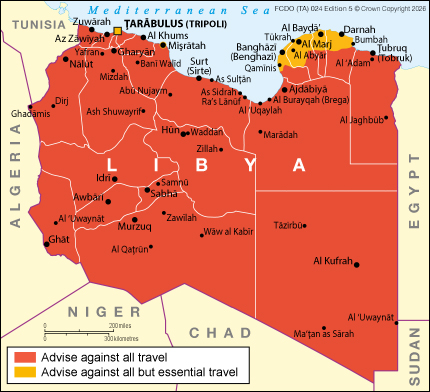
Advise against all travel
  • FCDO advises against all travel to Libya except for the cities of: Find out more about why the FCDO advises against travel.
All but essential travel
  • FCDO advises against all but essential travel to the cities of: Tripoli Benghazi, Al-Bayda and Derna, and the surrounding area knows as Jebel Akhdar, either side of the coastal and desert roads between and including the towns of Al-Maqrun and Al-Tamimi Misrata
Official Foreign Office map
Foreign Office map — Open Government Licence v3.0

Warnings — Foreign OfficeForeign Office ↗updated 21.07.2026 · read 16.10.2026

Warnings — Foreign Office

Your travel insurance could be invalidated if you travel against advice from the Foreign, Commonwealth & Development Office (FCDO).

Areas where FCDO advises against travel

FCDO advises against all travel to Libya except for the cities of:

  • Tripoli
  • Benghazi, Al-Bayda and Derna, and the surrounding area known as Jebel Akhdar, either side of the coastal and desert roads between and including the towns of Al-Maqrun and Al-Tamimi
  • Misrata

FCDO advises against all but essential travel to the cities of:

  • Tripoli
  • Benghazi, Al-Bayda and Derna, and the surrounding area knows as Jebel Akhdar, either side of the coastal and desert roads between and including the towns of Al-Maqrun and Al-Tamimi
  • Misrata

Find out more about why the FCDO advises against travel .

UK government support

UK government support is limited in Libya. If you are in Libya and need urgent help from the UK government (for example, if you’ve been attacked, arrested or someone has died) contact the British Embassy in Tunis, Tunisia who provide assistance for British nationals in Libya. In-person support is not available in Libya. If you are a British national already in, or planning to travel to Tripoli, you should have robust security arrangements and contingency plans in place.

Regional risks — Foreign OfficeForeign Office ↗updated 21.07.2026 · read 16.10.2026

Regional risks — Foreign Office

This section has safety advice for regions of Libya. It only covers regions where the Foreign, Commonwealth and Development Office (FCDO) has specific advice.

You should also read FCDO’s overall travel advice and safety and security advice for Libya.

Tripoli

FCDO advises against all but essential travel to all areas within the city limits of Tripoli.

The general security situation in Tripoli has been relatively stable since the UN-brokered ceasefire was signed in October 2020. Areas of the city are controlled by different militia, and the potential for sporadic inter-militia fighting remains, as witnessed in August 2022, during the large-scale mobilisation in May 2023 and clashes in August 2023 and May 2025.  Such clashes can break out without warning and may involve exchanges of high-calibre gunfire and rocket propelled grenades.

Benghazi

FCDO advises against all but essential travel to all areas within the city limits of Benghazi. Al-Bayda and Derna, and the region of Jebel Akhdar, either side of the coastal and desert roads between (and including) the towns of Al-Maqrun and Al-Tamimi.

The general security situation in Benghazi has been calm throughout 2024 and 2025. Security is controlled by a single military group, however there remains a risk of in-fighting, but there have not been any incidents in the last 12 months.

Misrata

FCDO advises against all but essential travel to all areas of within the city limits of Misrata.

The security situation in Misrata is stable despite the presence in the city of several armed groups. Regular policing is the responsibility of the Misrata Security Directorate, the security forces are widely assessed to be the most professional in the western region.

Safety — Foreign OfficeForeign Office ↗updated 21.07.2026 · read 16.10.2026

Terrorism

There is a high threat of terrorist attack globally affecting UK interests and British nationals, including from groups and individuals who view the UK and British nationals as targets. Stay aware of your surroundings at all times.

UK Counter Terrorism Policing has information and advice on staying safe and what to do in the event of a terrorist attack. Find out how to reduce your risk from terrorism while abroad .

Terrorism in Libya

Terrorist attacks in Libya cannot be ruled out.

Attacks could be indiscriminate, including in places visited by foreigners. British people and nationals of other western countries are considered high-value hostages. Government buildings and security checkpoints have also been targeted in recent years, leading to deaths.

Recent significant attacks include:

- In April 2022, 3 people were injured in a car bombing attack by Islamic State near a Tariq Ibn Ziyad Brigade camp in Umm el Araneb, Southern Libya.

- In 2021 Daesh claimed responsibility for 2 separate bomb attacks on Libyan security forces in the Fezzan province in southern Libya. These attacks killed at least 4 people.

Extremist groups including Daesh in Libya (formerly referred to as ISIL) are responsible for most attacks, which have targeted:

  • foreign and diplomatic personnel and premises
  • international hotels
  • oil installations
  • government and other official security institutions

While there is a greater concentration of terrorist groups in the Fezzan Province, it is highly likely smaller numbers of terrorists can move relatively freely to other towns and regions to facilitate activity outside of the Fezzan Province.

In the north of Libya, it is likely security pressure and violence between armed groups have helped to limit the movement of terrorist groups.

It is likely both Daesh and Al-Qaida in the Islamic Maghreb ( AQIM ) are using the Fezzan region in south-west Libya as a base for operations such as people-smuggling and illegally transporting weapons. These resources are essential to support terrorist activity in West Africa.

The risk of terrorism may be higher if you travel in the border regions. Extremist groups operating in the region, including AQIM and Daesh, conduct operations in the border areas of northern Mali, Niger and Algeria. They have a proven capability of travelling long distances to carry out attacks, including in neighbouring countries and Libya.

Terrorist kidnap

There has not been a terrorist kidnap in Libya for many years. Terrorist groups within Libya have intent to carry out kidnappings and it’s a realistic possibility that they will target foreign nationals. Criminal gangs also carry out kidnappings, and there is a realistic possibility that they would sell hostages on to terrorist groups. Foreign nationals have been kidnapped in Libya in the past, including 4 foreign nationals in south-east Libya in 2018.

It is likely that any kidnap for ransom attempt by a terrorist group in Libya would occur in the south of the country, whereas a kidnap for ransom by militias would occur in a northern coastal city.

In recent months, the importance of oil and natural gas production in Libya has increased, and any western nationals working for oil and natural gas companies in Libya are highly likely viewed as high-value targets.

British nationals are seen as legitimate targets, including tourists, humanitarian aid workers, journalists and business travellers. If you are kidnapped, the reason for your presence is unlikely to protect you or secure your safe release.

The long-standing policy…

American passport — U.S. Department of State

In brief
  • Do not travel to Libya due to terrorism, armed conflict, kidnapping, crime, civil unrest, and unexploded landmines throughout the country. State Department
  • Terrorist attacks may occur with minimal warning at public spaces including tourist locations, hotels, transportation hubs, markets, and government facilities. State Department
  • Kidnapping is widespread and has targeted U.S. citizens; armed groups may seize individuals to compel third parties to comply with demands. State Department
  • Avoid areas marked with red and white plastic tape, roadside ditches, shoulders, and unmarked trails due to unexploded landmines, cluster munitions, and ammunition. State Department
  • Armed violence between competing groups occurs with little warning in Tripoli, Surman, Al-Jufra, Misrata, Ajdabiya, Benghazi, and Zuwara, targeting hotels and airports. State Department
  • Armed groups detain travelers arbitrarily without legal access or notification rights; carry proof of citizenship and valid immigration status at all times. State Department

Faithful summary of the official texts below, which prevail.

Libya - Level 4: Do Not Travel 2026-08-30travel.state.gov ↗updated 30.08.2026 · read 16.10.2026

Advisory summary

Do not travel to Libya for any reason due to crime , terrorism , health concerns , unrest , kidnapping , or landmines . Read entire Travel Advisory.

Do not travel to Libya for any reason.

Restrictions on U.S. Government Personnel Movement

  • There is currently no U.S. Embassy in Libya.
  • The U.S. government cannot offer emergency services to U.S. citizens in Libya due to the safety risks .
  • U.S. citizens in Libya in need of routine consular services should contact the U.S. Embassy in Tunis , Tunisia for assistance.

Crime

  • Clashes among armed groups, including violence between competing armed groups and government-aligned forces, can occur at any time.
  • Weapons are plentiful in Libya and are controlled by various government organizations, armed groups, tribal factions, and criminal organizations.
  • Criminal organizations in Libya are known to be armed and involved in drug and human trafficking and other smuggling activity.
  • Targeted kidnappings and assassinations are common and committed by criminal organizations and armed groups.
  • Crimes of opportunity occur frequently. Wealthy or foreign nationals are often victims of these crimes.

Terrorism

There is risk of terrorist violence, including terrorist attacks and other activity in Libya. Visit the U.S. Department of State's country reports on terrorism to learn more.

  • Terrorist attacks could occur with little or no warning, targeting government facilities.
  • The Commandant of the U.S. Coast Guard has determined that effective anti-terrorism measures are not in place in Libyan ports and has imposed conditions of entry on vessels that arrive in U.S. ports having visited ports in Libya. Mariners and passengers traveling through the ports of Libya should exercise increased caution.
  • Review our information on Terrorism .

Health

  • Refer to our list of medical providers .
  • Make sure your insurance includes medical evacuation coverage.
  • Check with your doctor about required vaccines for high-risk exposure before you go to Libya.
  • Review the Health section in the Travel Guidance for Libya.

Unrest

Demonstrations related to the local political situation are common and may occur with little notice. Demonstrations may disrupt transportation and other essential services or lead to violence.

  • Even demonstrations intended to be peaceful can turn confrontational and escalate…

Global Affairs Canada — additional reading

Avoid all travel

LIBYA - AVOID ALL TRAVEL

Avoid all travel to Libya due to the volatile security situation throughout the country, unannounced clashes between rival armed groups, political instability, high risk of terrorist attacks and of arbitrary arrest, and high crime rate.

  • LIBYA — Avoid all travel to Libya due to the volatile security situation throughout the country, unannounced clashes between rival armed groups, political instability, high risk of terrorist attacks and of arbitrary arrest, and high crime rate.

Open Government Licence – Canada · October 6, 2026 09:33 EDTtravel.gc.ca ↗updated 06.10.2026 · read 15.10.2026

In brief
  • You must carry your passport at all times as foreign nationals have been arrested for failing to provide correct documentation when requested. Foreign Office
  • Extramarital relations, including sexual relations, are illegal and convicted offenders face severe penalties, including imprisonment and corporal punishment. Global Affairs Canada
  • Libyan authorities strictly enforce Islamic dress codes; women, including Canadian-Libyan women, may face harassment if not accompanied by a mahram (male guardian). Global Affairs Canada
  • Photography of military installations, personnel, and government buildings is prohibited; seek permission before photographing official buildings or individuals. Global Affairs Canada
  • Consensual same-sex sexual activity is illegal with penalties of up to five years imprisonment; LGBT+ individuals may face violence and harassment. Foreign Office
  • Alcohol and drugs are illegal; possession, use, or trafficking can result in severe penalties, including imprisonment. Foreign Office

Faithful summary of the official texts below, which prevail.

Global Affairs Canada — written for Canadian travellers, valid for all

Local laws

You must abide by local laws. Learn about what you should do and how we can help if you are arrested or detained abroad.

Political activism

Communications are closely monitored by the various armed groups and militias throughout Libya. You could face serious consequences, including arrest, detention and violence, if you discuss, share or publish negative information about the political situation or criticize the current authorities, including on social media. Journalists and activists are particularly at risk of surveillance by the authorities.

Extra-marital relations

Extramarital relations, including sexual relations, are illegal, and convicted offenders are subject to severe penalties, including imprisonment and corporal punishment.

Restrictions applicable to women

The Libyan authorities strictly enforce their interpretation of Islam. Libyan women, including Canadian-Libyan women, may be subject to harassment if not accompanied by a mahram (male guardian).

Dress and behavior

Libyan customs, laws and regulations adhere closely to Islamic practices and beliefs. To avoid offending the local population:

  • dress conservatively
  • behave discreetly
  • respect social and religious traditions
Photography

Photography of military installations, personnel and government buildings is prohibited. Seek permission before taking photos of official buildings or individuals.

Drugs

Penalties for possession, use or trafficking of drugs are severeConvicted offenders are subject to imprisonment or other penalties. Drugs, alcohol and travel

2SLGBTQI+ persons

Libyan law prohibits sexual acts between people of the same sex. Same-sex marriage is also illegal. Convicted offenders face prison sentences. 2SLGBTQI+ persons should carefully consider the risks of travelling to Libya. Travel and your sexual orientation, gender identity, gender expression and sex characteristics

Imports and exports

Libyan authorities strictly prohibit the import and/or export of certain goods, including:

  • alcohol
  • religious material and antiquities
  • weapons
  • illegal drugs
  • pork and pork products
  • pornographic content

You should consult the regulations in effect and contact the Libyan customs authorities before importing or exporting goods to or from Libya. Contact details - Libyan Customs Authority (in Arabic)

Driving

If you have an accident, stay calm and contact the local police. In the event of a fatal or seriously damaging accident, local authorities may detain the drivers involved until the dispute is settled.

Business disputes

Officials may confiscate your passport if you are involved in a business dispute.

Family law

Regardless of parental marital status, children of Libyan fathers acquire Libyan citizenship at birth, and must enter and leave Libya on Libyan passports. Canadian mothers require their husband’s permission to take their Libyan children outside the country. Child custody decisions are based on Islamic law. It is extremely difficult for a Canadian woman, even if she is a Muslim, to obtain custody of her children through a court decision, unless she decides to stay in Libya.

International Child Abduction

The Hague Convention on the Civil Aspects of International Child Abduction is an international treaty. It can help parents with the return of children who have been removed to or retained in certain countries in violation of custody rights. It does not apply between Canada and Libya. If your child was wrongfully taken to, or is being held in Libya by an abducting parent:

  • act as quickly as you can
  • consult a lawyer in Canada and in Libya to explore all the legal options for the return of your child
  • report the situation to the nearest Canadian government office abroad or to Global Affairs Canada by calling the Emergency Watch and Response Centre

If your child was removed from a country other than Canada, consult a lawyer to determine if The Hague Convention applies. Be aware that Canadian consular officials cannot interfere in private legal matters or in another country's judicial affairs.

Ramadan

In 2027, the lunar month of Ramadan is expected to begin on or around February 7. In public, between sunrise and sunset, be discreet when:

  • drinking
  • eating
  • smoking

Open Government Licence – Canada · October 6, 2026 09:33 EDTtravel.gc.ca ↗updated 06.10.2026 · read 15.10.2026

Foreign Office — laws and cultural differences

Personal ID

By law you must carry your passport. Foreign nationals have been arrested for failing to provide the correct documentation when requested.

Ramadan

Libya is an Islamic country. Respect local traditions, laws and religious customs, especially during the holy month of Ramadan. Ramadan dates vary by year and country. During this time do not:

  • eat, drink, smoke or chew gum in public in the daytime, including in your car
  • play loud music or dance
  • swear in public

Get more advice when you arrive from your hotel or business contacts. You should also:

  • check opening hours of shops and restaurants
  • be aware that if hotels and restaurants are providing food or drink in fasting hours, they may separate you from Islamic guests, for example with screens
  • follow local dress codes – clothing that does not meet local dress codes may cause more offence at this time
  • be aware that fasting can cause tiredness, particularly during the later afternoon and early evening
  • be patient and show tolerance
Religion

It is illegal in Libya to make any attempt to convert Muslims to another religion.

Alcohol and drugs laws

It is illegal in Libya to drink alcohol or use drugs. Libyan authorities treat drug and alcohol offences seriously. You can be punished for use, possession and trafficking of drugs or alcohol.

Methanol poisoning

There has been an increase in cases of serious illness caused by alcoholic drinks containing methanol around the world. Even small amounts of methanol can kill. It is not possible to identify methanol in alcoholic drinks by taste or smell. See Travel Aware Drink Spiking and Methanol Poisoning for information about how to reduce the risks. Seek urgent medical attention if you or someone you are travelling with show the signs of methanol poisoning after drinking.

Business travel in Libya

There are often complex bureaucratic procedures needed to travel for work in Libya. Follow all relevant protocols and procedures if you intend to travel around Libya for business. You are likely to be at risk of intimidation, harassment and detention if you fail to comply with local customs.

Journalism in Libya

You must get press accreditation from the relevant government authorities. This may reduce the risk of harassment, intimidation and detention by armed groups and Libya’s intelligence services. There is a real risk of hostility from those who object to media reporting. International and local journalists have previously been detained in Libya.

Using cameras near military facilities

You must get permission before taking any photographs or interviewing at or near military facilities.

LGBT+ travellers

Consensual same-sex sexual activity is illegal for men and women in Libya, with penalties of up to five years imprisonment. Libyan society is intolerant of people of the same sex showing affection in public. Individuals perceived to be part of the LGBT+ community have experienced physical and psychological violence and harassment. There have also been arrests for people perceived as ‘promoting homosexuality’. Read more advice for LGBT+ travellers.

Open Government Licence v3.0gov.uk ↗updated 21.07.2026 · read 16.10.2026

Air: Fair 30/100PM2.5 5.5 µg/m³ · PM10 7.9 µg/m³
UV moderate today max 6.0Right now 0.0 · WHO scale 0–11+

What it changes for you: Air acceptable at this hour: nothing special to plan.

Reading 06:00 (Africa/Tripoli)Open-Meteo ↗updated 16.10.2026 · read 16.10.2026

Air quality and UV: Open-Meteo.com (CC BY 4.0), data rounded and formatted by Maximum. Contains modified Copernicus Atmosphere Monitoring Service information 2026. Neither the European Commission nor ECMWF is responsible for any use that may be made of the Copernicus information or data it contains.

Physicians per 1,000 people
Libya2.0 2017
Switzerland4.5 2022
France3.3 2022
Hospital beds per 1,000 people
Libya3.5 2022
Switzerland4.4 2023
France5.7 2022
Health spending per person (USD)
Libya470 2023
Switzerland11,784 2023
France5,327 2024
Life expectancy (years)
Libya71.1 2024
Switzerland84.4 2024
France83.0 2024

Reading: With 2.0 physicians per 1,000 people (56% fewer than Switzerland), the nearest hospital does not always have the capacity for a serious case: evacuation to an adequate centre is the rule, not the exception — that is what unlimited evacuation and repatriation cover. Health spending of 470 USD per person (Switzerland: 11,784) goes with private hospitals that bill foreigners in hard currency and ask for a guarantee before admission: the direct payment guarantee is what avoids the deposit.

World Bank — latest published value, year per indicatordata.worldbank.org ↗read 10.10.2026

I travel on a passportVisa, passport validity, entry form: the rules depend on your passport. Each government describes them for its own nationals.

French passport — France Diplomatie

In brief
  • French nationals must obtain a Libya entry visa before arrival by contacting the Libyan embassy in Paris at +33 1 45 53 40 70 or +33 1 47 04 71 60. France Diplomatie
  • All COVID-19 health restrictions for entry to Libya have been lifted. France Diplomatie
  • No foreigner will be admitted to Libya if their passport bears Israeli visas or entry/exit stamps. France Diplomatie

Faithful summary of the official texts below, which prevail.

Libye

- Présentation de la Libye

-

-

-

-

-

-

-

-

-

Mesures liées à la Covid-19

Toutes les mesures de restrictions sanitaires pour l’entrée sur le territoire ont été levées.

Visa

Les Français se rendant en Libye doivent obtenir un visa d’entrée préalablement à leur arrivée . Pour tout renseignement, contacter l’ambassade de Libye en France : 6-8, rue Chasseloup-Laubat, 75015 Paris Tél. : +33 1 45 53 40 70 et +33 1 47 04 71 60 Télécopie : +33 1 47 55 96 25

Aucun étranger ne sera admis sur le territoire libyen s’il est détenteur d’un passeport revêtu de visas ou de tampons d’entrée ou de sortie d’Israël.

Entry and stay pagediplomatie.gouv.fr ↗updated 10.03.2026 · read 16.10.2026

Swiss passport — FDFA (Switzerland)

The FDFA does not publish entry requirements: they are set out by the destination's embassy or consulate in Switzerland — check them before booking, passport in hand. As a guide, the French and British requirements below describe the same rules as seen by two other governments.eda.admin.ch ↗updated 07.10.2025 · read 16.10.2026

British passport — Foreign Office (UK)

In brief
  • Your passport must be valid for your entire stay in Libya; you will be denied entry with an invalid or reported lost/stolen passport. Foreign Office
  • Passports showing previous travel to Israel will not be accepted for entry to Libya. Foreign Office
  • All short-stay visitors must register with the police within one week of arrival or face a fine upon departure. Foreign Office
  • You must declare cash exceeding 10,000 US dollars when entering or leaving Libya, or risk confiscation and detention. Foreign Office
  • Currency exchange into Libyan dinar is tightly controlled; only Central Bank-approved exchange offices are legal, and it is illegal to take dinar out of Libya. Foreign Office
  • Obtain the correct visa from the Libyan Embassy in London before travel, as visas issued overseas may not be recognised in some areas due to the political situation. Foreign Office

Faithful summary of the official texts below, which prevail.

Entry requirements — rules for a British passportForeign Office ↗updated 21.07.2026 · read 16.10.2026

Entry requirements — rules for a British passport

This information is for people travelling on a full ‘British citizen’ passport from the UK who choose to travel against FCDO advice. It is based on the UK government’s understanding of Libya’s current rules for the most common types of travel.

The authorities in Libya set and enforce entry rules. If you’re not sure how these requirements apply to you, contact the Libyan Embassy in the UK .

Passport validity requirements

To enter Libya, your passport must be valid for the duration of your stay.

Check with your travel provider that your passport and other travel documents meet requirements. Renew your passport if you need to.

You will be denied entry if you do not have a valid travel document or try to use a passport that has been reported lost or stolen.

Previous travel to Israel

If your passport shows previous travel to Israel, it will not be accepted for travel to Libya.

Dual nationals

When returning to the UK, British citizens must carry a valid British passport or certificate of entitlement . See Dual citizenship .

Be aware that a British passport or a certificate of entitlement to the right of abode could attract unwanted attention and pose a risk to your personal safety. Stay alert and exercise vigilance at all times.

Visa requirements

If you choose to travel to Libya against FCDO advice, ensure you have the right visa or you may be refused entry. Contact the Libyan Embassy in London for further information on the visa you require. You may require a specific type of visa depending on the nature of your trip.

A Libyan visa issued overseas may not be recognised in some areas or at certain ports of entry, due to the current political situation.

Vaccine requirements

For details about medical entry requirements and recommended vaccinations, see TravelHealthPro’s Libya guide .

Registering with the police

All short-stay visitors must register with the police within a week of arrival. The company you’re visiting or the local travel agency you’re using will usually arrange this. If you do not register, you could get a fine when you leave the country.

Customs rules

There are strict rules about goods you can take into or out of Libya . You must declare anything that may be prohibited or subject to tax or duty.

Taking money into or out of Libya

If you enter or leave Libya with over 10,000 US dollars-worth of cash, you must declare it to the customs authorities. If you do not, you risk having the money confiscated and even being detained.

There is a severe shortage of cash in Libya, and the Libyan Central Bank has imposed restrictions on cash withdrawals throughout the country.

Libya is a cash-based society. You cannot use bank cards at banks, ATMs or hotels.

The exchange of foreign currency into Libyan dinar is tightly controlled by the Libyan Central Bank. Accessing Libyan dinar through formal methods is difficult for travellers. You can legally use exchange offices approved by the Central Bank, but they operate at black market rates. No bank will change money. Informal methods of currency exchange exist though their use carries the risk of arrest.

It is illegal to take dinar out of Libya.

American passport — U.S. Department of State

The State Department publishes the requirements ("Entry, Exit and Visa Requirements") on its country page, which our servers cannot read. Read it before you go; as a guide, the French and British requirements below describe the same rules as seen by two other governments.travel.state.gov ↗updated 30.08.2026 · read 16.10.2026

Living on site

For each risk, the official texts themselves: what is happening, then, where they say so, what to do.

CrimeHIGH

What the texts say · Terrorist attacks in Libya cannot be ruled out. Crime is widespread across Libya and violent robbery, carjacking and smuggling of fuel, drugs, weapons and people are common across the country and in major cities such as Benghazi and Tripoli.

What they advise:
  • Take sensible precautions to protect yourself and your belongings.
  • Be cautious when travelling throughout the country, particularly at night.
Foreign Office
TransportMODERATE

What the texts say · Road accidents are common.

What they advise:
  • If you choose to take a taxi in Libya : exercise caution - never share it with strangers - confirm the fare in advance - bring cash for payment.
  • If you drive in Libya: always drive defensively - avoid driving at night - use main roads and highways whenever possible - always carry a cell phone and charger.
  • If you have an accident, stay calm and contact the local police.
Global Affairs Canada
Nature and climateMODERATE

What the texts say · Between June and September, temperatures can exceed 40°C, and sand and dust storms are frequent. Sand and dust storms are common.

What they advise:
  • During a dust storm : stay indoors - keep windows closed - be prepared to modify, interrupt or cancel your trip at any time - check local media regularly for updates.
  • Follow instructions of local authorities, including evacuation orders.
Global Affairs Canada
Laws and customsTO KNOW

What the texts say · It is illegal in Libya to drink alcohol or use drugs. Extramarital relations, including sexual relations, are illegal, and convicted offenders are subject to severe penalties, including imprisonment and corporal punishment.

What they advise:
  • To avoid offending the local population: dress conservatively - behave discreetly - respect social and religious traditions.
  • Seek permission before taking photos of official buildings or individuals.
Foreign Office · Global Affairs Canada
Cyber and dataMODERATE

What the texts say · Communications are closely monitored by the various armed groups and militias throughout Libya.

What they advise: You could face serious consequences, including arrest, detention and violence, if you discuss, share or publish negative information about the political situation or criticize the current authorities, including on social media.
Global Affairs Canada
Crowds and calendarMODERATE

What the texts say · Demonstrations can occur at any time due to the precarious political and security situation. Even demonstrations that are intended to be peaceful can suddenly give rise to acts of violence.

What they advise:
  • Avoid areas where demonstrations and large gatherings are taking place.
  • Monitor local media for information on ongoing demonstrations.
Global Affairs Canada

Sentences copied word for word from the official texts cited, chosen for the destination; the level is our reading. The full texts, at each source:Foreign Office ↗updated 21.07.2026 · read 16.10.2026 (updated 21.07.2026 · read 28.09.2026)Global Affairs Canada ↗updated 06.10.2026 · read 15.10.2026 (updated 06.10.2026 · read 28.09.2026)

Safety in figures
Road traffic deaths per 100,000 people
Libya21.3 2019
Switzerland2.2 2019
France5.1 2019

Reading: On the road, 10 times more deaths than in Switzerland: road crashes are the leading cause of death of healthy travellers (CDC) — seat belt, no night driving, a driver or a taxi from a rank.

World Bank (UNODC for homicides, WHO for roads) — latest published valuedata.worldbank.org ↗read 10.10.2026

—:—Local time · Africa/Tripoli ·
193Local emergency numbers · Police 193 · Ambulance 191 · Fire 190
+218 · ArabicDialling code · languages
Schuko, Europlug, Type L, Fiches et prises de courant alternatif : types britanniques et apparentés127 V
Drivingon the right

Time zone: IANA and timezone-boundary-builder (ODbL) · RESTCountries · EmergencyNumberAPI · Wikidata · European Central Bank

Places: © OpenStreetMap contributors (ODbL), Photon search by komoot.

Public holidaysNager.Date ↗read 25.09.2026

  • Fri 23 Oct — Liberation Day
  • Thu 24 Dec — Independence Day
ESSENTIAL

Maximum policyholder: before paying anything, call the 24/7 number. If you are admitted for more than 24 h, Maximum sends its direct payment guarantee to the hospital (art. 2.12).

+41 22 ••• •• •• — Full number in your client area

The three hospitals to know — Tripoli

1كلينك بوابة الامل للجدية والطب التجميليemergency · 4.6 km · طريق قرجي طرابلس

None of these facilities is a Maximum Insurance “partner”, and none is presented as waiving upfront payment: this list is a reading of public map data, nothing more. A direct payment guarantee is arranged CASE BY CASE by our assistance desk, facility by facility and when the need arises — one number, +41 22 ••• •• ••.

List read from OpenStreetMap on 14.10.2026, not read again since: these facilities may have changed.

80hospitals and clinics40pharmacies40doctorsFull map and list ↗

Before you go

  • Routine vaccinesup to date
  • Hepatitis Arecommended
  • Hepatitis Brecommended
  • Typhoidrecommended
  • Mpoxdepending on the trip
  • Rabiesdepending on the trip
  • Yellow fevernot recommended

CDC Travelers' Health recommendations, most important first. They depend on your age, vaccines and itinerary: confirm them with a doctor or a travel clinic 4 to 6 weeks before departure. Details, disease by disease ↗cdc.gov ↗read 10.10.2026

On site

MedicationIn their box, with the prescription — in English if possible.

The health system — With 2.0 physicians per 1,000 people (56% fewer than Switzerland), the nearest hospital does not always have the capacity for a serious case: evacuation to an adequate centre is the rule, not the exception — that is what unlimited evacuation and repatriation cover. Health spending of 470 USD per person (Switzerland: 11,784) goes with private hospitals that bill foreigners in hard currency and ask for a guarantee before admission: the direct payment guarantee is what avoids the deposit.

Back home — a fever in the following weeks should be told to a doctor, naming the country.

The next 7 days Africa/TripoliMET Norway ↗read 16.10.2026

Fri 16 Oct19–24°partly cloudy
Sat 17 Oct18–25°partly cloudy
Sun 18 Oct21–30°partly cloudy · 0.5 mm
Mon 19 Oct24–31°overcast
Tue 20 Oct24–29°partly cloudy
Wed 21 Oct25–34°partly cloudy · 0.3 mm
Thu 22 Oct23–25°partly cloudy · 0.5 mm

Forecast: MET Norway (Norwegian Meteorological Institute, CC BY 4.0), grouped by day and formatted by Maximum.

I travel on a passportYour embassy, and the service to register with, depend on your passport.

Your country, 24/7, from abroad

FR
Crisis and Support Centre — French Ministry for Europe and Foreign Affairs+33 1 53 59 11 0024/7 emergency line, standard rate. First contact abroad: the French embassy or consulate.www.diplomatie.gouv.fr ↗updated 10.03.2026 · read 16.10.2026
CH
FDFA Helpline+41 58 465 33 33+41 800 24 7 36524/7, 365 days a year — helpline@eda.admin.ch. Beware of scam calls spoofing these numbers.www.eda.admin.ch ↗updated 07.10.2025 · read 16.10.2026
GB
Foreign, Commonwealth & Development Office+44 20 7008 500024 hours, for British nationals.www.gov.uk ↗updated 21.07.2026 · read 16.10.2026
US
Overseas Citizens Services — U.S. Department of State+1 202 501 4444+1 888 407 4747From abroad; the second number from the U.S. and Canada.travel.state.gov ↗updated 30.08.2026 · read 16.10.2026

French passport — French embassy and consulates

FR
Ambassade de Franceembassy · nearest · 0.8 km

شارع عبدالله بن مسعود

021-4774891

OpenStreetMap

Swiss passport — Swiss embassy and consulates

CH
Ambassade de Suisseembassy · nearest · 1.9 km

phone not published

Useful addresses — FDFA, in French

Représentations suisses à l’étranger: En cas de situation d’urgence à l’étranger, vous pouvez vous adresser à la représentation suisse la plus proche ou à la Helpline DFAE. Ambassade de Suisse en Tunisie Helpline DFAE

OpenStreetMap · DFAE

British passport — British embassy and consulates

GB
British Ambassador residentembassy · nearest · 1.7 km

طريق الشط

phone not published

OpenStreetMap

American passport — U.S. embassy and consulates

US
Ambassade des États-Unisembassy · nearest · 12.3 km

phone not published

US
Consulat des États-Unis d'Amérique653.1 km

phone not published

OpenStreetMap

Police

  • الحرس البلدي · 0.5 km
    Sharia Baladea - شارع البلدية
  • مركز شرطه المدينه · 1.5 km
  • مركز شرطة باب بن غشير · 1.7 km
  • شرطة الدهماني · 2.1 km

Town hall

  • بلدية عين زارة · 7.9 km

OpenStreetMap

Getting help — Foreign OfficeForeign Office ↗updated 21.07.2026 · read 16.10.2026

Getting help — Foreign Office

The Foreign, Commonwealth & Development Office ( FCDO ) cannot provide tailored advice for individual trips. Read this travel advice and carry out your own research before deciding whether to travel.

Emergency services in Libya

Telephone: 1415 (ambulance, fire, police)

Contact your travel provider and insurer

Contact your travel provider and your insurer if you are involved in a serious incident or emergency abroad. They will tell you if they can help and what you need to do.

Support from FCDO

FCDO has guidance on staying safe and what to do if you need help or support abroad, including:

  • getting help if you’re a victim of crime
  • what to do if you’re in hospital
  • if you’re affected by a crisis , such as a terrorist attack
Help abroad

See how to get help from the UK government abroad including in an emergency.

Help in the UK

You can call FCDO  in London if you need urgent help because something has happened to a friend or relative abroad.

Telephone: 020 7008 5000 (24 hours)

Find out about call charges

Ten phrases in Arabic

For emergencies. If pronunciation fails, show the screen — or the printed page.

Help!النجدة!an-najda!
Call an ambulance!اتصلوا بالإسعاف!ittasilu bil-is'af!
I need a doctor.أحتاج إلى طبيب.ahtaju ila tabib.
Where is the nearest hospital?أين أقرب مستشفى؟ayna aqrab mustashfa?
Call the police!اتصلوا بالشرطة!ittasilu bish-shurta!
I am allergic to penicillin.عندي حساسية من البنسلين.'indi hassasiyya min al-binisilin.
I have international medical insurance.لدي تأمين طبي دولي.ladayya ta'min tibbi dawli.
I want to contact my embassy.أريد الاتصال بسفارتي.urid al-ittisal bi-safarati.
Please take me to this address.خذني إلى هذا العنوان من فضلك.khudhni ila hadha al-'unwan min fadlak.
Do you speak English?هل تتكلم الإنجليزية؟hal tatakallam al-injiliziya?

Translations by Maximum Insurance, original script and transliteration.

  • Keep the entry stamp, hospital invoices and the medical report. Without them a claim cannot be rebuilt.
  • File it from the claim form, once back, with those papers.

Actions to take before each professional trip abroad.

1Once — the framework
2For each departure
3During the mission, and after

What is happening in Libya right now

Live alerts and level changes, each with its official source. Continuously updated.

What governments have just written

UpdateGlobal Affairs Canada

Editorial change

October 6, 2026 09:33 EDTtravel.gc.ca ↗updated 06.10.2026 · read 15.10.2026

No level change recorded for this country since the log opened. The live alerts above are updated continuously.

⚡ The world feed — every country →

Frequently asked questions — travel insurance Libya

24/7 support number — +41 22 ••• •• ••An adviser goes through each question with you until you have an actionable answer: cover, hospital, entry rules, claims. Full number in your client area. You can also ask Maximum directly, just below these questions.
What is the official risk level in Libya today?

Level 4/4 — Do Not Travel, U.S. Department of State, retrieved on 16 October 2026.

  • Is the whole country advised against? United States: yes · France: yes · United Kingdom: no · Switzerland: yes (reading of 27 September 2026).
  • Switzerland’s FDFA advises against all travel to the country (published 07.10.2025).
  • The FDFA advises against the trip: art. 18.1 (Module A) opens cancellation, change and curtailment costs.
  • At this level most bank cards and standard policies exclude the trip: read My cover before booking, and only leave with cover that says so in writing.
  • We check these sources every morning and e-mail you the day one changes (Alerts button).

Sourcestravel.state.gov · updated 30.08 · read 16.10France Diplomatie · updated 10.03 · read 16.10DFAE · updated 07.10 · read 16.10207-country comparison

Is the whole of Libya advised against, or only some areas?

An area advised against does not rule out the country.

  • Official answers: United States: yes · France: yes · United Kingdom: no · Switzerland: yes.
  • Foreign Office, regional risks: “This section has safety advice for regions of Libya. It only covers regions where the Foreign, Commonwealth and Development Office (FCDO) has specific advice. You should also read FCDO’s overall travel advice and safety and security advice for Libya. Tripoli…”
  • Keep your country of residence's advisory on booking day and on departure day: that is what your policy's clauses cite.

SourcesFrance Diplomatie · updated 10.03 · read 16.10Foreign Office · updated 21.07 · read 16.10State Department · updated 30.08 · read 16.10

What are the entry requirements for Libya with my passport?

The rules depend on the passport, not on the destination alone.

  • French passport (France Diplomatie): French nationals must obtain a Libya entry visa before arrival by contacting the Libyan embassy in Paris at +33 1 45 53 40 70 or +33 1 47 04 71 60. All COVID-19 health restrictions for entry to Libya have been lifted. No foreigner will be admitted to Libya if their passport bears Israeli visas or entry/exit stamps.
  • British passport (Foreign Office): Your passport must be valid for your entire stay in Libya; you will be denied entry with an invalid or reported lost/stolen passport. Passports showing previous travel to Israel will not be accepted for entry to Libya. All short-stay visitors must register with the police within one week of arrival or face a fine upon departure.
  • American passport: the requirements are on the State Department country page (travel.state.gov).
  • Swiss passport: the FDFA refers you to the destination's embassy in Switzerland.
  • Pick your passport at the top of Before you go › Entry: the official text that concerns you comes first, with its “In brief” summary.

SourcesFrance Diplomatie · updated 10.03 · read 16.10Foreign Office · updated 21.07 · read 16.10State Department · updated 30.08 · read 16.10

Do I need an insurance certificate for a Libya visa?

For a Schengen visa, yes: at least €30,000 of travel medical insurance (Regulation (EC) No 810/2009, art. 15).

  • Many other countries ask for it on entry or for a visa, case by case: check Before you go › Entry, with your passport.
  • Subscribe: the named certificate arrives by e-mail on payment, with your name, dates and limits (EUR 1.5M medical expenses, unlimited evacuation and repatriation) — the ones consulates check.
  • Attach it to the visa file; if in doubt about the format, write to us.

SourcesRegulation (EC) 810/2009, art. 15General conditions, policy 20 00 479

What does Maximum Insurance do in Libya, concretely?

VIP Pack — €990 for twelve months, unlimited trips.

  • EUR 1.5M emergency medical expenses, unlimited medical evacuation and repatriation, search and rescue EUR 50,000, cancellation or change EUR 5,000.
  • One 24/7 number, +41 22 ••• •• ••: Maximum sends its direct payment guarantee to the hospital (art. 2.12).
  • Network of 45,000 providers (art. 6.9); evacuation is decided, organised and paid by Maximum's medical team if the local facility is not enough (art. 6.2.2).
  • Around Tripoli, the nearest hospital read from OpenStreetMap: عيادة بوابة الامل للجلدية والطب التجميلي · 4.6 km · 24/7 emergency room.
  • Named certificate by e-mail on payment, no medical questionnaire.

SourcesGeneral conditions, policy 20 00 479OpenStreetMap · read 11.10

What should I do if hospitalised in Libya?

Six steps, in this order.

  • 1. Call +41 22 ••• •• •• before paying anything, or have the front desk call: it is the condition for full cover (otherwise: reduced or refused benefits).
  • 2. Ask for a hospital in the Maximum network (art. 6.9) — the nearest: عيادة بوابة الامل للجلدية والطب التجميلي · 4.6 km · 24/7 emergency room.
  • 3. See a doctor the same day and leave with the certificate: without an on-the-spot finding, nothing is covered (art. 33).
  • 4. Admitted for more than 24 h? The front desk calls Maximum: direct payment guarantee, no deposit (art. 2.12).
  • 5. Book no ambulance or flight yourself (art. 6.2.2).
  • 6. Once home, file within 30 days (art. 35.7).
  • Local emergency services: police 193 · ambulance 191 · fire 190.

SourcesSpecial conditions 01.26General conditions, policy 20 00 479

Which emergency numbers in Libya?

Local emergency services: police 193 · ambulance 191 · fire 190

  • Maximum, 24/7, before any payment: +41 22 ••• •• ••.
  • France — Ambassade de France (0.8 km) · 021-4774891
  • Switzerland — Ambassade de Suisse (1.9 km)
  • United Kingdom — British Ambassador resident (1.7 km)
  • United States — Ambassade des États-Unis (12.3 km)
  • Save these numbers before leaving; in immediate danger, call local emergency services first, then Maximum.

SourcesEmergencyNumberAPI · Wikidata · read 08.10OpenStreetMap · read 11.10

Is an Amex, Visa or Mastercard enough in Libya?

At today's level 4/4, card by card:

  • Amex Platinum — Your Amex Platinum expressly excludes this trip: the T&Cs rule out travel to countries your government has advised against visiting.
  • Visa — Your Visa may not cover here: the notice excludes the consequences of war, notorious political instability and terrorism — precisely the risks of an advised-against area.
  • Mastercard — Your Mastercard World Elite expressly excludes this trip: areas 'formally advised against' by the French foreign ministry are ruled out, assessed at departure date.
  • Three lines to read in your notice: the duration (often 90 days per trip), the settlement (reimbursement afterwards or direct payment of the hospital) and the area exclusion at level 4/4.

SourcesAmex Platinum France T&Cs, 01.2025 — general exclusion n° 11BNP Paribas Visa Infinite notice (policy PT7), 04.2025 — comFortuneo World Elite Mastercard notice, 01.2026 — art. 5.5 '

Are a health plan or a travel policy enough in Libya?

A health plan reimburses at home; here, the hospital asks for a payment guarantee before admission.

  • Health plan — A health plan treats you at home. Here the hospital asks for a guarantee before admission — not a later reimbursement.
  • Travel policy — The clause is a market standard: the reference policy excludes trips to areas 'formally advised against by government authorities' — at this level most classic policies no longer cover.
  • A travel policy often has a territorial clause at level 4/4 and a 90-day limit per trip.
  • Have your IPID number or the PDF of the terms and ask an expert to call you back: the answer is in the document, not in the brochure.

SourcesGeneral conditions, policy 20 00 479

How do I use the medical network on this page?

Around Tripoli: 80 hospitals and clinics, 28 with a 24/7 emergency room, 40 pharmacies, 40 doctors' practices (OpenStreetMap, hospital list read on 14.10.2026).

  • Type your city, hotel or beach: the map re-centres, 24/7 emergency rooms come first.
  • Each row gives the phone when the source publishes it, the nearest street, directions and the Google Maps listing.
  • The PDF briefing repeats the same places, numbered on a printable map.
  • No customer reviews: OpenStreetMap has none, and we invent none.

SourcesOpenStreetMap (ODbL) · read 11.10

Which vaccines and health precautions for Libya?

The sourced detail is under Medical network › Health: vaccines, diseases present, altitude, outbreaks.

  • CDC (Travelers' Health), depending on the trip: Routine vaccines, COVID-19, Hepatitis A, Hepatitis B, Measles, Monkeypox, Rabies.
  • See a doctor or a travel clinic 8 weeks before departure (Foreign Office).
  • Carry your medicines in their packaging, with a prescription using international non-proprietary names (France Diplomatie).

SourcesCDC Travelers' Health · read 10.10France Diplomatie · updated 10.03 · read 16.10OMS · read 15.10Foreign Office · updated 21.07 · read 16.10

Can I be treated in Libya, or will I be evacuated?

2.0 physicians per 1,000 people (2017) versus 4.5 in Switzerland.

  • 3.5 hospital beds per 1,000 people versus 4.4 in Switzerland (World Bank).
  • With 2.0 physicians per 1,000 people (56% fewer than Switzerland), the nearest hospital does not always have the capacity for a serious case: evacuation to an adequate centre is the rule, not the exception — that is what unlimited evacuation and repatriation cover. Health spending of 470 USD per person (Switzerland: 11,784) goes with private hospitals that bill foreigners in hard currency and ask for a guarantee before admission: the direct payment guarantee is what avoids the deposit.
  • When the local facility is not enough, Maximum's medical team decides the evacuation to a suitable centre, and pays for it (art. 6.2.2).

SourcesWorld Bank · read 10.10General conditions, policy 20 00 479

Libya: safety, in figures?

Comparable figures (homicides, roads, incidents) are under Safety & risks › Incidents.

  • 21.3 road deaths per 100,000 people versus 2.2 in Switzerland (World Bank, WHO).
  • On the road, 10 times more deaths than in Switzerland: road crashes are the leading cause of death of healthy travellers (CDC) — seat belt, no night driving, a driver or a taxi from a rank.

SourcesWorld Bank (UNODC, WHO) · read 10.10UCDP

Where is my embassy in Libya, and why register?

The nearest representations, by passport (OpenStreetMap):

  • France — Ambassade de France (0.8 km) · 021-4774891
  • Switzerland — Ambassade de Suisse (1.9 km)
  • United Kingdom — British Ambassador resident (1.7 km)
  • United States — Ambassade des États-Unis (12.3 km)
  • Register before leaving: France: Ariane · Switzerland: Travel Admin · United Kingdom: Foreign Office alerts · United States: STEP.
  • Two minutes, and in a crisis your country's authorities can reach you and count you in an evacuation.
  • Pick your passport at the top of Contacts: your embassy comes first.

SourcesOpenStreetMap · read 11.10DFAE · updated 07.10 · read 16.10

Which regions of Libya should I avoid, precisely?

At least one official reading covers the whole country; 4 regions are also named, fully or partly.

  • Your point (Tripoli District): advised against — all travel.
  • Advised against — all travel: Benghazi, Jabal al Akhdar, Misrata, Tripoli District.
  • Global Affairs Canada covers the whole country.
  • France Diplomatie rates the rest of the country “formally advised against”.
  • Maximum does not exclude these areas: the VIP Pack covers care and repatriation there (sanctions, embargoes and a country already at war at departure remain enforceable).

SourcesGlobal Affairs Canada · updated 06.10 · read 15.10Foreign Office · updated 21.07 · read 16.10France Diplomatie · updated 10.03 · read 16.10

Which laws and customs should I know in Libya?

Local laws apply to every traveller; here is what the official texts say.

  • You must carry your passport at all times as foreign nationals have been arrested for failing to provide correct documentation when requested.
  • Extramarital relations, including sexual relations, are illegal and convicted offenders face severe penalties, including imprisonment and corporal punishment.
  • Libyan authorities strictly enforce Islamic dress codes; women, including Canadian-Libyan women, may face harassment if not accompanied by a mahram (male guardian).
  • Photography of military installations, personnel, and government buildings is prohibited; seek permission before photographing official buildings or individuals.
  • Consensual same-sex sexual activity is illegal with penalties of up to five years imprisonment; LGBT+ individuals may face violence and harassment.

SourcesGlobal Affairs Canada · updated 06.10 · read 15.10Foreign Office · updated 21.07 · read 16.10

Who can I call at any hour from Libya?

Every foreign ministry runs a 24/7 emergency line for its nationals.

  • France — Crisis and Support Centre — French Ministry for Europe and Foreign Affairs: +33 1 53 59 11 00. 24/7 emergency line, standard rate. First contact abroad: the French embassy or consulate.
  • Switzerland — FDFA Helpline: +41 58 465 33 33 · +41 800 24 7 365. 24/7, 365 days a year — helpline@eda.admin.ch. Beware of scam calls spoofing these numbers.
  • United Kingdom — Foreign, Commonwealth & Development Office: +44 20 7008 5000. 24 hours, for British nationals.
  • United States — Overseas Citizens Services — U.S. Department of State: +1 202 501 4444 · +1 888 407 4747. From abroad; the second number from the U.S. and Canada.
  • On site, Ambassade de France: 021-4774891.

Sourcesdiplomatie.gouv.fr · updated 10.03 · read 16.10eda.admin.ch · updated 07.10 · read 16.10

A few useful phrases in Arabic for Libya?

Emergency phrases, transliterated; the original script, to show if pronunciation fails, is under Useful phrases.

  • Help! → an-najda!
  • Call an ambulance! → ittasilu bil-is'af!
  • I need a doctor. → ahtaju ila tabib.
  • Where is the nearest hospital? → ayna aqrab mustashfa?
  • Call the police! → ittasilu bish-shurta!

SourcesMaximum Insurance

What should I keep after leaving Libya, and how do I file a claim?

Keep the entry stamp, the invoices, the prescriptions and the medical report.

  • File within 30 days (art. 35.7) from your client area, with the documents; the official forms are pre-filled.
  • Costs advanced on site are reimbursed against receipts.
  • Fever, persistent diarrhoea or a rash in the following weeks? See a doctor and say where you have been.

SourcesGeneral conditions, policy 20 00 479

What does the Pack VIP Extreme add?

Cancellation or change up to EUR 20,000, special risk EUR 5,000 per person, crisis management and security, optional Kidnap & Ransom.

  • Special risk (Module A): political event, attack, epidemic, natural disaster — opens when the FDFA, the FOPH or WHO advise against the trip (art. 18.1).
  • Epidemic: assistance must be requested within 7 days of the WHO or FDFA qualification (art. 36.2).
  • Crisis management and security: trip registration, monitoring, extraction, evacuation in case of riot, war, terrorism or disaster; Kidnap & Ransom subject to eligibility (art. 18.4).
  • €2,290 a year, unlimited trips.

SourcesGeneral conditions, policy 20 00 479

A question not answered here? Ask Maximum below, or call the support number: every question gets a clear, actionable answer.

A question? Maximum answers.Answers built from the Libya file and your policy.

In a life-threatening emergency, call local emergency services first, then Maximum: +41 22 ••• •• •• — 24/7 support number, an adviser stays with you to the end.

What Maximum knows

The 207 country pages — hospitals, pharmacies, police, embassies, emergency numbers, official advice from four governments, health, safety in figures, events in progress — read around the city you name. Your policy — benefits, the six steps, claims, articles. The site — prices, certificate, subscription. Nothing else: what it does not know, it says so and hands you to an adviser.

Same advisory level: Uganda · Russia · Central African Republic · Somalia · Sudan · South Sudan

Cross-check with official sources
U.S. State Department → UK FCDO → France Diplomatie → DFAE (Suisse) →

The displayed level comes from the State Department, checked every morning. Before departure, always cross-check your country of residence's advisory: that is what your policy cites.

The level shown is the official U.S. Department of State level, checked daily. Maximum Insurance is an insurance distributor — general information, not personal advice.

Travel covered to Libya
Get the Pack VIP — €990/yr Cover a team
Check my current cover in Libya

The destination is already Tripoli. A few choices, then the reading of your cover, here.

Go further
Insured in an advised-against country →What a repatriation really costs →Who pays the hospital abroad →Where the United States, France and the United Kingdom disagree →Insuring a team that travels: you cover a headcount, not names →What is duty of care? →

All 13 files, together → · All 207 countries →