Maximum Alerts / Brazil

BrazilLevel 2/4

Level published by the State Department on 30.08.2026 · read 16 October 2026 · source checked daily

Brazil — official level as of 16 October 2026: Level 2/4 ("Exercise Increased Caution"), from the U.S. Department of State. Maximum Insurance covers this country: hospital settled directly, unlimited repatriation, EUR 1.5M, certificate on payment.

Four official readings
United StatesState Departmentsource ↗Our reference level — the one shown across this site
Is the whole country advised against?Nono restriction on the whole country
Level 2/4 — “Exercise Increased Caution”levels 1 and 2 are advice to be careful, not travel restrictions
FranceFrance Diplomatiesource ↗Added on top of the U.S. level, under its own rules: red or orange AREAS
Is the whole country advised against?Nono restriction on the whole country+ red areas
our reading: some areas are classified red (formally advised against)
United KingdomFCDOsource ↗Added on top of the U.S. level, under its own rules: travel statuses
Is the whole country advised against?Nono restriction on the whole country+ parts of the country
our reading: all but essential travel advised against to parts of the country
source reviewed 9 September 2026
SwitzerlandFDFAsource ↗Advisory cited by the Maximum policy
Is the whole country advised against?Nono restriction on the whole country
our reading: the FDFA advises against no travel
The four readings on record agree: no restriction on the whole country — France still flags red areas; the United Kingdom still flags parts of the country.Our comparison reading: 27 September 2026

All 207 countries compared, advisory by advisory →

How we read these four advisories

Every country has its own scale, so we ask them all the same question: is the whole country advised against?

An advisory covering only areas of the country does not raise the answer: it stays “No”, and the area is shown in the relevant column.

The level shown on this page — and across this site — is the one published by the U.S. State Department, from 1 (normal precautions) to 4 (do not travel). France and the United Kingdom publish their own advisories, with their own rules: they add to that level, they do not replace it.
Get covered — €990/yr
Regional map…

41 recorded incidents (UCDP)hover, click to open it in the briefing

Level 2/4 — Exercise Increased Caution Checked on 16 October 2026 · U.S. State Department
Observed repatriation
30 000 € – 200 000 €
France Diplomatie (santé Brésil), 2026 ↗
Country briefing
Get the PDF

Where are you right now in Brazil?

List read from OpenStreetMap on 12.10.2026, not read again since: these facilities may have changed.

Hospitals and clinics — Brasília
+Proceram Instituto de Odontologia0.8 km24/7
emergency department0.8 km from the centre of Brasília · SCN Quadra 1 Bloco G Rossi Esplanada Business Sala 405 BrasíliaGiselli Cristinne
Google MapsDirections
+Hospital de Base do Distrito Federal0.9 km24/7
emergency department0.9 km from the centre of Brasília
Google MapsDirections
+Hospital Regional da Asa Norte (HRAN)1.0 km24/7
emergency department1.0 km from the centre of Brasília · near SMHN Quadra 1
Google MapsDirections
+Hospital SARAH1.1 km24/7
emergency department1.1 km from the centre of Brasília · SMHS Q 501 Conjunto
+Hospital SARAH1.1 km24/7
emergency department1.1 km from the centre of Brasília · SMHS - Área Especial, Qd 501 Brasília
+Centro de Saúde Brasília2.6 km24/7
emergency department2.6 km from the centre of Brasília · near SGAS - Quadra 605
Google MapsDirections
+Pronto Atendimento - HUB2.7 km24/7
emergency department2.7 km from the centre of Brasília · near Acesso para Pronto Atendimento HUBmpresa Brasileira de Serviços Hospitalares;Ministério da Educação
Google MapsDirections
+Hospital Universitário de Brasília2.7 km24/7
emergency department2.7 km from the centre of Brasília · SGAN - Quadra 605 BrasíliaEmpresa Brasileira de Serviços Hospitalares
Google MapsDirections
+Ambulatório II2.8 km24/7
emergency department2.8 km from the centre of Brasília
Google MapsDirections
+Unidade Mista de Saúde - Hospital Dia3.5 km24/7
emergency department3.5 km from the centre of Brasília · 508-509 Sul
Google MapsDirections
+Hospital Oftalmológico de Brasília3.5 km24/7
emergency department3.5 km from the centre of Brasília
Google MapsDirections
+Hospital Materno e Infantil de Brasília - HMIB - HRAS3.6 km24/7
emergency department3.6 km from the centre of Brasília · near SGAS - Quadra 608
Google MapsDirections
+Hospital Materno e Infantil de Brasília - HMIB - HRAS3.7 km24/7
emergency department3.7 km from the centre of Brasília · near SGAS - Quadra 608
Google MapsDirections
+Hospital Alvorada3.8 km24/7
emergency department3.8 km from the centre of Brasília · SEPS EQ 710/910
+Minha Terra3.8 km24/7
emergency department3.8 km from the centre of Brasília · sol nascente
Google MapsDirections
+Hospital Mantevida3.8 km24/7
emergency department3.8 km from the centre of Brasília · near L2 Norte
Google MapsDirections
+Hospital Maternidade Brasília4.0 km24/7
emergency department4.0 km from the centre of Brasília · QMSW 4
Google MapsDirections
+Hospital Naval de Brasília4.1 km24/7
emergency department4.1 km from the centre of Brasília · near W5 Sul
Google MapsDirections
+BELLA VITA ESTÉTICA INTEGRADA5.2 km24/7
emergency department5.2 km from the centre of Brasília · SHIS QI 7 25 Lago SulDRA ADRIANA ISAAC - DERMATOLOGISTA
+Hospital Urológico de Brasília5.5 km24/7
emergency department5.5 km from the centre of Brasília · SEPS EQ 714/914
+Centro Médico Hospitalar5.5 km24/7
emergency department5.5 km from the centre of Brasília
Google MapsDirections
+Hospital Militar de Área de Brasília5.6 km24/7
emergency department5.6 km from the centre of Brasília · near QRO - Conjunto 5 a 6
Google MapsDirections
+DF CARE Hospital de Especialidades Crônicas5.6 km24/7
emergency department5.6 km from the centre of Brasília · SHIS EQ/QL 06/08 Lote E Distrito Federal
Google MapsDirections
+Urocentro5.7 km24/7
emergency department5.7 km from the centre of Brasília · near SGAS 914
Google MapsDirections
+Dra. Mayara Flores5.7 km24/7
emergency department5.7 km from the centre of Brasília · SGAS II SGAS 614 C Brasília
Google MapsDirections
+Pacini Hospital Oftalmológico5.8 km24/7
emergency department5.8 km from the centre of Brasília · SEP Sul 715/915 Conjunto A
+Mix Imagem Diagnóstico por Imagem6.1 km24/7
emergency department6.1 km from the centre of Brasília · W3 Sul 606 e 608Mix Imagem
Google MapsDirections
+Hospital do Coração do Brasil6.2 km24/7
emergency department6.2 km from the centre of Brasília · SHLS 716 Conjunto G
+PAI - Pronto Atendimento Infantil6.2 km24/7
emergency department6.2 km from the centre of Brasília · near SHLS
Google MapsDirections
+Clinica de Otorrino Brasilia DF - Asa Sul | Otorrinolaringologia6.3 km24/7
emergency department6.3 km from the centre of Brasília · SHLS 716 Brasilia
+Hospital Santa Lúcia6.3 km24/7
emergency department6.3 km from the centre of Brasília · near SHLS
+Hospital Santa Luzia6.3 km24/7
emergency department6.3 km from the centre of Brasília · near SHLS
Google MapsDirections
+Hospital São Mateus6.4 km24/7
emergency department6.4 km from the centre of Brasília · near Avenida das Mangueiras
Google MapsDirections
+Santa Lucia Prontonorte6.6 km24/7
emergency department6.6 km from the centre of Brasília · near SHLN
Google MapsDirections
+Clínica Salus Ortopedia e Fisioterapia7.0 km24/7
emergency department7.0 km from the centre of Brasília · STM Norte Conjunto M, Entrada B 342 Brasília
Google MapsDirections
+HFAB - Hospital de Força Aérea de Brasília8.6 km24/7
emergency department8.6 km from the centre of Brasília
Google MapsDirections
+Renal Vida Jardim Botânico12.0 km24/7
emergency department12.0 km from the centre of Brasília · avenida das paineiras, quadra 01, bloco F, salas 201 a 204 Brasília
Google MapsDirections
+iluminar hospital dia12.0 km24/7
emergency department12.0 km from the centre of Brasília · avenida das paineiras, quadra 01, bloco F, salas 101 e 102 Brasília
Google MapsDirections
+Nova Medicina e Segurança do Trabalho0.3 km
0.3 km from the centre of Brasília · SDS, Bloco D, Ed. Eldorado, Entrada B, 1º. Subsolo Sala 01 Conic - Asa Sul, Brasília - DF, 70391-901 Brasília
+Laboratório Pasteur1.0 km
1.0 km from the centre of Brasília · near W1 Norte
Google MapsDirections
+Espaço Saúde2.2 km
2.2 km from the centre of Brasília · near CLN 304/305
Google MapsDirections
+Unidade Básica de Saúde 1 da Asa Norte2.5 km
2.5 km from the centre of Brasília · W5 Norte / SGAN 905 Módulo D BrasíliaSES DF;SUS
+Centro Clínico Metrópolis3.2 km
3.2 km from the centre of Brasília · SGAS 607 Lt 47
+Vitallab3.3 km
3.3 km from the centre of Brasília · near W3 Sul
Google MapsDirections
+Brasília Medical Center3.3 km
3.3 km from the centre of Brasília · near SGAN - Quadra 607
Google MapsDirections
+Vila Clínicas3.4 km
3.4 km from the centre of Brasília · Rua Carlos Ney de Carvalho 21 Brasília
+Clínica Ana Maia3.5 km
3.5 km from the centre of Brasília · near SCRN 708/709
+Sabin3.5 km
3.5 km from the centre of Brasília · near SCRN 708/709
Google MapsDirections
+Posto de Saúde 123.6 km
3.6 km from the centre of Brasília · near SQN 408
Google MapsDirections
+Laboratório Sabin3.7 km
3.7 km from the centre of Brasília · near SGAS 910
Google MapsDirections
+UBS Vila Planalto3.7 km
3.7 km from the centre of BrasíliaSecretaria distrital de saude
Google MapsDirections
+Digimed3.9 km
3.9 km from the centre of Brasília
Google MapsDirections
+Medicina da Visão4.0 km
4.0 km from the centre of Brasília · near W5 Sul
+Clinicordis4.0 km
4.0 km from the centre of Brasília · near W5 Sul
+CLIAOD4.0 km
4.0 km from the centre of Brasília · near W5 Sul
+Sabin4.0 km
4.0 km from the centre of Brasília
Google MapsDirections
+Praouvir4.0 km
4.0 km from the centre of Brasília
Google MapsDirections
+Uroclinic4.0 km
4.0 km from the centre of Brasília
Google MapsDirections
+Interplástica FB4.0 km
4.0 km from the centre of Brasília
Google MapsDirections
+Orthos4.0 km
4.0 km from the centre of Brasília
Google MapsDirections
+By Imagem4.0 km
4.0 km from the centre of Brasília
Google MapsDirections
+Laboratório Sabin4.3 km
4.3 km from the centre of Brasília
Google MapsDirections
+Exame4.4 km
4.4 km from the centre of Brasília
Google MapsDirections
+Clínica Previne4.6 km
4.6 km from the centre of Brasília · SGAS 610/611 Bloco 2 Sala 130
+Medcor5.6 km
5.6 km from the centre of Brasília · near CLSW 105
+Unidade Básica de Saúde 2 da Asa Norte5.7 km
5.7 km from the centre of Brasília · EQN 114-115 LT A BrasíliaSES DF;SUS
+Visão Institutos Oftalmológicos INBOL-ISOB5.7 km
5.7 km from the centre of Brasília
Google MapsDirections
+Clinique5.7 km
5.7 km from the centre of Brasília
+Clínica Cirúrgica5.7 km
5.7 km from the centre of Brasília
Google MapsDirections
+Unidade Básica de Saúde 2 do Cruzeiro5.8 km
5.8 km from the centre of Brasília · Setor Escolar LT 4 CruzeiroSES DF;SUS
+Policlínica da Polícia Civil do Df5.8 km
5.8 km from the centre of Brasília
Google MapsDirections
+Hemoclínica6.1 km
6.1 km from the centre of Brasília
Google MapsDirections
+Centro Médico de Brasília6.1 km
6.1 km from the centre of Brasília
Google MapsDirections
+Oral Concept6.2 km
6.2 km from the centre of Brasília
Google MapsDirections
+Exame6.2 km
6.2 km from the centre of Brasília
Google MapsDirections
+Exame6.2 km
6.2 km from the centre of Brasília
Google MapsDirections
+Sabin6.2 km
6.2 km from the centre of Brasília
Google MapsDirections
+Clínica IBED6.5 km
6.5 km from the centre of Brasília · near SHLN
+Laboratório Sabin8.1 km
8.1 km from the centre of Brasília · CA 01 Loja 08/09 Lago Norte
+Espaço Terapêutico8.6 km
8.6 km from the centre of Brasília · near Polo Verde 1
✈️ Aeroporto Internacional de Brasília – Presidente Juscelino KubitschekBSB9.6 kmNearest evacuation airport from Brasília — unlimited medical evacuation and repatriation included.
💱 Currency: BRL R$ · 🗣 Language: Portuguese
In an emergency from Brasília, your reflex remains +41 22 ••• •• •• — Full number in your client area.

Country dial code: +55

OpenStreetMap list read on 12.10.2026, straight-line distances. In an emergency: +41 22 ••• •• ••.

Doctors — Brasília4
DrDerma Star1.0 km

SCN Quadra 05 BL A Brasília
Mo-Fr 09:00-18:00

DrSIASS-DF1.6 km

near S2 Leste

Google MapsDirections
DrDaniel Pingret Nutricionista3.3 km

Sala 119 SGAN - Quadra 607, Módulo A Brasília
nutrition
Mo-Fr 09:00-18:00

Google MapsDirections
DrGastroenterologia5.6 km

gastroenterology

Google MapsDirections
Pharmacies — Brasília40
+Farmacentro Manipulação0.2 km

near S1

Google MapsDirections
+Pacheco0.6 km

near SCS Quadra 1/2

Google MapsDirections
+Farmácia do Trabalhador0.7 km

near SCS Quadra 1/2

Google MapsDirections
+Drogaria Rosário0.7 km

near SCS Quadra 1/2

Google MapsDirections
+DrogaFuji0.8 km

near N3

Google MapsDirections
+Drogasil1.0 km

near SCN Quadra 5

Google MapsDirections
+Guiafarma1.1 km

near SMHN Quadra 2

Google MapsDirections
+Santa Marta1.2 km

near CLS 302

Google MapsDirections
+Drogasil1.5 km

near CLN 303

Google MapsDirections
+Volta à Natureza1.5 km

near CLN 302/303

Google MapsDirections
+Vitabel1.5 km

near CLS 302/303

Google MapsDirections
+Vitale1.5 km

near CLS 302/303

Google MapsDirections
+Farmácia de Altos Custos - GDF1.5 km

SQS 102
Mo-Su 07:00-17:00

Google MapsDirections
+Drogarias Pacheco1.7 km

near CLS 402/403

Google MapsDirections
+Drogasil1.7 km

near CLS 402/403

Google MapsDirections
+Drogarias Pacheco1.7 km

near CLN 402/403

Google MapsDirections
+Colorado1.7 km

near CLN 402/403

Google MapsDirections
+Nova América1.7 km

near CLN 402/403

Google MapsDirections
+Medicare1.7 km

near CLN 402/403

Google MapsDirections
+Drogaria Renata1.8 km

near CLN 402/403

Google MapsDirections
+Drogasil1.9 km

near CLN 103/104
Mo-Su 08:00-22:00

Google MapsDirections
+Pharmacie2.0 km

CLN 204

+Drogaria Colorado2.0 km

CLN 204

Google MapsDirections
+Drogasil2.0 km

near CLN 203/204
Mo-Su 08:00-22:00

Google MapsDirections
+Drogaria Pacheco2.1 km

near CLS 304/305

Google MapsDirections
+Drogaria Maia2.2 km

near CLN 304/305

+Fórmula Animal2.2 km

near CLN 304/305

Google MapsDirections
+Onofarma2.4 km

CLN 404

Google MapsDirections
+Drogasil2.4 km

near CLS 405
24/7

Google MapsDirections
+Drogaria Macedo2.5 km

CLN 405

Google MapsDirections
+Drogaria Santa Marta2.5 km

near CLN 105/106

Google MapsDirections
+Drogaria Droga Lar2.5 km

near CLS 105/106

Google MapsDirections
+Pague Menos2.5 km

near CLS 105/106

Google MapsDirections
+Pharmakon2.5 km

near Ciclovia 405 Norte

Google MapsDirections
+Herba Mater2.6 km

near CLN 105/106

Google MapsDirections
+Drogaria Rosário2.6 km

near CLN 105/106

Google MapsDirections
+Pague Menos2.6 km

near CLN 105/106

Google MapsDirections
+Vicoflora2.6 km

near CLN 105/106

Google MapsDirections
+Medical Fit2.6 km

near CLS 205/206

Google MapsDirections
+Drogaria Rosário2.8 km

near CLN 306

Google MapsDirections
Official — Brasília12
Consulates and embassies 11
AEmbaixada da Costa Rica1.3 km

701 SRTVN

Google MapsDirections
AEmbaixada da Nova Zelândia4.3 km

1 SHIS QI 9 Conjunto 16 Brasília - DF
Mo-Fr 08:30-17:30

AEmbaixada da Argélia4.6 km

1 SHIS QI 9 Conjunto 13

ADelegação Da União Europeia no Brasil5.5 km

EQL 6/8 Distrito Federal
Mo-Th 08:30-12:00,14:30-16:30; Fr 08:30-12:00

AEmbaixada do Burkina Faso6.0 km

1 SHIS QL 14 Conjunto 9 Lago Sul
Mo-Fr 09:00-16:00

AEmbaixada da Líbia6.0 km

Chácara 26 SHIS QI 15

AEmbaixada do Haiti6.2 km

Chácara 27 SHIS QI 15

AEmbaixada dos Emirados Árabes Unidos6.4 km

54 SHIS QI 5 Brasilia
Mo-Fr 08:30-15:30

AEmbaixada da Jamaica8.2 km

2 SHIS QL 2 Conjunto 4
Mo-Th 09:00-17:00; Fr 09:00-16:00

AEmbaixada da República de Trinidad e Tobago8.5 km

1 SHIS QL 2 Conjunto 2

Google MapsDirections
AEmbaixada da Albânia9.3 km

near DB 5

Town halls 1
APrefeitura da SQN 3083.3 km

near SQN 308

Google MapsDirections
Police — Brasília12
P5ª DP Polícia Civil SBN0.8 km

near SBN Quadra 2

Google MapsDirections
PPolícia Federal - Sede0.8 km

SCN, Quadra 4, Bloco A Torres B, C e D do Edifício Multibrasil Corporate Brasília
Mo-Fr 08:00-18:00

Google MapsDirections
PPCS 991.5 km

near SRPS

Google MapsDirections
PPolícia Militar3.6 km

near Ciclovia W4 Norte

Google MapsDirections
PPRF - Polícia Rodoviária Federal (COE)3.7 km

SGON Quadra 05, Lote 15/18. Asa norte
Mo-Fr 08:00-17:00

PPolícia Militar - 3º Batalhao 2ª Companhia UnB4.0 km

near Ciclovia L3 Norte

Google MapsDirections
PPolícia Militar4.1 km

near L3 Sul

Google MapsDirections
PPolícia Militar - PCS 0454.9 km

near W4 Sul

PPolícia Civil - DCCP5.2 km
Google MapsDirections
PPolícia Civil - Departamento de Polícia Especializada - DPE5.2 km
Google MapsDirections
PPolícia Militar 5o BPM - Rio Branco5.2 km

SHIS QI 11 13 Área Especial

PPolícia Militar - PCS 0195.3 km

near Avenida das Jaqueiras

Transport — Brasília24
Airports 2
TAssociação dos Pilotos de Ultraleve de Brasília (APUB)3.4 km

4 Setor Recreativo Público Norte Camping Área n Brasília

TE-AR18.4 km
Google MapsDirections
Stations 8
TCentral0.2 km
TGaleria0.7 km

Galeria dos Estados Brasília

Google MapsDirections
T102 Sul1.5 km

near Eixo Rodoviário Sul

Google MapsDirections
T106 Sul2.9 km

near Eixo W Sul

Google MapsDirections
T108 Sul3.6 km

near Eixo W Sul

Google MapsDirections
T110 Sul4.3 km

near Eixo W Sul

Google MapsDirections
T112 Sul5.0 km

near Eixo W Sul

Google MapsDirections
T114 Sul5.7 km

Brasília

Google MapsDirections
Bus 6
TRodoviria do Plano Piloto0.1 km

near Eixo Rodoviário

Google MapsDirections
TRodoviaria do Plano Piloto0.1 km

near Eixo Rodoviário

Google MapsDirections
TAntiga Rodoferroviária de Brasília6.5 km
Google MapsDirections
TParada de ônibus SGIS QL 267.9 km

near Estrada Parque Dom Bosco

Google MapsDirections
TParada de ônibus EPTB, km 21,7 leste8.0 km

near Estrada Parque Dom Bosco

Google MapsDirections
TEPDB, km 25,1 oeste8.5 km

near Estrada Parque Dom Bosco

Google MapsDirections
Taxis 8
TSinpetaxi0.6 km

near Eixo W Norte

Google MapsDirections
TTaxi0.6 km

near SHN Quadra 2

TPonto de táxi da SQN 3021.3 km

near W1 Norte

Google MapsDirections
TPonto de Taxi2.2 km

near CLN 304

Google MapsDirections
TTáxi3.3 km

near W1 Sul

Google MapsDirections
TTaxi Dia e Noite4.1 km

near SQN 410

Google MapsDirections
TPonto 313 Sul5.0 km

near CLS 313

Google MapsDirections
TPonto de Táxi 105 Sudoeste5.5 km

CLSW 105 Brasília
24/7

The next 7 days around Brasília America/Sao_PauloMET Norway ↗read 16.10.2026

Fri 16 Oct19–27°showers · 1.4 mm
Sat 17 Oct18–29°showers · 1.0 mm
Sun 18 Oct19–27°heavy showers · 12.1 mm
Mon 19 Oct18–28°showers · 8.8 mm
Tue 20 Oct19–28°partly cloudy · 0.5 mm
Wed 21 Oct19–28°showers · 1.6 mm
Thu 22 Oct20–29°rain · 1.0 mm

Forecast: MET Norway (Norwegian Meteorological Institute, CC BY 4.0), grouped by day and formatted by Maximum.

Nearest river dischargeOpen-Meteo ↗updated 16.10.2026 · read 16.10.2026

10-16 10.3 · 10-17 17.0 · 10-18 12.9 · 10-19 9.3 · 10-20 6.5 · 10-21 4.2 · 10-22 3.0 m³/s

Simulated discharge: Open-Meteo.com (CC BY 4.0), data rounded and formatted by Maximum. Contains modified Copernicus Emergency Management Service information 2026. For information only: this is not a flood warning; only national or regional authorities issue those.

No geolocated event in this country at this reading.

41 incidents recorded in the country, all pinned on the map above (zoom out) — the 40 closest to Brasília are listed here, nearest first.

  • 927.5 km · 2 January 2026 · Guarujá town
    PCC henchman arrested after disappearance of young woman linked to CV. · 1 deaths
    Metropoles
  • 930.0 km · 26 March 2026 · Rio de Janeiro town
    Territorial dispute in a community in the North Zone leaves three men dead. · 3 deaths
    O Dia
  • 930.0 km · 29 April 2026 · Rio de Janeiro town
    War between militias and gangs led to deaths in Terreirão, in the Recreio dos Bandeirantes neighbourhood · 2 deaths
    O Globo
  • 930.0 km · 17 May 2026 · Rio de Janeiro town
    War between militias and gangs led to deaths in Terreirão, in the Recreio dos Bandeirantes neighbourhood · 1 deaths
    O Globo
  • 930.0 km · 23 March 2026 · Rio de Janeiro town
    Man killed inside his car in Rio’s North Zone; police investigate ‘Gold Scam’ · 1 deaths
    G1
  • 1498.1 km · 9 February 2026 · Alexandria town
    Homem baleado durante atentado em Alexandria, morre no Hospital TArcísio Maia em Mossoró · 1 deaths
    Fim da Linha
  • 1535.5 km · 17 February 2026 · Viçosa municipality
    Mecânico é morto a tiros enquanto podava árvore em frente de casa em Viçosa, no Alto Oeste potiguar · 1 deaths
    Fim da Linha
  • 1564.7 km · 10 February 2026 · Apodi municipality
    Homem é morto a tiros em estrada de barro na zona rural de Apodi · 1 deaths
    Fim da Linha
  • 1574.4 km · 8 February 2026 · Apodi town
    Ataque a tiros deixa dois mortos no no Bairro Garilândia em Apodi no Oeste Potiguar · 2 deaths
    Fim da Linha
  • 1635.7 km · 20 February 2026 · Baraúna town
    Baraúna registra a quarta morte violenta de 2026 após homem baleado morrer no HRTM · 1 deaths
    Fim da Linha
  • 1647.5 km · 23 February 2026 · Mossoró town
    Mossoró registra o 19º Homicídio de 2026: Cearense de Chorozinho é morto a tiros dentro de casa na Maísa · 1 deaths
    Fim da Linha
  • 1647.5 km · 21 February 2026 · Mossoró town
    Mossoró registra o 17º Homicídio do ano: Jovem de 24 anos é morta a tiros dentro de casa no Bairro Barrocas · 1 deaths
    Fim da Linha
  • 1647.5 km · 18 February 2026 · Mossoró town
    Mossoró registra o 14º Homicídio de 2026: Homem de 48 anos é executado no lugar do filho no Bairro Barrocas · 1 deaths
    Fim da Linha
  • 1647.5 km · 15 February 2026 · Mossoró town
    Mossoró registra o 13º Homicídio de 2026: Jovem de 18 anos é morto a tiros na Favela do Fio · 1 deaths
    Fim da Linha
  • 1647.5 km · 6 February 2026 · Mossoró town
    Mossoró registra o 12º Homicídio de 2026: Tornozelado morre em UPA após ser baleado nas Malvinas · 1 deaths
    Fim da Linha
  • 1650.5 km · 3 February 2026 · Açu town
    Violência em Assú: Dois homens são mortos a tiros em curto intervalo de tempo · 2 deaths
    Fim da Linha
  • 1650.5 km · 6 February 2026 · Açu town
    Jovem é perseguido e executado a tiros no Bairro Vertentes em Assú no RN · 1 deaths
    Fim da Linha
  • 1656.5 km · 22 February 2026 · Mossoró municipality
    Mossoró registra o 18º Homicídio de 2026: Corpo carbonizado é encontrado na zona rural · 1 deaths
    Fim da Linha
  • 1662.0 km · 19 February 2026 · Maisa district
    Mossoró registra o 16º Homicídio de 2026: Criminosos invadem casa a executam mulher de 40 anos na Maisa · 1 deaths
    Fim da Linha
  • 1786.8 km · 10 February 2026 · Santana town
    Police investigate the execution of brothers in Santana. · 2 deaths
    Diário do Amapá
  • 1786.8 km · 2 March 2026 · Santana town
    With no criminal record, man is executed with more than ten shots in Santana. · 1 deaths
    Diário do Amapá
  • 1786.8 km · 27 February 2026 · Santana town
    Attack in public square leaves one dead and one injured in Santana · 1 deaths
    Diário do Amapá
  • 1794.9 km · 20 February 2026 · Macapá town
    Attacks and deaths in war between criminal factions in Amapá · 3 deaths
    Diário do Amapá
  • 1794.9 km · 26 June 2026 · Macapá town
    Criminals invade apartment in Vila dos Oliveiras and execute man in front of his daughters. · 1 deaths
    Diário do Amapá
  • 1794.9 km · 13 June 2026 · Macapá town
    Man killed in possible ambush in the southern zone of Macapá. · 1 deaths
    Diário do Amapá
  • 1794.9 km · 7 June 2026 · Macapá town
    Man executed in broad daylight in the southern zone of Macapá. · 1 deaths
    Diário do Amapá
  • 1794.9 km · 10 May 2026 · Macapá town
    After surviving two assassination attempts, a man is executed in the northern part of Macapá. · 1 deaths
    Diário do Amapá
  • 1794.9 km · 3 May 2026 · Macapá town
    Man with a criminal record is executed in a public street in Cidade Nova. · 1 deaths
    Diário do Amapá
  • 1794.9 km · 20 March 2026 · Macapá town
    Young man with over 20 police records is stabbed to death in the Muca neighborhood. · 1 deaths
    Diário do Amapá
  • 1794.9 km · 19 March 2026 · Macapá town
    Man killed one day after leaving drug rehabilitation center. · 1 deaths
    Diário do Amapá
  • 1794.9 km · 15 March 2026 · Macapá town
    Residents find body in bridge area of ​​Congós neighborhood. · 1 deaths
    Diário do Amapá
  • 1794.9 km · 13 March 2026 · Macapá town
    Man tries to escape his assailant, but is shot dead. · 1 deaths
    Diário do Amapá
  • 1794.9 km · 9 March 2026 · Macapá town
    Man killed in Conjunto São José in Macapá · 1 deaths
    Diário do Amapá
  • 1794.9 km · 26 February 2026 · Macapá town
    Man executed in broad daylight in the northern part of Macapá. · 1 deaths
    Diário do Amapá
  • 1794.9 km · 20 February 2026 · Macapá town
    Attacks and deaths in war between criminal factions in Amapá · 1 deaths
    Diário do Amapá
  • 1794.9 km · 14 February 2026 · Macapá town
    “Lango” tries to escape, but is pursued and killed by two gunmen. · 1 deaths
    Diário do Amapá
  • 1906.9 km · 30 January 2026 · Porto Velho town
    Two bodies are found in a rural area of ​​Porto Velho after being missing for days. · 2 deaths
    Portal Tucumã
  • 1938.4 km · 28 May 2026 · Manaus town
    Body found in a state of decomposition in Manaus. · 1 deaths
    Portal Tucumã
  • 1938.4 km · 11 May 2026 · Manaus town
    Man found dead on a street in the Monte das Oliveiras neighborhood, in Manaus. · 1 deaths
    Portal Tucumã
  • 1938.4 km · 2 May 2026 · Manaus town
    Rivalry in prison motivated murder inside a bus in Manaus. · 1 deaths
    Portal Tucumã

Source: UCDP — GEDEvent_v26_01_26_06.csv. Closed period, Clear coding, precise location.

No news located around Brasília in this reading.

The country feed →

National numbers (Wikidata, 2026 reading). On site, call local emergency services first, then Maximum: the insurer sends its payment guarantee to the hospital.

Recommended vaccines and medicines11

Routine vaccinesCDC ↗

Make sure you are up-to-date on all routine vaccines before every trip. Some of these vaccines include Chickenpox (Varicella) Diphtheria-Tetanus-Pertussis (DTaP, Tdap, or Td) Flu (influenza) Measles-Mumps-Rubella (MMR) Polio Shingles

COVID-19CDC ↗

All eligible travelers should be up to date with their COVID-19 vaccines. Please see  Your COVID-19 Vaccination  for more information.

ChikungunyaCDC ↗

There is elevated chikungunya risk in Brazil.  Chikungunya vaccination  may be considered for people traveling or moving to this location if they are planning to stay for an extended period of time (for example, 6 months or more).

Hepatitis ACDC ↗

Recommended for unvaccinated travelers one year old or older going to Brazil. Infants 6 to 11 months old should also be vaccinated against Hepatitis A. The dose does not count toward the routine 2-dose series. Travelers allergic to a vaccine component should receive a single dose of immune globulin, which provides effective protection for up to 2 months depending on dosage given.

Hepatitis BCDC ↗

Recommended for unvaccinated travelers younger than 60 years old traveling to Brazil. Unvaccinated travelers 60 years and older may get vaccinated before traveling to Brazil.

MalariaCDC ↗

CDC recommends that travelers going to certain areas of Brazil take prescription medicine to prevent malaria. Depending on the medicine you take, you will need to start taking this medicine multiple days before your trip, as well as during and after your trip. Talk to your doctor about which malaria medication you should take.

MeaslesCDC ↗

Cases of measles are on the rise worldwide. Travelers are at risk of measles if they have not been fully vaccinated at least two weeks prior to departure, or have not had measles in the past, and travel internationally to areas where measles is spreading.

MonkeypoxCDC ↗

Monkeypox vaccination is recommended for any adult who anticipates any of the following activities during travel: Sexual or intimate contact with a new partner Sexual or intimate contact at a commercial sex venue, like a sex club or bathhouse Sexual or intimate contact in exchange for money, goods, drugs, or other trade Sexual or intimate contact in association with a large public event, such as a rave, party, or…

RabiesCDC ↗

Dogs infected with rabies are sometimes found in Brazil. Rabies is also commonly found in some terrestrial wildlife species and bats. If rabies exposures occur while in Brazil, rabies vaccines are typically available throughout most of the country.

TyphoidCDC ↗

Consider getting a typhoid vaccine if you might: Travel to areas with poor sanitation and unsafe water, including rural areas Spend a long time in Brazil, such as a month or more Visit friends or relatives Typhoid vaccine is not 100% effective. Practicing safe food and water habits , including washing hands at key times , can also help prevent typhoid fever .

Yellow FeverCDC ↗

CDC recommendations: Vaccine is recommended for travelers ≥9 months old going to the states of Acre, Amapá, Amazonas, Distrito Federal (including the capital city, Brasília), Espírito Santo, Goiás, Maranhão, Mato Grosso, Mato Grosso do Sul, Minas Gerais, Pará, Paraná, Piauí, Rio de Janeiro (including the city of Rio de Janeiro and all coastal islands), Rio Grande do Sul, Rondônia, Roraima, Santa Catarina, São Paulo…

CDC Travelers' Health, re-read weekly — the recommendation depends on your age, vaccines and itinerary: confirm it with a doctor or a travel clinic 4 to 6 weeks before departure.CDC ↗read 10.10.2026

Diseases without a vaccine — how they spread

Avoid contaminated food and water
  • Ciguatera Fish Poisoning — Eating contaminated fish
  • Leptospirosis — Touching urine or other body fluids from an animal infected with leptospirosis Swimming or wading in urine-contaminated fresh water, or contact with urine-contaminated mud Drinking water or eating foo
  • Melioidosis — Contact with contaminated fresh water, mud, or soil, especially after heavy rains   Drinking contaminated water Breathing in contaminated dust or water droplets, especially during severe weather
  • Schistosomiasis — Wading, swimming, bathing, or washing in contaminated freshwater streams, rivers, ponds, lakes, or untreated pools.
Avoid bugs
  • Chagas disease (American Trypanosomiasis) — Accidentally rub feces (poop) of the triatomine bug into the bug bite, other breaks in the skin, your eyes, or mouth From pregnant woman to her baby, contaminated blood products (transfusions), or con
  • Dengue — Mosquito bite
  • Leishmaniasis — Sand fly bite
  • New World Screwworm Myiasis — Eggs of the New World screwworm fly
  • Zika — Mosquito bite An infected pregnant woman can spread it to her unborn baby
Airborne & droplet
  • Hantavirus — Breathing in air or accidentally eating food contaminated with the urine, droppings, or saliva of infected rodents Bite from an infected rodent Less commonly, being around someone sick with hantavirus
  • Tuberculosis (TB) — Breathe in TB bacteria that is in the air from an infected and contagious person coughing, speaking, or singing.

Risks in figures

Tuberculosis — cases per 100,000
Brazil49 2024
Switzerland5 2024
France8 2024

Moderate incidence: nothing special for a short stay.

Children vaccinated against measles (%)
Brazil93 2024
Switzerland96 2024
France95 2024

High coverage.

Malaria — cases per 1,000 people at risk
Brazil3.8 2024

Transmission limited to some areas: repellent, and the CDC says which.

World Bank — latest published valuedata.worldbank.org ↗read 10.10.2026

The official advice, in full

Source: France Diplomatie (health advice, in French).

In brief
  • Consult your doctor or an international vaccination centre at least eight weeks before departure to assess your health and receive vaccination recommendations. Foreign Office
  • Ensure you are up to date with French vaccination calendar, particularly against diphtheria, tetanus, poliomyelitis, pertussis and measles; yellow fever vaccination is recommended before travelling to Brazil. France Diplomatie
  • Carry medications in original packaging with original labels, accompanied by a prescription listing drugs by international non-proprietary name; verify that your medications are authorised in Brazil. France Diplomatie
  • Protect yourself against mosquito bites by wearing long clothing, applying insect repellent to exposed skin, using impregnated mosquito nets, and eliminating standing water around your accommodation. France Diplomatie
  • Drink only bottled or boiled water; eat only thoroughly cooked food; avoid raw or undercooked fish, meat, poultry and shellfish; peel fruits and vegetables or wash them thoroughly. France Diplomatie
  • Private hospitals in Brazil require proof of financial means or insurance before treatment; public hospitals are overcrowded with long waiting times; seek emergency care by calling 192. Foreign Office

Faithful summary of the official texts below, which prevail.

WHO: no outbreak reported for this country in the last 24 months (Disease Outbreak News).who.int ↗read 15.10.2026

FDFA (Switzerland) — medical care, in French

Medical care

Dans de nombreux hôpitaux publics, les soins médicaux sont insuffisants. À la campagne, les conditions d’hygiène sont particulièrement précaires. Il est recommandé de choisir une clinique privée. Celles-ci exigent une garantie financière (carte de crédit ou paiement d’avance) avant de commencer un traitement. En dehors des grandes villes, les soins médicaux ne sont pas toujours assurés. Si vous prenez régulièrement des médicaments , emportez-en une quantité suffisante avec vous. N’oubliez toutefois pas que l’importation de médicaments contenant des stupéfiants (p. ex. méthadone) ou l'importation de substances utilisées pour traiter des troubles psychiques est soumise à des prescriptions spéciales dans de nombreux pays. Le cas échéant, renseignez-vous à ce sujet, avant le départ, auprès de la représentation étrangère compétente (ambassade ou consulat) et consultez la rubrique Liens voyages , où vous trouverez, entre autres, de plus amples informations sur ce thème ainsi que sur la médecine du voyage en général. Les informations concernant la propagation de maladies et les éventuelles mesures de protection à prendre sont fournies par le personnel médical et les centres de vaccination. Liens voyages

France Diplomatiesource ↗updated 15.09.2026 · read 15.10.2026

Recommandations pour la santé

Consulter si besoin son médecin traitant ou un centre de vaccinations internationales (médecine des voyages) pour faire une évaluation de son état de santé et bénéficier de recommandations sanitaires, notamment sur les vaccinations. Consulter éventuellement son dentiste avant le départ.

Constituer sa pharmacie personnelle en conséquence et n’emporter dans ses bagages que les médicaments strictement nécessaires ; ne jamais consommer de médicaments achetés dans la rue (risque de contrefaçons). Les médicaments doivent être dans leur emballage d’origine avec les étiquettes originales, accompagnés d’une ordonnance portant le nom des médicaments en dénomination commune internationale (DCI). Il est indispensable de vérifier que les médicaments concernés sont autorisés dans le pays visité : pour plus d’informations, consulter la fiche Informations pratiques .

Vaccinations

Les vaccins recommandés en France sont également indispensables lors d’un séjour à l’étranger : les maladies qu’ils préviennent circulent partout dans le monde, parfois même plus fréquemment qu’en France. Avant tout départ, le voyageur (adulte et enfant) doit donc d’abord s’assurer d’être à jour du calendrier vaccinal français, en particulier des vaccins contre la diphtérie, le tétanos, la poliomyélite, la coqueluche mais aussi contre la rougeole. Le carnet de vaccination peut être demandé à l’arrivée de certains pays.

Des vaccinations complémentaires peuvent être nécessaires :

  • Fièvre jaune : l a vaccination contre la fièvre jaune est recommandée avant tout déplacement au Brésil ;
  • Hépatite A : en fonction des conditions et de la durée de séjour ;
  • Fièvre typhoïde : en fonction des conditions et de la durée de séjour ;
  • Hépatite B : en cas de séjours fréquents ou prolongés ;
  • T uberculose : chez les enfants de moins de 15 ans en cas de séjours fréquents ou prolongés ;
  • Rage : notamment enfants en bas âge, séjour en milieu rural ou éloigné des villes principales.

Il est donc conseillé de consulter son médecin traitant ou un centre de vaccinations internationales (médecine des voyages) suffisamment de temps avant le voyage.

Maladies transmises par les moustiques

Chikungunya

La chikungunya est une maladie virale transmise par l’intermédiaire de moustiques infectés. Cette maladie se manifeste par l’apparition de symptômes grippaux (fièvre, douleurs musculaires et articulaires). En cas de signes cliniques, il est impératif de consulter immédiatement un médecin ; le traitement est uniquement symptomatique. Les moyens de prévention reposent sur la vaccination et la protection contre les piqûres de moustiques. Il est conseillé avant le départ de se référer à son médecin traitant et/ou à un centre de vaccination internationale.

Pour plus d’informations , consulter la rubrique risques sanitaires .

Les autorités sanitaires brésiliennes ont confirmé la présence de cas de chikungunya dans le nord, le nord-est du pays (État de Bahia en particulier) ainsi que dans l’État de Sao Paulo.

Dengue

La dengue est une maladie virale transmise par piqûres de moustiques. Les symptômes sont de type grippal (fièvre, maux de tête, courbatures, parfois éruption cutanée). En cas de signes cliniques, il est impératif de consulter immédiatement un médecin. Il n’existe pas de traitement curatif. La prise en charge médicale repose uniquement sur le traitement des symptômes. Il faut impérativement éviter la prise d’anti-inflammatoire. La prévention individuelle repose essentiellement sur les moyens de protection contre les piqûres de moustiques. La vaccination des voyageurs peut être indiquée dans certains cas. Il est conseillé de se référer, avant son départ, à son médecin traitant et /ou à un centre de vaccination internationale.

Pour plus d’informations, consulter le site du ministère de la Santé et le site de l’Organisation mondiale de la Santé .

Le ministère fédéral de la Santé du Brésil fait état d’une importante recrudescence de cette…

Autres maladies

Hantavirus

Ces virus sont transmis à l’être humain par des rongeurs sauvages (souris, rats). La contamination résulte essentiellement de l’inhalation de poussières contaminées par leurs urines, déjections ou salive. La transmission interhumaine est exceptionnelle. Les symptômes associent notamment une fièvre et de possibles hémorragies. Des formes graves et mortelles existent.

Afin de diminuer le risque d’infection il est recommandé :

  • d’éviter les contacts avec les rongeurs vivants ou morts, leurs excrétions ou leurs nids ;
  • de se laver soigneusement les mains après un travail ou une sortie dans la nature ;
  • de ventiler les espaces fermés et d’éviter de dormir dans des bâtiments potentiellement souillés.

Pour plus d’informations , consulter le site Santé publique France .

Rage

La rage est une maladie virale mortelle affectant le système nerveux et présent dans la salive des animaux infectés, tels que chiens, chats, chauves-souris et autres mammifères sauvages. Le virus se transmet par morsure, griffure ou contact de la salive avec une peau lésée ou une muqueuse. L’évolution est rapide avec l’apparition de fièvre, maux de tête, anxiété puis de troubles neurologiques (coma). La rage est presque toujours mortelle une fois les symptômes déclarés. Il est recommandé d’éviter tout contact avec des animaux suspects domestiques ou sauvages. La vaccination préventive contre la rage avant un séjour en zone exposée peut être indiquée en fonction du type de voyage et en particulier chez les jeunes enfants dès qu’ils marchent. Il est conseillé de demander conseil à un médecin ou à un centre de vaccinations internationales.

En cas d’exposition à risque, consulter immédiatement un médecin même si la vaccination est bien à jour.

Pour plus d’informations, consulter…

Mesures générales de prévention des piqûres de moustiques
  • Porter des vêtements longs et couvrants ;
  • Appliquer des produits répulsifs cutanés sur les zones découvertes du corps ;
  • Protéger son logement (moustiquaires imprégnées d’insecticide, diffuseurs électriques, serpentins à l’extérieur, climatisation, etc.) ;
  • Détruire les sites potentiels de reproduction des moustiques (récipients d’eau stagnante comme les soucoupes sous les pots de fleurs, les gouttières, les pneus, etc.).

Pour plus d’informations, consulter le site du ministère en charge de la Santé et le site de l'Assurance Maladie .

Règles d'hygiène alimentaire
  • Se laver les mains régulièrement avec de l’eau et du savon ou des solutions de lavage hydroalcooliques, surtout avant et après les repas et le passage aux toilettes ;
  • Veiller à la qualité des aliments et surtout à leur bonne cuisson ;
  • Éviter la consommation de produits alimentaires (poisson, viande, volaille, lait) crus ou peu cuits ;
  • Peler les fruits et légumes ou les laver soigneusement (à l’eau saine) ;
  • Éviter les crudités, coquillages, plats réchauffés et buffets froids ;
  • Ne boire que de l’eau ou des boissons encapsulées ou de l’eau rendue potable (filtration, ébullition ou à défaut produit désinfectant).

Pour plus d’informations, consulter le site du ministère en charge de la Santé .

Health — Foreign OfficeForeign Office ↗updated 29.09.2026 · read 15.10.2026

Health — Foreign Office

Before you travel check that:

  • your destination can provide the healthcare you may need
  • you have appropriate travel insurance for local treatment or unexpected medical evacuation

This is particularly important if you have a health condition or are pregnant.

Emergency medical number

Call 192 and ask for an ambulance.

Contact your insurance company quickly if you’re referred to a medical facility for treatment.

Vaccine recommendations and health risks

At least 8 weeks before your trip:

  • check the latest vaccination recommendations for Brazil
  • see where to get vaccines and whether you have to pay on the NHS travel vaccinations page

See what health risks you’ll face in Brazil , including:

  • yellow fever
  • dengue
  • chikungunya
  • oropouche
  • high UV levels

Altitude sickness is a risk in parts of Brazil. Read more about altitude sickness on TravelHealthPro .

Medication

The legal status and regulation of some medicines prescribed or bought in the UK can be different in other countries.

If you’re taking medication, bring a prescription or letter from your doctor confirming your need to carry the medication. Bring enough to last your whole trip, as some medicines may not be available locally. Counterfeit drugs can be an issue, so it’s better to travel with your own supplies.

Read best practice when travelling with medicines on TravelHealthPro .

Healthcare in Brazil

Foreign nationals are entitled to emergency medical treatment in Brazilian public hospitals. Public hospitals in Brazil, especially in major cities, tend to be overcrowded and there’s often a long wait for a bed and a lack of medication. Private hospitals will not accept you unless you can show evidence of enough money or insurance to cover your treatment.

FCDO has a list of medical providers in Brazil where some staff will speak English.

There is also guidance on healthcare if you’re living in Brazil .

Travel and mental health

Read FCDO guidance on travel and mental health . There is also mental health guidance on TravelHealthPro .

TravelHealthPro ↗

Places read from OpenStreetMap, within a circle of about 12 km: phone, email, address, website and hours when the source publishes them. No customer reviews, that source has none. Straight-line distances.

The comparator

What is your current insurance?

The verdict
No area exclusion at this level — but three written limits: deductible and prior approval, 90-day cap, advance under conditions.
Exact wording (official French text): « Des Voyages vers des pays où Votre gouvernement a conseillé de ne pas voyager » — general exclusion n° 11, applying to ALL travel covers.
Line by line
Cover
With your Amex Platinum
Territorial exclusion at this level
No territorial exclusion at this level — the clause targets countries your government advised against travelling to
Covered — the core of the Maximum contract
Medical expenses cap abroad
€2M — but 10% deductible (€150–500), insurer's prior approval, trip paid with the Card
EUR 1.5M emergency medical expenses
Hospital deposit before admission
Advance possible — prior approval required before care
Direct payment guarantee: the insurer settles the hospital
Trip duration covered
Maximum 90 consecutive days per trip
12 months, unlimited trips
Visa certificate (incl. Schengen)
Not provided
Official named certificate, issued on payment

Notices vary by bank and vintage — yours prevails. On the right: the Maximum contract (public documents).

Where to go, where not to

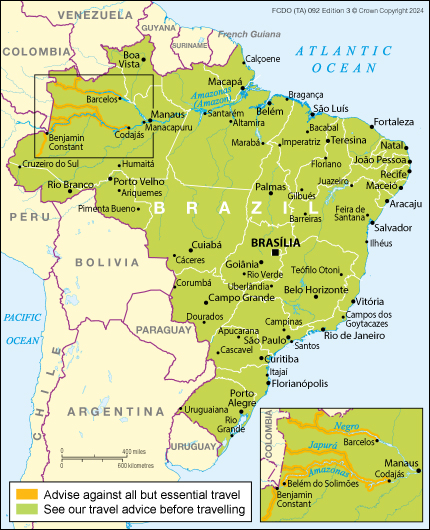
The country is not uniform: 1 region advised against, fully or partly, by at least one official reading. Brasília is not one of them.

In brief
  • Avoid all travel to Complexo da Maré and Complexo da Penha favela complexes in Rio de Janeiro due to very high violent crime rates and frequent large-scale police operations. Global Affairs Canada
  • Avoid non-essential travel within 20 km of borders with Bolivia (excluding Pantanal), Colombia, French Guiana, Guyana, Paraguay, Peru and Suriname due to drug and arms smuggling by criminal groups. Global Affairs Canada
  • Avoid non-essential travel within 50 km of the Venezuela border due to criminal activity. Global Affairs Canada
  • The Venezuela border zone is formally advised against for all travellers. France Diplomatie
  • Avoid all but essential travel along the Amazon River west of Codajás, the Itaquaí River, the Japurá River and its tributaries, and the Rio Negro north or west of Barcelos in Amazonas State. Foreign Office
  • Avoid all border zones except for pressing reasons due to ordinary crime, drug trafficking, illegal gold panning and land conflict violence. France Diplomatie

Faithful summary of the official texts below, which prevail.

Brasília (Federal District) is in no region these official readings advise against; check that it is not in one of the areas quoted below.The red dot on the map. Change the city at the top of the page to read the map from another point.
Rio Grande do Sul — Country-wide vigilanceRoraima — Country-wide vigilancePará — Country-wide vigilanceAcre — Country-wide vigilanceAmapá — Country-wide vigilanceMato Grosso do Sul — Country-wide vigilanceParaná — Country-wide vigilanceSanta Catarina — Country-wide vigilanceAmazonas — Advised against — all but essential travelRondônia — Country-wide vigilanceMato Grosso — Country-wide vigilanceMaranhão — Country-wide vigilancePiauí — Country-wide vigilanceCeará — Country-wide vigilanceRio Grande do Norte — Country-wide vigilanceParaíba — Country-wide vigilancePernambuco — Country-wide vigilanceAlagoas — Country-wide vigilanceSergipe — Country-wide vigilanceBahia — Country-wide vigilanceEspírito Santo — Country-wide vigilanceRio de Janeiro — Country-wide vigilanceSão Paulo — Country-wide vigilanceGoiás — Country-wide vigilanceFederal District — Country-wide vigilanceMinas Gerais — Country-wide vigilanceTocantins — Country-wide vigilanceAmazonasBrasília
Advised against — all but essential travelCountry-wide vigilanceBrasíliaSynthesis of the readings: Global Affairs Canada, Foreign Office, France Diplomatie. Where they differ, the colour keeps the strictest reading; the official text, quoted below region by region, prevails. Boundaries: Natural Earth. The areas quoted without a region are not drawn: they do not follow regional boundaries.
Advised against — all travel — areas, not drawn2
Global Affairs Canada — Complexo da Maré
Global Affairs Canada — Complexo da Penha
Advised against — all but essential travel1
Amazonas — along the Amazonas (Amazon) River and its tributaries west of the town of Codajás and…
Advised against — all but essential travel — areas, not drawn8
Global Affairs Canada — Within 20 km of the border with Bolivia, excluding Pantanal National Park
Global Affairs Canada — Within 20 km of the border with Colombia
Global Affairs Canada — Within 20 km of the border with French Guiana
Global Affairs Canada — Within 20 km of the border with Guyana
Global Affairs Canada — Within 20 km of the border with Paraguay
Global Affairs Canada — Within 20 km of the border with Peru
Global Affairs Canada — Within 20 km of the border with Suriname
Global Affairs Canada — Within 50 km of the border with Venezuela
Country-wide vigilance
the rest of the country, including Brasília
So:

the trip stays outside the advised-against regions. Any move into a red or orange region calls for a new, written decision. The areas quoted without a region (border, routes, localities) call for the same decision.

US30.08.2026
Level 2 of 4Exercise increased caution
FR04.03.2026
Red areas in the countrySome areas of the country are formally advised against.Your region (Federal District): not covered
GB29.09.2026
Some areas: essential travel only1 region covered, fully or partly.Your region (Federal District): not covered
CA14.10.2026
Exercise a high degree of cautionYour region (Federal District): not covered

The official text, region by region

Advised against — all but essential travel1 region

AmazonasGB

Foreign Office
along the Amazonas (Amazon) River and its tributaries west of the town of Codajás and east of the town of Belém do Solimões in Amazonas State

Official passages not placed on the map12

Global Affairs Canada — Advised against — all but essential travel
within 20 km of the border with Bolivia, excluding Pantanal National Park

Global Affairs Canada — Advised against — all but essential travel
within 20 km of the border with Colombia

Global Affairs Canada — Advised against — all but essential travel
within 20 km of the border with French Guiana

Global Affairs Canada — Advised against — all but essential travel
within 20 km of the border with Guyana

Global Affairs Canada — Advised against — all but essential travel
within 20 km of the border with Paraguay

Global Affairs Canada — Advised against — all but essential travel
within 20 km of the border with Peru

Global Affairs Canada — Advised against — all but essential travel
within 20 km of the border with Suriname

Global Affairs Canada — Advised against — all but essential travel
within 50 km of the border with Venezuela

Global Affairs Canada — Advised against — all travel
Complexo da Maré

Global Affairs Canada — Advised against — all travel
Complexo da Penha

France Diplomatie (in French) — Advised against — all travel
La zone frontalière avec le Venezuela est formellement déconseillée.

France Diplomatie (in French) — Advised against — all but essential travel
Dans les zones frontalières, la criminalité ordinaire, le trafic de stupéfiants, l’orpaillage clandestin et les affrontements liés aux conflits fonciers conduisent à déconseiller l’ensemble de ces zones, sauf raison impérative.

Maximum does not exclude these areas.The VIP Pack covers care and repatriation there. Still enforceable: sanctions and embargoes, and a country already at war at departure. Extraction and security belong to the VIP Pack Extreme, upon eligibility. See My cover

Global Affairs Canada — Open Government Licence – Canada (14.10.2026) · Foreign Office — Open Government Licence v3.0 · France Diplomatie (04.03.2026) · Natural Earth

No located event in this reading.

Last change: New information about elections taking place on 4 October, and political events ('Warnings and insurance' and 'Safety and security' pages).

Brazil - Level 2: Exercise Increased CautionState Department ↗updated 30.08.2026 · read 16.10.2026

Updated 30.08.2026

Exercise increased caution in Brazil due to  crime  and  kidnapping . Some areas have increased risk. Read the entire Travel Advisory.

Crime

Violent crime occurs in urban areas, day and night. Crimes include murder, armed robbery, and carjacking.

  • Gang activity and organized crime are widespread. and are often tied to the illegal drug trade.
  • Assaults are common, including with sedatives or drugs placed in drinks, especially in Rio de Janeiro.
  • Criminals target foreigners through dating apps or at bars before drugging and robbing their victims.

U.S. government employees working in Brazil need special authorization to travel to the following areas due to safety risks:

  • Within 100 miles/160 km of Brazil’s land borders (except travel to the Foz do Iguacu and Pantanal),
  • informal housing developments in Brazil and,
  • the Administrative Regions of Ceilandia, Santa Maria, Sao Sebastiao, and Paranoa between 6:00 p.m. and 6:00 a.m.

U.S. government employees are advised not to use municipal buses in Brazil due to serious risks of robbery and assault, especially at night.

Kidnapping

Kidnapping for ransom involving U.S. citizens is rare but occasionally occurs. Brazilians are most often targeted, but foreigners remain vulnerable. U.S. businesses frequently arrange enhanced security for senior executives in São Paulo and other major cities.

Organized criminal groups sometimes target individuals observed withdrawing money from ATMs or leaving banks. Use ATMs in secure locations such as shopping malls or major hotels. Express kidnapping — in which criminals force victims at gunpoint to withdraw cash from multiple ATMs or transfer funds via banking apps (commonly Pix) — is an ongoing threat to both locals and foreigners.

To reduce your risk, vary your routes and travel times; park in well-lit, guarded garages, as criminals often confront victims at their vehicles; and limit the number of bank and credit cards you carry to reduce potential losses

Do Not Travel to :

  • International land borders due to crime and kidnapping.
  • Informal housing developments (favelas, vilas, comunidades or conglomerados) due to crime.
  • Brasilia’s Satellite cities due to crime.

Nearest river dischargeOpen-Meteo ↗updated 16.10.2026 · read 16.10.2026

10-16 10.3 · 10-17 17.0 · 10-18 12.9 · 10-19 9.3 · 10-20 6.5 · 10-21 4.2 · 10-22 3.0 m³/s

Simulated discharge: Open-Meteo.com (CC BY 4.0), data rounded and formatted by Maximum. Contains modified Copernicus Emergency Management Service information 2026. For information only: this is not a flood warning; only national or regional authorities issue those.

Where, exactly?

What the national level does not tell you

The level is national. Risk areas are in the state advisories below.

  • U.S. State Department — the full advisory details the regions concerned and the reasons (crime, terrorism, kidnapping, civil unrest) (read the advisory)
  • Foreign, Commonwealth & Development Office (United Kingdom) — the United Kingdom advises against all but essential travel to parts · reviewed 29 September 2026
    Last announced change : « New information about elections taking place on 4 October, and political events ('Warnings and insurance' and 'Safety and security' pages). » (read the advisory)
  • France Diplomatie — France classifies SOME AREAS of the country as red (travel formally advised against) — the advisory is geographic, check it for your exact destination (read the Security advisory)

No major event in progress is located in this country at this morning's check.

What happened, and where

Over 1 January 2026 → 30 June 2026, UCDP (Uppsala University) recorded 41 geolocated violent incidents in this country, for 50 documented deaths.

Most affected areas
Amapá state 17 · Rio Grande do Norte state 14 · Rio de Janeiro state 4 · Amazonas state 4 · São Paulo state 1 · Rondônia state 1

Most recent incidents

  • 26 June 2026 · Amapá state · Macapá town
    Criminals invade apartment in Vila dos Oliveiras and execute man in front of his daughters. · 1 deathSource: Diário do Amapá · 29 June 2026 · Diário do Amapá · UCDP #634756 ↗
  • 13 June 2026 · Amapá state · Macapá town
    Man killed in possible ambush in the southern zone of Macapá. · 1 deathSource: Diário do Amapá · 15 June 2026 · Diário do Amapá · UCDP #634762 ↗
  • 7 June 2026 · Amapá state · Macapá town
    Man executed in broad daylight in the southern zone of Macapá. · 1 deathSource: Diário do Amapá · 8 June 2026 · Diário do Amapá · UCDP #634766 ↗
  • 28 May 2026 · Amazonas state · Manaus town
    Body found in a state of decomposition in Manaus. · 1 deathSource: Portal Tucumã · 28 May 2026 · Portal Tucumã · UCDP #631428 ↗
  • 17 May 2026 · Rio de Janeiro state · Rio de Janeiro town
    War between militias and gangs led to deaths in Terreirão, in the Recreio dos Bandeirantes neighbourhood · 1 deathSource: O Globo · 1 June 2026 · Civil Police · UCDP #630407 ↗
  • 11 May 2026 · Amazonas state · Manaus town
    Man found dead on a street in the Monte das Oliveiras neighborhood, in Manaus. · 1 deathSource: Portal Tucumã · 11 May 2026 · Portal Tucumã · UCDP #631439 ↗

Source: UCDP Georeferenced Event Dataset (Uppsala Conflict Data Program), file GEDEvent_v26_01_26_06.csv, CC BY 4.0 licence. We keep only incidents UCDP codes as "Clear" and whose location is precise enough to be placed — about 58% of the dataset. An incident may be revised, moved or withdrawn by UCDP in a later release: these figures describe a closed period, not a live situation.

Safety in figures
Intentional homicides per 100,000 people
Brazil19.3 2023
Switzerland0.6 2023
France1.3 2023
Road traffic deaths per 100,000 people
Brazil16.0 2019
Switzerland2.2 2019
France5.1 2019

Reading: The homicide rate is 32 times Switzerland's: violence is a real risk there, concentrated in the areas named by the official advisories. On the road, 7 times more deaths than in Switzerland: road crashes are the leading cause of death of healthy travellers (CDC) — seat belt, no night driving, a driver or a taxi from a rank.

World Bank (UNODC for homicides, WHO for roads) — latest published valuedata.worldbank.org ↗read 10.10.2026

What we locate on the map are events in progress that have real coordinates: USGS earthquakes, GDACS disasters, NOAA storms and open NASA EONET events. Hover a dot for details, click to open it in this briefing.

I travel on a passportEach government writes for its own nationals. The advisory that counts for you — and for your policy's clauses — is your country's.

French passport — France Diplomatie

In brief
  • The Venezuela border zone is formally advised against due to limited state presence, armed and criminal groups operating on both sides, and Venezuelan refugee flows. France Diplomatie
  • All border zones with Amazonas, Acre, Rondônia, Roraima, southern Mato Grosso, western Pará, and northern Amapá are advised against except for imperative reasons because of ordinary crime, drug trafficking, and land conflict violence. France Diplomatie
  • In Northeast states with high homicide rates, avoid walking alone in cities; use rental vehicles or taxis instead, plan routes in advance, and avoid metro systems in Recife due to frequent theft and assault. France Diplomatie
  • Do not drive at night or during heavy rain; avoid displaying valuables; keep backpacks worn frontally; use ATMs inside shopping centres or banks; in case of assault, do not resist and offer money without negotiation. France Diplomatie

Faithful summary of the official texts below, which prevail.

Some areas of the country are formally advised against.France Diplomatie ↗updated 15.09.2026 · read 15.10.2026

Vigilance areas — France Diplomatie (in French) updated 04.03.2026official map ↗updated 15.09.2026 · read 15.10.2026

Formally advised against — red
  • La zone frontalière avec le Venezuela est formellement déconseillée.
Except for imperative reasons — orange
  • Dans les zones frontalières, la criminalité ordinaire, le trafic de stupéfiants, l’orpaillage clandestin et les affrontements liés aux conflits fonciers conduisent à déconseiller l’ensemble de ces zones, sauf raison impérative.
Heightened vigilance — yellow
  • Le métro est sûr.
  • Le réseau d’autobus est plus étendu, mais moins sécurisé. Des agressions y sont parfois commises ; par ailleurs, les conducteurs conduisent à vitesse excessive, occasionnant régulièrement de graves accidents.
  • Privilégier les VTC pour bénéficier de la géolocalisation de la course et pour ne pas avoir à sortir d’argent de manière ostensible.
  • Attention au règlement de la course dans les taxis, bien identifiables (couleur jaune, identification du chauffeur sur le pare-brise) : bien vérifier d’une manière générale le montant indiqué sur le terminal de paiement. Des « erreurs » dans le montant, rarement à l’avantage du client, ont pu être constatées.
  • L’usage de motos-taxis est déconseillé compte-tenu des risques accrus d’accident. Il convient, au minimum, de ne pas héler de motos-taxis dans la rue mais de les réserver avec une application de VTC, et de s’assurer que la plaque du véhicule correspond bien à celle indiquée dans l’application (cas de courses usurpées conduisant à une agression).
  • Les véhicules de location, bien que banalisés, peuvent être identifiés, les transformant parfois en cibles dans la circulation. Il convient de rester vigilant sur les options d’itinéraires proposés par les systèmes de guidage automobile et d’éviter absolument de traverser les « comunidades » (nouvelle appellation des favelas). Ces systèmes ne tiennent pas compte de la sécurité des itinéraires. Les routes peu fréquent
  • Les piétons ne sont pas reconnus comme prioritaires lorsqu’ils traversent la chaussée. Les véhicules tiennent peu compte de leur présence sur la voie publique. De nombreux accidents sont régulièrement constatés impliquant des touristes.
  • Le réseau ferré est peu fiable et de mauvaise qualité.
  • Les quartiers aisés de Rio (Copacabana, Ipanema, Leblon, Barra da Tijuca), font l’objet d’une présence policière renforcée. Néanmoins, les touristes visitant ces quartiers peuvent être victimes de vols à l’arrachée, et parfois d’agressions sous la menace d’armes blanches ou à feu.
  • Les quartiers pauvres (« comunidades ») sont imbriqués dans la ville, et leur visite est vivement déconseillée : ce sont des lieux de vie d’une population défavorisée, où la curiosité touristique est inopportune et risquée. Les opérations de police y sont fréquentes et donnent souvent lieu à des affrontements avec échange de tirs.
  • Les quartiers touristiques sont les premières cibles de la criminalité. Il convient donc de redoubler de vigilance dans ces zones, en évitant d’attirer les convoitises. Il est recommandé d’éviter d’exposer téléphones, appareils photo, bijoux, montres ou objets de valeur à la vue de tous.
  • Les touristes visitant les quartiers de Lapa et Santa Teresa sont particulièrement ciblés, en période touristique (d’octobre à mars).
  • Le site du Corcovado peut être visité en priorité en recourant aux minibus ou funiculaires organisés par la municipalité. Eviter d’y accéder par la forêt sans être accompagné d’un guide.
  • Les plages de Copacabana et Ipanema concentrent les deux tiers des faits de vol. Il est préférable de s’y rendre uniquement doté du strict minimum nécessaire à la baignade. De nombreux vols sont signalés sur des touristes se rendant une dernière fois à la plage avec leur valise, avant de prendre l’avion.
Brésil

-

-

-

-

-

-

-

-

-

-

-

Zones de vigilance

Dernière actualisation le 04/03/2026, information toujours valable à la date du jour

Zones formellement déconseillées (en rouge sur la carte)

La zone frontalière avec le Venezuela est formellement déconseillée. La présence de l’État y est limitée et se résume à quelques postes militaires. Des groupes armés et/ou criminels agissent de part et d’autre de la frontière. La situation est aggravée par le flux de réfugiés en provenance du Venezuela.

Zones déconseillées sauf raison impérative (en orange sur la carte)

Dans les zones frontalières, la criminalité ordinaire, le trafic de stupéfiants, l’orpaillage clandestin et les affrontements liés aux conflits fonciers conduisent à déconseiller l’ensemble de ces zones, sauf raison impérative. Des exactions ne sont pas à exclure, par débordement, sur certaines voies de communication ou agglomérations, dans les États brésiliens limitrophes de l’Amazonas, d’Acre, de Rondônia, du Roraima, ainsi que du sud du Mato Grosso, de l’ouest du Para et du nord de l’Amapa.

Zones de vigilance renforcée (en jaune sur la carte)

Brasilia

Le District Fédéral est relativement sûr, le centre de Brasilia (Plan pilote, Lago Sul et Lago Norte mais aussi le quartier de Aguas Claras) profitant de la présence des administrations, des ambassades et des forces de sécurité. Des vols à l’arraché y ont cependant été signalés, ainsi qu’aux distributeurs d’argent liquide. Plusieurs attaques à main armée dans les transports en commun extra-urbains ont été rapportées. La plus grande prudence est recommandée dans les villes à proximité de la capitale.

Nordeste

Les États du Nordeste figurent parmi ceux ayant le taux d’homicides le plus élevé. La grande majorité des homicides ne cible pas les touristes (il convient cependant de ne pas attirer l’attention sur soi avec des bijoux, téléphones portables ou objets de valeur). Les vols et les agressions sont fréquents, y compris dans les zones les plus sûres.

Dans toutes les villes du Nordeste, il est recommandé d’éviter de se promener à pied, a fortiori seul, et de privilégier les véhicules particuliers de location et les taxis. Il est conseillé de préparer un itinéraire précis à l’avance, de ne pas s’éloigner des grands axes et zones d’activités. Il convient de rester vigilant sur les options d’itinéraires proposés par les systèmes de guidage automobile. Ces systèmes ne tiennent pas compte de la sécurité des itinéraires et peuvent vous orienter vers des zones risquées. A noter la pratique largement répandue de ne plus respecter les feux rouges tard le soir et la nuit. Il convient de prendre les précautions requises pour ne pas provoquer d’accidents et ne pas en subir.

Le métro, notamment à Recife, est à proscrire en raison des vols et agressions qui y sont fréquemment perpétrés. Les bus présentent un risque similaire auquel s’ajoute la conduite souvent…

Criminalité

Le Brésil demeure un pays à risque s’agissant des homicides, des agressions sexuelles et des viols. Les touristes sont régulièrement victimes de vols, parfois avec violences. La prudence et la vigilance sont recommandées en toutes circonstances.

Insécurité routière

Les routes du Brésil ne sont pas sans danger : imprudence des conducteurs et entretien souvent déficient du réseau qui n’est que partiellement asphalté. Il convient dès lors de ne pas circuler de nuit, ni en période d’intempéries, et de privilégier les transports aériens pour les longues distances.

Risques naturels

En saison sèche (mai-octobre), les incendies sont nombreux notamment en Amazonie, dans le Cerrado et le Pantanal.

En saison humide, les pluies tropicales intenses provoquent des inondations de moyenne ampleur et des effondrements de chaussée. Les inondations sont souvent à l’origine des ruptures de barrages et de coulées de boue meurtrières. Le Centre national de suivi et d’alerte sur les catastrophes naturelles fournit une prévision quotidienne des risques hydrologiques et géologiques.

Recommandations générales pour le Brésil
  • surveiller en permanence ses effets personnels en évitant de transporter tous ses papiers et son argent dans un seul sac. Les sacs à dos doivent être portés de préférence en position ventrale ;
  • faire une copie ou numériser ses documents d’identité pour y avoir accès depuis son adresse électronique en cas de vol ;
  • ne pas se déplacer avec des sommes importantes d’argent et ne pas exhiber d’objets de valeur dans la rue (montres, téléphones et ordinateurs portables, bijoux) ;
  • ne jamais laisser ses affaires sur la plage sans surveillance, notamment à Rio de Janeiro ;
  • ne pas laisser d’objets de valeur dans les auberges de jeunesse (« Hostels ») ;
  • privilégier les distributeurs de billets installés à l’intérieur des centres commerciaux ou agences bancaires ;
  • en cas d’agression, n’opposer aucune résistance et obéir aux injonctions sans négocier ni chercher à poursuivre l’agresseur qui peut être armé. Si possible, prévoir un peu d’argent à remettre sans hésiter à l’agresseur ;
  • en ville, privilégier les taxis positionnés dans les stations de taxis ou pré-réservés. Refuser le « racolage » de taxis pratiqué dans certains aéroports et s’adresser plutôt aux compagnies officielles. A Rio de Janeiro, préférer les VTC aux Taxis ;
  • circuler en ville les vitres fermées, surtout dans les embouteillages. En cas d’accident de la circulation, appeler immédiatement la police (téléphone : 190) pour réaliser le constat, sans déplacer son véhicule ;
  • s’informer sur place des zones à éviter telles que les quartiers de bureaux le soir et le week-end, les plages par temps de pluie etc. D’une manière générale, observer le rythme de vie local en évitant les promenades nocturnes ;
  • se tenir à l’écart de tout rassemblement ou manifestation ;
  • s’éloigner sans délai de toute…

Full text of the Security pagediplomatie.gouv.fr ↗updated 15.09.2026 · read 15.10.2026

Swiss passport — FDFA (Switzerland), in French

In brief
  • Avoid the Venezuela border region for non-urgent travel due to high risk of violence, criminal gang activity, and possible sudden border closures. DFAE
  • Exercise extreme caution in Ceará, Pernambuco, and Bahia states where violent gang confrontations occur frequently in tourist centres like Fortaleza, Recife, and Salvador. DFAE
  • In Rio de Janeiro state, violent clashes between criminal gangs and security forces are frequent; follow local security instructions and avoid areas recommended by hotel staff. DFAE
  • Avoid poor neighbourhoods (favelas), do not carry valuables or large cash amounts, use ATMs only inside supervised banks during daytime, and minimise mobile phone use on streets. DFAE
  • Do not drive outside cities at night due to increased accident and ambush risks; secondary roads are sometimes in poor condition with heavy, dangerous traffic. DFAE
  • Forest fires in Amazonia and Pantanal may cause smoke pollution nationwide and close tourist parks; monitor weather forecasts and follow local authority warnings for storms and flooding. DFAE

Faithful summary of the official texts below, which prevail.

FDFA update note — Ces conseils pour les voyages ont été contrôlés et publiés avec des changements rédactionnels. L’appréciation de la situation reste valable de manière inchangée. (published 28.07.2026)

General assessment

Les voyages au Brésil sont en principe considérés comme sûrs. En raison des tensions sociales, économiques et des hautes tensions politiques, des grèves, manifestations et actes de violence ont lieu régulièrement. Cela peut entraîner des barrages routiers et des perturbations dans les transports qui peuvent causer des retards du trafic touristique ainsi que des difficultés d'approvisionnement. Le taux de criminalité est très élevé dans tout le pays, en particulier dans les villes. Des affrontements violents ainsi que des fusillades entre les forces de l'ordre et les bandes criminelles sont fréquents dans l’ensemble du pays et affectent parfois aussi des personnes non impliquées. Des actes de violence sont commis de gangs organisés ainsi que d’individus isolés. Dans ce pays comme ailleurs, le risque d’attentats terroristes ne peut être exclu. La rubrique terrorisme et enlèvements attire l'attention sur les risques liés au terrorisme. Terrorisme et enlèvements Tenez-vous à l'écart des manifestations de tout genre. Des débordements et affrontements avec les forces de sécurité se passent principalement dans les grandes villes. Conformez-vous aux directives des autorités locales ( couvre-feu, etc.) et restez en contact avec votre tour-opérateur.

Specific regional risks

La description des zones à risques repose sur des données approximatives; les risques ne peuvent se restreindre à des zones délimitées. Région frontalière avec le Venezuela Il est déconseillé de se rendre dans la région frontalière avec le Venezuela pour des voyages touristiques ou autres qui ne présentent pas un caractère d'urgence. La situation tendue au Venezuela affecte également la zone frontalière avec le Brésil. Des tensions latentes entre la population locale et les personnes réfugiées vénézuéliennes peuvent éclater soudainement et déclencher des débordements. Les gangs criminels sont actifs au-delà des frontières; le risque d'attaques et d'actes de violence est très élevé. Des fermetures de frontières sont possibles à court terme. L'État fédéral de Rio de Janeiro L'État lutte contre le crime organisé avec l'armée et la police. Des affrontements violents et des fusillades entre des bandes criminelles et les forces de sécurité sont fréquents. Des cas d'incendies volontaires ont également été signalés. La présence des forces de l’ordre est renforcée dans tout l’État, y compris dans les lieux touristiques. Le risque d'être soudainement exposé à de violents affrontements ne peut être exclu. Faites preuve de prudence et renseignez-vous sur place sur la situation locale et sur les quartiers à éviter, auprès de vos personnes de contact sur place ou du personnel de l'hôtel. Suivez les instructions des forces de sécurité locales (barrages, couvre-feux etc.). États fédéraux de Ceará, Pernambuco et Bahia Des affrontements ont souvent lieu entre des gangs criminels, entre autres dans les grands centres touristiques comme Fortaleza, Recife et Salvador de Bahia. Le risque de se retrouver soudainement au milieu d'affrontements violents ne peut être exclu. Le taux de criminalité, y compris les meurtres, est elévé. Faites preuve de la plus grande prudence dans les états de Ceará, Pernambuco et Bahia. Renseignez-vous sur la situation avant le départ et durant votre voyage, dans les médias, auprès de vos personnes de contact sur place ou du personnel de l'hôtel. Suivez les instructions des forces de sécurité locales (barrages, couvre-feux, etc.).

Crime

La possession et l'utilisation d'armes à feu et d'autres armes sont très répandues. La petite délinquance, comme les vols à l'arraché et les vols à la tire, est fréquente dans les grandes villes. Ces délits sont notamment commis par de faux coursiers à vélo ou à moto. Les crimes violents , tels que les vols à main armée, les viols et autres délits sexuels, sont fréquents dans tout le pays. Des pillages peuvent se produire de manière isolée. Les risques sont particulièrement importants dans les rues peu fréquentées, aux carrefours avec des feux de signalisation et sur les plages. Les agressions peuvent avoir lieu dans les centres-villes ou dans les transports publics. Dans des grandes villes telles que Brasilia, Rio de Janeiro, São Paulo, Salvador ou Belo Horizonte, des agressions peuvent avoir lieu dans les restaurants ou des halls d’hôtels : lors d'agressions ciblées, les clients sont dérobés de l'argent liquide, des téléphones portables et des objets de valeur. Les victimes d’ enlèvements express sont contraintes à effectuer des prélèvements d’argent liquide au moyen de leur carte de crédit et de remettre leurs objets de valeur. Dans la plupart des cas, ces enlèvements ne durent que quelques heures et se produisent généralement à l'extérieur ou dans la circulation routière, en particulier à la tombée de la nuit, à des carrefours ou dans des embouteillages. Dans le cas des enlèvements dits virtuels (simulés par téléphone), les proches sont contraints de payer immédiatement une rançon. En conséquence des grèves du personnel de la police dans quelques états et villes, la criminalité violente peut augmenter localement. Il est notamment recommandé d'observer les mesures de précaution suivantes:

  • faites preuve de vigilance à tout moment et gardez un œil sur ce qui se passe autour de vous.
  • le taux de criminalité peut fortement varier d'une ville ou d'un quartier à l'autre. Renseignez-vous sur place sur la situation et sur les quartiers à éviter, auprès de vos personnes de contact sur place ou du personnel de l'hôtel.
  • évitez les visites dans des quartiers pauvres (favelas).
  • comportez-vous discrètement. Ne portez pas sur vous des objets de valeur (montre, bijoux, etc.) ou de grosses sommes d'argent.
  • dans la rue, où les vols à l’arraché sont fréquents, il est recommandé d’utiliser son téléphone portable le moins possible. Ces vols sont généralement commis par des personnes circulant à vélo ou à moto.
  • utilisez les bancomats à l’intérieur de banques surveillées et ceci uniquement pendant la journée. Assurez-vous que personne ne vous suit à votre…
Natural hazards

Il existe un important risque d’incendie de forêt dans de nombreux endroits, surtout en Amazonie et dans le Pantanal. Ces incendies peuvent provoquer une telle pollution par la fumée dans tout le pays, qui pourraient entraîner également la fermeture des parcs touristiques. Il faut s'attendre à de fortes pluies régionales ainsi que des ouragans qui provoquent des inondations ainsi que des glissements de terrain et des dommages des infrastructures. De fortes tempêtes ont causé par exemple de nombreux morts et blessés dans l’État méridional du Rio Grande do Sul dans les années passées. Le trafic touristique peut s’en trouver perturbé temporairement. Consultez les prévisions météorologiques et suivez les avertissements et les instructions des autorités locales. Instituto Nacional de Meteorologia Des séismes de faible intensité se produisent occasionnellement. USP Seismological Center Si une catastrophe naturelle devait se produire durant votre séjour, suivez strictement les instructions des autorités et prenez immédiatement contact avec vos proches. En cas d'interruption des communications avec l'étranger, mettez-vous en liaison avec la Représentation Suisse la plus proche (l'Ambassade à Brasilia ou Consulat Général à Rio de Janeiro ou São Paolo).

FDFA travel advice, in French, valid on 15.10.2026eda.admin.ch ↗updated 28.07.2026 · read 15.10.2026

British passport — Foreign Office (UK)

In brief
  • Travel insurance may be invalidated if you travel against Foreign Office advice. Foreign Office
  • Avoid all favelas in Brazilian cities, including favela tours and accommodation within them, and ensure GPS navigation does not route you through favelas. Foreign Office
  • Do not resist armed robbers; hand over valuables immediately. Thieves particularly target mobile phones between 4pm and 9pm, and large groups steal from beaches in 'arrastões'. Foreign Office
  • Avoid political rallies, protests and demonstrations scheduled around Brazil's election first round on 4 October, second round on 25 October, and presidential inauguration on 5 January in Brasília. Foreign Office
  • Exercise caution around major sites in large Brazilian cities following two explosions at Praça dos Três Poderes in central Brasília on 13 November 2024. Foreign Office

Faithful summary of the official texts below, which prevail.

Regions covered by the Foreign Officegov.uk ↗updated 29.09.2026 · read 15.10.2026

Advise against all travel
  • Amazonas State — Find out more about why FCDO advises against travel.
All but essential travel
  • Amazonas State — FCDO advises against all but essential travel to the following river areas towards the west of Amazonas State: along the Amazonas (Amazon) River and its tributaries west of the town of Codajás and east of the town of Belém do Solimões in Amazonas State along any part of the Itaquaí River in Amazonas State along any part of the Japurá River or its tributaries
Official Foreign Office map
Foreign Office map — Open Government Licence v3.0

Warnings — Foreign OfficeForeign Office ↗updated 29.09.2026 · read 15.10.2026

Warnings — Foreign Office

Your travel insurance could be invalidated if you travel against advice from the Foreign, Commonwealth & Development Office (FCDO).

Amazonas State

FCDO advises against all but essential travel to the following river areas towards the west of Amazonas State:

  • along the Amazonas (Amazon) River and its tributaries west of the town of Codajás and east of the town of Belém do Solimões in Amazonas State
  • along any part of the Itaquaí River in Amazonas State
  • along any part of the Japurá River or its tributaries in Amazonas State
  • along the Rio Negro (Black River) and its tributaries north or west of the town of Barcelos in Amazonas State

Find out more about why  FCDO  advises against travel .

Elections and political events

The first round of Brazil’s general election will take place on 4 October. A second round is scheduled for 25 October. The presidential inauguration ceremony will be held in Brasília on 5 January.

Protests and demonstrations can happen across Brazil without warning and the situation can change quickly.

See more information about protests and civil unrest on the Safety and security page .

Regional risks — Foreign OfficeForeign Office ↗updated 29.09.2026 · read 15.10.2026

Regional risks — Foreign Office

This section has safety advice for regions of Brazil. It only covers regions where FCDO has specific advice. You should also read FCDO ’s overall travel advice and safety and security advice .

You should monitor local media and follow the guidance of local authorities when travelling in remote areas.

River travel

FCDO  advises against all but essential travel:

- along the Amazonas (Amazon) River and its tributaries west of the town of Codajás and east of the town of Belém do Solimões in Amazonas State

- along any part of the Itaquaí River in Amazonas State

- along any part of the Japurá River or its tributaries in Amazonas State

- along the Rio Negro (Black River) and its tributaries north or west of the town of Barcelos in Amazonas State

There are risks to travellers in river areas towards the west of Amazonas State, where Brazil shares borders with Colombia, Peru and Venezuela, due to criminal activity. Armed groups, including pirates and drug traffickers, travel by the river routes in the Amazonas state where is there is low presence of police and local authorities.

Rio de Janeiro

The most common incidents affecting British nationals in Rio de Janeiro are thefts and pickpocketing around:

  • Copacabana beach
  • Ipanema beach
  • Lapa
  • Santa Teresa

Tourists have reported armed robberies on the Corcovado walking trail to the Christ the Redeemer statue. See our advice on Theft and robbery .

São Paulo

The most common incidents affecting British nationals in São Paulo are thefts or pickpocketing around:

  • Avenida Paulista
  • the historical downtown area
  • the red light districts located on Rua Augusta (north of Avenida Paulista)
  • Catedral da Sé
  • Praça da República
  • the Estacao de Luz metro area (where Cracolandia is located)
  • Pinheiros

See our advice on Theft and robbery .

Theft

In Brasilia, the central bus station area has a lot of incidents of theft. Theft from pedestrians also happens across the city, especially in the central and southern commercial centres. Take particular care at these locations. See our advice on Theft and robbery .

Theft

The most common incidents affecting British nationals in north-east Brazil are theft from hotel and motel rooms and muggings. Reduce the risk of being mugged by avoiding quiet or deserted areas and by using taxis after sunset instead of walking. See our advice on Theft and robbery .

Safety — Foreign OfficeForeign Office ↗updated 29.09.2026 · read 15.10.2026

Safety — Foreign Office

This guide also has safety advice for regions of Brazil .

Terrorism

There is a high threat of terrorist attack globally affecting UK interests and British nationals, including from groups and individuals who view the UK and British nationals as targets. Stay aware of your surroundings at all times.

UK Counter Terrorism Policing has information and advice on staying safe and what to do in the event of a terrorist attack. Find out how to reduce your risk from terrorism while abroad .

Terrorism in Brazil

Terrorists are likely to try to carry out attacks in Brazil.

Attacks could be indiscriminate including in places visited by foreigners. You should remain aware of your surroundings, keep up to date with local media reports and follow the advice of local authorities. Targets could include:

  • crowded places
  • public gatherings

On 13 November 2024, two explosions occurred at the Praça dos Três Poderes in central Brasilia. You should exercise caution around major sites in large Brazilian cities.

Protests and civil unrest

The first round of Brazil’s general election will take place on 4 October. A second round is scheduled for 25 October. The presidential inauguration ceremony will be held in Brasília on 5 January.

Protests, demonstrations and strikes may take place in cities across Brazil. Even peaceful events can become confrontational and may turn violent. Police have used rubber bullets and tear gas to disperse protesters.

You should:

  • avoid political rallies, protests and demonstrations
  • monitor local media for updates
  • follow the instructions of local authorities

If you encounter a protest or demonstration, or feel uncomfortable in a large crowd, leave the area as soon as it is safe to do so.

Favelas

Favelas (‘slum’ or ‘shanty town’) are urban neighbourhoods of high-density informal housing. They exist in all major Brazilian cities and can border areas used by tourists and visitors.

The security situation in many favelas is unpredictable and can be dangerous. Tourists have been shot after accidentally entering favelas.

You should:

  • avoid all favelas, including favela tours marketed to tourists and any accommodation, restaurants or bars advertised as being within a favela
  • if you’re using GPS navigation, make sure the suggested route does not take you into a favela

If you’re unsure about a location, check with your hotel or the local authorities.

Crime

If you’re the victim of crime, contact the local police number 190 or the nearest British embassy or consulate.

Read our guidance if you’re the victim of a crime abroad .

Theft and robbery

Robberies are common in many cities, particularly on buses. Thieves target mobile phones, particularly between 4pm and 9pm. Attackers may be armed and under the influence of drugs. Do not resist attackers. If threatened, hand over your valuables without resistance.

Thefts are particularly common on public beaches and include ‘arrastões’ where large groups of thieves run through an area of the beach grabbing possessions. Keep your belongings close and avoid taking valuables to the beach. Do not go on to city beaches after dark.

Pickpocketing is common.

Criminals target large-scale celebrations in Brazil, such as the Carnival in major cities. Be aware of your personal security and surroundings. Be cautious about proposals from strangers that take you away from public areas.

To reduce your risk:

  • avoid wearing expensive jewellery and watches
  • avoid carrying large sums of money
  • avoid using a mobile phone in the street
  • leave your passport and…

American passport — U.S. Department of State

In brief
  • Do not travel within 160 kilometres of Brazil's land borders with Bolivia, Colombia, Guyana, French Guiana, Paraguay, Peru, Suriname, and Venezuela, except Foz do Iguacu and Pantanal National Parks. State Department
  • Avoid informal housing developments such as favelas, vilas, comunidades, or conglomerados at any time due to crime. State Department
  • Do not visit Brasilia's Satellite Cities (Ceilandia, Santa Maria, Sao Sebastiao, Paranoa) at night. State Department
  • Kidnapping for ransom of travellers occurs; criminals target foreigners via dating apps and bars using sedatives and drugs in drinks. State Department
  • Do not use municipal buses due to serious robbery and assault risk, especially at night. State Department
  • Enrol in the Smart Traveler Enrollment Program (STEP) and establish a communication plan with family or employer to monitor your safety and location. State Department

Faithful summary of the official texts below, which prevail.

Brazil - Level 2: Exercise Increased Caution 2026-08-30travel.state.gov ↗updated 30.08.2026 · read 16.10.2026

Advisory summary

Exercise increased caution in Brazil due to  crime  and  kidnapping . Some areas have increased risk. Read the entire Travel Advisory.

Crime

Violent crime occurs in urban areas, day and night. Crimes include murder, armed robbery, and carjacking.

  • Gang activity and organized crime are widespread. and are often tied to the illegal drug trade.
  • Assaults are common, including with sedatives or drugs placed in drinks, especially in Rio de Janeiro.
  • Criminals target foreigners through dating apps or at bars before drugging and robbing their victims.

U.S. government employees working in Brazil need special authorization to travel to the following areas due to safety risks:

  • Within 100 miles/160 km of Brazil’s land borders (except travel to the Foz do Iguacu and Pantanal),
  • informal housing developments in Brazil and,
  • the Administrative Regions of Ceilandia, Santa Maria, Sao Sebastiao, and Paranoa between 6:00 p.m. and 6:00 a.m.

U.S. government employees are advised not to use municipal buses in Brazil due to serious risks of robbery and assault, especially at night.

Kidnapping

Kidnapping for ransom involving U.S. citizens is rare but occasionally occurs. Brazilians are most often targeted, but foreigners remain vulnerable. U.S. businesses frequently arrange enhanced security for senior executives in São Paulo and other major cities.

Organized criminal groups sometimes target individuals observed withdrawing money from ATMs or leaving banks. Use ATMs in secure locations such as shopping malls or major hotels. Express kidnapping — in which criminals force victims at gunpoint to withdraw cash from multiple ATMs or transfer funds via banking apps (commonly Pix) — is an ongoing threat to both locals and foreigners.

To reduce your risk, vary your routes and travel times; park in well-lit, guarded garages, as criminals often confront victims at their vehicles; and limit the number of bank and credit cards you carry to reduce potential losses

Do Not Travel to :

  • International land borders due to crime and kidnapping.
  • Informal housing developments (favelas, vilas, comunidades or conglomerados) due to crime.
  • Brasilia’s Satellite cities due to crime.

Global Affairs Canada — additional reading

Exercise a high degree of caution (with regional advisories)

Border areas - Avoid non-essential travel

Avoid non-essential travel to the following border areas due to criminal activity related to drugs and arms smuggling by illegal armed groups and other criminal organizations:

  • within 20 km of the border with Bolivia, excluding Pantanal National Park
  • within 20 km of the border with Colombia
  • within 20 km of the border with French Guiana
  • within 20 km of the border with Guyana
  • within 20 km of the border with Paraguay
  • within 20 km of the border with Peru
  • within 20 km of the border with Suriname
  • within 50 km of the border with Venezuela
Certain neighbourhoods in Rio de Janeiro - Avoid all travel

Avoid all travel to the following vulnerable neighbourhoods (favela complexes) in Rio de Janeiro due to very high rates of violent crime, frequent large-scale police operations and difficulty in obtaining emergency assistance:

  • Complexo da Maré
  • Complexo da Penha

Open Government Licence – Canada · October 14, 2026 08:35 EDTtravel.gc.ca ↗updated 14.10.2026 · read 15.10.2026

In brief
  • Brazil enforces zero-tolerance drinking and driving; police may confiscate your licence on the spot and convict offenders face heavy fines and jail sentences. Global Affairs Canada
  • You can drive with a valid Canadian licence for up to 180 days, but should carry an international driving permit as an official Portuguese translation. Global Affairs Canada
  • Always carry valid identification or a photocopy; keep separate photocopies of your passport and visa, plus digital copies of all travel documents. Global Affairs Canada
  • Electronic cigarettes, vaping devices, refills, parts and accessories are completely illegal; customs will confiscate them and you may receive fines. Global Affairs Canada
  • Drug trafficking penalties are severe with long jail sentences and heavy fines; never transport others' packages and pack your own luggage, monitoring it closely. Global Affairs Canada
  • The legal age of sexual consent is 18; child sex tourism convictions carry severe prison sentences. Global Affairs Canada

Faithful summary of the official texts below, which prevail.

Global Affairs Canada — written for Canadian travellers, valid for all

Local laws

You must abide by local laws. Learn about what you should do and how we can help if you are arrested or detained abroad.

Drugs

Penalties for possession, use or trafficking of illegal drugs are severe. Convicted offenders can expect long jail sentences and heavy fines, even if unknowingly carrying drugs.

  • Pack your own luggage and monitor it closely at all times
  • Never transport other people’s packages, bags, or suitcases

Drugs, alcohol and travel

Child sex tourism

Brazil is actively seeking to prevent child sex tourism. Several tourists have been convicted of offences relating to the exploitation of minors. The legal age of sexual consent in Brazil is 18. Prison sentences are severe. Child Sex Tourism: It’s a Crime

Driving

Brazil has a zero-tolerance policy for drinking and driving. If the police suspect you of drinking and driving, they could confiscate your driver’s licence on the spot. If convicted, you can expect heavy fines and jail sentences. Brazilian police may conduct periodic controls during the day and night, often to check for drunk driving. If you approach a police control, slow down and cooperate with the officers. You can drive in Brazil with a valid Canadian driver’s licence for up to 180 days. You should carry an international driving permit. This official Portuguese translation of your Canadian driver’s licence will help when dealing with local authorities. International driving permit

Identification

Local authorities may request to see your identification at any time.

  • Always carry valid identification or a photocopy of it
  • Keep a photocopy of your passport and visa in a safe place in case it’s lost or seized
  • Keep a digital copy of your identification and travel documents
Imports and exports

There are very strict rules regarding the importation and exportation of:

  • antiquities
  • business and communication equipment
  • firearms
  • medications
  • tropical plants
  • wildlife

Brazil’s Ministry of Health provides information about food items that you can and cannot bring to Brazil. Exporting to Brazil – Government of Brazil

Smoking and vaping

Smoking and vaping are prohibited in all enclosed public spaces. It’s illegal to bring these items into Brazil:

  • electronic cigarettes
  • vaping devices
  • vaping solutions

If you have them in your possession upon arrival, customs officials could confiscate them, and you could receive a fine. Electronic cigarette regulations – National Health Regulatory Agency (Portuguese only)

International Child Abduction

The Hague Convention on the Civil Aspects of International Child Abduction is an international treaty. It can help parents with the return of children who have been removed to or retained in certain countries in violation of custody rights. The convention applies between Canada and Brazil. If your child was wrongfully taken to, or is being held in Brazil, and if the applicable conditions are met, you may apply for the return of your child to the Brazilian court. If you are in this situation:

  • act as quickly as you can
  • contact the Central Authority for your province or territory of residence for information on starting an application under The Hague Convention
  • consult a lawyer in Canada and in Brazil to explore all the legal options for the return of your child
  • report the situation to the nearest Canadian government office abroad or to the Vulnerable Children's Consular Unit at Global Affairs Canada by calling the Emergency Watch and Response Centre

If your child was removed from a country other than Canada, consult a lawyer to determine if The Hague Convention applies. Be aware that Canadian consular officials cannot interfere in private legal matters or in another country's judicial affairs.

Money

The currency of Brazil is the Brazilian real (BRL). Canadian bank cards usually work in ATMs. Credit and debit cards are widely accepted in cities, restaurants, and stores, but less so in rural or informal markets. ATMs are scarcely available in rural areas. Carry cash for small transactions and when visiting remote areas. It’s difficult to exchange Canadian dollars in Brazil.

Open Government Licence – Canada · October 14, 2026 08:35 EDTtravel.gc.ca ↗updated 14.10.2026 · read 15.10.2026

Foreign Office — laws and cultural differences

Personal ID

Always carry a copy of your passport and another form of photo ID if you have one.

Illegal drugs and trafficking scams

Drug trafficking is widespread in Brazil. Bringing drugs in to or out of Brazil in any quantity is illegal and the penalties are severe. You should expect a long jail sentence and heavy fines for possessing, using or smuggling illegal drugs, including when transiting through the airport. British nationals have been targeted through email scams where fraudsters offer a financial reward for travelling to Brazil, where they are then asked to carry items in to or out of Brazil, including to the UK. These items are often illegal drugs. Anyone caught will face detention for drug trafficking, regardless of the circumstances. Airports in Brazil have excellent technology and security for detecting illegal items, including cannabis. This is also used to scan the baggage of transiting passengers.

Electronic smoking devices

All electronic cigarettes and vaping devices are illegal in Brazil, including refills, parts and accessories. Customs officials have the authority to confiscate any vape products found in travellers’ luggage (both checked in and carry on) during inspections.

LGBT+ travellers

There is no legislation against same-sex sexual activity in Brazil. Same-sex marriage is legal and LGBT+ couples have equal rights in law. São Paulo, Rio de Janeiro and other cities hold Pride events, which attract large numbers. These events are usually very peaceful. Brazil is generally tolerant. However, Brazilian society is quite conservative, particularly outside the larger towns and cities. There are reports of discrimination, violence and harassment against the LGBT+ community. Urban areas are usually more accepting. Read more advice for LGBT+ travellers.

Open Government Licence v3.0gov.uk ↗updated 29.09.2026 · read 15.10.2026

FDFA (Switzerland) — laws and customs, in French

Specific legal provisions

L'alcool au volant est interdit (0 pour mille). Les infractions à la loi sur les stupéfiants sont passibles de lourdes peines de prison. Les conditions de détention sont précaires.

Cultural specificities

Les minorités sexuelles ne sont pas tolérées dans toutes les régions du pays. Renseignez-vous sur les us et coutumes locaux, dans les guides de voyage ou directement sur place.

FDFA travel advice, in Frencheda.admin.ch ↗updated 28.07.2026 · read 15.10.2026

Air: Fair 31/100PM2.5 10.3 µg/m³ · PM10 10.4 µg/m³
UV extreme today max 13.2Right now 0.0 · WHO scale 0–11+

What it changes for you: Air acceptable at this hour: nothing special to plan. Very high UV: sunscreen, hat and shade between 11 am and 4 pm; sunstroke and dehydration are travellers' first reasons to see a doctor.

Reading 02:00 (America/Sao_Paulo)Open-Meteo ↗updated 16.10.2026 · read 16.10.2026

Air quality and UV: Open-Meteo.com (CC BY 4.0), data rounded and formatted by Maximum. Contains modified Copernicus Atmosphere Monitoring Service information 2026. Neither the European Commission nor ECMWF is responsible for any use that may be made of the Copernicus information or data it contains.

Physicians per 1,000 people
Brazil2.4 2023
Switzerland4.5 2022
France3.3 2022
Hospital beds per 1,000 people
Brazil2.5 2021
Switzerland4.4 2023
France5.7 2022
Health spending per person (USD)
Brazil1,010 2023
Switzerland11,784 2023
France5,327 2024
Life expectancy (years)
Brazil76.0 2024
Switzerland84.4 2024
France83.0 2024

Reading: With 2.4 physicians per 1,000 people (47% fewer than Switzerland), the nearest hospital does not always have the capacity for a serious case: evacuation to an adequate centre is the rule, not the exception — that is what unlimited evacuation and repatriation cover. Health spending of 1,010 USD per person (Switzerland: 11,784) goes with private hospitals that bill foreigners in hard currency and ask for a guarantee before admission: the direct payment guarantee is what avoids the deposit.

World Bank — latest published value, year per indicatordata.worldbank.org ↗read 10.10.2026

I travel on a passportVisa, passport validity, entry form: the rules depend on your passport. Each government describes them for its own nationals.

French passport — France Diplomatie

In brief
  • French nationals need a passport valid for at least six months from return date and a return ticket to enter Brazil visa-free for up to 90 days within any 180-day period, with no renewal possible. France Diplomatie
  • From 12 January 2024, France nationals exceeding the 90-day limit within 180 days risk entry refusal or forced departure from Brazil. France Diplomatie
  • Franco-Brazilian dual nationals must enter and exit Brazil using a Brazilian passport and follow Brazilian law while on Brazilian territory. France Diplomatie
  • Franco-Brazilian children with old passport models travelling alone or with one parent require written exit authorisation from both parents or the absent parent; Brazilian authorities strictly enforce this requirement. France Diplomatie
  • Pets from France require EU-approved serological testing showing rabies antibody titre above 0.5 UI before departure to return to Europe without delay; alternatively, testing must occur in Brazil at least three months before return. France Diplomatie

Faithful summary of the official texts below, which prevail.

Brésil

-

-

-

-

-

-

-

-

-

-

-

Mesures liées à la Covid-19

Comme mentionné sur le site du Consulat général du Brésil à Paris , toutes les mesures de restriction sanitaire pour l’entrée sur le territoire ont été levées.

Formalités d’entrée et séjour

Les Français sont dispensés de visa pour tout séjour inférieur à 90 jours. Le passeport doit avoir une validité de six mois au minimum à partir de la date de retour du voyage. Tout voyageur doit être muni d’un billet de retour ou de sortie du territoire brésilien.

Depuis le 12 janvier 2024, le Brésil a modifié sa législation concernant le régime de séjour sur son territoire pour les étrangers. Un ressortissant français peut donc séjourner au Brésil au maximum 90 jours sur une période de 180 jours, sans possibilité de renouvellement . En cas de non-respect de ces dispositions, les voyageurs s’exposent à un refus d’entrée sur le territoire, ou à une obligation de quitter le territoire.

Cas des doubles nationaux (franco-brésiliens)

Les Franco-Brésiliens sont soumis à la loi brésilienne s’ils se trouvent sur le territoire brésilien. Ils doivent à ce titre entrer et ressortir du territoire munis d’un passeport brésilien.

Les enfants et les adolescents franco-brésiliens titulaires du nouveau modèle de passeport brésilien pour mineurs avec filiation et autorisation de voyage imprimées sur la page d’identité, désormais en circulation, peuvent voyager avec un seul de leurs deux parents, sans distinction. Les titulaires de modèles antérieurs doivent être munis d’une autorisation de voyage signée par les parents ou le représentant légal. Avant le voyage, il est vivement conseillé de vérifier l’application de ces modalités auprès du consulat général du Brésil à Paris .

En effet, dans le cas où un enfant franco-brésilien voyagerait seul ou avec un seul de ses parents, il doit obligatoirement être muni d’une autorisation de sortie du territoire donnée par les deux parents ou par le parent qui n’accompagne pas le mineur. Les autorités brésiliennes sont intransigeantes et n’autorisent pas la sortie du mineur sans cette autorisation.

Animaux de compagnie

En cas de séjour au Brésil avec un animal de compagnie venant de France, afin de pouvoir assurer son retour sur le territoire de l’UE, un titrage sérique (prélèvement sanguin permettant de s’assurer de l’efficacité de la vaccination de l’animal contre la rage) devra être effectué dans un laboratoire agréé par l’Union européenne avant le départ. Il devra donner un résultat supérieur à 0,5 UI, attestant ainsi de la couverture vaccinale de l’animal. Le résultat du titrage sérique restera valide la vie de l’animal durant, sous réserve que la vaccination contre la rage reste toujours en cours de validité. Ce titrage qui n’est pas obligatoire pour rentrer sur le territoire brésilien, permettra le retour de l’animal en Europe sans délai.

En l’absence de ce titrage, ou pour un animal adopté lors du voyage, le prélèvement de sang devra être fait au Brésil (après identification de l’animal par puce et vaccination rage) et analysé dans un laboratoire agréé par l’Union européenne au moins trois mois avant le retour de l’animal.

[Pour de plus amples informations, il convient de prendre l’attache du consulat général du Brésil à Paris ou sur le site de l’ ambassade de France au Brésil .

Entry and stay pagediplomatie.gouv.fr ↗updated 15.09.2026 · read 15.10.2026

Swiss passport — FDFA (Switzerland)

The FDFA does not publish entry requirements: they are set out by the destination's embassy or consulate in Switzerland — check them before booking, passport in hand. As a guide, the French and British requirements below describe the same rules as seen by two other governments.eda.admin.ch ↗updated 28.07.2026 · read 15.10.2026

British passport — Foreign Office (UK)

In brief
  • British citizens need a passport valid for at least six months beyond arrival in Brazil; entry will be denied without valid travel documents. Foreign Office
  • British nationals can visit Brazil visa-free for up to 90 days for tourism; overstaying incurs daily fines payable on departure or next visit. Foreign Office
  • Ensure your passport receives an entry stamp from border control; lack of stamping may result in fines upon departure. Foreign Office
  • British-Brazilian dual nationals under 18 travelling without both parents require written authorisation from both parents or legal guardians to travel in or leave Brazil. Foreign Office
  • Declare cash or traveller's cheques valued at 10,000 US dollars or more online before entering Brazil. Foreign Office
  • British-Brazilian dual nationals must travel on Brazilian passports when visiting Brazil, as Brazilian immigration authorities often require this. Foreign Office

Faithful summary of the official texts below, which prevail.

Entry requirements — rules for a British passportForeign Office ↗updated 29.09.2026 · read 15.10.2026

Entry requirements — rules for a British passport

This information is for people travelling on a full ‘British citizen’ passport from the UK. It is based on the UK government’s understanding of Brazil’s current rules for the most common types of travel.

The authorities in Brazil set and enforce entry rules. If you’re not sure how these requirements apply to you, contact the Brazilian Embassy in the UK .

Passport validity requirements

To enter Brazil, your passport must have an ‘expiry date’ at least 6 months after the date you arrive.

Check with your travel provider that your passport and other travel documents meet requirements. Renew your passport if you need to.

You will be denied entry if you do not have a valid travel document or try to use a passport that has been reported lost or stolen.

Dual nationals

When returning to the UK, British citizens must carry a valid British passport or certificate of entitlement . See Dual citizenship .

British-Brazilian dual nationals

Brazilian immigration authorities often require dual British-Brazilian nationals visiting Brazil to travel on Brazilian (rather than British) passports.

Visa requirements

You can visit Brazil without a visa for up to 90 days for tourism.

If you want to extend your tourist visa, contact the Federal Police (in Portuguese) before your visa expires.

For more information about visas, contact the Brazilian Consulate in London .

If you overstay your visa, you’ll face a daily fine. You have the option to pay this fine either when you leave Brazil or during your next visit.

Make sure you get your passport stamped.

Make sure the border control officer puts a stamp in your passport. If it is not stamped, you may be fined when you leave.

Read about passport stamping if you live in Brazil (in Portuguese).

Children with dual British-Brazilian citizenship

British-Brazilian dual nationals under the age of 18 who are travelling without both parents or legal guardians need authorisation from both parents or legal guardians to travel in Brazil or leave the country. Read more about the  formal travel authorisation process for Brazilian minors  and the  frequently asked questions .

Children who are not dual British-Brazilian nationals

Families of non-Brazilian under-18s travelling through Brazil without one or both parents should follow the instructions for dual British-Brazilian under-18s. Make sure the under-18 or their travelling companion also carries the original or notarised copy of the under-18’s birth certificate. Contact the Brazilian Consulate in London for more information.

Vaccine requirements

For details about medical entry requirements and recommended vaccinations, see TravelHealthPro’s Brazil guide .

Customs rules

There are strict rules about goods you can take into or out of Brazil . You must declare anything that may be prohibited or subject to tax or duty.

Taking money into Brazil

If you are bringing cash or travellers cheques into Brazil with a value of 10,000 US dollars or more, you will need to declare it online .

American passport — U.S. Department of State

The State Department publishes the requirements ("Entry, Exit and Visa Requirements") on its country page, which our servers cannot read. Read it before you go; as a guide, the French and British requirements below describe the same rules as seen by two other governments.travel.state.gov ↗updated 30.08.2026 · read 16.10.2026

Living on site

For each risk, the official texts themselves: what is happening, then, where they say so, what to do.

CrimeHIGH

What the texts say · Robberies are common in many cities, particularly on buses. Short-term opportunistic kidnapping (called ‘express kidnapping’) can happen.

What they advise:
  • Do not resist attackers.
  • If threatened, hand over your valuables without resistance.
  • Do not accept food or drinks from strangers and always watch your drinks.
Foreign Office · State Department
Nature and climateMODERATE

What the texts say · Brasília and the country's interior experience extreme dry periods between May and October. Know the symptoms of dehydration and heatstroke, which can both be fatal.

What they advise: Stay informed of the latest regional weather forecasts and plan accordingly.
Global Affairs Canada
Laws and customsTO KNOW

What the texts say · Brazil has a zero-tolerance policy for drinking and driving.

What they advise: Always carry valid identification or a photocopy of it.
Global Affairs Canada
Cyber and dataMODERATE

What the texts say · Bank and credit card scams are common in Brazil, including card cloning from ATMs and in shops. Dating apps have been used by criminals to target foreign nationals in Brazil, leading to spiking of drinks, robbery and theft from bank accounts.

What they advise:
  • Do not use an ATM if you notice anything suspicious.
  • Exercise caution when engaging with such apps, buy and keep hold of your own drinks, share your plans with friends or family, and be vigilant of your belongings including your mobile phone.
Foreign Office
Crowds and calendarMODERATE

What the texts say · The first round of Brazil’s general election will take place on 4 October. Protests, demonstrations and strikes may take place in cities across Brazil.

What they advise:
  • You should: avoid political rallies, protests and demonstrations.
  • If you encounter a protest or demonstration, or feel uncomfortable in a large crowd, leave the area as soon as it is safe to do so.
Foreign Office

Sentences copied word for word from the official texts cited, chosen for the destination; the level is our reading. The full texts, at each source:Foreign Office ↗updated 29.09.2026 · read 15.10.2026 (updated 29.09.2026 · read 04.10.2026)State Department ↗updated 30.08.2026 · read 16.10.2026 (updated 30.08.2026 · read 04.10.2026)Global Affairs Canada ↗updated 14.10.2026 · read 15.10.2026 (updated 14.10.2026 · read 04.10.2026)

Safety in figures
Intentional homicides per 100,000 people
Brazil19.3 2023
Switzerland0.6 2023
France1.3 2023
Road traffic deaths per 100,000 people
Brazil16.0 2019
Switzerland2.2 2019
France5.1 2019

Reading: The homicide rate is 32 times Switzerland's: violence is a real risk there, concentrated in the areas named by the official advisories. On the road, 7 times more deaths than in Switzerland: road crashes are the leading cause of death of healthy travellers (CDC) — seat belt, no night driving, a driver or a taxi from a rank.

World Bank (UNODC for homicides, WHO for roads) — latest published valuedata.worldbank.org ↗read 10.10.2026

—:—Local time · America/Sao_Paulo ·
190Local emergency numbers · Police 190 · Ambulance 192 · Fire 193
+55 · PortugueseDialling code · languages
Europlug, CEI 60906-1127 V
Drivingon the right
1 EUR = 5.67 BRL1 CHF = 6.09 BRL · 2026-10-15

Time zone: IANA and timezone-boundary-builder (ODbL) · RESTCountries · EmergencyNumberAPI · Wikidata · European Central Bank

Places: © OpenStreetMap contributors (ODbL), Photon search by komoot.

FDFA (Switzerland) — transport and specific advice, in French

Transport and infrastructure

Les routes secondaires sont parfois en mauvais état. La plus grande prudence est de mise en raison du trafic lourd et la conduite dangereuse. Il est déconseillé de circuler de nuit en dehors des villes en raison du risque accru d'accident et d’embuscades. Il arrive que les points de passage de frontière avec le Venezuela soient temporairement fermés à court terme. Informez-vous auprès des autorités locales ou directement auprès des postes-frontières.

Specific remarks

Les personnes de nationalité étrangère doivent pouvoir justifier leur identité en tout temps par la présentation de leur passeport, sous peine d'amende. En règle générale, une photocopie du passeport est cependant acceptée. Personnes mineures: Des enfants mineurs de nationalité brésilienne (même s’ils ont une nationalité supplémentaire), qui ne sont pas accompagnés des deux parents ou des personnes qui exercent une autorité parentale, nécessitent une déclaration d’accord du parent non accompagnant, respectivement des deux parents ou des personnes exerçant une autorité parentale. Veuillez vous renseigner directement auprès des autorités brésiliennes compétentes ou auprès des Consulats Généraux de Brésil à Genève ou à Zurich pour des renseignements supplémentaires. Consulat Général du Brésil à Zürich Consulat Général du Brésil à Genève

FDFA travel advice, in Frencheda.admin.ch ↗updated 28.07.2026 · read 15.10.2026

Public holidaysNager.Date ↗read 25.09.2026

  • Mon 2 Nov — All Souls' Day
  • Sun 15 Nov — Republic Proclamation Day
  • Fri 20 Nov — Black Awareness Day
  • Fri 25 Dec — Christmas Day
ESSENTIAL

Maximum policyholder: before paying anything, call the 24/7 number. If you are admitted for more than 24 h, Maximum sends its direct payment guarantee to the hospital (art. 2.12).

+41 22 ••• •• •• — Full number in your client area

The three hospitals to know — Brasília

None of these facilities is a Maximum Insurance “partner”, and none is presented as waiving upfront payment: this list is a reading of public map data, nothing more. A direct payment guarantee is arranged CASE BY CASE by our assistance desk, facility by facility and when the need arises — one number, +41 22 ••• •• ••.

List read from OpenStreetMap on 12.10.2026, not read again since: these facilities may have changed.

80hospitals and clinics40pharmacies40doctorsFull map and list ↗

Before you go

  • Routine vaccinesup to date
  • Hepatitis Arecommended
  • Hepatitis Brecommended
  • Malariadepending on the area
  • Yellow feverdepending on the area
  • Chikungunyadepending on the trip
  • Mpoxdepending on the trip

CDC Travelers' Health recommendations, most important first. They depend on your age, vaccines and itinerary: confirm them with a doctor or a travel clinic 4 to 6 weeks before departure. Details, disease by disease ↗cdc.gov ↗read 10.10.2026

On site

DengueMosquitoes bite by day: repellent, long sleeves.
ChikungunyaMosquito-borne: same protection as for dengue.
SunUV extreme (13): hat, sunscreen, water.
MedicationIn their box, with the prescription — in English if possible.

The health system — With 2.4 physicians per 1,000 people (47% fewer than Switzerland), the nearest hospital does not always have the capacity for a serious case: evacuation to an adequate centre is the rule, not the exception — that is what unlimited evacuation and repatriation cover. Health spending of 1,010 USD per person (Switzerland: 11,784) goes with private hospitals that bill foreigners in hard currency and ask for a guarantee before admission: the direct payment guarantee is what avoids the deposit.

Back home — a fever in the following weeks should be told to a doctor, naming the country.

The next 7 days America/Sao_PauloMET Norway ↗read 16.10.2026

Fri 16 Oct19–27°showers · 1.4 mm
Sat 17 Oct18–29°showers · 1.0 mm
Sun 18 Oct19–27°heavy showers · 12.1 mm
Mon 19 Oct18–28°showers · 8.8 mm
Tue 20 Oct19–28°partly cloudy · 0.5 mm
Wed 21 Oct19–28°showers · 1.6 mm
Thu 22 Oct20–29°rain · 1.0 mm

Forecast: MET Norway (Norwegian Meteorological Institute, CC BY 4.0), grouped by day and formatted by Maximum.

I travel on a passportYour embassy, and the service to register with, depend on your passport.

Your country, 24/7, from abroad

FR
Crisis and Support Centre — French Ministry for Europe and Foreign Affairs+33 1 53 59 11 0024/7 emergency line, standard rate. First contact abroad: the French embassy or consulate.www.diplomatie.gouv.fr ↗updated 15.09.2026 · read 15.10.2026
CH
FDFA Helpline+41 58 465 33 33+41 800 24 7 36524/7, 365 days a year — helpline@eda.admin.ch. Beware of scam calls spoofing these numbers.www.eda.admin.ch ↗updated 28.07.2026 · read 15.10.2026
GB
Foreign, Commonwealth & Development Office+44 20 7008 500024 hours, for British nationals.www.gov.uk ↗updated 29.09.2026 · read 15.10.2026
US
Overseas Citizens Services — U.S. Department of State+1 202 501 4444+1 888 407 4747From abroad; the second number from the U.S. and Canada.travel.state.gov ↗updated 30.08.2026 · read 16.10.2026

French passport — French embassy and consulates

FR
Consulaire de France à Macapá1794.6 km

396 Rua Tiradentes, 68900-098, Macapá

phone not published

Useful contacts listed by France Diplomatie (in French)diplomatie.gouv.fr ↗updated 15.09.2026 · read 15.10.2026

  • Hôpitaux et cliniques recommandés (disposant de groupes électrogènes en cas de c
  • Hospital Municipal Miguel Couto, avenida Bartolomeu Mitre, 1108 - Leblon, Tél.+55 21 2274 2121
  • Hospital Copa d’Or, avenida Figueiredo de Magalhaes, 875 - Copacabana, Tél.+55 21 2545 3600
  • Clinica Samaritano, rua Bambina, 98 - Botafogo, Tél.+55 21 2535 4000
  • Clinica Sao Vicente, rua Joao Borges, 204 - Gavea, Tél.+55 21 2529 4505
  • Clinica Procardiaco (cardiologie), rua Dona Mariana, 219 - Botafogo, Tél.+55 21 2528 1442
  • Clinica Pediatrica Urpe (pédiatrie), avenida Pasteur, 72 - Botafogo, Tél.+55 21 2543 1378

Updated: 15 September 2026

OpenStreetMap

Swiss passport — Swiss embassy and consulates

Useful addresses — FDFA, in French

Numéro d'urgence général: 190 Les numéros de téléphone de la police (informations presque essentiellement en portugais): Brasilia: 190 ou +51 61 3207 6651 Fortaleza +5585 3101 7319 ou +55 85 3101 2488 (Whatsapp) Manaus: +55 92 3652 1656 Recife: +55 81 3182 8299 Rio de Janeiro: +55 21 2332 2924 Salvador +55 71 3116 6817 São Paulo : +55 11 3120 4417 Autorités douanières brésiliennes: Customs Guide for travelers Représentations suisses à l’étranger: En cas de situation d’urgence à l’étranger, vous pouvez vous adresser à la représentation suisse la plus proche ou à la Helpline DFAE. Représentations Suisses au Brésil Helpline DFAE Représentations étrangères en Suisse: Pour obtenir des informations sur les prescriptions d'entrée (documents d'identité admis, visa, etc.), veuillez vous adresser aux ambassades et consulats étrangers compétents. Ceux-ci peuvent également vous renseigner sur les dispositions douanières pour l'importation et l'exportation d'animaux et de marchandises: appareils électroniques, souvenirs, médicaments, etc. Représentations étrangères en Suisse

OpenStreetMap · DFAE

British passport — British embassy and consulates

GB
British Consulate872.9 km

741 Rua Ferreira de Araújo, 05428-002, São Paulo

phone not published

GB
British Consulate1652.6 km

4775 Avenida Governador Agamenon Magalhães, 50070-160, Recife

phone not published

OpenStreetMap

American passport — U.S. embassy and consulates

US
Centro de Atendimento ao Solicitante de Visto878.1 km

phone not published

US
Consulate General of the United States of America932.7 km

147 Avenida Presidente Wilson, 20030-020, Rio de Janeiro

+55 21 3823 2000

OpenStreetMap

Police

  • 5ª DP Polícia Civil SBN · 0.8 km
  • Polícia Federal - Sede · 0.8 km
    SCN, Quadra 4, Bloco A Torres B, C e D do Edifício Multibrasil Corporate Brasília
  • PCS 99 · 1.5 km
  • Polícia Militar · 3.6 km

Town hall

  • Prefeitura da SQN 308 · 3.3 km

OpenStreetMap

Getting help — Foreign OfficeForeign Office ↗updated 29.09.2026 · read 15.10.2026

Getting help — Foreign Office

The Foreign, Commonwealth & Development Office ( FCDO ) cannot provide tailored advice for individual trips. Read this travel advice and carry out your own research before deciding whether to travel.

Emergency services in Brazil

Ambulance: 192

Fire: 193

Police: 190 or 911

Contact your travel provider and insurer

Contact your travel provider and your insurer if you are involved in a serious incident or emergency abroad. They will tell you if they can help and what you need to do.

Help abroad

See  how to get help from the UK government abroad  including in an emergency.

Help in the UK

You can call  FCDO  in London if you need urgent help because something has happened to a friend or relative abroad.

Telephone: 020 7008 5000 (24 hours)

Find out about call charges

Ten phrases in Portuguese

For emergencies. If pronunciation fails, show the screen — or the printed page.

Help!Socorro!
Call an ambulance!Chame uma ambulância!
I need a doctor.Preciso de um médico.
Where is the nearest hospital?Onde fica o hospital mais próximo?
Call the police!Chame a polícia!
I am allergic to penicillin.Sou alérgico (alérgica) à penicilina.
I have international medical insurance.Tenho seguro médico internacional.
I want to contact my embassy.Quero falar com a minha embaixada.
Please take me to this address.Leve-me a este endereço, por favor.
Do you speak English?Fala inglês?

Translations by Maximum Insurance, original script and transliteration.

  • Keep the entry stamp, hospital invoices and the medical report. Without them a claim cannot be rebuilt.
  • File it from the claim form, once back, with those papers.
  • The France Diplomatie health page mentions dengue and chikungunya. A fever in the weeks after return should be told to a doctor, naming the country.

Actions to take before each professional trip abroad.

1Once — the framework
2For each departure
3During the mission, and after

What is happening in Brazil right now

Live alerts and level changes, each with its official source. Continuously updated.

What governments have just written

UpdateGlobal Affairs Canada

Natural disasters and climate section – added information on El Niño

October 14, 2026 08:35 EDTtravel.gc.ca ↗updated 14.10.2026 · read 15.10.2026

Level-change history

  • 2 August 2026level 2 → 1/4

⚡ The world feed — every country →

Frequently asked questions — travel insurance Brazil

24/7 support number — +41 22 ••• •• ••An adviser goes through each question with you until you have an actionable answer: cover, hospital, entry rules, claims. Full number in your client area. You can also ask Maximum directly, just below these questions.
What is the official risk level in Brazil today?

Level 2/4 — Exercise Increased Caution, U.S. Department of State, retrieved on 16 October 2026.

  • Is the whole country advised against? United States: no · France: no · United Kingdom: no · Switzerland: no (reading of 27 September 2026).
  • Contractually, only an FDFA, FOPH or WHO advisory against the trip opens Module A (art. 18.1) — that is not the case today.
  • International medical cover, 24/7 number saved, and a read of the areas named under Safety & risks before booking the itinerary.
  • We check these sources every morning and e-mail you the day one changes (Alerts button).

Sourcestravel.state.gov · updated 30.08 · read 16.10France Diplomatie · updated 15.09 · read 15.10DFAE · updated 28.07 · read 15.10207-country comparison

Is the whole of Brazil advised against, or only some areas?

An area advised against does not rule out the country.

  • Official answers: United States: no · France: no · United Kingdom: no · Switzerland: no.
  • Foreign Office, regional risks: “This section has safety advice for regions of Brazil. It only covers regions where FCDO has specific advice. You should also read FCDO ’s overall travel advice and safety and security advice . You should monitor local media and follow the guidance of local…”
  • Keep your country of residence's advisory on booking day and on departure day: that is what your policy's clauses cite.

SourcesFrance Diplomatie · updated 15.09 · read 15.10Foreign Office · updated 29.09 · read 15.10State Department · updated 30.08 · read 16.10

What are the entry requirements for Brazil with my passport?

The rules depend on the passport, not on the destination alone.

  • French passport (France Diplomatie): French nationals need a passport valid for at least six months from return date and a return ticket to enter Brazil visa-free for up to 90 days within any 180-day period, with no renewal possible. From 12 January 2024, France nationals exceeding the 90-day limit within 180 days risk entry refusal or forced departure from Brazil. Franco-Brazilian dual nationals must enter and exit Brazil using a Brazilian passport and follow Brazilian law while on Brazilian territory.
  • British passport (Foreign Office): British citizens need a passport valid for at least six months beyond arrival in Brazil; entry will be denied without valid travel documents. British nationals can visit Brazil visa-free for up to 90 days for tourism; overstaying incurs daily fines payable on departure or next visit. Ensure your passport receives an entry stamp from border control; lack of stamping may result in fines upon departure.
  • American passport: the requirements are on the State Department country page (travel.state.gov).
  • Swiss passport: the FDFA refers you to the destination's embassy in Switzerland.
  • Pick your passport at the top of Before you go › Entry: the official text that concerns you comes first, with its “In brief” summary.

SourcesFrance Diplomatie · updated 15.09 · read 15.10Foreign Office · updated 29.09 · read 15.10State Department · updated 30.08 · read 16.10

Do I need an insurance certificate for a Brazil visa?

For a Schengen visa, yes: at least €30,000 of travel medical insurance (Regulation (EC) No 810/2009, art. 15).

  • Many other countries ask for it on entry or for a visa, case by case: check Before you go › Entry, with your passport.
  • Subscribe: the named certificate arrives by e-mail on payment, with your name, dates and limits (EUR 1.5M medical expenses, unlimited evacuation and repatriation) — the ones consulates check.
  • Attach it to the visa file; if in doubt about the format, write to us.

SourcesRegulation (EC) 810/2009, art. 15General conditions, policy 20 00 479

What does Maximum Insurance do in Brazil, concretely?

VIP Pack — €990 for twelve months, unlimited trips.

  • EUR 1.5M emergency medical expenses, unlimited medical evacuation and repatriation, search and rescue EUR 50,000, cancellation or change EUR 5,000.
  • One 24/7 number, +41 22 ••• •• ••: Maximum sends its direct payment guarantee to the hospital (art. 2.12).
  • Network of 45,000 providers (art. 6.9); evacuation is decided, organised and paid by Maximum's medical team if the local facility is not enough (art. 6.2.2).
  • Around Brasília, the nearest hospital read from OpenStreetMap: Hospital SARAH · 1.1 km · +55 61 3319 1111 · 24/7 emergency room.
  • Named certificate by e-mail on payment, no medical questionnaire.

SourcesGeneral conditions, policy 20 00 479OpenStreetMap · read 12.10

How much does a medical repatriation from Brazil cost?

From 30 000 € to 200 000 € depending on severity and distance (France Diplomatie (santé Brésil), 2026).

  • Without cover: the hospital asks for a deposit before admission, and the medical flight is paid up front.
  • With the VIP Pack: the evacuation is decided and settled by Maximum (art. 6.2.2) — no advance, no cap.

SourcesFrance Diplomatie (santé Brésil), 2026 · updated 15.09 · read 15.10General conditions, policy 20 00 479

What should I do if hospitalised in Brazil?

Six steps, in this order.

  • 1. Call +41 22 ••• •• •• before paying anything, or have the front desk call: it is the condition for full cover (otherwise: reduced or refused benefits).
  • 2. Ask for a hospital in the Maximum network (art. 6.9) — the nearest: Hospital SARAH · 1.1 km · +55 61 3319 1111 · 24/7 emergency room.
  • 3. See a doctor the same day and leave with the certificate: without an on-the-spot finding, nothing is covered (art. 33).
  • 4. Admitted for more than 24 h? The front desk calls Maximum: direct payment guarantee, no deposit (art. 2.12).
  • 5. Book no ambulance or flight yourself (art. 6.2.2).
  • 6. Once home, file within 30 days (art. 35.7).
  • Local emergency services: police 190 · ambulance 192 · fire 193.

SourcesSpecial conditions 01.26General conditions, policy 20 00 479

Which emergency numbers in Brazil?

Local emergency services: police 190 · ambulance 192 · fire 193

  • Maximum, 24/7, before any payment: +41 22 ••• •• ••.
  • France — Ambassade de France (1.7 km) · +55 61 32223999
  • Switzerland — Ambassade de Suisse (4.5 km) · +55 61 3443 5500
  • United Kingdom — Ambassade du Royaume-Uni (1.9 km) · +55 61 3329-2300
  • United States — Ambassade des États-Unis d'Amérique (1.6 km) · +55 61 3312 7000
  • Save these numbers before leaving; in immediate danger, call local emergency services first, then Maximum.

SourcesEmergencyNumberAPI · Wikidata · read 08.10OpenStreetMap · read 12.10

Is an Amex, Visa or Mastercard enough in Brazil?

At today's level 2/4, card by card:

  • Amex Platinum — No area exclusion at this level — but three written limits: deductible and prior approval, 90-day cap, advance under conditions.
  • Visa — No express area exclusion — but a €156,000 cap, 90 days, and the war/instability exclusion in the background.
  • Mastercard — No exclusion in play at this level — but a €155,000 cap and 90 covered days.
  • Three lines to read in your notice: the duration (often 90 days per trip), the settlement (reimbursement afterwards or direct payment of the hospital) and the area exclusion at level 4/4.

SourcesAmex Platinum France T&Cs, 01.2025 — general exclusion n° 11BNP Paribas Visa Infinite notice (policy PT7), 04.2025 — comFortuneo World Elite Mastercard notice, 01.2026 — art. 5.5 '

Are a health plan or a travel policy enough in Brazil?

A health plan reimburses at home; here, the hospital asks for a payment guarantee before admission.

  • Health plan — A health plan treats you at home. Here the hospital asks for a guarantee before admission — not a later reimbursement.
  • Travel policy — No area exclusion at this level — compare cap, deductible and covered duration.
  • A travel policy often has a territorial clause at level 4/4 and a 90-day limit per trip.
  • Have your IPID number or the PDF of the terms and ask an expert to call you back: the answer is in the document, not in the brochure.

SourcesGeneral conditions, policy 20 00 479

How do I use the medical network on this page?

Around Brasília: 80 hospitals and clinics, 38 with a 24/7 emergency room, 40 pharmacies, 40 doctors' practices (OpenStreetMap, hospital list read on 12.10.2026).

  • Type your city, hotel or beach: the map re-centres, 24/7 emergency rooms come first.
  • Each row gives the phone when the source publishes it, the nearest street, directions and the Google Maps listing.
  • The PDF briefing repeats the same places, numbered on a printable map.
  • No customer reviews: OpenStreetMap has none, and we invent none.

SourcesOpenStreetMap (ODbL) · read 12.10

Which vaccines and health precautions for Brazil?

The sourced detail is under Medical network › Health: vaccines, diseases present, altitude, outbreaks.

  • CDC (Travelers' Health), depending on the trip: Routine vaccines, COVID-19, Chikungunya, Hepatitis A, Hepatitis B, Malaria, Measles.
  • France Diplomatie reports in the country: dengue, chikungunya — mosquito protection day and night.
  • See a doctor or a travel clinic 8 weeks before departure (Foreign Office).
  • Carry your medicines in their packaging, with a prescription using international non-proprietary names (France Diplomatie).

SourcesCDC Travelers' Health · read 10.10France Diplomatie · updated 15.09 · read 15.10OMS · read 15.10Foreign Office · updated 29.09 · read 15.10

Can I be treated in Brazil, or will I be evacuated?

2.4 physicians per 1,000 people (2023) versus 4.5 in Switzerland.

  • 2.5 hospital beds per 1,000 people versus 4.4 in Switzerland (World Bank).
  • With 2.4 physicians per 1,000 people (47% fewer than Switzerland), the nearest hospital does not always have the capacity for a serious case: evacuation to an adequate centre is the rule, not the exception — that is what unlimited evacuation and repatriation cover. Health spending of 1,010 USD per person (Switzerland: 11,784) goes with private hospitals that bill foreigners in hard currency and ask for a guarantee before admission: the direct payment guarantee is what avoids the deposit.
  • When the local facility is not enough, Maximum's medical team decides the evacuation to a suitable centre, and pays for it (art. 6.2.2).

SourcesWorld Bank · read 10.10General conditions, policy 20 00 479

Brazil: safety, in figures?

19.3 homicides per 100,000 people (2023) versus 0.6 in Switzerland and 1.3 in France.

  • 16.0 road deaths per 100,000 people versus 2.2 in Switzerland (World Bank, WHO).
  • UCDP (Uppsala University): 41 geolocated violent incidents, 50 deaths over the last closed period, each placed on the map.
  • The homicide rate is 32 times Switzerland's: violence is a real risk there, concentrated in the areas named by the official advisories. On the road, 7 times more deaths than in Switzerland: road crashes are the leading cause of death of healthy travellers (CDC) — seat belt, no night driving, a driver or a taxi from a rank.

SourcesWorld Bank (UNODC, WHO) · read 10.10UCDP

Where is my embassy in Brazil, and why register?

The nearest representations, by passport (OpenStreetMap):

  • France — Ambassade de France (1.7 km) · +55 61 32223999
  • Switzerland — Ambassade de Suisse (4.5 km) · +55 61 3443 5500
  • United Kingdom — Ambassade du Royaume-Uni (1.9 km) · +55 61 3329-2300
  • United States — Ambassade des États-Unis d'Amérique (1.6 km) · +55 61 3312 7000
  • Register before leaving: France: Ariane · Switzerland: Travel Admin · United Kingdom: Foreign Office alerts · United States: STEP.
  • Two minutes, and in a crisis your country's authorities can reach you and count you in an evacuation.
  • Pick your passport at the top of Contacts: your embassy comes first.

SourcesOpenStreetMap · read 12.10DFAE · updated 28.07 · read 15.10

Which regions of Brazil should I avoid, precisely?

1 region advised against, fully or partly, by at least one official reading.

  • Your point (Federal District): country-wide vigilance.
  • Advised against — all but essential travel: Amazonas.
  • Areas quoted without a region: Global Affairs Canada — Within 20 km of the border with Bolivia, excluding Pantanal National Park; Global Affairs Canada — Within 20 km of the border with Colombia; Global Affairs Canada — Within 20 km of the border with French Guiana; Global Affairs Canada — Within 20 km of the border with Guyana…
  • Maximum does not exclude these areas: the VIP Pack covers care and repatriation there (sanctions, embargoes and a country already at war at departure remain enforceable).

SourcesGlobal Affairs Canada · updated 14.10 · read 15.10Foreign Office · updated 29.09 · read 15.10France Diplomatie · updated 15.09 · read 15.10

Which laws and customs should I know in Brazil?

Local laws apply to every traveller; here is what the official texts say.

  • Brazil enforces zero-tolerance drinking and driving; police may confiscate your licence on the spot and convict offenders face heavy fines and jail sentences.
  • You can drive with a valid Canadian licence for up to 180 days, but should carry an international driving permit as an official Portuguese translation.
  • Always carry valid identification or a photocopy; keep separate photocopies of your passport and visa, plus digital copies of all travel documents.
  • Electronic cigarettes, vaping devices, refills, parts and accessories are completely illegal; customs will confiscate them and you may receive fines.
  • Drug trafficking penalties are severe with long jail sentences and heavy fines; never transport others' packages and pack your own luggage, monitoring it closely.

SourcesGlobal Affairs Canada · updated 14.10 · read 15.10Foreign Office · updated 29.09 · read 15.10

Who can I call at any hour from Brazil?

Every foreign ministry runs a 24/7 emergency line for its nationals.

  • France — Crisis and Support Centre — French Ministry for Europe and Foreign Affairs: +33 1 53 59 11 00. 24/7 emergency line, standard rate. First contact abroad: the French embassy or consulate.
  • Switzerland — FDFA Helpline: +41 58 465 33 33 · +41 800 24 7 365. 24/7, 365 days a year — helpline@eda.admin.ch. Beware of scam calls spoofing these numbers.
  • United Kingdom — Foreign, Commonwealth & Development Office: +44 20 7008 5000. 24 hours, for British nationals.
  • United States — Overseas Citizens Services — U.S. Department of State: +1 202 501 4444 · +1 888 407 4747. From abroad; the second number from the U.S. and Canada.
  • On site, Ambassade de France: +55 61 32223999.

Sourcesdiplomatie.gouv.fr · updated 15.09 · read 15.10eda.admin.ch · updated 28.07 · read 15.10

A few useful phrases in Portuguese for Brazil?

Emergency phrases, to show if pronunciation fails:

  • Help! → Socorro!
  • Call an ambulance! → Chame uma ambulância!
  • I need a doctor. → Preciso de um médico.
  • Where is the nearest hospital? → Onde fica o hospital mais próximo?
  • Call the police! → Chame a polícia!

SourcesMaximum Insurance

What should I keep after leaving Brazil, and how do I file a claim?

Keep the entry stamp, the invoices, the prescriptions and the medical report.

  • File within 30 days (art. 35.7) from your client area, with the documents; the official forms are pre-filled.
  • Costs advanced on site are reimbursed against receipts.
  • Fever, persistent diarrhoea or a rash in the following weeks? See a doctor and say where you have been — dengue, chikungunya circulate in the country (France Diplomatie).

SourcesGeneral conditions, policy 20 00 479

What does the Pack VIP Extreme add?

Cancellation or change up to EUR 20,000, special risk EUR 5,000 per person, crisis management and security, optional Kidnap & Ransom.

  • Special risk (Module A): political event, attack, epidemic, natural disaster — opens when the FDFA, the FOPH or WHO advise against the trip (art. 18.1).
  • Epidemic: assistance must be requested within 7 days of the WHO or FDFA qualification (art. 36.2).
  • Crisis management and security: trip registration, monitoring, extraction, evacuation in case of riot, war, terrorism or disaster; Kidnap & Ransom subject to eligibility (art. 18.4).
  • €2,290 a year, unlimited trips.

SourcesGeneral conditions, policy 20 00 479

A question not answered here? Ask Maximum below, or call the support number: every question gets a clear, actionable answer.

A question? Maximum answers.Answers built from the Brazil file and your policy.

In a life-threatening emergency, call local emergency services first, then Maximum: +41 22 ••• •• •• — 24/7 support number, an adviser stays with you to the end.

What Maximum knows

The 207 country pages — hospitals, pharmacies, police, embassies, emergency numbers, official advice from four governments, health, safety in figures, events in progress — read around the city you name. Your policy — benefits, the six steps, claims, articles. The site — prices, certificate, subscription. Nothing else: what it does not know, it says so and hands you to an adviser.

Travelling to São Paulo, Rio de Janeiro: what changes

The published advisory level is national, but risk is not: business hubs (São Paulo, Rio de Janeiro) do not share the profile of border areas. The medical network shown on this page is computed around Brasília — real hospitals, evacuation airport and live alerts. Before a specific trip, always cross-check your country of residence's advisory: that is what your policy cites.

Same advisory level: São Tomé and Príncipe · Tajikistan · Timor-Leste · Togo · Tunisia · Türkiye

Cross-check with official sources
U.S. State Department → UK FCDO → France Diplomatie → DFAE (Suisse) →

The displayed level comes from the State Department, checked every morning. Before departure, always cross-check your country of residence's advisory: that is what your policy cites.

The level shown is the official U.S. Department of State level, checked daily. Maximum Insurance is an insurance distributor — general information, not personal advice.

Travel covered to Brazil
Get the Pack VIP — €990/yr Cover a team
Check my current cover in Brazil

The destination is already Brasília. A few choices, then the reading of your cover, here.

Go further
Insured in an advised-against country →What a repatriation really costs →Who pays the hospital abroad →Where the United States, France and the United Kingdom disagree →Insuring a team that travels: you cover a headcount, not names →What is duty of care? →

All 13 files, together → · All 207 countries →