26 Oct 2026
Flood — Türkiye
505.1 km — GDACS report in progress — UN / European Commission
Maximum Alerts / Türkiye
Level published by the State Department on 08.06.2026 · read 31 October 2026 · source checked daily
Türkiye — official level as of 31 October 2026: Level 2/4 ("Exercise Increased Caution"), from the U.S. Department of State. Maximum Insurance covers this country: hospital settled directly, unlimited repatriation, EUR 1.5M, certificate on payment.
Every country has its own scale, so we ask them all the same question: is the whole country advised against?
An advisory covering only areas of the country does not raise the answer: it stays “No”, and the area is shown in the relevant column.
The level shown on this page — and across this site — is the one published by the U.S. State Department, from 1 (normal precautions) to 4 (do not travel). France and the United Kingdom publish their own advisories, with their own rules: they add to that level, they do not replace it.
1 event in progress2 recorded incidents (UCDP)hover, click to open it in the briefing
In a life-threatening emergency, call local emergency services first, then Maximum: +41 22 ••• •• •• — 24/7 support number, an adviser stays with you to the end.
The 207 country pages — hospitals, pharmacies, police, embassies, emergency numbers, official advice from four governments, health, safety in figures, events in progress — read around the city you name. Your policy — benefits, the six steps, claims, articles. The site — prices, certificate, subscription. Nothing else: what it does not know, it says so and hands you to an adviser.
What I say on the phone
What to do, in this order
In immediate danger, call local emergency services first. Then contact assistance without delay; before engaging a service, seek approval under your policy. Cover is confirmed by the insurer.
Ask assistance where to get care and whether direct cover can be arranged. It confirms the facility and seeks the insurer's approval under your policy. In immediate danger, call local emergency services first.
Even for a pain you meant to shrug off. Without a medical certificate written on the spot, the same day, the insurer cannot cover the event — a certificate written after you return does not count.
The hospital desk sends the request to assistance. Direct payment depends on the insurer's approval and the policy; the call alone does not guarantee it. Have the response confirmed before relying on no up-front payment.
In a life-threatening emergency, call local emergency services immediately. For an arranged transfer or repatriation, contact assistance: the insurer's medical team decides on measures under the policy. A medical flight booked without approval may not be reimbursed.
Even if everything went well on the ground. Send your invoices and the medical report within 30 days; after that, compensation may be reduced or refused.
Places read from OpenStreetMap, within a circle of about 12 km: phone, email, address, website and hours when the source publishes them. No customer reviews, that source has none. Straight-line distances.
Notices vary by bank and vintage — yours prevails. On the right: the Maximum contract (public documents).
The country is not uniform: 9 regions advised against, fully or partly, by at least one official reading. Ankara is not one of them.
Faithful summary of the official texts below, which prevail.
“(France Diplomatie)”: the level comes from its text, in French, quoted below region by region.
the trip stays outside the advised-against regions. Any move into a red or orange region calls for a new, written decision. The areas quoted without a region (border, routes, localities) call for the same decision.
France Diplomatie (in French)
Les départements du Hatay, de Kilis, de Gaziantep, de Şanlıurfa, de Mardin, de Diyarbakır et de Batman sont déconseillés sauf raison impérative.
France Diplomatie (in French)
Les départements du Hatay, de Kilis, de Gaziantep, de Şanlıurfa, de Mardin, de Diyarbakır et de Batman sont déconseillés sauf raison impérative.
France Diplomatie (in French)
Les départements du Hatay, de Kilis, de Gaziantep, de Şanlıurfa, de Mardin, de Diyarbakır et de Batman sont déconseillés sauf raison impérative.
Global Affairs Canada
Hakkari
France Diplomatie (in French)
Les départements du Hatay, de Kilis, de Gaziantep, de Şanlıurfa, de Mardin, de Diyarbakır et de Batman sont déconseillés sauf raison impérative.
France Diplomatie (in French)
Les départements du Hatay, de Kilis, de Gaziantep, de Şanlıurfa, de Mardin, de Diyarbakır et de Batman sont déconseillés sauf raison impérative.
France Diplomatie (in French)
Les départements du Hatay, de Kilis, de Gaziantep, de Şanlıurfa, de Mardin, de Diyarbakır et de Batman sont déconseillés sauf raison impérative.
Global Affairs Canada
Sirnak
France Diplomatie (in French)
Les départements du Hatay, de Kilis, de Gaziantep, de Şanlıurfa, de Mardin, de Diyarbakır et de Batman sont déconseillés sauf raison impérative.
Global Affairs Canada — Advised against — all travel
Avoid all travel to within 10 km of the borders with Iraq and Syria due to the unpredictable security situation and the threat of terrorism.
Foreign Office — Advised against — all travel
FCDO advises against all travel to within 10km of the border with Syria due to fighting and a heightened risk of terrorism. If you are in Syria, follow FCDO Travel Advice for Syria. The FCDO cannot facilitate entry for British nationals into Turkey from Syria.
France Diplomatie (in French) — Advised against — all travel
Compte tenu du contexte régional, les abords immédiats des frontières avec la Syrie et l’Irak sont formellement déconseillés.
France Diplomatie (in French) — Advised against — all travel
Frontière terrestre avec l’Iran — Compte tenu du conflit actuel entre l’Iran d’une part, et les États-Unis et Israël d’autre part, ainsi que des risques d’arrestation et de détention arbitraires de ressortissants français, il est formellement déconseillé de se rendre en Iran.
Global Affairs Canada — Open Government Licence – Canada (28.10.2026) · Foreign Office — Open Government Licence v3.0 · France Diplomatie (23.03.2026) · Natural Earth
Last change: Updated information about regional tensions (‘Warnings and insurance’ page).
Updated 08.06.2026
Exercise increased caution Exercise increased caution in Türkiye due to terrorism , armed conflict , and arbitrary detentions . Some areas have increased risk. Read the entire Travel Advisory.
Exercise caution in crowded public spaces including transportation hubs, markets, malls, government buildings, hotels, restaurants, clubs, places of worship, educational institutions, parks, airports, and major events.
There is risk of terrorist violence, including terrorist attacks and other activity in Türkiye. Visit the U.S. Department of State’s country reports on terrorism to learn more.
Do not travel to the border region with Syria and Iraq due to risk of terrorism and armed conflict .
10-31 1.3 · 11-01 1.7 · 11-02 1.2 · 11-03 1.0 · 11-04 1.0 · 11-05 1.3 · 11-06 0.9 m³/s
Simulated discharge: Open-Meteo.com (CC BY 4.0), data rounded and formatted by Maximum. Contains modified Copernicus Emergency Management Service information 2026. For information only: this is not a flood warning; only national or regional authorities issue those.
The level is national. Risk areas are in the state advisories below.
1 event located on the map
Over 1 January 2026 → 30 June 2026, UCDP (Uppsala University) recorded 2 geolocated violent incidents in this country, for 2 documented deaths.
Most affected areas
Ankara province 1 · İstanbul province 1
Most recent incidents
Source: UCDP Georeferenced Event Dataset (Uppsala Conflict Data Program), file GEDEvent_v26_01_26_06.csv, CC BY 4.0 licence. We keep only incidents UCDP codes as "Clear" and whose location is precise enough to be placed — about 58% of the dataset. An incident may be revised, moved or withdrawn by UCDP in a later release: these figures describe a closed period, not a live situation.
Reading: The homicide rate is 5 times Switzerland's: violence is a real risk there, concentrated in the areas named by the official advisories. On the road, 3 times more deaths than in Switzerland: road crashes are the leading cause of death of healthy travellers (CDC) — seat belt, no night driving, a driver or a taxi from a rank.
World Bank (UNODC for homicides, WHO for roads) — latest published valuedata.worldbank.org ↗read 30.10.2026
What we locate on the map are events in progress that have real coordinates: USGS earthquakes, GDACS disasters, NOAA storms and open NASA EONET events. Hover a dot for details, click to open it in this briefing.
French passport — France Diplomatie
Faithful summary of the official texts below, which prevail.
Some areas of the country are formally advised against.France Diplomatie ↗updated 15.09.2026 · read 31.10.2026
Vigilance areas — France Diplomatie (in French) updated 23.03.2026official map ↗updated 15.09.2026 · read 31.10.2026
- Présentation de la Turquie
-
-
-
-
-
-
-
-
-
-
Dernière actualisation le 23/03/2026, information toujours valable à la date du jour
Compte tenu du contexte régional, les abords immédiats des frontières avec la Syrie et l’Irak sont formellement déconseillés.
Des restrictions à la circulation sont possibles dans les districts frontaliers avec la Syrie et l’Irak (Reyhanli, Kirikhan, Siirt, Şırnak et Hakkari).
Les départements du Hatay, de Kilis, de Gaziantep, de Şanlıurfa, de Mardin, de Diyarbakır et de Batman sont déconseillés sauf raison impérative. Les préfectures de ces départements mettent régulièrement en place des contrôles renforcés sur les personnes et les véhicules et sont susceptibles sous court préavis de décider de restrictions d’accès à certaines zones.
Il convient de se renseigner attentivement sur la situation locale avant tout déplacement. En cas de déplacement dans ces zones pour raison impérative, l’ensemble des conseils des zones de vigilance renforcée s’appliquent avec une attention accentuée. Une escorte sécuritaire, organisée avec les autorités locales, est alors recommandée.
Dans les zones figurant en jaune sur la carte, il est recommandé de faire preuve d’une vigilance renforcée. Il est conseillé d’éviter tout rassemblement de foule et de se conformer strictement et dans le calme aux consignes qui pourraient être données sur place par les autorités turques, en particulier dans les zones touristiques et les quartiers très fréquentés.
La frontière avec l’Arménie est fermée et les deux postes frontières d’Aryaka (province de Kars) et d’Alican (commune d’Egdir) ne fonctionnent plus depuis 1993.
Compte tenu du conflit actuel entre l’Iran d’une part, et les États-Unis et Israël d’autre part, ainsi que des risques d’arrestation et de détention arbitraires de ressortissants français, il est formellement déconseillé de se rendre en Iran. L’Iran met en œuvre une politique délibérée de prise d’otages occidentaux et cible des ressortissants français de passage qu’il accuse d’espionnage.
Vers la fiche Conseils aux voyageurs pour l’Iran .
Il convient de respecter les mesures de prudence inhérentes à tout séjour à l’étranger. Toutes les personnes se rendant en Turquie pour un séjour inférieur à 6 mois sont invitées à s’enregistrer sur l’application Fil d’Ariane .
Pour les personnes effectuant un séjour prolongé de plus de 6 mois en Turquie, il est fortement recommandé de demander son inscription au registre des Français résidents à l’étranger .
Il est recommandé de toujours avoir sur soi ses documents d’identité français. Si vous avez votre passeport et votre carte nationale d’identité, il vous est conseillé de ne sortir qu’avec l’un des documents et de laisser le second en lieu sûr.
Comme dans toutes les grandes villes, une vigilance accrue est recommandée dans les lieux touristiques, notamment à Istanbul, où des pickpockets sont susceptibles d’opérer. Il est donc conseillé de veiller à ses effets personnels. Il est également recommandé d’éviter les quartiers à risque, notamment le soir et la nuit.
La prudence est recommandée en cas d’abord par des inconnus : les intéressés peuvent avoir des intentions malhonnêtes et proposer des boissons ou des aliments pouvant contenir des tranquillisants.
Il est recommandé aux femmes d’être vigilantes, particulièrement dans les zones touristiques où des agressions sexuelles ont été rapportées (hôtels, boites de nuit).
Pour tout paiement par carte bancaire, il est recommandé de vérifier le montant prélevé avant de procéder au paiement sans contact. En cas de perte de carte bancaire, il est conseillé de faire immédiatement opposition.
Il est également recommandé de rester discret (éviter de parler fort dans une langue étrangère dans la rue, éviter de poster sa géolocalisation sur les réseaux sociaux).
Il est recommandé d’éviter les tenues trop découvertes pour…
La majeure partie du territoire turc se trouve dans une zone de forte activité sismique. Les tremblements de terre y sont fréquents. Les tremblements de terre qui ont eu lieu le 6 février 2023 dans le Sud-Est de la Turquie ont causé des pertes humaines considérables et des dégâts matériels importants. En cas de séjour dans le pays, consulter les conseils pour se préparer à l’éventualité d’un séisme ainsi que la conduite à tenir pendant et après le séisme.
En cas de séisme, il convient de garder son calme, de se mettre à l’abri pendant le temps des secousses, puis de sortir après les secousses (des points de regroupement sont prévus dans chaque quartier). Il convient de bien suivre les instructions données par les autorités locales et d’attendre les secours, si nécessaire. Il est rappelé que tout séisme important peut être suivi de plusieurs secousses secondaires.
Pour plus d’informations quant aux mesures à prendre, consulter :
Du fait du climat méditerranéen, les risques d’inondations (dans le Nord-Est du pays notamment) et de feux de forêt, notamment sur les côtes égéennes et méditerranéennes sont importants.
Le risque terroriste reste élevé sur l’ensemble du territoire, en raison notamment de la proximité immédiate avec des zones de conflit où sont présents des groupes terroristes (Syrie, Irak). Les intérêts et les ressortissants français en Turquie peuvent être également pris pour cible.
Les Français résidents ou de passage sont invités à faire preuve d’une vigilance renforcée lors de leurs déplacements, en particulier dans les lieux accueillant des événements publics et/ou des regroupements importants, les lieux de forte affluence, les quartiers touristiques ou les lieux de culte.
La Turquie a en effet connu une importante vague d’attentats entre 2015 et 2017. Récemment, plusieurs attentats sont survenus : le 7 avril 2026 une fusillade devant le consulat israélien, le 23 octobre 2024 un attentat contre le siège de Turkish Aerospace Industries à Ankara, le 6 février 2024 devant le principal tribunal d’Istanbul, le 28 janvier 2024 dans l’église de Santa Maria du quartier de Büyükdere à Sariyer, le 1er octobre 2023 devant le ministère turc de l’Intérieur à Ankara, et le 13 novembre 2022 sur l’avenue Istiklal à Istanbul.
Il est formellement recommandé de se tenir à l’écart d’éventuels rassemblements et manifestations, en particulier de nature politique. Ceux-ci peuvent en effet être la cible d’attaques, ou d’affrontements entre manifestants et forces de l’ordre. Toute participation à un rassemblement de nature politique peut également conduire à des arrestations et à des détentions.
Les prises de position sur des sujets de nature politique, en particulier sur les réseaux sociaux (partages de publication compris), même lorsqu’elles ont été émises depuis un pays tiers, peuvent donner lieu à des mesures d’interdiction d’entrée ou de sortie du territoire turc et dans certains cas à des procédures pénales. Une loi sur la désinformation a été adoptée en octobre 2022 et a contribué à renforcer la surveillance des réseaux sociaux. Il est en outre interdit en Turquie, sous peine de prison, d’insulter la Nation turque, le chef de l’État ou le drapeau turc.
Il est strictement interdit de photographier des installations militaires ou des bâtiments et sites devant lesquels stationnent des militaires ou des membres des forces de l’ordre.
Plusieurs accidents mortels causés par des chutes de montgolfières conduisent à rappeler qu’il convient de vérifier que les mesures de sécurité adéquates ont été prises par l’organisateur, notamment en Cappadoce. Une vigilance particulière est également recommandée en cas d’utilisation de véhicules motorisés à des fins sportives (quads, buggies…) ou en cas de pratique de la plongée.
Full text of the Security pagediplomatie.gouv.fr ↗updated 15.09.2026 · read 31.10.2026
Swiss passport — FDFA (Switzerland), in French
Faithful summary of the official texts below, which prevail.
FDFA update note — Ces conseils pour les voyages ont été entièrement révisés. Toujours valable: Il est déconseillé de se rendre dans certains parties du pays. (published 30.09.2026)
En raison de tensions politiques internes, des protestations et manifestations ont régulièrement lieu dans tout le pays, principalement à Istanbul et dans les grandes villes. Des affrontements entre manifestants et forces de sécurité ne sont pas exclus. L’accès aux services de messagerie instantanée et des réseaux sociaux pourrait être partiellement restreint. La situation au Proche et au Moyen-Orient reste tendue et l'évolution demeure incertaine. Les développements dans les pays voisins, la Syrie et l' Irak , où la situation reste instable et volatile, peuvent entraîner des répercussions à court terme sur la sécurité, en particulier dans les zones frontalières. Dans le sud-est et l'est du pays, les forces armées mènent régulièrement des opérations contre des groupes terroristes et insurgés. Les forces de sécurité peuvent à tout moment restreindre la liberté de mouvement et de réunion, ainsi qu’imposer des couvre-feux locaux à court terme. Malgré le renforcement des mesures de sécurité, le risque d’attentats terroristes persiste à tout moment dans tout le pays. Ces dernières années, une série d'attentats graves a eu lieu; la plupart se sont produits dans le sud-est, à Istanbul et à Ankara. Faites preuve de prudence, en particulier dans les lieux fréquentés, tels que:
Prenez également en considération la rubrique Terrorisme et enlèvements Portez toujours votre passeport ou votre carte d'identité sur vous afin de pouvoir prouver votre identité lors des contrôles. Suivez les instructions des forces de sécurité locales (zones interdites, couvre-feux etc.) et restez en contact avec votre tour-opérateur. Tenez-vous à l'écart des manifestations et des rassemblements de foule de tout genre et suivez les instructions des autorités locales. Avant et pendant votre voyage, informez-vous dans les médias, auprès de votre tour-opérateur ou des autorités locales sur l'évolution de la situation.
La description des zones à risques repose sur des données approximatives; les risques ne peuvent se restreindre à des zones délimitées. Les voyages dans les zones frontalières de la Syrie et de l’Irak sont déconseillés. Dans le nord de la Syrie, les combats entre différentes factions se poursuivent. Ceux-ci ont également des répercussions sur les régions turques limitrophes. Des attentats ont été perpétrés contre des cibles civiles. Les forces de sécurité ont mis en place de nombreux points de contrôle routiers et délimitent largement leurs zones d’opération avant toute intervention militaire. Le long de la frontière à l’est, le danger de mines terrestres persiste partiellement. Il est déconseillé de se rendre dans les provinces suivantes pour des voyages touristiques et tout autre voyage qui ne présente pas un caractère urgent: Sirnak, Hakkari. La plus grande prudence est recommandée pour tout voyage dans les provinces frontalières avec la Syrie et l'Irak. Informez-vous avant et pendant le voyage auprès des autorités locales sur la situation sécuritaire actuelle. Faites-vous accompagner d’une personne locale de confiance et conformez-vous aux instructions des autorités de sécurité (éviter les zones interdites, respecter les couvre-feux etc.). En raison de la situation sécuritaire tendue dans le nord de la Syrie, le risque d'enlèvement pourrait s'aggraver dans les provinces turques limitrophes. Voyagez uniquement de jour et évitez les déplacements sur les routes rurales. Avant et pendant votre voyage, informez-vous auprès des autorités et des forces de sécurité locales sur la situation sur place et sur les zones de sécurité militaire. Suivez les consignes des autorités locales (par ex. couvre-feux) et restez en contact avec votre tour-opérateur. Les randonnées sont déconseillées dans les zones militaires de sécurité et interdites, ainsi que dans les régions isolées ou proches de la frontière. Avant de partir en randonnée , renseignez-vous auprès des autorités locales sur la situation sécuritaire actuelle et les éventuelles restrictions d'accès.
À Istanbul notamment, on recense des vols à la tire ainsi que, de manière sporadique, des agressions et des vols avec violence. Une prudence particulière s'impose notamment dans les aéroports, les gares, les stations de métro, les rues commerçantes très fréquentées et les marchés en plein air. Des contrefaçons de boissons alcoolisées contenant des substances toxiques (notamment du méthanol) sont en circulation et représentent un risque élevé pour la santé . Évitez ces boissons si vous ne connaissez pas leur provenance. N'achetez des boissons alcoolisées que dans des magasins, bars ou restaurants dignes de confiance et évitez les boissons vendues par des marchands ambulants ou sur la plage. Il est recommandé d'observer notamment les mesures de précaution suivantes:
Une grande partie de la Turquie se trouve dans une zone d ' activité sismique. Dans le bassin méditerranéen, il n’est pas exclu qu’un séisme ou une éruption volcanique provoque un tsunami qui atteigne toutes les zones côtières de la Méditerranée. De fortes pluies peuvent provoquer des inondations ainsi que des glissements de terrain et endommager les infrastructures. La circulation peut s’en trouver temporairement perturbée. Surtout en été, il existe un important risque d’incendies de forêt à de nombreux endroits. Observez également les informations des autorités locales et conformez à leurs instructions. AFAD Disaster and Emergency Management Presidency Si une catastrophe naturelle devait se produire durant votre séjour, prenez immédiatement contact avec vos proches et suivez les instructions des autorités turques. En cas d'interruption des communications avec l'étranger, mettez-vous en liaison avec le Consulat général de Suisse à Istanbul.
FDFA travel advice, in French, valid on 31.10.2026eda.admin.ch ↗updated 30.09.2026 · read 31.10.2026
British passport — Foreign Office (UK)
Faithful summary of the official texts below, which prevail.
Regions covered by the Foreign Officegov.uk ↗updated 27.10.2026 · read 31.10.2026
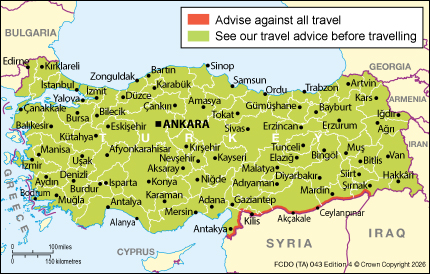
Warnings — Foreign OfficeForeign Office ↗updated 27.10.2026 · read 31.10.2026
Your travel insurance could be invalidated if you travel against advice from the Foreign, Commonwealth & Development Office (FCDO).
FCDO advises against all travel to within 10km of the border with Syria due to fighting and a heightened risk of terrorism. If you are in Syria, follow FCDO Travel Advice for Syria . The FCDO cannot facilitate entry for British nationals into Turkey from Syria.
Find out more about why FCDO advises against travel .
While 24-hour consular assistance is available by phone or online, in-person consular support is severely limited in areas where we advise against travel.
The context in the Middle East remains deeply unpredictable and the risk of sudden escalation is high. Since conflict began in early 2026, Iran has stated its intention to target locations associated with the US and Israel, including, but not limited to, organisations, businesses, facilities, and institutions. There have been strikes and retaliatory attacks by Iran and others across the region against civilian and US military infrastructure.
British nationals in, or planning to travel through, the Middle East should be prepared for possible flight cancellations, airspace closures, and travel disruptions. You should:
Regional risks — Foreign OfficeForeign Office ↗updated 27.10.2026 · read 31.10.2026
This section has safety advice for regions of Turkey. It only covers regions where FCDO has specific advice.
You should also read FCDO ’s overall travel advice .
FCDO advises against all travel within 10km of the Turkey-Syria border.
Fighting in Syria continues in areas close to the Turkish border and there is a heightened risk of terrorism in the region. See Terrorism .
Due to the ongoing conflict in Syria, roads in Hatay Province leading towards the border may be closed at short notice.
In Hakkari province you must get permission from the local Governor’s Office to visit areas near the border with Iraq and Iran. If visiting with a travel agent or tour group, confirm with them whether you need an individual permit. Keep up to date with local media and follow the advice of the local authorities.
Mount Ararat, in Ağrı Province, is a special military zone. You must have permission from the Doğubayazıt government office and pay a fee. If visiting with a travel agent or tour group, confirm with them whether you need an individual permit.
Take extra care if you’re travelling to this area. Keep up to date with local media and follow the advice of the local authorities.
Safety — Foreign OfficeForeign Office ↗updated 27.10.2026 · read 31.10.2026
This guide also has safety advice for regions of Turkey .
There is a high threat of terrorist attack globally affecting UK interests and British nationals, including from groups and individuals who view the UK and British nationals as targets. Stay aware of your surroundings at all times.
UK Counter Terrorism Policing has information and advice on staying safe and what to do in the event of a terrorist attack. Find out how to reduce your risk from terrorism while abroad .
Terrorists are likely to try to carry out attacks in Turkey.
Most terrorist attacks have occurred in southeast Turkey, Ankara and Istanbul. You should remain aware of your surroundings, keep up to date with local media reports and follow the advice of local authorities.
See Regional risks for details about the areas in south-east Turkey where FCDO advises against travel.
There have been several attacks involving knives, firearms and explosives. Attacks could be indiscriminate including in places visited by foreign nationals, such as:
Examples of recent attacks include:
Extremist groups based in Syria, including Daesh and Al-Qaeda linked groups, have the capacity to carry out attacks in Turkey. Daesh has previously targeted border crossings and nearby locations on the Syrian side of the border.
Regular demonstrations and protests are currently taking place in Istanbul and other cities across Turkey. Demonstrations may become violent. The police response has included use of tear gas and water cannons.
Events in Israel and Palestine have led to heightened tensions in the region and in locations across Turkey. Demonstrations continue to occur outside diplomatic missions connected to the conflict in major cities, particularly Israeli diplomatic missions in Ankara and Istanbul.
Avoid all demonstrations and leave the area if one develops. Local transport routes may be disrupted.
Street robbery and pickpocketing are common in the major tourist areas of Istanbul. Be aware of your personal belongings and make sure they are always secure.
Banks and money exchanges may not accept 50 or 100 US dollar bills, due to a reported surge in counterfeit banknotes of these denominations in Turkey. You should not accept these banknotes where possible.
Be wary of strangers approaching you to change money, or to take you to a restaurant or nightclub. If strangers offer you food and drink these could be spiked. Buy your own drinks and always keep sight of them.
There has been an…
American passport — U.S. Department of State
Faithful summary of the official texts below, which prevail.
Turkey - Level 2: Exercise Increased Caution 2026-06-08travel.state.gov ↗updated 08.06.2026 · read 31.10.2026
Exercise increased caution Exercise increased caution in Türkiye due to terrorism , armed conflict , and arbitrary detentions . Some areas have increased risk. Read the entire Travel Advisory.
Exercise caution in crowded public spaces including transportation hubs, markets, malls, government buildings, hotels, restaurants, clubs, places of worship, educational institutions, parks, airports, and major events.
There is risk of terrorist violence, including terrorist attacks and other activity in Türkiye. Visit the U.S. Department of State’s country reports on terrorism to learn more.
Do not travel to the border region with Syria and Iraq due to risk of terrorism and armed conflict .
Global Affairs Canada — additional reading
Exercise a high degree of caution (with regional advisories)
Avoid all travel to within 10 km of the borders with Iraq and Syria due to the unpredictable security situation and the threat of terrorism.
Avoid non-essential travel to the following southeastern provinces due to the ongoing risk of cross-border terrorist activity:
Open Government Licence – Canada · October 28, 2026 08:21 EDTtravel.gc.ca ↗updated 28.10.2026 · read 30.10.2026
Faithful summary of the official texts below, which prevail.
Global Affairs Canada — written for Canadian travellers, valid for all
You must abide by local laws. Learn about what you should do and how we can help if you are arrested or detained abroad.
Local authorities may request to see your identification at any time. If you fail to present valid documents upon request, you could face:
During your stay:
If you are temporarily in Türkiye and carry more than one passport, you should carry the one that contains your entry stamp and valid visa. If you reside in Türkiye, you should carry your Turkish resident identification (Kimlik and/or Ikamet). Hotels are legally required to register foreign guests with the local police or gendarmerie. Your passport will be required at check-in.
The use of illegal drugs is prohibited, including during transit. Penalties for possession, use or trafficking of illegal drugs, such as cannabis, are severe. Convicted offenders can expect lengthy jail sentences and heavy fines. Drugs, alcohol and travel
It is illegal to denigrate, desecrate or insult the:
Although religious proselytizing is not illegal, certain missionary activities could risk being interpreted as crimes defined under the Penal Code, such as blasphemy, insulting religious values, incitement against religion and disrupting public order. This may result in detention, fines and/or deportation.
Turkish authorities have detained and prosecuted people over public or published statements criticizing or protesting the government, state officials, the president and military operations. The same risk can apply to online activities, including what someone posts, shares or likes on social media. It can also include social media activity that took place in the past and outside Türkiye.
It is forbidden to photograph military or official installations. Avoid photographing public demonstrations, police officers or security forces. Cameras may be confiscated. Do not photograph people without their permission.
Turkish antiquities and other cultural artifacts that are considered of historical value or of national importance cannot be exported. Seek advice from the Turkish customs office if you want to export them. If the item can be exported, you will need a sales receipt and the official museum export certificate issued by the Turkish customs office.
Access to some e-SIM services is restricted in Türkiye. Foreign cell phones must be registered with local authorities within 120 days. Otherwise, they will be restricted from connecting to local networks.
Expect accessibility to be limited in transportation, lodging and general infrastructure.
The Hague Convention on the Civil Aspects of International Child Abduction is an international treaty. It can help parents with the return of children who have been removed to or retained in certain countries in violation of custody rights. The convention applies between Canada and Türkiye. If your child was wrongfully taken to, or is being held in Türkiye, and if the applicable conditions are met, you may apply for the return of your child to the Turkish court. If you are in this situation:
If your child was removed from a country other than Canada, consult a lawyer to determine if The Hague Convention applies. Be aware that Canadian consular officials cannot interfere in private legal matters or in another country's judicial affairs.
You should carry an international driving permit. For stays longer than 180 days, you must obtain a Turkish driver’s licence from the Turkish Security Directorate. You can bring a vehicle into Türkiye for up to 6 months with the proper documentation.
Penalties for drinking and driving include fines and a 6-month confiscation of your driver’s licence. Using a cell phone while driving is illegal and can lead to a fine. It is illegal to ride motorcycles and mopeds without wearing a helmet. Failure to wear one can result in a severe fine.
Islamic practices and beliefs are closely adhered to in many parts of the country. In all places of worship, women must cover their heads with a scarf and all visitors must cover their arms and legs. Respect religious and social traditions to avoid offending local sensitivities.
Open Government Licence – Canada · October 28, 2026 08:21 EDTtravel.gc.ca ↗updated 28.10.2026 · read 30.10.2026
Foreign Office — laws and cultural differences
Access to some e-sim services is restricted in Turkey. Check with your provider before travelling.
Ramadan is a holy month for Muslims in Turkey. The next Ramadan will likely begin between early February and early March in 2027 and will last for 29 or 30 days. Get more advice when you arrive from your tour guide, hotel or business contacts. During this time, it may cause offence if you:
You should also:
It is illegal not to carry some form of photographic ID in Turkey. Always carry your passport or residence permit. In some busy areas, especially Istanbul, the authorities may stop people for ID checks. There are also several police checkpoints on main roads across Turkey. Cooperate with officials conducting checks.
There are some reports of hotels refusing to check-in children aged 17 and under who are not accompanied by a parent or guardian, unless written parental consent has been provided (and in some cases notarised). Check with your accommodation provider in advance.
Dress modestly if you’re visiting a mosque or a religious shrine to avoid causing offence.
There are reports of tourists being encouraged to submit a claim for personal injury if they have experienced gastric illness in Turkey. Find out what you can do if you have suffered a personal injury on the Citizens Advice website. Only make a claim if you have genuinely suffered from injury or illness. If you make a false or fraudulent claim, you may face legal proceedings in the UK or Turkey.
Smoking is illegal on public transport and in all indoor workplaces and public places. Smoking is restricted in some outdoor areas where cultural, artistic, sports or entertainment activities are held.
Illegal drugs, including cannabis, carry severe penalties. You should expect a long prison sentence of 4 to 24 years and heavy fines for possessing, using or smuggling illegal drugs, including when transiting through airports. Airports in Turkey have excellent technology and security for detecting illegal items. This is also used to scan the baggage of transiting passengers.
Most towns and cities have stray dogs. Packs congregate in parks and wastelands and can be aggressive. Take care and do not approach stray dogs. If you’re bitten, get medical advice immediately. Rabies and other animal borne diseases are present in Turkey.
Buying or exporting antiquities is illegal. You could be fined and receive a prison sentence of 5 to 12 years. Some historical items found at local markets and in antique shops can be sold within Turkey but are illegal to export. Confirm the status of antique items before you buy them.
Do not take photographs of or near military or official installations. Ask for permission before photographing people.
Same-sex sexual activity is legal in Turkey. However, some parts of the country are socially conservative and public displays of affection may attract unwanted attention. Same-sex relationships are not legally recognised. Since 2015, authorities have banned or dispersed Pride events. Anti-LGBT+ statements by senior public figures have increased in recent years, and restrictions on LGBT+ organisations have increased. Turkish authorities have carried out operations against LGBT+ organisations and activists across the country. Read more advice for LGBT+ travellers.
It is illegal to insult the Turkish nation or the national flag. Insulting the President or the founder of the Turkish Republic, Mustafa Kemal Atatürk, is also a criminal offence. These laws can apply to comments or images online no matter where you were or when you posted them. Defacing Turkish banknotes is also illegal. Offences under these laws are punishable by a prison sentence of between 6 months and 3 years.
Open Government Licence v3.0gov.uk ↗updated 27.10.2026 · read 31.10.2026
FDFA (Switzerland) — laws and customs, in French
Sont notamment punissables:
Les infractions à la loi sur les stupéfiants , y compris la détention de minimes quantités de drogue quelle qu'elle soit, sont passibles de lourdes peines de prison. Les conducteurs/conductrices impliqués dans un accident de la circulation ayant fait des blessés ou des victimes ne sont pas autorisés, en cas de doute, à quitter le pays pendant l'enquête/le procès. Dans le cadre d'autres procédures pénales , les autorités juridiques peuvent, dans certaines circonstances, imposer aux personnes impliquées des interdictions de sortie du territoire de longue durée, jusqu'à ce que l'affaire soit close. Les autorités turques considèrent les personnes binationaux turco-suisses exclusivement comme des ressortissants turcs et n'autorisent en principe pas la Suisse à leur accorder une protection consulaire.
En dehors des plages touristiques, il est recommandé d'adapter son comportement et sa tenue vestimentaire aux coutumes locales. Renseignez-vous sur les codes de conduite et les dispositions précises. Pendant le mois de jeûne du ramadan et dans les lieux de culte, des règles et prescriptions particulières doivent être respectées. Les relations entre personnes du même sexe et la transsexualité ne sont pas tolérées dans toutes les régions du pays. Manifester de l'affection en public peut attirer une attention indésirable. Les personnes en voyage LGBTQ+ peuvent être victimes d'agressions et d’actes de discrimination. Renseignez-vous à l'avance sur les recommandations en vigueur.
FDFA travel advice, in Frencheda.admin.ch ↗updated 30.09.2026 · read 31.10.2026
What it changes for you: Air acceptable at this hour: nothing special to plan.
Reading 10:00 (Europe/Istanbul)Open-Meteo ↗updated 31.10.2026 · read 31.10.2026
Air quality and UV: Open-Meteo.com (CC BY 4.0), data rounded and formatted by Maximum. Contains modified Copernicus Atmosphere Monitoring Service information 2026. Neither the European Commission nor ECMWF is responsible for any use that may be made of the Copernicus information or data it contains.
Reading: With 2.2 physicians per 1,000 people (51% fewer than Switzerland), the nearest hospital does not always have the capacity for a serious case: evacuation to an adequate centre is the rule, not the exception — that is what unlimited evacuation and repatriation cover. Health spending of 548 USD per person (Switzerland: 11,784) goes with private hospitals that bill foreigners in hard currency and ask for a guarantee before admission: the direct payment guarantee is what avoids the deposit.
World Bank — latest published value, year per indicatordata.worldbank.org ↗read 30.10.2026
Live alerts and level changes, each with its official source. Continuously updated.
Depuis le mercredi 14 octobre, la région d’Istanbul est frappée par de fortes précipitations, qui ont causé des inondations dans plusieurs quartiers. Ces fortes pluies devraient reprendre vendredi 16 au soir et samedi 17 octobre. Il est recommandé de faire preuve de prudence, et d’éviter de se déplacer, sauf nécessité. Il est important de bien suivre les consignes données par les autorités locales, notamment le gouvernorat d’Istanbul. En cas d’urgence, appeler le 112.
France Diplomatie (in French) · posted 14 October 2026 · updated 16 October 2026diplomatie.gouv.fr ↗updated 15.09.2026 · read 31.10.2026La ville d’Antalya accueillera du 9 au 20 novembre 2026 le sommet de la COP31. De nombreuses délégations venues du monde entier seront présentes à cette période, ce qui pourrait entrainer la mise en place de dispositifs de sécurité importants, affecter les déplacements vers et autour d’Antalya et limiter l’offre hôtelière.
France Diplomatie (in French) · posted 13 October 2026diplomatie.gouv.fr ↗updated 15.09.2026 · read 31.10.2026Des incendies sont en cours dans plusieurs localités du sud et de l’ouest de la Turquie. Il est fortement recommandé de se tenir informé de l’évolution de la situation (via la radio, les réseaux sociaux des autorités locales ou la télévision) et à de respecter les consignes des autorités locales et des services de secours. Pour plus d’informations quant aux mesures à prendre, consulter le site turc de la gestion des catastrophes naturelles et des urgences (site en turc et en…
France Diplomatie (in French) · posted 30 July 2026diplomatie.gouv.fr ↗updated 15.09.2026 · read 31.10.2026Le ministère turc de la Défense a annoncé le 4 mars 2026 l’interception et la destruction d’un missile balistique iranien à proximité de la province du Hatay, au Sud-Est de la Turquie. En raison du risque d’escalade militaire régionale, il est fortement conseillé aux Français présents en Turquie de bien suivre les consignes diffusées par les autorités locales.
France Diplomatie (in French) · posted 5 March 2026diplomatie.gouv.fr ↗updated 15.09.2026 · read 31.10.2026The Need help? section was updated.
October 28, 2026 08:21 EDTtravel.gc.ca ↗updated 28.10.2026 · read 30.10.2026No level change recorded for this country since the log opened. The live alerts above are updated continuously.
Level 2/4 — Exercise Increased Caution, U.S. Department of State, retrieved on 31 October 2026.
Sourcestravel.state.gov · updated 08.06 · read 31.10France Diplomatie · updated 15.09 · read 31.10DFAE · updated 30.09 · read 31.10207-country comparison
An area advised against does not rule out the country.
SourcesFrance Diplomatie · updated 15.09 · read 31.10Foreign Office · updated 27.10 · read 31.10State Department · updated 08.06 · read 31.10
The rules depend on the passport, not on the destination alone.
SourcesFrance Diplomatie · updated 15.09 · read 31.10Foreign Office · updated 27.10 · read 31.10State Department · updated 08.06 · read 31.10
For a Schengen visa, yes: at least €30,000 of travel medical insurance (Regulation (EC) No 810/2009, art. 15).
SourcesRegulation (EC) 810/2009, art. 15General conditions, policy 20 00 479
VIP Pack — €990 for twelve months, unlimited trips.
SourcesGeneral conditions, policy 20 00 479OpenStreetMap · read 31.10
Six steps, in this order.
SourcesSpecial conditions 01.26General conditions, policy 20 00 479
Local emergency services: police 112 · fire 177
SourcesEmergencyNumberAPI · Wikidata · read 22.10OpenStreetMap · read 31.10
At today's level 2/4, card by card:
SourcesAmex Platinum France T&Cs, 01.2025 — general exclusion n° 11BNP Paribas Visa Infinite notice (policy PT7), 04.2025 — comFortuneo World Elite Mastercard notice, 01.2026 — art. 5.5 '
A health plan reimburses at home; here, the hospital asks for a payment guarantee before admission.
SourcesGeneral conditions, policy 20 00 479
Around Ankara: 80 hospitals and clinics, 62 with a 24/7 emergency room, 40 pharmacies, 18 doctors' practices (OpenStreetMap, hospital list read on 25.10.2026).
The sourced detail is under Medical network › Health: vaccines, diseases present, altitude, outbreaks.
SourcesCDC Travelers' HealthFrance Diplomatie · updated 15.09 · read 31.10OMS · read 31.10Foreign Office · updated 27.10 · read 31.10
2.2 physicians per 1,000 people (2022) versus 4.5 in Switzerland.
SourcesWorld Bank · read 30.10General conditions, policy 20 00 479
3.2 homicides per 100,000 people (2023) versus 0.6 in Switzerland and 1.3 in France.
The nearest representations, by passport (OpenStreetMap):
SourcesOpenStreetMap · read 31.10DFAE · updated 30.09 · read 31.10
9 regions advised against, fully or partly, by at least one official reading.
SourcesGlobal Affairs Canada · updated 28.10 · read 30.10Foreign Office · updated 27.10 · read 31.10France Diplomatie · updated 15.09 · read 31.10
Local laws apply to every traveller; here is what the official texts say.
SourcesGlobal Affairs Canada · updated 28.10 · read 30.10Foreign Office · updated 27.10 · read 31.10
Every foreign ministry runs a 24/7 emergency line for its nationals.
Sourcesdiplomatie.gouv.fr · updated 15.09 · read 31.10eda.admin.ch · updated 30.09 · read 31.10
Emergency phrases, to show if pronunciation fails:
SourcesMaximum Insurance
Keep the entry stamp, the invoices, the prescriptions and the medical report.
SourcesGeneral conditions, policy 20 00 479
Cancellation or change up to USD 20,000, special risk USD 5,000 per person, crisis management and security, optional Kidnap & Ransom.
SourcesGeneral conditions, policy 20 00 479
A question not answered here? Ask Maximum below, or call the support number: every question gets a clear, actionable answer.
In a life-threatening emergency, call local emergency services first, then Maximum: +41 22 ••• •• •• — 24/7 support number, an adviser stays with you to the end.
The 207 country pages — hospitals, pharmacies, police, embassies, emergency numbers, official advice from four governments, health, safety in figures, events in progress — read around the city you name. Your policy — benefits, the six steps, claims, articles. The site — prices, certificate, subscription. Nothing else: what it does not know, it says so and hands you to an adviser.
The published advisory level is national, but risk is not: business hubs (Istanbul, Ankara) do not share the profile of border areas. The medical network shown on this page is computed around Ankara — real hospitals, evacuation airport and live alerts. Before a specific trip, always cross-check your country of residence's advisory: that is what your policy cites.
Same advisory level: Belgium · Belize · Bolivia · Bosnia and Herzegovina · Botswana · Brazil
The displayed level comes from the State Department, checked every morning. Before departure, always cross-check your country of residence's advisory: that is what your policy cites.
The level shown is the official U.S. Department of State level, checked daily. Maximum Insurance is an insurance distributor — general information, not personal advice.
The destination is already Ankara. A few choices, then the reading of your cover, here.
Destination · Ankara
Travel Insurtech. 24/7 worldwide.
Swiss insurer · Worldwide medical network