Maximum Alerts / Bolivia

BoliviaLevel 2/4

Level published by the State Department on 17.08.2026 · read 16 October 2026 · source checked daily

Bolivia — official level as of 16 October 2026: Level 2/4 ("Exercise Increased Caution"), from the U.S. Department of State. Maximum Insurance covers this country: hospital settled directly, unlimited repatriation, EUR 1.5M, certificate on payment.

Four official readings
United StatesState Departmentsource ↗Our reference level — the one shown across this site
Is the whole country advised against?Nono restriction on the whole country
Level 2/4 — “Exercise Increased Caution”levels 1 and 2 are advice to be careful, not travel restrictions
FranceFrance Diplomatiesource ↗Added on top of the U.S. level, under its own rules: red or orange AREAS
Is the whole country advised against?Nono restriction on the whole country+ orange areas
our reading: some areas are classified orange (advised against except for imperative reasons)
United KingdomFCDOsource ↗Added on top of the U.S. level, under its own rules: travel statuses
Is the whole country advised against?Nono restriction on the whole country+ parts of the country
our reading: all but essential travel advised against to parts of the country
source reviewed 22 September 2026
SwitzerlandFDFAsource ↗Advisory cited by the Maximum policy
Is the whole country advised against?Nono restriction on the whole country
our reading: the FDFA advises against no travel
The four readings on record agree: no restriction on the whole country — France still flags orange areas; the United Kingdom still flags parts of the country.Our comparison reading: 27 September 2026

All 207 countries compared, advisory by advisory →

How we read these four advisories

Every country has its own scale, so we ask them all the same question: is the whole country advised against?

An advisory covering only areas of the country does not raise the answer: it stays “No”, and the area is shown in the relevant column.

The level shown on this page — and across this site — is the one published by the U.S. State Department, from 1 (normal precautions) to 4 (do not travel). France and the United Kingdom publish their own advisories, with their own rules: they add to that level, they do not replace it.

Get covered — €990/yr
Regional map…
Level 2/4 — Exercise Increased Caution Checked on 16 October 2026 · U.S. State Department
Country briefing
Get the PDF

Where are you right now in Bolivia?

Doctors — Sucre9
DrCentro de Salud Patacón0.7 km

Sucre
general

Google MapsDirections
DrCentro Medico0.9 km

Avenida Venezuela Sucre
general_practice

Google MapsDirections
DrPosta de Salud Alto Delicias1.0 km

Sucre

Google MapsDirections
DrLaboratorio de Anàlisis Clìnico Central1.3 km

Avenida Hernando Siles Zuaso Sucre
biochemistry

Google MapsDirections
DrPoliclinico 25 de Mayo CNS1.5 km

Capitán Agustín Ravelo Sucre

Google MapsDirections
DrHospital Monseñor Jesus Perez2.1 km

Calle Daniel Calvo Sucre

Google MapsDirections
DrCentro de Salud Casegural2.4 km

Calle Nueva Ilusión Sucre
general

Google MapsDirections
DrCentro de Salud Villa Rosario2.8 km

near Calle Destacamento Chuquisaca

Google MapsDirections
DrHospital Municipal Azar6.2 km

na sucre
general

Google MapsDirections
Pharmacies — Sucre40
+Farmacia Virgen del Socavón0.7 km

near Avenida Jaime Mendoza

Google MapsDirections
+Farmacia manantial0.8 km

near Calle Tomás Frías

Google MapsDirections
+Entrada y Farmacia del hospital0.9 km

near Plaza Aniceto Arce

Google MapsDirections
+Remedio1.0 km

near Calle Daniel Sánchez Bustamante

Google MapsDirections
+Farmacia San Mauro1.2 km

430 Calle Loa Sucre
Mo-Sa 12:00-21:00

+59146457918Directions
+Atenea1.3 km

Avenida H. Siles

Google MapsDirections
+Farmacia San Juan de Circa1.3 km

Avenida Hernando Siles Zuaso Sucre

Google MapsDirections
+Farmacia La Esperanza1.3 km

Avenida H. Siles

Google MapsDirections
+24hr Pharmacy1.3 km

Calle José Álvarez de Arenales Sucre

Google MapsDirections
+Farmacia San Agustín1.3 km

Calle Ayacucho Sucre

Google MapsDirections
+Farmacia Mar y Sol1.3 km

Calle Destacamento 130 Sucre
Mo-Su 10:00-22:00

Google MapsDirections
+Farmacia La Plata1.4 km

Calle Capitán Agustín Ravelo Sucre
Mo-Sa 08:00-18:00

Google MapsDirections
+Farmacia San Cayetano1.4 km

Calle Uyuni Sucre

Google MapsDirections
+Farmacia Andina1.4 km

Calle Capitán Agustín Ravelo Sucre

Google MapsDirections
+Farmacia Luz Vida1.4 km

Avenida Japon Sucre

Google MapsDirections
+Farmacia Sucrense1.4 km

Calle Colón Sucre

Google MapsDirections
+Farmacia La Capital1.5 km

Calle Aniceto Arce Sucre

Google MapsDirections
+Farmacia San Agustin1.5 km

Calle Colón Sucre

Google MapsDirections
+Farmavida1.5 km

Calle Pastor Sainz Sucre

Google MapsDirections
+Pharmacie1.5 km

Sucre

+Farmacia torrez1.5 km

near Avenida Gaspar de las Cuevas

Google MapsDirections
+Farmacia Villar1.6 km

near Avenida Alberto Ostria Gutierrez

Google MapsDirections
+Farmacia San Silvestre1.6 km

near Calle Guillermo Loayza

Google MapsDirections
+Farmacia Hispana1.7 km

Calle Colón Sucre

Google MapsDirections
+Farmacorp1.7 km

26 Calle Real Audiencia

+Farmacia Jorymar1.8 km

near Avenida Germán Mendoza

Google MapsDirections
+Farmacia Flores1.9 km

near Calle Ignacio Prudencio Bustillos

Google MapsDirections
+Farmamed1.9 km

near Rotonda Rotary

Google MapsDirections
+Farmacia san Andrés1.9 km

near Avenida Circunvalación

Google MapsDirections
+Mi salud1.9 km

near Avenida Marcelo Quiroga Santa Cruz

Google MapsDirections
+Farmacia san nicolas1.9 km

near Avenida Marcelo Quiroga Santa Cruz

Google MapsDirections
+Farmacia Gutiérrez1.9 km

near Avenida Marcelo Quiroga Santa Cruz

Google MapsDirections
+Farmacia San Agustin2.0 km

Calle Juan Jose Perez Sucre
Mo-Su 07:30-22:30

Google MapsDirections
+Megafarma2.0 km

near Avenida Marcelo Quiroga Santa Cruz

Google MapsDirections
+farmacia de barrio2.0 km

Avenida Germán Mendoza Sucre
Mo-Su 09:00-20:00

Google MapsDirections
+Cruz del Sur2.1 km

near Calle Simón Bolívar

Google MapsDirections
+Farmacia la salud2.1 km
Google MapsDirections
+Farmacorp2.1 km

402 Av. Las Americas

+Pharmacie2.1 km

Calle Inca Garcilaso de la Vega

+Farmacia Lázaro2.2 km

Calle Daniel Calvo Sucre

Google MapsDirections
Official — Sucre3
Town halls 3
ASub Alcaldia Distrito 20.9 km

near Daniel Sanchez Bustamente

Google MapsDirections
AGobierno Autónomo Municipal de Sucre1.6 km

Plaza 25 de Mayo Sucre

Google MapsDirections
ASub alcaldía Distrito 56.2 km

Yamparaez sucre

Google MapsDirections
Police — Sucre5
PPolicía Boliviana0.9 km

Sucre

Google MapsDirections
PComando Departamental1.7 km

near Calle Junín

Google MapsDirections
PTránsito1.8 km

near Avenida J. Prudencio Bustillos

Google MapsDirections
PPOLICIA DELTA2.2 km

near Plazuela Cumaná

Google MapsDirections
PModulo de control Azari6.3 km

RN6: Sucre-Tarabuco sucre
Mo-Su 09:00-21:00

Google MapsDirections
Transport — Sucre7
Stations 1
TEl Tejar3.1 km

Sucre

Google MapsDirections
Bus 4
TCollectivos hasta Potolo0.5 km

near Calle Monseñor Fernando Santillan

Google MapsDirections
TTruffis para Potolo0.8 km

near Calle Tomás Frías

Google MapsDirections
TDépart pour Potolo et Chataquila (Camino Inca) 6am0.8 km

near Calle Tomás Frías

Google MapsDirections
TParada a Tarabuco2.5 km

near Calle Tupaj Yupanqui

Google MapsDirections
Taxis 2
TTaxi Tours Urbano1.7 km

Calle Plaza 25 de Mayo Sucre

Google MapsDirections
TKtaxi Sucre4.6 km

near Avenida Circunvalación

Google MapsDirections

The next 7 days around Sucre America/La_PazMET Norway ↗read 16.10.2026

Fri 16 Oct8–20°rain · 1.3 mm
Sat 17 Oct8–22°fog · 0.6 mm
Sun 18 Oct8–20°rain · 1.4 mm
Mon 19 Oct8–22°overcast · 0.3 mm
Tue 20 Oct8–25°overcast · 0.6 mm
Wed 21 Oct11–30°partly cloudy
Thu 22 Oct12–24°showers · 2.9 mm

Forecast: MET Norway (Norwegian Meteorological Institute, CC BY 4.0), grouped by day and formatted by Maximum.

Nearest river dischargeOpen-Meteo ↗updated 16.10.2026 · read 16.10.2026

10-16 0.0 · 10-17 0.0 · 10-18 0.0 · 10-19 0.0 · 10-20 0.0 · 10-21 0.0 · 10-22 0.0 m³/s

Simulated discharge: Open-Meteo.com (CC BY 4.0), data rounded and formatted by Maximum. Contains modified Copernicus Emergency Management Service information 2026. For information only: this is not a flood warning; only national or regional authorities issue those.

No geolocated event in this country at this reading.

No geolocated UCDP incident in this country.

Country notices, with no street coordinate

Now
Level 1 - Global Dengue
Dengue is a year-round risk in many parts of the world, with outbreaks commonly occurring every 2–5 years. Travelers to risk areas should prevent mosquito bites. Country List : Colombia, Vietnam, Maldives, Bolivia, Cambodia, Kenya, Malaysia, Sri Lanka, Bangladesh, Costa Rica, Marshall Islands, Vanuatu Country List :…
The country feed →

National numbers (Wikidata, 2026 reading). On site, call local emergency services first, then Maximum: the insurer sends its payment guarantee to the hospital.

Altitude 2,820 mAbove 2,500 m: acute mountain sickness affects one traveller in four on the first day (headache, nausea, breathlessness). Ascend gradually, drink, no alcohol the first evening; worsening symptoms go to a doctor or the 24/7 number.

Elevation: MET Norway terrain model (CC BY 4.0), read from its forecast.

Recommended vaccines and medicines11

Routine vaccinesCDC ↗

Make sure you are up-to-date on all routine vaccines before every trip. Some of these vaccines include Chickenpox (Varicella) Diphtheria-Tetanus-Pertussis (DTaP, Tdap, or Td) Flu (influenza) Measles-Mumps-Rubella (MMR) Polio Shingles

COVID-19CDC ↗

All eligible travelers should be up to date with their COVID-19 vaccines. Please see  Your COVID-19 Vaccination  for more information.

ChikungunyaCDC ↗

All travelers should take steps to prevent mosquito bites. Chikungunya vaccination is generally not recommended. Travelers who wish to consider vaccination can visit “What to consider before traveling” on the chikungunya vaccines page to learn more.

Hepatitis ACDC ↗

Recommended for unvaccinated travelers one year old or older going to Bolivia. Infants 6 to 11 months old should also be vaccinated against Hepatitis A. The dose does not count toward the routine 2-dose series. Travelers allergic to a vaccine component should receive a single dose of immune globulin, which provides effective protection for up to 2 months depending on dosage given.

Hepatitis BCDC ↗

Recommended for unvaccinated travelers younger than 60 years old traveling to Bolivia. Unvaccinated travelers 60 years and older may get vaccinated before traveling to Bolivia.

MalariaCDC ↗

CDC recommends that travelers going to certain areas of Bolivia take prescription medicine to prevent malaria. Depending on the medicine you take, you will need to start taking this medicine multiple days before your trip, as well as during and after your trip. Talk to your doctor about which malaria medication you should take.

MeaslesCDC ↗

Cases of measles are on the rise worldwide. Travelers are at risk of measles if they have not been fully vaccinated at least two weeks prior to departure, or have not had measles in the past, and travel internationally to areas where measles is spreading.

MonkeypoxCDC ↗

Monkeypox vaccination is recommended for any adult who anticipates any of the following activities during travel: Sexual or intimate contact with a new partner Sexual or intimate contact at a commercial sex venue, like a sex club or bathhouse Sexual or intimate contact in exchange for money, goods, drugs, or other trade Sexual or intimate contact in association with a large public event, such as a rave, party, or…

RabiesCDC ↗

Dogs infected with rabies are commonly found in Bolivia. Rabies is also present in bats. If rabies exposures occur while in Bolivia, rabies vaccines are typically not readily available.

TyphoidCDC ↗

Consider getting a typhoid vaccine if you might: Travel to areas with poor sanitation and unsafe water, including rural areas Spend a long time in Bolivia, such as a month or more Visit friends or relatives Typhoid vaccine is not 100% effective. Practicing safe food and water habits , including washing hands at key times , can also help prevent typhoid fever .

Yellow FeverCDC ↗

CDC recommendations: Vaccine is recommended for travelers ≥9 months old going to areas <2,300 m (7,550 ft) elevation, east of the Andes Mountains: the entire departments of Beni, Pando, Santa Cruz, and designated areas in the departments of Chuquisaca, Cochabamba, La Paz, and Tarija.

CDC Travelers' Health, re-read weekly — the recommendation depends on your age, vaccines and itinerary: confirm it with a doctor or a travel clinic 4 to 6 weeks before departure.CDC ↗read 10.10.2026

Diseases without a vaccine — how they spread

Avoid contaminated food and water
  • Leptospirosis — Touching urine or other body fluids from an animal infected with leptospirosis Swimming or wading in urine-contaminated fresh water, or contact with urine-contaminated mud Drinking water or eating foo
Avoid bugs
  • Chagas disease (American Trypanosomiasis) — Accidentally rub feces (poop) of the triatomine bug into the bug bite, other breaks in the skin, your eyes, or mouth From pregnant woman to her baby, contaminated blood products (transfusions), or con
  • Dengue — Mosquito bite
  • Leishmaniasis — Sand fly bite
  • New World Screwworm Myiasis — Eggs of the New World screwworm fly
  • Zika — Mosquito bite An infected pregnant woman can spread it to her unborn baby
Airborne & droplet
  • Hantavirus — Breathing in air or accidentally eating food contaminated with the urine, droppings, or saliva of infected rodents Bite from an infected rodent Less commonly, being around someone sick with hantavirus
  • Tuberculosis (TB) — Breathe in TB bacteria that is in the air from an infected and contagious person coughing, speaking, or singing.

Risks in figures

Tuberculosis — cases per 100,000
Bolivia114 2024
Switzerland5 2024
France8 2024

High incidence: a long stay or time in care settings warrants a test on return.

Children vaccinated against measles (%)
Bolivia67 2024
Switzerland96 2024
France95 2024

Coverage too low to stop the virus circulating: check your two MMR doses before leaving.

Malaria — cases per 1,000 people at risk
Bolivia3.8 2024

Transmission limited to some areas: repellent, and the CDC says which.

World Bank — latest published valuedata.worldbank.org ↗read 10.10.2026

The official advice, in full

Source: France Diplomatie (health advice, in French).

In brief
  • Consult a doctor or international vaccination center at least eight weeks before travel to assess your health and update vaccinations, including measles, diphtheria, tetanus, and polio.
  • Carry sufficient prescription medication in original packaging with an International Nonproprietary Name (INN) prescription, and verify its legality in Bolivia.
  • Be aware that public healthcare in Bolivia can be inconsistent; private clinics are available in major cities and require upfront payment.
  • Altitude sickness is a risk above 2,500 meters; acclimatize gradually, ascend slowly, stay hydrated, avoid alcohol, and seek medical advice before high-altitude excursions, especially if pregnant or with pre-existing conditions.
  • Protect yourself from mosquito-borne diseases like Chikungunya and Dengue by wearing long clothing, using repellent, and protecting your accommodation.
  • Ensure you have adequate travel insurance that covers local treatment and potential medical evacuation, as hospitals often require financial guarantees before treatment.

Faithful summary of the official texts below, which prevail.

WHO — outbreaks reported for this country (last 24 months)

  • Chapare haemorrhagic fever- the Plurinational State of Bolivia20 January 2025 · who.int ↗
    On 7 January 2025, the International Health Regulations National Focal Point for the Plurinational State of Bolivia notified WHO of a laboratory-confirmed case of Chapare virus infection in an adult male from La Paz Department. Chapare haemorrhagic fever is an acute viral illness caused by Chapare virus. The virus…

FDFA (Switzerland) — medical care, in French

Medical care

En dehors des grandes villes, les soins médicaux ne sont pas toujours assurés. Les hôpitaux exigent en principe une garantie financière avant de commencer un traitement (preuve de couverture maladie, carte de crédit ou paiement d’avance). Si vous prenez régulièrement des médicaments , emportez-en une quantité suffisante avec vous. Notez toutefois que de nombreux pays appliquent des réglementations restrictives. Cela vaut en particulier, mais pas exclusivement, pour les médicaments contenant des stupéfiants (par exemple la méthadone) et les substances utilisées pour le traitement des troubles psychiques. Avant votre départ, renseignez-vous directement auprès de la représentation étrangère compétente (ambassade ou consulat) et consultez la rubrique Liens voyages , où vous trouverez de plus amples informations sur ce sujet ainsi que sur la médecine du voyage en général. Les informations concernant la propagation de maladies et les éventuelles mesures de protection à prendre sont fournies par le personnel médical et les centres de vaccination. Liens voyages

France Diplomatiesource ↗updated 15.09.2026 · read 16.10.2026

Recommandations pour la santé

Consulter si besoin son médecin traitant ou un centre de vaccinations internationales (médecine des voyages) pour faire une évaluation de son état de santé et bénéficier de recommandations sanitaires, notamment sur les vaccinations. Consulter éventuellement son dentiste avant le départ.

Constituer sa pharmacie personnelle en conséquence et n’emporter dans ses bagages que les médicaments strictement nécessaires ; ne jamais consommer de médicaments achetés dans la rue (risque de contrefaçons). Les médicaments doivent être dans leur emballage d’origine avec les étiquettes originales, accompagnés d’une ordonnance portant le nom des médicaments en dénomination commune internationale (DCI). Il est indispensable de vérifier que les médicaments concernés sont autorisés dans le pays visité : pour plus d’informations, consulter la fiche Informations pratiques .

La Bolivie a déclenché un état d’alerte sanitaire en raison d’une épidémie de rougeole dans les régions de Santa Cruz, La Paz et Potosi.

Il est recommandé à tous les voyageurs de vérifier, avant leur départ, leur statut vaccinal par rapport à la rougeole et de faire procéder à sa mise à jour, si nécessaire, auprès de leur médecin traitant ou d’un centre de vaccination international.

En cas de survenue de symptômes (fièvre, toux, écoulement nasal, yeux rouges et larmoyants), consulter un professionnel de santé.

Pour plus d’information :

  • Site du ministère de la santé
  • Site Vaccination info service

Les excursions et randonnées en altitude doivent faire l’objet d’un avis médical spécialisé avant le départ. La haute altitude est déconseillée pour les enfants âgés de moins de 7 ans ; des antécédents cardiaques, pulmonaires, neurologiques ou rénaux constituent une contre-indication, tout comme une grossesse.

Vaccinations

Les vaccins recommandés en France sont également indispensables lors d’un séjour à l’étranger : les maladies qu’ils préviennent circulent partout dans le monde, parfois même plus fréquemment qu’en France. Avant tout départ, le voyageur (adulte et enfant) doit donc d’abord s’assurer d’être à jour du calendrier vaccinal français, en particulier des vaccins contre la diphtérie, le tétanos, la poliomyélite, la coqueluche mais aussi contre la rougeole. Le carnet de vaccination peut être demandé à l’arrivée de certains pays.

Des vaccinations complémentaires peuvent être nécessaires :

  • Fièvre jaune : la vaccination contre la fièvre jaune est recommandée (à pratiquer dans un centre agréé) et est obligatoire en cas d’entrée en Bolivie par la frontière brésilienne amazonienne ;
  • Hépatite A : en fonction des conditions et de la durée de séjour ;
  • Fièvre typhoïde : en fonction des conditions et de la durée de séjour ;
  • Hépatite B : en cas de séjours fréquents ou prolongés ;
  • Tuberculose : chez les enfants de moins de 15 ans en cas de séjours fréquents ou prolongés ;
  • Rage : notamment enfants en bas âge, séjour en milieu rural ou éloigné des villes principales ;
  • Chikungunya : en cas d’épidémie ou de séjour prolongé ;
  • Dengue : en cas d’épidémie active ou de séjour prolongé en zone endémique.

Il est donc conseillé de consulter son médecin traitant ou un centre de vaccinations internationales (médecine des voyages) suffisamment de temps avant le voyage.

Maladies transmises par les moustiques

Chikungunya

La chikungunya est une maladie virale transmise par l’intermédiaire de moustiques infectés. Cette maladie se manifeste par l’apparition de symptômes grippaux (fièvre, douleurs musculaires et articulaires). En cas de signes cliniques, il est impératif de consulter immédiatement un médecin ; le traitement est uniquement symptomatique. Les moyens de prévention reposent sur la vaccination et la protection contre les piqûres de moustiques. Il est conseillé avant le départ de se référer à son médecin traitant et/ou à un centre de vaccination internationale.

Pour plus d’informations , consulter la rubrique risques sanitaires .

La transmission du chikungunya reste active en Bolivie.

Dengue

La dengue est une maladie virale transmise par piqûres de moustiques. Les symptômes sont de type grippal (fièvre, maux de tête, courbatures, parfois éruption cutanée). En cas de signes cliniques, il est impératif de consulter immédiatement un médecin. Il n’existe pas de traitement curatif. La prise en charge médicale repose uniquement sur le traitement des symptômes. Il faut impérativement éviter la prise d’anti-inflammatoire. La prévention individuelle repose essentiellement sur les moyens de protection contre les piqûres de moustiques. La vaccination des voyageurs peut être indiquée dans certains cas. Il est conseillé de se référer, avant son départ, à son médecin traitant et /ou à un centre de vaccination internationale.

Pour plus d’informations, consulter le site du ministère de la Santé et le site de l’Organisation mondiale de la Santé .

La transmission de la dengue s’effectue par l’intermédiaire de moustiques infectés. Les pluies et les chaleurs de l’été austral (novembre à avril) favorisent la multiplication des moustiques transmetteurs de ce virus. De ce…

Mal des montagnes

Le mal aigu des montagnes (MAM) est une maladie survenant en haute altitude (plus de 2 500 mètres de hauteur) lorsque l’organisme n’a pas eu le temps de s’acclimater au manque d’oxygène consécutif à la baisse de pression. Il peut se manifester par des troubles de type respiratoires (essoufflement) et/ou neurologiques (maux de tête, nausées, vomissements, troubles du sommeil) qui peuvent être transitoires ou s’aggraver et conduire au décès.

L’identification des symptômes du mal des montagnes peut être difficile : il est essentiel de communiquer en permanence, sans restriction, sur son état physique. De surcroît, les capacités de réflexion et d’action d’une victime du mal aigu des montagnes peuvent être altérées. En cas de survenue de symptômes il est recommandé d’interrompre l’ascension, de redescendre le plus rapidement possible à une altitude inférieure, au minimum en dessous de 4000 mètres, avec un accompagnant et de consulter un médecin.

Toute personne, quelle que soit sa condition physique et son habitude de la randonnée en altitude, peut être confrontée au mal des montagnes. La prévention repose sur des règles essentielles :

  • Une adaptation progressive à l’altitude en limitant les efforts physiques les premiers jours ;
  • Une ascension lente et progressive (pas plus de 400 m de dénivelé positif entre deux nuits consécutives à partir de 2 500 m) ;
  • Une hydratation régulière en évitant les boissons alcoolisées et repas copieux ;
  • Ne jamais abandonner une personne malade.

Les excursions et randonnées en altitude doivent faire l’objet d’un avis médical spécialisé avant le départ. La haute altitude est déconseillée pour les enfants. La grossesse ainsi que la notion d’antécédents cardiaques, pulmonaires, neurologiques ou rénaux constituent une…

Maladie de Chagas

La maladie de Chagas est une infection due à un parasite transmis principalement par la piqûre d’insectes appelés triatomes. Elle évolue en deux phases : une phase aiguë, souvent asymptomatique ou avec des symptômes bénins comme fièvre, fatigue, et œdème de la paupière ou une lésion cutanée au site de la piqûre (chagome), puis une phase chronique qui peut rester silencieuse ou entraîner des complications graves des années plus tard. Ces complications touchent principalement le cœur, le système digestif et plus rarement le système nerveux. La maladie peut aussi se transmettre lors de transfusion, de transplantation ou de façon congénitale. Le traitement repose sur la prise d’antiparasitaire surtout à la phase aiguë. Les mesures de prévention individuelle consistent principalement à se protéger contre les piqures d’insectes et à éviter les logements ruraux précaires.

Pour plus d’informations, consulter le site de l'Institut Pasteur et le site de l'Organisation mondiale de la Santé .

Les départements les plus touchés sont ceux de Cochabamba, Chuquisaca, Tarija et Santa Cruz.

Hantavirus

Ces virus sont transmis à l’être humain par des rongeurs sauvages (souris, rats). La contamination résulte essentiellement de l’inhalation de poussières contaminées par leurs urines, déjections ou salive. La transmission interhumaine est exceptionnelle. Les symptômes associent notamment une fièvre et de possibles hémorragies. Des formes graves et mortelles existent.

Afin de diminuer le risque d’infection il est recommandé :

  • d’éviter les contacts avec les rongeurs vivants ou morts, leurs excrétions ou leurs nids ;
  • de se laver soigneusement les mains après un travail ou une sortie dans la nature ;
  • de ventiler les espaces fermés et d’éviter de dormir dans des bâtiments…
Mesures générales de prévention des piqûres de moustiques
  • Porter des vêtements longs et couvrants ;
  • Appliquer des produits répulsifs cutanés sur les zones découvertes du corps ;
  • Protéger son logement (moustiquaires imprégnées d’insecticide, diffuseurs électriques, serpentins à l’extérieur, climatisation, etc.) ;
  • Détruire les sites potentiels de reproduction des moustiques (récipients d’eau stagnante comme les soucoupes sous les pots de fleurs, les gouttières, les pneus, etc.).

Pour plus d’informations, consulter le site du ministère en charge de la Santé et le site de l'Assurance Maladie .

Règles d'hygiène alimentaire
  • Se laver les mains régulièrement avec de l’eau et du savon ou des solutions de lavage hydroalcooliques, surtout avant et après les repas et le passage aux toilettes ;
  • Veiller à la qualité des aliments et surtout à leur bonne cuisson ;
  • Éviter la consommation de produits alimentaires (poisson, viande, volaille, lait) crus ou peu cuits ;
  • Peler les fruits et légumes ou les laver soigneusement (à l’eau saine) ;
  • Éviter les crudités, coquillages, plats réchauffés et buffets froids ;
  • Ne boire que de l’eau ou des boissons encapsulées ou de l’eau rendue potable (filtration, ébullition ou à défaut produit désinfectant).

Pour plus d’informations, consulter le site du ministère en charge de la Santé .

Health — Foreign OfficeForeign Office ↗updated 22.09.2026 · read 16.10.2026

Health — Foreign Office

Before you travel check that:

  • your destination can provide the healthcare you may need
  • you have appropriate travel insurance for local treatment or unexpected medical evacuation

This is particularly important if you have a health condition or are pregnant.

Emergency medical number

Call 118 and ask for an ambulance.

Contact your insurance company quickly if you’re referred to a medical facility for treatment.

Public healthcare in Bolivia can be inconsistent in response times and quality of service throughout the country. In remote areas the provision of emergency medical assistance is limited. Consider private alternatives if they are available.

Vaccine recommendations and health risks

At least 8 weeks before your trip:

  • check the latest vaccination recommendations for Bolivia
  • see where to get vaccines and whether you have to pay on the NHS travel vaccinations page

See what health risks you’ll face in Bolivia , including:

  • Oropouche virus disease
  • Zika virus

Altitude sickness is a risk in parts of Bolivia, including in La Paz and the Salar de Uyuni salt flats. Read more about altitude sickness on TravelHealthPro .

Medication

Some medications are currently in short supply in Bolivia. If you take prescription medicine, please ensure you have enough medicine to cover your stay in Bolivia.  You must bring your prescription with you.

The legal status and regulation of some medicines prescribed or bought in the UK can be different in other countries.

Read best practice when travelling with medicines on TravelHealthPro .

Healthcare in Bolivia

The public healthcare system does not meet the same standards as the UK, and you may not be able to access the public health system as it is already overstretched. Bolivia is also prone to shortages in medical supplies and pharmaceuticals. There are private clinics in all main cities that work with international insurance. It is very important to have travel insurance and access to funds, as you will need to pay up front to receive treatment.

FCDO has a list of medical providers in Bolivia where some staff will speak English.

Travel and mental health

Read FCDO guidance on travel and mental health . There is also mental health guidance on TravelHealthPro .

TravelHealthPro ↗ · CDC ↗read 10.10.2026

Level 1 - Global DengueCDC ↗read 10.10.2026Dengue is a year-round risk in many parts of the world, with outbreaks commonly occurring every 2–5 years. Travelers to risk areas should prevent mosquito bites. Country List : Colombia, Vietnam, Maldives, Bolivia, Cambodia, Kenya, Malaysia, Sri Lanka, Bangladesh, Costa Rica, Marshall Islands, Vanuatu Country List :…

Places read from OpenStreetMap, within a circle of about 12 km: phone, email, address, website and hours when the source publishes them. No customer reviews, that source has none. Straight-line distances.

The comparator

What is your current insurance?

The verdict
No area exclusion at this level — but three written limits: deductible and prior approval, 90-day cap, advance under conditions.
Exact wording (official French text): « Des Voyages vers des pays où Votre gouvernement a conseillé de ne pas voyager » — general exclusion n° 11, applying to ALL travel covers.
Line by line
Cover
With your Amex Platinum
Territorial exclusion at this level
No territorial exclusion at this level — the clause targets countries your government advised against travelling to
Covered — the core of the Maximum contract
Medical expenses cap abroad
€2M — but 10% deductible (€150–500), insurer's prior approval, trip paid with the Card
EUR 1.5M emergency medical expenses
Hospital deposit before admission
Advance possible — prior approval required before care
Direct payment guarantee: the insurer settles the hospital
Trip duration covered
Maximum 90 consecutive days per trip
12 months, unlimited trips
Visa certificate (incl. Schengen)
Not provided
Official named certificate, issued on payment

Notices vary by bank and vintage — yours prevails. On the right: the Maximum contract (public documents).

Where to go, where not to

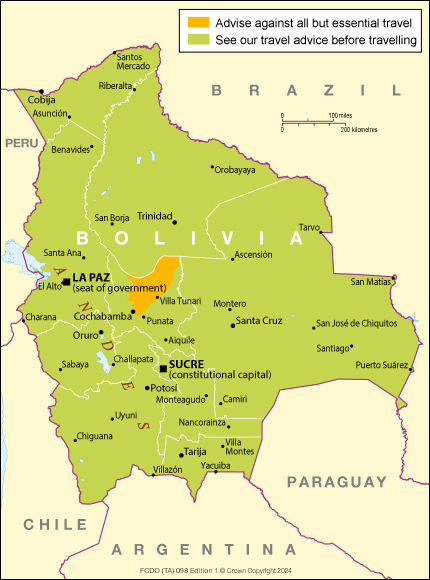
The country is not uniform: 1 region advised against, fully or partly, by at least one official reading. Sucre is not one of them.

In brief
  • Avoid all travel to Bolivia's Chapare Region, including Villa Tunari and highways 4 and 24, due to drug trafficking, kidnapping, extortion and anti-foreigner sentiment. Global Affairs Canada
  • The Foreign Office advises against all but essential travel to the Chapare region of Cochabamba Department, including Villa Tunari and highway routes 4 and 24. Foreign Office
  • France Diplomatie advises against travel to the Brazil-Bolivia border zone except for compelling reasons, due to drug trafficking, smuggling and significant weapons circulation. France Diplomatie

Faithful summary of the official texts below, which prevail.

Sucre (Chuquisaca) is in no region these official readings advise against; check that it is not in one of the areas quoted below.The red dot on the map. Change the city at the top of the page to read the map from another point.
La Paz — Country-wide vigilanceOruro — Country-wide vigilancePotosí — Country-wide vigilanceTarija — Country-wide vigilanceSanta Cruz — Country-wide vigilanceChuquisaca — Country-wide vigilancePando — Country-wide vigilanceBeni — Country-wide vigilanceCochabamba — Partly advised againstSucre
Partly advised againstCountry-wide vigilanceSucreSynthesis of the readings: Global Affairs Canada, Foreign Office, France Diplomatie. Where they differ, the colour keeps the strictest reading; the official text, quoted below region by region, prevails. Boundaries: Natural Earth. The areas quoted without a region are not drawn: they do not follow regional boundaries.
Advised against — all travel — areas, not drawn1
Global Affairs Canada — Avoid all travel to the Chapare Region, including Villa Tunari and major highway routes crossing the area…
Partly advised against1
Cochabamba — the Chapare region of Cochabamba Department including Villa Tunari and highway routes 4…
Country-wide vigilance
the rest of the country, including Sucre
So:

the trip stays outside the advised-against regions. Any move into a red or orange region calls for a new, written decision. The areas quoted without a region (border, routes, localities) call for the same decision.

US17.08.2026
Level 2 of 4Exercise increased caution
FR17.03.2026
Orange areas in the countrySome areas are advised against except for imperative reasons.Your region (Chuquisaca): not covered
GB22.09.2026
Some areas: essential travel only1 region covered, fully or partly.Your region (Chuquisaca): not covered
CA14.10.2026
Exercise a high degree of cautionYour region (Chuquisaca): not covered

The official text, region by region

Partly advised against1 region

CochabambaGB

Foreign Office
FCDO advises against all but essential travel to the Chapare region of Cochabamba Department including Villa Tunari and highway routes 4 and 24 that pass through Chapare.

Official passages not placed on the map2

Global Affairs Canada — Advised against — all travel
Avoid all travel to the Chapare Region, including Villa Tunari and major highway routes crossing the area, due to the unstable security situation, anti-foreigner sentiment, elevated civil unrest, restrictions on movement, and criminal activity such as drug trafficking, kidnapping and extortion.

France Diplomatie (in French) — Advised against — all but essential travel
En raison des trafics (stupéfiants, contrebande) et de l’importante quantité d’armes en circulation, il est déconseillé, sauf raison impérative, de se rendre ou de séjourner dans la zone frontalière avec le Brésil.

Maximum does not exclude these areas.The VIP Pack covers care and repatriation there. Still enforceable: sanctions and embargoes, and a country already at war at departure. Extraction and security belong to the VIP Pack Extreme, upon eligibility. See My cover

Global Affairs Canada — Open Government Licence – Canada (14.10.2026) · Foreign Office — Open Government Licence v3.0 · France Diplomatie (17.03.2026) · Natural Earth

No located event in this reading.

Last change: Updated information about the State of Emergency ('Warnings and insurance' page).

Bolivia - Level 2: Exercise Increased CautionState Department ↗updated 17.08.2026 · read 16.10.2026

Updated 17.08.2026

Exercise increased caution in Bolivia due to crime , unrest , and health . Some areas have increased risk. Read the entire Travel Advisory.

Crime

  • Petty crime is common, especially in popular tourist spots. Stay aware of your surroundings.

Unrest

  • Large demonstrations can happen with little warning. Demonstrations may block transportation and other essential services.
  • Avoid demonstrations and crowds.
  • Check local media for breaking news. Be prepared to adjust your plans.

U.S. government employee travel restrictions

  • U.S. government employees working in Bolivia need special authorization to travel to Chapare Province due to a higher incidence of crimes connected to narcotrafficking.
  • U.S. government employees working in Bolivia are encouraged to pay extra attention to their surroundings in El Alto because of petty crime.
  • U.S. citizens in Bolivia are advised to take the same precautions.

Do Not Travel to Chapare Province due to crime.

Bolivia: Floods - Dec 2025ReliefWeb ↗read 16.10.20262026-01-02

Bolivia: Wild Fires - Aug 2025ReliefWeb ↗read 16.10.20262025-09-15

Source: ReliefWeb (OCHA), via HDX — CC BY

Nearest river dischargeOpen-Meteo ↗updated 16.10.2026 · read 16.10.2026

10-16 0.0 · 10-17 0.0 · 10-18 0.0 · 10-19 0.0 · 10-20 0.0 · 10-21 0.0 · 10-22 0.0 m³/s

Simulated discharge: Open-Meteo.com (CC BY 4.0), data rounded and formatted by Maximum. Contains modified Copernicus Emergency Management Service information 2026. For information only: this is not a flood warning; only national or regional authorities issue those.

Where, exactly?

What the national level does not tell you

The level is national. Risk areas are in the state advisories below.

  • U.S. State Department — the full advisory details the regions concerned and the reasons (crime, terrorism, kidnapping, civil unrest) (read the advisory)
  • Foreign, Commonwealth & Development Office (United Kingdom) — the United Kingdom advises against all but essential travel to parts · reviewed 22 September 2026
    Last announced change : « Updated information about the State of Emergency ('Warnings and insurance' page). » (read the advisory)
  • France Diplomatie — France classifies SOME AREAS of the country as orange (advised against except for imperative reasons) — the advisory is geographic, check it for your exact destination (read the Security advisory)

No major event in progress is located in this country at this morning's check.

Safety in figures
Intentional homicides per 100,000 people
Bolivia4.4 2023
Switzerland0.6 2023
France1.3 2023
Road traffic deaths per 100,000 people
Bolivia21.1 2019
Switzerland2.2 2019
France5.1 2019

Reading: The homicide rate is 7 times Switzerland's: violence is a real risk there, concentrated in the areas named by the official advisories. On the road, 10 times more deaths than in Switzerland: road crashes are the leading cause of death of healthy travellers (CDC) — seat belt, no night driving, a driver or a taxi from a rank.

World Bank (UNODC for homicides, WHO for roads) — latest published valuedata.worldbank.org ↗read 10.10.2026

What we locate on the map are events in progress that have real coordinates: USGS earthquakes, GDACS disasters, NOAA storms and open NASA EONET events. Hover a dot for details, click to open it in this briefing.

I travel on a passportEach government writes for its own nationals. The advisory that counts for you — and for your policy's clauses — is your country's.

French passport — France Diplomatie

In brief
  • French nationals should avoid the border zone with Brazil due to drug trafficking and weapons, especially near Guayaramerin, and exercise caution at land borders.
  • Be vigilant for pickpockets at La Paz bus terminal and on the Feria in El Alto, and avoid displaying valuables.
  • In Santa Cruz, be particularly cautious of armed assaults, as crime rates are higher than in the rest of the country.
  • When visiting Lake Titicaca, check boat conditions and be aware that parts of Isla del Sol may be inaccessible due to local conflicts.
  • French nationals should register on the Fil d'Ariane service for travel in isolated areas, particularly during the rainy season from December to April.
  • Avoid leaving drinks unattended in bars and clubs to prevent drugging with Burundanga (scopolamine), which can lead to theft or sexual assault.

Faithful summary of the official texts below, which prevail.

Some areas are advised against except for imperative reasons.France Diplomatie ↗updated 15.09.2026 · read 16.10.2026

Vigilance areas — France Diplomatie (in French) updated 17.03.2026official map ↗updated 15.09.2026 · read 16.10.2026

Except for imperative reasons — orange
  • En raison des trafics (stupéfiants, contrebande) et de l’importante quantité d’armes en circulation, il est déconseillé, sauf raison impérative, de se rendre ou de séjourner dans la zone frontalière avec le Brésil.
Heightened vigilance — yellow
  • ne jamais circuler seul ;
  • ne jamais s’éloigner du sentier ou de la piste ;
  • ne jamais se baigner en dehors des endroits reconnus comme sûrs par la population locale (présence de courants, sauriens, serpents, poissons carnivores, etc.).
Bolivie

- Présentation de la Bolivie

-

-

-

-

-

-

-

-

-

-

Zones de vigilance

Dernière actualisation le 17/03/2026, information toujours valable à la date du jour

Zones déconseillées sauf raison impérative (orange sur la carte)

En raison des trafics (stupéfiants, contrebande) et de l’importante quantité d’armes en circulation, il est déconseillé, sauf raison impérative, de se rendre ou de séjourner dans la zone frontalière avec le Brésil. Il est recommandé de ne pas s’attarder lors du passage aux frontières terrestres avec le Brésil, notamment à Guayaramerin (département de Béni).

Zone de vigilance renforcée (en jaune sur la carte)

Le reste du pays est placé en vigilance renforcée.

Il est recommandé de s’inscrire sur le service Fil d’Ariane , notamment dans le cas de déplacements dans des zones isolées (Salar de Uyuni, Sud Lipez, Sajama, Amazonie) ou dans des régions difficiles d’accès, et surtout en saison des pluies (de décembre à avril pour les Yungas, l’Alto Beni, le Beni, etc.) afin de renseigner sur la plate-forme les itinéraires prévus.

Terminal d’autobus de La Paz

De nombreux touristes passant par le terminal d’autobus de La Paz sont victimes de vol. Il est recommandé d’être particulièrement attentif à ses bagages.

Santa Cruz

La délinquance est plus élevée dans la région de Santa Cruz que dans le reste du pays (possibilité d’agressions armées). Il convient d’être particulièrement vigilant lors de ses déplacements.

El Alto

Il convient d’être attentif aux pickpockets qui sévissent sur la Feria, et de ne pas s’y rendre avec des objets de valeur.

Abords et îles du Lac Titicaca

Il est recommandé d’être attentif à l’état des embarcations. Certaines parties de l’Isla del Sol sont parfois interdites aux visiteurs en raison de conflits entre communautés, il convient de bien se renseigner auprès des locaux avant d’entamer des promenades sans guide. Il convient d’anticiper des retards importants lors des trajets en bateau, les bateliers préférant attendre le remplissage des embarcations pour commencer la traversée.

Salar d’Uyuni et sud Lipez

Il convient, dans cette région désertique, de se protéger contre la réverbération le jour, et contre le froid la nuit. A noter que les déplacements la nuit dans le sud Lipez, et particulièrement à la frontière avec le Chili, sont à proscrire à moins d’être accompagné par une agence dûment autorisée par les autorités locales. Des…

Agitation sociale, manifestations, barrages routiers

La situation sociale est souvent tendue en Bolivie et des appels à mobilisation sont régulièrement lancés par toute sorte d’organisations (partis politiques, syndicats, comités civiques…) pour défendre leurs intérêts ou protester contre des mesures adoptées par les exécutifs nationaux ou locaux. Ces mobilisations, qui ne durent en général pas longtemps, peuvent prendre la forme de manifestations, de grèves ou de blocage d’institutions ou d’axes routiers. Elles peuvent facilement dégénérer et devenir violentes.

Il convient de se tenir éloigné des manifestations, de ne tenter en aucun cas de forcer les blocages, d’adapter ses déplacements en conséquence et de faire preuve de la plus grande prudence.

Criminalité et délinquance

La Bolivie n’est pas un pays particulièrement dangereux et les agressions violentes contre les touristes sont assez rares. L’insécurité existe néanmoins, notamment dans les lieux touristiques (gares routières, transports, marchés,…) où une petite délinquance se développe (pickpockets, vol à la tire,…). Il convient donc de se montrer vigilant (voir la rubrique « zone de vigilance » ci-dessous).

Il est recommandé :

  • en cas de menace contre sa sécurité, d’appeler des policiers ou des passants qui seraient à proximité, ou encore la réception de l’hôtel ou l’ambassade de France (cf. CONTACTS UTILES ci-contre).
  • en cas de contrôle de police, de ne présenter que son passeport et de demander aux policiers de contacter immédiatement l’ambassade de France. En effet, de "faux policiers" (des individus qui parviennent à se procurer des uniformes de police) sont parfois présents dans les lieux touristiques (centres historiques, gares routières, ou à proximité des hôtels bon marché) et profitent de l’autorité conférée par l’uniforme pour isoler les passants et leur soutirer de l’argent par divers moyens. Ne jamais présenter sa carte bancaire à des personnes portant un uniforme de police.

Des cas d’intoxication au Burundanga (scopolamine) ont été signalés. Il s’agit d’une drogue, ayant pour effet une perte de volonté et une amnésie, versée dans les verres à l’insu des victimes (principalement dans des bars ou des discothèques) pour les voler ou agresser sexuellement. Il est recommandé de ne pas laisser son verre sans surveillance dans ces lieux.

Transports et circulation routière

Il convient d’adopter une attitude prudente sur les routes. Il est préférable d’éviter de circuler la nuit, que ce soit en voiture particulière ou en bus. Il convient de vérifier le sérieux et la réputation des compagnies de bus.

Il est conseillé d’utiliser exclusivement les services d’un radio-taxi et de ne jamais monter dans un taxi arrêté en pleine rue (risque de « faux taxi »), notamment aux abords des gares routières. Les faux taxis conduisent leurs victimes dans un endroit isolé afin que des complices (parfois de faux policiers) les dépouillent de leurs objets de valeur et de leurs documents de voyage.

En cas d’excursion avec une agence de voyages dans le Sud de la Bolivie (Uyuni, Lipez), il est recommandé de s’assurer du sérieux de celle-ci (prise en compte des conditions climatiques, présence de téléphone satellite, assurance responsabilité civile pour les groupes en cas d’accident).

Les mouvements sociaux fréquents, et parfois de longue durée, sont susceptibles de bloquer les routes, donc la circulation des personnes, y compris des touristes. Il est recommandé de se tenir informé de la situation et de ne jamais tenter de forcer les barrages.

Si vous devez prendre la route en période de barrages routiers :

  • assurez-vous auprès de la compagnie de bus avec laquelle vous voyagez que votre itinéraire ne sera pas affecté par les troubles ; Une carte des routes bloquées est disponible sur le site ABC .
  • prenez des mesures pour assurer votre sécurité personnelle en reportant votre voyage ou en changeant éventuellement d’itinéraire ;
  • consultez les médias locaux.

Une fois qu’un barrage routier est érigé, il existe un risque qu’il perdure entrainant des difficultés d’approvisionnement d’une ville. Il est recommandé de se maintenir informé de la situation et…

Risques naturels

La Bolivie se situe dans une région sismique (notamment les régions de Cochabamba et Sucre). Pour obtenir plus d’informations sur la conduite à tenir en cas de séisme, consulter la fiche Séismes . En cas de séisme, conserver son calme, suivre les instructions données par les autorités locales et attendre les secours, si nécessaire. Tout séisme important est suivi d’une série de secousses secondaires (répliques).

En cas de tremblement de terre lors d’un séjour touristique, il est recommandé aux ressortissants français de contacter immédiatement leur famille ou leurs proches ou, en cas de problème de communication avec l’extérieur, de prendre contact avec la Section consulaire de l’ambassade de France à La Paz.

Durant la saison des pluies (de décembre à avril), des glissements de terrain sont fréquents à La Paz en raison de la configuration de la ville. De plus, les inondations sont fréquentes pendant la saison des pluies dans la région de l’Amazonie (départements de Beni et Pando). En cas de fortes pluies, il convient de faire preuve de prudence et de se tenir éloigné des cours d’eau.

Risques spécifiques pour les femmes

La Bolivie est le pays qui, malgré une législation progressiste, connaît les taux de féminicides parmi les plus élevés du sous-continent sud-américain. Les statistiques de violences sexuelles (viol ou agression) sont également élevées.

Des cas d’agressions sexuelles et de viols ont été signalés ces dernières années. Les touristes femmes, en particulier si elles voyagent seules, sont invitées à redoubler de vigilance et à vérifier le sérieux et la réputation des agences de voyage auxquelles elles ont recours, notamment dans des régions plus isolées telles que l’Amazonie (nord du pays).

Tout acte de viol ou agression sexuelle pourra être dénoncé auprès de la police de lutte contre les violences (FELCV – Fuerza Especial de Lucha contra la Violencia - ligne gratuite : 800-10-8004).

Recommandations générales

Il est fortement recommandé :

  • de scanner son passeport et son titre de transport, de les conserver en ligne, ce qui s’avère précieux en cas de perte ou de vol ;
  • de ne pas se déplacer avec des bijoux ou autres objets de valeur, de ne pas manipuler de fortes sommes d’argent en public, de ne pas conserver son argent ni ses papiers dans une poche accessible ;
  • de se méfier des pickpockets qui sévissent dans les sites touristiques et sur les marchés populaires, notamment la « Feria de El Alto » ou encore dans les stations de bus, où des groupes organisés entourent leur victime et détournent son attention pour commettre le vol.

Full text of the Security pagediplomatie.gouv.fr ↗updated 15.09.2026 · read 16.10.2026

Swiss passport — FDFA (Switzerland), in French

In brief
  • An emergency was declared on June 20, 2026, due to protests and road blockades that began in May 2026, impacting access to La Paz. DFAE
  • Political and social tensions persist following the 2025 government change, with frequent strikes and protests causing travel disruptions. DFAE
  • Travel to the Chapare region is not advised due to frequent road blockades and potential clashes between authorities and locals. DFAE
  • High crime rates, including violent theft and kidnappings, are prevalent, particularly in La Paz, El Alto, Copacabana, and Santa Cruz. DFAE
  • Road conditions outside major routes are often poor, and vehicle maintenance may not meet safety standards; night travel is discouraged. DFAE
  • Be aware of potential delays and cancellations in air travel, and note that fuel prices are higher for foreign-registered vehicles. DFAE

Faithful summary of the official texts below, which prevail.

FDFA update note — Le chapitre Derniers développements a été enlevé et les chapitres Situation gérérale et Risques régionaux spécifiques ont été révisés. Toujours valable : Les voyages touristiques et non urgents à destination de la région de Chapare (Département Cochabamba) sont déconseillés. (published 19.08.2026)

General assessment

Une attention particulière doit être accordée à la sécurité personnelle. L' état d'urgence à l’échelle nationale a été proclamé le 20 juin 2026 en réponse aux manifestations et aux barrages routiers qui se sont intensifiés depuis mai 2026 et qui ont notamment entraîné l'interruption des voies d'accès à La Paz. Cette mesure a permis de lever la plupart des barrages et de rétablir la circulation sur les principaux axes routiers. Conformez-vous aux directives des autorités locales et faites preuve de prudence. Après le changement de gouvernement en 2025, la situation politique et sociale reste tendue. Le mécontentement de la population concernant les difficultés d’approvisionnement et la hausse des prix se manifeste dans l’ensemble du pays souvent par des grèves, manifestations, marches de protestation, troubles et barrages routiers spontanés. Les risques de violences dans ce contexte sont élevés. Les grèves et les barrages routiers peuvent entraîner des retards et des annulations dans tout le pays, notamment des perturbations pour se rendre aux aéroports, ainsi que dans les transports publics. Pour les trajets vers les aéroports internationaux, il faut toujours prévoir suffisamment de temps. Dans l’éventualité de barrages routiers ou de grèves, il est conseillé de se renseigner sur place sur les autres possibilités de déplacement et d’attendre le cas échéant que la situation se normalise. En cas de barrages, il est très difficile pour l’Ambassade de Suisse à La Paz, resp. le Centre Consulaire Régional des Andes à Lima, Pérou – voire impossible selon les cas – d’aider les personnes de nationalité suisse à sortir des régions concernées. Informations sur l’état des routes: Transitabilidad Carte contenant des informations sur la situation actuelle: Administradora Boliviana de Carreteras Avant le départ et pendant votre voyage, informez-vous au travers des médias et auprès de votre tour-opérateur ou une agence de voyage locale pour savoir comment se présente la situation actuelle sur votre lieu de destination et si le voyage planifié peut être réalisé. Tenez-vous à l'écart des manifestations quelles qu'elles soient et conformez-vous aux directives des autorités locales. N'essayez pas de passer les barrages routiers car les réactions peuvent être violentes. Dans ce pays comme ailleurs, le risque d’attentats terroristes ne peut être exclu. La rubrique terrorisme et enlèvements attire l'attention sur les risques liés au terrorisme. Terrorisme et enlèvements

Specific regional risks

La description des zones à risques repose sur des données approximatives; les risques ne peuvent se restreindre à des zones délimitées. Région Chapare : Les voyages touristiques et non urgents à destination de la région de Chapare (Département Cochabamba) sont déconseillés. Les barrages routiers et les troubles se produisent souvent dans cette région. La destruction des plantations de coca peut en outre donner lieu à des affrontements entre les forces de l'ordre et une partie de la population locale. Zones frontalières avec les pays voisins Des groupes violents de contrebande et de trafiquants de drogue sévissent dans les zones frontalières. Les zones frontalières avec l’Argentine, le Brésil et le Paraguay sont particulièrement touchées. Faites preuve d’une prudence particulière.

Crime

Le taux de criminalité est élevé. Les crimes sont souvent accompagnés de violence et visent également les personnes en voyage. Des vols à la tire, à l'arraché et à l'astuce ainsi que des vols à main armée se produisent souvent. Des délits sexuels et autres actes de violence (entraînant parfois la mort) ont également été signalés. Des enlèvements contre rançon peuvent se produire. Ils peuvent durer quelques heures, voire quelques jours. Les victimes sont contraintes d’effectuer des retraits bancaires par carte de crédit ou de faire procéder à des virements depuis leur pays d’origine. Des vols, des agressions et des enlèvements risquent notamment de se produire dans les minibus et les taxis non officiels. Les risques sont particulièrement élevés à La Paz (notamment dans la gare routière et ses alentours et au centre-ville), à El Alto, à Copacabana et à Santa Cruz, ainsi que dans les régions isolées . Dans l’ensemble du pays, il est recommandé d'observer notamment les précautions suivantes:

  • renseignez-vous auprès de vos personnes de contact sur place, du personnel de l'hôtel ou des conducteurs des «radio-taxis» sur les éventuels quartiers à éviter ou qui requièrent une prudence particulière;
  • ne partagez jamais un taxi avec une personne inconnue et empruntez exclusivement les «radio-taxis» ou les taxis de l'hôtel;
  • ne portez pas d'objets de valeur sur vous (montre, bijoux, etc.) ni de grosses sommes d'argent;
  • déposez les documents importants dans le coffre de l'hôtel; gardez toujours une photocopie du passeport sur vous;
  • pour vos déplacements et vos tours de trekking, faites-vous accompagner par des guides ayant une expertise des lieux;
  • il est conseillé aux femmes voyageant seules de faire preuve d’une prudence particulière.
  • renoncez aux trajets en minibus et privilégiez les compagnies de bus de ligne régulières;
  • il arrive que des vols soient commis par des personnes portant un uniforme de police ou se faisant passer pour des agents des stupéfiants. Lors des contrôles d’identité effectués par la police, il est recommandé de présenter votre passeport ou une copie, ne montez pas avec les membres de la police dans une voiture civile. Exigez une voiture de police et appelez le numéro d’urgence de la police en cas de doutes;
  • en cas d'agression, n'opposez aucune résistance, car les assaillants n'hésitent pas à recourir à la violence .

Il arrive que la population indigène exerce une justice locale, où les peines imposées sont souvent plus sévères que celles de la justice ordinaire. Des cas de lynchage se produisent. Pour les personnes…

Natural hazards

Le pays se partage en plusieurs zones où règnent des conditions géologiques et climatiques parfois extrêmes (haute montagne, forêt amazonienne, désert salé, etc.). Laissez-vous accompagner de guides de confiance ayant une expertise des lieux lors des randonnées et les excursions en montagne, ou pour la traversée du lac salé. Dans les Andes, les symptômes du mal des montagnes ne devraient pas être sous-estimés. Il existe un important risque d’incendie de forêt à de nombreux endroits. Le pays est situé dans une zone sismique et des tremblements de terre se produisent. Il faut s'attendre à de fortes pluies régionales. Elles peuvent provoquer des inondations ainsi que des glissements de terrain et endommager les infrastructures. Le trafic touristique peut s’en trouver perturbé temporairement. Consultez les prévisions météorologiques et suivez les avertissements et les instructions des autorités locales. Servicio Nacional de Meteorología e Hidrología Si une catastrophe naturelle devait se produire durant votre séjour, suivez les instructions des autorités locales et prenez immédiatement contact avec vos proches. En cas d’interruption des communications avec l’étranger, vous pouvez vous mettre en liaison avec l’Ambassade de Suisse à La Paz.

FDFA travel advice, in French, valid on 16.10.2026eda.admin.ch ↗updated 19.08.2026 · read 16.10.2026

British passport — Foreign Office (UK)

In brief
  • British nationals should avoid all but essential travel to Bolivia's Chapare region, including Villa Tunari and highway routes 4 and 24, due to violent gang crime linked to drug trafficking.
  • A State of Emergency in Bolivia grants authorities powers to detain individuals for up to 8 hours without charge and remove roadblocks; follow local advice and avoid protests.
  • Do not attempt to cross roadblocks in Bolivia, as the situation can change rapidly; allow extra travel time and be prepared to alter plans.
  • Be aware of criminals impersonating police officers in Bolivia; police require a written order from a prosecutor to stop or search you on the street.
  • When using taxis in Bolivia, seek local advice, use registered companies, order by phone, and do not share a taxi with other passengers.
  • British nationals in Bolivia requiring urgent consular assistance can call +44 (0)20 7008 5000 or 2-2010020 locally.

Faithful summary of the official texts below, which prevail.

Regions covered by the Foreign Officegov.uk ↗updated 22.09.2026 · read 16.10.2026

Advise against all travel
  • Find out more about why FCDO advises against travel.
All but essential travel
  • FCDO advises against all but essential travel to the Chapare region of Cochabamba Department including Villa Tunari and highway routes 4 and 24 that pass through Chapare.
Official Foreign Office map
Foreign Office map — Open Government Licence v3.0

Warnings — Foreign OfficeForeign Office ↗updated 22.09.2026 · read 16.10.2026

Warnings — Foreign Office

Your travel insurance could be invalidated if you travel against advice from the Foreign, Commonwealth & Development Office (FCDO).

Areas where  FCDO  advises against travel

FCDO  advises against all but essential travel to the Chapare region of Cochabamba Department including Villa Tunari and highway routes 4 and 24 that pass through Chapare.

Find out more about why FCDO  advises against travel .

State of Emergency

A State of Emergency has been declared in Bolivia, giving police and armed forces powers to remove roadblocks, disrupt protests and detain those not complying with the new measures for up to 8 hours without charge. Follow the advice of local authorities, be wary of unverified or unofficial information, stay alert and keep away from protests and roadblocks.

Protests and roadblocks

Do not try to cross roadblocks. The situation has the potential to deteriorate without warning. Allow extra time to reach your destination and make sure you are ready to change your plans quickly if needed.

Any British national who requires urgent consular assistance, should contact us by phone on +44 (0)20 7008 5000, selecting the option: ‘Consular services for British nationals’. If you are in Bolivia and using a phone with a local SIM, please call 2-2010020.

Travel by Road

Check  road status updates from the Bolivian road authority  (available inside Bolivia only) to see which roads are blocked.

If you purchase a bus ticket ‘condicionado’ it means the bus company may not be able to guarantee arrival to your destination.

Regional risks — Foreign OfficeForeign Office ↗updated 22.09.2026 · read 16.10.2026

Regional risks — Foreign Office

This section has safety advice for regions of Bolivia. It only covers regions where FCDO has specific advice.

You should also read FCDO ’s overall travel advice and safety and security advice .

Chapare Region of Cochabamba Department

FCDO advises against all but essential travel to the Chapare region of Cochabamba Department. This includes Villa Tunari and highway routes 4 and 24 that pass through Chapare. This is due to a high level of gang-related violent crime predominantly linked to the production and trafficking of illegal drugs.

It is difficult for the British Embassy to provide in-person emergency or consular support in these areas. Local authorities may also be very limited in the help they can provide.

Safety — Foreign OfficeForeign Office ↗updated 22.09.2026 · read 16.10.2026

Terrorism

There is a high threat of terrorist attack globally affecting UK interests and British nationals, including from groups and individuals who view the UK and British nationals as targets. Stay aware of your surroundings at all times.

UK Counter Terrorism Policing has information and advice on staying safe and what to do in the event of a terrorist attack. Find out how to reduce your risk from terrorism while abroad .

Terrorism in Bolivia

Although there’s no recent history of terrorism in Bolivia, terrorist attacks cannot be ruled out.

Protecting your belongings

Bolivia is experiencing an economic crisis and dollar shortage which has led to an increase in crime rates. Petty crime is common in central La Paz, in other popular tourist destinations, on buses and in crowded areas. Do not leave your bag or other belongings unattended. Always keep your passport, money and other valuable items in a safe place. On night buses, use a money belt under your clothes for important documents and credit cards; theft can occur when you are asleep.

Criminals impersonating Police Officers

Thieves can impersonate police officers. They have used fake police ID cards, uniforms and even police stations to fool victims. They may ask to check your documents and your bags and take your belongings.

You should not get into an unmarked police car under any circumstances. The police cannot stop or search you on the street without a written order from a state prosecutor.

Violent crime

There has been an increase in robberies from people taking taxis in Santa Cruz, La Paz and Rurrenabaque. If you use a taxi:

  • seek local advice and use established companies
  • order the taxi by phone – ‘radio taxis’ have the telephone number and the name of the taxi company on the roof
  • check for a sticker on the windscreen or windows – registered taxis should display one
  • do not get into a taxi already carrying other passengers

Ignore anyone offering help at taxi stands and bus terminals and watch your belongings. Thieves work in teams to distract their victims.

Political Situation

Protests, marches and demonstrations can occur with little prior notice. If they occur, you should move away from the area and remain in a safe place. Stay alert to developments and pay attention to instructions from local authorities.

Protestors may block roads. Do not attempt to cross blockades in a motor vehicle or on a motorbike. Recent blockades have led to fuel and fresh food shortages in some areas.

To reduce any risk:

  • avoid large gatherings and protests
  • stay alert and monitor local media
  • take the advice of local authorities
  • be wary of unverified, unofficial information
  • allow extra time to reach your destination
Criminal Kidnap

Tourists, especially those travelling alone, are at risk of ‘express kidnapping’ in Bolivia. These are short-term, opportunistic abductions aimed at extracting cash from the victim. Victims may be held hostage for up to several days while criminals use stolen bank or credit cards.

Foreign visitors are particularly vulnerable when entering Bolivia at overland border points with Peru, Chile and Argentina. If you’re travelling from the town of Copacabana to La Paz, try to use a direct bus.

There have been several incidents at the Cementerio General and the Sopocachi areas of La Paz.

Express kidnappers sometimes impersonate police officers to target foreigners. They have used fake police ID cards, uniforms and even police stations to fool victims.

The police cannot stop or search you on the street…

American passport — U.S. Department of State

In brief
  • U.S. citizens should exercise increased caution in Bolivia due to crime, unrest, and health risks.
  • Petty crime is common in tourist areas; be aware of your surroundings.
  • Avoid demonstrations and crowds, as they can disrupt transportation and services.
  • U.S. government employees require special authorization to travel to Chapare Province due to narcotrafficking-related crime.
  • U.S. citizens are advised not to travel to Chapare Province due to crime.
  • U.S. government employees and citizens should be extra attentive in El Alto due to petty crime.

Faithful summary of the official texts below, which prevail.

Bolivia - Level 2: Exercise Increased Caution 2026-08-17travel.state.gov ↗updated 17.08.2026 · read 16.10.2026

Advisory summary

Exercise increased caution in Bolivia due to crime , unrest , and health . Some areas have increased risk. Read the entire Travel Advisory.

Crime

  • Petty crime is common, especially in popular tourist spots. Stay aware of your surroundings.

Unrest

  • Large demonstrations can happen with little warning. Demonstrations may block transportation and other essential services.
  • Avoid demonstrations and crowds.
  • Check local media for breaking news. Be prepared to adjust your plans.

U.S. government employee travel restrictions

  • U.S. government employees working in Bolivia need special authorization to travel to Chapare Province due to a higher incidence of crimes connected to narcotrafficking.
  • U.S. government employees working in Bolivia are encouraged to pay extra attention to their surroundings in El Alto because of petty crime.
  • U.S. citizens in Bolivia are advised to take the same precautions.

Do Not Travel to Chapare Province due to crime.

Global Affairs Canada — additional reading

Exercise a high degree of caution (with regional advisories)

Chapare Region - Avoid all travel

Avoid all travel to the Chapare Region, including Villa Tunari and major highway routes crossing the area, due to the unstable security situation, anti-foreigner sentiment, elevated civil unrest, restrictions on movement, and criminal activity such as drug trafficking, kidnapping and extortion.

  • Chapare Region — Avoid all travel to the Chapare Region, including Villa Tunari and major highway routes crossing the area, due to the unstable security situation, anti-foreigner sentiment, elevated civil unrest, restrictions on movement, and criminal activity such as drug trafficking, kidnapping and extortion.

Open Government Licence – Canada · October 14, 2026 08:28 EDTtravel.gc.ca ↗updated 14.10.2026 · read 16.10.2026

In brief
  • You must abide by all local laws and regulations in Bolivia.
  • Bolivian drug laws have a zero-tolerance policy, with severe penalties including lengthy prison sentences and heavy fines for possession, use, or trafficking.
  • Always pack your own luggage and never transport packages for others, as illegal drugs may be hidden inside.
  • Avoid unlicensed bars, as they are illegal and known to sell drugs, and police may detain you if they are raided.
  • It is illegal to export national treasures, including pre-Columbian artifacts and historical items, without written permission from the Ministry of Culture.
  • Carry copies of your passport and Bolivian entry stamp pages, and never leave your original passport or identity documents with anyone.

Faithful summary of the official texts below, which prevail.

Global Affairs Canada — written for Canadian travellers, valid for all

Local laws

You must abide by local laws. Learn about what you should do and how we can help if you are arrested or detained abroad.

Drugs

Bolivian drug laws include a zero-tolerance policy. Penalties for possession, use or trafficking of illegal drugs are severe. Convicted offenders can expect lengthy prison sentences and heavy fines. Travellers have fallen victim to scams in which illegal drugs are hidden inside objects or luggage that an acquaintance has asked them to bring to or take away from Bolivia. Dating websites are a source of such scams.

  • Pack your own luggage
  • Never transport luggage or packages on behalf of another person
Unlicensed bars

Unlicensed bars in Bolivia are illegal. They are known to sell drugs. Police may detain and question you if they raid the establishment, even if you’re not consuming any illegal substances. Avoid unlicensed bars. Drugs, alcohol and travel

Exports

It’s illegal to export any item that the Bolivian government considers a national treasure (Patrimonio cultural) without formal written permission from the Ministry of Culture, including:

  • pre-Columbian artifacts
  • historical paintings
  • items of Spanish colonial architecture and history
  • native textiles
  • flora, fauna and fossils

Any type of excavation for fossils or collection of fossils without prior written authorization is illegal.

Coca leaves

It’s illegal to import coca leaves and related products into Canada. Controlled drugs and substances act – Government of Canada

Identification

Police and immigration officials occasionally conduct identification checks. You may have to present your passport upon check-in at hotels and other commercial accommodation providers.

  • Carry copies of your passport and Bolivian entry stamp pages of your passport
  • Never leave your passport or any other identity document with anyone
Photography

Locals may find the presence of photographers intrusive, particularly in remote areas.

  • Be careful when travelling with cameras and communications devices
  • Befort taking someone’s photo, ask for permission
2SLGBTQI+ persons

Bolivian law does not prohibit sexual acts between individuals of the same sex. Homosexuality is increasingly socially accepted, but much of Bolivian society remains conservative. 2SLGBTQI+ persons could be discriminated against based on their sexual orientation, gender identity, gender expression or sex characteristics. Travel and your sexual orientation, gender identity, gender expression and sex characteristics

Military service

Military service is compulsory in Bolivia. Males aged 18 or over who are dual citizens must undertake military service upon arrival in the country.

International Child Abduction

The Hague Convention on the Civil Aspects of International Child Abduction is an international treaty. It can help parents with the return of children who have been removed to or retained in certain countries in violation of custody rights. It does not apply between Canada and Bolivia. If your child was wrongfully taken to, or is being held in Bolivia by an abducting parent:

  • act as quickly as you can
  • consult a lawyer in Canada and in Bolivia to explore all the legal options for the return of your child
  • report the situation to the nearest Canadian government office abroad or to Global Affairs Canada by calling the Emergency Watch and Response Centre

If your child was removed from a country other than Canada, consult a lawyer to determine if The Hague Convention applies. Be aware that Canadian consular officials cannot interfere in private legal matters or in another country's judicial affairs.

Driving

You must carry an international driving permit to rent or drive a vehicle. The legal blood alcohol limit is 0.00%. If the police suspect you of drinking and driving, they could confiscate your driver’s licence on the spot and apply heavy fines and jail sentences. If you’re involved in a traffic accident, remain at the scene until local police arrive. Attempting to leave the scene violates Bolivian law. International Driving Permit

Money

The currency in Bolivia is the boliviano (BOB). Credit and debit cards are not widely accepted outside urban centres. Carry small bank notes to facilitate daily transactions such as:

  • street food
  • taxis
  • tips

It’s difficult to exchange Canadian dollars in Bolivia. Bring U.S. dollars if you need to exchange cash.

Open Government Licence – Canada · October 14, 2026 08:28 EDTtravel.gc.ca ↗updated 14.10.2026 · read 16.10.2026

Foreign Office — laws and cultural differences

Personal ID

Police and immigration officials sometimes carry out ID checks. Carry copies of the photo page from your passport and the Bolivian entry stamps. Leave the original document in a safe place.

Illegal bars

There are illegal bars in Bolivia. If the police find you at one, you may be detained for questioning, particularly if drugs are found at the premises. Legal bars close at 3am.

Illegal drugs and prison sentences

Bolivia is the world’s third largest producer of cocaine. There are harsh penalties for those caught trafficking or in possession of drugs. The minimum sentence is 8 years and prison conditions are very poor. Never leave luggage unattended when departing the country and avoid any contact with illegal drugs. Under Bolivian law carrying any amount of illegal drugs or substances is considered drug trafficking. All passengers on departing international flights from Bolivia will have their hold and hand baggage searched by the Police Narcotics Division, and this will include a search of your person and your bags by a sniffer dog.

Ayahuasca ceremonies

Ayahuasca is a traditional plant used in ‘spiritual cleansing’ ceremonies by indigenous communities in Bolivia, primarily in the Amazon region, but also near La Paz. At these ceremonies people consume a brew containing dimethyltryptamine (DMT), a hallucinogenic drug that is a class A substance in the UK. It is not illegal to consume this brew, but its interaction with existing medical conditions is not well understood. People have suffered serious illnesses and in some cases death after consuming it. Some Ayahuasca retreats are in remote areas, making it difficult to get medical help.

Using cameras and binoculars in remote areas

Be careful travelling with cameras and binoculars in remote areas, particularly in coca-growing areas such as the Chapare and the Yungas, where people can be suspicious of anyone taking photographs. Check before taking photographs of local people.

LGBT+ travellers

Same-sex sexual activity is not illegal. However, same-sex relationships are frowned on by many Bolivians, more so in the Altiplano than in Santa Cruz, where attitudes tend to be more liberal. Read more advice for LGBT+ travellers.

Open Government Licence v3.0gov.uk ↗updated 22.09.2026 · read 16.10.2026

FDFA (Switzerland) — laws and customs, in French

Specific legal provisions

Les infractions à la loi sur les stupéfiants, y compris la détention de minimes quantités de drogue, sont passibles de lourdes peines de prison. Les conditions de détention sont précaires. La détention provisoire peut durer plusieurs années. En quittant le pays, n'oubliez pas que l'importation des produits à base de coca est interdite en Suisse (et dans de nombreux autres pays).

Cultural specificities

Ne visitez la population indigène qu'avec leur consentement et respectez les us et coutumes locaux. Ne photographiez les gens qu'avec leur accord. Montrez-vous également respectueux lorsque vous visitez des sites historiques et culturels. Renseignez-vous dans les guides de voyages, auprès de votre agence ou directement sur place, sur les codes de conduite et les conventions à respecter.

FDFA travel advice, in Frencheda.admin.ch ↗updated 19.08.2026 · read 16.10.2026

Air: Good 15/100PM2.5 3.7 µg/m³ · PM10 3.8 µg/m³
UV extreme today max 13.0Right now 0.0 · WHO scale 0–11+

What it changes for you: Air acceptable at this hour: nothing special to plan. Very high UV: sunscreen, hat and shade between 11 am and 4 pm; sunstroke and dehydration are travellers' first reasons to see a doctor.

Reading 01:00 (America/La_Paz)Open-Meteo ↗updated 16.10.2026 · read 16.10.2026

Air quality and UV: Open-Meteo.com (CC BY 4.0), data rounded and formatted by Maximum. Contains modified Copernicus Atmosphere Monitoring Service information 2026. Neither the European Commission nor ECMWF is responsible for any use that may be made of the Copernicus information or data it contains.

Physicians per 1,000 people
Bolivia1.3 2021
Switzerland4.5 2022
France3.3 2022
Hospital beds per 1,000 people
Bolivia1.5 2023
Switzerland4.4 2023
France5.7 2022
Health spending per person (USD)
Bolivia255 2023
Switzerland11,784 2023
France5,327 2024
Life expectancy (years)
Bolivia68.7 2024
Switzerland84.4 2024
France83.0 2024

Reading: With 1.3 physicians per 1,000 people (71% fewer than Switzerland), the nearest hospital does not always have the capacity for a serious case: evacuation to an adequate centre is the rule, not the exception — that is what unlimited evacuation and repatriation cover. Health spending of 255 USD per person (Switzerland: 11,784) goes with private hospitals that bill foreigners in hard currency and ask for a guarantee before admission: the direct payment guarantee is what avoids the deposit.

World Bank — latest published value, year per indicatordata.worldbank.org ↗read 10.10.2026

I travel on a passportVisa, passport validity, entry form: the rules depend on your passport. Each government describes them for its own nationals.

French passport — France Diplomatie

In brief
  • French nationals do not require a visa for stays under 90 days for tourism or family visits, provided their passport is valid for six months beyond entry. France Diplomatie
  • All COVID-19 entry restrictions have been lifted, and an entry stamp in your passport serves as a 90-day stay permit, eliminating the need for renewal. France Diplomatie
  • Travelers must present a sworn declaration form for baggage and currency upon entry and ensure their passport receives an entry stamp, except at the La Quiaca-Villazon border. France Diplomatie
  • Bringing certain medications into Bolivia requires an import permit from the Ministry of Health and must be declared with a detailed prescription. France Diplomatie
  • Declare all cash upon entry and exit; undeclared amounts exceeding the declared sum will be taxed at 30%. France Diplomatie
  • Crossing borders at night is strongly discouraged due to potential issues with entry stamps and associated fines. France Diplomatie

Faithful summary of the official texts below, which prevail.

Bolivie

- Présentation de la Bolivie

-

-

-

-

-

-

-

-

-

-

Mesures liées à la Covid-19

Toutes les mesures de restrictions sanitaires pour l’entrée sur le territoire ont été levées.

Formalités d’entrée

Le visa n’est pas exigé pour les Français séjournant moins de 90 jours en Bolivie (par période de 12 mois calendaires), pour raison touristique ou visite familiale. Les autorités boliviennes demandent que le passeport présenté soit encore valable 6 mois à compter de la date de l’entrée sur le territoire bolivien.

Un cachet d’entrée est apposé sur le passeport à l’arrivée dans le pays. Depuis le 1er août 2022, ce cachet vaut autorisation de séjour de 90 jours. Il n’est donc plus nécessaire de se rendre dans une agence de la migration pour renouveler l’autorisation de séjour par tranche de 30 jours. Les voyageurs doivent exiger l’apposition de ce cachet dès leur entrée sur le territoire bolivien, même par voie terrestre. Dans le cas contraire, il ne leur serait plus possible de quitter le pays sans avoir fait régulariser leur situation et s’être acquittés d’une amende avoisinant les 20 bolivianos par jour de dépassement.

Exception : ce cachet d’entrée n’est pas requis lors du passage frontalier entre La Quiaca (Argentine) et Villazon (Bolivia) en raison d’un accord entre les deux pays. Dans ce cas, le sceau de sortie d’Argentine est considéré « double » et justifie l’entrée régulière sur le territoire bolivien. Cependant, cette règle n’étant pas toujours bien connue aux postes-frontières avec les autres pays, il est préférable de demander l’apposition du cachet d’entrée même à la frontière avec l’Argentine.

Les voyageurs entrant sur le territoire bolivien doivent présenter le formulaire 250 de déclaration sur l’honneur de bagages et de devises ("Formulario de Declaración Jurada de Equipaje Acompañado y Divisas"). Ce formulaire peut être téléchargé en ligne en suivant ce lien https://www.facebook.com/AduanaBolivia/videos/escanea-el-c%C3%B3digo-qr/1380726692705850/

Un…

Liste des substances prohibées et des médicaments autorisés

Certaines substances contrôlées contenues dans des médicaments délivrés en France sont considérées comme des produits stupéfiants en Bolivie. L’entrée et la détention sur le territoire bolivien de ce type de médicaments, y compris pour usage personnel, n’est tolérée que dans de strictes conditions, comprenant notamment une autorisation d’importation du ministère bolivien de la Santé, à présenter en douane.

La liste (en espagnol) des molécules concernées est disponible sur le site (en espagnol) de la Direction générale des substances contrôlées . La détention de ces substances non déclarées et non accompagnées du permis d’importation conduira à la mise en détention immédiate de leur possesseur, qui pourra être condamné à une peine de 8 ans de réclusion minimum.

Il est par ailleurs possible d’entrer en Bolivie avec des médicaments ne comportant pas ces substances contrôlées, mais pour consommation personnelle uniquement. La liste (en espagnol) est disponible sur le site du ministère bolivien de la Santé . Ces médicaments doivent être déclarés à l’occasion du passage en douane à l’entrée dans le pays et accompagnés de l’original et de la copie d’une ordonnance détaillée correspondant à la durée du voyage. La prescription devra préciser la dénomination commune internationale (DCI ; nom de la molécule) plutôt que le nom commercial du médicament. L’original de la facture d’achat en pharmacie pourra également être réclamé. Malgré la stricte observation de ces exigences, la douane bolivienne pourra demander au voyageur de laisser les médicaments en dépôt et exiger qu’il effectue des démarches d’importation auprès de l’UNIMED (Unidad de Medicamentos y Tecnologias de la Salud) du ministère bolivien de la Santé.

Argent

Il est recommandé de déclarer correctement à l’entrée et à la sortie du pays le montant d’argent liquide effectivement détenu sur soi. En cas de vérification douanière, la différence entre la somme déclarée et la somme réelle est taxée à hauteur de 30 %.

NB : A l’occasion de la fête d’Alasita (fin janvier), des imitations de billets (bolivianos, euros et dollars) sont mis en vente. Les autorités américaines considèrent que leur détenteur est passible de lourdes sanctions pénales pour contrefaçon de monnaie.

Voyager avec un animal de compagnie

L’organisme en charge des entrées et sorties d’animaux en Bolivie est le SENASAG (Servicio Nacional de Sanidad Agropecuaria e Inocuidad Alimentaria). Il convient de se rapprocher de cet organisme pour vérifier les conditions d’entrée ou de sortie d’un animal en Bolivie. Pour les animaux de compagnie, il est demandé un justificatif d’identification et une preuve de vaccination antirabique.

Franchissement des frontières

Il est formellement déconseillé de traverser, de nuit, les frontières en cas d’absence avérée d’agents de police. En effet, à défaut de tampon d’entrée sur le territoire bolivien apposé sur le passeport, les autorités boliviennes sont en droit d’exiger l’équivalent de 15 € plus une amende journalière de 1 € entre la date présumée d’entrée et la date de sortie effective du territoire pour délit dit d’évasion de frontière.

Perte ou vol de passeport

En cas de perte ou de vol de votre passeport, l’ambassade est en mesure de délivrer un document de voyage (laissez-passer ou passeport d’urgence). Il sera nécessaire de solliciter le transfert du cachet d’entrée en Bolivie sur ce nouveau document auprès de la Direction de la Migration, sur présentation de la déclaration de perte ou de vol émise par les autorités locales.

Entry and stay pagediplomatie.gouv.fr ↗updated 15.09.2026 · read 16.10.2026

Swiss passport — FDFA (Switzerland)

The FDFA does not publish entry requirements: they are set out by the destination's embassy or consulate in Switzerland — check them before booking, passport in hand. As a guide, the French and British requirements below describe the same rules as seen by two other governments.eda.admin.ch ↗updated 19.08.2026 · read 16.10.2026

British passport — Foreign Office (UK)

In brief
  • British citizens must have a passport valid for at least six months beyond arrival with two blank pages to enter Bolivia.
  • You may need to show proof of accommodation for your first night and must get an entry stamp in your passport upon arrival.
  • British citizens can visit Bolivia visa-free for up to 90 days within a one-year period as tourists.
  • If travelling with a child for over 90 days, a judicial permit is required for departure if only one parent is present.
  • A yellow fever vaccination certificate is mandatory if arriving from a country with a risk of transmission.

Faithful summary of the official texts below, which prevail.

Entry requirements — rules for a British passportForeign Office ↗updated 22.09.2026 · read 16.10.2026

Entry requirements — rules for a British passport

This information is for people travelling on a full ‘British citizen’ passport from the UK. It is based on the UK government’s understanding of Bolivia’s current rules for the most common types of travel.

The authorities in Bolivia set and enforce entry rules. If you’re not sure how these requirements apply to you, contact the Bolivian Embassy in the UK (in Spanish).

Passport validity requirements

To enter Bolivia, your passport should have an ‘expiry date’ at least 6 months after the date you arrive and at least two blank pages.

Check with your travel provider that your passport and other travel documents meet requirements. Renew your passport if you need to.

You will be denied entry if you do not have a valid travel document or try to use a passport that has been reported lost or stolen.

Dual nationals

When returning to the UK, British citizens must carry a valid British passport or certificate of entitlement . See Dual Citizenship .

Checks at border control

You may need to show proof of your accommodation, for example, a hotel or hostel booking and its address, at least for your first night in Bolivia.

Make sure you get your passport stamped.

Make sure you get an entry stamp when you arrive in Bolivia, otherwise you’ll have to pay a fine when you leave.

If you enter Bolivia overland, make sure you get your passport stamped on both sides of the border, with an exit stamp from the country you are leaving and an entry stamp on the Bolivian side.

Bolivia no longer stamps passports on the border with Argentina, but you must register your exit with Argentina’s immigration authorities (in Spanish) who pass the information to Bolivian immigration.

The British Embassy cannot intervene in immigration issues.

Visa requirements

You can visit Bolivia for up to 90 days without a visa. Border officials issue 30-day stamps, but you can stay for 90 days without any new stamp.

As a tourist, you get 90 days of visa-free travel in a one-year period. If you want to stay longer, check with the Bolivian Embassy in the UK (in Spanish) or the Department of Immigration (in Spanish).

To work or study, for business travel or for other reasons, you must meet the Bolivian government’s entry requirements (in Spanish). Requirements include a police criminal record certificate from the UK, which you can get from the ACRO Criminal Records Office . If you need any documents from the UK, get them translated into Spanish and legalised by the Legalisation Office .

Travelling with children

If only one parent or legal guardian is travelling with a child, you cannot visit Bolivia for longer than 90 days. If you stay for more than 90 days, the child will need a judicial permit to leave Bolivia with only one parent.

Vaccine requirements

To enter Bolivia, you must have a certificate to prove you’ve had a yellow fever vaccination if you’re coming from a country listed as a transmission risk .

For full details about medical entry requirements and recommended vaccinations, see TravelHealthPro’s Bolivia guide .

Customs rules

There are strict rules about goods you can take into or out of Bolivia (in Spanish). You must declare anything that…

American passport — U.S. Department of State

The State Department publishes the requirements ("Entry, Exit and Visa Requirements") on its country page, which our servers cannot read. Read it before you go; as a guide, the French and British requirements below describe the same rules as seen by two other governments.travel.state.gov ↗updated 17.08.2026 · read 16.10.2026

Living on site

For each risk, the official texts themselves: what is happening, then, where they say so, what to do.

CrimeMODERATE

What the texts say · Tourists, especially those travelling alone, are at risk of ‘express kidnapping’ in Bolivia. Thieves can impersonate police officers.

What they advise:
  • If you are a victim of kidnapping, follow the kidnapper’s instructions.
  • You should not get into an unmarked police car under any circumstances.
  • If you use a taxi: seek local advice and use established companies.
Foreign Office
TransportMODERATE

What the texts say · There has been an increase in robberies from people taking taxis in Santa Cruz, La Paz and Rurrenabaque. Road travel can be dangerous due to poor road conditions and low driving standards.

What they advise:
  • Only use a reputable taxi company or a trusted ride-sharing app.
  • Don't cross roadblocks, even if they appear unattended.
Foreign Office · Global Affairs Canada
Nature and climateMODERATE

What the texts say · Floods and landslides are common, particularly in mountainous areas during the rainy season (November to March), although weather can be unpredictable throughout the year. Earthquakes can happen in Bolivia, although serious earthquakes are rare.

What they advise: Take food, water and warm clothing with you in case of delays or bad weather.
Foreign Office
Laws and customsTO KNOW

What the texts say · Under Bolivian law carrying any amount of illegal drugs or substances is considered drug trafficking. Police and immigration officials occasionally conduct identification checks.

What they advise:
  • Carry copies of your passport and Bolivian entry stamp pages of your passport.
  • Pack your own luggage.
Foreign Office · Global Affairs Canada
Cyber and dataMODERATE

What the texts say · Credit card and ATM fraud occurs.

What they advise: Keep cellphones, cameras and other electronic equipment out of sight.
Global Affairs Canada
Crowds and calendarMODERATE

What the texts say · Demonstrations occur frequently, often with little or no notice. Roadblocks are common throughout the country.

What they advise:
  • Avoid areas where demonstrations and large gatherings are taking place.
  • Before making your way to the airport, check with your airline to determine if there are delays or changes in flight schedules caused by roadblocks.
Global Affairs Canada

Sentences copied word for word from the official texts cited, chosen for the destination; the level is our reading. The full texts, at each source:Foreign Office ↗updated 22.09.2026 · read 16.10.2026 (updated 22.09.2026 · read 29.09.2026)Global Affairs Canada ↗updated 14.10.2026 · read 16.10.2026 (updated 14.10.2026 · read 29.09.2026)

Safety in figures
Intentional homicides per 100,000 people
Bolivia4.4 2023
Switzerland0.6 2023
France1.3 2023
Road traffic deaths per 100,000 people
Bolivia21.1 2019
Switzerland2.2 2019
France5.1 2019

Reading: The homicide rate is 7 times Switzerland's: violence is a real risk there, concentrated in the areas named by the official advisories. On the road, 10 times more deaths than in Switzerland: road crashes are the leading cause of death of healthy travellers (CDC) — seat belt, no night driving, a driver or a taxi from a rank.

World Bank (UNODC for homicides, WHO for roads) — latest published valuedata.worldbank.org ↗read 10.10.2026

—:—Local time · America/La_Paz ·
911Local emergency numbers · Single number 911 · Police 110 · Ambulance 160 · Fire 119
Europlug, NEMA 1-15115 V
Drivingon the right

Time zone: IANA and timezone-boundary-builder (ODbL) · RESTCountries · EmergencyNumberAPI · Wikidata · European Central Bank

Places: © OpenStreetMap contributors (ODbL), Photon search by komoot.

FDFA (Switzerland) — transport and specific advice, in French

Transport and infrastructure

Les routes principales entre les grandes villes sont en bon état. Toutefois, hors des grands axes, de nombreuses routes ne sont pas goudronnées et/ou sont en mauvais état. Cette consigne s’applique également aux sites touristiques tels que le «Salar d’Uyuni». L'entretien des véhicules, ainsi que celui des transports publics et des voitures de location, ne répond souvent pas aux normes de sécurité. La conduite dangereuse et la qualité du carburant, constituent des risques supplémentaires. Compte tenu du risque élevé d’accidents et des barrages routiers fréquents, il est recommandé aux personnes qui ne sont pas familiarisées avec le pays, de louer une voiture avec chauffeur. En général, les déplacements interurbains nocturnes sont déconseillés. Des difficultés d’approvisionnement en carburant et en diesel se produisent souvent. Les prix de du carburant pour des véhicules ayant des plaques d’immatriculation étrangères sont plus élevés que pour les locaux. Il peut arriver qu’il soit refusé de vendre du carburant aux voitures étrangères. Dans le trafic aérien, il faut s’attendre à des retards et à des annulations. La maintenance des avions n’est pas conforme aux standards internationaux. Les jours d’élections nationales, une interdiction générale de circuler est appliquée dans tout le pays et les vols domestiques sont suspendus. Les trajets en voiture ne sont permis qu’avec une autorisation spéciale, qui n’est délivrée qu’à quelques compagnies de taxis pour les trajets depuis et vers les aéroports internationaux. Il arrive que les points de passage des frontières soient temporairement fermés à court terme. Informez-vous auprès des autorités locales ou directement auprès des postes-frontières. Les bateaux et les véhicules tout-terrain utilisés pour les excursions touristiques sont souvent insuffisantes en matière de sécurité. La qualité des mesures de sécurité et du matériel utilisé est très variable dans le domaine des sports (à risque) (rafting, randonnées cyclistes, alpinisme, etc.). Informez-vous auprès des entreprises fournisseuses locales sur les mesures de sécurité et contrôlez le matériel de sport mis à disposition. Les connexions téléphoniques et Internet ainsi que les réseaux sociaux peuvent être temporairement limitées.

Specific remarks

Les personnes de nationalité étrangère doivent s'enregistrer en ligne auprès de l'Autorité bolivienne des migrations dans les 48 heures. L’importance des tampons d'entrée et de sortie ne doit pas être sous-estimée. Renseignez-vous auprès les Autorités de la migration ou directement auprès des postes-frontières. Les Autorités de migration peuvent infliger une amende à une personne qui n'est pas enregistrée. Sistema de gestión migratoria SIGEMIG Les Représentations Suisses en Bolivie transmettent, pour traitement, toutes les affaires consulaires au Centre Consulaire Régional des Andes à Lima, Pérou. Lors d’une perte de passeport , veuillez contacter immédiatement l'Ambassade de Suisse à Lima. Les Représentations Suisses de La Paz, Cochabamba et Santa Cruz acceptent les demandes de passeports provisoires et les transmettent au Centre Consulaire Régional des Andes à Lima, Pérou. La période d'attente peut durer jusqu’à deux semaines . Pendant l’attente, une sortie de Bolivie n’est pas possible. Centre Consulaire Régional des Andes à Lima, Pérou S’ils voyagent seuls ou avec un seul parent, les enfants mineurs (y inclus les double-nationaux) nécessitent selon les cas une autorisation de sortie/de voyage («Autorización de viaje») du Tribunal pour enfants et adolescents (Juzgado de la Niñez y de la Adolescencia) et/ou une autorisation des deux parents afin de sortir du pays. Renseignez-vous au préalable auprès de la Représentation Bolivienne compétente pour votre pays de domicile. Consulat Général de l'État Plurinational de Bolivie en Suisse

FDFA travel advice, in Frencheda.admin.ch ↗updated 19.08.2026 · read 16.10.2026

Public holidaysNager.Date ↗read 25.09.2026

  • Mon 2 Nov — All Saints' Day
  • Fri 25 Dec — Christmas Day
ESSENTIAL

Maximum policyholder: before paying anything, call the 24/7 number. If you are admitted for more than 24 h, Maximum sends its direct payment guarantee to the hospital (art. 2.12).

+41 22 ••• •• •• — Full number in your client area

The hospitals to know — Sucre

The hospital list has not been read from OpenStreetMap for this page yet: the medical-network map loads it when opened. Maximum's assistance directs you to the right facility, 24/7. The medical-network map ↗

40pharmacies9doctorsFull map and list ↗

Before you go

  • Routine vaccinesup to date
  • Hepatitis Arecommended
  • Hepatitis Brecommended
  • Malariadepending on the area
  • Yellow feverdepending on the area
  • Mpoxdepending on the trip
  • Rabiesdepending on the trip

CDC Travelers' Health recommendations, most important first. They depend on your age, vaccines and itinerary: confirm them with a doctor or a travel clinic 4 to 6 weeks before departure. Details, disease by disease ↗cdc.gov ↗read 10.10.2026

On site

DengueMosquitoes bite by day: repellent, long sleeves.
ChikungunyaMosquito-borne: same protection as for dengue.
SunUV extreme (13): hat, sunscreen, water.
MedicationIn their box, with the prescription — in English if possible.

The health system — With 1.3 physicians per 1,000 people (71% fewer than Switzerland), the nearest hospital does not always have the capacity for a serious case: evacuation to an adequate centre is the rule, not the exception — that is what unlimited evacuation and repatriation cover. Health spending of 255 USD per person (Switzerland: 11,784) goes with private hospitals that bill foreigners in hard currency and ask for a guarantee before admission: the direct payment guarantee is what avoids the deposit.

Back home — a fever in the following weeks should be told to a doctor, naming the country.

The next 7 days America/La_PazMET Norway ↗read 16.10.2026

Fri 16 Oct8–20°rain · 1.3 mm
Sat 17 Oct8–22°fog · 0.6 mm
Sun 18 Oct8–20°rain · 1.4 mm
Mon 19 Oct8–22°overcast · 0.3 mm
Tue 20 Oct8–25°overcast · 0.6 mm
Wed 21 Oct11–30°partly cloudy
Thu 22 Oct12–24°showers · 2.9 mm

Forecast: MET Norway (Norwegian Meteorological Institute, CC BY 4.0), grouped by day and formatted by Maximum.

I travel on a passportYour embassy, and the service to register with, depend on your passport.

Your country, 24/7, from abroad

FR
Crisis and Support Centre — French Ministry for Europe and Foreign Affairs+33 1 53 59 11 0024/7 emergency line, standard rate. First contact abroad: the French embassy or consulate.www.diplomatie.gouv.fr ↗updated 15.09.2026 · read 16.10.2026
CH
FDFA Helpline+41 58 465 33 33+41 800 24 7 36524/7, 365 days a year — helpline@eda.admin.ch. Beware of scam calls spoofing these numbers.www.eda.admin.ch ↗updated 19.08.2026 · read 16.10.2026
GB
Foreign, Commonwealth & Development Office+44 20 7008 500024 hours, for British nationals.www.gov.uk ↗updated 22.09.2026 · read 16.10.2026
US
Overseas Citizens Services — U.S. Department of State+1 202 501 4444+1 888 407 4747From abroad; the second number from the U.S. and Canada.travel.state.gov ↗updated 17.08.2026 · read 16.10.2026

French passport — French embassy and consulates

FR
Ambassade de Franceembassy · nearest · 410.5 km

+59 150 701 207 · France Diplomatie

Useful contacts listed by France Diplomatie (in French)diplomatie.gouv.fr ↗updated 15.09.2026 · read 16.10.2026

Updated: 15 September 2026

OpenStreetMap

Swiss passport — Swiss embassy and consulates

Useful addresses — FDFA, in French

Numéro d'urgence de la police: 110 Numéro d'urgence des services sanitaires: 118 Dispositions douanières de la Bolivie: Aduana Nacional Dirección general de migración Police pour touristes: Fuerza Especial de Lucha contra la Violencia Représentations suisses à l’étranger: En cas de situation d’urgence à l’étranger, vous pouvez vous adresser à la représentation suisse la plus proche ou à la Helpline DFAE. Ambassade de Suisse en Bolivie Centre Consulaire Régional des Andes à Lima, Pérou Helpline DFAE Représentations étrangères en Suisse: Pour obtenir des informations sur les prescriptions d'entrée (documents d'identité admis, visa, etc.), veuillez vous adresser aux ambassades et consulats étrangers compétents. Ceux-ci peuvent également vous renseigner sur les dispositions douanières pour l'importation et l'exportation d'animaux et de marchandises: appareils électroniques, souvenirs, médicaments, etc. Représentations étrangères en Suisse

OpenStreetMap · DFAE

British passport — British embassy and consulates

GB
Consulado Britániconearest · 256.2 km

phone not published

OpenStreetMap

American passport — U.S. embassy and consulates

US
United States of America Consulatenearest · 256.9 km

Calle Radial Castilla, Santa Cruz de la Sierra

phone not published

OpenStreetMap

Police

  • Policía Boliviana · 0.9 km
    Sucre
  • Comando Departamental · 1.7 km
  • Tránsito · 1.8 km
  • POLICIA DELTA · 2.2 km

Town hall

  • Sub Alcaldia Distrito 2 · 0.9 km
  • Gobierno Autónomo Municipal de Sucre · 1.6 km
    Plaza 25 de Mayo Sucre
  • Sub alcaldía Distrito 5 · 6.2 km
    Yamparaez sucre

OpenStreetMap

Getting help — Foreign OfficeForeign Office ↗updated 22.09.2026 · read 16.10.2026

Getting help — Foreign Office

The Foreign, Commonwealth & Development Office ( FCDO ) cannot provide tailored advice for individual trips. Read this travel advice and carry out your own research before deciding whether to travel.

Emergency services in Bolivia

Ambulance: 118

Police: 110

Fire: 119

Contact your travel provider and insurer

Contact your travel provider and your insurer if you are involved in a serious incident or emergency abroad. They will tell you if they can help and what you need to do.

Help abroad

See  how to get help from the UK government abroad  including in an emergency.

Help in the UK

You can call  FCDO  in London if you need urgent help because something has happened to a friend or relative abroad.

Telephone: 020 7008 5000 (24 hours)

Find out about call charges

Ten phrases in Spanish

For emergencies. If pronunciation fails, show the screen — or the printed page.

Help!¡Ayuda!
Call an ambulance!¡Llame a una ambulancia!
I need a doctor.Necesito un médico.
Where is the nearest hospital?¿Dónde está el hospital más cercano?
Call the police!¡Llame a la policía!
I am allergic to penicillin.Soy alérgico (alérgica) a la penicilina.
I have international medical insurance.Tengo un seguro médico internacional.
I want to contact my embassy.Quiero ponerme en contacto con mi embajada.
Please take me to this address.Lléveme a esta dirección, por favor.
Do you speak English?¿Habla inglés?

Translations by Maximum Insurance, original script and transliteration.

  • Keep the entry stamp, hospital invoices and the medical report. Without them a claim cannot be rebuilt.
  • File it from the claim form, once back, with those papers.
  • The France Diplomatie health page mentions dengue and chikungunya. A fever in the weeks after return should be told to a doctor, naming the country.

Actions to take before each professional trip abroad.

1Once — the framework
2For each departure
3During the mission, and after

What is happening in Bolivia right now

Live alerts and level changes, each with its official source. Continuously updated.

What governments have just written

LatestIntempéries en Bolivie

Le centre de surveillance météo bolivien (SENHAMI) a émis une alerte orange jusqu’au vendredi 2 octobre, prévoyant vent et chutes de neige dans certaines régions de la Bolivie. Certains axes routiers pourraient être fermés temporairement à la circulation, notamment dans le département de La Paz, sur la route vers les Yungas, et dans les Départements d’Oruro et d’Uyuni. Avant d’entreprendre un voyage par la route, il est recommandé de : consulter les sites d’information,…

France Diplomatie (in French) · posted 29 September 2026 · updated 1 October 2026diplomatie.gouv.fr ↗updated 15.09.2026 · read 16.10.2026
LatestEpidémie de Chikungunya dans l’Etat de Santa Cruz

Le Service de santé du Département de Santa Cruz (SEDES) maintient une alerte maximale compte tenu du nombre important de cas d’infections au Chikungunya. La chikungunya est une maladie virale transmise par l’intermédiaire de moustiques infectés. Cette maladie se manifeste par l’apparition de symptômes grippaux (fièvre, douleurs musculaires et articulaires). En cas de signes cliniques, il est impératif de consulter immédiatement un médecin ; le traitement est uniquement…

France Diplomatie (in French) · posted 30 September 2026diplomatie.gouv.fr ↗updated 15.09.2026 · read 16.10.2026
LatestMise en place de l’état d’exception

Le 20 juin, l’état d’exception a été mis en place sur l’ensemble du territoire, pour une durée maximum de 90 jours. Les principaux axes routiers du pays sont à présent libres d’accès à la circulation mais des restrictions ponctuelles pourraient être imposées par les forces de l’ordre, le cas échéant. Les voyageurs qui se trouveraient dans les zones d’intervention des forces de l’ordre sont invités 1) à respecter les instructions des autorités 2) si possible, en fonction des…

France Diplomatie (in French) · posted 2 July 2026diplomatie.gouv.fr ↗updated 15.09.2026 · read 16.10.2026
UpdateGlobal Affairs Canada

Natural disasters and climate section – added information on El Niño

October 14, 2026 08:28 EDTtravel.gc.ca ↗updated 14.10.2026 · read 16.10.2026

No level change recorded for this country since the log opened. The live alerts above are updated continuously.

⚡ The world feed — every country →

Frequently asked questions — travel insurance Bolivia

24/7 support number — +41 22 ••• •• ••An adviser goes through each question with you until you have an actionable answer: cover, hospital, entry rules, claims. Full number in your client area. You can also ask Maximum directly, just below these questions.
What is the official risk level in Bolivia today?

Level 2/4 — Exercise Increased Caution, U.S. Department of State, retrieved on 16 October 2026.

  • Is the whole country advised against? United States: no · France: no · United Kingdom: no · Switzerland: no (reading of 27 September 2026).
  • Contractually, only an FDFA, FOPH or WHO advisory against the trip opens Module A (art. 18.1) — that is not the case today.
  • International medical cover, 24/7 number saved, and a read of the areas named under Safety & risks before booking the itinerary.
  • We check these sources every morning and e-mail you the day one changes (Alerts button).

Sourcestravel.state.gov · updated 17.08 · read 16.10France Diplomatie · updated 15.09 · read 16.10DFAE · updated 19.08 · read 16.10207-country comparison

Is the whole of Bolivia advised against, or only some areas?

An area advised against does not rule out the country.

  • Official answers: United States: no · France: no · United Kingdom: no · Switzerland: no.
  • Foreign Office, regional risks: “This section has safety advice for regions of Bolivia. It only covers regions where FCDO has specific advice. You should also read FCDO ’s overall travel advice and safety and security advice . Chapare Region of Cochabamba Department FCDO advises against all…”
  • Keep your country of residence's advisory on booking day and on departure day: that is what your policy's clauses cite.

SourcesFrance Diplomatie · updated 15.09 · read 16.10Foreign Office · updated 22.09 · read 16.10State Department · updated 17.08 · read 16.10

What are the entry requirements for Bolivia with my passport?

The rules depend on the passport, not on the destination alone.

  • French passport (France Diplomatie): French nationals do not require a visa for stays under 90 days for tourism or family visits, provided their passport is valid for six months beyond entry. All COVID-19 entry restrictions have been lifted, and an entry stamp in your passport serves as a 90-day stay permit, eliminating the need for renewal. Travelers must present a sworn declaration form for baggage and currency upon entry and ensure their passport receives an entry stamp, except at the La Quiaca-Villazon border.
  • British passport (Foreign Office): British citizens must have a passport valid for at least six months beyond arrival with two blank pages to enter Bolivia. You may need to show proof of accommodation for your first night and must get an entry stamp in your passport upon arrival. British citizens can visit Bolivia visa-free for up to 90 days within a one-year period as tourists.
  • American passport: the requirements are on the State Department country page (travel.state.gov).
  • Swiss passport: the FDFA refers you to the destination's embassy in Switzerland.
  • Pick your passport at the top of Before you go › Entry: the official text that concerns you comes first, with its “In brief” summary.

SourcesFrance Diplomatie · updated 15.09 · read 16.10Foreign Office · updated 22.09 · read 16.10State Department · updated 17.08 · read 16.10

Do I need an insurance certificate for a Bolivia visa?

For a Schengen visa, yes: at least €30,000 of travel medical insurance (Regulation (EC) No 810/2009, art. 15).

  • Many other countries ask for it on entry or for a visa, case by case: check Before you go › Entry, with your passport.
  • Subscribe: the named certificate arrives by e-mail on payment, with your name, dates and limits (EUR 1.5M medical expenses, unlimited evacuation and repatriation) — the ones consulates check.
  • Attach it to the visa file; if in doubt about the format, write to us.

SourcesRegulation (EC) 810/2009, art. 15General conditions, policy 20 00 479

What does Maximum Insurance do in Bolivia, concretely?

VIP Pack — €990 for twelve months, unlimited trips.

  • EUR 1.5M emergency medical expenses, unlimited medical evacuation and repatriation, search and rescue EUR 50,000, cancellation or change EUR 5,000.
  • One 24/7 number, +41 22 ••• •• ••: Maximum sends its direct payment guarantee to the hospital (art. 2.12).
  • Network of 45,000 providers (art. 6.9); evacuation is decided, organised and paid by Maximum's medical team if the local facility is not enough (art. 6.2.2).
  • Named certificate by e-mail on payment, no medical questionnaire.

SourcesGeneral conditions, policy 20 00 479OpenStreetMap · read 12.10

What should I do if hospitalised in Bolivia?

Six steps, in this order.

  • 1. Call +41 22 ••• •• •• before paying anything, or have the front desk call: it is the condition for full cover (otherwise: reduced or refused benefits).
  • 2. Ask for a hospital in the Maximum network (art. 6.9).
  • 3. See a doctor the same day and leave with the certificate: without an on-the-spot finding, nothing is covered (art. 33).
  • 4. Admitted for more than 24 h? The front desk calls Maximum: direct payment guarantee, no deposit (art. 2.12).
  • 5. Book no ambulance or flight yourself (art. 6.2.2).
  • 6. Once home, file within 30 days (art. 35.7).
  • Local emergency services: single number 911 · police 110 · ambulance 160 · fire 119.

SourcesSpecial conditions 01.26General conditions, policy 20 00 479

Which emergency numbers in Bolivia?

Local emergency services: single number 911 · police 110 · ambulance 160 · fire 119

  • Maximum, 24/7, before any payment: +41 22 ••• •• ••.
  • France — Ambassade de France (410.5 km) · +59 150 701 207
  • Switzerland — Ambassade de Suisse (410.1 km) · +591 2 275 1225
  • United Kingdom — Consulado Británico (256.2 km)
  • United States — United States of America Consulate (256.9 km)
  • Save these numbers before leaving; in immediate danger, call local emergency services first, then Maximum.

SourcesEmergencyNumberAPI · Wikidata · read 08.10OpenStreetMap · read 12.10

Is an Amex, Visa or Mastercard enough in Bolivia?

At today's level 2/4, card by card:

  • Amex Platinum — No area exclusion at this level — but three written limits: deductible and prior approval, 90-day cap, advance under conditions.
  • Visa — No express area exclusion — but a €156,000 cap, 90 days, and the war/instability exclusion in the background.
  • Mastercard — No exclusion in play at this level — but a €155,000 cap and 90 covered days.
  • Three lines to read in your notice: the duration (often 90 days per trip), the settlement (reimbursement afterwards or direct payment of the hospital) and the area exclusion at level 4/4.

SourcesAmex Platinum France T&Cs, 01.2025 — general exclusion n° 11BNP Paribas Visa Infinite notice (policy PT7), 04.2025 — comFortuneo World Elite Mastercard notice, 01.2026 — art. 5.5 '

Are a health plan or a travel policy enough in Bolivia?

A health plan reimburses at home; here, the hospital asks for a payment guarantee before admission.

  • Health plan — A health plan treats you at home. Here the hospital asks for a guarantee before admission — not a later reimbursement.
  • Travel policy — No area exclusion at this level — compare cap, deductible and covered duration.
  • A travel policy often has a territorial clause at level 4/4 and a 90-day limit per trip.
  • Have your IPID number or the PDF of the terms and ask an expert to call you back: the answer is in the document, not in the brochure.

SourcesGeneral conditions, policy 20 00 479

How do I use the medical network on this page?

The page reads hospitals, pharmacies and doctors from OpenStreetMap, around the point you choose.

  • Type your city, hotel or beach: the map re-centres, 24/7 emergency rooms come first.
  • Each row gives the phone when the source publishes it, the nearest street, directions and the Google Maps listing.
  • The PDF briefing repeats the same places, numbered on a printable map.
  • No customer reviews: OpenStreetMap has none, and we invent none.

SourcesOpenStreetMap (ODbL) · read 12.10

Which vaccines and health precautions for Bolivia?

The sourced detail is under Medical network › Health: vaccines, diseases present, altitude, outbreaks.

  • CDC (Travelers' Health), depending on the trip: Routine vaccines, COVID-19, Chikungunya, Hepatitis A, Hepatitis B, Malaria, Measles.
  • France Diplomatie reports in the country: dengue, chikungunya — mosquito protection day and night.
  • The chosen point is at 2,819 m: altitude sickness is possible in the first days; descend if symptoms worsen.
  • WHO: 1 outbreak alert(s) for this country in the last 24 months, including “Chapare haemorrhagic fever- the Plurinational State of Bolivia” (20 January 2025).
  • See a doctor or a travel clinic 8 weeks before departure (Foreign Office).
  • Carry your medicines in their packaging, with a prescription using international non-proprietary names (France Diplomatie).

SourcesCDC Travelers' Health · read 10.10France Diplomatie · updated 15.09 · read 16.10OMS · updated 20.01 · read 16.10Foreign Office · updated 22.09 · read 16.10

Can I be treated in Bolivia, or will I be evacuated?

1.3 physicians per 1,000 people (2021) versus 4.5 in Switzerland.

  • 1.5 hospital beds per 1,000 people versus 4.4 in Switzerland (World Bank).
  • With 1.3 physicians per 1,000 people (71% fewer than Switzerland), the nearest hospital does not always have the capacity for a serious case: evacuation to an adequate centre is the rule, not the exception — that is what unlimited evacuation and repatriation cover. Health spending of 255 USD per person (Switzerland: 11,784) goes with private hospitals that bill foreigners in hard currency and ask for a guarantee before admission: the direct payment guarantee is what avoids the deposit.
  • When the local facility is not enough, Maximum's medical team decides the evacuation to a suitable centre, and pays for it (art. 6.2.2).

SourcesWorld Bank · read 10.10General conditions, policy 20 00 479

Bolivia: safety, in figures?

4.4 homicides per 100,000 people (2023) versus 0.6 in Switzerland and 1.3 in France.

  • 21.1 road deaths per 100,000 people versus 2.2 in Switzerland (World Bank, WHO).
  • The homicide rate is 7 times Switzerland's: violence is a real risk there, concentrated in the areas named by the official advisories. On the road, 10 times more deaths than in Switzerland: road crashes are the leading cause of death of healthy travellers (CDC) — seat belt, no night driving, a driver or a taxi from a rank.

SourcesWorld Bank (UNODC, WHO) · read 10.10UCDP

Where is my embassy in Bolivia, and why register?

The nearest representations, by passport (OpenStreetMap):

  • France — Ambassade de France (410.5 km) · +59 150 701 207
  • Switzerland — Ambassade de Suisse (410.1 km) · +591 2 275 1225
  • United Kingdom — Consulado Británico (256.2 km)
  • United States — United States of America Consulate (256.9 km)
  • Register before leaving: France: Ariane · Switzerland: Travel Admin · United Kingdom: Foreign Office alerts · United States: STEP.
  • Two minutes, and in a crisis your country's authorities can reach you and count you in an evacuation.
  • Pick your passport at the top of Contacts: your embassy comes first.

SourcesOpenStreetMap · read 12.10DFAE · updated 19.08 · read 16.10

Which regions of Bolivia should I avoid, precisely?

1 region advised against, fully or partly, by at least one official reading.

  • Your point (Chuquisaca): country-wide vigilance.
  • Partly advised against: Cochabamba.
  • Areas quoted without a region: Global Affairs Canada — Avoid all travel to the Chapare Region, including Villa Tunari and major highway routes…
  • Maximum does not exclude these areas: the VIP Pack covers care and repatriation there (sanctions, embargoes and a country already at war at departure remain enforceable).

SourcesGlobal Affairs Canada · updated 14.10 · read 16.10Foreign Office · updated 22.09 · read 16.10France Diplomatie · updated 15.09 · read 16.10

Which laws and customs should I know in Bolivia?

Local laws apply to every traveller; here is what the official texts say.

  • You must abide by all local laws and regulations in Bolivia.
  • Bolivian drug laws have a zero-tolerance policy, with severe penalties including lengthy prison sentences and heavy fines for possession, use, or trafficking.
  • Always pack your own luggage and never transport packages for others, as illegal drugs may be hidden inside.
  • Avoid unlicensed bars, as they are illegal and known to sell drugs, and police may detain you if they are raided.
  • It is illegal to export national treasures, including pre-Columbian artifacts and historical items, without written permission from the Ministry of Culture.

SourcesGlobal Affairs Canada · updated 14.10 · read 16.10Foreign Office · updated 22.09 · read 16.10

Who can I call at any hour from Bolivia?

Every foreign ministry runs a 24/7 emergency line for its nationals.

  • France — Crisis and Support Centre — French Ministry for Europe and Foreign Affairs: +33 1 53 59 11 00. 24/7 emergency line, standard rate. First contact abroad: the French embassy or consulate.
  • Switzerland — FDFA Helpline: +41 58 465 33 33 · +41 800 24 7 365. 24/7, 365 days a year — helpline@eda.admin.ch. Beware of scam calls spoofing these numbers.
  • United Kingdom — Foreign, Commonwealth & Development Office: +44 20 7008 5000. 24 hours, for British nationals.
  • United States — Overseas Citizens Services — U.S. Department of State: +1 202 501 4444 · +1 888 407 4747. From abroad; the second number from the U.S. and Canada.
  • On site, Ambassade de France: +59 150 701 207.

Sourcesdiplomatie.gouv.fr · updated 15.09 · read 16.10eda.admin.ch · updated 19.08 · read 16.10

A few useful phrases in Spanish for Bolivia?

Emergency phrases, to show if pronunciation fails:

  • Help! → ¡Ayuda!
  • Call an ambulance! → ¡Llame a una ambulancia!
  • I need a doctor. → Necesito un médico.
  • Where is the nearest hospital? → ¿Dónde está el hospital más cercano?
  • Call the police! → ¡Llame a la policía!

SourcesMaximum Insurance

What should I keep after leaving Bolivia, and how do I file a claim?

Keep the entry stamp, the invoices, the prescriptions and the medical report.

  • File within 30 days (art. 35.7) from your client area, with the documents; the official forms are pre-filled.
  • Costs advanced on site are reimbursed against receipts.
  • Fever, persistent diarrhoea or a rash in the following weeks? See a doctor and say where you have been — dengue, chikungunya circulate in the country (France Diplomatie).

SourcesGeneral conditions, policy 20 00 479

What does the Pack VIP Extreme add?

Cancellation or change up to EUR 20,000, special risk EUR 5,000 per person, crisis management and security, optional Kidnap & Ransom.

  • Special risk (Module A): political event, attack, epidemic, natural disaster — opens when the FDFA, the FOPH or WHO advise against the trip (art. 18.1).
  • Epidemic: assistance must be requested within 7 days of the WHO or FDFA qualification (art. 36.2).
  • Crisis management and security: trip registration, monitoring, extraction, evacuation in case of riot, war, terrorism or disaster; Kidnap & Ransom subject to eligibility (art. 18.4).
  • €2,290 a year, unlimited trips.

SourcesGeneral conditions, policy 20 00 479

A question not answered here? Ask Maximum below, or call the support number: every question gets a clear, actionable answer.

A question? Maximum answers.Answers built from the Bolivia file and your policy.

In a life-threatening emergency, call local emergency services first, then Maximum: +41 22 ••• •• •• — 24/7 support number, an adviser stays with you to the end.

What Maximum knows

The 207 country pages — hospitals, pharmacies, police, embassies, emergency numbers, official advice from four governments, health, safety in figures, events in progress — read around the city you name. Your policy — benefits, the six steps, claims, articles. The site — prices, certificate, subscription. Nothing else: what it does not know, it says so and hands you to an adviser.

Same advisory level: Angola · Antarctica · Armenia · Bahamas · Bangladesh · Belgium

Cross-check with official sources
U.S. State Department → UK FCDO → France Diplomatie → DFAE (Suisse) →

The displayed level comes from the State Department, checked every morning. Before departure, always cross-check your country of residence's advisory: that is what your policy cites.

The level shown is the official U.S. Department of State level, checked daily. Maximum Insurance is an insurance distributor — general information, not personal advice.

Travel covered to Bolivia
Get the Pack VIP — €990/yr Cover a team
Check my current cover in Bolivia

The destination is already Sucre. A few choices, then the reading of your cover, here.

Go further
Insured in an advised-against country →What a repatriation really costs →Who pays the hospital abroad →Where the United States, France and the United Kingdom disagree →An employee is hospitalised abroad: the sequence, seen from the company →Is an employer required to insure an employee on assignment abroad? →

All 13 files, together → · All 207 countries →