Maximum Alerts / Angola

AngolaLevel 2/4

Level published by the State Department on 04.03.2026 · read 31 October 2026 · source checked daily

Angola — official level as of 31 October 2026: Level 2/4 ("Exercise Increased Caution"), from the U.S. Department of State. Maximum Insurance covers this country: hospital settled directly, unlimited repatriation, EUR 1.5M, certificate on payment.

Four official readings
United StatesState Departmentsource ↗Our reference level — the one shown across this site
Is the whole country advised against?Nono restriction on the whole country
Level 2/4 — “Exercise Increased Caution”levels 1 and 2 are advice to be careful, not travel restrictions
FranceFrance Diplomatiesource ↗Added on top of the U.S. level, under its own rules: red or orange AREAS
Is the whole country advised against?Nono restriction on the whole country+ orange areas
our reading: some areas are classified orange (advised against except for imperative reasons)
United KingdomFCDOsource ↗Added on top of the U.S. level, under its own rules: travel statuses
Is the whole country advised against?Nono restriction on the whole country+ parts of the country
our reading: all but essential travel advised against to parts of the country
source reviewed 28 May 2026
SwitzerlandFDFAsource ↗Advisory cited by the Maximum policy
Is the whole country advised against?Nono restriction on the whole country+ parts of the country
our reading: Switzerland’s FDFA advises against travel to certain regions
advice published 01.10.2025
The four readings on record agree: no restriction on the whole country — France still flags orange areas; the United Kingdom still flags parts of the country; Switzerland still flags parts of the country.Our comparison reading: 24 October 2026

All 207 countries compared, advisory by advisory →

How we read these four advisories

Every country has its own scale, so we ask them all the same question: is the whole country advised against?

An advisory covering only areas of the country does not raise the answer: it stays “No”, and the area is shown in the relevant column.

The level shown on this page — and across this site — is the one published by the U.S. State Department, from 1 (normal precautions) to 4 (do not travel). France and the United Kingdom publish their own advisories, with their own rules: they add to that level, they do not replace it.
Get covered — €990/yr
Regional map…
Level 2/4 — Exercise Increased Caution Checked on 31 October 2026 · U.S. State Department
Country briefing
Get the PDF

Where are you right now in Angola?

Hospitals and clinics — Luanda
+Hospital Militar Central0.4 km24/7
emergency department0.4 km from the centre of Luanda · Luanda
Google MapsDirections
+Clínica Espírito Santo0.6 km24/7
emergency department0.6 km from the centre of Luanda · Rua da Liberdade 15 Luanda
+Centro Médico da Endiama0.7 km24/7
emergency department0.7 km from the centre of Luanda · Luanda
Google MapsDirections
+Chevron Clinic0.9 km24/7
emergency department0.9 km from the centre of Luanda · Luanda
Google MapsDirections
+Edifício Luanda Medical Center1.6 km24/7
emergency department1.6 km from the centre of Luanda · Rua Amílcar Cabral (Largo Serpa Pinto) Nº3 Luanda
Google MapsDirections
+Hospital Américo Boavida (HAB)1.7 km24/7
emergency department1.7 km from the centre of Luanda · Luanda
Google MapsDirections
+Clínica Girassol II1.7 km24/7
emergency department1.7 km from the centre of Luanda · Avenida Comandante Gika Luanda
Google MapsDirections
+Clínica Girassol1.8 km24/7
emergency department1.8 km from the centre of Luanda · Avenida Comandante Gika 225 Luanda
+Ministério da Saúde, Hospital Pediátrico David Bernardino1.8 km24/7
emergency department1.8 km from the centre of Luanda · Avenida Revolução de Outubro Luanda
Google MapsDirections
+Hospital Josina Machel1.8 km24/7
emergency department1.8 km from the centre of Luanda
Google MapsDirections
+Hospital Psiquiátrico de Luanda1.9 km24/7
emergency department1.9 km from the centre of Luanda · Avenida Revolução de Outubro Luanda
Google MapsDirections
+Hospital Especializado Augusto N’Gangula1.9 km24/7
emergency department1.9 km from the centre of Luanda
Google MapsDirections
+Clínica Mutamba1.9 km24/7
emergency department1.9 km from the centre of Luanda · Luanda
Google MapsDirections
+Hospital Psiquiátrico de Luanda2.0 km24/7
emergency department2.0 km from the centre of Luanda · Luanda
Google MapsDirections
+Clínica Climed2.0 km24/7
emergency department2.0 km from the centre of Luanda · Alameda do Principe Real 65 Luanda
Google MapsDirections
+Hospital do Prenda2.2 km24/7
emergency department2.2 km from the centre of Luanda · Luanda
Google MapsDirections
+Hospital Neves Bendinha2.3 km24/7
emergency department2.3 km from the centre of Luanda
Google MapsDirections
+Centro de Saúde Cassequel2.5 km24/7
emergency department2.5 km from the centre of Luanda
Google MapsDirections
+Centro de Saúde do Rangel2.8 km24/7
emergency department2.8 km from the centre of Luanda · Rua da Saúde
Google MapsDirections
+Hospital dos Cajueiros4.1 km24/7
emergency department4.1 km from the centre of Luanda
Google MapsDirections
+Hospital Materno Infantil do Golf 14.4 km24/7
emergency department4.4 km from the centre of Luanda
Google MapsDirections
+Hostpital & Maternidade do Palanca5.6 km24/7
emergency department5.6 km from the centre of Luanda · Luanda
Google MapsDirections
+Complexo Hospitalar de Doenças Cardio-Pulmonares Cardial Dom Alexandre do Nascim5.8 km24/7
emergency department5.8 km from the centre of Luanda
Google MapsDirections
+Hospital Municipal do Sambizanga6.5 km24/7
emergency department6.5 km from the centre of Luanda
Google MapsDirections
+Hospital Geral de Luanda8.0 km24/7
emergency department8.0 km from the centre of Luanda
Google MapsDirections
+Clínica CEMI8.7 km24/7
emergency department8.7 km from the centre of Luanda · Rua 130A 8011 Luanda+24493188080
Google MapsDirections
+Hospital Municipal da Samba8.9 km24/7
emergency department8.9 km from the centre of Luanda
Google MapsDirections
+Clínica Caridade9.6 km24/7
emergency department9.6 km from the centre of Luanda · Luanda
Google MapsDirections
+Maternidade do Chimbicato11.5 km24/7
emergency department11.5 km from the centre of Luanda · Luanda
Google MapsDirections
+Clínica da Sonangol0.6 km
0.6 km from the centre of Luanda
Google MapsDirections
+CMS0.6 km
0.6 km from the centre of Luanda
Google MapsDirections
+Cardiozono - BMA0.7 km
0.7 km from the centre of Luanda · Rua Major Marcelino Dias 114 Luanda
+Dr Fernando Póvoas0.8 km
0.8 km from the centre of Luanda · Rua Comandante Stona (ex Veriador Jaime de Amorim) 276 Luanda
+Centro Médico La Paz0.8 km
0.8 km from the centre of Luanda · Rua da Liberdade 71
+Consultório Médico Sara0.8 km
0.8 km from the centre of Luanda · Avenida Hoji Ya Henda Luanda
Google MapsDirections
+Cligest - Clínica Vida de Luanda (Sede)0.8 km
0.8 km from the centre of Luanda
Google MapsDirections
+Centro Médico La Paz0.9 km
0.9 km from the centre of Luanda · Rua da Liberdade 71 Vila Alice, Luanda
+Centro Médico La Paz0.9 km
0.9 km from the centre of Luanda · Rua da Liberdade 71 Vila Alice, Luanda
+Centro de Diagnostico do Luanda0.9 km
0.9 km from the centre of Luanda · Luanda
Google MapsDirections
+Clínica L&S1.0 km
1.0 km from the centre of Luanda · Luanda
Google MapsDirections
+Centro Médico Máxima Estética1.1 km
1.1 km from the centre of Luanda · Avenida Comandante Valódia (ex Combatentes) 106 Luanda
+Centro Médico1.1 km
1.1 km from the centre of Luanda · Avenida Comandante Valódia (ex Combatentes) Luanda
Google MapsDirections
+Clínica Atália1.1 km
1.1 km from the centre of Luanda · Custódio Bento de Azevedo Luanda
Google MapsDirections
+Consultório Médico Lusolo1.2 km
1.2 km from the centre of Luanda · Comandante Eurico Luanda
Google MapsDirections
+Clínica Santa Apolónia1.2 km
1.2 km from the centre of Luanda · Rua Comandante Dangereux Luanda
Google MapsDirections
+Mediag - Ho Chi Minh1.3 km
1.3 km from the centre of Luanda · Avenida Ho Chi Minh Luanda
+Centro Médico Cidadela1.3 km
1.3 km from the centre of Luanda · Avenida Hoji Ya Henda (ex Avenida Brasil) Luanda
Google MapsDirections
+Clínica Florence1.4 km
1.4 km from the centre of Luanda · Rua Comandante Stona 66-68 Luanda
+Centro Médico Dona Hosmida Ferreira do Nascimento1.4 km
1.4 km from the centre of Luanda · Sisenando Marques 16 Luanda
+Cardiozono BMA1.4 km
1.4 km from the centre of Luanda · Avenida Lenine 114 Luanda
+Centro Médico Betel1.4 km
1.4 km from the centre of Luanda · Avenida Hoji Ya Henda (ex Avenida Brasil) Luanda
Google MapsDirections
+Clínica Cemedic1.4 km
1.4 km from the centre of Luanda
Google MapsDirections
+Clínica Meditex1.5 km
1.5 km from the centre of Luanda · Rua da Missão Luanda
Google MapsDirections
+Clínica Meditex1.5 km
1.5 km from the centre of Luanda
Google MapsDirections
+Zdravexport1.6 km
1.6 km from the centre of Luanda · Marechal Tito "Presidente" 70 Luanda
+Hipocrates1.7 km
1.7 km from the centre of Luanda · Avenida Ho Chi Minh Luanda
Google MapsDirections
+Centro Médico Naturmed - Maianga1.7 km
1.7 km from the centre of Luanda
Google MapsDirections
+Clinica Central 29 de Novembro1.9 km
1.9 km from the centre of Luanda · Avenida do 1º Congresso do MPLA Luanda
Google MapsDirections
+Centro Médico - A Minha Vida2.1 km
2.1 km from the centre of Luanda · Rua do Laboratório de Engenharia Luanda
Google MapsDirections
+Centro de Medicina Física e de Reabilitação2.2 km
2.2 km from the centre of Luanda · Rua dos Heróis (ex Rua da Samba) Luanda
Google MapsDirections
+Centro Médico Líder Luemba2.4 km
2.4 km from the centre of Luanda · Rua dos Heróis 14 Luanda
+Centro de Medicina Sousa2.9 km
2.9 km from the centre of Luanda · Rua da Samba Luanda
Google MapsDirections
+Clifa - Clínica da Forca Aérea3.3 km
3.3 km from the centre of Luanda
Google MapsDirections
+Centro Médico4.0 km
4.0 km from the centre of Luanda · Luanda
Google MapsDirections
+Clínica Kieu4.3 km
4.3 km from the centre of Luanda · Rua dos Comandos
+Centro Médico do Cariango4.6 km
4.6 km from the centre of Luanda
Google MapsDirections
+Centro de Saúde da Samba4.7 km
4.7 km from the centre of Luanda · Estrada da Samba LuandaComissão Administrativa da Cidade de Luanda, Direcção de Repartição de Saúde
Google MapsDirections
+Centro Médico Horizonte Futuro6.7 km
6.7 km from the centre of Luanda · Luanda
Google MapsDirections
+Clínica da Corimba7.5 km
7.5 km from the centre of Luanda · Estrada da Samba Luanda
Google MapsDirections
+Centro Médico Cardiozono7.9 km
7.9 km from the centre of Luanda · Rua 3 1 Luanda
+Centro Médico Afrisaude8.3 km
8.3 km from the centre of Luanda · Avenida 21 de Janeiro Luanda
+Labomed Diagnóstico8.5 km
8.5 km from the centre of Luanda
+Diamond Clinic8.6 km
8.6 km from the centre of Luanda · Rua 48 Luanda
Google MapsDirections
+Consultório Médio Aldolase, Lda8.7 km
8.7 km from the centre of Luanda · Rua 51 Luanda
Google MapsDirections
+Clínica de Fisioterapia Vital Fisio8.8 km
8.8 km from the centre of Luanda · Luanda
Google MapsDirections
+Centro de Saúde9.0 km
9.0 km from the centre of Luanda
Google MapsDirections
+Medieg Analise Clinica9.1 km
9.1 km from the centre of Luanda · Luanda
Google MapsDirections
+Consultório Medico Saúde e Vida9.3 km
9.3 km from the centre of Luanda · Rua 51 E139 Luanda
Google MapsDirections
+Clínica Multiperfil9.4 km
9.4 km from the centre of Luanda · Estrada do Futungo Luanda
Google MapsDirections
+Coimbra9.5 km
9.5 km from the centre of Luanda · Rua dos Fiéis Luanda
Google MapsDirections
✈️ Aeroporto Internacional 4 de FevereiroLAD4.1 kmNearest evacuation airport from Luanda — unlimited medical evacuation and repatriation included.
💱 Currency: AOA Kz · 🗣 Language: Portuguese
In an emergency from Luanda, your reflex remains +41 22 ••• •• •• — Full number in your client area.

Country dial code: +244

OpenStreetMap list read on 31.10.2026, straight-line distances. In an emergency: +41 22 ••• •• ••.

Doctors — Luanda1
DrConsultório Médico Nguyen – Ecografia 4D2.0 km

Luanda

Google MapsDirections
Pharmacies — Luanda40
+Axiluandas0.3 km

Luanda

Google MapsDirections
+Mecofarma - Farmácia Atlântico0.4 km

Rua G. João de Almeida Luanda

Google MapsDirections
+Farmácia Maculusso0.5 km

Avenida Commandante Che Guevara (ex General Carmona) Luanda

Google MapsDirections
+Farmácia Maculusso0.7 km

Luanda

Google MapsDirections
+Farmácia life0.8 km

Alameda Ho Chi Minh (ex Alameda Manuel Van Dunem) Luanda

Google MapsDirections
+Farmácia Lea Pharma0.8 km

Avenida Hoji Ya Henda Luanda

Google MapsDirections
+Farmácia Medtech0.9 km

Avenida Rei Katyavala (ex Coronel Artur de Paiva) Luanda
24/7

Google MapsDirections
+Farmácia Valódia0.9 km

near Avenida Hoji Ya Henda

Google MapsDirections
+Farmácia Modelo1.0 km

Alameda Manuel Van-Dunem Luanda

Google MapsDirections
+Farmácia Luafar1.0 km

Rua da Liga Africana (ex Conde de Ficalho) Luanda

Google MapsDirections
+Apo Pharmacia1.1 km

Avenida Hoji Ya Henda (ex Avenida Brasil) Luanda

Google MapsDirections
+Farmácia Kinaxixi1.2 km

23 Avenida Comandante Valódia Luanda
24/7

+Farmácia Alameda1.2 km

Alameda Ho Chi Minh Luanda

Google MapsDirections
+Farmácia Bulivar1.2 km

Avenida Hoji Ya Henda (ex Avenida Brasil) Luanda

Google MapsDirections
+Farmácia de Angola1.4 km

Luanda

Google MapsDirections
+Farmácia Kiluba1.5 km

Luanda

Google MapsDirections
+Pharmacie1.6 km

Rua Kruame Krumah Luanda

+Farmácia Gika1.6 km

Avenida Comandante Gika Luanda

Google MapsDirections
+Farmácia Luki1.6 km

Luanda

Google MapsDirections
+Farmácia Bosim1.8 km

Rua Garcia Neto Luanda
Mo-Su 07:00-22:00

Google MapsDirections
+FarmáciaHoChiMin1.9 km

Avenida Ho Chi Minh Luanda

Google MapsDirections
+Farmácia Orquihaza II - Avinida Ho Chi Minh1.9 km

Avenida Ho Chi Minh Luanda

Google MapsDirections
+Farmácia das Prendas2.0 km

Avenida Revolução de Outubro Luanda

+Pharmacie2.1 km

Rua do Laboratório de Engenharia Luanda

+Mecofarma2.1 km

Avenida do 1º Congresso do MPLA Luanda

Google MapsDirections
+Farmácia Margoso2.1 km

Avenida Revolução de Outubro Luanda

Google MapsDirections
+Kajyfarma2.1 km

Rua Rainha Jinga Luanda

+Farmácia Ninafarma2.1 km

near Rua 20

Google MapsDirections
+Farmácia Lildia - Mártires de Kifangondo2.2 km

Avenida Revolução de Outubro (ex Avenida de Lisboa) Luanda

Google MapsDirections
+Farmácia Vitória2.3 km

Rua dos Heróis (ex Rua da Samba) Luanda

Google MapsDirections
+Mia Farma2.3 km

44 Rua 24 Luanda

+Farmácia Pereira - Bairro Cassenda2.3 km

Rua 8 Luanda

Google MapsDirections
+Farmácia Variedades2.4 km

146 Rua dos Heróis Luanda
24/7

+Farmácia Maca2.6 km

Rua 8 Luanda
24/7

+Farmácia Sousa2.9 km

Rua da Samba Luanda

+Farmácia Malonda3.0 km

Rua 9 Luanda

Google MapsDirections
+Farmácia Mambo II3.2 km

Estrada da Samba Luanda

Google MapsDirections
+Farmácia VMF3.2 km

Avenida Agostinho Neto Luanda

Google MapsDirections
+Farmácia Aufrada3.4 km

Rua 21 de Janeiro Luanda

Google MapsDirections
+Pharmacie3.9 km

Rua 21 de Janeiro Luanda

Official — Luanda15
Consulates and embassies 12
AConsulado da Republica das Filipinas0.2 km

Avenida Ho Chi Minh Luanda

AEmbaixada da República da Servia em Luanda0.7 km

25-27 Rua Comadante Nazji Luanda

AEmbaixada de Cuba em Luanda0.8 km

204 Rua Eduardo Chivambo Mondlane Luanda

Google MapsDirections
AEmbaixada da São Tomé e Príncipe em Luanda0.8 km

Rua Comadante Nazji Luanda

Google MapsDirections
AEmbaixada da República de Índia em Luanda0.8 km

Rua Comadante Nazji Luanda

AReprésentation0.8 km

Largo Che Guevara

AEmbassy of the Republic of Zambia in Luanda0.9 km

106 Avenida Rei Katyavala Luanda

AEmbaixada da República da Roménia em Luanda0.9 km

30 Ramalho Ortigão Luanda

AEmbaixada da República de Moçambique0.9 km

53-55 Rua Salvador Allende Luanda

AEmbaixada da República de Egipto em Luanda0.9 km

247-249 Rua Comandante Stona Luanda

ADelegação da União Europeia em Angola0.9 km

Rua da Liga Africana Luanda
Mo-Th 07:30-12:30,13:30-16:00;Fr 07:30-13:00

AConsulado do Canadá0.9 km
Town halls 3
AEdificio Yalelin2.2 km

Rua dos Eucaliptos

Google MapsDirections
AAdministração Municipal do Kilamba Kiaxi5.5 km

near Rua 6

Google MapsDirections
AComissão de Moradores Bairro 28 de Agosto7.6 km

near Trav 5

Google MapsDirections
Police — Luanda12
P5ª Esquadra da Maianga1.1 km

Luanda

Google MapsDirections
PPolícia Económica1.2 km

near Avenida Comandante Che Guevara

Google MapsDirections
PEsquadra da Polícia do Bairro Operário1.6 km

near Rua G

Google MapsDirections
P2ª Esquadra1.7 km

Rua de Massangano Luanda

Google MapsDirections
PComando de Protecção de Individualidades Protocolares (CPIP)1.9 km

Luanda

Google MapsDirections
PEsquadra Móvel2.2 km

near Rua Engenheiro Armindo de Andrade

Google MapsDirections
PPolícia Nacional, Comando Geral, Edifício 22.2 km

near Rua Major Kanhangulo

Google MapsDirections
PEsquadra de Polícia2.3 km

near Rua Miguel Angelo Lupi

Google MapsDirections
PPosto Movel2.5 km

Rua 8 Luanda

Google MapsDirections
PPolice2.5 km

Luanda

P8ª Esquadra da divisão do Rangel2.9 km

Bairro ctt, rangel, Luanda

Google MapsDirections
PComando Provincial da Polícia2.9 km

near Avenida Deolinda Rodrigues

Google MapsDirections
Transport — Luanda21
Stations 7
TBungo2.4 km

Luanda

Google MapsDirections
TMuceques3.3 km

near Avenida Kandende

Google MapsDirections
TTextang3.5 km

Luanda

Google MapsDirections
TRotunda5.1 km

Luanda

Google MapsDirections
TFilda5.5 km

near Avenida Deolinda Rodrigues

Google MapsDirections
TGamek9.1 km

Luanda

Google MapsDirections
TEstalagem11.6 km

near Rua da Sapú

Google MapsDirections
Bus 6
TTransporte Colectivo Urbano de Luanda (TCUL)1.8 km

Luanda

Google MapsDirections
TMutamba1.9 km

Rua Amilcar Cabral

Google MapsDirections
TBest Fly Terminal2.9 km
Google MapsDirections
TDesembarque7.3 km
Google MapsDirections
TTerminal Rodoviário7.5 km

near Avenida 21 de Janeiro

Google MapsDirections
TMacon Executivo8.7 km

near Avenida Pedro de Castro Van-Dúnem Loy

Google MapsDirections
Taxis 8
TParagem do IMEL0.4 km

near Avenida Deolinda Rodrigues

Google MapsDirections
TParagem do IMEL0.4 km

near Avenida Deolinda Rodrigues

Google MapsDirections
TLargo das Escolas0.5 km
Google MapsDirections
TAvenida Deolinda Rodrigues1.1 km

near Avenida Deolinda Rodrigues

Google MapsDirections
TParagem do Aeroporto2.5 km

near Rua 21 de Janeiro

Google MapsDirections
TTriangulo2.7 km

near Rua Lino Amezaga

Google MapsDirections
TParagem da Angomart5.8 km

near Rua 21 de Janeiro

Google MapsDirections
TParagem de táxi do Calemba 26.8 km

Av. Pedro Castro Vandunem Loy Luanda_Kilamba Kiaxi

Google MapsDirections

The next 7 days around Luanda Africa/LuandaMET Norway ↗read 31.10.2026

Sat 31 Oct24–27°rain · 1.3 mm
Sun 1 Nov24–28°overcast
Mon 2 Nov25–29°rain · 0.9 mm
Tue 3 Nov25–29°overcast · 0.1 mm
Wed 4 Nov25–29°overcast
Thu 5 Nov25–29°overcast · 0.2 mm
Fri 6 Nov25–29°overcast

Forecast: MET Norway (Norwegian Meteorological Institute, CC BY 4.0), grouped by day and formatted by Maximum.

Nearest river dischargeOpen-Meteo ↗updated 31.10.2026 · read 31.10.2026

10-31 1.9 · 11-01 1.9 · 11-02 1.0 · 11-03 0.6 · 11-04 0.4 · 11-05 0.3 · 11-06 0.2 m³/s

Simulated discharge: Open-Meteo.com (CC BY 4.0), data rounded and formatted by Maximum. Contains modified Copernicus Emergency Management Service information 2026. For information only: this is not a flood warning; only national or regional authorities issue those.

No geolocated event in this country at this reading.

No geolocated UCDP incident in this country.

No news located around Luanda in this reading.

The country feed →

National numbers (Wikidata, 2026 reading). On site, call local emergency services first, then Maximum: the insurer sends its payment guarantee to the hospital.

Recommended vaccines and medicines12

Routine vaccinesCDC ↗

Make sure you are up-to-date on all routine vaccines before every trip. Some of these vaccines include Chickenpox (Varicella) Diphtheria-Tetanus-Pertussis (DTaP, Tdap, or Td) Flu (influenza) Measles-Mumps-Rubella (MMR) Polio Shingles

COVID-19CDC ↗

All eligible travelers should be up to date with their COVID-19 vaccines. Please see  Your COVID-19 Vaccination  for more information.

CholeraCDC ↗

Active cholera transmission is  widespread  in Angola. Cholera is rare in travelers.  Certain factors  may increase the risk of getting cholera or having severe disease ( more information ). Avoiding unsafe food and water and washing your hands can also help prevent cholera. Vaccination may be considered for children and adults who are traveling to areas of active cholera transmission.

Hepatitis ACDC ↗

Recommended for unvaccinated travelers one year old or older going to Angola. Infants 6 to 11 months old should also be vaccinated against Hepatitis A. The dose does not count toward the routine 2-dose series. Travelers allergic to a vaccine component should receive a single dose of immune globulin, which provides effective protection for up to 2 months depending on dosage given.

Hepatitis BCDC ↗

Recommended for unvaccinated travelers of all ages traveling to Angola.

MalariaCDC ↗

CDC recommends that travelers going to Angola take prescription medicine to prevent malaria. Depending on the medicine you take, you will need to start taking this medicine multiple days before your trip, as well as during and after your trip. Talk to your doctor about which malaria medication you should take. Transmission areas All Drug resistance 1 Chloroquine Species P. falciparum (primarily) P. malariae , P.

MeaslesCDC ↗

Cases of measles are on the rise worldwide. Travelers are at risk of measles if they have not been fully vaccinated at least two weeks prior to departure, or have not had measles in the past, and travel internationally to areas where measles is spreading.

MonkeypoxCDC ↗

Monkeypox vaccination is recommended for any adult who anticipates any of the following activities during travel: Sexual or intimate contact with a new partner Sexual or intimate contact at a commercial sex venue, like a sex club or bathhouse Sexual or intimate contact in exchange for money, goods, drugs, or other trade Sexual or intimate contact in association with a large public event, such as a rave, party, or…

PolioCDC ↗

In Angola, poliovirus has been identified in the past year. Travelers to Angola are at increased risk of exposure to poliovirus.

RabiesCDC ↗

Dogs infected with rabies are commonly found in Angola. If rabies exposures occur while in Angola, rabies vaccines may only be available in larger suburban/urban medical facilities.

TyphoidCDC ↗

Recommended for most travelers. Typhoid vaccine is not 100% effective. Practicing safe food and water habits , including washing hands at key times , can also help prevent typhoid fever .

Yellow FeverCDC ↗

CDC recommendations:  Vaccine is recommended for all travelers ≥9 months old. Country entry requirements:   Vaccine is required for all arriving travelers ≥9 months old Updated April 23, 2025

CDC Travelers' Health, re-read weekly — the recommendation depends on your age, vaccines and itinerary: confirm it with a doctor or a travel clinic 4 to 6 weeks before departure.CDC ↗read 31.10.2026

Diseases without a vaccine — how they spread

Avoid contaminated food and water
  • Leptospirosis — Touching urine or other body fluids from an animal infected with leptospirosis Swimming or wading in urine-contaminated fresh water, or contact with urine-contaminated mud Drinking water or eating foo
  • Schistosomiasis — Wading, swimming, bathing, or washing in contaminated freshwater streams, rivers, ponds, lakes, or untreated pools.
Avoid bugs
  • African Sleeping Sickness (African Trypanosomiasis) — Tsetse fly bite
  • African Tick-Bite Fever — Tick bite
  • Dengue — Mosquito bite
  • Zika — Mosquito bite An infected pregnant woman can spread it to her unborn baby
Avoid animals
  • Marburg Virus Disease — Touching infected animals (including bats and primates) or their body fluids Touching body fluids (blood or sweat) from an infected person Touching objects contaminated with the body fluids of a perso
Airborne & droplet
  • Hantavirus — Breathing in air or accidentally eating food contaminated with the urine, droppings, or saliva of infected rodents Bite from an infected rodent Less commonly, being around someone sick with hantavirus
  • Tuberculosis (TB) — Breathe in TB bacteria that is in the air from an infected and contagious person coughing, speaking, or singing.

Risks in figures

Tuberculosis — cases per 100,000
Angola373 2024
Switzerland5 2024
France8 2024

High incidence: a long stay or time in care settings warrants a test on return.

Children vaccinated against measles (%)
Angola53 2024
Switzerland96 2024
France95 2024

Coverage too low to stop the virus circulating: check your two MMR doses before leaving.

Malaria — cases per 1,000 people at risk
Angola258.9 2024

Strong transmission: discuss preventive treatment with a doctor before leaving; bed net and repellent on site.

World Bank — latest published valuedata.worldbank.org ↗read 31.10.2026

The official advice, in full

Source: France Diplomatie (health advice, in French).

In brief
  • Consult your GP or a travel health clinic at least 8 weeks before travel to assess health needs and receive vaccine recommendations, including routine vaccines such as diphtheria, tetanus, polio, whooping cough, and measles. France Diplomatie
  • Prevent mosquito-borne diseases by using long clothing, insect repellents, impregnated mosquito nets, and eliminating standing water; seek immediate medical care if symptoms such as fever, muscle pain, or rash occur. France Diplomatie
  • British nationals must arrange comprehensive travel health insurance covering local treatment and medical evacuation; Luanda has private clinics but they require upfront payment, and healthcare outside Luanda is very limited. Foreign Office

Faithful summary of the official texts below, which prevail.

WHO — outbreaks reported for this country (last 24 months)

  • Cholera - Angola28 March 2025 · who.int ↗
    Since January 2025, Angola has been experiencing a substantial cholera outbreak. As of 23 March 2025, a total of 8543 cases and 329 deaths (Case Fatality Rate (CFR) 3.9%) have been reported, with one-third of the deaths occurring in the community. The outbreak has rapidly spread to 16 out of Angola’s 21 provinces,…

FDFA (Switzerland) — medical care, in French

Medical care

Les soins médicaux ne sont assurés que dans certaines limites, même à Luanda. Les hôpitaux exigent une garantie financière avant de commencer un traitement (carte de crédit ou paiement d’avance). Il peut s'avérer utile de se munir de matériel de soins tel que pansement et seringues à usage unique. En cas de maladie ou de blessure grave, il faut se faire soigner hors du pays (Europe ou Afrique du Sud). Si vous prenez régulièrement des médicaments , emportez-en une quantité suffisante avec vous. N’oubliez toutefois pas que l’importation de médicaments contenant des stupéfiants (p. ex. méthadone) ou l'importation de substances utilisées pour traiter des troubles psychiques est soumise à des prescriptions spéciales dans de nombreux pays. Le cas échéant, renseignez-vous à ce sujet, avant le départ, auprès de la représentation étrangère compétente (ambassade ou consulat) et consultez la rubrique Liens voyages , où vous trouverez, entre autres, de plus amples informations sur ce thème ainsi que sur la médecine du voyage en général. Les informations concernant la propagation de maladies et les éventuelles mesures de protection à prendre sont fournies par le personnel médical et les centres de vaccination. Liens voyages

France Diplomatiesource ↗updated 15.09.2026 · read 30.10.2026

Recommandations pour la santé

Consulter si besoin son médecin traitant ou un centre de vaccinations internationales (médecine des voyages) pour faire une évaluation de son état de santé et bénéficier de recommandations sanitaires, notamment sur les vaccinations. Consulter éventuellement son dentiste avant le départ.

Constituer sa pharmacie personnelle en conséquence et n’emporter dans ses bagages que les médicaments strictement nécessaires ; ne jamais consommer de médicaments achetés dans la rue (risque de contrefaçons). Les médicaments doivent être dans leur emballage d’origine avec les étiquettes originales, accompagnés d’une ordonnance portant le nom des médicaments en dénomination commune internationale (DCI). Il est indispensable de vérifier que les médicaments concernés sont autorisés dans le pays visité : pour plus d’informations, consulter la fiche Informations pratiques .

Vaccinations

Les vaccins recommandés en France sont également indispensables lors d’un séjour à l’étranger : les maladies qu’ils préviennent circulent partout dans le monde, parfois même plus fréquemment qu’en France. Avant tout départ, le voyageur (adulte et enfant) doit donc d’abord s’assurer d’être à jour du calendrier vaccinal français, en particulier des vaccins contre la diphtérie, le tétanos, la poliomyélite, la coqueluche mais aussi contre la rougeole. Le carnet de vaccination peut être demandé à l’arrivée de certains pays.

Des vaccinations complémentaires peuvent être nécessaires :

  • Fièvre jaune : la vaccination contre la fièvre jaune est recommandée. Pour les voyageurs ne provenant pas d’un pays à risque de fièvre jaune, la vaccination antiamarile n’est plus obligatoire pour entrer sur le territoire angolais ;
  • Hépatite A : en fonction des conditions et de la durée de séjour ;
  • Fièvre typhoïde : en fonction des conditions et de la durée de séjour ;
  • Méningite ACWY : en cas de séjour pendant la saison sèche (habituellement hiver et printemps) ou d’épidémie signalée ;
  • Tuberculose : chez les enfants de moins de 15 ans en cas de séjours fréquents ou prolongés ;
  • Rage : notamment enfants en bas âge, séjour en milieu rural ou éloigné des villes principales ;
  • Hépatite B : en cas de séjours fréquents ou prolongés ;
  • Chikungunya : en cas d’épidémie ou de séjour prolongé ;
  • Dengue : en cas d’épidémie active ou de séjour prolongé en zone endémique ;
  • Mpox : en cas d’exposition à risque.

Il est donc conseillé de consulter son médecin traitant ou un centre de vaccinations internationales (médecine des voyages) suffisamment de temps avant le voyage.

Maladies transmises par les moustiques

Chikungunya

La chikungunya est une maladie virale transmise par l’intermédiaire de moustiques infectés. Cette maladie se manifeste par l’apparition de symptômes grippaux (fièvre, douleurs musculaires et articulaires). En cas de signes cliniques, il est impératif de consulter immédiatement un médecin ; le traitement est uniquement symptomatique. Les moyens de prévention reposent sur la vaccination et la protection contre les piqûres de moustiques. Il est conseillé avant le départ de se référer à son médecin traitant et/ou à un centre de vaccination internationale.

Pour plus d’informations , consulter la rubrique risques sanitaires .

Dengue

La dengue est une maladie virale transmise par piqûres de moustiques. Les symptômes sont de type grippal (fièvre, maux de tête, courbatures, parfois éruption cutanée). En cas de signes cliniques, il est impératif de consulter immédiatement un médecin. Il n’existe pas de traitement curatif. La prise en charge médicale repose uniquement sur le traitement des symptômes. Il faut impérativement éviter la prise d’anti-inflammatoire. La prévention individuelle repose essentiellement sur les moyens de protection contre les piqûres de moustiques. La vaccination des voyageurs peut être indiquée dans certains cas. Il est conseillé de se référer, avant son départ, à son médecin traitant et /ou à un centre de vaccination internationale.

Pour plus d’informations, consulter le site du ministère de la Santé et le site de l’Organisation mondiale de la Santé .

Fièvre jaune

Il s’agit d’une maladie virale transmise par piqûres de moustiques. Les symptômes sont variables, allant du syndrome pseudo-grippal (fièvre, frissons, douleurs musculaires, maux de tête…) à des formes plus graves (vomissements de sang, jaunisse, convulsions, coma…)…

Autres maladies

Choléra

Le choléra est une infection digestive bactérienne qui se transmet par ingestion d’aliments mal cuits (fruits de mer, par exemple) ou souillés (fruits et légumes) et/ ou ingestion d’eau contaminée. Cette maladie, dite « des mains sales », se traduit par des troubles digestifs sévères (diarrhée liquide abondante, crampes abdominales, vomissements), un état de faiblesse générale et parfois de la fièvre.

La prévention repose sur la vaccination et le respect des règles d’hygiène alimentaire (se laver régulièrement les mains, ne consommer que de l’eau en bouteille, peler les fruits et légumes, manger de la nourriture cuite ; utilisation des installations sanitaires). Les personnes présentant les signes de la maladie doivent consulter un médecin en urgence.

Pour plus d’informations, consulter le site Santé publique France et le site du ministère de la Santé .

L’Angola est fréquemment touché par des épidémies de choléra. Des mesures d’hygiène alimentaire strictes s’imposent à toute personne devant se rendre dans le pays.

Fièvre typhoïde

La fièvre typhoïde est une maladie infectieuse causée par des bactéries présentes dans l’eau contaminée par des matières fécales d’origine humaine. L’infection résulte le plus souvent de l’ingestion d’eau ou d’aliments contaminés, ou d’une transmission directe de personne à personne. Les symptômes surviennent en moyenne 3 semaines après la contamination et associent fièvre, maux de tête, perte d’appétit, douleurs abdominales avec diarrhée ou constipation, fatigue et parfois, éruption cutanée. Dans les formes plus graves, la fièvre typhoïde peut être fatale en l’absence de traitement.

Les mesures de prévention reposent sur les règles élémentaires d’hygiène générale vis-à-vis de l’eau, des aliments et du lavage des mains…

Mesures générales de prévention des piqûres de moustiques
  • Porter des vêtements longs et couvrants ;
  • Appliquer des produits répulsifs cutanés sur les zones découvertes du corps ;
  • Protéger son logement (moustiquaires imprégnées d’insecticide, diffuseurs électriques, serpentins à l’extérieur, climatisation, etc.) ;
  • Détruire les sites potentiels de reproduction des moustiques (récipients d’eau stagnante comme les soucoupes sous les pots de fleurs, les gouttières, les pneus, etc.).

Pour plus d’informations, consulter le site du ministère en charge de la Santé et le site de l'Assurance Maladie .

Règles d'hygiène alimentaire
  • Se laver les mains régulièrement avec de l’eau et du savon ou des solutions de lavage hydroalcooliques, surtout avant et après les repas et le passage aux toilettes ;
  • Veiller à la qualité des aliments et surtout à leur bonne cuisson ;
  • Éviter la consommation de produits alimentaires (poisson, viande, volaille, lait) crus ou peu cuits ;
  • Peler les fruits et légumes ou les laver soigneusement (à l’eau saine) ;
  • Éviter les crudités, coquillages, plats réchauffés et buffets froids ;
  • Ne boire que de l’eau ou des boissons encapsulées ou de l’eau rendue potable (filtration, ébullition ou à défaut produit désinfectant).

Pour plus d’informations, consulter le site du ministère en charge de la Santé .

Health — Foreign OfficeForeign Office ↗updated 28.05.2026 · read 30.10.2026

Health — Foreign Office

Before you travel check that:

  • your destination can provide the healthcare you may need
  • you have appropriate travel insurance for local treatment or unexpected medical evacuation

This is particularly important if you have a health condition or are pregnant.

Emergency medical number

Call 112 and ask for an ambulance.

Contact your insurance company quickly if you’re referred to a medical facility for treatment.

Vaccine recommendations and health risks

At least 8 weeks before your trip:

  • check the latest vaccine recommendations for Angola
  • see where to get vaccines and whether you have to pay on the NHS travel vaccinations page

See what health risks you’ll face in Angola including:

  • Yellow fever
  • Malaria and dengue
  • Zika virus
  • Cholera

Altitude sickness is a risk in parts of Angola. Read more about altitude sickness on TravelHealthPro .

Ebola

On 15 May the Democratic Republic of Congo Ministry of Health announced an outbreak of Ebola Bundibugyo in the North-Eastern Ituri Province. Read more about the  Ebola outbreak on TravelHealth Pro  and see  information on Ebola and similar diseases.  World Health Organisation (WHO) have  declared this a Public Health Emergency of International Concern .

Due to the outbreak, you may experience heightened health screening at international borders in the region.  Check entry requirements  for the country you’re travelling to or transiting.

Medication

The legal status and regulation of some medicines prescribed or bought in the UK can be different in other countries.

Read best practice when travelling with medicines on TravelHealthPro .

Healthcare in Angola

There are several competent private clinics in Luanda. They charge high fees in advance. Outside Luanda healthcare is very limited. Make sure you have adequate travel health insurance and accessible funds to cover the cost of any medical treatment abroad and repatriation.

FCDO has a list of medical providers in Angola where some staff will speak English.

Travel and mental health

Read FCDO guidance on travel and mental health . There is also mental health guidance on TravelHealthPro .

TravelHealthPro ↗

Places read from OpenStreetMap, within a circle of about 12 km: phone, email, address, website and hours when the source publishes them. No customer reviews, that source has none. Straight-line distances.

The comparator

What is your current insurance?

The verdict
No area exclusion at this level — but three written limits: deductible and prior approval, 90-day cap, advance under conditions.
Exact wording (official French text): « Des Voyages vers des pays où Votre gouvernement a conseillé de ne pas voyager » — general exclusion n° 11, applying to ALL travel covers.
Line by line
Cover
With your Amex Platinum
Territorial exclusion at this level
No territorial exclusion at this level — the clause targets countries your government advised against travelling to
Covered — the core of the Maximum contract
Medical expenses cap abroad
€2M — but 10% deductible (€150–500), insurer's prior approval, trip paid with the Card
EUR 1.5M emergency medical expenses
Hospital deposit before admission
Advance possible — prior approval required before care
Direct payment guarantee: the insurer settles the hospital
Trip duration covered
Maximum 90 consecutive days per trip
12 months, unlimited trips
Visa certificate (incl. Schengen)
Not provided
Official named certificate, issued on payment

Notices vary by bank and vintage — yours prevails. On the right: the Maximum contract (public documents).

Where to go, where not to

The country is not uniform: 4 regions advised against, fully or partly, by at least one official reading.

In brief
  • Avoid non-essential travel to the provinces of Cabinda and Lunda Norte due to security concerns and limited consular assistance. Global Affairs Canada
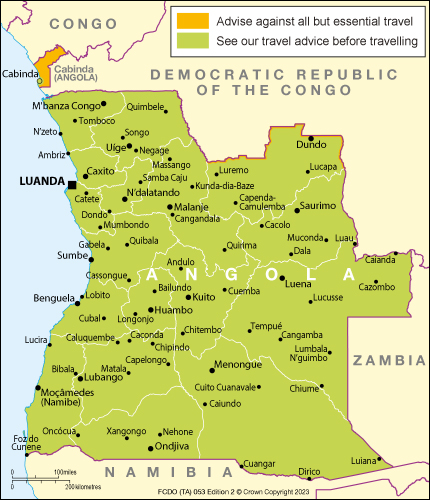
  • Avoid all but essential travel to Cabinda Province, except to Cabinda city, due to separatist attacks and kidnapping risks. Foreign Office
  • Avoid all but essential travel to within 1km of the DRC border in Lunda Norte Province, except official border crossings and access roads, due to insecurity and banditry. Foreign Office
  • Avoid travel to Lunda Sul and Lunda Norte provinces unless for pressing reasons, due to the presence of traffickers. France Diplomatie
  • Avoid travel to the city of Cabinda and its province unless for pressing reasons, as they are potential insecurity hotspots. France Diplomatie

Faithful summary of the official texts below, which prevail.

Part of Luanda is advised against: read its text below to see whether Luanda is concerned.The red dot on the map. Change the city at the top of the page to read the map from another point.
Cabinda — Advised against — all but essential travelCuando Cubango — Country-wide vigilanceMoxico — Country-wide vigilanceNamibe — Country-wide vigilanceCunene — Country-wide vigilanceZaire — Country-wide vigilanceUíge — Country-wide vigilanceLunda Norte — Advised against — all but essential travelMalanje — Country-wide vigilanceLunda Sul — Advised against — all but essential travelCuanza Sul — Country-wide vigilanceBenguela — Country-wide vigilanceBengo — Country-wide vigilanceLuanda — Partly advised againstBié — Country-wide vigilanceCuanza Norte — Country-wide vigilanceHuíla — Country-wide vigilanceHuambo — Country-wide vigilanceLunda NorteLunda SulLuanda
Advised against — all but essential travelPartly advised againstCountry-wide vigilanceLuandaSynthesis of the readings: Global Affairs Canada, Foreign Office, France Diplomatie. Where they differ, the colour keeps the strictest reading; the official text, quoted below region by region, prevails. Boundaries: Natural Earth.
Advised against — all but essential travel3
Cabinda — the provinces of Cabinda and Lunda Norte due to security concerns
Lunda Norte — the provinces of Cabinda and Lunda Norte due to security concerns
Lunda Sul — the whole region (France Diplomatie)
Partly advised against1
Luanda — the provinces of Cabinda and Lunda Norte due to security concerns
Country-wide vigilance
the rest of the country

“(France Diplomatie)”: the level comes from its text, in French, quoted below region by region.

So:

part of the region is advised against; check the exact address against the official text below, and record the decision in writing.

US04.03.2026
Level 2 of 4Exercise increased caution
FR18.03.2026
Orange areas in the countrySome areas are advised against except for imperative reasons.Your region (Luanda): not covered
GB28.05.2026
Some areas: essential travel only2 regions covered, fully or partly.Your region (Luanda): not covered
CA14.10.2026
Exercise a high degree of caution3 regions covered.Your region (Luanda): partly covered
CH01.10.2025
Some regions advised againstSwitzerland’s FDFA advises against travel to certain regions.

The official text, region by region

Advised against — all but essential travel3 regions

CabindaCAGBFR

Global Affairs Canada
Avoid non-essential travel to the provinces of Cabinda and Lunda Norte due to security concerns. Because these areas are not easily accessible, the ability of the High Commission of Canada to Mozambique, in Maputo, and the Consulate of Canada in Luanda to offer assistance is severely limited or non-existent.

Foreign Office
FCDO advises against all but essential travel to Cabinda Province, except to Cabinda city. This is due to separatist groups carrying out targeted attacks on foreigners and the risk of kidnap.

France Diplomatie (in French)
Province et ville de Cabinda — Les déplacements dans la ville de Cabinda et dans sa province, foyers d’insécurité potentiels, sont déconseillés sauf raison impérative.

Lunda NorteCAGBFR

Global Affairs Canada
Avoid non-essential travel to the provinces of Cabinda and Lunda Norte due to security concerns. Because these areas are not easily accessible, the ability of the High Commission of Canada to Mozambique, in Maputo, and the Consulate of Canada in Luanda to offer assistance is severely limited or non-existent.

France Diplomatie (in French)
Lunda Sul et Lunda Norte — Les déplacements dans les provinces diamantifères de Lunda Sul et Lunda Norte sont déconseillés, sauf pour raison impérative, du fait de la présence de trafiquants.

Foreign Office
FCDO advises against all but essential travel to within 1km of the border with the Democratic Republic of the Congo (DRC) in Lunda Norte province, except for official border crossings and their access roads. This is due to poor conditions, insecurity and banditry.

Lunda SulFR

France Diplomatie (in French)
Lunda Sul et Lunda Norte — Les déplacements dans les provinces diamantifères de Lunda Sul et Lunda Norte sont déconseillés, sauf pour raison impérative, du fait de la présence de trafiquants.

Partly advised against1 region

LuandaCA

Global Affairs Canada
Avoid non-essential travel to the provinces of Cabinda and Lunda Norte due to security concerns. Because these areas are not easily accessible, the ability of the High Commission of Canada to Mozambique, in Maputo, and the Consulate of Canada in Luanda to offer assistance is severely limited or non-existent.

Maximum does not exclude these areas.The VIP Pack covers care and repatriation there. Still enforceable: sanctions and embargoes, and a country already at war at departure. Extraction and security belong to the VIP Pack Extreme, upon eligibility. See My cover

Global Affairs Canada — Open Government Licence – Canada (14.10.2026) · Foreign Office — Open Government Licence v3.0 · France Diplomatie (18.03.2026) · Natural Earth

No located event in this reading.

Last change: Addition of information about a declaration of an Ebola outbreak in DRC on 15 May and updated information about road travel ('Safety and security' and 'Health' pages).

Angola - Level 2: Exercise Increased CautionState Department ↗updated 04.03.2026 · read 31.10.2026

Updated 04.03.2026

Exercise increased caution in Angola due to crime , health , unrest , and landmines . Some areas have increased risk. Read the entire Travel Advisory.

Crime

Petty crime, assaults, and armed robberies are common. Other crimes, like burglary, occur, but with less frequency.

Health

Medical services in Angola are limited. Adequate trauma and ambulance services are not widely available. Even a minor health issue may require medical evacuation at the traveler’s expense.

Unrest

Demonstrations related to the local political situation may occur with little notice. They may disrupt transportation and other essential services.

Landmines

Landmines and unexploded ordnance exist throughout Angola. Many locations with unexploded landmines and ordnance are marked. However, some may be unmarked or hard to spot.

Reconsider Travel to the Luanda greater metropolitan area due to risk of crime .

Angola: Floods - Feb 2026ReliefWeb ↗read 31.10.20262026-03-19

Angola: Cholera Outbreak - Jan 2025ReliefWeb ↗read 31.10.20262025-01-10

Angola: Drought - 2024-2026ReliefWeb ↗read 31.10.20262024-06-18

Source: ReliefWeb (OCHA), via HDX — CC BY

Nearest river dischargeOpen-Meteo ↗updated 31.10.2026 · read 31.10.2026

10-31 1.9 · 11-01 1.9 · 11-02 1.0 · 11-03 0.6 · 11-04 0.4 · 11-05 0.3 · 11-06 0.2 m³/s

Simulated discharge: Open-Meteo.com (CC BY 4.0), data rounded and formatted by Maximum. Contains modified Copernicus Emergency Management Service information 2026. For information only: this is not a flood warning; only national or regional authorities issue those.

Where, exactly?

What the national level does not tell you

The level is national. Risk areas are in the state advisories below.

  • U.S. State Department — the full advisory details the regions concerned and the reasons (crime, terrorism, kidnapping, civil unrest) (read the advisory)
  • Foreign, Commonwealth & Development Office (United Kingdom) — the United Kingdom advises against all but essential travel to parts · reviewed 28 May 2026
    Last announced change : « Addition of information about a declaration of an Ebola outbreak in DRC on 15 May and updated information about road travel ('Safety and security' and 'Health' pages). » (read the advisory)
  • France Diplomatie — France classifies SOME AREAS of the country as orange (advised against except for imperative reasons) — the advisory is geographic, check it for your exact destination (read the Security advisory)

No major event in progress is located in this country at this morning's check.

Safety in figures
Intentional homicides per 100,000 people
Angola4.1 2016
Switzerland0.6 2023
France1.3 2023
Road traffic deaths per 100,000 people
Angola26.1 2019
Switzerland2.2 2019
France5.1 2019

Reading: The homicide rate is 7 times Switzerland's: violence is a real risk there, concentrated in the areas named by the official advisories. On the road, 12 times more deaths than in Switzerland: road crashes are the leading cause of death of healthy travellers (CDC) — seat belt, no night driving, a driver or a taxi from a rank.

World Bank (UNODC for homicides, WHO for roads) — latest published valuedata.worldbank.org ↗read 31.10.2026

What we locate on the map are events in progress that have real coordinates: USGS earthquakes, GDACS disasters, NOAA storms and open NASA EONET events. Hover a dot for details, click to open it in this briefing.

I travel on a passportEach government writes for its own nationals. The advisory that counts for you — and for your policy's clauses — is your country's.

French passport — France Diplomatie

In brief
  • Avoid travel to Lunda Sul and Lunda Norte provinces unless imperative, due to diamond-trafficker presence; check local restrictions before entering. France Diplomatie
  • Avoid travel to Cabinda province and its city, identified as potential insecurity hotspots, unless imperative. France Diplomatie
  • In Luanda, avoid walking after dark, especially in Ilha district, and do not drive at night outside major roads; violent crime targets opportunistic theft. France Diplomatie
  • Expect heightened crime and violent thefts involving firearms or knives, particularly in Luanda’s outskirts; do not resist during an assault. France Diplomatie
  • Avoid all demonstrations ahead of August 2027 elections; violent unrest in July 2025 left dozens dead; stay away from gatherings. France Diplomatie
  • During the rainy season (October–May), avoid driving or walking during heavy rains; floods damage roads and cause accidents; mines may be present off main routes. France Diplomatie

Faithful summary of the official texts below, which prevail.

Some areas are advised against except for imperative reasons.France Diplomatie ↗updated 15.09.2026 · read 30.10.2026

Vigilance areas — France Diplomatie (in French) updated 18.03.2026official map ↗updated 15.09.2026 · read 30.10.2026

Except for imperative reasons — orange
  • Lunda Sul et Lunda Norte — Les déplacements dans les provinces diamantifères de Lunda Sul et Lunda Norte sont déconseillés, sauf pour raison impérative, du fait de la présence de trafiquants.
  • Province et ville de Cabinda — Les déplacements dans la ville de Cabinda et dans sa province, foyers d’insécurité potentiels, sont déconseillés sauf raison impérative.
Angola

- Présentation de l'Angola

-

-

-

-

-

-

-

-

-

-

Zones de vigilance

Dernière actualisation le 18/03/2026, information toujours valable à la date du jour

Zones déconseillées sauf raison impérative (en orange)

Lunda Sul et Lunda Norte

Les déplacements dans les provinces diamantifères de Lunda Sul et Lunda Norte sont déconseillés, sauf pour raison impérative, du fait de la présence de trafiquants. En cas d’obligation de déplacement dans ces provinces, il convient de s’assurer au préalable qu’aucune restriction de circulation n’est émise par les autorités locales.

Province et ville de Cabinda

Les déplacements dans la ville de Cabinda et dans sa province, foyers d’insécurité potentiels, sont déconseillés sauf raison impérative.

Le reste du pays est en vigilance renforcée (en jaune)

Il convient néanmoins d’être vigilant à Luanda, en fin de journée, dans le secteur d’Ilha, très fréquenté pour ses restaurants et clubs de nuit. La nuit, il est également recommandé d’éviter les municipalités en périphérie de Luanda.

Délinquance et criminalité

Compte tenu de la crise économique que traverse l’Angola, la criminalité et la délinquance restent élevées. Les actes de violence se font souvent sous la menace d’arme à feu ou d’armes blanches et ont pour objectif principal le vol d’opportunité d’argent ou d’objets de valeur (téléphones portables en particulier). Les expatriés et voyageurs étrangers ne sont pas spécifiquement pris pour cibles, la criminalité touchant d’abord les citoyens angolais résidant dans les quartiers populaires. La grande majorité des actes de délinquance ont lieu dans la périphérie de Luanda, cependant le centre-ville n’est pas épargné. Il convient ainsi de respecter les règles élémentaires de prudence et de vigilance : ne pas circuler à pied ; éviter de circuler de nuit en véhicule ; s’assurer de la sécurisation des hébergements ; se renseigner préalablement à tout déplacement ; en cas d’agression, n’opposer aucune résistance. Il convient également d’être particulièrement vigilant lors de retrait ou dépôt d’argent dans les agences bancaires.

Manifestations et rassemblements

Des appels à manifester sont lancés régulièrement par différents groupes (partis politiques, associations, organisations étudiantes…) à Luanda, mais également dans les grandes villes de province. Dans un contexte de tensions croissantes en amont des prochaines élections (août 2027), et compte tenu des violences survenues lors de certaines manifestations (des dizaines de morts en juillet 2025), il est recommandé de faire preuve de la plus grande vigilance, et de rester à l’écart de tout attroupement.

Risques naturels

Durant la saison des pluies (octobre à mai), la plus grande vigilance est recommandée, en raison des phénomènes de pluies diluviennes, particulièrement dans les régions situées au nord et à l’est du pays. Ces pluies provoquent des inondations importantes et causent des dégâts sur le réseau routier. Il est déconseillé de circuler en voiture ou à pied pendant ces épisodes.

Risques liés aux transports

En raison de l’état dégradé du réseau routier et de la conduite dangereuse de la plupart des automobilistes, les déplacements en véhicules peuvent être dangereux. Ils doivent toujours être effectués de jour. En raison du nombre élevé d’accidents, il est déconseillé d’emprunter les transports collectifs.

La présence de mines dans certains secteurs en dehors des grands axes et des principales villes est possible. Ces zones sont la plupart du temps identifiées par une signalétique adaptée.

Recommandations générales

Il est recommandé de :

  • ne pas se déplacer avec des objets de valeur et d’importantes sommes d’argent ;
  • circuler en voiture vitres fermées et portes verrouillées ;
  • ne pas sortir des axes routiers importants et ne pas conduire de nuit ;
  • ne pas circuler seul(e) et à pied, y compris en centre-ville ;
  • ne pas utiliser les moyens de transport collectif locaux ;
  • utiliser des compagnies de taxi sûres et identifiées (deux compagnies proposent à Luanda des applications qui permettent de commander des taxis par géolocalisation) ;
  • ne pas stationner son véhicule dans des endroits peu fréquentés ou mal éclairés ;
  • faire preuve de vigilance lors des retraits d’argent ;
  • ne pas opposer de résistance en cas d’agression ;
  • éviter les rassemblements.

Full text of the Security pagediplomatie.gouv.fr ↗updated 15.09.2026 · read 30.10.2026

Swiss passport — FDFA (Switzerland), in French

In brief
  • Carry sufficient US dollars in cash (large denominations) as ATMs often do not work; verify the maximum allowed entry and exit amounts with the Embassy of the Republic of Angola in Bern beforehand. DFAE
  • Avoid all travel to the provinces of Cabinda (except the city of Cabinda), Lunda Norte, and Lunda Sul unless urgent, due to precarious security conditions in diamond-rich areas and mine risks near borders with DRC, Zambia, and Namibia. DFAE
  • Do not travel at night, avoid poor neighborhoods, and never resist in case of armed robbery; carry only a certified photocopy of your passport and visa for identity checks. DFAE
  • Expect poor infrastructure outside Luanda: unpaved roads, unreliable electricity, water, and fuel supplies; avoid road accidents to prevent mob retaliation and do not stop—proceed to the nearest police station. DFAE
  • Maritime piracy incidents are reported in Angolan waters; consult the DFAE’s maritime risks advisory before sea travel. DFAE
  • After heavy rains, expect flooding that may damage infrastructure and disrupt tourism; follow local weather warnings and authorities’ instructions. DFAE

Faithful summary of the official texts below, which prevail.

FDFA update note — Le chapitre Derniers développements a été enlevé (manifestations violentes). (published 01.10.2025)

General assessment

La situation économique est tendue. Des manifestations ont lieu; elles peuvent donner lieu à des débordements et à des affrontements violents entre les manifestants et les forces de l'ordre ainsi qu'à des barrages routiers. Fin juillet 2025, des manifestations contre le gouvernement ont éclaté dans tout le pays. Les troubles ont fait de nombreux morts et des centaines de blessés. La situation reste tendue et d'autres événements de ce type ne peuvent être exclus. Les retraits d'argent aux distributeurs automatiques ne sont souvent pas possibles. Il est recommandé d'emporter suffisamment de dollars américains en espèces (grosses coupures). Vérifiez toutefois au préalable auprès de l’Ambassade de la République d’Angola à Berne le montant maximal autorisé à l’entrée et à la sortie du pays. Le risque d'attentats terroristes ne peut pas être exclu en Angola non plus. La rubrique terrorisme et enlèvements attire l'attention sur les risques liés au terrorisme. Terrorisme et enlèvements Une grande attention doit être accordée à la sécurité personnelle. Informez-vous de l'évolution de la situation au travers des médias et auprès de vos connaissances sur place, avant et pendant le voyage. Tenez-vous à l’écart des rassemblements de foule et des manifestations de tout genre.

Specific regional risks

La description des zones à risques repose sur des données approximatives; les risques ne peuvent se restreindre à des zones délimitées. Province de Cabinda : En raison de la précarité de la situation sécuritaire y prévalant, il est déconseillé d’entreprendre des voyages touristiques ou autres qui ne présentent pas un caractère d’urgence dans la province de Cabinda, à l'exception de la ville de Cabinda . Provinces de Lunda Norte et de Lunda Sul : En raison de la précarité de la situation sécuritaire prévalant dans les régions diamantifères, il est déconseillé d’entreprendre dans ces provinces des voyages touristiques ou autres qui ne présentent pas un caractère d’urgence . La présence de mines dans certaines régions peut présenter des dangers. Les champs de mines ne sont pas toujours signalés. Une prudence toute particulière est conseillée dans les zones proches des frontières avec la République démocratique du Congo, la Zambie et la Namibie. Empruntez donc exclusivement les routes les plus fréquentées et faites-vous accompagner par des guides ayant une expertise des lieux. Renseignez-vous au besoin auprès des autorités locales et/ou de la population.

Crime

Le taux de criminalité est élevé. Le nombre de vols et d'agressions à main armée a augmenté, surtout à Luanda. Des délits sexuels et autres infractions violentes (entraînant parfois la mort), ainsi que des cas d’enlèvements ont également été signalés. Il est conseillé d'observer les précautions suivantes:

  • le taux de criminalité peut fortement varier d'une ville ou d'un quartier à l'autre. Renseignez-vous sur place auprès de vos personnes de contact sur place ou du personnel de l'hôtel sur la situation locale, sur les quartiers à éviter et les quartiers réputés sûrs.
  • si vous ne connaissez pas bien le pays, il est préférable que vous vous joigniez à un groupe de voyage organisé.
  • évitez tout déplacement la nuit, soit à pied, soit en voiture.
  • faites-vous accompagner par des personnes fiables et dignes de confiance dès l'arrivée à l'aéroport et suivez leurs conseils.
  • renoncez à visiter les quartiers pauvres des villes.
  • ne portez pas d'objet de valeur sur vous (montre, bijoux) ou de grosses sommes d'argent.
  • déposez les objets de valeur ainsi que les papiers d’identité dans le coffre de l'hôtel. Déplacez-vous toujours avec une photocopie certifiée conforme de votre passeport une photocopie y inclus le visa pour pouvoir justifier votre identité et prouver la validité de votre visa lors de contrôles policiers.
  • utilisez de préférence les appareils bancomats placés à l'intérieur des banques ou des hôtels et faites preuve de vigilance. Des agressions violentes ont eu lieu en lien avec le dépôt/retrait d'argent dans les banques et à proximité des bancomats.
  • gardez les portières de votre véhicule verrouillées et les vitres relevées.
  • en cas d'agression, n'opposez aucune résistance, car les assaillants n'hésitent pas à recourir à la violence.

On signale des cas de lynchage. Pour les personnes en voyage qui se déplacent en voiture, les accidents entraînant des dommages corporels pourraient se révéler être une source d’ennuis. Dans les eaux angolaises, des actes de piraterie sont parfois commis. Consultez les informations spécifiques: Risques maritimes et piraterie

Natural hazards

Après de fortes pluies, il faut s'attendre à des inondations. Celles-ci peuvent endommager les infrastructures et également perturber le trafic touristique temporairement. Suivez les prévisions météorologiques ainsi que les mises en garde et les instructions des autorités locales. World Meteorological Organization

FDFA travel advice, in French, valid on 30.10.2026eda.admin.ch ↗updated 01.10.2025 · read 30.10.2026

British passport — Foreign Office (UK)

In brief
  • British travellers must not enter Cabinda Province except Cabinda city, where only essential travel is permitted due to targeted attacks on foreigners and kidnapping risks. Foreign Office
  • British travellers must avoid within 1km of the DRC border in Lunda Norte Province except official crossings and access roads because of insecurity and banditry. Foreign Office
  • British travellers should not travel to Lunda Norte or Lunda Sul unless absolutely necessary; movement may be restricted and non-compliance can lead to arrest and detention. Foreign Office
  • British travellers must carry original passport and visa or entry stamp when outside Luanda and provincial capitals; officials may request them and transport and accommodation are extremely limited. Foreign Office
  • British travellers should avoid all protests; in July 2025 violent riots occurred and authorities may impose curfews at short notice. Foreign Office
  • British travellers must carry certified copy of passport photo page as ID; failure to present ID can result in an on-the-spot fine of 15,000 kwanzas. Foreign Office

Faithful summary of the official texts below, which prevail.

Regions covered by the Foreign Officegov.uk ↗updated 28.05.2026 · read 30.10.2026

Advise against all travel
  • Border areas in Lunda Norte Province — Find out more about why FCDO advises against travel.
All but essential travel
  • Cabinda Province, except Cabinda city — FCDO advises against all but essential travel to Cabinda Province, except to Cabinda city. This is due to separatist groups carrying out targeted attacks on foreigners and the risk of kidnap.
  • Border areas in Lunda Norte Province — FCDO advises against all but essential travel to within 1km of the border with the Democratic Republic of the Congo (DRC) in Lunda Norte province, except for official border crossings and their access roads. This is due to poor conditions, insecurity and banditry.
Official Foreign Office map
Foreign Office map — Open Government Licence v3.0

Warnings — Foreign OfficeForeign Office ↗updated 28.05.2026 · read 30.10.2026

Warnings — Foreign Office

Your travel insurance could be invalidated if you travel against advice from the Foreign, Commonwealth & Development Office (FCDO).

Cabinda Province, except Cabinda city

FCDO advises against all but essential travel to Cabinda Province, except to Cabinda city. This is due to separatist groups carrying out targeted attacks on foreigners and the risk of kidnap.

Border areas in Lunda Norte Province

FCDO advises against all but essential travel to within 1km of the border with the Democratic Republic of the Congo (DRC) in Lunda Norte province, except for official border crossings and their access roads. This is due to poor conditions, insecurity and banditry.

Find out more about why FCDO advises against travel .

Regional risks — Foreign OfficeForeign Office ↗updated 28.05.2026 · read 30.10.2026

Regional risks — Foreign Office

This section has safety advice for regions of Angola. It only covers regions where the Foreign, Commonwealth & Development Office ( FCDO ) has specific advice.

You should also read FCDO ’s overall travel advice and safety and security advice .

Cabinda Province, except Cabinda city

FCDO advises against all but essential travel to Cabinda Province, except to Cabinda city.

There are regular violent incidents including rape, murder and kidnappings in Cabinda Province. These have involved both foreigners and Angolans.

Separatist groups in the northern exclave of Cabinda (a province not joined to the rest of Angola) have been known to carry out attacks involving both foreigners and Angolans. Groups claiming responsibility for these attacks have said they’ll continue attacks against foreigners.

Border areas in Lunda Norte Province

FCDO advises against all but essential travel to within 1km of the border with the Democratic Republic of the Congo (DRC) in Lunda Norte province, except for official border crossings and their access roads.

FCDO also advises against all travel to the provinces of Kasaï and Kasaï Central, across the border in the Central Democratic Republic of Congo .

The rest of Lunda Norte and Lunda Sul

FCDO advises against travelling to Lunda Norte and Lunda Sol unless absolutely necessary. Get security advice and travel with the support of a security company or sponsoring organisation.

The Angolan authorities are sensitive to the presence of foreigners in diamond-producing areas, which includes Lunda Norte and Lunda Sul. They may impose restrictions on your movement in these provinces. If you do not comply, they may arrest you and detain you.

The diamond mines increase the threat of crime and banditry on roads leading to and from these areas. Bandits may carry out armed hold-ups.

Areas outside Luanda and the provincial capitals

If you travel outside Luanda and the provincial capitals, go with people or organisations that know the area, as conditions can be difficult. There is widespread poverty, limited infrastructure, and social exclusion and disease. There are mines and unexploded weapons in many parts of the country.

Transport and accommodation are extremely limited outside Luanda. Officials are likely to ask for your passport and visa or entry stamp, so take the originals with you.

Safety — Foreign OfficeForeign Office ↗updated 28.05.2026 · read 30.10.2026

Safety — Foreign Office

This guide also has safety advice for regions of Angola .

Terrorism

There is a high threat of terrorist attack globally affecting UK interests and British nationals, including from groups and individuals who view the UK and British nationals as targets. Stay aware of your surroundings at all times.

UK Counter Terrorism Policing has information and advice on staying safe and what to do in the event of a terrorist attack. Find out how to reduce your risk from terrorism while abroad .

Terrorism in Angola

Although there’s no recent history of terrorism in Angola, attacks cannot be ruled out.

Protests and demonstrations

Public gatherings and demonstrations can occur with little notice and can quickly turn violent. In recent years, there have been protests against the increase in fuel prices and cost of living. In July 2025 there were 3 days of violent riots. Similar protests cannot be ruled out in future.

To minimise your personal risk:

  • follow local media for news of any planned protests
  • stay away from areas where protests are planned
  • leave quickly and do not attempt to watch or photograph any demonstration or disturbance
  • consider making contingency plans
  • keep a stock of essential supplies
  • keep your travel documents up-to-date, including appropriate visas
  • be prepared to move or go into curfew at short notice if told to by the authorities
  • see how to prepare for a crisis overseas
Crime

There is a high level of crime in Luanda, some of it violent. Muggers can be armed and some attacks have been fatal. If you are attacked, hand over your money and valuables immediately.

Most international companies and organisations operating in Angola have security rules for staff. If your company has rules, read and follow them.

Protecting yourself and your belongings

Criminals target areas popular with foreigners. You should be particularly careful when withdrawing money from banks and ATMs, as you could be followed and robbed.

You can reduce your personal risk by:

  • using pre-arranged cars or hotel cars when withdrawing money
  • not walking around in Luanda, especially not alone or after dark
  • not wearing expensive-looking jewellery or watches or using a mobile in public places
  • not walking between bars and restaurants on the Ilha do Cabo
  • avoiding crowded places like markets and all large gatherings

Put your valuables and cash in a hotel safe where practical. Keep a certified copy of your passport’s photo page in a separate place.

Vehicle crime

Theft from stationary or slow-moving cars is common in downtown Luanda. Keep valuables out of sight and do not use mobiles or laptops while in traffic. When driving, keep doors locked and windows closed. Do not respond if anyone signals you to pull over. Thieves may fake a minor traffic incident to get you out of your car. If they succeed, they may rob you and also steal the car.

Sexual assault

Incidents of rape have been reported in popular nightlife areas, as well as in private homes. Never travel alone at night.

Personal ID

Always carry ID – it is safest to carry a certified copy your passport’s photo page . If travelling outside of Luanda and the provincial capitals, take the originals with you, packed as securely as you can. If you do not have any ID, you may get an on-the-spot fine of 15,000 kwanzas.

Illegal drugs and prison sentences

Drug taking and smuggling are offences. Punishments can be severe and prison conditions are very poor.

Using cameras and binoculars in secure areas

Do not use…

American passport — U.S. Department of State

In brief
  • Exercise increased caution in Angola due to crime, health risks, political unrest, and landmines; read the full Travel Advisory before travel. State Department
  • Petty crime, assaults, and armed robberies are common; burglary occurs less frequently. State Department
  • Medical services are limited; even minor issues may require evacuation at your own expense. State Department
  • Demonstrations may occur with little notice, disrupting transport and essential services. State Department
  • Landmines and unexploded ordnance exist throughout Angola; some areas are marked, but others may be unmarked or hard to spot. State Department
  • Reconsider travel to the Luanda greater metropolitan area due to high crime risk. State Department

Faithful summary of the official texts below, which prevail.

Angola - Level 2: Exercise Increased Caution 2026-03-04travel.state.gov ↗updated 04.03.2026 · read 31.10.2026

Advisory summary

Exercise increased caution in Angola due to crime , health , unrest , and landmines . Some areas have increased risk. Read the entire Travel Advisory.

Crime

Petty crime, assaults, and armed robberies are common. Other crimes, like burglary, occur, but with less frequency.

Health

Medical services in Angola are limited. Adequate trauma and ambulance services are not widely available. Even a minor health issue may require medical evacuation at the traveler’s expense.

Unrest

Demonstrations related to the local political situation may occur with little notice. They may disrupt transportation and other essential services.

Landmines

Landmines and unexploded ordnance exist throughout Angola. Many locations with unexploded landmines and ordnance are marked. However, some may be unmarked or hard to spot.

Reconsider Travel to the Luanda greater metropolitan area due to risk of crime .

Global Affairs Canada — additional reading

Exercise a high degree of caution (with regional advisories)

Provinces of Cabinda and Lunda Norte - Avoid non-essential travel

Avoid non-essential travel to the provinces of Cabinda and Lunda Norte due to security concerns. Because these areas are not easily accessible, the ability of the High Commission of Canada to Mozambique, in Maputo, and the Consulate of Canada in Luanda to offer assistance is severely limited or non-existent.

  • Provinces of Cabinda and Lunda Norte — Avoid non-essential travel to the provinces of Cabinda and Lunda Norte due to security concerns. Because these areas are not easily accessible, the ability of the High Commission of Canada to Mozambique, in Maputo, and the Consulate of Canada in Luanda to offer assistance is severely limited or non-existent.

Open Government Licence – Canada · October 14, 2026 07:03 EDTtravel.gc.ca ↗updated 14.10.2026 · read 31.10.2026

In brief
  • You must comply with local laws and know what to do if arrested or detained abroad. Global Affairs Canada
  • Drug-related offences carry severe punishments; avoid all drugs, alcohol and travel-related risks. Global Affairs Canada
  • Do not engage in black-market currency exchange, remove turtle shells or ivory, or photograph airports, roads, bridges, military personnel or government buildings. Global Affairs Canada
  • Same-sex relationships are not widely accepted; 2SLGBTQI+ travellers should carefully assess risks before travelling to Angola. Global Affairs Canada
  • If your child is wrongfully taken to Angola, act quickly, consult lawyers in Canada and Angola, and report to Global Affairs Canada’s Emergency Watch and Response Centre. Global Affairs Canada
  • Carry an international driving permit; the kwanza (AOA) is the local currency and not convertible internationally. Global Affairs Canada

Faithful summary of the official texts below, which prevail.

Global Affairs Canada — written for Canadian travellers, valid for all

Local laws

You must abide by local laws. Learn about what you should do and how we can help if you are arrested or detained abroad.

Drugs

Punishment for drug-related offences can be severe. Drugs, alcohol and travel

Illegal or restricted activities

Involvement in black-market currency conversion could lead to arrest. Some handicrafts considered of cultural value may be retained by customs. It is illegal to remove turtle shells and ivory from the country. Avoid photographing airports, major roads, bridges, communications installations, military personnel and government buildings. Taking photos of urban areas may be frowned upon by police.

2SLGBTQI+ persons

Angola does not prohibit sexual acts between persons of the same sex. However, homosexuality is not widely socially accepted. Same-sex marriage is not recognized. 2SLGBTQI+ persons should carefully consider the risks of travelling to Angola. Travel and your sexual orientation, gender identity, gender expression and sex characteristics

International Child Abduction

The Hague Convention on the Civil Aspects of International Child Abduction is an international treaty. It can help parents with the return of children who have been removed to or retained in certain countries in violation of custody rights. It does not apply between Canada and Angola. If your child was wrongfully taken to, or is being held in Angola by an abducting parent:

  • act as quickly as you can
  • consult a lawyer in Canada and in Angola to explore all the legal options for the return of your child
  • report the situation to the nearest Canadian government office abroad or to Global Affairs Canada by calling the Emergency Watch and Response Centre

If your child was removed from a country other than Canada, consult a lawyer to determine if The Hague Convention applies. Be aware that Canadian consular officials cannot interfere in private legal matters or in another country's judicial affairs.

Driving

You should carry an international driving permit. More about the International Driving Permit

Money

The currency in Angola is the kwanza (AOA). The kwanza is not convertible on the international market. Dollars can be converted into kwanzas, or vice versa, at the few exchange bureaus in Luanda or at local banks. Receiving foreign currency is often very difficult due to present scarcity (even for those with foreign currency accounts). Kwanzas cannot be taken out of the country. No more than US$15,000 can be taken into or out of Angola, unless an official declaration is made upon entry. Newer U.S.-dollar bills are preferred, due to the ease with which the older bills are counterfeited. Credit cards are accepted at only a few of Luanda’s largest hotels and restaurants, and it varies as to which cards are accepted. VISA is the most commonly accepted credit card. Leave a copy of your card information with a trusted family member or friend in case of emergency. ATMs dispense kwanzas only. Some ATMs in Luanda accept VISA cards, but only to withdraw kwanzas. Note that machines often malfunction or run out of cash. Debit cards do not work.

Open Government Licence – Canada · October 14, 2026 07:03 EDTtravel.gc.ca ↗updated 14.10.2026 · read 31.10.2026

Foreign Office — laws and cultural differences

Personal ID

Always carry ID – it is safest to carry a certified copy your passport’s photo page. If travelling outside of Luanda and the provincial capitals, take the originals with you, packed as securely as you can. If you do not have any ID, you may get an on-the-spot fine of 15,000 kwanzas.

Illegal drugs and prison sentences

Drug taking and smuggling are offences. Punishments can be severe and prison conditions are very poor.

Using cameras and binoculars in secure areas

Do not use cameras, binoculars or GPS equipment near any government buildings. Taking photographs in the streets can draw the attention of the authorities and they may confiscate your camera.

LGBT+ travellers

In January 2019, Angola’s parliament made it illegal to discriminate against people on the basis of sexual orientation. However, public attitudes towards same-sex relationships are less tolerant than in the UK. Showing affection in public may attract negative attention. Read more advice for LGBT+ travellers.

Wildlife, animal products and souvenirs

If you’re caught buying or trafficking goods made of ivory it’s likely you’ll be prosecuted and get a prison sentence or fine.

Open Government Licence v3.0gov.uk ↗updated 28.05.2026 · read 30.10.2026

FDFA (Switzerland) — laws and customs, in French

Specific legal provisions

Il y a lieu de relever que le trafic de marchandises avec l'Angola est partiellement soumis à des restrictions internationales au commerce. Il est interdit de photographier des personnes en uniforme, des installations militaires et des bâtiments ou ouvrages publics (aéroports, ponts, etc.). Les infractions à la loi sur les stupéfiants, y compris la détention de minimes quantités de drogue quelle qu'elle soit, sont durement réprimées. Les conditions de détention sont précaires.

FDFA travel advice, in Frencheda.admin.ch ↗updated 01.10.2025 · read 30.10.2026

Air: Fair 33/100PM2.5 11.6 µg/m³ · PM10 13.9 µg/m³
UV very high today max 8.3Right now 7.5 · WHO scale 0–11+

What it changes for you: Air acceptable at this hour: nothing special to plan. Very high UV: sunscreen, hat and shade between 11 am and 4 pm; sunstroke and dehydration are travellers' first reasons to see a doctor.

Reading 11:00 (Africa/Luanda)Open-Meteo ↗updated 31.10.2026 · read 31.10.2026

Air quality and UV: Open-Meteo.com (CC BY 4.0), data rounded and formatted by Maximum. Contains modified Copernicus Atmosphere Monitoring Service information 2026. Neither the European Commission nor ECMWF is responsible for any use that may be made of the Copernicus information or data it contains.

Physicians per 1,000 people
Angola0.2 2022
Switzerland4.5 2022
France3.3 2022
Hospital beds per 1,000 people
Angola0.8 2019
Switzerland4.4 2023
France5.7 2022
Health spending per person (USD)
Angola76 2023
Switzerland11,784 2023
France5,327 2024
Life expectancy (years)
Angola64.8 2024
Switzerland84.4 2024
France83.0 2024

Reading: With 0.2 physicians per 1,000 people (96% fewer than Switzerland), the nearest hospital does not always have the capacity for a serious case: evacuation to an adequate centre is the rule, not the exception — that is what unlimited evacuation and repatriation cover. Health spending of 76 USD per person (Switzerland: 11,784) goes with private hospitals that bill foreigners in hard currency and ask for a guarantee before admission: the direct payment guarantee is what avoids the deposit.

World Bank — latest published value, year per indicatordata.worldbank.org ↗read 31.10.2026

I travel on a passportVisa, passport validity, entry form: the rules depend on your passport. Each government describes them for its own nationals.

French passport — France Diplomatie

In brief
  • French nationals may enter Angola visa-free for tourism for up to 30 days per entry, with a maximum cumulative stay of 90 days per year as of 30 September 2023. France Diplomatie
  • French travelers must present a passport valid for the entire duration of their stay in Angola. France Diplomatie
  • Tourists wishing to stay longer than 30 consecutive days must apply for a tourist visa online before arrival and may renew it with the Serviço de Migração e Estrangeiros (SME) before expiration. France Diplomatie
  • Short-stay visas for non-exempt travelers require a mandatory in-person visit to the Angolan Consulate in Paris for fingerprinting, with processing fees of 120 USD at Luanda airport if using the pre-authorization system. France Diplomatie
  • Travelers crossing from Cabinda (Angola) to mainland Angola via the Democratic Republic of the Congo must obtain the required visas and permits from the DRC embassy in Paris prior to departure. France Diplomatie
  • As of 25 October 2023, yellow fever vaccination is no longer mandatory for entry into Angola unless arriving from a country with yellow fever risk; travelers without valid vaccination records will be denied entry. France Diplomatie

Faithful summary of the official texts below, which prevail.

Angola

- Présentation de l'Angola

-

-

-

-

-

-

-

-

-

-

Formalités d’entrée

Depuis le 30 septembre 2023, 98 nationalités, dont les Français, sont exemptées de visa de tourisme.

Sont couvertes par le visa de tourisme : les visites pour raisons familiales, la prospection commerciale, la participation à des activités scientifiques et technologiques ou les visites à caractère récréatif, sportif ou culturel. Cette exemption permet de rester en Angola jusqu’à 30 jours par entrée, et ce pour un total cumulé de 90 jours par an. Les Français doivent présenter à la frontière un passeport dont la validité est supérieure à la durée du séjour prévu.

Les touristes désirant rester plus de 30 jours d’affilée devront demander un visa de tourisme en ligne avant d’arriver sur le territoire angolais (voir procédure ci-dessous). Ils pourront alors demander le renouvellement de leur visa auprès du Serviço de Migração e Estrangeiros (SME) avant son expiration.

Visas de court séjour

(pour les autres cas ne relevant pas de l’exemption tourisme)

L’accès au territoire angolais est soumis à l’obtention d’un visa.

Il est conseillé d’obtenir un visa avant le départ auprès du Consulat général d’Angola à Paris (cf. contacts dans l’encadré à droite). Le déplacement physique au Consulat général est impératif car une prise d’empreintes digitales est réalisée.

Depuis avril 2018, les autorités angolaises ont mis en œuvre des mesures facilitant la délivrance des visas court séjour/tourisme pour les ressortissants de pays de l’Union européenne. Il est désormais possible d’obtenir un visa à l’aéroport de Luanda à condition de disposer d’une pré-autorisation de visa .

Cette procédure nécessite :

  • d’effectuer une demande en ligne : https://www.smevisa.gov.ao/ (en anglais) ;
  • d’obtenir une pré-autorisation (suite à la demande faite en ligne) ;
  • d’effectuer le paiement de 120 USD à l’aéroport ;
  • de présenter les justificatifs nécessaires (ressources, lettre d’invitation et/ou réservation d’hôtel, billet retour) ;

En fonction de la durée du séjour en Angola, peuvent être sollicités :

  • un visa ordinaire, multi-entrées et valable pour une durée de 3 mois. Ce visa peut être délivré jusqu’à 60 jours avant l’arrivée sur le territoire angolais. En raison du délai de délivrance, il est conseillé d’en faire la demande au minimum 15 jours avant le départ.
  • un visa ordinaire, multi-entrées et valable pour une durée de 1 à 3 ans. Ce visa est délivré sur présentation de garanties de ressources et d’hébergement (une lettre de prise en charge par un organisme opérant en Angola est indispensable).
Points de passage terrestres à la frontière entre Cabinda (Angola) et la RDC

Les voyageurs souhaitant rejoindre par voie terrestre, depuis la province de Cabinda (exclave angolaise) le reste du territoire angolais, sont informés que cet itinéraire implique la traversée du territoire de la République démocratique du Congo (RDC). À ce titre, il est impératif de s’informer auprès de l’ambassade de RDC à Paris et d’obtenir, préalablement au départ, les visas et autorisations d’entrée requis pour emprunter cet itinéraire.

Les voyageurs ne disposant pas de documents valides s’exposent à un refus d’entrée.

Il est recommandé de prévoir des délais suffisants pour l’obtention des visas nécessaires.

Fièvre jaune

Depuis le décret présidentiel du 25 octobre 2023, la vaccination contre la fièvre jaune n’est plus obligatoire pour entrer sur le territoire angolais pour les voyageurs ne provenant pas d’un pays à risque de fièvre amarile. Les autres voyageurs doivent avoir leur carnet de vaccination antiamarile, autrement ils ne seront pas autorisés à entrer en Angola et seront immédiatement renvoyés vers leur pays de provenance.

Règlementation douanière

Les touristes ne sont pas autorisés à importer plus de 5 000 USD (ou sa contrevaleur).

Entry and stay pagediplomatie.gouv.fr ↗updated 15.09.2026 · read 30.10.2026

Swiss passport — FDFA (Switzerland)

The FDFA does not publish entry requirements: they are set out by the destination's embassy or consulate in Switzerland — check them before booking, passport in hand. As a guide, the French and British requirements below describe the same rules as seen by two other governments.eda.admin.ch ↗updated 01.10.2025 · read 30.10.2026

British passport — Foreign Office (UK)

In brief
  • British citizens must hold a passport valid for at least 6 months after arrival and with 2 blank pages to enter Angola. Foreign Office
  • Travellers without a valid passport or with a reported lost or stolen passport will be denied entry to Angola. Foreign Office
  • British citizens do not need a visa for Angola if visiting for tourism for up to 30 days. Foreign Office
  • A visa is required in advance for work, study or business travel to Angola; failure to present the correct visa may result in boarding denial or airport detention. Foreign Office
  • Overstaying a visa in Angola incurs a fine of 15,000 Angolan kwanzas per day and may prevent departure or re-entry until the fine is paid. Foreign Office
  • Travellers must declare cash or travellers cheques of 5,000 US dollars or more (10,000 for residents) when entering or leaving Angola. Foreign Office

Faithful summary of the official texts below, which prevail.

Entry requirements — rules for a British passportForeign Office ↗updated 28.05.2026 · read 30.10.2026

Entry requirements — rules for a British passport

This information is for people travelling on a full ‘British citizen’ passport from the UK. It is based on the UK government’s understanding of Angola’s current rules for the most common types of travel.

The authorities in Angola set and enforce entry rules. If you’re not sure how these requirements apply to you, check with the Angolan immigration department or contact the Consulate General of Angola in the UK .

Passport validity requirements

Your passport must have an ‘expiry date’ at least 6 months after the date you arrive in Angola and have at least 2 blank pages.

Check with your travel provider that your passport and other travel documents meet requirements. Renew your passport if you need to.

You will be denied entry if you do not have a valid travel document or try to use a passport that has been reported lost or stolen.

Dual nationals

When returning to the UK, British citizens must carry a valid British passport or certificate of entitlement . See Dual Citizenship .

Visa requirements

You do not need a visa to visit Angola for up to 30 days, if visiting for tourism.

If travelling for work, study or business, you must get a visa in advance . If you do not have a visa, or if you have the wrong visa, you may be stopped from boarding or detained at the airport on arrival. Angola’s deportation process can take a long time.

You can be fined 15,000 Angolan kwanzas a day if you overstay your visa. You may not be allowed to leave the country until your fine has been paid. You may also not be allowed to re-enter Angola.

The Angolan authorities can fine you for visa offences, including:

  • working, studying or living in Angola without the correct visa
  • changing employment without notifying the authorities
  • employing staff with incorrect visas
  • failing to renew residence cards
  • changing address without notifying the authorities
Vaccine requirements

There is a risk of yellow fever transmission in Angola. This means you will need a certificate of yellow fever vaccination for some onward travel, including to South Africa.

For full details about health entry requirements and recommended vaccinations, see TravelHealthPro’s Angola guide .

Customs rules

There are strict rules about goods you can take into or out of Angola. You must declare anything that may be prohibited or subject to tax or duty.

Taking money into and out of Angola

Declare cash or travellers cheques if the value is 5,000 US dollars or more (10,000 if you’re a resident). You’ll get a certified declaration to show you brought it in with you.

You cannot take out more than 5,000 US dollars (10,000 if you’re a resident) or its equivalent in any foreign currency.

You can take out up to 50,000 kwanzas in cash in addition to the foreign currency.

Officials at the airport may search you to make sure you’re not leaving the country with more than the allowed amount.

American passport — U.S. Department of State

The State Department publishes the requirements ("Entry, Exit and Visa Requirements") on its country page, which our servers cannot read. Read it before you go; as a guide, the French and British requirements below describe the same rules as seen by two other governments.travel.state.gov ↗updated 04.03.2026 · read 31.10.2026

Living on site

For each risk, the official texts themselves: what is happening, then, where they say so, what to do.

CrimeHIGH

What the texts say · There is a high level of crime in Luanda, some of it violent.

What they advise:
  • If you are attacked, hand over your money and valuables immediately.
  • You can reduce your personal risk by: using pre-arranged cars or hotel cars when withdrawing money - not walking around in Luanda, especially not alone or after dark - not wearing expensive-looking jewellery or watches or using a mobile in public places - not walking between bars and restaurants on the Ilha do Cabo - avoiding crowded places like markets and all large gatherings.
Foreign Office
TransportMODERATE

What the texts say · Theft from stationary or slow-moving cars is common in downtown Luanda. Door-to-door taxis are scarce and expensive, so you should try to hire a car with driver.

What they advise:
  • When driving, keep doors locked and windows closed.
  • Avoid using public transportation, including buses and van taxis.
Foreign Office · Global Affairs Canada
Nature and climateMODERATE

What the texts say · During the rainy season from November to April, there are storms and heavy downpours.

What they advise: Stay indoors during storms.
Foreign Office
Laws and customsTO KNOW

What the texts say · Always carry ID – it is safest to carry a certified copy your passport’s photo page. Punishment for drug-related offences can be severe.

What they advise:
  • If travelling outside of Luanda and the provincial capitals, take the originals with you, packed as securely as you can.
  • Avoid photographing airports, major roads, bridges, communications installations, military personnel and government buildings.
Foreign Office · Global Affairs Canada
Cyber and dataMODERATE

What the texts say · Criminals can compromise public Wi-Fi networks in order to steal personal data or credit information.

What they advise: Avoid using public Wi-Fi networks - Avoid shopping on unencrypted websites - Be cautious when posting information on social media - Be wary of unsolicited emails offering attractive business opportunities - Don't click on suspicious links that ask for your banking information in an e-mail or text message.
Global Affairs Canada
Crowds and calendarMODERATE

What the texts say · Even peaceful demonstrations can turn violent at any time.

What they advise: Avoid areas where demonstrations and large gatherings are taking place - Follow the instructions of local authorities - Monitor local media for information on ongoing demonstrations.
Global Affairs Canada

Sentences copied word for word from the official texts cited, chosen for the destination; the level is our reading. The full texts, at each source:Foreign Office ↗updated 28.05.2026 · read 30.10.2026 (updated 28.05.2026 · read 28.09.2026)Global Affairs Canada ↗updated 14.10.2026 · read 31.10.2026 (updated 14.10.2026 · read 28.09.2026)

Safety in figures
Intentional homicides per 100,000 people
Angola4.1 2016
Switzerland0.6 2023
France1.3 2023
Road traffic deaths per 100,000 people
Angola26.1 2019
Switzerland2.2 2019
France5.1 2019

Reading: The homicide rate is 7 times Switzerland's: violence is a real risk there, concentrated in the areas named by the official advisories. On the road, 12 times more deaths than in Switzerland: road crashes are the leading cause of death of healthy travellers (CDC) — seat belt, no night driving, a driver or a taxi from a rank.

World Bank (UNODC for homicides, WHO for roads) — latest published valuedata.worldbank.org ↗read 31.10.2026

—:—Local time · Africa/Luanda ·
113Local emergency numbers · Police 113 · Ambulance 116 · Fire 115
+244 · PortugueseDialling code · languages
Europlug220 V
Drivingon the right

Time zone: IANA and timezone-boundary-builder (ODbL) · RESTCountries · EmergencyNumberAPI · Wikidata · European Central Bank

Places: © OpenStreetMap contributors (ODbL), Photon search by komoot.

FDFA (Switzerland) — transport and specific advice, in French

Transport and infrastructure

En dehors de Luanda, les infrastructures touristiques (hôtels, restaurants, etc.) sont rares et très modestes. Les routes sont souvent en mauvais état (p.ex. beaucoup de nids de poules) et seuls quelques grands axes routiers sont asphaltés. Les comportements parfois imprévisibles sur les routes constituent un risque supplémentaire. La nuit, renoncez aux déplacements à travers le pays . En cas d'accident de la route ayant causé des blessures, des mesures de représailles de la population sont à craindre. Il est de ce fait recommandé de ne pas s'arrêter, dans la mesure du possible, et de gagner le poste de police le plus proche. Il est recommandé de louer une voiture avec chauffeur. Entreprenez des voyages dans les villes de provinces de préférence par un vol de ligne. Toutefois, les standards de sécurité des chemins de fer et des avions pour les vols internes ne correspondent pas aux normes européennes ou internationales. Dans certaines régions, les communications téléphoniques internationales et mobiles ainsi que l’accès à internet ne sont pas toujours ni partout assurés. Des pénuries d'électricité, d'eau et de carburant se produisent. Il arrive que les passages de frontières soient temporairement fermés sans préavis, par ex. afin d’endiguer la propagation de maladies. Informez-vous auprès des autorités locales ou directement auprès des postes-frontières.

Specific remarks

Portez toujours une copie certifiée conforme de votre passeport (y inclus le visa) sur vous afin de pouvoir prouver votre identité lors des fréquents contrôles de personnes.

FDFA travel advice, in Frencheda.admin.ch ↗updated 01.10.2025 · read 30.10.2026

Public holidaysNager.Date ↗read 25.10.2026

  • Mon 2 Nov — All Souls' Day
  • Wed 11 Nov — Independence Day
  • Fri 25 Dec — Christmas Day
ESSENTIAL

Maximum policyholder: before paying anything, call the 24/7 number. If you are admitted for more than 24 h, Maximum sends its direct payment guarantee to the hospital (art. 2.12).

+41 22 ••• •• •• — Full number in your client area

The three hospitals to know — Luanda

None of these facilities is a Maximum Insurance “partner”, and none is presented as waiving upfront payment: this list is a reading of public map data, nothing more. A direct payment guarantee is arranged CASE BY CASE by our assistance desk, facility by facility and when the need arises — one number, +41 22 ••• •• ••.

List read from OpenStreetMap on 31.10.2026.

80hospitals and clinics40pharmacies40doctorsFull map and list ↗

Before you go

  • Routine vaccinesup to date
  • Yellow feverrequired for entry
  • Hepatitis Arecommended
  • Hepatitis Brecommended
  • Malariapreventive medicine recommended
  • Typhoidrecommended
  • Choleradepending on the trip

CDC Travelers' Health recommendations, most important first. They depend on your age, vaccines and itinerary: confirm them with a doctor or a travel clinic 4 to 6 weeks before departure. Details, disease by disease ↗cdc.gov ↗read 31.10.2026

On site

DengueMosquitoes bite by day: repellent, long sleeves.
MalariaPresent in some areas: talk to a doctor before leaving.
ChikungunyaMosquito-borne: same protection as for dengue.
SunUV very high (8): hat, sunscreen, water.
MedicationIn their box, with the prescription — in English if possible.

The health system — With 0.2 physicians per 1,000 people (96% fewer than Switzerland), the nearest hospital does not always have the capacity for a serious case: evacuation to an adequate centre is the rule, not the exception — that is what unlimited evacuation and repatriation cover. Health spending of 76 USD per person (Switzerland: 11,784) goes with private hospitals that bill foreigners in hard currency and ask for a guarantee before admission: the direct payment guarantee is what avoids the deposit.

Back home — a fever in the following weeks should be told to a doctor, naming the country.

The next 7 days Africa/LuandaMET Norway ↗read 31.10.2026

Sat 31 Oct24–27°rain · 1.3 mm
Sun 1 Nov24–28°overcast
Mon 2 Nov25–29°rain · 0.9 mm
Tue 3 Nov25–29°overcast · 0.1 mm
Wed 4 Nov25–29°overcast
Thu 5 Nov25–29°overcast · 0.2 mm
Fri 6 Nov25–29°overcast

Forecast: MET Norway (Norwegian Meteorological Institute, CC BY 4.0), grouped by day and formatted by Maximum.

I travel on a passportYour embassy, and the service to register with, depend on your passport.

Your country, 24/7, from abroad

FR
Crisis and Support Centre — French Ministry for Europe and Foreign Affairs+33 1 53 59 11 0024/7 emergency line, standard rate. First contact abroad: the French embassy or consulate.www.diplomatie.gouv.fr ↗updated 15.09.2026 · read 30.10.2026
CH
FDFA Helpline+41 58 465 33 33+41 800 24 7 36524/7, 365 days a year — helpline@eda.admin.ch. Beware of scam calls spoofing these numbers.www.eda.admin.ch ↗updated 01.10.2025 · read 30.10.2026
GB
Foreign, Commonwealth & Development Office+44 20 7008 500024 hours, for British nationals.www.gov.uk ↗updated 28.05.2026 · read 30.10.2026
US
Overseas Citizens Services — U.S. Department of State+1 202 501 4444+1 888 407 4747From abroad; the second number from the U.S. and Canada.travel.state.gov ↗updated 04.03.2026 · read 31.10.2026

French passport — French embassy and consulates

FR
Ambassade de Franceembassy · 2.0 km

26 Houari Boumedienne, Luanda

phone not published

Useful contacts listed by France Diplomatie (in French)diplomatie.gouv.fr ↗updated 15.09.2026 · read 30.10.2026

Updated: 15 September 2026

OpenStreetMap

Swiss passport — Swiss embassy and consulates

Useful addresses — FDFA, in French

Représentations suisses à l’étranger: En cas de situation d’urgence à l’étranger, vous pouvez vous adresser à la représentation suisse la plus proche ou à la Helpline DFAE. Centre consulaire régional pour l’Afrique australe à Pretoria, Afrique du Sud Ambassade de Suisse en Angola Helpline DFAE Représentations étrangères en Suisse: Pour obtenir des informations sur les prescriptions d’entrée (documents d’identité admis, visa, etc.), veuillez vous adresser aux ambassades et consulats étrangers compétents. Ceux-ci peuvent également vous renseigner sur les dispositions douanières pour l’importation et l’exportation d’animaux et de marchandises: appareils électroniques, souvenirs, médicaments, etc. Représentations étrangères en Suisse

OpenStreetMap · DFAE

British passport — British embassy and consulates

OpenStreetMap

American passport — U.S. embassy and consulates

OpenStreetMap

Police

  • 5ª Esquadra da Maianga · 1.1 km
    Luanda
  • Polícia Económica · 1.2 km
  • Esquadra da Polícia do Bairro Operário · 1.6 km
  • 2ª Esquadra · 1.7 km
    Rua de Massangano Luanda

Town hall

  • Edificio Yalelin · 2.2 km
    Rua dos Eucaliptos
  • Administração Municipal do Kilamba Kiaxi · 5.5 km
  • Comissão de Moradores Bairro 28 de Agosto · 7.6 km

OpenStreetMap

Getting help — Foreign OfficeForeign Office ↗updated 28.05.2026 · read 30.10.2026

Getting help — Foreign Office

The Foreign, Commonwealth & Development Office ( FCDO ) cannot provide tailored advice for individual trips. Read this travel advice and carry out your own research before deciding whether to travel.

Emergency services in Angola

Ambulance: 112

Fire: 118

Police: 110

Contact your travel provider and insurer

Contact your travel provider and your insurer if you are involved in a serious incident or emergency abroad. They will tell you if they can help and what you need to do.

Help abroad

See how to get help from the UK government abroad including in an emergency.

Help in the UK

You can call  FCDO  in London if you need urgent help because something has happened to a friend or relative abroad.

Telephone: 020 7008 5000 (24 hours)

Find out about call charges

Ten phrases in Portuguese

For emergencies. If pronunciation fails, show the screen — or the printed page.

Help!Socorro!
Call an ambulance!Chame uma ambulância!
I need a doctor.Preciso de um médico.
Where is the nearest hospital?Onde fica o hospital mais próximo?
Call the police!Chame a polícia!
I am allergic to penicillin.Sou alérgico (alérgica) à penicilina.
I have international medical insurance.Tenho seguro médico internacional.
I want to contact my embassy.Quero falar com a minha embaixada.
Please take me to this address.Leve-me a este endereço, por favor.
Do you speak English?Fala inglês?

Translations by Maximum Insurance, original script and transliteration.

  • Keep the entry stamp, hospital invoices and the medical report. Without them a claim cannot be rebuilt.
  • File it from the claim form, once back, with those papers.
  • The France Diplomatie health page mentions dengue and malaria and chikungunya. A fever in the weeks after return should be told to a doctor, naming the country.

Actions to take before each professional trip abroad.

1Once — the framework
2For each departure
3During the mission, and after

What is happening in Angola right now

Live alerts and level changes, each with its official source. Continuously updated.

What governments have just written

LatestÉpidémie de choléra

L’Angola connait depuis 2023 des flambées épidémiques de choléra. Une recrudescence a été observée par les autorités sanitaires en janvier 2025. L’épidémie évolue par poussées dans la grande majorité des provinces avec une létalité importante chez les personnes fragiles. Les foyers actifs en avril 2026 sont : Benguela, Malanje, huila, Icolo e Bengo, Luanda. Il convient de suivre les recommandations des autorités sanitaires locales. Les mesures de prévention sont…

France Diplomatie (in French) · posted 27 March 2026 · updated 22 April 2026diplomatie.gouv.fr ↗updated 15.09.2026 · read 30.10.2026
UpdateGlobal Affairs Canada

Natural disasters and climate section – added information on El Niño

October 14, 2026 07:03 EDTtravel.gc.ca ↗updated 14.10.2026 · read 31.10.2026

No level change recorded for this country since the log opened. The live alerts above are updated continuously.

⚡ The world feed — every country →

Frequently asked questions — travel insurance Angola

24/7 support number — +41 22 ••• •• ••An adviser goes through each question with you until you have an actionable answer: cover, hospital, entry rules, claims. Full number in your client area. You can also ask Maximum directly, just below these questions.
What is the official risk level in Angola today?

Level 2/4 — Exercise Increased Caution, U.S. Department of State, retrieved on 31 October 2026.

  • Is the whole country advised against? United States: no · France: no · United Kingdom: no · Switzerland: no (reading of 24 October 2026).
  • Switzerland’s FDFA advises against travel to certain regions (published 01.10.2025).
  • Contractually, only an FDFA, FOPH or WHO advisory against the trip opens Module A (art. 18.1) — that is not the case today.
  • International medical cover, 24/7 number saved, and a read of the areas named under Safety & risks before booking the itinerary.
  • We check these sources every morning and e-mail you the day one changes (Alerts button).

Sourcestravel.state.gov · updated 04.03 · read 31.10France Diplomatie · updated 15.09 · read 30.10DFAE · updated 01.10 · read 30.10207-country comparison

Is the whole of Angola advised against, or only some areas?

An area advised against does not rule out the country.

  • Official answers: United States: no · France: no · United Kingdom: no · Switzerland: no.
  • Foreign Office, regional risks: “This section has safety advice for regions of Angola. It only covers regions where the Foreign, Commonwealth & Development Office ( FCDO ) has specific advice. You should also read FCDO ’s overall travel advice and safety and security advice . Cabinda…”
  • Keep your country of residence's advisory on booking day and on departure day: that is what your policy's clauses cite.

SourcesFrance Diplomatie · updated 15.09 · read 30.10Foreign Office · updated 28.05 · read 30.10State Department · updated 04.03 · read 31.10

What are the entry requirements for Angola with my passport?

The rules depend on the passport, not on the destination alone.

  • French passport (France Diplomatie): French nationals may enter Angola visa-free for tourism for up to 30 days per entry, with a maximum cumulative stay of 90 days per year as of 30 September 2023. French travelers must present a passport valid for the entire duration of their stay in Angola. Tourists wishing to stay longer than 30 consecutive days must apply for a tourist visa online before arrival and may renew it with the Serviço de Migração e Estrangeiros (SME) before expiration.
  • British passport (Foreign Office): British citizens must hold a passport valid for at least 6 months after arrival and with 2 blank pages to enter Angola. Travellers without a valid passport or with a reported lost or stolen passport will be denied entry to Angola. British citizens do not need a visa for Angola if visiting for tourism for up to 30 days.
  • American passport: the requirements are on the State Department country page (travel.state.gov).
  • Swiss passport: the FDFA refers you to the destination's embassy in Switzerland.
  • Pick your passport at the top of Before you go › Entry: the official text that concerns you comes first, with its “In brief” summary.

SourcesFrance Diplomatie · updated 15.09 · read 30.10Foreign Office · updated 28.05 · read 30.10State Department · updated 04.03 · read 31.10

Do I need an insurance certificate for a Angola visa?

For a Schengen visa, yes: at least €30,000 of travel medical insurance (Regulation (EC) No 810/2009, art. 15).

  • Many other countries ask for it on entry or for a visa, case by case: check Before you go › Entry, with your passport.
  • Subscribe: the named certificate arrives by e-mail on payment, with your name, dates and limits (EUR 1.5M medical expenses, unlimited evacuation and repatriation) — the ones consulates check.
  • Attach it to the visa file; if in doubt about the format, write to us.

SourcesRegulation (EC) 810/2009, art. 15General conditions, policy 20 00 479

What does Maximum Insurance do in Angola, concretely?

VIP Pack — €990 for twelve months, unlimited trips.

  • EUR 1.5M emergency medical expenses, unlimited medical evacuation and repatriation, search and rescue USD 50,000, cancellation or change USD 5,000.
  • One 24/7 number, +41 22 ••• •• ••: Maximum sends its direct payment guarantee to the hospital (art. 2.12).
  • Network of 45,000 providers (art. 6.9); evacuation is decided, organised and paid by Maximum's medical team if the local facility is not enough (art. 6.2.2).
  • Around Luanda, the nearest hospital read from OpenStreetMap: Clínica Espírito Santo · 0.6 km · +244 912 752 792 · 24/7 emergency room.
  • Named certificate by e-mail on payment, no medical questionnaire.

SourcesGeneral conditions, policy 20 00 479OpenStreetMap · read 29.10

What should I do if hospitalised in Angola?

Six steps, in this order.

  • 1. Call +41 22 ••• •• •• before paying anything, or have the front desk call: it is the condition for full cover (otherwise: reduced or refused benefits).
  • 2. Ask for a hospital in the Maximum network (art. 6.9) — the nearest: Clínica Espírito Santo · 0.6 km · +244 912 752 792 · 24/7 emergency room.
  • 3. See a doctor the same day and leave with the certificate: without an on-the-spot finding, nothing is covered (art. 33).
  • 4. Admitted for more than 24 h? The front desk calls Maximum: direct payment guarantee, no deposit (art. 2.12).
  • 5. Book no ambulance or flight yourself (art. 6.2.2).
  • 6. Once home, file within 30 days (art. 35.7).
  • Local emergency services: police 113 · ambulance 116 · fire 115.

SourcesSpecial conditions 01.26General conditions, policy 20 00 479

Which emergency numbers in Angola?

Local emergency services: police 113 · ambulance 116 · fire 115

  • Maximum, 24/7, before any payment: +41 22 ••• •• ••.
  • France — Ambassade de France (1.5 km) · +244 222 330 065
  • Switzerland — Ambassade de Suisse en République d'Angola (1.4 km) · +244 923 169 910, +244 912 521 986, +244 912 501 396
  • United Kingdom — Ambassade de Grande-Bretagne à Luanda (2.9 km)
  • United States — Ambassade des États-Unis d'Amérique (1.9 km) · +244-222-64-1000
  • Save these numbers before leaving; in immediate danger, call local emergency services first, then Maximum.

SourcesEmergencyNumberAPI · Wikidata · read 22.10OpenStreetMap · read 29.10

Is an Amex, Visa or Mastercard enough in Angola?

At today's level 2/4, card by card:

  • Amex Platinum — No area exclusion at this level — but three written limits: deductible and prior approval, 90-day cap, advance under conditions.
  • Visa — No express area exclusion — but a €156,000 cap, 90 days, and the war/instability exclusion in the background.
  • Mastercard — No exclusion in play at this level — but a €155,000 cap and 90 covered days.
  • Three lines to read in your notice: the duration (often 90 days per trip), the settlement (reimbursement afterwards or direct payment of the hospital) and the area exclusion at level 4/4.

SourcesAmex Platinum France T&Cs, 01.2025 — general exclusion n° 11BNP Paribas Visa Infinite notice (policy PT7), 04.2025 — comFortuneo World Elite Mastercard notice, 01.2026 — art. 5.5 '

Are a health plan or a travel policy enough in Angola?

A health plan reimburses at home; here, the hospital asks for a payment guarantee before admission.

  • Health plan — A health plan treats you at home. Here the hospital asks for a guarantee before admission — not a later reimbursement.
  • Travel policy — No area exclusion at this level — compare cap, deductible and covered duration.
  • A travel policy often has a territorial clause at level 4/4 and a 90-day limit per trip.
  • Have your IPID number or the PDF of the terms and ask an expert to call you back: the answer is in the document, not in the brochure.

SourcesGeneral conditions, policy 20 00 479

How do I use the medical network on this page?

Around Luanda: 80 hospitals and clinics, 29 with a 24/7 emergency room, 40 pharmacies, 40 doctors' practices (OpenStreetMap, hospital list read on 31.10.2026).

  • Type your city, hotel or beach: the map re-centres, 24/7 emergency rooms come first.
  • Each row gives the phone when the source publishes it, the nearest street, directions and the Google Maps listing.
  • The PDF briefing repeats the same places, numbered on a printable map.
  • No customer reviews: OpenStreetMap has none, and we invent none.

SourcesOpenStreetMap (ODbL) · read 29.10

Which vaccines and health precautions for Angola?

The sourced detail is under Medical network › Health: vaccines, diseases present, altitude, outbreaks.

  • CDC (Travelers' Health), depending on the trip: Routine vaccines, COVID-19, Cholera, Hepatitis A, Hepatitis B, Malaria, Measles.
  • France Diplomatie reports in the country: dengue, malaria, chikungunya — mosquito protection day and night.
  • WHO: 1 outbreak alert(s) for this country in the last 24 months, including “Cholera - Angola” (28 March 2025).
  • See a doctor or a travel clinic 8 weeks before departure (Foreign Office).
  • Carry your medicines in their packaging, with a prescription using international non-proprietary names (France Diplomatie).

SourcesCDC Travelers' Health · read 31.10France Diplomatie · updated 15.09 · read 30.10OMS · updated 28.03 · read 30.10Foreign Office · updated 28.05 · read 30.10

Can I be treated in Angola, or will I be evacuated?

0.2 physicians per 1,000 people (2022) versus 4.5 in Switzerland.

  • 0.8 hospital beds per 1,000 people versus 4.4 in Switzerland (World Bank).
  • With 0.2 physicians per 1,000 people (96% fewer than Switzerland), the nearest hospital does not always have the capacity for a serious case: evacuation to an adequate centre is the rule, not the exception — that is what unlimited evacuation and repatriation cover. Health spending of 76 USD per person (Switzerland: 11,784) goes with private hospitals that bill foreigners in hard currency and ask for a guarantee before admission: the direct payment guarantee is what avoids the deposit.
  • When the local facility is not enough, Maximum's medical team decides the evacuation to a suitable centre, and pays for it (art. 6.2.2).

SourcesWorld Bank · read 31.10General conditions, policy 20 00 479

Angola: safety, in figures?

4.1 homicides per 100,000 people (2016) versus 0.6 in Switzerland and 1.3 in France.

  • 26.1 road deaths per 100,000 people versus 2.2 in Switzerland (World Bank, WHO).
  • The homicide rate is 7 times Switzerland's: violence is a real risk there, concentrated in the areas named by the official advisories. On the road, 12 times more deaths than in Switzerland: road crashes are the leading cause of death of healthy travellers (CDC) — seat belt, no night driving, a driver or a taxi from a rank.

SourcesWorld Bank (UNODC, WHO) · read 31.10UCDP

Where is my embassy in Angola, and why register?

The nearest representations, by passport (OpenStreetMap):

  • France — Ambassade de France (1.5 km) · +244 222 330 065
  • Switzerland — Ambassade de Suisse en République d'Angola (1.4 km) · +244 923 169 910, +244 912 521 986, +244 912 501 396
  • United Kingdom — Ambassade de Grande-Bretagne à Luanda (2.9 km)
  • United States — Ambassade des États-Unis d'Amérique (1.9 km) · +244-222-64-1000
  • Register before leaving: France: Ariane · Switzerland: Travel Admin · United Kingdom: Foreign Office alerts · United States: STEP.
  • Two minutes, and in a crisis your country's authorities can reach you and count you in an evacuation.
  • Pick your passport at the top of Contacts: your embassy comes first.

SourcesOpenStreetMap · read 29.10DFAE · updated 01.10 · read 30.10

Which regions of Angola should I avoid, precisely?

4 regions advised against, fully or partly, by at least one official reading.

  • Your point (Luanda): partly advised against.
  • Advised against — all but essential travel: Cabinda, Lunda Norte, Lunda Sul.
  • Partly advised against: Luanda.
  • Maximum does not exclude these areas: the VIP Pack covers care and repatriation there (sanctions, embargoes and a country already at war at departure remain enforceable).

SourcesGlobal Affairs Canada · updated 14.10 · read 31.10Foreign Office · updated 28.05 · read 30.10France Diplomatie · updated 15.09 · read 30.10

Which laws and customs should I know in Angola?

Local laws apply to every traveller; here is what the official texts say.

  • You must comply with local laws and know what to do if arrested or detained abroad.
  • Drug-related offences carry severe punishments; avoid all drugs, alcohol and travel-related risks.
  • Do not engage in black-market currency exchange, remove turtle shells or ivory, or photograph airports, roads, bridges, military personnel or government buildings.
  • Same-sex relationships are not widely accepted; 2SLGBTQI+ travellers should carefully assess risks before travelling to Angola.
  • If your child is wrongfully taken to Angola, act quickly, consult lawyers in Canada and Angola, and report to Global Affairs Canada’s Emergency Watch and Response Centre.

SourcesGlobal Affairs Canada · updated 14.10 · read 31.10Foreign Office · updated 28.05 · read 30.10

Who can I call at any hour from Angola?

Every foreign ministry runs a 24/7 emergency line for its nationals.

  • France — Crisis and Support Centre — French Ministry for Europe and Foreign Affairs: +33 1 53 59 11 00. 24/7 emergency line, standard rate. First contact abroad: the French embassy or consulate.
  • Switzerland — FDFA Helpline: +41 58 465 33 33 · +41 800 24 7 365. 24/7, 365 days a year — helpline@eda.admin.ch. Beware of scam calls spoofing these numbers.
  • United Kingdom — Foreign, Commonwealth & Development Office: +44 20 7008 5000. 24 hours, for British nationals.
  • United States — Overseas Citizens Services — U.S. Department of State: +1 202 501 4444 · +1 888 407 4747. From abroad; the second number from the U.S. and Canada.
  • On site, Ambassade de France: +244 222 330 065.

Sourcesdiplomatie.gouv.fr · updated 15.09 · read 30.10eda.admin.ch · updated 01.10 · read 30.10

A few useful phrases in Portuguese for Angola?

Emergency phrases, to show if pronunciation fails:

  • Help! → Socorro!
  • Call an ambulance! → Chame uma ambulância!
  • I need a doctor. → Preciso de um médico.
  • Where is the nearest hospital? → Onde fica o hospital mais próximo?
  • Call the police! → Chame a polícia!

SourcesMaximum Insurance

What should I keep after leaving Angola, and how do I file a claim?

Keep the entry stamp, the invoices, the prescriptions and the medical report.

  • File within 30 days (art. 35.7) from your client area, with the documents; the official forms are pre-filled.
  • Costs advanced on site are reimbursed against receipts.
  • Fever, persistent diarrhoea or a rash in the following weeks? See a doctor and say where you have been — dengue, malaria, chikungunya circulate in the country (France Diplomatie).

SourcesGeneral conditions, policy 20 00 479

What does the Pack VIP Extreme add?

Cancellation or change up to USD 20,000, special risk USD 5,000 per person, crisis management and security, optional Kidnap & Ransom.

  • Special risk (Module A): political event, attack, epidemic, natural disaster — opens when the FDFA, the FOPH or WHO advise against the trip (art. 18.1).
  • Epidemic: assistance must be requested within 7 days of the WHO or FDFA qualification (art. 36.2).
  • Crisis management and security: trip registration, monitoring, extraction, evacuation in case of riot, war, terrorism or disaster; Kidnap & Ransom subject to eligibility (art. 18.4).
  • €2,290 a year, unlimited trips.

SourcesGeneral conditions, policy 20 00 479

A question not answered here? Ask Maximum below, or call the support number: every question gets a clear, actionable answer.

A question? Maximum answers.Answers built from the Angola file and your policy.

In a life-threatening emergency, call local emergency services first, then Maximum: +41 22 ••• •• •• — 24/7 support number, an adviser stays with you to the end.

What Maximum knows

The 207 country pages — hospitals, pharmacies, police, embassies, emergency numbers, official advice from four governments, health, safety in figures, events in progress — read around the city you name. Your policy — benefits, the six steps, claims, articles. The site — prices, certificate, subscription. Nothing else: what it does not know, it says so and hands you to an adviser.

Same advisory level: Cameroon · Chile · China · Comoros · Congo · Costa Rica

Cross-check with official sources
U.S. State Department → UK FCDO → France Diplomatie → DFAE (Suisse) →

The displayed level comes from the State Department, checked every morning. Before departure, always cross-check your country of residence's advisory: that is what your policy cites.

The level shown is the official U.S. Department of State level, checked daily. Maximum Insurance is an insurance distributor — general information, not personal advice.

Travel covered to Angola
Get the Pack VIP — €990/yr Cover a team
Check my current cover in Angola

The destination is already Luanda. A few choices, then the reading of your cover, here.

Go further
Insured in an advised-against country →What a repatriation really costs →Who pays the hospital abroad →Where the United States, France and the United Kingdom disagree →What insurance do you need for an assignment abroad? →Insuring a team that travels: you cover a headcount, not names →

All 13 files, together → · All 207 countries →