Maximum Alerts / Congo

CongoLevel 2/4

Level read 16 October 2026 · source checked daily

Congo — official level as of 16 October 2026: Level 2/4 ("Exercise Increased Caution"), from the U.S. Department of State. Maximum Insurance covers this country: hospital settled directly, unlimited repatriation, EUR 1.5M, certificate on payment.

Four official readings
United StatesState Departmentsource ↗Our reference level — the one shown across this site
Is the whole country advised against?Nono restriction on the whole country
Level 2/4 — “Exercise Increased Caution”levels 1 and 2 are advice to be careful, not travel restrictions
FranceFrance Diplomatiesource ↗Added on top of the U.S. level, under its own rules: red or orange AREAS
Is the whole country advised against?Nono restriction on the whole country+ orange areas
our reading: some areas are classified orange (advised against except for imperative reasons)
United KingdomFCDOsource ↗Added on top of the U.S. level, under its own rules: travel statuses
Is the whole country advised against?Nono restriction on the whole country+ parts of the country
our reading: all travel advised against to parts of the country
source reviewed 2 June 2026
SwitzerlandFDFAsource ↗Advisory cited by the Maximum policy
Is the whole country advised against?Nono restriction on the whole country
our reading: the FDFA advises against no travel
The four readings on record agree: no restriction on the whole country — France still flags orange areas; the United Kingdom still flags parts of the country.Our comparison reading: 27 September 2026

All 207 countries compared, advisory by advisory →

How we read these four advisories

Every country has its own scale, so we ask them all the same question: is the whole country advised against?

An advisory covering only areas of the country does not raise the answer: it stays “No”, and the area is shown in the relevant column.

The level shown on this page — and across this site — is the one published by the U.S. State Department, from 1 (normal precautions) to 4 (do not travel). France and the United Kingdom publish their own advisories, with their own rules: they add to that level, they do not replace it.

Get covered — €990/yr
Regional map…

2 events in progresshover, click to open it in the briefing

Level 2/4 — Exercise Increased Caution Checked on 16 October 2026 · U.S. State Department
Country briefing
Get the PDF

Where are you right now in Congo?

Doctors — Brazzaville40
DrCentre de santé Poto poto0.8 km

near Avenue de la Paix

Google MapsDirections
DrCNSS de Moungalie1.2 km

near Rue d'Impfondo

Google MapsDirections
DrClinique Pasteur1.4 km

near Avenue des Bornous

Google MapsDirections
DrClinique Municipale Albert Leyeno1.6 km

near Rue Bateke

Google MapsDirections
DrNetcare1.8 km

near Boulevard du Maréchal Lyautey

Google MapsDirections
DrCentre médical social la Colombe1.9 km
Google MapsDirections
DrMalinas1.9 km

near Rue Louolo

Google MapsDirections
DrCabinet médical du Plateau2.0 km

84 Louolo 84, Plateau des 15 ans

Google MapsDirections
DrNZOLANI2.0 km

near Rue Louolo

Google MapsDirections
DrLes Rosiers2.3 km

near Avenue de la Morgue
general

Google MapsDirections
DrReine Elizabeth2.6 km

near Rue Mossaka

Google MapsDirections
DrCentre Médico Social Évangélique de MAYANGUI2.6 km

near Rue Bassoundi

Google MapsDirections
DrClinique Suza3.0 km

near Rue Itoumbi

Google MapsDirections
DrCentre de santé Intendance3.5 km

near Avenue de l'Intendance

Google MapsDirections
DrClinique Victoria3.6 km

near Rue de la Palmeraie

Google MapsDirections
DrClinique Jésus Sauve3.7 km

near Rue de la Palmeraie

Google MapsDirections
DrClinique Medoco-Churigicale Junior Ekind's3.7 km

near Rue Ntonkama

Google MapsDirections
DrLa prospérité3.9 km

near Avenue Ntembé

Google MapsDirections
DrCentre de lutte contre l'onchocercose4.1 km

Rue Frigo Bernard Brazzaville

Google MapsDirections
DrMaison Médicale ADBES / ONG4.4 km

near Rue Loualou

Google MapsDirections
DrEuphrate ONG4.4 km
Google MapsDirections
DrCentre Medical International4.5 km

81 Avenue Mbuji Mayi Gombe

Google MapsDirections
DrCentre medical4.6 km

Avenue Ngongo Lutete

Google MapsDirections
DrCentre Médical EXODE4.7 km
Google MapsDirections
DrMAHO ONG4.7 km

near Avenue de Ngamaba

Google MapsDirections
DrClub des Agents de Santé en milieu rural (CASMR)4.7 km

near Rue Mabiala

Google MapsDirections
DrCentre Medical de la Mongala4.8 km

Kinshasa

Google MapsDirections
DrHôpital de L'FNUAP4.8 km

30 Boulevard du 30 Juin
24/7

0819947292Directions
DrCentre de Santé Gradi4.8 km

Avenue Colonel Lukusa Kinshasa

Google MapsDirections
DrCABINET D4IMAGERIE MEDICALE4.9 km

near Avenue Wangata

Google MapsDirections
DrDispensaire Armée du Salut5.0 km

Rue Ngangouoni

Google MapsDirections
DrCentre de Santé Sos Medecin de Nuit5.0 km

near Avenue du Livre

Google MapsDirections
DrCentre Medical de la Monusco5.0 km

12 Avenue des Aviateurs Kinshasa

Google MapsDirections
DrCentre Medical Diamant5.0 km

Boulevard du 30 juin
24/7

DrPolyclinique SNEL5.0 km

De la Justice

Google MapsDirections
DrCentre de Santé Diamant5.0 km

Sur Boulevard du 30 juin

Google MapsDirections
DrCentre de Santé Gecamine5.0 km

near Avenue Wangata

Google MapsDirections
DrCentre de Santé Sos Medecin de Nuit5.0 km

near Avenue du Livre

Google MapsDirections
DrMaison Médicale Fleur de LYS5.1 km
Google MapsDirections
DrClinique Bucco Dentaire5.2 km

near Avenue Tombalbaye
Mo-Sa 08:00-05:30

Google MapsDirections
Pharmacies — Brazzaville40
+Mavré0.9 km

near Avenue du Camp

Google MapsDirections
+Pharmacie Brant Jynes0.9 km

near Avenue Paul Doumer

Google MapsDirections
+Pharmacie Daphné1.4 km

near Avenue Miadeka

Google MapsDirections
+Pharmacie de nuit la Coronela1.4 km

near Avenue Miadeka

Google MapsDirections
+Pharmacy of CHU (Hospital)1.6 km

Boulevard du Maréchal Lyautey Brazzaville

Google MapsDirections
+Pharmacie de Moungali1.8 km

near Rue Lagué

Google MapsDirections
+Pharmacie Bikoumou2.0 km

near Boulevard du Maréchal Lyautey

Google MapsDirections
+Pharmacie Clairon2.0 km

near Avenue de la 2ème Division Blindée

Google MapsDirections
+Pharmacie Patrice2.3 km

near Avenue Sergent Malamine

Google MapsDirections
+Pharmacie Reich Biopharma2.4 km

near Avenue du Général Charles de Gaulle

Google MapsDirections
+Jagger2.6 km

Avenue Loutassi Brazzaville

Google MapsDirections
+Pharmacie de Nuit Sophiana2.6 km

near Rue Sainte-Anne

Google MapsDirections
+Pharmacie Mpila2.7 km

near Avenue de l'Intendance

Google MapsDirections
+Pharmacie de nuit ( Boueta Mbongo)2.8 km

near Avenue Boueta Mbongo

Google MapsDirections
+Pharmacie Christ La Persévérance2.8 km

near Avenue de la Tsiémé

Google MapsDirections
+Pharmacie Rosel3.0 km

near Rue Itoumbi

Google MapsDirections
+Pharmacie de nuit EBINA3.1 km

near Avenue des Trois Martyrs

Google MapsDirections
+Pharmacie Béatitude3.5 km

near Rue Tsaba

Google MapsDirections
+Pharmacie la Clémence3.5 km

near Avenue Boueta Mbongo

Google MapsDirections
+Pharmacie de la Glacière3.7 km

near Rue Bernard Fouékélé

Google MapsDirections
+Pharmacie GALAXIE3.8 km

near Rue Bankoua

Google MapsDirections
+Pharmacie de nuit La RENAISSANCE4.2 km

near Rue Delamard

Google MapsDirections
+Pharmacie de la Gombe4.6 km

near Avenue Colonel Lukusa

Google MapsDirections
+Pharmacie ver d'ô de talangaï4.6 km

Rue Ndolo Brazzaville

Google MapsDirections
+Pharmacie de la Base4.8 km

near Avenue de Ngamaba

Google MapsDirections
+Pharmacie Venus4.8 km

1 Avenue du Port Kinshasa
07:30-17:00

+Pharmacie LENAL'O4.8 km

near Avenue de Ngamaba

Google MapsDirections
+Pharmacie Lenalo4.8 km

near Avenue de Ngamaba

Google MapsDirections
+Pharmacie EMMANUEL I4.9 km

near Rond-Point de Mazala

Google MapsDirections
+Alpha4.9 km

near Avenue des Étoiles

Google MapsDirections
+Pharmacie de l'independance5.0 km

near Boulevard du 30 Juin

Google MapsDirections
+Pharmacie de la lumière5.0 km

near Avenue de l'Équateur

Google MapsDirections
+Oxygene5.1 km

Avenue de l'Équateur Kinshasa

Google MapsDirections
+Pharmacie du Centre Ville5.1 km

2 Mpolo-Maurice
08:30-17:00

+Pharmabel5.2 km

near Avenue Dongo

Google MapsDirections
+Pharmacie du Centre Sportif5.2 km

near Avenue de l'OUA

Google MapsDirections
+Nouvelle Pharmacie Moderne5.3 km

301 24 Novembre
08:00-21:00

+Meilleure Santé Mètre5.3 km

02/0134 Tombalbaye
24/7

+Pharmacie Santé Pour Tous5.4 km

near Avenue de Ngamaba

Google MapsDirections
+Pharmacie Saint Ignace5.6 km

119 Haut-Congo
08:00-17:00

Official — Brazzaville14
Consulates and embassies 12
AEmbassy of Venezuela0.5 km

near Rue de la Musique Tambourinée

Google MapsDirections
AAmbassade de Namibie0.5 km

near Rue de Maya-Maya
Mo-Fr 08:00-15:00

Google MapsDirections
AAmbassade d'Afrique du Sud0.6 km

near Rue de Maya-Maya

Google MapsDirections
AEmbassy of Brazil0.6 km

near Rue de la Mfoa

Google MapsDirections
ARomania (Honorary Consulate)0.8 km

near Avenue Paul Doumer

Google MapsDirections
AGreece (Honorary Consulate)0.8 km

near Avenue Félix Eboué

Google MapsDirections
AEmbassy of Cameroon0.9 km

near Rue Gouverneur Général Bayardelle

Google MapsDirections
AAmbassade d'Italie0.9 km

near Avenue Auxence Ickonga

Google MapsDirections
AAmbassade de Türkiye0.9 km

near Rue de la Musique Tambourinée

AEmbassy of Nigeria1.0 km

near Rue Mbochi

Google MapsDirections
AAmbassade de Russie1.1 km

Avenue Felix Eboue Brazzaville

ASweden (Honorary Consulate)1.1 km

near Avenue Monseigneur Augouard

Google MapsDirections
Town halls 2
AMairie de Poto-Poto0.2 km

near Rond-Point de Poto-Poto

Google MapsDirections
AMairie de Mfilou5.9 km

near Avenue du District

Google MapsDirections
Police — Brazzaville12
PDG de la Police0.8 km

near Avenue Monseigneur Augouard

Google MapsDirections
PImmigration0.8 km

near Avenue Paul Doumer

Google MapsDirections
PImmigration1.3 km

near Avenue Albert 1er

Google MapsDirections
PPolice GRB1.7 km

near Rue Mbochi

Google MapsDirections
PCommissariat CHACONA2.7 km

near Avenue de l'Intendance

Google MapsDirections
PHôtel de Police2.9 km

near Boulevard Denis Sassou-Nguesso

Google MapsDirections
PGendarmérie3.7 km

near Avenue de l'OUA

Google MapsDirections
PCommissariat de Diata4.3 km

near Avenue du 5 Février

Google MapsDirections
PPsp kibeliba4.4 km

near Avenue des Cimetières

Google MapsDirections
PCasier judiciaire4.4 km

near Avenue de la Mission

Google MapsDirections
PGENDARMERIE De Moukondo4.6 km
Google MapsDirections
PCOMUS4.8 km

near Avenue de Ngamaba

Google MapsDirections
Transport — Brazzaville10
Stations 4
TGare de Brazzaville0.7 km
Google MapsDirections
TKinshasa Est5.5 km

near Avenue des Sénégalais

TGare de Mfilou6.6 km
Google MapsDirections
TNdolo7.4 km
Google MapsDirections
Bus 6
TGare CFCO0.7 km

near Avenue Paul Doumer

Google MapsDirections
TCongo Pharmacie1.1 km

near Boulevard Denis Sassou-Nguesso

Google MapsDirections
TCongo Pharmacie1.2 km

near Boulevard Denis Sassou-Nguesso

Google MapsDirections
TCHU1.7 km

near Boulevard du Maréchal Lyautey

Google MapsDirections
TCCF3.1 km

near Avenue de l'OUA

Google MapsDirections
TCCF3.1 km

near Avenue de l'OUA

Google MapsDirections

The next 7 days around Brazzaville Africa/BrazzavilleMET Norway ↗read 16.10.2026

Fri 16 Oct24–28°rain · 3.7 mm
Sat 17 Oct24–31°heavy showers · 13.2 mm
Sun 18 Oct23–30°heavy rain · 6.5 mm
Mon 19 Oct24–30°showers · 4.4 mm
Tue 20 Oct24–31°showers · 5.2 mm
Wed 21 Oct24–32°showers · 4.1 mm
Thu 22 Oct24–31°showers · 4.2 mm

Forecast: MET Norway (Norwegian Meteorological Institute, CC BY 4.0), grouped by day and formatted by Maximum.

Nearest river dischargeOpen-Meteo ↗updated 16.10.2026 · read 16.10.2026

10-16 19229.9 · 10-17 19363.2 · 10-18 19542.4 · 10-19 19768.7 · 10-20 19951.6 · 10-21 20043.7 · 10-22 20136.2 m³/s

Simulated discharge: Open-Meteo.com (CC BY 4.0), data rounded and formatted by Maximum. Contains modified Copernicus Emergency Management Service information 2026. For information only: this is not a flood warning; only national or regional authorities issue those.

The same events as on the country map, from the closest to Brazzaville to the farthest — all are pinned on the map above (zoom out). Each card carries its source.

No geolocated UCDP incident in this country.

Country notices, with no street coordinate

Now
Level 4 - Ebola Bundibugyo Virus Disease in Ituri and Nord-Kivu Provinces of the Democratic Republic of the Congo
CDC travel notice
Now
Level 3 - Ebola Bundibugyo Virus Disease in Haut-Uélé and Tshopo Provinces of the Democratic Republic of the Congo
CDC travel notice
Now
Level 2 - Global Polio
Some international destinations have circulating poliovirus. Before any international travel, make sure you are up to date on your polio vaccines. Country List : Afghanistan, Algeria, Benin, Cameroon, Chad, Côte d'Ivoire (Ivory Coast), Democratic Republic of the Congo, Niger, Nigeria, Pakistan, Somalia, Yemen, Sudan,…
Now
Level 2 - Ebola Bundibugyo Virus Disease in the Democratic Republic of the Congo and Uganda
CDC recommends practicing enhanced precautions for travel to Uganda or to provinces in the Democratic Republic of the Congo (DRC) not affected by the current Bundibugyo virus disease (BVD) outbreak. Country List : Democratic Republic of the Congo, Uganda Country List : Democratic Republic of the Congo, Uganda

The country feed →

National numbers (Wikidata, 2026 reading). On site, call local emergency services first, then Maximum: the insurer sends its payment guarantee to the hospital.

Recommended vaccines and medicines12

Routine vaccinesCDC ↗

Make sure you are up-to-date on all routine vaccines before every trip. Some of these vaccines include Chickenpox (Varicella) Diphtheria-Tetanus-Pertussis (DTaP, Tdap, or Td) Flu (influenza) Measles-Mumps-Rubella (MMR) Polio Shingles

COVID-19CDC ↗

All eligible travelers should be up to date with their COVID-19 vaccines. Please see  Your COVID-19 Vaccination  for more information.

ChikungunyaCDC ↗

All travelers should take steps to prevent mosquito bites. Chikungunya vaccination is generally not recommended. Travelers who wish to consider vaccination can visit “What to consider before traveling” on the chikungunya vaccines page to learn more.

CholeraCDC ↗

Areas of active cholera transmission are  localized to the departments of Brazzaville (last case reported 9-12 months ago), Congo-Oubangui (last case reported 3-6 months ago), Gamboma (last case reported 3-6 months ago), Impfondo (last case reported 3-6 months ago), Likouala (last case reported in the past 3 months), Nkeni-Alima (last case reported 3-6 months ago), and Plateaux (last case reported in the past 3…

Hepatitis ACDC ↗

Recommended for unvaccinated travelers one year old or older going to the Congo. Infants 6 to 11 months old should also be vaccinated against Hepatitis A. The dose does not count toward the routine 2-dose series. Travelers allergic to a vaccine component should receive a single dose of immune globulin, which provides effective protection for up to 2 months depending on dosage given.

Hepatitis BCDC ↗

Recommended for unvaccinated travelers younger than 60 years old traveling to the Congo. Unvaccinated travelers 60 years and older may get vaccinated before traveling to the Congo.

MalariaCDC ↗

CDC recommends that travelers going to the Congo take prescription medicine to prevent malaria. Depending on the medicine you take, you will need to start taking this medicine multiple days before your trip, as well as during and after your trip. Talk to your doctor about which malaria medication you should take. Transmission areas All Drug resistance 1 Chloroquine Species P. falciparum (primarily) P. malariae , P.

MeaslesCDC ↗

Cases of measles are on the rise worldwide. Travelers are at risk of measles if they have not been fully vaccinated at least two weeks prior to departure, or have not had measles in the past, and travel internationally to areas where measles is spreading.

MonkeypoxCDC ↗

Monkeypox vaccination is recommended for any adult who anticipates any of the following activities during travel: Sexual or intimate contact with a new partner Sexual or intimate contact at a commercial sex venue, like a sex club or bathhouse Sexual or intimate contact in exchange for money, goods, drugs, or other trade Sexual or intimate contact in association with a large public event, such as a rave, party, or…

RabiesCDC ↗

Dogs infected with rabies are commonly found in the Congo. If rabies exposures occur while in the Congo, rabies vaccines may only be available in larger suburban/urban medical facilities.

TyphoidCDC ↗

Recommended for most travelers. Typhoid vaccine is not 100% effective. Practicing safe food and water habits , including washing hands at key times , can also help prevent typhoid fever .

Yellow FeverCDC ↗

CDC recommendations:  Vaccine is recommended for all travelers ≥9 months old. Country entry requirements:   Vaccine is required for all arriving travelers ≥9 months old. Updated April 23, 2025

CDC Travelers' Health, re-read weekly — the recommendation depends on your age, vaccines and itinerary: confirm it with a doctor or a travel clinic 4 to 6 weeks before departure.CDC ↗read 10.10.2026

Diseases without a vaccine — how they spread

Avoid contaminated food and water
  • Leptospirosis — Touching urine or other body fluids from an animal infected with leptospirosis Swimming or wading in urine-contaminated fresh water, or contact with urine-contaminated mud Drinking water or eating foo
  • Schistosomiasis — Wading, swimming, bathing, or washing in contaminated freshwater streams, rivers, ponds, lakes, or untreated pools.
Avoid bugs
  • African Sleeping Sickness (African Trypanosomiasis) — Tsetse fly bite
  • African Tick-Bite Fever — Tick bite
  • Dengue — Mosquito bite
Avoid animals
  • Ebola — Touching infected animals (including bats and primates) or their body fluids Touching body fluids (blood or sweat) from an infected person Touching objects contaminated with the body fluids of a perso
Airborne & droplet
  • Hantavirus — Breathing in air or accidentally eating food contaminated with the urine, droppings, or saliva of infected rodents Bite from an infected rodent Less commonly, being around someone sick with hantavirus
  • Tuberculosis (TB) — Breathe in TB bacteria that is in the air from an infected and contagious person coughing, speaking, or singing.

Risks in figures

Tuberculosis — cases per 100,000
Congo302 2024
Switzerland5 2024
France8 2024

High incidence: a long stay or time in care settings warrants a test on return.

Children vaccinated against measles (%)
Congo72 2024
Switzerland96 2024
France95 2024

Coverage too low to stop the virus circulating: check your two MMR doses before leaving.

Malaria — cases per 1,000 people at risk
Congo221.0 2024

Strong transmission: discuss preventive treatment with a doctor before leaving; bed net and repellent on site.

World Bank — latest published valuedata.worldbank.org ↗read 11.10.2026

The official advice, in full

Source: France Diplomatie (health advice, in French).

In brief
  • Consult your GP or an international travel health clinic to assess health risks and receive vaccination advice before travel to the Republic of the Congo. France Diplomatie
  • Ensure all medications are in original packaging with labels and a prescription in international non-proprietary names; verify their legality in the destination country. France Diplomatie
  • Yellow fever vaccination is mandatory for travellers over 9 months old, administered at least 10 days before departure in an approved centre; an International Certificate of Vaccination may be checked on arrival. France Diplomatie
  • British nationals must arrange comprehensive travel insurance covering medical treatment and emergency evacuation, as local healthcare is limited and evacuation costs are high. Foreign Office
  • Carry sufficient medication for the entire trip plus a copy of the prescription; check legal status of medicines abroad, especially controlled substances. Foreign Office
  • Bring enough cash for advance payments at hospitals, as facilities often require upfront cash payments before treatment begins. DFAE

Faithful summary of the official texts below, which prevail.

WHO: no outbreak reported for this country in the last 24 months (Disease Outbreak News).who.int ↗read 16.10.2026

FDFA (Switzerland) — medical care, in French

Medical care

Dans les villes, les soins médicaux de base sont assurés. Les hôpitaux exigent un paiement d’avance (en espèces) avant de commencer un traitement. En cas de maladie ou de blessure grave, il faut se faire soigner à l'étranger. Si vous prenez régulièrement des médicaments , emportez-en une quantité suffisante avec vous. N'oubliez toutefois pas que l'importation de médicaments contenant des stupéfiants (p. ex. méthadone) ou l'importation de substances utilisées pour traiter des troubles psychiques est soumise à des prescriptions spéciales dans de nombreux pays. Le cas échéant, renseignez-vous à ce sujet, avant le départ, auprès de la représentation étrangère compétente (ambassade ou consulat) et consultez la rubrique Liens voyages , où vous trouverez, entre autres, de plus amples informations sur ce thème ainsi que sur la médecine du voyage en général. Les informations concernant la propagation de maladies et les éventuelles mesures de protection à prendre sont fournies par le personnel médical et les centres de vaccination. Liens voyages

France Diplomatiesource ↗updated 15.09.2026 · read 16.10.2026

Recommandations pour la santé

Consulter si besoin son médecin traitant ou un centre de vaccinations internationales (médecine des voyages) pour faire une évaluation de son état de santé et bénéficier de recommandations sanitaires, notamment sur les vaccinations. Consulter éventuellement son dentiste avant le départ.

Constituer sa pharmacie personnelle en conséquence et n’emporter dans ses bagages que les médicaments strictement nécessaires ; ne jamais consommer de médicaments achetés dans la rue (risque de contrefaçons). Les médicaments doivent être dans leur emballage d’origine avec les étiquettes originales, accompagnés d’une ordonnance portant le nom des médicaments en dénomination commune internationale (DCI). Il est indispensable de vérifier que les médicaments concernés sont autorisés dans le pays visité : pour plus d’informations, consulter la fiche Informations pratiques .

Vaccinations

Les vaccins recommandés en France sont également indispensables lors d’un séjour à l’étranger : les maladies qu’ils préviennent circulent partout dans le monde, parfois même plus fréquemment qu’en France. Avant tout départ, le voyageur (adulte et enfant) doit donc d’abord s’assurer d’être à jour du calendrier vaccinal français, en particulier des vaccins contre la diphtérie, le tétanos, la poliomyélite, la coqueluche mais aussi contre la rougeole. Le carnet de vaccination peut être demandé à l’arrivée de certains pays.

Des vaccinations complémentaires peuvent être nécessaires :

  • Fièvre jaune : la vaccination contre la fièvre jaune est obligatoire pour les adultes et enfants de plus de 9 mois et à réaliser au moins 10 jours avant le départ dans un centre agréé. Le carnet de vaccinations internationales est contrôlé à l’entrée sur le territoire ;
  • Hépatite A : en fonction des conditions et de la durée de séjour ;
  • Fièvre typhoïde : en fonction des conditions et de la durée de séjour ;
  • Tuberculose : chez les enfants de moins de 15 ans en cas de séjours fréquents ou prolongés ;
  • Rage : notamment enfants en bas âge, séjour en milieu rural ou éloigné des villes principales ;
  • Chikungunya : en cas d’épidémie ou de séjour prolongé ;
  • Dengue : en cas d’épidémie active ou de séjour prolongé en zone endémique ;
  • Hépatite B : en cas de séjours fréquents ou prolongés ;
  • Mpox : en cas d’exposition à risque.

Il est donc conseillé de consulter son médecin traitant ou un centre de vaccinations internationales (médecine des voyages) suffisamment de temps avant le voyage.

Maladies transmises par les moustiques

Chikungunya

La chikungunya est une maladie virale transmise par l’intermédiaire de moustiques infectés. Cette maladie se manifeste par l’apparition de symptômes grippaux (fièvre, douleurs musculaires et articulaires). En cas de signes cliniques, il est impératif de consulter immédiatement un médecin ; le traitement est uniquement symptomatique. Les moyens de prévention reposent sur la vaccination et la protection contre les piqûres de moustiques. Il est conseillé avant le départ de se référer à son médecin traitant et/ou à un centre de vaccination internationale.

Pour plus d’informations , consulter la rubrique risques sanitaires .

De nombreux cas de chikungunya sont signalés par les autorités sanitaires locales, particulièrement dans les départements de Pointe-Noire et du Kouilou. Des cas sont également signalés à Brazzaville.

Dengue

La dengue est une maladie virale transmise par piqûres de moustiques. Les symptômes sont de type grippal (fièvre, maux de tête, courbatures, parfois éruption cutanée). En cas de signes cliniques, il est impératif de consulter immédiatement un médecin. Il n’existe pas de traitement curatif. La prise en charge médicale repose uniquement sur le traitement des symptômes. Il faut impérativement éviter la prise d’anti-inflammatoire. La prévention individuelle repose essentiellement sur les moyens de protection contre les piqûres de moustiques. La vaccination des voyageurs peut être indiquée dans certains cas. Il est conseillé de se référer, avant son départ, à son médecin traitant et /ou à un centre de vaccination internationale.

Pour plus d’informations, consulter le site du ministère de la Santé et le site de l’Organisation mondiale de la Santé .

La présence du virus de la dengue est avérée au Congo.

Fièvre jaune

Il s’agit…

Autres maladies

Choléra

Le choléra est une infection digestive bactérienne qui se transmet par ingestion d’aliments mal cuits (fruits de mer, par exemple) ou souillés (fruits et légumes) et/ ou ingestion d’eau contaminée. Cette maladie, dite « des mains sales », se traduit par des troubles digestifs sévères (diarrhée liquide abondante, crampes abdominales, vomissements), un état de faiblesse générale et parfois de la fièvre.

La prévention repose sur la vaccination et le respect des règles d’hygiène alimentaire (se laver régulièrement les mains, ne consommer que de l’eau en bouteille, peler les fruits et légumes, manger de la nourriture cuite ; utilisation des installations sanitaires). Les personnes présentant les signes de la maladie doivent consulter un médecin en urgence.

Pour plus d’informations, consulter le site Santé publique France et le site du ministère de la Santé .

Fièvre typhoïde

La fièvre typhoïde est une maladie infectieuse causée par des bactéries présentes dans l’eau contaminée par des matières fécales d’origine humaine. L’infection résulte le plus souvent de l’ingestion d’eau ou d’aliments contaminés, ou d’une transmission directe de personne à personne. Les symptômes surviennent en moyenne 3 semaines après la contamination et associent fièvre, maux de tête, perte d’appétit, douleurs abdominales avec diarrhée ou constipation, fatigue et parfois, éruption cutanée. Dans les formes plus graves, la fièvre typhoïde peut être fatale en l’absence de traitement.

Les mesures de prévention reposent sur les règles élémentaires d’hygiène générale vis-à-vis de l’eau, des aliments et du lavage des mains ainsi que sur la vaccination.

Pour plus d’informations , consulter le site de l'Institut Pasteur .

Hépatite A

L’hépatite A est une maladie virale du foie…

Mesures générales de prévention des piqûres de moustiques
  • Porter des vêtements longs et couvrants ;
  • Appliquer des produits répulsifs cutanés sur les zones découvertes du corps ;
  • Protéger son logement (moustiquaires imprégnées d’insecticide, diffuseurs électriques, serpentins à l’extérieur, climatisation, etc.) ;
  • Détruire les sites potentiels de reproduction des moustiques (récipients d’eau stagnante comme les soucoupes sous les pots de fleurs, les gouttières, les pneus, etc.).

Pour plus d’informations, consulter le site du ministère en charge de la Santé et le site de l'Assurance Maladie .

Règles d'hygiène alimentaire
  • Se laver les mains régulièrement avec de l’eau et du savon ou des solutions de lavage hydroalcooliques, surtout avant et après les repas et le passage aux toilettes ;
  • Veiller à la qualité des aliments et surtout à leur bonne cuisson ;
  • Éviter la consommation de produits alimentaires (poisson, viande, volaille, lait) crus ou peu cuits ;
  • Peler les fruits et légumes ou les laver soigneusement (à l’eau saine) ;
  • Éviter les crudités, coquillages, plats réchauffés et buffets froids ;
  • Ne boire que de l’eau ou des boissons encapsulées ou de l’eau rendue potable (filtration, ébullition ou à défaut produit désinfectant).

Pour plus d’informations, consulter le site du ministère en charge de la Santé .

Health — Foreign OfficeForeign Office ↗updated 02.06.2026 · read 16.10.2026

Health — Foreign Office

Before you travel check that:

  • your destination can provide the healthcare you may need
  • you have appropriate travel insurance for local treatment or unexpected medical evacuation

This is particularly important if you have a health condition or are pregnant.

Emergency medical number

There’s no central number for emergency services. Check for local medical facilities and carry contact details with you.

Contact your insurance company quickly if you’re referred to a medical facility for treatment.

Vaccine recommendations and health risks

At least 8 weeks before you travel:

  • check the latest vaccine recommendations for the Republic of Congo
  • see how to get vaccines and whether you have to pay on the NHS travel vaccinations page

See what health risks you’ll face in the Republic of Congo , including:

  • yellow fever
  • schistosomiasis
  • malaria and dengue
  • mpox
Medication

The legal status and regulation of some medicines prescribed or bought in the UK can be different in other countries.

If you take medication, bring enough for your time in the Republic of Congo and make sure it is clearly labelled. Bring a copy of any prescription.

Read best practice when travelling with medicines on TravelHealthPro .

Healthcare in the Republic of Congo

Medical facilities in the country are limited, particularly in rural areas. Medical evacuation is likely to be necessary for all but the most basic treatments. If you become ill while in the Republic of Congo or straight after leaving the country, get immediate medical advice.

Make sure you have adequate travel and medical insurance to cover the cost of any medical treatment abroad and repatriation; this should specifically include the very high costs of evacuation by air ambulance.

FCDO has a list of medical providers in the Republic of Congo where some staff will speak English.

Travel and mental health

Read FCDO guidance on travel and mental health . There is also mental health guidance on TravelHealthPro .

TravelHealthPro ↗ · CDC ↗read 10.10.2026

Level 2 - Global PolioCDC ↗read 10.10.2026Some international destinations have circulating poliovirus. Before any international travel, make sure you are up to date on your polio vaccines. Country List : Afghanistan, Algeria, Benin, Cameroon, Chad, Côte d'Ivoire (Ivory Coast), Democratic Republic of the Congo, Niger, Nigeria, Pakistan, Somalia, Yemen, Sudan,…

Level 2 - Ebola Bundibugyo Virus Disease in the Democratic Republic of the Congo and UgandaCDC ↗read 10.10.2026CDC recommends practicing enhanced precautions for travel to Uganda or to provinces in the Democratic Republic of the Congo (DRC) not affected by the current Bundibugyo virus disease (BVD) outbreak. Country List : Democratic Republic of the Congo, Uganda Country List : Democratic Republic of the Congo, Uganda

Level 4 - Ebola Bundibugyo Virus Disease in Ituri and Nord-Kivu Provinces of the Democratic Republic of the CongoCDC ↗read 10.10.2026CDC recommends avoiding all travel to Ituri and Nord-Kivu (North-Kivu) provinces in the Democratic Republic of the Congo (DRC) due to the current Bundibugyo virus disease (BVD) outbreak unless traveling for humanitarian aid or emergency response.

Level 3 - Ebola Bundibugyo Virus Disease in Haut-Uélé and Tshopo Provinces of the Democratic Republic of the CongoCDC ↗read 10.10.2026CDC recommends avoiding nonessential travel to Haut-Uélé and Tshopo provinces in the Democratic Republic of the Congo (DRC) due to the current Bundibugyo virus disease (BVD) outbreak.

Places read from OpenStreetMap, within a circle of about 12 km: phone, email, address, website and hours when the source publishes them. No customer reviews, that source has none. Straight-line distances.

The comparator

What is your current insurance?

The verdict
No area exclusion at this level — but three written limits: deductible and prior approval, 90-day cap, advance under conditions.
Exact wording (official French text): « Des Voyages vers des pays où Votre gouvernement a conseillé de ne pas voyager » — general exclusion n° 11, applying to ALL travel covers.
Line by line
Cover
With your Amex Platinum
Territorial exclusion at this level
No territorial exclusion at this level — the clause targets countries your government advised against travelling to
Covered — the core of the Maximum contract
Medical expenses cap abroad
€2M — but 10% deductible (€150–500), insurer's prior approval, trip paid with the Card
EUR 1.5M emergency medical expenses
Hospital deposit before admission
Advance possible — prior approval required before care
Direct payment guarantee: the insurer settles the hospital
Trip duration covered
Maximum 90 consecutive days per trip
12 months, unlimited trips
Visa certificate (incl. Schengen)
Not provided
Official named certificate, issued on payment

Notices vary by bank and vintage — yours prevails. On the right: the Maximum contract (public documents).

Where to go, where not to

The country is not uniform: 1 region advised against, fully or partly, by at least one official reading. Brazzaville is not one of them.

In brief
  • Avoid non-essential travel to within 50 km of the Republic of Congo-Central African Republic border in Likouala Region due to criminal gangs and armed militias. Global Affairs Canada
  • The Foreign Office advises against all travel to within 50 km of the Republic of Congo-Central African Republic border in Likouala Region. Foreign Office
  • Travel is advised against except for compelling reasons to within 30 km of the border between Republic of Congo and southern Central African Republic due to security situation and presence of criminals, poachers and traffickers. France Diplomatie
  • Travel is advised against except for compelling reasons to within 10 km of the border with Cabinda (Angola) and Democratic Republic of Congo in southern Congo due to porous borders and trafficking activities. France Diplomatie

Faithful summary of the official texts below, which prevail.

Brazzaville is in no region these official readings advise against; check that it is not in one of the areas quoted below.The red dot on the map. Change the city at the top of the page to read the map from another point.
Likouala — Partly advised againstCuvette — Country-wide vigilancePlateaux — Country-wide vigilancePool — Country-wide vigilanceBrazzaville — Country-wide vigilanceBouenza — Country-wide vigilanceNiari — Country-wide vigilanceKouilou — Country-wide vigilanceSangha — Country-wide vigilanceCuvette-Ouest — Country-wide vigilanceLékoumou — Country-wide vigilancePointe-Noire — Country-wide vigilanceBrazzaville
Partly advised againstCountry-wide vigilanceBrazzavilleSynthesis of the readings: Global Affairs Canada, Foreign Office, France Diplomatie. Where they differ, the colour keeps the strictest reading; the official text, quoted below region by region, prevails. Boundaries: Natural Earth. The areas quoted without a region are not drawn: they do not follow regional boundaries.
Advised against — all but essential travel — areas, not drawn1
Global Affairs Canada — Avoid non-essential travel to within 50 km of the border with the Central African Republic due to the…
Partly advised against1
Likouala — within 50km of the Republic of Congo-Central African Republic border in Likouala Region
Country-wide vigilance
the rest of the country, including Brazzaville
So:

the trip stays outside the advised-against regions. Any move into a red or orange region calls for a new, written decision. The areas quoted without a region (border, routes, localities) call for the same decision.

FR05.03.2026
Orange areas in the countrySome areas are advised against except for imperative reasons.Your region (Brazzaville): not covered
GB02.06.2026
Some areas: no travel1 region covered, fully or partly.Your region (Brazzaville): not covered
CA24.09.2026
Exercise a high degree of cautionYour region (Brazzaville): not covered

The official text, region by region

Partly advised against1 region

LikoualaGB

Foreign Office
FCDO advises against all travel to within 50km of the Republic of Congo-Central African Republic border in Likouala Region.

Official passages not placed on the map5

Global Affairs Canada — Advised against — all but essential travel
Avoid non-essential travel to within 50 km of the border with the Central African Republic due to the presence of criminal gangs and armed militias.

France Diplomatie (in French) — Advised against — all but essential travel
Frontière nord avec la République Centrafricaine (RCA)

France Diplomatie (in French) — Advised against — all but essential travel
Il est déconseillé, sauf raison impérative, de se rendre dans une bande de 30 km de large le long de la frontière entre la République du Congo et le sud de la RCA, en raison de la situation sécuritaire en RCA, de la porosité des frontières, et de la présence dans cette zone de délinquants, braconniers et trafiquants.

France Diplomatie (in French) — Advised against — all but essential travel
La zone frontalière avec, d’une part, le Cabinda (Angola) et, d’autre part, la RDC, au sud du pays, est un foyer d’insécurité potentiel, en raison de la porosité des frontières et de l’existence de nombreux trafics. Les déplacements dans cette zone, à l’intérieur d’une bande frontalière de 10 km de large, sont déconseillés sauf raison impérative.

France Diplomatie (in French) — Advised against — all but essential travel
Frontières avec les autres pays voisins

Maximum does not exclude these areas.The VIP Pack covers care and repatriation there. Still enforceable: sanctions and embargoes, and a country already at war at departure. Extraction and security belong to the VIP Pack Extreme, upon eligibility. See My cover

Global Affairs Canada — Open Government Licence – Canada (24.09.2026) · Foreign Office — Open Government Licence v3.0 · France Diplomatie (05.03.2026) · Natural Earth

Now
Level 4 - Ebola Bundibugyo Virus Disease in Ituri and Nord-Kivu Provinces of the Democratic Republic of the Congo
CDC travel notice
Now
Level 3 - Ebola Bundibugyo Virus Disease in Haut-Uélé and Tshopo Provinces of the Democratic Republic of the Congo
CDC travel notice

Last change: New information about Ebola screening when arriving in country (‘Entry requirements’ page).

Congo: Cholera Outbreak - Jul 2025ReliefWeb ↗read 15.10.20262025-08-12

Source: ReliefWeb (OCHA), via HDX — CC BY

Nearest river dischargeOpen-Meteo ↗updated 16.10.2026 · read 16.10.2026

10-16 19229.9 · 10-17 19363.2 · 10-18 19542.4 · 10-19 19768.7 · 10-20 19951.6 · 10-21 20043.7 · 10-22 20136.2 m³/s

Simulated discharge: Open-Meteo.com (CC BY 4.0), data rounded and formatted by Maximum. Contains modified Copernicus Emergency Management Service information 2026. For information only: this is not a flood warning; only national or regional authorities issue those.

Where, exactly?

What the national level does not tell you

The level is national. Risk areas are in the state advisories below.

  • U.S. State Department — the full advisory details the regions concerned and the reasons (crime, terrorism, kidnapping, civil unrest) (read the advisory)
  • Foreign, Commonwealth & Development Office (United Kingdom) — the United Kingdom advises against all travel to PARTS of the country · reviewed 2 June 2026
    Last announced change : « New information about Ebola screening when arriving in country (‘Entry requirements’ page). » (read the advisory)
  • France Diplomatie — France classifies SOME AREAS of the country as orange (advised against except for imperative reasons) — the advisory is geographic, check it for your exact destination (read the Security advisory)

4 events located on the map

  • Drought — Congo — orange alert in progress — UN / European Commission (source)
  • Drought — Congo — orange alert in progress — UN / European Commission (source)
  • Level 4 - Ebola Bundibugyo Virus Disease in Ituri and Nord-Kivu Provinces of the Democratic Republic of the Congo — CDC travel notice (source)
  • Level 3 - Ebola Bundibugyo Virus Disease in Haut-Uélé and Tshopo Provinces of the Democratic Republic of the Congo — CDC travel notice (source)
Safety in figures
Road traffic deaths per 100,000 people
Congo29.7 2019
Switzerland2.2 2019
France5.1 2019

Reading: On the road, 13 times more deaths than in Switzerland: road crashes are the leading cause of death of healthy travellers (CDC) — seat belt, no night driving, a driver or a taxi from a rank.

World Bank (UNODC for homicides, WHO for roads) — latest published valuedata.worldbank.org ↗read 11.10.2026

What we locate on the map are events in progress that have real coordinates: USGS earthquakes, GDACS disasters, NOAA storms and open NASA EONET events. Hover a dot for details, click to open it in this briefing.

I travel on a passportEach government writes for its own nationals. The advisory that counts for you — and for your policy's clauses — is your country's.

French passport — France Diplomatie

In brief
  • Avoid travel within 30 km of the northern border with the Central African Republic due to insecurity and porous borders. France Diplomatie
  • Avoid travel within 10 km of the southern borders with the Democratic Republic of the Congo and Cabinda (Angola) unless essential. France Diplomatie
  • In the Pool department, travel only on RN1 Brazzaville–Ignié–Mindouli–Dolisie–Pointe-Noire or Brazzaville–Kinkala axes, by day, in a two-vehicle 4x4 convoy, with emergency supplies and satellite communication. France Diplomatie
  • Register on the Ariane platform before a trip of less than 6 months to the Republic of the Congo to receive security alerts. France Diplomatie
  • Carry a photocopy of your passport (including visa page) for city travel; carry the original passport with visa for intercity travel to avoid fines or up to 72-hour detention. France Diplomatie
  • Do not drive at night; use convoys of at least two vehicles; avoid intercity public transport; carry first-aid and technical assistance kits; and dial 117 for police or gendarmerie assistance. France Diplomatie

Faithful summary of the official texts below, which prevail.

Some areas are advised against except for imperative reasons.France Diplomatie ↗updated 15.09.2026 · read 16.10.2026

Vigilance areas — France Diplomatie (in French) updated 05.03.2026official map ↗updated 15.09.2026 · read 16.10.2026

Except for imperative reasons — orange
  • Frontière nord avec la République Centrafricaine (RCA)
  • Il est déconseillé, sauf raison impérative, de se rendre dans une bande de 30 km de large le long de la frontière entre la République du Congo et le sud de la RCA, en raison de la situation sécuritaire en RCA, de la porosité des frontières, et de la présence dans cette zone de délinquants, braconniers et trafiquants.
  • La zone frontalière avec, d’une part, le Cabinda (Angola) et, d’autre part, la RDC, au sud du pays, est un foyer d’insécurité potentiel, en raison de la porosité des frontières et de l’existence de nombreux trafics. Les déplacements dans cette zone, à l’intérieur d’une bande frontalière de 10 km de large, sont déconseillés sauf raison impérative.
  • Frontières avec les autres pays voisins
Heightened vigilance — yellow
  • sur le front de mer. Les promenades sur la plage au-delà de l’ancien wharf, vers le sud, sont déconseillées à toute heure de la journée et de la nuit, en raison de la présence régulière de groupes de délinquants.
  • dans les quartiers périphériques de Pointe-Noire.
  • dans le centre-ville, la nuit, en raison de la circulation automobile dangereuse (nombreux excès de vitesse, conducteurs en état d’ébriété).
  • sur la route de Dolisie. La traversée du massif de Mayombe n’est pas sans danger, notamment par temps de pluie, en raison du trafic des grumiers, de la vitesse excessive des véhicules ou de leur mauvais entretien, qui peuvent provoquer des accidents graves.
Congo

-

-

-

-

-

-

-

-

-

-

-

Zones de vigilance

Dernière actualisation le 05/03/2026, information toujours valable à la date du jour

Zones déconseillées sauf raison impérative (en orange sur la carte)

Frontière nord avec la République Centrafricaine (RCA)

Il est déconseillé, sauf raison impérative, de se rendre dans une bande de 30 km de large le long de la frontière entre la République du Congo et le sud de la RCA, en raison de la situation sécuritaire en RCA, de la porosité des frontières, et de la présence dans cette zone de délinquants, braconniers et trafiquants.

Frontières sud avec la République démocratique du Congo (RDC) et le Cabinda (Angola)

La zone frontalière avec, d’une part, le Cabinda (Angola) et, d’autre part, la RDC, au sud du pays, est un foyer d’insécurité potentiel, en raison de la porosité des frontières et de l’existence de nombreux trafics. Les déplacements dans cette zone, à l’intérieur d’une bande frontalière de 10 km de large, sont déconseillés sauf raison impérative.

Frontières avec les autres pays voisins

Plus généralement, toutes les frontières terrestres avec les pays voisins (Cameroun, Gabon, RDC) sont des zones potentiellement à risque, en raison des trafics qui peuvent s’y dérouler. Le franchissement inopiné d’une frontière peut conduire à une arrestation sur un territoire pour lequel le voyageur ne dispose pas de visa.

Zones en vigilance renforcée (en jaune sur la carte)

Une vigilance renforcée s’impose sur l’ensemble du territoire de la République du Congo, et plus particulièrement dans le département du Pool.

Région limitrophe du département de la Bouenza et du Pool

Le département du Pool, situé au sud du pays près de la capitale, a été le théâtre de troubles et d’affrontements armés depuis les années 1990. La situation dans la région s’est progressivement stabilisée après la signature d’un accord de cessez-le-feu, en décembre 2017.

Il est possible de se déplacer dans le département du Pool, en empruntant notamment la RN1 Brazzaville - Ignié (PK45) - Mindouli vers Dolisie puis Pointe-Noire, ainsi que l’axe intérieur Brazzaville-Kinkala (la piste qui rejoint ensuite Mindouli est déconseillée en raison de son état).

Une vigilance accrue est cependant recommandée sur ces axes, comme dans l’ensemble du département du Pool, en raison du non-achèvement du processus de désarmement, démobilisation et réinsertion des ex-rebelles, toujours présents dans la zone. Comme sur l’ensemble du territoire, les déplacements interurbains doivent impérativement être effectués de jour, en convoi de deux véhicules 4x4 en bon état et bien équipés (équipements de secours, eau, alimentation, réserve de carburant, moyens de communication satellites).

Les déplacements en dehors de l’axe RN1 doivent être soigneusement préparés, tout déplacement de nuit étant prohibé sauf nécessité impérative. Il est prudent de rendre visite aux autorités administratives ou traditionnelles locales, généralement très accessibles, pour signaler sa présence.

Brazzaville

Le niveau d’insécurité est faible, notamment dans les quartiers du centre où séjournent la plupart des étrangers. Il convient néanmoins d’être vigilant lors des déplacements nocturnes et de circuler avec…

Risques encourus et recommandations associées

Il est recommandé aux voyageurs français, avant un voyage de moins de 6 mois en République du Congo, de s’inscrire sur la plateforme Ariane , ce qui permet de recevoir des alertes de sécurité.

Lors de ses déplacements en ville, il est conseillé de toujours avoir sur soi la photocopie de son passeport (y compris la page avec le visa) et de conserver son passeport original au domicile.

En revanche, lors des déplacements interurbains, il est vivement recommandé de se munir de l’original du passeport contenant le visa. L’impossibilité de présenter le passeport lors d’éventuels contrôles de police ou de gendarmerie peut conduire à une simple amende mais aussi, en fonction des circonstances, à un placement en garde à vue (durée maximale 72h).

Risque routier

Le nombre d’accidents de la route, très élevé, est en hausse continue en l’absence d’une véritable politique de prévention routière. Les services de secours sont limités dans la capitale et les villes principales, et inexistants en dehors, même s’il existe un centre d’appel Police secours (numéro d’appel national : 117).

Pour tout déplacement, il est recommandé de :

  • enregistrer les numéros de téléphone de l’ambassade de France et/ou du consulat général à Pointe-Noire ;
  • éviter de sortir seul de nuit dans les quartiers excentrés ;
  • respecter les injonctions des forces de l’ordre en cas de barrages routiers ;
  • attacher systématiquement sa ceinture de sécurité, à l’avant et à l’arrière, y compris en ville ;
  • porter un casque et être muni de tous les autres équipements de sécurité obligatoires en France pour les déplacements à moto, bicyclette et autres moyens de mobilité ;
  • être extrêmement attentif aux piétons ;
  • en cas d’accident ou d’accrochage, ne pas déplacer le véhicule et prévenir rapidement la police ou la gendarmerie (numéro d’appel national : 117).

Lors des déplacements interurbains, il est recommandé de :

  • ne pas emprunter les transports en commun interurbains ;
  • rouler en convoi d’au moins deux véhicules ;
  • ne pas conduire de nuit ;
  • se munir de moyens de communication opérationnels (téléphone satellitaire conseillé pour les déplacements interurbains) ;
  • se munir des matériels de premier secours et d’assistance technique (pelle, câbles ou sangles résistantes, etc.) si des pistes doivent être empruntées.
Délinquance et criminalité

Il existe un risque de petite et moyenne délinquance (vols avec ou sans violence, cambriolages, agressions à main armée) et un risque criminel limité, principalement à Brazzaville et à Pointe-Noire. Les agressions visent généralement les biens.

Les vols et cambriolages connaissent une recrudescence périodique au moment des fêtes de fin d’année. Il convient d’être particulièrement vigilant pendant cette période et, en tout temps, d’éviter de transporter d’importantes sommes d’argent ou tout objet de valeur. Pour se prémunir du risque de vol à la roulotte, il est recommandé d’éviter de laisser à la vue des effets de valeur dans les véhicules.

Il est déconseillé de fréquenter des quartiers excentrés de nuit, et surtout à pied. En cas de tentative de vol, ne pas résister, porter plainte et relever le détail des circonstances.

Risques politiques et sociaux

La situation économique demeure fragile. Une large partie de la population vit dans la précarité, notamment dans les quartiers périphériques des grandes villes. Cette situation engendre un risque d’instabilité sociale, malgré la forte résilience de la population.

En période de tension, il est recommandé de se tenir à l’écart des rassemblements.

Activités sportives à risque

La pratique d’activités sportives à risque doit tenir compte de la faiblesse générale du réseau hospitalier.

Randonnées

Lors de randonnées, il convient de ne jamais s’éloigner du groupe, particulièrement en forêt.

Baignades

Il est fortement déconseillé de se baigner dans les rapides du fleuve Congo et de ses affluents, très dangereux, ainsi que dans les cascades.

A Pointe-Noire, la baignade dans l’océan peut être dangereuse à certains endroits, notamment sur la côte sauvage. Il n’existe pas de dispositif de secours pour les baigneurs. Il est recommandé de rester prudent et vigilant, en particulier avec les jeunes enfants.

Full text of the Security pagediplomatie.gouv.fr ↗updated 15.09.2026 · read 16.10.2026

Swiss passport — FDFA (Switzerland), in French

In brief
  • Avoid gatherings and demonstrations, follow local authorities’ instructions such as curfews, and monitor local media and security forces for updates before and during travel. DFAE
  • Do not travel to the border area with the Central African Republic due to porous borders, criminal activity, and regional instability. DFAE
  • Exercise caution in the Pool and Bouenza departments; monitor local media or tour operators for security updates as conditions can deteriorate unexpectedly. DFAE
  • Avoid displaying valuables or large sums of cash, choose secure accommodations, do not walk alone after dark, and travel between cities with a trusted local escort or in convoy; be aware of high petty crime in Brazzaville, Pointe-Noire, and beaches. DFAE
  • Expect poor road conditions, fuel shortages, and high accident risks; avoid nighttime travel and internal flights due to unreliable maintenance and safety standards. DFAE
  • Prepare for heavy rains causing floods and landslides; follow local evacuation orders and contact relatives immediately if a natural disaster occurs. DFAE

Faithful summary of the official texts below, which prevail.

FDFA update note — Le chapitre Risques régionaux spécifiques a été complété (Départements du Pool et de la Bouenza). (published 04.05.2026)

General assessment

Les voyages en République du Congo sont en principe considérés comme sûrs. En raison de tensions sociales, économiques et politiques, des grèves, manifestations et actes de violence peuvent se produire. Avant et pendant le voyage, informez-vous au travers des médias et auprès des forces de sécurité locales sur la situation sécuritaire actuelle. Tenez-vous à l'écart des rassemblements de foule et des manifestations de tout genre et conformez-vous aux instructions des autorités locales (p.ex. couvre-feux). Dans ce pays comme ailleurs, le risque d’attentats terroristes ne peut être exclu. La rubrique terrorisme et enlèvements attire l'attention sur les risques liés au terrorisme. Terrorisme et enlèvements

Specific regional risks

La description des zones à risques repose sur des données approximatives; les risques ne peuvent se restreindre à des zones délimitées. Frontière nord avec la République centrafricaine Il est déconseillé de se rendre dans la zone frontalière entre la République du Congo et la République centrafricaine en raison de la situation sécuritaire précaire en République centrafricaine, de la porosité des frontières et de la présence de criminels, de braconniers et de contrebandiers. Départements du Pool et de la Bouenza Dans les départements du Pool et de la Bouenza , des tensions liées à la sécurité peuvent survenir de manière ponctuelle. Le département du Pool a par le passé été particulièrement touché par des troubles et des mesures de sécurité renforcées, notamment en lien avec des événements politiques. Malgré une situation globalement plus stable, une détérioration ne peut être exclue . Faites preuve de prudence. Avant et pendant le voyage, informez-vous au travers des médias et par le biais de votre tour-opérateur sur la situation sécuritaire actuelle.

Crime

La petite délinquance est élevée, notamment à Brazzaville et Pointe-Noire ainsi que sur les plages. Des attaques à main armée et des cambriolages surviennent également. Il est notamment recommandé d'observer les précautions suivantes:

  • ne portez pas sur vous d'objets de valeur (bijoux, montre, etc.) ni de grosses sommes d'argent;
  • les taux de criminalité peuvent fortement varier d'une ville ou d'un quartier à l'autre. Renseignez-vous auprès de vos personnes de contact ou du personnel de l'hôtel sur la situation sur place et, en particulier, sur les quartiers à éviter;
  • accordez une attention particulière à l'aspect sécuritaire lors du choix de votre hébergement ;
  • évitez de vous promener à pied après la tombée de la nuit;
  • n'entreprenez des déplacements interurbains uniquement en vous faisant accompagner d'une personne locale digne de confiance et voyagez de préférence en convoi de plusieurs véhicules.

Des actes de piraterie ont été commis à de multiples reprises dans le Golfe de Guinée y inclus les eaux congolaises. Consultez les informations spécifiques: Risques maritimes et piraterie

Natural hazards

Il faut s'attendre à de fortes pluies . Ces intempéries peuvent provoquer des inondations et des glissements de terrain et endommager les infrastructures. Le trafic peut s’en trouver temporairement perturbé. Si une catastrophe naturelle devait se produire durant votre séjour, prenez immédiatement contact avec vos proches et suivez les instructions des autorités locales (barrages, ordres d'évacuation, etc.).

FDFA travel advice, in French, valid on 16.10.2026eda.admin.ch ↗updated 04.05.2026 · read 16.10.2026

British passport — Foreign Office (UK)

In brief
  • British nationals must not travel within 50 km of the Republic of Congo–Central African Republic border in Likouala Region due to risks of violence, crime and insecurity. Foreign Office
  • Avoid the districts of Boko, Kindamba, Kinkala, Mayama and Mindouli in Pool Region, where violent clashes could resume without warning despite the 2017 ceasefire. Foreign Office
  • Carry a colour copy of your passport (including visa entry stamp) at all times; if residing in Congo, also carry a colour copy of your residency card for police checks. Foreign Office
  • Do not drive after dark in rural areas, use a well-maintained 4-wheel drive with supplies, travel in convoy and keep doors locked and windows closed to reduce vehicle crime risks. Foreign Office
  • Use only UK photocard driving licences or obtain the 1968 IDP if holding a paper licence; hire-car firms may require one year’s experience, higher age and an IDP. Foreign Office
  • Show documents through a closed window at frequent, poorly marked checkpoints and remain in your vehicle; expect them anywhere in the country. Foreign Office

Faithful summary of the official texts below, which prevail.

Regions covered by the Foreign Officegov.uk ↗updated 02.06.2026 · read 16.10.2026
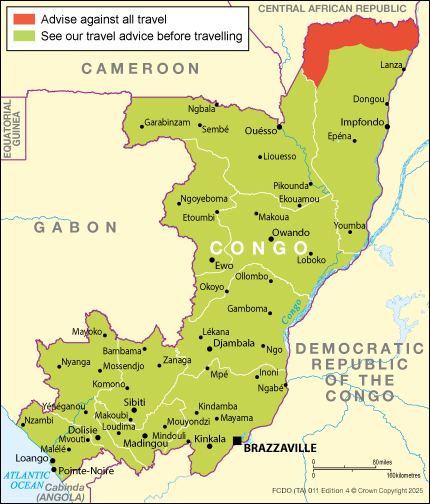
Advise against all travel
  • Republic of Congo-Central African Republic border area in Likouala Region — FCDO advises against all travel to within 50km of the Republic of Congo-Central African Republic border in Likouala Region. Find out more about why FCDO advises against travel.
Official Foreign Office map
Foreign Office map — Open Government Licence v3.0

Warnings — Foreign OfficeForeign Office ↗updated 02.06.2026 · read 16.10.2026

Warnings — Foreign Office

Your travel insurance could be invalidated if you travel against advice from the Foreign, Commonwealth & Development Office (FCDO).

Republic of Congo-Central African Republic border area in Likouala Region

FCDO advises against all travel to within 50km of the Republic of Congo-Central African Republic border in Likouala Region.

Find out more about why FCDO advises against travel .

Regional risks — Foreign OfficeForeign Office ↗updated 02.06.2026 · read 16.10.2026

Regional risks — Foreign Office

This section has safety advice for regions of the Republic of Congo. It only covers regions where FCDO has specific advice.

You should also read FCDO ’s overall travel advice and safety and security advice .

Republic of Congo-Central African Republic border area in Likouala Region

FCDO advises against all travel within 50km of the Republic of Congo-Central African Republic ( CAR ) border in Likouala Region.

There is a risk of violence, crime and insecurity in this area due to instability in CAR .

The Pool Region

Some areas in the Pool region have historically been areas of conflict between the government and the Ninja insurgent group. There have not been any reports of live conflict since a ceasefire was agreed in 2017, however a risk remains of violent clashes breaking out with little or no notice, particularly in the districts of Boko, Kindamba, Kinkala, Mayama and Mindouli.

Safety — Foreign OfficeForeign Office ↗updated 02.06.2026 · read 16.10.2026

Safety — Foreign Office

This guide also has safety advice for regions of the Republic of Congo .

There is a high threat of terrorist attack globally affecting UK interests and British nationals, including from groups and individuals who view the UK and British nationals as targets. Stay aware of your surroundings at all times.

UK Counter Terrorism Policing has information and advice on staying safe and what to do in the event of a terrorist attack. Find out how to reduce your risk from terrorism while abroad .

Terrorism in the Republic of Congo

Although there’s no recent history of terrorism in the Republic of Congo, attacks cannot be ruled out.

Political situation

Demonstrations happen occasionally. In the past, demonstrations have become violent. Even when they are peaceful there is a risk of violence. Avoid any areas with demonstrations.

The Pool Region has historically been an area of conflict between Government Forces and the Ninja insurgent group. Live conflict has not been reported since both parties signed a ceasefire agreement in 2017. Violent clashes could arise again with little or no notice in response to political events. Be vigilant for reports of local unrest.

Crime

There have been reports of crime, particularly opportunistic crime such as pickpocketing, particularly in Brazzaville and Pointe Noire, and criminals may target foreigners.

Protecting yourself and your belongings

Take care of your belongings, particularly in Brazzaville and Pointe Noire. To reduce your personal risk:

  • avoid walking in the streets after dark
  • do not carry large amounts of cash or valuables
  • avoid isolated areas, including beaches
Vehicle crime

Criminals may target your car. Take extra precautions against criminals targeting your vehicle, especially when travelling outside urban centres and anywhere in the Pool Region and Mouyondzi District. Reduce the risk of carjacking and break-ins by:

  • locking doors and keeping windows closed, including whilst travelling
  • not driving away from main routes
  • always parking in a secure location
  • making journeys during daylight hours in rural areas
Personal ID

Police may ask you for ID. Always carry a colour copy of your passport, including your visa entry stamp. If you live in Congo, also always carry a colour copy of your residency card.

Road travel

If you are planning to drive in the Republic of Congo, see information on driving abroad .

You can use a UK photocard driving licence to drive in the Republic of Congo. If you still have a paper driving licence, you may need to update it to a photocard licence or get the correct version of the international driving permit ( IDP ) as well.

Hire car companies often have stricter requirements for their customers, such as a year of driving experience, a higher minimum age and holding an IDP .

Some road conditions, particularly in remote parts of the country may be poor, particularly during the wet season from November to May. Reduce the risks of rural travel by using a well-maintained 4-wheel drive vehicle with necessary supplies. Travelling in convoy and in daylight will reduce the risk of being stranded if a breakdown or accident happens.

Checkpoints

There are frequent vehicle checkpoints in the Republic of Congo, which can be poorly marked. If you’re asked for documents at a checkpoint, stay in your vehicle and show them through a closed window.

Air travel

The UK Air Safety List (ASL) lists all known airlines in the Republic of Congo that do not meet international…

American passport — U.S. Department of State

The State Department published no readable advisory for this country at this reading: consult travel.state.gov directly.travel.state.gov ↗read 16.10.2026

Global Affairs Canada — additional reading

Exercise a high degree of caution (with regional advisories)

Border area with the Central African Republic - Avoid non-essential travel

Avoid non-essential travel to within 50 km of the border with the Central African Republic due to the presence of criminal gangs and armed militias.

  • Border area with the Central African Republic — Avoid non-essential travel to within 50 km of the border with the Central African Republic due to the presence of criminal gangs and armed militias.

Open Government Licence – Canada · September 24, 2026 08:53 EDTtravel.gc.ca ↗updated 24.09.2026 · read 15.10.2026

In brief
  • You must carry valid photo identification and your valid visa at all times; local authorities may request to see them and you may be detained if you cannot produce them.
  • Always carry an International Driving Permit with your Canadian driver’s licence to drive in the Republic of the Congo; the legal blood alcohol limit is 0.08% and penalties for drinking and driving are severe.
  • Penalties for possession, use or trafficking of illegal drugs are severe, including jail sentences and heavy fines; never transport other people’s packages or luggage.
  • It is illegal to photograph government buildings, military installations, border crossings or transportation infrastructure; seek permission before photographing official buildings or individuals.
  • Arts and crafts are subject to an export tax that must be paid before departure; exporting items of historical significance such as wood pieces, sculptures or paintings is illegal and punishable by heavy fines or jail sentences.
  • The currency is the CFA franc (XAF); the economy is primarily cash-based, though major hotels and stores may accept major credit cards, euros or U.S. dollars.

Faithful summary of the official texts below, which prevail.

Global Affairs Canada — written for Canadian travellers, valid for all

Local laws

You must abide by local laws. Learn about what you should do and how we can help if you are arrested or detained abroad.

Drugs

Penalties for possession, use or trafficking of illegal drugs are severe. Convicted offenders can expect jail sentences and heavy fines.

  • Pack your own luggage and monitor it closely at all times
  • Never transport other people’s packages, bags or suitcases

Drugs, alcohol and travel

Photography

It’s illegal to photograph:

  • government buildings
  • military installations
  • border crossings
  • transportation infrastructure, including ports, train stations and airports

Seek permission before taking photos of official buildings or individuals.

Export

Arts and crafts are subject to an export tax that must be paid before your departure. It’s illegal to export items of historical significance, such as wood pieces, sculptures and paintings. Convicted offenders can expect heavy fines or jail sentences.

Identification

Local authorities may request to see your identification at any time. You may be detained by police if you’re unable to produce acceptable identification.

  • Always carry valid photo identification and your valid visa
  • Keep a photocopy of your passport and visa or travel permit in a safe place in case it’s lost or seized
  • Keep a digital copy of your identification and travel documents
Driving

You must have an International Driving Permit along with your valid Canadian driver’s licence to drive in the Republic of the Congo. The legal blood alcohol limit is 0.08% and penalties for drinking and driving are severe. Traffic accidents can quickly draw large crowds. Remain calm if there is a dispute, particularly in a public place. If threatened by a large crowd, seek direct intervention from the local police. International Driving Permit

Traffic violations

If a police officer asks you to pay a fine on the spot for a traffic violation, ask for a written copy of the ticket, which can be paid later at a local court or police station.

International Child Abduction

The Hague Convention on the Civil Aspects of International Child Abduction is an international treaty. It can help parents with the return of children who have been removed to or retained in certain countries in violation of custody rights. It does not apply between Canada and the Republic of the Congo. If your child was wrongfully taken to, or is being held in the Republic of the Congo by an abducting parent:

  • act as quickly as you can
  • consult a lawyer in Canada and in the Republic of the Congo to explore all the legal options for the return of your child
  • report the situation to the nearest Canadian government office abroad or to Global Affairs Canada by calling the Emergency Watch and Response Centre

If your child was removed from a country other than Canada, consult a lawyer to determine if The Hague Convention applies. Be aware that Canadian consular officials cannot interfere in private legal matters or in another country's judicial affairs.

Money

The currency of the Republic of the Congo is the CFA franc (XAF), also known as the Central African CFA franc. The economy is primarily cash-based. Major hotels and stores generally accept major credit cards, as well as euros and U.S. dollars. However, you should confirm when making a reservation. Outside these establishments in Brazzaville and Pointe-Noire, credit cards are rarely accepted.

Open Government Licence – Canada · September 24, 2026 08:53 EDTtravel.gc.ca ↗updated 24.09.2026 · read 15.10.2026

Foreign Office — laws and cultural differences

Personal ID

Police may ask you for ID. Always carry a colour copy of your passport, including your visa entry stamp. If you live in Congo, also always carry a colour copy of your residency card.

Open Government Licence v3.0gov.uk ↗updated 02.06.2026 · read 16.10.2026

FDFA (Switzerland) — laws and customs, in French

Specific legal provisions

Il est notamment interdit de photographier les installations militaires et les bâtiments et ouvrages publics (aéroports, ponts, etc.). Les infractions à la loi sur les stupéfiants, y compris la détention de minimes quantités de drogue quelle qu'elle soit, sont durement réprimées. Les conditions de détention sont précaires.

Cultural specificities

Les relations homosexuelles et la transsexualité sont réprouvées de manière générale.

FDFA travel advice, in Frencheda.admin.ch ↗updated 04.05.2026 · read 16.10.2026

Air: Moderate 41/100PM2.5 16.7 µg/m³ · PM10 17.3 µg/m³
UV high today max 6.5Right now 0.5 · WHO scale 0–11+

What it changes for you: Air acceptable at this hour: nothing special to plan. High UV at midday: sun protection.

Reading 07:00 (Africa/Brazzaville)Open-Meteo ↗updated 16.10.2026 · read 16.10.2026

Air quality and UV: Open-Meteo.com (CC BY 4.0), data rounded and formatted by Maximum. Contains modified Copernicus Atmosphere Monitoring Service information 2026. Neither the European Commission nor ECMWF is responsible for any use that may be made of the Copernicus information or data it contains.

Physicians per 1,000 people
Congo0.2 2022
Switzerland4.5 2022
France3.3 2022
Health spending per person (USD)
Congo76 2023
Switzerland11,784 2023
France5,327 2024
Life expectancy (years)
Congo66.0 2024
Switzerland84.4 2024
France83.0 2024

No value published by the World Bank in the last eight years for Congo: hospital beds per 1,000 people.

Reading: With 0.2 physicians per 1,000 people (96% fewer than Switzerland), the nearest hospital does not always have the capacity for a serious case: evacuation to an adequate centre is the rule, not the exception — that is what unlimited evacuation and repatriation cover. Health spending of 76 USD per person (Switzerland: 11,784) goes with private hospitals that bill foreigners in hard currency and ask for a guarantee before admission: the direct payment guarantee is what avoids the deposit.

World Bank — latest published value, year per indicatordata.worldbank.org ↗read 11.10.2026

I travel on a passportVisa, passport validity, entry form: the rules depend on your passport. Each government describes them for its own nationals.

French passport — France Diplomatie

In brief
  • French nationals require a visa obtained online from the Congolese embassy in Paris before departure, as no visas are issued upon arrival.
  • Visa applications for the Republic of Congo must include proof of accommodation, such as a hotel reservation or a certificate from a local town hall.
  • Visa processing times for the Republic of Congo are three days for express service and seven days for normal service.
  • International vaccination certificates, particularly for yellow fever, may be checked upon entry into the Republic of Congo.
  • Travelers to the Republic of Congo must declare and pay duties on antiquities or traditional items, with proof of payment required upon departure.
  • The import of goods into the Republic of Congo, for personal or commercial use, necessitates customs clearance through an approved freight forwarder.

Faithful summary of the official texts below, which prevail.

Congo

-

-

-

-

-

-

-

-

-

-

-

Formalités d’entrée

Le carnet de vaccinations internationales (fièvre jaune) est susceptible d’être contrôlé à l’entrée sur le territoire congolais.

Visas

L’obtention d’un visa avant le départ est obligatoire pour se rendre en République du Congo, sauf pour les passeports diplomatiques. Aucun visa n’est délivré à l’arrivée dans le pays. Le visa doit être impérativement sollicité auprès de l’ambassade du Congo à Paris.

Les demandeurs de visas doivent soumettre et payer leur demande de visa uniquement en ligne.

La durée du visa est comprise entre 15 et 91 jours. Les délais de traitement des demandes sont de 7 jours pour la procédure normale et de 3 jours pour la procédure express.

NB : Un certificat d’hébergement, délivré par une mairie d’arrondissement au Congo ou une réservation d’hôtel dûment acquittée sont obligatoires pour l’obtention d’un visa d’entrée en République du Congo. Ces documents doivent être présentés lors de l’entrée sur le territoire congolais

Les informations sur l’obtention d’un visa pour la République du Congo, sont consultables en ligne sur le site de l’ambassade du Congo en France .

Règlementation douanière

Le service de surveillance des douanes congolaises contrôle les bagages des voyageurs aux aéroports, en particulier pour faire respecter les réglementations propres à certaines marchandises, notamment celles soumises à des restrictions de circulation et de détention : stupéfiants et autres substances nocives, armes et explosifs, contrefaçons, bien culturels et imprimés interdits. Ces contrôles portent sur les bagages accompagnés, les colis postaux, le fret et l’avitaillement.

Les voyageurs doivent s’acquitter de droits sur l’achat d’antiquités ou d’objets traditionnels, la preuve que ces droits ont été payés étant systématiquement exigée au départ. L’achat d’ivoire est prohibé.

A l’importation des marchandises au Congo (effets tant à usage personnel que commercial), les formalités de dédouanement s’effectuent obligatoirement par l’intermédiaire d’un transitaire agréé. Les droits de douane pour un véhicule neuf sont de 48 à 53 % ad valorem pour les voitures de tourisme ; ils sont calculés sur la valeur argus pour les véhicules d’occasion.

Entry and stay pagediplomatie.gouv.fr ↗updated 15.09.2026 · read 16.10.2026

Swiss passport — FDFA (Switzerland)

The FDFA does not publish entry requirements: they are set out by the destination's embassy or consulate in Switzerland — check them before booking, passport in hand. As a guide, the French and British requirements below describe the same rules as seen by two other governments.eda.admin.ch ↗updated 04.05.2026 · read 16.10.2026

British passport — Foreign Office (UK)

In brief
  • British citizens must have a passport valid for the duration of their stay in the Republic of Congo; no extra validity period is required. Foreign Office
  • A visa is mandatory to enter the Republic of Congo; apply before travel via the Republic of Congo Embassy in the UK. Foreign Office
  • Travellers must present a yellow fever vaccination certificate and a polio vaccine certificate to pass border control in the Republic of Congo. Foreign Office
  • British citizens must carry a valid British passport or certificate of entitlement when returning to the UK. Foreign Office
  • Travellers may face enhanced health screening due to the Ebola outbreak in the Democratic Republic of Congo; check entry requirements for transit countries. Foreign Office
  • Contact the Republic of Congo Embassy in the UK for visa and entry requirements: 0203 691 5979, contactambacouki@gmail.com, 83 Victoria Street, London, SW1H OHW. Foreign Office

Faithful summary of the official texts below, which prevail.

Entry requirements — rules for a British passportForeign Office ↗updated 02.06.2026 · read 16.10.2026

Entry requirements — rules for a British passport

This information is for people travelling on a full ‘British citizen’ passport from the UK. It is based on the UK government’s understanding of Congo’s current rules for the most common types of travel.

The authorities in the Republic of Congo set and enforce entry rules. If you’re not sure how these requirements apply to you, contact the Republic of Congo Embassy in the UK.

Telephone: 0203 691 5979

Email: contactambacouki@gmail.com

Address: 83 Victoria Street, London, SW1H OHW

Passport validity requirements

Your passport must be valid for the duration of your stay. No additional period of validity is needed.

Check with your travel provider that your passport and other travel documents meet requirements. Renew your passport if you need to.

You will be denied entry if you do not have a valid travel document or try to use a passport that has been reported lost or stolen.

Dual nationals

When returning to the UK, British citizens must carry a valid British passport or certificate of entitlement . See Dual citizenship .

Visa requirements

You must have a visa to enter the Republic of Congo.

Applying for a visa

Apply for a visa before you travel. Contact the Republic of Congo Embassy in the UK for more information.

Vaccine requirements

To pass border control in the Republic of Congo, you must have certificates to prove you’ve had:

  • a yellow fever vaccination, due to a risk of yellow fever transmission
  • a polio vaccine, due to the risk of polio transmission

For more details about health entry requirements and recommended vaccinations, see TravelHealthPro’s Republic of Congo guide .

Ebola

Travellers arriving in the Republic of Congo may be subject to enhanced health screening measures due to the ongoing Ebola outbreak centred in the Democratic Republic of Congo.

The World Health Organisation (WHO) has declared this a Public Health Emergency of International Concern . Check entry requirements for the country you’re travelling to or transiting.

Customs rules

There are strict rules about goods you can take into or out of the Republic of Congo. You must declare anything that may be prohibited or subject to tax or duty.

American passport — U.S. Department of State

The State Department publishes the requirements ("Entry, Exit and Visa Requirements") on its country page, which our servers cannot read. Read it before you go; as a guide, the French and British requirements below describe the same rules as seen by two other governments.travel.state.gov ↗read 16.10.2026

Living on site

For each risk, the official texts themselves: what is happening, then, where they say so, what to do.

CrimeMODERATE

What the texts say · There have been reports of crime, particularly opportunistic crime such as pickpocketing, particularly in Brazzaville and Pointe Noire, and criminals may target foreigners. While not common, violent crime, such as armed robbery and assault, remains a concern throughout the Republic of the Congo.

What they advise:
  • Do not resist an attack.
  • Avoid walking in the streets after dark.
  • Do not carry large amounts of cash or valuables.
Foreign Office · State Department · Global Affairs Canada
TransportMODERATE

What the texts say · Some road conditions, particularly in remote parts of the country may be poor, particularly during the wet season from November to May. The army and the police set up roadblocks, which are sometimes poorly marked, throughout the country.

What they advise:
  • If you choose to drive in the Republic of the Congo: always keep doors and windows closed and locked.
  • Always carry your identification with you and be prepared to show it.
  • If you are planning to travel to remote areas: avoid travelling after dark outside urban areas.
Foreign Office · Global Affairs Canada
Nature and climateMODERATE

What the texts say · Seasonal flooding can hamper overland travel and reduce the provision of essential services.

What they advise:
  • Stay away from flooded areas.
  • Follow the instructions of local authorities, including evacuation orders.
Global Affairs Canada
Laws and customsTO KNOW

What the texts say · Local authorities may request to see your identification at any time.

What they advise: Penalties for possession, use or trafficking of illegal drugs are severe.
Global Affairs Canada
Crowds and calendarMODERATE

What the texts say · Demonstrations occur, especially in Brazzaville, Pointe-Noire, and the Pool Department. Even peaceful demonstrations can turn violent at any time.

What they advise: Avoid areas where demonstrations and large gatherings are taking place.
Global Affairs Canada

Sentences copied word for word from the official texts cited, chosen for the destination; the level is our reading. The full texts, at each source:Foreign Office ↗updated 02.06.2026 · read 16.10.2026 (updated 02.06.2026 · read 28.09.2026)State Department ↗read 16.10.2026 (read 28.09.2026)Global Affairs Canada ↗updated 24.09.2026 · read 15.10.2026 (updated 24.09.2026 · read 28.09.2026)

State Department: no travel advice page found for Congo.

Safety in figures
Road traffic deaths per 100,000 people
Congo29.7 2019
Switzerland2.2 2019
France5.1 2019

Reading: On the road, 13 times more deaths than in Switzerland: road crashes are the leading cause of death of healthy travellers (CDC) — seat belt, no night driving, a driver or a taxi from a rank.

World Bank (UNODC for homicides, WHO for roads) — latest published valuedata.worldbank.org ↗read 11.10.2026

—:—Local time · Africa/Brazzaville ·
117Local emergency numbers · Police 117 · Fire 118
Europlug, prise électrique de type E230 V
Drivingon the right

Time zone: IANA and timezone-boundary-builder (ODbL) · RESTCountries · EmergencyNumberAPI · Wikidata · European Central Bank

Places: © OpenStreetMap contributors (ODbL), Photon search by komoot.

FDFA (Switzerland) — transport and specific advice, in French

Transport and infrastructure

Les routes sont parfois en mauvais état et les risques d'accident élevés. La nuit, renoncez aux déplacements à travers le pays. L'approvisionnement en carburant n'est pas toujours assuré. Bien souvent, l’entretien des chemins de fer et des avions pour les vols internes ne correspond pas aux normes européennes et internationales. De graves incidents impliquant des avions sur les liaisons internes du pays se produisent régulièrement, certains appareils étant vieux ou mal entretenus. Les points de passage des frontières peuvent être fermés à court terme, par exemple afin d’endiguer la propagation de maladies. Informez-vous auprès des autorités locales ou directement auprès des postes-frontières.

Specific remarks

Les déplacements dans certaines régions sont soumis à une autorisation préalable de l’armée congolaise. Pour plus d’informations, veuillez contacter l’ambassade de la République du Congo (Brazzaville) à Genève. Portez toujours une copie certifiée conforme de votre passeport (y inclus le visa) sur vous afin de pouvoir prouver votre identité lors des fréquents contrôles de personnes.

FDFA travel advice, in Frencheda.admin.ch ↗updated 04.05.2026 · read 16.10.2026

Public holidaysNager.Date ↗read 25.09.2026

  • Sun 1 Nov — All Saints' Day
  • Sat 28 Nov — Republic Day
  • Fri 25 Dec — Christmas Day
ESSENTIAL

Maximum policyholder: before paying anything, call the 24/7 number. If you are admitted for more than 24 h, Maximum sends its direct payment guarantee to the hospital (art. 2.12).

+41 22 ••• •• •• — Full number in your client area

The hospitals to know — Brazzaville

The hospital list has not been read from OpenStreetMap for this page yet: the medical-network map loads it when opened. Maximum's assistance directs you to the right facility, 24/7. The medical-network map ↗

40pharmacies40doctorsFull map and list ↗

Before you go

  • Routine vaccinesup to date
  • Yellow feverrequired for entry
  • Hepatitis Arecommended
  • Hepatitis Brecommended
  • Malariapreventive medicine recommended
  • Typhoidrecommended
  • Choleradepending on the area

CDC Travelers' Health recommendations, most important first. They depend on your age, vaccines and itinerary: confirm them with a doctor or a travel clinic 4 to 6 weeks before departure. Details, disease by disease ↗cdc.gov ↗read 10.10.2026

On site

DengueMosquitoes bite by day: repellent, long sleeves.
MalariaPresent in some areas: talk to a doctor before leaving.
ChikungunyaMosquito-borne: same protection as for dengue.
SunUV high (6): hat, sunscreen, water.
MedicationIn their box, with the prescription — in English if possible.

The health system — With 0.2 physicians per 1,000 people (96% fewer than Switzerland), the nearest hospital does not always have the capacity for a serious case: evacuation to an adequate centre is the rule, not the exception — that is what unlimited evacuation and repatriation cover. Health spending of 76 USD per person (Switzerland: 11,784) goes with private hospitals that bill foreigners in hard currency and ask for a guarantee before admission: the direct payment guarantee is what avoids the deposit.

Back home — a fever in the following weeks should be told to a doctor, naming the country.

The next 7 days Africa/BrazzavilleMET Norway ↗read 16.10.2026

Fri 16 Oct24–28°rain · 3.7 mm
Sat 17 Oct24–31°heavy showers · 13.2 mm
Sun 18 Oct23–30°heavy rain · 6.5 mm
Mon 19 Oct24–30°showers · 4.4 mm
Tue 20 Oct24–31°showers · 5.2 mm
Wed 21 Oct24–32°showers · 4.1 mm
Thu 22 Oct24–31°showers · 4.2 mm

Forecast: MET Norway (Norwegian Meteorological Institute, CC BY 4.0), grouped by day and formatted by Maximum.

I travel on a passportYour embassy, and the service to register with, depend on your passport.

Your country, 24/7, from abroad

FR
Crisis and Support Centre — French Ministry for Europe and Foreign Affairs+33 1 53 59 11 0024/7 emergency line, standard rate. First contact abroad: the French embassy or consulate.www.diplomatie.gouv.fr ↗updated 15.09.2026 · read 16.10.2026
CH
FDFA Helpline+41 58 465 33 33+41 800 24 7 36524/7, 365 days a year — helpline@eda.admin.ch. Beware of scam calls spoofing these numbers.www.eda.admin.ch ↗updated 04.05.2026 · read 16.10.2026
GB
Foreign, Commonwealth & Development Office+44 20 7008 500024 hours, for British nationals.www.gov.uk ↗updated 02.06.2026 · read 16.10.2026
US
Overseas Citizens Services — U.S. Department of State+1 202 501 4444+1 888 407 4747From abroad; the second number from the U.S. and Canada.travel.state.gov ↗read 16.10.2026

French passport — French embassy and consulates

FR
Consulate of Francenearest · 385.8 km

phone not published

Useful contacts listed by France Diplomatie (in French)diplomatie.gouv.fr ↗updated 15.09.2026 · read 16.10.2026

Updated: 15 September 2026

OpenStreetMap

Swiss passport — Swiss embassy and consulates

Useful addresses — FDFA, in French

Représentations suisses à l'étranger: En cas de situation d'urgence à l'étranger, vous pouvez vous adresser à la représentation suisse la plus proche ou à la Helpline DFAE. Ambassade de Suisse en République démocratique du Congo Helpline DFAE Représentations étrangères en Suisse: Pour obtenir des informations sur les prescriptions d'entrée (documents d'identité admis, visa, etc.), veuillez vous adresser aux ambassades et consulats étrangers compétents. Ceux-ci peuvent également vous renseigner sur les dispositions douanières pour l'importation et l'exportation d'animaux et de marchandises: appareils électroniques, souvenirs, médicaments, etc. Représentations étrangères en Suisse

OpenStreetMap · DFAE

British passport — British embassy and consulates

GB
United Kingdom (Honorary Consulate)nearest · 1.2 km

phone not published

OpenStreetMap

American passport — U.S. embassy and consulates

OpenStreetMap

Police

  • DG de la Police · 0.8 km
  • Immigration · 0.8 km
  • Immigration · 1.3 km
  • Police GRB · 1.7 km

Town hall

  • Mairie de Poto-Poto · 0.2 km
  • Mairie de Mfilou · 5.9 km

OpenStreetMap

Getting help — Foreign OfficeForeign Office ↗updated 02.06.2026 · read 16.10.2026

Getting help — Foreign Office

The Foreign, Commonwealth & Development Office ( FCDO ) cannot provide tailored advice for individual trips. Read this travel advice and carry out your own research before deciding whether to travel.

Emergency services in the Republic of Congo

There’s no central number for emergency services in the Republic of Congo. You can report crimes to local police on 06 665 4804. Few police will speak English.

Check for local medical facilities and carry contact details with you.

Telephone numbers can be unreliable.

Contact your travel provider and insurer

Contact your travel provider and your insurer if you are involved in a serious incident or emergency abroad. They will tell you if they can help and what you need to do.

Help abroad

See how to get help from the UK government abroad including in an emergency.

Help in the UK

You can call  FCDO  in London if you need urgent help because something has happened to a friend or relative abroad.

Telephone: 020 7008 5000 (24 hours)

Find out about call charges

Ten phrases in French

For emergencies. If pronunciation fails, show the screen — or the printed page.

Help!Au secours !
Call an ambulance!Appelez une ambulance !
I need a doctor.J'ai besoin d'un médecin.
Where is the nearest hospital?Où est l'hôpital le plus proche ?
Call the police!Appelez la police !
I am allergic to penicillin.Je suis allergique à la pénicilline.
I have international medical insurance.J'ai une assurance médicale internationale.
I want to contact my embassy.Je voudrais contacter mon ambassade.
Please take me to this address.Emmenez-moi à cette adresse, s'il vous plaît.
Do you speak English?Parlez-vous anglais ?

Translations by Maximum Insurance, original script and transliteration.

  • Keep the entry stamp, hospital invoices and the medical report. Without them a claim cannot be rebuilt.
  • File it from the claim form, once back, with those papers.
  • The France Diplomatie health page mentions dengue and malaria and chikungunya. A fever in the weeks after return should be told to a doctor, naming the country.

Actions to take before each professional trip abroad.

1Once — the framework
2For each departure
3During the mission, and after

What is happening in Congo right now

Live alerts and level changes, each with its official source. Continuously updated.

What governments have just written

UpdateGlobal Affairs Canada

Health – editorial change

September 24, 2026 08:53 EDTtravel.gc.ca ↗updated 24.09.2026 · read 15.10.2026

No level change recorded for this country since the log opened. The live alerts above are updated continuously.

⚡ The world feed — every country →

Frequently asked questions — travel insurance Congo

24/7 support number — +41 22 ••• •• ••An adviser goes through each question with you until you have an actionable answer: cover, hospital, entry rules, claims. Full number in your client area. You can also ask Maximum directly, just below these questions.
What is the official risk level in Congo today?

Level 2/4 — Exercise Increased Caution, U.S. Department of State, retrieved on 16 October 2026.

  • Is the whole country advised against? United States: no · France: no · United Kingdom: no · Switzerland: no (reading of 27 September 2026).
  • Contractually, only an FDFA, FOPH or WHO advisory against the trip opens Module A (art. 18.1) — that is not the case today.
  • International medical cover, 24/7 number saved, and a read of the areas named under Safety & risks before booking the itinerary.
  • We check these sources every morning and e-mail you the day one changes (Alerts button).

Sourcestravel.state.gov · read 16.10France Diplomatie · updated 15.09 · read 16.10DFAE · updated 04.05 · read 16.10207-country comparison

Is the whole of Congo advised against, or only some areas?

An area advised against does not rule out the country.

  • Official answers: United States: no · France: no · United Kingdom: no · Switzerland: no.
  • Foreign Office, regional risks: “This section has safety advice for regions of the Republic of Congo. It only covers regions where FCDO has specific advice. You should also read FCDO ’s overall travel advice and safety and security advice . Republic of Congo-Central African Republic border…”
  • Keep your country of residence's advisory on booking day and on departure day: that is what your policy's clauses cite.

SourcesFrance Diplomatie · updated 15.09 · read 16.10Foreign Office · updated 02.06 · read 16.10State Department · read 16.10

What are the entry requirements for Congo with my passport?

The rules depend on the passport, not on the destination alone.

  • French passport (France Diplomatie): French nationals require a visa obtained online from the Congolese embassy in Paris before departure, as no visas are issued upon arrival. Visa applications for the Republic of Congo must include proof of accommodation, such as a hotel reservation or a certificate from a local town hall. Visa processing times for the Republic of Congo are three days for express service and seven days for normal service.
  • British passport (Foreign Office): British citizens must have a passport valid for the duration of their stay in the Republic of Congo; no extra validity period is required. A visa is mandatory to enter the Republic of Congo; apply before travel via the Republic of Congo Embassy in the UK. Travellers must present a yellow fever vaccination certificate and a polio vaccine certificate to pass border control in the Republic of Congo.
  • American passport: the requirements are on the State Department country page (travel.state.gov).
  • Swiss passport: the FDFA refers you to the destination's embassy in Switzerland.
  • Pick your passport at the top of Before you go › Entry: the official text that concerns you comes first, with its “In brief” summary.

SourcesFrance Diplomatie · updated 15.09 · read 16.10Foreign Office · updated 02.06 · read 16.10State Department · read 16.10

Do I need an insurance certificate for a Congo visa?

For a Schengen visa, yes: at least €30,000 of travel medical insurance (Regulation (EC) No 810/2009, art. 15).

  • Many other countries ask for it on entry or for a visa, case by case: check Before you go › Entry, with your passport.
  • Subscribe: the named certificate arrives by e-mail on payment, with your name, dates and limits (EUR 1.5M medical expenses, unlimited evacuation and repatriation) — the ones consulates check.
  • Attach it to the visa file; if in doubt about the format, write to us.

SourcesRegulation (EC) 810/2009, art. 15General conditions, policy 20 00 479

What does Maximum Insurance do in Congo, concretely?

VIP Pack — €990 for twelve months, unlimited trips.

  • EUR 1.5M emergency medical expenses, unlimited medical evacuation and repatriation, search and rescue EUR 50,000, cancellation or change EUR 5,000.
  • One 24/7 number, +41 22 ••• •• ••: Maximum sends its direct payment guarantee to the hospital (art. 2.12).
  • Network of 45,000 providers (art. 6.9); evacuation is decided, organised and paid by Maximum's medical team if the local facility is not enough (art. 6.2.2).
  • Named certificate by e-mail on payment, no medical questionnaire.

SourcesGeneral conditions, policy 20 00 479OpenStreetMap · read 14.10

What should I do if hospitalised in Congo?

Six steps, in this order.

  • 1. Call +41 22 ••• •• •• before paying anything, or have the front desk call: it is the condition for full cover (otherwise: reduced or refused benefits).
  • 2. Ask for a hospital in the Maximum network (art. 6.9).
  • 3. See a doctor the same day and leave with the certificate: without an on-the-spot finding, nothing is covered (art. 33).
  • 4. Admitted for more than 24 h? The front desk calls Maximum: direct payment guarantee, no deposit (art. 2.12).
  • 5. Book no ambulance or flight yourself (art. 6.2.2).
  • 6. Once home, file within 30 days (art. 35.7).
  • Local emergency services: police 117 · fire 118.

SourcesSpecial conditions 01.26General conditions, policy 20 00 479

Which emergency numbers in Congo?

Local emergency services: police 117 · fire 118

  • Maximum, 24/7, before any payment: +41 22 ••• •• ••.
  • France — Consulate of France (385.8 km)
  • United Kingdom — United Kingdom (Honorary Consulate) (1.2 km)
  • United States — Ambassade des États-Unis (3.1 km) · (+242) 06 612-2000
  • Save these numbers before leaving; in immediate danger, call local emergency services first, then Maximum.

SourcesEmergencyNumberAPI · Wikidata · read 08.10OpenStreetMap · read 14.10

Is an Amex, Visa or Mastercard enough in Congo?

At today's level 2/4, card by card:

  • Amex Platinum — No area exclusion at this level — but three written limits: deductible and prior approval, 90-day cap, advance under conditions.
  • Visa — No express area exclusion — but a €156,000 cap, 90 days, and the war/instability exclusion in the background.
  • Mastercard — No exclusion in play at this level — but a €155,000 cap and 90 covered days.
  • Three lines to read in your notice: the duration (often 90 days per trip), the settlement (reimbursement afterwards or direct payment of the hospital) and the area exclusion at level 4/4.

SourcesAmex Platinum France T&Cs, 01.2025 — general exclusion n° 11BNP Paribas Visa Infinite notice (policy PT7), 04.2025 — comFortuneo World Elite Mastercard notice, 01.2026 — art. 5.5 '

Are a health plan or a travel policy enough in Congo?

A health plan reimburses at home; here, the hospital asks for a payment guarantee before admission.

  • Health plan — A health plan treats you at home. Here the hospital asks for a guarantee before admission — not a later reimbursement.
  • Travel policy — No area exclusion at this level — compare cap, deductible and covered duration.
  • A travel policy often has a territorial clause at level 4/4 and a 90-day limit per trip.
  • Have your IPID number or the PDF of the terms and ask an expert to call you back: the answer is in the document, not in the brochure.

SourcesGeneral conditions, policy 20 00 479

How do I use the medical network on this page?

The page reads hospitals, pharmacies and doctors from OpenStreetMap, around the point you choose.

  • Type your city, hotel or beach: the map re-centres, 24/7 emergency rooms come first.
  • Each row gives the phone when the source publishes it, the nearest street, directions and the Google Maps listing.
  • The PDF briefing repeats the same places, numbered on a printable map.
  • No customer reviews: OpenStreetMap has none, and we invent none.

SourcesOpenStreetMap (ODbL) · read 14.10

Which vaccines and health precautions for Congo?

The sourced detail is under Medical network › Health: vaccines, diseases present, altitude, outbreaks.

  • CDC (Travelers' Health), depending on the trip: Routine vaccines, COVID-19, Chikungunya, Cholera, Hepatitis A, Hepatitis B, Malaria.
  • France Diplomatie reports in the country: dengue, malaria, chikungunya — mosquito protection day and night.
  • See a doctor or a travel clinic 8 weeks before departure (Foreign Office).
  • Carry your medicines in their packaging, with a prescription using international non-proprietary names (France Diplomatie).

SourcesCDC Travelers' Health · read 10.10France Diplomatie · updated 15.09 · read 16.10OMS · read 16.10Foreign Office · updated 02.06 · read 16.10

Can I be treated in Congo, or will I be evacuated?

0.2 physicians per 1,000 people (2022) versus 4.5 in Switzerland.

  • With 0.2 physicians per 1,000 people (96% fewer than Switzerland), the nearest hospital does not always have the capacity for a serious case: evacuation to an adequate centre is the rule, not the exception — that is what unlimited evacuation and repatriation cover. Health spending of 76 USD per person (Switzerland: 11,784) goes with private hospitals that bill foreigners in hard currency and ask for a guarantee before admission: the direct payment guarantee is what avoids the deposit.
  • When the local facility is not enough, Maximum's medical team decides the evacuation to a suitable centre, and pays for it (art. 6.2.2).

SourcesWorld Bank · read 11.10General conditions, policy 20 00 479

Congo: safety, in figures?

Comparable figures (homicides, roads, incidents) are under Safety & risks › Incidents.

  • 29.7 road deaths per 100,000 people versus 2.2 in Switzerland (World Bank, WHO).
  • On the road, 13 times more deaths than in Switzerland: road crashes are the leading cause of death of healthy travellers (CDC) — seat belt, no night driving, a driver or a taxi from a rank.

SourcesWorld Bank (UNODC, WHO) · read 11.10UCDP

Where is my embassy in Congo, and why register?

The nearest representations, by passport (OpenStreetMap):

  • France — Consulate of France (385.8 km)
  • United Kingdom — United Kingdom (Honorary Consulate) (1.2 km)
  • United States — Ambassade des États-Unis (3.1 km) · (+242) 06 612-2000
  • Register before leaving: France: Ariane · Switzerland: Travel Admin · United Kingdom: Foreign Office alerts · United States: STEP.
  • Two minutes, and in a crisis your country's authorities can reach you and count you in an evacuation.
  • Pick your passport at the top of Contacts: your embassy comes first.

SourcesOpenStreetMap · read 14.10DFAE · updated 04.05 · read 16.10

Which regions of Congo should I avoid, precisely?

1 region advised against, fully or partly, by at least one official reading.

  • Your point (Brazzaville): country-wide vigilance.
  • Partly advised against: Likouala.
  • Areas quoted without a region: Global Affairs Canada — Avoid non-essential travel to within 50 km of the border with the Central African…
  • Maximum does not exclude these areas: the VIP Pack covers care and repatriation there (sanctions, embargoes and a country already at war at departure remain enforceable).

SourcesGlobal Affairs Canada · updated 24.09 · read 15.10Foreign Office · updated 02.06 · read 16.10France Diplomatie · updated 15.09 · read 16.10

Which laws and customs should I know in Congo?

Local laws apply to every traveller; here is what the official texts say.

  • You must carry valid photo identification and your valid visa at all times; local authorities may request to see them and you may be detained if you cannot produce them.
  • Always carry an International Driving Permit with your Canadian driver’s licence to drive in the Republic of the Congo; the legal blood alcohol limit is 0.08% and penalties for drinking and driving are severe.
  • Penalties for possession, use or trafficking of illegal drugs are severe, including jail sentences and heavy fines; never transport other people’s packages or luggage.
  • It is illegal to photograph government buildings, military installations, border crossings or transportation infrastructure; seek permission before photographing official buildings or individuals.
  • Arts and crafts are subject to an export tax that must be paid before departure; exporting items of historical significance such as wood pieces, sculptures or paintings is illegal and punishable by heavy fines or jail sentences.

SourcesGlobal Affairs Canada · updated 24.09 · read 15.10Foreign Office · updated 02.06 · read 16.10

Who can I call at any hour from Congo?

Every foreign ministry runs a 24/7 emergency line for its nationals.

  • France — Crisis and Support Centre — French Ministry for Europe and Foreign Affairs: +33 1 53 59 11 00. 24/7 emergency line, standard rate. First contact abroad: the French embassy or consulate.
  • Switzerland — FDFA Helpline: +41 58 465 33 33 · +41 800 24 7 365. 24/7, 365 days a year — helpline@eda.admin.ch. Beware of scam calls spoofing these numbers.
  • United Kingdom — Foreign, Commonwealth & Development Office: +44 20 7008 5000. 24 hours, for British nationals.
  • United States — Overseas Citizens Services — U.S. Department of State: +1 202 501 4444 · +1 888 407 4747. From abroad; the second number from the U.S. and Canada.
  • On site, Ambassade de France au Congo: +33 5 33 52 08 48.

Sourcesdiplomatie.gouv.fr · updated 15.09 · read 16.10eda.admin.ch · updated 04.05 · read 16.10

A few useful phrases in French for Congo?

Emergency phrases, to show if pronunciation fails:

  • Help! → Au secours !
  • Call an ambulance! → Appelez une ambulance !
  • I need a doctor. → J'ai besoin d'un médecin.
  • Where is the nearest hospital? → Où est l'hôpital le plus proche ?
  • Call the police! → Appelez la police !

SourcesMaximum Insurance

What should I keep after leaving Congo, and how do I file a claim?

Keep the entry stamp, the invoices, the prescriptions and the medical report.

  • File within 30 days (art. 35.7) from your client area, with the documents; the official forms are pre-filled.
  • Costs advanced on site are reimbursed against receipts.
  • Fever, persistent diarrhoea or a rash in the following weeks? See a doctor and say where you have been — dengue, malaria, chikungunya circulate in the country (France Diplomatie).

SourcesGeneral conditions, policy 20 00 479

What does the Pack VIP Extreme add?

Cancellation or change up to EUR 20,000, special risk EUR 5,000 per person, crisis management and security, optional Kidnap & Ransom.

  • Special risk (Module A): political event, attack, epidemic, natural disaster — opens when the FDFA, the FOPH or WHO advise against the trip (art. 18.1).
  • Epidemic: assistance must be requested within 7 days of the WHO or FDFA qualification (art. 36.2).
  • Crisis management and security: trip registration, monitoring, extraction, evacuation in case of riot, war, terrorism or disaster; Kidnap & Ransom subject to eligibility (art. 18.4).
  • €2,290 a year, unlimited trips.

SourcesGeneral conditions, policy 20 00 479

A question not answered here? Ask Maximum below, or call the support number: every question gets a clear, actionable answer.

A question? Maximum answers.Answers built from the Congo file and your policy.

In a life-threatening emergency, call local emergency services first, then Maximum: +41 22 ••• •• •• — 24/7 support number, an adviser stays with you to the end.

What Maximum knows

The 207 country pages — hospitals, pharmacies, police, embassies, emergency numbers, official advice from four governments, health, safety in figures, events in progress — read around the city you name. Your policy — benefits, the six steps, claims, articles. The site — prices, certificate, subscription. Nothing else: what it does not know, it says so and hands you to an adviser.

Same advisory level: Comoros · Costa Rica · Cuba · Ivory Coast · Denmark · Djibouti

Cross-check with official sources
U.S. State Department → UK FCDO → France Diplomatie → DFAE (Suisse) →

The displayed level comes from the State Department, checked every morning. Before departure, always cross-check your country of residence's advisory: that is what your policy cites.

The level shown is the official U.S. Department of State level, checked daily. Maximum Insurance is an insurance distributor — general information, not personal advice.

Travel covered to Congo
Get the Pack VIP — €990/yr Cover a team
Check my current cover in Congo

The destination is already Brazzaville. A few choices, then the reading of your cover, here.

Go further
Insured in an advised-against country →What a repatriation really costs →Who pays the hospital abroad →Where the United States, France and the United Kingdom disagree →Is an employer required to insure an employee on assignment abroad? →What insurance do you need for an assignment abroad? →

All 13 files, together → · All 207 countries →