Maximum Alerts / Algeria
Level published by the State Department on 24.08.2026 · read 16 October 2026 · source checked daily
Algeria — official level as of 16 October 2026: Level 1/4 ("Exercise Normal Precautions"), from the U.S. Department of State. Maximum Insurance covers this country: hospital settled directly, unlimited repatriation, EUR 1.5M, certificate on payment.
Every country has its own scale, so we ask them all the same question: is the whole country advised against?
An advisory covering only areas of the country does not raise the answer: it stays “No”, and the area is shown in the relevant column.
The level shown on this page — and across this site — is the one published by the U.S. State Department, from 1 (normal precautions) to 4 (do not travel). France and the United Kingdom publish their own advisories, with their own rules: they add to that level, they do not replace it.
You will be alerted only on the day the official level of this country changes.
In a life-threatening emergency, call local emergency services first, then Maximum: +41 22 ••• •• •• — 24/7 support number, an adviser stays with you to the end.
The 207 country pages — hospitals, pharmacies, police, embassies, emergency numbers, official advice from four governments, health, safety in figures, events in progress — read around the city you name. Your policy — benefits, the six steps, claims, articles. The site — prices, certificate, subscription. Nothing else: what it does not know, it says so and hands you to an adviser.
What I say on the phone
What to do, in this order
In immediate danger, call local emergency services first. Then contact assistance without delay; before engaging a service, seek approval under your policy. Cover is confirmed by the insurer.
Ask assistance where to get care and whether direct cover can be arranged. It confirms the facility and seeks the insurer's approval under your policy. In immediate danger, call local emergency services first.
Even for a pain you meant to shrug off. Without a medical certificate written on the spot, the same day, the insurer cannot cover the event — a certificate written after you return does not count.
The hospital desk sends the request to assistance. Direct payment depends on the insurer's approval and the policy; the call alone does not guarantee it. Have the response confirmed before relying on no up-front payment.
In a life-threatening emergency, call local emergency services immediately. For an arranged transfer or repatriation, contact assistance: the insurer's medical team decides on measures under the policy. A medical flight booked without approval may not be reimbursed.
Even if everything went well on the ground. Send your invoices and the medical report within 30 days; after that, compensation may be reduced or refused.
Reading hospitals, doctors and pharmacies around this point…
List read from OpenStreetMap on 13.10.2026, not read again since: these facilities may have changed.
Country dial code: +213
OpenStreetMap list read on 13.10.2026, straight-line distances. In an emergency: +41 22 ••• •• ••.
27 Avenue Fellah Mohamed
near شارع مسعود دهيم
near شارع بوجمعة المغني
near شارع بوشكوم عمر
Bt 19A Cité El Hayat
Bt14 Cité Said Ramdane 224lgts Ain-Naadja
near Rue Baktache Nadir
ophthalmology
near Place Al Qods
gynaecology
04 Chemin Gadouche Abdelkader Hydra
near Rue Hassiba Benbouali
near Rue Colonel Chabani Mohamed
near Rue Chetoug D
near route de kadous
near Première Rocade Sud التجنب الجنوبي الأول
near Rampe Louni Arezki منحدر أرزقي لوني
near Rue Tazrout Mohamed
gynaecology
near Rue Kadri Ali
near شارع العقيد لطفي
near Rue Admane Akli
near شارع الرائد عبد الرحمن ميرة
near Boulevard Ali Basta
near Rue Mouloud Abbas
حسين داي
طريق فرنان حنافي حسين داي
near Rue Général Nadjaat Slimane
24/7
near Rue Alliche Ali
حسين داي
حسين داي
شارع بوجمعة المغني حسين داي
near Rue des Sports
near Rue Belouizdad Mohamed شارع محمد بلوزداد
near Route de Badjarrah
near شارع باش جراح
near Boulevard Ain Naadja
near شارع باش جراح
2 Boulevard des Frères Merrakchi جادة الإخوة مراكشي
near Rue Cheikh Tahar El Djazairi
near Rue Missoum Mohamed شارع محمد ميسوم
Bâtiment 98 A
near Rue Bouguerfa Mohamed شارع محمد بوقررفة
near Boulevard Bouchekoum Amar
near Rue Freres Attari
بوروبة
near Rue de la cité diar el Djemaa
near شارع باش جراح
near Boulevard des Martyrs نهج الشهداء
بئر خادم
near Chemin de la Concorde
near Rue Frères Mistraoui
near Rue Mohamed Bourahla
near Rue Akli Aïssou
سيدي امحمد
شارع ديدوش مراد سيدي امحمد
near Rue Beladjel Hocine
near Voie service Ardis
الجزائر
near Chemin Saïd Hamdine
near Avenue Colonel Ahmed Bougara
22 نهج العربي عليق حيدرة
03 الأبيار
08:00-15:30
8 Lotissement Djenane Dely Brahim
3 نهج 11 ديسمبر 1960 الأبيار
25 Chemin Al Bakri Abdelkader بن عكنون
Su-Th 09:00-17:00
طريق محمد جمية جيدر بن عكنون
05 طريق عبد القادر البكري بن عكنون
11 Chemin Abdelkader Gadouche Ben Aknoun
08:30-15:30
5 lot Doudou Mokhta Ben Aknoun
08:30-15:30
بوزريعة
1 شارع نور الدين مكري بولوغين
22 Rue Aouis Abdelkader شارع عويس عبد القادر Bologhine
وادي قريش
Su-Th 08:00-12:00,13:00-16:30; PH off
near Rue Hamou Berkane
near Rue des Frères Khennouche
near Rue Ibnou Abbas Ibnou Kounfoud
24/7
near Rue Aristote
near Rue Harizi Mohamed
near طريق باش جراح
near Avenue Bag Mohamed
near Rue du 5 juillet
near Route des Annassers
near Autoroute Nord-Sud
near Rue Bouchekoum Amar
near Route de Bourouba ⴰⴱⵔⵉⴷ ⵏ ⴱⵓⵔⵓⴱⴰ طريق بوروبة
near Chemin Fernane Hannafi
near شارع بوجاتيت محمد
near طريق فرنان حنافي
near Rue Amraoui Ahmed
near Boulevard Douar Mohamed
near Autoroute Nord-Sud
near Rue du métro
near شارع جيش التحرير الوطني
near Route de Badjarrah
near شارع باش جراح
near Place El Mokrani
بئر خادم
near Rue Djadid Ali
near شارع جيش التحرير الوطني
24/7
near Avenue Mohamedi
near Avenue Al Moutanabi
24/7
near Rue Belkacem Hamidi
24/7
near Rue de Taxi Ardis
near Terrasse Bouneta
near Rue Ben Lounas Ahmed
Forecast: MET Norway (Norwegian Meteorological Institute, CC BY 4.0), grouped by day and formatted by Maximum.
10-16 6.1 · 10-17 6.1 · 10-18 6.1 · 10-19 6.2 · 10-20 6.5 · 10-21 9.0 · 10-22 7.9 m³/s
Simulated discharge: Open-Meteo.com (CC BY 4.0), data rounded and formatted by Maximum. Contains modified Copernicus Emergency Management Service information 2026. For information only: this is not a flood warning; only national or regional authorities issue those.
No geolocated event in this country at this reading.
No geolocated UCDP incident in this country.
National numbers (Wikidata, 2026 reading). On site, call local emergency services first, then Maximum: the insurer sends its payment guarantee to the hospital.
Make sure you are up-to-date on all routine vaccines before every trip. Some of these vaccines include Chickenpox (Varicella) Diphtheria-Tetanus-Pertussis (DTaP, Tdap, or Td) Flu (influenza) Measles-Mumps-Rubella (MMR) Polio Shingles
All eligible travelers should be up to date with their COVID-19 vaccines. Please see Your COVID-19 Vaccination for more information.
There is no longer active cholera transmission and vaccine is not recommended.
Recommended for unvaccinated travelers one year old or older going to Algeria. Infants 6 to 11 months old should also be vaccinated against Hepatitis A. The dose does not count toward the routine 2-dose series. Travelers allergic to a vaccine component should receive a single dose of immune globulin, which provides effective protection for up to 2 months depending on dosage given.
Recommended for unvaccinated travelers younger than 60 years old traveling to Algeria. Unvaccinated travelers 60 years and older may get vaccinated before traveling to Algeria.
Cases of measles are on the rise worldwide. Travelers are at risk of measles if they have not been fully vaccinated at least two weeks prior to departure, or have not had measles in the past, and travel internationally to areas where measles is spreading.
Monkeypox vaccination is recommended for any adult who anticipates any of the following activities during travel: Sexual or intimate contact with a new partner Sexual or intimate contact at a commercial sex venue, like a sex club or bathhouse Sexual or intimate contact in exchange for money, goods, drugs, or other trade Sexual or intimate contact in association with a large public event, such as a rave, party, or…
In Algeria, poliovirus has been identified in the past year. Travelers to Algeria are at increased risk of exposure to poliovirus.
Dogs infected with rabies are commonly found in Algeria. If rabies exposures occur while in Algeria, rabies vaccines may only be available in larger suburban/urban medical facilities.
Recommended for most travelers. Typhoid vaccine is not 100% effective. Practicing safe food and water habits , including washing hands at key times , can also help prevent typhoid fever .
CDC recommendations: Vaccine is not recommended. Country entry requirements: Direct travel from United States: Vaccine is not required. Travel from countries with risk for YF virus transmission: Vaccine is required for travelers ≥9 months old; this includes >12-hour airport transits or layovers in countries with risk for YF virus transmission. 3 Updated April 23, 2025 See footnotes
CDC Travelers' Health, re-read weekly — the recommendation depends on your age, vaccines and itinerary: confirm it with a doctor or a travel clinic 4 to 6 weeks before departure.CDC ↗read 10.10.2026
Moderate incidence: nothing special for a short stay.
World Bank — latest published valuedata.worldbank.org ↗read 10.10.2026
Source: France Diplomatie (health advice, in French).
Faithful summary of the official texts below, which prevail.
WHO: no outbreak reported for this country in the last 24 months (Disease Outbreak News).who.int ↗read 15.10.2026
FDFA (Switzerland) — medical care, in French
Hors des grandes villes, les infrastructures médicales sont souvent insuffisantes voire précaires. Les hôpitaux privés exigent une garantie financière avant de commencer un traitement (carte de crédit ou paiement d’avance). Si vous prenez régulièrement des médicaments , emportez-en une quantité suffisante avec vous. Notez toutefois que de nombreux pays appliquent des réglementations restrictives. Cela vaut en particulier, mais pas exclusivement, pour les médicaments contenant des stupéfiants (par exemple la méthadone) et les substances utilisées pour le traitement des troubles psychiques. Avant votre départ, renseignez-vous directement auprès de la représentation étrangère compétente (ambassade ou consulat) et consultez la rubrique Liens voyages , où vous trouverez de plus amples informations sur ce sujet ainsi que sur la médecine du voyage en général. Les informations concernant la propagation de maladies et les éventuelles mesures de protection à prendre sont fournies par le personnel médical et les centres de vaccination. Liens voyages
France Diplomatiesource ↗updated 02.03.2026 · read 15.10.2026
Consulter si besoin son médecin traitant ou un centre de vaccinations internationales (médecine des voyages) pour faire une évaluation de son état de santé et bénéficier de recommandations sanitaires, notamment sur les vaccinations. Consulter éventuellement son dentiste avant le départ.
Constituer sa pharmacie personnelle en conséquence et n’emporter dans ses bagages que les médicaments strictement nécessaires ; ne jamais consommer de médicaments achetés dans la rue (risque de contrefaçons). Les médicaments doivent être dans leur emballage d’origine avec les étiquettes originales, accompagnés d’une ordonnance portant le nom des médicaments en dénomination commune internationale (DCI). Il est indispensable de vérifier que les médicaments concernés sont autorisés dans le pays visité : pour plus d’informations, consulter la fiche Informations pratiques .
Les vaccins recommandés en France sont également indispensables lors d’un séjour à l’étranger : les maladies qu’ils préviennent circulent partout dans le monde, parfois même plus fréquemment qu’en France. Avant tout départ, le voyageur (adulte et enfant) doit donc d’abord s’assurer d’être à jour du calendrier vaccinal français, en particulier des vaccins contre la diphtérie, le tétanos, la poliomyélite, la coqueluche mais aussi contre la rougeole. Le carnet de vaccination peut être demandé à l’arrivée de certains pays.
Des vaccinations complémentaires peuvent être nécessaires :
Il est donc conseillé de consulter son médecin traitant ou un centre de vaccinations internationales (médecine des voyages) suffisamment de temps avant le voyage.
Le choléra est une infection digestive bactérienne qui se transmet par ingestion d’aliments mal cuits (fruits de mer, par exemple) ou souillés (fruits et légumes) et/ ou ingestion d’eau contaminée. Cette maladie, dite « des mains sales », se traduit par des troubles digestifs sévères (diarrhée liquide abondante, crampes abdominales, vomissements), un état de faiblesse générale et parfois de la fièvre.
La prévention repose sur la vaccination et le respect des règles d’hygiène alimentaire (se laver régulièrement les mains, ne consommer que de l’eau en bouteille, peler les fruits et légumes, manger de la nourriture cuite ; utilisation des installations sanitaires). Les personnes présentant les signes de la maladie doivent consulter un médecin en urgence.
Pour plus d’informations, consulter le site Santé publique France et le site du ministère de la Santé .
La fièvre typhoïde est une maladie infectieuse causée par des bactéries présentes dans l’eau contaminée par des matières fécales d’origine humaine. L’infection résulte le plus souvent de l’ingestion d’eau ou d’aliments contaminés, ou d’une transmission directe de personne à personne. Les symptômes surviennent en moyenne 3 semaines après la contamination et associent fièvre, maux de tête, perte d’appétit, douleurs abdominales avec diarrhée ou constipation, fatigue et parfois, éruption cutanée. Dans les formes plus graves, la fièvre typhoïde peut être fatale en l’absence de traitement.
Les mesures de prévention reposent sur les règles élémentaires d’hygiène générale vis-à-vis de l’eau, des aliments et du lavage des mains ainsi que sur la vaccination.
Pour plus d’informations , consulter le site de l'Institut Pasteur .
L’hépatite A est une maladie virale du foie…
Pour plus d’informations, consulter le site du ministère en charge de la Santé et le site de l'Assurance Maladie .
Pour plus d’informations, consulter le site du ministère en charge de la Santé .
Health — Foreign OfficeForeign Office ↗updated 25.09.2026 · read 15.10.2026
Before you travel check that:
- your destination can provide the healthcare you may need
- you have appropriate travel insurance for local treatment or unexpected medical evacuation
This is particularly important if you have a health condition or are pregnant.
Call 16 or 1021 and ask for an ambulance.
Contact your insurance company quickly if you’re referred to a medical facility for treatment.
At least 8 weeks before your trip:
See what health risks you’ll face in Algeria .
Altitude sickness is a risk in parts of Algeria. Read more about altitude sickness on TravelHealthPro .
The legal status and regulation of some medicines prescribed or bought in the UK can be different in other countries.
Read best practice when travelling with medicines on TravelHealthPro .
Facilities at private clinics are usually better than government hospitals. Make sure you have adequate travel health insurance and accessible funds to cover the cost of any medical treatment abroad and repatriation.
English is not widely spoken and you may face communication difficulties if you do not speak Arabic or French.
FCDO has a list of medical providers in Algeria .
Read FCDO guidance on travel and mental health . There is also mental health guidance on TravelHealthPro .
TravelHealthPro ↗ · CDC ↗read 10.10.2026
Level 2 - Global PolioCDC ↗read 10.10.2026Some international destinations have circulating poliovirus. Before any international travel, make sure you are up to date on your polio vaccines. Country List : Afghanistan, Algeria, Benin, Cameroon, Chad, Côte d'Ivoire (Ivory Coast), Democratic Republic of the Congo, Niger, Nigeria, Pakistan, Somalia, Yemen, Sudan,…
Places read from OpenStreetMap, within a circle of about 12 km: phone, email, address, website and hours when the source publishes them. No customer reviews, that source has none. Straight-line distances.
Notices vary by bank and vintage — yours prevails. On the right: the Maximum contract (public documents).
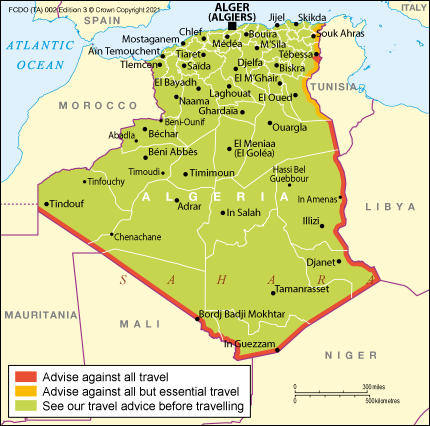
The country is not uniform: 7 regions advised against, fully or partly, by at least one official reading. Algiers is not one of them.
Faithful summary of the official texts below, which prevail.
“(France Diplomatie)”: the level comes from its text, in French, quoted below region by region.
the trip stays outside the advised-against regions. Any move into a red or orange region calls for a new, written decision. The areas quoted without a region (border, routes, localities) call for the same decision.
France Diplomatie (in French)
Wilaya d’Aïn Defla : des groupes terroristes subsistent dans la région.
France Diplomatie (in French)
Wilaya de Batna : des groupes terroristes résiduels subsistent dans les massifs montagneux.
Foreign Office
FCDO advises against all travel to within 30km of Algeria’s borders with: Tunisia – in the provinces of Illizi and Ouargla and in the Chaambi mountains area
Foreign Office
FCDO advises against all travel to within 30km of Algeria’s borders with: Tunisia – in the provinces of Illizi and Ouargla and in the Chaambi mountains area
France Diplomatie (in French)
Wilaya de Sétif : des trafics subsistent autour de ce centre urbain.
France Diplomatie (in French)
A l’est : il convient d’éviter la zone frontalière avec la Tunisie, à partir et au sud de Tébessa (présence de groupes terroristes) ainsi que la zone frontalière avec la Libye du fait de l’instabilité du pays. Le poste frontière avec la Libye est par ailleurs fermé.
France Diplomatie (in French)
Région de Tindouf, à l’ouest : cette région accueille des camps de réfugiés sahraouis, en situation de grande vulnérabilité, dans une région politiquement sensible et sous fort contrôle militaire.
Global Affairs Canada — Advised against — all travel
within 200 km of the border with Mali, Mauritania and Niger
Global Affairs Canada — Advised against — all travel
within 50 km of the border with Libya
Global Affairs Canada — Advised against — all travel
within 50 km of the border with Tunisia, except for travel by land to/from Tunisia via the N44 highway and the Oum Tboul border crossing, where you should exercise a high degree of caution
Global Affairs Canada — Advised against — all travel
Avoid all travel to the area within 50 km of the border with Morocco due to the increased military presence, the unstable security situation and the difficulty of finding the border’s exact location.
Foreign Office — Advised against — all travel
FCDO advises against all travel to within 30km of Algeria’s borders with: Libya
Foreign Office — Advised against — all travel
FCDO advises against all travel to within 30km of Algeria’s borders with: Mauritania
Foreign Office — Advised against — all travel
FCDO advises against all travel to within 30km of Algeria’s borders with: Mali
Foreign Office — Advised against — all travel
FCDO advises against all travel to within 30km of Algeria’s borders with: Niger
Foreign Office — Advised against — all but essential travel
FCDO advises against all but essential travel to within 30km of the rest of Algeria’s border with Tunisia.
France Diplomatie (in French) — Advised against — all travel
Zones frontalières : l’Algérie compte 6 400 kilomètres de frontières terrestres, notamment avec des pays en situation d’instabilité et connaissant un risque terroriste élevé (Libye, Mali, Niger). Malgré un dispositif sécuritaire important, les frontières ne sont pas étanches. De nombreux trafics et activités de contrebande menés par des réseaux transfrontali
France Diplomatie (in French) — Advised against — all travel
A l’ouest : la frontière algéro-marocaine, qui demeure fermée, est sous étroite surveillance avec une intensification significative des contrôles tout au long de celle-ci.
France Diplomatie (in French) — Advised against — all but essential travel
Au nord-est, le massif des Aurès : des groupes terroristes résiduels subsistent dans les zones montagneuses.
France Diplomatie (in French) — Advised against — all but essential travel
Le massif de Chréa : des trafics subsistent dans les zones montagneuses.
France Diplomatie (in French) — Advised against — all but essential travel
Frontière terrestre avec le Maroc : la frontière est fermée depuis août 1994 et reste une zone sous tension. Il est fortement déconseillé de s’en approcher.
France Diplomatie (in French) — Advised against — all but essential travel
Région de Hassi Messaoud : cette région accueille des champs pétroliers et gaziers sous fort contrôle militaire.
Global Affairs Canada — Open Government Licence – Canada (15.10.2026) · Foreign Office — Open Government Licence v3.0 · France Diplomatie (02.03.2026) · Natural Earth
No located event in this reading.
Last change: Updated information about customs rules, terrorism in Algeria, political situation and personal ID (‘Entry requirements’ and ‘Safety and security’ pages).
Updated 24.08.2026
Exercise increased caution in Algeria due to terrorism and kidnapping . Some areas have increased risk. Read the entire Travel Advisory.
Terrorism remains a possible threat in Algeria. Terrorist attacks have historically targeted Algerian security forces. Attacks are possible in both rural and urban areas despite a heavy and active police presence. Kidnapping for ransom events in Algeria’s deep south have targeted foreigners in recent years.
The U.S. government has limited ability to offer emergency services to U.S. citizens outside Algiers province. This is due to the size of the country, as well as the Algerian government’s travel restrictions on U.S. government employees.
There is risk of terrorist violence, including terrorist attacks and other activity in Algeria. Visit the U.S. Department of State's country reports on terrorism to learn more.
Do Not Travel to:
Algeria: Floods - Jan 2026ReliefWeb ↗read 16.10.20262026-02-03
Algeria: Floods - May 2025ReliefWeb ↗read 16.10.20262025-05-30
Source: ReliefWeb (OCHA), via HDX — CC BY
10-16 6.1 · 10-17 6.1 · 10-18 6.1 · 10-19 6.2 · 10-20 6.5 · 10-21 9.0 · 10-22 7.9 m³/s
Simulated discharge: Open-Meteo.com (CC BY 4.0), data rounded and formatted by Maximum. Contains modified Copernicus Emergency Management Service information 2026. For information only: this is not a flood warning; only national or regional authorities issue those.
The level is national. Risk areas are in the state advisories below.
No major event in progress is located in this country at this morning's check.
Reading: The homicide rate is above Switzerland's, without being out of range. On the road, 9 times more deaths than in Switzerland: road crashes are the leading cause of death of healthy travellers (CDC) — seat belt, no night driving, a driver or a taxi from a rank.
World Bank (UNODC for homicides, WHO for roads) — latest published valuedata.worldbank.org ↗read 10.10.2026
What we locate on the map are events in progress that have real coordinates: USGS earthquakes, GDACS disasters, NOAA storms and open NASA EONET events. Hover a dot for details, click to open it in this briefing.
French passport — France Diplomatie
Faithful summary of the official texts below, which prevail.
Some areas of the country are formally advised against.France Diplomatie ↗updated 02.03.2026 · read 15.10.2026
Vigilance areas — France Diplomatie (in French) updated 02.03.2026official map ↗updated 02.03.2026 · read 15.10.2026
- Présentation de l'Algérie
-
-
-
-
-
-
-
-
-
Dernière actualisation le 02/03/2026, information toujours valable à la date du jour
Sahara et zones désertiques (autour de Tamanrasset)
Les forces de sécurité restent engagées dans la lutte contre les réseaux qui subsistent sur son territoire. La menace persiste, à un niveau réduit. Des groupes terroristes (AQMI et EI) sont toujours présents de manière résiduelle. Des opérations sont menées régulièrement pour démanteler les cellules terroristes et leurs réseaux logistiques et de soutien. Le dispositif sécuritaire est important dans les grands centres urbains, notamment Alger et Oran, y garantissant un niveau de sécurité satisfaisant, sous réserve d’y respecter les règles élémentaires de vigilance. La dégradation de la sécurité dans les pays du Sahel, et notamment au Niger et plus encore au Mali, accroit en revanche les risques dans les zones frontalières avec ces pays.
L’engagement de la France dans la lutte contre le terrorisme international fait des intérêts et des ressortissants français une cible déclarée des groupes terroristes.
Il convient donc d’être attentif à l’évolution de la situation sécuritaire, notamment pour tous les déplacements et de se conformer strictement aux instructions que les autorités algériennes peuvent donner localement.
Il convient de respecter les règles élémentaires de vigilance (mise en sureté de ses objets personnels de valeur, moyens de paiement, téléphones et ordinateurs portables, papiers d’identité, lieux désertés par le public la nuit tombée…).
Afin de respecter les us et coutumes locaux, il est conseillé d’adapter sa tenue et son comportement (cf. onglet Infos utiles).
Afin de limiter tout risque d’agression et de vol, il est vivement conseillé de limiter ses déplacements aux axes routiers principaux. Des risques de banditisme et de brigandage existent sur les routes de montagne et les axes routiers secondaires.
L’état des routes s’est considérablement amélioré ces dernières années. Circuler sur les routes algériennes nécessite néanmoins prudence et adaptation.
Les routes nationales sont généralement bien entretenues. Parfois étroites, elles génèrent un trafic intense. La circulation peut y être dangereuse en raison d’habitudes de conduite différentes, des infractions fréquentes au code de la route ou de comportements imprévisibles de la part des chauffeurs de transports collectifs (grands taxis, autocars, camions). Les accidents de la route font chaque année de nombreuses victimes.
Les 115 000 km du réseau routier et autoroutier sont de construction récente. Les infrastructures autoroutières (aires d’arrêt, postes de secours, etc.) et les équipements de sécurité de qualité sont toutefois peu nombreux. Pour de longues distances, le réseau routier doit être évité au profit des liaisons aériennes.
L’Algérie, située à la convergence entre les plaques Eurasie et Afrique, est une zone à forte sismicité. Les principales failles actives sont localisées au niveau de l’Atlas. Au cours de son histoire, le pays a connu plusieurs séismes destructeurs (1715, 1954, 1980 et 2003) et enregistre chaque année plusieurs tremblements de terre d’ampleur modérée.
Pour plus d’informations sur la conduite à tenir en cas de séisme, consulter la fiche " Séismes ".
Il convient de faire preuve de grande prudence et de vigilance renforcée pour éviter tout désagrément pendant son séjour : ne pas photographier de bâtiments officiels algériens, d’ambassades ou consulats étrangers ; ne pas faire usage de drones, jumelles ou GPS, dont l’introduction sur le territoire algérien est soumise à des autorisations très restrictives ; être vigilant aux appréciations portées, sur les réseaux sociaux, ayant trait à la situation locale. La captation photographique ou vidéo de personnes dans l’espace public peut également être sensible et mal perçue, pouvant le cas échéant causer des difficultés avec la police voire avec la justice locale.
Toute activité de production de contenu ayant vocation à être publié en ligne (blogs, réseaux sociaux) peut être assimilée par les autorités locales à une pratique journalistique, laquelle est strictement encadrée en Algérie. Tout visiteur ayant l’intention de se prêter à ce type d’activité, y compris à titre non professionnel, est invité à le déclarer dès le dépôt de sa demande de visa auprès du consulat algérien. A défaut, le voyageur est susceptible d’être interpellé par les autorités locales durant son séjour (contrôles voire poursuites). Dans le cadre d’une activité professionnelle, une demande d’accréditation doit être déposée auprès du consulat algérien (cf. visas). Une fois le visa correspondant obtenu, l’utilisation de matériel professionnel, scientifique ou pédagogique (notamment caméras, appareils photos…) peut être facilitée par la présentation d’un carnet ATA (Admission Temporaire) à l’arrivée à l’aéroport.
Il convient d’éviter les rassemblements de population et les manifestations.
En cas de déplacements avec une escorte locale, il convient de circuler à un rythme raisonnable sans chercher à tout…
Comme sur les routes, des comportements inappropriés et dangereux sont observés en matière de conduite des véhicules nautiques à moteur. Une grande vigilance est nécessaire si un jet-ski navigue à proximité des lieux de baignade, d’autant que les zones de baignade ne sont pas séparées des zones de navigation des jet-skis.
Full text of the Security pagediplomatie.gouv.fr ↗updated 02.03.2026 · read 15.10.2026
Swiss passport — FDFA (Switzerland), in French
Faithful summary of the official texts below, which prevail.
FDFA update note — Le chapitre Risques régionaux spécifiques a été actualisé (sud et sud-est du pays). (published 27.02.2026)
Une attention particulière doit être accordée à la sécurité personnelle. Il est déconseillé de se rendre dans certaines parties du pays. L'instabilité sécuritaire dans la région touche principalement le sud du pays et l'ensemble de la zone frontalière. Le risque d'attentats et d'enlèvements est élevé dans les zones frontalières avec la Tunisie, la Libye, le Niger, le Mali, la Mauritanie et à proximité du Sahara occidental. Des groupes criminels, armés ou terroristes sont actifs dans une grande partie de cette région. Les autorités algériennes mènent des opérations de lutte contre le terrorisme; toutefois le risque d'attentats terroristes est présent dans tout le pays. Dans certaines régions, la menace terroriste est élevée (voir chapitre Risques régionaux spécifiques). Les attaques terroristes visent principalement les institutions publiques et les forces de sécurité, mais peuvent également toucher des entreprises étrangères et des lieux fréquentés par des ressortissants étrangers. Il existe un risque que des ressortissants étrangers soient victimes d’actes isolés. Des bandes armées et des groupes terroristes, qui vivent de contrebande et d'enlèvements contre rançon, sévissent dans une grande partie du Sahara. Ils sont bien organisés, opèrent sans tenir compte des frontières, et ont des contacts avec des groupes criminels locaux. Le risque d'enlèvement est élevé dans certaines régions; les ressortissants étrangers peuvent également être victimes d’enlèvements (voir le chapitre Risques régionaux spécifiques). Le risque d’enlèvement ne peut pas être exclu dans les autres parties du pays. Veuillez également tenir compte des informations figurant sur nos pages Internet spécifiques: Terrorisme et enlèvements Risque d’enlèvement dans le Sahara et le Sahel Des manifestations peuvent avoir lieu, en particulier dans les villes. Des affrontements violents entre les manifestants et les forces de sécurité ne peuvent être exclus. Des grèves sont également possibles. Il convient notamment d’observer les précautions suivantes:
La description des zones à risques repose sur des données approximatives; les risques ne peuvent se restreindre à des zones délimitées. Kabylie (nord-est) Il est déconseillé de se rendre dans les zones reculées de la Kabylie (régions montagneuses). La Kabylie reste le théâtre de troubles. Dans les zones reculées, le risque d’enlèvement est élevé. De temps en temps, des affrontements armés entre l’armée et des groupes terroristes ou d'autres groupes armés se produisent. Zone frontalière avec le Maroc Il est déconseillé de se rendre dans la région frontalière avec le Maroc pour des voyages touristiques ou non urgents. La frontière terrestre avec le Maroc est fermée. Dans cette région il y a encore des champs de mines. Empruntez exclusivement les routes les plus fréquentées et informez-vous auprès des autorités locales et/ou de votre guide en cas de doute. Nord-est du pays et zones frontalières avec la Tunisie Il est largement déconseillé de se rendre dans les zones frontalières avec la Tunisie. Faites preuve d’une prudence accrue dans les autres régions, en particulier dans les provinces de Tébessa, Batna et Khenchela. Il existe un risque élevé d’attentats et d’ enlèvements. Dans cette région des bandes de terroristes sont actives. Elles sont bien organisées, prédisposées à la violence et elles opèrent sans tenir compte des frontières. Des combats occasionnels ont lieu entre les forces de sécurité et des groupes terroristes. En outre, des champs de mines subsistent encore. Sud-est et sud Il est déconseillé de se rendre dans les provinces/zones frontalières suivantes: Provinces frontalières avec la Libye et le Niger: Tamanrasset, Djanet, Illizi Provinces du sud, frontière avec le Niger et le Mali: In Guezzam, Bordj Baji Mokhtar Dans les provinces d'Adrar et de Tindouf, il faut éviter toute la zone frontalière avec la Maurétanie et le Mali. La situation sécuritaire en Libye, au Niger et au Mali accentue les problèmes de sécurité. La proximité de la zone sahélienne et la perméabilité des frontières permettent aux réseaux terroristes et criminels d'opérer et de se coordonner plus facilement. Les personnes étrangères peuvent également être victimes d'homicides et d'enlèvements. Le risque terroriste est élevé.
La petite délinquance est surtout présente dans les grandes villes comme Alger, Constantine et Oran. Le harcèlement sexuel des femmes est fréquent selon les endroits. Outre les mesures de précaution habituelles, veuillez également respecter les points suivants:
Des tremblements de terre peuvent occasionnellement se produire au nord du pays. Dans le bassin méditerranéen, il n’est pas exclu qu’un séisme ou une éruption volcanique provoque un tsunami qui atteigne toutes les zones côtières de la Méditerranée. Lors de fortes pluies, les petits ruisseaux asséchés (oueds) peuvent se transformer très rapidement en fleuves impétueux. Notamment dans les montagnes, les conditions météorologiques peuvent changer rapidement. La circulation peut s’en trouver temporairement perturbée. En été, il existe un important risque d’incendie de forêt à de nombreux endroits . Suivez les prévisions météorologiques ainsi que les mises en garde et les instructions des autorités locales, notamment en ce qui concerne les ordres d’évacuation. Météo Algérie Si une catastrophe naturelle devait se produire durant votre séjour, prenez immédiatement contact avec vos proches et suivez les instructions des autorités locales. En cas d’interruption des communications avec l’étranger, vous pouvez vous mettre en liaison avec l’Ambassade de Suisse à Alger.
FDFA travel advice, in French, valid on 15.10.2026eda.admin.ch ↗updated 27.02.2026 · read 15.10.2026
British passport — Foreign Office (UK)
Faithful summary of the official texts below, which prevail.
Regions covered by the Foreign Officegov.uk ↗updated 25.09.2026 · read 15.10.2026

Warnings — Foreign OfficeForeign Office ↗updated 25.09.2026 · read 15.10.2026
Your travel insurance could be invalidated if you travel against advice from the Foreign, Commonwealth & Development Office (FCDO).
FCDO advises against all travel to within 30km of Algeria’s borders with:
FCDO advises against all but essential travel to within 30km of the rest of Algeria’s border with Tunisia.
Find out more about why FCDO advises against travel .
Safety — Foreign OfficeForeign Office ↗updated 25.09.2026 · read 15.10.2026
There is a high threat of terrorist attack globally affecting UK interests and British nationals, including from groups and individuals who view the UK and British nationals as targets. Stay aware of your surroundings at all times.
UK Counter Terrorism Policing has information and advice on staying safe and what to do in the event of a terrorist attack. Find out how to reduce your risk from terrorism while abroad .
Terrorists are likely to try to carry out attacks in Algeria.
Terrorist attacks could be indiscriminate, including in places visited by foreign nationals, such as:
There is also a risk that lone actors target foreign nationals. Stay aware of your surroundings, keep up to date with local media reports and follow the advice of local authorities.
The threat from terrorism is higher in some parts of the country, including:
The terrorist threat comes from individuals inspired by Islamist extremist and anti-Semitic ideology and established groups, such as Al-Qaida in the Islamic Maghreb ( AQIM ). These groups have been active across the country and likely consider Western nationals legitimate targets.
The Algerian authorities conduct effective counter-terrorism operations and retain a strong, visible security presence across the country.
There is a threat of kidnapping by groups operating in North Africa, particularly from Libya, Mauritania and groups originating in the Sahel. This includes AQIM and Daesh-affiliated groups, who may travel across the region’s porous border. There is a heightened risk of kidnap in border and remote desert areas of North Africa, particularly in the southern and eastern border areas (bordering Mali and Libya respectively). Terrorist groups have kidnapped foreigners, government officials and civilians in the region for financial gain and for political leverage.
British nationals are seen as legitimate targets, including tourists, humanitarian aid workers, journalists and business travellers. If you are kidnapped, the reason for your presence is unlikely to protect you or secure your safe release.
The long-standing policy of the British government is to not make substantive concessions to hostage takers. The British government considers that paying ransoms and releasing prisoners increases the risk of further hostage taking. The Terrorism Act (2000) also makes payments to terrorists illegal.
Algeria has a visible security presence across the country that gives considerable attention to the safety of its visitors. Demonstrations and other forms of protest are subject to various restrictions. You should take precautions for your personal safety by avoiding political gatherings and demonstrations. Follow instructions given by local security authorities.
The land border between Algeria and Morocco is closed. Do not attempt to cross it.
The Algerian authorities do not always inform the British Embassy when British nationals have been arrested. If you are detained, insist on your right to contact the British Embassy.
It can take time for the British Embassy to get the necessary permission to visit you.
##…
American passport — U.S. Department of State
Faithful summary of the official texts below, which prevail.
Algeria - Level 2: Exercise Increased Caution 2026-08-24travel.state.gov ↗updated 24.08.2026 · read 16.10.2026
Exercise increased caution in Algeria due to terrorism and kidnapping . Some areas have increased risk. Read the entire Travel Advisory.
Terrorism remains a possible threat in Algeria. Terrorist attacks have historically targeted Algerian security forces. Attacks are possible in both rural and urban areas despite a heavy and active police presence. Kidnapping for ransom events in Algeria’s deep south have targeted foreigners in recent years.
The U.S. government has limited ability to offer emergency services to U.S. citizens outside Algiers province. This is due to the size of the country, as well as the Algerian government’s travel restrictions on U.S. government employees.
There is risk of terrorist violence, including terrorist attacks and other activity in Algeria. Visit the U.S. Department of State's country reports on terrorism to learn more.
Do Not Travel to:
Global Affairs Canada — additional reading
Exercise a high degree of caution (with regional advisories)
Avoid all travel to the following border areas due to the high threat of terrorism, banditry and kidnapping:
Avoid all travel to the area within 50 km of the border with Morocco due to the increased military presence, the unstable security situation and the difficulty of finding the border’s exact location.
Open Government Licence – Canada · October 15, 2026 08:05 EDTtravel.gc.ca ↗updated 15.10.2026 · read 16.10.2026
Faithful summary of the official texts below, which prevail.
Global Affairs Canada — written for Canadian travellers, valid for all
You must abide by local laws. Learn about what you should do and how we can help if you are arrested or detained abroad. Penalties for breaking the law in Algeria can be more severe than in Canada, even for similar offences. No transfer of offenders treaty exists between Canada and Algeria. If you’re convicted of a serious crime, you must serve your jail sentence in Algeria. You may also have to remain in Algeria for a parole period after your release.
Penalties for possession, use or trafficking of illegal drugs are severe. Convicted offenders can expect a jail sentence and a heavy fine.
The consumption of alcohol in public is illegal. Avoid drinking alcohol outside licensed premises. Drugs, alcohol and travel
Algerian law criminalizes sexual acts and relationships between persons of the same sex. 2SLGBTQI+ persons may also be charged with offences of indecency or other related offences. 2SLGBTQI+ persons could also be discriminated against or detained based on their sexual orientation, gender identity, gender expression, or sex characteristics. Convicted offenders could face up to 3 years of imprisonment and heavy fines. 2SLGBTQI+ persons should carefully consider the risks of travelling to Algeria. Travel and your sexual orientation, gender identity, gender expression and sex characteristics
Although capital punishment has not been applied since 1993, you may still face the death penalty if you’re found guilty of serious offences.
Algerian customs, laws and regulations adhere closely to Islamic practices and beliefs. Public displays of affection, including holding hands and kissing, are not socially accepted. Foreign female travellers are not expected to wear head covers. However, revealing clothing is considered inappropriate. To avoid offending local sensitivities:
In 2027, the lunar month of Ramadan is expected to begin on or around February 7. In public, between sunrise and sunset, be discreet when:
Religious proselytism is illegal. You should avoid engaging in religious activities that contradict or challenge Islamic teachings and values. This includes preaching, possessing, or distributing religious literature or material.
Algerian men over the age of 19 are subject to mandatory military service. Local authorities may prevent you from leaving the country if you’re a dual Canadian-Algerian citizen and are unable to produce either:
Obtain a document certifying your status from the Embassy of Algeria before travel.
Algerian family law is different from Canadian family law. Decisions are based on Islamic law. Children of an Algerian father automatically acquire Algerian citizenship at birth. If you are involved in a custody dispute in Algeria, consult an Algerian lawyer for advice and assistance regarding your specific situation.
The Hague Convention on the Civil Aspects of International Child Abduction is an international treaty. It can help parents with the return of children who have been removed to or retained in certain countries in violation of custody rights. It does not apply between Canada and Algeria. If your child was wrongfully taken to, or is being held in Algeria by an abducting parent:
If your child was removed from a country other than Canada, consult a lawyer to determine if The Hague Convention applies. Be aware that Canadian consular officials cannot interfere in private legal matters or in another country's judicial affairs.
Local authorities may ask you to show identification at any time.
Photography of sensitive installations is prohibited. This includes:
Seek permission before taking photos of official buildings and individuals.
Laws on purchasing and exporting antiquities and objects of particular significance to Algeria's cultural heritage are strict. Algerian antiquities and other cultural artifacts cannot be exported. Obtain and carry the required legal paperwork to purchase or export antiquities.
Open Government Licence – Canada · October 15, 2026 08:05 EDTtravel.gc.ca ↗updated 15.10.2026 · read 16.10.2026
Foreign Office — laws and cultural differences
You will need your passport to check in to any hotels in Algeria. You do not have to carry your passport at all times, but take it with you on longer journeys. You must have your passport if you travel inside Algeria by air. Keep copies of your passport’s photo page and your visa or entry stamp in a separate place.
Ramadan is a holy month for Muslims. The dates vary by year and country, next starting in February 2027. During this time, do not:
Get more advice when you arrive from your tour guide, hotel or business contacts. You should also:
It is illegal to drink or be under the influence of alcohol in a public place.
There is zero tolerance for drugs-related offences. The penalties for trafficking, smuggling, using and possessing illegal drugs are severe and can include the death penalty depending upon the severity of the offence.
Mobile phone coverage can be patchy or unavailable in more remote areas, particularly in the south of Algeria. Some online maps may not be accurate in remote areas.
It is illegal to bring drones, binoculars, telescopes and certain types of photography equipment into Algeria without authorisation. If you have any doubt about items you plan to bring with you, contact the Algerian customs to check prior to your travel.
Sexual acts between people of the same sex are illegal in Algeria. Read more advice for LGBT+ travellers.
Algerian family law is different from UK law. Mothers cannot renew their children’s passports without written consent from the father. Fathers can renew their children’s passports without needing the mother’s consent. Algerian nationals, including dual-nationals, who enter the country on an Algerian passport, must leave the country on an Algerian passport, so if you are travelling with a child who has British-Algerian dual nationality, and you are unable to access a valid Algerian passport for them, you will not be able to bring the child out of Algeria without the father’s written consent or permission from the Algerian courts.
If you are a British male of Algerian origin, you may be liable for national service even if you have been living outside of Algeria. You can contact the Algerian consulate near you to check your status prior to travelling to Algeria.
Open Government Licence v3.0gov.uk ↗updated 25.09.2026 · read 15.10.2026
FDFA (Switzerland) — laws and customs, in French
Entre autres, sont punissables:
Il existe des restrictions à l'importation de livres et d'objets à caractère religieux qui ne sont pas destinés à un usage personnel. Les infractions à la loi sur les stupéfiants sont sévèrement punies, même pour des petites quantités et quel que soit le type de drogue. Elles peuvent même être passibles de la peine de mort. L'importation, le change et la réexportation de devises sont soumis à des restrictions. Les conditions de détention sont précaires.
Il est recommandé d'adapter son comportement et sa tenue vestimentaire aux coutumes locales. Renseignez-vous dans les guides de voyages, auprès de votre agence ou directement sur place, sur les codes de conduite. Pendant le mois de jeûne du ramadan, des règles et prescriptions particulières doivent être respectées. En cas de mariage entre un étranger/une étrangère et un Algérien/une Algérienne, certaines lois et règles de conduite islamiques doivent être observées. Le mari a par exemple le droit, dans un cas extrême, d'empêcher sa femme et ses enfants de quitter l'Algérie, quelle que soit leur nationalité.
FDFA travel advice, in Frencheda.admin.ch ↗updated 27.02.2026 · read 15.10.2026
What it changes for you: Air acceptable at this hour: nothing special to plan.
Reading 09:00 (Africa/Algiers)Open-Meteo ↗updated 16.10.2026 · read 16.10.2026
Air quality and UV: Open-Meteo.com (CC BY 4.0), data rounded and formatted by Maximum. Contains modified Copernicus Atmosphere Monitoring Service information 2026. Neither the European Commission nor ECMWF is responsible for any use that may be made of the Copernicus information or data it contains.
Reading: With 1.7 physicians per 1,000 people (62% fewer than Switzerland), the nearest hospital does not always have the capacity for a serious case: evacuation to an adequate centre is the rule, not the exception — that is what unlimited evacuation and repatriation cover. Health spending of 233 USD per person (Switzerland: 11,784) goes with private hospitals that bill foreigners in hard currency and ask for a guarantee before admission: the direct payment guarantee is what avoids the deposit.
World Bank — latest published value, year per indicatordata.worldbank.org ↗read 10.10.2026
French passport — France Diplomatie
Faithful summary of the official texts below, which prevail.
- Présentation de l'Algérie
-
-
-
-
-
-
-
-
-
Toutes les mesures de restriction sanitaire pour l’entrée sur le territoire ont été levées.
L’entrée sur le territoire algérien est soumise à une obligation de visa, qui peut être obtenu au consulat algérien de son lieu de résidence. L’Algérie dispose de 18 consulats en France : Paris, Marseille, Strasbourg, Lyon, Lille, Bobigny, Créteil, Nanterre, Pontoise, Saint-Étienne, Nice, Besançon, Grenoble, Metz, Bordeaux, Nantes, Toulouse et Montpellier. Il existe différents types de visas : familial, touristique, d’affaires, de travail, culturel, d’études et de transit.
Des facilitations de délivrance de visas de régularisation sont par ailleurs accordées au profit de touristes souhaitant se rendre, dans le cadre de voyages en groupe organisés par des agences de voyage agréées vers les destinations du grand Sud algérien.
Le programme touristique proposé par les agences agréées doit comporter au minimum une des Wilayas suivantes : Adrar, Laghouat, Biskra, Bechar, Tamanrasset, Djelfa, Msila, Ouargla, El-Bayad, Illizi, Tindouf, El oued, Naâma, Ghardaia, Timimoune, Bordj Badji Mokhtar, Ouled Djalel, Béni Abbès, Ain Salah Ain Guezzam, Touggourt, Djanet, El M’Ghair, El Menia.
Ces nouvelles mesures, adoptées dans le cadre de la promotion du tourisme saharien en Algérie, permettent de bénéficier d’une délivrance de visas à l’arrivée d’une durée de validité n’excédant pas trente jours.
Après traitement, les agences transmettent à leurs clients une autorisation d’embarquement comportant un QR code. Le paiement des frais de visa s’effectue à l’arrivée.
Les journalistes qui souhaitent effectuer des reportages en Algérie doivent obtenir un visa spécifique d’accréditation afin de pouvoir exercer leur métier.
Il est vivement recommandé aux voyageurs de type…
Ils sont effectués par la Police aux frontières, à l’arrivée sur le territoire algérien et à la sortie.
Les voyageurs sont soumis à l’obligation de déclarer auprès du bureau des douanes, à l’entrée et à la sortie du territoire national, les billets de banque et/ou tout instrument négociable libellés en monnaies étrangères librement convertibles, qu’ils importent ou exportent et dont le montant est égal ou supérieur à l’équivalent de mille (1000) euros.
Les voyageurs non-résidents peuvent exporter les billets de banques et/ou les instruments négociables libellés en monnaies étrangères librement convertibles, importés et non utilisés en Algérie, sur présentation au bureau des douanes, du formulaire de déclaration d’importation visé par un guichet de la Banque d’Algérie, un guichet d’une banque, intermédiaire agréé et/ou un bureau de change constatant les opérations de change effectuées durant leur séjour en Algérie.
Dans tous les cas, les voyageurs résidents et non-résidents sortant d’Algérie sont autorisés à exporter, par voyage :
Enfin, seuls les résidents sont autorisés à faire entrer ou sortir des dinars algériens, dans la limite de 10 000 dinars (dix mille DZD).
Les ressortissants étrangers ont en outre l’obligation de se signaler au bureau des étrangers de la wilaya de leur lieu de résidence.
Le voyageur bénéficie, au moment de son entrée en Algérie, de la franchise des droits et taxes pour les effets et objets à usage personnel, à l’exclusion de toute marchandise importée à des fins commerciales.
Pour plus d’informations, se reporter au site des douanes algériennes .
Entry and stay pagediplomatie.gouv.fr ↗updated 02.03.2026 · read 15.10.2026
Swiss passport — FDFA (Switzerland)
The FDFA does not publish entry requirements: they are set out by the destination's embassy or consulate in Switzerland — check them before booking, passport in hand. As a guide, the French and British requirements below describe the same rules as seen by two other governments.eda.admin.ch ↗updated 27.02.2026 · read 15.10.2026
British passport — Foreign Office (UK)
Faithful summary of the official texts below, which prevail.
Entry requirements — rules for a British passportForeign Office ↗updated 25.09.2026 · read 15.10.2026
This information is for people travelling on a full ‘British citizen’ passport from the UK. It is based on the UK government’s understanding of Algeria’s current rules for the most common types of travel.
The authorities in Algeria set and enforce entry rules. If you’re not sure how these requirements apply to you, contact the Algerian Consulate in the UK .
To enter Algeria, your passport must have an ‘expiry date’ at least 6 months after the date you arrive.
Check with your travel provider that your passport and other travel documents meet requirements. Renew your passport if you need to.
You will be denied entry if you do not have a valid travel document or try to use a passport that has been reported lost or stolen.
When returning to the UK, British citizens must carry a valid British passport or certificate of entitlement . See Dual Citizenship .
If your passport is lost or stolen during your stay, the Algerian authorities will ask for a police report when you leave the country.
You must have a visa to visit Algeria.
Check your visa details, including validity dates, before you travel. If you overstay, it is likely Algerian immigration police will detain you at the airport on departure. You may face criminal prosecution and up to 3 months in prison.
If you want to extend your stay in Algeria, apply at the town hall (‘la wilaya’) nearest to you.
Before you travel, apply for a visa through the Algerian Consulate in the UK .
You may be able to get a tourist visa on arrival at some airports in Algeria if the majority of your travel is in the south of the country. You should have a confirmed reservation with an approved local travel agency. Contact the Algerian Consulate in the UK for more information and for details of approved travel agencies.
To enter Algeria, you must have a certificate to prove you’ve had a yellow fever vaccination if you’re coming from a country listed as a transmission risk .
For full details about medical entry requirements and recommended vaccinations, see TravelHealthPro’s Algeria guide .
In Algeria, a child is:
- someone under the age of 19 years and one day
- considered to be an Algerian citizen if one of their parents is Algerian
If an Algerian citizen or a British-Algerian dual national child travels with one parent, the parent (whether mother or father) must prove their parental link through a ‘Livret de famille’ (original or certified copy).
Algerian children travelling alone must have a letter (‘Autorisation Parentale’) from their parent or legal guardian giving them permission to leave the country. Children not from Algeria travelling alone need to show proof of permanent residence in the country they are travelling to.
For further information, check the website of the Algerian Ministry of Interior or contact the Algerian Consulate in London .
There are strict rules about goods you can take into and out of Algeria . You must declare anything that may be prohibited or…
American passport — U.S. Department of State
The State Department publishes the requirements ("Entry, Exit and Visa Requirements") on its country page, which our servers cannot read. Read it before you go; as a guide, the French and British requirements below describe the same rules as seen by two other governments.travel.state.gov ↗updated 24.08.2026 · read 16.10.2026
For each risk, the official texts themselves: what is happening, then, where they say so, what to do.
What the texts say · Terrorists are likely to try to carry out attacks in Algeria. There is a risk of pickpocketing, robbery and petty theft in the larger cities in Algeria.
What the texts say · Algeria has a very high road traffic accident rate and driving can be erratic. At military or police checkpoints, approach slowly, do not cross boundaries without permission and be prepared to show photo ID if asked.
What the texts say · Earthquakes are a risk in the northern part of Algeria, including Algiers. The rainy season extends from November to March.
What the texts say · It is illegal to drink or be under the influence of alcohol in a public place. Sexual acts between people of the same sex are illegal in Algeria.
What the texts say · Internet romance scams via dating websites or social media have occurred.
What the texts say · Demonstrations and other forms of protest are subject to various restrictions. Even peaceful demonstrations can suddenly turn violent at any time.
Sentences copied word for word from the official texts cited, chosen for the destination; the level is our reading. The full texts, at each source:Foreign Office ↗updated 25.09.2026 · read 15.10.2026 (updated 25.09.2026 · read 27.09.2026)Global Affairs Canada ↗updated 15.10.2026 · read 16.10.2026 (updated 15.10.2026 · read 27.09.2026)
Reading: The homicide rate is above Switzerland's, without being out of range. On the road, 9 times more deaths than in Switzerland: road crashes are the leading cause of death of healthy travellers (CDC) — seat belt, no night driving, a driver or a taxi from a rank.
World Bank (UNODC for homicides, WHO for roads) — latest published valuedata.worldbank.org ↗read 10.10.2026
Time zone: IANA and timezone-boundary-builder (ODbL) · RESTCountries · EmergencyNumberAPI · Wikidata · European Central Bank
Places: © OpenStreetMap contributors (ODbL), Photon search by komoot.
FDFA (Switzerland) — transport and specific advice, in French
Les routes sont en général en bon état. Les accidents de la route font chaque année de nombreuses victimes en raison de la conduite souvent dangereuse ou du mauvais entretien technique de nombreux véhicules. Il est déconseillé de se déplacer en dehors des grandes villes la nuit tombée.
Renseignez-vous suffisamment tôt auprès des autorités algériennes sur les règles exactes et les autorisations de travail nécessaires, surtout si vous souhaitez exercer une activité journalistique sur le territoire algérien. Cela vaut également pour les personnes algériennes ayant la double nationalité. Dans certaines parties du pays, les autorités algériennes interdisent l'accès aux personnes de nationalité étrangère. Les personnes de nationalité étrangère ne peuvent se rendre dans certaines régions qu’avec une autorisation de la police et sous escorte ou avec des restrictions concernant certains jours ou heures autorisés par les autorités. Cela concerne les lieux les plus divers, comme par exemple le monastère de Tibhirine. Informez-vous auprès des autorités locales sur les règlements à suivre. .
FDFA travel advice, in Frencheda.admin.ch ↗updated 27.02.2026 · read 15.10.2026
Maximum policyholder: before paying anything, call the 24/7 number. If you are admitted for more than 24 h, Maximum sends its direct payment guarantee to the hospital (art. 2.12).
+41 22 ••• •• •• — Full number in your client areaNone of these facilities is a Maximum Insurance “partner”, and none is presented as waiving upfront payment: this list is a reading of public map data, nothing more. A direct payment guarantee is arranged CASE BY CASE by our assistance desk, facility by facility and when the need arises — one number, +41 22 ••• •• ••.
List read from OpenStreetMap on 13.10.2026, not read again since: these facilities may have changed.
CDC Travelers' Health recommendations, most important first. They depend on your age, vaccines and itinerary: confirm them with a doctor or a travel clinic 4 to 6 weeks before departure. Details, disease by disease ↗cdc.gov ↗read 10.10.2026
The health system — With 1.7 physicians per 1,000 people (62% fewer than Switzerland), the nearest hospital does not always have the capacity for a serious case: evacuation to an adequate centre is the rule, not the exception — that is what unlimited evacuation and repatriation cover. Health spending of 233 USD per person (Switzerland: 11,784) goes with private hospitals that bill foreigners in hard currency and ask for a guarantee before admission: the direct payment guarantee is what avoids the deposit.
Back home — a fever in the following weeks should be told to a doctor, naming the country.
Forecast: MET Norway (Norwegian Meteorological Institute, CC BY 4.0), grouped by day and formatted by Maximum.
French passport — French embassy and consulates
25 طريق عبد القادر قدوش, 16035, حيدرة
نهج علي خوجة, 16000, الجزائر
phone not published
https://www.ciep.fr/en/tcf ↗
1 شارع غواتا سبتي, 23000, عنابة
OpenStreetMap
Swiss passport — Swiss embassy and consulates
9-11 شارع النقيب سليمان حسين, 16070, المرادية
+213 21 981 000
https://www.eda.admin.ch/alger ↗updated 27.02.2026 · read 15.10.2026
Dispositions douanières algérienne: Direction générale des douanes Représentations suisses à l’étranger: En cas de situation d’urgence à l’étranger, vous pouvez vous adresser à la représentation suisse la plus proche ou à la Helpline DFAE. Ambassade de Suisse à Algérie Helpline DFAE Représentations étrangères en Suisse: Pour obtenir des informations sur les prescriptions d'entrée (documents d'identité admis, visa, etc.), veuillez vous adresser aux ambassades et consulats étrangers compétents. Ceux-ci peuvent également vous renseigner sur les dispositions douanières pour l'importation et l'exportation d'animaux et de marchandises: appareils électroniques, souvenirs, médicaments, etc. Représentations étrangères en Suisse
OpenStreetMap · DFAE
British passport — British embassy and consulates
3 شارع النقيب سليمان حسين, المرادية
+213 770 08 50 00
https://www.gov.uk/world/organisations/bri ↗updated 25.09.2026 · read 15.10.2026
OpenStreetMap
American passport — U.S. embassy and consulates
5 Chemin Cheikh Bachir, 16030, Ibrahimi, El Biar
+(213) 770-08-2000
https://dz.usembassy.gov/ ↗updated 24.08.2026 · read 16.10.2026
OpenStreetMap
OpenStreetMap
Getting help — Foreign OfficeForeign Office ↗updated 25.09.2026 · read 15.10.2026
The Foreign, Commonwealth & Development Office ( FCDO ) cannot provide tailored advice for individual trips. Read this travel advice and carry out your own research before deciding whether to travel.
Ambulance: 1021
Fire: 14
Police: 17 or 1548
Contact your travel provider and your insurer if you are involved in a serious incident or emergency abroad. They will tell you if they can help and what you need to do.
See how to get help from the UK government abroad including in an emergency.
You can call FCDO in London if you need urgent help because something has happened to a friend or relative abroad.
Telephone: 020 7008 5000 (24 hours)
Find out about call charges
For emergencies. If pronunciation fails, show the screen — or the printed page.
| Help! | النجدة!an-najda! |
| Call an ambulance! | اتصلوا بالإسعاف!ittasilu bil-is'af! |
| I need a doctor. | أحتاج إلى طبيب.ahtaju ila tabib. |
| Where is the nearest hospital? | أين أقرب مستشفى؟ayna aqrab mustashfa? |
| Call the police! | اتصلوا بالشرطة!ittasilu bish-shurta! |
| I am allergic to penicillin. | عندي حساسية من البنسلين.'indi hassasiyya min al-binisilin. |
| I have international medical insurance. | لدي تأمين طبي دولي.ladayya ta'min tibbi dawli. |
| I want to contact my embassy. | أريد الاتصال بسفارتي.urid al-ittisal bi-safarati. |
| Please take me to this address. | خذني إلى هذا العنوان من فضلك.khudhni ila hadha al-'unwan min fadlak. |
| Do you speak English? | هل تتكلم الإنجليزية؟hal tatakallam al-injiliziya? |
Translations by Maximum Insurance, original script and transliteration.
Actions to take before each professional trip abroad.
Live alerts and level changes, each with its official source. Continuously updated.
The Need help? section was updated.
October 15, 2026 08:05 EDTtravel.gc.ca ↗updated 15.10.2026 · read 16.10.2026No level change recorded for this country since the log opened. The live alerts above are updated continuously.
Level 1/4 — Exercise Normal Precautions, U.S. Department of State, retrieved on 16 October 2026.
Sourcestravel.state.gov · updated 24.08 · read 16.10France Diplomatie · updated 02.03 · read 15.10DFAE · updated 27.02 · read 15.10207-country comparison
An area advised against does not rule out the country.
SourcesFrance Diplomatie · updated 02.03 · read 15.10Foreign Office · updated 25.09 · read 15.10State Department · updated 24.08 · read 16.10
The rules depend on the passport, not on the destination alone.
SourcesFrance Diplomatie · updated 02.03 · read 15.10Foreign Office · updated 25.09 · read 15.10State Department · updated 24.08 · read 16.10
For a Schengen visa, yes: at least €30,000 of travel medical insurance (Regulation (EC) No 810/2009, art. 15).
SourcesRegulation (EC) 810/2009, art. 15General conditions, policy 20 00 479
VIP Pack — €990 for twelve months, unlimited trips.
SourcesGeneral conditions, policy 20 00 479OpenStreetMap · read 12.10
Six steps, in this order.
SourcesSpecial conditions 01.26General conditions, policy 20 00 479
Local emergency services: police 1548 / 1055 / 17 · ambulance 14 · fire 14
SourcesEmergencyNumberAPI · Wikidata · read 08.10OpenStreetMap · read 12.10
At today's level 1/4, card by card:
SourcesAmex Platinum France T&Cs, 01.2025 — general exclusion n° 11BNP Paribas Visa Infinite notice (policy PT7), 04.2025 — comFortuneo World Elite Mastercard notice, 01.2026 — art. 5.5 '
A health plan reimburses at home; here, the hospital asks for a payment guarantee before admission.
SourcesGeneral conditions, policy 20 00 479
Around Algiers: 80 hospitals and clinics, 32 with a 24/7 emergency room, 40 pharmacies, 40 doctors' practices (OpenStreetMap, hospital list read on 13.10.2026).
The sourced detail is under Medical network › Health: vaccines, diseases present, altitude, outbreaks.
SourcesCDC Travelers' Health · read 10.10France Diplomatie · updated 02.03 · read 15.10OMS · read 15.10Foreign Office · updated 25.09 · read 15.10
1.7 physicians per 1,000 people (2022) versus 4.5 in Switzerland.
SourcesWorld Bank · read 10.10General conditions, policy 20 00 479
1.2 homicides per 100,000 people (2023) versus 0.6 in Switzerland and 1.3 in France.
The nearest representations, by passport (OpenStreetMap):
SourcesOpenStreetMap · read 12.10DFAE · updated 27.02 · read 15.10
7 regions advised against, fully or partly, by at least one official reading.
SourcesGlobal Affairs Canada · updated 15.10 · read 16.10Foreign Office · updated 25.09 · read 15.10France Diplomatie · updated 02.03 · read 15.10
Local laws apply to every traveller; here is what the official texts say.
SourcesGlobal Affairs Canada · updated 15.10 · read 16.10Foreign Office · updated 25.09 · read 15.10
Every foreign ministry runs a 24/7 emergency line for its nationals.
Sourcesdiplomatie.gouv.fr · updated 02.03 · read 15.10eda.admin.ch · updated 27.02 · read 15.10
Emergency phrases, transliterated; the original script, to show if pronunciation fails, is under Useful phrases.
SourcesMaximum Insurance
Keep the entry stamp, the invoices, the prescriptions and the medical report.
SourcesGeneral conditions, policy 20 00 479
Cancellation or change up to EUR 20,000, special risk EUR 5,000 per person, crisis management and security, optional Kidnap & Ransom.
SourcesGeneral conditions, policy 20 00 479
A question not answered here? Ask Maximum below, or call the support number: every question gets a clear, actionable answer.
In a life-threatening emergency, call local emergency services first, then Maximum: +41 22 ••• •• •• — 24/7 support number, an adviser stays with you to the end.
The 207 country pages — hospitals, pharmacies, police, embassies, emergency numbers, official advice from four governments, health, safety in figures, events in progress — read around the city you name. Your policy — benefits, the six steps, claims, articles. The site — prices, certificate, subscription. Nothing else: what it does not know, it says so and hands you to an adviser.
The published advisory level is national, but risk is not: business hubs (Alger) do not share the profile of border areas. The medical network shown on this page is computed around Algiers — real hospitals, evacuation airport and live alerts. Before a specific trip, always cross-check your country of residence's advisory: that is what your policy cites.
Same advisory level: French Guiana · Georgia · Hungary · Ireland · Iceland · Japan
The displayed level comes from the State Department, checked every morning. Before departure, always cross-check your country of residence's advisory: that is what your policy cites.
The level shown is the official U.S. Department of State level, checked daily. Maximum Insurance is an insurance distributor — general information, not personal advice.
The destination is already Algiers. A few choices, then the reading of your cover, here.
Destination · Algiers
Travel Insurtech. 24/7 worldwide.
Swiss insurer · Worldwide medical network