Maximum Alerts / Ivory Coast
Ivory CoastLevel 2/4
Level read 16 October 2026 · source checked daily
Ivory Coast — official level as of 16 October 2026: Level 2/4 ("Exercise Increased Caution"), from the U.S. Department of State. Maximum Insurance covers this country: hospital settled directly, unlimited repatriation, EUR 1.5M, certificate on payment.
How we read these four advisories
Every country has its own scale, so we ask them all the same question: is the whole country advised against?
An advisory covering only areas of the country does not raise the answer: it stays “No”, and the area is shown in the relevant column.
The level shown on this page — and across this site — is the one published by the U.S. State Department, from 1 (normal precautions) to 4 (do not travel). France and the United Kingdom publish their own advisories, with their own rules: they add to that level, they do not replace it.
In a life-threatening emergency, call local emergency services first, then Maximum: +41 22 ••• •• •• — 24/7 support number, an adviser stays with you to the end.
What Maximum knows
The 207 country pages — hospitals, pharmacies, police, embassies, emergency numbers, official advice from four governments, health, safety in figures, events in progress — read around the city you name. Your policy — benefits, the six steps, claims, articles. The site — prices, certificate, subscription. Nothing else: what it does not know, it says so and hands you to an adviser.
What I say on the phone
- I am insured with Maximum, here is my policy number. Where should I go? Send me to a hospital in the Maximum network.
- Send the payment guarantee to the hospital: I do not want to pay anything up front.
- For non-urgent transport or repatriation, tell me what you authorise and arrange. In a life-threatening emergency, I call local emergency services immediately.
What to do, in this order
1Contact assistance without delay›
In immediate danger, call local emergency services first. Then contact assistance without delay; before engaging a service, seek approval under your policy. Cover is confirmed by the insurer.
2Ask where to get care›
Ask assistance where to get care and whether direct cover can be arranged. It confirms the facility and seeks the insurer's approval under your policy. In immediate danger, call local emergency services first.
3See a doctor the same day›
Even for a pain you meant to shrug off. Without a medical certificate written on the spot, the same day, the insurer cannot cover the event — a certificate written after you return does not count.
4Admitted? Have the hospital front desk call Maximum›
The hospital desk sends the request to assistance. Direct payment depends on the insurer's approval and the policy; the call alone does not guarantee it. Have the response confirmed before relying on no up-front payment.
5For non-urgent transport, seek assistance approval›
In a life-threatening emergency, call local emergency services immediately. For an arranged transfer or repatriation, contact assistance: the insurer's medical team decides on measures under the policy. A medical flight booked without approval may not be reimbursed.
6Once home, report the claim within 30 days›
Even if everything went well on the ground. Send your invoices and the medical report within 30 days; after that, compensation may be reduced or refused.
Places read from OpenStreetMap, within a circle of about 12 km: phone, email, address, website and hours when the source publishes them. No customer reviews, that source has none. Straight-line distances.
What is your current insurance?
Notices vary by bank and vintage — yours prevails. On the right: the Maximum contract (public documents).
Where to go, where not to
The country is not uniform: 4 regions advised against, fully or partly, by at least one official reading. Yamoussoukro is not one of them.
- Avoid all travel to within 50 km of the borders with Mali and Burkina Faso due to terrorist activity. Global Affairs Canada
- Avoid non-essential travel to within 25 km of the border with Liberia in Cavally, San Pedro, and Tonkpi regions due to crime and insecurity. Global Affairs Canada
- Avoid all travel to within 40 km of the borders with Burkina Faso and Mali, Northern Zanzan and Savanes provinces, and Comoé National Park. Foreign Office
- Avoid all but essential travel to within 20 km of the border with Liberia due to the risk of serious violence by local militias. Foreign Office
- Avoid travel to the entire border zone with Mali and Burkina Faso, Northern Zanzan, Eastern Savanes, and Comoé National Park due to terrorism and kidnapping risks. France Diplomatie
- Avoid travel to the border zone with Liberia, including Tabou, Taï, and Grabo, except for pressing reasons due to difficult accessibility and isolation. France Diplomatie
Faithful summary of the official texts below, which prevail.
the trip stays outside the advised-against regions. Any move into a red or orange region calls for a new, written decision. The areas quoted without a region (border, routes, localities) call for the same decision.
The official text, region by region
Partly advised against4 regions
ComoéGBFR
Foreign Office
Comoé National Park
France Diplomatie (in French)
Il est également formellement déconseillé de se rendre quel que soit le motif dans le nord du district du Zanzan et l’est du district des Savanes ainsi que dans le parc national de la Comoé.
Moyen-CavallyCA
Global Affairs Canada
Avoid non-essential travel to the following regions, within 25 km of the border with Liberia: Cavally
SavanesGBFR
Foreign Office
Northern Zanzan and Savanes provinces
France Diplomatie (in French)
Il est également formellement déconseillé de se rendre quel que soit le motif dans le nord du district du Zanzan et l’est du district des Savanes ainsi que dans le parc national de la Comoé.
ZanzanGBFR
Foreign Office
Northern Zanzan and Savanes provinces
France Diplomatie (in French)
Il est également formellement déconseillé de se rendre quel que soit le motif dans le nord du district du Zanzan et l’est du district des Savanes ainsi que dans le parc national de la Comoé.
Official passages not placed on the map8
Global Affairs Canada — Advised against — all travel
Avoid all travel to within 50 km of the borders with Mali and Burkina Faso, due to the risk of terrorist activity.
Global Affairs Canada — Advised against — all but essential travel
Avoid non-essential travel to the following regions, within 25 km of the border with Liberia: San Pedro
Global Affairs Canada — Advised against — all but essential travel
Avoid non-essential travel to the following regions, within 25 km of the border with Liberia: Tonkpi
Foreign Office — Advised against — all travel
within 40km of the borders with Burkina Faso and Mali
Foreign Office — Advised against — all but essential travel
FCDO advises against all but essential travel to within 20km of the border with Liberia owing to the risk of serious violence by local militias.
France Diplomatie (in French) — Advised against — all travel
Zone frontalière avec le Mali et le Burkina Faso
France Diplomatie (in French) — Advised against — all travel
Compte tenu du risque terroriste et d’enlèvement, l’intégralité de la zone frontalière de la Côte d’Ivoire avec le Mali et le Burkina Faso est formellement déconseillée.
France Diplomatie (in French) — Advised against — all but essential travel
Régions frontalières du Libéria — La zone située à la frontière libérienne, notamment les villes de Tabou, Taï et Grabo, est déconseillée sauf raison impérative, en raison de son accessibilité difficile et de son enclavement.
Global Affairs Canada — Open Government Licence – Canada (14.10.2026) · Foreign Office — Open Government Licence v3.0 · France Diplomatie (05.03.2026) · Natural Earth
Last change: Addition of information about heightened health screening measures for those entering Côte d'Ivoire from Ebola-affected regions ('Entry requirements' page).
Côte d'Ivoire: Cholera Outbreak - Jun 2025ReliefWeb ↗read 16.10.20262025-06-18
Source: ReliefWeb (OCHA), via HDX — CC BY
Nearest river dischargeOpen-Meteo ↗updated 16.10.2026 · read 16.10.2026
10-16 0.3 · 10-17 0.3 · 10-18 0.2 · 10-19 0.1 · 10-20 0.1 · 10-21 0.1 · 10-22 0.1 m³/s
Simulated discharge: Open-Meteo.com (CC BY 4.0), data rounded and formatted by Maximum. Contains modified Copernicus Emergency Management Service information 2026. For information only: this is not a flood warning; only national or regional authorities issue those.
What the national level does not tell you
The level is national. Risk areas are in the state advisories below.
- U.S. State Department — the full advisory details the regions concerned and the reasons (crime, terrorism, kidnapping, civil unrest) (read the advisory)
- Foreign, Commonwealth & Development Office (United Kingdom) — the United Kingdom advises against all travel to PARTS of the country · reviewed 29 May 2026
Last announced change : « Addition of information about heightened health screening measures for those entering Côte d'Ivoire from Ebola-affected regions ('Entry requirements' page). » (read the advisory) - France Diplomatie — France classifies SOME AREAS of the country as red (travel formally advised against) — the advisory is geographic, check it for your exact destination (read the Security advisory)
1 event located on the map
- Level 2 - Global Polio — CDC travel notice (source)
Reading: On the road, 11 times more deaths than in Switzerland: road crashes are the leading cause of death of healthy travellers (CDC) — seat belt, no night driving, a driver or a taxi from a rank.
World Bank (UNODC for homicides, WHO for roads) — latest published valuedata.worldbank.org ↗read 10.10.2026
What we locate on the map are events in progress that have real coordinates: USGS earthquakes, GDACS disasters, NOAA storms and open NASA EONET events. Hover a dot for details, click to open it in this briefing.
French passport — France Diplomatie
- French nationals are formally advised against travelling to the entire border zone with Mali and Burkina Faso due to terrorism and kidnapping risks.
- Travel to the northern Zanzan district, eastern Savanes district, and Comoé National Park is also formally discouraged for French nationals.
- French nationals should avoid the Liberian border zone, including Tabou, Taï, and Grabo, unless absolutely necessary, due to difficult access.
- French nationals in the rest of the country should ensure accommodation security, stay on main roads, travel in convoys during the day, and avoid night travel.
- French nationals should avoid travelling with valuables and large sums of money, and carry photocopies of travel documents instead of originals.
- French nationals should exercise caution when leaving establishments, keep car windows closed and doors locked, and avoid swimming in the sea and lagoons due to frequent drownings.
Faithful summary of the official texts below, which prevail.
Some areas of the country are formally advised against.France Diplomatie ↗updated 15.09.2026 · read 15.10.2026
Vigilance areas — France Diplomatie (in French) updated 05.03.2026official map ↗updated 15.09.2026 · read 15.10.2026
- Zone frontalière avec le Mali et le Burkina Faso
- Compte tenu du risque terroriste et d’enlèvement, l’intégralité de la zone frontalière de la Côte d’Ivoire avec le Mali et le Burkina Faso est formellement déconseillée.
- Il est également formellement déconseillé de se rendre quel que soit le motif dans le nord du district du Zanzan et l’est du district des Savanes ainsi que dans le parc national de la Comoé.
- Régions frontalières du Libéria — La zone située à la frontière libérienne, notamment les villes de Tabou, Taï et Grabo, est déconseillée sauf raison impérative, en raison de son accessibilité difficile et de son enclavement.
Côte d'Ivoire
- Présentation de la Côte d’Ivoire
-
-
-
-
-
-
-
-
-
-
Zones de vigilance
Dernière actualisation le 05/03/2026, information toujours valable à la date du jour
Zones formellement déconseillées (rouge sur la carte)
Zone frontalière avec le Mali et le Burkina Faso
Compte tenu du risque terroriste et d’enlèvement, l’intégralité de la zone frontalière de la Côte d’Ivoire avec le Mali et le Burkina Faso est formellement déconseillée.
Il est également formellement déconseillé de se rendre quel que soit le motif dans le nord du district du Zanzan et l’est du district des Savanes ainsi que dans le parc national de la Comoé.
Zones déconseillées sauf raison impérative (orange sur la carte)
Régions frontalières du Libéria
La zone située à la frontière libérienne, notamment les villes de Tabou, Taï et Grabo, est déconseillée sauf raison impérative, en raison de son accessibilité difficile et de son enclavement.
Zone de vigilance renforcée (jaune sur la carte)
Le reste du pays est en vigilance renforcée.
Dans ces zones, il convient de s’assurer de la sécurité de l’hébergement, de ne pas s’éloigner des axes principaux, de circuler en convoi d’au moins deux véhicules le jour et de ne pas circuler de nuit.
Dans la capitale économique et de nuit, il convient de ne pas se rendre seul(e) dans certaines communes d’Abidjan (Adjamé, Yopougon, Abobo, quartier de Gonzagueville à Port-Bouët).
Recommandations générales
Il est recommandé :
- d’éviter de se déplacer avec des objets de valeur et d’importantes sommes d’argent ;
- de conserver en lieu sûr les documents de voyage (coffres d’hôtels par exemple) et ne circuler qu’avec des photocopies de ces documents ;
- de faire preuve de vigilance en quittant un maquis (gargote de rue), un restaurant, une banque ou un distributeur de billets ;
- de circuler avec les vitres fermées, les portières verrouillées, et de ne rien laisser de visible sur les sièges et banquettes arrière des véhicules ;
- d’éviter de conduire de nuit ;
- de rester à l’écart des rassemblements et mouvements de foule, et de se tenir éloigné des axes de manifestions.
Activités sportives à risques
La mer et les lagunes sont dangereuses et souvent laissées sans surveillance. S’y baigner comporte des risques, y compris pour d’excellents nageurs. Les noyades sont fréquentes. Une vigilance et une prudence permanentes sont recommandées pour toutes les activités nautiques.
Full text of the Security pagediplomatie.gouv.fr ↗updated 15.09.2026 · read 15.10.2026
Swiss passport — FDFA (Switzerland), in French
- Political tensions and social unrest may lead to violent demonstrations, strikes, and road blockades, particularly around the presidential elections of October 25, 2025, and legislative elections of December 27, 2025.
- Terrorist attacks and kidnappings are a significant risk, especially in the north and northeast, but also in other rural areas and public places.
- Travel to the Denguélé, Savanes, and northern Zanzan districts is not advised due to armed groups and terrorist activity near borders.
- High crime rates include assaults and extortion; avoid travel outside urban areas at night and never resist during an attack.
- Roads can be in poor condition, and dangerous driving practices increase accident risks for all road users, especially at night.
- Heavy rainfall can cause floods and landslides, disrupting infrastructure and traffic; monitor weather forecasts and local authority instructions.
Faithful summary of the official texts below, which prevail.
FDFA update note — Le chapitre Derniers développements a été enlevé (élections présidentielles) et le chapitre Situation générale a été actualisé. (published 20.11.2025)
General assessment
Les grèves, manifestations et barrages routiers , en raison de tensions sociales et politiques, peuvent s'accompagner de violences. À l'occasion des élections présidentielles du 25 octobre 2025, des manifestations parfois violentes ont eu lieu dans plusieurs régions. La situation politique intérieure reste tendue, notamment dans la perspective des élections législatives du 27 décembre 2025. D'autres manifestations, grèves ou barrages routiers ne sont pas à exclure et peuvent survenir à court terme. Dans l’éventualité de barrages routiers, il est recommandé aux personnes en voyage de se renseigner sur place sur les autres possibilités de déplacement et d’attendre le cas échéant que la situation se normalise. En cas de barrages, il est très difficile pour l’Ambassade de Suisse à Abidjan – voire impossible selon les cas – d’aider les ressortissants suisses à sortir des régions concernées. Le risque d’attentats existe à tout moment dans l'ensemble du pays, malgré le renforcement des mesures de sécurité du gouvernement. Particulièrement dans le nord et le nord-est, il existe un risque élevé d’attaques terroristes et d'enlèvements à caractère terroriste. Ce risque ne peut être totalement exclu dans d'autres régions rurales du pays. Faites preuve de vigilance, en particulier dans les lieux publics comme les marchés, les gares routières, les églises, dans les environs de représentations diplomatiques ou de bâtiments du gouvernement, lors d'événements et dans les endroits fréquentés par les personnes de nationalités étrangères, tels que des centres commerciaux modernes et des plages. La rubrique terrorisme et enlèvements attire l'attention sur les risques liés au terrorisme. Terrorisme et enlèvements Avant et pendant le voyage, informez-vous au travers des médias et par le biais de votre tour-opérateur sur la situation sécuritaire actuelle. Tenez-vous à l'écart des manifestations et rassemblements de foule de tout genre et conformez-vous aux directives des autorités locales (couvre-feu, etc.).
Specific regional risks
La description des zones à risques repose sur des données approximatives; les risques ne peuvent se restreindre à des zones précises. Nord et nord-est du pays Il est déconseillé de se rendre dans les districts de Denguélé et de Savanes ainsi que dans la moitié nord du district de Zanzan (y compris le parc national de la Comoé). Des bandes armées et des groupes terroristes sévissent au Mali et au Burkina Faso. Il existe le risque qu'ils commettent des attentats, des attaques armées et des enlèvements du côté ivoirien de la frontière. Ce risque existe également à la frontière avec le Ghana. Par le passé, des personnes ont perdu la vie ou ont été blessées lors de plusieurs attaques dans ces zones. Moitié sud du district de Zanzan Des tensions intercommunautaires latentes existent. Celles-ci éclatent sporadiquement en conflits locaux violents. Avant et pendant un voyage dans la partie sud du district de Zanzan, informez-vous auprès d’une personne de contact locale et/ou auprès des autorités locales sur la situation sécuritaire actuelle, et faites preuve d’une prudence particulière. Ouest et zone frontalière avec le Libéria Dans cette région, des bandes armées et des brigands sont actifs. En dépit des mesures de sécurité accrues, le risque d’agression ne peut être écarté. Des tensions latentes entre différents groupes de population se traduisent sporadiquement par des affrontements violents lors desquels des personnes sont tuées ou blessées. Lors de voyages dans les districts Montagnes, Sassandra-Marahoué et Bas-Sassandra , faites-vous accompagner d’une personne connaissant les lieux et vérifiez au préalable avec elle les conditions de sécurité.
Crime
Le taux de criminalité est élevé. Des agressions et tentatives d’extorsion sont possibles. Il est notamment recommandé d’observer les précautions suivantes:
- le taux de criminalité peut fortement varier d'une ville ou d'un quartier à l'autre. Renseignez-vous sur place sur la situation et, en particulier, sur les quartiers à éviter auprès de vos connaissances, de vos partenaires d'affaires ou du personnel de l'hôtel;
- prêtez attention à l'aspect sécuritaire lors du choix de votre hébergement;
- tout déplacement en dehors des agglomérations dès la tombée de la nuit jusqu’à l’aube sont à éviter en raison de l’activité de bandes criminelles armées;
- gardez les vitres de votre véhicule relevées et les portières verrouillées;
- ne portez pas sur vous des objets de valeur (montre, bijoux, etc.) ou de grosses sommes d'argent;
- utilisez avec prudence votre carte de crédit; les abus sont fréquents;
- en cas d'agression, n'opposez aucune résistance, car les assaillants n'hésitent pas à recourir à la violence.
Les agressions contre les personnes qui affichent en publique leur homosexualité sont en augmentation. La cybercriminalité est très répandue dans la région. Des escroqueries en provenance d’Afrique de l’Ouest se produisent régulièrement. Les auteurs usent de toutes sortes de motifs pour inciter leurs victimes par e-mail à effectuer des versements d’argent ou des avances de fonds . Souvent, il s'agit d'intentions frauduleuses, par exemple lorsque:
- une personne, invoquant une situation d’urgence médicale ou autre (agression à main armée, placement en détention, problèmes avec les autorités, problème de visa, etc.) vous demande de lui transférer de l’argent au plus vite;
- il vous est demandé de communiquer vos coordonnées bancaires au motif d’un héritage ou d’un transfert d’argent à votre profit;
- vous recevez des offres promettant un gain d’argent important;
- vous recevez par courrier postal des pièces justificatives ayant l’apparence de documents officiels. Il s’agit souvent de documents falsifiés.
Faites preuve de prudence envers des personnes dont vous feriez la connaissance sur Internet. Il arrive que des criminels se fassent passer pour des personnes en quête de contacts amicaux ou professionnels, afin d'attirer des gens dans le pays. Une fois arrivés, ils peuvent les menacer, voire les enlever, dans le but de leur soutirer de l'argent. Vous trouverez de plus amples informations sur ces agissements sur le site Internet de la Prévention Suisse de la Criminalité . Des actes de piraterie sont fréquents dans les eaux ivoiriennes et dans…
Natural hazards
Il faut s’attendre à de fortes pluies . Ces intempéries peuvent provoquer des inondations et des glissements de terrain, pouvant endommager les infrastructures. La circulation peut s’en trouver temporairement perturbée. Consultez les prévisions météorologiques et suivez les avertissements ainsi que les instructions des autorités locales. Sodexam: Météorologie nationale World Meteorological Organization
FDFA travel advice, in French, valid on 15.10.2026eda.admin.ch ↗updated 20.11.2025 · read 15.10.2026
British passport — Foreign Office (UK)
- British nationals should avoid all travel within 40km of the borders with Burkina Faso and Mali due to terror risks.
- British nationals should avoid all travel to Northern Zanzan and Savanes provinces, including Comoé National Park.
- British nationals should avoid all but essential travel within 20km of the border with Liberia due to militia violence.
- Terrorist attacks are possible in Côte d’Ivoire, including in places frequented by foreign nationals.
- British nationals must carry their original passport at all times, as copies may not be accepted by police.
- Photographing military sites, government buildings, and airports is prohibited in Côte d’Ivoire.
Faithful summary of the official texts below, which prevail.
Regions covered by the Foreign Officegov.uk ↗updated 29.05.2026 · read 15.10.2026
- Borders with Burkina Faso and Mali — FCDO advises against all travel to: within 40km of the borders with Burkina Faso and Mali Northern Zanzan and Savanes provinces Comoé National Park
- Côte d’Ivoire-Liberia border — Find out more about why FCDO advises against travel.
- Côte d’Ivoire-Liberia border — FCDO advises against all but essential travel to within 20km of the border with Liberia owing to the risk of serious violence by local militias.
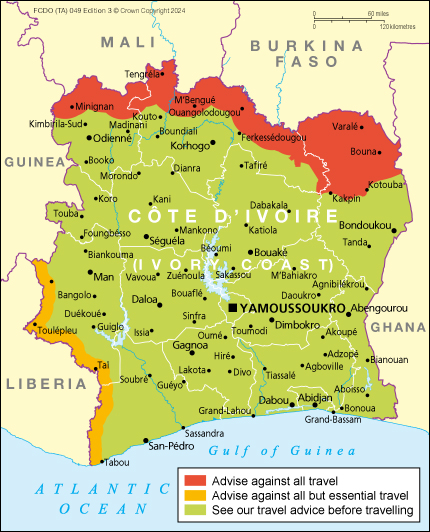
Warnings — Foreign OfficeForeign Office ↗updated 29.05.2026 · read 15.10.2026
Warnings — Foreign Office
Your travel insurance could be invalidated if you travel against advice from the Foreign, Commonwealth & Development Office (FCDO).
Borders with Burkina Faso and Mali
FCDO advises against all travel to:
- within 40km of the borders with Burkina Faso and Mali
- Northern Zanzan and Savanes provinces
- Comoé National Park
This is due to an increased risk of terrorist attacks and kidnaps by terrorists based in the Sahel region, which includes Burkina Faso and Mali.
Côte d’Ivoire-Liberia border
FCDO advises against all but essential travel to within 20km of the border with Liberia owing to the risk of serious violence by local militias.
Find out more about why FCDO advises against travel .
Regional risks — Foreign OfficeForeign Office ↗updated 29.05.2026 · read 15.10.2026
Regional risks — Foreign Office
This section has safety advice for regions of Côte d’Ivoire. It only covers regions where FCDO has specific advice.
You should also read FCDO ’s overall travel advice .
Borders with Burkina Faso and Mali
FCDO advises against all travel to within 40km of the borders with Burkina Faso and Mali. There is an increased risk of terrorist attacks and kidnaps by terrorists based in the Sahel region, which includes Burkina Faso and Mali.
Northern provinces
FCDO also advises against all travel to:
- Northern Zanzan and Savanes provinces
- Comoé National Park
See Safety and security for details about terrorism risks in Côte d’Ivoire.
Côte d’Ivoire-Liberia border
FCDO advises against all but essential travel to within 20km of the border with Liberia. This is due to the risk of clashes between local militias and security forces. Fatal clashes have taken place in and around this area in the past. If you travel to this area, seek professional security advice locally.
Safety — Foreign OfficeForeign Office ↗updated 29.05.2026 · read 15.10.2026
Safety — Foreign Office
This guide also has safety advice for regions of Côte d’Ivoire .
Terrorism
There is a high threat of terrorist attack globally affecting UK interests and British nationals, including from groups and individuals who view the UK and British nationals as targets. Stay aware of your surroundings at all times.
UK Counter Terrorism Policing has information and advice on staying safe and what to do in the event of a terrorist attack. Find out how to reduce your risk from terrorism while abroad .
Terrorism in Côte d’Ivoire
Terrorist attacks in Côte d’Ivoire cannot be ruled out.
Attacks could be indiscriminate, including in places visited by foreign nationals such as:
- beach resorts
- hotels
- cafés and restaurants
- major sporting events
The main threat in Côte d’Ivoire is from Jama’at Nusrat al-Islam wal-Muslimin (JNIM) and other al-Qa’ida (AQ) affiliated groups, including al-Qa’ida in the Islamic Maghreb (AQIM). JNIM is mainly active in the northern border areas, including the Comoé National Park in the north-east, but attacks could occur anywhere, including major towns and cities such as Abidjan.
Stay aware of your surroundings, keep up to date with local media reports and follow the advice of the local authorities.
Political situation
Political demonstrations sometimes take place in Abidjan and regional towns, particularly around elections. The authorities may use tear gas to disrupt unauthorised protests. Crowds can gather quickly, and roadblocks are common. It is possible that, in the event of significant unrest, internet access might be restricted.
You should:
- avoid crowds and demonstrations
- follow local instructions and any additional security checks or measures
- monitor local media
Be alert near military barracks and military installations.
Personal security measures
If you’re staying for long in Côte d’Ivoire, you should seek professional security advice and regularly review personal security arrangements. You should keep a stock of food and water.
Crime
There is a risk of violent crime in Abidjan, including armed break-ins to private residences and armed hold-ups in the street. Though not common, they do occur.
Street crime
To reduce your personal risk:
- use taxi apps or pre-arranged private taxis
- avoid using public transport after dark
- make sure your accommodation has security measures in place
- keep any valuables out of sight and do not wear expensive-looking jewellery or watches
- do not walk after dark
- take transport to use ATMs or to exchange money at the bank
To prevent card fraud, keep your bank card in sight when paying bills.
Vehicle crime
There have been attacks by armed robbers on private cars driving on the main roads in the west of the country. You could be at risk in daylight as well as at night.
Keep your car doors locked, windows shut and all valuables out of sight while driving.
Personal ID
You must carry your passport. Carry the original as the police will not always accept copies.
Dress code
Dress modestly when visiting religious places or buildings.
Illegal drugs and prison sentences
Drug trafficking and possession are illegal. If you’re found guilty, you could receive a long prison sentence or a heavy fine.
Using cameras in secure areas
It is prohibited to take photographs near sensitive installations, including:
- military sites
- government buildings
- radio and TV stations
- the Presidency building
- Abidjan Airport
LGBT+ travellers
Same-sex sexual activity is not illegal in…
American passport — U.S. Department of State
The State Department published no readable advisory for this country at this reading: consult travel.state.gov directly.travel.state.gov ↗read 16.10.2026
Global Affairs Canada — additional reading
Exercise a high degree of caution (with regional advisories)
Avoid all travel to within 50 km of the borders with Mali and Burkina Faso, due to the risk of terrorist activity.
- Borders with Mali and Burkina Faso — Avoid all travel to within 50 km of the borders with Mali and Burkina Faso, due to the risk of terrorist activity.
Avoid non-essential travel to the following regions, within 25 km of the border with Liberia, due to crime, insecurity and recurrent inter-community conflicts:
- Cavally
- San Pedro
- Tonkpi
Open Government Licence – Canada · October 14, 2026 09:37 EDTtravel.gc.ca ↗updated 14.10.2026 · read 16.10.2026
- Always carry your original passport, as local authorities may request to see identification at any time and may not accept copies.
- Penalties for drug possession, use, or trafficking are severe, potentially leading to long prison sentences and heavy fines.
- Photography of sensitive installations, including military sites and government buildings, is prohibited; seek permission before photographing individuals.
- In case of a car accident, remain calm, stay at the scene, and call the national police at 100 or 01 03 79 91 44 before moving your vehicle.
- Exporting cultural objects requires an official export permit from the National Museum; purchased art must be accompanied by this document.
- Be aware that consular officials cannot interfere in private legal matters or judicial affairs of another country.
Faithful summary of the official texts below, which prevail.
Global Affairs Canada — written for Canadian travellers, valid for all
Local laws
You must abide by local laws. Learn about what you should do and how we can help if you are arrested or detained abroad.
Drugs
Penalties for possession, use or trafficking of illegal drugs are severe. If you are convicted, you can expect jail sentences and heavy fines. Drugs, alcohol and travel
International Child Abduction
The Hague Convention on the Civil Aspects of International Child Abduction is an international treaty. It can help parents with the return of children who have been removed to or retained in certain countries in violation of custody rights. It does not apply between Canada and Côte d’Ivoire. If your child was wrongfully taken to, or is being held in Côte d’Ivoire by an abducting parent:
- act as quickly as you can
- consult a lawyer in Canada and in Côte d’Ivoire to explore all the legal options for the return of your child
- report the situation to the nearest Canadian government office abroad or to Global Affairs Canada by calling the Emergency Watch and Response Centre
If your child was removed from a country other than Canada, consult a lawyer to determine if The Hague Convention applies. Be aware that Canadian consular officials cannot interfere in private legal matters or in another country's judicial affairs.
Identification
Local authorities may request to see your ID at any time.
- Always carry valid identification or a photocopy of it
- Keep a photocopy of your passport, visa or residence permit in a safe place in case they’re lost or seized
- Keep a digital copy of your ID and travel documents
Photography
Photography of sensitive installations is prohibited, including:
- military sites
- government buildings, including radio and television stations
- the presidential palace
- the airport
- the Charles de Gaulle and Houphouet-Boigny bridges in Abidjan
Seek permission before taking photos of individuals.
Dress and behaviour
To avoid offending local sensitivities:
- dress conservatively
- behave discreetly
- respect religious and social traditions
Export of cultural objects
The export of cultural objects is regulated. Art objects purchased in Côte d'Ivoire must be accompanied by an export permit issued by the National Museum.
Driving
You should carry an international driving permit. In the event of a car accident:
- stay calm and avoid confrontation
- remain at the scene of the accident
- call the national police at 100 or 01 03 79 91 44 to report the accident and request the intervention of the transport police
- don't move your vehicle until the authorities arrive
If you feel in danger:
- ensure your doors are locked and your windows are closed
- drive to the nearest police station or secure location
- report the accident to the police and your insurance company as soon as possible
More about the International Driving Permit
Money
The currency in Côte d'Ivoire is the African Financial Community franc (CFAF). Credit cards are accepted at major hotels, and some restaurants and shops. ATMs are available in Abidjan and most major cities. Carry cash outside major cities.
Open Government Licence – Canada · October 14, 2026 09:37 EDTtravel.gc.ca ↗updated 14.10.2026 · read 16.10.2026
Foreign Office — laws and cultural differences
Personal ID
You must carry your passport. Carry the original as the police will not always accept copies.
Dress code
Dress modestly when visiting religious places or buildings.
Illegal drugs and prison sentences
Drug trafficking and possession are illegal. If you’re found guilty, you could receive a long prison sentence or a heavy fine.
Using cameras in secure areas
It is prohibited to take photographs near sensitive installations, including:
- military sites
- government buildings
- radio and TV stations
- the Presidency building
- Abidjan Airport
LGBT+ travellers
Same-sex sexual activity is not illegal in Côte d’Ivoire, but the law does not recognise same-sex partnerships or marriage. Attitudes are less tolerant and there is no specific anti-discrimination law to protect LGBT+ people. Read more advice for LGBT+ travellers.
Open Government Licence v3.0gov.uk ↗updated 29.05.2026 · read 15.10.2026
FDFA (Switzerland) — laws and customs, in French
Specific legal provisions
Bien que les prescriptions en la matière soient relativement floues, il est recommandé d’éviter de prendre des photos de toute installation militaire ainsi que des forces de l’ordre. Les infractions à la loi sur les stupéfiants, y compris la détention de minimes quantités de drogue quelle qu'elle soit, sont passibles de lourdes peines de prison. Les procédures de poursuite judiciaire ou d’enquête policière sont différentes de celles en vigueur en Suisse: il faut s’attendre à de longs délais d’attente et tenir compte des us et coutumes locaux. Les services d’un avocat local bien choisi ou d’une avocate locale bien choisie sont dans ces cas absolument nécessaires. Les conditions de détention sont précaires.
FDFA travel advice, in Frencheda.admin.ch ↗updated 20.11.2025 · read 15.10.2026
What it changes for you: Air acceptable at this hour: nothing special to plan. Very high UV: sunscreen, hat and shade between 11 am and 4 pm; sunstroke and dehydration are travellers' first reasons to see a doctor.
Reading 06:00 (Africa/Abidjan)Open-Meteo ↗updated 16.10.2026 · read 16.10.2026
Air quality and UV: Open-Meteo.com (CC BY 4.0), data rounded and formatted by Maximum. Contains modified Copernicus Atmosphere Monitoring Service information 2026. Neither the European Commission nor ECMWF is responsible for any use that may be made of the Copernicus information or data it contains.
No value published by the World Bank in the last eight years for Ivory Coast: hospital beds per 1,000 people.
Reading: With 0.2 physicians per 1,000 people (96% fewer than Switzerland), the nearest hospital does not always have the capacity for a serious case: evacuation to an adequate centre is the rule, not the exception — that is what unlimited evacuation and repatriation cover. Health spending of 88 USD per person (Switzerland: 11,784) goes with private hospitals that bill foreigners in hard currency and ask for a guarantee before admission: the direct payment guarantee is what avoids the deposit.
World Bank — latest published value, year per indicatordata.worldbank.org ↗read 10.10.2026
What is happening in Ivory Coast right now
Live alerts and level changes, each with its official source. Continuously updated.
What governments have just written
Natural disasters and climate section – added information on El Niño
October 14, 2026 09:37 EDTtravel.gc.ca ↗updated 14.10.2026 · read 16.10.2026No level change recorded for this country since the log opened. The live alerts above are updated continuously.
Frequently asked questions — travel insurance Ivory Coast
What is the official risk level in Ivory Coast today?
Level 2/4 — Exercise Increased Caution, U.S. Department of State, retrieved on 16 October 2026.
- Is the whole country advised against? United States: no · France: no · United Kingdom: no · Switzerland: no (reading of 27 September 2026).
- Switzerland’s FDFA advises against travel to certain regions (published 20.11.2025).
- Contractually, only an FDFA, FOPH or WHO advisory against the trip opens Module A (art. 18.1) — that is not the case today.
- International medical cover, 24/7 number saved, and a read of the areas named under Safety & risks before booking the itinerary.
- We check these sources every morning and e-mail you the day one changes (Alerts button).
Sourcestravel.state.gov · read 16.10France Diplomatie · updated 15.09 · read 15.10DFAE · updated 20.11 · read 15.10207-country comparison
Is the whole of Ivory Coast advised against, or only some areas?
An area advised against does not rule out the country.
- Official answers: United States: no · France: no · United Kingdom: no · Switzerland: no.
- Foreign Office, regional risks: “This section has safety advice for regions of Côte d’Ivoire. It only covers regions where FCDO has specific advice. You should also read FCDO ’s overall travel advice . Borders with Burkina Faso and Mali FCDO advises against all travel to within 40km of the…”
- Keep your country of residence's advisory on booking day and on departure day: that is what your policy's clauses cite.
SourcesFrance Diplomatie · updated 15.09 · read 15.10Foreign Office · updated 29.05 · read 15.10State Department · read 16.10
What are the entry requirements for Ivory Coast with my passport?
The rules depend on the passport, not on the destination alone.
- French passport (France Diplomatie): French nationals require a biometric visa and yellow fever vaccination for entry into Côte d'Ivoire, with passports valid for over six months. Biometric visas can be obtained from the Ivorian Consulate General in Paris or online via snedai.com, with an e-visa issued upon arrival. Non-residents must declare foreign currency exceeding the equivalent of €1,500 (one million CFA francs) upon entry.
- British passport (Foreign Office): British citizens must ensure their passport is valid for at least six months beyond their arrival date in Côte d’Ivoire. All travellers require a visa for Côte d’Ivoire and must apply for an e-visa online at least ten working days before departure. A valid certificate proving yellow fever vaccination is mandatory for entry into Côte d’Ivoire.
- American passport: the requirements are on the State Department country page (travel.state.gov).
- Swiss passport: the FDFA refers you to the destination's embassy in Switzerland.
- Pick your passport at the top of Before you go › Entry: the official text that concerns you comes first, with its “In brief” summary.
SourcesFrance Diplomatie · updated 15.09 · read 15.10Foreign Office · updated 29.05 · read 15.10State Department · read 16.10
Do I need an insurance certificate for a Ivory Coast visa?
For a Schengen visa, yes: at least €30,000 of travel medical insurance (Regulation (EC) No 810/2009, art. 15).
- Many other countries ask for it on entry or for a visa, case by case: check Before you go › Entry, with your passport.
- Subscribe: the named certificate arrives by e-mail on payment, with your name, dates and limits (EUR 1.5M medical expenses, unlimited evacuation and repatriation) — the ones consulates check.
- Attach it to the visa file; if in doubt about the format, write to us.
SourcesRegulation (EC) 810/2009, art. 15General conditions, policy 20 00 479
What does Maximum Insurance do in Ivory Coast, concretely?
VIP Pack — €990 for twelve months, unlimited trips.
- EUR 1.5M emergency medical expenses, unlimited medical evacuation and repatriation, search and rescue EUR 50,000, cancellation or change EUR 5,000.
- One 24/7 number, +41 22 ••• •• ••: Maximum sends its direct payment guarantee to the hospital (art. 2.12).
- Network of 45,000 providers (art. 6.9); evacuation is decided, organised and paid by Maximum's medical team if the local facility is not enough (art. 6.2.2).
- Around Yamoussoukro, the nearest hospital read from OpenStreetMap: Centre Hospitalier Régional de Yamoussoukro · 0.3 km · 24/7 emergency room.
- Named certificate by e-mail on payment, no medical questionnaire.
SourcesGeneral conditions, policy 20 00 479OpenStreetMap · read 13.10
How much does a medical repatriation from Ivory Coast cost?
From 30 000 € to 200 000 € depending on severity and distance (Le Ciel Africain, 2026).
- Without cover: the hospital asks for a deposit before admission, and the medical flight is paid up front.
- With the VIP Pack: the evacuation is decided and settled by Maximum (art. 6.2.2) — no advance, no cap.
SourcesLe Ciel Africain, 2026General conditions, policy 20 00 479
What should I do if hospitalised in Ivory Coast?
Six steps, in this order.
- 1. Call +41 22 ••• •• •• before paying anything, or have the front desk call: it is the condition for full cover (otherwise: reduced or refused benefits).
- 2. Ask for a hospital in the Maximum network (art. 6.9) — the nearest: Centre Hospitalier Régional de Yamoussoukro · 0.3 km · 24/7 emergency room.
- 3. See a doctor the same day and leave with the certificate: without an on-the-spot finding, nothing is covered (art. 33).
- 4. Admitted for more than 24 h? The front desk calls Maximum: direct payment guarantee, no deposit (art. 2.12).
- 5. Book no ambulance or flight yourself (art. 6.2.2).
- 6. Once home, file within 30 days (art. 35.7).
- Local emergency services: police 111 / 110 / 170 · ambulance 185 · fire 180.
SourcesSpecial conditions 01.26General conditions, policy 20 00 479
Which emergency numbers in Ivory Coast?
Local emergency services: police 111 / 110 / 170 · ambulance 185 · fire 180
- Maximum, 24/7, before any payment: +41 22 ••• •• ••.
- France — Ambassade de France (216.8 km) · +22520207400
- Switzerland — Ambassade de Suisse (218.3 km) · +225 22 44 79 89
- United Kingdom — Residence de l’ambassadeur du Royaume-Uni (218.1 km)
- United States — Ambassade des États-Unis (219.1 km) · +225 22-49-40-00
- Save these numbers before leaving; in immediate danger, call local emergency services first, then Maximum.
SourcesEmergencyNumberAPI · Wikidata · read 08.10OpenStreetMap · read 13.10
Is an Amex, Visa or Mastercard enough in Ivory Coast?
At today's level 2/4, card by card:
- Amex Platinum — No area exclusion at this level — but three written limits: deductible and prior approval, 90-day cap, advance under conditions.
- Visa — No express area exclusion — but a €156,000 cap, 90 days, and the war/instability exclusion in the background.
- Mastercard — No exclusion in play at this level — but a €155,000 cap and 90 covered days.
- Three lines to read in your notice: the duration (often 90 days per trip), the settlement (reimbursement afterwards or direct payment of the hospital) and the area exclusion at level 4/4.
SourcesAmex Platinum France T&Cs, 01.2025 — general exclusion n° 11BNP Paribas Visa Infinite notice (policy PT7), 04.2025 — comFortuneo World Elite Mastercard notice, 01.2026 — art. 5.5 '
Are a health plan or a travel policy enough in Ivory Coast?
A health plan reimburses at home; here, the hospital asks for a payment guarantee before admission.
- Health plan — A health plan treats you at home. Here the hospital asks for a guarantee before admission — not a later reimbursement.
- Travel policy — No area exclusion at this level — compare cap, deductible and covered duration.
- A travel policy often has a territorial clause at level 4/4 and a 90-day limit per trip.
- Have your IPID number or the PDF of the terms and ask an expert to call you back: the answer is in the document, not in the brochure.
SourcesGeneral conditions, policy 20 00 479
How do I use the medical network on this page?
Around Yamoussoukro: 17 hospitals and clinics, 5 with a 24/7 emergency room, 19 pharmacies, 12 doctors' practices (OpenStreetMap, hospital list read on 14.10.2026).
- Type your city, hotel or beach: the map re-centres, 24/7 emergency rooms come first.
- Each row gives the phone when the source publishes it, the nearest street, directions and the Google Maps listing.
- The PDF briefing repeats the same places, numbered on a printable map.
- No customer reviews: OpenStreetMap has none, and we invent none.
Which vaccines and health precautions for Ivory Coast?
The sourced detail is under Medical network › Health: vaccines, diseases present, altitude, outbreaks.
- CDC (Travelers' Health), depending on the trip: Routine vaccines, COVID-19, Chikungunya, Cholera, Hepatitis A, Hepatitis B, Malaria.
- France Diplomatie reports in the country: dengue, malaria, chikungunya — mosquito protection day and night.
- See a doctor or a travel clinic 8 weeks before departure (Foreign Office).
- Carry your medicines in their packaging, with a prescription using international non-proprietary names (France Diplomatie).
SourcesCDC Travelers' Health · read 10.10France Diplomatie · updated 15.09 · read 15.10OMS · read 15.10Foreign Office · updated 29.05 · read 15.10
Can I be treated in Ivory Coast, or will I be evacuated?
0.2 physicians per 1,000 people (2023) versus 4.5 in Switzerland.
- With 0.2 physicians per 1,000 people (96% fewer than Switzerland), the nearest hospital does not always have the capacity for a serious case: evacuation to an adequate centre is the rule, not the exception — that is what unlimited evacuation and repatriation cover. Health spending of 88 USD per person (Switzerland: 11,784) goes with private hospitals that bill foreigners in hard currency and ask for a guarantee before admission: the direct payment guarantee is what avoids the deposit.
- When the local facility is not enough, Maximum's medical team decides the evacuation to a suitable centre, and pays for it (art. 6.2.2).
SourcesWorld Bank · read 10.10General conditions, policy 20 00 479
Ivory Coast: safety, in figures?
Comparable figures (homicides, roads, incidents) are under Safety & risks › Incidents.
- 24.1 road deaths per 100,000 people versus 2.2 in Switzerland (World Bank, WHO).
- On the road, 11 times more deaths than in Switzerland: road crashes are the leading cause of death of healthy travellers (CDC) — seat belt, no night driving, a driver or a taxi from a rank.
Where is my embassy in Ivory Coast, and why register?
The nearest representations, by passport (OpenStreetMap):
- France — Ambassade de France (216.8 km) · +22520207400
- Switzerland — Ambassade de Suisse (218.3 km) · +225 22 44 79 89
- United Kingdom — Residence de l’ambassadeur du Royaume-Uni (218.1 km)
- United States — Ambassade des États-Unis (219.1 km) · +225 22-49-40-00
- Register before leaving: France: Ariane · Switzerland: Travel Admin · United Kingdom: Foreign Office alerts · United States: STEP.
- Two minutes, and in a crisis your country's authorities can reach you and count you in an evacuation.
- Pick your passport at the top of Contacts: your embassy comes first.
SourcesOpenStreetMap · read 13.10DFAE · updated 20.11 · read 15.10
Which regions of Ivory Coast should I avoid, precisely?
4 regions advised against, fully or partly, by at least one official reading.
- Your point (Lacs): country-wide vigilance.
- Partly advised against: Comoé, Moyen-Cavally, Savanes, Zanzan.
- Areas quoted without a region: Global Affairs Canada — Avoid all travel to within 50 km of the borders with Mali and Burkina Faso, due to the…; Global Affairs Canada — Avoid non-essential travel to the following regions, within 25 km of the…: San Pedro; Global Affairs Canada — Avoid non-essential travel to the following regions, within 25 km of the border…: Tonkpi; Foreign Office — Within 40km of the borders with Burkina Faso and Mali…
- Maximum does not exclude these areas: the VIP Pack covers care and repatriation there (sanctions, embargoes and a country already at war at departure remain enforceable).
SourcesGlobal Affairs Canada · updated 14.10 · read 16.10Foreign Office · updated 29.05 · read 15.10France Diplomatie · updated 15.09 · read 15.10
Which laws and customs should I know in Ivory Coast?
Local laws apply to every traveller; here is what the official texts say.
- Always carry your original passport, as local authorities may request to see identification at any time and may not accept copies.
- Penalties for drug possession, use, or trafficking are severe, potentially leading to long prison sentences and heavy fines.
- Photography of sensitive installations, including military sites and government buildings, is prohibited; seek permission before photographing individuals.
- In case of a car accident, remain calm, stay at the scene, and call the national police at 100 or 01 03 79 91 44 before moving your vehicle.
- Exporting cultural objects requires an official export permit from the National Museum; purchased art must be accompanied by this document.
SourcesGlobal Affairs Canada · updated 14.10 · read 16.10Foreign Office · updated 29.05 · read 15.10
Who can I call at any hour from Ivory Coast?
Every foreign ministry runs a 24/7 emergency line for its nationals.
- France — Crisis and Support Centre — French Ministry for Europe and Foreign Affairs: +33 1 53 59 11 00. 24/7 emergency line, standard rate. First contact abroad: the French embassy or consulate.
- Switzerland — FDFA Helpline: +41 58 465 33 33 · +41 800 24 7 365. 24/7, 365 days a year — helpline@eda.admin.ch. Beware of scam calls spoofing these numbers.
- United Kingdom — Foreign, Commonwealth & Development Office: +44 20 7008 5000. 24 hours, for British nationals.
- United States — Overseas Citizens Services — U.S. Department of State: +1 202 501 4444 · +1 888 407 4747. From abroad; the second number from the U.S. and Canada.
- On site, Ambassade de France: +22520207400.
Sourcesdiplomatie.gouv.fr · updated 15.09 · read 15.10eda.admin.ch · updated 20.11 · read 15.10
A few useful phrases in French for Ivory Coast?
Emergency phrases, to show if pronunciation fails:
- Help! → Au secours !
- Call an ambulance! → Appelez une ambulance !
- I need a doctor. → J'ai besoin d'un médecin.
- Where is the nearest hospital? → Où est l'hôpital le plus proche ?
- Call the police! → Appelez la police !
SourcesMaximum Insurance
What should I keep after leaving Ivory Coast, and how do I file a claim?
Keep the entry stamp, the invoices, the prescriptions and the medical report.
- File within 30 days (art. 35.7) from your client area, with the documents; the official forms are pre-filled.
- Costs advanced on site are reimbursed against receipts.
- Fever, persistent diarrhoea or a rash in the following weeks? See a doctor and say where you have been — dengue, malaria, chikungunya circulate in the country (France Diplomatie).
SourcesGeneral conditions, policy 20 00 479
What does the Pack VIP Extreme add?
Cancellation or change up to EUR 20,000, special risk EUR 5,000 per person, crisis management and security, optional Kidnap & Ransom.
- Special risk (Module A): political event, attack, epidemic, natural disaster — opens when the FDFA, the FOPH or WHO advise against the trip (art. 18.1).
- Epidemic: assistance must be requested within 7 days of the WHO or FDFA qualification (art. 36.2).
- Crisis management and security: trip registration, monitoring, extraction, evacuation in case of riot, war, terrorism or disaster; Kidnap & Ransom subject to eligibility (art. 18.4).
- €2,290 a year, unlimited trips.
SourcesGeneral conditions, policy 20 00 479
A question not answered here? Ask Maximum below, or call the support number: every question gets a clear, actionable answer.
In a life-threatening emergency, call local emergency services first, then Maximum: +41 22 ••• •• •• — 24/7 support number, an adviser stays with you to the end.
What Maximum knows
The 207 country pages — hospitals, pharmacies, police, embassies, emergency numbers, official advice from four governments, health, safety in figures, events in progress — read around the city you name. Your policy — benefits, the six steps, claims, articles. The site — prices, certificate, subscription. Nothing else: what it does not know, it says so and hands you to an adviser.
Travelling to Abidjan: what changes
The published advisory level is national, but risk is not: business hubs (Abidjan) do not share the profile of border areas. The medical network shown on this page is computed around Yamoussoukro — real hospitals, evacuation airport and live alerts. Before a specific trip, always cross-check your country of residence's advisory: that is what your policy cites.
Same advisory level: Denmark · Djibouti · Spain · Eswatini · France · Gabon
The displayed level comes from the State Department, checked every morning. Before departure, always cross-check your country of residence's advisory: that is what your policy cites.
The level shown is the official U.S. Department of State level, checked daily. Maximum Insurance is an insurance distributor — general information, not personal advice.