Make sure you are up-to-date on all routine vaccines before every trip. Some of these vaccines include Chickenpox (Varicella) Diphtheria-Tetanus-Pertussis (DTaP, Tdap, or Td) Flu (influenza) Measles-Mumps-Rubella (MMR) Polio Shingles
Maximum Alerts / Tunisia
Level published by the State Department on 20.05.2026 · read 16 October 2026 · source checked daily
Tunisia — official level as of 16 October 2026: Level 2/4 ("Exercise Increased Caution"), from the U.S. Department of State. Maximum Insurance covers this country: hospital settled directly, unlimited repatriation, EUR 1.5M, certificate on payment.
Every country has its own scale, so we ask them all the same question: is the whole country advised against?
An advisory covering only areas of the country does not raise the answer: it stays “No”, and the area is shown in the relevant column.
The level shown on this page — and across this site — is the one published by the U.S. State Department, from 1 (normal precautions) to 4 (do not travel). France and the United Kingdom publish their own advisories, with their own rules: they add to that level, they do not replace it.
You will be alerted only on the day the official level of this country changes.
In a life-threatening emergency, call local emergency services first, then Maximum: +41 22 ••• •• •• — 24/7 support number, an adviser stays with you to the end.
The 207 country pages — hospitals, pharmacies, police, embassies, emergency numbers, official advice from four governments, health, safety in figures, events in progress — read around the city you name. Your policy — benefits, the six steps, claims, articles. The site — prices, certificate, subscription. Nothing else: what it does not know, it says so and hands you to an adviser.
What I say on the phone
What to do, in this order
In immediate danger, call local emergency services first. Then contact assistance without delay; before engaging a service, seek approval under your policy. Cover is confirmed by the insurer.
Ask assistance where to get care and whether direct cover can be arranged. It confirms the facility and seeks the insurer's approval under your policy. In immediate danger, call local emergency services first.
Even for a pain you meant to shrug off. Without a medical certificate written on the spot, the same day, the insurer cannot cover the event — a certificate written after you return does not count.
The hospital desk sends the request to assistance. Direct payment depends on the insurer's approval and the policy; the call alone does not guarantee it. Have the response confirmed before relying on no up-front payment.
In a life-threatening emergency, call local emergency services immediately. For an arranged transfer or repatriation, contact assistance: the insurer's medical team decides on measures under the policy. A medical flight booked without approval may not be reimbursed.
Even if everything went well on the ground. Send your invoices and the medical report within 30 days; after that, compensation may be reduced or refused.
Reading hospitals, doctors and pharmacies around this point…
List read from OpenStreetMap on 14.10.2026, not read again since: these facilities may have changed.
Country dial code: +216
OpenStreetMap list read on 14.10.2026, straight-line distances. In an emergency: +41 22 ••• •• ••.
82 شارع يوغرطة Tunis-Mutuelleville
near شارع لندن
شارع الحبيب بورقيبة باردو
neurology
Mo-Sa 08:30-17:30
near شارع الحبيب بورقيبة
3 Rue Habib KHANFIR El Menzah 9 تونس
near شارع عثمان بن عفان
near شارع رجاء بن عمار
near نهج 18 جانفي 1952
أريانة
near ساحة سيدي عمار
شارع الهادي نويرة النصر 1
surgery
Mo-Fr 09:00-17:00; Sa 09:00-13:00
near شارع الطّيب المهيري
Avenue Khaled ibn Walid
شارع الشّهداء
near Ahmed
شارع الطّيب المهيري
near 42558
general
near الطريق الجهوية الزهراء - السيجومي
general
near نهج المزري
near شارع الهادي السعيدي
near نهج العسل
near نهج زغوان
near نهج آلان سافاري
near شارع الشادلي قلالة
near نهج بديع الزمان
near شارع لندن
near نهج باب سويقة
near شارع يوغرطة
near نهج لوسي فور
نهج 8300 تونس
near نهج الالعاب الرياضية
near شارع جان جوريس
near نهج الحبيب الشطي
شارع ابن الخطيب تونس
near Rue Abderrahmen Ibn Aouf
1bis شارع فطومة بورقيبة
near شارع 20 مارس 1956
near شارع الحبيب ثامر
near نهج شارل ديغول
near Avenue de Carthage
near شارع الحبيب بورقيبة
near شارع محمود بيرم التونسي
24 شارع المنجي سليم Tunis
near نهج عمار إبن ياسر
near شارع عبد الرحمان الخبثاني
Rue du dialogue des civilisations التحرير
41 Avenue Aberrahman Khabthani أريانة
Avenue Hédi Nouira تونس
near شارع الهادي نويرة
near شارع رجاء بن عمار
54 Avenue Hedi Nouira Ennasr 2
near شارع المنجي سليم
5 نهج موريطانيا تونس
3 زنقة أبو العتاهية تونس
98 نهج فلسطين تونس
Mo-Fr 07:45-16:15
near شارع جامعة الدول العربية
4 نهج ليبيريا تونس
Mo-Fr 09:00-15:00 open "The Consular Section is open to public"
10 زنقة أنطلاس تونس
47 نهج 1 جوان 1955 تونس
7 نهج اشطارت تونس
Mo-Th 08:00-16:00; Fr 08:00-13:00
9 نهج اشطارت تونس
17 شارع الحكيم كونساي تونس
4 نهج الصاحب بن عباد تونس
near نهج المستشفى العسكري
near نهج محمد علي الحامي
near نهج الطاهر ممي
near Rue Ali Dargouth
الزهور
near شارع العهد الجديد
Mo-Sa 08:30-16:00
Avenue Ali Belhouane شارع علي البلهوان تونس
near نهج شارل ديغول
نهج 18 جانفي 1952
نهج الحكام
أريانة
شارع المنصف باي تونس
near Rue Abdel Majid Ellaoui
near شارع بلحسن بن شعبان
near طريق مفتاح سعد الله
near شارع البشير صفر
near شارع الهادي السعيدي
near نهج الدكتور مامي
near نهج ماليزيا
near شارع لوي براي
Avenue Habib Bougatfa Tunis
Mo-Su 04:00-22:00
near شارع محمد الخامس
near شارع 20 مارس 1956
near شارع الحبيب ثامر
near زنقة الثلج
شارع غانا تونس
near شارع الحبيب بورقيبة
near نهج سيدي البشير
Forecast: MET Norway (Norwegian Meteorological Institute, CC BY 4.0), grouped by day and formatted by Maximum.
10-16 0.3 · 10-17 0.2 · 10-18 0.2 · 10-19 0.1 · 10-20 0.1 · 10-21 0.2 · 10-22 0.2 m³/s
Simulated discharge: Open-Meteo.com (CC BY 4.0), data rounded and formatted by Maximum. Contains modified Copernicus Emergency Management Service information 2026. For information only: this is not a flood warning; only national or regional authorities issue those.
No geolocated event in this country at this reading.
No geolocated UCDP incident in this country.
No news located around Tunis in this reading.
National numbers (Wikidata, 2026 reading). On site, call local emergency services first, then Maximum: the insurer sends its payment guarantee to the hospital.
Make sure you are up-to-date on all routine vaccines before every trip. Some of these vaccines include Chickenpox (Varicella) Diphtheria-Tetanus-Pertussis (DTaP, Tdap, or Td) Flu (influenza) Measles-Mumps-Rubella (MMR) Polio Shingles
All eligible travelers should be up to date with their COVID-19 vaccines. Please see Your COVID-19 Vaccination for more information.
Recommended for unvaccinated travelers one year old or older going to Tunisia. Infants 6 to 11 months old should also be vaccinated against Hepatitis A. The dose does not count toward the routine 2-dose series. Travelers allergic to a vaccine component should receive a single dose of immune globulin, which provides effective protection for up to 2 months depending on dosage given.
Recommended for unvaccinated travelers younger than 60 years old traveling to Tunisia. Unvaccinated travelers 60 years and older may get vaccinated before traveling to Tunisia.
Cases of measles are on the rise worldwide. Travelers are at risk of measles if they have not been fully vaccinated at least two weeks prior to departure, or have not had measles in the past, and travel internationally to areas where measles is spreading.
Monkeypox vaccination is recommended for any adult who anticipates any of the following activities during travel: Sexual or intimate contact with a new partner Sexual or intimate contact at a commercial sex venue, like a sex club or bathhouse Sexual or intimate contact in exchange for money, goods, drugs, or other trade Sexual or intimate contact in association with a large public event, such as a rave, party, or…
Dogs infected with rabies are commonly found in Tunisia. If rabies exposures occur while in Tunisia, rabies vaccines are typically available throughout most of the country.
Recommended for most travelers. Typhoid vaccine is not 100% effective. Practicing safe food and water habits , including washing hands at key times , can also help prevent typhoid fever .
CDC recommendations: Vaccine is not recommended. Country entry requirements: Vaccine is not required. Updated April 23, 2025
CDC Travelers' Health, re-read weekly — the recommendation depends on your age, vaccines and itinerary: confirm it with a doctor or a travel clinic 4 to 6 weeks before departure.CDC ↗read 10.10.2026
Moderate incidence: nothing special for a short stay.
High coverage.
World Bank — latest published valuedata.worldbank.org ↗read 10.10.2026
Source: France Diplomatie (health advice, in French).
Faithful summary of the official texts below, which prevail.
WHO: no outbreak reported for this country in the last 24 months (Disease Outbreak News).who.int ↗read 15.10.2026
FDFA (Switzerland) — medical care, in French
Les soins médicaux de base sont en principe assurés. Toutefois, des pénuries de médicaments se produisent de plus en plus souvent. Les hôpitaux exigent une garantie financière (attestation écrite de couverture des frais ou une avance de payement) avant de commencer un traitement. En cas de maladie ou de blessure grave, il est recommandé de se faire soigner en Europe. Si vous prenez régulièrement des médicaments , emportez-en une quantité suffisante avec vous. N'oubliez toutefois pas que l'importation de médicaments contenant des stupéfiants (p. ex. méthadone) ou l'importation de substances utilisées pour traiter des troubles psychiques est soumise à des prescriptions spéciales dans de nombreux pays. Le cas échéant, renseignez-vous à ce sujet, avant le départ, auprès de la représentation étrangère compétente (ambassade ou consulat) et consultez la rubrique Liens voyages , où vous trouverez, entre autres, de plus amples informations sur ce thème ainsi que sur la médecine du voyage en général. Les informations concernant la propagation de maladies et les éventuelles mesures de protection à prendre sont fournies par le personnel médical et les centres de vaccination. Liens voyages
France Diplomatiesource ↗updated 15.09.2026 · read 15.10.2026
Consulter si besoin son médecin traitant ou un centre de vaccinations internationales (médecine des voyages) pour faire une évaluation de son état de santé et bénéficier de recommandations sanitaires, notamment sur les vaccinations. Consulter éventuellement son dentiste avant le départ.
Constituer sa pharmacie personnelle en conséquence et n’emporter dans ses bagages que les médicaments strictement nécessaires ; ne jamais consommer de médicaments achetés dans la rue (risque de contrefaçons). Les médicaments doivent être dans leur emballage d’origine avec les étiquettes originales, accompagnés d’une ordonnance portant le nom des médicaments en dénomination commune internationale (DCI). Il est indispensable de vérifier que les médicaments concernés sont autorisés dans le pays visité : pour plus d’informations, consulter la fiche Informations pratiques .
Les vaccins recommandés en France sont également indispensables lors d’un séjour à l’étranger : les maladies qu’ils préviennent circulent partout dans le monde, parfois même plus fréquemment qu’en France. Avant tout départ, le voyageur (adulte et enfant) doit donc d’abord s’assurer d’être à jour du calendrier vaccinal français, en particulier des vaccins contre la diphtérie, le tétanos, la poliomyélite, la coqueluche mais aussi contre la rougeole. Le carnet de vaccination peut être demandé à l’arrivée de certains pays.
Des vaccinations complémentaires peuvent être nécessaires :
Il est donc conseillé de consulter son médecin traitant ou un centre de vaccinations internationales (médecine des voyages) suffisamment de temps avant le voyage.
La fièvre du Nil occidental ( West Nile Virus ) est une maladie des oiseaux transmise à l’humain par l’intermédiaire de piqûres de moustiques infectés.
La maladie est souvent asymptomatique ou bénigne (fièvre, maux de tête, douleurs musculaires, frissons, éruption cutanée) mais dans de rares cas, des complications de type neurologique peuvent survenir (méningite, encéphalite) et entrainer des séquelles voire le décès.
Il n’existe pas de vaccin contre cette maladie pour les humains, la prévention repose uniquement sur la protection contre les piqûres de moustiques.
Pour plus d’informations, consulter le site de l'Institut Pasteur et le site du ministère de la Santé .
La fièvre typhoïde est une maladie infectieuse causée par des bactéries présentes dans l’eau contaminée par des matières fécales d’origine humaine. L’infection résulte le plus souvent de l’ingestion d’eau ou d’aliments contaminés, ou d’une transmission directe de personne à personne. Les symptômes surviennent en moyenne 3 semaines après la contamination et associent fièvre, maux de tête, perte d’appétit, douleurs abdominales avec diarrhée ou constipation, fatigue et parfois, éruption cutanée. Dans les formes plus graves, la fièvre typhoïde peut être fatale en l’absence de traitement.
Les mesures de prévention reposent sur les règles élémentaires d’hygiène générale vis-à-vis de l’eau, des aliments et du lavage des mains ainsi que sur la vaccination.
Pour plus d’informations , consulter le site de l'Institut Pasteur .
La rage est une maladie virale mortelle affectant le système nerveux et présent dans la salive des animaux infectés, tels que chiens, chats, chauves-souris et autres mammifères sauvages. Le virus se transmet par morsure, griffure ou contact de la salive avec une peau lésée ou une muqueuse. L’évolution est rapide avec l’apparition de fièvre, maux de tête, anxiété puis de troubles neurologiques (coma). La rage est presque toujours mortelle une fois les symptômes déclarés. Il est recommandé d’éviter tout contact avec des animaux suspects domestiques ou sauvages. La vaccination préventive contre la rage avant un séjour en zone exposée peut être indiquée en fonction du type de voyage et en particulier chez les jeunes enfants dès qu’ils marchent. Il est conseillé de demander conseil à un médecin ou à un centre de vaccinations internationales.
En cas d’exposition à risque, consulter immédiatement un médecin même si la vaccination…
Pour plus d’informations, consulter le site du ministère en charge de la Santé et le site de l'Assurance Maladie .
Pour plus d’informations, consulter le site du ministère en charge de la Santé .
Health — Foreign OfficeForeign Office ↗updated 24.07.2026 · read 15.10.2026
Before you travel check that:
This is particularly important if you have a health condition or are pregnant.
Call 190 and ask for an ambulance.
Contact your insurance company quickly if you’re referred to a medical facility for treatment.
At least 8 weeks before your trip:
See what health risks you’ll face in Tunisia , including biting insects and ticks.
The legal status and regulation of some medicines prescribed or bought in the UK can be different in other countries.
Read best practice when travelling with medicines on TravelHealthPro .
If you’re bringing prescription medicines, keep them in the original packaging and carry a note from your GP confirming the medication has been prescribed to you. If you have any specific concerns about taking certain types of medication with you to Tunisia, contact the Tunisian Embassy in the UK .
FCDO has a list of list of medical providers in Tunisia where some staff will speak some English.
There’s no provision for free medical attention for foreign nationals in Tunisia. All doctors’ fees, medication and treatment in private clinics must be paid for on the spot (and sometimes before treatment). These costs can be high. Make sure you have adequate travel health insurance and accessible funds to cover the cost of any medical treatment abroad and repatriation.
Read FCDO guidance on travel and mental health . There is also mental health guidance on TravelHealthPro .
Places read from OpenStreetMap, within a circle of about 12 km: phone, email, address, website and hours when the source publishes them. No customer reviews, that source has none. Straight-line distances.
Notices vary by bank and vintage — yours prevails. On the right: the Maximum contract (public documents).
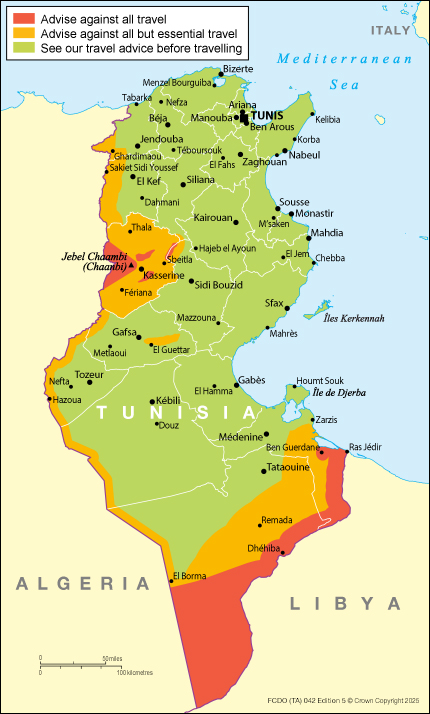
The country is not uniform: 5 regions advised against, fully or partly, by at least one official reading. Tunis is not one of them.
Faithful summary of the official texts below, which prevail.
the trip stays outside the advised-against regions. Any move into a red or orange region calls for a new, written decision. The areas quoted without a region (border, routes, localities) call for the same decision.
Global Affairs Canada
the governorate of Kasserine, including the mountain ranges and surrounding forests of the following mountains: Chaambi; Mghila, which extends into the governorate of Sidi Bouzid; Sammama; Selloum
Foreign Office
Kasserine Governorate, including the town of Sbeitla
Foreign Office
areas north and west of the town of Ghardimaou in Jendouba Governorate, including El Feidja National Park
Foreign Office
within 20km of the Tunisia-Algeria border in El Kef and Jendouba governorates, south of the town of Jendouba
Foreign Office
In addition, FCDO advises against all but essential travel to within 75km of the Tunisia-Libya border, including Remada and El Borma but excluding Zarzis, the C118 road and all areas in Medenine Governorate north of the road.
Global Affairs Canada
the cordoned-off military zone south of the town of Remada in the governorate of Tataouine
Global Affairs Canada — Advised against — all travel
the area within 20 km of the Algerian border, except for the highway P7 to/from the Malloula border crossing and following tourist towns, where you should exercise a high degree of caution: Aïn Draham; Chebika; Mides; Tabarka
Global Affairs Canada — Advised against — all travel
the area within 30 km of the border with Libya
Global Affairs Canada — Advised against — all but essential travel
the Delegation of Remada
Global Affairs Canada — Advised against — all but essential travel
Mount Orbata
Foreign Office — Advised against — all travel
the Chaambi Mountains National Park
Foreign Office — Advised against — all travel
Mount Salloum
Foreign Office — Advised against — all travel
Mount Sammamma
Foreign Office — Advised against — all travel
Mount Mghila
Foreign Office — Advised against — all but essential travel
within 10km of Mount Mghila
Foreign Office — Advised against — all but essential travel
Mount Orbata
Foreign Office — Advised against — all travel
the militarised zone south of the towns of El Borma and Dhehiba
Foreign Office — Advised against — all travel
within 20km of the rest of the Tunisia-Libya border area north of Dhehiba
Foreign Office — Advised against — all travel
the town of Ben Guerdane and immediate surrounding area
France Diplomatie (in French) — Advised against — all travel
Extrême Sud du pays — La région saharienne proche des frontières avec la Libye et avec l’Algérie est formellement déconseillée.
France Diplomatie (in French) — Advised against — all travel
Extrême Sud du pays — Il est formellement déconseillé de se rendre dans la zone montagneuse de l’Ouest (monts d’Orbata, Selloum, Semema, Chambi et Mghila), car pouvant abriter différentes activités terroristes, et proches de zones militarisées ou minées.
France Diplomatie (in French) — Advised against — all but essential travel
Sud du pays — Les déplacements sont déconseillés, sauf raison impérative, dans la zone désertique au sud et à l’Est de la ligne Bir Rijm Maatoug - Borj Bourguiba -Ben Guerdane (cette dernière ville étant comprise dans la zone formellement déconseillée).
France Diplomatie (in French) — Advised against — all but essential travel
Sud du pays — Les zones entre les monts Chambi, Semema et Mghila, la partie au sud du Mont Selloum, ainsi que les alentours du Mont Orbata sont déconseillés sauf raison impérative car ayant pu abriter différentes activités terroristes, et proches de zones militarisées ou minées.
France Diplomatie (in French) — Advised against — all but essential travel
Nord-ouest
Global Affairs Canada — Open Government Licence – Canada (14.10.2026) · Foreign Office — Open Government Licence v3.0 · France Diplomatie (13.03.2026) · Natural Earth
No located event in this reading.
Last change: This travel advice has been reviewed for accuracy with changes made throughout, including visa requirements, taking money into and out of Tunisia, electronic devices, drugs and illegal substances and power supply in summer months ('Entry re
Updated 20.05.2026
Exercise increased caution in Tunisia due to terrorism , crime , and unrest . Some areas have increased risk. Read the entire Travel Advisory.
U.S. government employees working in Tunisia are not allowed to travel to the following locations without prior coordination with the Tunisian government due to safety risks:
U.S. citizens in Tunisia are strongly advised to take the same precautions and not travel to these areas for any reason.
There is risk of terrorist violence, including terrorist attacks and other activity in Tunisia. Visit the U.S. Department of State's country reports on terrorism to learn more.
Terrorist groups continue plotting possible attacks in Tunisia. Terrorist groups and individuals may attack, and may do so without warning or a pre-meditated target. There is a country-wide state of emergency in effect. It gives more authority to security forces to maintain civil order. It allows the government to focus on fighting terrorism.
There is high risk of violence and armed conflict in the Desert South of Remada. It is a military zone and requires special government permission to enter. For more information review the section on risks in specific areas.
Do Not Travel to:
10-16 0.3 · 10-17 0.2 · 10-18 0.2 · 10-19 0.1 · 10-20 0.1 · 10-21 0.2 · 10-22 0.2 m³/s
Simulated discharge: Open-Meteo.com (CC BY 4.0), data rounded and formatted by Maximum. Contains modified Copernicus Emergency Management Service information 2026. For information only: this is not a flood warning; only national or regional authorities issue those.
The level is national. Risk areas are in the state advisories below.
No major event in progress is located in this country at this morning's check.
Reading: The homicide rate is 8 times Switzerland's: violence is a real risk there, concentrated in the areas named by the official advisories. On the road, 7 times more deaths than in Switzerland: road crashes are the leading cause of death of healthy travellers (CDC) — seat belt, no night driving, a driver or a taxi from a rank.
World Bank (UNODC for homicides, WHO for roads) — latest published valuedata.worldbank.org ↗read 10.10.2026
What we locate on the map are events in progress that have real coordinates: USGS earthquakes, GDACS disasters, NOAA storms and open NASA EONET events. Hover a dot for details, click to open it in this briefing.
French passport — France Diplomatie
Faithful summary of the official texts below, which prevail.
Some areas of the country are formally advised against.France Diplomatie ↗updated 15.09.2026 · read 15.10.2026
Vigilance areas — France Diplomatie (in French) updated 13.03.2026official map ↗updated 15.09.2026 · read 15.10.2026
- Présentation de la Tunisie
-
-
-
-
-
-
-
-
-
-
Dernière actualisation le 13/03/2026, information toujours valable à la date du jour
La région saharienne proche des frontières avec la Libye et avec l’Algérie est formellement déconseillée. Elle correspond à une zone militaire instaurée au mois d’août 2013 par les autorités tunisiennes, les déplacements y sont, en tout état de cause, soumis à une autorisation préalable.
Il est formellement déconseillé de se rendre dans la zone montagneuse de l’Ouest (monts d’Orbata, Selloum, Semema, Chambi et Mghila), car pouvant abriter différentes activités terroristes, et proches de zones militarisées ou minées.
Des opérations liées à la lutte anti-terroriste y sont menées régulièrement.
Les déplacements sont déconseillés, sauf raison impérative, dans la zone désertique au sud et à l’Est de la ligne Bir Rijm Maatoug - Borj Bourguiba -Ben Guerdane (cette dernière ville étant comprise dans la zone formellement déconseillée).
Les zones entre les monts Chambi, Semema et Mghila, la partie au sud du Mont Selloum, ainsi que les alentours du Mont Orbata sont déconseillés sauf raison impérative car ayant pu abriter différentes activités terroristes, et proches de zones militarisées ou minées.
Il convient de se renseigner auprès des autorités locales en cas de déplacement dans les zones rurales comprises entre Kasserine, Sbeitla, Sidi Bouzid et Gafsa, hors des principaux axes routiers (Gafsa-Kasserine et Gafsa-Sidi Bouzid). Ceux-ci peuvent être empruntés à condition de ne pas s’en écarter.
Dans les gouvernorats de Jendouba et du Kef, il est recommandé sauf raison impérative de ne pas s’approcher, y compris en randonnée, à moins de cinq kilomètres de la frontière algérienne en dehors des axes routiers menant aux postes-frontières officiels, qui peuvent être empruntés en véhicule (pour mémoire, l’Algérie demande un visa pour l’entrée des Français sur son territoire).
Dans le gouvernorat du Kef, il est recommandé d’effectuer la visite du site de la Table de Jugurtha dans le cadre de circuits organisés par des guides de voyage en lien avec les autorités locales.
Le reste du territoire est en vigilance renforcée.
Les mouvements sociaux et manifestations, souvent spontanés, peuvent provoquer des difficultés de circulation automobile. Il est recommandé de se tenir à distance de ces rassemblements. En fonction des événements, des mesures de sécurité renforcées, y compris des interdictions de circuler ou des couvre-feux sont parfois mis en place, interdisant l’accès à certaines zones (dans le centre-ville de Tunis et autour du palais présidentiel à Carthage notamment). Il est important de se conformer strictement aux injonctions des forces de l’ordre sur l’ensemble du territoire.
Plusieurs attentats terroristes et actes de violences ont eu lieu au cours des dernières années (en mars 2015 au Bardo et à Sousse, à Tunis en 2019 et mars 2020, à Sousse en septembre 2020 et enfin à Djerba en mai 2023). Les forces de sécurité tunisiennes constituent la principale cible des dernières attaques. Il est donc recommandé de se tenir, autant que possible, à distance des lieux devant lesquels ces forces sont stationnées.
Les massifs montagneux du centre-ouest (monts Chambi, Selloum, Mghila, Orbata et Semema) peuvent abriter différentes activités terroristes. Il est fortement déconseillé de se rendre dans ces zones.
Des organisations terroristes profèrent régulièrement des menaces à l’encontre des intérêts ou ressortissants occidentaux. Les Français résidant ou désirant se rendre en Tunisie sont appelés à faire preuve de vigilance renforcée et à se conformer aux consignes de sécurité figurant sur ce site.
La délinquance de voie publique est relativement maîtrisée en Tunisie.
De manière générale, il est recommandé, notamment dans les lieux touristiques, de veiller à ses sacs et effets personnels, en évitant d’afficher ostensiblement des objets de valeur. Enfin, il est rappelé que des peines sévères de prison sont encourues en Tunisie pour l’importation, la détention ou la consommation de drogue (même en petite quantité).
Il est obligatoire de déclarer ses devises en numéraire à l’entrée en Tunisie.
Le voyageur non-résident ne pourra réexporter un montant en devises supérieur à la contre-valeur de 5 000 dinars tunisiens (environ 1 500 €). Toute sortie de devises en numéraire qui serait supérieure à cette somme n’est possible que sur présentation de la déclaration d’importation de devises en numéraire qui aura été établie lors de l’entrée sur le territoire tunisien (des guichets existent dans les ports et aéroports). Cette réglementation est observée de manière stricte par les agents des douanes qui saisissent systématiquement les sommes supérieures à ce montant.
L’usage de cartes bancaires est généralisée dans l’ensemble du pays (paiements et ATM).
Full text of the Security pagediplomatie.gouv.fr ↗updated 15.09.2026 · read 15.10.2026
Swiss passport — FDFA (Switzerland), in French
Faithful summary of the official texts below, which prevail.
FDFA update note — Ces conseils pour les voyages ont été révisés. (published 03.11.2025)
Les voyages en Tunisie sont en principe considérés comme sûrs. La situation politique, sociale et économique est tendue. Des protestations et des manifestations ont lieu régulièrement. Des affrontements violents entre les manifestants et les forces de sécurité ne peuvent être exclus. Les grèves occasionnelles peuvent entraîner des perturbations des transports publics et des pénuries de carburant dans tout le pays. En cas de troubles, le gouvernement peut imposer un couvre-feu. L’état d’urgence déclaré en 2015 est toujours en vigueur dans tout le pays et est régulièrement prolongé. Malgré le renforcement des mesures de sécurité, le risque d’attentats terroristes persiste dans tout le pays. Des attentats ont été perpétrés à plusieurs reprises. La plupart du temps, ils visaient les forces de sécurité, mais dans le passé des civils ont également été tués ou blessés. En mai 2023 par exemple, un attentat contre une synagogue sur l'île de Djerba a fait plusieurs victimes et blessés. Les autorités ont pris une série de mesures pour démanteler les cellules terroristes. Dans certaines régions du pays, des opérations de sécurité sont régulièrement menées contre des organisations terroristes. Les mesures de sécurité ont été renforcées dans les lieux ou se rassemblent des grandes foules. Il faut s'attendre à une présence accrue des forces de sécurité dans les sites touristiques. Faites preuve de prudence, en particulier dans les lieux fréquentés, tels que:
Un risque d’enlèvement existe particulièrement dans certaines zones frontalières avec l'Algérie et dans le sud du pays. Voir chapitre Risques régionaux spécifiques. Prenez également en considération la rubrique terrorisme et enlèvements. Terrorisme et enlèvements Informez-vous avant et pendant le voyage au travers des médias sur le développement de la situation. Suivez les consignes des autorités locales et des tour-opérateurs. Informez-vous sur place (auprès des médias, de votre hôtel, etc.) au sujet d’éventuels couvre-feux; ils sont généralement imposés et levés à court terme. Tenez-vous à l'écart des manifestations de tout genre et observez une attitude de retenue. Avant d'entreprendre un voyage par voie terrestre , renseignez-vous auprès des autorités locales pour savoir si des risques pour la sécurité, tels que des barrages routiers illégaux, des manifestations ou des actions de protestation, sont à…
La description des zones à risques repose sur des données approximatives; les risques ne peuvent se restreindre à des zones délimitées. Ouest du pays Il est déconseillé de se rendre dans la zone frontalière avec l’Algérie à l’ouest de la route qui relie Tabarka à Tozeur, y compris tout le gouvernorat de Kasserine. Il existe un risque d'enlèvements par des groupes terroristes actifs dans certaines zones de forêt à la frontière avec l'Algérie, en particulier dans les montagnes du Jebel Chaambi, du Jebel Selloum et du Jebel Mrhila, dans la province de Kasserine. Ces groupes opèrent au-delà des frontières. L'armée contrôle et interdit l'accès aux zones à risque, qui sont en partie minées; des affrontements sporadiques avec les groupes terroristes y ont lieu. Les forces de sécurité peuvent établir des zones militaires temporairement interdites. Moitié sud du pays Il est déconseillé de se rendre dans la région frontalière avec la Libye. La situation sécuritaire précaire en Libye affecte également les zones frontalières tunisiennes. Les contrebandiers et les groupes criminels opèrent également au-delà des frontières. Les voyages touristiques et tout autre voyage qui ne présente pas un caractère d'urgence sont déconseillés dans la région située au sud de la ligne qui s'étend de la frontière algérienne à Zarzis (côte sud-est) en passant par Tozeur, Douz et Tataouine. Une grande partie de la région au sud de cette ligne se trouve dans une zone d'exclusion militaire. Les villes de Tabarka, Tozeur, Douz, Tataouine et Zarzis peuvent être visitées en respectant les mesures de précaution mentionnées dans ces Conseils pour les voyages. N'entreprenez des excursions dans les régions désertiques qu'en groupe et en compagnie d'un guide local fiable et connaissant bien les lieux. Dans la moitié sud du pays, la zone frontalière avec l’Algérie et la Libye présente un risque élevé d’enlèvement . La plus grande prudence est de mise lors de voyages dans les zones reculées, loin des axes routiers principaux. Même en compagnie d’une ou d’un guide expérimenté et les renseignements préalables obtenus auprès des autorités locales, le risque d’enlèvement ne peut être exclu.
La petite délinquance est en augmentation et particulièrement répandue dans les lieux touristiques et les marchés. Des vols à la tire, des vols dans les voitures en stationnement, des cambriolages dans les appartements et les chambres d'hôtel, etc. peuvent se produire. Les cas de harcèlement sexuel envers les femmes existent. Observez notamment les mesures de précaution suivantes:
Des tremblements de terre se produisent. On ne peut exclure que des tremblements de terre ou des éruptions volcaniques dans la région méditerranéenne provoquent des tsunamis pouvant atteindre toutes les zones côtières de la Méditerranée. Les conditions météorologiques peuvent changer rapidement, surtout en montagne. En été, il existe un risque d'incendie de forêt . Consultez les prévisions météorologiques et suivez les avertissements et les instructions des autorités locales. Institut national de la météorologie Si une catastrophe naturelle survient pendant votre séjour, prenez immédiatement contact avec vos proches et suivez les instructions des autorités locales. En cas d’interruption des communications avec l’étranger, vous pouvez vous mettre en liaison avec l’Ambassade de Suisse à Tunis.
FDFA travel advice, in French, valid on 15.10.2026eda.admin.ch ↗updated 03.11.2025 · read 15.10.2026
British passport — Foreign Office (UK)
Faithful summary of the official texts below, which prevail.
Regions covered by the Foreign Officegov.uk ↗updated 24.07.2026 · read 15.10.2026

Warnings — Foreign OfficeForeign Office ↗updated 24.07.2026 · read 15.10.2026
Your travel insurance could be invalidated if you travel against advice from the Foreign, Commonwealth & Development Office (FCDO).
FCDO advises against all travel to:
- the designated military operations zones:
This is due to cross-border terrorist activity and operations by the Tunisian security forces.
In addition, FCDO advises against all but essential travel to:
FCDO advises against all travel to:
This is due to cross-border terrorist activity and fighting in Libya.
In addition, FCDO advises against all but essential travel to within 75km of the Tunisia-Libya border, including Remada and El Borma but excluding Zarzis, the C118 road and all areas in Medenine Governorate north of the road.
Find out more about why FCDO advises against travel .
Regional risks — Foreign OfficeForeign Office ↗updated 24.07.2026 · read 15.10.2026
This section has safety advice for regions of Tunisia. It only covers regions where FCDO has specific advice.
You should also read FCDO ’s overall travel advice and safety and security advice .
FCDO advises against all travel to:
In addition, FCDO advises against all but essential travel to:
There is a heightened Tunisian security presence at the border with Algeria. See Algeria travel advice .
FCDO advises against all travel to:
In addition, FCDO advises against all but essential travel to within 75km of the Tunisia-Libya border, including Remada and El Borma but excluding Zarzis, the C118 road and all areas in Medenine Governorate north of the road.
There is a heightened Tunisian security presence at the border with Libya due to cross-border terrorist activity and fighting in Libya. Border crossings are sometimes closed temporarily without notice. Some violent incidents have occurred. See Libya travel advice .
Safety — Foreign OfficeForeign Office ↗updated 24.07.2026 · read 15.10.2026
This guide also has safety advice for regions of Tunisia .
There is a high threat of terrorist attack globally affecting UK interests and British nationals, including from groups and individuals who view the UK and British nationals as targets. Stay aware of your surroundings at all times.
UK Counter Terrorism Policing has information and advice on staying safe and what to do in the event of a terrorist attack. Find out how to reduce your risk from terrorism while abroad .
Terrorists are likely to try to carry out attacks in Tunisia.
Security forces remain on a high state of alert in Tunis and other places. You may be at higher risk in and around:
The terrorism threat comes from both established groups and self-initiated individuals.
A formal state of emergency has been in place since a terrorist attack against a police bus took place in 2015. The security forces are visibly present in many parts of the country, including at the entry points to some towns and cities.
Despite some improvements in border security, there remains continuing instability and violence on the border with Libya. Tunisian security forces have been the primary target in terrorist-related incidents, mainly in border areas including in the Chaambi Mountains. See Regional risks .
In 2023 a number of terrorist attacks were planned and carried out by self-initiated individuals possibly influenced by terrorist organisations.
Recent significant attacks include:
In response to the current situation in Israel and Palestine, peaceful demonstrations have occurred in some Tunisian cities, including outside some western embassies.
Demonstrations and protests happen occasionally and may start with little or no warning. Although rare, they can sometimes become violent. Demonstrations and protests tend to be at weekends and on prominent national dates (which may include 14 January and 17 December). They usually take place in central areas of Tunis and other major cities, and may focus on government buildings.
Labour strikes and industrial action can cause disruption to public transport, airports, seaports and road networks. Land border crossings may have delays or temporary closures.
The authorities may impose curfews or set up checkpoints at short notice in response to events. To reduce your personal risk:
American passport — U.S. Department of State
Faithful summary of the official texts below, which prevail.
Tunisia - Level 2: Exercise Increased Caution 2026-05-20travel.state.gov ↗updated 20.05.2026 · read 16.10.2026
Exercise increased caution in Tunisia due to terrorism , crime , and unrest . Some areas have increased risk. Read the entire Travel Advisory.
U.S. government employees working in Tunisia are not allowed to travel to the following locations without prior coordination with the Tunisian government due to safety risks:
U.S. citizens in Tunisia are strongly advised to take the same precautions and not travel to these areas for any reason.
There is risk of terrorist violence, including terrorist attacks and other activity in Tunisia. Visit the U.S. Department of State's country reports on terrorism to learn more.
Terrorist groups continue plotting possible attacks in Tunisia. Terrorist groups and individuals may attack, and may do so without warning or a pre-meditated target. There is a country-wide state of emergency in effect. It gives more authority to security forces to maintain civil order. It allows the government to focus on fighting terrorism.
There is high risk of violence and armed conflict in the Desert South of Remada. It is a military zone and requires special government permission to enter. For more information review the section on risks in specific areas.
Do Not Travel to:
Global Affairs Canada — additional reading
Exercise a high degree of caution (with regional advisories)
Avoid all travel to the following areas, due to recurring anti-terrorist operations:
Avoid non-essential travel to the following areas due to the presence of a military zone, the risk of terrorism and the limited cellular coverage:
Open Government Licence – Canada · October 14, 2026 15:47 EDTtravel.gc.ca ↗updated 14.10.2026 · read 16.10.2026
Faithful summary of the official texts below, which prevail.
Global Affairs Canada — written for Canadian travellers, valid for all
You must abide by local laws. Learn about what you should do and how we can help if you are arrested or detained abroad.
Penalties for possession, use or trafficking of illegal drugs are severe. Those convicted of these offences are subject to heavy fines and prison sentences of up to life. Drugs, alcohol and travel
Religious proselytizing is prohibited. This includes preaching, possessing or distributing religious literature or material. Avoid engaging in religious activities that contradict or challenge Islamic teachings and values.
You can drive in Tunisia with a valid Canadian driver's licence. You should have an International Driving Permit. International Driving Permit
A child born to a Tunisian mother or father can be considered by the Tunisian authorities as a Tunisian citizen, no matter where he or she was born and what other citizenship he or she has acquired. In cases where one or more family members hold Tunisian citizenship, parents should consider the risks before their children travel to Tunisia, including that:
The Hague Convention on the Civil Aspects of International Child Abduction is an international treaty. It can help parents with the return of children who have been removed to or retained in certain countries in violation of custody rights. It does not apply between Canada and Tunisia. If your child was wrongfully taken to, or is being held in Tunisia by an abducting parent:
If your child was removed from a country other than Canada, consult a lawyer to determine if The Hague Convention applies. Be aware that Canadian consular officials cannot interfere in private legal matters or in another country's judicial affairs.
Tunisian authorities strictly prohibit the import and/or export of certain goods, including :
Special permits may be required for certain types of goods. You should consult the regulations in force and contact the Tunisian customs authorities before importing or exporting goods to or from Tunisia. Prohibitions and restrictions – Tunisian Customs (in French and Arabic)
The majority of the population is Muslim. Dress conservatively, and respect religious and social traditions to avoid offending the local population. In 2027, the lunar month of Ramadan is expected to begin on or around February 7. In public, between sunrise and sunset, be discreet when:
Avoid taking pictures of military installations, government buildings and embassies. Ask permission before taking people's pictures.
The currency is the Tunisian dinar (TND). It’s prohibited to import and export Tunisian dinars (TND). ATMs are widely available in tourist areas and can be found in all major centres. Many establishments in urban and tourist areas accept credit cards.
Tunisian foreign exchange regulations are strict and complex. There are restrictions on the import and export of foreign currency. You must declare all foreign currency in your possession equal to or superior to the equivalent of 20,000 TND:
If you enter Tunisia with a sum exceeding 5,000 TND, you must declare the amount to airport customs so that the exceeding sum is not confiscated when you leave the country. In the event of confiscation upon leaving, you must request a refund using a form available on the Tunisian customs website. In addition, you will not be able to leave Tunisia with the equivalent of 30,000 TND or more, even if you declared it upon entry. These rules apply to non-residents. Residents of Tunisia may obtain a conversion allowance of up to 6000 TND in foreign currency per calendar year under certain conditions. However, in order to leave the country as a resident with foreign currency in your possession, you must:
If you’re travelling to Tunisia, you should:
Foreign currency declarations apply to:
Currency and exchange – Tunisian Customs (in French and Arabic only)
Open Government Licence – Canada · October 14, 2026 15:47 EDTtravel.gc.ca ↗updated 14.10.2026 · read 16.10.2026
Foreign Office — laws and cultural differences
As a foreign national, you must carry ID, such as a copy of the photo page of your passport. Security officials may ask you for ID at any time. Dual British-Tunisian nationals should carry a copy of the photo page of their passport or their national ID card.
Beach-appropriate clothing in holiday resorts is acceptable, however when visiting religious sites or remote areas of the country, local custom is to dress modestly.
Ramadan is a holy month for Muslims. The dates vary by year and country, next starting in February 2027. During this time, eating or drinking, smoking or chewing gum in public in the daytime may cause offence. Get more advice when you arrive from your tour guide, hotel or business contacts. You should also:
The sale of alcohol is permitted in Tunisia but is banned from sale in supermarkets on Fridays. You can still order and drink alcohol in hotels and bars. During Ramadan, sale of alcohol is banned and the consumption of alcohol is restricted to fewer restaurants and bars. These rules do not apply at holiday resorts.
It is illegal to bring any controlled or prohibited substances into Tunisia. Travellers found in possession of illegal drugs can face severe penalties, including lengthy prison sentences and heavy fines. Tunisian legislation relating to illegal drugs applies regardless of the traveller’s country of residence, country of departure, whether the substance is legal elsewhere or the quantity being carried. Do not carry any such substances into the country.
Do not take photographs of or near government buildings or military sites.
You must get permission from the Tunisian authorities before removing antiquities from Tunisia. Not getting permission in advance can result in lengthy delays on departure. If you do not declare the item, you could get a fine and a prison sentence.
It is illegal for foreign nationals to buy property outright in Tunisia. British nationals often do this through a Tunisian third party. If you are considering buying property, consult a local lawyer. Do not make private arrangements, which may be illegal and could result in a large financial loss.
Same-sex sexual activity is illegal in Tunisia. Members of the LGBT+ community have been targeted by criminals. Read more advice for LGBT+ travellers.
Open Government Licence v3.0gov.uk ↗updated 24.07.2026 · read 15.10.2026
FDFA (Switzerland) — laws and customs, in French
La loi fixe divers taux d'alcoolémie maximaux punissables pour les personnes au volant. Entre autres, sont punissables:
Les infractions à la loi sur les stupéfiants , y compris la détention de minimes quantités de drogue quelle qu'elle soient, sont passibles de lourdes peines de prison. Les conditions de détention sont très pénibles.
Informez-vous dans les guides touristiques, auprès de votre agence de voyage ou sur place sur les règles de conduite et les dispositions exactes et adaptez votre comportement et votre tenue vestimentaire aux coutumes locales, en particulier en dehors des complexes hôteliers. Pendant le mois de jeûne du ramadan, des règles et prescriptions particulières doivent être respectées. Ne photographiez des personnes qu'avec leur consentement explicite. En cas de mariage entre un/e étranger/ère et un/e Tunisien/ne de confession musulmane, il convient d'accorder une attention particulière aux normes de conduite islamiques et aux lois tunisiennes.
FDFA travel advice, in Frencheda.admin.ch ↗updated 03.11.2025 · read 15.10.2026
What it changes for you: Air acceptable at this hour: nothing special to plan.
Reading 06:00 (Africa/Tunis)Open-Meteo ↗updated 16.10.2026 · read 16.10.2026
Air quality and UV: Open-Meteo.com (CC BY 4.0), data rounded and formatted by Maximum. Contains modified Copernicus Atmosphere Monitoring Service information 2026. Neither the European Commission nor ECMWF is responsible for any use that may be made of the Copernicus information or data it contains.
Reading: With 1.3 physicians per 1,000 people (71% fewer than Switzerland), the nearest hospital does not always have the capacity for a serious case: evacuation to an adequate centre is the rule, not the exception — that is what unlimited evacuation and repatriation cover. Health spending of 318 USD per person (Switzerland: 11,784) goes with private hospitals that bill foreigners in hard currency and ask for a guarantee before admission: the direct payment guarantee is what avoids the deposit.
World Bank — latest published value, year per indicatordata.worldbank.org ↗read 10.10.2026
French passport — France Diplomatie
Faithful summary of the official texts below, which prevail.
- Présentation de la Tunisie
-
-
-
-
-
-
-
-
-
-
Depuis le 1er janvier 2025, tous les visiteurs sont tenus de présenter un passeport d’une validité minimale de 3 mois à la date d’entrée sur le territoire.
Le visa n’est pas nécessaire pour un séjour d’une durée inférieure ou égale à trois mois.
Au-delà de trois mois, un visa et une carte de séjour doivent être obtenus auprès du ministère de l’Intérieur. En cas de séjour irrégulier, la sortie du territoire doit être autorisée par la Direction des frontières et des étrangers et elle est généralement subordonnée au paiement d’une amende dont le montant est proportionnel à la durée de dépassement constatée.
Les ressortissants français possédant également la nationalité tunisienne (double-nationaux franco-tunisiens) doivent impérativement présenter :
Attention : à l’embarquement en Tunisie, les compagnies aériennes ou maritimes n’acceptent pas les passagers démunis de titres leur permettant d’entrer sur le territoire français. Les voyageurs dont le passeport français ou la carte d’identité sont périmés au cours de leur séjour en Tunisie s’exposent au risque d’être bloqués en Tunisie et de ne pas pouvoir retourner en France. À noter que, conformément à la réglementation française, le consulat général ne délivre pas de laissez-passer aux voyageurs qui ont négligé de se faire délivrer un document d’identité et de voyage français préalablement à leur départ.
NB : Les cartes nationales d’identité délivrées entre le 1er janvier 2004 et le 31 décembre 2013 sont encore valables 5 ans après la…
Entry and stay pagediplomatie.gouv.fr ↗updated 15.09.2026 · read 15.10.2026
Swiss passport — FDFA (Switzerland)
The FDFA does not publish entry requirements: they are set out by the destination's embassy or consulate in Switzerland — check them before booking, passport in hand. As a guide, the French and British requirements below describe the same rules as seen by two other governments.eda.admin.ch ↗updated 03.11.2025 · read 15.10.2026
British passport — Foreign Office (UK)
Faithful summary of the official texts below, which prevail.
Entry requirements — rules for a British passportForeign Office ↗updated 24.07.2026 · read 15.10.2026
This information is for people travelling on a full ‘British citizen’ passport from the UK. It is based on the UK government’s understanding of the current rules for the most common types of travel.
The authorities in Tunisia set and enforce entry rules. If you’re not sure how these requirements apply to you, contact the Tunisian Embassy in the UK .
To enter Tunisia, your passport should be valid for the duration of your stay.
Check with your travel provider that your passport and other travel documents meet requirements. Renew your passport if you need to.
You will be denied entry if you do not have a valid travel document or try to use a passport that has been reported lost or stolen.
If you enter Tunisia with a damaged or torn passport, you may encounter difficulties when attempting to leave the country. Ensure your passport is in good condition before travelling.
When returning to the UK, British citizens must carry a valid British passport or certificate of entitlement . See Dual citizenship .
Dual British-Tunisian nationals should enter and leave Tunisia on the same passport.
You can visit Tunisia without a visa for up to 90 days, except for holders of Crown Dependency passports, who may need to buy a visa on arrival. Contact the Tunisian Embassy in the UK for information on how to apply.
Make sure you get your passport stamped.
Border officials will stamp your passport on arrival and check the length of your stay on departure. If you overstay the 90-day period without a valid reason, you will have to pay a fine. You can pay on departure at the airport, or in advance at some police stations.
On arrival in Tunisia, border officials have the right to ask for:
A small number of visitors have been denied entry to Tunisia, or been delayed, for not being able to provide sufficient evidence of accommodation.
Border officials check passenger names against an immigration database. A small number of passengers with the same or similar names to those on the database have been delayed and questioned on arrival and departure to confirm their identity. Occasionally border officials carry out searches on these passengers. Statistically, this has disproportionately affected British nationals of South Asian descent.
This can cause distress and inconvenience. The British Embassy in Tunis cannot override decisions made by the Tunisian authorities but if you are affected, contact the British Embassy on +216 71 108 700 or contact the Tunisian Embassy in London.
You will need to pay a hotel tax upon arrival. This tax amounts to 8 Tunisian Dinars per person per night for 3-star hotels and 12 Tunisian Dinars per person per night for 4- and 5-star hotels. The tax is charged for a maximum of ten nights, so guests staying longer will only pay for the first ten nights of their stay. The tax cannot be…
American passport — U.S. Department of State
The State Department publishes the requirements ("Entry, Exit and Visa Requirements") on its country page, which our servers cannot read. Read it before you go; as a guide, the French and British requirements below describe the same rules as seen by two other governments.travel.state.gov ↗updated 20.05.2026 · read 16.10.2026
For each risk, the official texts themselves: what is happening, then, where they say so, what to do.
What the texts say · Terrorists are likely to try to carry out attacks in Tunisia. Most crimes against foreigners are crimes of opportunity, like purse snatching and pickpocketing.
What the texts say · Driving at night can be hazardous outside towns, due to unlit roads, vehicles without lights and livestock on the road. Driving standards can be low.
What the texts say · Between June and September, temperatures can exceed 40°C, and sand and dust storms are frequent. In the winter, downpours can block roads.
What the texts say · As a foreign national, you must carry ID, such as a copy of the photo page of your passport. It is illegal to bring any controlled or prohibited substances into Tunisia.
What the texts say · In response to the current situation in Israel and Palestine, peaceful demonstrations have occurred in some Tunisian cities, including outside some western embassies. Demonstrations and protests happen occasionally and may start with little or no warning.
Sentences copied word for word from the official texts cited, chosen for the destination; the level is our reading. The full texts, at each source:Foreign Office ↗updated 24.07.2026 · read 15.10.2026 (updated 24.07.2026 · read 27.09.2026)State Department ↗updated 20.05.2026 · read 16.10.2026 (updated 20.05.2026 · read 27.09.2026)Global Affairs Canada ↗updated 14.10.2026 · read 16.10.2026 (updated 14.10.2026 · read 27.09.2026)
Reading: The homicide rate is 8 times Switzerland's: violence is a real risk there, concentrated in the areas named by the official advisories. On the road, 7 times more deaths than in Switzerland: road crashes are the leading cause of death of healthy travellers (CDC) — seat belt, no night driving, a driver or a taxi from a rank.
World Bank (UNODC for homicides, WHO for roads) — latest published valuedata.worldbank.org ↗read 10.10.2026
Time zone: IANA and timezone-boundary-builder (ODbL) · RESTCountries · EmergencyNumberAPI · Wikidata · European Central Bank
Places: © OpenStreetMap contributors (ODbL), Photon search by komoot.
FDFA (Switzerland) — transport and specific advice, in French
Bien que les routes principales soient en bon état, de graves accidents de la circulation se produisent fréquemment. Le comportement de nombreux usagers de la route est imprévisible. Sur les routes interurbaines, les manœuvres de dépassement téméraires causent de nombreux accidents. Évitez de rouler de nuit sur les routes interurbaines ou redoublez de prudence.
FDFA travel advice, in Frencheda.admin.ch ↗updated 03.11.2025 · read 15.10.2026
Maximum policyholder: before paying anything, call the 24/7 number. If you are admitted for more than 24 h, Maximum sends its direct payment guarantee to the hospital (art. 2.12).
+41 22 ••• •• •• — Full number in your client areaNone of these facilities is a Maximum Insurance “partner”, and none is presented as waiving upfront payment: this list is a reading of public map data, nothing more. A direct payment guarantee is arranged CASE BY CASE by our assistance desk, facility by facility and when the need arises — one number, +41 22 ••• •• ••.
List read from OpenStreetMap on 14.10.2026, not read again since: these facilities may have changed.
CDC Travelers' Health recommendations, most important first. They depend on your age, vaccines and itinerary: confirm them with a doctor or a travel clinic 4 to 6 weeks before departure. Details, disease by disease ↗cdc.gov ↗read 10.10.2026
The health system — With 1.3 physicians per 1,000 people (71% fewer than Switzerland), the nearest hospital does not always have the capacity for a serious case: evacuation to an adequate centre is the rule, not the exception — that is what unlimited evacuation and repatriation cover. Health spending of 318 USD per person (Switzerland: 11,784) goes with private hospitals that bill foreigners in hard currency and ask for a guarantee before admission: the direct payment guarantee is what avoids the deposit.
Back home — a fever in the following weeks should be told to a doctor, naming the country.
Forecast: MET Norway (Norwegian Meteorological Institute, CC BY 4.0), grouped by day and formatted by Maximum.
French passport — French embassy and consulates
5 نهج عبد المؤمن بن علي, 1002, تونس
+216 31 315 000 · France Diplomatie
2 ساحة الاستقلال, 1000, تونس
phone not published
صفاقس
phone not published
OpenStreetMap
Swiss passport — Swiss embassy and consulates
22 نهج أفلاطون, 2015, الكرم
+216 71 191 997
eda.admin.ch ↗updated 03.11.2025 · read 15.10.2026
Numéro d'urgence: 197 Police touristique: 198 Dispositions douanières tunisiennes: Direction général des douanes Représentations suisses à l’étranger: En cas de situation d’urgence à l’étranger, vous pouvez vous adresser à la représentation suisse la plus proche ou à la Helpline DFAE. Ambassade de Suisse en Tunisie Helpline DFAE Représentations étrangères en Suisse: Pour obtenir des informations sur les prescriptions d'entrée (documents d'identité admis, visa, etc.), veuillez vous adresser aux ambassades et consulats étrangers compétents. Ceux-ci peuvent également vous renseigner sur les dispositions douanières pour l'importation et l'exportation d'animaux et de marchandises: appareils électroniques, souvenirs, médicaments, etc. Représentations étrangères en Suisse
OpenStreetMap · DFAE
British passport — British embassy and consulates
زنقة بحيرة وندارمير, 1053, تونس
phone not published
https://www.gov.uk/government/world/tunisi ↗updated 24.07.2026 · read 15.10.2026
OpenStreetMap
American passport — U.S. embassy and consulates
السفارة الأميركية, 1053, تونس
+216 71 107 000
https://tn.usembassy.gov/embassy/tunis/ ↗updated 20.05.2026 · read 16.10.2026
OpenStreetMap
OpenStreetMap
Getting help — Foreign OfficeForeign Office ↗updated 24.07.2026 · read 15.10.2026
The Foreign, Commonwealth & Development Office ( FCDO ) cannot provide tailored advice for individual trips. Read this travel advice and carry out your own research before deciding whether to travel.
Ambulance: 190
Fire and car accidents: 198
Police (when in towns and cities): 197
National Guard (when in rural areas and small villages): 193
Contact your travel provider and your insurer if you are involved in a serious incident or emergency abroad. They will tell you if they can help and what you need to do.
See how to get help from the UK government abroad including in an emergency.
You can call FCDO in London if you need urgent help because something has happened to a friend or relative abroad.
Telephone: 020 7008 5000 (24 hours)
Find out about call charges
For emergencies. If pronunciation fails, show the screen — or the printed page.
| Help! | النجدة!an-najda! |
| Call an ambulance! | اتصلوا بالإسعاف!ittasilu bil-is'af! |
| I need a doctor. | أحتاج إلى طبيب.ahtaju ila tabib. |
| Where is the nearest hospital? | أين أقرب مستشفى؟ayna aqrab mustashfa? |
| Call the police! | اتصلوا بالشرطة!ittasilu bish-shurta! |
| I am allergic to penicillin. | عندي حساسية من البنسلين.'indi hassasiyya min al-binisilin. |
| I have international medical insurance. | لدي تأمين طبي دولي.ladayya ta'min tibbi dawli. |
| I want to contact my embassy. | أريد الاتصال بسفارتي.urid al-ittisal bi-safarati. |
| Please take me to this address. | خذني إلى هذا العنوان من فضلك.khudhni ila hadha al-'unwan min fadlak. |
| Do you speak English? | هل تتكلم الإنجليزية؟hal tatakallam al-injiliziya? |
Translations by Maximum Insurance, original script and transliteration.
Actions to take before each professional trip abroad.
Live alerts and level changes, each with its official source. Continuously updated.
Depuis le 1er janvier 2025, tous les visiteurs sont tenus de présenter un passeport d’une validité minimale de 3 mois à la date d’entrée sur le territoire.
France Diplomatie (in French) · posted 24 March 2025 · updated 7 April 2026diplomatie.gouv.fr ↗updated 15.09.2026 · read 15.10.2026Editorial change
October 14, 2026 15:47 EDTtravel.gc.ca ↗updated 14.10.2026 · read 16.10.2026Level 2/4 — Exercise Increased Caution, U.S. Department of State, retrieved on 16 October 2026.
Sourcestravel.state.gov · updated 20.05 · read 16.10France Diplomatie · updated 15.09 · read 15.10DFAE · updated 03.11 · read 15.10207-country comparison
An area advised against does not rule out the country.
SourcesFrance Diplomatie · updated 15.09 · read 15.10Foreign Office · updated 24.07 · read 15.10State Department · updated 20.05 · read 16.10
The rules depend on the passport, not on the destination alone.
SourcesFrance Diplomatie · updated 15.09 · read 15.10Foreign Office · updated 24.07 · read 15.10State Department · updated 20.05 · read 16.10
For a Schengen visa, yes: at least €30,000 of travel medical insurance (Regulation (EC) No 810/2009, art. 15).
SourcesRegulation (EC) 810/2009, art. 15General conditions, policy 20 00 479
VIP Pack — €990 for twelve months, unlimited trips.
SourcesGeneral conditions, policy 20 00 479OpenStreetMap · read 12.10
Six steps, in this order.
SourcesSpecial conditions 01.26General conditions, policy 20 00 479
Local emergency services: police 197 · ambulance 190 · fire 198
SourcesEmergencyNumberAPI · Wikidata · read 08.10OpenStreetMap · read 12.10
At today's level 2/4, card by card:
SourcesAmex Platinum France T&Cs, 01.2025 — general exclusion n° 11BNP Paribas Visa Infinite notice (policy PT7), 04.2025 — comFortuneo World Elite Mastercard notice, 01.2026 — art. 5.5 '
A health plan reimburses at home; here, the hospital asks for a payment guarantee before admission.
SourcesGeneral conditions, policy 20 00 479
Around Tunis: 80 hospitals and clinics, 41 with a 24/7 emergency room, 40 pharmacies, 40 doctors' practices (OpenStreetMap, hospital list read on 14.10.2026).
The sourced detail is under Medical network › Health: vaccines, diseases present, altitude, outbreaks.
SourcesCDC Travelers' Health · read 10.10France Diplomatie · updated 15.09 · read 15.10OMS · read 15.10Foreign Office · updated 24.07 · read 15.10
1.3 physicians per 1,000 people (2021) versus 4.5 in Switzerland.
SourcesWorld Bank · read 10.10General conditions, policy 20 00 479
4.7 homicides per 100,000 people (2020) versus 0.6 in Switzerland and 1.3 in France.
The nearest representations, by passport (OpenStreetMap):
SourcesOpenStreetMap · read 12.10DFAE · updated 03.11 · read 15.10
5 regions advised against, fully or partly, by at least one official reading.
SourcesGlobal Affairs Canada · updated 14.10 · read 16.10Foreign Office · updated 24.07 · read 15.10France Diplomatie · updated 15.09 · read 15.10
Local laws apply to every traveller; here is what the official texts say.
SourcesGlobal Affairs Canada · updated 14.10 · read 16.10Foreign Office · updated 24.07 · read 15.10
Every foreign ministry runs a 24/7 emergency line for its nationals.
Sourcesdiplomatie.gouv.fr · updated 15.09 · read 15.10eda.admin.ch · updated 03.11 · read 15.10
Emergency phrases, transliterated; the original script, to show if pronunciation fails, is under Useful phrases.
SourcesMaximum Insurance
Keep the entry stamp, the invoices, the prescriptions and the medical report.
SourcesGeneral conditions, policy 20 00 479
Cancellation or change up to EUR 20,000, special risk EUR 5,000 per person, crisis management and security, optional Kidnap & Ransom.
SourcesGeneral conditions, policy 20 00 479
A question not answered here? Ask Maximum below, or call the support number: every question gets a clear, actionable answer.
In a life-threatening emergency, call local emergency services first, then Maximum: +41 22 ••• •• •• — 24/7 support number, an adviser stays with you to the end.
The 207 country pages — hospitals, pharmacies, police, embassies, emergency numbers, official advice from four governments, health, safety in figures, events in progress — read around the city you name. Your policy — benefits, the six steps, claims, articles. The site — prices, certificate, subscription. Nothing else: what it does not know, it says so and hands you to an adviser.
Same advisory level: Comoros · Congo · Costa Rica · Cuba · Ivory Coast · Denmark
The displayed level comes from the State Department, checked every morning. Before departure, always cross-check your country of residence's advisory: that is what your policy cites.
The level shown is the official U.S. Department of State level, checked daily. Maximum Insurance is an insurance distributor — general information, not personal advice.
The destination is already Tunis. A few choices, then the reading of your cover, here.
Destination · Tunis
Travel Insurtech. 24/7 worldwide.
Swiss insurer · Worldwide medical network