Maximum Alerts / Cuba

CubaLevel 2/4

Level published by the State Department on 06.05.2025 · read 16 October 2026 · source checked daily

Cuba — official level as of 16 October 2026: Level 2/4 ("Exercise Increased Caution"), from the U.S. Department of State. Maximum Insurance covers this country: hospital settled directly, unlimited repatriation, EUR 1.5M, certificate on payment.

Four official readings
United StatesState Departmentsource ↗Our reference level — the one shown across this site
Is the whole country advised against?Nono restriction on the whole country
Level 2/4 — “Exercise Increased Caution”levels 1 and 2 are advice to be careful, not travel restrictions
FranceFrance Diplomatiesource ↗Added on top of the U.S. level, under its own rules: red or orange AREAS
Is the whole country advised against?Nono restriction on the whole country
our reading: no area of the country is classified red or orange
United KingdomFCDOsource ↗Added on top of the U.S. level, under its own rules: travel statuses
Is the whole country advised against?Except for imperative reasonsthe whole country is advised against, unless the reason is imperative
our reading: all but essential travel advised against, whole country
source reviewed 25 September 2026
SwitzerlandFDFAsource ↗Advisory cited by the Maximum policy
Is the whole country advised against?Except for imperative reasonsthe whole country is advised against, unless the reason is imperative
our reading: Switzerland’s FDFA advises against tourist travel
advice published 17.02.2026
These readings do not say the same thing. The United Kingdom and Switzerland say except for imperative reasons; the United States and France say no — a 1-band gap on our comparison scale.Our comparison reading: 27 September 2026

All 207 countries compared, advisory by advisory →

How we read these four advisories

Every country has its own scale, so we ask them all the same question: is the whole country advised against?

An advisory covering only areas of the country does not raise the answer: it stays “No”, and the area is shown in the relevant column.

The level shown on this page — and across this site — is the one published by the U.S. State Department, from 1 (normal precautions) to 4 (do not travel). France and the United Kingdom publish their own advisories, with their own rules: they add to that level, they do not replace it.
Get covered — €990/yr
Regional map…
Level 2/4 — Exercise Increased Caution Checked on 16 October 2026 · U.S. State Department
Country briefing
Get the PDF

Where are you right now in Cuba?

List read from OpenStreetMap on 15.10.2026, not read again since: these facilities may have changed.

Hospitals and clinics — Havana
+Hospital Ortopédico Fructuoso Rodríguez0.3 km24/7
emergency department0.3 km from the centre of Havana · Calle 29Ministerio de Salud Pública
+Hospital Universitario General Calixto García0.3 km24/7
emergency department0.3 km from the centre of HavanaMinisterio de Salud Pública
Google MapsDirections
+Instituto Nacional de Oncología y Radiobiología0.4 km24/7
emergency department0.4 km from the centre of Havana · Calle FMinisterio de Salud Pública
+Instituto de Gastroenterología0.4 km24/7
emergency department0.4 km from the centre of HavanaMinisterio de Salud Pública
Google MapsDirections
+Instituto Nacional de Oncología y Radiobiología0.5 km24/7
emergency department0.5 km from the centre of Havana · Calle 29Ministerio de Salud Pública
+Instituto Neurología y Neurocirugía0.5 km24/7
emergency department0.5 km from the centre of HavanaMinisterio de Salud Pública
Google MapsDirections
+Instituto de Neurología y Neurocirugía. Consulta externa0.5 km24/7
emergency department0.5 km from the centre of Havana · 29Ministerio de Salud Pública
Google MapsDirections
+Hospital Clínico Quirúrgico Freyre de Andrade (Emergencias)0.7 km24/7
emergency department0.7 km from the centre of Havana · Avenida Salvador Allende (Carlos III) e/ Espada y Hospital 858 Centro Habana, La HabanaMinisterio de Salud Pública
+Hospital Pediátrico de Centro Habana1.0 km24/7
emergency department1.0 km from the centre of HavanaMinisterio de Salud Pública
+Hospital Internacional Camilo Cienfuegos1.3 km24/7
emergency department1.3 km from the centre of HavanaMINSAP
Google MapsDirections
+Hospital Gineco-Obstétrico América Arias1.4 km24/7
emergency department1.4 km from the centre of HavanaMinisterio de Salud Pública
+Instituto de Cardiología y Cirugía Cardiovascular1.4 km24/7
emergency department1.4 km from the centre of Havana · 17Ministerio de Salud Pública
+Hospital Hermanos Ameijeiras1.4 km24/7
emergency department1.4 km from the centre of Havana · San Lázaro e/ Marquéz González y Belascoaín La HabanaMinisterio de Salud Pública
+Instituto de Cirugía Cardiovascular (Asclepio)1.4 km24/7
emergency department1.4 km from the centre of Havana · Paseo 401Ministerio de Salud Pública
Google MapsDirections
+Hospital Pediátrico Borrás-Marfan1.5 km24/7
emergency department1.5 km from the centre of Havana · 17 801 VedadoMINSAP
+Instituto de Hematología e Inmunología1.8 km24/7
emergency department1.8 km from the centre of HavanaMinisterio de Salud Pública
Google MapsDirections
+Hospital Neumológico. (Benéfico-Jurídico)2.3 km24/7
emergency department2.3 km from the centre of HavanaMINSAP
Google MapsDirections
+Hospital Salvador Allende (Covadonga)2.4 km24/7
emergency department2.4 km from the centre of Havana · Calzada del CerroMinisterio de Salud Pública
+Hospital Clínico Quirúrgico 10 de Octubre (La Dependiente)2.5 km24/7
emergency department2.5 km from the centre of HavanaMinisterio de Salud Pública
+Instituto Nacional de Angiología y Cirugía Vascular2.6 km24/7
emergency department2.6 km from the centre of HavanaMinisterio de Salud Pública
Google MapsDirections
+Hospital Pediátrico del Cerro2.7 km24/7
emergency department2.7 km from the centre of Havana · Calzada del Cerro 354Ministerio de Salud Pública
Google MapsDirections
+Hospital Miguel Enríquez (La Benéfica)3.1 km24/7
emergency department3.1 km from the centre of Havana · AtarésMinisterio de Salud Pública
+Hospital Clínico Quirúrgico Joaquín Albarrán (Clínico de 26)3.5 km24/7
emergency department3.5 km from the centre of Havana · Avenida 26Ministerio de Salud Pública
+Servimed3.5 km24/7
emergency department3.5 km from the centre of Havana
Google MapsDirections
+Clínica Kohly3.6 km24/7
emergency department3.6 km from the centre of Havana
Google MapsDirections
+Políclinico Hospital Universitario Raúl Gómez García4.0 km24/7
emergency department4.0 km from the centre of HavanaMinisterio de Salud Pública
Google MapsDirections
+Hospital Hijas de Galicia4.1 km24/7
emergency department4.1 km from the centre of HavanaMinisterio de Salud Pública
Google MapsDirections
+Hospital Militar Dr. Luis Díaz Soto (Naval)5.6 km24/7
emergency department5.6 km from the centre of HavanaFAR – MINSAP
+Hospital Militar Dr. Carlos J. Finlay7.6 km24/7
emergency department7.6 km from the centre of Havana · 120AFAR – MINSAP
7 274 3000Directions
+Hospital Pediátrico Universitario William Soler7.9 km24/7
emergency department7.9 km from the centre of Havana · Avenida San Francisco (Calle 100)Ministerio de Salud Pública
+Hospital Psiquiátrico Dr. Galigarcía8.5 km24/7
emergency department8.5 km from the centre of Havana · Aldabó 14015Ministerio de Salud Pública
+Salud Mental Barandilla9.9 km24/7
emergency department9.9 km from the centre of Havana
Google MapsDirections
+Centro Internacional de Restauración Neurológica10.4 km24/7
emergency department10.4 km from the centre of Havana
+Cuerpo de guardia11.0 km24/7
emergency department11.0 km from the centre of Havana
Google MapsDirections
+Hospital CIMEQ11.1 km24/7
emergency department11.1 km from the centre of Havana
Google MapsDirections
+Hospital Calixto García. Atención a familiares de pacientes graves0.1 km
0.1 km from the centre of HavanaMinisterio de Salud Pública
Google MapsDirections
+Servicio de Alergia0.1 km
0.1 km from the centre of Havana
Google MapsDirections
+Consultas Fructuoso0.3 km
0.3 km from the centre of Havana
Google MapsDirections
+CITED0.3 km
0.3 km from the centre of Havana
Google MapsDirections
+Edificio Emilio Martínez: Otorrinolaringología0.3 km
0.3 km from the centre of HavanaMinisterio de Salud Pública
Google MapsDirections
+Edificio Cowley. Centro de Salud Mental0.3 km
0.3 km from the centre of HavanaHospital Calixto García
Google MapsDirections
+Especialidades Poliquirúrgicas0.3 km
0.3 km from the centre of HavanaHospital Calixto García.
Google MapsDirections
+Edificio Bisbé: Nefrología0.4 km
0.4 km from the centre of HavanaHospital Calixto García
Google MapsDirections
+Instituto de Gastroenterología. Consulta externa0.5 km
0.5 km from the centre of Havana
Google MapsDirections
+Policlínico Pedro Borrás0.5 km
0.5 km from the centre of HavanaMinisterio de Salud Pública
Google MapsDirections
+Consulta Externa Gastoenterología0.5 km
0.5 km from the centre of Havana · Calle 25 411 La HabanaHospital Calixto García
Google MapsDirections
+Policlínico Nguyen Van Troi0.8 km
0.8 km from the centre of Havana · Avenida Salvador Allende (Carlos III) e/ Hospital y Castillejo Centro Habana, La HabanaMinisterio de Salud Pública
Google MapsDirections
+Clínica G y 190.8 km
0.8 km from the centre of HavanaMinisterio de Salud Pública
Google MapsDirections
+Centro de Estudios de Bienestar Psicológico1.0 km
1.0 km from the centre of Havana
+Policlínico Héroes del Moncada1.0 km
1.0 km from the centre of Havana · Calle 23Ministerio de Salud Pública
Google MapsDirections
+Policlínico Universitario Rampa1.0 km
1.0 km from the centre of HavanaMINSAP
Google MapsDirections
+Centro de Atención al Diabético1.1 km
1.1 km from the centre of Havana
Google MapsDirections
+Centro Auditivo - La Habana1.1 km
1.1 km from the centre of Havana
Google MapsDirections
+Policlínico Héroes del Corinthia1.2 km
1.2 km from the centre of Havanapublic
Google MapsDirections
+Policlínico Joaquín Albarrán1.2 km
1.2 km from the centre of Havana · Jovellar 22MINSAP
Google MapsDirections
+Base Nacional de Urgencias Médicas1.2 km
1.2 km from the centre of Havana · Árbol Seco
Google MapsDirections
+Centro Médico IACC1.2 km
1.2 km from the centre of Havana
Google MapsDirections
+Clinica Internacional1.3 km
1.3 km from the centre of Havana · Calle 13
Google MapsDirections
+Albarran1.3 km
1.3 km from the centre of Havana
Google MapsDirections
+Medicina Nuclear1.3 km
1.3 km from the centre of Havana · ÁnimasHospital Amejeiras
Google MapsDirections
+Consultas1.4 km
1.4 km from the centre of Havana
Google MapsDirections
+Policlínico Reina y Chávez1.4 km
1.4 km from the centre of HavanaMINSAP
Google MapsDirections
+Policlínico Girón1.6 km
1.6 km from the centre of Havana · Cruz del Padre El CerroMinisterio de Salud Pública
Google MapsDirections
+Clínica Neny Saín Casado1.7 km
1.7 km from the centre of Havana · José de San Martín (San José)
Google MapsDirections
+Policlínico Mario Manduley1.7 km
1.7 km from the centre of Havana · San Lázaro Centro HabanaMinisterio de Salud Pública
Google MapsDirections
+Policlínico docente referencia nacional Plaza1.8 km
1.8 km from the centre of Havana · Ermita y San Pedro
Google MapsDirections
+Instituto de Hematología e Inmunología1.8 km
1.8 km from the centre of Havana · Calle 8 406 e/ 17 y 19
Google MapsDirections
+Policlínico Mario Manduley1.8 km
1.8 km from the centre of Havana · San Lázaro Centro HabanaMinisterio de Salud Pública
Google MapsDirections
+Policlínico Universitario 19 de Abril2.2 km
2.2 km from the centre of Havana · TulipánMINSAP
Google MapsDirections
+Policlínico2.2 km
2.2 km from the centre of Havana · BlancoMinisterio de Salud Pública
Google MapsDirections
+Policlínico2.3 km
2.3 km from the centre of HavanaMinisterio de Salud Pública
Google MapsDirections
+Policlínico Docente Abelardo Ramírez2.3 km
2.3 km from the centre of Havana · Calle 18Ministerio de Salud Pública
Google MapsDirections
+Policlínico Zulueta2.4 km
2.4 km from the centre of Havana · FigurasMINSAP
Google MapsDirections
+Consultas2.5 km
2.5 km from the centre of Havana
Google MapsDirections
+Clínica Central Cira García3.5 km
3.5 km from the centre of Havana · Avenida Lázaro Cárdenas (41)
+Clínica Especializada en Psoriasis y Alopecia4.6 km
4.6 km from the centre of Havana · Avenida Santa Catalina 209Policlínico - Hospital Luis de la Puente Uceda
+Policlínico - Hospital Luis de la Puente Uceda4.6 km
4.6 km from the centre of HavanaMinisterio de Salud Pública
+Policlínico Antonio Maceo4.7 km
4.7 km from the centre of HavanaMinisterio de Salud Pública
7 637 8202Directions
+Policlínico Docente Luis Artemio Carbo Ricardo6.4 km
6.4 km from the centre of Havana · C 10Ministerio de Salud Pública
+Policlínico Docente California7.1 km
7.1 km from the centre of Havana · 52Ministerio de Salud Pública
✈️ Aeropuerto Internacional José MartíHAV16.4 kmNearest evacuation airport from Havana — unlimited medical evacuation and repatriation included.
💱 Currency: CUC $ · 🗣 Language: Spanish
In an emergency from Havana, your reflex remains +41 22 ••• •• •• — Full number in your client area.

Country dial code: +53

OpenStreetMap list read on 15.10.2026, straight-line distances. In an emergency: +41 22 ••• •• ••.

Doctors — Havana23
DrConsultorio Médico de Familia1.5 km

near Calle 9

Google MapsDirections
DrConsultorio Médico de la Familia1.6 km

near Calle I
general

Google MapsDirections
DrMédecin1.6 km

Pedro Pérez

DrConsultorio Médico de la familia1.8 km

near San Pedro
general

Google MapsDirections
Drconsultorio del médico de familia1.9 km

near Calle Clavel

Google MapsDirections
DrMédico de la Familia2.0 km

near Santovenia

Google MapsDirections
DrConsultorio Médico de la familia2.0 km

near Calle Clavel
general

Google MapsDirections
DrConsultorio Médico de la Familia2.1 km

La Habana

Google MapsDirections
DrConsultorio Médico de la Familia2.1 km

La Habana
general

Google MapsDirections
DrConsultorio Médico de la Familia2.4 km

9na. (Línea) La Habana
general

Google MapsDirections
DrAvelino2.4 km
Google MapsDirections
DrIgnacio2.4 km

Hospital La Dependiente

Google MapsDirections
DrConsultorio Médico de la Familia2.5 km

Calle 16 La Habana
general

Google MapsDirections
DrConsultorio Médico de la Familia2.6 km

Calle 20 La Habana
general

Google MapsDirections
DrConsultorio Médico de la Familia2.6 km

Calle 11 La Habana
general

Google MapsDirections
DrMédecin2.8 km

204

DrMédecin2.8 km

Rabí
Mo-Fr 08:00-16:00

DrConsultorio Medico2.9 km

256 Tejadillo

Google MapsDirections
DrPoliclínico Ángel A. Aballi3.1 km

near Sol

Google MapsDirections
DrHogar Materno Infantil Doña Leonor Pérez Cabrera3.5 km

near Lamparilla
maternity

Google MapsDirections
DrConsultorio Médico de la Familia3.8 km

near Libertad
general

Google MapsDirections
DrServicios Médicos Marítimos3.9 km

Anillo del Puerto

Google MapsDirections
DrConsultorio Médico de la Familia4.0 km

general

Google MapsDirections
Pharmacies — Havana40
+F y 290.4 km

Calle 29
24/7

+Dispensario Pedro Borrás0.5 km

27 y F

+53 78328621Directions
+Farmacia de Infanta Antes de San Lázaro0.7 km

near Concordia

Google MapsDirections
+Farmacia Internacional0.7 km

near Calle M

Google MapsDirections
+Pharmacie0.7 km

Calle C
24/7

+Pharmacie1.0 km

Avenida Salvador Allende (Carlos III)

+Farmacia Ayestarán y General Suárez1.4 km

Ayestarán La Habana
8:00-20:00

Google MapsDirections
+Farmacia El Vedado1.6 km

870 Calle 19 Vedado
24/7

Google MapsDirections
+Pharmacie1.6 km

Avendia 23

+Farmacia1.8 km

Calzada (7ma)

+Universidad e Infanta1.8 km

Universidad

Google MapsDirections
+Pharmacie1.9 km

Estatica % Lombillo y San pedro

+Pharmacie2.0 km

Ayestarán y Lombillo

+Pharmacie2.0 km

Calle 23

+Auditor y Calzada del Cerro2.1 km

Calzada del Cerro

Google MapsDirections
+Pharmacie2.1 km

Máximo Gómez (Monte)

+Farmacia Galiano y Vitudes2.1 km

Avenida de Italia (Galiano)

Google MapsDirections
+Calzada del Cerro y Domínguez2.2 km

Calzada del Cerro

Google MapsDirections
+Farmacia Piloto2.3 km

Línea y Calle 14 El Vedado
24/7

Google MapsDirections
+Cristina y Pila2.3 km

Cristina

Google MapsDirections
+Pharmacie2.3 km

Calle 17
Mo-Su 09:00-18:00

+Pharmacie2.3 km

Calle 17

+Santa Ana2.5 km

Santa Ana
00:00-24:00

Google MapsDirections
+Farmacia Internacional Hotel Sevilla2.6 km

near Paseo del Prado

Google MapsDirections
+Hospital La Dependiente2.6 km

Calzada del 10 de Octubre El Cerro, La Habana
24/7

Google MapsDirections
+International Pharmacy2.6 km

La Habana

Google MapsDirections
+Pharmacie2.6 km

La Habana

+Calzada del Cerro y Peñon2.7 km

Calzada del Cerro

Google MapsDirections
+Farmacia de 23 y 282.7 km

near Calle 28

Google MapsDirections
+Pharmacie2.8 km

259

+Pharmacie2.8 km

Apodaca
24/7

+San Julio y Buenos Aires2.8 km

San Julio

Google MapsDirections
+Serafines y Rabí2.8 km

Serafines
24/7

Google MapsDirections
+Primelles y San Cristobal2.9 km

Primelles

Google MapsDirections
+Meireles y Palatino3.0 km

Meireles

Google MapsDirections
+La Reunión3.1 km

near Habana

Google MapsDirections
+Pharmacie3.1 km

Acosta
Mo-Sa 07:00-18:00

+Salvador y Bella Vista3.1 km

Salvador

Google MapsDirections
+Johnson3.2 km

near Obispo

Google MapsDirections
+Pharmacie3.2 km

Calzada de Luyanó
Mo-Fr 09:00-17:00

Official — Havana17
Consulates and embassies 12
AEmbajada de Hungría0.8 km

458 Avenida de los Presidentes (Calle G)

+5378333365Directions
ACasa Embajador Chino1.4 km

Calle A

Google MapsDirections
AResidencia del Embajador de Francia3.4 km

Calle 10 La Habana

AEmbajada del Perú3.5 km

307 Calle 8 La Habana

AEmbajada de Chile3.6 km

1423 Avenida 33

ASección Consular Embajada de México3.6 km

518 Calle 12

Google MapsDirections
AResidencia de Embajada de Granada3.7 km

calle 14

Google MapsDirections
AEmbajada de Barbados3.7 km

715 18

Google MapsDirections
AEmbajada de Portugal4.1 km

2207 Avenida 7ma

AEmbajada de Granada4.1 km

2006 5ta Aveniy e/ 20 y 22
Mo-Fr 09:00-17:00

ADiplomatic apartments4.5 km
Google MapsDirections
AEmbajada de Suecia4.7 km

510 Calle 34 Havanna

Town halls 5
AGobierno Municipal Plaza2.0 km

Calzada (7ma)

Google MapsDirections
AAsamblea Municipal del Poder Popular Centro Habana2.1 km

near Avenida Simón Bolívar (Reina)
Mo-Fr 08:00-17:00

Google MapsDirections
AAsamblea Provincial del Poder Popular La Habana3.0 km

Monserrate

Google MapsDirections
AGobierno Municipal de La Habana Vieja3.6 km

Habana Vieja

Google MapsDirections
AAsamblea Municipal del Poder Popular4.4 km

Santa Catalina

Google MapsDirections
Police — Havana12
PUnidad Zapata y C0.7 km

near Zapata

Google MapsDirections
PPanchito Gómez1.3 km

Panchito Gómez

Google MapsDirections
PPNR Consejo "Latino"1.4 km

near Ayestarán

Google MapsDirections
PZanja1.6 km

near Dragones

Google MapsDirections
PMININT 2 y 131.6 km

Calle 2

Google MapsDirections
PPunto de control1.7 km

near Paseo

Google MapsDirections
PTulipán y Boyeros2.1 km

Tulipán

Google MapsDirections
PEstación de Dragones2.6 km

Dragones

Google MapsDirections
PUnidad Provincial de Patrullas2.8 km
Google MapsDirections
PUnidad Nacional Ingeniería de Tránsito2.8 km

near Línea (9)

Google MapsDirections
PBEN (Jefatura)3.2 km

21

Google MapsDirections
POficina de Tránsito Licencia de Conducción3.6 km

Calzada de Luyanó

Google MapsDirections
Transport — Havana22
Stations 8
T19 de Noviembre (Tulipán)2.2 km

near Factor

Google MapsDirections
TTerminal La Coubre3.1 km

near Avenida del Puerto (Desamparados)

Google MapsDirections
TCiénaga3.1 km

near Santa Rosa

Google MapsDirections
TCasablanca4.0 km

near Coloma

Google MapsDirections
TLuyanó4.6 km

near Armenteros

Google MapsDirections
TAlmendares6.7 km
Google MapsDirections
TMolina6.7 km
Google MapsDirections
TLos Pinos7.7 km

near Avenida del Oeste

Google MapsDirections
Bus 6
TViazul Bus Station0.7 km

101 Avenida Independencia

TPiquera Empresa de Servicios a la Aviación Civil SERVAC1.2 km

Hospital
24/7

+5378799295Directions
TPunto Expedición Regla A49-A60-A66-A724.7 km

near Martí

Google MapsDirections
TTerminal Lawton6.2 km

A

Google MapsDirections
TTerminal Lido6.3 km

near Avenida 41

Google MapsDirections
TTerminal de guaguas de Playa 8-69-92-191-192-193-420-A91-A93-A978.5 km

120

72084157Directions
Taxis 8
TTaxis compartidos hacia otras provincias0.8 km

near 19 de Mayo

Google MapsDirections
TMetroTaxi a Santiago0.8 km

near Calle 27

Google MapsDirections
TJuan - Taxi Driver1.2 km

near Peñalver

TCooperativa Taxi Rutero1.8 km

near Matadero

Google MapsDirections
TTaxi Compartido2.4 km

near Consulado

Google MapsDirections
TAgencia 4 de Taxi2.6 km

Talleres

Google MapsDirections
TTaxis Colectivos2.8 km

near Misión

Google MapsDirections
TMetroTaxi 52.9 km

Arsenal Habana Vieja

Google MapsDirections

The next 7 days around Havana America/HavanaMET Norway ↗read 16.10.2026

Fri 16 Oct25–31°heavy showers · 7.0 mm
Sat 17 Oct25–30°heavy showers · 13.9 mm
Sun 18 Oct24–27°heavy showers · 10.6 mm
Mon 19 Oct24–28°showers · 4.9 mm
Tue 20 Oct24–29°showers · 1.7 mm
Wed 21 Oct23–28°showers · 1.3 mm
Thu 22 Oct23–27°showers · 2.7 mm

Forecast: MET Norway (Norwegian Meteorological Institute, CC BY 4.0), grouped by day and formatted by Maximum.

Nearest river dischargeOpen-Meteo ↗updated 16.10.2026 · read 16.10.2026

10-16 1.2 · 10-17 1.3 · 10-18 1.6 · 10-19 2.6 · 10-20 2.6 · 10-21 1.9 · 10-22 1.4 m³/s

Simulated discharge: Open-Meteo.com (CC BY 4.0), data rounded and formatted by Maximum. Contains modified Copernicus Emergency Management Service information 2026. For information only: this is not a flood warning; only national or regional authorities issue those.

No geolocated event in this country at this reading.

No geolocated UCDP incident in this country.

No news located around Havana in this reading.

The country feed →

National numbers (Wikidata, 2026 reading). On site, call local emergency services first, then Maximum: the insurer sends its payment guarantee to the hospital.

Recommended vaccines and medicines10

Routine vaccinesCDC ↗

Make sure you are up-to-date on all routine vaccines before every trip. Some of these vaccines include Chickenpox (Varicella) Diphtheria-Tetanus-Pertussis (DTaP, Tdap, or Td) Flu (influenza) Measles-Mumps-Rubella (MMR) Polio Shingles

COVID-19CDC ↗

All eligible travelers should be up to date with their COVID-19 vaccines. Please see  Your COVID-19 Vaccination  for more information.

ChikungunyaCDC ↗

All travelers should take steps to prevent mosquito bites. Chikungunya vaccination is generally not recommended. Travelers who wish to consider vaccination can visit “What to consider before traveling” on the chikungunya vaccines page to learn more.

Hepatitis ACDC ↗

Recommended for unvaccinated travelers one year old or older going to Cuba. Infants 6 to 11 months old should also be vaccinated against Hepatitis A. The dose does not count toward the routine 2-dose series. Travelers allergic to a vaccine component should receive a single dose of immune globulin, which provides effective protection for up to 2 months depending on dosage given.

Hepatitis BCDC ↗

Recommended for unvaccinated travelers younger than 60 years old traveling to Cuba. Unvaccinated travelers 60 years and older may get vaccinated before traveling to Cuba.

MeaslesCDC ↗

Cases of measles are on the rise worldwide. Travelers are at risk of measles if they have not been fully vaccinated at least two weeks prior to departure, or have not had measles in the past, and travel internationally to areas where measles is spreading.

MonkeypoxCDC ↗

Monkeypox vaccination is recommended for any adult who anticipates any of the following activities during travel: Sexual or intimate contact with a new partner Sexual or intimate contact at a commercial sex venue, like a sex club or bathhouse Sexual or intimate contact in exchange for money, goods, drugs, or other trade Sexual or intimate contact in association with a large public event, such as a rave, party, or…

RabiesCDC ↗

Dogs infected with rabies are sometimes found in Cuba. Rabies is also commonly found in some terrestrial wildlife species. If rabies exposures occur while in Cuba, rabies vaccines are typically available throughout most of the country.

TyphoidCDC ↗

Consider getting a typhoid vaccine if you might: Travel to areas with poor sanitation and unsafe water, including rural areas Spend a long time in Cuba, such as a month or more Visit friends or relatives Typhoid vaccine is not 100% effective. Practicing safe food and water habits , including washing hands at key times , can also help prevent typhoid fever .

Yellow FeverCDC ↗

CDC recommendations: Vaccine is not recommended. Country entry requirements: Direct travel from United States: Vaccine is not required. Travel from countries with risk for YF virus transmission: Vaccine is required for travelers ≥9 months old; this includes >12-hour airport transits or layovers in countries with risk for YF virus transmission. 3 Updated April 23, 2025

CDC Travelers' Health, re-read weekly — the recommendation depends on your age, vaccines and itinerary: confirm it with a doctor or a travel clinic 4 to 6 weeks before departure.CDC ↗read 10.10.2026

Diseases without a vaccine — how they spread

Avoid contaminated food and water
  • Leptospirosis — Touching urine or other body fluids from an animal infected with leptospirosis Swimming or wading in urine-contaminated fresh water, or contact with urine-contaminated mud Drinking water or eating foo
Avoid bugs
  • Dengue — Mosquito bite
  • New World Screwworm Myiasis — Eggs of the New World screwworm fly
  • Zika — Mosquito bite An infected pregnant woman can spread it to her unborn baby
Airborne & droplet
  • Hantavirus — Breathing in air or accidentally eating food contaminated with the urine, droppings, or saliva of infected rodents Bite from an infected rodent Less commonly, being around someone sick with hantavirus
  • Tuberculosis (TB) — Breathe in TB bacteria that is in the air from an infected and contagious person coughing, speaking, or singing.

Risks in figures

Tuberculosis — cases per 100,000
Cuba11 2024
Switzerland5 2024
France8 2024

Low incidence, comparable to Europe.

Children vaccinated against measles (%)
Cuba99 2024
Switzerland96 2024
France95 2024

High coverage.

World Bank — latest published valuedata.worldbank.org ↗read 10.10.2026

The official advice, in full

Source: France Diplomatie (health advice, in French).

In brief
  • Consult a doctor or international vaccination center at least 8 weeks before travel for health assessments and recommended vaccinations, including those for diphtheria, tetanus, polio, and pertussis.
  • Carry essential personal medications in their original packaging with an international common name prescription, and verify their legality in Cuba.
  • Be aware of mosquito-borne diseases like Dengue, Chikungunya, and Oropouche, and take precautions such as wearing long clothing and using insect repellent.
  • Medical facilities in Havana are better equipped than elsewhere, but payment in foreign currency (excluding Visa/Mastercard) is required before treatment.
  • Due to severe shortages of medicines and medical supplies, it is recommended to bring sufficient personal medication and be prepared for potential medical evacuation.
  • The Cuban government declared an arbovirus epidemic in 2025, and although the warning is no longer active, these viruses continue to circulate.

Faithful summary of the official texts below, which prevail.

WHO: no outbreak reported for this country in the last 24 months (Disease Outbreak News).who.int ↗read 16.10.2026

FDFA (Switzerland) — medical care, in French

Medical care

Il y a une épidémie d'arbovirus ( dengue, chikungunya, oropouche, zika ). Ces maladies sont transmises par les piqûres de moustiques et peuvent entraîner des complications graves, voire, dans de rares cas, la mort. Les soins médicaux ne sont pas assurés . En raison de la pénurie aggravante de médicaments (y inclus l’antibiotique, anesthésies), du matériel médical ainsi que du manque d’infrastructures et de transport des patients, le retour immédiat en Suisse même en cas de blessure légère ou de maladie bénigne est recommandé. Si vous prenez régulièrement des médicaments , emportez-en une quantité suffisante avec vous. N'oubliez toutefois pas que l'importation de médicaments contenant des stupéfiants (p. ex. méthadone) ou l'importation de substances utilisées pour traiter des troubles psychiques est soumise à des prescriptions spéciales dans de nombreux pays. Le cas échéant, renseignez-vous à ce sujet, avant le départ, auprès de la représentation étrangère compétente (ambassade ou consulat) et consultez la rubrique Liens voyages , où vous trouverez, entre autres, de plus amples informations sur ce thème ainsi que sur la médecine du voyage en général. Les informations concernant la propagation de maladies et les éventuelles mesures de protection à prendre sont fournies par le personnel médical et les centres de vaccination. Liens voyages

France Diplomatiesource ↗updated 15.09.2026 · read 16.10.2026

Recommandations pour la santé

Consulter si besoin son médecin traitant ou un centre de vaccinations internationales (médecine des voyages) pour faire une évaluation de son état de santé et bénéficier de recommandations sanitaires, notamment sur les vaccinations. Consulter éventuellement son dentiste avant le départ.

Constituer sa pharmacie personnelle en conséquence et n’emporter dans ses bagages que les médicaments strictement nécessaires ; ne jamais consommer de médicaments achetés dans la rue (risque de contrefaçons). Les médicaments doivent être dans leur emballage d’origine avec les étiquettes originales, accompagnés d’une ordonnance portant le nom des médicaments en dénomination commune internationale (DCI). Il est indispensable de vérifier que les médicaments concernés sont autorisés dans le pays visité : pour plus d’informations, consulter la fiche Informations pratiques .

Il existe des sections internationales dans les hôpitaux cubains de la plupart des villes de province. Les pharmacies cubaines étant souvent en rupture de stock, il est recommandé de se munir de ses médicaments habituels en quantité suffisante, et de quelques médicaments de première nécessité ainsi que de ses produits d’hygiène corporelle.

Vaccinations

Les vaccins recommandés en France sont également indispensables lors d’un séjour à l’étranger : les maladies qu’ils préviennent circulent partout dans le monde, parfois même plus fréquemment qu’en France. Avant tout départ, le voyageur (adulte et enfant) doit donc d’abord s’assurer d’être à jour du calendrier vaccinal français, en particulier des vaccins contre la diphtérie, le tétanos, la poliomyélite, la coqueluche mais aussi contre la rougeole. Le carnet de vaccination peut être demandé à l’arrivée de certains pays.

Des vaccinations complémentaires peuvent être nécessaires :

  • Fièvre jaune : obligatoire pour les voyageurs en provenance de zones d'endémie ;
  • Hépatite A : en fonction des conditions et de la durée de séjour ;
  • Fièvre typhoïde : en fonction des conditions et de la durée de séjour ;
  • Rage : notamment enfants en bas âge, séjour en milieu rural ou éloigné des villes principales ;
  • Hépatite B : en cas de séjours fréquents ou prolongés ;
  • Chikungunya : en cas d’épidémie ou de séjour prolongé ;
  • Dengue : en cas d’épidémie active ou de séjour prolongé en zone endémique.

Il est donc conseillé de consulter son médecin traitant ou un centre de vaccinations internationales (médecine des voyages) suffisamment de temps avant le voyage.

Maladies transmises par les moustiques

Chikungunya

La chikungunya est une maladie virale transmise par l’intermédiaire de moustiques infectés. Cette maladie se manifeste par l’apparition de symptômes grippaux (fièvre, douleurs musculaires et articulaires). En cas de signes cliniques, il est impératif de consulter immédiatement un médecin ; le traitement est uniquement symptomatique. Les moyens de prévention reposent sur la vaccination et la protection contre les piqûres de moustiques. Il est conseillé avant le départ de se référer à son médecin traitant et/ou à un centre de vaccination internationale.

Pour plus d’informations , consulter la rubrique risques sanitaires .

La transmission du Chikungunya par l’intermédiaire de moustiques infectés est possible à Cuba.

Dengue

La dengue est une maladie virale transmise par piqûres de moustiques. Les symptômes sont de type grippal (fièvre, maux de tête, courbatures, parfois éruption cutanée). En cas de signes cliniques, il est impératif de consulter immédiatement un médecin. Il n’existe pas de traitement curatif. La prise en charge médicale repose uniquement sur le traitement des symptômes. Il faut impérativement éviter la prise d’anti-inflammatoire. La prévention individuelle repose essentiellement sur les moyens de protection contre les piqûres de moustiques. La vaccination des voyageurs peut être indiquée dans certains cas. Il est conseillé de se référer, avant son départ, à son médecin traitant et /ou à un centre de vaccination internationale.

Pour plus d’informations, consulter le site du ministère de la Santé et le site de l’Organisation mondiale de la Santé .

Maladie à virus Oropouche

L’infection à virus Oropouche est une maladie transmise par piqure de moucherons ou de moustiques ; la transmission par voie sexuelle et entre une mère et son…

Autres maladies

Choléra

Le choléra est une infection digestive bactérienne qui se transmet par ingestion d’aliments mal cuits (fruits de mer, par exemple) ou souillés (fruits et légumes) et/ ou ingestion d’eau contaminée. Cette maladie, dite « des mains sales », se traduit par des troubles digestifs sévères (diarrhée liquide abondante, crampes abdominales, vomissements), un état de faiblesse générale et parfois de la fièvre.

La prévention repose sur la vaccination et le respect des règles d’hygiène alimentaire (se laver régulièrement les mains, ne consommer que de l’eau en bouteille, peler les fruits et légumes, manger de la nourriture cuite ; utilisation des installations sanitaires). Les personnes présentant les signes de la maladie doivent consulter un médecin en urgence.

Pour plus d’informations, consulter le site Santé publique France et le site du ministère de la Santé .

Des cas de choléra ont été signalés de façon intermittente à Cuba depuis 2015. Les autorités cubaines ont mis en place un système de veille. Il reste indispensable de respecter les mesures d’hygiène.

Rage

La rage est une maladie virale mortelle affectant le système nerveux et présent dans la salive des animaux infectés, tels que chiens, chats, chauves-souris et autres mammifères sauvages. Le virus se transmet par morsure, griffure ou contact de la salive avec une peau lésée ou une muqueuse. L’évolution est rapide avec l’apparition de fièvre, maux de tête, anxiété puis de troubles neurologiques (coma). La rage est presque toujours mortelle une fois les symptômes déclarés. Il est recommandé d’éviter tout contact avec des animaux suspects domestiques ou sauvages. La vaccination préventive contre la rage avant un séjour en zone exposée peut être indiquée en fonction du type de voyage et en particulier…

Mesures générales de prévention des piqûres de moustiques
  • Porter des vêtements longs et couvrants ;
  • Appliquer des produits répulsifs cutanés sur les zones découvertes du corps ;
  • Protéger son logement (moustiquaires imprégnées d’insecticide, diffuseurs électriques, serpentins à l’extérieur, climatisation, etc.) ;
  • Détruire les sites potentiels de reproduction des moustiques (récipients d’eau stagnante comme les soucoupes sous les pots de fleurs, les gouttières, les pneus, etc.).

Pour plus d’informations, consulter le site du ministère en charge de la Santé et le site de l'Assurance Maladie .

Règles d'hygiène alimentaire
  • Se laver les mains régulièrement avec de l’eau et du savon ou des solutions de lavage hydroalcooliques, surtout avant et après les repas et le passage aux toilettes ;
  • Veiller à la qualité des aliments et surtout à leur bonne cuisson ;
  • Éviter la consommation de produits alimentaires (poisson, viande, volaille, lait) crus ou peu cuits ;
  • Peler les fruits et légumes ou les laver soigneusement (à l’eau saine) ;
  • Éviter les crudités, coquillages, plats réchauffés et buffets froids ;
  • Ne boire que de l’eau ou des boissons encapsulées ou de l’eau rendue potable (filtration, ébullition ou à défaut produit désinfectant).

Pour plus d’informations, consulter le site du ministère en charge de la Santé .

Health — Foreign OfficeForeign Office ↗updated 25.09.2026 · read 16.10.2026

Health — Foreign Office

Before you travel check that:

  • your destination can provide the healthcare you may need
  • you have appropriate travel insurance for local treatment or unexpected medical evacuation

This is particularly important if you have a health condition or are pregnant.

Emergency medical number

Call 104 and ask for an ambulance.

The ambulance service is limited and generally unreliable, particularly in emergencies outside urban areas.

Contact your insurance company quickly if you’re referred to a medical facility for treatment.

Vaccine recommendations and health risks

At least 8 weeks before your trip:

- check the latest  vaccine recommendations for Cuba

- see where to get vaccines and whether you have to pay on the  NHS travel vaccinations page

The Cuban government had declared an arbovirus epidemic in 2025 following the significant increase in cases of mosquito-borne diseases in Cuba, including Dengue, Oropouche and Chikungunya. Although the epidemic warning is no longer live, these viruses continue to circulate. The U.S. Centers for Disease Control and Prevention (CDC) has issued a notice (“Practice Enhanced Precautions”) in response to a Chikungunya outbreak in Cuba.

See  what health risks you’ll face in Cuba,  including:

  • dengue
  • zika virus
  • malaria
  • oropouche virus disease
  • chikungunya

You should take precautions to avoid or prevent mosquito and other insect bites.

To control the spread of mosquito-borne diseases, the Cuban authorities may carry out chemical fumigation measures across the island. The chemicals used may cause some discomfort if you come into contact with them.

Medication

There are severe shortages of basic medicines, but clinics treating foreigners are more likely to stock basic medical supplies. Many medicines, pharmacy items and sanitary products that are easily accessible in the UK, are not available in Cuba.

If you have a pre-existing medical condition, do not expect to buy medication in Cuba. A letter from your GP stating treatment and dosage may be helpful if you need treatment from a medical practitioner.

The legal status and regulation of some medicines prescribed or bought in the UK can be different in other countries. Read best practice when travelling with medicines on TravelHealthPro .

Healthcare in Cuba

Medical facilities in Havana are better than elsewhere in Cuba. If you need medical treatment, you or your insurance company will need to pay with foreign currency (most likely USD) before any treatment, bearing in mind that Visa/Mastercard payments cannot be made. Make sure you have accessible funds to cover the cost of any medical treatment abroad and repatriation.

FCDO has a list of medical providers in Cuba where some staff will speak English.

Travel and mental health

Psychiatric care facilities for foreigners are limited and difficult to access.

FCDO guidance on travel and mental health . There is also mental health guidance on TravelHealthPro .

TravelHealthPro ↗

Places read from OpenStreetMap, within a circle of about 12 km: phone, email, address, website and hours when the source publishes them. No customer reviews, that source has none. Straight-line distances.

The comparator

What is your current insurance?

The verdict
No area exclusion at this level — but three written limits: deductible and prior approval, 90-day cap, advance under conditions.
Exact wording (official French text): « Des Voyages vers des pays où Votre gouvernement a conseillé de ne pas voyager » — general exclusion n° 11, applying to ALL travel covers.
Line by line
Cover
With your Amex Platinum
Territorial exclusion at this level
No territorial exclusion at this level — the clause targets countries your government advised against travelling to
Covered — the core of the Maximum contract
Medical expenses cap abroad
€2M — but 10% deductible (€150–500), insurer's prior approval, trip paid with the Card
EUR 1.5M emergency medical expenses
Hospital deposit before admission
Advance possible — prior approval required before care
Direct payment guarantee: the insurer settles the hospital
Trip duration covered
Maximum 90 consecutive days per trip
12 months, unlimited trips
Visa certificate (incl. Schengen)
Not provided
Official named certificate, issued on payment

Notices vary by bank and vintage — yours prevails. On the right: the Maximum contract (public documents).

Where to go, where not to

At least one official reading covers the whole country; no region is singled out.

In brief
  • Canadians should avoid non-essential travel to Cuba due to severe shortages of fuel, electricity, food, water, and medicine. Global Affairs Canada
  • These shortages may impact resort services and ground transportation, with fuel availability being unpredictable. Global Affairs Canada
  • Conditions are expected to persist and potentially worsen during the upcoming hurricane season. Global Affairs Canada
  • Canadians are advised to register with the Registration of Canadians Abroad service for updates. Global Affairs Canada
  • Ensure all travel documents are current and secure at all times. Global Affairs Canada
  • Contact the Emergency Watch and Response Centre for emergency consular assistance. Global Affairs Canada

Faithful summary of the official texts below, which prevail.

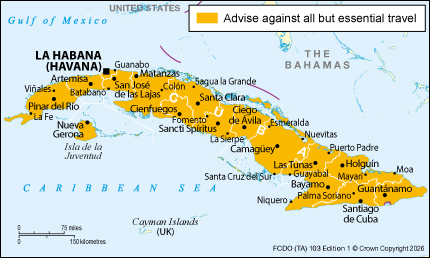
Havana: the whole country is rated “advised against — all but essential travel” (Global Affairs Canada, Foreign Office).The red dot on the map. Change the city at the top of the page to read the map from another point.

Global Affairs Canada — advises against all but essential travel to the whole country.

Foreign Office — advises against all but essential travel to the whole country.

Guantánamo — Advised against — all but essential travelCamagüey — Advised against — all but essential travelCiego de Ávila — Advised against — all but essential travelHolguín — Advised against — all but essential travelIsla de la Juventud — Advised against — all but essential travelSancti Spíritus — Advised against — all but essential travelVilla Clara — Advised against — all but essential travelMatanzas — Advised against — all but essential travelLas Tunas — Advised against — all but essential travelMayabeque — Advised against — all but essential travelHavana — Advised against — all but essential travelArtemisa — Advised against — all but essential travelPinar del Río — Advised against — all but essential travelCienfuegos — Advised against — all but essential travelGranma — Advised against — all but essential travelSantiago de Cuba — Advised against — all but essential travelCamagüeyHolguínGranmaHavana
Advised against — all but essential travelHavanaSynthesis of the readings: Global Affairs Canada, Foreign Office. Where they differ, the colour keeps the strictest reading; the official text, quoted below region by region, prevails. Boundaries: Natural Earth.
Advised against — all but essential travel
the whole country, including Havana (Global Affairs Canada, Foreign Office)
So:

an official reading covers the whole country; every trip calls for a written management decision, justified by a pressing reason, with reinforced conditions.

US06.05.2025
Level 2 of 4Exercise increased caution
FR27.03.2026
No red or orange areaThe security page lists no red or orange area.Your region (Havana): not covered
GB25.09.2026
Whole country: essential travel onlyYour region (Havana): covered, like the whole country
CA13.10.2026
Avoid non-essential travelYour region (Havana): covered, like the whole country
CH17.02.2026
Tourist travel advised againstSwitzerland’s FDFA advises against tourist travel.
Maximum does not exclude these areas.The VIP Pack covers care and repatriation there. Still enforceable: sanctions and embargoes, and a country already at war at departure. Extraction and security belong to the VIP Pack Extreme, upon eligibility. See My cover

Global Affairs Canada — Open Government Licence – Canada (13.10.2026) · Foreign Office — Open Government Licence v3.0 · France Diplomatie (27.03.2026) · Natural Earth

No located event in this reading.

Last change: This travel advice has been reviewed for accuracy with changes made throughout, including protests in Cuba, power outages and fuel and water shortages, travel disruption, international card transactions, travel insurance, visa requirements,

Cuba - Level 2: Exercise Increased CautionState Department ↗updated 06.05.2025 · read 16.10.2026

Updated 06.05.2025

Exercise increased caution in Cuba due to crime and unreliable electrical power .

Petty crime is a risk for travelers in Cuba. This includes pick pocketing, purse snatchings, and car break-ins. Violent crime, including armed robbery and homicide, is also on the rise in Cuba.

U.S. law and regulation prohibit travel to, from, or within Cuba for tourist activities. OFAC regulates travel to, from, and within Cuba by persons subject to U.S. jurisdiction, defined to include, among other things, all U.S. citizens or residents (wherever located) and anyone in the United States, regardless of their citizenship and nationality. Failure by a person subject to U.S. jurisdiction to act consistently with the regulations may result in penalties and criminal prosecution. Travel to Cuba without an OFAC license is illegal.

Cuba's electrical supply is unreliable. Since October 2024, there have been several prolonged nationwide power outages. Scheduled and unscheduled power cuts lasting up to 12 hours occur daily in Havana, and even longer outside the capital. Some large businesses, hotels, hospitals, and institutions use generators during power outages. However, they may have trouble keeping the generators running during a long outage due to the inconsistent and scarce availability of fuel.

U.S. citizens in Cuba or those planning to visit should check local news often to stay up to date. In Cuba, peaceful assembly and freedom of speech are not protected rights. U.S. citizens should avoid protests or demonstrations.

U.S. Embassy employees must follow a special notification process with the Government of Cuba to travel outside of Havana. This process can impact the embassy's ability to help U.S. citizens in Cuba during emergencies.

If a person subject to U.S. jurisdiction travels to Cuba consistent with 1 of the 12 travel categories authorized by a general OFAC license, the person would not need to apply for a specific OFAC license for the travel transactions. For non-tourist travel that is not otherwise covered by a general license, a person subject to U.S. jurisdiction must seek a specific license from OFAC to authorize the travel. For travel questions, check 31 C.F.R. 515.560 and OFAC’s Frequently Asked Questions .

Review the travel guidance section for additional information on travel to Cuba.

Cuba: Arboviral Outbreak - Oct 2025ReliefWeb ↗read 16.10.20262025-10-30

Hurricane Melissa - Oct 2025ReliefWeb ↗read 16.10.20262025-10-24

Source: ReliefWeb (OCHA), via HDX — CC BY

Nearest river dischargeOpen-Meteo ↗updated 16.10.2026 · read 16.10.2026

10-16 1.2 · 10-17 1.3 · 10-18 1.6 · 10-19 2.6 · 10-20 2.6 · 10-21 1.9 · 10-22 1.4 m³/s

Simulated discharge: Open-Meteo.com (CC BY 4.0), data rounded and formatted by Maximum. Contains modified Copernicus Emergency Management Service information 2026. For information only: this is not a flood warning; only national or regional authorities issue those.

Where, exactly?

What the national level does not tell you

The level is national. Risk areas are in the state advisories below.

  • U.S. State Department — the full advisory details the regions concerned and the reasons (crime, terrorism, kidnapping, civil unrest) (read the advisory)
  • Foreign, Commonwealth & Development Office (United Kingdom) — the United Kingdom advises against all but essential travel to the whole country · reviewed 25 September 2026
    Last announced change : « This travel advice has been reviewed for accuracy with changes made throughout, including protests in Cuba, power outages and fuel and water shortages, travel disruption, international card transactions, travel insurance, visa requirements, » (read the advisory)
  • France Diplomatie — France classifies no area of this country as red or orange (see the Security page)

No major event in progress is located in this country at this morning's check.

Safety in figures
Intentional homicides per 100,000 people
Cuba4.5 2019
Switzerland0.6 2023
France1.3 2023
Road traffic deaths per 100,000 people
Cuba8.9 2019
Switzerland2.2 2019
France5.1 2019

Reading: The homicide rate is 8 times Switzerland's: violence is a real risk there, concentrated in the areas named by the official advisories. On the road, 4 times more deaths than in Switzerland: road crashes are the leading cause of death of healthy travellers (CDC) — seat belt, no night driving, a driver or a taxi from a rank.

World Bank (UNODC for homicides, WHO for roads) — latest published valuedata.worldbank.org ↗read 10.10.2026

What we locate on the map are events in progress that have real coordinates: USGS earthquakes, GDACS disasters, NOAA storms and open NASA EONET events. Hover a dot for details, click to open it in this briefing.

I travel on a passportEach government writes for its own nationals. The advisory that counts for you — and for your policy's clauses — is your country's.

French passport — France Diplomatie

In brief
  • Non-essential travel to Cuba is discouraged due to an energy crisis impacting air travel and other services. France Diplomatie
  • Increased insecurity and violence are reported in cities like Havana and Santiago, including sexual assault and GHB-facilitated attacks. France Diplomatie
  • Avoid leaving valuables like identity documents, phones, or wallets unattended on beaches, as thefts are frequent. France Diplomatie
  • Driving at night outside urban areas is strongly discouraged due to poor road conditions, lack of lighting, and unexpected obstacles. France Diplomatie
  • Be cautious of online scams when renting vehicles, and verify taxi conditions for long journeys. France Diplomatie
  • During hurricane season (June to November), travellers should monitor storm updates and follow civil protection guidelines. France Diplomatie

Faithful summary of the official texts below, which prevail.

The security page lists no red or orange area.France Diplomatie ↗updated 15.09.2026 · read 16.10.2026

Cuba

- Présentation de Cuba

-

-

-

-

-

-

-

-

-

-

Zones de vigilance

Dernière actualisation le 27/03/2026, information toujours valable à la date du jour

Compte tenu de la crise énergétique à Cuba et de ses multiples répercussions, y compris pour les liaisons aériennes, les voyages non essentiels vers l’île sont déconseillés.

Délinquance

Dans les villes, notamment à La Havane et à Santiago, une hausse de l’insécurité est observée, qui s’accompagne parfois de violences pouvant porter atteinte aux personnes. Des actes d’agression et de harcèlement sexuels ont été également rapportés, ainsi que quelques cas d’agressions au GHB (drogue de soumission mise dans une boisson ou soufflée au visage, aussi appelée Scopolamine). Il est recommandé de faire preuve de prudence, d’adopter une attitude responsable et de ne pas se déplacer seul(e) la nuit.

De plus, les vols d’effets personnels sur les plages sont de plus en plus fréquents. Il est donc fortement déconseillé d’emporter avec soi ses documents de voyage et d’identité, son téléphone, son portefeuille, ses clés…etc, ou de les laisser sur la plage sans surveillance directe.

Risques liés aux transports

Circuler de nuit sur les routes cubaines hors des agglomérations est vivement déconseillé, en raison de la présence fréquente au milieu de la chaussée d’animaux, de piétons, de cyclistes ou de véhicules sans éclairage.

De manière générale, la signalétique, l’état des routes et l’éclairage public sont défectueux à Cuba, y compris sur le trajet permettant de se rendre à La Havane depuis l’aéroport. Il est donc déconseillé de louer un véhicule à partir de l’aéroport, en particulier si l’arrivée a lieu à la nuit tombée. De nombreux véhicules sont dans un état de fonctionnement et de maintenance précaires. Les accidents de la circulation sont ainsi fréquents dans le pays. En conséquence, il est fortement déconseillé de circuler de nuit en dehors du centre des grandes villes. Par ailleurs, en cas d’utilisation d’un taxi pour un long trajet, il est conseillé de vérifier l’état du véhicule avant de partir, et de ne pas hésiter à renoncer à un trajet si les conditions de sécurité ne semblent pas assurées.

En matière de location de véhicules, des escroqueries par Internet ont également été signalées (faux sites, fausses agences).

Risques naturels

Comme l’ensemble de la région des Caraïbes, Cuba connaît une saison cyclonique qui s’étend de juin à novembre. En raison des perturbations climatiques susceptibles d’affecter la zone Caraïbes et dans le cas où leur vol de retour serait annulé pour cause de force majeure (telle qu’une catastrophe naturelle), il est fortement recommandé aux voyageurs de se renseigner auprès de leur agence de voyages ou de leur compagnie d’assurance sur les modalités de prise en charge de la prolongation de leur séjour à Cuba. Les personnes en voyage à Cuba sont instamment invitées à respecter les consignes diffusées par la Protection civile cubaine, qui sont également reprises par les hôtels et les voyagistes.

Il convient également de

  • suivre l’évolution des tempêtes et des ouragans sur le site du National Hurricane Center ;
  • se conformer aux recommandations qui seront données sur le site de ce ministère à la rubrique Risques climatiques (cyclones / ouragans) et sur le site de l’ambassade de France à Cuba .

En cas de difficulté sur place, il est recommandé de prendre contact avec l’ambassade.

Recommandations générales

Il est conseillé de faire une photocopie du passeport pour justifier de son identité en cas de contrôle, et de ne présenter le document original que pour retirer des liquidités à la banque. Il est recommandé, dans la mesure du possible, de laisser ses documents d’identité et de voyage, sa carte bancaire ainsi qu’une partie de ses liquidités dans un coffre à l’hôtel, et de ne pas porter de bijoux de valeur lors des déplacements quotidiens (chaînes en or, montres de luxe, etc.). Une vigilance renforcée doit par ailleurs être portée aux cartes bancaires car le paiement se fait parfois sans obligation préalable de taper le code secret, ce qui facilite les usages frauduleux en cas de vol.

Il est vivement recommandé de se tenir à l’écart de tout rassemblement sur la voie publique.

Full text of the Security pagediplomatie.gouv.fr ↗updated 15.09.2026 · read 16.10.2026

Swiss passport — FDFA (Switzerland), in French

In brief
  • Tourist travel to Cuba is not recommended due to persistent economic and energy crises, causing frequent and prolonged power outages affecting daily life and hotels. DFAE
  • Shortages of food, essential goods, medicines, and medical supplies are occurring, and emergency services may not be guaranteed. DFAE
  • High crime rates include pickpocketing, muggings, armed robbery, and drug-related crime, with attacks on buses and thefts from cars and taxis reported. DFAE
  • Fuel shortages mean long waits at limited service stations, where only US dollars are accepted for payment. DFAE
  • Travelers should avoid carrying valuables or large sums of money and store important documents in hotel safes, keeping a passport copy. DFAE
  • Natural risks include hurricanes, earthquakes, volcanic eruptions, and forest fires, requiring travelers to monitor weather forecasts and follow local authorities' instructions. DFAE

Faithful summary of the official texts below, which prevail.

FDFA update note — Ces conseils pour les voyages ont été révisés. Désormais il est déconseillé de se rendre à Cuba pour des voyages touristiques et tout autre voyage qui ne présente pas un caractère d'urgence. (published 17.02.2026)

General assessment

Il est déconseillé de se rendre à Cuba pour des voyages touristiques et tout autre voyage qui ne présente pas un caractère d’urgence. En raison de la crise énergétique et de la crise économique persistante, il y a des pénuries d’approvisionnement en carburant et en électricité qui ont de graves conséquences sur la vie quotidienne. Des coupures d'électricité pouvant durer plusieurs heures, voire plusieurs jours, sont fréquentes. Les hôtels sont également touchés. Il existe également des problèmes d'approvisionnement en denrées alimentaires, en produits de première nécessité, ainsi qu’en médicaments et en matériel médical. Les services d'urgence ne sont pas assurés. Les liaisons téléphoniques et Internet peuvent être interrompues, notamment Internet qui peut être indisponible pendant une longue période. Dans ce pays comme ailleurs, le risque d’attentats terroristes ne peut être exclu. La rubrique terrorisme et enlèvements attire l'attention sur les risques liés au terrorisme. Terrorisme et enlèvements Avant et pendant le voyage, informez-vous au travers des médias sur la situation actuelle, si vous devez vous rendre à Cuba pour des raisons urgentes . Seules les compagnies aériennes donnent des renseignements sur les liaisons aériennes. Tenez-vous à l’écart des événements de masse et des rassemblements de foule en tout genre. Conformez-vous aux directives des autorités locales. Une attention particulière doit être accordée à la sécurité personnelle.

Crime

La situation générale de la sécurité s'est détériorée. Le taux de criminalité est élevé. En particulier les vols à la tire et à l’arraché ainsi que les vols à main armée sont de plus en plus rapportés, la criminalité liée à la drogue augmente. Des attaques contre des bus ont également été signalées. Les vols dans les voitures et taxis, souvent avec la complicité des chauffeurs, sont fréquents. Des cambriolages dans des logements privés (casas particulares) sont également à déplorer. Il est notamment recommandé d'observer les précautions suivantes:

  • ne portez pas d'objets de valeur sur vous (montre, bijoux, etc.) ni de grosses sommes d'argent;
  • déposez les documents importants dans le coffre de l'hôtel (passeports, billets d'avion, etc.); gardez sur vous une copie de votre passeport;
  • si vous comptez loger dans une des «casas particulares», assurez-vous qu'il s'agit de logements marqués par un triangle bleu sur la porte;
  • utilisez exclusivement les taxis officiels signalés comme tels ou des services de transport considérés comme sûrs. Renseignez-vous auprès de l’hôtel au sujet des services de transport considérés comme sûrs;
  • En raison du risque d'agression et de vol, ne prenez pas d'auto-stoppeurs.
Natural hazards

Il faut s’attendre à des ouragans ; ils provoquent souvent des inondations et causent des dommages aux infrastructures. La circulation peut s’en trouver temporairement perturbée. Consultez les prévisions météorologiques et suivez les avertissements et des instructions des autorités. Instituto de Meteorología de la Republica de Cuba World meteorological organization (WMO) Des tremblements de terre peuvent se produire, particulièrement dans la partie orientale de l’île. Outre les dévastations causées sur la terre ferme, les tremblements de terre et les éruptions volcaniques dans les Caraïbes peuvent aussi provoquer des raz-de-marées. En été, il existe un important risque d’incendie de forêt à de nombreux endroits. Si une catastrophe naturelle devait se produire durant votre séjour, prenez immédiatement contact avec vos proches et suivez les instructions des autorités locales. En cas d’interruption des communications avec l’étranger, vous pouvez contacter l’Ambassade de Suisse à La Havane.

FDFA travel advice, in French, valid on 16.10.2026eda.admin.ch ↗updated 17.02.2026 · read 16.10.2026

British passport — Foreign Office (UK)

In brief
  • The FCDO advises against all but essential travel to Cuba due to an escalating economic crisis and widespread shortages.
  • International Visa and Mastercard are no longer accepted; travellers must bring sufficient cash in US dollars or euros for their entire stay.
  • Frequent power outages and fuel shortages are disrupting essential services, including transport and water supply, requiring travellers to conserve resources.
  • Aviation fuel shortages have led to flight suspensions by several airlines, and only Terminal 3 at José Martí International Airport is operational.
  • Travellers should be aware of an increase in opportunistic crime, including muggings and burglaries, and exercise caution, especially at night.
  • Avoid all demonstrations and large gatherings, as protests can escalate, and follow the instructions of local authorities.

Faithful summary of the official texts below, which prevail.

Regions covered by the Foreign Officegov.uk ↗updated 25.09.2026 · read 16.10.2026

Official Foreign Office map
Foreign Office map — Open Government Licence v3.0

Warnings — Foreign OfficeForeign Office ↗updated 25.09.2026 · read 16.10.2026

Warnings — Foreign Office

## FCDO advises against all but essential travel to Cuba

Protests in Cuba

Cuba is experiencing a worsening economic situation with shortages of fuel, electricity, water and basic necessities. This is affecting tourism services and disrupting travel within the country.

The situation has led to frequent protests. To date most of these have remained peaceful but be aware that protests can escalate. You should stay away from large gatherings, monitor the media for updates and follow the advice of the local authorities.

The situation is also leading to an increase in opportunistic crime, but levels remain lower than in the UK. See ‘Crime’ on the Safety and security page .

Power outages and fuel and water shortages

The Cuban National Electric grid has collapsed a number of times over the last few months. Given current circumstances, further grid collapses are likely. Low fuel reserves are leading to severe and sustained disruption to essential infrastructure and basic services, including transport, medical care, communications, water supply and street lighting. Authorities have introduced fuel rationing, scaled back public services, and made changes to healthcare, education, transport and tourism operations to conserve severely limited energy supplies. Access to safe drinking water and wastewater management can be problematic.

Take precautions by conserving fuel, water, food and mobile phone charge, and be prepared for significant disruption.

Travel disruption

Cuban authorities have announced that all of its international airports are without aviation fuel. Only Terminal 3 at José Martí International Airport is currently in operation. Some airlines, including all Canadian airlines, Air France, Iberia, World2Fly and LATAM, have suspended flights to and from Cuba. Other airlines are keeping their routes under review. Options for leaving the country could reduce further if the situation worsens.

If you are currently in Cuba, carefully consider if your presence is essential. The situation has the potential to deteriorate quickly and without warning. Make sure you are ready to change your plans quickly if needed. If you are considering leaving Cuba, check for messaging from your airline or tour operator for up-to-date information. Ensure your travel documents remain valid and confirm you have any required visas for onward travel.

Continue to monitor local media and follow the instructions of local authorities. Subscribe to FCDO email alerts and read our guidance on how to deal with a crisis overseas .

International card transactions

The Cuban Central Bank has announced that international cards such as Visa and Mastercard are no longer accepted in Cuba. Available payment methods include cash and Cuban prepaid cards. You will not be able to withdraw cash through ATMs with an international card.

If you need to visit Cuba, you should bring enough cash to cover your expenses for the entire length of your stay and in case of an emergency (such as medical treatment or delayed departure). US dollars and euros are widely accepted and can be exchanged in Cuba. See ‘Money’ on the Safety and security page .

Safety — Foreign OfficeForeign Office ↗updated 25.09.2026 · read 16.10.2026

Terrorism

There is a high threat of terrorist attack globally affecting UK interests and British nationals, including from groups and individuals who view the UK and British nationals as targets. Stay aware of your surroundings at all times.

UK Counter Terrorism Policing has information and advice on staying safe and what to do in the event of a terrorist attack. Find out how to reduce your risk from terrorism while abroad .

Terrorism in Cuba

Although there’s no recent history of terrorism in Cuba, attacks cannot be ruled out.

Political situation

Cuba is ruled by a single party, with a high level of social control. Opposition parties are not allowed. There are restrictions on freedom of speech, association and assembly for Cuban nationals. Any political demonstrations not approved by the government may be broken up by the authorities.

Avoid any demonstrations or large gatherings and follow the advice of the local authorities. Internet access can sometime be blocked during times of political tension.

Crime

While crime has reportedly increased in recently months, data suggests that levels of crime are generally lower than in the UK or regional averages, but the difficult economic situation is leading to an increase in opportunistic crime. There have been reports of muggings in Havana and of burglaries at properties, with instances of violent crime. Siphoning of fuel from parked vehicles is a regular occurrence.

Exercise caution, particularly at night. Keep your personal belongings, including your passport, in a secure place, avoid carrying large amounts of cash or showing signs of affluence. Always carry a photocopy of your passport. Pre-arrange transport and avoid walking at night.

Protecting your belongings

There is a risk of theft from luggage when baggage is being handled on arrival or departure at the airport. You should:

  • not pack valuables in your hold luggage
  • lock suitcases
  • shrink-wrap luggage before check-in if possible

Be aware of pickpockets and bag-snatching:

  • in the streets of Old Havana or any crowded areas
  • on public transport
  • in nightclubs

Do not carry large amounts of cash or wear expensive-looking jewellery. Mobiles and laptops are particularly attractive to thieves. Leave valuables in a hotel safe.

Beware of theft from your accommodation, particularly from private guest houses (‘casas particulares’).

Fake taxi drivers

There are a small number of criminals who pose as tour operators or taxi drivers. These fake drivers operate at the airport and around Old Havana. Only travel with your tour operator. If you need to use a taxi from the airport, make sure it’s a registered yellow taxi.

Vehicle crime

There are sometimes car-related crimes and muggings in Havana, and other tourist areas. Do not hail taxis or accept lifts from anyone you do not know. Take care when driving in central Havana, particularly at night. Keep doors locked and windows closed.

There have been attacks on foreigners in hire cars after deliberate puncturing of tyres. If you are in a remote area with a punctured tyre drive on to the nearest town before stopping. Do not pick up hitchhikers.

Illegal drugs penalties

Cuba has a zero tolerance policy against the use, possession and trafficking of illegal drugs. Cuban courts can give severe penalties for drug-related offences. Pack all luggage yourself and do not carry items for anyone else.

Using cameras in restricted areas

Avoid all military zones and other restricted areas. Do not take photographs or videos…

American passport — U.S. Department of State

In brief
  • U.S. citizens and residents must have an OFAC license for any travel to Cuba, as tourist activities are prohibited by U.S. law.
  • Travel to Cuba without an OFAC license may lead to penalties and criminal prosecution for individuals subject to U.S. jurisdiction.
  • Cuba experiences unreliable electrical power, with daily outages lasting up to 12 hours, and potentially longer outside Havana.
  • Fuel shortages may affect the operation of generators in businesses and hotels during prolonged power outages.
  • U.S. citizens in Cuba should avoid protests and demonstrations, as peaceful assembly and freedom of speech are not protected rights.

Faithful summary of the official texts below, which prevail.

Cuba - Level 2: Exercise Increased Caution 2025-05-06travel.state.gov ↗updated 06.05.2025 · read 16.10.2026

Advisory summary

Exercise increased caution in Cuba due to crime and unreliable electrical power .

Petty crime is a risk for travelers in Cuba. This includes pick pocketing, purse snatchings, and car break-ins. Violent crime, including armed robbery and homicide, is also on the rise in Cuba.

U.S. law and regulation prohibit travel to, from, or within Cuba for tourist activities. OFAC regulates travel to, from, and within Cuba by persons subject to U.S. jurisdiction, defined to include, among other things, all U.S. citizens or residents (wherever located) and anyone in the United States, regardless of their citizenship and nationality. Failure by a person subject to U.S. jurisdiction to act consistently with the regulations may result in penalties and criminal prosecution. Travel to Cuba without an OFAC license is illegal.

Cuba's electrical supply is unreliable. Since October 2024, there have been several prolonged nationwide power outages. Scheduled and unscheduled power cuts lasting up to 12 hours occur daily in Havana, and even longer outside the capital. Some large businesses, hotels, hospitals, and institutions use generators during power outages. However, they may have trouble keeping the generators running during a long outage due to the inconsistent and scarce availability of fuel.

U.S. citizens in Cuba or those planning to visit should check local news often to stay up to date. In Cuba, peaceful assembly and freedom of speech are not protected rights. U.S. citizens should avoid protests or demonstrations.

U.S. Embassy employees must follow a special notification process with the Government of Cuba to travel outside of Havana. This process can impact the embassy's ability to help U.S. citizens in Cuba during emergencies.

If a person subject to U.S. jurisdiction travels to Cuba consistent with 1 of the 12 travel categories authorized by a general OFAC license, the person would not need to apply for a specific OFAC license for the travel transactions. For non-tourist travel that is not otherwise covered by a general license, a person subject to U.S. jurisdiction must seek a specific license from OFAC to authorize the travel. For travel questions, check 31 C.F.R. 515.560 and OFAC’s Frequently Asked Questions .

Review the travel guidance section for additional information on travel to Cuba.

Global Affairs Canada — additional reading

Avoid non-essential travel

CUBA - AVOID NON-ESSENTIAL TRAVEL

Avoid non-essential travel to Cuba due to worsening shortages of fuel, electricity, and basic necessities including food, water, and medicine. These shortages can also affect services at resorts and disrupt ground transportation. Fuel availability has decreased and is difficult to predict. These conditions are likely to persist in the immediate term and could worsen further during the upcoming hurricane season.

  • Sign up for the Registration of Canadians Abroad service to receive important updates
  • Make sure your travel documents are up to date and secure at all times
  • If you require emergency consular assistance, contact the Emergency Watch and Response Centre

Open Government Licence – Canada · October 13, 2026 11:14 EDTtravel.gc.ca ↗updated 13.10.2026 · read 16.10.2026

In brief
  • From June 6, 2026, Visa and Mastercard credit and debit cards will no longer be accepted in Cuba; plan to bring sufficient cash, as U.S. dollars or Euros are more widely accepted than Canadian dollars. Global Affairs Canada
  • It is illegal to exchange money on the street or anywhere other than authorized entities, with penalties including fines or prison sentences for unauthorized exchanges. [Global Affairs Canada, Foreign Office]
  • Penalties for drug offenses are severe, with potential for lengthy prison sentences; pack your own luggage and never transport packages for others. [Global Affairs Canada, Foreign Office]
  • Photographing military or police installations, personnel, or restricted areas is forbidden and can be considered espionage, potentially leading to imprisonment. [Global Affairs Canada, Foreign Office]
  • Foreign drivers involved in traffic accidents may be prohibited from leaving Cuba during investigations and trials, which can last for months. DFAE
  • Drones are prohibited and will be confiscated by authorities upon entry into Cuba. Global Affairs Canada

Faithful summary of the official texts below, which prevail.

Global Affairs Canada — written for Canadian travellers, valid for all

Local laws

You must abide by local laws. Learn about what you should do and how we can help if you are arrested or detained abroad.

Criminal justice system

The criminal justice system in Cuba differs significantly from that in Canada. Charges are not laid until an investigation is complete. If you’re arrested in Cuba, you will likely be detained during the entire period of investigation. You should expect long delays to resolve your case. You will not be allowed to leave the country during this period. Cuba’s constitution allows the death penalty, but since 2003, the country has effectively had a moratorium on carrying out death sentences.

Money

The currency of Cuba is the Cuban peso (CUP). Starting June 6, 2026, Visa and Mastercard credit and debit cards will no longer be accepted in Cuba. The following payment methods will remain available:

  • cash
  • domestic prepaid cards: Clásica and Tropical (Spanish only)

Given the current conditions in the banking sector, these cards may not always function as expected and access to funds may be temporarily limited or inaccessible. Credit cards issued by U.S. financial institutions or affiliated with U.S. banks continue to not be accepted in Cuba. You should plan to bring sufficient cash for the duration of your trip and all associated costs. Canadian dollars and certain other international currencies are not widely accepted or easily exchanged. U.S. dollars or Euros are more widely accepted. You should also carry small bills for daily transactions such as street food, taxis and tips. You may be able to exchange currency at the following locations:

  • money exchange bureaus in Cuba’s international airports
  • banks
  • major hotels
  • official exchange bureaus

It’s illegal to change money on the street or anywhere else other than authorized entities.

Investments

Private property rights in Cuba are strictly controlled. Only Cubans and permanent residents can buy a property in Cuba or register a privately owned vehicle. Be wary of strangers or acquaintances offering to purchase these items on your behalf. If you plan on making investments in Cuba, seek legal advice in Canada and Cuba before making commitments.

Drugs

Penalties for possession, use or trafficking of illegal drugs are severe. Convicted offenders can expect lengthy prison sentences.

  • Pack your own luggage and monitor it closely at all times
  • Never transport other people’s packages, bags or suitcases

Drugs, alcohol and travel

Marriage

To get married in Cuba, all documents you submit must be translated into Spanish, certified, authenticated, and legalised by the Embassy of Cuba to Canada, in Ottawa. Consult the Embassy of Cuba to Canada if you wish to marry in Cuba, including to a Cuban national. The 2022 Family Code eliminated the previous marriage exceptions that had allowed girls to marry at age 14 with their parents’ consent. The new law bans child marriage. The age of consent in Cuba is 16, but the new laws introduced in 2022 added protections for individuals under the age of 18 from exploitation or coercion. Even when a minor is over the age of 16, prosecutors can dismiss the argument of consent if there is any perceived imbalance of power, economic influence or relationship of authority. Penalties for the “corruption of minors” are severe and may result in long prison sentences.

Drones

Drones are prohibited. They will be confiscated by the authorities upon entry.

Photography

Professional photographers require a visa to work in Cuba. If you are traveling to Cuba to work as a photographer, you may need a permit to import your equipment. It’s forbidden to photograph:

  • military and police installations or personnel
  • harbour, rail and airport facilities

Military zones and any other restricted or heavily guarded areas are not always identified.

Identification

Local authorities may request to see your identification at any time. By law, you must always carry valid identification.

  • Keep a photocopy of your passport in case it’s lost or seized
  • Keep a digital copy of your identification and travel documents
International Child Abduction

The Hague Convention on the Civil Aspects of International Child Abduction is an international treaty. It can help parents with the return of children who have been removed to or retained in certain countries in violation of custody rights. It does not apply between Canada and Cuba. If your child was wrongfully taken to, or is being held in Cuba by an abducting parent:

  • act as quickly as you can
  • consult a lawyer in Canada and in Cuba to explore all the legal options for the return of your child
  • report the situation to the nearest Canadian government office abroad or to Global Affairs Canada by calling the Emergency Watch and Response Centre

If your child was removed from a country other than Canada, consult a lawyer to determine if The Hague Convention applies. Be aware that Canadian consular officials cannot interfere in private legal matters or in another country's judicial affairs.

Black market

Street vendors may offer you black-market goods, such as cigars, or ask to change dollars for Cuban currency. Engaging in black-market transactions is illegal and can lead to difficulties with the Cuban authorities. Cuban Customs Administration – Government of Cuba

Boat traffic

The U.S. government closely monitors boat traffic in the Straits of Florida. U.S. authorities will seize any vessel not bearing a licence from the Office of Foreign Assets Control (OFAC) if they believe it’s headed for Cuba. Vessels registered in Canada are exempt from these restrictions, unless you dock your boat in Florida while en route from Canada to Cuba. If you dock your vessel in Florida before travelling to Cuba, you must follow the OFAC regulations. If you travel by boat to Cuba from the U.S.:

  • make sure to know the regulations related to docking and port controls
  • expect thorough searches and interrogations
Traffic accidents

Canadians have been arrested and detained due to traffic accidents. Accidents resulting in injury or death are treated as crimes. The driver must prove their innocence. If you’re found responsible in a traffic accident resulting in serious injury or death, you could face up to 10 years in prison. If you’re involved in an accident:

  • do not leave the scene
  • do not move your vehicle
  • call the police

Car insurance is mandatory for foreign drivers and foreign-registered vehicles, but not for Cuban citizens. As a result, most local drivers don't have car insurance. You shouldn’t expect compensation for vehicle damage or personal injury from a Cuban driver following a car accident.

Vehicle rentals

Car insurance coverage in Cuba differs from that in Canada. Rental agencies are government-controlled. If you’re found to be at fault in an accident, the rental agency will nullify your coverage and seek compensation to cover the cost of repairs. Cuban authorities can prohibit you from leaving the country unless the rental agency receives payment or until all claims associated with an accident are settled. Contract agreements don’t cover occasional drivers. As a result, the signatory is responsible for all people driving the vehicle.

  • Be cautious if you rent a vehicle in Cuba
  • Avoid renting a scooter because thieves target them, and you may be responsible for the cost of its replacement
  • Make sure to obtain a receipt when returning a rental vehicle

Open Government Licence – Canada · October 13, 2026 11:14 EDTtravel.gc.ca ↗updated 13.10.2026 · read 16.10.2026

Foreign Office — laws and cultural differences

Illegal drugs penalties

Cuba has a zero tolerance policy against the use, possession and trafficking of illegal drugs. Cuban courts can give severe penalties for drug-related offences. Pack all luggage yourself and do not carry items for anyone else.

Using cameras in restricted areas

Avoid all military zones and other restricted areas. Do not take photographs or videos in these areas. Possession of photographs or information relating to military areas or installations can be regarded as espionage and could result in a prison sentence.

LGBT+ travellers

Same-sex sexual activity is legal in Cuba, but gender diversity is not fully accepted by the general population. Same-sex marriages are recognised under Cuban law. Read more advice for LGBT+ travellers.

Risk of detention

If you break the law, or are suspected of causing injury to someone, you may be stopped from leaving Cuba during the investigation and trial, and you could be imprisoned. Contact the British Embassy in Havana as soon as possible for assistance.

Money

The Cuban Central Bank has announced that international cards such as Visa and Mastercard are no longer accepted in Cuba. Available payment methods include cash and Cuban prepaid cards (CLASICA card). You will not be able to withdraw cash through ATMs with an international card. If you need to visit Cuba, you should bring enough cash to cover your expenses for the entire length of your stay and in case of an emergency (including medical costs or if your departure is delayed). US dollars and euros are widely accepted and can be exchanged in Cuba. It is illegal to exchange money anywhere other than Cadeca exchange houses, including with any individuals who may offer exchange services. If you’re caught making an unauthorised exchange, you could be fined or get a prison sentence. Check with your hotel and tour providers on how to make payments ahead of your arrival in Cuba, and whether these can be made in advance via international bank transfer. Take precautions when carrying large amounts of cash.

Open Government Licence v3.0gov.uk ↗updated 25.09.2026 · read 16.10.2026

FDFA (Switzerland) — laws and customs, in French

Specific legal provisions

Entre autres, sont punissables:

  • photographier des personnes en uniforme, des installations militaires et des édifices publics (aéroports, ponts, etc.);
  • un comportement impoli envers la police et remarques désobligeantes sur le pays ou de ses autorités. Cela peut entraîner une procédure pénale pour outrage à fonctionnaire ou atteinte à l’honneur;
  • toute participation à des activités politiques par des personnes de nationalité étrangère;
  • l’alcool au volant est interdit (0 pour mille).

La location de voitures aux touristes est soumise à certaines règles. Les conducteurs/conductrices de nationalité étrangère impliqués dans un accident de la route peuvent ne pas être autorisés à quitter le pays pendant la durée de l’enquête judiciaire et du procès, qui peuvent durer des mois. Il est recommandé de louer une voiture avec chauffeur. Les personnes possédant à la fois la nationalité suisse et la nationalité cubaine sont considérées exclusivement comme des ressortissants cubains par les autorités du Cuba. En cas d'ouverture d'une enquête policière ou judiciaire, les ressortissants étrangers peuvent être détenus par les autorités cubaines jusqu'à ce que les faits soient clarifiés. Cela vaut également pour les infractions au code de la route. Les procédures juridiques peuvent durer longtemps. Les infractions à la loi sur les stupéfiants sont punies de longues peines de prison, même pour de petites quantités et tout type de drogue. Des peines très élevées sont également imposées pour les délits sexuels . Les conditions de détention ne peuvent pas être comparées à celles en Suisse; la crise économique a provoqué une dégradation des soins médicaux et des conditions d'alimentation dans les prisons.

FDFA travel advice, in Frencheda.admin.ch ↗updated 17.02.2026 · read 16.10.2026

Air: Good 12/100PM2.5 2.9 µg/m³ · PM10 4.2 µg/m³
UV high today max 7.7Right now 0.0 · WHO scale 0–11+

What it changes for you: Air acceptable at this hour: nothing special to plan. High UV at midday: sun protection.

Reading 03:00 (America/Havana)Open-Meteo ↗updated 16.10.2026 · read 16.10.2026

Air quality and UV: Open-Meteo.com (CC BY 4.0), data rounded and formatted by Maximum. Contains modified Copernicus Atmosphere Monitoring Service information 2026. Neither the European Commission nor ECMWF is responsible for any use that may be made of the Copernicus information or data it contains.

Physicians per 1,000 people
Cuba9.5 2021
Switzerland4.5 2022
France3.3 2022
Hospital beds per 1,000 people
Cuba4.3 2023
Switzerland4.4 2023
France5.7 2022
Health spending per person (USD)
Cuba1,199 2020
Switzerland11,784 2023
France5,327 2024
Life expectancy (years)
Cuba78.3 2024
Switzerland84.4 2024
France83.0 2024

Reading: Medical density above Switzerland: the question is not capacity, it is the bill. Health spending of 1,199 USD per person (Switzerland: 11,784) goes with private hospitals that bill foreigners in hard currency and ask for a guarantee before admission: the direct payment guarantee is what avoids the deposit.

World Bank — latest published value, year per indicatordata.worldbank.org ↗read 10.10.2026

I travel on a passportVisa, passport validity, entry form: the rules depend on your passport. Each government describes them for its own nationals.

French passport — France Diplomatie

In brief
  • Travellers to Cuba must have a passport valid for at least six months beyond arrival, a return ticket, and a tourist visa, which is valid for 90 days and renewable once.
  • Within 72 hours before travel, all travellers must complete the D'viajeros online form and present the generated document at departure and arrival.
  • A medical travel insurance valid for Cuba is mandatory; travellers without it must purchase it upon arrival.
  • Individuals who have visited Cuba since January 12, 2021, require a visa to enter the United States and cannot use the ESTA system.
  • Travellers entering Cuba may be subject to random COVID-19 testing upon arrival, with positive cases requiring isolation at their accommodation.
  • The introduction of devices like satellite phones, GPS, drones, or filming equipment is strictly regulated and may be held at customs.

Faithful summary of the official texts below, which prevail.

Cuba

- Présentation de Cuba

-

-

-

-

-

-

-

-

-

-

Mesures liées à la Covid-19

Depuis le 30 mai 2022, les passagers peuvent être soumis à un dépistage aléatoire à l’arrivée. En cas de résultat positif, le voyageur fera l’objet d’un suivi sur son lieu de séjour.

Dans tous les cas, le voyageur est invité à se conformer strictement aux règles, évolutives, édictées par les autorités sanitaires cubaines. Il est recommandé de se tenir à jour des protocoles de contrôle sanitaire en consultant régulièrement le site de l’ Ambassade de Cuba en France , du ministère cubain du Tourisme et du ministère cubain de la Santé .

Visa de tourisme/entrée à Cuba

Toute personne désirant se rendre à Cuba pour un séjour touristique doit être en possession d’un passeport d’une durée de validité d’au moins 6 mois au-delà de sa date d’arrivée à Cuba, d’un billet de retour/de sortie de Cuba, et d’un visa de tourisme pour Cuba. Le visa de tourisme a une durée de validité de 90 jours (une entrée), renouvelable une fois pour la même durée. Le voyageur doit veiller à ne pas dépasser la durée maximum de séjour, sous peine de détention ou d’amende par les services de l’immigration au moment du départ.

  • Première étape :
  • La demande de visa de tourisme se fait en ligne, à l’adresse suivante : https://evisacuba.cu/en/inicio .
  • Le demandeur reçoit un courriel de confirmation qui contient notamment le code de visa.
  • Deuxième étape :
  • Le courriel de confirmation contient également un lien personnalisé vers la plateforme D’viajeros :
  • En effet, dans les 72 heures précédant le voyage, le demandeur doit compléter/valider le formulaire D’viajeros en ligne. Il doit télécharger/imprimer le document généré qui doit être présenté à l’aéroport de départ et à l’arrivée à Cuba.

Les personnes titulaires d’un permis de séjour cubain ou d’un visa autre que le visa de tourisme doivent également remplir en ligne/générer/ imprimer le formulaire D’viajeros dans les 72 heures précédant toute entrée à Cuba.

Voyages vers Cuba en provenance des États-Unis / entrée en vigueur de mesures restrictives

Les voyages touristiques à Cuba depuis les États-Unis (même en transit) restent, en principe, interdits, quelle que soit la nationalité de la personne. Toutefois, l’Office of Foreign Assets Control (OFAC) du Département du Trésor américain a délivré des autorisations générales pour 12 catégories de voyageurs qui n’ont pas à lui demander d’autorisation supplémentaire pour se rendre à Cuba (voir les catégories de voyages autorisés sur le site de l’ OFAC) .

Les voyageurs se rendant à Cuba depuis les États-Unis (y compris un transit par un aéroport américain) doivent ainsi se conformer aux règles restrictives mises en place par les États-Unis et compléter le formulaire remis par les autorités américaines avant de pouvoir embarquer.

Dans le cadre de la préparation d’un voyage à Cuba depuis les États-Unis, il est vivement conseillé de consulter au préalable des représentants des autorités américaines et/ou cubaines dans son pays de résidence.

Voyages aux États-Unis après un séjour à Cuba / obligation de visa

Tout voyageur qui a séjourné à Cuba est désormais soumis à un visa pour entrer aux États-Unis, quelle que soit sa provenance (Cuba ou pays tiers).

Ainsi, les voyageurs qui se sont rendus à Cuba depuis le 12 janvier 2021 et qui désirent se rendre aux États-Unis ne peuvent pas bénéficier du régime de l’ESTA et doivent obligatoirement faire une demande de visa auprès d’un consulat américain avant d’entreprendre un voyage aux États-Unis, et ce, même s’ils bénéficient d’un ESTA précédemment approuvé, sous peine de voir celui-ci annulé par les agents de la police aux frontières (Customs and Border Protection) lors de l’entrée sur le sol américain, ou de faire l’objet d’une décision de refus d’embarquement. Pour plus d’informations, consulter la FAQ sur le site de l’agence fédérale Customs and Border Protection.

Il convient de noter que l’ambassade des États-Unis à Cuba n’est pas en mesure actuellement de traiter et de recevoir les demandes de visas (hors motifs familiaux), qui devront donc être déposées dans un pays tiers.

Assurance médicale

Une assurance voyage/médicale est exigée par les autorités cubaines pour les voyageurs se rendant à Cuba.

Il convient de s’assurer que l’assurance souscrite est valable pour Cuba. Une attestation d’assurance liée à une carte bancaire peut ainsi être demandée au titulaire de la carte.

Les voyageurs qui ne seront pas en mesure de produire une attestation ou un contrat d’assurance devront souscrire cette assurance à leur arrivée à Cuba, auprès d’une agence cubaine, sans garantie d’une bonne prise en charge.

Les autorités cubaines n’autorisent pas les voyageurs à quitter le pays s’ils ont des factures médicales impayées. Les factures doivent être réglées par carte bancaire internationale.

Introduction de matériels

L’introduction sur l’île d’appareils tels que téléphones satellitaires, GPS, drones ou matériel de tournage est très strictement réglementée. Il est conseillé de consulter avant le départ le consulat de Cuba à Paris à ce sujet, ou encore le site internet des douanes cubaines (accessible également en anglais). Ces matériels sont généralement retenus à la douane, pour être restitués à leurs propriétaires à la fin de leur séjour.

Selon la loi, les objets d’art, tels que peintures ou livres anciens (même s’ils ont été acquis sur les marchés artisanaux), ne peuvent être exportés que s’ils sont accompagnés d’un certificat délivré par l’administration cubaine des biens culturels.

Recommandations générales

Pour tout voyage à Cuba, il est recommandé d’imprimer et d’emporter avec soi tout document utile : formulaire « DViajeros », assurance, réservations d’hébergement, de billets d’avion ou de véhicule, voire photocopies des passeports… etc. Ces documents pourront vous être utiles en cas d’impossibilité d’accéder à Internet une fois sur place.

Entry and stay pagediplomatie.gouv.fr ↗updated 15.09.2026 · read 16.10.2026

Swiss passport — FDFA (Switzerland)

The FDFA does not publish entry requirements: they are set out by the destination's embassy or consulate in Switzerland — check them before booking, passport in hand. As a guide, the French and British requirements below describe the same rules as seen by two other governments.eda.admin.ch ↗updated 17.02.2026 · read 16.10.2026

British passport — Foreign Office (UK)

In brief
  • British citizens must ensure their passport expires at least six months after arrival and three months after departure to enter Cuba.
  • A tourist visa, or tourist card, is required for visits to Cuba and can be obtained via the Cuban Embassy or an electronic application.
  • All travellers must complete the online D’Viajeros form within 72 hours before arrival, presenting the resulting QR code.
  • Proof of onward or return travel must be shown upon entry into Cuba.
  • A yellow fever vaccination certificate is mandatory if travelling from a country listed as a transmission risk.

Faithful summary of the official texts below, which prevail.

Entry requirements — rules for a British passportForeign Office ↗updated 25.09.2026 · read 16.10.2026

Entry requirements — rules for a British passport

This information is for people travelling on a full ‘British citizen’ passport from the UK. It is based on the UK government’s understanding of Cuba’s current rules for the most common types of travel.

The authorities in Cuba set and enforce entry rules. If you’re not sure how these requirements apply to you, contact the Cuban Embassy in the UK .

Passport validity requirements

To enter Cuba, your passport must have an ‘expiry date’ at least 6 months after the date you arrive and 3 months after your planned departure date.

Check with your travel provider that your passport and other travel documents meet requirements. Renew your passport if you need to.

You will be denied entry if you do not have a valid travel document or try to use a passport that has been reported lost or stolen.

Dual nationals

When returning to the UK, British citizens must carry a valid British passport or certificate of entitlement . See Dual citizenship .

Visa requirements

If you’re visiting Cuba as a tourist, you need to get a tourist visa, also known as a tourist card, before you travel. Apply through the Cuban Embassy in the UK or check with your travel agent or tour operator. You can also apply for an electronic visa through the eVisa-Cuba site. When your application is approved, you will receive a ten-character code which should be entered as you fill in your advance passenger information on the DViajeros platform (see below). This will generate a QR code to be presented to the immigration authorities at the border. The electronic visa will be linked to the applicant’s passport.

You must also show proof of onward or return travel. See Cuba’s consular services information for details.

For more information and advice about other types of visas, contact the Cuban Embassy in the UK .

Overstaying your visa

The authorities take any breach of immigration rules seriously. You could be detained if you overstay your visa.

Checks at border control

You must complete an online arrival form on the D’Viajeros traveller information portal within 72 hours before entering the country. You’ll get a QR code by email. This must be shown to the authorities on arrival as an electronic or printed version. Airlines will check completion of the form at check-in.

You should download or print your completed DViajeros form as a PDF, as wifi may not be accessible to do so on arrival in Cuba.

Travelling from the USA to Cuba

US regulations do not authorise tourist travel to Cuba from the US. Travellers departing the US for Cuba are generally required to certify that their travel falls within one of the 12 categories for which the US authorities approve direct travel to Cuba.

For more information see the US State Department’s travel advice for Cuba .

Travelling from Cuba to the USA

You cannot travel from Cuba to the USA without a US visa.

Vaccine requirements

You must have a certificate to prove you’ve had a yellow fever vaccination if you’re coming from a country listed as a transmission risk .

For full details about medical entry requirements and recommended vaccinations, see TravelHealthPro’s Cuba guide .

Customs rules

There are rules about…

American passport — U.S. Department of State

The State Department publishes the requirements ("Entry, Exit and Visa Requirements") on its country page, which our servers cannot read. Read it before you go; as a guide, the French and British requirements below describe the same rules as seen by two other governments.travel.state.gov ↗updated 06.05.2025 · read 16.10.2026

Living on site

For each risk, the official texts themselves: what is happening, then, where they say so, what to do.

CrimeMODERATE

What the texts say · There are a small number of criminals who pose as tour operators or taxi drivers.

What they advise:
  • These fake drivers operate at the airport and around Old Havana.
  • If you need to use a taxi from the airport, make sure it’s a registered yellow taxi.
  • If you’re threatened by robbers, stay calm and do not resist.
Foreign Office · Global Affairs Canada
TransportMODERATE

What the texts say · Old-model private vehicles offered as taxis are not equipped with standard safety features. Three-wheel Coco-taxis may be in an unsafe condition.

What they advise:
  • Official yellow taxis are generally reliable.
  • Take care when driving in central Havana, particularly at night.
  • Keep doors locked and windows closed.
Global Affairs Canada · Foreign Office
Nature and climateMODERATE

What the texts say · The hurricane season in Cuba is from June to November each year. Cuba is in an active earthquake zone, but strong earthquakes are not common.

Foreign Office
Laws and customsTO KNOW

What the texts say · If you break the law, or are suspected of causing injury to someone, you may be stopped from leaving Cuba during the investigation and trial, and you could be imprisoned. Cuba has a zero tolerance policy against the use, possession and trafficking of illegal drugs.

What they advise:
  • Always carry a photocopy of your passport.
  • It is illegal to exchange money anywhere other than Cadeca exchange houses, including with any individuals who may offer exchange services.
  • Avoid all military zones and other restricted areas.
Foreign Office
Cyber and dataLOW

What the texts say · The telecommunications network in Cuba is poor.

What they advise: Do not rely solely on your cell phone for emergencies, especially outside major cities.
Global Affairs Canada
Crowds and calendarMODERATE

What the texts say · Any political demonstrations not approved by the government may be broken up by the authorities.

What they advise: Avoid any demonstrations or large gatherings and follow the advice of the local authorities.
Foreign Office

Sentences copied word for word from the official texts cited, chosen for the destination; the level is our reading. The full texts, at each source:Foreign Office ↗updated 25.09.2026 · read 16.10.2026 (updated 25.09.2026 · read 28.09.2026)Global Affairs Canada ↗updated 13.10.2026 · read 16.10.2026 (updated 13.10.2026 · read 28.09.2026)

Safety in figures
Intentional homicides per 100,000 people
Cuba4.5 2019
Switzerland0.6 2023
France1.3 2023
Road traffic deaths per 100,000 people
Cuba8.9 2019
Switzerland2.2 2019
France5.1 2019

Reading: The homicide rate is 8 times Switzerland's: violence is a real risk there, concentrated in the areas named by the official advisories. On the road, 4 times more deaths than in Switzerland: road crashes are the leading cause of death of healthy travellers (CDC) — seat belt, no night driving, a driver or a taxi from a rank.

World Bank (UNODC for homicides, WHO for roads) — latest published valuedata.worldbank.org ↗read 10.10.2026

—:—Local time · America/Havana ·
106Local emergency numbers · Police 106 · Ambulance 104 · Fire 105
+53 · SpanishDialling code · languages
NEMA 1-15, NEMA 5-15110 V
Drivingon the right

Time zone: IANA and timezone-boundary-builder (ODbL) · RESTCountries · EmergencyNumberAPI · Wikidata · European Central Bank

Places: © OpenStreetMap contributors (ODbL), Photon search by komoot.

FDFA (Switzerland) — transport and specific advice, in French

Transport and infrastructure

L'approvisionnement en carburant n'est pas assuré. Le carburant n'est disponible que dans certaines stations-services et en petites quantités, il faut calculer de longs délais d'attente. Seuls les dollars américains sont acceptés pour le paiement. Le trafic des trains, des bus et des taxis est limité. Les services navales (ferries) sont également concernés. Les routes et les véhicules sont très mal entretenus et constituent de sérieux risques d'accident. Renoncer aux déplacements à travers le pays la nuit.

Specific remarks

Assurance Les personnes en voyage qui entrent sur le territoire cubain doivent fournir la preuve que leur assurance maladie ou leur assurance voyage couvre les frais médicaux à Cuba , en présentant par ex. leur police d’assurance, la carte d’assuré de leur caisse maladie ou leur assurance voyage. Renseignez-vous auprès de votre assurance afin de déterminer si elle est reconnue et accréditée à Cuba. Les personnes qui ne seront pas en mesure d’apporter cette preuve devront souscrire une assurance auprès de la compagnie publique d’assistance cubaine Asistur. Cette règlementation concerne toute personne qui ne réside pas à Cuba. La compagnie Asistur et l’Ambassade de la République de Cuba à Berne fournissent de plus amples renseignements à ce sujet. Ambassade de la République de Cuba à Berne (espagnol) Asistur: asisten@asistur.cu, Tel: +53 7 866 44 99 Asistur Entrée et sortie Informations relatives à l’entrée dans le pays: D’Viajeros Cuba Lors d’un voyage à destination ou au départ de Cuba, renseignez-vous précisément sur les conditions d’entrée dans vos pays de transit et de destination (notamment en provenance et à destination des États-Unis). Assurez-vous que vous remplissez encore les conditions à l’aller comme au retour. Représentations étrangères en Suisse Conseils pour les voyages pour les États-Unis d’Amérique Mode de paiement La monnaie nationale CUP (Peso Cubano) ne peut être obtenue qu'à l'intérieur du pays. L'importation et l'exportation de CUP sont soumises à des restrictions. L’Ambassade de la République de Cuba à Berne fournit de plus amples renseignements à ce sujet. Attention: les paiements ou les retraits d’espèces avec les cartes bancaires suisses (Maestro, Visa, PostFinance), les chèques de voyage ainsi que certaines cartes de crédit ne sont pas possibles ou seulement de manière très limitée. Renseignez-vous suffisamment à l’avance auprès de votre banque ou de l’établissement émetteur de votre carte de crédit. Il est avantageux de se munir de suffisamment d’Euros ou d’USD en espèces pour toute la durée de votre séjour. Selon la loi cubaine, le change de devises étrangères n’est autorisé que dans les bureaux de change «Cadeca» agrées par le gouvernement ou dans les banques cubaines.

FDFA travel advice, in Frencheda.admin.ch ↗updated 17.02.2026 · read 16.10.2026

Public holidaysNager.Date ↗read 25.09.2026

  • Fri 25 Dec — Christmas Day
ESSENTIAL

Maximum policyholder: before paying anything, call the 24/7 number. If you are admitted for more than 24 h, Maximum sends its direct payment guarantee to the hospital (art. 2.12).

+41 22 ••• •• •• — Full number in your client area

The three hospitals to know — Havana

2Hospital Clínico Quirúrgico Freyre de Andrade (Emergencias)emergency · 0.7 km · Avenida Salvador Allende (Carlos III) e/ Espada y Hospital 858 Centro Habana, La Habana

None of these facilities is a Maximum Insurance “partner”, and none is presented as waiving upfront payment: this list is a reading of public map data, nothing more. A direct payment guarantee is arranged CASE BY CASE by our assistance desk, facility by facility and when the need arises — one number, +41 22 ••• •• ••.

List read from OpenStreetMap on 15.10.2026, not read again since: these facilities may have changed.

80hospitals and clinics40pharmacies40doctorsFull map and list ↗

Before you go

  • Routine vaccinesup to date
  • Yellow feverrequired if arriving from a risk area
  • Hepatitis Arecommended
  • Hepatitis Brecommended
  • Mpoxdepending on the trip
  • Typhoiddepending on the trip
  • Chikungunyanot recommended

CDC Travelers' Health recommendations, most important first. They depend on your age, vaccines and itinerary: confirm them with a doctor or a travel clinic 4 to 6 weeks before departure. Details, disease by disease ↗cdc.gov ↗read 10.10.2026

On site

DengueMosquitoes bite by day: repellent, long sleeves.
MalariaPresent in some areas: talk to a doctor before leaving.
ChikungunyaMosquito-borne: same protection as for dengue.
SunUV high (8): hat, sunscreen, water.
MedicationIn their box, with the prescription — in English if possible.

The health system — Medical density above Switzerland: the question is not capacity, it is the bill. Health spending of 1,199 USD per person (Switzerland: 11,784) goes with private hospitals that bill foreigners in hard currency and ask for a guarantee before admission: the direct payment guarantee is what avoids the deposit.

Back home — a fever in the following weeks should be told to a doctor, naming the country.

The next 7 days America/HavanaMET Norway ↗read 16.10.2026

Fri 16 Oct25–31°heavy showers · 7.0 mm
Sat 17 Oct25–30°heavy showers · 13.9 mm
Sun 18 Oct24–27°heavy showers · 10.6 mm
Mon 19 Oct24–28°showers · 4.9 mm
Tue 20 Oct24–29°showers · 1.7 mm
Wed 21 Oct23–28°showers · 1.3 mm
Thu 22 Oct23–27°showers · 2.7 mm

Forecast: MET Norway (Norwegian Meteorological Institute, CC BY 4.0), grouped by day and formatted by Maximum.

I travel on a passportYour embassy, and the service to register with, depend on your passport.

Your country, 24/7, from abroad

FR
Crisis and Support Centre — French Ministry for Europe and Foreign Affairs+33 1 53 59 11 0024/7 emergency line, standard rate. First contact abroad: the French embassy or consulate.www.diplomatie.gouv.fr ↗updated 15.09.2026 · read 16.10.2026
CH
FDFA Helpline+41 58 465 33 33+41 800 24 7 36524/7, 365 days a year — helpline@eda.admin.ch. Beware of scam calls spoofing these numbers.www.eda.admin.ch ↗updated 17.02.2026 · read 16.10.2026
GB
Foreign, Commonwealth & Development Office+44 20 7008 500024 hours, for British nationals.www.gov.uk ↗updated 25.09.2026 · read 16.10.2026
US
Overseas Citizens Services — U.S. Department of State+1 202 501 4444+1 888 407 4747From abroad; the second number from the U.S. and Canada.travel.state.gov ↗updated 06.05.2025 · read 16.10.2026

French passport — French embassy and consulates

Useful contacts listed by France Diplomatie (in French)diplomatie.gouv.fr ↗updated 15.09.2026 · read 16.10.2026

Updated: 15 September 2026

OpenStreetMap

Swiss passport — Swiss embassy and consulates

CH
Residencia Embajador Suizaembassy · 9.7 km

phone not published

Useful addresses — FDFA, in French

Numéro d’urgence de la police: 106 Représentations suisses à l’étranger: En cas de situation d’urgence à l’étranger, vous pouvez vous adresser à la représentation suisse la plus proche ou à la Helpline DFAE. Ambassade de Suisse à Cuba Helpline DFAE Représentations étrangères en Suisse: Pour obtenir des informations sur les prescriptions d'entrée (documents d'identité admis, visa, etc.), veuillez vous adresser aux ambassades et consulats étrangers compétents. Ceux-ci peuvent également vous renseigner sur les dispositions douanières pour l'importation et l'exportation d'animaux et de marchandises: appareils électroniques, souvenirs, médicaments, etc. Représentations étrangères en Suisse

OpenStreetMap · DFAE

British passport — British embassy and consulates

GB
Résidence de l'ambassade de Grande Bretagneembassy · nearest · 1.5 km

phone not published

OpenStreetMap

American passport — U.S. embassy and consulates

US
Residencia Embajador de Estados Unidosembassy · 9.1 km

150, La Habana

phone not published

OpenStreetMap

Police

  • Unidad Zapata y C · 0.7 km
  • Panchito Gómez · 1.3 km
    Panchito Gómez
  • PNR Consejo "Latino" · 1.4 km
  • Zanja · 1.6 km

Town hall

  • Gobierno Municipal Plaza · 2.0 km
    Calzada (7ma)
  • Asamblea Municipal del Poder Popular Centro Habana · 2.1 km
  • Asamblea Provincial del Poder Popular La Habana · 3.0 km
    Monserrate

OpenStreetMap

Getting help — Foreign OfficeForeign Office ↗updated 25.09.2026 · read 16.10.2026

Getting help — Foreign Office

The Foreign, Commonwealth & Development Office ( FCDO ) cannot provide tailored advice for individual trips. Read this travel advice and carry out your own research before deciding whether to travel.

Emergency services in Cuba

Ambulance: 104

Fire: 105

Police: 106

Contact your travel provider and insurer

Contact your travel provider and your insurer if you are involved in a serious incident or emergency abroad. They will tell you if they can help and what you need to do.

Help abroad

See how to get help from the UK government abroad including in an emergency.

Help in the UK

You can call  FCDO  in London if you need urgent help because something has happened to a friend or relative abroad.

Telephone: 020 7008 5000 (24 hours)

Find out about call charges

Ten phrases in Spanish

For emergencies. If pronunciation fails, show the screen — or the printed page.

Help!¡Ayuda!
Call an ambulance!¡Llame a una ambulancia!
I need a doctor.Necesito un médico.
Where is the nearest hospital?¿Dónde está el hospital más cercano?
Call the police!¡Llame a la policía!
I am allergic to penicillin.Soy alérgico (alérgica) a la penicilina.
I have international medical insurance.Tengo un seguro médico internacional.
I want to contact my embassy.Quiero ponerme en contacto con mi embajada.
Please take me to this address.Lléveme a esta dirección, por favor.
Do you speak English?¿Habla inglés?

Translations by Maximum Insurance, original script and transliteration.

  • Keep the entry stamp, hospital invoices and the medical report. Without them a claim cannot be rebuilt.
  • File it from the claim form, once back, with those papers.
  • The France Diplomatie health page mentions dengue and malaria and chikungunya. A fever in the weeks after return should be told to a doctor, naming the country.

Actions to take before each professional trip abroad.

1Once — the framework
2For each departure
3During the mission, and after

What is happening in Cuba right now

Live alerts and level changes, each with its official source. Continuously updated.

What governments have just written

LatestSituation sécuritaire

Dans les villes, notamment à La Havane et à Santiago de Cuba, une hausse de l’insécurité et des vols est observée, qui s’accompagne parfois de violences pouvant porter atteinte aux personnes et tout particulièrement aux ressortissants étrangers. Des actes de cambriolage avec intrusion, d’agression et de harcèlement sexuels ont été également rapportés, ainsi que quelques cas d’agressions au GHB (drogue de soumission mise dans une boisson ou soufflée au visage, aussi appelée…

France Diplomatie (in French) · posted 27 July 2026diplomatie.gouv.fr ↗updated 15.09.2026 · read 16.10.2026
LatestCrise énergétique à Cuba

Compte tenu de la crise énergétique à Cuba et de ses multiples répercussions, y compris pour les liaisons aériennes, les voyages non essentiels vers l’île sont déconseillés.

France Diplomatie (in French) · posted 13 March 2026 · updated 31 March 2026diplomatie.gouv.fr ↗updated 15.09.2026 · read 16.10.2026
UpdateGlobal Affairs Canada

Health – editorial change

October 13, 2026 11:14 EDTtravel.gc.ca ↗updated 13.10.2026 · read 16.10.2026

No level change recorded for this country since the log opened. The live alerts above are updated continuously.

⚡ The world feed — every country →

Frequently asked questions — travel insurance Cuba

24/7 support number — +41 22 ••• •• ••An adviser goes through each question with you until you have an actionable answer: cover, hospital, entry rules, claims. Full number in your client area. You can also ask Maximum directly, just below these questions.
What is the official risk level in Cuba today?

Level 2/4 — Exercise Increased Caution, U.S. Department of State, retrieved on 16 October 2026.

  • Is the whole country advised against? United States: no · France: no · United Kingdom: except for imperative reasons · Switzerland: except for imperative reasons (reading of 27 September 2026).
  • Switzerland’s FDFA advises against tourist travel (published 17.02.2026).
  • Contractually, only an FDFA, FOPH or WHO advisory against the trip opens Module A (art. 18.1) — that is not the case today.
  • International medical cover, 24/7 number saved, and a read of the areas named under Safety & risks before booking the itinerary.
  • We check these sources every morning and e-mail you the day one changes (Alerts button).

Sourcestravel.state.gov · updated 06.05 · read 16.10France Diplomatie · updated 15.09 · read 16.10DFAE · updated 17.02 · read 16.10207-country comparison

Is the whole of Cuba advised against, or only some areas?

An area advised against does not rule out the country.

  • Official answers: United States: no · France: no · United Kingdom: except for imperative reasons · Switzerland: except for imperative reasons.
  • Keep your country of residence's advisory on booking day and on departure day: that is what your policy's clauses cite.

SourcesFrance Diplomatie · updated 15.09 · read 16.10Foreign Office · updated 25.09 · read 16.10State Department · updated 06.05 · read 16.10

What are the entry requirements for Cuba with my passport?

The rules depend on the passport, not on the destination alone.

  • French passport (France Diplomatie): Travellers to Cuba must have a passport valid for at least six months beyond arrival, a return ticket, and a tourist visa, which is valid for 90 days and renewable once. Within 72 hours before travel, all travellers must complete the D'viajeros online form and present the generated document at departure and arrival. A medical travel insurance valid for Cuba is mandatory; travellers without it must purchase it upon arrival.
  • British passport (Foreign Office): British citizens must ensure their passport expires at least six months after arrival and three months after departure to enter Cuba. A tourist visa, or tourist card, is required for visits to Cuba and can be obtained via the Cuban Embassy or an electronic application. All travellers must complete the online D’Viajeros form within 72 hours before arrival, presenting the resulting QR code.
  • American passport: the requirements are on the State Department country page (travel.state.gov).
  • Swiss passport: the FDFA refers you to the destination's embassy in Switzerland.
  • Pick your passport at the top of Before you go › Entry: the official text that concerns you comes first, with its “In brief” summary.

SourcesFrance Diplomatie · updated 15.09 · read 16.10Foreign Office · updated 25.09 · read 16.10State Department · updated 06.05 · read 16.10

Do I need an insurance certificate for a Cuba visa?

For a Schengen visa, yes: at least €30,000 of travel medical insurance (Regulation (EC) No 810/2009, art. 15).

  • Many other countries ask for it on entry or for a visa, case by case: check Before you go › Entry, with your passport.
  • Subscribe: the named certificate arrives by e-mail on payment, with your name, dates and limits (EUR 1.5M medical expenses, unlimited evacuation and repatriation) — the ones consulates check.
  • Attach it to the visa file; if in doubt about the format, write to us.

SourcesRegulation (EC) 810/2009, art. 15General conditions, policy 20 00 479

What does Maximum Insurance do in Cuba, concretely?

VIP Pack — €990 for twelve months, unlimited trips.

  • EUR 1.5M emergency medical expenses, unlimited medical evacuation and repatriation, search and rescue EUR 50,000, cancellation or change EUR 5,000.
  • One 24/7 number, +41 22 ••• •• ••: Maximum sends its direct payment guarantee to the hospital (art. 2.12).
  • Network of 45,000 providers (art. 6.9); evacuation is decided, organised and paid by Maximum's medical team if the local facility is not enough (art. 6.2.2).
  • Around Havana, the nearest hospital read from OpenStreetMap: Hospital Ortopédico Fructuoso Rodríguez · 0.3 km · +53 7 838 2788 · 24/7 emergency room.
  • Named certificate by e-mail on payment, no medical questionnaire.

SourcesGeneral conditions, policy 20 00 479OpenStreetMap · read 12.10

What should I do if hospitalised in Cuba?

Six steps, in this order.

  • 1. Call +41 22 ••• •• •• before paying anything, or have the front desk call: it is the condition for full cover (otherwise: reduced or refused benefits).
  • 2. Ask for a hospital in the Maximum network (art. 6.9) — the nearest: Hospital Ortopédico Fructuoso Rodríguez · 0.3 km · +53 7 838 2788 · 24/7 emergency room.
  • 3. See a doctor the same day and leave with the certificate: without an on-the-spot finding, nothing is covered (art. 33).
  • 4. Admitted for more than 24 h? The front desk calls Maximum: direct payment guarantee, no deposit (art. 2.12).
  • 5. Book no ambulance or flight yourself (art. 6.2.2).
  • 6. Once home, file within 30 days (art. 35.7).
  • Local emergency services: police 106 · ambulance 104 · fire 105.

SourcesSpecial conditions 01.26General conditions, policy 20 00 479

Which emergency numbers in Cuba?

Local emergency services: police 106 · ambulance 104 · fire 105

  • Maximum, 24/7, before any payment: +41 22 ••• •• ••.
  • France — Résidence de l'ambassade de France (3.4 km) · +53 7 2013131
  • Switzerland — Ambassade de Suisse (4.1 km)
  • United Kingdom — Résidence de l'ambassade de Grande Bretagne (1.5 km)
  • United States — Ambassade des États-Unis (1.5 km) · +53 7 839 4100
  • Save these numbers before leaving; in immediate danger, call local emergency services first, then Maximum.

SourcesEmergencyNumberAPI · Wikidata · read 08.10OpenStreetMap · read 12.10

Is an Amex, Visa or Mastercard enough in Cuba?

At today's level 2/4, card by card:

  • Amex Platinum — No area exclusion at this level — but three written limits: deductible and prior approval, 90-day cap, advance under conditions.
  • Visa — No express area exclusion — but a €156,000 cap, 90 days, and the war/instability exclusion in the background.
  • Mastercard — No exclusion in play at this level — but a €155,000 cap and 90 covered days.
  • Three lines to read in your notice: the duration (often 90 days per trip), the settlement (reimbursement afterwards or direct payment of the hospital) and the area exclusion at level 4/4.

SourcesAmex Platinum France T&Cs, 01.2025 — general exclusion n° 11BNP Paribas Visa Infinite notice (policy PT7), 04.2025 — comFortuneo World Elite Mastercard notice, 01.2026 — art. 5.5 '

Are a health plan or a travel policy enough in Cuba?

A health plan reimburses at home; here, the hospital asks for a payment guarantee before admission.

  • Health plan — A health plan treats you at home. Here the hospital asks for a guarantee before admission — not a later reimbursement.
  • Travel policy — No area exclusion at this level — compare cap, deductible and covered duration.
  • A travel policy often has a territorial clause at level 4/4 and a 90-day limit per trip.
  • Have your IPID number or the PDF of the terms and ask an expert to call you back: the answer is in the document, not in the brochure.

SourcesGeneral conditions, policy 20 00 479

How do I use the medical network on this page?

Around Havana: 80 hospitals and clinics, 35 with a 24/7 emergency room, 40 pharmacies, 40 doctors' practices (OpenStreetMap, hospital list read on 15.10.2026).

  • Type your city, hotel or beach: the map re-centres, 24/7 emergency rooms come first.
  • Each row gives the phone when the source publishes it, the nearest street, directions and the Google Maps listing.
  • The PDF briefing repeats the same places, numbered on a printable map.
  • No customer reviews: OpenStreetMap has none, and we invent none.

SourcesOpenStreetMap (ODbL) · read 12.10

Which vaccines and health precautions for Cuba?

The sourced detail is under Medical network › Health: vaccines, diseases present, altitude, outbreaks.

  • CDC (Travelers' Health), depending on the trip: Routine vaccines, COVID-19, Chikungunya, Hepatitis A, Hepatitis B, Measles, Monkeypox.
  • France Diplomatie reports in the country: dengue, malaria, chikungunya — mosquito protection day and night.
  • See a doctor or a travel clinic 8 weeks before departure (Foreign Office).
  • Carry your medicines in their packaging, with a prescription using international non-proprietary names (France Diplomatie).

SourcesCDC Travelers' Health · read 10.10France Diplomatie · updated 15.09 · read 16.10OMS · read 16.10Foreign Office · updated 25.09 · read 16.10

Can I be treated in Cuba, or will I be evacuated?

9.5 physicians per 1,000 people (2021) versus 4.5 in Switzerland.

  • 4.3 hospital beds per 1,000 people versus 4.4 in Switzerland (World Bank).
  • Medical density above Switzerland: the question is not capacity, it is the bill. Health spending of 1,199 USD per person (Switzerland: 11,784) goes with private hospitals that bill foreigners in hard currency and ask for a guarantee before admission: the direct payment guarantee is what avoids the deposit.
  • When the local facility is not enough, Maximum's medical team decides the evacuation to a suitable centre, and pays for it (art. 6.2.2).

SourcesWorld Bank · read 10.10General conditions, policy 20 00 479

Cuba: safety, in figures?

4.5 homicides per 100,000 people (2019) versus 0.6 in Switzerland and 1.3 in France.

  • 8.9 road deaths per 100,000 people versus 2.2 in Switzerland (World Bank, WHO).
  • The homicide rate is 8 times Switzerland's: violence is a real risk there, concentrated in the areas named by the official advisories. On the road, 4 times more deaths than in Switzerland: road crashes are the leading cause of death of healthy travellers (CDC) — seat belt, no night driving, a driver or a taxi from a rank.

SourcesWorld Bank (UNODC, WHO) · read 10.10UCDP

Where is my embassy in Cuba, and why register?

The nearest representations, by passport (OpenStreetMap):

  • France — Résidence de l'ambassade de France (3.4 km) · +53 7 2013131
  • Switzerland — Ambassade de Suisse (4.1 km)
  • United Kingdom — Résidence de l'ambassade de Grande Bretagne (1.5 km)
  • United States — Ambassade des États-Unis (1.5 km) · +53 7 839 4100
  • Register before leaving: France: Ariane · Switzerland: Travel Admin · United Kingdom: Foreign Office alerts · United States: STEP.
  • Two minutes, and in a crisis your country's authorities can reach you and count you in an evacuation.
  • Pick your passport at the top of Contacts: your embassy comes first.

SourcesOpenStreetMap · read 12.10DFAE · updated 17.02 · read 16.10

Which regions of Cuba should I avoid, precisely?

At least one official reading covers the whole country; no region is singled out.

  • Your point (Havana): advised against — all but essential travel.
  • Global Affairs Canada covers the whole country.
  • Foreign Office covers the whole country.
  • Maximum does not exclude these areas: the VIP Pack covers care and repatriation there (sanctions, embargoes and a country already at war at departure remain enforceable).

SourcesGlobal Affairs Canada · updated 13.10 · read 16.10Foreign Office · updated 25.09 · read 16.10France Diplomatie · updated 15.09 · read 16.10

Which laws and customs should I know in Cuba?

Local laws apply to every traveller; here is what the official texts say.

  • From June 6, 2026, Visa and Mastercard credit and debit cards will no longer be accepted in Cuba; plan to bring sufficient cash, as U.S. dollars or Euros are more widely accepted than Canadian dollars.
  • It is illegal to exchange money on the street or anywhere other than authorized entities, with penalties including fines or prison sentences for unauthorized exchanges. [Global Affairs Canada, Foreign Office]
  • Penalties for drug offenses are severe, with potential for lengthy prison sentences; pack your own luggage and never transport packages for others. [Global Affairs Canada, Foreign Office]
  • Photographing military or police installations, personnel, or restricted areas is forbidden and can be considered espionage, potentially leading to imprisonment. [Global Affairs Canada, Foreign Office]
  • Foreign drivers involved in traffic accidents may be prohibited from leaving Cuba during investigations and trials, which can last for months.

SourcesGlobal Affairs Canada · updated 13.10 · read 16.10Foreign Office · updated 25.09 · read 16.10

Who can I call at any hour from Cuba?

Every foreign ministry runs a 24/7 emergency line for its nationals.

  • France — Crisis and Support Centre — French Ministry for Europe and Foreign Affairs: +33 1 53 59 11 00. 24/7 emergency line, standard rate. First contact abroad: the French embassy or consulate.
  • Switzerland — FDFA Helpline: +41 58 465 33 33 · +41 800 24 7 365. 24/7, 365 days a year — helpline@eda.admin.ch. Beware of scam calls spoofing these numbers.
  • United Kingdom — Foreign, Commonwealth & Development Office: +44 20 7008 5000. 24 hours, for British nationals.
  • United States — Overseas Citizens Services — U.S. Department of State: +1 202 501 4444 · +1 888 407 4747. From abroad; the second number from the U.S. and Canada.
  • On site, Résidence de l'ambassade de France: +53 7 2013131.

Sourcesdiplomatie.gouv.fr · updated 15.09 · read 16.10eda.admin.ch · updated 17.02 · read 16.10

A few useful phrases in Spanish for Cuba?

Emergency phrases, to show if pronunciation fails:

  • Help! → ¡Ayuda!
  • Call an ambulance! → ¡Llame a una ambulancia!
  • I need a doctor. → Necesito un médico.
  • Where is the nearest hospital? → ¿Dónde está el hospital más cercano?
  • Call the police! → ¡Llame a la policía!

SourcesMaximum Insurance

What should I keep after leaving Cuba, and how do I file a claim?

Keep the entry stamp, the invoices, the prescriptions and the medical report.

  • File within 30 days (art. 35.7) from your client area, with the documents; the official forms are pre-filled.
  • Costs advanced on site are reimbursed against receipts.
  • Fever, persistent diarrhoea or a rash in the following weeks? See a doctor and say where you have been — dengue, malaria, chikungunya circulate in the country (France Diplomatie).

SourcesGeneral conditions, policy 20 00 479

What does the Pack VIP Extreme add?

Cancellation or change up to EUR 20,000, special risk EUR 5,000 per person, crisis management and security, optional Kidnap & Ransom.

  • Special risk (Module A): political event, attack, epidemic, natural disaster — opens when the FDFA, the FOPH or WHO advise against the trip (art. 18.1).
  • Epidemic: assistance must be requested within 7 days of the WHO or FDFA qualification (art. 36.2).
  • Crisis management and security: trip registration, monitoring, extraction, evacuation in case of riot, war, terrorism or disaster; Kidnap & Ransom subject to eligibility (art. 18.4).
  • €2,290 a year, unlimited trips.

SourcesGeneral conditions, policy 20 00 479

A question not answered here? Ask Maximum below, or call the support number: every question gets a clear, actionable answer.

A question? Maximum answers.Answers built from the Cuba file and your policy.

In a life-threatening emergency, call local emergency services first, then Maximum: +41 22 ••• •• •• — 24/7 support number, an adviser stays with you to the end.

What Maximum knows

The 207 country pages — hospitals, pharmacies, police, embassies, emergency numbers, official advice from four governments, health, safety in figures, events in progress — read around the city you name. Your policy — benefits, the six steps, claims, articles. The site — prices, certificate, subscription. Nothing else: what it does not know, it says so and hands you to an adviser.

Same advisory level: Indonesia · Italy · Jamaica · Kenya · Kosovo · Laos

Cross-check with official sources
U.S. State Department → UK FCDO → France Diplomatie → DFAE (Suisse) →

The displayed level comes from the State Department, checked every morning. Before departure, always cross-check your country of residence's advisory: that is what your policy cites.

The level shown is the official U.S. Department of State level, checked daily. Maximum Insurance is an insurance distributor — general information, not personal advice.

Travel covered to Cuba
Get the Pack VIP — €990/yr Cover a team
Check my current cover in Cuba

The destination is already Havana. A few choices, then the reading of your cover, here.

Go further
Insured in an advised-against country →What a repatriation really costs →Who pays the hospital abroad →Where the United States, France and the United Kingdom disagree →What is duty of care? →An employee is hospitalised abroad: the sequence, seen from the company →

All 13 files, together → · All 207 countries →