Maximum Alerts / Djibouti

DjiboutiLevel 2/4

Level published by the State Department on 05.03.2025 · read 16 October 2026 · source checked daily

Djibouti — official level as of 16 October 2026: Level 2/4 ("Exercise Increased Caution"), from the U.S. Department of State. Maximum Insurance covers this country: hospital settled directly, unlimited repatriation, EUR 1.5M, certificate on payment.

Four official readings
United StatesState Departmentsource ↗Our reference level — the one shown across this site
Is the whole country advised against?Nono restriction on the whole country
Level 2/4 — “Exercise Increased Caution”levels 1 and 2 are advice to be careful, not travel restrictions
FranceFrance Diplomatiesource ↗Added on top of the U.S. level, under its own rules: red or orange AREAS
Is the whole country advised against?Nono restriction on the whole country+ red areas
our reading: some areas are classified red (formally advised against)
United KingdomFCDOsource ↗Added on top of the U.S. level, under its own rules: travel statuses
Is the whole country advised against?Nono restriction on the whole country+ parts of the country
our reading: all travel advised against to parts of the country
source reviewed 27 July 2026
SwitzerlandFDFAsource ↗Advisory cited by the Maximum policy
Is the whole country advised against?Nono restriction on the whole country+ parts of the country
our reading: Switzerland’s FDFA advises against travel to certain regions
advice published 22.04.2026
The four readings on record agree: no restriction on the whole country — France still flags red areas; the United Kingdom still flags parts of the country; Switzerland still flags parts of the country.Our comparison reading: 27 September 2026

All 207 countries compared, advisory by advisory →

How we read these four advisories

Every country has its own scale, so we ask them all the same question: is the whole country advised against?

An advisory covering only areas of the country does not raise the answer: it stays “No”, and the area is shown in the relevant column.

The level shown on this page — and across this site — is the one published by the U.S. State Department, from 1 (normal precautions) to 4 (do not travel). France and the United Kingdom publish their own advisories, with their own rules: they add to that level, they do not replace it.
Get covered — €990/yr
Regional map…
Level 2/4 — Exercise Increased Caution Checked on 16 October 2026 · U.S. State Department
Country briefing
Get the PDF

Where are you right now in Djibouti?

Doctors — Djibouti5
DrAffi أفى0.3 km

جيبوتي

Google MapsDirections
DrLaboratoire Affi0.6 km

near Avenue Mohamed Farah Dirir Djanaleh شارع جورج محمد فارح درير
laboratory

Google MapsDirections
DrPôle Medical المركز الطبي0.7 km

جيبوتي
general

Google MapsDirections
DrMinistère de la santé وزارة الصحة0.8 km

جيبوتي

Google MapsDirections
DrNicolas Gorgalis طبيب عام0.9 km

near Rue Marchand شارع التجاري

Google MapsDirections
Pharmacies — Djibouti9
+الصيدلية الوطنية0.3 km

near Rue de Bender شارع بندر
Sa-Th 08:00-23:00

Google MapsDirections
+La Pharmacie Moderne صيدلية حديثة0.4 km

جيبوتي

Google MapsDirections
+Pharmacie Centrale الصيدلية المركزية0.4 km

جيبوتي

Google MapsDirections
+Pharmacie de l'Indépendance صيدلية الاستقلال0.6 km

جيبوتي

+عسل سهيل للعسل اليمني والإثيوبي ولجميع أنواع الأعشاب الطبية0.6 km

شارع ١ جيبوتي
Sa-Th 08:00-22:00; Fr 17:00-22:00

+25377066806Directions
+Pharmacie Océan Indien الصيدلة من المحيط الهندي0.8 km

شارع الجنرال ديغول جيبوتي

+Pharmacie de la Corne d'Afrique صيدلية القرن الأفريقي0.8 km

جيبوتي

Google MapsDirections
+Pharmacie BSH صيدلية بي إس أيتش1.3 km

جيبوتي

Google MapsDirections
+Pharmacie de l'Aviation صيدلية الطيران3.3 km

جيبوتي

Google MapsDirections
Official — Djibouti14
Consulates and embassies 12
AConsulate of Poland0.4 km

near Parking موقف سيارات

Google MapsDirections
ADélégation de l’Union Européenne وفد الاتحاد الأوروبي0.9 km

Route de Venise طريق البندقية جيبوتي
Su-Th 07:30-16:00

AAmbassade de France السفارة الفرنسية1.4 km

جيبوتي

Google MapsDirections
AAmbassade de Somalie سفارة الصومال1.9 km

شارع محمد دلتا شيشم جيبوتي
Mo-Fr 08:00-13:00

Google MapsDirections
AAmbassade du Yémen سفارة الجمهورية اليمنية2.3 km

near Rue Denis de Rivoye

Google MapsDirections
AEmbassy of the United Arab Emirates2.8 km

356 Airport Road Djibouti Ville
Sa-Th 08:00-14:00

AAmbassade de Chine سفارة الصين الشعبية3.3 km

جيبوتي

Google MapsDirections
AAmbassade de Lybie سفارة ليبيا3.3 km

شارع برنار جيبوتي

AAmbassade d'Égypte سفارة جمهورية مصر العربية3.3 km

49 شارع برنار جيبوتي
Mo-Fr 09:00-15:00

AAmbassade d'Allemagne سفارة جمهورية ألمانيا الاتحادية3.4 km

جيبوتي
Su-Th 07:30-12:30

AConsulat du Royaume-Uni قنصلية المملكة المتحدة3.5 km

جيبوتي

Google MapsDirections
AAmbassade de Türkiye سفارة تركيا3.7 km

Su-Th 09:00-13:00,14:00-18:00

Town halls 2
AMairie de Djibouti التوجيه الوطني للانتخابات0.7 km

near Rue de Madrid شارع مدريد

Google MapsDirections
ACité Ministérielle مدينة الوزاري1.0 km

جيبوتي

Google MapsDirections
Police — Djibouti1
PPolice0.6 km

جيبوتي

No named airport, station, bus or taxi in the radius read.

The next 7 days around Djibouti Africa/DjiboutiMET Norway ↗read 16.10.2026

Sat 17 Oct27–30°overcast · 0.2 mm
Sun 18 Oct28–30°mainly clear
Mon 19 Oct27–30°mainly clear
Tue 20 Oct26–30°clear
Wed 21 Oct27–30°clear
Thu 22 Oct26–30°clear
Fri 23 Oct28–30°mainly clear · 0.1 mm

Forecast: MET Norway (Norwegian Meteorological Institute, CC BY 4.0), grouped by day and formatted by Maximum.

No geolocated event in this country at this reading.

No geolocated UCDP incident in this country.

No news located around Djibouti in this reading.

The country feed →

National numbers (Wikidata, 2026 reading). On site, call local emergency services first, then Maximum: the insurer sends its payment guarantee to the hospital.

Recommended vaccines and medicines12

Routine vaccinesCDC ↗

Make sure you are up-to-date on all routine vaccines before every trip. Some of these vaccines include Chickenpox (Varicella) Diphtheria-Tetanus-Pertussis (DTaP, Tdap, or Td) Flu (influenza) Measles-Mumps-Rubella (MMR) Polio Shingles

COVID-19CDC ↗

All eligible travelers should be up to date with their COVID-19 vaccines. Please see  Your COVID-19 Vaccination  for more information.

ChikungunyaCDC ↗

All travelers should take steps to prevent mosquito bites. Chikungunya vaccination is generally not recommended. Travelers who wish to consider vaccination can visit “What to consider before traveling” on the chikungunya vaccines page to learn more.

Hepatitis ACDC ↗

Recommended for unvaccinated travelers one year old or older going to Djibouti. Infants 6 to 11 months old should also be vaccinated against Hepatitis A. The dose does not count toward the routine 2-dose series. Travelers allergic to a vaccine component should receive a single dose of immune globulin, which provides effective protection for up to 2 months depending on dosage given.

Hepatitis BCDC ↗

Recommended for unvaccinated travelers of all ages traveling to Djibouti.

MalariaCDC ↗

CDC recommends that travelers going to Djibouti take prescription medicine to prevent malaria. Depending on the medicine you take, you will need to start taking this medicine multiple days before your trip, as well as during and after your trip. Talk to your doctor about which malaria medication you should take. Transmission areas All Drug resistance 1 Chloroquine Species P. falciparum (60–70%) P. vivax (30–40%) P.

MeaslesCDC ↗

Cases of measles are on the rise worldwide. Travelers are at risk of measles if they have not been fully vaccinated at least two weeks prior to departure, or have not had measles in the past, and travel internationally to areas where measles is spreading.

MonkeypoxCDC ↗

Monkeypox vaccination is recommended for any adult who anticipates any of the following activities during travel: Sexual or intimate contact with a new partner Sexual or intimate contact at a commercial sex venue, like a sex club or bathhouse Sexual or intimate contact in exchange for money, goods, drugs, or other trade Sexual or intimate contact in association with a large public event, such as a rave, party, or…

PolioCDC ↗

In Djibouti, poliovirus has been identified in the past year. Travelers to Djibouti are at increased risk of exposure to poliovirus.

RabiesCDC ↗

Dogs infected with rabies are commonly found in Djibouti. If rabies exposures occur while in Djibouti, rabies vaccines may only be available in larger suburban/urban medical facilities.

TyphoidCDC ↗

Recommended for most travelers. Typhoid vaccine is not 100% effective. Practicing safe food and water habits , including washing hands at key times , can also help prevent typhoid fever .

Yellow FeverCDC ↗

CDC recommendations: Vaccine is not recommended. Country entry requirements: Direct travel from United States: Vaccine is not required. Travel from countries with risk for YF virus transmission: Vaccine is required for travelers ≥1 year old; this includes >12-hour airport transits or layovers in countries with risk for YF virus transmission. 3 Updated April 23, 2025 See footnotes

CDC Travelers' Health, re-read weekly — the recommendation depends on your age, vaccines and itinerary: confirm it with a doctor or a travel clinic 4 to 6 weeks before departure.CDC ↗read 10.10.2026

Diseases without a vaccine — how they spread

Avoid contaminated food and water
  • Leptospirosis — Touching urine or other body fluids from an animal infected with leptospirosis Swimming or wading in urine-contaminated fresh water, or contact with urine-contaminated mud Drinking water or eating foo
  • Schistosomiasis — Wading, swimming, bathing, or washing in contaminated freshwater streams, rivers, ponds, lakes, or untreated pools.
Avoid bugs
  • African Tick-Bite Fever — Tick bite
  • Dengue — Mosquito bite
  • Leishmaniasis — Sand fly bite
Airborne & droplet
  • Hantavirus — Breathing in air or accidentally eating food contaminated with the urine, droppings, or saliva of infected rodents Bite from an infected rodent Less commonly, being around someone sick with hantavirus
  • Tuberculosis (TB) — Breathe in TB bacteria that is in the air from an infected and contagious person coughing, speaking, or singing.

Risks in figures

Tuberculosis — cases per 100,000
Djibouti495 2024
Switzerland5 2024
France8 2024

High incidence: a long stay or time in care settings warrants a test on return.

Children vaccinated against measles (%)
Djibouti75 2024
Switzerland96 2024
France95 2024

Coverage too low to stop the virus circulating: check your two MMR doses before leaving.

Malaria — cases per 1,000 people at risk
Djibouti45.1 2024

Transmission limited to some areas: repellent, and the CDC says which.

World Bank — latest published valuedata.worldbank.org ↗read 10.10.2026

The official advice, in full

Source: France Diplomatie (health advice, in French).

In brief
  • Consult your doctor or an international vaccination centre well before departure to assess your health and receive vaccination recommendations. France Diplomatie
  • Ensure you are up to date with French vaccination calendar, particularly against diphtheria, tetanus, poliomyelitis, pertussis and measles; your vaccination record may be requested upon arrival. France Diplomatie
  • Carry only necessary medications in original packaging with original labels, accompanied by a prescription listing medicines in international nonproprietary names; verify these are authorised in your destination country. France Diplomatie
  • Protect yourself against mosquito bites by wearing long clothing, applying repellent to exposed skin, using insecticide-treated bed nets, and eliminating standing water around your accommodation. France Diplomatie
  • Follow strict food hygiene: wash hands regularly, drink only bottled or boiled water, peel fruits and vegetables, avoid raw or undercooked seafood, meat and poultry, and avoid cold buffets. France Diplomatie
  • Medical facilities in Djibouti are limited; hospitals require financial guarantee before treatment begins, so obtain adequate travel health insurance and accessible funds for medical costs and potential repatriation. DFAE

Faithful summary of the official texts below, which prevail.

WHO: no outbreak reported for this country in the last 24 months (Disease Outbreak News).who.int ↗read 15.10.2026

FDFA (Switzerland) — medical care, in French

Medical care

Les soins médicaux ne sont pas toujours assurés. Les hôpitaux exigent une garantie financière avant de commencer un traitement (carte de crédit ou paiement d’avance). En cas de blessure ou de maladie grave, il faut se faire soigner à l'étranger (Europe). Si vous prenez régulièrement des médicaments , emportez-en une quantité suffisante avec vous. N’oubliez toutefois pas que l’importation de médicaments contenant des stupéfiants (p. ex. méthadone) ou l'importation de substances utilisées pour traiter des troubles psychiques est soumise à des prescriptions spéciales dans de nombreux pays. Le cas échéant, renseignez-vous à ce sujet, avant le départ, auprès de la représentation étrangère compétente (ambassade ou consulat) et consultez la rubrique Liens voyages , où vous trouverez, entre autres, de plus amples informations sur ce thème ainsi que sur la médecine du voyage en général. Les informations concernant la propagation de maladies et les éventuelles mesures de protection à prendre sont fournies par le personnel médical et les centres de vaccination. Liens voyages

France Diplomatiesource ↗updated 15.09.2026 · read 15.10.2026

Recommandations pour la santé

Consulter si besoin son médecin traitant ou un centre de vaccinations internationales (médecine des voyages) pour faire une évaluation de son état de santé et bénéficier de recommandations sanitaires, notamment sur les vaccinations. Consulter éventuellement son dentiste avant le départ.

Constituer sa pharmacie personnelle en conséquence et n’emporter dans ses bagages que les médicaments strictement nécessaires ; ne jamais consommer de médicaments achetés dans la rue (risque de contrefaçons). Les médicaments doivent être dans leur emballage d’origine avec les étiquettes originales, accompagnés d’une ordonnance portant le nom des médicaments en dénomination commune internationale (DCI). Il est indispensable de vérifier que les médicaments concernés sont autorisés dans le pays visité : pour plus d’informations, consulter la fiche Informations pratiques .

Vaccinations

Les vaccins recommandés en France sont également indispensables lors d’un séjour à l’étranger : les maladies qu’ils préviennent circulent partout dans le monde, parfois même plus fréquemment qu’en France. Avant tout départ, le voyageur (adulte et enfant) doit donc d’abord s’assurer d’être à jour du calendrier vaccinal français, en particulier des vaccins contre la diphtérie, le tétanos, la poliomyélite, la coqueluche mais aussi contre la rougeole. Le carnet de vaccination peut être demandé à l’arrivée de certains pays.

Des vaccinations complémentaires peuvent être nécessaires :

  • Fièvre jaune : obligatoire pour les voyageurs en provenance de zones d’endémie ;
  • Hépatite A : en fonction des conditions et de la durée de séjour ;
  • Fièvre typhoïde : en fonction des conditions et de la durée de séjour ;
  • Tuberculose : chez les enfants de moins de 15 ans en cas de séjours fréquents ou prolongés ;
  • Rage : notamment enfants en bas âge, séjour en milieu rural ou éloigné des villes principales ;
  • Chikungunya : en cas d’épidémie ou de séjour prolongé ;
  • Dengue : en cas d’épidémie active ou de séjour prolongé en zone endémique ;
  • Hépatite B : en cas de séjours fréquents ou prolongés ;
  • Mpox : en cas d’exposition à risque.

Il est donc conseillé de consulter son médecin traitant ou un centre de vaccinations internationales (médecine des voyages) suffisamment de temps avant le voyage.

Maladies transmises par les moustiques

Chikungunya

La chikungunya est une maladie virale transmise par l’intermédiaire de moustiques infectés. Cette maladie se manifeste par l’apparition de symptômes grippaux (fièvre, douleurs musculaires et articulaires). En cas de signes cliniques, il est impératif de consulter immédiatement un médecin ; le traitement est uniquement symptomatique. Les moyens de prévention reposent sur la vaccination et la protection contre les piqûres de moustiques. Il est conseillé avant le départ de se référer à son médecin traitant et/ou à un centre de vaccination internationale.

Pour plus d’informations , consulter la rubrique risques sanitaires .

Des cas de chikungunya sont recensés toute l’année à Djibouti.

Dengue

La dengue est une maladie virale transmise par piqûres de moustiques. Les symptômes sont de type grippal (fièvre, maux de tête, courbatures, parfois éruption cutanée). En cas de signes cliniques, il est impératif de consulter immédiatement un médecin. Il n’existe pas de traitement curatif. La prise en charge médicale repose uniquement sur le traitement des symptômes. Il faut impérativement éviter la prise d’anti-inflammatoire. La prévention individuelle repose essentiellement sur les moyens de protection contre les piqûres de moustiques. La vaccination des voyageurs peut être indiquée dans certains cas. Il est conseillé de se référer, avant son départ, à son médecin traitant et /ou à un centre de vaccination internationale.

Pour plus d’informations, consulter le site du ministère de la Santé et le site de l’Organisation mondiale de la Santé .

Fièvre jaune

Il s’agit d’une maladie virale transmise par piqûres de moustiques. Les symptômes sont variables, allant du syndrome pseudo-grippal (fièvre, frissons, douleurs musculaires, maux de tête…) à des formes…

Autres risques

Choléra

Le choléra est une infection digestive bactérienne qui se transmet par ingestion d’aliments mal cuits (fruits de mer, par exemple) ou souillés (fruits et légumes) et/ ou ingestion d’eau contaminée. Cette maladie, dite « des mains sales », se traduit par des troubles digestifs sévères (diarrhée liquide abondante, crampes abdominales, vomissements), un état de faiblesse générale et parfois de la fièvre.

La prévention repose sur la vaccination et le respect des règles d’hygiène alimentaire (se laver régulièrement les mains, ne consommer que de l’eau en bouteille, peler les fruits et légumes, manger de la nourriture cuite ; utilisation des installations sanitaires). Les personnes présentant les signes de la maladie doivent consulter un médecin en urgence.

Pour plus d’informations, consulter le site Santé publique France et le site du ministère de la Santé .

Hépatite A

L’hépatite A est une maladie virale du foie provoquée par l’ingestion d’eau ou d’aliments contaminés. La prévention repose sur la vaccination et le respect de règles d’hygiène alimentaire.

MPOX

Le mpox (anciennement variole du singe) est une maladie virale qui se transmet par contact rapproché avec une personne infectée via notamment des lésions cutanées, des fluides corporels, des objets contaminés ou encore des gouttelettes respiratoires (postillons). La maladie est caractérisée le plus souvent par l’association de fièvre, de courbatures et d’une éruption cutanée. Des formes graves voire mortelles sont possibles, notamment chez les enfants, les femmes enceintes et les personnes immunodéprimées.

Avant le départ en zone endémique, la vaccination peut être indiquée pour les voyageurs les plus à risques. L’application des mesures de prévention est essentielle : hygiène des mains,…

Mesures générales de prévention des piqûres de moustiques
  • Porter des vêtements longs et couvrants ;
  • Appliquer des produits répulsifs cutanés sur les zones découvertes du corps ;
  • Protéger son logement (moustiquaires imprégnées d’insecticide, diffuseurs électriques, serpentins à l’extérieur, climatisation, etc.) ;
  • Détruire les sites potentiels de reproduction des moustiques (récipients d’eau stagnante comme les soucoupes sous les pots de fleurs, les gouttières, les pneus, etc.).

Pour plus d’informations, consulter le site du ministère en charge de la Santé et le site de l'Assurance Maladie .

Règles d'hygiène alimentaire
  • Se laver les mains régulièrement avec de l’eau et du savon ou des solutions de lavage hydroalcooliques, surtout avant et après les repas et le passage aux toilettes ;
  • Veiller à la qualité des aliments et surtout à leur bonne cuisson ;
  • Éviter la consommation de produits alimentaires (poisson, viande, volaille, lait) crus ou peu cuits ;
  • Peler les fruits et légumes ou les laver soigneusement (à l’eau saine) ;
  • Éviter les crudités, coquillages, plats réchauffés et buffets froids ;
  • Ne boire que de l’eau ou des boissons encapsulées ou de l’eau rendue potable (filtration, ébullition ou à défaut produit désinfectant).

Pour plus d’informations, consulter le site du ministère en charge de la Santé .

Health — Foreign OfficeForeign Office ↗updated 27.07.2026 · read 15.10.2026

Health — Foreign Office

Before you travel check that:

  • your destination can provide the healthcare you may need
  • you have appropriate travel insurance for local treatment or unexpected medical evacuation

This is particularly important if you have a health condition or are pregnant.

Emergency medical number

Call 21 35 09 62 or 21 35 27 12 and ask for an ambulance.

Contact your insurance company quickly if you’re referred to a medical facility for treatment.

Vaccine recommendations and health risks

At least 8 weeks before your trip:

  • check the latest vaccine recommendations for Djibouti
  • see where to get vaccines and whether you have to pay on the NHS travel vaccinations page

See what health risks you’ll face in Djibouti , including:

  • dengue
  • Zika virus
  • schistosoma
Medication

The legal status and regulation of some medicines prescribed or bought in the UK can be different in other countries.

Read best practice when travelling with medicines on TravelHealthPro .

Healthcare in Djibouti

Medical facilities in Djibouti are limited. Make sure you have adequate travel health insurance and accessible funds to cover the cost of any medical treatment abroad and repatriation.

FCDO has a list of medical providers in Djibouti where some staff will speak English.

Travel and mental health

Read FCDO guidance on travel and mental health . There is also mental health guidance on TravelHealthPro .

TravelHealthPro ↗

Places read from OpenStreetMap, within a circle of about 12 km: phone, email, address, website and hours when the source publishes them. No customer reviews, that source has none. Straight-line distances.

The comparator

What is your current insurance?

The verdict
No area exclusion at this level — but three written limits: deductible and prior approval, 90-day cap, advance under conditions.
Exact wording (official French text): « Des Voyages vers des pays où Votre gouvernement a conseillé de ne pas voyager » — general exclusion n° 11, applying to ALL travel covers.
Line by line
Cover
With your Amex Platinum
Territorial exclusion at this level
No territorial exclusion at this level — the clause targets countries your government advised against travelling to
Covered — the core of the Maximum contract
Medical expenses cap abroad
€2M — but 10% deductible (€150–500), insurer's prior approval, trip paid with the Card
EUR 1.5M emergency medical expenses
Hospital deposit before admission
Advance possible — prior approval required before care
Direct payment guarantee: the insurer settles the hospital
Trip duration covered
Maximum 90 consecutive days per trip
12 months, unlimited trips
Visa certificate (incl. Schengen)
Not provided
Official named certificate, issued on payment

Notices vary by bank and vintage — yours prevails. On the right: the Maximum contract (public documents).

Where to go, where not to

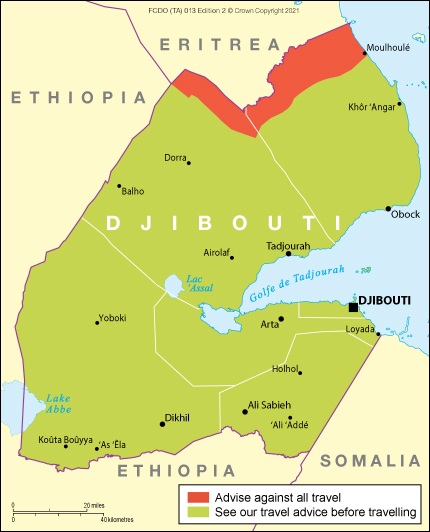
No whole region is advised against, but Global Affairs Canada and France Diplomatie advise against specific areas (border zone, locality, route…): the map does not draw them, their text is quoted below. Foreign Office also announces areas this synthesis cannot locate: its official text, linked below, prevails.

In brief
  • Avoid all travel to the Djibouti-Eritrea border area due to tensions between the two countries. Foreign Office
  • Avoid non-essential travel within 10 km of Djibouti's border with Eritrea due to ongoing tensions. Global Affairs Canada
  • Do not approach the northern border zone with Eritrea by land, sea or air due to the border dispute. France Diplomatie
  • Avoid the road area after Refuge Décan towards the border town of Loyada, as it lacks adequate security conditions. France Diplomatie
  • Do not travel independently to the Seven Brothers Archipelago (Sawabi). France Diplomatie
  • Avoid maritime navigation south of the Red Sea, in the Gulf of Aden and off the Horn of Africa, especially for vessels under 15 knots or with freeboard below 2 metres. France Diplomatie

Faithful summary of the official texts below, which prevail.

Djibouti is in no region these official readings advise against; check that it is not in one of the areas quoted below.The red dot on the map. Change the city at the top of the page to read the map from another point.
Ali Sabieh — Country-wide vigilanceArta — Country-wide vigilanceDikhil — Country-wide vigilanceTadjourah — Country-wide vigilanceObock — Country-wide vigilanceDjibouti — Country-wide vigilanceDjibouti
Country-wide vigilanceDjiboutiNone of the readings checked (Global Affairs Canada, Foreign Office and France Diplomatie) names a region: the whole country keeps the “country-wide vigilance” colour. Boundaries: Natural Earth. The areas quoted without a region are not drawn: they do not follow regional boundaries.
Advised against — all but essential travel — areas, not drawn1
Global Affairs Canada — Avoid non-essential travel to the area within 10 km of Djibouti’s border with Eritrea, due to tensions…
Country-wide vigilance
the whole country, including Djibouti
So:

specific areas are advised against; check the itinerary against their text below and record the decision in writing.

US05.03.2025
Level 2 of 4Exercise increased caution
FR05.03.2026
Red areas in the countrySome areas of the country are formally advised against.Your region (Djibouti): not covered
GB27.07.2026
Some areas: no travelYour region (Djibouti): not covered
CA14.10.2026
Exercise a high degree of cautionYour region (Djibouti): not covered
CH22.04.2026
Some regions advised againstSwitzerland’s FDFA advises against travel to certain regions.

The official text

Official passages not placed on the map6

Global Affairs Canada — Advised against — all but essential travel
Avoid non-essential travel to the area within 10 km of Djibouti’s border with Eritrea, due to tensions between the two countries.

France Diplomatie (in French) — Advised against — all travel
Il est possible de circuler librement dans le pays mais les frontières terrestres et maritimes sont à éviter.

France Diplomatie (in French) — Advised against — all travel
Au nord, en raison du différend frontalier entre l’Érythrée et Djibouti, il demeure formellement déconseillé d’approcher la zone frontalière par voie terrestre, maritime ou aérienne.

France Diplomatie (in French) — Advised against — all travel
Après le "Refuge Décan", la zone traversée par la route venant de Djibouti en direction de la ville frontière de Loyada est à éviter car elle n’offre pas toutes les conditions de sécurité.

France Diplomatie (in French) — Advised against — all travel
Piraterie maritime — La navigation au sud de la mer Rouge, dans le golfe d’Aden et au large de la Corne de l’Afrique est fortement déconseillée, notamment aux navires dont la vitesse est inférieure à 15 nœuds et dont le franc-bord est bas sur l’eau (hauteur inférieure à 2 mètres).

France Diplomatie (in French) — Advised against — all travel
Archipel des Sept-frères (Sawabi) — Il est formellement déconseillé de se rendre par soi-même dans cet archipel.

Maximum does not exclude these areas.The VIP Pack covers care and repatriation there. Still enforceable: sanctions and embargoes, and a country already at war at departure. Extraction and security belong to the VIP Pack Extreme, upon eligibility. See My cover

Global Affairs Canada — Open Government Licence – Canada (14.10.2026) · Foreign Office — Open Government Licence v3.0 · France Diplomatie (05.03.2026) · Natural Earth

No located event in this reading.

Last change: New information about military activity in the Red Sea area ('Regional risks’ page).

Djibouti - Level 2: Exercise Increased CautionState Department ↗updated 05.03.2025 · read 16.10.2026

Updated 05.03.2025

Exercise increased caution in Djibouti due to terrorism . Some areas have increased risk. Read the entire Travel Advisory.

Terrorists may attack with little or no warning. Terrorists target public areas including:

  • Tourist locations
  • Transportation centers (airports)
  • Government buildings
  • Markets and shopping malls
  • Hotels, clubs, and restaurants
  • Places of worship and schools
  • Parks and public areas
  • Major sporting and cultural events
  • Hospitals
  • Read the Travel Guidance for more information on travel to Djibouti.

Reconsider travel to areas bordering Eritrea due to border tensions .

Where, exactly?

What the national level does not tell you

The level is national. Risk areas are in the state advisories below.

  • U.S. State Department — the full advisory details the regions concerned and the reasons (crime, terrorism, kidnapping, civil unrest) (read the advisory)
  • Foreign, Commonwealth & Development Office (United Kingdom) — the United Kingdom advises against all travel to PARTS of the country · reviewed 27 July 2026
    Last announced change : « New information about military activity in the Red Sea area ('Regional risks’ page). » (read the advisory)
  • France Diplomatie — France classifies SOME AREAS of the country as red (travel formally advised against) — the advisory is geographic, check it for your exact destination (read the Security advisory)

No major event in progress is located in this country at this morning's check.

Safety in figures
Road traffic deaths per 100,000 people
Djibouti23.5 2019
Switzerland2.2 2019
France5.1 2019

Reading: On the road, 11 times more deaths than in Switzerland: road crashes are the leading cause of death of healthy travellers (CDC) — seat belt, no night driving, a driver or a taxi from a rank.

World Bank (UNODC for homicides, WHO for roads) — latest published valuedata.worldbank.org ↗read 10.10.2026

What we locate on the map are events in progress that have real coordinates: USGS earthquakes, GDACS disasters, NOAA storms and open NASA EONET events. Hover a dot for details, click to open it in this briefing.

I travel on a passportEach government writes for its own nationals. The advisory that counts for you — and for your policy's clauses — is your country's.

French passport — France Diplomatie

In brief
  • Avoid all land, sea and air approaches to the northern border with Eritrea due to ongoing territorial dispute. France Diplomatie
  • Do not travel south-east beyond Refuge Décan towards Loyada on the Somaliland border, as security conditions are inadequate. France Diplomatie
  • Maritime navigation south of the Red Sea, in the Gulf of Aden and off the Horn of Africa is strongly discouraged, especially for vessels with speed below 15 knots or freeboard under 2 metres. France Diplomatie
  • Register with MSCHOA (Maritime Security Centre - Horn of Africa) at +44 1923958547 if present in piracy-risk waters. France Diplomatie
  • Do not travel at night anywhere in the country; travel inland only in convoys of at least two 4x4 vehicles with 8 litres water per person per day. France Diplomatie
  • Sites of Oued Kalou and Mont Moussa Ali are forbidden to all visitors including tourists; military checkpoints may appear without notice on roads. France Diplomatie

Faithful summary of the official texts below, which prevail.

Some areas of the country are formally advised against.France Diplomatie ↗updated 15.09.2026 · read 15.10.2026

Vigilance areas — France Diplomatie (in French) updated 05.03.2026official map ↗updated 15.09.2026 · read 15.10.2026

Formally advised against — red
  • Il est possible de circuler librement dans le pays mais les frontières terrestres et maritimes sont à éviter.
  • Au nord, en raison du différend frontalier entre l’Érythrée et Djibouti, il demeure formellement déconseillé d’approcher la zone frontalière par voie terrestre, maritime ou aérienne.
  • Après le "Refuge Décan", la zone traversée par la route venant de Djibouti en direction de la ville frontière de Loyada est à éviter car elle n’offre pas toutes les conditions de sécurité.
  • Piraterie maritime — La navigation au sud de la mer Rouge, dans le golfe d’Aden et au large de la Corne de l’Afrique est fortement déconseillée, notamment aux navires dont la vitesse est inférieure à 15 nœuds et dont le franc-bord est bas sur l’eau (hauteur inférieure à 2 mètres).
  • Archipel des Sept-frères (Sawabi) — Il est formellement déconseillé de se rendre par soi-même dans cet archipel.
Djibouti

- Présentation de Djibouti

-

-

-

-

-

-

-

-

-

-

Zones de vigilance

Dernière actualisation le 05/03/2026, information toujours valable à la date du jour

Zones formellement déconseillées (en rouge sur la carte)

Il est possible de circuler librement dans le pays mais les frontières terrestres et maritimes sont à éviter.

Au nord, en raison du différend frontalier entre l’Érythrée et Djibouti, il demeure formellement déconseillé d’approcher la zone frontalière par voie terrestre, maritime ou aérienne.

Au sud-est du pays, les délimitations frontalières entre Djibouti et le Somaliland sont incertaines. Après le "Refuge Décan", la zone traversée par la route venant de Djibouti en direction de la ville frontière de Loyada est à éviter car elle n’offre pas toutes les conditions de sécurité.

Piraterie maritime

Malgré des améliorations récentes liées à une forte présence aérienne et navale internationale et à l’armement des navires marchands, les attaques avec prises d’otages restent possibles. Les actes de piraterie maritime peuvent avoir lieu à partir du détroit de Bab el Mandeb, dans le golfe d’Aden et le long des côtes somaliennes ou yéménites ainsi que dans une grande partie du nord-ouest de l’océan Indien.

La navigation au sud de la mer Rouge, dans le golfe d’Aden et au large de la Corne de l’Afrique est fortement déconseillée, notamment aux navires dont la vitesse est inférieure à 15 nœuds et dont le franc-bord est bas sur l’eau (hauteur inférieure à 2 mètres). Ils représentent des proies de choix pour les pirates. Pour toute navigation maritime dans le monde, contacter le MICA Center afin de prendre connaissance de la Coopération Navale Volontaire :

MICA Center : par téléphone (+33 298 14 99 17) ou par courriel à mica-watchkeeper.fct@def.gouv.fr

En cas de présence dans cette zone, il est recommandé de se signaler au MSCHOA (Maritime Security Centre - Horn of Africa, coopération navale volontaire mis en place dans le cadre de l’opération Atalante : tél. +44 1923958547…

Zones de vigilance renforcée (en jaune sur la carte)

En dehors des zones rouges, l’intégralité du pays est en zone de vigilance renforcée. Il est possible d’y circuler en respectant les Recommandations générales listées ci-après.

L’attention des voyageurs est attirée sur le contrôle que les autorités militaires djiboutiennes exercent sur l’accès à une zone au nord des villes situées sur l’axe Balho, Adaïlou, Ouaddhi, Godoria. Des barrages sont installés par les Forces armées djiboutiennes (FAD) sur les principaux itinéraires. Tout déplacement dans cette zone peut être soumis à l’autorisation des FAD, de manière épisodique, et sans préavis, voire même temporairement interdit. Il convient de respecter strictement les consignes édictées par les FAD aux barrages concernés.

Vigilance particulière

Compte-tenu des contraintes sécuritaires imposées par les autorités djiboutiennes, l’accès aux sites de l’Oued Kalou et du mont Moussa Ali sont interdits, même à des fins touristiques. De manière plus générale, des barrages et des contrôles peuvent être organisés sur le réseau routier du pays. Il est impératif de s’y soumettre et d’adopter une attitude respectueuse et courtoise à l’égard des forces de sécurité locales.

Terrorisme

Voisine de l’Éthiopie, de la Somalie, de l’Érythrée et, du Yémen par la mer, la République de Djibouti fait figure d’îlot de stabilité dans une zone sensible. Cette stabilité est renforcée par la présence de forces militaires de différents pays qui y sont stationnées. Son port, d’importance stratégique, sert d’escale à de nombreuses marines étrangères.

Un contingent de l’armée djiboutienne est déployé en Somalie depuis 2012. Il est actuellement engagé au sein de la Mission de soutien et de stabilisation de l’Union africaine en Somalie (AUSSOM).

Bien qu’aucune attaque n’ait eu lieu à Djibouti-ville depuis l’attentat suicide du 24 mai 2014 au restaurant « La Chaumière », la vigilance reste recommandée dans les lieux publics et ceux fréquentés par les expatriés (centre historique ; lieux de culte et institutions religieuses ; proximité des zones portuaires, aéroportuaires et installations militaires djiboutiennes et étrangères ; emprises françaises ; lieux de vie, restaurants, bars).

En province, certaines régions du nord et de l’ouest du pays font l’objet d’opérations militaires ponctuelles en réaction aux attaques terroristes du FRUD-armé. Si les Français ne sont pas visés par ces dernières, il convient de s’informer des zones à risques auprès des points de contrôle des forces de défense et de sécurité rencontrés. D’une manière générale, il est recommandé de ne pas bivouaquer en dehors des campements officiels et de recourir systématiquement aux services d’un guide habilité par les autorités.

Somaliland

L’absence sur place de toute représentation française rend aléatoire la protection de nos ressortissants en difficulté. Il est recommandé à toute personne appelée à se rendre au Somaliland de se faire connaître auprès de l’ambassade de France au Kenya et de…

Risque routier

La circulation routière est dangereuse en ville et sur l’axe Djibouti-frontière éthiopienne (trafic intense de camions semi-remorques et véhicules en mauvais état). Il convient d’adapter sa vitesse aux conditions de circulation et d’éviter de circuler de nuit en dehors de la capitale. Le réseau routier est globalement en mauvais état (nids de poule, routes irrégulières, défaut d’éclairage en dehors de la ville) avec de nombreuses pistes non goudronnées. Il convient d’anticiper les crevaisons fréquentes et de se déplacer de préférence à deux véhicules en dehors de la ville. Quelle que soit la destination touristique, la présence d’un guide francophone est vivement conseillée (notamment pour les excursions dans le nord du pays).

Risque maritime

Compte tenu des menaces visant les navires qui passent par le détroit de Bab-el-Mandeb et des activités militaires en Mer Rouge et dans le nord du Golfe d’Aden, les navigateurs de plaisance doivent reporter leurs déplacements dans cette zone.

En outre, une recrudescence des actes de piraterie le long des côtes de la Somalie a été enregistrée et est susceptible d’affecter les bateaux ayant besoin de faire escale dans la région.

En cas de présence dans la zone, il est recommandé de se signaler le plus tôt possible auprès de la cellule de permanence de l’Autorité française dans cette zone maritime : État-major ALINDIEN COMFOR EAU – cellule MICA OI : par téléphone (+971 265 74 265) ou par courriel à alindien-comfor-eau-mica-io.contact.fct @ intradef.gouv.fr

Voir également la fiche Piraterie maritime .

Risque sismique

Djibouti se situe dans une région d’activité sismique.

La faille qui annonce le rift africain partage le territoire de Djibouti en son centre. L’activité sismique est donc permanente, mais d’une intensité relativement faible. La faille se situant dans une zone inhabitée, le risque ne touche pas directement les populations. En revanche, une partie des constructions de Djibouti-ville a été construite récemment à partir de remblais, sans répondre aux normes antisismiques, et ne résisterait pas à un tremblement de terre d’une forte amplitude. Pour plus d’informations, consulter la fiche sur les séismes .

Recommandations générales

Compte tenu de la situation sécuritaire au plan régional et des conditions climatiques extrêmes, il importe de suivre les recommandations suivantes :

  • Les déplacements de nuit sont déconseillés sur tout le territoire ;
  • Les déplacements à l’intérieur du pays doivent se faire en convois d’au moins deux véhicules 4x4 (prévoir une réserve d’eau de 8 litres par jour et par personne) ;
  • Ne pas s’écarter des pistes, sauf avec le concours d’un guide expérimenté ;
  • Emprunter de préférence les pistes les plus régulièrement fréquentées ;
  • Ne pas porter de bijoux de valeur est préférable.
Activités sportives à risques

À la plage, être conscient des risques liés à la faune marine : risque de marcher sur le dard de raies pastenague au bord de l’eau, ou de se blesser en frôlant coraux ou oursins.

En raison des conditions climatiques particulièrement éprouvantes, les activités sportives doivent être pratiquées avec prudence.

Full text of the Security pagediplomatie.gouv.fr ↗updated 15.09.2026 · read 15.10.2026

Swiss passport — FDFA (Switzerland), in French

In brief
  • Avoid the border zone with Eritrea due to unresolved frontier conflicts and persistent tensions in the continental shelf and Doumeira Island regions. DFAE
  • Avoid the Somalia border region because of significant aggression risks. DFAE
  • Exercise heightened vigilance in public places including markets, bus stations, churches, government buildings, and areas frequented by foreign nationals due to al-Shabab terrorist threats. DFAE
  • Do not travel at night across the country; for inter-city and desert trips, always hire a local expert guide and travel in convoys of multiple four-wheel-drive vehicles with sufficient water, food, fuel and spare parts. DFAE
  • Stay informed about current security conditions through media and follow local authorities' instructions; avoid crowds and demonstrations as incidents may occur. DFAE
  • Avoid leaving main roads due to residual risks from unexploded ordnance; exercise increased caution in the Red Sea and Gulf of Aden due to Somali pirate attack risks. DFAE

Faithful summary of the official texts below, which prevail.

FDFA update note — Ces conseils pour les voyages ont été publiés avec des modifications marginales. L’appréciation de la situation reste valable de manière inchangée. (published 22.04.2026)

General assessment

Des tensions locales peuvent survenir ponctuellement, notamment en lien avec des questions ethniques ou politiques. Par le passé, des affrontements isolés entre différents groupes ont fait des blessés et des victimes. Des tensions persistent dans les régions de la colline continentale et de l’île Doumeira, à la frontière entre l’Érythrée et Djibouti (voir également le chapitre Risques régionaux spécifiques). Dans ce pays comme ailleurs, le risque d’attentats terroristes ne peut être exclu. Le groupe somalien al-Shabab menace plus particulièrement d’également perpétrer des attentats au Djibouti. La rubrique terrorisme et enlèvements attire l'attention sur les risques liés au terrorisme. Terrorisme et enlèvements Faites preuve de vigilance, en particulier dans les lieux publics comme les marchés, les gares routières, les églises, dans les environs des bâtiments du gouvernement et dans les endroits fréquentés par les personnes de nationalité étrangère. Avant et pendant le voyage, informez-vous au travers des médias sur la situation sécuritaire actuelle. Suivez les consignes des autorités locales et tenez-vous à l’écart des rassemblements de foule et des manifestations de tout genre, car des débordements sont possibles.

Specific regional risks

La description des zones à risques repose sur des données approximatives; les risques ne peuvent se restreindre à des zones délimitées. En 2004, Djibouti a été déclaré sans risques de mines. Un faible risque résiduel lié à la présence d’anciens restes explosifs de guerre subsiste. Il est recommandé de ne pas quitter les routes et les chemins les plus fréquentés. Zone frontalière avec l’Erythrée: Il est déconseillé de se rendre dans cette zone. En raison des conflits frontaliers irrésolus entre Djibouti et l'Erythrée, la situation est toujours tendue. Zone frontalière avec la Somalie: Il faut éviter la région frontalière avec la Somalie en raison du risque important d’agression. Passage par la mer Rouge et le golfe d’Aden: Dans la région de la mer Rouge et le golfe d’Aden, il est recommandé de faire preuve d’une vigilance accrue; voir information sous Risques maritimes et piraterie .

Crime

Il convient de prendre les précautions d'usage contre la délinquance. Dans le golfe d'Aden , il existe un risque d'attaques par des pirates somaliens. Consultez les informations spécifiques: Risques maritimes et piraterie

Natural hazards

Les rares pluies peuvent être très violentes. En l'espace de quelques instants, elles peuvent provoquer des inondations, en particulier dans la ville de Djibouti. Des périodes de sécheresse sont également possibles. Consultez les prévisions météorologiques et suivez les avertissements et les instructions des autorités locales. Agence Nationale de la Météorologie de Djibouti Organisation météorologique mondiale Djibouti se trouve dans une zone sismique et compte plusieurs volcans . Si une secousse sismique / une catastrophe naturelle devait se produire durant votre séjour, prenez immédiatement contact avec vos proches et suivez les instructions des autorités locales.

FDFA travel advice, in French, valid on 15.10.2026eda.admin.ch ↗updated 22.04.2026 · read 15.10.2026

British passport — Foreign Office (UK)

In brief
  • The FCDO advises against all travel to the Djibouti-Eritrea border due to fragile military situation and risk of further conflict. Foreign Office
  • Unmarked landmines exist near the Djibouti-Eritrea border; borders with Ethiopia and Somalia are not always clearly identified. Foreign Office
  • Take great care on roads north of Tadjoura and Obock where military roadblocks operate; obtain formal military approval for journeys in these areas. Foreign Office
  • Terrorists are likely to attempt attacks in Djibouti, particularly at transport hubs, hotels, restaurants, shopping areas, religious and sporting events, and military bases. Foreign Office
  • During Ramadan, do not eat, drink, smoke or chew gum in public during daytime; violating alcohol laws can result in a two-year prison sentence. Foreign Office
  • Photographing infrastructure including ports, airports, military facilities and bridges is prohibited; equipment may be confiscated and you could be arrested. Foreign Office

Faithful summary of the official texts below, which prevail.

Regions covered by the Foreign Officegov.uk ↗updated 27.07.2026 · read 15.10.2026

Advise against all travel
  • Djibouti-Eritrea border — FCDO advises against all travel to the Djibouti-Eritrea border.
Official Foreign Office map
Foreign Office map — Open Government Licence v3.0

Warnings — Foreign OfficeForeign Office ↗updated 27.07.2026 · read 15.10.2026

Warnings — Foreign Office

Your travel insurance could be invalidated if you travel against advice from the Foreign, Commonwealth & Development Office (FCDO).

Djibouti-Eritrea border

FCDO advises against all travel to the Djibouti-Eritrea border.

Before you travel

No travel can be guaranteed safe. Read all the advice in this guide. You may also find it helpful to:

  • see general advice for women travellers
  • read our guide on disability and travel abroad
  • see general advice for LGBT+ travellers
  • read about safety for solo and independent travel
  • see advice on volunteering and adventure travel abroad
Travel insurance

If you choose to travel, research your destinations and get appropriate travel insurance . Insurance should cover your itinerary, planned activities and expenses in an emergency.

Regional risks — Foreign OfficeForeign Office ↗updated 27.07.2026 · read 15.10.2026

Regional risks — Foreign Office

This section has safety advice for regions of Djibouti. It only covers regions where FCDO has specific advice.

You should also read FCDO ’s overall travel advice and safety and security advice .

Military activity in the Red Sea area

There is a risk of military activity is currently underway in response to attempts by Houthi militants to prevent movement of international shipping in the Red Sea. While the area of activity is limited to the Red Sea and Yemen, there is a possibility that the situation could change at short notice. You should:

- read If you’re affected by a crisis abroad - GOV.UK . This includes guidance on “how to prepare for a crisis” with suggestions on what you might include in your emergency supplies and “what to do in a crisis”

- sign up to FCDO Travel Advice email alerts

- monitor local and international media for the latest information

Djibouti-Eritrea border

FCDO advises against all travel to the Djibouti-Eritrea border.

In 2008 there were military clashes between Djibouti and Eritrea after Eritrean forces entered the disputed Djibouti border region. The situation remains fragile and further conflict is possible.

Djibouti-Somaliland border

Take great care if you travel to the Djibouti-Somaliland border. The Djiboutian military have set up roadblocks and checkpoints. Follow the advice given by the authorities and seek military approval for journeys in this area.

Landmines near borders

There are unmarked landmines near the Djibouti-Eritrea border. In other border areas most landmines have been marked or cleared. Djibouti’s borders with Ethiopia and Somalia are not always clearly identified.

Roads north of Tadjoura

Take great care travelling on roads north of Tadjoura and Obock where there are military roadblocks.

Respect advice given by those operating the roadblocks. If required, get formal military approval for your journey.

Safety — Foreign OfficeForeign Office ↗updated 27.07.2026 · read 15.10.2026

Safety — Foreign Office

This guide also has safety advice for regions of Djibouti .

Terrorism

There is a high threat of terrorist attack globally affecting UK interests and British nationals, including from groups and individuals who view the UK and British nationals as targets. Stay aware of your surroundings at all times.

UK Counter Terrorism Policing has information and advice on staying safe and what to do in the event of a terrorist attack. Find out how to reduce your risk from terrorism while abroad .

Terrorism in Djibouti

Terrorists are likely to try to carry out attacks in Djibouti.

Terrorism attacks could be indiscriminate, including in crowded areas and places frequented by foreign nationals, such as:

  • transport hubs
  • hotels, restaurants and bars
  • shopping areas
  • religious events
  • sporting events
  • military bases

Stay aware of your surroundings, keep up to date with local media reports and follow the advice of local authorities.

The terrorist group Al Shabaab may see Djibouti and international interests within Djibouti as legitimate targets. This is because Djibouti participates in the African Union peacekeeping mission, ATMIS , and joins in international support of the Somali government. Al Shabaab has issued public threats against Djibouti.

Protecting your belongings

There is a risk of petty crime. Take precautions such as:

  • not walking alone late at night
  • keeping valuables, particularly cameras and passports, out of sight
Ramadan

Ramadan is a holy month for Muslims. The dates vary by year and country. During this time, do not:

  • eat, drink, smoke or chew gum in public in the daytime, including in your car
  • play loud music or dance
  • swear in public

Get more advice when you arrive from your tour guide, hotel or business contacts. You should show respect to those who are fasting and take care not to offend local values.

You should also:

  • check opening hours of shops and restaurants
  • be aware that if hotels and restaurants are providing food or drink in fasting hours, they may separate you from Islamic guests, for example with screens
  • be aware that government offices and public institutions may change their working hours during Ramadan
  • follow local dress codes – clothing that does not meet local dress codes may cause more offence at this time
  • be aware that fasting can cause tiredness, particularly during the later afternoon and early evening
  • be patient and show tolerance
Money

Credit and debit cards are not widely accepted. If credit cards are accepted, you often need a Visa card. ATMs are normally available in Djibouti City, but they may not accept Mastercard. Make sure that you carry enough cash.

Alcohol laws

Drinking alcohol is allowed, but you can get a 2-year prison sentence for drunken behaviour.

Using cameras

Photographing infrastructure, such as ports, public buildings, airports, military facilities, and bridges, is prohibited. Your equipment could be confiscated, and you could be arrested. When taking photos near prohibited places, take care and seek local advice if you are unsure.

LGBT+ travellers

Same-sex sexual behaviour is not illegal but is not common in Djiboutian public life. Same-sex couples showing affection in public could attract the attention of the authorities under laws around “good morals”.

Read more advice for LGBT+ travellers .

Road travel

If you are planning to drive in Djibouti, see information on driving abroad .

You can use a UK photocard driving licence to drive in…

American passport — U.S. Department of State

In brief
  • Exercise increased caution in Djibouti due to terrorism targeting tourist locations, airports, hotels, markets, places of worship, and public gatherings. State Department
  • Reconsider travel within 10 miles of the border with Eritrea in Tadjoura and Obock regions due to government restrictions and limited emergency services. State Department
  • Enroll in the Smart Traveler Enrollment Program (STEP) to receive alerts from the U.S. Embassy and facilitate emergency assistance. State Department
  • Purchase travel insurance before departure, ensuring it covers evacuation assistance, medical expenses, and trip cancellation. State Department

Faithful summary of the official texts below, which prevail.

Djibouti - Level 2: Exercise Increased Caution 2025-03-05travel.state.gov ↗updated 05.03.2025 · read 16.10.2026

Advisory summary

Exercise increased caution in Djibouti due to terrorism . Some areas have increased risk. Read the entire Travel Advisory.

Terrorists may attack with little or no warning. Terrorists target public areas including:

  • Tourist locations
  • Transportation centers (airports)
  • Government buildings
  • Markets and shopping malls
  • Hotels, clubs, and restaurants
  • Places of worship and schools
  • Parks and public areas
  • Major sporting and cultural events
  • Hospitals
  • Read the Travel Guidance for more information on travel to Djibouti.

Reconsider travel to areas bordering Eritrea due to border tensions .

Global Affairs Canada — additional reading

Exercise a high degree of caution (with regional advisories)

Djibouti-Eritrea border - Avoid non-essential travel

Avoid non-essential travel to the area within 10 km of Djibouti’s border with Eritrea, due to tensions between the two countries.

  • Djibouti-Eritrea border — Avoid non-essential travel to the area within 10 km of Djibouti’s border with Eritrea, due to tensions between the two countries.

Open Government Licence – Canada · October 14, 2026 09:54 EDTtravel.gc.ca ↗updated 14.10.2026 · read 16.10.2026

In brief
  • You must comply with local laws; learn about arrest and detention procedures abroad from Global Affairs Canada. Global Affairs Canada
  • Possession, use or trafficking of illegal drugs can lead to long prison sentences and heavy fines; public drunkenness may result in a two-year prison term. Global Affairs Canada
  • Photography of military installations is prohibited; ask permission before photographing individuals. Global Affairs Canada
  • During Ramadan (expected to begin on or around February 7, 2027), refrain from eating, drinking, or smoking in public between sunrise and sunset. Global Affairs Canada
  • Carry an international driving permit and sufficient cash, as credit and debit cards are not widely accepted; the local currency is the Djiboutian franc. Global Affairs Canada
  • Same-sex sexual conduct is not illegal but may lead to arrest under laws prohibiting attacks on “good morals”; LGBT+ travellers should consider the risks. Global Affairs Canada

Faithful summary of the official texts below, which prevail.

Global Affairs Canada — written for Canadian travellers, valid for all

Local laws

You must abide by local laws. Learn about what you should do and how we can help if you are arrested or detained abroad.

Drugs

Penalties for possession, use or trafficking of illegal drugs are severe. Convicted offenders can expect long prison sentences and heavy fines. Consumption of alcohol is authorized, but public displays of drunkenness could result in a two-year prison term. Drugs, alcohol and travel

Illegal or restricted activities

Hunting is prohibited by law.

Photography

Photography of military installations is prohibited. Ask permission before photographing individuals.

2SLGBTQI+ persons

Although the laws of Djibouti don’t prohibit sexual acts between individuals of the same sex, homosexuality is not socially tolerated. 2SLGBTQI+ persons could face arrest under other charges. Laws that prohibit attacks on “good morals” have been used to prosecute public displays of same-sex conduct. 2SLGBTQI+ travellers should carefully consider the risks of travelling to Djibouti. Travel and your sexual orientation, gender identity, gender expression and sex characteristics

Culture

In 2027, the lunar month of Ramadan is expected to begin on or around February 7. In public, between sunrise and sunset, refrain from:

  • drinking
  • eating
  • smoking

Islamic practices and beliefs are part of Djibouti’s customs, laws and regulations. It is forbidden to produce, display publicly or sell any object, image, film or audio-visual recording considered contrary to accepted standards of behaviour.

  • Exercise common sense and discretion in dress and behaviour
  • Dress conservatively and respect religious and social traditions to avoid offending local sensitivities
International Child Abduction

The Hague Convention on the Civil Aspects of International Child Abduction is an international treaty. It can help parents with the return of children who have been removed to or retained in certain countries in violation of custody rights. It does not apply between Canada and Djibouti. If your child was wrongfully taken to, or is being held in Djibouti by an abducting parent:

  • act as quickly as you can
  • consult a lawyer in Canada and in Djibouti to explore all the legal options for the return of your child
  • report the situation to the nearest Canadian government office abroad or to Global Affairs Canada by calling the Emergency Watch and Response Centre

If your child was removed from a country other than Canada, consult a lawyer to determine if The Hague Convention applies. Be aware that Canadian consular officials cannot interfere in private legal matters or in another country's judicial affairs.

Driving

You should carry an international driving permit International Driving Permit

Money

The currency of Djibouti is the Djiboutian franc. The economy is predominately cash based. Ensure you carry enough currency, as credit and debit cards are not widely accepted.

Open Government Licence – Canada · October 14, 2026 09:54 EDTtravel.gc.ca ↗updated 14.10.2026 · read 16.10.2026

Foreign Office — laws and cultural differences

Ramadan

Ramadan is a holy month for Muslims. The dates vary by year and country. During this time, do not:

  • eat, drink, smoke or chew gum in public in the daytime, including in your car
  • play loud music or dance
  • swear in public

Get more advice when you arrive from your tour guide, hotel or business contacts. You should show respect to those who are fasting and take care not to offend local values. You should also:

  • check opening hours of shops and restaurants
  • be aware that if hotels and restaurants are providing food or drink in fasting hours, they may separate you from Islamic guests, for example with screens
  • be aware that government offices and public institutions may change their working hours during Ramadan
  • follow local dress codes – clothing that does not meet local dress codes may cause more offence at this time
  • be aware that fasting can cause tiredness, particularly during the later afternoon and early evening
  • be patient and show tolerance
Money

Credit and debit cards are not widely accepted. If credit cards are accepted, you often need a Visa card. ATMs are normally available in Djibouti City, but they may not accept Mastercard. Make sure that you carry enough cash.

Alcohol laws

Drinking alcohol is allowed, but you can get a 2-year prison sentence for drunken behaviour.

Using cameras

Photographing infrastructure, such as ports, public buildings, airports, military facilities, and bridges, is prohibited. Your equipment could be confiscated, and you could be arrested. When taking photos near prohibited places, take care and seek local advice if you are unsure.

LGBT+ travellers

Same-sex sexual behaviour is not illegal but is not common in Djiboutian public life. Same-sex couples showing affection in public could attract the attention of the authorities under laws around “good morals”. Read more advice for LGBT+ travellers.

Open Government Licence v3.0gov.uk ↗updated 27.07.2026 · read 15.10.2026

FDFA (Switzerland) — laws and customs, in French

Specific legal provisions

Entre autres, les délits suivants sont punissables:

  • la prise de photos de personnes en uniforme, d’installations militaires et de bâtiments publics (aéroports, ponts, mosquée, etc.);
  • l'alcool au volant (taux maximum d'alcoolémie toléré: 0 pour mille);
  • l’ébriété dans un lieu public.

Les infractions à la loi sur les stupéfiants , y compris la détention de minimes quantités de drogue quelle qu'elle soit, sont passibles de lourdes peines de prison. Les conditions de détention sont précaires (prisons surpeuplées, alimentation et soins médicaux insuffisants, etc.).

Cultural specificities

Les actes à caractère homosexuel ne sont pas tolérés. Djibouti est un pays à majorité musulmane. Adaptez votre comportement et votre tenue vestimentaire aux us et coutumes locaux. Renseignez-vous dans les guides de voyages, auprès de votre agence ou directement sur place sur les codes de conduite. Des prescriptions particulières sont à observer durant la période du Ramadan et dans les endroits religieux. Demandez préalablement la permission aux personnes que vous souhaitez photographier.

FDFA travel advice, in Frencheda.admin.ch ↗updated 22.04.2026 · read 15.10.2026

Air: Moderate 42/100PM2.5 12.4 µg/m³ · PM10 17.8 µg/m³
UV very high today max 9.7Right now 9.3 · WHO scale 0–11+

What it changes for you: Air acceptable at this hour: nothing special to plan. Very high UV: sunscreen, hat and shade between 11 am and 4 pm; sunstroke and dehydration are travellers' first reasons to see a doctor.

Reading 11:00 (Africa/Djibouti)Open-Meteo ↗updated 16.10.2026 · read 16.10.2026

Air quality and UV: Open-Meteo.com (CC BY 4.0), data rounded and formatted by Maximum. Contains modified Copernicus Atmosphere Monitoring Service information 2026. Neither the European Commission nor ECMWF is responsible for any use that may be made of the Copernicus information or data it contains.

Physicians per 1,000 people
Djibouti0.2 2022
Switzerland4.5 2022
France3.3 2022
Hospital beds per 1,000 people
Djibouti1.4 2018
Switzerland4.4 2023
France5.7 2022
Health spending per person (USD)
Djibouti78 2023
Switzerland11,784 2023
France5,327 2024
Life expectancy (years)
Djibouti66.2 2024
Switzerland84.4 2024
France83.0 2024

Reading: With 0.2 physicians per 1,000 people (96% fewer than Switzerland), the nearest hospital does not always have the capacity for a serious case: evacuation to an adequate centre is the rule, not the exception — that is what unlimited evacuation and repatriation cover. Health spending of 78 USD per person (Switzerland: 11,784) goes with private hospitals that bill foreigners in hard currency and ask for a guarantee before admission: the direct payment guarantee is what avoids the deposit.

World Bank — latest published value, year per indicatordata.worldbank.org ↗read 10.10.2026

I travel on a passportVisa, passport validity, entry form: the rules depend on your passport. Each government describes them for its own nationals.

French passport — France Diplomatie

In brief
  • French nationals require a visa for Djibouti, obtainable from diplomatic missions, via e-visa at https://www.evisa.gouv.dj/, or on arrival for one month at airline and immigration discretion. France Diplomatie
  • Overstaying beyond authorised visa duration incurs penalties of 40,000 FDJ for up to 90 days excess or 80,000 FDJ for over 90 days, payable to immigration police or face three to six months imprisonment and five-year entry ban. France Diplomatie
  • Pleasure boat crews cannot use e-visas; notify the French embassy at admin-francais.djibouti-fslt@diplomatie.gouv.fr in advance with crew passports, boat registration and vaccination records, avoiding Friday and Saturday arrivals. France Diplomatie
  • Travellers crossing the Ethiopia-Djibouti border by road must pass both border police and customs checkpoints in both directions; non-compliance risks vehicle impoundment and indefinite detention without embassy assistance. France Diplomatie
  • Present at the Ethiopia-Djibouti border on weekdays only, not Fridays or public holidays, or obtain a visa in Addis Ababa beforehand to avoid same-day entry denial. France Diplomatie
  • Foreign nationals staying over three months in Djibouti must hold a temporary residence card or resident card valid maximum one year and not exceeding travel document validity. France Diplomatie

Faithful summary of the official texts below, which prevail.

Djibouti

- Présentation de Djibouti

-

-

-

-

-

-

-

-

-

-

Mesures liées à la Covid-19

Toutes les mesures de restrictions sanitaires pour l’entrée sur le territoire ont été levées.

Formalités d’entrée

Les ressortissants français sont soumis à l’obligation de visa. Il peut être obtenu :

  • auprès des représentations diplomatiques djiboutiennes basées à l’étranger ;
  • en utilisant une procédure de e-visa : https://www.evisa.gouv.dj/ (pour les visas de transit et de court séjour).
  • à l’arrivée sur le territoire pour une durée d’un mois, à la discrétion de la compagnie aérienne au départ et du service d’immigration de Djibouti à l’arrivée, en fonction de la nature du déplacement et du type de passeport.

Les personnes titulaires d’une carte de séjour djiboutienne en cours de validité peuvent accéder au territoire djiboutien sans visa et sans autorisation d’accès visée par les autorités djiboutiennes. Pour plus de renseignements, s’adresser aux autorités djiboutiennes ou aux compagnies aériennes concernées.

Dans un communiqué du 22 novembre 2022, le ministre de l’Intérieur a rappelé les dispositions suivantes :

  • Tout ressortissant étranger, rentré légalement sur le territoire djiboutien, et restant au-delà de la durée autorisée par son visa est astreint à une pénalité de 40.000 FDJ pour un dépassement n’excédant pas 90 jours, et 80.000 FDJ pour un dépassement de plus de 90 jours.
  • La perception de ces pénalités s’effectue auprès de la Police de l’immigration sur délivrance d’une quittance du Trésor Public.
  • En cas d’impossibilité de régler la pénalité, le ressortissant étranger sera puni d’une peine d’emprisonnement de 3 à 6 mois et d’une interdiction de séjour sur le territoire djiboutien pour une durée de 5 ans.
Escales des bateaux de plaisance :

Les plaisanciers qui souhaitent faire escale à Djibouti ne peuvent pas utiliser un E-visa. Un visa d’entrée est délivré directement au port.

Pour faciliter ces démarches, il est préférable d’annoncer en amont son arrivée auprès de la section consulaire de l’ambassade de France qui informera les autorités portuaires djiboutiennes. Le courriel devra être adressé à : admin-francais.djibouti-fslt@diplomatie.gouv.fr

En annexe du message, il faudra ajouter une copie des passeports des membres d’équipage et une copie de l’acte de francisation du bateau. Ne pas omettre le carnet de vaccination qui risque d’être demandé par les autorités portuaires. Il est déconseillé d’arriver à Djibouti pendant le weekend (le vendredi et le samedi) car les démarches peuvent prendre beaucoup de temps en dehors des jours ouvrés.

Pour les voyageurs se rendant d’Éthiopie à Djibouti par la voie routière :

Le contrôle à la frontière entre Djibouti et l’Éthiopie s’effectue en deux temps : le premier contrôle est mené par la police aux frontières, le second par la douane. Il est obligatoire de passer ces deux points de contrôle, dans le sens Djibouti/Éthiopie et inversement. Le non-respect de cette règle expose les voyageurs à de sérieuses difficultés avec les services de sécurité du pays visité pouvant entraîner l’immobilisation du véhicule et donc le blocage de son propriétaire à la frontière pour une durée indéterminée, sans que l’ambassade de France à Djibouti ni l’ambassade de France en Éthiopie ne puissent assister les voyageurs qui contreviendraient à cette obligation ou qui ne seraient pas en mesure de présenter tous les documents requis.

La présentation à la frontière le vendredi (jour de repos à Djibouti) ou un jour férié comporte le risque de ne pas pouvoir pénétrer le jour-même sur le territoire djiboutien. Il est donc préférable et fortement recommandé de se procurer un visa à Addis Abeba ou de se présenter à la frontière un jour ouvré.

Tout étranger doit, s’il séjourne en République de Djibouti après l’expiration d’un délai de 3 mois depuis son entrée sur le territoire, être muni d’une carte de séjour temporaire ou d’une carte de résident délivrée dans les conditions prévues par la loi N°201/AN/07 fixant les conditions d’entrée et de séjour. La durée de validité de la carte de séjour temporaire ne peut être supérieure à 1 an et ne peut dépasser la validité des documents de voyage. L’étranger doit quitter la République de Djibouti à l’expiration de la validité de sa carte, à moins qu’il n’en obtienne le renouvellement. La carte de résident est délivrée aux étrangers salariés dans des sociétés de zone franche qui justifient être en possession d’un contrat de…

Entry and stay pagediplomatie.gouv.fr ↗updated 15.09.2026 · read 15.10.2026

Swiss passport — FDFA (Switzerland)

The FDFA does not publish entry requirements: they are set out by the destination's embassy or consulate in Switzerland — check them before booking, passport in hand. As a guide, the French and British requirements below describe the same rules as seen by two other governments.eda.admin.ch ↗updated 22.04.2026 · read 15.10.2026

British passport — Foreign Office (UK)

In brief
  • British citizens need a passport valid for at least six months beyond arrival date to enter Djibouti. Foreign Office
  • A visa is mandatory for entry to Djibouti. You may purchase a tourist visa on arrival in cash US dollars, apply online beforehand, or contact the Djibouti Embassy. Foreign Office
  • You must provide evidence of onward journey when applying for a Djibouti visa. Foreign Office
  • Yellow fever vaccination certificate is required if arriving from a transmission risk country listed by authorities. Foreign Office
  • Strict customs rules apply; declare all goods that may be prohibited or subject to tax or duty when entering or leaving Djibouti. Foreign Office

Faithful summary of the official texts below, which prevail.

Entry requirements — rules for a British passportForeign Office ↗updated 27.07.2026 · read 15.10.2026

Entry requirements — rules for a British passport

This information is for people travelling on a full ‘British citizen’ passport from the UK. It is based on the UK government’s understanding of Djibouti’s current rules for the most common types of travel.

The authorities in Djibouti set and enforce entry rules. If you’re not sure how these requirements apply to you, contact the Djibouti Embassy in the UK .

Passport validity requirements

To enter Djibouti, your passport must have an ‘expiry date’ at least 6 months after the date you arrive.

Check with your travel provider that your passport and other travel documents meet requirements. Renew your passport if you need to.

You will be denied entry if you do not have a valid travel document or try to use a passport that has been reported lost or stolen.

Dual nationals

When returning to the UK, British citizens must carry a valid British passport or certificate of entitlement . See Dual citizenship .

Visa requirements

You must have a visa to enter Djibouti.

Applying for a visa

You can buy a tourist visa when you arrive in Djibouti with payment in cash in US dollars. You can also apply for a visa online before travelling or contact the Djibouti Embassy . You must have evidence of your onward journey.

Vaccine requirements

To enter Djibouti, you must have a certificate to prove you’ve had a yellow fever vaccination if you’re coming from a country listed as a transmission risk .

For full details about medical entry requirements and recommended vaccinations, see TravelHealthPro’s Djibouti guide .

Customs rules

There are strict rules about goods you can take into or out of Djibouti. You must declare anything that may be prohibited or subject to tax or duty.

American passport — U.S. Department of State

The State Department publishes the requirements ("Entry, Exit and Visa Requirements") on its country page, which our servers cannot read. Read it before you go; as a guide, the French and British requirements below describe the same rules as seen by two other governments.travel.state.gov ↗updated 05.03.2025 · read 16.10.2026

Living on site

For each risk, the official texts themselves: what is happening, then, where they say so, what to do.

CrimeHIGH

What the texts say · Terrorists are likely to try to carry out attacks in Djibouti. There is a risk of petty crime.

What they advise:
  • Stay aware of your surroundings, keep up to date with local media reports and follow the advice of local authorities.
  • Take precautions such as: not walking alone late at night - keeping valuables, particularly cameras and passports, out of sight.
Foreign Office
TransportMODERATE

What the texts say · Driving standards are generally poor. On some major roads police use wire coils as roadblocks, which are not clearly visible at night.

What they advise:
  • Stay on paved roads and avoid travelling outside city centres after dark.
  • In the event of an accident, remain in the car and wait until the police arrive on the scene.
Foreign Office · Global Affairs Canada
Nature and climateMODERATE

What the texts say · Intense rainfall is rare but can cause flash floods, particularly around Djibouti City. Earthquakes and volcanic eruptions are a risk in Djibouti.

What they advise:
  • Stay away from flood areas and follow official advice.
  • The US Federal Emergency Management Agency website has advice about what to do before, during and after an earthquake.
Foreign Office
Laws and customsTO KNOW

What the texts say · Drinking alcohol is allowed, but you can get a 2-year prison sentence for drunken behaviour. Photographing infrastructure, such as ports, public buildings, airports, military facilities, and bridges, is prohibited.

What they advise:
  • You should always carry photo identification, preferably a certified copy of your passport’s identification page.
  • Your equipment could be confiscated, and you could be arrested.
Foreign Office · Global Affairs Canada

Sentences copied word for word from the official texts cited, chosen for the destination; the level is our reading. The full texts, at each source:Foreign Office ↗updated 27.07.2026 · read 15.10.2026 (updated 27.07.2026 · read 27.09.2026)Global Affairs Canada ↗updated 14.10.2026 · read 16.10.2026 (updated 14.10.2026 · read 27.09.2026)

Safety in figures
Road traffic deaths per 100,000 people
Djibouti23.5 2019
Switzerland2.2 2019
France5.1 2019

Reading: On the road, 11 times more deaths than in Switzerland: road crashes are the leading cause of death of healthy travellers (CDC) — seat belt, no night driving, a driver or a taxi from a rank.

World Bank (UNODC for homicides, WHO for roads) — latest published valuedata.worldbank.org ↗read 10.10.2026

—:—Local time · Africa/Djibouti ·
17Local emergency numbers · Police 17 · Ambulance 19 · Fire 18
Europlug, prise électrique de type E220 V
Drivingon the right

Time zone: IANA and timezone-boundary-builder (ODbL) · RESTCountries · EmergencyNumberAPI · Wikidata · European Central Bank

Places: © OpenStreetMap contributors (ODbL), Photon search by komoot.

FDFA (Switzerland) — transport and specific advice, in French

Transport and infrastructure

En dehors des villes, les infrastructures sont insuffisantes et il faut s'attendre à des difficultés de circulation en particulier lors de déplacements par la route. Dans le désert, les conditions climatiques et topographiques difficiles sont très éprouvantes pour les personnes en voyage. De plus, il faut souvent parcourir de longues distances avant de trouver une station-service ou un lieu d'approvisionnement. Pour les déplacements interurbains et surtout pour les tours dans le désert, il est de ce fait recommandé de toujours se faire accompagner par une ou un guide ayant une expertise des lieux et de voyager en convoi de plusieurs véhicules tout terrain. Il est vital de se munir d'une provision suffisante d'eau, de nourriture et de carburant, ainsi que de pièces de rechange. La nuit, renoncez aux déplacements à travers le pays. Les points de passage des frontières peuvent être fermés à court terme, par exemple afin d’endiguer la propagation de maladies. Informez-vous auprès des autorités locales ou directement auprès des postes-frontières.

FDFA travel advice, in Frencheda.admin.ch ↗updated 22.04.2026 · read 15.10.2026

ESSENTIAL

Maximum policyholder: before paying anything, call the 24/7 number. If you are admitted for more than 24 h, Maximum sends its direct payment guarantee to the hospital (art. 2.12).

+41 22 ••• •• •• — Full number in your client area

The hospitals to know — Djibouti

The hospital list has not been read from OpenStreetMap for this page yet: the medical-network map loads it when opened. Maximum's assistance directs you to the right facility, 24/7. The medical-network map ↗

9pharmacies5doctorsFull map and list ↗

Before you go

  • Routine vaccinesup to date
  • Yellow feverrequired if arriving from a risk area
  • Hepatitis Arecommended
  • Hepatitis Brecommended
  • Malariapreventive medicine recommended
  • Typhoidrecommended
  • Mpoxdepending on the trip

CDC Travelers' Health recommendations, most important first. They depend on your age, vaccines and itinerary: confirm them with a doctor or a travel clinic 4 to 6 weeks before departure. Details, disease by disease ↗cdc.gov ↗read 10.10.2026

On site

DengueMosquitoes bite by day: repellent, long sleeves.
ChikungunyaMosquito-borne: same protection as for dengue.
SunUV very high (10): hat, sunscreen, water.
MedicationIn their box, with the prescription — in English if possible.

The health system — With 0.2 physicians per 1,000 people (96% fewer than Switzerland), the nearest hospital does not always have the capacity for a serious case: evacuation to an adequate centre is the rule, not the exception — that is what unlimited evacuation and repatriation cover. Health spending of 78 USD per person (Switzerland: 11,784) goes with private hospitals that bill foreigners in hard currency and ask for a guarantee before admission: the direct payment guarantee is what avoids the deposit.

Back home — a fever in the following weeks should be told to a doctor, naming the country.

The next 7 days Africa/DjiboutiMET Norway ↗read 16.10.2026

Sat 17 Oct27–30°overcast · 0.2 mm
Sun 18 Oct28–30°mainly clear
Mon 19 Oct27–30°mainly clear
Tue 20 Oct26–30°clear
Wed 21 Oct27–30°clear
Thu 22 Oct26–30°clear
Fri 23 Oct28–30°mainly clear · 0.1 mm

Forecast: MET Norway (Norwegian Meteorological Institute, CC BY 4.0), grouped by day and formatted by Maximum.

I travel on a passportYour embassy, and the service to register with, depend on your passport.

Your country, 24/7, from abroad

FR
Crisis and Support Centre — French Ministry for Europe and Foreign Affairs+33 1 53 59 11 0024/7 emergency line, standard rate. First contact abroad: the French embassy or consulate.www.diplomatie.gouv.fr ↗updated 15.09.2026 · read 15.10.2026
CH
FDFA Helpline+41 58 465 33 33+41 800 24 7 36524/7, 365 days a year — helpline@eda.admin.ch. Beware of scam calls spoofing these numbers.www.eda.admin.ch ↗updated 22.04.2026 · read 15.10.2026
GB
Foreign, Commonwealth & Development Office+44 20 7008 500024 hours, for British nationals.www.gov.uk ↗updated 27.07.2026 · read 15.10.2026
US
Overseas Citizens Services — U.S. Department of State+1 202 501 4444+1 888 407 4747From abroad; the second number from the U.S. and Canada.travel.state.gov ↗updated 05.03.2025 · read 16.10.2026

French passport — French embassy and consulates

FR
Ambassade de Franceembassy · nearest · 1.4 km

جيبوتي

+33 3 59 39 70 03 · France Diplomatie

FR
Résidence de l'ambassadeur de Franceembassy · 1.4 km

جيبوتي

phone not published

FR
Ambassade de Franceembassy · 2.2 km

جيبوتي

phone not published

FR
Consulat de France1.8 km

جيبوتي

phone not published

Useful contacts listed by France Diplomatie (in French)diplomatie.gouv.fr ↗updated 15.09.2026 · read 15.10.2026

Updated: 15 September 2026

OpenStreetMap

Swiss passport — Swiss embassy and consulates

Useful addresses — FDFA, in French

Numéro d'urgence de la police: 17 Commissariat de la police centrale: 00253 21 35 38 91 Gendarmerie nationale: 00253 21 35 10 03 Représentations suisses à l’étranger: En cas de situation d’urgence à l’étranger, vous pouvez vous adresser à la représentation suisse la plus proche ou à la Helpline DFAE. Ambassade de Suisse en Ethiopie Helpline DFAE Représentations étrangères en Suisse: Pour obtenir des informations sur les prescriptions d'entrée (documents d'identité admis, visa, etc.), veuillez vous adresser aux ambassades et consulats étrangers compétents. Ceux-ci peuvent également vous renseigner sur les dispositions douanières pour l'importation et l'exportation d'animaux et de marchandises: appareils électroniques, souvenirs, médicaments, etc. Représentations étrangères en Suisse Djibouti e-Visa

OpenStreetMap · DFAE

British passport — British embassy and consulates

GB
Consulat du Royaume-Uninearest · 3.5 km

جيبوتي

phone not published

OpenStreetMap

American passport — U.S. embassy and consulates

US
Ambassade des États-Unis d'Amériqueembassy · nearest · 2.3 km

شارع دني لوريفوي, جيبوتي

phone not published

OpenStreetMap

Police

  • Police · 0.6 km
    جيبوتي

Town hall

  • Mairie de Djibouti التوجيه الوطني للانتخابات · 0.7 km
  • Cité Ministérielle مدينة الوزاري · 1.0 km
    جيبوتي

OpenStreetMap

Getting help — Foreign OfficeForeign Office ↗updated 27.07.2026 · read 15.10.2026

Getting help — Foreign Office

The Foreign, Commonwealth & Development Office (FCDO) cannot provide tailored advice for individual trips. Read this travel advice and carry out your own research before deciding whether to travel.

Emergency services in Djibouti

Ambulance: 21 35 09 62 or 21 35 27 12

Fire: 18

Police: 17

Contact your travel provider and insurer

Contact your travel provider and your insurer if you are involved in a serious incident or emergency abroad. They will tell you if they can help and what you need to do.

Help abroad

See how to get help from the UK government abroad including in an emergency.

Help in the UK

You can call FCDO in London if you need urgent help because something has happened to a friend or relative abroad.

Telephone: 020 7008 5000 (24 hours)

Find out about call charges

Ten phrases in French

For emergencies. If pronunciation fails, show the screen — or the printed page.

Help!Au secours !
Call an ambulance!Appelez une ambulance !
I need a doctor.J'ai besoin d'un médecin.
Where is the nearest hospital?Où est l'hôpital le plus proche ?
Call the police!Appelez la police !
I am allergic to penicillin.Je suis allergique à la pénicilline.
I have international medical insurance.J'ai une assurance médicale internationale.
I want to contact my embassy.Je voudrais contacter mon ambassade.
Please take me to this address.Emmenez-moi à cette adresse, s'il vous plaît.
Do you speak English?Parlez-vous anglais ?

Translations by Maximum Insurance, original script and transliteration.

  • Keep the entry stamp, hospital invoices and the medical report. Without them a claim cannot be rebuilt.
  • File it from the claim form, once back, with those papers.
  • The France Diplomatie health page mentions dengue and chikungunya. A fever in the weeks after return should be told to a doctor, naming the country.

Actions to take before each professional trip abroad.

1Once — the framework
2For each departure
3During the mission, and after

What is happening in Djibouti right now

Live alerts and level changes, each with its official source. Continuously updated.

What governments have just written

UpdateGlobal Affairs Canada

Natural disasters and climate section – added information on El Niño

October 14, 2026 09:54 EDTtravel.gc.ca ↗updated 14.10.2026 · read 16.10.2026

No level change recorded for this country since the log opened. The live alerts above are updated continuously.

⚡ The world feed — every country →

Frequently asked questions — travel insurance Djibouti

24/7 support number — +41 22 ••• •• ••An adviser goes through each question with you until you have an actionable answer: cover, hospital, entry rules, claims. Full number in your client area. You can also ask Maximum directly, just below these questions.
What is the official risk level in Djibouti today?

Level 2/4 — Exercise Increased Caution, U.S. Department of State, retrieved on 16 October 2026.

  • Is the whole country advised against? United States: no · France: no · United Kingdom: no · Switzerland: no (reading of 27 September 2026).
  • Switzerland’s FDFA advises against travel to certain regions (published 22.04.2026).
  • Contractually, only an FDFA, FOPH or WHO advisory against the trip opens Module A (art. 18.1) — that is not the case today.
  • International medical cover, 24/7 number saved, and a read of the areas named under Safety & risks before booking the itinerary.
  • We check these sources every morning and e-mail you the day one changes (Alerts button).

Sourcestravel.state.gov · updated 05.03 · read 16.10France Diplomatie · updated 15.09 · read 15.10DFAE · updated 22.04 · read 15.10207-country comparison

Is the whole of Djibouti advised against, or only some areas?

An area advised against does not rule out the country.

  • Official answers: United States: no · France: no · United Kingdom: no · Switzerland: no.
  • Foreign Office, regional risks: “This section has safety advice for regions of Djibouti. It only covers regions where FCDO has specific advice. You should also read FCDO ’s overall travel advice and safety and security advice . Military activity in the Red Sea area There is a risk of…”
  • Keep your country of residence's advisory on booking day and on departure day: that is what your policy's clauses cite.

SourcesFrance Diplomatie · updated 15.09 · read 15.10Foreign Office · updated 27.07 · read 15.10State Department · updated 05.03 · read 16.10

What are the entry requirements for Djibouti with my passport?

The rules depend on the passport, not on the destination alone.

  • French passport (France Diplomatie): French nationals require a visa for Djibouti, obtainable from diplomatic missions, via e-visa at https://www.evisa.gouv.dj/, or on arrival for one month at airline and immigration discretion. Overstaying beyond authorised visa duration incurs penalties of 40,000 FDJ for up to 90 days excess or 80,000 FDJ for over 90 days, payable to immigration police or face three to six months imprisonment and five-year entry ban. Pleasure boat crews cannot use e-visas; notify the French embassy at admin-francais.djibouti-fslt@diplomatie.gouv.fr in advance with crew passports, boat registration and vaccination records, avoiding Friday and Saturday arrivals.
  • British passport (Foreign Office): British citizens need a passport valid for at least six months beyond arrival date to enter Djibouti. A visa is mandatory for entry to Djibouti. You may purchase a tourist visa on arrival in cash US dollars, apply online beforehand, or contact the Djibouti Embassy. You must provide evidence of onward journey when applying for a Djibouti visa.
  • American passport: the requirements are on the State Department country page (travel.state.gov).
  • Swiss passport: the FDFA refers you to the destination's embassy in Switzerland.
  • Pick your passport at the top of Before you go › Entry: the official text that concerns you comes first, with its “In brief” summary.

SourcesFrance Diplomatie · updated 15.09 · read 15.10Foreign Office · updated 27.07 · read 15.10State Department · updated 05.03 · read 16.10

Do I need an insurance certificate for a Djibouti visa?

For a Schengen visa, yes: at least €30,000 of travel medical insurance (Regulation (EC) No 810/2009, art. 15).

  • Many other countries ask for it on entry or for a visa, case by case: check Before you go › Entry, with your passport.
  • Subscribe: the named certificate arrives by e-mail on payment, with your name, dates and limits (EUR 1.5M medical expenses, unlimited evacuation and repatriation) — the ones consulates check.
  • Attach it to the visa file; if in doubt about the format, write to us.

SourcesRegulation (EC) 810/2009, art. 15General conditions, policy 20 00 479

What does Maximum Insurance do in Djibouti, concretely?

VIP Pack — €990 for twelve months, unlimited trips.

  • EUR 1.5M emergency medical expenses, unlimited medical evacuation and repatriation, search and rescue EUR 50,000, cancellation or change EUR 5,000.
  • One 24/7 number, +41 22 ••• •• ••: Maximum sends its direct payment guarantee to the hospital (art. 2.12).
  • Network of 45,000 providers (art. 6.9); evacuation is decided, organised and paid by Maximum's medical team if the local facility is not enough (art. 6.2.2).
  • Named certificate by e-mail on payment, no medical questionnaire.

SourcesGeneral conditions, policy 20 00 479OpenStreetMap · read 11.10

What should I do if hospitalised in Djibouti?

Six steps, in this order.

  • 1. Call +41 22 ••• •• •• before paying anything, or have the front desk call: it is the condition for full cover (otherwise: reduced or refused benefits).
  • 2. Ask for a hospital in the Maximum network (art. 6.9).
  • 3. See a doctor the same day and leave with the certificate: without an on-the-spot finding, nothing is covered (art. 33).
  • 4. Admitted for more than 24 h? The front desk calls Maximum: direct payment guarantee, no deposit (art. 2.12).
  • 5. Book no ambulance or flight yourself (art. 6.2.2).
  • 6. Once home, file within 30 days (art. 35.7).
  • Local emergency services: police 17 · ambulance 19 · fire 18.

SourcesSpecial conditions 01.26General conditions, policy 20 00 479

Which emergency numbers in Djibouti?

Local emergency services: police 17 · ambulance 19 · fire 18

  • Maximum, 24/7, before any payment: +41 22 ••• •• ••.
  • France — Ambassade de France (1.4 km) · +33 3 59 39 70 03
  • United Kingdom — Consulat du Royaume-Uni (3.5 km)
  • United States — Ambassade des États-Unis d'Amérique (2.3 km)
  • Save these numbers before leaving; in immediate danger, call local emergency services first, then Maximum.

SourcesEmergencyNumberAPI · Wikidata · read 08.10OpenStreetMap · read 11.10

Is an Amex, Visa or Mastercard enough in Djibouti?

At today's level 2/4, card by card:

  • Amex Platinum — No area exclusion at this level — but three written limits: deductible and prior approval, 90-day cap, advance under conditions.
  • Visa — No express area exclusion — but a €156,000 cap, 90 days, and the war/instability exclusion in the background.
  • Mastercard — No exclusion in play at this level — but a €155,000 cap and 90 covered days.
  • Three lines to read in your notice: the duration (often 90 days per trip), the settlement (reimbursement afterwards or direct payment of the hospital) and the area exclusion at level 4/4.

SourcesAmex Platinum France T&Cs, 01.2025 — general exclusion n° 11BNP Paribas Visa Infinite notice (policy PT7), 04.2025 — comFortuneo World Elite Mastercard notice, 01.2026 — art. 5.5 '

Are a health plan or a travel policy enough in Djibouti?

A health plan reimburses at home; here, the hospital asks for a payment guarantee before admission.

  • Health plan — A health plan treats you at home. Here the hospital asks for a guarantee before admission — not a later reimbursement.
  • Travel policy — No area exclusion at this level — compare cap, deductible and covered duration.
  • A travel policy often has a territorial clause at level 4/4 and a 90-day limit per trip.
  • Have your IPID number or the PDF of the terms and ask an expert to call you back: the answer is in the document, not in the brochure.

SourcesGeneral conditions, policy 20 00 479

How do I use the medical network on this page?

The page reads hospitals, pharmacies and doctors from OpenStreetMap, around the point you choose.

  • Type your city, hotel or beach: the map re-centres, 24/7 emergency rooms come first.
  • Each row gives the phone when the source publishes it, the nearest street, directions and the Google Maps listing.
  • The PDF briefing repeats the same places, numbered on a printable map.
  • No customer reviews: OpenStreetMap has none, and we invent none.

SourcesOpenStreetMap (ODbL) · read 11.10

Which vaccines and health precautions for Djibouti?

The sourced detail is under Medical network › Health: vaccines, diseases present, altitude, outbreaks.

  • CDC (Travelers' Health), depending on the trip: Routine vaccines, COVID-19, Chikungunya, Hepatitis A, Hepatitis B, Malaria, Measles.
  • France Diplomatie reports in the country: dengue, chikungunya — mosquito protection day and night.
  • See a doctor or a travel clinic 8 weeks before departure (Foreign Office).
  • Carry your medicines in their packaging, with a prescription using international non-proprietary names (France Diplomatie).

SourcesCDC Travelers' Health · read 10.10France Diplomatie · updated 15.09 · read 15.10OMS · read 15.10Foreign Office · updated 27.07 · read 15.10

Can I be treated in Djibouti, or will I be evacuated?

0.2 physicians per 1,000 people (2022) versus 4.5 in Switzerland.

  • 1.4 hospital beds per 1,000 people versus 4.4 in Switzerland (World Bank).
  • With 0.2 physicians per 1,000 people (96% fewer than Switzerland), the nearest hospital does not always have the capacity for a serious case: evacuation to an adequate centre is the rule, not the exception — that is what unlimited evacuation and repatriation cover. Health spending of 78 USD per person (Switzerland: 11,784) goes with private hospitals that bill foreigners in hard currency and ask for a guarantee before admission: the direct payment guarantee is what avoids the deposit.
  • When the local facility is not enough, Maximum's medical team decides the evacuation to a suitable centre, and pays for it (art. 6.2.2).

SourcesWorld Bank · read 10.10General conditions, policy 20 00 479

Djibouti: safety, in figures?

Comparable figures (homicides, roads, incidents) are under Safety & risks › Incidents.

  • 23.5 road deaths per 100,000 people versus 2.2 in Switzerland (World Bank, WHO).
  • On the road, 11 times more deaths than in Switzerland: road crashes are the leading cause of death of healthy travellers (CDC) — seat belt, no night driving, a driver or a taxi from a rank.

SourcesWorld Bank (UNODC, WHO) · read 10.10UCDP

Where is my embassy in Djibouti, and why register?

The nearest representations, by passport (OpenStreetMap):

  • France — Ambassade de France (1.4 km) · +33 3 59 39 70 03
  • United Kingdom — Consulat du Royaume-Uni (3.5 km)
  • United States — Ambassade des États-Unis d'Amérique (2.3 km)
  • Register before leaving: France: Ariane · Switzerland: Travel Admin · United Kingdom: Foreign Office alerts · United States: STEP.
  • Two minutes, and in a crisis your country's authorities can reach you and count you in an evacuation.
  • Pick your passport at the top of Contacts: your embassy comes first.

SourcesOpenStreetMap · read 11.10DFAE · updated 22.04 · read 15.10

Which regions of Djibouti should I avoid, precisely?

No whole region is advised against, but Global Affairs Canada and France Diplomatie advise against specific areas (border zone, locality, route…): the map does not draw them, their text is quoted below. Foreign Office also announces areas this synthesis cannot locate: its official text, linked below, prevails.

  • Your point (Djibouti): country-wide vigilance.
  • Areas quoted without a region: Global Affairs Canada — Avoid non-essential travel to the area within 10 km of Djibouti’s border with Eritrea…
  • Maximum does not exclude these areas: the VIP Pack covers care and repatriation there (sanctions, embargoes and a country already at war at departure remain enforceable).

SourcesGlobal Affairs Canada · updated 14.10 · read 16.10Foreign Office · updated 27.07 · read 15.10France Diplomatie · updated 15.09 · read 15.10

Which laws and customs should I know in Djibouti?

Local laws apply to every traveller; here is what the official texts say.

  • You must comply with local laws; learn about arrest and detention procedures abroad from Global Affairs Canada.
  • Possession, use or trafficking of illegal drugs can lead to long prison sentences and heavy fines; public drunkenness may result in a two-year prison term.
  • Photography of military installations is prohibited; ask permission before photographing individuals.
  • During Ramadan (expected to begin on or around February 7, 2027), refrain from eating, drinking, or smoking in public between sunrise and sunset.
  • Carry an international driving permit and sufficient cash, as credit and debit cards are not widely accepted; the local currency is the Djiboutian franc.

SourcesGlobal Affairs Canada · updated 14.10 · read 16.10Foreign Office · updated 27.07 · read 15.10

Who can I call at any hour from Djibouti?

Every foreign ministry runs a 24/7 emergency line for its nationals.

  • France — Crisis and Support Centre — French Ministry for Europe and Foreign Affairs: +33 1 53 59 11 00. 24/7 emergency line, standard rate. First contact abroad: the French embassy or consulate.
  • Switzerland — FDFA Helpline: +41 58 465 33 33 · +41 800 24 7 365. 24/7, 365 days a year — helpline@eda.admin.ch. Beware of scam calls spoofing these numbers.
  • United Kingdom — Foreign, Commonwealth & Development Office: +44 20 7008 5000. 24 hours, for British nationals.
  • United States — Overseas Citizens Services — U.S. Department of State: +1 202 501 4444 · +1 888 407 4747. From abroad; the second number from the U.S. and Canada.
  • On site, Ambassade de France: +33 3 59 39 70 03.

Sourcesdiplomatie.gouv.fr · updated 15.09 · read 15.10eda.admin.ch · updated 22.04 · read 15.10

A few useful phrases in French for Djibouti?

Emergency phrases, to show if pronunciation fails:

  • Help! → Au secours !
  • Call an ambulance! → Appelez une ambulance !
  • I need a doctor. → J'ai besoin d'un médecin.
  • Where is the nearest hospital? → Où est l'hôpital le plus proche ?
  • Call the police! → Appelez la police !

SourcesMaximum Insurance

What should I keep after leaving Djibouti, and how do I file a claim?

Keep the entry stamp, the invoices, the prescriptions and the medical report.

  • File within 30 days (art. 35.7) from your client area, with the documents; the official forms are pre-filled.
  • Costs advanced on site are reimbursed against receipts.
  • Fever, persistent diarrhoea or a rash in the following weeks? See a doctor and say where you have been — dengue, chikungunya circulate in the country (France Diplomatie).

SourcesGeneral conditions, policy 20 00 479

What does the Pack VIP Extreme add?

Cancellation or change up to EUR 20,000, special risk EUR 5,000 per person, crisis management and security, optional Kidnap & Ransom.

  • Special risk (Module A): political event, attack, epidemic, natural disaster — opens when the FDFA, the FOPH or WHO advise against the trip (art. 18.1).
  • Epidemic: assistance must be requested within 7 days of the WHO or FDFA qualification (art. 36.2).
  • Crisis management and security: trip registration, monitoring, extraction, evacuation in case of riot, war, terrorism or disaster; Kidnap & Ransom subject to eligibility (art. 18.4).
  • €2,290 a year, unlimited trips.

SourcesGeneral conditions, policy 20 00 479

A question not answered here? Ask Maximum below, or call the support number: every question gets a clear, actionable answer.

A question? Maximum answers.Answers built from the Djibouti file and your policy.

In a life-threatening emergency, call local emergency services first, then Maximum: +41 22 ••• •• •• — 24/7 support number, an adviser stays with you to the end.

What Maximum knows

The 207 country pages — hospitals, pharmacies, police, embassies, emergency numbers, official advice from four governments, health, safety in figures, events in progress — read around the city you name. Your policy — benefits, the six steps, claims, articles. The site — prices, certificate, subscription. Nothing else: what it does not know, it says so and hands you to an adviser.

Same advisory level: Bolivia · Bosnia and Herzegovina · Botswana · Brazil · Benin · Cambodia

Cross-check with official sources
U.S. State Department → UK FCDO → France Diplomatie → DFAE (Suisse) →

The displayed level comes from the State Department, checked every morning. Before departure, always cross-check your country of residence's advisory: that is what your policy cites.

The level shown is the official U.S. Department of State level, checked daily. Maximum Insurance is an insurance distributor — general information, not personal advice.

Travel covered to Djibouti
Get the Pack VIP — €990/yr Cover a team
Check my current cover in Djibouti

The destination is already Djibouti. A few choices, then the reading of your cover, here.

Go further
Insured in an advised-against country →What a repatriation really costs →Who pays the hospital abroad →Where the United States, France and the United Kingdom disagree →What insurance do you need for an assignment abroad? →Insuring a team that travels: you cover a headcount, not names →

All 13 files, together → · All 207 countries →