Maximum Alerts / Cameroon
Level published by the State Department on 14.05.2026 · read 13 October 2026 · source checked daily
Cameroon — official level as of 13 October 2026: Level 2/4 ("Exercise Increased Caution"), from the U.S. Department of State. Maximum Insurance covers this country: hospital settled directly, unlimited repatriation, USD 1.5M, certificate on payment.
Every country has its own scale, so we ask them all the same question: is the whole country advised against?
An advisory covering only areas of the country does not raise the answer: it stays “No”, and the area is shown in the relevant column.
The level shown on this page — and across this site — is the one published by the U.S. State Department, from 1 (normal precautions) to 4 (do not travel). France and the United Kingdom publish their own advisories, with their own rules: they add to that level, they do not replace it.
You will be alerted only on the day the official level of this country changes.
77 recorded incidents (UCDP)hover, click to open it in the briefing
In a life-threatening emergency, call local emergency services first, then Maximum: +41 22 ••• •• •• — 24/7 support number, an adviser stays with you to the end.
The 207 country pages — hospitals, pharmacies, police, embassies, emergency numbers, official advice from four governments, health, safety in figures, events in progress — read around the city you name. Your policy — benefits, the six steps, claims, articles. The site — prices, certificate, subscription. Nothing else: what it does not know, it says so and hands you to an adviser.
What I say on the phone
What to do, in this order
In immediate danger, call local emergency services first. Then contact assistance without delay; before engaging a service, seek approval under your policy. Cover is confirmed by the insurer.
Ask assistance where to get care and whether direct cover can be arranged. It confirms the facility and seeks the insurer's approval under your policy. In immediate danger, call local emergency services first.
Even for a pain you meant to shrug off. Without a medical certificate written on the spot, the same day, the insurer cannot cover the event — a certificate written after you return does not count.
The hospital desk sends the request to assistance. Direct payment depends on the insurer's approval and the policy; the call alone does not guarantee it. Have the response confirmed before relying on no up-front payment.
In a life-threatening emergency, call local emergency services immediately. For an arranged transfer or repatriation, contact assistance: the insurer's medical team decides on measures under the policy. A medical flight booked without approval may not be reimbursed.
Even if everything went well on the ground. Send your invoices and the medical report within 30 days; after that, compensation may be reduced or refused.
Reading hospitals, doctors and pharmacies around this point…
near Rue 1.026
near Boulevard Rodolph Manga Bell
near Rue 1.096
near Rue Many Ewondo
near Place Mvog-Ada
near Place Mvog-Ada
near Rue de la Briqueterie
near Rue Ze Mendouga
near Rue Martin Paul Samba
near Rue 3.478
near Rue 1.048
near Rue Ze Mendouga
near Rue 1.401
near Rue 1.870
near Rue Manfred Otto Fouda
near Rue 1.267
near Rue 1.109
near Rue 1.913
Neurologie Pédiatrie
Avenue Germaine Ahidjo
near Rue Manfred Otto Fouda
near Rue 1.295
near Rue de Melen
near Rue 1.271
near Rue Jean Abanda Bili
near Rue 1.273
near Rue 1.276
near Rue Bounoungou Mbono
near Rue 1.447
near Rue 3.420
near Rue 1.291
near Rue Joseph Mballa Eloumdem
near Rue 1.772
near Rue 1.810
near Rue 1.813
near Rue 1.334
near Rue 1.302
near Rue 1.276
Rue 2.373
near Impasse 1.874/869
near Rue Marie Gocker
near Rue 1.022
near Avenue John F. Kennedy
near Boulevard du 20 Mai 1972
Place Elig-Essono
near Rue 1.008
Rue 1.001 Yaoundé
near Rue Joseph Essono Balla
near Rue de Nguele Mendouga
near Avenue Konrad Adenauer
near Boulevard Rodolph Manga Bell
near Rue de l'Université
near Rue Simekoa Angoula
near Rue de Melen
near Rue Henri Dunant
near Rue 4.016
near Rue Joseph Mballa Eloumdem
near Rue Jean Abanda Bili
near Rue 3.485
Avenue Charles Atangana
near Boulevard Sultan Njoya Ibrahim
near Nouvelle Route Bastos
Rue Nana Tchakounte
near Rue Bounoungou Mbono
near Rue Jean Abanda Bili
near Nouvelle Route Bastos
Route de Ngousso
near Rue Joseph Mballa Eloumdem
near Rue 1.374
near Avenue John Ngu Foncha
near Rue Martin Tabi Essomba
near Rue 7.007
near Rue 5.500
near Rue André Amougou
near Rue 8.078
Yaoundé
near Rue 8.842
near Rue 7.512
near Rue 7.404
near Rue 1.037
near Avenue Charles De Gaulle
Mo-Fr 08:00-11:00
Avenue Winston Churchill Yaounde
Mo-Th 08:30-15:30 open "By appointment only";Fr 08:30-12:30 open "By appointment
Rue Joseph Atemengue (Rue 3.715)
Nouvelle Route Bastos Yaoundé
Mo-Fr 08:00-11:00
near Rue 1.773
Mo-Fr 08:00-12:30
near Rue Joseph Mballa Eloumdem
Yaounde
near Rue 1.912
1782 Boulevard de l'U.R.S.S.
Mo-Fr 08:00-12:00,13:30-17:00
near Rue 1.882
near Rue 1.772
Yaoundé
near Place de Djoungolo
near Rue 6.518
near Rue 6.139
near Rue Nachtigal
near Rue Essono Ela
Avenue Konrad Adenauer Yaoundé I
near Avenue Konrad Adenauer
Avenue Konrad Adenauer Yaoundé I
near Rue 3.352
near Rue 1.290
near Rue de l'Université
near Rue 1.046
near Rue 4.007
near Rue Nana Tchakounte
near Rue de Melen
Rue 1.093
near Autoroute Yaoundé-Nsimalen
near Avenue Mgr. François Xavier Vogt
near Rue 1.097
near Rue 2.700
near Rue 4.753
near Rue 1.677
near Rue 8.226
Forecast: MET Norway (Norwegian Meteorological Institute, CC BY 4.0), grouped by day and formatted by Maximum.
10-13 0.6 · 10-14 0.8 · 10-15 1.6 · 10-16 1.9 · 10-17 2.6 · 10-18 5.6 · 10-19 3.2 m³/s
Simulated discharge: Open-Meteo.com (CC BY 4.0), data rounded and formatted by Maximum. Contains modified Copernicus Emergency Management Service information 2026. For information only: this is not a flood warning; only national or regional authorities issue those.
No geolocated event in this country at this reading.
77 incidents recorded in the country, all pinned on the map above (zoom out) — the 40 closest to Yaoundé are listed here, nearest first.
Source: UCDP — GEDEvent_v26_01_26_06.csv. Closed period, Clear coding, precise location.
National numbers (Wikidata, 2026 reading). On site, call local emergency services first, then Maximum: the insurer sends its payment guarantee to the hospital.
Make sure you are up-to-date on all routine vaccines before every trip. Some of these vaccines include Chickenpox (Varicella) Diphtheria-Tetanus-Pertussis (DTaP, Tdap, or Td) Flu (influenza) Measles-Mumps-Rubella (MMR) Polio Shingles
All eligible travelers should be up to date with their COVID-19 vaccines. Please see Your COVID-19 Vaccination for more information.
All travelers should take steps to prevent mosquito bites. Chikungunya vaccination is generally not recommended. Travelers who wish to consider vaccination can visit “What to consider before traveling” on the chikungunya vaccines page to learn more.
Areas of active cholera transmission are localized to the region of Far North (last case reported in the past 3 months) in Cameroon. Cholera is rare in travelers. Certain factors may increase the risk of getting cholera or having severe disease ( more information ). Avoiding unsafe food and water and washing your hands can also help prevent cholera.
Recommended for unvaccinated travelers one year old or older going to Cameroon. Infants 6 to 11 months old should also be vaccinated against Hepatitis A. The dose does not count toward the routine 2-dose series. Travelers allergic to a vaccine component should receive a single dose of immune globulin, which provides effective protection for up to 2 months depending on dosage given.
Recommended for unvaccinated travelers of all ages traveling to Cameroon.
CDC recommends that travelers going to Cameroon take prescription medicine to prevent malaria. Depending on the medicine you take, you will need to start taking this medicine multiple days before your trip, as well as during and after your trip. Talk to your doctor about which malaria medication you should take. Transmission areas All Drug resistance 1 Chloroquine Species P. falciparum (primarily) P. malariae , P.
Cases of measles are on the rise worldwide. Travelers are at risk of measles if they have not been fully vaccinated at least two weeks prior to departure, or have not had measles in the past, and travel internationally to areas where measles is spreading.
Recommended for travelers 2 months old or older traveling to areas of Cameroon that are part of the meningitis belt during the dry season (roughly December to June).
Monkeypox vaccination is recommended for any adult who anticipates any of the following activities during travel: Sexual or intimate contact with a new partner Sexual or intimate contact at a commercial sex venue, like a sex club or bathhouse Sexual or intimate contact in exchange for money, goods, drugs, or other trade Sexual or intimate contact in association with a large public event, such as a rave, party, or…
In Cameroon, poliovirus has been identified in the past year. Travelers to Cameroon are at increased risk of exposure to poliovirus.
Dogs infected with rabies are commonly found in Cameroon. If rabies exposures occur while in Cameroon, rabies vaccines may only be available in larger suburban/urban medical facilities.
Recommended for most travelers. Typhoid vaccine is not 100% effective. Practicing safe food and water habits , including washing hands at key times , can also help prevent typhoid fever .
CDC recommendations: Vaccine is recommended for all travelers ≥9 months old. Country entry requirements: Vaccine is required for all arriving travelers ≥1 year old Updated April 23, 2025
CDC Travelers' Health, re-read weekly — the recommendation depends on your age, vaccines and itinerary: confirm it with a doctor or a travel clinic 4 to 6 weeks before departure.CDC ↗read 10.10.2026
High incidence: a long stay or time in care settings warrants a test on return.
Coverage too low to stop the virus circulating: check your two MMR doses before leaving.
Strong transmission: discuss preventive treatment with a doctor before leaving; bed net and repellent on site.
World Bank — latest published valuedata.worldbank.org ↗read 10.10.2026
Source: France Diplomatie (health advice, in French).
Faithful summary of the official texts below, which prevail.
WHO: no outbreak reported for this country in the last 24 months (Disease Outbreak News).who.int ↗read 13.10.2026
FDFA (Switzerland) — medical care, in French
En dehors des grandes villes, les soins médicaux ne sont pas assurés. Les hôpitaux exigent une avance de paiement (en espèces et en devise locale) avant de commencer un traitement. Le matériel nécessaire au traitement, ainsi que les médicaments doivent habituellement être fournis par la personne suivie médicalement (respectivement par ses proches). En cas de maladie ou de blessure grave, il est recommandé de retourner en Europe pour se faire soigner. Si vous prenez régulièrement des médicaments , emportez-en une quantité suffisante avec vous. N’oubliez toutefois pas que l’importation de médicaments contenant des stupéfiants (p. ex. méthadone) ou l'importation de substances utilisées pour traiter des troubles psychiques est soumise à des prescriptions spéciales dans de nombreux pays. Le cas échéant, renseignez-vous à ce sujet, avant le départ, auprès de la représentation étrangère compétente (ambassade ou consulat) et consultez la rubrique Liens voyages , où vous trouverez, entre autres, de plus amples informations sur ce thème ainsi que sur la médecine du voyage en général. Les informations concernant la propagation de maladies et les éventuelles mesures de protection à prendre sont fournies par le personnel médical et les centres de vaccination. Liens voyages
France Diplomatiesource ↗updated 15.09.2026 · read 13.10.2026
Consulter si besoin son médecin traitant ou un centre de vaccinations internationales (médecine des voyages) pour faire une évaluation de son état de santé et bénéficier de recommandations sanitaires, notamment sur les vaccinations. Consulter éventuellement son dentiste avant le départ.
Constituer sa pharmacie personnelle en conséquence et n’emporter dans ses bagages que les médicaments strictement nécessaires ; ne jamais consommer de médicaments achetés dans la rue (risque de contrefaçons). Les médicaments doivent être dans leur emballage d’origine avec les étiquettes originales, accompagnés d’une ordonnance portant le nom des médicaments en dénomination commune internationale (DCI). Il est indispensable de vérifier que les médicaments concernés sont autorisés dans le pays visité : pour plus d’informations, consulter la fiche Informations pratiques .
Les vaccins recommandés en France sont également indispensables lors d’un séjour à l’étranger : les maladies qu’ils préviennent circulent partout dans le monde, parfois même plus fréquemment qu’en France. Avant tout départ, le voyageur (adulte et enfant) doit donc d’abord s’assurer d’être à jour du calendrier vaccinal français, en particulier des vaccins contre la diphtérie, le tétanos, la poliomyélite, la coqueluche mais aussi contre la rougeole. Le carnet de vaccination peut être demandé à l’arrivée de certains pays.
Des vaccinations complémentaires peuvent être nécessaires :
Il est donc conseillé de consulter son médecin traitant ou un centre de vaccinations internationales (médecine des voyages) suffisamment de temps avant le voyage.
La chikungunya est une maladie virale transmise par l’intermédiaire de moustiques infectés. Cette maladie se manifeste par l’apparition de symptômes grippaux (fièvre, douleurs musculaires et articulaires). En cas de signes cliniques, il est impératif de consulter immédiatement un médecin ; le traitement est uniquement symptomatique. Les moyens de prévention reposent sur la vaccination et la protection contre les piqûres de moustiques. Il est conseillé avant le départ de se référer à son médecin traitant et/ou à un centre de vaccination internationale.
Pour plus d’informations , consulter la rubrique risques sanitaires .
La dengue est une maladie virale transmise par piqûres de moustiques. Les symptômes sont de type grippal (fièvre, maux de tête, courbatures, parfois éruption cutanée). En cas de signes cliniques, il est impératif de consulter immédiatement un médecin. Il n’existe pas de traitement curatif. La prise en charge médicale repose uniquement sur le traitement des symptômes. Il faut impérativement éviter la prise d’anti-inflammatoire. La prévention individuelle repose essentiellement sur les moyens de protection contre les piqûres de moustiques. La vaccination des voyageurs peut être indiquée dans certains cas. Il est conseillé de se référer, avant son départ, à son médecin traitant et /ou à un centre de vaccination internationale.
Pour plus d’informations, consulter le site du ministère de la Santé et le site de l’Organisation mondiale de la Santé .
Il s’agit d’une maladie virale transmise par piqûres de moustiques. Les symptômes sont variables, allant du syndrome pseudo-grippal (fièvre, frissons, douleurs musculaires, maux de tête…) à des formes plus graves (vomissements de sang, jaunisse, convulsions, coma…)…
Le choléra est une infection digestive bactérienne qui se transmet par ingestion d’aliments mal cuits (fruits de mer, par exemple) ou souillés (fruits et légumes) et/ ou ingestion d’eau contaminée. Cette maladie, dite « des mains sales », se traduit par des troubles digestifs sévères (diarrhée liquide abondante, crampes abdominales, vomissements), un état de faiblesse générale et parfois de la fièvre.
La prévention repose sur la vaccination et le respect des règles d’hygiène alimentaire (se laver régulièrement les mains, ne consommer que de l’eau en bouteille, peler les fruits et légumes, manger de la nourriture cuite ; utilisation des installations sanitaires). Les personnes présentant les signes de la maladie doivent consulter un médecin en urgence.
Pour plus d’informations, consulter le site Santé publique France et le site du ministère de la Santé .
Une épidémie de choléra touche le Cameroun depuis le mois de novembre 2021. Le foyer d’origine, dans le Sud-Ouest, s’est étendu aux régions du Centre (dont la capitale Yaoundé), du Sud et du Littoral (Douala).
La MVM est une fièvre hémorragique due à un virus transmis par la chauve-souris (déjections, salive) ou par contact direct avec les liquides corporels (sang, salive, vomissures…) de personnes infectées, ou indirect par des surfaces ou des objets contaminés. Les symptômes associent une forte fièvre, des maux de tête intenses, des vomissements et diarrhées. La maladie peut être mortelle. Il n’existe ni traitement spécifique ni vaccin. Les mesures de prévention sont essentielles :
Pour plus d’informations, consulter le site du ministère en charge de la Santé et le site de l'Assurance Maladie .
Pour plus d’informations, consulter le site du ministère en charge de la Santé .
Health — Foreign OfficeForeign Office ↗updated 09.02.2026 · read 13.10.2026
Before you travel check that:
This is particularly important if you have a health condition or are pregnant.
Call 112 and ask for an ambulance.
Contact your insurance company quickly if you’re referred to a medical facility for treatment.
At least 8 weeks before your trip:
See what health risks you’ll face in Cameroon , including:
Altitude sickness is a risk in parts of Cameroon. Read more about altitude sickness on TravelHealthPro .
The legal status and regulation of some medicines prescribed or bought in the UK can be different in other countries.
Read best practice when travelling with medicines on TravelHealthPro .
Medical facilities in Cameroon are below UK standards. Emergency facilities are extremely limited. For serious medical treatment, medical evacuation to Europe will be necessary. Make sure you have adequate travel health insurance and accessible funds to cover the cost of any medical treatment abroad and repatriation.
Read FCDO guidance on travel and mental health . There is also mental health guidance on TravelHealthPro .
TravelHealthPro ↗ · CDC ↗read 10.10.2026
Level 2 - Global PolioCDC ↗read 10.10.2026Some international destinations have circulating poliovirus. Before any international travel, make sure you are up to date on your polio vaccines. Country List : Afghanistan, Algeria, Benin, Cameroon, Chad, Côte d'Ivoire (Ivory Coast), Democratic Republic of the Congo, Niger, Nigeria, Pakistan, Somalia, Yemen, Sudan,…
Level 1 - Global MeaslesCDC ↗read 10.10.2026Measles cases are rising in many countries around the world. All international travelers should be fully vaccinated against measles with the measles-mumps-rubella (MMR) vaccine, according to CDC's measles vaccination recommendations for international travel. Country List : Afghanistan, Benin, Cameroon, Central African…
Places read from OpenStreetMap, within a circle of about 12 km: phone, email, address, website and hours when the source publishes them. No customer reviews, that source has none. Straight-line distances.
Notices vary by bank and vintage — yours prevails. On the right: the Maximum contract (public documents).
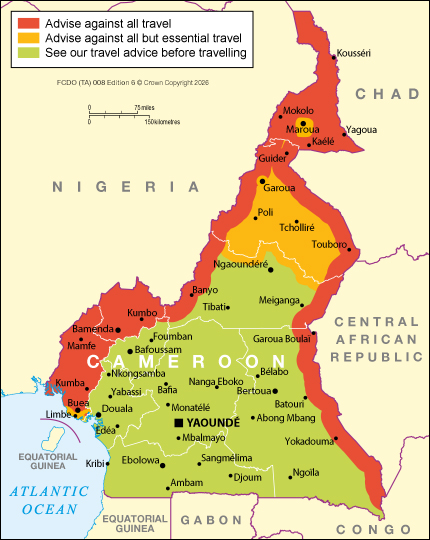
The country is not uniform: 6 regions advised against, fully or partly, by at least one official reading. Yaoundé is not one of them.
Faithful summary of the official texts below, which prevail.
“(France Diplomatie)”: the level comes from its text, in French, quoted below region by region.
the trip stays outside the advised-against regions. Any move into a red or orange region calls for a new, written decision.
Global Affairs Canada
Avoid all travel to the Far North region and Mayo-Louti Department in the North region due to military operations, the risk of terrorism, armed attacks and the risk of kidnappings.
Foreign Office
FCDO advises against all travel to the Far-North Region, except for:
France Diplomatie (in French)
Région de l’Extrême-Nord : toute la région de l’Extrême-Nord du Cameroun est formellement déconseillée du fait d’opérations militaires, du risque terroriste et du risque d’enlèvements, y compris les Monts Mandara en dépit de l’inscription au patrimoine mondial de l’UNESCO des sites Diy-Biy en juillet 2025. Il s’agit d’un site refuge de groupes terroristes ;
Global Affairs Canada
Avoid all travel to the North-West and South-West regions due to clashes between armed groups and security forces, civil unrest, armed attacks, the risk of kidnappings and banditry.
Foreign Office
FCDO advises against all travel to the North-West Region.
France Diplomatie (in French)
Région du Nord-Ouest : toute la région est formellement déconseillée du fait d’opérations militaires, du risque terroriste et du risque d’enlèvement.
Global Affairs Canada
Avoid all travel to the North-West and South-West regions due to clashes between armed groups and security forces, civil unrest, armed attacks, the risk of kidnappings and banditry.
Foreign Office
FCDO advises against all travel to the South-West Region, including the towns of Buea, Muyuka and Tiko in Fako Division. Except for:
France Diplomatie (in French)
Région du Sud-Ouest : tout déplacement dans la presqu’île de Bakassi est formellement déconseillé, compte tenu de l’isolement et des problèmes d’insécurité liés notamment aux activités de contrebandiers qui affectent ce territoire rétrocédé au Cameroun par le Nigéria en 2008. Le parc national de Korup se trouve en partie dans la zone frontalière avec le Nigé
Global Affairs Canada
Avoid non-essential travel to the North and Adamaoua regions due to the risk of kidnappings and armed attacks.
Foreign Office
FCDO advises against all but essential travel to within 20km of the border with the North region of Cameroon. FCDO advises against all travel to within 40km of the Central African Republic (CAR) and Nigeria borders.
France Diplomatie (in French)
Région du Nord et départements de la Vina et du Mbéré dans l’Adamaoua : dans les régions du Nord, à l’exception du département du Mayo-Louti, et dans l’Est de l’Adamaoua (départements de la Vina et du Mbéré), le risque terroriste est moins élevé que dans l’Extrême-Nord. Toutefois, des incidents de sécurité sont régulièrement signalés : coupeurs de route, déc
Global Affairs Canada
Avoid non-essential travel to the North and Adamaoua regions due to the risk of kidnappings and armed attacks.
Foreign Office
FCDO advises against all but essential travel to the North Region, including Garoua,, and a 20km radius to the north, east and west of Maroua, and 30km south of Maroua, in Far-North Region.
France Diplomatie (in French)
Région du Nord et départements de la Vina et du Mbéré dans l’Adamaoua : dans les régions du Nord, à l’exception du département du Mayo-Louti, et dans l’Est de l’Adamaoua (départements de la Vina et du Mbéré), le risque terroriste est moins élevé que dans l’Extrême-Nord. Toutefois, des incidents de sécurité sont régulièrement signalés : coupeurs de route, déc
France Diplomatie (in French)
Région de l’Ouest : les zones frontalières avec les régions du Nord-Ouest et du Sud-Ouest, les abords du lac Bamendji, dans un rayon de 20 km depuis la rive, (y compris les sites touristiques se trouvant dans cette zone, notamment le lac de Petpenoun) et l’axe D66 reliant Kouomboum et Kouhouat sont déconseillés sauf raison impérative.
Global Affairs Canada — Advised against — all travel
Avoid all travel to areas within 30 km of the borders with Nigeria, Chad and the Central African Republic, due to military operations, the risk of terrorism, armed attacks and the risk of kidnappings.
Foreign Office — Advised against — all travel
FCDO advises against all travel to Bakassi Peninsula.
Foreign Office — Advised against — all travel
FCDO advises against all travel to within 40km of the border with Central African Republic.
Foreign Office — Advised against — all travel
FCDO advises against all travel to within 40km of the border with Chad.
France Diplomatie (in French) — Advised against — all travel
Frontière nigériane : l’ensemble de la frontière avec le Nigéria est formellement déconseillée sur une profondeur de 30 km, du fait d’incursions de groupes terroristes ou criminels à partir du Nigéria (Boko Haram, miliciens du Delta du Niger, etc.).
France Diplomatie (in French) — Advised against — all travel
Frontière avec la République centrafricaine (RCA) et avec le Tchad : il est formellement déconseillé de se rendre dans une bande de 30 km le long de la frontière du Cameroun, du lac Tchad jusqu’au sud de la RCA en raison de la situation sécuritaire en RCA et de la porosité des frontières à des bandes armées (braconniers, bandits, trafiquants, etc.). Les vill
France Diplomatie (in French) — Advised against — all travel
l’axe reliant Yaoundé à N’Gaoundéré via Garoua-Boulaï ;
France Diplomatie (in French) — Advised against — all travel
l’axe reliant Garoua et N’Gaoundéré à Moundou (Tchad) via Touboro ;
France Diplomatie (in French) — Advised against — all travel
l’axe reliant Bertoua à Yokadouma.
Global Affairs Canada — Open Government Licence – Canada (24.09.2026) · Foreign Office — Open Government Licence v3.0 · France Diplomatie (05.03.2026) · Natural Earth
No located event in this reading.
Last change: FCDO no longer advises against all but essential travel to the majority of Adamawa Region. FCDO continues to advise against all but essential or all travel to parts of Cameroon.
Updated 14.05.2026
Exercise increased caution in Cameroon due to risk of crime , terrorism , unrest , health , kidnapping , and improvised explosive devices (IEDs). Some areas have increased risk. Read the entire Travel Advisory.
Violent crime, kidnapping for ransom, armed robbery, and carjacking are common in Cameroon. This is especially true in the Southwest, Northwest, Far North, and North Regions; the Adamawa Region north of the capital city of Ngaoundere; and the East Region within 20 kilometers of the border with Central African Republic.
Civil unrest is common, with the potential for political violence. Demonstrations related to the local political situation may occur with little notice. They may disrupt transportation and other essential services.
Medical services in Cameroon are limited. Adequate trauma and ambulance services are not widely available. Even a minor health issue may require medical evacuation at your expense.
There is risk of terrorist violence, including terrorist attacks and other activity in Cameroon. Visit the U.S. Department of State's country reports on terrorism to learn more.
Kidnappings by terrorist organizations are a significant risk in the Far North Region.
IEDs exist in Cameroon, especially in the Northwest, Southwest, and Far North Regions. IEDs are unmarked and are actively used by terrorists in high-risk areas in the Far North Region.
Do Not Travel to the Southwest , Northwest , and Far North Regions for any reason due to risk of terrorism , unrest , crime , kidnapping , and i mprovised explosive devices (IEDs) .
Do Not Travel to within 20 kilometers of the borders with Central African Republic , Chad , and Nigeria for any reason due to risk of terrorism , unrest , crime , kidnapping , and improvised explosive devices (IEDs) .
Cameroon: Cholera Outbreak - Jun 2026ReliefWeb ↗read 13.10.20262026-09-10
Nigeria: Cholera Outbreak - Jun 2017ReliefWeb ↗read 13.10.20262017-06-07
Source: ReliefWeb (OCHA), via HDX — CC BY
10-13 0.6 · 10-14 0.8 · 10-15 1.6 · 10-16 1.9 · 10-17 2.6 · 10-18 5.6 · 10-19 3.2 m³/s
Simulated discharge: Open-Meteo.com (CC BY 4.0), data rounded and formatted by Maximum. Contains modified Copernicus Emergency Management Service information 2026. For information only: this is not a flood warning; only national or regional authorities issue those.
The level is national. Risk areas are in the state advisories below.
No major event in progress is located in this country at this morning's check.
Over 1 January 2026 → 30 June 2026, UCDP (Uppsala University) recorded 77 geolocated violent incidents in this country, for 159 documented deaths.
Most affected areas
Far North region 46 · North-West region 23 · South-West region 7 · West region 1
Most recent incidents
Source: UCDP Georeferenced Event Dataset (Uppsala Conflict Data Program), file GEDEvent_v26_01_26_06.csv, CC BY 4.0 licence. We keep only incidents UCDP codes as "Clear" and whose location is precise enough to be placed — about 58% of the dataset. An incident may be revised, moved or withdrawn by UCDP in a later release: these figures describe a closed period, not a live situation.
Reading: The homicide rate is 11 times Switzerland's: violence is a real risk there, concentrated in the areas named by the official advisories. On the road, 14 times more deaths than in Switzerland: road crashes are the leading cause of death of healthy travellers (CDC) — seat belt, no night driving, a driver or a taxi from a rank.
World Bank (UNODC for homicides, WHO for roads) — latest published valuedata.worldbank.org ↗read 10.10.2026
What we locate on the map are events in progress that have real coordinates: USGS earthquakes, GDACS disasters, NOAA storms and open NASA EONET events. Hover a dot for details, click to open it in this briefing.
French passport — France Diplomatie
Faithful summary of the official texts below, which prevail.
Some areas of the country are formally advised against.France Diplomatie ↗updated 15.09.2026 · read 13.10.2026
Vigilance areas — France Diplomatie (in French) updated 05.03.2026official map ↗updated 15.09.2026 · read 13.10.2026
-
-
-
-
-
-
-
-
-
-
-
Dernière actualisation le 05/03/2026, information toujours valable à la date du jour
Les ressortissants français vivant dans ces régions sont invités à signaler leur présence ou celle de Français de passage ainsi que leurs déplacements dans cette zone à la section consulaire de l’ambassade de France à Yaoundé, via son adresse mail . En cas de séjour visible (réunion amenant plusieurs Français à séjourner ou travailler au même endroit pendant plusieurs jours), une protection militaire est très recommandée (contacter la gendarmerie). Les voyages de nuit sont vivement déconseillés.
Pour tout déplacement dans cette région, qui ne saurait être entrepris que pour des raisons impérieuses, il convient de solliciter une escorte (gendarmerie ou bataillon d’intervention rapide – contacter le service de l’attaché de sécurité intérieure de…
Malgré les dispositions prises pour renforcer la sécurité dans la région des « monts de Manengouba et des Lacs jumeaux » (situés près de la ville de Melong - Nord de Douala), tant sur les lieux d’hébergement qu’en montagne, il est recommandé de prendre contact au préalable avec les gérants des établissements hôteliers concernés et, le cas échéant, de solliciter auprès d’eux une escorte solide. Par ailleurs, il est rappelé qu’il est strictement interdit de s’approcher à moins de 500 m d’une plate-forme pétrolière ; cette interdiction pouvant être portée à 2 ou 3 milles nautiques dans certaines zones. Des renseignements peuvent être obtenus auprès de la capitainerie et des marinas.
Le risque terroriste existe, en particulier dans l’Extrême-Nord, en raison d’incursions du groupe terroriste Boko Haram. Les Occidentaux constituent des cibles potentielles et le risque d’enlèvement est également présent dans les zones frontalières est et ouest des régions Nord et de l’Adamaoua.
La situation sécuritaire dans les régions anglophones du Nord-Ouest et du Sud-Ouest s’est dégradée depuis la fin de l’année 2017. Les meurtres et enlèvements d’officiels et de civils sont réguliers. Des étrangers présents dans ces régions ont également été ciblés.
Les routes camerounaises sont dangereuses, en particulier l’axe Yaoundé-Douala.
La plus grande vigilance est recommandée et la circulation de nuit est formellement déconseillée.
La présence de camions transportant du bois (grumiers), dont l’état est souvent défaillant et les dépassements dangereux, constitue un danger permanent.
Il est déconseillé d’emprunter les transports en commun, du fait de leur implication régulière dans des accidents de la route mortels. Lorsque l’on est amené à en emprunter, il est prudent de vérifier les horaires d’arrivée à destination afin d’éviter de se trouver sur la route à la nuit tombée, en raison de la dangerosité.
Des faits de délinquance dans les villes (vols à l’arraché, agressions) et en zone rurale (« coupeurs de route », notamment dans les régions proches du Tchad et de la République centrafricaine) sont régulièrement rapportés. La vigilance et le bon sens permettent de s’en prémunir (éviter de conduire de nuit sur des routes isolées, éviter certains quartiers, etc.). Dans les grandes agglomérations, il est conseillé de prendre des précautions, tant lors des déplacements (à pied ou en véhicule) qu’au domicile (hôtel, appartement situé en étage, villa). Des cas de cambriolages et d’agressions sont régulièrement rapportés.
Une détérioration des conditions de vie pourrait mener à des manifestations de mécontentement. Certaines régions présentent des fragilités particulières :
La navigation de plaisance est formellement déconseillée dans le golfe de Guinée, a fortiori le mouillage près des côtes, compte tenu des risques liés à la piraterie maritime .
Le mont Cameroun est un volcan en activité. Les randonneurs doivent être prudents au sommet. Il est déconseillé de s’y rendre actuellement, en raison des troubles qui affectent la région du Sud-Ouest (cf. infra). Certains lacs de zone volcanique (ouest) sont susceptibles d’émanations soudaines de grandes quantités de dioxyde de carbone retenues dans leurs profondeurs (près de 2 000 morts lors d’une éruption limnique au lac Nyos en 1986). Les régions du Nord (en zone orange ou rouge) et de l’Extrême-Nord (en zone rouge) connaissent des inondations fréquentes en saison des pluies.
Il convient d’être vigilant, particulièrement autour des fêtes de fin d’année (décembre et janvier) ainsi qu’au moment de la rentrée scolaire (septembre). Il est recommandé :
D’une manière générale, il est conseillé de :
Full text of the Security pagediplomatie.gouv.fr ↗updated 15.09.2026 · read 13.10.2026
Swiss passport — FDFA (Switzerland), in French
Faithful summary of the official texts below, which prevail.
FDFA update note — Le chapitre Derniers développements a été enlevé (élections présidentielles) et le chapitre Situation générale a été actualisé. (published 17.11.2025)
La plus grande attention doit être accordée à la sécurité personnelle. Les voyages à destination de certaines régions du pays sont déconseillés. Voir également le chapitre Risques régionaux spécifiques. La situation sécuritaire demeure critique dans toute la région du Sahel, y inclus dans la sous-région du Lac Tchad. Les forces armées de la Force multinationale mixte (FMM) effectuent des opérations militaires dans la région de l’Extrême-Nord. Les combattants du groupe terroriste Boko Haram sont actifs dans la zone frontalière avec le Nigéria. Dans tout le pays il existe un risque d’attentats par des groupes terroristes. Dans les régions Nord et Extrême-Nord, des personnes ont été tuées ou ont été blessées lors d’attaques répétées. De petites explosions se produisent parfois à Yaoundé, Douala et Bamenda. Elles se dirigent principalement contre les institutions publiques et les marchés et peuvent provoquer des blessures corporelles et/ou des dommages matériels. Faites preuve de prudence, en particulier dans les lieux publics comme les marchés, les gares routières, ainsi qu’ à proximité des bâtiments du gouvernement, des postes de police, des bâtiments militaires, des lieux de culte, et dans tous les endroits fréquentés régulièrement par les personnes étrangères, tels que des centres commerciaux, des restaurants etc. Prenez également en considération la rubrique. Terrorisme et enlèvements La situation sécuritaire tendue en République centrafricaine se répercute également sur les régions de l'est du Cameroun . De nombreuses personnes fuyant la République centrafricaine sont entrées sur le territoire camerounais. Après les élections présidentielles du 12 octobre 2025, plusieurs villes et régions ont été le théâtre de violentes manifestations. La situation politique intérieure reste tendue. Il n'est pas exclu que de nouvelles manifestations, grèves ou barrages routiers aient lieu. Ceux-ci peuvent éclater à court terme et entraîner des restrictions dans la vie publique et la circulation. Tenez-vous à l'écart des rassemblements de foule et les manifestations de tout genre et conformez-vous aux consignes des autorités locales (couvre-feu etc.). Des retards et des perturbations peuvent donc avoir lieu dans le trafic voyageur. Dans l’éventualité de barrages routiers ou de grèves, il est recommandé de s’informer sur les autres possibilités de déplacement et d’attendre, le cas échéant, que la situation se normalise. En cas de barrages, il est très difficile pour l’Ambassade de Suisse à Yaoundé – voire impossible selon les cas – d’aider les personnes suisses à sortir…
La description des zones à risques repose sur des données approximatives; les risques ne peuvent se restreindre à des zones délimitées . Presqu'île de Bakassi Il est déconseillé de se rendre sur la presqu’île de Bakassi. Le taux de criminalité y est très élevé et il existe un risque d’enlèvement. Nord du pays, zones frontalières avec le Tchad et le Nigéria Les voyages à destination des régions d’Amadaoua, Nord et Extrême-Nord sont déconseillés ainsi que les séjours de tout genre dans ces régions. Il est déconseillé de se rendre dans les zones frontalières avec le Tchad et le Nigéria, qui sont à éviter largement. Le risque d'agression et d’enlèvement par des groupes terroristes et des bandits est très élevé dans cette région. Le risque concerne également les personnes en voyage et les membres d’organisations caritatives ou d’entreprises étrangères. Entre janvier et août 2025, au moins 174 personnes ont été enlevées dans la région Extrême-Nord. Dans la région de l'Extrême-Nord, des personnes sont régulièrement tuées ou blessées lors d'affrontements violents à motivation ethnique. Par exemple, le 14 novembre 2024, 10 personnes ont été tuées lors d'une attaque à Ldamang, dans le département de Mayo-Tsanaga. Le 25 mars 2025, plus de 10 soldats ont été tués dans la région de l'Extrême-Nord. Est du pays, régions frontalières avec la République centrafricaine Les voyages dans la zone frontalière avec la République centrafricaine sont déconseillés. La situation sécuritaire précaire en République centrafricaine influence la sécurité dans la zone frontalière du Cameroun avec la République centrafricaine. De nombreuses personnes fuyant la République centrafricaine sont entrées sur le territoire camerounais. Des groupes armés et violents font de fréquentes incursions au Cameroun. Le risque d'agressions par des voleurs usant de violence est particulièrement élevé. Il y existe également un risque d'enlèvements contre rançon. Régions Nord-Ouest et Sud-Ouest Les voyages à destination des régions du Nord-Ouest et Sud-Ouest sont déconseillés. Dans ces deux régions anglophones , il existe des tensions entre des groupes séparatistes et le gouvernement central. Le risque d’attentat et d’enlèvement par des groupes armés est élevé. Des émeutes de nature politique se produisent presque quotidiennement, surtout à Bamenda. Des affrontements violents entre contestataires et forces de l’ordre ainsi que des attaques à main armée contre les forces de l’ordre ont eu lieu, faisant à plusieurs reprises des morts et des blessés. Les affrontements violents entre les forces de l'ordre et…
La criminalité violente a pris des proportions préoccupantes surtout à Douala et à Yaoundé, les deux plus grandes villes du pays: vols à l'arraché, cambriolages, vols de voitures, en particulier de véhicules à quatre roues motrices, perpétrés sous la menace, voire accompagnés de violences et viols. Des agressions à main armée ont également été commises dans des restaurants ou hôtels. Des bandits sévissent dans l’ensemble du pays, y compris dans les banlieues des grandes villes. Il est notamment recommandé d'observer les mesures de précaution suivantes:
Dans le Golfe du Guinée et dans les eaux camerounaises, les actes de piraterie ont été commis à de multiples reprises. Consultez les informations spécifiques: Risques maritimes et piraterie
Le Mont Cameroun est un volcan en activité. De légers séismes sont toujours possibles à proximité immédiate du volcan. Des gaz toxiques peuvent émaner des lacs volcaniques Nyos et Monoum. Il faut s'attendre à de fortes pluies. Ces intempéries peuvent provoquer des inondations et des glissements de terrain, pouvant endommager les infrastructures. Le trafic touristique peut s’en trouver temporairement perturbé. Si une catastrophe naturelle devait se produire durant votre séjour, prenez immédiatement contact avec vos proches et suivez les instructions des autorités. En cas d'interruption des communications avec l'étranger, mettez-vous en contact avec l'Ambassade de Suisse à Yaoundé.
FDFA travel advice, in French, valid on 13.10.2026eda.admin.ch ↗updated 17.11.2025 · read 13.10.2026
British passport — Foreign Office (UK)
Faithful summary of the official texts below, which prevail.
Regions covered by the Foreign Officegov.uk ↗updated 09.02.2026 · read 13.10.2026

Warnings — Foreign OfficeForeign Office ↗updated 09.02.2026 · read 13.10.2026
Your travel insurance could be invalidated if you travel against advice from the Foreign, Commonwealth & Development Office (FCDO).
FCDO advises against all travel to Bakassi Peninsula.
FCDO advises against all travel to within 40km of the border with Central African Republic.
FCDO advises against all travel to within 40km of the border with Chad.
FCDO advises against all travel to within 40km of the border with Nigeria, except for Garoua in the North Region.
FCDO advises against all travel to the Far-North Region, except for:
FCDO advises against all travel to the North-West Region.
FCDO advises against all travel to the South-West Region, including the towns of Buea, Muyuka and Tiko in Fako Division. Except for:
FCDO advises against all but essential travel to Limbé and the 35km stretch of the N3 road connecting Limbé to the Littoral Region in Fako Division, South-West Region.
FCDO advises against all but essential travel to the North Region, including Garoua,, and a 20km radius to the north, east and west of Maroua, and 30km south of Maroua, in Far-North Region.
FCDO advises against all but essential travel to within 20km of the border with the North region of Cameroon. FCDO advises against all travel to within 40km of the Central African Republic ( CAR ) and Nigeria borders.
Find out more about why FCDO advises against travel .
The British High Commission can only offer limited support for British nationals in areas where we advise against travel.
Regional risks — Foreign OfficeForeign Office ↗updated 09.02.2026 · read 13.10.2026
This section has safety advice for regions of Cameroon. It only covers regions where FCDO has specific advice.
You should also read FCDO ’s overall travel advice and safety and security advice .
FCDO advises against all travel to the Bakassi Peninsula.
There have been armed robberies and incidents of piracy in the Gulf of Guinea, particularly in the waters around the Niger Delta and the Bakassi Peninsula. The ferry that operates between Limbé and Tiko in Cameroon and Calabar in Nigeria passes through areas where pirates operate. Cameroon’s Rapid Intervention Brigade patrols the waters, but it is difficult to police the Bakassi Peninsula’s mangrove forests and isolated islands. Mariners should get professional security advice and take appropriate precautions.
FCDO advises against all travel to within 40km of the border with Central African Republic ( CAR ).
Large, armed criminal gangs and highway bandits have stopped travellers and taken hostages for ransom, particularly in the east of Cameroon, close to the CAR border. Violence frequently spills across the CAR border into Cameroon. Incidents like these are more likely due to the ongoing insecurity in CAR .
FCDO advises against all travel to within 40km of the border with Chad.
There is a risk of armed banditry, including poachers in Bouba Ndjida National Park in the North Region.
FCDO advises against all travel to within 40km of the border with Nigeria, except for Garoua in the North Region.
FCDO advises against all travel to the Far-North Region, except for:
Terrorist groups are active in the Far-North Region, see terrorism . There is also a general threat of kidnapping, criminality and armed banditry.
Nigerian military operations in the Nigerian states of Borno, Yobe and Adamawa could have an impact across the border in Cameroon. There have also been a number of reported civilian fatalities in these regions at or near checkpoints due to accidental discharge of weapons.
FCDO advises against all travel to the North-West Region.
FCDO advises against all travel to the South-West Region, including the towns of Buea, Muyuka and Tiko in Fako Division. Except for:
Non-state armed groups ( NSAGs ) sometimes use improvised explosive devices (IEDs) to target civilians in the North-West and South-West regions.
Civilians have been killed at or near road checkpoints controlled by NSAGs or government forces. Be cautious when you approach roadblocks.
In recent years Cameroonian security forces and NSAGs have fought multiple times in many parts of the North-West and South-West regions. Restrictions including night curfews and a ban on public meetings are in place in some areas. There is a high risk of violent crime, especially at night.
There have also been a number of reported civilian fatalities in these regions at or near checkpoints due to accidental discharge of weapons.
If you decide to travel to, or within, areas of the English-speaking regions where the FCDO advises against all travel or all but essential travel, you should consider carefully the risks of travel. Monitor developments closely, keep a low profile and minimise your movements.
General strikes (or ‘ghost towns’) are called in the English-speaking North-West and South-West regions each Monday. There are often additional days, including in February (around Youth Day, 11 February), May (around National Day on 20 May) and around 1 October (Unofficial Unification Day). There is often violence and travel disruption on these days.
As events develop, be cautious and regularly check news reports, this travel advice and information from local authorities.
Lake Nyos in the North-West Region emitted carbon dioxide in 1986, suffocating about 1,700 people without warning. Although the Cameroon authorities now closely monitor the lake, this situation could repeat with limited warning. The authorities are also concerned that the volcanic dam holding back Lake Nyos is not sufficiently strong. Nearby Lake Mounoun is also saturated with carbon dioxide.
FCDO advises against all but essential travel to Limbé and the 35km stretch of N3 road connecting Limbé to the Littoral Region in Fako Division, South-West Region.
FCDO advises against all but essential travel to the North Region, including Garoua,, and a 20km radius to the north, east and west of Maroua, and 30km south of Maroua, in Far-North Region.
FCDO advises against all but essential travel to within 20km of the border with the North region of Cameroon. FCDO advises against all travel to within 40km of the Central African Republic ( CAR ) and Nigeria borders.
Safety — Foreign OfficeForeign Office ↗updated 09.02.2026 · read 13.10.2026
This guide also has safety advice for regions of Cameroon .
There is a high threat of terrorist attack globally affecting UK interests and British nationals, including from groups and individuals who view the UK and British nationals as targets. Stay aware of your surroundings at all times.
UK Counter Terrorism Policing has information and advice on staying safe and what to do in the event of a terrorist attack. Find out how to reduce your risk from terrorism while abroad .
Terrorists are very likely to try to carry out attacks in Cameroon.
Terrorist attacks could be indiscriminate, including in places visited by foreigners such as:
The terrorist groups Boko Haram and Islamic State West Africa (ISWA) are mainly active in the Far-North Region but attacks could occur anywhere, including major towns and cities such as Yaoundé and Douala. There was an increase in the use of improvised explosive devices by violent extremist organisations in the Far-North Region in 2023. Stay aware of your surroundings, keep up to date with local media reports and follow the advice of local authorities.
There are occasional isolated incidents of political unrest around the country. You should stay alert, avoid large gatherings and monitor local media.
The results of the 12 October Presidential elections were announced on Monday 27 October. Protests and unrest can occur without warning and the situation could change quickly. Stay away from crowded areas and rallies.
Political developments and increased tensions related to the English-speaking North-West and South-West regions could lead to isolated incidents of violence in other parts of the country. This could affect western interests, as well as places frequented by foreigners. Plan your movements carefully. In November 2020, a threat by non-state armed groups was made against diplomatic missions in Yaoundé, including the British High Commission.
Non-state armed groups are increasingly using improvised explosive devices ( IEDs ) to target civilians in the North-West and South-West regions and against government forces in the Far-North Region. IEDs have also been seen in the capital Yaoundé.
There could be more attacks in urban areas, or other locations around the country. Stay alert and keep up to date with developments through the media and local authorities.
There is risk of armed robbery and mugging throughout Cameroon, particularly in the cities Yaoundé, Douala, Ngaoundere and Bafoussam.
Avoid isolated or less developed areas of towns for example, Briqueterie and Mokolo market in Yaoundé and Nkololun, New Bell, Akwa, Bonaberi and Village in Douala. Be cautious at all times when walking, particularly alone, and avoid walking at night.
Close and lock all doors and windows, particularly at night. Make sure burglar proof metal bars are installed. Identify callers through spy holes before opening doors, especially late at night.
Petty theft is common on trains, coaches and bush taxis and around bus stations and hotels. Be particularly careful with your belongings.
Taxis in cities operate like buses, picking up passengers while there is still room in the car. They often take indirect routes, and many do not meet basic safety requirements. There have been violent assaults and robberies on taxi passengers. Do not hail taxis…
American passport — U.S. Department of State
Faithful summary of the official texts below, which prevail.
Cameroon - Level 2: Exercise Increased Caution 2026-05-14travel.state.gov ↗updated 14.05.2026 · read 13.10.2026
Exercise increased caution in Cameroon due to risk of crime , terrorism , unrest , health , kidnapping , and improvised explosive devices (IEDs). Some areas have increased risk. Read the entire Travel Advisory.
Violent crime, kidnapping for ransom, armed robbery, and carjacking are common in Cameroon. This is especially true in the Southwest, Northwest, Far North, and North Regions; the Adamawa Region north of the capital city of Ngaoundere; and the East Region within 20 kilometers of the border with Central African Republic.
Civil unrest is common, with the potential for political violence. Demonstrations related to the local political situation may occur with little notice. They may disrupt transportation and other essential services.
Medical services in Cameroon are limited. Adequate trauma and ambulance services are not widely available. Even a minor health issue may require medical evacuation at your expense.
There is risk of terrorist violence, including terrorist attacks and other activity in Cameroon. Visit the U.S. Department of State's country reports on terrorism to learn more.
Kidnappings by terrorist organizations are a significant risk in the Far North Region.
IEDs exist in Cameroon, especially in the Northwest, Southwest, and Far North Regions. IEDs are unmarked and are actively used by terrorists in high-risk areas in the Far North Region.
Do Not Travel to the Southwest , Northwest , and Far North Regions for any reason due to risk of terrorism , unrest , crime , kidnapping , and i mprovised explosive devices (IEDs) .
Do Not Travel to within 20 kilometers of the borders with Central African Republic , Chad , and Nigeria for any reason due to risk of terrorism , unrest , crime , kidnapping , and improvised explosive devices (IEDs) .
Global Affairs Canada — additional reading
Exercise a high degree of caution (with regional advisories)
Avoid all travel to the Far North region and Mayo-Louti Department in the North region due to military operations, the risk of terrorism, armed attacks and the risk of kidnappings.
Avoid all travel to areas within 30 km of the borders with Nigeria, Chad and the Central African Republic, due to military operations, the risk of terrorism, armed attacks and the risk of kidnappings.
Avoid all travel to the North-West and South-West regions due to clashes between armed groups and security forces, civil unrest, armed attacks, the risk of kidnappings and banditry.
Avoid non-essential travel to the North and Adamaoua regions due to the risk of kidnappings and armed attacks.
Open Government Licence – Canada · September 24, 2026 11:45 EDTtravel.gc.ca ↗updated 24.09.2026 · read 13.10.2026
Faithful summary of the official texts below, which prevail.
Global Affairs Canada — written for Canadian travellers, valid for all
You must abide by local laws. Learn about what you should do and how we can help if you are arrested or detained abroad.
Penalties for possession, use or trafficking of illegal drugs are severe. Convicted offenders can expect jail sentences and heavy fines. Drugs, alcohol and travel
To avoid offending local sensitivities:
It’s illegal to wear, buy, sell or distribute military clothing in Cameroon. It is an offence for a civilian to wear camouflage or other military-style clothing.
The Hague Convention on the Civil Aspects of International Child Abduction is an international treaty. It can help parents with the return of children who have been removed to or retained in certain countries in violation of custody rights. It does not apply between Canada and Cameroon. If your child was wrongfully taken to, or is being held in Cameroon by an abducting parent:
If your child was removed from a country other than Canada, consult a lawyer to determine if The Hague Convention applies. Be aware that Canadian consular officials cannot interfere in private legal matters or in another country's judicial affairs.
Local authorities may request to see your identification at any time.
Photography of sensitive installations is prohibited. This includes:
Always ask permission before photographing official buildings or individuals.
To drive in Cameroon you must have an International Driving Permit along your valid Canadian driver’s licence. If you intend to stay in Cameroon for more than one year, you will require a Cameroonian driver’s licence. To obtain a Cameroonian driver's licence, you are required to present your Canadian driver’s licence to the Delegation of Public Transport in your town of residence. Traffic accidents can quickly draw large crowds. Remain calm if there is a dispute, particularly in a public place. If you feel threatened by a large crowd, ask the local police to intervene. International Driving Permit
If a police officer asks you to pay a fine on the spot for a traffic violation, ask for a written copy of the fine, which can be paid later at a local courthouse or police station.
The currency is the Central African CFA franc (XAF), known in French as the “franc CFA d’Afrique centrale”. Cameroon is largely a cash-based economy. Large stores and hotels may accept major credit cards or euros and U.S. dollars, but this should be confirmed when your booking. Credit cards are rarely accepted outside international hotels.
Open Government Licence – Canada · September 24, 2026 11:45 EDTtravel.gc.ca ↗updated 24.09.2026 · read 13.10.2026
Foreign Office — laws and cultural differences
Always carry ID, either a residence permit or a certified copy of your passport showing a valid visa. The police can detain you if you do not have ID.
It is illegal to wear camouflage clothing unless you are in the armed forces. Penalties may include a fine and detention.
Penalties for using and possessing drugs are severe and usually include a prison sentence.
It is illegal to photograph military sites, government buildings, airports and ports. While photography elsewhere is not illegal, communities can be sensitive to people taking photos or may ask for money in return. Officials may also ask you for money, perhaps suggesting that you need to pay for a ‘permit’ to photograph certain places.
Same-sex relationships are not widely accepted in central African society, and same-sex sexual acts are illegal in Cameroon. Same-sex partners have been arrested and prosecuted. Read more advice for LGBT+ travellers.
It is illegal to buy, sell, kill or capture any protected wild animal or trade its parts without a licence. If you are caught buying or trafficking these goods, you’ll be prosecuted and could get a prison sentence or a fine.
It is difficult to exchange sterling travellers cheques in Cameroon. Many banks will only allow you to exchange travellers cheques if you hold an account with them. Euros and US dollars are the most widely accepted foreign currency. Shops usually require small notes, which can be difficult to obtain. You must pay heavy fees to make cash withdrawals from UK bank accounts and ATMs. ATMs are not often available outside of large towns.
Open Government Licence v3.0gov.uk ↗updated 09.02.2026 · read 13.10.2026
FDFA (Switzerland) — laws and customs, in French
Entre autres, sont punissables:
Les infractions à la loi sur les stupéfiants, y compris la détention de minimes quantités de drogue quelle qu'elle soit, sont passibles de lourdes peines de prison. Les procédures pénales peuvent durer plusieurs années. Les conditions de détention sont précaires.
La population se compose de plus de 200 ethnies différentes. Adaptez votre comportement et votre tenue vestimentaire aux us et coutumes locaux, variables selon les régions, et ne photographiez des personnes qu'avec leur consentement. Renseignez-vous dans les guides de voyages, auprès de votre agence ou directement sur place, sur les codes de conduite.
FDFA travel advice, in Frencheda.admin.ch ↗updated 17.11.2025 · read 13.10.2026
What it changes for you: Air acceptable at this hour: nothing special to plan. High UV at midday: sun protection.
Reading 23:00 (Africa/Douala)Open-Meteo ↗updated 13.10.2026 · read 13.10.2026
Air quality and UV: Open-Meteo.com (CC BY 4.0), data rounded and formatted by Maximum. Contains modified Copernicus Atmosphere Monitoring Service information 2026. Neither the European Commission nor ECMWF is responsible for any use that may be made of the Copernicus information or data it contains.
Reading: With 0.1 physicians per 1,000 people (98% fewer than Switzerland), the nearest hospital does not always have the capacity for a serious case: evacuation to an adequate centre is the rule, not the exception — that is what unlimited evacuation and repatriation cover. Health spending of 79 USD per person (Switzerland: 11,784) goes with private hospitals that bill foreigners in hard currency and ask for a guarantee before admission: the direct payment guarantee is what avoids the deposit.
World Bank — latest published value, year per indicatordata.worldbank.org ↗read 10.10.2026
French passport — France Diplomatie
Faithful summary of the official texts below, which prevail.
-
-
-
-
-
-
-
-
-
-
-
Toutes les mesures de restrictions sanitaires pour l’entrée sur le territoire ont été levées.
Les ressortissants français souhaitant séjourner au Cameroun doivent formuler une demande de visa avant leur départ. Les voyageurs doivent notamment disposer d’un passeport valide 6 mois après la date de retour prévue, d’un billet retour et d’un justificatif de lieu de séjour. Pour tout séjour supérieur à 30 jours ou à des fins professionnelles, un visa temporaire (valide jusqu’à 6 mois) ou de visa long séjour (validité supérieure à 6 mois) doit être obtenu.
Les demandes de visa doivent être déposées en ligne, via la plateforme internet dédiée .
La vaccination contre la fièvre jaune est obligatoire pour entrer sur le territoire camerounais.
Pour plus d’informations sur les modalités d’obtention des visas et les documents à fournir, prendre l’attache du consulat général de la République du Cameroun à Paris . Il est également possible de contacter le consulat du Cameroun à Marseille .
Le Cameroun appartient à la Communauté économique et monétaire de l’Afrique centrale (CEMAC). Les pays tiers à la CEMAC doivent s’acquitter, quel que soit leur point d’entrée dans la CEMAC, des droits et taxes définis suivant le Tarif extérieur commun (TEC). Les taux de douane applicables sont fonction de la catégorie à laquelle appartient le produit importé :
Les voyageurs résidents ou non-résidents franchissant les frontières du Cameroun, à l’entrée ou à la sortie, doivent déclarer en douane les devises, titres ou valeurs d’un montant supérieur à 1 million de francs CFA (1 524,49 euros).
Entry and stay pagediplomatie.gouv.fr ↗updated 15.09.2026 · read 13.10.2026
Swiss passport — FDFA (Switzerland)
The FDFA does not publish entry requirements: they are set out by the destination's embassy or consulate in Switzerland — check them before booking, passport in hand. As a guide, the French and British requirements below describe the same rules as seen by two other governments.eda.admin.ch ↗updated 17.11.2025 · read 13.10.2026
British passport — Foreign Office (UK)
Faithful summary of the official texts below, which prevail.
Entry requirements — rules for a British passportForeign Office ↗updated 09.02.2026 · read 13.10.2026
This information is for people travelling on a full ‘British citizen’ passport from the UK. It is based on the UK government’s understanding of Cameroon’s current rules for the most common types of travel.
The authorities in Cameroon set and enforce entry rules. If you’re not sure how these requirements apply to you, contact the Cameroon High Commission in the UK .
To enter Cameroon, your passport must have an ‘expiry date’ at least 6 months after the date you arrive.
Check with your travel provider that your passport and other travel documents meet requirements. Renew your passport if you need to.
You will be denied entry if you do not have a valid travel document or try to use a passport that has been reported lost or stolen.
When returning to the UK, British citizens must carry a valid British passport or certificate of entitlement . See Dual Citizenship .
You must have a visa to enter Cameroon.
You must apply for a e-visa online – some people encounter technical problems with this online service, so apply in good time.
You cannot get a visa on arrival at either Yaoundé or Douala airport.
If you travel to Cameroon by road or sea, you must get a physical visa before you arrive by applying at your nearest Cameroon embassy or high commission. You cannot get an e-visa at land or sea borders.
If you are in Cameroon and have questions about your immigration status, contact the General Delegation for National Security in Yaoundé:
Telephone: +237 22221 2884
Make sure you get your passport stamped.
Make sure the border control officer puts a stamp in your passport.
To enter Cameroon, you must have a certificate to prove you’ve had a yellow fever vaccination.
For more details about medical entry requirements and recommended vaccinations, see TravelHealthPro’s Cameroon guide .
There are strict rules about goods you can take into or out of Cameroon . You must declare anything that may be prohibited or subject to tax or duty.
American passport — U.S. Department of State
The State Department publishes the requirements ("Entry, Exit and Visa Requirements") on its country page, which our servers cannot read. Read it before you go; as a guide, the French and British requirements below describe the same rules as seen by two other governments.travel.state.gov ↗updated 14.05.2026 · read 13.10.2026
For each risk, the official texts themselves: what is happening, then, where they say so, what to do.
What the texts say · Terrorists are very likely to try to carry out attacks in Cameroon. There is risk of armed robbery and mugging throughout Cameroon, particularly in the cities Yaoundé, Douala, Ngaoundere and Bafoussam.
What the texts say · There have been violent assaults and robberies on taxi passengers. Avoid travelling at night in Cameroon, particularly in rural areas.
What the texts say · Mount Cameroon is an active volcano.
What the texts say · It is illegal to wear camouflage clothing unless you are in the armed forces.
What the texts say · Scam artists often target foreign visitors and residents. Advance fee scams are common in Cameroon.
What the texts say · Protests and unrest can occur without warning and the situation could change quickly. Even peaceful demonstrations can turn violent at any time.
Sentences copied word for word from the official texts cited, chosen for the destination; the level is our reading. The full texts, at each source:Foreign Office ↗updated 09.02.2026 · read 13.10.2026 (updated 09.02.2026 · read 27.09.2026)Global Affairs Canada ↗updated 24.09.2026 · read 13.10.2026 (updated 24.09.2026 · read 27.09.2026)
Reading: The homicide rate is 11 times Switzerland's: violence is a real risk there, concentrated in the areas named by the official advisories. On the road, 14 times more deaths than in Switzerland: road crashes are the leading cause of death of healthy travellers (CDC) — seat belt, no night driving, a driver or a taxi from a rank.
World Bank (UNODC for homicides, WHO for roads) — latest published valuedata.worldbank.org ↗read 10.10.2026
Time zone: IANA and timezone-boundary-builder (ODbL) · RESTCountries · EmergencyNumberAPI · Wikidata · European Central Bank
Places: © OpenStreetMap contributors (ODbL), Photon search by komoot.
FDFA (Switzerland) — transport and specific advice, in French
Il arrive que les passages de frontières soient temporairement fermés sans préavis, par exemple afin d’endiguer la propagation de maladies. Informez-vous auprès des autorités locales ou directement auprès des postes-frontières. La conduite dangereuse augmente les risques d'accident. L'état des routes est en outre mauvais. La nuit, renoncez aux déplacements à travers le pays. Il existe une liaison ferroviaire entre Douala et Yaoundé ainsi que Ngaoundéré, mais l'infrastructure est mal entretenue. Des accidents sont relativement fréquents. Des coupures de l’approvisionnement en électricité peuvent survenir. Il n'est pas exclu que l'accès à Internet et aux réseaux sociaux soit partiellement restreint.
Déplacez-vous toujours avec votre passeport et votre certificat de vaccination pour pouvoir justifier de votre identité en cas de contrôles de police. L'absence de pièce d'identité peut entraîner une arrestation.
FDFA travel advice, in Frencheda.admin.ch ↗updated 17.11.2025 · read 13.10.2026
Maximum policyholder: before paying anything, call the 24/7 number. If you are admitted for more than 24 h, Maximum sends its direct payment guarantee to the hospital (art. 2.12).
+41 22 ••• •• •• — Full number in your client areaThe hospital list has not been read from OpenStreetMap for this page yet: the medical-network map loads it when opened. Maximum's assistance directs you to the right facility, 24/7. The medical-network map ↗
CDC Travelers' Health recommendations, most important first. They depend on your age, vaccines and itinerary: confirm them with a doctor or a travel clinic 4 to 6 weeks before departure. Details, disease by disease ↗cdc.gov ↗read 10.10.2026
The health system — With 0.1 physicians per 1,000 people (98% fewer than Switzerland), the nearest hospital does not always have the capacity for a serious case: evacuation to an adequate centre is the rule, not the exception — that is what unlimited evacuation and repatriation cover. Health spending of 79 USD per person (Switzerland: 11,784) goes with private hospitals that bill foreigners in hard currency and ask for a guarantee before admission: the direct payment guarantee is what avoids the deposit.
Back home — a fever in the following weeks should be told to a doctor, naming the country.
Forecast: MET Norway (Norwegian Meteorological Institute, CC BY 4.0), grouped by day and formatted by Maximum.
French passport — French embassy and consulates
Rue Joseph Atemengue (Rue 3.715)
+237 2 22 22 79 00 · France Diplomatie
http://www.ambafrance-cm.org ↗
Useful contacts listed by France Diplomatie (in French)diplomatie.gouv.fr ↗updated 15.09.2026 · read 13.10.2026
Updated: 15 September 2026
OpenStreetMap
Swiss passport — Swiss embassy and consulates
129 Boulevard de l'URSS, Yaoundé
+237 222 20 50 67
https://www.eda.admin.ch/yaounde ↗updated 17.11.2025 · read 13.10.2026
phone not published
Numéro d’urgence de la police: 117 Représentations suisses à l’étranger: En cas de situation d’urgence à l’étranger, vous pouvez vous adresser à la représentation suisse la plus proche ou à la Helpline DFAE. Ambassade de Suisse au Cameroun Helpline DFAE Représentations étrangères en Suisse: Pour obtenir des informations sur les prescriptions d'entrée (documents d'identité admis, visa, etc.), veuillez vous adresser aux ambassades et consulats étrangers compétents. Ceux-ci peuvent également vous renseigner sur les dispositions douanières pour l'importation et l'exportation d'animaux et de marchandises: appareils électroniques, souvenirs, médicaments, etc. Représentations étrangères en Suisse
OpenStreetMap · DFAE
British passport — British embassy and consulates
Avenue Winston Churchill, Yaounde
phone not published
https://www.gov.uk/world/organisations/bri ↗updated 09.02.2026 · read 13.10.2026
OpenStreetMap
American passport — U.S. embassy and consulates
Rue Rosa Parks
+237 22220-1500
https://cm.usembassy.gov ↗updated 14.05.2026 · read 13.10.2026
phone not published
https://cm.usembassy.gov/ ↗updated 14.05.2026 · read 13.10.2026
OpenStreetMap
OpenStreetMap
Getting help — Foreign OfficeForeign Office ↗updated 09.02.2026 · read 13.10.2026
The Foreign, Commonwealth & Development Office ( FCDO ) cannot provide tailored advice for individual trips. Read this travel advice and carry out your own research before deciding whether to travel.
Ambulance: 112
Fire: 119
Police: 117
Contact your travel provider and your insurer if you are involved in a serious incident or emergency abroad. They will tell you if they can help and what you need to do.
See how to get help from the UK government abroad including in an emergency.
You can call FCDO in London if you need urgent help because something has happened to a friend or relative abroad.
Telephone: 020 7008 5000 (24 hours)
Find out about call charges
For emergencies. If pronunciation fails, show the screen — or the printed page.
English is also an official language in Cameroon; these phrases are in French, an official language more widely spoken there than English.
| Help! | Au secours ! |
| Call an ambulance! | Appelez une ambulance ! |
| I need a doctor. | J'ai besoin d'un médecin. |
| Where is the nearest hospital? | Où est l'hôpital le plus proche ? |
| Call the police! | Appelez la police ! |
| I am allergic to penicillin. | Je suis allergique à la pénicilline. |
| I have international medical insurance. | J'ai une assurance médicale internationale. |
| I want to contact my embassy. | Je voudrais contacter mon ambassade. |
| Please take me to this address. | Emmenez-moi à cette adresse, s'il vous plaît. |
| Do you speak English? | Parlez-vous anglais ? |
Translations by Maximum Insurance, original script and transliteration.
Actions to take before each professional trip abroad.
Live alerts and level changes, each with its official source. Continuously updated.
Le Cameroun fait actuellement face à une épidémie de choléra qui touche les régions du Nord et de l’Extrême Nord du pays. Un premier cas confirmé de Choléra a été déclaré le 9 novembre 2025 dans le district de Mayo Oulo entre Garoua et Maroua dans le Nord et l’Extrême Nord du Cameroun. Il convient d’être vigilant sur le risque de contamination. Des mesures de précaution et d’hygiène s’imposent comme suit : Lavage des mains fréquent avec de l’eau et du savon ou des solutions…
France Diplomatie (in French) · posted 14 November 2025 · updated 30 September 2026diplomatie.gouv.fr ↗updated 15.09.2026 · read 13.10.2026Les autorités sanitaires camerounaises notifient une augmentation du nombre de cas suspects de mpox depuis quelques semaines, particulièrement dans la région du Littoral et le Sud (Kribi). La riposte est en cours et organisée par le Ministère de la Santé publique. Par conséquent, il convient de rester vigilant. Le mpox (anciennement variole du singe) est une maladie virale qui se transmet par contact rapproché avec une personne infectée via notamment des lésions cutanées,…
France Diplomatie (in French) · posted 4 August 2026diplomatie.gouv.fr ↗updated 15.09.2026 · read 13.10.2026Editorial change
September 24, 2026 11:45 EDTtravel.gc.ca ↗updated 24.09.2026 · read 13.10.2026No level change recorded for this country since the log opened. The live alerts above are updated continuously.
Level 2/4 — Exercise Increased Caution, U.S. Department of State, retrieved on 13 October 2026.
Sourcestravel.state.gov · updated 14.05 · read 13.10France Diplomatie · updated 15.09 · read 13.10DFAE · updated 17.11 · read 13.10207-country comparison
An area advised against does not rule out the country.
SourcesFrance Diplomatie · updated 15.09 · read 13.10Foreign Office · updated 09.02 · read 13.10State Department · updated 14.05 · read 13.10
The rules depend on the passport, not on the destination alone.
SourcesFrance Diplomatie · updated 15.09 · read 13.10Foreign Office · updated 09.02 · read 13.10State Department · updated 14.05 · read 13.10
For a Schengen visa, yes: at least €30,000 of travel medical insurance (Regulation (EC) No 810/2009, art. 15).
SourcesRegulation (EC) 810/2009, art. 15General conditions, policy 20 00 479
VIP Pack — $990 for twelve months, unlimited trips.
SourcesGeneral conditions, policy 20 00 479OpenStreetMap · read 12.10
Six steps, in this order.
SourcesSpecial conditions 01.26General conditions, policy 20 00 479
Local emergency services: single number 112
SourcesEmergencyNumberAPI · Wikidata · read 08.10OpenStreetMap · read 12.10
At today's level 2/4, card by card:
SourcesAmex Platinum France T&Cs, 01.2025 — general exclusion n° 11BNP Paribas Visa Infinite notice (policy PT7), 04.2025 — comFortuneo World Elite Mastercard notice, 01.2026 — art. 5.5 '
A health plan reimburses at home; here, the hospital asks for a payment guarantee before admission.
SourcesGeneral conditions, policy 20 00 479
The page reads hospitals, pharmacies and doctors from OpenStreetMap, around the point you choose.
The sourced detail is under Medical network › Health: vaccines, diseases present, altitude, outbreaks.
SourcesCDC Travelers' Health · read 10.10France Diplomatie · updated 15.09 · read 13.10OMS · read 13.10Foreign Office · updated 09.02 · read 13.10
0.1 physicians per 1,000 people (2022) versus 4.5 in Switzerland.
SourcesWorld Bank · read 10.10General conditions, policy 20 00 479
6.8 homicides per 100,000 people (2022) versus 0.6 in Switzerland and 1.3 in France.
The nearest representations, by passport (OpenStreetMap):
SourcesOpenStreetMap · read 12.10DFAE · updated 17.11 · read 13.10
6 regions advised against, fully or partly, by at least one official reading.
SourcesGlobal Affairs Canada · updated 24.09 · read 13.10Foreign Office · updated 09.02 · read 13.10France Diplomatie · updated 15.09 · read 13.10
Local laws apply to every traveller; here is what the official texts say.
SourcesGlobal Affairs Canada · updated 24.09 · read 13.10Foreign Office · updated 09.02 · read 13.10
Every foreign ministry runs a 24/7 emergency line for its nationals.
Sourcesdiplomatie.gouv.fr · updated 15.09 · read 13.10eda.admin.ch · updated 17.11 · read 13.10
Emergency phrases, to show if pronunciation fails:
SourcesMaximum Insurance
Keep the entry stamp, the invoices, the prescriptions and the medical report.
SourcesGeneral conditions, policy 20 00 479
Cancellation or change up to CHF 20,000, special risk CHF 5,000 per person, crisis management and security, optional Kidnap & Ransom.
SourcesGeneral conditions, policy 20 00 479
A question not answered here? Ask Maximum below, or call the support number: every question gets a clear, actionable answer.
In a life-threatening emergency, call local emergency services first, then Maximum: +41 22 ••• •• •• — 24/7 support number, an adviser stays with you to the end.
The 207 country pages — hospitals, pharmacies, police, embassies, emergency numbers, official advice from four governments, health, safety in figures, events in progress — read around the city you name. Your policy — benefits, the six steps, claims, articles. The site — prices, certificate, subscription. Nothing else: what it does not know, it says so and hands you to an adviser.
Same advisory level: São Tomé and Príncipe · Tajikistan · Timor-Leste · Togo · Tunisia · Türkiye
The displayed level comes from the State Department, checked every morning. Before departure, always cross-check your country of residence's advisory: that is what your policy cites.
The level shown is the official U.S. Department of State level, checked daily. Maximum Insurance is an insurance distributor — general information, not personal advice.
The destination is already Yaoundé. A few choices, then the reading of your cover, here.
Destination · Yaoundé
Travel Insurtech. 24/7 worldwide.
Swiss insurer · Worldwide medical network