Make sure you are up-to-date on all routine vaccines before every trip. Some of these vaccines include Chickenpox (Varicella) Diphtheria-Tetanus-Pertussis (DTaP, Tdap, or Td) Flu (influenza) Measles-Mumps-Rubella (MMR) Polio Shingles
Maximum Alerts / Azerbaijan
Level published by the State Department on 27.04.2026 · read 13 October 2026 · source checked daily
Azerbaijan — official level as of 13 October 2026: Level 3/4 ("Reconsider Travel"), from the U.S. Department of State. Maximum Insurance covers this country: hospital settled directly, unlimited repatriation, USD 1.5M, certificate on payment.
Every country has its own scale, so we ask them all the same question: is the whole country advised against?
An advisory covering only areas of the country does not raise the answer: it stays “No”, and the area is shown in the relevant column.
The level shown on this page — and across this site — is the one published by the U.S. State Department, from 1 (normal precautions) to 4 (do not travel). France and the United Kingdom publish their own advisories, with their own rules: they add to that level, they do not replace it.
You will be alerted only on the day the official level of this country changes.
In a life-threatening emergency, call local emergency services first, then Maximum: +41 22 ••• •• •• — 24/7 support number, an adviser stays with you to the end.
The 207 country pages — hospitals, pharmacies, police, embassies, emergency numbers, official advice from four governments, health, safety in figures, events in progress — read around the city you name. Your policy — benefits, the six steps, claims, articles. The site — prices, certificate, subscription. Nothing else: what it does not know, it says so and hands you to an adviser.
What I say on the phone
What to do, in this order
In immediate danger, call local emergency services first. Then contact assistance without delay; before engaging a service, seek approval under your policy. Cover is confirmed by the insurer.
Ask assistance where to get care and whether direct cover can be arranged. It confirms the facility and seeks the insurer's approval under your policy. In immediate danger, call local emergency services first.
Even for a pain you meant to shrug off. Without a medical certificate written on the spot, the same day, the insurer cannot cover the event — a certificate written after you return does not count.
The hospital desk sends the request to assistance. Direct payment depends on the insurer's approval and the policy; the call alone does not guarantee it. Have the response confirmed before relying on no up-front payment.
In a life-threatening emergency, call local emergency services immediately. For an arranged transfer or repatriation, contact assistance: the insurer's medical team decides on measures under the policy. A medical flight booked without approval may not be reimbursed.
Even if everything went well on the ground. Send your invoices and the medical report within 30 days; after that, compensation may be reduced or refused.
Reading hospitals, doctors and pharmacies around this point…
List read from OpenStreetMap on 07.10.2026, not read again since: these facilities may have changed.
Country dial code: +994
OpenStreetMap list read on 07.10.2026, straight-line distances. In an emergency: +41 22 ••• •• ••.
106 Həsən Əliyev
Bülbül
3 Tərlan Əliyarbəyov
Mo-Sa 08:30-18:00
155 Məhsəti Gəncəvi
Mo-Sa 09:00-18:00
65 Neftçilər pr. Bakı
Mərdanov qardaşları
Sabit Rəhman
Qara Qarayev
Mo-Su 09:00-06:00
Nəsrəddin Tusi küçəsi
12 İnşaatçılar pr.
Mo-Sa 09:00-13:00, 14:00-18:00
Xocalı pr.
17 Sabit Orucov
7 Ахмед Раджабли
Faiq Yusifov
24/7
138 Fatali khan Khoyski
Mo-Su 00:00-24:00+
78 Ağa Nemətulla küç.
Ramiz Quliyev
Mo-Su 10:00-22:00
Zığ şossesi
Zığ şossesi
3 Əziz Əliyev küçəsi Bakı
Mo-Su 09:00-23:00
Həsən Əliyev
4d Şıxəli Qurbanov
15x Şıxəli Qurbanov küçəsi Bakı
24/7
Akademik Mirəsədulla Mirqasımov Bakı
Məhəmməd Hadi küçəsi
Sarayevo
134b Qurban Abbasov küç.
68b Qurban Abbasov küç.
37 Xocalı prospekti Bakı
67 Xaqani küçəsi Bakı
45 Xaqani küçəsi Baku
"Appointment only";PH off
90A Nizami küçəsi Bakı
Mo-Fr 09:30-17:30
15 Baku, AZ 1000, Bulbul ave. 15, Sahil Business Center, 6th floor Baku
125A Həsən Əliyev küçəsi Bakı
Mo-Fr 09:00-18:00
9 Rəsul Rza küçəsi Bakı
69 Nizami küçəsi Bakı
Mo-Th 09:00-16:00; Fr 08:00-14:00
69 Nizami küçəsi Baku
Mo-Fr 10:00-13:00, 14:00-17:00
69 Nizami küçəsi Bakı
Mo-Fr 09:30-13:00, 14:00-17:30
9 Böyük Qala küçəsi Bakı
106 Atatürk prospekti Bakı
23 Nobel pr. Baki
Mo-Fr 10:00-20:00; Sa-Su 10:00-17:00
22 Yusif Səfərov küçəsi Bakı
26 (köhnə 32a) Şirin Mirzəyev küç.
Mo-Fr 09:00-18:00
Mərdanov Qardaşları
Cəmşid Naxçıvanski
Mo-Su 06:00-00:00
Mo-Su 06:00-00:00
Mo-Su 06:00-00:00
Mo-Su 06:00-00:00
Forecast: MET Norway (Norwegian Meteorological Institute, CC BY 4.0), grouped by day and formatted by Maximum.
10-13 0.2 · 10-14 0.2 · 10-15 0.2 · 10-16 0.1 · 10-17 0.1 · 10-18 0.1 · 10-19 0.1 m³/s
Simulated discharge: Open-Meteo.com (CC BY 4.0), data rounded and formatted by Maximum. Contains modified Copernicus Emergency Management Service information 2026. For information only: this is not a flood warning; only national or regional authorities issue those.
No geolocated event in this country at this reading.
No geolocated UCDP incident in this country.
No news located around Baku in this reading.
National numbers (Wikidata, 2026 reading). On site, call local emergency services first, then Maximum: the insurer sends its payment guarantee to the hospital.
Make sure you are up-to-date on all routine vaccines before every trip. Some of these vaccines include Chickenpox (Varicella) Diphtheria-Tetanus-Pertussis (DTaP, Tdap, or Td) Flu (influenza) Measles-Mumps-Rubella (MMR) Polio Shingles
All eligible travelers should be up to date with their COVID-19 vaccines. Please see Your COVID-19 Vaccination for more information.
Recommended for unvaccinated travelers one year old or older going to Azerbaijan. Infants 6 to 11 months old should also be vaccinated against Hepatitis A. The dose does not count toward the routine 2-dose series. Travelers allergic to a vaccine component should receive a single dose of immune globulin, which provides effective protection for up to 2 months depending on dosage given.
Recommended for unvaccinated travelers younger than 60 years old traveling to Azerbaijan. Unvaccinated travelers 60 years and older may get vaccinated before traveling to Azerbaijan.
Cases of measles are on the rise worldwide. Travelers are at risk of measles if they have not been fully vaccinated at least two weeks prior to departure, or have not had measles in the past, and travel internationally to areas where measles is spreading.
Monkeypox vaccination is recommended for any adult who anticipates any of the following activities during travel: Sexual or intimate contact with a new partner Sexual or intimate contact at a commercial sex venue, like a sex club or bathhouse Sexual or intimate contact in exchange for money, goods, drugs, or other trade Sexual or intimate contact in association with a large public event, such as a rave, party, or…
Dogs infected with rabies are commonly found in Azerbaijan. Rabies is also present in some terrestrial wildlife species. If rabies exposures occur while in Azerbaijan, rabies vaccines may only be available in larger suburban/urban medical facilities.
CDC recommendations: Vaccine is not recommended. Country entry requirements: Vaccine is not required. Updated April 23, 2025
CDC Travelers' Health, re-read weekly — the recommendation depends on your age, vaccines and itinerary: confirm it with a doctor or a travel clinic 4 to 6 weeks before departure.CDC ↗read 10.10.2026
Moderate incidence: nothing special for a short stay.
Coverage too low to stop the virus circulating: check your two MMR doses before leaving.
Very low or no transmission.
World Bank — latest published valuedata.worldbank.org ↗read 10.10.2026
Source: France Diplomatie (health advice, in French).
Faithful summary of the official texts below, which prevail.
WHO: no outbreak reported for this country in the last 24 months (Disease Outbreak News).who.int ↗read 13.10.2026
FDFA (Switzerland) — medical care, in French
En dehors de la capitale, les soins médicaux sont limités. Optez si possible pour les hôpitaux privés; ils sont en règle générale mieux équipés que les hôpitaux publics. Ils exigent cependant une avance de paiement ou une garantie financière avant de commencer un traitement. Si vous prenez régulièrement des médicaments , emportez-en une quantité suffisante avec vous. N'oubliez toutefois pas que l'importation de médicaments contenant des stupéfiants (p. ex. méthadone) ou l'importation de substances utilisées pour traiter des troubles psychiques est soumise à des prescriptions spéciales dans de nombreux pays. Le cas échéant, renseignez-vous à ce sujet, avant le départ, auprès de la représentation étrangère compétente (ambassade ou consulat) et consultez la rubrique Liens voyages , où vous trouverez, entre autres, de plus amples informations sur ce thème ainsi que sur la médecine du voyage en général. Les informations concernant la propagation de maladies et les éventuelles mesures de protection à prendre sont fournies par le personnel médical et les centres de vaccination. Liens voyages
France Diplomatiesource ↗updated 15.09.2026 · read 13.10.2026
Consulter si besoin son médecin traitant ou un centre de vaccinations internationales (médecine des voyages) pour faire une évaluation de son état de santé et bénéficier de recommandations sanitaires, notamment sur les vaccinations. Consulter éventuellement son dentiste avant le départ.
Constituer sa pharmacie personnelle en conséquence et n’emporter dans ses bagages que les médicaments strictement nécessaires ; ne jamais consommer de médicaments achetés dans la rue (risque de contrefaçons). Les médicaments doivent être dans leur emballage d’origine avec les étiquettes originales, accompagnés d’une ordonnance portant le nom des médicaments en dénomination commune internationale (DCI). Il est indispensable de vérifier que les médicaments concernés sont autorisés dans le pays visité : pour plus d’informations, consulter la fiche Informations pratiques .
Certains médicaments ne sont pas disponibles sur le territoire azerbaïdjanais, notamment certains anti-douleurs.
Les vaccins recommandés en France sont également indispensables lors d’un séjour à l’étranger : les maladies qu’ils préviennent circulent partout dans le monde, parfois même plus fréquemment qu’en France. Avant tout départ, le voyageur (adulte et enfant) doit donc d’abord s’assurer d’être à jour du calendrier vaccinal français, en particulier des vaccins contre la diphtérie, le tétanos, la poliomyélite, la coqueluche mais aussi contre la rougeole. Le carnet de vaccination peut être demandé à l’arrivée de certains pays.
Des vaccinations complémentaires peuvent être nécessaires :
Il est donc conseillé de consulter son médecin traitant ou un centre de vaccinations internationales (médecine des voyages) suffisamment de temps avant le voyage.
Le paludisme (ou malaria) est une maladie parasitaire transmise par piqûres de moustiques infectés. Les formes bénignes associent des symptômes de type grippal : fièvre, frissons, fatigue, maux de tête, courbatures, vomissements. Des formes graves potentiellement mortelles peuvent survenir d’emblée ou en l’absence de traitement (confusion, convulsions, difficultés à respirer, jaunisse, saignements anormaux). En cas de survenue de symptômes pendant un séjour à l’étranger ou dans les semaines qui suivent le retour, il est nécessaire de consulter rapidement un médecin.
La prévention du paludisme repose sur la protection contre les piqûres de moustiques et la prise d’un traitement préventif. Avant tout séjour en zone d’endémie, il est recommandé de consulter son médecin traitant ou un médecin spécialisé en médecine des voyages.
Pour plus d’informations, consulter la rubrique risques sanitaires .
Le pays connaît des cas sporadiques de transmission de paludisme entre mai et octobre dans le nord du pays.
La fièvre typhoïde est une maladie infectieuse causée par des bactéries présentes dans l’eau contaminée par des matières fécales d’origine humaine. L’infection résulte le plus souvent de l’ingestion d’eau ou d’aliments contaminés, ou d’une transmission directe de personne à personne. Les symptômes surviennent en moyenne 3 semaines après la contamination et associent fièvre, maux de tête, perte d’appétit, douleurs abdominales avec diarrhée ou constipation, fatigue et parfois, éruption cutanée. Dans les formes plus graves, la fièvre typhoïde peut être fatale en l’absence de traitement.
Les mesures de prévention reposent sur les règles élémentaires d’hygiène générale vis-à-vis de l’eau, des aliments et du lavage des mains ainsi que sur la vaccination.
Pour plus d’informations , consulter le site de l'Institut Pasteur .
Le terme regroupe l’ensemble des infections de type grippal causées par différents virus influenza d’origine animale (oiseaux sauvages, volailles, porcs). La survenue de cas chez l’être humain est exceptionnelle. La transmission résulte soit d’un contact direct notamment avec les sécrétions respiratoires et les matières fécales des animaux malades, soit de façon indirecte par l’exposition à des matières contaminées. Les symptômes sont similaires à ceux de la grippe saisonnière (fièvre, toux, courbatures…) mais peuvent se compliquer de difficultés respiratoires, de troubles digestifs, d’atteintes neurologiques, voire de décès.
Pour plus d’informations , consulter la rubrique risques sanitaires .
La rage est une maladie virale mortelle affectant le système nerveux et présent dans la salive des animaux infectés, tels que chiens, chats, chauves-souris et autres mammifères sauvages. Le virus se…
Pour plus d’informations, consulter le site du ministère en charge de la Santé et le site de l'Assurance Maladie .
Pour plus d’informations, consulter le site du ministère en charge de la Santé .
L’eau du robinet n’est pas potable en Azerbaïdjan. Même si les grands hôtels internationaux disposent de systèmes de filtration, la consommation d’eau du robinet reste déconseillée.
La fiabilité des contrôles sanitaires sur les viandes et les produits frais importés est aléatoire. La chaîne du froid n’est pas toujours respectée, surtout en période estivale. Il est donc recommandé de vérifier les dates de péremption de ces produits et de ne pas les consommer en cas de doute.
Health — Foreign OfficeForeign Office ↗updated 08.10.2026 · read 13.10.2026
Before you travel check that:
This is particularly important if you have a health condition or are pregnant.
Call 103 and ask for an ambulance.
Contact your insurance company quickly if you’re referred to a medical facility for treatment.
At least 8 weeks before your trip:
Go to TravelHealthPro to see what health risks you’ll face in Azerbaijan .
Altitude sickness is a risk in some parts of Azerbaijan, including the ski resorts of Shahdag and Tufangdag in the Gusar district, Lake Batabat in Nakhchivan, and the Talysh mountains. Read more about altitude sickness on TravelHealthPro .
The legal status and regulation of some medicines prescribed or bought in the UK can be different in other countries.
Read best practice when travelling with medicines on TravelHealthPro .
Medical facilities outside Baku are very limited. Carry a comprehensive first aid kit for any trips out of Baku. Even in Baku, serious illness or injury may require evacuation to Turkey or Western Europe. Make sure you have appropriate travel health insurance.
FCDO has a list of medical providers in Azerbaijan where some staff will speak English.
Read FCDO guidance on travel and mental health . There is also mental health guidance on TravelHealthPro .
Places read from OpenStreetMap, within a circle of about 12 km: phone, email, address, website and hours when the source publishes them. No customer reviews, that source has none. Straight-line distances.
Notices vary by bank and vintage — yours prevails. On the right: the Maximum contract (public documents).
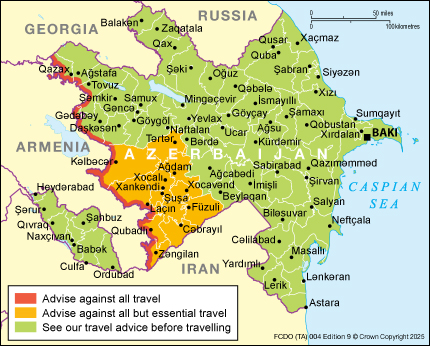
The country is not uniform: 9 regions advised against, fully or partly, by at least one official reading. Baku is not one of them.
Faithful summary of the official texts below, which prevail.
the trip stays outside the advised-against regions. Any move into a red or orange region calls for a new, written decision.
Global Affairs Canada
Fuzuli
Foreign Office
The districts (‘rayons’) of Kelbajar, Lachin, Qubadli, Zengilan, Jabrayil, Fuzuli, Khojavand, Shusha, Khojali, Khankendi, Aghdam and Tartar
Global Affairs Canada
Jabrayil
Foreign Office
The districts (‘rayons’) of Kelbajar, Lachin, Qubadli, Zengilan, Jabrayil, Fuzuli, Khojavand, Shusha, Khojali, Khankendi, Aghdam and Tartar
Global Affairs Canada
Kalbajar
Global Affairs Canada
Khojali
Foreign Office
The districts (‘rayons’) of Kelbajar, Lachin, Qubadli, Zengilan, Jabrayil, Fuzuli, Khojavand, Shusha, Khojali, Khankendi, Aghdam and Tartar
Global Affairs Canada
Shusha
Foreign Office
The districts (‘rayons’) of Kelbajar, Lachin, Qubadli, Zengilan, Jabrayil, Fuzuli, Khojavand, Shusha, Khojali, Khankendi, Aghdam and Tartar
Global Affairs Canada
Tartar
Foreign Office
The districts (‘rayons’) of Kelbajar, Lachin, Qubadli, Zengilan, Jabrayil, Fuzuli, Khojavand, Shusha, Khojali, Khankendi, Aghdam and Tartar
Global Affairs Canada
Zangilan
Foreign Office
The border with Armenia remains closed. The FCDO advises against all travel to within 5km of the border with Armenia, due to tensions between Azerbaijan and Armenia. Note that this does not include the border of Azerbaijan’s Nakhchivan exclave with Armenia.
France Diplomatie (in French)
Zone frontalière avec l’Arménie — Les zones frontalières avec l’Arménie (y compris dans la région du Nakhitchevan) sont formellement déconseillées en raison du risque d’affrontements armés et de la présence de nombreuses mines anti-personnel.
Foreign Office
The districts (‘rayons’) of Kelbajar, Lachin, Qubadli, Zengilan, Jabrayil, Fuzuli, Khojavand, Shusha, Khojali, Khankendi, Aghdam and Tartar
Global Affairs Canada — Advised against — all travel
Aghdam
Global Affairs Canada — Advised against — all travel
Gubadli
Global Affairs Canada — Advised against — all travel
Lachin
Global Affairs Canada — Advised against — all travel
Khankendi
Global Affairs Canada — Advised against — all travel
Khojavand
Global Affairs Canada — Advised against — all travel
Aghdara
Global Affairs Canada — Advised against — all travel
Avoid all travel to the area within 1 km of the border with Armenia, which is closed, due to the uncertain security environment.
France Diplomatie (in French) — Advised against — all travel
Ancien oblast autonome du Haut-Karabagh et anciens districts adjacents
France Diplomatie (in French) — Advised against — all travel
Il est formellement déconseillé aux citoyens français de se rendre dans la région de l’ancien oblast autonome du Haut-Karabagh et à ses abords (majeure partie des anciens districts adjacents).
France Diplomatie (in French) — Advised against — all but essential travel
Zone frontalière avec le Daghestan — Compte tenu de l’instabilité qui prévaut en république du Daghestan (Russie), les déplacements le long de la frontière entre cette république et l’Azerbaïdjan sont déconseillés sauf raison impérative.
Global Affairs Canada — Open Government Licence – Canada (24.09.2026) · Foreign Office — Open Government Licence v3.0 · France Diplomatie (06.03.2026) · Natural Earth
No located event in this reading.
Last change: Removal of information about visa procedures for visitors travelling to Azerbaijan in connection with the Formula 1 Azerbaijan Grand Prix (‘Entry requirements’ page).
Updated 27.04.2026
Reconsider travel to Azerbaijan due to terrorism , armed conflict , and risk of landmines . Some areas have increased risk. Read the entire Travel Advisory.
Following the onset of hostilities between the United States and Iran on February 28, 2026, there has been an ongoing threat of drone and missile attacks from Iran. There was a March 5, 2026, drone strike on Nakhchivan International Airport. Commercial flights have also been seriously disrupted.
There is risk of terrorist violence, including terrorist attacks and other activity in Azerbaijan. Visit the U.S. Department of State's country reports on terrorism to learn more.
Terrorist groups continue to plan attacks and are a risk in Azerbaijan. Terrorists may attack with little or no warning. They may target:
Do not travel to:
10-13 0.2 · 10-14 0.2 · 10-15 0.2 · 10-16 0.1 · 10-17 0.1 · 10-18 0.1 · 10-19 0.1 m³/s
Simulated discharge: Open-Meteo.com (CC BY 4.0), data rounded and formatted by Maximum. Contains modified Copernicus Emergency Management Service information 2026. For information only: this is not a flood warning; only national or regional authorities issue those.
The level is national. Risk areas are in the state advisories below.
No major event in progress is located in this country at this morning's check.
Reading: The homicide rate is 4 times Switzerland's: violence is a real risk there, concentrated in the areas named by the official advisories. On the road, 3 times more deaths than in Switzerland: road crashes are the leading cause of death of healthy travellers (CDC) — seat belt, no night driving, a driver or a taxi from a rank.
World Bank (UNODC for homicides, WHO for roads) — latest published valuedata.worldbank.org ↗read 10.10.2026
What we locate on the map are events in progress that have real coordinates: USGS earthquakes, GDACS disasters, NOAA storms and open NASA EONET events. Hover a dot for details, click to open it in this briefing.
French passport — France Diplomatie
Faithful summary of the official texts below, which prevail.
Il est donc déconseillé sauf raison impérative aux ressortissants français, y compris binationaux, de se rendre en Azerbaïdjan.France Diplomatie ↗updated 15.09.2026 · read 13.10.2026
Vigilance areas — France Diplomatie (in French) updated 06.03.2026official map ↗updated 15.09.2026 · read 13.10.2026
- Présentation de l'Azerbaïdjan
-
-
-
-
-
-
-
-
-
-
Dernière actualisation le 06/03/2026, information toujours valable à la date du jour
Il est formellement déconseillé aux citoyens français de se rendre dans la région de l’ancien oblast autonome du Haut-Karabagh et à ses abords (majeure partie des anciens districts adjacents). En effet, la présence de restes explosifs de guerre (mines notamment) dans ces régions constitue un danger de première importance. La présence de mines n’est encore que partiellement cartographiée et des accidents mortels ont régulièrement lieu. Les autorités azerbaïdjanaises conduisent des opérations de déminage qui prendront probablement plusieurs années.
Les personnes qui, sans l’autorisation préalable des autorités azerbaïdjanaises, se seraient rendues dans ces régions alors qu’elles échappaient à leur contrôle sont considérées comme ayant séjourné illégalement en Azerbaïdjan. Elles risquent de se voir refoulées à l’entrée du territoire azerbaïdjanais mais sont également susceptibles de poursuites pénales pour franchissement illégal de la frontière.
Les zones frontalières avec l’Arménie (y compris dans la région du Nakhitchevan) sont formellement déconseillées en raison du risque d’affrontements armés et de la présence de nombreuses mines anti-personnel.
La majeure partie du territoire azerbaïdjanais est placé en orange sur la carte des Conseils aux voyageurs et reste déconseillée sauf raison impérative. Les régions frontalières ci-après nécessitent également la plus grande vigilance.
Compte tenu de l’instabilité qui prévaut en république du Daghestan (Russie), les déplacements le long de la frontière entre cette république et l’Azerbaïdjan sont déconseillés sauf raison impérative.
En raison de l’existence de trafics et de l’absence de signalisation claire, il est déconseillé aux voyageurs, sauf raison impérative, de se rendre à la frontière entre l’Azerbaïdjan et l’Iran, y compris au Nakhitchevan. Le passage de l’Azerbaïdjan vers l’Iran est en principe possible au poste-frontière d’Astara (mais actuellement fermé du fait des restrictions liées au Covid-19, toujours en vigueur jusqu’à nouvel ordre).
La majeure partie du territoire azerbaïdjanais est placée en orange sur la carte des Conseils aux voyageurs. Il est donc déconseillé sauf raison impérative aux ressortissants français, y compris binationaux, de se rendre en Azerbaïdjan.
Il reste en outre formellement déconseillé de se rendre dans les zones frontalières avec l’Arménie ainsi que dans les régions de l’ancien oblast autonome du Haut-Karabagh et des anciens districts adjacents (zones en rouge sur la carte des Conseils aux voyageurs).
Risques d’arrestation, de détention arbitraire et de jugement inéquitable en Azerbaïdjan
Les ressortissants français, y compris binationaux, qu’ils soient résidents ou de passage, s’exposent à un risque d’arrestation, de détention arbitraire et de jugement inéquitable en Azerbaïdjan.
Ce risque peut concerner les personnes effectuant une simple visite touristique ou un voyage d’affaires. En cas d’arrestation ou de détention, le respect des droits fondamentaux n’est pas garanti.
Tout ressortissant français arrêté s’expose :
Les accusations et placements en détention peuvent être arbitraires.
Ces régions ont été le théâtre d’affrontements militaires de grande ampleur entre forces azerbaïdjanaises et arméniennes. Les forces armées azerbaïdjanaises ont conduit en septembre 2023 une opération militaire d’ampleur dans l’ancien oblast autonome du Haut-Karabagh qui a entraîné le départ vers l’Arménie de la quasi-totalité de la population arménienne.
Les autorités azerbaïdjanaises contrôlent désormais la totalité de ces régions pour lesquelles l’accès se fait sur autorisation. Compte tenu de la présence de nombreuses mines, il est formellement déconseillé aux citoyens français de se rendre dans ces régions et à leurs abords.
Des affrontements armés entre les forces des deux pays ont régulièrement lieu à la frontière entre l’Arménie et l’Azerbaïdjan. Pour cette raison mais également en raison de la présence de nombreuses mines anti-personnel, il est formellement déconseillé aux citoyens français de se rendre dans les régions frontalières. Le conflit du Haut-Karabagh et la relation avec l’Arménie étant d’une extrême sensibilité en Azerbaïdjan, il est conseillé de faire preuve de la plus grande réserve dans ses propos à ce sujet.
Compte tenu des risques très élevés d’arrestation et de détention arbitraire de ressortissants français, il est recommandé de renoncer à tout projet de voyage en Iran. L’Iran met en œuvre une politique délibérée de prise d’otages occidentaux et cible des ressortissants français de passage qu’il accuse d’espionnage.
Vers la fiche Conseils aux voyageurs pour l’Iran .
L’infrastructure routière est globalement satisfaisante à Bakou et dans sa banlieue, contrairement à celle du reste du pays.
Les habitudes de conduite locales rendent indispensable une vigilance de tous les instants pour le conducteur à Bakou. La plus grande prudence et le strict respect des règles sont donc des exigences absolues. Il est déconseillé aux conducteurs inexpérimentés de prendre le volant. Dans le reste du pays, il est peu recommandé de conduire un véhicule notamment la nuit, en raison notamment de l’état des infrastructures, des comportements à risques de certains conducteurs, du faible éclairage et de la présence d’obstacles pouvant être très mal ou non signalés.
La délinquance de droit commun est faible en Azerbaïdjan et la sécurité est assurée dans la capitale, Bakou, en particulier dans le centre-ville, où la police effectue des patrouilles régulières. La nuit, il convient d’éviter certains quartiers périphériques de la capitale qui ne bénéficient que d’un éclairage public limité.
Il est vivement recommandé de se munir de copies (papier ou numériques) des documents d’identité, des titres de voyage et des visas. Il est également possible de stocker une copie de ces documents dans le porte-document de votre espace personnel sur le site service-public.fr . Il sera ainsi facile d’en récupérer une copie en cas de vol ou de perte. Il peut également être utile de conserver sur soi le numéro de téléphone de sa compagnie d’assurance ainsi que le numéro d’urgence de l’ambassade.
L’Azerbaïdjan est situé dans une région d’activité sismique. En cas de séisme, il importe de respecter les recommandations de base .
Les voyageurs sont invités à prendre toutes les précautions utiles : agence de voyage fiable, guide professionnel expérimenté, etc… En complément d’une inscription sur le portail Ariane, il est par ailleurs souhaitable d’informer précisément ses proches de l’itinéraire emprunté, ainsi que des dates et des horaires des déplacements prévus. A noter que les épisodes neigeux sont imprévisibles en hiver. En montagne, il convient de se tenir à l’écart des chiens de berger qui peuvent être agressifs. Il est également conseillé d’être vigilant quant à la présence d’animaux sauvages (serpents venimeux, ours, loups, etc.).
Il est à noter que la sécurité dans les stations de ski de Shahdag (région de Gusar) et de Tufandag (région de Gabala) est assurée malgré leur proximité avec les zones frontalières. Les touristes français peuvent s’y rendre avec une vigilance habituelle pour les zones de montagne (risques d’entorse, chutes de pierre, etc.).
Full text of the Security pagediplomatie.gouv.fr ↗updated 15.09.2026 · read 13.10.2026
Swiss passport — FDFA (Switzerland), in French
FDFA update note — Il est désormais déconseillé d'effectuer des voyages touristiques et non urgents dans la zone frontalière avec l’Iran (Derniers développements). (published 18.03.2026)
Malgré les progrès réalisés dans le processus de paix entre l’Azerbaïdjan et l’Arménie, des incidents armés ne peuvent être exclus dans la zone frontière. Voir chapitre Risques régionaux spécifiques. Dans ce pays comme ailleurs, le risque d’attentats terroristes ne peut être exclu. La rubrique terrorisme et enlèvements attire l'attention sur les risques liés au terrorisme. Terrorisme et enlèvements Avant le départ et pendant le voyage, suivez l’évolution de la situation au travers des médias, des autorités locales, des personnes de contact sur place ou du personnel de l'hôtel sur le développement de la situation. Tenez-vous à l’écart des manifestations et rassemblements quels qu'ils soient. Suivez les directives des autorités locales (par exemple couvre-feux). Une attention particulière doit être accordée à la sécurité personnelle.
La description des zones à risques repose sur des données approximatives; les risques ne peuvent se restreindre à des zones délimitées. Région du Karabakh et zones frontalières avec l’Arménie: Il est déconseillé de se rendre dans la région du Karabakh et dans les zones proches de la frontière avec l’Arménie. Des graves affrontements armés ont produit de nombreuses victimes et blessées. En septembre 2023 toute la région azerbaïdjanaise du Karabakh est passée sous contrôle azerbaïdjanais, ce qui a entraîné des flux de réfugiés. Dans les zones concernées par le conflit, il existe parfois un risque lié aux mines. Quiconque se rend dans la région du Haut-Karabagh sans autorisation des autorités azerbaïdjanaises s’expose à des poursuites pénales en vertu du droit azerbaïdjanais. Selon la situation, il est très difficile pour la Suisse, voire impossible, de porter assistance aux personnes de nationalité suisse en cas d’urgence. Les frontières entre l’Azerbaïdjan et l’Arménie sont fermées.
Observez les précautions d'usage contre la petite criminalité.
L'Azerbaïdjan se trouve dans une zone d'activité sismique. Republican seismic survey center of the Azerbaijan national academy of sciences Après de fortes pluies, il faut s'attendre à des inondations. Il existe un important risque d’incendie de forêt à de nombreux endroits. Si une catastrophe naturelle se produisait durant votre séjour, prenez immédiatement contact avec vos proches et suivez les instructions des autorités. Dans le cas où les liaisons avec l’étranger seraient interrompues, contactez l’Ambassade de Suisse à Bakou.
FDFA travel advice, in French, valid on 13.10.2026eda.admin.ch ↗updated 18.03.2026 · read 13.10.2026
British passport — Foreign Office (UK)
Faithful summary of the official texts below, which prevail.
Regions covered by the Foreign Officegov.uk ↗updated 08.10.2026 · read 13.10.2026

Warnings — Foreign OfficeForeign Office ↗updated 08.10.2026 · read 13.10.2026
Your travel insurance could be invalidated if you travel against advice from the Foreign, Commonwealth & Development Office (FCDO).
The border with Armenia remains closed. The FCDO advises against all travel to within 5km of the border with Armenia, due to tensions between Azerbaijan and Armenia. Note that this does not include the border of Azerbaijan’s Nakhchivan exclave with Armenia.
The Foreign, Commonwealth & Development Office ( FCDO ) advises against all but essential travel to:
You should follow Azerbaijani national government and local authorities’ advice in areas that have not been cleared of mines or unexploded ordnance.
Find out more about why FCDO advises against travel .
Help for British nationals is extremely limited in the areas where we advise against travel.
There is a heightened risk of regional tension. Escalation could lead to travel disruption, including airspace closures and other unanticipated impacts.
British nationals should take sensible precautions, considering their own individual circumstances. These include:
- read if you’re affected by a crisis abroad - GOV.UK . This includes guidance on “how to prepare for a crisis” with suggestions on what you might include in your emergency supplies and “what to do in a crisis”
- sign up to FCDO Travel Advice email alerts
- monitor local and international media for the latest information
- follow the instructions of the local authorities
For information on crossing the border from Iran into Azerbaijan, see Entry requirements .
Regional risks — Foreign OfficeForeign Office ↗updated 08.10.2026 · read 13.10.2026
This section has safety advice for regions of Azerbaijan. It only covers regions where the Foreign, Commonwealth & Development Office ( FCDO ) has specific advice.
You should also read FCDO ’s overall travel advice and safety and security advice .
The Foreign, Commonwealth & Development Office ( FCDO ) advises against all but essential travel to some areas in south-western Azerbaijan, including districts in and around the region formerly known as “Nagorno-Karabakh” due to the risks from leftover military equipment and weapons from former conflict. This includes:
It is illegal to enter certain areas in south-western Azerbaijan, without the permission of the Azerbaijani authorities. Anyone who has previously visited these areas, including the town of Khankendi, without the permission of Azerbaijani authorities could be denied entry to Azerbaijan. You should contact the nearest embassy or consulate of Azerbaijan before you travel.
Whilst tensions have calmed and the risk of further conflict has decreased, there remains a risk of unexploded weapons and landmines in south-western Azerbaijan. The Azerbaijani authorities are working to remove unexploded weapons and landmines.
Follow Azerbaijani national government and local authorities’ advice in areas that have not been cleared of mines or unexploded ordnance. If you come across an unexploded weapon or landmine do not approach it or touch it. Make a note of where you saw it and notify the authorities on 102 or 112. Beware of more unexploded weapons or landmines nearby.
The border with Armenia remains closed. The FCDO also advises against all travel to within 5km of the rest of the border with Armenia. Note that this does not include the border of Azerbaijan’s Nakhchivan exclave with Armenia.
The land border between Azerbaijan and Russia (Dagestan) is closed. The FCDO continues to advise against all travel to Russia. For further details, see FCDO ’s travel advice for Russia .
Safety — Foreign OfficeForeign Office ↗updated 08.10.2026 · read 13.10.2026
This guide also has safety advice for regions of Azerbaijan .
There is a high threat of terrorist attack globally affecting UK interests and British nationals, including from groups and individuals who view the UK and British nationals as targets. Stay aware of your surroundings at all times.
UK Counter Terrorism Policing has information and advice on staying safe and what to do in the event of a terrorist attack. Find out how to reduce your risk from terrorism while abroad .
Terrorists are likely to try to carry out attacks in Azerbaijan.
Terrorism attacks could be indiscriminate, including in places visited by foreign nationals, such as:
- hotels, restaurants and pubs
- energy sector facilities
- religious sites and places of worship
- shopping centres and crowded places
- embassies and government buildings
- sporting and cultural events
- transport hubs
Stay aware of your surroundings, keep up to date with local media reports and follow the advice of local authorities.
The political situation in Azerbaijan is generally calm, but demonstrations and opposition rallies can occur.
Avoid large gatherings and any demonstrations. They are illegal and there could be a swift response from the authorities. Monitor the media for information about possible demonstrations and be alert to local and regional developments, which may trigger public disturbances.
If you are a British journalist, make sure you are clearly identifiable.
Tensions between Armenia and Azerbaijan have calmed and the risk of further conflict has decreased, including in the areas of those regions affected by conflict in 2020 and 2023. The FCDO continues to advise against all but essential travel to some areas in south-western Azerbaijan due to the risks from mines or unexploded ordnance from former conflict, and advises against all travel within 5km of the border with Armenia. See Regional Risks .
Crime levels in Baku are generally low. Be alert to possible bag-snatching or mugging, particularly if you are carrying large amounts of cash or valuables. The risk is higher after dark in the centre of town. Avoid displaying large sums of money or expensive-looking valuables and do not walk alone at night.
There are occasionally reports of government officials asking foreign nationals to make undocumented payments. If you think you have been mistreated by a traffic policeman or health professional, report your case to the relevant government department.
Fraudsters can steal your card details without you noticing. Take extra care to guard against card skimming when using credit cards or withdrawing cash from ATMs. Use ATMs inside banks where possible, check street ATMs for signs of tampering, and always keep your card in sight when paying in shops and restaurants.
Azerbaijan is a largely secular society, although most of the population is Muslim. Religion is usually considered a private matter.
Some areas, such as Martyrs’ Alley, are especially sensitive. Disruptive or disrespectful conduct in or around such area may result in police action, including fines or being summoned to the police station.
Police sometimes carry out checks of identity documents. Carry your passport at all times. Keep a copy of the photo page in a safe place.
In Baku local and foreign women usually dress in conservative western-style clothing. It is now more…
American passport — U.S. Department of State
Faithful summary of the official texts below, which prevail.
Azerbaijan - Level 3: Reconsider Travel 2026-04-27travel.state.gov ↗updated 27.04.2026 · read 13.10.2026
Reconsider travel to Azerbaijan due to terrorism , armed conflict , and risk of landmines . Some areas have increased risk. Read the entire Travel Advisory.
Following the onset of hostilities between the United States and Iran on February 28, 2026, there has been an ongoing threat of drone and missile attacks from Iran. There was a March 5, 2026, drone strike on Nakhchivan International Airport. Commercial flights have also been seriously disrupted.
There is risk of terrorist violence, including terrorist attacks and other activity in Azerbaijan. Visit the U.S. Department of State's country reports on terrorism to learn more.
Terrorist groups continue to plan attacks and are a risk in Azerbaijan. Terrorists may attack with little or no warning. They may target:
Do not travel to:
Global Affairs Canada — additional reading
Exercise a high degree of caution (with regional advisories)
Avoid all travel to the following districts due to the presence of unexploded ordnance:
Avoid all travel to the area within 1 km of the border with Armenia, which is closed, due to the uncertain security environment.
Open Government Licence – Canada · September 24, 2026 08:53 EDTtravel.gc.ca ↗updated 24.09.2026 · read 13.10.2026
Faithful summary of the official texts below, which prevail.
Global Affairs Canada — written for Canadian travellers, valid for all
You must abide by local laws. Learn about what you should do and how we can help if you are arrested or detained abroad.
It is strictly forbidden to take pictures of military installations and equipment. Trespassing on military sites can lead to arrest. Visitors have been detained and questioned when attempting to photograph military bases, equipment and installations, all of which are considered sensitive. Promoting religion and trying to convert others are not permitted.
Always carry your passport. Keep a photocopy of your passport in a safe place in case it’s lost or confiscated. If you are a resident, you must provide proof of residency status. Police checks in public areas are common. You could be taken to a police station and fined if you fail to provide proper identification on request from an official.
Penalties for possession, use or trafficking of illegal drugs are severe. Convicted offenders can expect long jail sentences and heavy fines. Drugs, alcohol and travel
Azerbaijani law does not prohibit sexual acts between individuals of the same sex. However, 2SLGBTQI+ persons may face discrimination, harassment, and violence based on their sexual orientation, gender identity, gender expression, or sex characteristics. Travel and your sexual orientation, gender identity, gender expression and sex characteristics
The Hague Convention on the Civil Aspects of International Child Abduction is an international treaty. It can help parents with the return of children who have been removed to or retained in certain countries in violation of custody rights. It does not apply between Canada and Azerbaijan. If your child was wrongfully taken to, or is being held in Azerbaijan by an abducting parent:
If your child was removed from a country other than Canada, consult a lawyer to determine if The Hague Convention applies. Be aware that Canadian consular officials cannot interfere in private legal matters or in another country's judicial affairs.
You must carry an International Driving Permit. International Driving Permit There is a zero-tolerance policy for drinking and driving. Traffic stops are common. Always carry your licence, International Driving Permit, proof of insurance and vehicle registration. You must have the following documents in the car:
If you intend to drive for more than one month, you may need to convert your Canadian driver’s licence into an Azerbaijani one. If you own a car, you must get an annual roadworthiness test done between January 1 and October 31. You will receive a check-up card each year following the inspection. Azerbaijan Service and Assessment Network
You must declare foreign currency upon entry. You cannot leave the country with more than you brought in. There are restrictions on the import and export of certain goods to and from Azerbaijan. Customs authorities strictly enforce regulations concerning the import and export of firearms, religious objects, works of art and antiquities. You need an export certificate to take antiques or art like carpets, samovars, copperware or paintings out of Azerbaijan. Your can get a certificate from your vendor or the Azerbaijan National Carpet Museum.
If you plan to use a local SIM card for more than 30 days, you must register it and pay a fee at a local post office. If you don’t declare your device or register your SIM card, it may stop working on local networks.
Azerbaijan is a secular state, but some people adhere closely to Islamic practices and beliefs. To avoid offending local sensitivities:
In 2027, the lunar month of Ramadan is expected to begin on or around February 7. In public, between sunrise and sunset, be discreet when:
The currency of Azerbaijan is the Azerbaijani manat (AZN). Outside of major businesses, credit cards may not always be accepted for payment. Several ATMs in major cities dispense both U.S. dollars and Azerbaijani manat.
Open Government Licence – Canada · September 24, 2026 08:53 EDTtravel.gc.ca ↗updated 24.09.2026 · read 13.10.2026
Foreign Office — laws and cultural differences
Azerbaijan is a largely secular society, although most of the population is Muslim. Religion is usually considered a private matter. Some areas, such as Martyrs’ Alley, are especially sensitive. Disruptive or disrespectful conduct in or around such area may result in police action, including fines or being summoned to the police station.
Police sometimes carry out checks of identity documents. Carry your passport at all times. Keep a copy of the photo page in a safe place.
In Baku local and foreign women usually dress in conservative western-style clothing. It is now more acceptable for men to wear shorts in Baku in the summer months. Outside of Baku it may still be frowned on, and you may receive unwelcome attention.
Ramadan is a holy month for Muslims. The dates vary by year and country. Most restaurants, cafés, shops and other services in Azerbaijan continue to operate during Ramadan. Some businesses may adjust their opening hours or offer special Ramadan arrangements. During Ramadan, you should:
Smoking is restricted to designated areas. You can be fined for dropping smoking-related litter. Use bins provided.
Possession or use of illegal drugs, including cannabis, carries severe penalties. You should expect a long jail sentence and heavy fines for possessing, using, or smuggling illegal drugs, including when transiting through the airport. Airports in Azerbaijan have excellent technology and security for detecting illegal items. This is also used to scan the baggage of transiting passengers.
Be aware of cultural sensitivities when photographing mosques, churches and other religious sites or sites of commemoration, such as the Alley of Martyrs in Baku. If in doubt, ask for permission. Military bases, equipment and installations in any condition are considered sensitive areas, and visitors have been detained and questioned while attempting to visit or photograph them. If you do not have temporary or permanent residence rights in Azerbaijan, you are not allowed to import drones. Any drones will be confiscated by the State Customs Office at the port or border and returned upon departure. Unmanned drones cannot be rented to individuals without a valid taxpayer identification number (TIN). If you have a TIN, special permission from the Ministry of Digital Development and Transport is required. Manned drones can be rented without requiring permission.
While same-sex sexual activity is not illegal, LGBT+ people in Azerbaijan tend to keep a low profile. Showing affection in public is frowned upon, especially outside of Baku and among the older generation. Holding hands or embracing between men is usually a sign of friendship. Read more advice for LGBT+ travellers.
Open Government Licence v3.0gov.uk ↗updated 08.10.2026 · read 13.10.2026
FDFA (Switzerland) — laws and customs, in French
L'alcool au volant est interdit (0 pour mille). Il est interdit de photographier des personnes en uniforme et des installations militaires. Les infractions à la loi sur les stupéfiants, y compris la détention de minimes quantités de drogue quelle qu'elle soit, sont sévèrement réprimées.
Adaptez votre comportement et votre tenue vestimentaire aux usages locaux. Les personnes qui affichent en public leur homosexualité sont susceptibles d'être la cible d'agression. Renseignez-vous dans les guides de voyages, auprès de votre agence ou directement sur place, sur les codes de conduite.
FDFA travel advice, in Frencheda.admin.ch ↗updated 18.03.2026 · read 13.10.2026
What it changes for you: Air acceptable at this hour: nothing special to plan.
Reading 02:00 (Asia/Baku)Open-Meteo ↗updated 14.10.2026 · read 13.10.2026
Air quality and UV: Open-Meteo.com (CC BY 4.0), data rounded and formatted by Maximum. Contains modified Copernicus Atmosphere Monitoring Service information 2026. Neither the European Commission nor ECMWF is responsible for any use that may be made of the Copernicus information or data it contains.
Reading: With 3.2 physicians per 1,000 people (29% fewer than Switzerland), the nearest hospital does not always have the capacity for a serious case: evacuation to an adequate centre is the rule, not the exception — that is what unlimited evacuation and repatriation cover. Health spending of 300 USD per person (Switzerland: 11,784) goes with private hospitals that bill foreigners in hard currency and ask for a guarantee before admission: the direct payment guarantee is what avoids the deposit.
World Bank — latest published value, year per indicatordata.worldbank.org ↗read 10.10.2026
French passport — France Diplomatie
Faithful summary of the official texts below, which prevail.
- Présentation de l'Azerbaïdjan
-
-
-
-
-
-
-
-
-
-
Quelle que soit la catégorie de visiteurs, seule une entrée par voie aérienne est possible, les frontières terrestres demeurant fermées à tous les voyageurs. Les mesures de restrictions sanitaires pour l’entrée sur le territoire liées à l’épidémie de Covid 19 (présentation d’un certificat de vaccination ou d’un test PCR) ont été levées.
La ligne de train entre Bakou et Tbilissi récemment ouverte aux passagers n’est actuellement pas accessible aux ressortissants français, de l’Union européenne ou de pays ne disposant pas d’une exemption de visa avec l’Azerbaïdjan.
Il est conseillé de suivre les recommandations des autorités locales et de consulter le site internet et les réseaux sociaux de l’ambassade de France en Azerbaïdjan. Les demandes d’e-visas pour les Français peuvent être réalisées en ligne sur le site officiel azerbaïdjanais ASAN VIZA (voir le paragraphe ci-dessous « Visas »). Le départ de l’Azerbaïdjan ne requiert quant à lui que la présentation des documents exigés par le pays d’arrivée. Les dispositions adoptées par les autorités locales sont évolutives et souvent d’application immédiate.
Les voyageurs se rendant en Azerbaïdjan doivent être obligatoirement munis, préalablement à leur départ, d’un visa valable pour toute la durée de leur séjour. Ce visa peut être obtenu auprès de l’ambassade d’Azerbaïdjan compétente ou par une procédure en ligne.
NB : il est impossible d’obtenir un visa aux postes-frontières terrestres (toutes les frontières terrestres sont actuellement fermées aux voyageurs). Avant tout séjour et déplacement à Bakou et dans le reste du pays, il convient de s’assurer, avant son départ, de la validité des documents administratifs (visas, carte de résident le cas échéant), en fonction de la nature du séjour envisagé.
En raison de problèmes récurrents, il est demandé aux voyageurs de vérifier, dès la délivrance, trois éléments essentiels du visa qui leur est accordé :
Depuis le 10 janvier 2017, les personnes souhaitant se rendre en Azerbaïdjan peuvent obtenir en ligne un…
L’importation de devises est contrôlée à l’entrée dans le pays (un formulaire doit être rempli et conservé car il est réclamé à la sortie).
L’exportation de tout objet artisanal ou d’art et de toute antiquité est soumise à la délivrance d’une autorisation préalable de sortie du territoire national, sous peine de confiscation ou de paiement d’une amende. C’est le cas notamment des tapis, dont l’exportation est soumise à la présentation d’un permis délivré par le Musée d’État des Tapis, et que doit impérativement se procurer le vendeur.
La réglementation azerbaïdjanaise limite à 125 grammes l’exportation de caviar à titre privé, 3 cartouches de cigarettes et 3 litres d’alcool.
Entry and stay pagediplomatie.gouv.fr ↗updated 15.09.2026 · read 13.10.2026
Swiss passport — FDFA (Switzerland)
The FDFA does not publish entry requirements: they are set out by the destination's embassy or consulate in Switzerland — check them before booking, passport in hand. As a guide, the French and British requirements below describe the same rules as seen by two other governments.eda.admin.ch ↗updated 18.03.2026 · read 13.10.2026
British passport — Foreign Office (UK)
Faithful summary of the official texts below, which prevail.
Entry requirements — rules for a British passportForeign Office ↗updated 08.10.2026 · read 13.10.2026
This information is for people travelling on a full ‘British citizen’ passport from the UK. It is based on the UK government’s understanding of Azerbaijan’s current rules for the most common types of travel.
The authorities in Azerbaijan set and enforce entry rules. If you’re not sure how these requirements apply to you, contact the Azerbaijani Embassy in the UK.
The border between Azerbaijan and Iran is closed. But British nationals might be able to cross at the Astara border crossing with special authorisation from the Government of Azerbaijan, which must be facilitated by the British Embassy in Baku. British nationals seeking entry into Azerbaijan should contact the FCDO before travelling to the border crossing at Astara, indicating whether you are contacting from Iran or from the UK on behalf of a relative. Other border crossings to Azerbaijan remain closed.
British nationals will need to provide personal details (name, date of birth, passport information). The British Embassy will provide confirmation and a code from the Azerbaijani authorities. This will take approximately 48 hours. You will need to show the code before crossing. You will also need to apply for a visa through the normal process. See ‘applying for a visa’.
If you intend to leave Iran overland, you do so at your own risk. In Iran, holding a British passport or having perceived connections to the UK can be reason enough for the Iranian authorities to detain you.
Read more FCDO advice if you’re affected by a crisis abroad .
To enter Azerbaijan as a visitor, your passport must usually have an ‘expiry date’ at least 6 months after the date you arrive and at least 2 blank pages for entry stamps. See ‘visa requirements’ for more details.
To enter Azerbaijan as a resident, your passport must have an ‘expiry date’ at least 3 months after the expiry date of your temporary or permanent residence permit.
Check with your travel provider that your passport and other travel documents meet requirements. Renew your passport if you need to.
You will be denied entry if you do not have a valid travel document or try to use a passport that has been reported lost or stolen.
When returning to the UK, British citizens must carry a valid British passport or certificate of entitlement . See Dual citizenship .
Azerbaijan does not recognise dual nationality, but does not prohibit Azerbaijani nationals from holding dual nationality. You must inform the local Azerbaijani Embassy or State Migration Service within one month of taking up another nationality. If you do not, this can impact the level of consular support FCDO will be able to provide.
If you’re a British passport holder with links to Azerbaijan, through birth or otherwise, and need to check your nationality status, contact the State Migration Service before you travel.
Anyone who has previously visited certain areas in south-western Azerbaijan, including the town of Khankendi, without the permission of the Azerbaijani authorities could be…
American passport — U.S. Department of State
The State Department publishes the requirements ("Entry, Exit and Visa Requirements") on its country page, which our servers cannot read. Read it before you go; as a guide, the French and British requirements below describe the same rules as seen by two other governments.travel.state.gov ↗updated 27.04.2026 · read 13.10.2026
For each risk, the official texts themselves: what is happening, then, where they say so, what to do.
What the texts say · Terrorists are likely to try to carry out attacks in Azerbaijan. Thieves sometimes pose as police officers and demand that tourists pay on-the-spot fines.
What the texts say · Some visitors have reported being severely overcharged by local taxis. Many vehicles are poorly maintained, and the standard of driving is erratic.
What the texts say · There is a risk of earthquakes across the Caucasus region, although there have been no recent serious earthquakes in Azerbaijan. Flooding may occur in parts of Azerbaijan, especially on the Southern Caspian coast in the Lankaran-Astara region.
What the texts say · Possession or use of illegal drugs, including cannabis, carries severe penalties. Always carry your passport.
What the texts say · Fraudsters can steal your card details without you noticing.
What the texts say · The political situation in Azerbaijan is generally calm, but demonstrations and opposition rallies can occur.
Sentences copied word for word from the official texts cited, chosen for the destination; the level is our reading. The full texts, at each source:Foreign Office ↗updated 08.10.2026 · read 13.10.2026 (updated 08.10.2026 · read 30.09.2026)Global Affairs Canada ↗updated 24.09.2026 · read 13.10.2026 (updated 24.09.2026 · read 30.09.2026)
Reading: The homicide rate is 4 times Switzerland's: violence is a real risk there, concentrated in the areas named by the official advisories. On the road, 3 times more deaths than in Switzerland: road crashes are the leading cause of death of healthy travellers (CDC) — seat belt, no night driving, a driver or a taxi from a rank.
World Bank (UNODC for homicides, WHO for roads) — latest published valuedata.worldbank.org ↗read 10.10.2026
Time zone: IANA and timezone-boundary-builder (ODbL) · RESTCountries · EmergencyNumberAPI · Wikidata · European Central Bank
Places: © OpenStreetMap contributors (ODbL), Photon search by komoot.
FDFA (Switzerland) — transport and specific advice, in French
Dans les zones reculées, l'approvisionnement en carburant n'est pas toujours assuré. En dehors de la capitale, les routes sont parfois en mauvais état. Les comportements parfois imprévisibles augmentent considérablement les risques d'accident. Une grande prudence est de mise après la tombée de la nuit. L'entrée en Azerbaïdjan n'est actuellement possible que par voie aérienne, les frontières terrestres et maritimes sont ouverts que pour les transports de marchandises. Informez-vous auprès des autorités locales, directement auprès des postes-frontières ou auprès de l’Ambassade de la République d’Azerbaïdjan à Berne. Ambassade de la République d'Azerbaïdjan à Berne En mer Caspienne, les retards et les annulations sont fréquents dans le trafic maritime entre l'Azerbaïdjan et ses pays voisins. Prévoyez donc suffisamment de temps et de ressources financiers afin de pouvoir emprunter d'autres itinéraires.
Les personnes de nationalité étrangère qui séjournent plus de quinze jours en Azerbaïdjan ou qui y travaillent, doivent s’enregistrer sur place auprès des autorités azerbaïdjanaises. Renseignez-vous sur la procédure exacte auprès de l’Ambassade d’Azerbaïdjan à Berne. Demandez à votre hôtel ou votre employeur si l’enregistrement a été effectué. Le fait de ne pas s'enregistrer peut compliquer le départ du pays.
FDFA travel advice, in Frencheda.admin.ch ↗updated 18.03.2026 · read 13.10.2026
Maximum policyholder: before paying anything, call the 24/7 number. If you are admitted for more than 24 h, Maximum sends its direct payment guarantee to the hospital (art. 2.12).
+41 22 ••• •• •• — Full number in your client areaNone of these facilities is a Maximum Insurance “partner”, and none is presented as waiving upfront payment: this list is a reading of public map data, nothing more. A direct payment guarantee is arranged CASE BY CASE by our assistance desk, facility by facility and when the need arises — one number, +41 22 ••• •• ••.
List read from OpenStreetMap on 07.10.2026, not read again since: these facilities may have changed.
CDC Travelers' Health recommendations, most important first. They depend on your age, vaccines and itinerary: confirm them with a doctor or a travel clinic 4 to 6 weeks before departure. Details, disease by disease ↗cdc.gov ↗read 10.10.2026
The health system — With 3.2 physicians per 1,000 people (29% fewer than Switzerland), the nearest hospital does not always have the capacity for a serious case: evacuation to an adequate centre is the rule, not the exception — that is what unlimited evacuation and repatriation cover. Health spending of 300 USD per person (Switzerland: 11,784) goes with private hospitals that bill foreigners in hard currency and ask for a guarantee before admission: the direct payment guarantee is what avoids the deposit.
Back home — a fever in the following weeks should be told to a doctor, naming the country.
Forecast: MET Norway (Norwegian Meteorological Institute, CC BY 4.0), grouped by day and formatted by Maximum.
French passport — French embassy and consulates
9 Rəsul Rza küçəsi, AZ1000, Bakı
OpenStreetMap
Swiss passport — Swiss embassy and consulates
9 Böyük Qala küçəsi, 1004, Bakı
(+994-12) 437-3850
https://www.eda.admin.ch/baku ↗updated 18.03.2026 · read 13.10.2026
Numéro d’urgence de la police : 102 Représentations suisses à l’étranger : En cas de situation d’urgence à l’étranger, vous pouvez vous adresser à la représentation suisse la plus proche ou à la Helpline DFAE. Ambassade de Suisse en Azerbaïdjan Helpline DFAE Représentations étrangères en Suisse: Pour obtenir des informations sur les prescriptions d'entrée (documents d'identité admis, visa etc.), veuillez vous adresser aux ambassades et consulats étrangers compétents. Ceux-ci peuvent également vous renseigner sur les dispositions douanières pour l'importation et l'exportation d'animaux et de marchandises: appareils électroniques, souvenirs, médicaments, etc. Représentations étrangères en Suisse Republic of Azerbaijan: e-visa
OpenStreetMap · DFAE
British passport — British embassy and consulates
45 Xaqani küçəsi, AZ1010, Baku
+994 12 437 78 78
https://www.gov.uk/world/organisations/bri ↗updated 08.10.2026 · read 13.10.2026
96 Nizami küçəsi, AZ1010, Bakı
OpenStreetMap
American passport — U.S. embassy and consulates
111 Azadlıq prospekti, AZ1007, Bakı
(+994-12) 488-3300
https://az.usembassy.gov/ ↗updated 27.04.2026 · read 13.10.2026
OpenStreetMap
OpenStreetMap
Getting help — Foreign OfficeForeign Office ↗updated 08.10.2026 · read 13.10.2026
The Foreign, Commonwealth & Development Office ( FCDO ) cannot provide tailored advice for individual trips. Read this travel advice and carry out your own research before deciding whether to travel.
Ambulance: 103
Fire: 101
Police: 102
Contact your travel provider and your insurer if you are involved in a serious incident or emergency abroad. They will tell you if they can help and what you need to do.
See how to get help from the UK government abroad including in an emergency.
You can call FCDO in London if you need urgent help because something has happened to a friend or relative abroad.
Telephone: 020 7008 5000 (24 hours)
Find out about call charges
For emergencies. If pronunciation fails, show the screen — or the printed page.
| Help! | Kömək edin! |
| Call an ambulance! | Təcili yardım çağırın! |
| I need a doctor. | Mənə həkim lazımdır. |
| Where is the nearest hospital? | Ən yaxın xəstəxana haradadır? |
| Call the police! | Polis çağırın! |
| I am allergic to penicillin. | Mənim penisillinə allergiyam var. |
| I have international medical insurance. | Mənim beynəlxalq tibbi sığortam var. |
| I want to contact my embassy. | Ölkəmin səfirliyi ilə əlaqə saxlamaq istəyirəm. |
| Please take me to this address. | Xahiş edirəm, məni bu ünvana aparın. |
| Do you speak English? | Siz ingiliscə danışırsınız? |
Translations by Maximum Insurance, original script and transliteration.
Actions to take before each professional trip abroad.
Live alerts and level changes, each with its official source. Continuously updated.
Le territoire azerbaïdjanais a été la cible, le jeudi 5 mars, d’une attaque de drones iranienne qui a visé la République autonome du Nakhtchivan. Compte tenu des tensions régionales actuelles, tout déplacement dans la zone frontalière avec l’Iran est formellement déconseillé. Au regard de la volatilité de la situation sécuritaire régionale et de ses possibles répercussions locales, il est recommandé aux ressortissants français de : se tenir informés à partir de sites fiables…
France Diplomatie (in French) · posted 8 March 2026 · updated 7 April 2026diplomatie.gouv.fr ↗updated 15.09.2026 · read 13.10.2026Il est désormais déconseillé sauf raison impérative aux ressortissants français, y compris binationaux, de se rendre en Azerbaïdjan. Les ressortissants français y compris binationaux, qu’ils soient résidents ou de passage, s’exposent à un risque d’arrestation, de détention arbitraire et de jugement inéquitable en Azerbaïdjan. Ce risque peut concerner notamment les personnes effectuant une simple visite touristique, un voyage d’affaires. En cas d’arrestation ou de détention,…
France Diplomatie (in French) · posted 4 September 2024 · updated 7 April 2026diplomatie.gouv.fr ↗updated 15.09.2026 · read 13.10.2026Health – editorial change
September 24, 2026 08:53 EDTtravel.gc.ca ↗updated 24.09.2026 · read 13.10.2026No level change recorded for this country since the log opened. The live alerts above are updated continuously.
Level 3/4 — Reconsider Travel, U.S. Department of State, retrieved on 13 October 2026.
Sourcestravel.state.gov · updated 27.04 · read 13.10France Diplomatie · updated 15.09 · read 13.10DFAE · updated 18.03 · read 13.10207-country comparison
An area advised against does not rule out the country.
SourcesFrance Diplomatie · updated 15.09 · read 13.10Foreign Office · updated 08.10 · read 13.10State Department · updated 27.04 · read 13.10
The rules depend on the passport, not on the destination alone.
SourcesFrance Diplomatie · updated 15.09 · read 13.10Foreign Office · updated 08.10 · read 13.10State Department · updated 27.04 · read 13.10
For a Schengen visa, yes: at least €30,000 of travel medical insurance (Regulation (EC) No 810/2009, art. 15).
SourcesRegulation (EC) 810/2009, art. 15General conditions, policy 20 00 479
VIP Pack — $990 for twelve months, unlimited trips.
SourcesGeneral conditions, policy 20 00 479OpenStreetMap · read 13.10
Six steps, in this order.
SourcesSpecial conditions 01.26General conditions, policy 20 00 479
Local emergency services: single number 112 / 102 · ambulance 103 · fire 101
SourcesEmergencyNumberAPI · Wikidata · read 08.10OpenStreetMap · read 13.10
At today's level 3/4, card by card:
SourcesAmex Platinum France T&Cs, 01.2025 — general exclusion n° 11BNP Paribas Visa Infinite notice (policy PT7), 04.2025 — comFortuneo World Elite Mastercard notice, 01.2026 — art. 5.5 '
A health plan reimburses at home; here, the hospital asks for a payment guarantee before admission.
SourcesGeneral conditions, policy 20 00 479
Around Baku: 80 hospitals and clinics, 53 with a 24/7 emergency room, 40 pharmacies, 40 doctors' practices (OpenStreetMap, hospital list read on 07.10.2026).
The sourced detail is under Medical network › Health: vaccines, diseases present, altitude, outbreaks.
SourcesCDC Travelers' Health · read 10.10France Diplomatie · updated 15.09 · read 13.10OMS · read 13.10Foreign Office · updated 08.10 · read 13.10
3.2 physicians per 1,000 people (2022) versus 4.5 in Switzerland.
SourcesWorld Bank · read 10.10General conditions, policy 20 00 479
2.2 homicides per 100,000 people (2023) versus 0.6 in Switzerland and 1.3 in France.
The nearest representations, by passport (OpenStreetMap):
SourcesOpenStreetMap · read 13.10DFAE · updated 18.03 · read 13.10
9 regions advised against, fully or partly, by at least one official reading.
SourcesGlobal Affairs Canada · updated 24.09 · read 13.10Foreign Office · updated 08.10 · read 13.10France Diplomatie · updated 15.09 · read 13.10
Local laws apply to every traveller; here is what the official texts say.
SourcesGlobal Affairs Canada · updated 24.09 · read 13.10Foreign Office · updated 08.10 · read 13.10
Every foreign ministry runs a 24/7 emergency line for its nationals.
Sourcesdiplomatie.gouv.fr · updated 15.09 · read 13.10eda.admin.ch · updated 18.03 · read 13.10
Emergency phrases, to show if pronunciation fails:
SourcesMaximum Insurance
Keep the entry stamp, the invoices, the prescriptions and the medical report.
SourcesGeneral conditions, policy 20 00 479
Cancellation or change up to CHF 20,000, special risk CHF 5,000 per person, crisis management and security, optional Kidnap & Ransom.
SourcesGeneral conditions, policy 20 00 479
A question not answered here? Ask Maximum below, or call the support number: every question gets a clear, actionable answer.
In a life-threatening emergency, call local emergency services first, then Maximum: +41 22 ••• •• •• — 24/7 support number, an adviser stays with you to the end.
The 207 country pages — hospitals, pharmacies, police, embassies, emergency numbers, official advice from four governments, health, safety in figures, events in progress — read around the city you name. Your policy — benefits, the six steps, claims, articles. The site — prices, certificate, subscription. Nothing else: what it does not know, it says so and hands you to an adviser.
Same advisory level: Trinidad and Tobago · Venezuela · United Arab Emirates · Ethiopia · Saudi Arabia · Bahrain
The displayed level comes from the State Department, checked every morning. Before departure, always cross-check your country of residence's advisory: that is what your policy cites.
The level shown is the official U.S. Department of State level, checked daily. Maximum Insurance is an insurance distributor — general information, not personal advice.
The destination is already Baku. A few choices, then the reading of your cover, here.
Destination · Baku
Travel Insurtech. 24/7 worldwide.
Swiss insurer · Worldwide medical network