Make sure you are up-to-date on all routine vaccines before every trip. Some of these vaccines include Chickenpox (Varicella) Diphtheria-Tetanus-Pertussis (DTaP, Tdap, or Td) Flu (influenza) Measles-Mumps-Rubella (MMR) Polio Shingles
Maximum Alerts / Venezuela
Level published by the State Department on 26.06.2026 · read 1 November 2026 · source checked daily
Venezuela — official level as of 1 November 2026: Level 3/4 ("Reconsider Travel"), from the U.S. Department of State. Maximum Insurance covers this country: hospital settled directly, unlimited repatriation, EUR 1.5M, certificate on payment.
Every country has its own scale, so we ask them all the same question: is the whole country advised against?
An advisory covering only areas of the country does not raise the answer: it stays “No”, and the area is shown in the relevant column.
The level shown on this page — and across this site — is the one published by the U.S. State Department, from 1 (normal precautions) to 4 (do not travel). France and the United Kingdom publish their own advisories, with their own rules: they add to that level, they do not replace it.
You will be alerted only on the day the official level of this country changes.
In a life-threatening emergency, call local emergency services first, then Maximum: +41 22 ••• •• •• — 24/7 support number, an adviser stays with you to the end.
The 207 country pages — hospitals, pharmacies, police, embassies, emergency numbers, official advice from four governments, health, safety in figures, events in progress — read around the city you name. Your policy — benefits, the six steps, claims, articles. The site — prices, certificate, subscription. Nothing else: what it does not know, it says so and hands you to an adviser.
What I say on the phone
What to do, in this order
In immediate danger, call local emergency services first. Then contact assistance without delay; before engaging a service, seek approval under your policy. Cover is confirmed by the insurer.
Ask assistance where to get care and whether direct cover can be arranged. It confirms the facility and seeks the insurer's approval under your policy. In immediate danger, call local emergency services first.
Even for a pain you meant to shrug off. Without a medical certificate written on the spot, the same day, the insurer cannot cover the event — a certificate written after you return does not count.
The hospital desk sends the request to assistance. Direct payment depends on the insurer's approval and the policy; the call alone does not guarantee it. Have the response confirmed before relying on no up-front payment.
In a life-threatening emergency, call local emergency services immediately. For an arranged transfer or repatriation, contact assistance: the insurer's medical team decides on measures under the policy. A medical flight booked without approval may not be reimbursed.
Even if everything went well on the ground. Send your invoices and the medical report within 30 days; after that, compensation may be reduced or refused.
Reading hospitals, doctors and pharmacies around this point…
Bulevar Panteón Caracas
Avenida Este 2 Caracas
Avenida Fuerzas Armadas Caracas
Mo-Fr 07:00-18:00; Jan 1,Apr 19,May 1,Jun 24,Jul 5,Jul 24,Oct 12,Dec 24,Dec 25,D
Avenida Sur 15 Caracas
Avenida Lecuna Caracas
Avenida San Martín Caracas
physiatry
Avenida Los Erasos Caracas
Avenida Los Próceres Caracas
internal;neurosurgery;ophthalmology;otolaryngology;paediatrics;psychiatry;rheuma
Cristo Rey Caracas
00:01-24:00
Prolongación Avenida Fernando Peñalver Caracas
Mariscál Sucre Caracas
Fajardo Caracas
ophthalmology
Fajardo Caracas
Mariscál Sucre Caracas
Oriente Caracas
Avenida Principal del Cementerio Caracas
Avenida Andrés Bello Caracas
00:01-24:00
Avenida E de El Pinar Caracas
Avenida Berrezbeitia Caracas
Avenida Gran Colombia Caracas
Colombia Caracas
Simón Bolívar Caracas
vaccination
Mo-Fr 06:00-15:00; Jan 01,Apr 19,May 01,Jun 24,Jul 05,Jul 24,Oct 12,Dec 24,Dec 2
Avenida Teresa de La Parra Caracas
Caracas
Avenida Oeste 0 Caracas
Mo-Fr 08:30-17:30; Sa 09:00-18:00; Jan 01,Apr 19,May 01,Jun 24,Jul 05,Jul 24,Oct
Avenida Universidad Caracas
Mo-Fr 09:00-18:00; Sa 09:00-17:00; Jan 01-Jan 01,Apr 19-Apr 19,May 01-May 01,Jun
Avenida Baralt Caracas
Avenida Oeste 2 Caracas
Mo-Sa 08:00-19:30; Su 08:00-17:00
Avenida Baralt Caracas
Mo-Sa 08:00-20:00; Su 11:00-19:00
Avenida Urdaneta Caracas
Mo-Fr 08:00-17:00, Sa 08:00-16:00
Avenida Este 2 Caracas
Mo-Sa 09:00-18:00; Sa 09:00-17:00
35 Avenida Oeste 3 Caracas
Avenida Este 2 Caracas
Avenida Oeste 8 Caracas
Mo-Fr 08:00-12:00,13:00-17:00; Sa 08:00-14:00; Jan 01-Jan 01,Apr 19-Apr 19,May 0
Avenida Baralt Caracas
Mo-Sa 08:00-20:00; Su 12:00-20:00; Jan 1,Apr 19,May 1,Jun 24,Jul 5,Jul 24,Oct 12
Avenida Este 0 Caracas
Mo-Fr 08:30-17:30; Sa 09:00-18:00
Avenida Universidad Caracas
Mo-Sa 08:00-18:00
Avenida Oeste 8 Caracas
Avenida Lecuna Caracas
Avenida Urdaneta Caracas
24/7
49 Avenida Universidad Caracas
Mo-Sa 07:00-20:00; Su 08:00-17:00
Avenida Oeste 7 Caracas
Avenida Sur 5 Caracas
Avenida Sur 9 Caracas
Avenida Urdaneta Caracas
Mo-Sa 08:00-20:00;Su 09:00-17:00
Avenida San Martín Caracas
Avenida Oeste 9 Caracas
Avenida Fuerzas Armadas Caracas
Avenida Este 12 Caracas
Avenida Este 0 Caracas
Avenida Fuerzas Armadas Caracas
Avenida Sur 4 Caracas
Avenida Norte 13 Caracas
Mo-Sa 08:00-18:00; Jan 01,Apr 19,May 01,Jun 24,Jul 05,Jul 24,Oct 12,Dec 24,Dec 2
Avenida Este 0 Caracas
Mo-Sa 09:00-18:00; Sa 09:00-17:00
Avenida Sur 2 Caracas
Avenida San Martín Caracas
Avenida Oeste 16 Caracas
Avenida México Caracas
Mo-Fr 07:00-18:30; Sa 09:00-18:00; Su 08:00-17:00; Jan 01,Apr 19,May 01,Jun 24,J
Avenida Baralt Caracas
Mo-Fr 09:00-17:00
Avenida Urdaneta Caracas
Mo-Su 10:00-19:00
Avenida San Martín Caracas
Avenida del Parque Caracas
Mo-Sa 10:00-19:30
Avenida Este 0 Caracas
Mo-Su 08:00-18:00
Parima Caracas
Avenida Casiquiare Caracas
Avenida Francisco de Miranda Caracas
1 Avenida Sorocaima Caracas
Mo-We 08:30-11:00; Fr 08:30-11:00; Jan 01,Apr 19,May 01,Jun 24,Jul 05,Jul 24,Oct
1 Avenida Mohedano Caracas
Mo-Fr 08:00-12:00; We off; Jan 01,Apr 19,May 01,Jun 24,Jul 05,Jul 24,Oct 12,Dec
Avenida Principal de La Castellana Caracas
Mo-We 09:00-11:30; Th 09:00-11:30,13:30-15:30; Jan 01,Apr 19,May 01,Jun 24,Jul 0
Avenida Principal de La Castellana Caracas
open "By appointment only";PH off
Avenida Eugenio Mendoza Caracas
Paseo Henrique Eraso Caracas
Mo-Th 08:30-13:00,14:00-16:00; Fr 08:30-13:00; Jan 01,Apr 19,May 01,Jun 24,Jul 0
Avenida San Juan Bosco Caracas
Mo-Fr 08:00-16:00
Avenida Sur 5 Caracas
Avenida Leonardo Ruíz Pineda Caracas
Calle 100 Caracas
Avenida Leonardo Ruíz Pineda Caracas
Avenida Sur 16 Caracas
Avenida Trujillo Caracas
Agrosa Caracas
00:01-24:00
Avenida San Martín Caracas
24/7
Carretera Vieja Caracas - La Guaira Caracas
Avenida La Facultad Caracas
Avenida Francisco Solano Caracas
Avenida del Parque Caracas
Mo-Sa 10:00-21:00;Su 12:00-20:00;PH 12:00-20:00
Forecast: MET Norway (Norwegian Meteorological Institute, CC BY 4.0), grouped by day and formatted by Maximum.
11-01 0.2 · 11-02 0.1 · 11-03 0.1 · 11-04 0.1 · 11-05 0.2 · 11-06 0.4 · 11-07 0.3 m³/s
Simulated discharge: Open-Meteo.com (CC BY 4.0), data rounded and formatted by Maximum. Contains modified Copernicus Emergency Management Service information 2026. For information only: this is not a flood warning; only national or regional authorities issue those.
No geolocated event in this country at this reading.
No geolocated UCDP incident in this country.
No news located around Caracas in this reading.
National numbers (Wikidata, 2026 reading). On site, call local emergency services first, then Maximum: the insurer sends its payment guarantee to the hospital.
Make sure you are up-to-date on all routine vaccines before every trip. Some of these vaccines include Chickenpox (Varicella) Diphtheria-Tetanus-Pertussis (DTaP, Tdap, or Td) Flu (influenza) Measles-Mumps-Rubella (MMR) Polio Shingles
All eligible travelers should be up to date with their COVID-19 vaccines. Please see Your COVID-19 Vaccination for more information.
All travelers should take steps to prevent mosquito bites. Chikungunya vaccination is generally not recommended. Travelers who wish to consider vaccination can visit “What to consider before traveling” on the chikungunya vaccines page to learn more.
Recommended for unvaccinated travelers one year old or older going to Venezuela. Infants 6 to 11 months old should also be vaccinated against Hepatitis A. The dose does not count toward the routine 2-dose series. Travelers allergic to a vaccine component should receive a single dose of immune globulin, which provides effective protection for up to 2 months depending on dosage given.
Recommended for unvaccinated travelers younger than 60 years old traveling to Venezuela. Unvaccinated travelers 60 years and older may get vaccinated before traveling to Venezuela.
CDC recommends that travelers going to certain areas of Venezuela take prescription medicine to prevent malaria. Depending on the medicine you take, you will need to start taking this medicine multiple days before your trip, as well as during and after your trip. Talk to your doctor about which malaria medication you should take.
Cases of measles are on the rise worldwide. Travelers are at risk of measles if they have not been fully vaccinated at least two weeks prior to departure, or have not had measles in the past, and travel internationally to areas where measles is spreading.
Monkeypox vaccination is recommended for any adult who anticipates any of the following activities during travel: Sexual or intimate contact with a new partner Sexual or intimate contact at a commercial sex venue, like a sex club or bathhouse Sexual or intimate contact in exchange for money, goods, drugs, or other trade Sexual or intimate contact in association with a large public event, such as a rave, party, or…
Dogs infected with rabies are sometimes found in Venezuela. Rabies is also present in bats. If rabies exposures occur while in Venezuela, rabies vaccines may only be available in larger suburban/urban medical facilities.
Consider getting a typhoid vaccine if you might: Travel to areas with poor sanitation and unsafe water, including rural areas Spend a long time in Venezuela, such as a month or more Visit friends or relatives Typhoid vaccine is not 100% effective. Practicing safe food and water habits , including washing hands at key times , can also help prevent typhoid fever .
CDC recommendations: Vaccine is recommended for all travelers ≥9 months old except as follows. Vaccine is generally not recommended for travel limited to the Distrito Capital or the states of Aragua, Carabobo, Miranda, Vargas, or Yaracuy.
CDC Travelers' Health, re-read weekly — the recommendation depends on your age, vaccines and itinerary: confirm it with a doctor or a travel clinic 4 to 6 weeks before departure.CDC ↗read 30.10.2026
Moderate incidence: nothing special for a short stay.
Coverage too low to stop the virus circulating: check your two MMR doses before leaving.
Transmission limited to some areas: repellent, and the CDC says which.
World Bank — latest published valuedata.worldbank.org ↗read 31.10.2026
Source: France Diplomatie (health advice, in French).
Faithful summary of the official texts below, which prevail.
WHO: no outbreak reported for this country in the last 24 months (Disease Outbreak News).who.int ↗read 31.10.2026
FDFA (Switzerland) — medical care, in French
En raison du manque de personnel, des difficultés d’approvisionnement en médicaments et des conditions d’hygiène, les soins médicaux dans les hôpitaux publics sont pratiquement inexistants. Dans la mesure du possible, il est recommandé de choisir des cliniques privées. En cas de maladie ou de blessure grave, il est préférable de se faire soigner à l'étranger. Les cliniques exigent un prépaiement (argent liquide, carte de crédit) avant de commencer un traitement. Si vous prenez régulièrement des médicaments , emportez-en une quantité suffisante avec vous. N'oubliez toutefois pas que l'importation de médicaments contenant des stupéfiants (p. ex. méthadone) ou l’importation de substances utilisées pour traiter des troubles psychiques est soumise à des prescriptions spéciales dans de nombreux pays. Le cas échéant, renseignez-vous à ce sujet, avant le départ, auprès de la représentation étrangère compétente (ambassade ou consulat) et consultez la rubrique Liens voyages , où vous trouverez, entre autres, de plus amples informations sur ce thème ainsi que sur la médecine du voyage en général. Les informations concernant la propagation de maladies et les éventuelles mesures de protection à prendre sont fournies par le personnel médical et les centres de vaccination. Liens voyages
France Diplomatiesource ↗updated 15.09.2026 · read 31.10.2026
Consulter si besoin son médecin traitant ou un centre de vaccinations internationales (médecine des voyages) pour faire une évaluation de son état de santé et bénéficier de recommandations sanitaires, notamment sur les vaccinations. Consulter éventuellement son dentiste avant le départ.
Constituer sa pharmacie personnelle en conséquence et n’emporter dans ses bagages que les médicaments strictement nécessaires ; ne jamais consommer de médicaments achetés dans la rue (risque de contrefaçons). Les médicaments doivent être dans leur emballage d’origine avec les étiquettes originales, accompagnés d’une ordonnance portant le nom des médicaments en dénomination commune internationale (DCI). Il est indispensable de vérifier que les médicaments concernés sont autorisés dans le pays visité : pour plus d’informations, consulter la fiche Informations pratiques .
Pénurie de médicaments :
La crise prolongée que traverse le Vénézuéla induit de graves insuffisances du système sanitaire, en particulier en-dehors de Caracas. Certains médicaments continuent de faire l’objet de pénuries, ainsi que le matériel médical, à la fois dans les pharmacies, les hôpitaux publics, voire les cliniques privées. En cas de traitement spécifique, il est ainsi fortement recommandé de prévoir le stock nécessaire de médicaments avant d’entrer dans le pays.
Les soins liés aux accidents ou aux agressions sont prodigués en tenant compte de ces conditions ; la circulation de médicaments périmés a également été constatée.
Les vaccins recommandés en France sont également indispensables lors d’un séjour à l’étranger : les maladies qu’ils préviennent circulent partout dans le monde, parfois même plus fréquemment qu’en France. Avant tout départ, le voyageur (adulte et enfant) doit donc d’abord s’assurer d’être à jour du calendrier vaccinal français, en particulier des vaccins contre la diphtérie, le tétanos, la poliomyélite, la coqueluche mais aussi contre la rougeole. Le carnet de vaccination peut être demandé à l’arrivée de certains pays.
Des vaccinations complémentaires peuvent être nécessaires :
Il est donc conseillé de consulter son médecin traitant ou un centre de vaccinations internationales (médecine des voyages) suffisamment de temps avant le voyage.
La chikungunya est une maladie virale transmise par l’intermédiaire de moustiques infectés. Cette maladie se manifeste par l’apparition de symptômes grippaux (fièvre, douleurs musculaires et articulaires). En cas de signes cliniques, il est impératif de consulter immédiatement un médecin ; le traitement est uniquement symptomatique. Les moyens de prévention reposent sur la vaccination et la protection contre les piqûres de moustiques. Il est conseillé avant le départ de se référer à son médecin traitant et/ou à un centre de vaccination internationale.
Pour plus d’informations , consulter la rubrique risques sanitaires .
La dengue est une maladie virale transmise par piqûres de moustiques. Les symptômes sont de type grippal (fièvre, maux de tête, courbatures, parfois éruption cutanée). En cas de signes cliniques, il est impératif de consulter immédiatement un médecin. Il n’existe pas de traitement curatif. La prise en charge médicale repose uniquement sur le traitement des symptômes. Il faut impérativement éviter la prise d’anti-inflammatoire. La prévention individuelle repose essentiellement sur les moyens de protection contre les piqûres de moustiques. La vaccination des voyageurs peut être indiquée dans certains cas. Il est conseillé de se référer, avant son départ, à son médecin traitant et /ou à un centre de vaccination internationale.
Pour plus d’informations, consulter le site du ministère de la Santé et le site de l’Organisation mondiale de la Santé .
Il s’agit d’une maladie virale transmise par piqûres de moustiques. Les symptômes sont variables, allant du syndrome pseudo-grippal (fièvre, frissons, douleurs musculaires, maux de tête…) à des formes plus graves (vomissements de sang, jaunisse, convulsions, coma…)…
La fièvre typhoïde est une maladie infectieuse causée par des bactéries présentes dans l’eau contaminée par des matières fécales d’origine humaine. L’infection résulte le plus souvent de l’ingestion d’eau ou d’aliments contaminés, ou d’une transmission directe de personne à personne. Les symptômes surviennent en moyenne 3 semaines après la contamination et associent fièvre, maux de tête, perte d’appétit, douleurs abdominales avec diarrhée ou constipation, fatigue et parfois, éruption cutanée. Dans les formes plus graves, la fièvre typhoïde peut être fatale en l’absence de traitement.
Les mesures de prévention reposent sur les règles élémentaires d’hygiène générale vis-à-vis de l’eau, des aliments et du lavage des mains ainsi que sur la vaccination.
Pour plus d’informations , consulter le site de l'Institut Pasteur .
La rage est une maladie virale mortelle affectant le système nerveux et présent dans la salive des animaux infectés, tels que chiens, chats, chauves-souris et autres mammifères sauvages. Le virus se transmet par morsure, griffure ou contact de la salive avec une peau lésée ou une muqueuse. L’évolution est rapide avec l’apparition de fièvre, maux de tête, anxiété puis de troubles neurologiques (coma). La rage est presque toujours mortelle une fois les symptômes déclarés. Il est recommandé d’éviter tout contact avec des animaux suspects domestiques ou sauvages. La vaccination préventive contre la rage avant un séjour en zone exposée peut être indiquée en fonction du type de voyage et en particulier chez les jeunes enfants dès qu’ils marchent. Il est conseillé de demander conseil à un médecin ou à un centre de vaccinations internationales.
En cas d’exposition à risque, consulter immédiatement un médecin même si la vaccination…
Pour plus d’informations, consulter le site du ministère en charge de la Santé et le site de l'Assurance Maladie .
Pour plus d’informations, consulter le site du ministère en charge de la Santé .
Health — Foreign OfficeForeign Office ↗updated 14.10.2026 · read 31.10.2026
Before you travel check that:
This is particularly important if you have a pre-existing health condition or are pregnant.
Call 911 and ask for an ambulance.
Nationwide ambulance services like AeroAm (in Spanish) can help you get back to Caracas or other major cities if you’re in an accident.
Contact your insurance company quickly if you’re referred to a medical facility for treatment.
At least 8 weeks before your trip:
See what health risks you’ll face in Venezuela , including:
Altitude sickness is a risk in parts of Venezuela, mainly in the Andean region of the country: Mérida, Táchira and Trujillo states. Read more about altitude sickness on TravelHealthPro .
The legal status and regulation of some medicines prescribed or bought in the UK can be different in other countries.
Read best practice when travelling with medicines on TravelHealthPro .
The Venezuelan Pharmaceutical Federation has reported a shortage of 80% of medical supplies due to the economic crisis. Make sure you bring enough medication for your stay, including extra medication in case your return is delayed.
Medical facilities in Venezuela vary widely in quality. In large cities, private clinics provide acceptable care for routine treatments but are vulnerable to acute shortages of medical supplies and medicines. More complex treatments may require evacuation. Make sure you have adequate travel health insurance and accessible funds to cover the cost of any medical treatment abroad and repatriation.
Public health facilities are poor, with frequent shortages of medicines and funding. Ambulance services in remote areas are unreliable and hospitals often lack adequate medical supplies and equipment.
FCDO has a list of English-speaking doctors in Venezuela where some staff will speak English.
Read FCDO guidance on travel and mental health . There is also mental health guidance on TravelHealthPro .
Places read from OpenStreetMap, within a circle of about 12 km: phone, email, address, website and hours when the source publishes them. No customer reviews, that source has none. Straight-line distances.
Notices vary by bank and vintage — yours prevails. On the right: the Maximum contract (public documents).
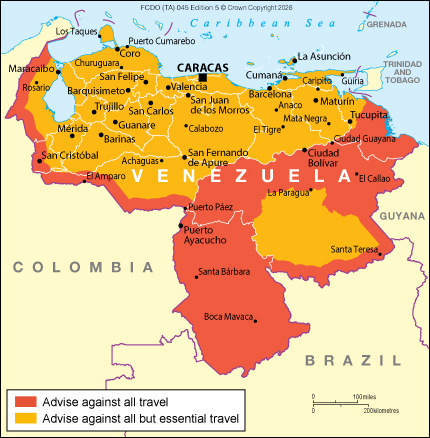
At least one official reading covers the whole country; 5 regions are also named, fully or partly.
Faithful summary of the official texts below, which prevail.
Global Affairs Canada — advises against all travel to the whole country.
France Diplomatie — rates the rest of the country “advised against except for imperative reasons”.
an official reading covers the whole country; every trip calls for a written management decision, justified by a pressing reason, with reinforced conditions.
Foreign Office
FCDO advises against all travel to Amazonas state.
Foreign Office
FCDO advises against all travel to the Orinoco Mining Arc (‘Arco Minero’) region to the south of the Orinoco river. This includes:
Foreign Office
FCDO advises against all travel to the area to the south of the Orinoco river.
Foreign Office
the northern part of Sucre Municipality, from the Orinoco river to 80km south of the Troncal 19 road
Foreign Office
The FCDO advises against all but essential travel to the remaining areas of Venezuela including Zulia state, Maracaibo and the eastern shore of Lake Maracaibo.
Foreign Office — Advised against — all travel
within 40km (25 miles) of the border with Colombia
Foreign Office — Advised against — all travel
within 40km (25 miles) of the border with Brazil
Foreign Office — Advised against — all travel
within 40km (25 miles) of the border with Guyana
France Diplomatie (in French) — Advised against — all travel
Zones frontalières — Les zones frontalières avec la Colombie, le Brésil et le Guyana sont formellement déconseillées en raison de la présence de groupes armés et de bandes criminelles dédiées à divers trafics.
France Diplomatie (in French) — Advised against — all travel
Zones frontalières — Au vu de la situation prévalant dans ces zones, il est formellement déconseillé d’entrer au Vénézuéla par voie terrestre.
France Diplomatie (in French) — Advised against — all but essential travel
Caracas et aéroport de Maiquietía — La majorité des crimes sont commis dans les « barrios » (bidonvilles locaux disséminés dans la ville). Il est particulièrement recommandé d’éviter les quartiers populaires situés à l’ouest et au sud du centre historique (Catia, 23 de Enero, El Paraíso, Cota 905, La Vega, Antímano, San Agustín, etc.) ainsi que la zone de Pe
Global Affairs Canada — Open Government Licence – Canada (13.10.2026) · Foreign Office — Open Government Licence v3.0 · France Diplomatie (13.03.2026) · Natural Earth
No located event in this reading.
Earthquakes near coast of Venezuela On 24 June, Venezuela suffered two earthquakes of 7.2 and 7.5 magnitude, causing significant damage in La Guaira, parts of Caracas and elsewhere. A significant humanitarian response is currently taking place. If in Venezuela, follow the advice of local authorities and stay away from damaged buildings.
Last change: FCDO now advises against all travel to Amazonas state and to within 40km (25 miles) of the border with Colombia. FCDO continues to advise against all travel to the Orinoco Mining Arc (‘Arco Minero’) region to the south of the Orinoco river,
Updated 26.06.2026
Reconsider travel to Venezuela due to risk of crime , kidnapping , terrorism , and poor health infrastructure and natural disaster . Some areas have increased risk. Read the entire Travel Advisory.
On June 24, 2026, Venezuela experienced a powerful foreshock and earthquake in rapid succession. These caused extensive damage and disruption to transportation, infrastructure, and emergency services.
The Consular Section at the U.S. Embassy in Caracas is currently providing emergency services only to U.S. citizens.
In March 2026, the U.S. Embassy in Caracas resumed operations, including the provision of limited consular services for U.S. citizens in Venezuela.
Conditions in some parts of Venezuela remain dangerous. Violent crimes such as homicide, armed robbery, and kidnapping occur.
There is risk of terrorist violence, including terrorist attacks and other activity in Venezuela. Visit the U.S. Department of State’s Country Reports on Terrorism to learn more.
Venezuela’s healthcare system is in a state…
Venezuela: Earthquakes - Jun 2026ReliefWeb ↗read 01.11.20262026-06-25
Venezuela: Floods and Landslides - Jun 2025ReliefWeb ↗read 01.11.20262025-07-10
Source: ReliefWeb (OCHA), via HDX — CC BY
11-01 0.2 · 11-02 0.1 · 11-03 0.1 · 11-04 0.1 · 11-05 0.2 · 11-06 0.4 · 11-07 0.3 m³/s
Simulated discharge: Open-Meteo.com (CC BY 4.0), data rounded and formatted by Maximum. Contains modified Copernicus Emergency Management Service information 2026. For information only: this is not a flood warning; only national or regional authorities issue those.
The level is national. Risk areas are in the state advisories below.
No major event in progress is located in this country at this morning's check.
Reading: The homicide rate is 21 times Switzerland's: violence is a real risk there, concentrated in the areas named by the official advisories. On the road, 18 times more deaths than in Switzerland: road crashes are the leading cause of death of healthy travellers (CDC) — seat belt, no night driving, a driver or a taxi from a rank.
World Bank (UNODC for homicides, WHO for roads) — latest published valuedata.worldbank.org ↗read 31.10.2026
What we locate on the map are events in progress that have real coordinates: USGS earthquakes, GDACS disasters, NOAA storms and open NASA EONET events. Hover a dot for details, click to open it in this briefing.
French passport — France Diplomatie
Faithful summary of the official texts below, which prevail.
Some areas of the country are formally advised against.France Diplomatie ↗updated 15.09.2026 · read 31.10.2026
Vigilance areas — France Diplomatie (in French) updated 13.03.2026official map ↗updated 15.09.2026 · read 31.10.2026
-
-
-
-
-
-
-
-
-
-
-
Le Vénézuéla connaît une criminalité violente endémique et fait partie des pays ayant les plus forts taux d’homicides au monde. Les conditions de sécurité y sont structurellement dégradées. Les infrastructures de santé publiques sont fortement déficientes (cf. onglet Santé). En-dehors de Caracas, les pénuries d’essence, les coupures d’eau et d’électricité sont fréquentes et l’accès aux réseaux de télécommunication peut être aléatoire.
Les voyageurs sont invités à communiquer à intervalles réguliers avec leur famille et à signaler à l’ambassade toute agression, extorsion ou arrestation en appelant le 0212.909.65.00 ou le 0424.211.44.51 (en semaine) ou le 0414.320.85.81 (le week-end et les jours fériés). Depuis la France, le premier 0 doit être remplacé par +58.
Dernière actualisation le 13/03/2026, information toujours valable à la date du jour
Les zones frontalières avec la Colombie, le Brésil et le Guyana sont formellement déconseillées en raison de la présence de groupes armés et de bandes criminelles dédiées à divers trafics.
Au vu de la situation prévalant dans ces zones, il est formellement déconseillé d’entrer au Vénézuéla par voie terrestre. En outre, l’entrée par les points de passage illégaux (trochas) expose les voyageurs au risque d’arrestation et de détention.
Cette zone fait l’objet d’une criminalité de plus en plus importante liée à divers trafics, aggravée par la présence de groupes armés.
Dans la zone côtière de l’État de Sucre, plusieurs groupes criminels liés au narcotrafic sont très actifs, les règlements de comptes sont fréquents ainsi que les enlèvements et les vols à main armée.
Le golfe de Paria et la zone entre la Péninsule de Paria et l’île Margarita sont dangereux avec de nombreux cas de piraterie recensés (attaque d’embarcations).
Cette péninsule est sujette à des actes de banditisme et à des trafics de stupéfiants du fait de la proximité avec les îles d’Aruba, de Bonaire et de Curaçao.
La majorité des crimes sont commis dans les « barrios » (bidonvilles locaux disséminés dans la ville). Il est particulièrement recommandé d’éviter les quartiers populaires situés à l’ouest et au sud du centre historique (Catia, 23 de Enero, El Paraíso, Cota 905, La Vega, Antímano, San Agustín, etc.) ainsi que la zone de Petare à l’est de l’agglomération – et de privilégier les hébergements dans la zone centre-est (municipalité de Chacao et quartiers de Sebucan, Los Chorros, Las Mercedes et El Cafetal). Il convient toutefois de garder à l’esprit qu’aucun quartier n’est épargné par les risques de violences.
Les déplacements de nuit entre l’aéroport international de Maiquetía et Caracas sont formellement déconseillés. La prudence est de mise à l’intérieur et aux abords des terminaux. Des agressions et des vols y ont été enregistrés. Pour passer du terminal international au terminal national, il est recommandé de privilégier le passage souterrain.
Des recommandations similaires à celles décrites pour Caracas s’appliquent dans toutes les grandes villes vénézuéliennes. Aucune zone du pays n’est exempte de délinquance.
Les sites les plus touristiques (île Margarita, parc Morrocoy, Choroní, Colonia Tovar, Lechería, parc Canaima, etc.) présentent généralement des niveaux de sécurité adéquats dès lors qu’un certain nombre de précautions sont prises. Il est ainsi recommandé :
Les îles Los Roques sont accessibles par avion ou par voie maritime moyennant une traversée relativement longue. Il est conseillé de se conformer aux recommandations générales de sécurité de la présente fiche.
Si la pratique des enlèvements dans les espaces publics a diminué, le risque existe toujours. Les vols peuvent être particulièrement violents. Il est vivement conseillé de ne pas opposer de résistance.
De manière générale, il est recommandé de privilégier les déplacements en voiture individuelle ou en taxi (uniquement taxis officiels ou voitures réservées via des applications) de jour et de circuler avec les portes verrouillées et les vitres fermées. Les transports en commun, les déplacements à pied et les trajets de nuit sont à éviter. Il n’est pas recommandé de garer son véhicule dans un endroit non-sécurisé ou isolé.
Dans l’espace public, il est conseillé de montrer le moins possible de signes extérieurs de richesse (bijoux, montre, téléphone portable, etc.), de limiter la quantité d’argent liquide transportée sur soi et de ne se déplacer qu’avec une photocopie de son document d’identité (en gardant l’original en lieu sûr chez soi ou à l’hôtel).
En cas de sortie dans un bar ou dans une boîte de nuit, il est conseillé de surveiller son verre et de prendre garde à l’usage délictueux de la scopolamine, drogue qui, mélangée à une boisson, des aliments, ou inhalée (par exemple sur un mouchoir) cause une perte de volonté, de conscience, et une amnésie temporaire.
Les voyageurs sont invités à prendre garde lors des contrôles par les forces de sécurité et à contacter immédiatement l’ambassade en cas d’arrestation. Plusieurs cas d’extorsion par de faux policiers ou par des agents corrompus ont été rapportés au cours des dernières années.
Hormis les recommandations ci-dessus, la plus grande prudence est de mise sur la route en raison de la fréquence des accidents et de l’état des axes routiers (nids de poule, ralentisseurs peu visibles, absence de feux rouges, etc.). Le port de la ceinture de sécurité est très fortement recommandé et la conduite de nuit doit être évitée, a fortiori en-dehors des villes. Si vous devez conduire de nuit, il faut être particulièrement attentif aux croisements, les feux rouges n’étant plus respectés à partir de 21h.
Si vous êtes impliqué dans un accident de la route (auteur ou victime), vous devez impérativement contacter et attendre la police sans déplacer le véhicule. Seule la police peut établir un constat.
Il est recommandé de se tenir à l’écart de toute manifestation et d’éviter toute expression sur la situation politique du pays en public.
Les conditions d’entrée des journalistes et des travailleurs du secteur humanitaire sur le territoire vénézuélien sont spécifiques, quelle que soit la durée du séjour. Il est recommandé de contacter l’ambassade au préalable.
Les cartes de crédit européennes fonctionnent dans de nombreux commerces mais elles peuvent être déclinées voire bloquées de manière aléatoire. Le retrait d’espèces au distributeur n’est pas possible. Pour parer à tout inconvénient, il est recommandé de se munir, en vue de tout voyage au Venezuela, de dollars américains en espèces, de préférence en petites coupures et en quantité suffisante.
Il est d’usage pour les commerçants de demander le code de la carte bleue à voix haute. Il est recommandé de demander à composer soi-même son code pour éviter les fraudes et à ne jamais quitter votre carte des yeux.
Une très grande partie du territoire vénézuélien, y compris Caracas, se trouve en zone de risque sismique. Le dernier grand tremblement de terre à Caracas remonte à 1967.
Durant la saison des pluies (de juin à novembre), le nord du Vénézuéla, notamment ses côtes et ses îles, sont régulièrement affectées par les queues des ouragans (« ondas tropicales ») qui traversent le sud de la mer des Caraïbes et dont la fréquence et l’intensité sont amenées à augmenter avec le réchauffement climatique. Les inondations, coulées de boue et glissements de terrain sont fréquents, notamment sur la côte centrale, l’axe Caracas-Maracay et la région des Llanos où les routes peuvent être impraticables. En cas de déplacement dans des zones présentant des risques naturels, respecter les recommandations d’usage.
La prudence est recommandée lors des baignades en mer, notamment en cas de fortes vagues.
Full text of the Security pagediplomatie.gouv.fr ↗updated 15.09.2026 · read 31.10.2026
Swiss passport — FDFA (Switzerland), in French
Faithful summary of the official texts below, which prevail.
FDFA update note — Le chapitre Derniers développements a été actualisé (séismes). Toujours valable : Les voyages touristiques à destination du Venezuela et tout autre voyage qui ne présente pas un caractère d'urgence sont déconseillés. Il est de manière générale déconseillé de se rendre dans certaines parties du pays. (published 17.07.2026)
Les voyages touristiques à destination du Venezuela et tout autre voyage qui ne présente pas un caractère d'urgence sont déconseillés. Il est de manière générale déconseillé de se rendre dans certaines parties du pays. Voir le chapitre Risques régionaux spécifiques. Avec l'opération militaire du 3 janvier 2026 un gouvernement de transition a été installé. Les tensions politiques sont élevées et l'évolution de la situation reste incertaine. Des manifestations avec des affrontements violents sont possibles. Des violences liées à des tensions politiques ont fait des victimes et des blessés par le passé. Des dégâts matériels et des pillages peuvent également avoir lieu. Les médias sociaux peuvent être temporairement bloqués. Il existe le risque que les voyageurs étrangers soient arrêtés, interrogés et détenus . Le taux de criminalité et la propension à la violence sont élevés. L'approvisionnement en carburant, en eau et en électricité est perturbé. Les pénuries de biens de première nécessité et de médicaments peuvent également persister pendant de longues périodes, en particulier dans les zones rurales. Dans l’éventualité de troubles, barrages routiers, grèves et pénuries, il est conseillé aux personnes en voyage de se renseigner sur place sur les autres possibilités de déplacement et, le cas échéant, d’attendre que la situation se normalise. Selon la situation, il est très difficile à l’Ambassade de Suisse à Caracas – voire impossible – d’aider les personnes suisses à quitter des régions concernées. Dans ce pays comme ailleurs, le risque d’attentats terroristes ne peut être exclu. La rubrique terrorisme et enlèvements attire l'attention sur les risques liés au terrorisme. Terrorisme et enlèvements Avant et pendant le voyage, informez-vous sur l'évolution de la situation à travers des médias, par le biais de votre tour-opérateur ou auprès des autorités locales, si vous devez vous rendre au Venezuela pour des motifs urgents. Conformez-vous aux directives des autorités locales (p. ex. couvre-feux) et tenez-vous à l'écart des manifestations et rassemblements de foule de tout genre.
La description des zones à risques repose sur des données approximatives; les risques ne peuvent se restreindre à des zones délimitées. Région frontalière avec la Colombie Il est déconseillé de se rendre dans les zones frontalières avec la Colombie, qui sont à éviter largement. La criminalité organisée et les activités transfrontalières de la guérilla colombienne et d’autres organisations armées illégales ont des répercussions sur la situation sécuritaire prévalant le long de la frontière. Il existe un risque accru d’infractions violentes et d’enlèvements. Des affrontements violents entre les forces gouvernementales et des groupes armés ont lieu. Des personnes non impliquées peuvent également en être affectées. Des fermetures de frontières sont possibles à court terme. Région frontalière avec le Brésil Il est déconseillé de se rendre dans les zones frontalières avec le Brésil, qui sont à éviter largement. Les gangs criminels sont actifs au-delà des frontières. Il existe un risque accru d’être victime d’une attaque ou d’agissements criminels. Des fermetures de frontières sont possibles à court terme. Région de l’arc minier de l’Orénoque (nord-est de l’État de Bolívar, nord-est de l’État d’Amazonas et certaines parties de l’État de Delta Amacuro) Il est déconseillé de se rendre dans la région de l’arc minier de l’Orénoque. La présence de groupements armés qui exploitent des mines illégales augmente le risque d’être victime d’un acte de violence. Nord et est de l’État de Sucre, y compris la péninsule de Paria Il est déconseillé de se rendre dans le nord et l’est de l’État de Sucre et dans la péninsule de Paria. Des trafiquants de drogue et d’autres bandes criminelles sont actifs dans cette région. Le risque d’être victime d’un acte de violence est élevé.
Le taux de criminalité est élevé . La possession et l’utilisation d’ armes à feu sont très courantes, et les criminels en font usage. Il existe un risque que les affrontements entre les forces de l'ordre et les groupes criminels fassent des victimes collatérales. Les vols à la tire et à l’arraché sont fréquents. Les actes de violence sont également nombreux: enlèvements contre rançon, vols de voitures sous la menace d’une arme, agressions à main armée, délits sexuels et meurtres. Les personnes victimes d’ enlèvements express sont contraintes d’effectuer des achats par carte de crédit ou des transactions financières. Des affaires pénales impliquant des membres de la police ont été signalées. Sur les routes , les attaques sont souvent commises par des criminels à moto. Ces attaques ont lieu dans les villes comme sur les routes interurbaines, et visent autant les occupants des voitures particulières que les passagers des bus. Le risque d’agression concerne aussi bien les personnes voyageant seules que celles faisant partie d’un groupe. Il est notamment recommandé d’observer les mesures de précaution suivantes:
Les îles et les régions côtières peuvent être sujettes aux ouragans. Il faut également s’attendre à de fortes pluies qui peuvent provoquer des inondations, des glissements de terrain et causer des dommages aux infrastructures. Le trafic touristique peut s’en trouver perturbé temporairement. Consultez les prévisions météorologiques et suivez les avertissements et les instructions des autorités locales. World Meteorological Organization (WMO) La partie nord-est du pays, Caracas y compris, se trouve dans une zone d’activité sismique. Outre les dévastations causées sur la terre ferme, les tremblements de terre et les éruptions volcaniques aux Caraïbes peuvent aussi provoquer des tsunamis. Fundación Venezolana de investigaciones sismológicas (Funvisis) National weather service - Caribbean Tsunami Warning Program (CTWP) National Oceanic and Atmosphere Administration (NOAA) – U.S. Tsunami Warning System Si une catastrophe naturelle devait se produire durant votre séjour, prenez immédiatement contact avec vos proches et suivez les instructions des autorités. En cas d’interruption des communications avec l’étranger, vous pouvez vous mettre en liaison avec l’Ambassade de Suisse à Caracas.
FDFA travel advice, in French, valid on 31.10.2026eda.admin.ch ↗updated 17.07.2026 · read 31.10.2026
British passport — Foreign Office (UK)
Faithful summary of the official texts below, which prevail.
Regions covered by the Foreign Officegov.uk ↗updated 14.10.2026 · read 31.10.2026

Warnings — Foreign OfficeForeign Office ↗updated 14.10.2026 · read 31.10.2026
Your travel insurance could be invalidated if you travel against advice from the Foreign, Commonwealth & Development Office (FCDO).
FCDO advises against all travel to:
FCDO advises against all travel to Amazonas state.
FCDO advises against all travel to the Orinoco Mining Arc (‘Arco Minero’) region to the south of the Orinoco river. This includes:
FCDO advises against all travel to the area to the south of the Orinoco river.
The FCDO advises against all but essential travel to the remaining areas of Venezuela including Zulia state, Maracaibo and the eastern shore of Lake Maracaibo.
If you are a British national already living or travelling in Venezuela, you should be prepared to change your plans quickly if necessary. You should have a ‘personal emergency plan’, including practical steps for leaving the country or staying safe during a crisis, that does not depend on support from the UK government.
Before you travel, check the ‘Entry requirements’ section for Venezuela’s current entry restrictions and requirements. These may change with little warning. Monitor local media and stay in contact with your travel provider.
On 24 June, Venezuela suffered two earthquakes of 7.2 and 7.5 magnitude, causing significant damage in La Guaira, parts of Caracas and elsewhere.
A significant humanitarian response is currently taking place. If in Venezuela, follow the advice of local authorities and stay away from damaged buildings.
Availability of commercial flights to and from Venezuela is limited. Maiquetía Simón Bolívar International Airport, which serves Caracas, resumed commercial flight operations on 1 September with limited capacity.
Commercial international flights are also operating from Valencia (Arturo Michelena International Airport), Barquisimeto (Jacinto Lara International Airport), Barcelona (General José Antonio Anzoátegui International Airport) and Maracaibo (La Chinita International Airport). Stay in contact with your airline or travel agent/tour operator for the latest travel information and flight updates.
If you are affected and need assistance from the UK government, call:
Be aware of the possibility of earthquake aftershocks. See further information about earthquakes .
Regional risks — Foreign OfficeForeign Office ↗updated 14.10.2026 · read 31.10.2026
This section has safety advice for regions of Venezuela. It only covers regions where Foreign, Commonwealth & Development Office ( FCDO ) has specific advice.
You should also read FCDO ’s overall travel advice and safety and security advice .
Drug traffickers and illegal armed groups are active along the border areas with Colombia, Brazil and Guyana.
Avoid crossing between Venezuela and Colombia by land.
Crossing the border from Brazil can be a lengthy process.
There is no official land border crossing between Venezuela and Guyana, which is covered by dense jungle. Avoid crossing between Venezuela and Guyana by land.
FCDO advises against all travel to the Orinoco Mining Arc (‘Arco Minero’) region to the south of the Orinoco river. This includes:
Illegal armed groups are active in the ‘Arco Minero’ and involved in criminal activities, particularly in remote areas.
FCDO advises against all travel to the area to the south of the Orinoco river, where drug traffickers and illegal armed groups are active.
FCDO advises against all travel to Zulia state due to the presence of illegal armed groups and ongoing crime and violence.
Almost all states outside Caracas are experiencing issues, including criminality, prolonged power cuts, water and fuel shortages and a general lack of essential services.
Safety — Foreign OfficeForeign Office ↗updated 14.10.2026 · read 31.10.2026
This guide also has safety advice for regions of Venezuela .
There is a high threat of terrorist attack globally affecting UK interests and British nationals, including from groups and individuals who view the UK and British nationals as targets. Stay aware of your surroundings at all times.
UK Counter Terrorism Policing has information and advice on staying safe and what to do in the event of a terrorist attack. Find out how to reduce your risk from terrorism while abroad .
Terrorist attacks in Venezuela cannot be ruled out.
On 15 September, the UK upgraded diplomatic relations with Venezuela. Although the security situation has improved in recent years and many visits take place without incident, political, economic and operational conditions remain uncertain and can change rapidly. Consular access and support to British nationals in Venezuela may be severely limited. If you choose to travel to Venezuela, monitor developments closely through local and international media and keep up to date with this travel advice.
Flights can be delayed or cancelled at short notice. Keep in close contact with your airline or travel agent to see if your flight is affected. Some foreign nationals have reported extensive questioning by the authorities on arrival or departure. This can result in delays and, in some cases, may affect onward travel arrangements.
Following the earthquakes of 24 June, La Guaira was declared a disaster zone and remains subject to enhanced security and access controls. There is also a visible security presence in major cities, including Caracas, and security checkpoints are common throughout the country. Foreign nationals may be asked to provide identification or explain the purpose of their visit. British nationals should always carry identification and ensure that travel documentation is in order. Members of the security services are unlikely to speak English.
Public services including healthcare and security, and the supply of electricity, water and fuel can be severely limited, particularly outside of Caracas. Prolonged power cuts can affect living conditions and cut mobile networks and internet.
Demonstrations and gatherings can turn violent and could be dispersed by the use of force, including with the use of rubber bullets and tear gas. Avoid political rallies, demonstrations and crowds, and do not cross security-force lines or barricades.
Armed robbery, mugging, carjacking and burglary are common in parts of Venezuela and can be accompanied by extreme violence. Do not resist an attacker. Remain alert and avoid displaying electronics or valuables while on the street or in a vehicle. Avoid public transport. A number of robberies, including at gunpoint, have taken place on public transport.
Use pre-booked taxis only. Hotels will normally book a taxi from a reputable company or supply their own service.
In many rural areas, the authority of the Venezuelan state is limited, and the British Embassy’s ability to help British nationals in trouble in these areas will also be limited. Mobile and internet connection in rural areas is often limited.
Illegal armed groups and criminal gangs are active in states along Venezuela’s borders and where illegal mining or drugs trafficking is common. The risk is particularly significant in:
- Zulia, Tachira and Apure states
- the Orinoco Mining Arc area of Amazonas, Bolívar and Delta Amacuro states, including the…
American passport — U.S. Department of State
Faithful summary of the official texts below, which prevail.
Venezuela - Level 3: Reconsider Travel 2026-06-26travel.state.gov ↗updated 26.06.2026 · read 01.11.2026
Reconsider travel to Venezuela due to risk of crime , kidnapping , terrorism , and poor health infrastructure and natural disaster . Some areas have increased risk. Read the entire Travel Advisory.
On June 24, 2026, Venezuela experienced a powerful foreshock and earthquake in rapid succession. These caused extensive damage and disruption to transportation, infrastructure, and emergency services.
The Consular Section at the U.S. Embassy in Caracas is currently providing emergency services only to U.S. citizens.
In March 2026, the U.S. Embassy in Caracas resumed operations, including the provision of limited consular services for U.S. citizens in Venezuela.
Conditions in some parts of Venezuela remain dangerous. Violent crimes such as homicide, armed robbery, and kidnapping occur.
There is risk of terrorist violence, including terrorist attacks and other activity in Venezuela. Visit the U.S. Department of State’s Country Reports on Terrorism to learn more.
Venezuela’s healthcare system is in a state…
Global Affairs Canada — additional reading
Avoid all travel
Avoid all travel to Venezuela due to the heightened security situation, unstable political and economic situations, significant level of violent crime, the risk of arbitrary detention, and the decline in basic living conditions, including shortages of medication, gasoline and water.
Open Government Licence – Canada · October 13, 2026 15:19 EDTtravel.gc.ca ↗updated 13.10.2026 · read 01.11.2026
Faithful summary of the official texts below, which prevail.
Global Affairs Canada — written for Canadian travellers, valid for all
You must abide by local laws. Learn about what you should do and how we can help if you are arrested or detained abroad.
Penalties for possession, use or trafficking of illegal drugs are severe. Convicted offenders can expect immediate detention and lengthy jail terms. All departing visitors are thoroughly screened for drugs by the Bolivarian National Guard. Pack your luggage yourself and keep it with you at all times. Don’t carry anything through customs for anyone else. Drugs, alcohol and travel
You must carry your passport at all times.
Photography of sensitive installations, including the presidential palace, military sites, government buildings and airports, is prohibited.
You must declare imports worth more than US$1,000 to customs officials and pay appropriate taxes.
The Hague Convention on the Civil Aspects of International Child Abduction is an international treaty. It can help parents with the return of children who have been removed to or retained in certain countries in violation of custody rights. The convention applies between Canada and Venezuela. If your child was wrongfully taken to, or is being held in Venezuela, and if the applicable conditions are met, you may apply for the return of your child to the Venezuelan court. If you are in this situation:
If your child was removed from a country other than Canada, consult a lawyer to determine if The Hague Convention applies. Be aware that Canadian consular officials cannot interfere in private legal matters or in another country's judicial affairs.
Stopping at Bolivarian National Guard of Venezuela and police checkpoints is mandatory. There are many control points throughout the country. Follow all instructions and have vehicle and insurance papers and passports readily available. Vehicles may be searched. It is not uncommon for authorities to seek bribes. In the case of an accident, don’t move your vehicle until a traffic police officer fills out a report. Police response times are often slow. You should carry an international driving permit. International Driving Permit
The currency in Venezuela is the Venezuelan bolivar (Bs or VEF). It can be difficult to obtain local currency. US dollars are widely accepted. Carry small bank notes to facilitate daily transactions. You must change money at the official government rate. Banks often restrict transactions to their clients only. Official exchange houses are scarce outside of major cities and the law prohibits the sale and purchase of any foreign currency outside of authorized institutions. You are subject to a fine if you are caught exchanging foreign currency outside of authorized institutions. Very few exchange houses or banks will exchange bolívars outside Venezuela. You cannot rely on wire transfers as a source of emergency funds. Cash withdrawals from foreign bank accounts at ATMs are not possible. Malfunctions and insufficient cash are recurring problems. Many ATMs don’t accept international credit cards or ask for additional codes to confirm identity.
Identification is required for a credit card transaction. If you are entering or leaving Venezuela with more than US$10,000, you are required to declare it to the authorities.
Open Government Licence – Canada · October 13, 2026 15:19 EDTtravel.gc.ca ↗updated 13.10.2026 · read 01.11.2026
Foreign Office — laws and cultural differences
Always carry identification with you. You can carry copies of the photo page of your passport and your entry stamp. Keep your passport in a safe place where you can access it quickly if you need to. Local security forces may ask you to show ID at any time, particularly at police checkpoints. If you cannot produce it, you could be arrested and detained pending an investigation.
Drug trafficking is a serious crime in Venezuela. Detection methods are sophisticated, and drug traffickers should expect to be arrested. Conviction leads to a lengthy prison sentence of between 8 and 15 years. Conditions in Venezuelan jails are harsh, dangerous, and among the worst in the region.
It is illegal to photograph military or strategic installations, including military airports and the presidential palace. Avoid plane spotting.
Internet service is generally slow outside of major cities. Mobile network operators run modern 4G (LTE) networks in most major cities, while they also operate slower legacy 3G (WCDMA) networks for their nationwide voice and data services. In Venezuela, power outages are frequent and can occur without warning, often due to infrastructure challenges and weather conditions. These can be both localised and nationwide, and may vary in duration. Power cuts can affect mobile signals and internet across the whole country, including Caracas. Keep in contact with your airline or travel agent as flights can be delayed or cancelled when there are power cuts.
Same-sex relationships are not illegal. However, showing affection in public will most likely be frowned on by locals and may receive negative attention from the police and other security forces. Venezuelan law does not recognise same-sex partnerships, so same-sex partners have no rights as next of kin. Read more advice for LGBT+ travellers.
The age of consent in Venezuela is 18 and sex with anyone 17 and under is illegal. Offenders face long jail sentences.
Open Government Licence v3.0gov.uk ↗updated 14.10.2026 · read 31.10.2026
FDFA (Switzerland) — laws and customs, in French
Il est interdit de photographier les bâtiments officiels (aéroport militaire, palais présidentiel, etc.). L’argent ne doit être changé que dans les banques et les bureaux de change officiels. Les conceptions juridiques et les sanctions pénales peuvent s'écarter considérablement des normes suisses. Les infractions peuvent être passibles de fortes amendes ainsi que de peines de prison de plusieurs années. Il existe toutefois quelques incertitudes jurisprudentielles, par exemple en ce qui concerne l’application des dispositions en matière d’interdiction des cigarettes électroniques. Les infractions à la loi sur les stupéfiants sont punies de lourdes peines de prison. Les contrôles effectués à cet égard sont très sévères. La personne soupçonnée de transporter de la drogue à l’intérieur de son corps peut être soumise à un contrôle radiographique. Procédures de poursuite judiciaire ou d’enquête policière: Il faut s’attendre à de longs délais d’attente et tenir compte des us et coutumes locaux . Les services d’un avocat local bien choisi ou d’une avocate locale bien choisie sont dans ces cas absolument nécessaires. En cas de doute, une personne de nationalité étrangère ne peut pas quitter le pays pendant l'enquête/l'instruction. Les conditions de détention sont très précaires: cellules surpeuplées, mauvais traitements, mauvaise alimentation, eau non potable, hygiène défectueuse, risque de contamination par la tuberculose, violence entre les personnes détenues, etc.
FDFA travel advice, in Frencheda.admin.ch ↗updated 17.07.2026 · read 31.10.2026
What it changes for you: Air acceptable at this hour: nothing special to plan. Very high UV: sunscreen, hat and shade between 11 am and 4 pm; sunstroke and dehydration are travellers' first reasons to see a doctor.
Reading 09:00 (America/Caracas)Open-Meteo ↗updated 01.11.2026 · read 01.11.2026
Air quality and UV: Open-Meteo.com (CC BY 4.0), data rounded and formatted by Maximum. Contains modified Copernicus Atmosphere Monitoring Service information 2026. Neither the European Commission nor ECMWF is responsible for any use that may be made of the Copernicus information or data it contains.
Reading: With 1.7 physicians per 1,000 people (62% fewer than Switzerland), the nearest hospital does not always have the capacity for a serious case: evacuation to an adequate centre is the rule, not the exception — that is what unlimited evacuation and repatriation cover. Health spending of 186 USD per person (Switzerland: 11,784) goes with private hospitals that bill foreigners in hard currency and ask for a guarantee before admission: the direct payment guarantee is what avoids the deposit.
World Bank — latest published value, year per indicatordata.worldbank.org ↗read 31.10.2026
French passport — France Diplomatie
Faithful summary of the official texts below, which prevail.
-
-
-
-
-
-
-
-
-
-
-
Tout voyageur souhaitant se rendre au Vénézuéla dans le cadre d’un séjour touristique n’excédant pas 90 jours doit être muni d’un passeport en cours de validité. Celui-ci devra avoir une durée de validité de plus de 6 mois à partir de la date d’entrée sur le territoire vénézuélien.
S’il désire se maintenir sur le sol vénézuélien au-delà de cette période , et pour le même motif touristique , il devra solliciter une autorisation auprès du Servicio Administrativo de Identificación, Migración y Extranjería (SAIME) afin de séjourner pour une seule nouvelle et même durée maximum de 90 jours. Passées ces 2 périodes de 90 jours, il devra quitter le territoire vénézuélien.
Conformément aux dispositions de la législation locale (Conseil national des droits de l’enfant et de l’adolescent), tout déplacement à l’intérieur ou à l’extérieur du territoire vénézuélien d’un mineur isolé ou accompagné d’un seul des deux parents, quel que soit le moyen de locomotion (bus, avion, etc.), est préalablement assujetti à la délivrance d’une autorisation parentale. Les autorités vénézuéliennes exigent un « pouvoir » pris auprès d’une officine notariale vénézuélienne. Le parent accompagnateur et l’enfant doivent donc être en mesure de présenter ce document en cas de contrôle.
Les autorités locales exigent de toute personne de nationalité vénézuélienne, même si elle possède une autre nationalité, qu’elle présente un passeport vénézuélien en cours de validité pour sortir du pays. Les personnes concernées doivent donc prendre leurs dispositions en amont de leur voyage afin d’éviter de ne plus pouvoir ressortir du Vénézuéla.
Les personnes possédant la…
Toutes les mesures de restrictions sanitaires pour l’entrée sur le territoire ont été levées. Pour plus d’informations, le voyageur est invité à consulter régulièrement le site de l’Ambassade de France à Caracas .
La production d’un certificat de vaccination contre la fièvre jaune est exigée des voyageurs en provenance de Guyane française.
Entry and stay pagediplomatie.gouv.fr ↗updated 15.09.2026 · read 31.10.2026
Swiss passport — FDFA (Switzerland)
The FDFA does not publish entry requirements: they are set out by the destination's embassy or consulate in Switzerland — check them before booking, passport in hand. As a guide, the French and British requirements below describe the same rules as seen by two other governments.eda.admin.ch ↗updated 17.07.2026 · read 31.10.2026
British passport — Foreign Office (UK)
Faithful summary of the official texts below, which prevail.
Entry requirements — rules for a British passportForeign Office ↗updated 14.10.2026 · read 31.10.2026
This information is for people travelling on a full ‘British citizen’ passport from the UK. It is based on the UK government’s understanding of Venezuela’s current rules for the most common types of travel.
The authorities in Venezuela set and enforce entry rules. If you’re not sure how these requirements apply to you, contact the Venezuelan Embassy in the UK (in Spanish).
To enter Venezuela, your passport must have an ‘expiry date’ at least 6 months after the date you plan to leave.
Check with your travel provider that your passport and other travel documents meet requirements. Renew your passport if you need to.
You will be denied entry if you do not have a travel document or try to use a passport that has been reported lost or stolen.
If you’re a resident in Venezuela, both your passport and resident visa or permit must be valid at the time of your arrival.
If you arrive by air, you can stay for up to 90 days visa-free on a ‘tourist card’, issued on arrival. You must show your return or onward travel ticket.
If you’re arriving overland or by sea, you may need to get a visa in advance. Contact the nearest Venezuelan embassy or consulate for advice.
You can apply for an extension of up to 90 days before your tourist card and entry stamp expire. Apply and pay the fee at any SAIME (immigration service) office (in Spanish). If you live in Venezuela, you must apply at the main regional SAIME office of the state where you are living.
If you overstay your allowed time, you may be arrested and fined when trying to leave Venezuela.
If you aren’t visiting for tourism, you must get a visa before travelling to Venezuela. It must be related to the purpose and duration of your stay. This includes visits related to work of any nature, whether paid or unpaid, including for:
You will also need a visa if you are coming to Venezuela to study or for an internship.
Contact the nearest Venezuelan embassy or consulate for information on how to obtain a visa.
If you’re a Venezuelan dual national, you must use your Venezuelan identity documents for entry and departure of the country. The authorities may not allow you to depart Venezuela if you are not in possession of a valid Venezuelan passport, as required by law.
Children travelling unaccompanied, with a guardian, or with one parent, must provide a travel permit from the non-travelling parent(s). This permit is available from the nearest local SAREN (Servicio Autónomo de Registros y Notarías) office, or the respective Court for Children and Adolescents.
If the child is resident overseas, you can get the permit from the nearest Venezuelan embassy or consulate .
The child should carry this travel permit while travelling within the country and also at time of departure from Venezuela. Children may be denied exit from the country otherwise.
To enter Venezuela from Brazil, you must have a certificate to prove you’ve had a yellow fever vaccination.
For full details about…
American passport — U.S. Department of State
The State Department publishes the requirements ("Entry, Exit and Visa Requirements") on its country page, which our servers cannot read. Read it before you go; as a guide, the French and British requirements below describe the same rules as seen by two other governments.travel.state.gov ↗updated 26.06.2026 · read 01.11.2026
For each risk, the official texts themselves: what is happening, then, where they say so, what to do.
What the texts say · Armed robbery, mugging, carjacking and burglary are common in parts of Venezuela and can be accompanied by extreme violence. Authorities (e.g. police, airport, immigration) have harassed and extorted money from travellers.
What the texts say · You are at most risk when travelling to and from the airport at night. There are regular police and National Guard checkpoints throughout the country.
What the texts say · The hurricane season runs from June to November and affects parts of northern Venezuela. On 24 June, Venezuela suffered two earthquakes of 7.2 and 7.5 magnitude, causing significant damage in La Guaira, parts of Caracas and elsewhere.
What the texts say · Drug trafficking is a serious crime in Venezuela. It is illegal to photograph military or strategic installations, including military airports and the presidential palace.
What the texts say · Credit card and ATM fraud may occur. In Venezuela, power outages are frequent and can occur without warning, often due to infrastructure challenges and weather conditions.
What the texts say · Demonstrations and gatherings can turn violent and could be dispersed by the use of force, including with the use of rubber bullets and tear gas. The current situation in Venezuela is tense and could escalate quickly.
Sentences copied word for word from the official texts cited, chosen for the destination; the level is our reading. The full texts, at each source:Foreign Office ↗updated 14.10.2026 · read 31.10.2026 (updated 14.10.2026 · read 29.10.2026)Global Affairs Canada ↗updated 13.10.2026 · read 01.11.2026 (updated 13.10.2026 · read 29.10.2026)
Reading: The homicide rate is 21 times Switzerland's: violence is a real risk there, concentrated in the areas named by the official advisories. On the road, 18 times more deaths than in Switzerland: road crashes are the leading cause of death of healthy travellers (CDC) — seat belt, no night driving, a driver or a taxi from a rank.
World Bank (UNODC for homicides, WHO for roads) — latest published valuedata.worldbank.org ↗read 31.10.2026
Time zone: IANA and timezone-boundary-builder (ODbL) · RESTCountries · EmergencyNumberAPI · Wikidata · European Central Bank
Places: © OpenStreetMap contributors (ODbL), Photon search by komoot.
FDFA (Switzerland) — transport and specific advice, in French
Les routes interurbaines sont partiellement en mauvais état. La conduite dangereuse constitue un risque d’accident considérable. Évitez de rouler de nuit sur les routes interurbaines. La police effectue des contrôles d’identité à de nombreux checkpoints. Il est arrivé que des membres des forces de sécurité exigent des paiements injustifiés. Transports publics: l’entretien des moyens de transports publics (métros, bus) et des cars est déficient et le risque d’agression ou de vol est élevé. Il est déconseillé d’utiliser les métros, les bus et les cars. Des pannes techniques provoquées par des infrastructures vétustes et mal entretenues affectent régulièrement les transports aériens et maritimes. Les accidents ne peuvent pas être exclus. Il faut s’attendre à des coupures parfois longues d’eau et d’électricité dans tout le pays. En dehors de Caracas, l'approvisionnement en carburant n'est pas garanti. Les liaisons téléphoniques et Internet peuvent être temporairement bloqués. Entre le Venezuela et le Guyana, des conflits frontaliers irrésolus subsistent. Il arrive que les points de passage des frontières soient temporairement fermés à court terme. Renseignez-vous avant de franchir la frontière (par voie terrestre ou fluviale) auprès des autorités compétentes ou directement auprès du poste-frontière sur les dispositions et les heures d'ouverture en vigueur.
En raison d'une inflation très élevée, il est presque impossible de recevoir de la monnaie nationale (bolivar digital). La plupart des paiements se font donc en espèces avec des dollars américains ou par carte de crédit. Il n'est pas possible de retirer de l'argent en espèces avec des cartes de crédit ou des cartes bancaires étrangères. Il est avantageux de se munir de suffisamment d'argent en espèces en petites coupures de dollars américains, car il n'y a souvent pas de change.
FDFA travel advice, in Frencheda.admin.ch ↗updated 17.07.2026 · read 31.10.2026
Maximum policyholder: before paying anything, call the 24/7 number. If you are admitted for more than 24 h, Maximum sends its direct payment guarantee to the hospital (art. 2.12).
+41 22 ••• •• •• — Full number in your client areaThe hospital list has not been read from OpenStreetMap for this page yet: the medical-network map loads it when opened. Maximum's assistance directs you to the right facility, 24/7. The medical-network map ↗
CDC Travelers' Health recommendations, most important first. They depend on your age, vaccines and itinerary: confirm them with a doctor or a travel clinic 4 to 6 weeks before departure. Details, disease by disease ↗cdc.gov ↗read 30.10.2026
The health system — With 1.7 physicians per 1,000 people (62% fewer than Switzerland), the nearest hospital does not always have the capacity for a serious case: evacuation to an adequate centre is the rule, not the exception — that is what unlimited evacuation and repatriation cover. Health spending of 186 USD per person (Switzerland: 11,784) goes with private hospitals that bill foreigners in hard currency and ask for a guarantee before admission: the direct payment guarantee is what avoids the deposit.
Back home — a fever in the following weeks should be told to a doctor, naming the country.
Forecast: MET Norway (Norwegian Meteorological Institute, CC BY 4.0), grouped by day and formatted by Maximum.
French passport — French embassy and consulates
Madrid, 1060, Caracas
OpenStreetMap
Swiss passport — Swiss embassy and consulates
Avenida El Samán, 1060, Caracas
+58 212 2679585
https://www.eda.admin.ch/caracas ↗updated 17.07.2026 · read 31.10.2026
Avenida Eugenio Mendoza, 1060, Caracas
+58 212 267 95 85
https://www.eda.admin.ch/caracas ↗updated 17.07.2026 · read 31.10.2026
Numéros d'urgence généraux: 911 ou 171 (selon la région) Représentations suisses à l’étranger: En cas de situation d’urgence à l’étranger, vous pouvez vous adresser à la Représentation Suisse la plus proche ou à la Helpline DFAE. Ambassade de Suisse au Venezuela Helpline DFAE Représentations étrangères en Suisse: Pour obtenir des informations sur les prescriptions d'entrée (documents d'identité admis, visa, etc.), veuillez vous adresser aux ambassades et consulats étrangers compétents. Ceux-ci peuvent également vous renseigner sur les dispositions douanières pour l'importation et l'exportation d'animaux et de marchandises: appareils électroniques, souvenirs, médicaments, etc. Représentations étrangères en Suisse
OpenStreetMap · DFAE
British passport — British embassy and consulates
Avenida Principal de La Castellana, 1060, Caracas
phone not published
https://www.gov.uk/government/world/venezu ↗updated 14.10.2026 · read 31.10.2026
OpenStreetMap
American passport — U.S. embassy and consulates
Suapure, 1080, Caracas
phone not published
OpenStreetMap
OpenStreetMap
Getting help — Foreign OfficeForeign Office ↗updated 14.10.2026 · read 31.10.2026
The Foreign, Commonwealth & Development Office ( FCDO ) cannot provide tailored advice for individual trips. Read this travel advice and carry out your own research before deciding whether to travel.
Telephone: 911 (ambulance, fire, police)
Contact your travel provider and your insurer if you are involved in a serious incident or emergency abroad. They will tell you if they can help and what you need to do.
See how to get help from the UK government abroad including in an emergency.
You can call FCDO in London if you need urgent help because something has happened to a friend or relative abroad.
Telephone: 020 7008 5000 (24 hours)
Find out about call charges
For emergencies. If pronunciation fails, show the screen — or the printed page.
| Help! | ¡Ayuda! |
| Call an ambulance! | ¡Llame a una ambulancia! |
| I need a doctor. | Necesito un médico. |
| Where is the nearest hospital? | ¿Dónde está el hospital más cercano? |
| Call the police! | ¡Llame a la policía! |
| I am allergic to penicillin. | Soy alérgico (alérgica) a la penicilina. |
| I have international medical insurance. | Tengo un seguro médico internacional. |
| I want to contact my embassy. | Quiero ponerme en contacto con mi embajada. |
| Please take me to this address. | Lléveme a esta dirección, por favor. |
| Do you speak English? | ¿Habla inglés? |
Translations by Maximum Insurance, original script and transliteration.
Actions to take before each professional trip abroad.
Live alerts and level changes, each with its official source. Continuously updated.
En raison de contrôles d’identité réguliers dans le pays, il est indispensable d’être toujours muni d’une copie de son passeport, lequel doit permettre d’attester la régularité de son séjour sur le territoire vénézuélien. Il est en outre fortement recommandé aux Français de passage de pouvoir présenter une pièce justificative de leur lieu d’hébergement. Il convient par ailleurs de se tenir éloigné de toute manifestation ou rassemblement à caractère politique et de se tenir…
France Diplomatie (in French) · posted 15 September 2026diplomatie.gouv.fr ↗updated 15.09.2026 · read 31.10.2026Natural disasters and climate section – added information on El Niño
October 13, 2026 15:19 EDTtravel.gc.ca ↗updated 13.10.2026 · read 01.11.2026No level change recorded for this country since the log opened. The live alerts above are updated continuously.
Level 3/4 — Reconsider Travel, U.S. Department of State, retrieved on 1 November 2026.
Sourcestravel.state.gov · updated 26.06 · read 01.11France Diplomatie · updated 15.09 · read 31.10DFAE · updated 17.07 · read 31.10207-country comparison
An area advised against does not rule out the country.
SourcesFrance Diplomatie · updated 15.09 · read 31.10Foreign Office · updated 14.10 · read 31.10State Department · updated 26.06 · read 01.11
The rules depend on the passport, not on the destination alone.
SourcesFrance Diplomatie · updated 15.09 · read 31.10Foreign Office · updated 14.10 · read 31.10State Department · updated 26.06 · read 01.11
For a Schengen visa, yes: at least €30,000 of travel medical insurance (Regulation (EC) No 810/2009, art. 15).
SourcesRegulation (EC) 810/2009, art. 15General conditions, policy 20 00 479
VIP Pack — €990 for twelve months, unlimited trips.
SourcesGeneral conditions, policy 20 00 479OpenStreetMap · read 31.10
From 23 000 € to 200 000 € depending on severity and distance (Vemedic (aéro-ambulances), 2026).
SourcesVemedic (aéro-ambulances), 2026General conditions, policy 20 00 479
Six steps, in this order.
SourcesSpecial conditions 01.26General conditions, policy 20 00 479
Local emergency services: single number 911 · police 171 · ambulance 171 · fire 171
SourcesEmergencyNumberAPI · Wikidata · read 22.10OpenStreetMap · read 31.10
At today's level 3/4, card by card:
SourcesAmex Platinum France T&Cs, 01.2025 — general exclusion n° 11BNP Paribas Visa Infinite notice (policy PT7), 04.2025 — comFortuneo World Elite Mastercard notice, 01.2026 — art. 5.5 '
A health plan reimburses at home; here, the hospital asks for a payment guarantee before admission.
SourcesGeneral conditions, policy 20 00 479
The page reads hospitals, pharmacies and doctors from OpenStreetMap, around the point you choose.
The sourced detail is under Medical network › Health: vaccines, diseases present, altitude, outbreaks.
SourcesCDC Travelers' Health · read 30.10France Diplomatie · updated 15.09 · read 31.10OMS · read 31.10Foreign Office · updated 14.10 · read 31.10
1.7 physicians per 1,000 people (2017) versus 4.5 in Switzerland.
SourcesWorld Bank · read 31.10General conditions, policy 20 00 479
12.7 homicides per 100,000 people (2022) versus 0.6 in Switzerland and 1.3 in France.
The nearest representations, by passport (OpenStreetMap):
SourcesOpenStreetMap · read 31.10DFAE · updated 17.07 · read 31.10
At least one official reading covers the whole country; 5 regions are also named, fully or partly.
SourcesGlobal Affairs Canada · updated 13.10 · read 01.11Foreign Office · updated 14.10 · read 31.10France Diplomatie · updated 15.09 · read 31.10
Local laws apply to every traveller; here is what the official texts say.
SourcesGlobal Affairs Canada · updated 13.10 · read 01.11Foreign Office · updated 14.10 · read 31.10
Every foreign ministry runs a 24/7 emergency line for its nationals.
Sourcesdiplomatie.gouv.fr · updated 15.09 · read 31.10eda.admin.ch · updated 17.07 · read 31.10
Emergency phrases, to show if pronunciation fails:
SourcesMaximum Insurance
Keep the entry stamp, the invoices, the prescriptions and the medical report.
SourcesGeneral conditions, policy 20 00 479
Cancellation or change up to USD 20,000, special risk USD 5,000 per person, crisis management and security, optional Kidnap & Ransom.
SourcesGeneral conditions, policy 20 00 479
A question not answered here? Ask Maximum below, or call the support number: every question gets a clear, actionable answer.
In a life-threatening emergency, call local emergency services first, then Maximum: +41 22 ••• •• •• — 24/7 support number, an adviser stays with you to the end.
The 207 country pages — hospitals, pharmacies, police, embassies, emergency numbers, official advice from four governments, health, safety in figures, events in progress — read around the city you name. Your policy — benefits, the six steps, claims, articles. The site — prices, certificate, subscription. Nothing else: what it does not know, it says so and hands you to an adviser.
Same advisory level: Guyana · Honduras · Israel · Jordan · Kenya · Kuwait
The displayed level comes from the State Department, checked every morning. Before departure, always cross-check your country of residence's advisory: that is what your policy cites.
The level shown is the official U.S. Department of State level, checked daily. Maximum Insurance is an insurance distributor — general information, not personal advice.
The destination is already Caracas. A few choices, then the reading of your cover, here.
Destination · Caracas
Travel Insurtech. 24/7 worldwide.
Swiss insurer · Worldwide medical network