Make sure you are up-to-date on all routine vaccines before every trip. Some of these vaccines include Chickenpox (Varicella) Diphtheria-Tetanus-Pertussis (DTaP, Tdap, or Td) Flu (influenza) Measles-Mumps-Rubella (MMR) Polio Shingles
Maximum Alerts / Israel
Level published by the State Department on 25.08.2026 · read 11 October 2026 · source checked daily
Israel — official level as of 11 October 2026: Level 3/4 ("Reconsider Travel"), from the U.S. Department of State. Maximum Insurance covers this country: hospital settled directly, unlimited repatriation, USD 1.5M, certificate on payment.
One source could not be read: the cell says so — that is not an answer.
Every country has its own scale, so we ask them all the same question: is the whole country advised against?
An advisory covering only areas of the country does not raise the answer: it stays “No”, and the area is shown in the relevant column.
The level shown on this page — and across this site — is the one published by the U.S. State Department, from 1 (normal precautions) to 4 (do not travel). France and the United Kingdom publish their own advisories, with their own rules: they add to that level, they do not replace it.
You will be alerted only on the day the official level of this country changes.
120 recorded incidents (UCDP)hover, click to open it in the briefing
In a life-threatening emergency, call local emergency services first, then Maximum: +41 22 ••• •• •• — 24/7 support number, an adviser stays with you to the end.
The 207 country pages — hospitals, pharmacies, police, embassies, emergency numbers, official advice from four governments, health, safety in figures, events in progress — read around the city you name. Your policy — benefits, the six steps, claims, articles. The site — prices, certificate, subscription. Nothing else: what it does not know, it says so and hands you to an adviser.
What I say on the phone
What to do, in this order
In immediate danger, call local emergency services first. Then contact assistance without delay; before engaging a service, seek approval under your policy. Cover is confirmed by the insurer.
Ask assistance where to get care and whether direct cover can be arranged. It confirms the facility and seeks the insurer's approval under your policy. In immediate danger, call local emergency services first.
Even for a pain you meant to shrug off. Without a medical certificate written on the spot, the same day, the insurer cannot cover the event — a certificate written after you return does not count.
The hospital desk sends the request to assistance. Direct payment depends on the insurer's approval and the policy; the call alone does not guarantee it. Have the response confirmed before relying on no up-front payment.
In a life-threatening emergency, call local emergency services immediately. For an arranged transfer or repatriation, contact assistance: the insurer's medical team decides on measures under the policy. A medical flight booked without approval may not be reimbursed.
Even if everything went well on the ground. Send your invoices and the medical report within 30 days; after that, compensation may be reduced or refused.
Reading hospitals, doctors and pharmacies around this point…
List read from OpenStreetMap on 01.10.2026, not read again since: these facilities may have changed.
Country dial code: +972
OpenStreetMap list read on 01.10.2026, straight-line distances. In an emergency: +41 22 ••• •• ••.
60 דיסקין
dermatology
near אבו תור
near וואדי הילווה
near מונבז
near וואדי הילווה
2nd floor
near شارع السلطان سليمان
near מעלות עיר דוד
near شارع السلطان سليمان
near צאלח א-דין
near צאלח א-דין
near יריחו
28 הרב זוננפלד
near ארבל
near הארון אל-רשיד
near الصويح
near שרי ישראל
near איבן חלדון
near איבן חלדון
near איבן חלדון
near יריחו
near הפלמ"ח
near עמק רפאים
Su-Th 08:30-22:30; Fr 08:00-16:00
near המלך ג׳ורג׳
near ההסתדרות
near יהודה בורלא
near הרברט סמואל
near דניאל ינובסקי
near מיוחס
27 סולטן סולימאן Jerusalem
08:00-20:00
near הארון אל-רשיד
near צאלח א-דין
near שכם
near אביזוהר
near יריחו
near הארזים
near אבו רביע
near ראבעה אל-עדוויה
near الخلة
5 פארן ירושלים
near AlRass
3 אורוגואי ירושלים
near AlRass
near شارع المدارس
near משאריף
44 שועפט Jerusalem
طريق بيت حنينا القدس
near طريق أريحا
near شارع المهد
near شارع المهد
near شارع الكركفة
near شارع بيت جالا
near Virgin Mary Street
near Anata
near شارع القديسة ماري الفونسين غطاس
near ז'בוטינסקי
Jerusalem
Jerusalem
Jerusalem
11 קרן היסוד Jerusalem
Jerusalem
Jerusalem
11-19 הפטריארכיה הלטינית Jerusalem
Mo-Fr 08:30-16:30
46 שבטי ישראל Jerusalem
near על"ר
14 דוד פלוסר ירושלים
Mo-Fr 08:00-17:00
2 האור ירושלים
near Alshaikh Sa'd
near طريق أريحا
near Albayada
near شارع الجامعة
near Bedouin
near شارع المدارس
Jerusalem
Western Wall Plaza Jerusalem
24/7
near מעלות המדרשה
near התנופה
near ענטרה בן שדאד
near צאלח א-דין
near מעלה הזיתים
near מקדם לעיל
near משעול העיט הזהוב
شارع البلدية بيت ساحور
near طريق تراسنطة
near כיכר מורטון ל' מנדל
near יצחק מודעי
near ממילא
near نابلس
near شارع السلطان سليمان
near המרפא
near אגרון
near ההסתדרות
near הרב קוק
near צאלח א-דין
near شارع عمر بن العاص
near Jericho
Forecast: MET Norway (Norwegian Meteorological Institute, CC BY 4.0), grouped by day and formatted by Maximum.
10-11 0.1 · 10-12 0.1 · 10-13 0.1 · 10-14 0.1 · 10-15 0.1 · 10-16 0.1 · 10-17 0.1 m³/s
Simulated discharge: Open-Meteo.com (CC BY 4.0), data rounded and formatted by Maximum. Contains modified Copernicus Emergency Management Service information 2026. For information only: this is not a flood warning; only national or regional authorities issue those.
No geolocated event in this country at this reading.
120 incidents recorded in the country, all pinned on the map above (zoom out) — the 40 closest to Jerusalem are listed here, nearest first.
Source: UCDP — GEDEvent_v26_01_26_06.csv. Closed period, Clear coding, precise location.
No news located around Jerusalem in this reading.
Make sure you are up-to-date on all routine vaccines before every trip. Some of these vaccines include Chickenpox (Varicella) Diphtheria-Tetanus-Pertussis (DTaP, Tdap, or Td) Flu (influenza) Measles-Mumps-Rubella (MMR) Polio Shingles
All eligible travelers should be up to date with their COVID-19 vaccines. Please see Your COVID-19 Vaccination for more information.
Recommended for unvaccinated travelers one year old or older going to Israel, the West Bank and Gaza. Infants 6 to 11 months old should also be vaccinated against Hepatitis A. The dose does not count toward the routine 2-dose series. Travelers allergic to a vaccine component should receive a single dose of immune globulin, which provides effective protection for up to 2 months depending on dosage given.
Recommended for unvaccinated travelers younger than 60 years old traveling to Israel, the West Bank and Gaza. Unvaccinated travelers 60 years and older may get vaccinated before traveling to Israel, the West Bank and Gaza.
Cases of measles are on the rise worldwide. Travelers are at risk of measles if they have not been fully vaccinated at least two weeks prior to departure, or have not had measles in the past, and travel internationally to areas where measles is spreading.
Monkeypox vaccination is recommended for any adult who anticipates any of the following activities during travel: Sexual or intimate contact with a new partner Sexual or intimate contact at a commercial sex venue, like a sex club or bathhouse Sexual or intimate contact in exchange for money, goods, drugs, or other trade Sexual or intimate contact in association with a large public event, such as a rave, party, or…
In Israel, the West Bank and Gaza, poliovirus has been identified in the past year. Travelers to Israel, the West Bank and Gaza are at increased risk of exposure to poliovirus.
Dogs infected with rabies are commonly found in Israel, the West Bank and Gaza. Rabies is also present in some terrestrial wildlife species. If rabies exposures occur while in Israel, the West Bank and Gaza, rabies vaccines are typically available throughout most of the country.
Recommended for travelers to the West Bank and Gaza. Other travelers are likely at low risk of getting typhoid fever. Typhoid vaccine is not 100% effective. Practicing safe food and water habits , including washing hands at key times , also can help prevent typhoid fever .
CDC recommendations: Vaccine is not recommended. Country entry requirements: Vaccine is not required. Updated April 23, 2025
CDC Travelers' Health, re-read weekly — the recommendation depends on your age, vaccines and itinerary: confirm it with a doctor or a travel clinic 4 to 6 weeks before departure.CDC ↗read 10.10.2026
Low incidence, comparable to Europe.
High coverage.
World Bank — latest published valuedata.worldbank.org ↗read 10.10.2026
Source: France Diplomatie (health advice, in French).
Faithful summary of the official texts below, which prevail.
WHO — outbreaks reported for this country (last 24 months)
FDFA (Switzerland) — medical care, in French
Les soins médicaux sont assurés. En général, la plupart des hôpitaux exigent un paiement d’avance pour les personnes qui ne résident pas en Israël. Si vous prenez régulièrement des médicaments, emportez-en une quantité suffisante avec vous. Notez toutefois que de nombreux pays appliquent des réglementations restrictives. Cela vaut en particulier, mais pas exclusivement, pour les médicaments contenant des stupéfiants (par exemple la méthadone) et les substances utilisées pour le traitement des troubles psychiques. Avant votre départ, renseignez-vous directement auprès de la représentation étrangère compétente (ambassade ou consulat) et consultez la rubrique Liens voyages, où vous trouverez de plus amples informations sur ce sujet ainsi que sur la médecine du voyage en général. Les informations concernant la propagation de maladies et les éventuelles mesures de protection à prendre sont fournies par le personnel médical et les centres de vaccination. Liens voyages
Health — Foreign OfficeForeign Office ↗updated 22.07.2026 · read 11.10.2026
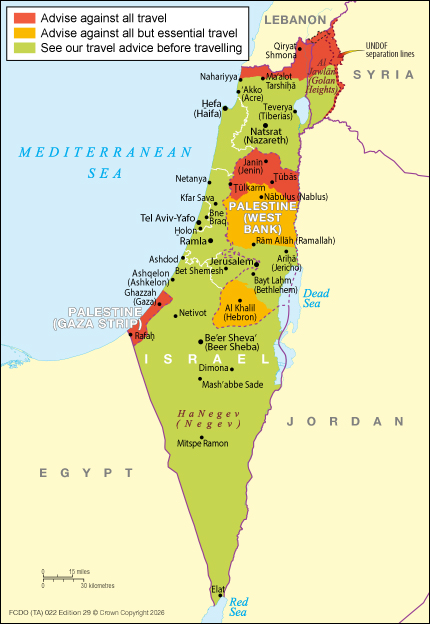
This travel advice covers Israel and Palestine.
Before you travel check that:
This is particularly important if you have a health condition or are pregnant.
For an ambulance dial:
Contact your insurance company quickly if you’re referred to a medical facility for treatment.
At least 8 weeks before your trip:
See what health risks you’ll face in Israel and Palestine .
The legal status and regulation of some medicines prescribed or bought in the UK can be different in other countries.
Read best practice when travelling with medicines on TravelHealthPro .
Healthcare in Israel and Palestine is not free and medical treatment can be expensive. Hospitals will insist on payment and may take legal action to stop you leaving until bills are paid. Make sure you have adequate travel health insurance and accessible funds to cover the cost of any medical treatment and repatriation.
FCDO has lists of medical providers in Israel and medical providers in Palestine where some staff will speak English.
There is also guidance on healthcare if you’re living in Israel and Palestine .
Read FCDO guidance on travel and mental health . There is also mental health guidance on TravelHealthPro .
Places read from OpenStreetMap, within a circle of about 12 km: phone, email, address, website and hours when the source publishes them. No customer reviews, that source has none. Straight-line distances.
Notices vary by bank and vintage — yours prevails. On the right: the Maximum contract (public documents).
At least one official reading covers the whole country; 1 region is also named, fully or partly.
Faithful summary of the official texts below, which prevail.
Global Affairs Canada — advises against all but essential travel to the whole country.
an official reading covers the whole country; every trip calls for a written management decision, justified by a pressing reason, with reinforced conditions. The areas quoted without a region (border, routes, localities) call for the same decision.
Global Affairs Canada
Avoid non-essential travel to Jerusalem due to the volatile security situation in the region.
France Diplomatie (in French)
Jérusalem — La zone est déconseillée sauf raison impérative.
Global Affairs Canada — Advised against — all travel
Avoid all travel to Palestine. This advisory excludes the following roads, where you should avoid non-essential travel: Highway 1; Route 90, from the intersection with Highway 1 to King Hussein Bridge (Allenby), near Jericho
Global Affairs Canada — Advised against — all travel
Avoid all travel to the parts of the Golan Heights that border Syria, east of Highway 98, due to military activity.
Global Affairs Canada — Advised against — all travel
Avoid all travel to the area within 5 kilometres of the border with Lebanon due to ongoing military operations.
Global Affairs Canada — Advised against — all travel
Avoid all travel to the area within 10km of the border with the Gaza Strip due to the risk of rocket and mortar fire, gunfire and military activity.
Foreign Office — Advised against — all travel
FCDO advises against all travel to Gaza
Foreign Office — Advised against — all travel
FCDO advises against all travel within 500m of the border with Gaza
Foreign Office — Advised against — all travel
Tulkarm Governorate, Jenin Governorate, and Tubas Governorate except Route 90
Foreign Office — Advised against — all travel
Areas north of Route 89 between Nahariyya and Dalton; north of a straight eastward line from Dalton to Route 91; and north of Route 91 across the Golan Heights, excluding routes 89 and 91 themselves
Foreign Office — Advised against — all travel
Within 500m of the Area of Separation in the occupied Golan Heights (the ‘Alpha line’). Do not attempt to enter the occupied Golan Heights through Syria
Foreign Office — Advised against — all travel
Sheba’a Farms and Ghajja
Foreign Office — Advised against — all but essential travel
The rest of the West Bank, except for: East Jerusalem, Bethlehem Governate, Ramallah Municipality, Jericho municipality and all areas which lie south of it (this includes the Allenby crossing). Highway 1 that links Jerusalem and Tel Aviv and the areas that lie to the south and west of the Highway (this includes Highway 3), and Route 443 and Highway 45 which
France Diplomatie (in French) — Advised against — all travel
Israël — Il est donc formellement déconseillé de se rendre sur le plateau du Golan et le long de la frontière avec le Liban.
France Diplomatie (in French) — Advised against — all travel
Israël — Il est formellement déconseillé de se rendre dans la zone située autour de la bande de Gaza, des tirs de roquette se produisant régulièrement.
France Diplomatie (in French) — Advised against — all travel
Palestine — Il demeure formellement déconseillé aux ressortissants français de se rendre dans la Bande de Gaza.
France Diplomatie (in French) — Advised against — all but essential travel
Palestine — Les déplacements en Cisjordanie sont déconseillés, sauf raison impérative, compte tenu de la situation sécuritaire depuis le 7 octobre 2023.
Global Affairs Canada — Open Government Licence – Canada (24.09.2026) · Foreign Office — Open Government Licence v3.0 · France Diplomatie (13.03.2026) · Natural Earth
No located event in this reading.
Last change: Updated information about regional tensions, including information about recent strikes and retaliatory attacks by Iran ('Warnings insurance') page.
Updated 25.08.2026
Reissued Statement
There were no changes to the Travel Advisory Level. The health risk indicator was added for Gaza. Advisory summary was updated to reflect that family members may travel to Israel.
Reconsider Travel to Israel due to terrorism and unrest . Some areas have increased risk. Read the entire Travel Advisory.
Advisory summary
As of August 26, 2026, family members may join U.S. government employees who work in Israel.
U.S. government employee travel restrictions
U.S. government employees working in Israel are restricted from the following locations due to safety risks:
Any official travel of U.S. government personnel within these areas requires approval from the U.S. embassy’s security office.
Additional movement restrictions may be imposed on U.S. government employees working in Israel, with little to no notice, due to increased security issues or threats.
Terrorism
There is risk of terrorist violence, including terrorist attacks and other activity in Israel. Visit the U.S. Department of State's country reports on terrorism to learn more.
Unrest
The security environment in Israel is complex and can change quickly. Violence can occur without warning. Increased regional tensions can cause airlines to cancel or limit flights into and out of Israel.
Risks in specific areas
Level 4 – Do Not Travel
Areas north of Route 85 to Route 90 (south) to Route 87
Do Not Travel to areas north of Route 85 to Route 90 (south) to Route 87 due to armed conflict.
The Israeli authorities restrict travel to areas north of Route 85 to Route 90 (south) to Route 87 due to Israeli Defense Forces presence and activity. Do not travel to this area for any reason.
U.S. government employees working in Israel are not…
10-11 0.1 · 10-12 0.1 · 10-13 0.1 · 10-14 0.1 · 10-15 0.1 · 10-16 0.1 · 10-17 0.1 m³/s
Simulated discharge: Open-Meteo.com (CC BY 4.0), data rounded and formatted by Maximum. Contains modified Copernicus Emergency Management Service information 2026. For information only: this is not a flood warning; only national or regional authorities issue those.
The level is national. Risk areas are in the state advisories below.
No major event in progress is located in this country at this morning's check.
Over 1 January 2026 → 30 June 2026, UCDP (Uppsala University) recorded 392 geolocated violent incidents in this country, for 740 documented deaths.
Most affected areas
Gaza Strip 347 · West Bank 31 · Central district 3 · Southern district 3 · Haifa district 3 · Tel Aviv district 3
Most recent incidents
Source: UCDP Georeferenced Event Dataset (Uppsala Conflict Data Program), file GEDEvent_v26_01_26_06.csv, CC BY 4.0 licence. We keep only incidents UCDP codes as "Clear" and whose location is precise enough to be placed — about 58% of the dataset. An incident may be revised, moved or withdrawn by UCDP in a later release: these figures describe a closed period, not a live situation.
Reading: The homicide rate is above Switzerland's, without being out of range. On the road, a level close to Switzerland's; road crashes are the leading cause of death of healthy travellers (CDC) — seat belt, no night driving, a driver or a taxi from a rank.
World Bank (UNODC for homicides, WHO for roads) — latest published valuedata.worldbank.org ↗read 10.10.2026
What we locate on the map are events in progress that have real coordinates: USGS earthquakes, GDACS disasters, NOAA storms and open NASA EONET events. Hover a dot for details, click to open it in this briefing.
French passport — France Diplomatie
Faithful summary of the official texts below, which prevail.
déconseillé aux ressortissants français, sauf pour des raisons impératives, de se rendre en Israël.France Diplomatie ↗updated 15.09.2026 · read 11.10.2026
Vigilance areas — France Diplomatie (in French) updated 13.03.2026official map ↗updated 15.09.2026 · read 11.10.2026
- Présentation
- Présentation d'Israël
- Présentation de la Palestine
-
-
-
-
-
-
-
-
-
- Israël - politique et économie
- Palestine - politique et économie
-
- Israël - relations bilatérales
- Palestine - relations bilatérales
Dernière actualisation le 13/03/2026, information toujours valable à la date du jour
Il demeure déconseillé aux ressortissants français, sauf pour des raisons impératives, de se rendre en Israël. Il est en outre formellement déconseillé aux voyageurs de se rendre dans les régions suivantes :
Des tirs de roquettes ou des attaques de drones en provenance du Liban et de Syrie peuvent atteindre le nord d’Israël et le plateau du Golan (territoire occupé et annexé par Israël). Il est donc formellement déconseillé de se rendre sur le plateau du Golan et le long de la frontière avec le Liban.
Il est formellement déconseillé de se rendre dans la zone située autour de la bande de Gaza, des tirs de roquette se produisant régulièrement.
Les déplacements en Cisjordanie sont déconseillés, sauf raison impérative, compte tenu de la situation sécuritaire depuis le 7 octobre 2023. C’est en particulier le cas dans le Nord de la Cisjordanie, où les camps de réfugiés et les grandes villes (Jénine, Tulkarem notamment) font l’objet d’opérations militaires continues.
De très nombreux checkpoints israéliens, qui font l’objet de contrôles parfois durs, sont mis en place à travers la Cisjordanie, en particulier aux abords de toutes les grandes villes. La circulation est donc rendue très difficile. En outre, des groupes de colons violents attaquent régulièrement les véhicules en circulation sur les routes de Cisjordanie.
Pour tout déplacement en Cisjordanie, il est recommandé de : • se tenir informé de l’actualité avant chaque déplacement, dans la mesure où la situation peut rapidement évoluer ; • éviter les rassemblements et rester vigilant dans les lieux publics ; • se signaler sur l’application Fil d’Ariane et au Consulat général de France à Jérusalem .
Dans ce contexte, les ressortissants français doivent être conscients qu’ils s’exposent, dans ce climat de très forte insécurité, à des risques particulièrement élevés. Des affrontements de grande ampleur ne sont pas à exclure.
Il demeure formellement déconseillé aux ressortissants français de se rendre dans la Bande de Gaza.
Depuis octobre 2023 une guerre de haute intensité se déroule dans la bande de Gaza, où la situation humanitaire est catastrophique. Toute personne s’y trouvant, quelle que soit sa nationalité ou la raison de sa présence, est exposée à un risque considérable. Tous les points d’accès sont actuellement fermés, empêchant toute possibilité de secours ou d’évacuation.
La zone est déconseillée sauf raison impérative.
Dans la Vieille ville et dans certains autres quartiers de Jérusalem-Est (At-Tour, Ras al-Amoud, Jabal al-Mukaber, Issawiya, Silwan), des tensions et incidents sont récurrents.
Dans ces circonstances, les déploiements policiers deviennent rapidement importants et les accès à la Vieille ville peuvent être fermés. Lors des visites de la Vieille ville, il convient d’éviter les regroupements et de faire preuve d’une vigilance particulière, en particulier les jeudi, vendredi et samedi en fin de journée. Ces moments consacrés à la prière occasionnent une plus forte fréquentation de la Vieille ville aux abords des Lieux saints.
Il convient enfin de faire preuve de discrétion et de prudence dans l’usage des appareils photographiques, notamment lors de déplacements dans les quartiers juifs ultra-orthodoxes de la ville. Une tenue adaptée est également recommandée, notamment pour les femmes (manches longues, pas de vêtements moulants), dans ces quartiers.
Durant le Shabbat (du vendredi en fin d’après-midi au samedi soir), les véhicules ne peuvent pas circuler dans les quartiers ultra-orthodoxes.
Il demeure déconseillé aux ressortissants français, sauf raison impérative, de se rendre en Israël et en Cisjordanie, y compris pour des visites touristiques et familiales. Il est recommandé aux ressortissants français qui y sont actuellement présents de faire preuve de la plus grande vigilance et prudence et de se tenir absolument à l’écart de toute manifestation ou rassemblement.
Cette recommandation s’applique également pour Jérusalem.
Il demeure formellement déconseillé aux ressortissants français de se rendre dans la Bande de Gaza.
En raison du conflit israélo-palestinien et du contexte régional, il est recommandé de suivre l’actualité, avant et pendant le voyage.
Des tirs de missiles et des drones atteignent très régulièrement l’ensemble du territoire et notamment la région de Tel Aviv.
Le risque d’attentats est élevé : des attaques à l’arme blanche, à l’arme à feu et à la voiture bélier se sont récemment produites en Israël, à Jérusalem et en Cisjordanie.
Dans ce contexte, les voyageurs sont invités à faire preuve de vigilance dans les lieux publics et dans les transports en commun.
Il convient de suivre les consignes de sécurité des autorités israéliennes et palestiniennes par région sur le site du Home Front Command (accessible seulement en Israël ou par VPN) et de la Défense civile palestinienne ( www.pcd.ps et الدفاع المدني الفلسطيني Facebook ).
Il convient également de se tenir informé de la situation sur les sites internet du Consulat général de France à Tel Aviv et du Consulat général de France à Jérusalem .
Le risque sismique est élevé dans toute la région, Israël, Jérusalem et la Palestine étant situés sur une ligne de fracture géologique majeure. Bien que la région n’ait pas connu de tremblement de terre de forte magnitude depuis 1927, la survenue d’un puissant séisme ou d’un tsunami est possible.
Plus d’informations sur la conduite à tenir :
et sur :
Sur la côte méditerranéenne, des courants forts et des vents violents peuvent s’avérer dangereux pour les baigneurs. Il est recommandé de privilégier les zones surveillées et de faire preuve de grande prudence en cas de baignade non surveillée.
Des vols peuvent avoir lieu sur les plages. Il convient de ne pas laisser ses effets personnels sans surveillance.
En raison des fortes chaleurs au printemps et à l’été, les cas de déshydratation sont fréquents. Il convient de prévoir suffisamment d’eau et de suivre la situation météorologique. Les randonnées en groupe sont à privilégier. Des altercations, voire des agressions, peuvent survenir à proximité de colonies israéliennes. Des cas de vols ont également été signalés.
Full text of the Security pagediplomatie.gouv.fr ↗updated 15.09.2026 · read 11.10.2026
Swiss passport — FDFA (Switzerland), in French
Faithful summary of the official texts below, which prevail.
FDFA update note — Ces conseils pour les voyages ont été révisés. Il est déconseillé de manière générale de se rendre dans certaines parties du pays. Les tensions régionales restent élevées. (published 30.09.2026)
Une attention particulière doit être accordée à la sécurité personnelle. Il est déconseillé de manière générale de se rendre dans certaines parties du pays (voir chapitre Risques régionaux spécifiques). Les tensions géopolitiques et régionales persistent et restent élevées. Les cessez-le-feu en vigueur sont fragiles. Le risque d'escalade reste élevé, tandis que l'évolution de la situation demeure incertaine.
Voir également les Risques régionaux spécifiques. En cas de nouveaux conflits régionaux majeurs, il faut s’attendre à des restrictions du trafic aérien. Des fermetures temporaires d’aéroports sont également possibles. Les postes-frontières avec l'Égypte et la Jordanie, qui sont habituellement ouverts, peuvent être fermés pendant quelques jours ou voir leurs horaires d’ouverture réduits. Des informations sont disponibles auprès des compagnies aériennes concernées, du ministère des Transports et de la Sécurité routière , des ambassades des pays concernés et des postes-frontières ( Aéroports et terminaux frontaliers en Israël ) . La situation politique est tendue . Des élections législatives devraient avoir lieu le 27 octobre 2026. À l’approche de ces élections, les tensions politiques pourraient s’intensifier. Avant, pendant et après les élections, il faut s’attendre à une recrudescence des manifestations et des protestations . Des affrontements violents avec les forces de sécurité ne peuvent être exclus. Dans tout le pays, il existe un risque accru d’attentats terroristes et d’attaques isolées. Des incidents violents tels que des agressions à l'arme blanche, des attaques au véhicule bélier, des incendies criminels, etc. ont fait des victimes et des blessés ces dernières années. Une attention particulière doit être accordée à la sécurité personnelle. Faites preuve de prudence, en particulier dans les lieux très fréquentés. Il est recommandé entre autres, de respecter tout particulièrement les mesures de précaution suivantes:
La description des zones à risques repose sur des données approximatives; les risques ne peuvent se restreindre à des zones délimitées. Vieille ville de Jérusalem (y compris Jérusalem-Est, Territoire palestinien occupé) Il existe un risque d'actes de violence. Des manifestations accompagnées de débordements violents et d'affrontements avec les forces de sécurité ont lieu, en particulier à proximité des lieux de culte. Suivez les consignes des forces de sécurité locales et évitez de vous rendre dans les lieux saints pendent les fêtes religieuses. Faites preuve de prudence . Veuillez également tenir compte des autres informations et recommandations figurant dans les conseils pour les voyages pour le Territoire palestinien occupé (bande de Gaza et la Cisjordanie occupée, y compris Jérusalem-Est ). Zones frontalières: la situation dans les zones frontalières est globalement tendue.
À proximité immédiate de la barrière de sécurité entre Israël et la Cisjordanie, des attentats et/ou des affrontements peuvent se produire. Faites preuve de prudence .
Ne vous rendez pas à proximité immédiate de la frontière. Respectez les consignes des Israeli Defence Forces et des autorités de sécurité.
Les combats se poursuivent. Le risque que les hostilités reprennent à tout moment et sans avertissement préalable persiste.
Il est déconseillé de se rendre à proximité de la zone démilitarisée surveillée par l'ONU (conformément à l'accord de désengagement de 1974 entre Israël et la Syrie) .
Champs de mines Il existe encore des champs de mines dans les zones frontalières et sur le Plateau du Golan occupé par Israël. Ils sont entourés de barrières et signalés par des pancartes. Sur le Golan et le long des frontières avec la Jordanie, l'Egypte et le Liban, ne quittez jamais les chemins balisés. Passage par la mer Rouge et le canal de Suez Dans la région de la mer Rouge et le canal de Suez, il est recommandé de faire preuve d’une vigilance accrue; voir information sous Risques maritimes et piraterie
Respectez les mesures de précaution habituelles contre la petite délinquance, notamment le vol à la tire, en particulier dans les grandes agglomérations et les sites touristiques très fréquentés.
Il existe un risque d’incendie de forêt , surtout en été et en automne. Respectez les avertissements et les consignes des autorités locales, par exemple les barrages routiers et les ordres d’évacuation. Dans le sud (dans le Néguev), des pluies soudaines et violentes sont possibles, surtout en hiver. Elles provoquent des inondations imprévues sur les routes et donnent lieu à des torrents déchaînés dans les oueds des vallées désertiques. Des tremblements de terre peuvent se produire. Dans le bassin méditerranéen, il n’est pas exclu qu’un séisme ou une éruption volcanique provoque un tsunami qui atteigne toutes les zones côtières de la Méditerranée. Si une catastrophe naturelle devait se produire durant votre séjour, prenez immédiatement contact avec vos proches et suivez les instructions des autorités locales. En cas d’interruption des communications avec l’étranger, vous pouvez vous mettre en contact avec l’Ambassade de Suisse en Israël.
FDFA travel advice, in French, valid on 11.10.2026eda.admin.ch ↗updated 30.09.2026 · read 11.10.2026
British passport — Foreign Office (UK)
Faithful summary of the official texts below, which prevail.
Regions covered by the Foreign Officegov.uk ↗updated 22.07.2026 · read 11.10.2026

Warnings — Foreign OfficeForeign Office ↗updated 22.07.2026 · read 11.10.2026
Your travel insurance could be invalidated if you travel against advice from the Foreign, Commonwealth & Development Office (FCDO).
FCDO advises against all travel to Gaza
FCDO advises against all travel within 500m of the border with Gaza
FCDO advises against all travel to:
- Areas north of Route 89 between Nahariyya and Dalton; north of a straight eastward line from Dalton to Route 91; and north of Route 91 across the Golan Heights, excluding routes 89 and 91 themselves
- Within 500m of the Area of Separation in the occupied Golan Heights (the ‘Alpha line’). Do not attempt to enter the occupied Golan Heights through Syria
- Sheba’a Farms and Ghajja
FCDO advises against all but essential travel to:
Find out more about why FCDO advises against travel .
The US and Iran announced a memorandum of understanding (MOU) on 17 June in relation to the conflict in the Middle East, however the situation in the Middle East remains unpredictable. Since 8 July there have been strikes and retaliatory attacks by Iran in a number of locations across the region against US military and civilian infrastructure. There is a risk of more attacks and unforeseen escalation in the region. Before the ceasefire, the Iranian regime had stated its intention to target locations associated with the US and Israel, including organisations, businesses, facilities, and institutions.
British nationals currently in the Middle East should be prepared for possible flight cancellations, periodic airspace closures, and potential travel disruptions, and should:
- read If you’re affected by a crisis abroad - GOV.UK . This includes guidance on “how to prepare for a crisis” with suggestions on what you might include in your emergency supplies and “what to do in a crisis”
- sign up to FCDO Travel Advice email alerts
- follow advice from the local authorities
- monitor local and international media for the latest information, including updates relating to airports and airspace which could close at short notice
- stay away from areas around security or military facilities
- keep your departure plans under review, and ensure your travel documents are up to date
- if advised to take shelter, stay indoors or find the nearest safe building or designated shelter. An interior stairwell or a room with as few external walls or windows as possible may provide additional protection. The greatest risk is from falling debris caused by intercepts, and you are safest inside a secure structure. Do not approach or touch any drone or missile fragments or unusual objects
Follow the instructions of the local authorities. If you are advised to take shelter, Israel’s Home Front Command provides guidance on how to find a protected space . The best option is a residential protected space (Mamad, Mamak or Maman) or a communal shelter. If that is not possible, choose a stairwell without windows and exterior walls and stay at its centre.
Sign up to receive information and alerts. Visit Israel’s Home Front Command .
Due to ongoing regional tensions, we recommend against all travel to some parts of Israel and Palestine.
The situation could escalate quickly and poses significant risks. Regional tensions may cause international borders (air and land) to close.
If you are in Israel and Palestine, be aware that whilst the frequency of missile and drone attacks has decreased there is a risk of rocket and drone attacks throughout Israel. There is a risk of shrapnel from intercepted missiles falling across Israel and Palestine, and possible disruption at Ben Gurion airport in Tel Aviv.
Political tension can cause demonstrations and clashes around anniversaries and significant events.
Keep up to date through local media and follow the instructions of Israeli Home Front Command. To find these:
- visit the Israeli Home Front Command website (available in Israel only).
- call 104 if you are in Israel
Before travelling within Israel or Palestine, check the local measures in place, that roads are open and, where appropriate, that scheduled train and bus services are operating.
Travel within or out of Israel or Palestine is at your own risk. You are encouraged to follow the advice of local authorities, for example on which routes are open or when to take shelter.
Border crossings out of Gaza have been closed to civilians and general traffic since the…
Regional risks — Foreign OfficeForeign Office ↗updated 22.07.2026 · read 11.10.2026
This travel advice covers Israel and Palestine.
This section has safety advice for regions of Israel and Palestine. It only covers regions where FCDO has specific advice.
You should also read FCDO ’s overall travel advice and safety and security advice .
Since 7 October Israeli authorities have limited access to Jerusalem, and Israel in general, for residents of the West Bank, enforcing age and gender-specific restrictions for entry, particularly during Ramadan. While women aged 51 or over and men aged 56 or over with special permits have been granted entry for prayers, many potential worshippers have been turned away. Additionally, there have been routine instances of physical searches and detentions.
Street protests and demonstrations can happen across Jerusalem, including East Jerusalem and the Old City. Check local news ahead of travel and follow instructions of local authorities. Avoid demonstrations and large gatherings.
There are frequent demonstrations in many of the areas visited by tourists in the Old City and after Friday prayers. Areas include in and around:
Some protests have led to violent clashes. Be aware of your surroundings at all times and leave the area if there is evidence of tension or unrest, for example if the shops in the souks of the Old City suddenly begin to close their shutters. The entrances to the Old City may have additional checks, or may close.
There have been a number of violent incidents on public transport and near public transport lines. Take extra care when using public transport in Jerusalem.
Take extra care when using public transport in Tel Aviv, in particular at transport hubs, and when using buses in the greater Tel Aviv area. Consider using other forms of transport.
There have been large political demonstrations in Tel Aviv. Entry and exit to Ben Gurion airport has occasionally been impacted during demonstrations.
There have been repeated instances of rocket fire from Gaza, which may reach well beyond the Gaza border area. Israel has often responded with air strikes into Gaza. You should:
FCDO advises against all travel to Gaza (including the waters off Gaza).
You should not approach the perimeter fence surrounding the Gaza Strip.
FCDO cannot offer routine consular assistance in Gaza. If you travel to Gaza against our advice, review your security arrangements regularly.
The border crossings with Israel (Erez) and Egypt (Rafah) may close with no notice. Check the status of the Rafah crossing into Egypt before you travel. Movement to the Rafah crossing and beyond is at your own risk. Currently, the Rafah border regularly closes with no warning and for long periods. The Erez border has been closed since October 2023.
There will be no warning siren inside Gaza and there are no official air raid shelters. Take advice from locals about the safest place to shelter.
FCDO cannot help individuals applying for entry or exit permits for Gaza. See entry requirements .
FCDO recognises that major international organisations need to carry out humanitarian and reconstruction work and engage in independent reporting and verification of the situation in Gaza. Medical and other essential specialist staff should co-ordinate their entry to and exit from Gaza with those organisations.
Do not enter Gaza by sea, including via a flotilla delivering humanitarian aid. The Israeli Navy routinely patrols the area and will prevent any vessels attempting to breach the restrictions – see entry requirements . You will be detained and deported, and your electronic equipment is likely to be confiscated. FCDO does not believe that humanitarian supplies should be delivered in this way. If you send humanitarian assistance or other goods to Gaza, use established channels.
There was an ongoing conflict between Israel and Lebanese Hizballah (LH). On 27 November 2024, LH and Israel agreed to a ceasefire, with a 60-day implementation period. Hostilities resumed in 2026 with a ceasefire agreed on 16 April.
There remains a risk that hostilities could reignite, and with little warning. You should check Home Front Command for the latest guidance. Restrictions may be put in place at short notice. If travelling near military operation areas, follow all Israeli official instructions.
Military activity continues on the Israel-Lebanon border. Keep up to date with the news while travelling. See also section on Conflict with Lebanese Hizballah.
FCDO advises against all travel within 500m of the border with Syria (the ‘Alpha Line’).
The situation is fragile, with military exchanges either side of the border. If you’re travelling in the area, be aware of your personal security, check local media and follow advice from local authorities.
FCDO advises against all travel within…
Safety — Foreign OfficeForeign Office ↗updated 22.07.2026 · read 11.10.2026
This travel advice covers Israel and Palestine.
Following the conflict between Israel and Lebanese Hizballah (LH), a cessation of hostilities was announced on 16 April 2026. However, fighting continues and the dynamic nature of the conflict means the situation may change quickly.
There remains a risk that hostilities could reignite, and with little warning. Check Home Front Command for the latest guidance. Restrictions may be put in place at short notice.
Following the conflict between Israel and Iran a ceasefire was agreed on 8 April 2026.
There remains a risk that hostilities could reignite, and with little warning. Check Home Front Command for the latest guidance. Restrictions may be put in place at short notice.
Following the conflict between Israel and the Houthis (in Yemen), there continues to be a risk of missile and drone attacks throughout Israel. There is a risk of shrapnel from intercepted missiles falling across Israel and Palestine and possible disruption at Ben Gurion airport. On 22 and 24 September 2025, two drones fired by the Houthis fell in Eilat, injuring at least 20 people.
Check Home Front Command for the latest guidance. Restrictions may be put in place at short notice.
On 7 October 2023 there was a large-scale terrorist attack by Hamas in southern Israel. The frequency of attacks has significantly decreased but there is still a risk of rocket attacks throughout Israel.
There is an increased risk of political tension which can cause demonstrations and clashes around anniversaries and significant events.
There is a high threat of terrorist attack globally affecting UK interests and British nationals, including from groups and individuals who view the UK and British nationals as targets. Stay aware of your surroundings at all times.
UK Counter Terrorism Policing has information and advice on staying safe and what to do in the event of a terrorist attack. Find out how to reduce your risk from terrorism while abroad .
Terrorists are very likely to try to carry out attacks in Israel and Palestine.
There was a large-scale terrorist attack by Hamas into southern Israel on 7 October 2023 where over 1,200 people were killed. Hamas continue to launch rockets into Israel and the Israeli Defence Forces are conducting significant military activity in Gaza.
Terrorist attacks in Israel and Palestine are very likely to continue with an increased threat of attacks, including by individuals acting alone.
Any attacks could be indiscriminate, including places visited by foreign nationals such as:
Areas where foreign nationals and tourists are known to gather may be at higher risk of attack. Stay aware of your surroundings, keep up to date with local media reports and follow the advice of local authorities.
Examples of recent significant attacks include:
In 2025:
- in September, six people were killed and eight wounded in a shooting attack in northern Jerusalem
- in March, one person was killed and one person injured in a shooting attack in northern Israel
- in March, one person was killed and 3 injured in a stabbing attack in Haifa
- in February, one person was killed and 12…
American passport — U.S. Department of State
Faithful summary of the official texts below, which prevail.
Israel - Level 3: Reconsider Travel - Level 3: Reconsider Travel 2026-08-25travel.state.gov ↗updated 25.08.2026 · read 11.10.2026
Reissued Statement
There were no changes to the Travel Advisory Level. The health risk indicator was added for Gaza. Advisory summary was updated to reflect that family members may travel to Israel.
Reconsider Travel to Israel due to terrorism and unrest . Some areas have increased risk. Read the entire Travel Advisory.
Advisory summary
As of August 26, 2026, family members may join U.S. government employees who work in Israel.
U.S. government employee travel restrictions
U.S. government employees working in Israel are restricted from the following locations due to safety risks:
Any official travel of U.S. government personnel within these areas requires approval from the U.S. embassy’s security office.
Additional movement restrictions may be imposed on U.S. government employees working in Israel, with little to no notice, due to increased security issues or threats.
Terrorism
There is risk of terrorist violence, including terrorist attacks and other activity in Israel. Visit the U.S. Department of State's country reports on terrorism to learn more.
Unrest
The security environment in Israel is complex and can change quickly. Violence can occur without warning. Increased regional tensions can cause airlines to cancel or limit flights into and out of Israel.
Risks in specific areas
Level 4 – Do Not Travel
Areas north of Route 85 to Route 90 (south) to Route 87
Do Not Travel to areas north of Route 85 to Route 90 (south) to Route 87 due to armed conflict.
The Israeli authorities restrict travel to areas north of Route 85 to Route 90 (south) to Route 87 due to Israeli Defense Forces presence and activity. Do not travel to this area for any reason.
U.S. government employees working in Israel are not…
Global Affairs Canada — additional reading
Avoid non-essential travel (with regional advisories)
Avoid non-essential travel to Israel due to the volatile security situation in the region.
Avoid all travel to Palestine due to the ongoing military activities, the dire humanitarian conditions, the volatile and unpredictable security situation, and extensive damage to infrastructure in the Gaza Strip, and the volatile security situation in the West Bank.
This advisory excludes the following roads, where you should avoid non-essential travel:
Avoid non-essential travel to Jerusalem due to the volatile security situation in the region.
Avoid all travel to the parts of the Golan Heights that border Syria, east of Highway 98, due to military activity.
Avoid all travel to the area within 5 kilometres of the border with Lebanon due to ongoing military operations.
Avoid all travel to the area within 10km of the border with the Gaza Strip due to the risk of rocket and mortar fire, gunfire and military activity.
Open Government Licence – Canada · September 24, 2026 08:53 EDTtravel.gc.ca ↗updated 24.09.2026 · read 11.10.2026
Faithful summary of the official texts below, which prevail.
Global Affairs Canada — written for Canadian travellers, valid for all
You must abide by local laws. Learn about what you should do and how we can help if you are arrested or detained abroad.
Penalties for possession, use or trafficking of illegal drugs, are severe. Convicted offenders can expect jail sentences and fines. Drugs, alcohol and travel
Although alcohol consumption in public is illegal in the Gaza Strip, you can drink alcohol in certain areas in the West Bank. Avoid drinking alcohol outside licensed premises in the West Bank.
Photography of sensitive installations is prohibited. This includes:
Seek permission before taking photos of people in Muslim or Orthodox Jewish areas.
The Hague Convention on the Civil Aspects of International Child Abduction is an international treaty. It can help parents with the return of children who have been removed to or retained in certain countries in violation of custody rights. The convention applies between Canada and Israel. If your child was wrongfully taken to, or is being held in Israel, and if the applicable conditions are met, you may apply for the return of your child to the Israeli court. If you are in this situation:
If your child was removed from a country other than Canada, consult a lawyer to determine if The Hague Convention applies. Be aware that Canadian consular officials cannot interfere in private legal matters or in another country's judicial affairs.
Some Jewish, Christian and Muslim communities' customs, laws and regulations adhere closely to religious practices and beliefs. Tensions between religious groups are higher during religious holidays and may lead to violence. There is a risk of assault if you travel by car in the Old City of Jerusalem and conservative neighbourhoods of Israel during Shabbat. To avoid offending local sensitivities, especially during religious holidays:
Israeli law doesn’t criminalize sexual acts or relationships between persons of the same sex. Same-sex consensual acts are legal in Jerusalem and the West Bank. 2SLGBTQI+ persons could still be discriminated against or victims of harassment and/or violence based on their sexual orientation, gender identity, gender expression, or sex characteristics. The Gaza Strip’s law criminalizes sexual acts and relationships between persons of the same sex. 2SLGBTQI+ persons could be detained based on their sexual orientation, gender identity, gender expression, or sex characteristics. They may also be detained and face other charges such as:
2SLGBTQI+ persons could face up to 10 years of imprisonment. They should carefully consider the risks of travelling to the Gaza Strip. Travel and your sexual orientation, gender identity, gender expression and sex characteristics
You may drive in Israel using your Canadian driver’s license for up to 12 months. Vehicles with Palestinian licence plates are not permitted to enter Israel unless granted a permit by Israeli authorities in advance. If you are planning to enter the West Bank with a rented vehicle, verify your insurance coverage and permissions with your car rental agency. You should carry an International Driving Permit. International Driving Permit
The currency of Israel is the Israeli Shekel (ILS). Palestine does not have an official currency, but the Jordanian Dinar (JOD), the Israeli Shekel (NIS) and the U.S. Dollar (USD) are all accepted. ATMs are available in Israel and the West Bank, but may not accept Canadian cards. The banking system in the West Bank is fragile and mainly relies on card payments for day-to-day transactions. In Gaza, there are no ATMs or banks. The only form of payment is cash.
Open Government Licence – Canada · September 24, 2026 08:53 EDTtravel.gc.ca ↗updated 24.09.2026 · read 11.10.2026
Foreign Office — laws and cultural differences
Always carry ID, for example, a copy of the personal details and entry stamp pages of your passport).
In Jerusalem, the West Bank and Gaza, clothing should cover your shoulders, upper arms, and legs above the knee. Locals in ultra-Orthodox Jewish neighbourhoods such as Bnei Brak, Modi’in Illit, Beitar Illit, Beit Shemesh and Safed can react strongly to anyone, particularly women, dressed less conservatively. Check locations of ultra-Orthodox neighbourhoods and towns in travel guides.
Ramadan is a holy month for Muslims. The dates vary by year and country. If you are in Palestine during this time, do not:
Children aged 7 and under do not fast during Ramadan. Access and prayers at Al-Aqsa Mosque during Ramadan have seen restrictions and heightened security measures by Israeli authorities. This includes age and gender-based entry restrictions, and routine physical searches. There will be a heightened security environment and tense atmosphere during Ramadan in the Old City. Get more advice when you arrive from your tour guide, hotel or business contacts. You should also:
There are risks in buying property in Israeli settlements on land considered to be occupied under international law in East Jerusalem, the rest of the West Bank and the Golan. A future peace deal between Israel and the Palestinians, or between Israel and Syria, could have consequences for property you buy in these settlements. FCDO does not offer legal advice on or become involved in private property disputes.
If you’re caught with drugs, you can expect a prison sentence.
Be sensitive about taking pictures of people in Muslim and Orthodox Jewish areas. Do not take photographs of military or police officers or installations.
Israeli law does not criminalise same-sex sexual relations between consenting adults. In Palestine, same-sex sexual activity is legal in the West Bank but illegal in Gaza, where it carries a 10-year prison sentence. Attitudes towards LGBT+ issues in some parts of Palestinian and Israeli society can be hostile. In more conservative Israeli areas in the West Bank, including in ultra-Orthodox communities, if you show affection in public, regardless of your gender or sexuality, you may receive negative attention. In Palestinian society, same-sex relationships are largely taboo. Some Palestinian groups may violently oppose cultural events and demonstrations, which they see as inconsistent with their values. This includes those seen as linked to the LGBT+ community, even if the event is not intended to promote LGBT+ rights. In these cases, the Palestinian security forces and police may not always act effectively to protect participants. Be aware of these risks. Liaise with local authorities before planning or organising any event. Tel Aviv has a large, active LGBT+ community and a big annual Pride parade. Jerusalem also has an annual Pride parade, but there has been a heavy security presence at the event since a fatal stabbing in 2015. Be aware of your personal security if attending. See more advice for LGBT+ travellers.
If you’re caught breaking local laws on import and export of wild animals, expect to receive a substantial fine and up to 2 years in prison. For more information on the regulations and laws in Israel see the Israeli Nature and Park Authority website.
Open Government Licence v3.0gov.uk ↗updated 22.07.2026 · read 11.10.2026
FDFA (Switzerland) — laws and customs, in French
L'alcool au volant est interdit (0 pour mille). Les infractions à la loi sur les stupéfiants, y compris la détention de minimes quantités de drogue quelle qu'elle soit, sont passibles de lourdes peines de prison. Il est interdit de photographier des personnes en uniforme, des installations militaires et des bâtiments publics (aéroports, gares, ponts, antennes, bâtiments d'ambassades étrangères, etc.).
Adaptez votre tenue vestimentaire et votre comportement aux coutumes locales, en particulier à Jérusalem et dans ses environs, ainsi que dans les lieux de culte. Le non-respect des sensibilités religieuses peut entraîner des poursuites pénales. Des règles particulières s’appliquent parfois lors des jours fériés et des commémorations religieuses ou nationales. Renseignez-vous sur les règles et les comportements en vigueur.
FDFA travel advice, in Frencheda.admin.ch ↗updated 30.09.2026 · read 11.10.2026
What it changes for you: Air acceptable at this hour: nothing special to plan.
Reading 13:00 (Asia/Jerusalem)Open-Meteo ↗updated 11.10.2026 · read 11.10.2026
Air quality and UV: Open-Meteo.com (CC BY 4.0), data rounded and formatted by Maximum. Contains modified Copernicus Atmosphere Monitoring Service information 2026. Neither the European Commission nor ECMWF is responsible for any use that may be made of the Copernicus information or data it contains.
Reading: Medical density comparable to Switzerland: the local network handles most cases; repatriation remains a question of convalescence and cost. Health spending of 3,928 USD per person (Switzerland: 11,784): expensive care, settled directly by the insurer with the payment guarantee.
World Bank — latest published value, year per indicatordata.worldbank.org ↗read 10.10.2026
French passport — France Diplomatie
Faithful summary of the official texts below, which prevail.
- Présentation
- Présentation d'Israël
- Présentation de la Palestine
-
-
-
-
-
-
-
-
-
- Israël - politique et économie
- Palestine - politique et économie
-
- Israël - relations bilatérales
- Palestine - relations bilatérales
Le visa n’est nécessaire ni en Israël ni en Palestine, pour un séjour touristique inférieur ou égal à trois mois (cette autorisation peut être prolongée de trois mois sur demande justifiée). Cependant, depuis le 1er janvier 2025 une autorisation électronique de voyage doit être obtenue avant toute arrivée en Israël.
L’autorisation électronique de voyage : ETA-IL
A compter du 1er janvier 2025, le ressortissant français qui se rend en Israël doit obligatoirement solliciter, via Internet, une autorisation électronique de voyage avant le départ (Electronic Travel Authorization - ETA-IL).
L’ETA-IL peut être obtenue en répondant aux questions posées sur le site Internet de l’autorité de la population et de l’immigration, seul site habilité par les autorités israéliennes et prévoyant un paiement en ligne par carte bancaire (25 shekels). Le passeport doit avoir une validité minimale de 6 mois à la date de demande de l’ETA-IL.
L’ETA ne constitue pas un droit d’entrée sur le territoire israélien, lequel reste accordé ou refusé à l’arrivée par l’officier d’immigration.
L’autorisation est valable 2 ans à compter de la date de délivrance, mais doit être renouvelée en cas de changement de situation (nom, prénom, sexe, nationalité, passeport, etc.) ou jusqu’à la date d’expiration du passeport si inférieure à ce délai de 2 ans.
Les citoyens israéliens (y compris les binationaux) et les étrangers titulaires d’un numéro d’identification israélien ne sont pas soumis à l’ETA-IL.
Les tampons d’entrée et de sortie ne sont pas apposés sur les passeports français. En revanche, la police des frontières israélienne délivre au voyageur une vignette papier de couleur bleue qu’il convient de conserver pendant son séjour.
Les volontaires ou responsables d’ONG souhaitant exercer leurs…
Pour des raisons de sécurité, tous les voyageurs peuvent faire l’objet de contrôles prolongés à l’aéroport Ben Gourion de Tel Aviv. Il convient, le cas échéant, de faire preuve de patience et de coopération, et de ne pas chercher à dissimuler les motifs de son séjour. La liste des contacts sur les téléphones portables et les disques durs des ordinateurs portables peuvent être examinés pour des raisons de sécurité.
Au départ de l’aéroport, les bagages enregistrés peuvent faire l’objet d’inspections de sécurité après leur enregistrement. Un document est alors habituellement déposé dans le bagage, attestant du fait qu’il a fait l’objet d’une vérification de sécurité. Il est recommandé de ne pas laisser dans son bagage de documents sensibles ou personnels.
La compagnie aérienne israélienne El Al procédant régulièrement à des contrôles de sécurité poussés, en fonction du profil des voyageurs, il est recommandé de s’y préparer.
Les ressortissants franco-israéliens sont normalement tenus de présenter leur passeport israélien à la sortie d’Israël. Cette mesure est toutefois suspendue pour l’heure par l’Autorité israélienne de la Population et de l’Immigration .
Les autorités israéliennes considèrent les ressortissants français ayant la double nationalité française et palestinienne, même s’ils ne disposent pas de documents d’identité ou de voyage palestiniens, comme exclusivement palestiniens. Les doubles-nationaux sont donc en règle générale confrontés aux restrictions appliquées aux Palestiniens pour transiter par l’aéroport Ben Gourion, ce transit étant autorisé par les autorités israéliennes dans des conditions très limitatives, avec des cas récurrents de détention temporaire, voire de refoulement. Les autorités israéliennes recommandent donc aux double-nationaux de transiter par la Jordanie pour accéder à la Palestine, via le checkpoint d’Allenby, et de prendre connaissance des règles relatives à l’entrée en Cisjordanie (cf. ci-dessous).
L’accès terrestre par la Jordanie peut se faire par les points de passage de Nahar Hayarden / Sheikh Hussein (près de Beit Shean), du pont Allenby / King Hussein (près de Jéricho, en Cisjordanie) ou de Yitzhak Rabin / Wadi Araba (près d’Eilat). Il convient de se renseigner sur les horaires d’ouverture (notamment pour éviter les cas de fermeture durant le Shabbat) et le fait que le passage peut être, sans préavis, restreint ou interdit, en fonction du contexte sécuritaire ou des cas individuels.
Les déplacements à Gaza sont impossibles, et il convient de se reporter à la rubrique Sécurité de cette fiche.
Pour de plus amples informations, prendre l’attache de l’ambassade d’Israël ou de la Mission de Palestine à Paris.
Les autorités israéliennes ont annoncé le 5 septembre 2022 de nouvelles règles relatives à l’entrée en Cisjordanie, dont l’entrée en vigueur est intervenue le 20 octobre 2022. La mise en application de ces règles a été précisée dans un document explicatif .
Les séjours de moins de 3 mois en Cisjordanie et n’ayant pas pour objet d’y travailler durablement continuent d’être couverts par le visa B/2, qui est délivré aux visiteurs lors de leur entrée en Israël.
Les autorités israéliennes demandent en revanche à présent l’obtention d’une autorisation spécifique pour les séjours plus longs et/ou d’ordre professionnel (recherche et enseignement ; études ; volontariat ; experts et consultants dans des secteurs particuliers). Ces autorisations peuvent être sollicitées auprès de l’ambassade israélienne où réside le voyageur.
De nouvelles règles spécifiques sont par ailleurs mises en œuvre pour les conjoints et conjointes de Palestiniens et Palestiniennes résidant en Cisjordanie. Pour plus de précisions, les voyageurs souhaitant se rendre en Cisjordanie, hors motif touristique, sont invités à se référer à ce document explicatif . Les formulaires de demandes d’autorisations peuvent être trouvés ici .
Entry and stay pagediplomatie.gouv.fr ↗updated 15.09.2026 · read 11.10.2026
Swiss passport — FDFA (Switzerland)
The FDFA does not publish entry requirements: they are set out by the destination's embassy or consulate in Switzerland — check them before booking, passport in hand. As a guide, the French and British requirements below describe the same rules as seen by two other governments.eda.admin.ch ↗updated 30.09.2026 · read 11.10.2026
British passport — Foreign Office (UK)
Faithful summary of the official texts below, which prevail.
Entry requirements — rules for a British passportForeign Office ↗updated 22.07.2026 · read 11.10.2026
This travel advice covers Israel and Palestine.
This information is for people travelling on a full ‘British citizen’ passport from the UK who choose to travel despite FCDO advice. It is based on the UK government’s understanding of the current rules for the most common types of travel.
The authorities in Israel and Palestine set and enforce entry rules. If you’re not sure how these requirements apply to you, contact the Israeli Embassy in London or the Palestinian Mission to the UK .
Check Israeli immigration policies before you travel. Allow extra time for increased security measures and checks at airports, especially during Israeli holidays and during the summer tourist season.
To enter Israel or Palestine, your passport must have an ‘expiry date’ at least 90 days after the date you arrive.
Check with your travel provider that your passport and other travel documents meet requirements. Renew your passport if you need to.
You will be denied entry if you do not have a valid travel document or try to use a passport that has been reported lost or stolen.
You can visit Israel without a visa as a tourist. On entry, visitors get permission to stay for up to 3 months. However, if you are a dual national, read the dual nationals guidance for more information.
If you work in Israel without the proper permissions, you can be detained and deported. This process could take several months.
As of 1 January 2025, to visit Israel you will need to get an Electronic Travel Authorisation (ETA) before you arrive. The ETA is valid for 2 years and covers a visit of 90 days. It will cost 25 new Israeli shekels. You can check your eligibility and apply for an ETA with the Israel Population and Immigration authority .
Visitors entering via Tel Aviv Ben Gurion Airport get an entry card instead of an entry stamp in their passport. At other entry points to the country, you may get an entry card or you may get a stamp.
Keep your entry card with your passport until you leave. This is evidence that you entered Israel legally. You may need it, particularly if you’re crossing into Palestine. If you’re refused entry to Israel, your passport may be stamped with an entry stamp and 2 red lines drawn across it to show the refusal.
Entry stamps that state ‘Palestinian Authority only’ or ‘Judea and Samaria only’ have been issued to some travellers at:
Since travellers entering by the Allenby Bridge crossing must pass through Israeli checkpoints and Israeli-controlled territory to reach Jerusalem or Gaza, this effectively limits travellers who receive this stamp.
It is not clear how travellers who get this stamp at Tel Aviv Ben Gurion Airport can leave the airport without violating the restriction.
This stamp has been issued to travellers who have no Palestinian or other Arab ancestry, and do not seem to have a claim to a Palestinian Authority ID.
The Israeli authorities…
American passport — U.S. Department of State
The State Department publishes the requirements ("Entry, Exit and Visa Requirements") on its country page, which our servers cannot read. Read it before you go; as a guide, the French and British requirements below describe the same rules as seen by two other governments.travel.state.gov ↗updated 25.08.2026 · read 11.10.2026
For each risk, the official texts themselves: what is happening, then, where they say so, what to do.
What the texts say · Terrorists are very likely to try to carry out attacks in Israel and Palestine. Any attacks could be indiscriminate, including places visited by foreign nationals such as: the Old City in Jerusalem.
What the texts say · There are frequent road accidents due to: erratic driving.
What the texts say · Earthquakes are a risk in Israel and Palestine. Heavy rains, particularly during winter, can cause flooding and landslides throughout the territory.
What the texts say · In Jerusalem, the West Bank and Gaza, clothing should cover your shoulders, upper arms, and legs above the knee. Filming, taking photos and online sharing of images of military installations, activity or damage could lead to severe penalties pursuant to the enforcement of local laws and regulations across the region.
What the texts say · Large political demonstrations can: happen across Israel and Palestine - happen at short notice and often turn violent. There is increased risk of political tension, which can cause demonstrations and clashes, during events such as: Thursday and Saturday evenings - after Friday prayers - Jewish high holidays (Passover, Rosh Hashana, Yom Kippur and Succoth) - Ramadan, in particular Laylat Al Qadr - other religious holidays - anniversaries including 7 October, Independence Day (14 May, Hebrew calendar dates vary), Jerusalem Day (date varies), Land Day (30 March), Nakba Day (15 May)
Sentences copied word for word from the official texts cited, chosen for the destination; the level is our reading. The full texts, at each source:Foreign Office ↗updated 22.07.2026 · read 11.10.2026 (updated 22.07.2026 · read 05.10.2026)Global Affairs Canada ↗updated 24.09.2026 · read 11.10.2026 (updated 24.09.2026 · read 05.10.2026)
Reading: The homicide rate is above Switzerland's, without being out of range. On the road, a level close to Switzerland's; road crashes are the leading cause of death of healthy travellers (CDC) — seat belt, no night driving, a driver or a taxi from a rank.
World Bank (UNODC for homicides, WHO for roads) — latest published valuedata.worldbank.org ↗read 10.10.2026
Time zone: IANA and timezone-boundary-builder (ODbL) · RESTCountries · EmergencyNumberAPI · Wikidata · European Central Bank
Places: © OpenStreetMap contributors (ODbL), Photon search by komoot.
FDFA (Switzerland) — transport and specific advice, in French
Les routes sont en général en bon état. Quelques routes sont soumises à péage. Transports publics: Israël dispose d’un bon réseau de transports publics (trains et bus).
Lors de vos voyages en Israël, restez en contact avec vos proches et suivez les instructions des autorités locales. Si les communications avec l’étranger sont interrompues, contactez l’Ambassade de Suisse en Israël. ETA-IL – Information importante Les personnes de nationalité étrangère se rendant en Israël, doivent être en possession d'une autorisation ETA-IL ou d'un visa en cours de validité avant d'entamer leur voyage. Pour des plus amples informations, visitez ce site web ou contactez le Centre de services d’immigration israélien eta@piba.gov.il Lors de l'entrée sur le territoire, les autorités israéliennes de l'immigration examinent attentivement le motif du séjour et peuvent refuser l'entrée en cas de doute. Les personnes de nationalité suisse qui ont également la nationalité libanaise, syrienne, irakienne ou iranienne sont soumis à une obligation de visa. Des conditions spéciales s'appliquent également aux personnes d'origine palestinienne. Les personnes suisses d'origine arabe ou iranienne doivent s'attendre à un interrogatoire de sécurité approfondi et à un éventuel refus d'entrée. Renseignez-vous sur les prescriptions d’entrée exactes, surtout si vous envisagez de vous rendre également dans le Territoire palestinien occupé. En Israël, vous êtes tenu de pouvoir vous identifier avec votre passeport (ou avec une photocopie de ce dernier) à n’importe quel moment. Aux checkpoints, le passeport original est toujours requis.
FDFA travel advice, in Frencheda.admin.ch ↗updated 30.09.2026 · read 11.10.2026
Maximum policyholder: before paying anything, call the 24/7 number. If you are admitted for more than 24 h, Maximum sends its direct payment guarantee to the hospital (art. 2.12).
+41 22 ••• •• •• — Full number in your client areaNone of these facilities is a Maximum Insurance “partner”, and none is presented as waiving upfront payment: this list is a reading of public map data, nothing more. A direct payment guarantee is arranged CASE BY CASE by our assistance desk, facility by facility and when the need arises — one number, +41 22 ••• •• ••.
List read from OpenStreetMap on 01.10.2026, not read again since: these facilities may have changed.
CDC Travelers' Health recommendations, most important first. They depend on your age, vaccines and itinerary: confirm them with a doctor or a travel clinic 4 to 6 weeks before departure. Details, disease by disease ↗cdc.gov ↗read 10.10.2026
The health system — Medical density comparable to Switzerland: the local network handles most cases; repatriation remains a question of convalescence and cost. Health spending of 3,928 USD per person (Switzerland: 11,784): expensive care, settled directly by the insurer with the payment guarantee.
Back home — a fever in the following weeks should be told to a doctor, naming the country.
Forecast: MET Norway (Norwegian Meteorological Institute, CC BY 4.0), grouped by day and formatted by Maximum.
French passport — French embassy and consulates
Jerusalem
phone not published
phone not published
37 הגפן, חיפה
phone not published
https://il.ambafrance.org/-Consulat-de-Fra ↗
Useful contacts listed by France Diplomatie (in French)diplomatie.gouv.fr ↗updated 15.09.2026 · read 11.10.2026
Updated: 15 September 2026
OpenStreetMap
Swiss passport — Swiss embassy and consulates
228 הירקון, Tel Aviv
+972 3 546 44 55
https://www.eda.admin.ch/telaviv ↗updated 30.09.2026 · read 11.10.2026
Numéro d’urgence de la police: 100 Numéro d’urgence des services sanitaires (Magen David Adom): 101 Israel Defence Forces: 1207 (informations sur la situation sécuritaire actuelle) Home Front Command: Emergency Preparations and Emergencies (exclusivement accessible en Israël) Home Front Command: Proper Conduct under Missile or Rocket fire Ministry of Tourism: Official Notice to Tourists - Emergency Situation Représentations suisses à l’étranger: En cas de situation d’urgence à l’étranger, vous pouvez vous adresser à la représentation suisse la plus proche ou à la Helpline DFAE. Ambassade de Suisse en Israël Helpline DFAE Représentations étrangères en Suisse : Pour obtenir des informations sur les prescriptions d’entrée (documents d’identité admis, visa, etc.), veuillez vous adresser aux ambassades et consulats étrangers compétents. Ceux-ci peuvent également vous renseigner sur les dispositions douanières pour l’importation et l’exportation d’animaux et de marchandises: appareils électroniques, souvenirs, médicaments, etc. Représentation étrangère en Suisse
OpenStreetMap · DFAE
British passport — British embassy and consulates
192 הירקון, 6340502, Tel Aviv
phone not published
https://www.gov.uk/world/organisations/bri ↗updated 22.07.2026 · read 11.10.2026
15 רג'ב נשאשבי, 97200, Jerusalem
phone not published
https://www.gov.uk/world/organisations/bri ↗updated 22.07.2026 · read 11.10.2026
OpenStreetMap
American passport — U.S. embassy and consulates
14 דוד פלוסר, 9378322, ירושלים
(+972-2) 630-4000
https://il.usembassy.gov/ ↗updated 25.08.2026 · read 11.10.2026
phone not published
71 הירקון, Tel Aviv
phone not published
OpenStreetMap
OpenStreetMap
Getting help — Foreign OfficeForeign Office ↗updated 22.07.2026 · read 11.10.2026
This travel advice covers Israel and Palestine.
The Foreign, Commonwealth & Development Office ( FCDO ) cannot provide tailored advice for individual trips. Read this travel advice and carry out your own research before deciding whether to travel.
Ambulance: 101
Fire: 102
Police: 100
Contact your travel provider and your insurer if you are involved in a serious incident or emergency abroad. They will tell you if they can help and what you need to do.
See how to get help from the UK government abroad including in an emergency.
You can call FCDO in London if you need urgent help because something has happened to a friend or relative abroad.
Telephone: 020 7008 5000 (24 hours)
Find out about call charges
For emergencies. If pronunciation fails, show the screen — or the printed page.
| Help! | הצילו!Hatsilu! |
| Call an ambulance! | תזמינו אמבולנס!Tazminu ambulans! |
| I need a doctor. | אני צריך (צריכה) רופא.Ani tsarich (tsricha) rofe. |
| Where is the nearest hospital? | איפה בית החולים הקרוב?Eifo beit ha-cholim ha-karov? |
| Call the police! | תזמינו משטרה!Tazminu mishtara! |
| I am allergic to penicillin. | אני אלרגי (אלרגית) לפניצילין.Ani alergi (alergit) le-penitsilin. |
| I have international medical insurance. | יש לי ביטוח רפואי בינלאומי.Yesh li bituach refui beinleumi. |
| I want to contact my embassy. | אני רוצה ליצור קשר עם השגרירות שלי.Ani rotse (rotsa) litsor kesher im ha-shagrirut sheli. |
| Please take me to this address. | בבקשה, קח אותי לכתובת הזאת.Bevakasha, kach oti la-ktovet ha-zot. |
| Do you speak English? | אתה מדבר אנגלית?Ata medaber anglit? |
Translations by Maximum Insurance, original script and transliteration.
Actions to take before each professional trip abroad.
Live alerts and level changes, each with its official source. Continuously updated.
En raison de la situation sécuritaire régionale et de ses possibles répercussions locales, il est rappelé aux ressortissants français : qu’il demeure déconseillé de se rendre en Israël, à Jérusalem et en Cisjordanie, y compris pour des visites touristiques et familiales ; qu’en fonction de l’évolution du contexte régional et de la possibilité d’une fermeture de l’espace aérien, des annulations et reports de vols peuvent survenir durant plusieurs jours ; qu’il convient de se…
France Diplomatie (in French) · posted 23 July 2026diplomatie.gouv.fr ↗updated 15.09.2026 · read 11.10.2026Health – editorial change
September 24, 2026 08:53 EDTtravel.gc.ca ↗updated 24.09.2026 · read 11.10.2026No level change recorded for this country since the log opened. The live alerts above are updated continuously.
Level 3/4 — Reconsider Travel, U.S. Department of State, retrieved on 11 October 2026.
Sourcestravel.state.gov · updated 25.08 · read 11.10France Diplomatie · updated 15.09 · read 11.10DFAE · updated 30.09 · read 11.10207-country comparison
An area advised against does not rule out the country.
SourcesFrance Diplomatie · updated 15.09 · read 11.10Foreign Office · updated 22.07 · read 11.10State Department · updated 25.08 · read 11.10
The rules depend on the passport, not on the destination alone.
SourcesFrance Diplomatie · updated 15.09 · read 11.10Foreign Office · updated 22.07 · read 11.10State Department · updated 25.08 · read 11.10
For a Schengen visa, yes: at least €30,000 of travel medical insurance (Regulation (EC) No 810/2009, art. 15).
SourcesRegulation (EC) 810/2009, art. 15General conditions, policy 20 00 479
VIP Pack — $990 for twelve months, unlimited trips.
SourcesGeneral conditions, policy 20 00 479OpenStreetMap · read 05.10
Six steps, in this order.
SourcesSpecial conditions 01.26General conditions, policy 20 00 479
Local numbers are under Before you go › On site.
SourcesEmergencyNumberAPI · Wikidata · read 08.10OpenStreetMap · read 05.10
At today's level 3/4, card by card:
SourcesAmex Platinum France T&Cs, 01.2025 — general exclusion n° 11BNP Paribas Visa Infinite notice (policy PT7), 04.2025 — comFortuneo World Elite Mastercard notice, 01.2026 — art. 5.5 '
A health plan reimburses at home; here, the hospital asks for a payment guarantee before admission.
SourcesGeneral conditions, policy 20 00 479
Around Jerusalem: 80 hospitals and clinics, 60 with a 24/7 emergency room, 40 pharmacies, 40 doctors' practices (OpenStreetMap, hospital list read on 01.10.2026).
The sourced detail is under Medical network › Health: vaccines, diseases present, altitude, outbreaks.
SourcesCDC Travelers' Health · read 10.10France Diplomatie · updated 15.09 · read 11.10OMS · updated 20.08 · read 11.10Foreign Office · updated 22.07 · read 11.10
3.8 physicians per 1,000 people (2023) versus 4.5 in Switzerland.
SourcesWorld Bank · read 10.10General conditions, policy 20 00 479
1.6 homicides per 100,000 people (2022) versus 0.6 in Switzerland and 1.3 in France.
The nearest representations, by passport (OpenStreetMap):
SourcesOpenStreetMap · read 05.10DFAE · updated 30.09 · read 11.10
At least one official reading covers the whole country; 1 region is also named, fully or partly.
SourcesGlobal Affairs Canada · updated 24.09 · read 11.10Foreign Office · updated 22.07 · read 11.10France Diplomatie · updated 15.09 · read 11.10
Local laws apply to every traveller; here is what the official texts say.
SourcesGlobal Affairs Canada · updated 24.09 · read 11.10Foreign Office · updated 22.07 · read 11.10
Every foreign ministry runs a 24/7 emergency line for its nationals.
Sourcesdiplomatie.gouv.fr · updated 15.09 · read 11.10eda.admin.ch · updated 30.09 · read 11.10
Emergency phrases, transliterated; the original script, to show if pronunciation fails, is under Useful phrases.
SourcesMaximum Insurance
Keep the entry stamp, the invoices, the prescriptions and the medical report.
SourcesGeneral conditions, policy 20 00 479
Cancellation or change up to CHF 20,000, special risk CHF 5,000 per person, crisis management and security, optional Kidnap & Ransom.
SourcesGeneral conditions, policy 20 00 479
A question not answered here? Ask Maximum below, or call the support number: every question gets a clear, actionable answer.
In a life-threatening emergency, call local emergency services first, then Maximum: +41 22 ••• •• •• — 24/7 support number, an adviser stays with you to the end.
The 207 country pages — hospitals, pharmacies, police, embassies, emergency numbers, official advice from four governments, health, safety in figures, events in progress — read around the city you name. Your policy — benefits, the six steps, claims, articles. The site — prices, certificate, subscription. Nothing else: what it does not know, it says so and hands you to an adviser.
Same advisory level: Macau · Mauritania · Nicaragua · Nigeria · Oman · Pakistan
The displayed level comes from the State Department, checked every morning. Before departure, always cross-check your country of residence's advisory: that is what your policy cites.
The level shown is the official U.S. Department of State level, checked daily. Maximum Insurance is an insurance distributor — general information, not personal advice.
The destination is already Jerusalem. A few choices, then the reading of your cover, here.
Destination · Jerusalem
Travel Insurtech. 24/7 worldwide.
Swiss insurer · Worldwide medical network