Maximum Alerts / Mauritania
MauritaniaLevel 3/4
Level published by the State Department on 17.08.2026 · read 16 October 2026 · source checked daily
Mauritania — official level as of 16 October 2026: Level 3/4 ("Reconsider Travel"), from the U.S. Department of State. Maximum Insurance covers this country: hospital settled directly, unlimited repatriation, EUR 1.5M, certificate on payment.
How we read these four advisories
Every country has its own scale, so we ask them all the same question: is the whole country advised against?
An advisory covering only areas of the country does not raise the answer: it stays “No”, and the area is shown in the relevant column.
The level shown on this page — and across this site — is the one published by the U.S. State Department, from 1 (normal precautions) to 4 (do not travel). France and the United Kingdom publish their own advisories, with their own rules: they add to that level, they do not replace it.
In a life-threatening emergency, call local emergency services first, then Maximum: +41 22 ••• •• •• — 24/7 support number, an adviser stays with you to the end.
What Maximum knows
The 207 country pages — hospitals, pharmacies, police, embassies, emergency numbers, official advice from four governments, health, safety in figures, events in progress — read around the city you name. Your policy — benefits, the six steps, claims, articles. The site — prices, certificate, subscription. Nothing else: what it does not know, it says so and hands you to an adviser.
What I say on the phone
- I am insured with Maximum, here is my policy number. Where should I go? Send me to a hospital in the Maximum network.
- Send the payment guarantee to the hospital: I do not want to pay anything up front.
- For non-urgent transport or repatriation, tell me what you authorise and arrange. In a life-threatening emergency, I call local emergency services immediately.
What to do, in this order
1Contact assistance without delay›
In immediate danger, call local emergency services first. Then contact assistance without delay; before engaging a service, seek approval under your policy. Cover is confirmed by the insurer.
2Ask where to get care›
Ask assistance where to get care and whether direct cover can be arranged. It confirms the facility and seeks the insurer's approval under your policy. In immediate danger, call local emergency services first.
3See a doctor the same day›
Even for a pain you meant to shrug off. Without a medical certificate written on the spot, the same day, the insurer cannot cover the event — a certificate written after you return does not count.
4Admitted? Have the hospital front desk call Maximum›
The hospital desk sends the request to assistance. Direct payment depends on the insurer's approval and the policy; the call alone does not guarantee it. Have the response confirmed before relying on no up-front payment.
5For non-urgent transport, seek assistance approval›
In a life-threatening emergency, call local emergency services immediately. For an arranged transfer or repatriation, contact assistance: the insurer's medical team decides on measures under the policy. A medical flight booked without approval may not be reimbursed.
6Once home, report the claim within 30 days›
Even if everything went well on the ground. Send your invoices and the medical report within 30 days; after that, compensation may be reduced or refused.
Places read from OpenStreetMap, within a circle of about 12 km: phone, email, address, website and hours when the source publishes them. No customer reviews, that source has none. Straight-line distances.
What is your current insurance?
Notices vary by bank and vintage — yours prevails. On the right: the Maximum contract (public documents).
Where to go, where not to
At least one official reading covers the whole country; 7 regions are also named, fully or partly.
- Avoid all non-essential travel to Mauritania due to terrorism threats targeting Western interests. Global Affairs Canada
- Avoid all travel to northern and eastern Mauritania, including Tiris Zemmour, Hodh El Gharbi, and Hodh Ech Chargui regions, and areas within 25 km of northern borders. Global Affairs Canada
- Avoid all travel east of the line between Kankossa, Akhreijit, Ghallaouia, Zouerat, and Fderîck due to banditry and kidnapping risks. Foreign Office
- Avoid all travel within 25 km of the Mali border in the south, including Khabou. Foreign Office
- Avoid all but essential travel within 25 km of the Western Sahara border, except the Nouakchott-Nouadhibou road and Nouadhibou city. Foreign Office
- Avoid all travel north of Zouérate and east of the Ghallaouia-Akhrejit line due to security deterioration near Mali. France Diplomatie
Faithful summary of the official texts below, which prevail.
Global Affairs Canada — advises against all but essential travel to the whole country.
an official reading covers the whole country; every trip calls for a written management decision, justified by a pressing reason, with reinforced conditions. The areas quoted without a region (border, routes, localities) call for the same decision.
The official text, region by region
Advised against — all but essential travel7 regions
AdrarGB
Foreign Office
FCDO advises against all but essential travel to the rest of the province of Tiris Zemmour, Assaba, Hodh el Gharbi, Gorgol and Guidimaka, and areas of Adrar and Tagant provinces, west of a line drawn between the towns of Ghallaouia, Akhreijit and Kankossa. This excludes:
AssabaGBFR
Foreign Office
FCDO advises against all but essential travel to the rest of the province of Tiris Zemmour, Assaba, Hodh el Gharbi, Gorgol and Guidimaka, and areas of Adrar and Tagant provinces, west of a line drawn between the towns of Ghallaouia, Akhreijit and Kankossa. This excludes:
France Diplomatie (in French)
au sud-est d’une ligne Tichit – Kaedi. Cette zone inclut les wilayas de l’Assaba, du Gorgol, et du Guidimaka.
GorgolGBFR
Foreign Office
FCDO advises against all but essential travel to the rest of the province of Tiris Zemmour, Assaba, Hodh el Gharbi, Gorgol and Guidimaka, and areas of Adrar and Tagant provinces, west of a line drawn between the towns of Ghallaouia, Akhreijit and Kankossa. This excludes:
France Diplomatie (in French)
au sud-est d’une ligne Tichit – Kaedi. Cette zone inclut les wilayas de l’Assaba, du Gorgol, et du Guidimaka.
GuidimakaGBFR
Foreign Office
FCDO advises against all but essential travel to the rest of the province of Tiris Zemmour, Assaba, Hodh el Gharbi, Gorgol and Guidimaka, and areas of Adrar and Tagant provinces, west of a line drawn between the towns of Ghallaouia, Akhreijit and Kankossa. This excludes:
France Diplomatie (in French)
au sud-est d’une ligne Tichit – Kaedi. Cette zone inclut les wilayas de l’Assaba, du Gorgol, et du Guidimaka.
Hodh El GharbiGB
Foreign Office
FCDO advises against all but essential travel to the rest of the province of Tiris Zemmour, Assaba, Hodh el Gharbi, Gorgol and Guidimaka, and areas of Adrar and Tagant provinces, west of a line drawn between the towns of Ghallaouia, Akhreijit and Kankossa. This excludes:
TagantGB
Foreign Office
FCDO advises against all but essential travel to the rest of the province of Tiris Zemmour, Assaba, Hodh el Gharbi, Gorgol and Guidimaka, and areas of Adrar and Tagant provinces, west of a line drawn between the towns of Ghallaouia, Akhreijit and Kankossa. This excludes:
Tiris ZemmourGB
Foreign Office
FCDO advises against all but essential travel to the rest of the province of Tiris Zemmour, Assaba, Hodh el Gharbi, Gorgol and Guidimaka, and areas of Adrar and Tagant provinces, west of a line drawn between the towns of Ghallaouia, Akhreijit and Kankossa. This excludes:
Official passages not placed on the map15
Global Affairs Canada — Advised against — all travel
northern and eastern Mauritania, especially: all of the following regions: Tiris Zemmour; Hodh El Gharbi; Hodh Ech Chargui
Global Affairs Canada — Advised against — all travel
east of the Zouerate-Ouadane-Tidjikdja-Kiffa-Sélibali line in the following regions: Adrar; Tagant; Assaba; Guidimakha
Global Affairs Canada — Advised against — all travel
areas within 25 km of the northern borders, west of the Zouerate-Ouadane-Tidjikdja-Kiffa-Sélibali line.
Foreign Office — Advised against — all travel
FCDO advises against all travel to areas east of a line drawn between but excluding the towns of Kankossa, Akhreijit, Ghallaouia, Zouerat, Fderîck and onwards west to the border with Western Sahara.
Foreign Office — Advised against — all travel
FCDO advises against all travel to areas within 25km of the Malian border in the south, including Khabou.
Foreign Office — Advised against — all but essential travel
FCDO advises against all but essential travel to areas within 25km of the Western Sahara border, excluding the section of the Nouakchott-Nouadhibou road and the city of Nouadhibou.
France Diplomatie (in French) — Advised against — all travel
Compte-tenu de la situation sécuritaire dégradée au Mali voisin, il est formellement déconseillé de s’approcher des frontières de ce pays.
France Diplomatie (in French) — Advised against — all travel
au nord de la ville de Zouérate ;
France Diplomatie (in French) — Advised against — all travel
à l’est d’une ligne Ghallaouia – Akhrejit ;
France Diplomatie (in French) — Advised against — all travel
au nord-est d’une ligne Zouérate – Ghallaouia ;
France Diplomatie (in French) — Advised against — all travel
au sud-est d’une ligne Akhrejit – Kankossa ;
France Diplomatie (in French) — Advised against — all travel
dans la bande frontalière avec le Mali.
France Diplomatie (in French) — Advised against — all but essential travel
La zone frontalière de Nouadhibou jusqu’à Zouerate est déconseillée sauf raison impérative, à l’exception du poste frontière PK55.
France Diplomatie (in French) — Advised against — all but essential travel
au nord d’une ligne Choum – Aghouedir ;
France Diplomatie (in French) — Advised against — all but essential travel
à l’est d’une ligne Aghouedir – Tichit ;
Global Affairs Canada — Open Government Licence – Canada (09.10.2026) · Foreign Office — Open Government Licence v3.0 · France Diplomatie (11.03.2026) · Natural Earth
Last change: New information about protests (‘Warnings and insurance’ page).
Mauritania - Level 3: Reconsider TravelState Department ↗updated 17.08.2026 · read 16.10.2026
Updated 17.08.2026
Reconsider travel to Mauritania due to terrorism, crime, and limited health infrastructure . Some areas have increased risk. Read the entire Travel Advisory.
U.S. government employee travel restrictions
- The U.S. government has limited ability to offer emergency services to American citizens in Mauritania due to safety risks.
- U.S. government employees working in Mauritania are not allowed to travel outside Nouakchott at night. They cannot walk alone outside of specific areas and times.
- U.S. government employees working in Mauritania need special authorization to travel outside Nouakchott.
- American citizens in Mauritania are advised to take similar precautions.
Crime
Violent crimes occur frequently outside the Tevragh Zeina neighborhoods in Nouakchott. This includes mugging, armed robbery, and assault. Local police lack the resources to respond quickly and effectively to serious crimes.
Transportation options and communication infrastructure are limited outside Nouakchott. Crimes may happen with little or no warning, targeting tourist places. Crimes often happen at night and include kidnapping, assault, and armed robbery.
Stay aware of your surroundings in:
- Urban areas and crowded markets.
- Roadblocks, including by armed groups. They are present throughout the country.
Terrorism
There is risk of terrorist violence, including terrorist attacks and other activity in Mauritania. Visit the U.S. Department of State's country reports on terrorism to learn more.
Terrorists may attack without warning:
Tourist spots where foreigners gather, anywhere in the country
- Schools
- Hotels
- Restaurants
- Places of worship and religious sites
- International diplomatic missions
- Local security forces and civilians
Health
Health facilities are available in major cities. However, routine and emergency care may be limited or unavailable.
- Healthcare in rural areas in Mauritania is very limited.
- Medical care may not meet U.S. standards of care.
- Hospitals and doctors require payment up front prior to service or admission. Payments can be made in cash or mobile payments apps (Bankily, Masrvi, and Sadad) using a local Mauritanian bank.
- Medication and medical supplies may be unavailable in many healthcare facilities.
- Locally available medications may be unsafe. Pharmacies are not well regulated.
- Read the Health section of the…
NASA EONET — événements ouverts, posés sur la carte
Nearest river dischargeOpen-Meteo ↗updated 16.10.2026 · read 16.10.2026
10-16 0.1 · 10-17 0.1 · 10-18 0.1 · 10-19 0.1 · 10-20 0.1 · 10-21 0.1 · 10-22 0.1 m³/s
Simulated discharge: Open-Meteo.com (CC BY 4.0), data rounded and formatted by Maximum. Contains modified Copernicus Emergency Management Service information 2026. For information only: this is not a flood warning; only national or regional authorities issue those.
What the national level does not tell you
The level is national. Risk areas are in the state advisories below.
- U.S. State Department — the full advisory details the regions concerned and the reasons (crime, terrorism, kidnapping, civil unrest) (read the advisory)
- Foreign, Commonwealth & Development Office (United Kingdom) — the United Kingdom advises against all travel to PARTS of the country · reviewed 24 March 2026
Last announced change : « New information about protests (‘Warnings and insurance’ page). » (read the advisory) - France Diplomatie — France classifies SOME AREAS of the country as red (travel formally advised against) — the advisory is geographic, check it for your exact destination (read the Security advisory)
1 event located on the map
- Level 1 - Diphtheria in Sub-Saharan Africa — CDC travel notice (source)
Reading: The homicide rate is above Switzerland's, without being out of range. On the road, 12 times more deaths than in Switzerland: road crashes are the leading cause of death of healthy travellers (CDC) — seat belt, no night driving, a driver or a taxi from a rank.
World Bank (UNODC for homicides, WHO for roads) — latest published valuedata.worldbank.org ↗read 10.10.2026
What we locate on the map are events in progress that have real coordinates: USGS earthquakes, GDACS disasters, NOAA storms and open NASA EONET events. Hover a dot for details, click to open it in this briefing.
French passport — France Diplomatie
- French nationals must avoid red zones: areas north of Zouérate, east of the Ghallaouia–Akhrejit line, and the Mali border region due to terrorist infiltration risks and kidnapping threats. France Diplomatie
- The north-eastern military zone (bounded by the 10th meridian west and 18°40' south latitude) requires express authorization from the military staff or regional governor; unauthorized entry risks being treated as a military target. France Diplomatie
- Orange zones from Nouadhibou to Zouérate are discouraged except for imperative reasons; travellers must stay on the marked track and avoid the PK55 border crossing area which is mined. France Diplomatie
- Night driving outside towns is dangerous; desert travel requires two vehicles minimum, experienced guides, satellite communication, water, food, fuel reserves, and prior notification to relatives. France Diplomatie
- Armed robberies on motorcycles are increasing in Nouakchott, particularly targeting women in isolated areas and near the Olympic stadium during sporting events; avoid night-time foot travel. France Diplomatie
- Air operations require prior contact with ASECNA (+222 45 25 38 38 or +222 45 25 28 47) for airspace safety regulations; rally organizers must provide repatriation assistance contracts. France Diplomatie
Faithful summary of the official texts below, which prevail.
Some areas of the country are formally advised against.France Diplomatie ↗updated 28.09.2026 · read 15.10.2026
Vigilance areas — France Diplomatie (in French) updated 11.03.2026official map ↗updated 28.09.2026 · read 15.10.2026
- Compte-tenu de la situation sécuritaire dégradée au Mali voisin, il est formellement déconseillé de s’approcher des frontières de ce pays.
- au nord de la ville de Zouérate ;
- à l’est d’une ligne Ghallaouia – Akhrejit ;
- au nord-est d’une ligne Zouérate – Ghallaouia ;
- au sud-est d’une ligne Akhrejit – Kankossa ;
- dans la bande frontalière avec le Mali.
- La zone frontalière de Nouadhibou jusqu’à Zouerate est déconseillée sauf raison impérative, à l’exception du poste frontière PK55.
- au nord d’une ligne Choum – Aghouedir ;
- à l’est d’une ligne Aghouedir – Tichit ;
- au sud-est d’une ligne Tichit – Kaedi. Cette zone inclut les wilayas de l’Assaba, du Gorgol, et du Guidimaka.
Mauritanie
- Présentation de la Mauritanie
-
-
-
-
-
-
-
-
-
-
Zones de vigilance
Dernière actualisation le 11/03/2026, information toujours valable à la date du jour
La situation au Sahel et en particulier au Mali voisin expose la Mauritanie à des risques d’infiltration de groupes terroristes, susceptibles de mener des actions (enlèvement, attentat) contre les intérêts et les ressortissants français. Dans ce contexte, il est rappelé qu’il convient de maintenir la plus grande vigilance.
Zones formellement déconseillées (zone rouge)
Compte-tenu de la situation sécuritaire dégradée au Mali voisin, il est formellement déconseillé de s’approcher des frontières de ce pays.
Il est formellement déconseillé de se rendre dans les zones situées :
- au nord de la ville de Zouérate ;
- à l’est d’une ligne Ghallaouia – Akhrejit ;
- au nord-est d’une ligne Zouérate – Ghallaouia ;
- au sud-est d’une ligne Akhrejit – Kankossa ;
- dans la bande frontalière avec le Mali.
Dans la partie nord-est du pays, aux confins des frontières malienne, algérienne et avec le Sahara occidental, l’existence d’activités illicites (passage à travers le territoire mauritanien de trafiquants armés, orpaillage illégal), ainsi que le risque d’infiltration de groupes terroristes, ont amené les autorités mauritaniennes à déclarer une « zone militaire ». Ce territoire est délimité à l’est et au nord par les frontières, à l’ouest par le 10ème méridien et au sud par la latitude 18°40’. Selon les termes du ministère mauritanien de la défense, « tout individu circulant ou transitant dans cette partie du territoire national serait traité comme cible militaire » (communiqué du 12 juillet 2017). Une autorisation expresse de l’état-major ou du gouverneur de la région est requise pour y accéder (voir l’onglet Entrée/séjour ).
Zones déconseillées sauf raison impérative (zone orange)
La zone frontalière de Nouadhibou jusqu’à Zouerate est déconseillée sauf raison impérative, à l’exception du poste frontière PK55. Il convient de ne pas quitter la piste sur cet itinéraire.
Il est déconseillé sauf raison impérative de se rendre :
- au nord d’une ligne Choum – Aghouedir ;
- à l’est d’une ligne Aghouedir – Tichit ;
- au sud-est d’une ligne Tichit – Kaedi. Cette zone inclut les wilayas de l’Assaba, du Gorgol, et du Guidimaka.
Zones de vigilance renforcée (zone jaune)
Le reste du territoire est en vigilance renforcée.
Franchissement du PK55 : sur la piste traversant le « no man’s land » séparant le Sahara occidental de la Mauritanie, la circulation dans les deux sens est libre depuis le 1er janvier 2000, sous réserve d’accomplir les formalités de passage (de 8h à 18h) : les autorités mauritaniennes délivrent des visas au niveau de la frontière (voir l'onglet Entrée/Séjour) Les abords de cette piste sont minés, il est impératif de ne pas s’en écarter.
Une conduite prudente est indispensable. Les déplacements de nuit sont dangereux. Les régions qui ne sont pas desservies par des routes goudronnées, comme le site touristique du Banc d’Arguin, justifient un déplacement à deux véhicules et le recours à des guides expérimentés.
Terrorisme
La situation au Sahel et en particulier au Mali voisin (activités des groupes terroristes, trafics transfrontaliers, interventions des forces armées) continue d’exposer le territoire mauritanien à des risques d’infiltration de groupes hostiles, susceptibles de mener des actions (enlèvement, attentat) contre les intérêts et les ressortissants français.
Il est formellement déconseillé de se rendre en zone rouge et d’emprunter les axes routiers vers le Mali.
Sécurité routière
L’état des routes et des véhicules, la divagation d’animaux, les comportements au volant, le recouvrement du bitume par le sable provoquent de nombreux accidents graves. La plus grande vigilance est requise dans l’ensemble du pays. Il est particulièrement dangereux de circuler de nuit en dehors des agglomérations.
Délinquance
Dans la ville de Nouakchott, le niveau de délinquance observé est relativement faible en comparaison avec des villes de taille équivalente dans le monde. Néanmoins, on note une recrudescence des vols avec violence par des individus circulant à deux roues motorisées, y compris dans les quartiers les plus sûrs de Nouakchott. Dans les zones périphériques de Nouakchott, les atteintes aux biens et aux personnes sont également en augmentation.
Le risque d’agressions à l’encontre des femmes existe, notamment dans les lieux isolés (plages, quartiers excentrés). Il convient donc pour elles d'éviter de se déplacer seules dans ces endroits, en particulier de nuit.
En marge d’événements sportifs ou culturels organisés au stade olympique de Nouakchott, des délinquants opérant en bandes peuvent sévir et s’en prendre aux biens des spectateurs ou des personnes se trouvant dans les quartiers situés aux abords du stade, en les menaçant parfois à l’aide d’armes blanches. Il est recommandé de se tenir informés de l’organisation d’événements de ce type, d’adopter une attitude de prudence et de vigilance les jours de match ou de concert et d’éviter, en tout état de cause, de se déplacer à pied la nuit.
Activités sportives aériennes
Les conditions météorologiques extrêmes du Sahara (vents de sable, variations thermiques fortes et soudaines, relief accidenté) et les moyens techniques limités (guidage, atterrissage et assistance) requièrent une organisation et une préparation méticuleuses. Pour tout survol du territoire ou toute escale, il convient impérativement de se rapprocher de l’ASECNA (tél : +222 45 25 38 38 - +222 45 25 28 47) afin de s’assurer de la réglementation relative à la sûreté des déplacements dans l’espace aérien du pays.
Activités sportives à risque
La pratique de certaines activités sportives à risque (rallyes automobiles et moto notamment) doit prendre en compte une capacité locale d’intervention très réduite voire inexistante, s’agissant notamment des secours dans le désert. En cas d’accident hors de Nouakchott, l’enclavement géographique et l’absence d’infrastructures sanitaires, comme de moyens d’évacuation, rendent hypothétique l’accès aux soins urgents et vitaux. Il convient, avant le départ, de vérifier que l'organisateur du rallye a bien souscrit un contrat d’assistance rapatriement (voir l'onglet Santé)
Recommandations générales
Avant le départ, il est recommandé de s’inscrire sur le fil d’Ariane afin de recevoir des consignes de sécurité et pouvoir être contacté si la situation dans le pays le justifie.
Sur place, il est essentiel, en toutes circonstances, de se conformer aux injonctions et recommandations des forces de sécurité mauritaniennes. Lors des contrôles routiers, il convient de déclarer avec soin l’identité des voyageurs, les contacts téléphoniques, le numéro d’immatriculation, l’itinéraire programmé précis, itinéraire qu’il est recommandé ensuite ne pas changer.
Déplacements dans le désert
Les déplacements dans le désert requièrent une préparation et du matériel adaptés. Il convient de recourir à des guides expérimentés. Au-delà des routes goudronnées, il est conseillé de se déplacer en convoi de deux véhicules au moins, d’en vérifier l’état au préalable, de prévoir une réserve d’eau, de vivres et de carburant, d’avoir informé ses proches de sa destination. Les moyens de communication par satellite peuvent être d’un grand secours. La participation à des rallyes ou toute autre activité organisée n’exonère pas de tenir compte des zones déconseillées.
Full text of the Security pagediplomatie.gouv.fr ↗updated 28.09.2026 · read 15.10.2026
Swiss passport — FDFA (Switzerland), in French
- Armed bands and terrorist groups operate throughout the Sahara and Sahel; foreigners, tourists, and aid workers face particular kidnapping risk, especially north and east of the country. DFAE
- Desert travel requires multiple four-wheel-drive vehicles in convoy, experienced local guide, navigation instrument, and sufficient water, fuel, food, and spare parts; heightened danger cannot be excluded. DFAE
- Avoid the border zone with Western Sahara and all regions north of Ouadane city and east of the Ouadane–Lexeiba line. DFAE
- Petty crime is increasing in Nouakchott, including vehicle attacks, burglaries, and violent theft by motorcycle riders; do not carry valuables or large cash amounts; women should not travel alone. DFAE
- Poor road conditions, dangerous driving, vehicle defects, and stray livestock cause numerous accidents; avoid intercity travel at night. DFAE
- Vehicles entering Mauritania are annotated in the owner's passport and must be re-exported or cleared by the same person; consult Mauritania's embassy in Geneva beforehand. DFAE
Faithful summary of the official texts below, which prevail.
FDFA update note — Ces conseils pour les voyages ont été contrôlés et publiés avec des changements rédactionnels. L’appréciation de la situation reste valable de manière inchangée. (published 06.01.2026)
General assessment
Une attention particulière doit être accordée à la sécurité personnelle. D’importantes disparités sociales existent entre les différents groupes de la population, générant ainsi un potentiel latent de tension. Il y a un risque d’attentats terroristes sur tout le territoire. Des bandes armées et des groupes terroristes, qui vivent de contrebande et d'enlèvements contre rançon, sévissent dans une grande partie du Sahara et du Sahel. Ils sont bien organisés, opèrent sans tenir compte des frontières, et ont des contacts avec des groupes criminels locaux. Des personnes étrangères sont régulièrement enlevées dans la région du Sahel. Les touristes, les personnes travaillant pour des organisations internationales, des organisations d’entraide ou des entreprises étrangères ainsi que les personnes appartenant à des institutions religieuses sont particulièrement menacées. Au nord et à l'est du pays, le risque d’enlèvement par des groupes terroristes est élevé (voir le chapitre Risques régionaux spécifiques), mais existe également dans les autres régions du pays. Prenez également en considérations les informations suivantes: Risque d’enlèvement dans le Sahara et le Sahel Terrorisme et enlèvements Pour voyager dans le désert, il est recommandé de circuler uniquement en convoi de plusieurs véhicules tout terrain. Faites-vous accompagner d'un ou d’une guide de confiance connaissant bien le terrain. Il est vital de se munir d’un instrument de navigation et d'une provision suffisante d'eau, de nourriture et de carburant, ainsi que de pièces de rechange. Même accompagné par des guides locales expérimentés, et les renseignements pris au préalable auprès des autorités locales, un danger accru ne peut pas être exclu. Tenez-vous à l'écart des manifestations et rassemblements de foule de tout genre, car ceux-ci peuvent dégénérer en violences, parfois avec des conséquences . Conformez-vous aux directives des autorités locales (couvre-feu, etc.). Les connexions Internet peuvent être temporairement limitées .
Specific regional risks
La description des zones à risques repose sur des données approximatives; les risques ne peuvent se restreindre à des zones délimitées. Il est déconseillé de se rendre dans la zone frontalière avec le Sahara occidental ainsi que dans toute la région au nord de la ville d'Ouadane et à l'est de la ligne Ouadane – Lexeiba. Des bandes armées et des groupes terroristes, qui vivent de contrebande et d'enlèvements contre rançon, sévissent dans une grande partie du Sahara et du Sahel. Ils sont bien organisés, opèrent sans tenir compte des frontières, et ont des contacts avec des groupes criminels locaux. Au nord et à l'est du pays, le risque d’enlèvement est élevé. La situation sécuritaire au Sahara occidental peut également avoir des répercussions dans la zone frontalière avec la Mauritanie.
Crime
La petite criminalité est présente, en particulier à Nouakchott, où les attaques sur des voitures et des cambriolages dans des maisons sont en augmentation. Même dans les quartiers de la capitale considérés comme sûrs, on observe une nette augmentation des vols violents, souvent commis par des personnes circulant sur des deux‑roues motorisées. Des délits sexuels ont également été signalés. Il convient notamment d’observer les précautions suivantes:
- ne portez pas sur vous des objets de valeur (montre, bijoux, etc.) ou de grosses sommes d'argent;
- il est recommandé aux femmes de ne pas voyager seules.
Natural hazards
Il faut s'attendre à de fortes pluies saisonnières. Ces intempéries peuvent provoquer des inondations et endommager les infrastructures. Les petits ruisseaux asséchés (oueds) peuvent se transformer très rapidement en fleuves impétueux. Les conditions météorologiques peuvent changer rapidement. Consultez les prévisions météorologiques et suivez les avertissements et les instructions des autorités locales (p. ex. évacuations). World Meteorological Organization
FDFA travel advice, in French, valid on 15.10.2026eda.admin.ch ↗updated 06.01.2026 · read 15.10.2026
British passport — Foreign Office (UK)
- Your travel insurance may be invalidated if you travel against FCDO advice. Do not travel to eastern Mauritania east of the line Kankossa-Akhreijit-Ghallaouia-Zouerat-Fderîck, or within 25km of the Mali border south. Foreign Office
- Do not travel within 25km of the Western Sahara border except on the Nouakchott-Nouadhibou road and in Nouadhibou city; unexploded landmines remain there and shift with weather. Foreign Office
- Avoid all but essential travel to Tiris Zemmour, Adrar, Tagant, Hodh el Gharbi, Assaba, Gorgol and Guidimaka provinces west of the Ghallaouia-Akhreijit-Kankossa line, except specified roads and towns. Foreign Office
- Terrorist attacks cannot be ruled out in Mauritania and may target foreign nationals. Avoid all demonstrations, monitor local media, and stay aware of your surroundings at all times. Foreign Office
- It is illegal to import or consume alcohol and pork products; authorities scan baggage at Nouakchott Airport and may arrest or fine violators. Do not eat, drink or smoke publicly during Ramadan daytime. Foreign Office
- Always carry copies of your photo ID outside Nouakchott where police checkpoints exist. Blasphemy is a criminal offence with maximum penalty of death; respect local religion and customs. Foreign Office
Faithful summary of the official texts below, which prevail.
Regions covered by the Foreign Officegov.uk ↗updated 24.03.2026 · read 15.10.2026
- Eastern Mauritania — FCDO advises against all travel to areas east of a line drawn between but excluding the towns of Kankossa, Akhreijit, Ghallaouia, Zouerat, Fderîck and onwards west to the border with Western Sahara.
- Mauritania-Mali border — FCDO advises against all travel to areas within 25km of the Malian border in the south, including Khabou.
- Tiris Zemmour, Adrar, Tagant, Hodh el Gharbi, Assaba, Gorgol and Guidimaka provinces — Find out more about why FCDO advises against travel.
- Mauritania-Western Sahara border — FCDO advises against all but essential travel to areas within 25km of the Western Sahara border, excluding the section of the Nouakchott-Nouadhibou road and the city of Nouadhibou.
- Tiris Zemmour, Adrar, Tagant, Hodh el Gharbi, Assaba, Gorgol and Guidimaka provinces — FCDO advises against all but essential travel to the rest of the province of Tiris Zemmour, Assaba, Hodh el Gharbi, Gorgol and Guidimaka, and areas of Adrar and Tagant provinces, west of a line drawn between the towns of Ghallaouia, Akhreijit and Kankossa. This excludes:
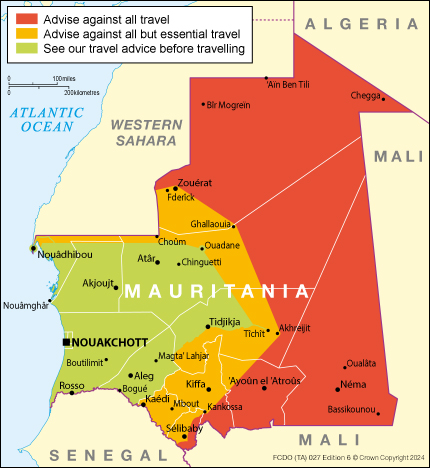
Warnings — Foreign OfficeForeign Office ↗updated 24.03.2026 · read 15.10.2026
Warnings — Foreign Office
Your travel insurance could be invalidated if you travel against Foreign, Commonwealth & Development Office (FCDO) advice.
Eastern Mauritania
FCDO advises against all travel to areas east of a line drawn between but excluding the towns of Kankossa, Akhreijit, Ghallaouia, Zouerat, Fderîck and onwards west to the border with Western Sahara.
Mauritania-Mali border
FCDO advises against all travel to areas within 25km of the Malian border in the south, including Khabou.
Mauritania-Western Sahara border
FCDO advises against all but essential travel to areas within 25km of the Western Sahara border, excluding the section of the Nouakchott-Nouadhibou road and the city of Nouadhibou.
Tiris Zemmour, Adrar, Tagant, Hodh el Gharbi, Assaba, Gorgol and Guidimaka provinces
FCDO advises against all but essential travel to the rest of the province of Tiris Zemmour, Assaba, Hodh el Gharbi, Gorgol and Guidimaka, and areas of Adrar and Tagant provinces, west of a line drawn between the towns of Ghallaouia, Akhreijit and Kankossa. This excludes:
- the areas west of a line running between Choum, Ouadane and where the 10th Meridian West meets latitude 18° 40°
- the town of Ouadane
- the Tidjikja-Tichit road
- the Aleg to Tidjikja road via Moudjeria and all areas of Tagant west of that road
- the Bogue to Kaedi road via Bababe
Find out more about why FCDO advises against travel .
UK government support
The British Embassy in Nouakchott cannot provide consular services in person. British nationals in Mauritania should contact the British Embassy in Dakar, Senegal , for support.
Protests
There have been periodic protests in Mauritania relating to developments in the Middle East. Demonstrations can take place with little or no warning.
You should:
- avoid all demonstrations and larger gatherings
- monitor local media for updates
- follow the advice of local authorities
Regional risks — Foreign OfficeForeign Office ↗updated 24.03.2026 · read 15.10.2026
Regional risks — Foreign Office
This section has safety advice for regions of Mauritania. It only covers regions where FCDO has specific advice.
You should also read FCDO’s overall travel advice and safety and security advice .
Eastern Mauritania
FCDO advises against all travel to areas east of a line drawn between but excluding the towns of Kankossa, Akhreijit, Ghallaouia, Zouerat, Fderîck and onwards west to the border with Western Sahara.
FCDO advises against all travel because of designated “military zones” by the Mauritanian military. These areas are off-limits to foreign nationals and most civilians. The Mauritanian Ministry of Defence warned that individuals entering these areas would be treated as a military target. The boundaries of such zones frequently change and authorisation from authorities is needed for access.
These zones are due to the deterioration of the security situation in Mali leading to increased risks of incursions by terrorist groups based in Mali into Mauritanian territory, including Jama’a Nusrat ul-Islam wa al-Muslimin (JNIM). Serious organised crime groups operate in eastern Mauritania.
Mauritania-Mali border
FCDO advises against all travel to areas within 25km of the Malian border in the south of Mauritania, including Khabou. There is increased terrorist and serious organised crime activity across the border in Kayes Region in Mali.
Mauritania-Western Sahara border
FCDO advises against all but essential travel to areas within 25km of the Western Sahara border, excluding the section of the Nouakchott-Nouadhibou road and the city of Nouadhibou.
Unexploded landmines remain on the border with Western Sahara. Landmines can shift location due to weather conditions. You should check local advice before travelling.
Tiris Zemmour, Adrar, Tagant, Hodh el Gharbi, Assaba and Guidimaka provinces
FCDO advises against all but essential travel to the rest of the province of Tiris Zemmour, Assaba, Hodh el Gharbi, Gorgol and Guidimaka, and areas of Adrar and Tagant provinces, west of a line drawn between the towns of Ghallaouia, Akhreijit and Kankossa. This excludes:
- the areas west of a line running between Choum, Ouadane and where the 10th Meridian West meets latitude 18° 40°
- the town of Ouadane
- the Tidjikja-Tichit road
- the Aleg to Tidjikja road via Moudjeria and all areas of Tagant west of that road
- the Bogue to Kaedi road via Bababe
This is due to risks of instability extending from eastern Mauritania as a result of the conflict in Mali, including from organised crime.
Safety — Foreign OfficeForeign Office ↗updated 24.03.2026 · read 15.10.2026
Terrorism
There is a high threat of terrorist attack globally affecting UK interests and British nationals, including from groups and individuals who view the UK and British nationals as targets. Stay aware of your surroundings at all times.
UK Counter Terrorism Policing has information and advice on staying safe and what to do in the event of a terrorist attack. Find out how to reduce your risk from terrorism while abroad .
Terrorism in Mauritania
Terrorist attacks in Mauritania cannot be ruled out.
Terrorist attacks could be indiscriminate, including in places visited by foreign nationals. Stay aware of your surroundings, keep up to date with local media reports and follow the advice of local authorities.
Political situation
Demonstrations can happen at any time in Nouakchott. You should avoid political gatherings and demonstrations and follow the advice of local authorities and security forces. Maintain adequate stocks of non-perishable food and water.
Crime
Crime levels are moderate but steadily increasing.
There have been burglaries in areas where foreign nationals live and robberies during daylight.
There have been thefts and robberies at knifepoint during the day and night on the unlit and isolated beaches in Nouakchott and in the ‘Le Cinquième’, ‘Dar Naim’ and Citè Plage districts. Be particularly careful in these places.
Report crime to the police by dialling 117 or visiting a police station.
Personal ID
You should always carry copies of your photo ID, especially outside Nouakchott where there are police checkpoints. Follow any directions from the police or other Mauritanian security forces.
Religion
Mauritania recognises Islam as the only religion of its citizens and the state. It is illegal to participate in non-Islamic gatherings and activities that have not been authorised by the Mauritanian authorities. Attempting to convert people to other religions is illegal – those caught doing this can be arrested or deported. Blasphemy is a criminal offence and the maximum penalty is death. Respect local traditions, customs, laws and religion at all times and be aware of your actions to ensure they don’t offend, especially during the holy month of Ramadan or when visiting religious sites.
Ramadan
Ramadan is a holy month for Muslims. The dates vary by year and country. During this time, do not eat, drink, smoke or chew gum in public in the daytime, including in your car.
Get more advice when you arrive from your tour guide, hotel or business contacts.
You should also:
- check opening hours of shops and restaurants
- follow local dress codes – clothing that does not meet local dress codes may cause more offence at this time
- be aware that driving may be more erratic, particularly when people are trying to get home at dusk
Alcohol and pork products ban
It is illegal for Muslims and non-Muslims to import or consume alcohol and pork products in Mauritania. The Mauritanian authorities scan all baggage on arrival at Nouakchott International Airport and may search vehicles at land borders. They will confiscate alcohol or pork products and arrest or fine people found carrying them.
Illegal drugs and prison sentences
Drug laws in Mauritania are severe. The penalties for possessing illegal drugs include imprisonment.
Dress code
You should dress modestly when not on the beach. Women should cover their shoulders and not wear short skirts. Men should not wear sleeveless tops or shorts.
Using cameras
Police and members of the public can object to…
American passport — U.S. Department of State
- The U.S. State Department advises to reconsider travel to Mauritania due to terrorism, crime, and limited health infrastructure. State Department
- Violent crimes including mugging, armed robbery, and assault occur frequently outside Tevragh Zeina neighborhoods in Nouakchott; local police lack resources to respond effectively. State Department
- Terrorists may attack without warning at tourist spots, schools, hotels, restaurants, places of worship, diplomatic missions, and against security forces throughout the country. State Department
- U.S. government employees cannot travel outside Nouakchott at night, cannot walk alone outside specific areas and times, and need special authorization for travel outside Nouakchott. State Department
- Healthcare in rural areas is very limited; hospitals require upfront payment in cash or via Bankily, Masrvi, and Sadad mobile apps; medications may be unavailable or unsafe. State Department
Faithful summary of the official texts below, which prevail.
Mauritania - Level 3: Reconsider Travel 2026-08-17travel.state.gov ↗updated 17.08.2026 · read 16.10.2026
Advisory summary
Reconsider travel to Mauritania due to terrorism, crime, and limited health infrastructure . Some areas have increased risk. Read the entire Travel Advisory.
U.S. government employee travel restrictions
- The U.S. government has limited ability to offer emergency services to American citizens in Mauritania due to safety risks.
- U.S. government employees working in Mauritania are not allowed to travel outside Nouakchott at night. They cannot walk alone outside of specific areas and times.
- U.S. government employees working in Mauritania need special authorization to travel outside Nouakchott.
- American citizens in Mauritania are advised to take similar precautions.
Crime
Violent crimes occur frequently outside the Tevragh Zeina neighborhoods in Nouakchott. This includes mugging, armed robbery, and assault. Local police lack the resources to respond quickly and effectively to serious crimes.
Transportation options and communication infrastructure are limited outside Nouakchott. Crimes may happen with little or no warning, targeting tourist places. Crimes often happen at night and include kidnapping, assault, and armed robbery.
Stay aware of your surroundings in:
- Urban areas and crowded markets.
- Roadblocks, including by armed groups. They are present throughout the country.
Terrorism
There is risk of terrorist violence, including terrorist attacks and other activity in Mauritania. Visit the U.S. Department of State's country reports on terrorism to learn more.
Terrorists may attack without warning:
Tourist spots where foreigners gather, anywhere in the country
- Schools
- Hotels
- Restaurants
- Places of worship and religious sites
- International diplomatic missions
- Local security forces and civilians
Health
Health facilities are available in major cities. However, routine and emergency care may be limited or unavailable.
- Healthcare in rural areas in Mauritania is very limited.
- Medical care may not meet U.S. standards of care.
- Hospitals and doctors require payment up front prior to service or admission. Payments can be made in cash or mobile payments apps (Bankily, Masrvi, and Sadad) using a local Mauritanian bank.
- Medication and medical supplies may be unavailable in many healthcare facilities.
- Locally available medications may be unsafe. Pharmacies are not well regulated.
- Read the Health section of the…
Global Affairs Canada — additional reading
Avoid non-essential travel (with regional advisories)
Avoid non-essential travel to Mauritania due to the threat of terrorism, particularly against Western interests.
- MAURITANIA — Avoid non-essential travel to Mauritania due to the threat of terrorism, particularly against Western interests.
Avoid all travel to the following areas due to the risk of banditry, kidnapping and the presence of prohibited military zones:
- northern and eastern Mauritania, especially : all of the following regions: Tiris Zemmour ; Hodh El Gharbi ; Hodh Ech Chargui
- east of the Zouerate-Ouadane-Tidjikdja-Kiffa-Sélibali line in the following regions : Adrar ; Tagant ; Assaba ; Guidimakha
- areas within 25 km of the northern borders, west of the Zouerate-Ouadane-Tidjikdja-Kiffa-Sélibali line.
Open Government Licence – Canada · October 9, 2026 07:25 EDTtravel.gc.ca ↗updated 09.10.2026 · read 16.10.2026
- You must abide by local laws, which are strictly based on Islamic law and can result in severe penalties, including imprisonment or the death penalty for offenses such as drug trafficking, blasphemy, adultery, and homosexual acts.
- Dress conservatively and behave discreetly, especially women who should wear a headscarf and cover their arms and legs to avoid offending local sensitivities.
- It is illegal to import alcohol, pork products, firearms, and drugs; penalties for drug possession are severe, including lengthy prison sentences and potentially the death penalty.
- During Ramadan, refrain from eating, drinking, or smoking in public between sunrise and sunset, and be aware that driving may be more erratic at dusk.
- Photographing military installations, airports, government buildings, and religious buildings is forbidden, and you should always seek permission before taking photos of people.
- Children of Mauritanian fathers automatically acquire citizenship, and their father's permission is required for any child to travel, even if the child holds a foreign passport.
Faithful summary of the official texts below, which prevail.
Global Affairs Canada — written for Canadian travellers, valid for all
Local laws
You must abide by local laws. Learn about what you should do and how we can help if you are arrested or detained abroad.
Drugs
Penalties for possession, use or trafficking of illegal drugs are severe. Drugs, alcohol and travel
2SLGBTQI+ persons
The laws of Mauritania prohibit sexual acts between individuals of the same sex. Convicted male offenders can face the death penalty. Female offenders can be punished by 3 months to 2 years in prison and a large fine. 2SLGBTQI+ persons should carefully consider the risks of travelling to Mauritania. Travel and your sexual orientation, gender identity, gender expression and sex characteristics
Dress and behaviour
Islamic practices and beliefs are closely adhered to in the country’s customs, laws and regulations. Dress conservatively, behave discreetly and respect religious and social traditions to avoid offending local sensitivities. It would be prudent for women to wear a headscarf and cover their arms and legs.
Ramadan
In 2027, the lunar month of Ramadan is expected to begin on or around February 7. In public, between sunrise and sunset, refrain from:
- drinking
- eating
- smoking
Extramarital relations
Adultery, extra-marital sexual relations and prostitution are illegal. Offenders may face strict penalties, including imprisonment.
Family law
Children of Mauritanian fathers automatically acquire Mauritanian citizenship at birth, regardless of where they were born. The father’s permission is required for any child to travel, even if the child is travelling on a foreign passport.
International Child Abduction
The Hague Convention on the Civil Aspects of International Child Abduction is an international treaty. It can help parents with the return of children who have been removed to or retained in certain countries in violation of custody rights. It does not apply between Canada and Mauritania. If your child was wrongfully taken to, or is being held in Mauritania by an abducting parent:
- act as quickly as you can
- consult a lawyer in Canada and in Mauritania to explore all the legal options for the return of your child
- report the situation to the nearest Canadian government office abroad or to Global Affairs Canada by calling the Emergency Watch and Response Centre
If your child was removed from a country other than Canada, consult a lawyer to determine if The Hague Convention applies. Be aware that Canadian consular officials cannot interfere in private legal matters or in another country's judicial affairs.
Photography
Photographing military installations, airports, government buildings and religious buildings is forbidden.
Imports
It is illegal to import alcoholic beverages, firearms and pork products.
Driving
Between midnight and 5 am, the Mauritanian authorities prohibit intercity traffic for vehicles transporting passengers and goods vehicles over 3.5 tonnes. During this traffic ban period, vehicles are not allowed on national roads. They must be parked at roadside stations or in designated areas in cities. You must carry an International Driving Permit. International Driving Permit
Money
The currency is the ouguiya (MRO), which is non-convertible and can’t be taken out of the country. Mauritania is a cash-based economy. There is no limit on the importation of foreign currency but it should be declared on arrival. The exportation of foreign currency is limited to the amount declared on arrival. Exchanges will only accept U.S. dollars and euros. Some hotels in Nouakchott and Nouadhibou accept credit cards.
Open Government Licence – Canada · October 9, 2026 07:25 EDTtravel.gc.ca ↗updated 09.10.2026 · read 16.10.2026
Foreign Office — laws and cultural differences
Personal ID
You should always carry copies of your photo ID, especially outside Nouakchott where there are police checkpoints. Follow any directions from the police or other Mauritanian security forces.
Religion
Mauritania recognises Islam as the only religion of its citizens and the state. It is illegal to participate in non-Islamic gatherings and activities that have not been authorised by the Mauritanian authorities. Attempting to convert people to other religions is illegal – those caught doing this can be arrested or deported. Blasphemy is a criminal offence and the maximum penalty is death. Respect local traditions, customs, laws and religion at all times and be aware of your actions to ensure they don’t offend, especially during the holy month of Ramadan or when visiting religious sites.
Ramadan
Ramadan is a holy month for Muslims. The dates vary by year and country. During this time, do not eat, drink, smoke or chew gum in public in the daytime, including in your car. Get more advice when you arrive from your tour guide, hotel or business contacts. You should also:
- check opening hours of shops and restaurants
- follow local dress codes – clothing that does not meet local dress codes may cause more offence at this time
- be aware that driving may be more erratic, particularly when people are trying to get home at dusk
Alcohol and pork products ban
It is illegal for Muslims and non-Muslims to import or consume alcohol and pork products in Mauritania. The Mauritanian authorities scan all baggage on arrival at Nouakchott International Airport and may search vehicles at land borders. They will confiscate alcohol or pork products and arrest or fine people found carrying them.
Illegal drugs and prison sentences
Drug laws in Mauritania are severe. The penalties for possessing illegal drugs include imprisonment.
Dress code
You should dress modestly when not on the beach. Women should cover their shoulders and not wear short skirts. Men should not wear sleeveless tops or shorts.
Using cameras
Police and members of the public can object to photography or filming if you do not get their permission. Do not photograph or film government and military sites or members of the security forces.
LGBT+ travellers
There are no laws in Mauritania to protect LGBT+ people from discrimination. Under Mauritanian law, the maximum penalty for sexual activity between men is death. Penalties for women include a prison sentence ranging from 3 months to 2 years and a fine. Read more advice for LGBT+ travellers.
Accessing money
It is illegal to take Mauritanian currency (ougiyas) out of the country. The Mauritanian authorities may confiscate money from people trying to do so. You can exchange US dollars and euros for Mauritanian ouguiyas at banks, some hotels and official bureau de change. You can exchange British pounds at some official bureau de change, but the exchange rate is very poor. Mauritania is mainly a cash-based society. A few hotels in Nouakchott and Nouadhibou accept credit cards – some hotels only accept Visa cards. Some ATMs accept foreign credit or debit cards.
Open Government Licence v3.0gov.uk ↗updated 24.03.2026 · read 15.10.2026
FDFA (Switzerland) — laws and customs, in French
Specific legal provisions
Le cadre juridique s'inspire d’une conception du droit islamique stricte et de principes moraux rigides. Les infractions sont systématiquement poursuivies et punies plus strictement qu’en Suisse. Entre autres sont punissables:
- la consommation d’alcool.
- tout comportement provocant en public, par exemple des gestes affectifs entre personnes adultes, les vulgarités. Il faut compter sur des réactions agressives de la part du public.
- les relations extraconjugales et homosexuelles, ainsi que les grossesses extra-conjugales. En cas d’infraction d’ordre sexuel, la victime doit prouver, le cas échéant, qu’elle n’a pas elle-même enfreint la loi.
- tenir des propos désobligeants à l'égard du gouvernement ou de l'Islam. De manière générale, renoncez aux discussions et aux déclarations politiques, y compris dans les médias sociaux.
- photographier les bâtiments et infrastructures du gouvernement et de l’armée, ainsi que des installations à visée stratégique comme les aéroports, etc. Il demeure des incertitudes par rapport à ce qui tombe dans ces catégories. Faites attention aux panneaux indicateurs et, en cas de doute, demandez l’autorisation aux forces de sécurité locales ou renoncez à prendre la photo.
La personne au volant impliquée dans un accident de la route ayant causé la mort ou des blessures est en règle générale placée en garde à vue jusqu'à ce qu'elle ait été dégagée de toute responsabilité. En cas de doute, pendant la procédure, les personnes de nationalité étrangère n’ont pas la possibilité de quitter la Mauritanie. Les infractions à la loi sur les stupéfiants, y compris la détention de minimes quantités de drogue quelle qu'elle soit , sont passibles de lourdes peines de prison; la peine de mort peut être prononcée. La peine capitale peut également être prononcée pour certains autres délits, comme par exemple les actes homosexuels et l'adultère. Les conditions de détention sont précaires: facilités sanitaires minimales, cellules surpeuplées, alimentation insuffisante.
Cultural specificities
La Mauritanie est un pays musulman. Adaptez votre comportement et votre tenue vestimentaire aux us et coutumes locaux, qui peuvent être très différents selon la région et le lieu. Ne photographiez personne sans son accord. Renseignez-vous dans les guides de voyages, auprès de votre agence ou directement sur place, sur les codes de conduite et les conventions à respecter. Durant la période du Ramadan et dans les endroits religieux, des règles et des prescriptions particulières doivent être respectées.
FDFA travel advice, in Frencheda.admin.ch ↗updated 06.01.2026 · read 15.10.2026
What it changes for you: Air acceptable at this hour: nothing special to plan. Very high UV: sunscreen, hat and shade between 11 am and 4 pm; sunstroke and dehydration are travellers' first reasons to see a doctor.
Reading 06:00 (Africa/Nouakchott)Open-Meteo ↗updated 16.10.2026 · read 16.10.2026
Air quality and UV: Open-Meteo.com (CC BY 4.0), data rounded and formatted by Maximum. Contains modified Copernicus Atmosphere Monitoring Service information 2026. Neither the European Commission nor ECMWF is responsible for any use that may be made of the Copernicus information or data it contains.
No value published by the World Bank in the last eight years for Mauritania: hospital beds per 1,000 people.
Reading: With 0.3 physicians per 1,000 people (93% fewer than Switzerland), the nearest hospital does not always have the capacity for a serious case: evacuation to an adequate centre is the rule, not the exception — that is what unlimited evacuation and repatriation cover. Health spending of 92 USD per person (Switzerland: 11,784) goes with private hospitals that bill foreigners in hard currency and ask for a guarantee before admission: the direct payment guarantee is what avoids the deposit.
World Bank — latest published value, year per indicatordata.worldbank.org ↗read 10.10.2026
What is happening in Mauritania right now
Live alerts and level changes, each with its official source. Continuously updated.
What governments have just written
Natural disasters and climate section – added information on El Niño
October 9, 2026 07:25 EDTtravel.gc.ca ↗updated 09.10.2026 · read 16.10.2026No level change recorded for this country since the log opened. The live alerts above are updated continuously.
Frequently asked questions — travel insurance Mauritania
What is the official risk level in Mauritania today?
Level 3/4 — Reconsider Travel, U.S. Department of State, retrieved on 16 October 2026.
- Is the whole country advised against? United States: except for imperative reasons · France: no · United Kingdom: no · Switzerland: no (reading of 27 September 2026).
- Switzerland’s FDFA advises against travel to certain regions (published 06.01.2026).
- Contractually, only an FDFA, FOPH or WHO advisory against the trip opens Module A (art. 18.1) — that is not the case today.
- Read the areas to avoid, inform your company (Duty of Care checklist) and check that your cover has no territorial clause — My cover says it card by card.
- We check these sources every morning and e-mail you the day one changes (Alerts button).
Sourcestravel.state.gov · updated 17.08 · read 16.10France Diplomatie · updated 28.09 · read 15.10DFAE · updated 06.01 · read 15.10207-country comparison
Is the whole of Mauritania advised against, or only some areas?
An area advised against does not rule out the country.
- Official answers: United States: except for imperative reasons · France: no · United Kingdom: no · Switzerland: no.
- Foreign Office, regional risks: “This section has safety advice for regions of Mauritania. It only covers regions where FCDO has specific advice. You should also read FCDO’s overall travel advice and safety and security advice . Eastern Mauritania FCDO advises against all travel to areas…”
- Keep your country of residence's advisory on booking day and on departure day: that is what your policy's clauses cite.
SourcesFrance Diplomatie · updated 28.09 · read 15.10Foreign Office · updated 24.03 · read 15.10State Department · updated 17.08 · read 16.10
What are the entry requirements for Mauritania with my passport?
The rules depend on the passport, not on the destination alone.
- French passport (France Diplomatie): French nationals must enter Mauritania through 21 designated international border posts only; the Gogui post is formally discouraged due to red zone status. Obtain electronic visa authorization at anrpts.gov.mr before travel, then pay €55 at arrival for a 30-day single-entry visa with biometric data capture. Alcohol, cannabis, pork products and unlicensed substances are prohibited; possession triggers detention, court appearance and prison sentences.
- British passport (Foreign Office): Your passport must be valid for at least six months beyond your arrival date in Mauritania. From 5 January 2025, visas on arrival are no longer available; you must obtain an e-visa online beforehand via the Mauritanian National Agency for the Population Register and Secure Titles (contact@anrpts.gov.mr). E-visa fees must be paid in exact cash upon arrival in Mauritania in Euros or US dollars only; no change or receipts are provided.
- American passport: the requirements are on the State Department country page (travel.state.gov).
- Swiss passport: the FDFA refers you to the destination's embassy in Switzerland.
- Pick your passport at the top of Before you go › Entry: the official text that concerns you comes first, with its “In brief” summary.
SourcesFrance Diplomatie · updated 28.09 · read 15.10Foreign Office · updated 24.03 · read 15.10State Department · updated 17.08 · read 16.10
Do I need an insurance certificate for a Mauritania visa?
For a Schengen visa, yes: at least €30,000 of travel medical insurance (Regulation (EC) No 810/2009, art. 15).
- Many other countries ask for it on entry or for a visa, case by case: check Before you go › Entry, with your passport.
- Subscribe: the named certificate arrives by e-mail on payment, with your name, dates and limits (EUR 1.5M medical expenses, unlimited evacuation and repatriation) — the ones consulates check.
- Attach it to the visa file; if in doubt about the format, write to us.
SourcesRegulation (EC) 810/2009, art. 15General conditions, policy 20 00 479
What does Maximum Insurance do in Mauritania, concretely?
VIP Pack — €990 for twelve months, unlimited trips.
- EUR 1.5M emergency medical expenses, unlimited medical evacuation and repatriation, search and rescue EUR 50,000, cancellation or change EUR 5,000.
- One 24/7 number, +41 22 ••• •• ••: Maximum sends its direct payment guarantee to the hospital (art. 2.12).
- Network of 45,000 providers (art. 6.9); evacuation is decided, organised and paid by Maximum's medical team if the local facility is not enough (art. 6.2.2).
- Around Nouakchott, the nearest hospital read from OpenStreetMap: Clinique Dar Essiha دار الصحة البروفسور الشيخان اجدود · 1.5 km · +22236307385 · 24/7 emergency room.
- Named certificate by e-mail on payment, no medical questionnaire.
SourcesGeneral conditions, policy 20 00 479OpenStreetMap · read 10.10
How much does a medical repatriation from Mauritania cost?
From 30 000 € to 200 000 € depending on severity and distance (Le Ciel Africain, 2026).
- Without cover: the hospital asks for a deposit before admission, and the medical flight is paid up front.
- With the VIP Pack: the evacuation is decided and settled by Maximum (art. 6.2.2) — no advance, no cap.
SourcesLe Ciel Africain, 2026General conditions, policy 20 00 479
What should I do if hospitalised in Mauritania?
Six steps, in this order.
- 1. Call +41 22 ••• •• •• before paying anything, or have the front desk call: it is the condition for full cover (otherwise: reduced or refused benefits).
- 2. Ask for a hospital in the Maximum network (art. 6.9) — the nearest: Clinique Dar Essiha دار الصحة البروفسور الشيخان اجدود · 1.5 km · +22236307385 · 24/7 emergency room.
- 3. See a doctor the same day and leave with the certificate: without an on-the-spot finding, nothing is covered (art. 33).
- 4. Admitted for more than 24 h? The front desk calls Maximum: direct payment guarantee, no deposit (art. 2.12).
- 5. Book no ambulance or flight yourself (art. 6.2.2).
- 6. Once home, file within 30 days (art. 35.7).
- Local emergency services: police 117 · ambulance 101 · fire 118.
SourcesSpecial conditions 01.26General conditions, policy 20 00 479
Which emergency numbers in Mauritania?
Local emergency services: police 117 · ambulance 101 · fire 118
- Maximum, 24/7, before any payment: +41 22 ••• •• ••.
- France — French Embassy (1.0 km) · +222 45 29 96 99
- United States — Ambassade des Etats-Unis (2.3 km) · +222-4525-2660
- Save these numbers before leaving; in immediate danger, call local emergency services first, then Maximum.
SourcesEmergencyNumberAPI · Wikidata · read 08.10OpenStreetMap · read 10.10
Is an Amex, Visa or Mastercard enough in Mauritania?
At today's level 3/4, card by card:
- Amex Platinum — No area exclusion at this level — but three written limits: deductible and prior approval, 90-day cap, advance under conditions.
- Visa — No express area exclusion — but a €156,000 cap, 90 days, and the war/instability exclusion in the background.
- Mastercard — No exclusion in play at this level — but a €155,000 cap and 90 covered days.
- Three lines to read in your notice: the duration (often 90 days per trip), the settlement (reimbursement afterwards or direct payment of the hospital) and the area exclusion at level 4/4.
SourcesAmex Platinum France T&Cs, 01.2025 — general exclusion n° 11BNP Paribas Visa Infinite notice (policy PT7), 04.2025 — comFortuneo World Elite Mastercard notice, 01.2026 — art. 5.5 '
Are a health plan or a travel policy enough in Mauritania?
A health plan reimburses at home; here, the hospital asks for a payment guarantee before admission.
- Health plan — A health plan treats you at home. Here the hospital asks for a guarantee before admission — not a later reimbursement.
- Travel policy — No area exclusion at this level — compare cap, deductible and covered duration.
- A travel policy often has a territorial clause at level 4/4 and a 90-day limit per trip.
- Have your IPID number or the PDF of the terms and ask an expert to call you back: the answer is in the document, not in the brochure.
SourcesGeneral conditions, policy 20 00 479
How do I use the medical network on this page?
Around Nouakchott: 54 hospitals and clinics, 38 with a 24/7 emergency room, 40 pharmacies, 11 doctors' practices (OpenStreetMap, hospital list read on 16.10.2026).
- Type your city, hotel or beach: the map re-centres, 24/7 emergency rooms come first.
- Each row gives the phone when the source publishes it, the nearest street, directions and the Google Maps listing.
- The PDF briefing repeats the same places, numbered on a printable map.
- No customer reviews: OpenStreetMap has none, and we invent none.
Which vaccines and health precautions for Mauritania?
The sourced detail is under Medical network › Health: vaccines, diseases present, altitude, outbreaks.
- CDC (Travelers' Health), depending on the trip: Routine vaccines, COVID-19, Hepatitis A, Hepatitis B, Malaria, Measles, Meningococcal disease.
- France Diplomatie reports in the country: dengue, chikungunya — mosquito protection day and night.
- WHO: 1 outbreak alert(s) for this country in the last 24 months, including “Rift Valley fever- Mauritania and Senegal” (5 November 2025).
- See a doctor or a travel clinic 8 weeks before departure (Foreign Office).
- Carry your medicines in their packaging, with a prescription using international non-proprietary names (France Diplomatie).
SourcesCDC Travelers' Health · read 10.10France Diplomatie · updated 28.09 · read 15.10OMS · updated 05.11 · read 15.10Foreign Office · updated 24.03 · read 15.10
Can I be treated in Mauritania, or will I be evacuated?
0.3 physicians per 1,000 people (2022) versus 4.5 in Switzerland.
- With 0.3 physicians per 1,000 people (93% fewer than Switzerland), the nearest hospital does not always have the capacity for a serious case: evacuation to an adequate centre is the rule, not the exception — that is what unlimited evacuation and repatriation cover. Health spending of 92 USD per person (Switzerland: 11,784) goes with private hospitals that bill foreigners in hard currency and ask for a guarantee before admission: the direct payment guarantee is what avoids the deposit.
- When the local facility is not enough, Maximum's medical team decides the evacuation to a suitable centre, and pays for it (art. 6.2.2).
SourcesWorld Bank · read 10.10General conditions, policy 20 00 479
Mauritania: safety, in figures?
1.0 homicides per 100,000 people (2020) versus 0.6 in Switzerland and 1.3 in France.
- 25.6 road deaths per 100,000 people versus 2.2 in Switzerland (World Bank, WHO).
- The homicide rate is above Switzerland's, without being out of range. On the road, 12 times more deaths than in Switzerland: road crashes are the leading cause of death of healthy travellers (CDC) — seat belt, no night driving, a driver or a taxi from a rank.
Where is my embassy in Mauritania, and why register?
The nearest representations, by passport (OpenStreetMap):
- France — French Embassy (1.0 km) · +222 45 29 96 99
- United States — Ambassade des Etats-Unis (2.3 km) · +222-4525-2660
- Register before leaving: France: Ariane · Switzerland: Travel Admin · United Kingdom: Foreign Office alerts · United States: STEP.
- Two minutes, and in a crisis your country's authorities can reach you and count you in an evacuation.
- Pick your passport at the top of Contacts: your embassy comes first.
SourcesOpenStreetMap · read 10.10DFAE · updated 06.01 · read 15.10
Which regions of Mauritania should I avoid, precisely?
At least one official reading covers the whole country; 7 regions are also named, fully or partly.
- Your point (Nouakchott): advised against — all but essential travel.
- Advised against — all but essential travel: Adrar, Assaba, Gorgol, Guidimaka, Hodh El Gharbi, Tagant, Tiris Zemmour.
- Global Affairs Canada covers the whole country.
- Areas quoted without a region: Global Affairs Canada — Northern and eastern Mauritania…: Tiris Zemmour; Hodh El Gharbi; Hodh Ech Chargui; Global Affairs Canada — East of the…: Adrar; Tagant; Assaba; Guidimakha; Global Affairs Canada — Areas within 25 km of the northern borders, west of the…; Foreign Office — FCDO advises against all travel to areas east of a line drawn between but excluding the…
- Maximum does not exclude these areas: the VIP Pack covers care and repatriation there (sanctions, embargoes and a country already at war at departure remain enforceable).
SourcesGlobal Affairs Canada · updated 09.10 · read 16.10Foreign Office · updated 24.03 · read 15.10France Diplomatie · updated 28.09 · read 15.10
Which laws and customs should I know in Mauritania?
Local laws apply to every traveller; here is what the official texts say.
- You must abide by local laws, which are strictly based on Islamic law and can result in severe penalties, including imprisonment or the death penalty for offenses such as drug trafficking, blasphemy, adultery, and homosexual acts.
- Dress conservatively and behave discreetly, especially women who should wear a headscarf and cover their arms and legs to avoid offending local sensitivities.
- It is illegal to import alcohol, pork products, firearms, and drugs; penalties for drug possession are severe, including lengthy prison sentences and potentially the death penalty.
- During Ramadan, refrain from eating, drinking, or smoking in public between sunrise and sunset, and be aware that driving may be more erratic at dusk.
- Photographing military installations, airports, government buildings, and religious buildings is forbidden, and you should always seek permission before taking photos of people.
SourcesGlobal Affairs Canada · updated 09.10 · read 16.10Foreign Office · updated 24.03 · read 15.10
Who can I call at any hour from Mauritania?
Every foreign ministry runs a 24/7 emergency line for its nationals.
- France — Crisis and Support Centre — French Ministry for Europe and Foreign Affairs: +33 1 53 59 11 00. 24/7 emergency line, standard rate. First contact abroad: the French embassy or consulate.
- Switzerland — FDFA Helpline: +41 58 465 33 33 · +41 800 24 7 365. 24/7, 365 days a year — helpline@eda.admin.ch. Beware of scam calls spoofing these numbers.
- United Kingdom — Foreign, Commonwealth & Development Office: +44 20 7008 5000. 24 hours, for British nationals.
- United States — Overseas Citizens Services — U.S. Department of State: +1 202 501 4444 · +1 888 407 4747. From abroad; the second number from the U.S. and Canada.
- On site, French Embassy: +222 45 29 96 99.
Sourcesdiplomatie.gouv.fr · updated 28.09 · read 15.10eda.admin.ch · updated 06.01 · read 15.10
A few useful phrases in Arabic for Mauritania?
Emergency phrases, transliterated; the original script, to show if pronunciation fails, is under Useful phrases.
- Help! → an-najda!
- Call an ambulance! → ittasilu bil-is'af!
- I need a doctor. → ahtaju ila tabib.
- Where is the nearest hospital? → ayna aqrab mustashfa?
- Call the police! → ittasilu bish-shurta!
SourcesMaximum Insurance
What should I keep after leaving Mauritania, and how do I file a claim?
Keep the entry stamp, the invoices, the prescriptions and the medical report.
- File within 30 days (art. 35.7) from your client area, with the documents; the official forms are pre-filled.
- Costs advanced on site are reimbursed against receipts.
- Fever, persistent diarrhoea or a rash in the following weeks? See a doctor and say where you have been — dengue, chikungunya circulate in the country (France Diplomatie).
SourcesGeneral conditions, policy 20 00 479
What does the Pack VIP Extreme add?
Cancellation or change up to EUR 20,000, special risk EUR 5,000 per person, crisis management and security, optional Kidnap & Ransom.
- Special risk (Module A): political event, attack, epidemic, natural disaster — opens when the FDFA, the FOPH or WHO advise against the trip (art. 18.1).
- Epidemic: assistance must be requested within 7 days of the WHO or FDFA qualification (art. 36.2).
- Crisis management and security: trip registration, monitoring, extraction, evacuation in case of riot, war, terrorism or disaster; Kidnap & Ransom subject to eligibility (art. 18.4).
- €2,290 a year, unlimited trips.
SourcesGeneral conditions, policy 20 00 479
A question not answered here? Ask Maximum below, or call the support number: every question gets a clear, actionable answer.
In a life-threatening emergency, call local emergency services first, then Maximum: +41 22 ••• •• •• — 24/7 support number, an adviser stays with you to the end.
What Maximum knows
The 207 country pages — hospitals, pharmacies, police, embassies, emergency numbers, official advice from four governments, health, safety in figures, events in progress — read around the city you name. Your policy — benefits, the six steps, claims, articles. The site — prices, certificate, subscription. Nothing else: what it does not know, it says so and hands you to an adviser.
Same advisory level: Tanzania · Trinidad and Tobago · Venezuela · United Arab Emirates · Ethiopia · Saudi Arabia
The displayed level comes from the State Department, checked every morning. Before departure, always cross-check your country of residence's advisory: that is what your policy cites.
The level shown is the official U.S. Department of State level, checked daily. Maximum Insurance is an insurance distributor — general information, not personal advice.