Maximum Alerts / Saudi Arabia
Level published by the State Department on 11.10.2026 · read 16 October 2026 · source checked daily
Saudi Arabia — official level as of 16 October 2026: Level 3/4 ("Reconsider Travel"), from the U.S. Department of State. Maximum Insurance covers this country: hospital settled directly, unlimited repatriation, EUR 1.5M, certificate on payment.
Every country has its own scale, so we ask them all the same question: is the whole country advised against?
An advisory covering only areas of the country does not raise the answer: it stays “No”, and the area is shown in the relevant column.
The level shown on this page — and across this site — is the one published by the U.S. State Department, from 1 (normal precautions) to 4 (do not travel). France and the United Kingdom publish their own advisories, with their own rules: they add to that level, they do not replace it.
You will be alerted only on the day the official level of this country changes.
1 recorded incident (UCDP)hover, click to open it in the briefing
In a life-threatening emergency, call local emergency services first, then Maximum: +41 22 ••• •• •• — 24/7 support number, an adviser stays with you to the end.
The 207 country pages — hospitals, pharmacies, police, embassies, emergency numbers, official advice from four governments, health, safety in figures, events in progress — read around the city you name. Your policy — benefits, the six steps, claims, articles. The site — prices, certificate, subscription. Nothing else: what it does not know, it says so and hands you to an adviser.
What I say on the phone
What to do, in this order
In immediate danger, call local emergency services first. Then contact assistance without delay; before engaging a service, seek approval under your policy. Cover is confirmed by the insurer.
Ask assistance where to get care and whether direct cover can be arranged. It confirms the facility and seeks the insurer's approval under your policy. In immediate danger, call local emergency services first.
Even for a pain you meant to shrug off. Without a medical certificate written on the spot, the same day, the insurer cannot cover the event — a certificate written after you return does not count.
The hospital desk sends the request to assistance. Direct payment depends on the insurer's approval and the policy; the call alone does not guarantee it. Have the response confirmed before relying on no up-front payment.
In a life-threatening emergency, call local emergency services immediately. For an arranged transfer or repatriation, contact assistance: the insurer's medical team decides on measures under the policy. A medical flight booked without approval may not be reimbursed.
Even if everything went well on the ground. Send your invoices and the medical report within 30 days; after that, compensation may be reduced or refused.
Reading hospitals, doctors and pharmacies around this point…
List read from OpenStreetMap on 07.10.2026, not read again since: these facilities may have changed.
Country dial code: +966
OpenStreetMap list read on 07.10.2026, straight-line distances. In an emergency: +41 22 ••• •• ••.
near عبدالله بن عبداللطيف آل الشيخ
near المعتمد بن عباد
near الأخضر بن علي
near طريق صلاح الدين الأيوبي الفرعي
near شارع الاحساء
near Al Amir Sultan Ibn Abdul Aziz
near شارع الحارث الطائي
Al Ameen Abdullah Al Ali Al Naeem Street
Mo-Su 06:00-04:00
near الأمير منصور بن عبدالعزيز
الرياض
near طريق الأمير محمد بن عبد العزيز
near طريق صلاح الدين الأيوبي
near شارع متعب بن عبدالعزيز
near الأمير عبدالله بن جلوي بن تركي
موسى بن نصير الرياض
24/7
near المهندس مساعد العنقري
near خرشة بن الحارث
near الشيخ عبدالله العنقري
near الإمام فيصل بن تركي بن عبدالله
near الإمام أحمد بن حنبل
near أبي إسحاق المقدسي
near الملك عبدالله
Hafsah Bint Omar St.
Abdullah Bin Al Abbas St.
24/7
near شارع الأمير نايف بن عبدالعزيز
near سلام
7733 العباس الرشيدي
Su-Th 09:00-16:00
7393 ابن يونس الصدفي
Su-Th 09:00-16:00
25 ثابت اللغوي منطقة الرياض
Su-Th 08:00-17:00
near حسن البدر
1 ابن هبة الله
Su-Th 08:30-15:30
8039 Dareen Street
C40 AlRadaef Street
near الحكيم حبش المروزي
near شارع عمرو الضمري
near ابن قنفذ
near أبي الوفاء البوزجاني
Su-Th 09:00-12:30,14:00-17:00
near طريق صلاح الدين الأيوبي
near سميحة
near شارع عبدالله بن رواحة
King Fahd Road
طريق الملك فهد
near الناصرية
near البطحاء
near سليمان بن حرب
near طريق الملك عبدالعزيز
near ابن الغزال
near BRT 11
near طريق الملك عبدالعزيز
near شارع العليا
near طريق الملك عبدالعزيز
Al Madhar
near الناصرية
Forecast: MET Norway (Norwegian Meteorological Institute, CC BY 4.0), grouped by day and formatted by Maximum.
10-16 0.6 · 10-17 0.6 · 10-18 0.6 · 10-19 0.6 · 10-20 0.6 · 10-21 0.6 · 10-22 0.6 m³/s
Simulated discharge: Open-Meteo.com (CC BY 4.0), data rounded and formatted by Maximum. Contains modified Copernicus Emergency Management Service information 2026. For information only: this is not a flood warning; only national or regional authorities issue those.
No geolocated event in this country at this reading.
1 incidents recorded in the country, all pinned on the map above (zoom out) — the 1 closest to Riyadh are listed here, nearest first.
Source: UCDP — GEDEvent_v26_01_26_06.csv. Closed period, Clear coding, precise location.
National numbers (Wikidata, 2026 reading). On site, call local emergency services first, then Maximum: the insurer sends its payment guarantee to the hospital.
Make sure you are up-to-date on all routine vaccines before every trip. Some of these vaccines include Chickenpox (Varicella) Diphtheria-Tetanus-Pertussis (DTaP, Tdap, or Td) Flu (influenza) Measles-Mumps-Rubella (MMR) Polio Shingles
All eligible travelers should be up to date with their COVID-19 vaccines. Please see Your COVID-19 Vaccination for more information.
Recommended for unvaccinated travelers one year old or older going to Saudi Arabia. Infants 6 to 11 months old should also be vaccinated against Hepatitis A. The dose does not count toward the routine 2-dose series. Travelers allergic to a vaccine component should receive a single dose of immune globulin, which provides effective protection for up to 2 months depending on dosage given.
Recommended for unvaccinated travelers younger than 60 years old traveling to Saudi Arabia. Unvaccinated travelers 60 years and older may get vaccinated before traveling to Saudi Arabia.
CDC recommends that travelers going to certain areas of Saudi Arabia take prescription medicine to prevent malaria. Depending on the medicine you take, you will need to start taking this medicine multiple days before your trip, as well as during and after your trip. Talk to your doctor about which malaria medication you should take.
Cases of measles are on the rise worldwide. Travelers are at risk of measles if they have not been fully vaccinated at least two weeks prior to departure, or have not had measles in the past, and travel internationally to areas where measles is spreading.
Meningococcal vaccine is required for those traveling to Saudi Arabia to take part in Hajj or Umrah. In 2024 and 2025, cases of meningococcal disease were reported in people who traveled to Saudi Arabia for these mass gatherings. See the CDC Health Advisory and the Embassy of the Kingdom of Saudi Arabia Hajj and Umrah Health Requirements .
Monkeypox vaccination is recommended for any adult who anticipates any of the following activities during travel: Sexual or intimate contact with a new partner Sexual or intimate contact at a commercial sex venue, like a sex club or bathhouse Sexual or intimate contact in exchange for money, goods, drugs, or other trade Sexual or intimate contact in association with a large public event, such as a rave, party, or…
Dogs infected with rabies are sometimes found in Saudi Arabia. Rabies is also present in some terrestrial wildlife species. If rabies exposures occur while in Saudi Arabia, rabies vaccines are typically available throughout most of the country.
Recommended for most travelers. Typhoid vaccine is not 100% effective. Practicing safe food and water habits , including washing hands at key times , can also help prevent typhoid fever .
CDC recommendations: Vaccine is not recommended. Country entry requirements: Direct travel from United States: Vaccine is not required. Travel from countries with risk for YF virus transmission: Vaccine is required for travelers ≥9 months old; this includes >12-hour airport transits or layovers in countries with risk for YF virus transmission. 3 Updated April 23, 2025 See footnotes
CDC Travelers' Health, re-read weekly — the recommendation depends on your age, vaccines and itinerary: confirm it with a doctor or a travel clinic 4 to 6 weeks before departure.CDC ↗read 10.10.2026
Low incidence, comparable to Europe.
High coverage.
Very low or no transmission.
World Bank — latest published valuedata.worldbank.org ↗read 12.10.2026
Source: France Diplomatie (health advice, in French).
Faithful summary of the official texts below, which prevail.
WHO — outbreaks reported for this country (last 24 months)
FDFA (Switzerland) — medical care, in French
Les soins médicaux sont en principe assurés. Les hôpitaux exigent un paiement d’avance ou une déclaration de garantie financière avant de commencer un traitement. Si vous prenez régulièrement des médicaments, emportez-en une quantité suffisante avec vous. Notez toutefois que de nombreux pays appliquent des réglementations restrictives. Cela vaut en particulier, mais pas exclusivement, pour les médicaments contenant des stupéfiants (par exemple la méthadone) et les substances utilisées pour le traitement des troubles psychiques. Avant votre départ, renseignez-vous directement auprès de la représentation étrangère compétente (ambassade ou consulat) et consultez la rubrique Liens voyages, où vous trouverez de plus amples informations sur ce sujet ainsi que sur la médecine du voyage en général. Les informations concernant la propagation de maladies et les éventuelles mesures de protection à prendre sont fournies par le personnel médical et les centres de vaccination. Liens voyages
France Diplomatiesource ↗updated 13.10.2026 · read 16.10.2026
Consulter si besoin son médecin traitant ou un centre de vaccinations internationales (médecine des voyages) pour faire une évaluation de son état de santé et bénéficier de recommandations sanitaires, notamment sur les vaccinations. Consulter éventuellement son dentiste avant le départ.
Constituer sa pharmacie personnelle en conséquence et n’emporter dans ses bagages que les médicaments strictement nécessaires ; ne jamais consommer de médicaments achetés dans la rue (risque de contrefaçons). Les médicaments doivent être dans leur emballage d’origine avec les étiquettes originales, accompagnés d’une ordonnance portant le nom des médicaments en dénomination commune internationale (DCI). Il est indispensable de vérifier que les médicaments concernés sont autorisés dans le pays visité : pour plus d’informations, consulter la fiche Informations pratiques .
Les vaccins recommandés en France sont également indispensables lors d’un séjour à l’étranger : les maladies qu’ils préviennent circulent partout dans le monde, parfois même plus fréquemment qu’en France. Avant tout départ, le voyageur (adulte et enfant) doit donc d’abord s’assurer d’être à jour du calendrier vaccinal français, en particulier des vaccins contre la diphtérie, le tétanos, la poliomyélite, la coqueluche mais aussi contre la rougeole. Le carnet de vaccination peut être demandé à l’arrivée de certains pays.
Des vaccinations complémentaires peuvent être nécessaires :
Vaccinations avant le départ pour un pèlerinage à La Mecque ou Médine :
La dengue est une maladie virale transmise par piqûres de moustiques. Les symptômes sont de type grippal (fièvre, maux de tête, courbatures, parfois éruption cutanée). En cas de signes cliniques, il est impératif de consulter immédiatement un médecin. Il n’existe pas de traitement curatif. La prise en charge médicale repose uniquement sur le traitement des symptômes. Il faut impérativement éviter la prise d’anti-inflammatoire. La prévention individuelle repose essentiellement sur les moyens de protection contre les piqûres de moustiques. La vaccination des voyageurs peut être indiquée dans certains cas. Il est conseillé de se référer, avant son départ, à son médecin traitant et /ou à un centre de vaccination internationale.
Pour plus d’informations, consulter le site du ministère de la Santé et le site de l’Organisation mondiale de la Santé .
Un nombre élevé de cas de dengue est signalé dans la région de Djeddah, près de La Mecque.
Le paludisme (ou malaria) est une maladie parasitaire transmise par piqûres de moustiques infectés. Les formes bénignes associent des symptômes de type grippal : fièvre, frissons, fatigue, maux de tête, courbatures, vomissements. Des formes graves potentiellement mortelles peuvent survenir d’emblée ou en l’absence de traitement (confusion, convulsions, difficultés à respirer, jaunisse, saignements anormaux). En cas de survenue de symptômes pendant un séjour à l’étranger ou dans les semaines qui suivent le retour, il est nécessaire de consulter rapidement un médecin.
La prévention du paludisme repose sur la protection contre les piqûres de moustiques et la prise d’un traitement préventif. Avant tout séjour en zone d’endémie, il est recommandé de consulter son médecin traitant ou un médecin spécialisé en médecine…
Les coronavirus sont une vaste famille de virus susceptibles de provoquer un large éventail de maladies chez l’humain, du rhume banal jusqu’à une atteinte respiratoire sévère. Concernant le Mers CoV, la présentation la plus fréquente associe de la fièvre et une infection pulmonaire qui peut être sévère. Des formes mortelles sont possibles. Il n’existe pas de vaccin.
Les mesures classiques d’hygiène sont recommandées :
En cas de survenue de forte fièvre, de toux et/ou de difficultés respiratoires, y compris après le retour consulter un médecin en urgence ou contacter le Samu (15).
Pour toute information complémentaire , consulter la rubrique risques sanitaires ainsi que les sites internet du ministère de la santé et de l’ Organisation mondiale de la Santé .
La fièvre typhoïde est une maladie infectieuse causée par des bactéries présentes dans l’eau contaminée par des matières fécales d’origine humaine. L’infection résulte le plus souvent de l’ingestion d’eau ou d’aliments contaminés, ou d’une transmission directe de personne à personne. Les symptômes surviennent en moyenne 3 semaines après la contamination et associent fièvre, maux de tête, perte d’appétit, douleurs abdominales avec diarrhée ou constipation, fatigue et parfois, éruption cutanée. Dans les formes plus graves, la fièvre typhoïde peut être fatale en l’absence de traitement.
Les mesures de prévention reposent sur…
Pour plus d’informations, consulter le site du ministère en charge de la Santé et le site de l'Assurance Maladie .
Pour plus d’informations, consulter le site du ministère en charge de la Santé .
Health — Foreign OfficeForeign Office ↗updated 15.10.2026 · read 16.10.2026
Before you travel check that:
This is particularly important if you have a health condition or are pregnant.
Call 911 and ask for an ambulance.
Contact your insurance company quickly if you’re referred to a medical facility for treatment.
At least 8 weeks before your trip:
See what health risks you’ll face in Saudi Arabia .
Altitude sickness is a risk in parts of Saudi Arabia. Read more about altitude sickness on TravelHealthPro .
Contagious diseases spread quickly, particularly during Hajj and Ramadan. There is an increased risk of heat stroke and dehydration during the summer months. Bring basic medicines with you and consume adequate liquids and salts.
The legal status and regulation of some medicines prescribed or bought in the UK can be different in other countries. In Saudi Arabia some prescribed or over-the-counter medicines are controlled substances. You may need approval from the Saudi authorities to bring some prescription drugs. See rules on bringing prescription drugs to Saudi Arabia .
If you need to bring controlled or prescription medication, make sure you have an official prescription, hospital note or a letter from your GP, which includes:
See narcotics and psychotropic substances information from the Saudi government .
UK prescriptions are not accepted in Saudi Arabia. Only doctors registered and licensed by the Saudi Commission for Health Specialities may issue prescriptions.
Pharmacies are common and easy to find, particularly in the big cities. All hospitals have a dispensing pharmacy. Shopping malls and plazas sell international brands.
Read best practice when travelling with medicines on TravelHealthPro .
Healthcare facilities in major Saudi cities are of a high standard. Most towns have a health centre or basic hospital. Serious cases may be transferred by ambulance or air to a hospital in a major city, which might be some distance away.
FCDO has a list of medical providers in Saudi Arabia where some staff will speak English.
Read FCDO guidance on travel and mental health . There is also mental health guidance on TravelHealthPro .
WHO and the Kingdom of Saudi Arabia sign agreements in support of health prioritiesOMS ↗updated 12.05.2025 · read 16.10.2026The Riyadh International Humanitarian Forum 2025 was a significant event that underscored the continued partnership between WHO and KSrelief, as well as with other international partners to address critical humanitarian health crises. The agreements made during the forum are pivotal in combating diseases like malaria,…
Places read from OpenStreetMap, within a circle of about 12 km: phone, email, address, website and hours when the source publishes them. No customer reviews, that source has none. Straight-line distances.
Notices vary by bank and vintage — yours prevails. On the right: the Maximum contract (public documents).
At least one official reading covers the whole country; 4 regions are also named, fully or partly.
Faithful summary of the official texts below, which prevail.
Global Affairs Canada — advises against all but essential travel to the whole country.
an official reading covers the whole country; every trip calls for a written management decision, justified by a pressing reason, with reinforced conditions.
Global Affairs Canada
Avoid all travel to to the provinces of Asir, Jazan and Najran due to the risk of armed strikes, drone attacks and military debris from interception.
Foreign Office
all but essential travel to Aseer province, Riyadh province, Najran province, Jizan province and the cities of Taif, Jeddah and Dammam
France Diplomatie (in French)
L’ensemble de la zone frontalière avec le Yémen sur une profondeur d’une centaine de kilomètres et englobant la région de Nadjran, d’Abha, de Khamis Mouchaït et Djizan (Jazan).
Global Affairs Canada
Avoid all travel to to the provinces of Asir, Jazan and Najran due to the risk of armed strikes, drone attacks and military debris from interception.
Foreign Office
all but essential travel to Aseer province, Riyadh province, Najran province, Jizan province and the cities of Taif, Jeddah and Dammam
Foreign Office
all but essential travel to Aseer province, Riyadh province, Najran province, Jizan province and the cities of Taif, Jeddah and Dammam
Global Affairs Canada
Avoid all travel to King Khalid International Airport in Riyadh due to ongoing military activity, which is disrupting airport operations.
France Diplomatie (in French)
Compte tenu de la situation sécuritaire, il est formellement déconseillé aux ressortissants français de se rendre ou d’effectuer une escale à l’aéroport international King Khalid de Riyad, à l’aéroport King Abdulaziz de Djeddah et à l’aéroport King Fahd de Dammam.
Global Affairs Canada — Advised against — all travel
Avoid all travel to areas within 30 km of the border with Yemen, due to the ongoing armed conflict in Yemen and the risk of violent clashes and spillovers across the border.
Foreign Office — Advised against — all travel
all travel to within 10km of the border with Yemen
Foreign Office — Advised against — all travel
all but essential travel to all airports within Saudi Arabia except for Medina International Airport
Global Affairs Canada — Open Government Licence – Canada (11.10.2026) · Foreign Office — Open Government Licence v3.0 · France Diplomatie (13.10.2026) · Natural Earth
No located event in this reading.
Last change: Updated information about regional tensions (‘Warnings and insurance’ page).
Updated 11.10.2026
Reconsider travel to Saudi Arabia due to risk of drone and missile targeting of American interests by Iran and the Iranian-supported Houthis, armed conflict, terrorism, exit bans , and local laws regarding social media activity . Some areas have increased risk. Read the entire Travel Advisory.
U.S. government employee travel restrictions
Armed conflict
Following the onset of hostilities between the United States and Iran on February 28, 2026, there has been an ongoing threat of drone and missile attacks from Iran. Commercial flights are operational from Saudi Arabia, though they have been significantly disrupted at times.
Terrorism
There is risk of terrorist violence, including terrorist attacks and other activity in Saudi Arabia. Visit the U.S. Department of State’s country reports on terrorism to learn more.
Terrorism is a concern in Saudi Arabia. Attacks can occur with little or no warning, especially around holidays. They can involve knives, firearms, and vehicles.
Terrorists may use violence to respond to direct attacks against them or other military operations in the region.
Potential targets include:
Missile and drone attacks from Iran and threats from Houthis in Yemen
Iran and Iran-backed Houthi rebels have launched missile and drone attacks into Saudi Arabia.
10-16 0.6 · 10-17 0.6 · 10-18 0.6 · 10-19 0.6 · 10-20 0.6 · 10-21 0.6 · 10-22 0.6 m³/s
Simulated discharge: Open-Meteo.com (CC BY 4.0), data rounded and formatted by Maximum. Contains modified Copernicus Emergency Management Service information 2026. For information only: this is not a flood warning; only national or regional authorities issue those.
The level is national. Risk areas are in the state advisories below.
No major event in progress is located in this country at this morning's check.
Over 1 January 2026 → 30 June 2026, UCDP (Uppsala University) recorded 1 geolocated violent incidents in this country, for 3 documented deaths.
Most affected areas
Eastern region 1
Most recent incidents
Source: UCDP Georeferenced Event Dataset (Uppsala Conflict Data Program), file GEDEvent_v26_01_26_06.csv, CC BY 4.0 licence. We keep only incidents UCDP codes as "Clear" and whose location is precise enough to be placed — about 58% of the dataset. An incident may be revised, moved or withdrawn by UCDP in a later release: these figures describe a closed period, not a live situation.
Reading: The homicide rate is above Switzerland's, without being out of range. On the road, 16 times more deaths than in Switzerland: road crashes are the leading cause of death of healthy travellers (CDC) — seat belt, no night driving, a driver or a taxi from a rank.
World Bank (UNODC for homicides, WHO for roads) — latest published valuedata.worldbank.org ↗read 12.10.2026
What we locate on the map are events in progress that have real coordinates: USGS earthquakes, GDACS disasters, NOAA storms and open NASA EONET events. Hover a dot for details, click to open it in this briefing.
French passport — France Diplomatie
Faithful summary of the official texts below, which prevail.
Some areas of the country are formally advised against.France Diplomatie ↗updated 13.10.2026 · read 16.10.2026
Vigilance areas — France Diplomatie (in French) updated 13.10.2026official map ↗updated 13.10.2026 · read 16.10.2026
- Présentation de l'Arabie saoudite
-
-
-
-
-
-
-
-
-
-
Dernière actualisation le 13/10/2026, information toujours valable à la date du jour
Compte tenu de la situation sécuritaire, il est formellement déconseillé aux ressortissants français de se rendre ou d’effectuer une escale à l’aéroport international King Khalid de Riyad, à l’aéroport King Abdulaziz de Djeddah et à l’aéroport King Fahd de Dammam.
Le risque terroriste reste présent en Arabie saoudite. Les ressortissants français sont appelés à faire preuve de la vigilance maximale . Des arrestations, des saisies d’armes et de munitions sont régulièrement opérées par les autorités.
Les intérêts étrangers, et notamment français, ont été la cible d’attaques en 2020 et 2021 et font l’objet de menaces terroristes réitérées.
Le 30 décembre 2021 à Djeddah, un véhicule du Rallye Dakar 2022, occupé par un équipage de cinq Français, a été touché par une explosion, blessant grièvement le conducteur de la voiture. Le parquet national antiterroriste français, qui a ouvert une enquête préliminaire du chef de tentative d’assassinats en relation avec une entreprise terroriste, a conclu à un acte délibéré de pose d’un engin explosif improvisé.
Le 29 octobre 2020, le consulat général de France à Djeddah a subi une agression au couteau qui a visé un vigile, employé d’une société de sécurité. La cérémonie annuelle commémorant la fin de la Première Guerre mondiale, organisée à Djeddah le 11 novembre 2020, a quant à elle été la cible d’une attaque à l’engin explosif causant des blessures sévères parmi les participants.
Les Français qui se rendent en Arabie saoudite doivent prendre les mesures adéquates concernant leur sécurité personnelle et faire preuve de la vigilance maximale.
L’Arabie saoudite a subi, entre janvier 2015 et la fin mars 2022, plus d’un millier de tirs de missiles et de drones explosifs en provenance du Yémen qui visaient généralement des sites stratégiques. Ces tirs concentrés en premier lieu sur le sud du pays, frontalier avec le Yémen, ont également visé les grandes métropoles (Djeddah, Riyad, Dammam). Ils ont été en général interceptés par la défense antiaérienne saoudienne mais ces interceptions ont entraîné la chute de débris dangereux.
Depuis la trêve conclue entre les parties en conflit au Yémen, sous l’égide des Nations Unies en mars 2022, les tirs de missiles ou de drones en direction du territoire saoudien se sont raréfiés. Pour autant, cette trêve n’a pas été officiellement renouvelée en octobre 2022.
Depuis le 7 octobre 2023, des missiles et des drones sont ainsi tirés régulièrement par les Houthis depuis les massifs montagneux du Yémen afin de frapper le territoire israélien. Certains d’entre eux survolent le territoire saoudien. Il est à noter que des hostilités se poursuivent ponctuellement dans les zones frontalières avec le Yémen. Dans ce contexte, il reste recommandé de se tenir à l’écart des infrastructures sensibles et d’éviter de se rendre dans les zones frontalières avec le Yémen.
En cas d’alerte, il convient de suivre les consignes suivantes :
La montée des tensions régionales peut avoir des répercussions sur la situation en Arabie Saoudite. L’évolution de la situation dans la région doit faire l’objet d’une attention constante et soutenue.
La conduite en Arabie saoudite présente un risque significatif pour les voyageurs étrangers. Les grandes villes, en particulier, disposent de voies rapides où la conduite est dangereuse en raison de la vitesse, d’incivilités et d’une application très inégale du code de la route. L’Arabie saoudite enregistre ainsi chaque année plusieurs milliers de décès dus à des accidents de la route.
Il est recommandé aux ressortissants français qui effectuent un court séjour en Arabie saoudite de faire preuve de la plus grande prudence, voire de faire appel aux services d’un chauffeur local. Il est recommandé de ne pas conduire par temps de pluie. Pour plus de détails, se référer à l’onglet Infos utiles/Transports .
Les consignes suivantes sont valables pour l’ensemble du pays, et doivent être respectées :
Les ressortissants français sont également invités à s’informer de l’actualité générale et locale avant tout déplacement dans le pays. Avant le départ, il leur est conseillé de laisser à leurs proches…
La navigation dans la mer Rouge et l’océan Indien en général demeure dangereuse, notamment à cause d’actes ponctuels de piraterie et d’une hausse significative des tensions sur le plan régional. Compte tenu des menaces visant les bâtiments civils qui passent par le détroit de Bab-el-Mandeb, d’activités militaires en Mer Rouge et dans le nord du Golfe d’Aden, il convient d’éviter la navigation de plaisance dans ces zones à forts risques.
Il est impératif de signaler tout projet de déplacement par voie maritime dans la région et de rejoindre la coopération navale volontaire en transmettant sa position et ses intentions à :
Pour toute navigation maritime dans le monde, il convient de joindre le MICA Center (Maritime Information Cooperation and Awareness - Indian Ocean) afin de prendre connaissance de la Coopération Navale Volontaire :
La navigation en mer Rouge et dans l’océan Indien en général demeure dangereuse, notamment à cause d’évènements ponctuels engageant la sécurité des équipages et des évolutions de la situation régionale.
Consulter également la fiche consacrée à la Piraterie maritime .
Full text of the Security pagediplomatie.gouv.fr ↗updated 13.10.2026 · read 16.10.2026
Swiss passport — FDFA (Switzerland), in French
Faithful summary of the official texts below, which prevail.
FDFA update note — Il est désormais déconseillé de se rendre en Arabie saoudite pour des voyages touristiques et tout autre voyage qui ne présente pas un caractère d'urgence. Toujours valable: Il est déconseillé de manière générale de se rendre dans certaines parties du pays. (published 12.10.2026)
Il est déconseillé de se rendre en Arabie saoudite pour des voyages touristiques et tout autre voyage qui ne présente pas un caractère d'urgence. De manière générale, il est déconseillé de se rendre dans certaines parties du pays. Voir le chapitre Risques régionaux spécifiques. L'évolution de la situation est incertaine et une nouvelle détérioration de la situation sécuritaire est possible à tout moment. À la suite de l'accord de cessez-le-feu conclu en 2022 entre l'Arabie saoudite et les Houthis au Yémen, ces derniers ont repris, à la mi-juillet 2026, leurs attaques de roquettes et de drones contre l'Arabie saoudite. Ces attaques visent spécifiquement des installations militaires, des infrastructures énergétiques et des aéroports internationaux. D'autres attaques, y compris contre la capitale Riyad, ne sont pas à exclure. Des restrictions du trafic aérien sont à prévoir. Les aéroports peuvent être temporairement fermés . Évitez les endroits situés à proximité de cibles potentielles, telles que les infrastructures diplomatiques, militaires et sécuritaires. Faites preuve de la plus grande prudence, si vous devez vous rendre en Arabie saoudite pour des motifs urgents. Renseignez-vous avant le départ et pendant votre voyage sur la situation actuelle dans le pays, faites preuve de grande vigilance concernant votre sécurité personnelle: conformez-vous strictement aux prescriptions de sécurité de la police ainsi que des responsables de la sécurité dans les aéroports, les lieux et établissements publics, les hôtels et les complexes résidentiels. En cas de détérioration de la situation, l'Ambassade de Suisse à Riad n'a que des possibilités très limitées de fournir des prestations d'assistance en cas d'urgence. Les personnes de nationalité suisse qui ont besoin d'assistance peuvent s'adresser à l'Ambassade de Suisse à Riad ou à la Helpline du DFAE par courriel ou téléphone. Ambassade de Suisse en Arabie saoudite Helpline DFAE Dans la région de la mer Rouge, il est recommandé de faire preuve d’une vigilance accrue. Les événements qui agitent le Proche-Orient depuis octobre 2023 ont des répercussions sur la navigation maritime internationale en mer Rouge et dans le canal de Suez. Les attaques contre des navires commerciaux en mer Rouge ont lieu. Consultez les informations spécifiques: Risques maritimes et piraterie Le risque d’attentats terroristes ne peut être exclu en Arabie-saoudite non plus. Dans le passé, les attentats visaient principalement les forces de sécurité et la communauté chiite. Prenez également en considération la rubrique Terrorisme et enlèvements
La description des zones à risques repose sur des données approximatives; les risques ne peuvent se restreindre à des zones délimitées. Région frontalière avec le Yémen Il est déconseillé de se rendre dans la zone frontalière avec le Yémen dans un rayon de 30 kilomètres. Il existe un risque élevé d'attaques de missiles et de drones. Il existe un risque de blessures corporelles lors de ces frappes ou par la chute de débris. Provinces de l’Est Faites preuve d’une prudence particulière. Il faut s’attendre à des attaques contre des infrastructures critiques, en particulier les installations énergétiques et aéroportuaires. Al-Qatif/Al Ahsa : Des tensions politiques et religieuses persistent entre le gouvernement sunnite et la population majoritairement chiite. Des manifestations, des troubles ainsi que des attaques armées contre les forces de sécurité ne peuvent être exclues. Avant d’effectuer un voyage dans une autre région de la province de l’Est, informez-vous de la situation sécuritaire auprès des autorités locales. Evitez les manifestations de tout genre car des affrontements violents avec les forces de l’ordre sont possibles. Région frontalière avec l’Irak Il est déconseillé de se rendre dans la région frontalière avec l’Irak. En vue de conflits régionaux, la situation sécuritaire est très volatile.
Observez les précautions d'usage contre la petite délinquance. Des cas de harcèlement de femmes étrangères ont également été signalés. Dans les grandes villes, le taux de criminalité peut fortement varier d'un quartier à l'autre. Renseignez-vous auprès de vos personnes de contact sur place ou du personnel de l'hôtel sur les quartiers à éviter ou qui méritent une prudence particulière.
Il faut s’attendre à des tempêtes de sable et de fortes pluies. Lors de fortes pluies, les petits ruisseaux asséchés (wadis) peuvent se transformer très rapidement en fleuves impétueux. A plusieurs reprises, Djeddah, Riyad et d’autres villes ont été touchées par des inondations dévastatrices qui ont fait de nombreuses victimes. La circulation peut s’en trouver temporairement perturbée. Consultez les prévisions météorologiques et suivez les avertissements et les instructions des autorités locales. National Center for Meteorology
FDFA travel advice, in French, valid on 16.10.2026eda.admin.ch ↗updated 12.10.2026 · read 16.10.2026
British passport — Foreign Office (UK)
Faithful summary of the official texts below, which prevail.
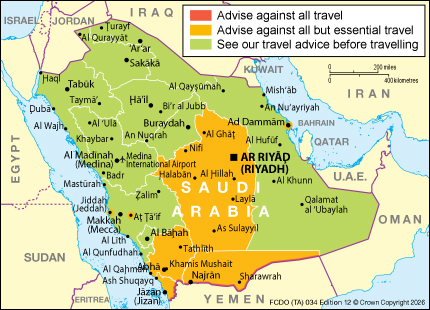
Regions covered by the Foreign Officegov.uk ↗updated 15.10.2026 · read 16.10.2026

Warnings — Foreign OfficeForeign Office ↗updated 15.10.2026 · read 16.10.2026
Your travel insurance could be invalidated if you travel against advice from the Foreign, Commonwealth & Development Office (FCDO).
FCDO advises against:
- all travel to within 10km of the border with Yemen
- all but essential travel to Aseer province, Riyadh province, Najran province, Jizan province and the cities of Taif, Jeddah and Dammam
- all but essential travel to all airports within Saudi Arabia except for Medina International Airport
Find out more about why FCDO advises against travel .
Following a serious incident at King Khalid International Airport on 10 October 2026 at approximately 3pm local time, we advise British nationals to stay away from King Khalid International Airport until it is secure and to follow advice from the Saudi authorities.
Since 13 July, the Houthis (a military group in Yemen) have launched missiles and drones targeting several locations in Saudi Arabia. There is a heightened threat against airports, Saudi military and defence buildings, military bases, ports and energy infrastructure across Saudi Arabia, including Abha, Jizan, Najran, Riyadh, Jeddah, Dammam and Yanbu, as well as shipping in the Red Sea. Further attacks against airports as well as disruption and cancellations are very likely.
We therefore advise against all but essential travel to all airports in Saudi Arabia, except for Medina International Airport.
As an alternative to airports within Saudi Arabia, British nationals wishing to leave Saudi Arabia should consider travelling by land to a neighbouring country and flying from there. Plan your journey carefully, including checking the travel advice for any entry and exit requirements. See ‘Regional risks page’ for more information on land routes.
In addition to the threat from Houthi attacks, there remains the possibility of renewed attacks by Iran. The US and Iran announced a memorandum of understanding (MOU) on 17 June 2026 in relation to the conflict in the Middle East. However, the situation remains unpredictable and there is a risk of further attacks or escalation in the region. Before the ceasefire, the Iranian regime stated its intention to target locations associated with the US and Israel, including organisations, businesses, facilities, and institutions.
In light of the regional tensions, British nationals in Saudi Arabia should:
- read If you’re affected by a crisis abroad - GOV.UK . This includes guidance on “how to prepare for a crisis” including suggestedemergency supplies and “what to do in a crisis”
- sign up for FCDO Travel Advice email alerts
- follow advice from the local authorities. Saudi Civil Defence may issue early warning alerts to people in affected areas
- monitor local and international media for the latest information
- avoid capturing or sharing images of conflict-related incidents
- stay away from areas around oil infrastructure and military facilities
- keep your travel plans under review and ensure your travel documents are up to date
- if travelling by air, check that your booking is confirmed and the status of your flight before travelling to the airport; remain alert and follow instructions from local authorities
- if you are advised to take shelter, stay indoors or go to the nearest safe building or designated shelter; an interior stairwell or a room with as few external walls or windows as possible may provide additional protection; the greatest risk is from falling debris caused by interceptions, and you are safest inside a secure structure
Regional risks — Foreign OfficeForeign Office ↗updated 15.10.2026 · read 16.10.2026
This section has safety advice for regions of Saudi Arabia. It only covers regions where FCDO has specific advice.
You should also read FCDO ’s overall travel advice and safety and security advice .
In 2026, direct military conflict between the Houthi rebel military group and the Governments of Yemen and Saudi Arabia has resumed.
FCDO advises against:
As an alternative to airports within Saudi Arabia, British nationals wishing to leave Saudi Arabia should consider travelling by land to a neighbouring country and flying from there. If you judge it is safe to do so, plan your journey carefully, including checking travel advice for the country you are considering to travel through, and any entry and exit requirements to make sure you have the correct documentation and not be denied entry.
If travelling by car, the vehicle must be wholly owned and registered in your name. If using commercial transport, check the latest updates from your airline or tour operator and ensure they can transport you across the border, follow instructions from the local authorities and check the status of border crossings before you travel. Make sure you have access to emergency supplies, water and essential medication. Travel within or out of Saudi Arabia is at your own risk.
Vehicle authorisations can be issued through the Absher portal, allowing another person, including dependants aged 18 and over, to drive your vehicle in Saudi Arabia or abroad. Drivers with a valid Exit/Re-Entry Visa must cancel it before the authorisation can be issued.
Some bus services, private hire taxis and other vehicles may offer cross-border travel. Check schedules, confirm bookings and make sure the operator has the necessary permissions to cross the border. Before you travel, check where your transport will leave you. Some border crossings do not have onward transportation, and facilities can be extremely limited.
The Saudi Tourism Authority has banned tourist trips to military zones and border posts.
In light of the regional tensions, British nationals in Saudi Arabia should:
- read If you’re affected by a crisis abroad - GOV.UK . This includes guidance on “how to prepare for a crisis” with suggested emergency supplies, and “what to do in a crisis”
- sign up for FCDO Travel Advice email alerts
- follow advice from the local authorities; Saudi Civil Defence may issue early warning alerts to people in affected areas
- monitor local and international media for the latest information
- avoid capturing or sharing images of conflict-related incidents
- stay away from areas around oil infrastructure and military facilities
- keep your travel plans under review and ensure your travel documents are up to date
- if travelling by air, check that your booking is confirmed and the status of your flight before travelling to the airport; remain alert at airports and follow instructions from local authorities
- if you are advised to take shelter, stay indoors or go to the nearest safe building or designated shelter; an interior stairwell or a room with as few external walls or windows as possible may offer additional protection; the greatest risk is from falling debris caused by interceptions, and you are safest inside a secure structure
Safety — Foreign OfficeForeign Office ↗updated 15.10.2026 · read 16.10.2026
There is a high threat of terrorist attack globally affecting UK interests and British nationals, including from groups and individuals who view the UK and British nationals as targets. Stay aware of your surroundings at all times.
UK Counter Terrorism Policing has information and advice on staying safe and what to do in the event of a terrorist attack. Find out how to reduce your risk from terrorism while abroad .
Terrorists are likely to try to carry out attacks in Saudi Arabia.
Attacks could be indiscriminate, including in places visited by foreign nationals. Stay aware of your surroundings, keep up to date with local media reports and follow the advice of local authorities.
Terrorists have threatened to carry out attacks in the Gulf region, including on:
Be aware of your surroundings, particularly during high-profile events, and avoid large demonstrations.
Ongoing hostilities between Israel and Lebanon could escalate quickly and pose risks for the wider region.
Monitor this travel advice and other media as the situation is changing fast. Follow and contact FCDO travel on X , Facebook and Instagram . You can also get email notifications when this travel advice is updated.
Read FCDO advice if you’re affected by a crisis abroad .
Public demonstrations are illegal. Avoid any protest or demonstration and follow the advice of local authorities.
The crime rate in Saudi Arabia is low, but there is petty crime. There have also been more serious crimes, including crimes against women. Take care when travelling outside towns and cities.
Saudi Arabia is a Muslim country and Islamic law is strictly enforced. Respect local traditions, customs, laws and religion so you do not cause offence. There may be serious penalties for doing something that might not be illegal in the UK.
You should avoid:
Penalties include fines, imprisonment and deportation. See Visit Saudi for information on behaviour.
You must always carry ID. You can get a fine or prison sentence if you do not have any.
If you’re a tourist, carry a copy of your passport and visa.
If you live in Saudi Arabia, carry your residency card (‘Iqama’). Police also accept an electronic version of the Iqama on the Tawakkalna app and Absher.
Ramadan is a holy month for Muslims. The dates vary by year and country. Ramadan in Saudi Arabia started on 18 February in 2026 and will last for 30 days. During this time, do not:
Get more advice when you arrive from your tour guide, hotel or business contacts.
You should also:
Men and women must wear loose-fitting…
American passport — U.S. Department of State
Faithful summary of the official texts below, which prevail.
Saudi Arabia - Level 3: Reconsider Travel 2026-10-11travel.state.gov ↗updated 11.10.2026 · read 16.10.2026
Reconsider travel to Saudi Arabia due to risk of drone and missile targeting of American interests by Iran and the Iranian-supported Houthis, armed conflict, terrorism, exit bans , and local laws regarding social media activity . Some areas have increased risk. Read the entire Travel Advisory.
U.S. government employee travel restrictions
Armed conflict
Following the onset of hostilities between the United States and Iran on February 28, 2026, there has been an ongoing threat of drone and missile attacks from Iran. Commercial flights are operational from Saudi Arabia, though they have been significantly disrupted at times.
Terrorism
There is risk of terrorist violence, including terrorist attacks and other activity in Saudi Arabia. Visit the U.S. Department of State’s country reports on terrorism to learn more.
Terrorism is a concern in Saudi Arabia. Attacks can occur with little or no warning, especially around holidays. They can involve knives, firearms, and vehicles.
Terrorists may use violence to respond to direct attacks against them or other military operations in the region.
Potential targets include:
Missile and drone attacks from Iran and threats from Houthis in Yemen
Iran and Iran-backed Houthi rebels have launched missile and drone attacks into Saudi Arabia.
Global Affairs Canada — additional reading
Avoid non-essential travel (with regional advisories)
Avoid non-essential travel to Saudi Arabia due to the volatile security situation in the region.
Avoid all travel to King Khalid International Airport in Riyadh due to ongoing military activity, which is disrupting airport operations.
Avoid all travel to to the provinces of Asir, Jazan and Najran due to the risk of armed strikes, drone attacks and military debris from interception.
Avoid all travel to areas within 30 km of the border with Yemen, due to the ongoing armed conflict in Yemen and the risk of violent clashes and spillovers across the border.
Open Government Licence – Canada · October 11, 2026 09:58 EDTtravel.gc.ca ↗updated 11.10.2026 · read 15.10.2026
Faithful summary of the official texts below, which prevail.
Global Affairs Canada — written for Canadian travellers, valid for all
You must abide by local laws. Learn about what you should do and how we can help if you are arrested or detained abroad.
Saudi Arabia’s judicial system is based on Sharia (Islamic law). Legal proceedings can be slow, complex, and may lack the transparency typically expected in Canada. Individuals suspected of a crime, or even witnesses, can be detained for extended periods without access to legal counsel or consular support. When access is granted, it may be limited and at the discretion of Saudi authorities. It is important to seek legal assistance as early as possible. Authorities may impose exit bans on individuals involved in legal proceedings or investigations, or those with unpaid debts. In some cases, Saudi citizens can also request exit bans against others.
Penalties for the importation, manufacturing, possession and consumption of alcohol, illegal narcotics and drugs (including cannabis) or products containing their ingredients are severe. Saudi authorities practice zero tolerance and make no distinction between alcohol and soft or hard drugs. Your bags will be screened on arrival. Drug offenders may be sentenced to corporal punishment or death. Drugs, alcohol and travel
It's illegal to:
Be cautious when discussing religious issues.
The importation, possession, and use of drones, including aerial photography and videography, are strictly regulated in Saudi Arabia. You must obtain authorization before importing or operating a drone. Failure to comply with drone regulations may result in severe penalties, including imprisonment, fines, and confiscation of the equipment.
In 2027, the lunar month of Ramadan is expected to begin on or around February 7. In public, between sunrise and sunset, be discreet when:
Saudi Arabia’s customs, laws, and regulations closely adhere to Islamic practices and beliefs. You should dress conservatively, behave discreetly, and respect religious and social traditions to avoid offending local sensitivities, especially in the holy cities of Mecca and Medina and in mosques. Both men and women should dress modestly in public, avoiding tight-fitting clothing or items with language or images that may be considered culturally offensive. Shoulders and knees should be covered. Women who don’t adhere to local dress standards may attract unwanted attention. In Saudi Arabia, cultural norms and the Public Decorum Charter encourage modest dress. Women are generally expected to cover their arms and legs. Clothing with profanity, offensive images, or symbols promoting racism, drugs or obscenity is prohibited in public.
Avoid public displays of affection, such as holding hands. Some restaurants have sections for men only and one for families where females can be served, including when unaccompanied.
Saudi law criminalizes sexual acts and relationships between persons of the same sex. Convicted 2SLGBTQI+ persons face:
2SLGBTQI+ persons could be detained based on their sexual orientation, gender identity, gender expression, or sex characteristics. They could also face charges such as:
Transgender people and cross-dressers face the same consequences as those convicted of homosexuality. Public or online discussions related to sexual orientation or gender identity could be considered by Saudi authorities as provoking or questioning public order, religious values, and public morals. 2SLGBTQI+ persons should take into consideration the risks of travelling to Saudi Arabia. Travel and your sexual orientation, gender identity, gender expression and sex characteristics
Local authorities may ask you to show identification at any time.
If you wish to reside in Saudi Arabia and are in a common-law relationship, you will be required to provide proof of marriage to register in the country.
Extramarital relations are illegal and subject to severe punishment, including the death penalty.
The Hague Convention on the Civil Aspects of International Child Abduction is an international treaty. It can help parents with the return of children who have been removed to or retained in certain countries in violation of custody rights. It does not apply between Canada and Saudi Arabia. If your child was wrongfully taken to, or is being held in Saudi Arabia by an abducting parent:
If your child was removed from a country other than Canada, consult a lawyer to determine if The Hague Convention applies. Be aware that Canadian consular officials cannot interfere in private legal matters or in another country's judicial affairs.
It’s prohibited to import and consume pork-based products.
Open Government Licence – Canada · October 11, 2026 09:58 EDTtravel.gc.ca ↗updated 11.10.2026 · read 15.10.2026
Foreign Office — laws and cultural differences
Saudi Arabia is a Muslim country and Islamic law is strictly enforced. Respect local traditions, customs, laws and religion so you do not cause offence. There may be serious penalties for doing something that might not be illegal in the UK. You should avoid:
Penalties include fines, imprisonment and deportation. See Visit Saudi for information on behaviour.
You must always carry ID. You can get a fine or prison sentence if you do not have any. If you’re a tourist, carry a copy of your passport and visa. If you live in Saudi Arabia, carry your residency card (‘Iqama’). Police also accept an electronic version of the Iqama on the Tawakkalna app and Absher.
Ramadan is a holy month for Muslims. The dates vary by year and country. Ramadan in Saudi Arabia started on 18 February in 2026 and will last for 30 days. During this time, do not:
Get more advice when you arrive from your tour guide, hotel or business contacts. You should also:
Men and women must wear loose-fitting clothing that covers the elbow and below the knees. Avoid clothing that:
Female travellers do not have to wear the traditional robe (‘abaya’) or cover their hair. See Visit Saudi for more information on dress codes.
It is illegal to practise any religion other than Islam. However, the Saudi authorities accept private practice of other religions. It is illegal to try to convert people to another religion. You can bring other religious books for personal use. However, you may be prosecuted if you try to import large numbers of religious books.
Do not bring alcohol into Saudi Arabia or arrive under the influence of alcohol. It is illegal to drink alcohol or be drunk in public. Police have arrested British nationals for disorderly or offensive behaviour when drinking. You can face severe penalties, including prison, for brewing, possessing or selling alcohol.
There is zero tolerance for drug offences in Saudi Arabia, and the penalties are severe. If you’re arrested for drug offences, you may have a long period of detention before trial. You can get a prison sentence of up to 5 years and a fine of 30,000 Saudi riyals for possessing even small amounts. Drug dealing and smuggling can result in a death sentence.
Sex outside of marriage and adultery are illegal, including for tourists. In the most serious circumstances (for example, those involving Saudi nationals) the penalties could include custodial sentences or deportation. There are special arrangements for visitors, and unmarried tourists may share hotel rooms.
If you or your partner becomes pregnant outside marriage in Saudi Arabia, you could both face penalties including imprisonment and deportation. However, in practice, legal action is uncommon. Doctors may ask for proof of marriage during antenatal checks. To get a birth certificate from the Saudi authorities, you must provide a marriage certificate. The authorities may compare the date of the marriage against the estimated date of conception. If you’re an unmarried woman who gives birth in Saudi Arabia, you may have difficulties registering the birth of a child in Saudi Arabia. You could be arrested, imprisoned or deported.
It is illegal to film or photograph government buildings, diplomatic premises, military installations and palaces. If you produce, transmit or distribute printed, digital, audio or video information, you must get permission from the General Authority of Media Regulation (GCAM) in advance. If you do not, you could get a large fine and a prison sentence. Only photograph local people if you have their consent.
It is illegal to say publicly anything that the Saudi authorities deem disruptive to public order. Avoid making comments verbally or on social media on the topics below:
Speaking publicly about these issues can be defined by the Saudi authorities as posing a threat to national security. Statements made on social media many years ago, or those published outside Saudi Arabia, may be taken into account. Punishment can include long custodial sentences. The legal processes around national security cases can be complex and slow. If you are detained, it may take some time for the Saudi authorities to grant permission for consular officials to visit you. You’re likely to come under more scrutiny if you’re a British national who also:
It is illegal to have 2 passports in your name in Saudi Arabia. Immigration authorities will take additional passports. You must leave Saudi Arabia using the passport you entered on.
The Saudi legal system differs from the UK, for example:
If you’re detained and need consular assistance, British Embassy staff will visit once they know about your case. In some cases, British Embassy staff have not been allowed to visit immediately or have had limited access. There is no legal aid in Saudi Arabia. You may want to hire a translator if you need to attend a criminal proceeding. Find a translator or interpreter in Saudi Arabia.
You can get a fine, prison sentence or travel ban, or face deportation for financial crimes, including:
The Saudi authorities can also freeze your bank account or other assets. You may be liable for cheques you signed on behalf of a company. The Saudi authorities could:
Open Government Licence v3.0gov.uk ↗updated 15.10.2026 · read 16.10.2026
FDFA (Switzerland) — laws and customs, in French
Le cadre juridique s'inspire d’une conception du droit islamique stricte et de principes moraux rigides. Les infractions sont systématiquement poursuivies et punies plus durement qu’en Suisse. Entre autres, sont punissables:
De nombreux produits sont soumis à des restrictions ou interdictions d’importation. Conformez-vous aux consignes des autorités saoudiennes. Saudi Customs Les infractions à la loi sur les stupéfiants, y compris la détention de minimes quantités de drogue quelle qu'elle soit, sont passibles de lourdes peines de prison; la peine de mort peut être prononcée. Les conditions de détention sont bien plus dures qu'en Suisse. Une personne au volant impliquée dans un accident de la route ayant fait des victimes ou des personnes blessées ne peut pas quitter le pays pendant l'enquête/l'instruction, tant que la question de la responsabilité n’a pas été clarifiée. Il arrive aussi, en cas de litige financier, que la police empêche des personnes de nationalité étrangère de quitter le pays jusqu'à ce que l'affaire soit réglée.
Conformez-vous aux règles de conduite très strictes et adaptez votre comportement et votre tenue vestimentaire aux us et coutumes locaux ainsi qu'aux sensibilités religieuses et nationales. Renseignez-vous dans les guides de voyages, auprès de votre agence ou directement sur place, sur les codes de conduite et les conventions à respecter. Pendant le ramadan, des règles et des prescriptions particulières s’appliquent. Demandez préalablement la permission aux personnes que vous souhaitez photographier. Visit Saudi Arabia: Public Decorum Charter
FDFA travel advice, in Frencheda.admin.ch ↗updated 12.10.2026 · read 16.10.2026
What it changes for you: Air acceptable at this hour: nothing special to plan. High UV at midday: sun protection.
Reading 07:00 (Asia/Riyadh)Open-Meteo ↗updated 16.10.2026 · read 16.10.2026
Air quality and UV: Open-Meteo.com (CC BY 4.0), data rounded and formatted by Maximum. Contains modified Copernicus Atmosphere Monitoring Service information 2026. Neither the European Commission nor ECMWF is responsible for any use that may be made of the Copernicus information or data it contains.
Reading: Medical density comparable to Switzerland: the local network handles most cases; repatriation remains a question of convalescence and cost. Health spending of 1,825 USD per person (Switzerland: 11,784) goes with private hospitals that bill foreigners in hard currency and ask for a guarantee before admission: the direct payment guarantee is what avoids the deposit.
World Bank — latest published value, year per indicatordata.worldbank.org ↗read 12.10.2026
French passport — France Diplomatie
Faithful summary of the official texts below, which prevail.
- Présentation de l'Arabie saoudite
-
-
-
-
-
-
-
-
-
-
RAPPEL
L’Arabie saoudite propose aux ressortissants de 65 pays, dont la France, un service de visa électronique pour motif touristique.
Pour autant, il est recommandé aux Français souhaitant effectuer un voyage touristique en Arabie Saoudite d’obtenir en ligne, avant leur déplacement, un visa électronique via le site Visit Saudi .
Les autorités saoudiennes ne délivrent pas de visas aux détenteurs de passeports sur lesquels figurent des visas ou des tampons israéliens.
Dans tous les cas, les visiteurs doivent être en mesure, à l’arrivée, de présenter les justificatifs obligatoires, notamment en matière de couverture médicale.
Selon la compagnie et l’itinéraire empruntés, certains passagers en transit en Arabie saoudite sont exemptés de visa de transit. Les autorités saoudiennes peuvent cependant exiger un visa à l’arrivée pour les passagers en transit. Il faut en conséquence prévoir le délai et les fonds nécessaires à cette démarche. Il est également possible de demander un e-visa en ligne avant le départ vers l’Arabie saoudite. Toutes les informations officielles se trouvent sur le site Visit Saudi .
Stopover visa (Flynas et Saudi Arabia Airlines uniquement)
Ce visa gratuit permet de se rendre en Arabie saoudite pour transiter vers un autre pays, entrer en Arabie saoudite pour faire la Omra ou encore faire du tourisme. Les conditions à remplir :
Modalités d’obtention :
L’entrée sur le territoire saoudien pour motif religieux nécessite l’obtention d’un e-visa accessible sur le site Visit Saudi . Le e-visa permet de combiner le petit pèlerinage (Omra) avec un séjour touristique.
Pour la Omra, en plus du visa, il convient de s’inscrire sur la plateforme Nusuk et de consulter la brochure 2024 dédiée au pèlerinage.
Pour le pèlerinage Hajj, il existe un visa et une procédure spécifiques, décrits dans la brochure 2024 dédiée au pèlerinage.
Toute demande de visa professionnel doit être garantie par un répondant (« sponsor ») saoudien ou un expatrié résidant dans le pays. Les étrangers résidant en Arabie Saoudite dépendent d’un répondant et doivent disposer d’une carte de séjour (« iqama »). Le visa d’installation doit être demandé en dehors d’Arabie saoudite et permet l’obtention de l’iqama après l’arrivée sur le territoire saoudien. En sus de l’iqama, l’employeur devra également faire les démarches de visa « exit-re entry », qui seul permettra une entrée/sortie du territoire saoudien.
Toutes les informations relatives à la situation des résidents étrangers, toutes les mises à jour de leur situation se font sur l’application Absher.
Il arrive que l’employeur conserve le passeport de l’employé. Ce dernier ne peut quitter définitivement l’Arabie saoudite que si son employeur demande pour lui et obtient un visa de sortie définitif (final exit). La détention d’un second passeport est interdite. Dans ces conditions, il peut être difficile de quitter le pays en cas de litige avec un particulier ou une entreprise saoudienne.
A l’arrivée en Arabie Saoudite, les bagages sont généralement inspectés dans le détail. Il convient de respecter les interdictions sur l’importation de certains biens (voir la rubrique « us et coutumes »), pour éviter leur confiscation et une fouille pénible.
L’introduction de drones de loisir n’est pas autorisée et leur utilisation locale est strictement encadrée. Tout drone non autorisé préalablement sera confisqué et son détenteur pourra faire l’objet de poursuites. Informations en suivant ce lien GACA .
Pour tout renseignement complémentaire, il est recommandé de contacter l’ambassade d’Arabie Saoudite en France .
Lorsqu’ils s’installent en Arabie Saoudite, les ressortissants français sont instamment invités à effectuer les formalités d’inscription consulaire auprès de l’ambassade de France à Riyad (dont la circonscription consulaire inclut outre Riyad, les gouvernorats de Hail, Qassim et la province orientale : Dammam, Al Khobar, Jubail) ou du consulat général de France à Djeddah (dont la circonscription consulaire inclut également les gouvernorats de Tabouk, Al Jouf, Médine, La Mecque, Djeddah, Al Baha, Assir, Jizan, Najran, et de la frontière nord).
Dans tous les cas, il est recommandé aux ressortissants français, qu’ils soient de passage ou en résidence, de détenir les coordonnées des services consulaires au cours de leur séjour en Arabie Saoudite. Il leur est demandé d’informer au plus vite l’ambassade de France à Riyad ou le consulat général à Djeddah de tout incident dont ils pourraient avoir connaissance, ce qui permet, le cas échéant, d’évaluer la situation et d’adapter le dispositif de sécurité pour la communauté française.
A partir du 1er Février 2025, la vaccination contre les infections invasives à méningocoques avec un vaccin quadrivalent (ACWY) est obligatoire pour tous les pèlerins effectuant la Oumra ou le pèlerinage, qu’ils soient :
En cas de contrôle, toutes les personnes séjournant sur les lieux saints doivent pouvoir présenter une preuve de vaccination.
Dès lors, un justificatif de vaccination (carnet de vaccination, certificat médical) sera exigé à l’aéroport pour toute personne se présentant sur le territoire saoudien avec le statut de pèlerin.
Pour rappel, cette vaccination doit être réalisée au-moins 10 jours avant le départ.
Plus d’informations à la rubrique santé .
Depuis le 13 juin 2022, le respect des mesures barrières (masque facial, distanciation) et la présentation d’une preuve d’immunisation (application Tawakkalna ou certificat de vaccination) ne sont plus requis pour l’accès aux espaces publics, aux transports en commun ou aux lieux de travail dans le royaume.
S’agissant des voyageurs entrant dans le pays, aucune vaccination ni test PCR ne sont exigés.
Tous les voyageurs titulaires de visas de court séjour doivent impérativement souscrire une assurance médicale couvrant les éventuels frais médicaux qu’ils engageraient et être en mesure de la présenter à leur arrivée.
Il reste cependant recommandé d’être en possession d’un certificat de vaccination en anglais ou traduit en arabe, ce dernier pouvant être exigé en cas d’admission dans un établissement hospitalier ou à l’occasion d’une consultation médicale.
Entry and stay pagediplomatie.gouv.fr ↗updated 13.10.2026 · read 16.10.2026
Swiss passport — FDFA (Switzerland)
The FDFA does not publish entry requirements: they are set out by the destination's embassy or consulate in Switzerland — check them before booking, passport in hand. As a guide, the French and British requirements below describe the same rules as seen by two other governments.eda.admin.ch ↗updated 12.10.2026 · read 16.10.2026
British passport — Foreign Office (UK)
Faithful summary of the official texts below, which prevail.
Entry requirements — rules for a British passportForeign Office ↗updated 15.10.2026 · read 16.10.2026
This information is for people travelling on a full ‘British citizen’ passport from the UK. It is based on the UK government’s understanding of Saudi Arabia’s current rules for the most common types of travel.
The authorities in Saudi Arabia set and enforce entry rules. If you’re not sure how these requirements apply to you, contact the Saudi Embassy in the UK .
For entry into Saudi Arabia, your passport must have an ‘expiry date’ at least 6 months after the date you arrive.
Check with your travel provider that your passport and other travel documents meet requirements. Renew your passport if you need to.
You will be denied entry if you do not have a valid travel document or try to use a passport that has been reported lost or stolen.
You may not be allowed to enter Saudi Arabia if your passport shows that you have travelled to, or were born in, Israel.
When returning to the UK, British citizens must carry a valid British passport or certificate of entitlement . See Dual citizenship .
You must get a visa to visit Saudi Arabia. The type of visa you choose depends on your reason for travelling and how long you want to stay.
If you overstay your visa, you could face large fines, detention and deportation. You could be banned from returning to Saudi Arabia.
You can apply for an electronic travel authorisation (ETA) if you are travelling to Saudi Arabia for:
- tourism
- business
- study
- medical treatment
- Umrah (outside the Hajj season)
An ETA is is valid for 730 days from the date of issue.
Valid for multiple entries, but only 180 days in total across the 730 day period .
Apply for an ETA online before you travel. If you are travelling for Hajj, you must obtain a separate Hajj visa. See Pilgrimage for more information.
An ETA does not include health insurance for your visit. Visas issued before the ETA was introduced will remain valid, in accordance with the conditions and dates on the visa when issued.
You can apply for an e-visa if you are a tourist.
E-visas are:
Apply for an e-visa online or when you arrive at any of Saudi Arabia’s international airports.
An e-visa includes health insurance for your visit up to 100,000 Saudi Arabian Riyals (SAR). Medical treatment in Saudi Arabia can be expensive, and you should consider taking out additional travel insurance to cover costs beyond 100,000 SAR.
You must get a separate visa for Hajj. See Pilgrimage .
Electronic visa waivers are for:
An electronic visa waiver allows you to enter Saudi Arabia once and stay for up to 180 days.
An electronic visa waiver does not include health insurance for your visit.
Apply for an electronic visa waiver online at least 48 hours before your flight, or up to 90 days in advance. You will need to…
American passport — U.S. Department of State
The State Department publishes the requirements ("Entry, Exit and Visa Requirements") on its country page, which our servers cannot read. Read it before you go; as a guide, the French and British requirements below describe the same rules as seen by two other governments.travel.state.gov ↗updated 11.10.2026 · read 16.10.2026
For each risk, the official texts themselves: what is happening, then, where they say so, what to do.
What the texts say · Since 13 July 2026, the Houthis have launched missiles and drones targeting several cities, airports, military bases and energy infrastructure sites across Saudi Arabia including Abha, Jizan, Najran, Riyadh, Taif, Jeddah and Yanbu as well as Saudi shipping vessels in the Red Sea. Terrorists are likely to try to carry out attacks in Saudi Arabia.
What the texts say · The authorities can temporarily close airports near the Saudi Arabia-Yemen border.
What the texts say · Heavy rains from November to February can cause flooding. Saudi Arabia faces extreme heat, especially in the summer between May and October, with temperatures well above 40°C.
What the texts say · It is illegal to drink alcohol or be drunk in public. Penalties for the importation, manufacturing, possession and consumption of alcohol, illegal narcotics and drugs (including cannabis) or products containing their ingredients are severe.
What the texts say · Public demonstrations are illegal.
Sentences copied word for word from the official texts cited, chosen for the destination; the level is our reading. The full texts, at each source:Foreign Office ↗updated 15.10.2026 · read 16.10.2026 (updated 15.10.2026 · read 01.10.2026)Global Affairs Canada ↗updated 11.10.2026 · read 15.10.2026 (updated 11.10.2026 · read 01.10.2026)
Reading: The homicide rate is above Switzerland's, without being out of range. On the road, 16 times more deaths than in Switzerland: road crashes are the leading cause of death of healthy travellers (CDC) — seat belt, no night driving, a driver or a taxi from a rank.
World Bank (UNODC for homicides, WHO for roads) — latest published valuedata.worldbank.org ↗read 12.10.2026
Time zone: IANA and timezone-boundary-builder (ODbL) · RESTCountries · EmergencyNumberAPI · Wikidata · European Central Bank
Places: © OpenStreetMap contributors (ODbL), Photon search by komoot.
FDFA (Switzerland) — transport and specific advice, in French
Les comportements parfois imprévisibles sur les routes et les excès de vitesse augmentent considérablement les risques d'accident de la circulation. Pour voyager dans le désert , il est recommandé de circuler uniquement en convoi de plusieurs véhicules tout terrain. Il est vital de se munir d’un instrument de navigation et d’une provision suffisante d’eau, de nourriture et de carburant, ainsi que de pièces de rechange. Les points de passage des frontières peuvent être temporairement fermés à court terme, par exemple afin d’endiguer la propagation de maladies. Informez-vous auprès des autorités locales ou directement auprès des postes-frontières.
L'accès à certaines régions est soumis à une autorisation spéciale. L'Ambassade d'Arabie saoudite à Berne fournit toutes informations à ces sujets. Il est obligatoire de pouvoir s’identifier avec son passeport à tout moment (ou avec une photocopie y inclus le visa).
FDFA travel advice, in Frencheda.admin.ch ↗updated 12.10.2026 · read 16.10.2026
Maximum policyholder: before paying anything, call the 24/7 number. If you are admitted for more than 24 h, Maximum sends its direct payment guarantee to the hospital (art. 2.12).
+41 22 ••• •• •• — Full number in your client areaNone of these facilities is a Maximum Insurance “partner”, and none is presented as waiving upfront payment: this list is a reading of public map data, nothing more. A direct payment guarantee is arranged CASE BY CASE by our assistance desk, facility by facility and when the need arises — one number, +41 22 ••• •• ••.
List read from OpenStreetMap on 07.10.2026, not read again since: these facilities may have changed.
CDC Travelers' Health recommendations, most important first. They depend on your age, vaccines and itinerary: confirm them with a doctor or a travel clinic 4 to 6 weeks before departure. Details, disease by disease ↗cdc.gov ↗read 10.10.2026
The health system — Medical density comparable to Switzerland: the local network handles most cases; repatriation remains a question of convalescence and cost. Health spending of 1,825 USD per person (Switzerland: 11,784) goes with private hospitals that bill foreigners in hard currency and ask for a guarantee before admission: the direct payment guarantee is what avoids the deposit.
Back home — a fever in the following weeks should be told to a doctor, naming the country.
Forecast: MET Norway (Norwegian Meteorological Institute, CC BY 4.0), grouped by day and formatted by Maximum.
French passport — French embassy and consulates
+966-11) 51 02 769 · France Diplomatie
http://www.ambafrance-sa.org/ ↗
phone not published
phone not published
Useful contacts listed by France Diplomatie (in French)diplomatie.gouv.fr ↗updated 13.10.2026 · read 16.10.2026
Updated: 13 October 2026
OpenStreetMap
Swiss passport — Swiss embassy and consulates
Diplomatic quarter
+966 11 488 12 91
https://www.eda.admin.ch/countries/saudi-a ↗updated 12.10.2026 · read 16.10.2026
Représentations suisses à l’étranger: En cas de situation d’urgence à l’étranger, vous pouvez vous adresser à la représentation suisse la plus proche ou à la Helpline DFAE. Ambassade de Suisse en Arabie saoudite Helpline DFAE Représentations étrangères en Suisse: Pour obtenir des informations sur les prescriptions d'entrée (documents d'identité admis, visa, etc.), veuillez vous adresser aux ambassades et consulats étrangers compétents. Ceux-ci peuvent également vous renseigner sur les dispositions douanières pour l'importation et l'exportation d'animaux et de marchandises: appareils électroniques, souvenirs, médicaments, etc. Représentations étrangères en Suisse e-Visa pour l’Arabie saoudite
OpenStreetMap · DFAE
British passport — British embassy and consulates
phone not published
https://www.gov.uk/world/organisations/bri ↗updated 15.10.2026 · read 16.10.2026
phone not published
https://www.gov.uk/world/organisations/bri ↗updated 15.10.2026 · read 16.10.2026
OpenStreetMap
American passport — U.S. embassy and consulates
phone not published
https://sa.usembassy.gov/ ↗updated 11.10.2026 · read 16.10.2026
phone not published
(966-13) 330-3200
https://sa.usembassy.gov/embassy-consulate ↗updated 11.10.2026 · read 16.10.2026
Khobar
phone not published
Al Safa Street, Jeddah
phone not published
https://sa.usembassy.gov/ ↗updated 11.10.2026 · read 16.10.2026
phone not published
OpenStreetMap
OpenStreetMap
Getting help — Foreign OfficeForeign Office ↗updated 15.10.2026 · read 16.10.2026
The Foreign, Commonwealth & Development Office ( FCDO ) cannot provide tailored advice for individual trips. Read this travel advice and carry out your own research before deciding whether to travel.
Telephone: 911 (ambulance, fire, police)
If you do not have a Saudi SIM card, call 112 in an emergency.
Contact the Saudi Embassy in London or the Saudi Embassy in the country you are located.
Contact your travel provider and your insurer if you’re involved in a serious incident or emergency abroad. They will tell you if they can help and what you need to do.
See how to get help from the UK government abroad including in an emergency.
You can call FCDO in London if you need urgent help because something has happened to a friend or relative abroad.
Telephone: 020 7008 5000 (24 hours)
Find out about call charges
For emergencies. If pronunciation fails, show the screen — or the printed page.
| Help! | النجدة!an-najda! |
| Call an ambulance! | اتصلوا بالإسعاف!ittasilu bil-is'af! |
| I need a doctor. | أحتاج إلى طبيب.ahtaju ila tabib. |
| Where is the nearest hospital? | أين أقرب مستشفى؟ayna aqrab mustashfa? |
| Call the police! | اتصلوا بالشرطة!ittasilu bish-shurta! |
| I am allergic to penicillin. | عندي حساسية من البنسلين.'indi hassasiyya min al-binisilin. |
| I have international medical insurance. | لدي تأمين طبي دولي.ladayya ta'min tibbi dawli. |
| I want to contact my embassy. | أريد الاتصال بسفارتي.urid al-ittisal bi-safarati. |
| Please take me to this address. | خذني إلى هذا العنوان من فضلك.khudhni ila hadha al-'unwan min fadlak. |
| Do you speak English? | هل تتكلم الإنجليزية؟hal tatakallam al-injiliziya? |
Translations by Maximum Insurance, original script and transliteration.
Actions to take before each professional trip abroad.
Live alerts and level changes, each with its official source. Continuously updated.
Les frappes meurtrières menées au cours des derniers jours par les Houthis sur Riyad et son aéroport international ainsi qu’à Dammam et dans le sud de l’Arabie saoudite doivent conduire les ressortissants français présents sur le territoire saoudien à éviter tout déplacement non-essentiel et à faire preuve de la plus grande vigilance. Il est recommandé aux ressortissants français de : suivre les consignes diffusées par les autorités locales ; se mettre à l’abri en cas…
France Diplomatie (in French) · posted 8 October 2026 · updated 12 October 2026diplomatie.gouv.fr ↗updated 13.10.2026 · read 16.10.2026Compte tenu des menaces visant les bâtiments civils qui passent par le détroit de Bab-el-Mandeb et d’activités militaires en Mer Rouge et dans le nord du Golfe d’Aden, il est instamment recommandé aux navigateurs de plaisance de reporter sine die leurs déplacements dans cette zone. En outre, une recrudescence récente des actes de piraterie le long des côtes de la Somalie a été enregistrée et est susceptible d’affecter les bateaux ayant besoin de faire d’escale dans la…
France Diplomatie (in French) · posted 1 October 2025 · updated 4 March 2026diplomatie.gouv.fr ↗updated 13.10.2026 · read 16.10.2026Safety and security section – updated information on the situation at the King Khalid International Airport
October 11, 2026 09:58 EDTtravel.gc.ca ↗updated 11.10.2026 · read 15.10.2026No level change recorded for this country since the log opened. The live alerts above are updated continuously.
Level 3/4 — Reconsider Travel, U.S. Department of State, retrieved on 16 October 2026.
Sourcestravel.state.gov · updated 11.10 · read 16.10France Diplomatie · updated 13.10 · read 16.10DFAE · updated 12.10 · read 16.10207-country comparison
An area advised against does not rule out the country.
SourcesFrance Diplomatie · updated 13.10 · read 16.10Foreign Office · updated 15.10 · read 16.10State Department · updated 11.10 · read 16.10
The rules depend on the passport, not on the destination alone.
SourcesFrance Diplomatie · updated 13.10 · read 16.10Foreign Office · updated 15.10 · read 16.10State Department · updated 11.10 · read 16.10
For a Schengen visa, yes: at least €30,000 of travel medical insurance (Regulation (EC) No 810/2009, art. 15).
SourcesRegulation (EC) 810/2009, art. 15General conditions, policy 20 00 479
VIP Pack — €990 for twelve months, unlimited trips.
SourcesGeneral conditions, policy 20 00 479OpenStreetMap · read 13.10
From 45 000 € to 120 000 € depending on severity and distance (SkyCare (guide tarifaire), 2025).
SourcesSkyCare (guide tarifaire), 2025General conditions, policy 20 00 479
Six steps, in this order.
SourcesSpecial conditions 01.26General conditions, policy 20 00 479
Local emergency services: single number 112 / 911 · police 999 · ambulance 911
SourcesEmergencyNumberAPI · Wikidata · read 08.10OpenStreetMap · read 13.10
At today's level 3/4, card by card:
SourcesAmex Platinum France T&Cs, 01.2025 — general exclusion n° 11BNP Paribas Visa Infinite notice (policy PT7), 04.2025 — comFortuneo World Elite Mastercard notice, 01.2026 — art. 5.5 '
A health plan reimburses at home; here, the hospital asks for a payment guarantee before admission.
SourcesGeneral conditions, policy 20 00 479
Around Riyadh: 80 hospitals and clinics, 62 with a 24/7 emergency room, 24 pharmacies, 17 doctors' practices (OpenStreetMap, hospital list read on 07.10.2026).
The sourced detail is under Medical network › Health: vaccines, diseases present, altitude, outbreaks.
SourcesCDC Travelers' Health · read 10.10France Diplomatie · updated 13.10 · read 16.10OMS · updated 12.05 · read 16.10Foreign Office · updated 15.10 · read 16.10
3.4 physicians per 1,000 people (2023) versus 4.5 in Switzerland.
SourcesWorld Bank · read 12.10General conditions, policy 20 00 479
0.9 homicides per 100,000 people (2019) versus 0.6 in Switzerland and 1.3 in France.
The nearest representations, by passport (OpenStreetMap):
SourcesOpenStreetMap · read 13.10DFAE · updated 12.10 · read 16.10
At least one official reading covers the whole country; 4 regions are also named, fully or partly.
SourcesGlobal Affairs Canada · updated 11.10 · read 15.10Foreign Office · updated 15.10 · read 16.10France Diplomatie · updated 13.10 · read 16.10
Local laws apply to every traveller; here is what the official texts say.
SourcesGlobal Affairs Canada · updated 11.10 · read 15.10Foreign Office · updated 15.10 · read 16.10
Every foreign ministry runs a 24/7 emergency line for its nationals.
Sourcesdiplomatie.gouv.fr · updated 13.10 · read 16.10eda.admin.ch · updated 12.10 · read 16.10
Emergency phrases, transliterated; the original script, to show if pronunciation fails, is under Useful phrases.
SourcesMaximum Insurance
Keep the entry stamp, the invoices, the prescriptions and the medical report.
SourcesGeneral conditions, policy 20 00 479
Cancellation or change up to EUR 20,000, special risk EUR 5,000 per person, crisis management and security, optional Kidnap & Ransom.
SourcesGeneral conditions, policy 20 00 479
A question not answered here? Ask Maximum below, or call the support number: every question gets a clear, actionable answer.
In a life-threatening emergency, call local emergency services first, then Maximum: +41 22 ••• •• •• — 24/7 support number, an adviser stays with you to the end.
The 207 country pages — hospitals, pharmacies, police, embassies, emergency numbers, official advice from four governments, health, safety in figures, events in progress — read around the city you name. Your policy — benefits, the six steps, claims, articles. The site — prices, certificate, subscription. Nothing else: what it does not know, it says so and hands you to an adviser.
The published advisory level is national, but risk is not: business hubs (Riyad, Djeddah, NEOM) do not share the profile of border areas. The medical network shown on this page is computed around Riyadh — real hospitals, evacuation airport and live alerts. Before a specific trip, always cross-check your country of residence's advisory: that is what your policy cites.
Same advisory level: Oman · Pakistan · Papua New Guinea · Qatar · Rwanda · Tanzania
The displayed level comes from the State Department, checked every morning. Before departure, always cross-check your country of residence's advisory: that is what your policy cites.
The level shown is the official U.S. Department of State level, checked daily. Maximum Insurance is an insurance distributor — general information, not personal advice.
The destination is already Riyadh. A few choices, then the reading of your cover, here.
Destination · Riyadh
Travel Insurtech. 24/7 worldwide.
Swiss insurer · Worldwide medical network