2 d ago
Magnitude 6.0 earthquake — Papua New Guinea
706.6 km — 126 km S of Kokopo, Papua New Guinea · USGS, last 7 days
Maximum Alerts / Papua New Guinea
Level published by the State Department on 28.04.2025 · read 16 October 2026 · source checked daily
Papua New Guinea — official level as of 16 October 2026: Level 3/4 ("Reconsider Travel"), from the U.S. Department of State. Maximum Insurance covers this country: hospital settled directly, unlimited repatriation, EUR 1.5M, certificate on payment.
Every country has its own scale, so we ask them all the same question: is the whole country advised against?
An advisory covering only areas of the country does not raise the answer: it stays “No”, and the area is shown in the relevant column.
The level shown on this page — and across this site — is the one published by the U.S. State Department, from 1 (normal precautions) to 4 (do not travel). France and the United Kingdom publish their own advisories, with their own rules: they add to that level, they do not replace it.
2 events in progress4 recorded incidents (UCDP)hover, click to open it in the briefing
In a life-threatening emergency, call local emergency services first, then Maximum: +41 22 ••• •• •• — 24/7 support number, an adviser stays with you to the end.
The 207 country pages — hospitals, pharmacies, police, embassies, emergency numbers, official advice from four governments, health, safety in figures, events in progress — read around the city you name. Your policy — benefits, the six steps, claims, articles. The site — prices, certificate, subscription. Nothing else: what it does not know, it says so and hands you to an adviser.
What I say on the phone
What to do, in this order
In immediate danger, call local emergency services first. Then contact assistance without delay; before engaging a service, seek approval under your policy. Cover is confirmed by the insurer.
Ask assistance where to get care and whether direct cover can be arranged. It confirms the facility and seeks the insurer's approval under your policy. In immediate danger, call local emergency services first.
Even for a pain you meant to shrug off. Without a medical certificate written on the spot, the same day, the insurer cannot cover the event — a certificate written after you return does not count.
The hospital desk sends the request to assistance. Direct payment depends on the insurer's approval and the policy; the call alone does not guarantee it. Have the response confirmed before relying on no up-front payment.
In a life-threatening emergency, call local emergency services immediately. For an arranged transfer or repatriation, contact assistance: the insurer's medical team decides on measures under the policy. A medical flight booked without approval may not be reimbursed.
Even if everything went well on the ground. Send your invoices and the medical report within 30 days; after that, compensation may be reduced or refused.
Places read from OpenStreetMap, within a circle of about 12 km: phone, email, address, website and hours when the source publishes them. No customer reviews, that source has none. Straight-line distances.
Notices vary by bank and vintage — yours prevails. On the right: the Maximum contract (public documents).
At least one official reading covers the whole country; 6 regions are also named, fully or partly.
Faithful summary of the official texts below, which prevail.
Global Affairs Canada — advises against all but essential travel to the whole country.
an official reading covers the whole country; every trip calls for a written management decision, justified by a pressing reason, with reinforced conditions.
France Diplomatie (in French)
Compte tenu de la situation sécuritaire qui prévaut dans les Highlands et le Sepik (provinces d’Hela, Enga, Jiwaka, Simbu, Western Highlands, Southern Highlands, Eastern Highlands, West et East Sepik) et des fréquents évènements violents que connaissent ces contrées sur fond de tensions tribales et communautaires, il est fortement déconseillé de s’y rendre s
Foreign Office
Enga Province in the Highlands, except Wabag District
France Diplomatie (in French)
Compte tenu de la situation sécuritaire qui prévaut dans les Highlands et le Sepik (provinces d’Hela, Enga, Jiwaka, Simbu, Western Highlands, Southern Highlands, Eastern Highlands, West et East Sepik) et des fréquents évènements violents que connaissent ces contrées sur fond de tensions tribales et communautaires, il est fortement déconseillé de s’y rendre s
Foreign Office
Hela and Southern Highlands Provinces due to the high risk of tribal fighting
France Diplomatie (in French)
Compte tenu de la situation sécuritaire qui prévaut dans les Highlands et le Sepik (provinces d’Hela, Enga, Jiwaka, Simbu, Western Highlands, Southern Highlands, Eastern Highlands, West et East Sepik) et des fréquents évènements violents que connaissent ces contrées sur fond de tensions tribales et communautaires, il est fortement déconseillé de s’y rendre s
France Diplomatie (in French) — Advised against — all but essential travel
La zone frontière avec l’Indonésie (760 km) est le lieu d’affrontements armés et de trafics, dans sa partie nord en particulier. Elle est déconseillée sauf raison impérative.
Global Affairs Canada — Open Government Licence – Canada (15.10.2026) · Foreign Office — Open Government Licence v3.0 · France Diplomatie (11.03.2026) · Natural Earth
Last change: Updated information about interruptions to the supply of water and electricity (‘Warnings and insurance’ page).
Updated 28.04.2025
Reconsider travel to Papua New Guinea due to crime, civil unrest , and piracy. Exercise increased caution due to kidnapping, unexploded ordnance, inconsistent availability of healthcare services, and potential for natural disasters . Some areas have increased risk. Read the entire Travel Advisory.
Violent crime , including sexual assault, carjackings, home invasions, and armed robberies, is common. There have been reports of criminals attacking resorts popular with foreign tourists to steal goods and money. Tensions between communal or tribal groups may lead to civil unrest involving violence and can occur without warning. Police presence is limited outside of the capital, Port Moresby, and police may be unable to assist due to limited resources.
The U.S. government has limited ability to provide emergency services to U.S. citizens outside of Port Moresby due to limited transportation infrastructure. U.S. government employees must obtain authorization before traveling to certain areas, including the central part of Bougainville and the provinces of Southern Highlands, Western Highlands (excluding Mt. Hagen), Eastern Highlands (excluding Goroka), Hela, Enga, Jiwaka, and other areas of Papua New Guinea where one is unable to fly directly.
Piracy is active in the waters surrounding Papua New Guinea. Travelers by boat should reconsider travel to the Bismarck and Solomon Seas along Papua New Guinea's north and eastern coasts. In 2021 and 2022, the Embassy was aware of at least three occasions in which sailboats operated by or carrying U.S. citizens were boarded by criminals. The criminals, who have been known to use physical violence, robbed the boats, and in one incident, severely injured the captain when he attempted to fight back.
Visit our website on International Maritime Piracy and Armed Robbery at Sea .
Kidnapping for ransom or political influence occurs in Papua New Guinea, though foreign nationals are not frequently targeted. In February 2023, a foreign national was kidnapped. In late 2022, foreign nationals employed by an international company were kidnapped and held for several days.
Travelers should exercise increased caution when traveling in remote areas of Papua New Guinea due to the presence of unexploded ordnance (UXO) remaining from the Second World War. UXO is discovered infrequently throughout the country, often on smaller…
10-16 0.1 · 10-17 0.1 · 10-18 0.1 · 10-19 0.1 · 10-20 0.1 · 10-21 0.1 · 10-22 0.1 m³/s
Simulated discharge: Open-Meteo.com (CC BY 4.0), data rounded and formatted by Maximum. Contains modified Copernicus Emergency Management Service information 2026. For information only: this is not a flood warning; only national or regional authorities issue those.
The level is national. Risk areas are in the state advisories below.
2 events located on the map
Over 1 January 2026 → 30 June 2026, UCDP (Uppsala University) recorded 4 geolocated violent incidents in this country, for 21 documented deaths.
Most affected areas
National Capital district 1 · Oro (Northern) province 1 · Southern Highlands province 1 · Western Highlands province 1
Most recent incidents
Source: UCDP Georeferenced Event Dataset (Uppsala Conflict Data Program), file GEDEvent_v26_01_26_06.csv, CC BY 4.0 licence. We keep only incidents UCDP codes as "Clear" and whose location is precise enough to be placed — about 58% of the dataset. An incident may be revised, moved or withdrawn by UCDP in a later release: these figures describe a closed period, not a live situation.
Reading: On the road, 6 times more deaths than in Switzerland: road crashes are the leading cause of death of healthy travellers (CDC) — seat belt, no night driving, a driver or a taxi from a rank.
World Bank (UNODC for homicides, WHO for roads) — latest published valuedata.worldbank.org ↗read 10.10.2026
What we locate on the map are events in progress that have real coordinates: USGS earthquakes, GDACS disasters, NOAA storms and open NASA EONET events. Hover a dot for details, click to open it in this briefing.
French passport — France Diplomatie
Faithful summary of the official texts below, which prevail.
Some areas are advised against except for imperative reasons.France Diplomatie ↗updated 11.03.2026 · read 15.10.2026
Vigilance areas — France Diplomatie (in French) updated 11.03.2026official map ↗updated 11.03.2026 · read 15.10.2026
- Présentation de la Papouasie-Nouvelle-Guinée
-
-
-
-
-
-
-
-
-
L’ambassade de France en Papouasie-Nouvelle-Guinée dispose de capacités limitées pour venir en aide aux Français en cas de crise. Les Français qui se rendent dans le pays sont responsables de leur propre sécurité. Ils sont invités à s’assurer qu’ils disposent de moyens de secours nécessaires en cas de crise (vérifier les termes des contrats d’ assurance , s’assurer de disposer des moyens financiers nécessaires pour couvrir d’éventuels frais d’hospitalisation ou d’évacuation).
L’ambassade ne délivre pas de titres d’identité ou de voyage. En cas de perte ou de vol de passeport , l’ambassade pourra néanmoins émettre un laissez-passer. Ce titre d’urgence permet uniquement de se rendre en France, où l’on peut faire renouveler le titre perdu ou volé. Le consulat général de France à Sydney (Australie) est compétent pour toutes les autres démarches administratives concernant les Français résidant ou de passage en Papouasie-Nouvelle-Guinée.
L’ambassade de France à Port Moresby peut être jointe au +675 321 55 50, du lundi au vendredi de 8h30 à 12h30 et de 14h00 à 18h, et au + 675 70183716 (téléphone d’urgence) en dehors des horaires d’ouverture.
Le consulat général de France à Sydney peut être joint au +61 2 9268 2400 du lundi au jeudi de 09h00 à 17h00 et le vendredi de 09h00 à 12h30.
En cas d’incident grave dans le pays pendant son séjour, prendre, dans toute la mesure du possible, l’initiative de rassurer ses proches.
Dernière actualisation le 11/03/2026, information toujours valable à la date du jour
D’une façon générale, il est recommandé de :
L’ensemble du pays est marqué par un taux élevé de criminalité et de graves difficultés de sécurité . Il est toutefois possible d’y voyager, à condition de se maintenir dûment informé de l’évolution de la situation et de respecter des règles de prudence.
Des agressions pouvant survenir dans les endroits touristiques , il est nécessaire d’y respecter également les consignes données par les autorités (en particulier pour les randonnées) et de recourir à des agences spécialisées et à des guides professionnels licenciés.
Les affrontements intertribaux sont fréquents, en zone urbaine comme en zone rurale. Ils peuvent être d’une extrême violence. À l’approche des élections et pendant les fêtes de fin d’année, on observe une recrudescence d’incidents. Il convient donc de toujours se renseigner sur l’évolution de la situation sécuritaire dans la région que l’on souhaite visiter.
Le pays se trouve sur une zone d’activité sismique (ceinture de feu du Pacifique). Il est particulièrement exposé aux éruptions volcaniques, aux tremblements de terre (celui du 26 février 2018 dans les Highlands a été particulièrement dévastateur) et aux raz-de-marée. La partie nord-ouest du pays est la plus exposée, notamment les îles de Nouvelle-Bretagne, de Nouvelle-Irlande et de Manam dont le volcan connaît depuis avril 2017 une nouvelle phase d’activité. L’île de Manam a été évacuée et son accès n’est pas autorisé.
Soumis à de violentes intempéries, le pays est aussi sujet aux inondations et aux glissements de terrain.
Du fait de la dépendance du pays à l’hydroélectricité et de la sécheresse liée au phénomène El Niño, les coupures d’électricité sont fréquentes.
Consulter également la fiche Séismes .
Full text of the Security pagediplomatie.gouv.fr ↗updated 11.03.2026 · read 15.10.2026
Swiss passport — FDFA (Switzerland), in French
Faithful summary of the official texts below, which prevail.
FDFA update note — Le chapitre Risques régionaux spécifiques a été actualisé (Province autonome de Bougainville). (published 04.09.2026)
La plus grande attention doit être accordée à la sécurité personnelle. Il est déconseillé de se rendre dans certaines parties du pays pour des voyages touristiques et tout autre voyage qui ne présente pas un caractère d'urgence (voir chapitre Risques régionaux spécifiques). De nombreux groupes tribaux vivaient jusqu’à récemment de manière isolée et étaient parfois en conflit les uns avec les autres. Leur cohabitation au sein d’un État moderne s’accompagne de difficultés sociales et politiques. Le taux de criminalité est très élevé et les actes criminels donnent souvent lieu à des violences. La situation politique, économique et sociale est très tendue. Des manifestations, des troubles régionaux et des débordements violents à caractère politique ont lieu régulièrement, en particulier dans la capitale Port Moresby et dans les régions des hauts plateaux. Les troubles, manifestations et grèves peuvent s'accompagner de dégâts matériels, de débordements, de pillages et d’autres actes violents, entraînant parfois la mort. Une prudence accrue est de mise lors de voyages dans les centres urbains. Lors de troubles, les autorités peuvent décréter l’état d’urgence et des couvre-feux à court terme dans les régions concernées. Elles peuvent aussi entraîner des perturbations du trafic et des retards. En cas de perturbations du trafic ou de grèves, il est recommandé aux personnes en voyage de se renseigner sur place sur les autres possibilités de déplacement et d’attendre le cas échéant que la situation se normalise. En cas de mise en place de barrages, il est très difficile – voire impossible selon les cas – pour l’Ambassade de Suisse à Canberra d’aider les personnes suisses à sortir des régions concernées. En raison de difficultés d'approvisionnement, les produits de première nécessité et le carburant ne sont pas toujours disponibles partout. Dans ce pays comme ailleurs, le risque d’attentats terroristes ne peut être exclu. La rubrique terrorisme et enlèvements attire l'attention sur les risques liés au terrorisme. Terrorisme et enlèvements Faites preuve de la plus grande prudence. Renseignez-vous avant le départ et pendant le séjour au travers des médias et par le biais de votre tour-opérateur sur la situation sécuritaire au lieu de destination. Tenez-vous à l’écart des manifestations de tout genre, conformez-vous aux directives des autorités locales (couvre-feu, etc.) et restez en contact avec votre tour-opérateur.
La description des zones à risques repose sur des données approximatives; les risques ne peuvent se restreindre à des zones délimitées. Provinces des hauts plateaux: Il est déconseillé de se rendre dans les provinces d'Enga, Hela, Southern Highlands et Western Highlands pour des voyages touristiques et tout autre voyage qui ne présente pas un caractère d'urgence. La plus grande prudence est de mise pour les voyages dans les autres provinces des hauts plateaux de Chimbu (Simbu), Eastern Highlands et Jiwaka. Dans les provinces des hauts plateaux, des conflits entre groupes ethniques hostiles se produisent régulièrement, faisant de nombreux victimes et blessés. Il faut s'attendre à tout moment à des manifestations, des troubles régionaux ainsi que des débordements violents. On y dénombre également des bandes armées actives. Il arrive que des personnes en voyage se retrouvent prises entre les feux de clans ennemis. Des enlèvements ont également lieu. Les personnes étrangères sont également exposées à ce risque. Les autorités peuvent à tout moment imposer des couvre-feux et les services publics peuvent être suspendus. Avant le départ et pendant votre voyage, informez-vous au travers des médias et auprès de votre tour-opérateur pour savoir comment se présente la situation actuelle sur votre lieu de destination et si le voyage planifié peut être réalisé. Faites preuve de prudence, suivez les instructions des autorités locales et faites-vous accompagner par une ou un guide ayant une expertise des lieux. Zone frontalière avec l'Indonésie: La zone frontalière avec l'Indonésie est parfois le théâtre d'affrontements armés. Les frontières peuvent être fermées à tout moment pour une durée indéterminée. Faites preuve de la plus grande prudence. Province autonome de Bougainville: Fin 2019, la province autonome de Bougainville a voté pour l'indépendance lors d'un référendum. Le vote prévu le 30 août 2026 au Parlement national sur l'indépendance de cette région a été reporté à une date indéterminée. Avant et pendant le scrutin, et au moment de la publication des résultats, il faut s’attendre à des manifestations, des troubles régionaux et des actes de violence à caractère politique. La prudence reste de mise en cas de voyage dans l'île de Bougainville. Des anciens rebelles gardent encore une influence et des armes considérables dans le centre de Bougainville , où se trouve la mine de cuivre (désaffectée) de Panguna. Les personnes de nationalité étrangère devraient éviter cette zone, où leur présence est indésirable.
Le taux de criminalité est très élevé. Les agressions à main armée, enlèvements, les vols de voitures et vols à l'arraché, les cambriolages et les viols constituent les délits les plus fréquents. A Port Moresby, Mt. Hagen et à Lae, le taux de criminalité est nettement plus élevé que dans les régions rurales et dans certaines îles, mais les principaux axes routiers ne sont pas non plus entièrement sûrs en raison des criminels. Il est notamment recommandé d'observer les mesures de précaution suivantes:
Dans les eaux de la Papouasie-Nouvelle-Guinée, des actes de piraterie sont parfois commis. Consultez les informations spécifiques: Risques maritimes et piraterie
La Papouasie-Nouvelle-Guinée se trouve dans une zone d'activité sismique et compte plusieurs volcans actifs. Outre les dévastations sur la terre ferme, les éruptions volcaniques et les tremblements de terre peuvent causer des tsunamis, qui submergent parfois entièrement les îles non montagneuses. Les tsunamis provoqués par des éruptions volcaniques ou des tremblements de terre dans la région du Pacifique ou du sud-est asiatique peuvent également atteindre la Papouasie-Nouvelle-Guinée. Global Volcanism Program Les fortes pluies et des cyclones peuvent provoquer des inondations, des glissements de terrain et endommager les infrastructures. La circulation peut s’en trouver perturbée. Consultez les prévisions météorologiques et suivez les avertissements et les instructions des autorités locales: p.ex. zones interdites autour des volcans actifs, ordres d’évacuation. National Weather Service Si une catastrophe naturelle devait se produire pendant votre séjour, prenez immédiatement contact avec vos proches et suivez les instructions des autorités locales.
FDFA travel advice, in French, valid on 15.10.2026eda.admin.ch ↗updated 04.09.2026 · read 15.10.2026
British passport — Foreign Office (UK)
Faithful summary of the official texts below, which prevail.
Regions covered by the Foreign Officegov.uk ↗updated 17.08.2026 · read 15.10.2026
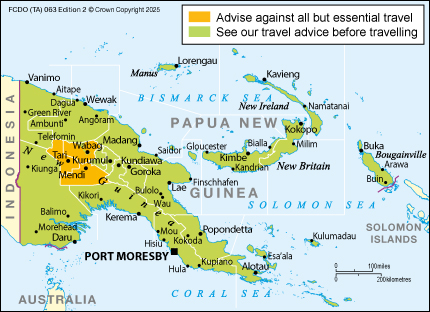
Warnings — Foreign OfficeForeign Office ↗updated 17.08.2026 · read 15.10.2026
Your travel insurance could be invalidated if you travel against advice from the Foreign, Commonwealth and Development Office (FCDO).
FCDO advises against all but essential travel to:
Find out more about why FCDO advises against travel .
Papua New Guinea can experience interruptions in the supply of water and electricity to urban centres. The water supplier to Port Moresby, Water PNG, completed some planned maintenance works in mid-August.
Consider personal preparedness and regularly check media updates from Water PNG for the latest information.
Escalation in the Middle East has caused widespread travel disruption, including airspace closures, delayed and cancelled flights.
Your travel plans may be affected, even if your destination is not in the Middle East. Before you travel:
Following wide-spread intercommunal violence in Wapenamanda area of Enga Province, the provincial government has declared all districts except Wabag District, which remains relatively safe, as ‘fighting zones’. The authorities report deaths, destruction of property, and the closure of public services. Checkpoints, random searches, and curfews have been introduced.
Regional risks — Foreign OfficeForeign Office ↗updated 17.08.2026 · read 15.10.2026
This section has safety advice for regions of Papua New Guinea. It only covers regions where the Foreign, Commonwealth & Development Office ( FCDO ) has specific advice.
You should also read FCDO ’s overall travel advice and safety and security advice .
FCDO advises against all but essential travel to Hela, Southern Highlands and Enga Provinces (except Wabag District) due to the high risk of tribal fighting.
If you plan to travel there, be cautious, stay away from large crowds and gatherings and consider getting private security advice. Pay attention to local advice on curfews and other restrictions which may be imposed at short notice.
Be particularly cautious and stay away from, the area around the Porgera gold mine, which has been subject to violent landowner disputes.
See Tribal fighting .
The land border between Papua New Guinea and Indonesia stretches for around 760km and is poorly defined. There are sometimes armed clashes along the border between the Indonesian military and the Organisasi Papua Merdeka (OPM, Free Papua Movement).
The Papua New Guinea government has defence units at its Wutung border post in Sandaun Province. Be extremely cautious and be prepared for possible sudden closure of the border crossing.
Bougainville Island has been calm since a 2001 peace agreement ended separatist fighting. You should still be cautious, particularly in central and southern Bougainville. There is a risk of lawlessness and violence. The autonomous Bougainville government has designated the mountainous area in central Bougainville around the old Panguna mine a ‘no go zone’. Do not travel to it without prior authorisation.
Safety — Foreign OfficeForeign Office ↗updated 17.08.2026 · read 15.10.2026
This guide also has safety advice for regions of Papua New Guinea .
There is a high threat of terrorist attack globally affecting UK interests and British nationals, including from groups and individuals who view the UK and British nationals as targets. Stay aware of your surroundings at all times.
UK Counter Terrorism Policing has information and advice on staying safe and what to do in the event of a terrorist attack. Find out how to reduce your risk from terrorism while abroad .
Although there’s no recent history of terrorism in Papua New Guinea, attacks cannot be ruled out.
Outbreaks of tribal fighting are common across Papua New Guinea, including tourist areas. Ethnic disputes can quickly escalate and lead to widespread destruction of property, disruption of normal services and serious injury. Tribal fighters may be armed.
Although tribal fighters do not normally attack foreign nationals, you should stay away from areas where there is fighting.
Stay alert, monitor local media and consult local contacts such as your hotel before you travel to a new area. Be particularly cautious in the suburbs of Port Moresby and the Highlands Region. See Regional risks .
There is a high risk of serious crime in the capital, Port Moresby, and in the cities of Lae and Mount Hagen. Suburbs of towns and cities can be particularly dangerous.
High-risk crime areas include the:
There is a serious risk of bag-snatching and robbery. Criminals often use machetes (‘bush knives’) and firearms in assaults and thefts. They target people who are using banks and ATMs.
Walking after dark is particularly dangerous in Port Moresby and other urban centres.
You can take precautions such as:
Carjacking and other types of vehicle crime are common. Criminals use roadblocks outside towns to stop and loot vehicles and then attack the occupants.
If you plan travel in these areas, particularly after dark, take great care and consider travelling in convoy or using a security escort. Always lock car doors and keep windows up.
Armed criminals have attacked and robbed passengers on public buses (known as ‘PMVs’) and in taxis. There have also been incidents of rape on Port Moresby PMVs. Many PMVs and taxis are not roadworthy.
Rape and sexual assault are common in Papua New Guinea. Stay alert and leave travel plans with friends, relatives or reliable local contacts. See advice for women travelling abroad .
There have been serious attacks and robberies along the Kokoda Track. Although community leaders have assured tourists of their safety and wellbeing while walking the Kokoda Track, you should take care. Avoid walking independently and travel with guides from trusted travel companies. You can get details from the Papua New Guinea Tourism Authority or the Kokoda Track Authority .
Organised gangs have abducted people and forced…
American passport — U.S. Department of State
Faithful summary of the official texts below, which prevail.
Papua New Guinea - Level 3: Reconsider Travel 2025-04-28travel.state.gov ↗updated 28.04.2025 · read 16.10.2026
Reconsider travel to Papua New Guinea due to crime, civil unrest , and piracy. Exercise increased caution due to kidnapping, unexploded ordnance, inconsistent availability of healthcare services, and potential for natural disasters . Some areas have increased risk. Read the entire Travel Advisory.
Violent crime , including sexual assault, carjackings, home invasions, and armed robberies, is common. There have been reports of criminals attacking resorts popular with foreign tourists to steal goods and money. Tensions between communal or tribal groups may lead to civil unrest involving violence and can occur without warning. Police presence is limited outside of the capital, Port Moresby, and police may be unable to assist due to limited resources.
The U.S. government has limited ability to provide emergency services to U.S. citizens outside of Port Moresby due to limited transportation infrastructure. U.S. government employees must obtain authorization before traveling to certain areas, including the central part of Bougainville and the provinces of Southern Highlands, Western Highlands (excluding Mt. Hagen), Eastern Highlands (excluding Goroka), Hela, Enga, Jiwaka, and other areas of Papua New Guinea where one is unable to fly directly.
Piracy is active in the waters surrounding Papua New Guinea. Travelers by boat should reconsider travel to the Bismarck and Solomon Seas along Papua New Guinea's north and eastern coasts. In 2021 and 2022, the Embassy was aware of at least three occasions in which sailboats operated by or carrying U.S. citizens were boarded by criminals. The criminals, who have been known to use physical violence, robbed the boats, and in one incident, severely injured the captain when he attempted to fight back.
Visit our website on International Maritime Piracy and Armed Robbery at Sea .
Kidnapping for ransom or political influence occurs in Papua New Guinea, though foreign nationals are not frequently targeted. In February 2023, a foreign national was kidnapped. In late 2022, foreign nationals employed by an international company were kidnapped and held for several days.
Travelers should exercise increased caution when traveling in remote areas of Papua New Guinea due to the presence of unexploded ordnance (UXO) remaining from the Second World War. UXO is discovered infrequently throughout the country, often on smaller…
Global Affairs Canada — additional reading
Avoid non-essential travel
Avoid non-essential travel to Papua New Guinea due to high levels of crime, inter-ethnic violence and civil unrest.
Open Government Licence – Canada · October 15, 2026 06:32 EDTtravel.gc.ca ↗updated 15.10.2026 · read 16.10.2026
Faithful summary of the official texts below, which prevail.
Global Affairs Canada — written for Canadian travellers, valid for all
You must abide by local laws. Learn about what you should do and how we can help if you are arrested or detained abroad.
Penalties for possession, use or trafficking of illegal drugs are severe. Convicted offenders can expect lengthy jail sentences. Drugs, alcohol and travel
Photography may be restricted at certain cultural sites. Do not photograph individuals without their prior consent.
Adultery is a criminal offence. Offenders can face imprisonment.
The possession and sale of pornographic material are strictly prohibited.
Papua New Guinean law prohibits sexual acts between individuals of the same sex. Those convicted can face up to 14 years' imprisonment. 2SLGBTQI+ persons should carefully consider the risks of travelling to Papua New Guinea. Travel and your sexual orientation, gender identity, gender expression and sex characteristics
To avoid offending local sensitivities:
The Hague Convention on the Civil Aspects of International Child Abduction is an international treaty. It can help parents with the return of children who have been removed to or retained in certain countries in violation of custody rights. It does not apply between Canada and Papua New Guinea. If your child was wrongfully taken to, or is being held in Papua New Guinea by an abducting parent:
If your child was removed from a country other than Canada, consult a lawyer to determine if The Hague Convention applies. Be aware that Canadian consular officials cannot interfere in private legal matters or in another country's judicial affairs.
Traffic drives on the left. You must always carry the following when driving:
If your driver’s licence is in a language other than English, it must be accompanied by an official English translation. Police roadblocks are common. You could be fined if your documents are not up-to-date. International Driving Permit
The currency of Papua New Guinea is the kina (PGK). ATMs are available in Port Moresby and other main cities but may be rare in certain rural areas.
Open Government Licence – Canada · October 15, 2026 06:32 EDTtravel.gc.ca ↗updated 15.10.2026 · read 16.10.2026
Foreign Office — laws and cultural differences
It is a serious offence to use, possess or traffic illegal drugs, including marijuana. If convicted, you can get a long prison sentence.
Same-sex sexual activity between men is illegal. People who are convicted face up to 14 years imprisonment. Read more advice for LGBT+ travellers.
Open Government Licence v3.0gov.uk ↗updated 17.08.2026 · read 15.10.2026
FDFA (Switzerland) — laws and customs, in French
Les actes à caractère homosexuel et les relations sexuelles extraconjugales sont interdits. Les infractions à la loi sur les stupéfiants sont sévèrement réprimées, quelle que soit la nature des stupéfiants. Des peines d'emprisonnement à vie peuvent être prononcées. Les conditions de détention sont très précaires.
La population de Papouasie-Nouvelle-Guinée se compose de plus de 800 groupes ethniques ayant chacun sa propre langue et ses propres coutumes. De nombreuses traditions sont restées vivantes et les nouvelles formes de société auxquelles la population se voit de plus en plus confrontée sont souvent ressenties comme étant étrangères à la culture autochtone. Respectez les us et coutumes locaux et adoptez une attitude réservée. Renseignez-vous dans les guides de voyages, auprès de votre agence ou directement sur place, sur les codes de conduite et les conventions à respecter.
FDFA travel advice, in Frencheda.admin.ch ↗updated 04.09.2026 · read 15.10.2026
What it changes for you: Air acceptable at this hour: nothing special to plan. Very high UV: sunscreen, hat and shade between 11 am and 4 pm; sunstroke and dehydration are travellers' first reasons to see a doctor.
Reading 14:00 (Pacific/Port_Moresby)Open-Meteo ↗updated 16.10.2026 · read 16.10.2026
Air quality and UV: Open-Meteo.com (CC BY 4.0), data rounded and formatted by Maximum. Contains modified Copernicus Atmosphere Monitoring Service information 2026. Neither the European Commission nor ECMWF is responsible for any use that may be made of the Copernicus information or data it contains.
Reading: With 0.1 physicians per 1,000 people (98% fewer than Switzerland), the nearest hospital does not always have the capacity for a serious case: evacuation to an adequate centre is the rule, not the exception — that is what unlimited evacuation and repatriation cover. Health spending of 85 USD per person (Switzerland: 11,784) goes with private hospitals that bill foreigners in hard currency and ask for a guarantee before admission: the direct payment guarantee is what avoids the deposit.
World Bank — latest published value, year per indicatordata.worldbank.org ↗read 10.10.2026
Live alerts and level changes, each with its official source. Continuously updated.
Port Moresby fait face à un risque de rupture d’approvisionnement en eau, liée à la dégradation critique de l’aqueduc de Rouna, infrastructure qui alimente la capitale. Des travaux de maintenance sont prévus prochainement sur une des conduites principales. Ces travaux une fois engagés entraîneront très certainement une baisse conséquente de la pression, des coupures temporaires de l’approvisionnement dans différents quartiers de la ville et des rationnements qui pourraient…
France Diplomatie (in French) · posted 29 May 2026 · updated 22 June 2026diplomatie.gouv.fr ↗updated 11.03.2026 · read 15.10.2026Une augmentation des cas de paludisme et de dengue a été enregistrée par l’hôpital général de Port Moresby. Il est recommandé de bien suivre les mesures de protection contre les piqures de moustique. Il est conseillé de consulter un médecin au moindre symptôme évocateur. Ne pas hésiter à consulter les informations supplémentaires qui sont disponibles dans l’onglet santé.
France Diplomatie (in French) · posted 4 March 2026diplomatie.gouv.fr ↗updated 11.03.2026 · read 15.10.2026Les autorités locales et l’Organisation Mondiale de la Santé (OMS) font état d’une épidémie de poliomyélite en Papouasie-Nouvelle Guinée et plus particulièrement dans la province de Morobe. Il est impératif, pour les voyageurs souhaitant se rendre dans le pays, de s’assurer de la validité de leur vaccination et de pouvoir en apporter la preuve à l’entrée sur le territoire. Pour les voyageurs ayant séjourné plus de 4 semaines dans le pays touché par la poliomyélite, une…
France Diplomatie (in French) · posted 4 March 2026diplomatie.gouv.fr ↗updated 11.03.2026 · read 15.10.2026Natural disasters and climate section – added information on El Niño
October 15, 2026 06:32 EDTtravel.gc.ca ↗updated 15.10.2026 · read 16.10.2026No level change recorded for this country since the log opened. The live alerts above are updated continuously.
Level 3/4 — Reconsider Travel, U.S. Department of State, retrieved on 16 October 2026.
Sourcestravel.state.gov · updated 28.04 · read 16.10France Diplomatie · updated 11.03 · read 15.10DFAE · updated 04.09 · read 15.10207-country comparison
An area advised against does not rule out the country.
SourcesFrance Diplomatie · updated 11.03 · read 15.10Foreign Office · updated 17.08 · read 15.10State Department · updated 28.04 · read 16.10
The rules depend on the passport, not on the destination alone.
SourcesFrance Diplomatie · updated 11.03 · read 15.10Foreign Office · updated 17.08 · read 15.10State Department · updated 28.04 · read 16.10
For a Schengen visa, yes: at least €30,000 of travel medical insurance (Regulation (EC) No 810/2009, art. 15).
SourcesRegulation (EC) 810/2009, art. 15General conditions, policy 20 00 479
VIP Pack — €990 for twelve months, unlimited trips.
SourcesGeneral conditions, policy 20 00 479OpenStreetMap · read 13.10
From 18 000 € to 140 000 € depending on severity and distance (WhereNext (guide PNG), 2026).
SourcesWhereNext (guide PNG), 2026General conditions, policy 20 00 479
Six steps, in this order.
SourcesSpecial conditions 01.26General conditions, policy 20 00 479
Local emergency services: police 112 · ambulance 111 · fire 110
SourcesEmergencyNumberAPI · Wikidata · read 08.10OpenStreetMap · read 13.10
At today's level 3/4, card by card:
SourcesAmex Platinum France T&Cs, 01.2025 — general exclusion n° 11BNP Paribas Visa Infinite notice (policy PT7), 04.2025 — comFortuneo World Elite Mastercard notice, 01.2026 — art. 5.5 '
A health plan reimburses at home; here, the hospital asks for a payment guarantee before admission.
SourcesGeneral conditions, policy 20 00 479
The page reads hospitals, pharmacies and doctors from OpenStreetMap, around the point you choose.
The sourced detail is under Medical network › Health: vaccines, diseases present, altitude, outbreaks.
SourcesCDC Travelers' Health · read 10.10France Diplomatie · updated 11.03 · read 15.10OMS · updated 20.05 · read 15.10Foreign Office · updated 17.08 · read 15.10
0.1 physicians per 1,000 people (2023) versus 4.5 in Switzerland.
SourcesWorld Bank · read 10.10General conditions, policy 20 00 479
Comparable figures (homicides, roads, incidents) are under Safety & risks › Incidents.
The nearest representations, by passport (OpenStreetMap):
SourcesOpenStreetMap · read 13.10DFAE · updated 04.09 · read 15.10
At least one official reading covers the whole country; 6 regions are also named, fully or partly.
SourcesGlobal Affairs Canada · updated 15.10 · read 16.10Foreign Office · updated 17.08 · read 15.10France Diplomatie · updated 11.03 · read 15.10
Local laws apply to every traveller; here is what the official texts say.
SourcesGlobal Affairs Canada · updated 15.10 · read 16.10Foreign Office · updated 17.08 · read 15.10
Every foreign ministry runs a 24/7 emergency line for its nationals.
Sourcesdiplomatie.gouv.fr · updated 11.03 · read 15.10eda.admin.ch · updated 04.09 · read 15.10
Keep the entry stamp, the invoices, the prescriptions and the medical report.
SourcesGeneral conditions, policy 20 00 479
Cancellation or change up to EUR 20,000, special risk EUR 5,000 per person, crisis management and security, optional Kidnap & Ransom.
SourcesGeneral conditions, policy 20 00 479
A question not answered here? Ask Maximum below, or call the support number: every question gets a clear, actionable answer.
In a life-threatening emergency, call local emergency services first, then Maximum: +41 22 ••• •• •• — 24/7 support number, an adviser stays with you to the end.
The 207 country pages — hospitals, pharmacies, police, embassies, emergency numbers, official advice from four governments, health, safety in figures, events in progress — read around the city you name. Your policy — benefits, the six steps, claims, articles. The site — prices, certificate, subscription. Nothing else: what it does not know, it says so and hands you to an adviser.
Same advisory level: Azerbaijan · Bahrain · Burundi · Colombia · Guatemala · Guinea-Bissau
The displayed level comes from the State Department, checked every morning. Before departure, always cross-check your country of residence's advisory: that is what your policy cites.
The level shown is the official U.S. Department of State level, checked daily. Maximum Insurance is an insurance distributor — general information, not personal advice.
The destination is already Port Moresby. A few choices, then the reading of your cover, here.
Destination · Port Moresby
Travel Insurtech. 24/7 worldwide.
Swiss insurer · Worldwide medical network