Maximum Alerts / Colombia
ColombiaLevel 3/4
Level published by the State Department on 30.03.2026 · read 16 October 2026 · source checked daily
Colombia — official level as of 16 October 2026: Level 3/4 ("Reconsider Travel"), from the U.S. Department of State. Maximum Insurance covers this country: hospital settled directly, unlimited repatriation, EUR 1.5M, certificate on payment.
How we read these four advisories
Every country has its own scale, so we ask them all the same question: is the whole country advised against?
An advisory covering only areas of the country does not raise the answer: it stays “No”, and the area is shown in the relevant column.
The level shown on this page — and across this site — is the one published by the U.S. State Department, from 1 (normal precautions) to 4 (do not travel). France and the United Kingdom publish their own advisories, with their own rules: they add to that level, they do not replace it.
120 recorded incidents (UCDP)hover, click to open it in the briefing
In a life-threatening emergency, call local emergency services first, then Maximum: +41 22 ••• •• •• — 24/7 support number, an adviser stays with you to the end.
What Maximum knows
The 207 country pages — hospitals, pharmacies, police, embassies, emergency numbers, official advice from four governments, health, safety in figures, events in progress — read around the city you name. Your policy — benefits, the six steps, claims, articles. The site — prices, certificate, subscription. Nothing else: what it does not know, it says so and hands you to an adviser.
What I say on the phone
- I am insured with Maximum, here is my policy number. Where should I go? Send me to a hospital in the Maximum network.
- Send the payment guarantee to the hospital: I do not want to pay anything up front.
- For non-urgent transport or repatriation, tell me what you authorise and arrange. In a life-threatening emergency, I call local emergency services immediately.
What to do, in this order
1Contact assistance without delay›
In immediate danger, call local emergency services first. Then contact assistance without delay; before engaging a service, seek approval under your policy. Cover is confirmed by the insurer.
2Ask where to get care›
Ask assistance where to get care and whether direct cover can be arranged. It confirms the facility and seeks the insurer's approval under your policy. In immediate danger, call local emergency services first.
3See a doctor the same day›
Even for a pain you meant to shrug off. Without a medical certificate written on the spot, the same day, the insurer cannot cover the event — a certificate written after you return does not count.
4Admitted? Have the hospital front desk call Maximum›
The hospital desk sends the request to assistance. Direct payment depends on the insurer's approval and the policy; the call alone does not guarantee it. Have the response confirmed before relying on no up-front payment.
5For non-urgent transport, seek assistance approval›
In a life-threatening emergency, call local emergency services immediately. For an arranged transfer or repatriation, contact assistance: the insurer's medical team decides on measures under the policy. A medical flight booked without approval may not be reimbursed.
6Once home, report the claim within 30 days›
Even if everything went well on the ground. Send your invoices and the medical report within 30 days; after that, compensation may be reduced or refused.
Places read from OpenStreetMap, within a circle of about 12 km: phone, email, address, website and hours when the source publishes them. No customer reviews, that source has none. Straight-line distances.
What is your current insurance?
Notices vary by bank and vintage — yours prevails. On the right: the Maximum contract (public documents).
Where to go, where not to
The country is not uniform: 20 regions advised against, fully or partly, by at least one official reading. Bogotá is not one of them.
- Avoid all travel to Arauca Department, Cauca (except Popayán), Chocó (except Bahía Solano, Capurganá, Nuquí), and within 50 km of Venezuela border (except Cúcuta) due to kidnapping and armed group violence. Global Affairs Canada
- Avoid all travel to within 100 km of Panama border and within 50 km of Ecuador border (except Ipiales crossing) due to criminal organizations and illegal armed groups. Global Affairs Canada
- Avoid all travel to Tumaco port and Buenaventura city due to kidnapping and violence from illegal armed groups. Global Affairs Canada
- Avoid non-essential travel to Putumayo, Guaviare, Guainía, Vaupés, Vichada, and Amazonas within 20 km of Peru border due to drug-related criminal activity. Global Affairs Canada
- Do not use Colombia-Venezuela land crossings; avoid all but essential travel to entire Norte de Santander Department including Cúcuta and all Arauca Department. Foreign Office
- Avoid all but essential travel to Chocó Department except Quibdó, Nuquí, Bahía Solano, and Capurganá; avoid Buenaventura and western Valle del Cauca due to criminal violence. Foreign Office
Faithful summary of the official texts below, which prevail.
“(France Diplomatie)”: the level comes from its text, in French, quoted below region by region.
the trip stays outside the advised-against regions. Any move into a red or orange region calls for a new, written decision.
The official text, region by region
Advised against — all travel5 regions
AraucaCAGB
Global Affairs Canada
Arauca
Foreign Office
all of Arauca Department
CaquetáCAGBFR
Global Affairs Canada
Caquetá, excluding the city of Florencia
Foreign Office
Cartagena del Chairá, San Vicente del Caguan, Puerto Rico, El Doncello, Paujil and La Montañita in Caquetá Department
France Diplomatie (in French)
Ce zonage concerne les départements de l’est de la Colombie (Vichada, Guainía, Guaviare, Vaupes), du sud (Amazonas, Caqueta et Putumayo), de la totalité du département du Nariño et du secteur oriental du Valle del Cauca.
CaucaCAGB
Global Affairs Canada
Cauca, excluding the city of Popayan
Foreign Office
all of Cauca Department, except for the department capital Popayán
ChocóCAGB
Global Affairs Canada
Chocó, excluding the towns of: Bahía Solano; Capurganá; Nuquí
Foreign Office
Chocó Department, except for the department capital Quibdó, the towns of Nuquí and Bahía Solano and Capurganá
Norte de SantanderCAGB
Global Affairs Canada
Norte de Santander, excluding the city of Cúcuta
Foreign Office
all of Norte de Santander Department, including Cúcuta.
Advised against — all but essential travel8 regions
GuainíaCAFR
Global Affairs Canada
Guainía
France Diplomatie (in French)
Ce zonage concerne les départements de l’est de la Colombie (Vichada, Guainía, Guaviare, Vaupes), du sud (Amazonas, Caqueta et Putumayo), de la totalité du département du Nariño et du secteur oriental du Valle del Cauca.
GuaviareCAGBFR
Global Affairs Canada
Guaviare
Foreign Office
all of Guaviare Department, except for the department capital San José del Guaviare
France Diplomatie (in French)
Ce zonage concerne les départements de l’est de la Colombie (Vichada, Guainía, Guaviare, Vaupes), du sud (Amazonas, Caqueta et Putumayo), de la totalité du département du Nariño et du secteur oriental du Valle del Cauca.
MetaCAGB
Global Affairs Canada
Meta, excluding: Caño Cristales; city of Villavicencio
Foreign Office
the Ariari region of southern Meta, except for Caño Cristales
NariñoCAGBFR
Global Affairs Canada
Nariño, excluding the city of Pasto
Foreign Office
the South Pacific, Sanquianga and Telembi regions of Nariño Department
France Diplomatie (in French)
Ce zonage concerne les départements de l’est de la Colombie (Vichada, Guainía, Guaviare, Vaupes), du sud (Amazonas, Caqueta et Putumayo), de la totalité du département du Nariño et du secteur oriental du Valle del Cauca.
PutumayoCAGBFR
Global Affairs Canada
Putumayo
Foreign Office
FCDO advises against all but essential travel to Orito, San Miguel, Valle del Guamuez, Puerto Caicedo, Puerto Guzmán, Puerto Asis and Puerto Leguizamo in Putumayo Department.
France Diplomatie (in French)
Ce zonage concerne les départements de l’est de la Colombie (Vichada, Guainía, Guaviare, Vaupes), du sud (Amazonas, Caqueta et Putumayo), de la totalité du département du Nariño et du secteur oriental du Valle del Cauca.
Valle del CaucaCAGBFR
Global Affairs Canada
Valle del Cauca, excluding the cities of: Buga; Cali; Palmira
Foreign Office
the western part of Valle del Cauca Department, including Buenaventura
France Diplomatie (in French)
Ce zonage concerne les départements de l’est de la Colombie (Vichada, Guainía, Guaviare, Vaupes), du sud (Amazonas, Caqueta et Putumayo), de la totalité du département du Nariño et du secteur oriental du Valle del Cauca.
VaupésCAFR
Global Affairs Canada
Vaupés
France Diplomatie (in French)
Ce zonage concerne les départements de l’est de la Colombie (Vichada, Guainía, Guaviare, Vaupes), du sud (Amazonas, Caqueta et Putumayo), de la totalité du département du Nariño et du secteur oriental du Valle del Cauca.
VichadaCAGBFR
Global Affairs Canada
Vichada
Foreign Office
the municipality of Puerto Carreño in Vichada Department
France Diplomatie (in French)
Ce zonage concerne les départements de l’est de la Colombie (Vichada, Guainía, Guaviare, Vaupes), du sud (Amazonas, Caqueta et Putumayo), de la totalité du département du Nariño et du secteur oriental du Valle del Cauca.
Partly advised against7 regions
AmazonasCAFR
Global Affairs Canada
Amazonas, within 20 km of the border with Peru, west of Puerto Narino
France Diplomatie (in French)
Ce zonage concerne les départements de l’est de la Colombie (Vichada, Guainía, Guaviare, Vaupes), du sud (Amazonas, Caqueta et Putumayo), de la totalité du département du Nariño et du secteur oriental du Valle del Cauca.
AntioquiaCAGBFR
Global Affairs Canada
Antioquia, the area along the border with Choco department that is north of highway 60 and west of highway 62 and all areas north of the city of Buriticá
Foreign Office
the Urabá and Bajo Cauca regions of Antioquia Department
France Diplomatie (in French)
De même, la zone reliant le Venezuela à la côte pacifique de la Colombie étant le théâtre d’affrontements fréquents entre groupes armés, les déplacements dans le nord de la province d’Antioquia et de Santander ainsi que dans le sud des provinces de Sucre, de Cordoba et de Bolivar sont déconseillés.
BolívarGBFR
Foreign Office
the southern part of Bolívar Department
France Diplomatie (in French)
De même, la zone reliant le Venezuela à la côte pacifique de la Colombie étant le théâtre d’affrontements fréquents entre groupes armés, les déplacements dans le nord de la province d’Antioquia et de Santander ainsi que dans le sud des provinces de Sucre, de Cordoba et de Bolivar sont déconseillés.
CesarCA
Global Affairs Canada
Cesar, in the municipalities of González and Río de Oro
CórdobaCAGBFR
Global Affairs Canada
Córdoba, in the Paramillo National Natural Park
Foreign Office
the southern part of Córdoba Department
France Diplomatie (in French)
De même, la zone reliant le Venezuela à la côte pacifique de la Colombie étant le théâtre d’affrontements fréquents entre groupes armés, les déplacements dans le nord de la province d’Antioquia et de Santander ainsi que dans le sud des provinces de Sucre, de Cordoba et de Bolivar sont déconseillés.
SantanderFR
France Diplomatie (in French)
De même, la zone reliant le Venezuela à la côte pacifique de la Colombie étant le théâtre d’affrontements fréquents entre groupes armés, les déplacements dans le nord de la province d’Antioquia et de Santander ainsi que dans le sud des provinces de Sucre, de Cordoba et de Bolivar sont déconseillés.
SucreFR
France Diplomatie (in French)
De même, la zone reliant le Venezuela à la côte pacifique de la Colombie étant le théâtre d’affrontements fréquents entre groupes armés, les déplacements dans le nord de la province d’Antioquia et de Santander ainsi que dans le sud des provinces de Sucre, de Cordoba et de Bolivar sont déconseillés.
Official passages not placed on the map14
Global Affairs Canada — Advised against — all travel
within 50 km of the border with Venezuela, excluding the city of Cúcuta
Global Affairs Canada — Advised against — all travel
within 100 km of the border with Panama
Global Affairs Canada — Advised against — all travel
within 50 km of the border with Ecuador, excluding the border crossing at Ipiales
Global Affairs Canada — Advised against — all travel
the Port of Tumaco and the city of Buenaventura
Global Affairs Canada — Advised against — all but essential travel
city of Cúcuta
Global Affairs Canada — Advised against — all but essential travel
city of Florencia
Global Affairs Canada — Advised against — all but essential travel
city of Ipiales and Ipiales border crossing
Global Affairs Canada — Advised against — all but essential travel
city of Popayan
Foreign Office — Advised against — all but essential travel
within 5km of the rest of the border with Venezuela.
Foreign Office — Advised against — all but essential travel
FCDO advises against all but essential travel to within 5km of the border with Ecuador except for: the border crossing on the Pan-American highway at the Puente Internacional de Rumichaca
France Diplomatie (in French) — Advised against — all travel
Zones frontalières avec le Vénézuéla, le Panama, l’Équateur, le Pérou et le Brésil
France Diplomatie (in French) — Advised against — all travel
Les frontières de la Colombie sont des zones de trafics où des bandes criminelles sont actives et où les groupes armés illégaux se sont repliés. Il est formellement déconseillé d’entrer en Colombie par voie terrestre ou de circuler dans les zones frontalières.
France Diplomatie (in French) — Advised against — all travel
Côte pacifique
France Diplomatie (in French) — Advised against — all but essential travel
Zones déconseillées sauf raison impérative — Compte tenu du niveau élevé de violences qui y sont signalées, les zones qui figurent en orange sur la carte sont déconseillées « sauf raison impérative ».
Global Affairs Canada — Open Government Licence – Canada (14.10.2026) · Foreign Office — Open Government Licence v3.0 · France Diplomatie (27.05.2026) · Natural Earth
Last change: New information about the 2026-2027 El Niño weather event (‘Safety and security’ page).
Colombia - Level 3: Reconsider TravelState Department ↗updated 30.03.2026 · read 16.10.2026
Updated 30.03.2026
Reconsider travel to Colombia due to crime, terrorism, civil unrest, kidnapping, and natural disasters. Some areas have an increased risk. Read the entire Travel Advisory.
Violent crime is common in many areas of Colombia, including murder, assault, and robbery. Other crimes, such as drugging, extortion, kidnapping, and armed break-ins—including at hotels and other places tourists stay—also occur frequently in some regions.
Street crime occurs throughout Colombia and can quickly become violent. If you are targeted by criminals, do not resist. Police procedures and investigations in Colombia differ from those in the United States, and crimes against tourists are not always prosecuted. This can be a source of frustration for victims.
Terrorism
There is risk of terrorist violence, including terrorist attacks and other activity, in Colombia. Visit the U.S. Department of State’s Country Reports on Terrorism to learn more.
Terrorists in Colombia may attack with little or no warning and target:
- U.S. government facilities
- Local government facilities
- Tourist areas and attractions
- Transportation centers
- Shopping malls and markets
- Military and police facilities
- Hotels
- Clubs
- Restaurants
- Airports
Police, military personnel, and their facilities are often targeted, including in large cities. In the past, attacks have included car bombs, grenades, explosive devices placed in buildings or on main roads, and the use of drones.
Illegal armed groups, including narcotrafficking groups and terrorist organizations, have increased in number and expanded into more regions of Colombia. In remote areas where these groups are fighting with the government, they use improvised explosive devices (IEDs) and landmines against rivals and government forces. These explosives may be hidden in vehicles, attached to drones, or buried in the ground. Truck bombs have also been used to attack police and military installations. Civilians could be unintentionally harmed by IED attacks aimed at rival groups and government targets.
Demonstrations
- Political demonstrations are common throughout Colombia and can:
- Shut down roads and highways without notice or estimated reopening timelines.
- Lead to road closures that reduce access to public transportation.
- Interrupt travel within and between cities.
- Become violent and result in deaths and…
Colombia: Earthquake - Aug 2026ReliefWeb ↗read 16.10.20262026-08-11
Colombia: Floods - Jan 2026ReliefWeb ↗read 16.10.20262026-02-12
Source: ReliefWeb (OCHA), via HDX — CC BY
Nearest river dischargeOpen-Meteo ↗updated 16.10.2026 · read 16.10.2026
10-16 0.5 · 10-17 0.4 · 10-18 0.3 · 10-19 0.3 · 10-20 0.3 · 10-21 0.3 · 10-22 0.3 m³/s
Simulated discharge: Open-Meteo.com (CC BY 4.0), data rounded and formatted by Maximum. Contains modified Copernicus Emergency Management Service information 2026. For information only: this is not a flood warning; only national or regional authorities issue those.
What the national level does not tell you
The level is national. Risk areas are in the state advisories below.
- U.S. State Department — the full advisory details the regions concerned and the reasons (crime, terrorism, kidnapping, civil unrest) (read the advisory)
- Foreign, Commonwealth & Development Office (United Kingdom) — the United Kingdom advises against all but essential travel to parts · reviewed 15 October 2026
Last announced change : « New information about the 2026-2027 El Niño weather event (‘Safety and security’ page). » (read the advisory) - France Diplomatie — France classifies SOME AREAS of the country as red (travel formally advised against) — the advisory is geographic, check it for your exact destination (read the Security advisory)
1 event located on the map
- Level 2 - Yellow Fever in Colombia — CDC travel notice (source)
Over 1 January 2026 → 30 June 2026, UCDP (Uppsala University) recorded 287 geolocated violent incidents in this country, for 581 documented deaths.
Most affected areas
Atlántico department 135 · Antioquia department 22 · Norte de Santander department 18 · Cauca department 14 · La Guajira department 13 · Valle del Cauca department 12
Most recent incidents
- 29 June 2026 · Atlántico department · Barranquilla town
Shooting in Villa San Carlos leaves one person dead and three wounded, including a minor · 1 deathSource: El Heraldo · 30 June 2026 · El Heraldo · UCDP #634962 ↗ - 18 June 2026 · Atlántico department · Barranquilla town
Alleged member of 'Los Costeños' murdered in front of his home in the Siete de Abril neighborhood · 1 deathSource: El Heraldo · 19 June 2026 · El Heraldo · UCDP #634880 ↗ - 16 June 2026 · Valle del Cauca department · Buenaventura town
Asesinato en el barrio Nuevo Amanecer de Buenaventura · 1 deathSource: Noticias 24/7 · 16 June 2026 · Noticias 24/7 · UCDP #634330 ↗ - 16 June 2026 · Atlántico department · Soledad town
Hitman on motorcycle murders mototaxi driver in Villa Estadio, Soledad · 1 deathSource: El Heraldo · 17 June 2026 · El Heraldo · UCDP #634871 ↗ - 12 June 2026 · Atlántico department · Malambo town
Man killed inside business in La Milagrosa neighborhood of Malambo identified · 1 deathSource: El Heraldo · 13 June 2026 · El Heraldo · UCDP #634846 ↗ - 12 June 2026 · Atlántico department · Malambo town
A 19-year-old man was killed on the terrace of a house in Malambo. · 1 deathSource: El Heraldo · 13 June 2026 · El Heraldo · UCDP #634847 ↗
Source: UCDP Georeferenced Event Dataset (Uppsala Conflict Data Program), file GEDEvent_v26_01_26_06.csv, CC BY 4.0 licence. We keep only incidents UCDP codes as "Clear" and whose location is precise enough to be placed — about 58% of the dataset. An incident may be revised, moved or withdrawn by UCDP in a later release: these figures describe a closed period, not a live situation.
Reading: The homicide rate is 42 times Switzerland's: violence is a real risk there, concentrated in the areas named by the official advisories. On the road, 7 times more deaths than in Switzerland: road crashes are the leading cause of death of healthy travellers (CDC) — seat belt, no night driving, a driver or a taxi from a rank.
World Bank (UNODC for homicides, WHO for roads) — latest published valuedata.worldbank.org ↗read 10.10.2026
What we locate on the map are events in progress that have real coordinates: USGS earthquakes, GDACS disasters, NOAA storms and open NASA EONET events. Hover a dot for details, click to open it in this briefing.
French passport — France Diplomatie
- Do not enter Colombia by land or travel in border zones with Venezuela, Panama, Ecuador, Peru, and Brazil due to active criminal gangs, illegal armed groups, and regular bomb attacks on police stations and roads. France Diplomatie
- Avoid southern and eastern departments (Vichada, Guainía, Guaviare, Vaupes, Amazonas, Caqueta, Putumayo, Nariño, and eastern Valle del Cauca) except for imperative reasons due to high violence levels. France Diplomatie
- Do not use public buses due to regular assaults; avoid mountain roads at night and outside daylight hours; do not travel solo at night; keep valuables in hotel safes with photocopies; withdraw cash only during daytime from busy locations. France Diplomatie
Faithful summary of the official texts below, which prevail.
Some areas of the country are formally advised against.France Diplomatie ↗updated 21.09.2026 · read 16.10.2026
Vigilance areas — France Diplomatie (in French) updated 27.05.2026official map ↗updated 21.09.2026 · read 16.10.2026
- Zones frontalières avec le Vénézuéla, le Panama, l’Équateur, le Pérou et le Brésil
- Les frontières de la Colombie sont des zones de trafics où des bandes criminelles sont actives et où les groupes armés illégaux se sont repliés. Il est formellement déconseillé d’entrer en Colombie par voie terrestre ou de circuler dans les zones frontalières.
- Côte pacifique
- Zones déconseillées sauf raison impérative — Compte tenu du niveau élevé de violences qui y sont signalées, les zones qui figurent en orange sur la carte sont déconseillées « sauf raison impérative ».
- Ce zonage concerne les départements de l’est de la Colombie (Vichada, Guainía, Guaviare, Vaupes), du sud (Amazonas, Caqueta et Putumayo), de la totalité du département du Nariño et du secteur oriental du Valle del Cauca.
- De même, la zone reliant le Venezuela à la côte pacifique de la Colombie étant le théâtre d’affrontements fréquents entre groupes armés, les déplacements dans le nord de la province d’Antioquia et de Santander ainsi que dans le sud des provinces de Sucre, de Cordoba et de Bolivar sont déconseillés.
- Il est déconseillé de se rendre dans les communes situées sur les flancs de Medellín, hauts lieux du trafic de drogue.
- Il est formellement déconseillé de se rendre dans les communes à proximité immédiate du sud de Cali (Jamundi, Corinto notamment), du fait de la présence des groupes armés et du risque d’attentats terroristes.
Colombie
- Présentation de la Colombie
-
-
-
-
-
-
-
-
-
-
Zones de vigilance
Dernière actualisation le 27/05/2026, information toujours valable à la date du jour
Zones formellement déconseillées
Zones frontalières avec le Vénézuéla, le Panama, l’Équateur, le Pérou et le Brésil
Les frontières de la Colombie sont des zones de trafics où des bandes criminelles sont actives et où les groupes armés illégaux se sont repliés. Il est formellement déconseillé d’entrer en Colombie par voie terrestre ou de circuler dans les zones frontalières.
Ces régions frontalières sont également des zones de friction entre les forces de sécurité colombiennes et les groupes armés. Cela se traduit par l’organisation régulière d’attentats à l’explosif dans les villes contre les postes de police, les édifices publics et surtout sur les axes l’irriguant (routes et véhicules visés par des engins explosifs improvisés). Ces zones représentent donc un risque élevé, principalement en raison de la menace terroriste. Des risques d’enlèvements ne sont pas à exclure.
Côte pacifique
Dans le département du Chocó, la circulation par voie terrestre est particulièrement dangereuse car les glissements de terrain sont fréquents du fait des précipitations. Des risques d’agressions existent dans la zone du Rio Atrato et du rio Baudo, principaux foyers de l’exploitation minière illégale. La présence de groupes armés illégaux liés au narcotrafic est régulièrement signalée dans le secteur du rio San Juan.
L’ensemble de la côte pacifique de la Colombie (incluant la province de Choco, le Cauca et le Vallee de Cauca) à l’exception des villes de Nuqui et Bahia Solano, accessibles par voie aérienne, est une zone de trafics importants dont le territoire fait régulièrement l’objet de disputes par différents groupes armés.
Zones déconseillées sauf raison impérative
Compte tenu du niveau élevé de violences qui y sont signalées, les zones qui figurent en orange sur la carte sont déconseillées « sauf raison impérative ».
Ce zonage concerne les départements de l’est de la Colombie (Vichada, Guainía, Guaviare, Vaupes), du sud (Amazonas, Caqueta et Putumayo), de la totalité du département du Nariño et du secteur oriental du Valle del Cauca.
La zone est du Caqueta faisant l’objet d’un repositionnement des groupes armés, il convient d’être particulièrement vigilant si des déplacements devaient y être effectués.
De même, la zone reliant le Venezuela à la côte pacifique de la Colombie étant le théâtre d’affrontements fréquents entre groupes armés, les déplacements dans le nord de la province d’Antioquia et de Santander ainsi que dans le sud des provinces de Sucre, de Cordoba et de Bolivar sont déconseillés.
Les vols de passeports sont fréquents dans les bus reliant Pasto à Ipiales, à la frontière avec l’Équateur. Il convient d’être particulièrement vigilant sur cette ligne de transport.
Il est recommandé de se rendre par voie aérienne dans les villes de Buenaventura, Cúcuta, Puerto Carreño et Puerto Inírida si le déplacement est impératif.
Zones à vigilance renforcée
Bogota
Au sud de la capitale, les quartiers populaires (Kennedy, Ciudad Bolivar), les banlieues d’Altos, de Cazuca et de Soacha, sont déconseillés sauf raison impérative.
Au nord, dans les quartiers aisés et les zones les plus résidentielles de la capitale (Chapinero, Chico, Parque de la 93, Zona T, Usaquen), des vols à l’arrachée sont recensés.
Les agressions à main armée (arme à feu ou arme blanche) dans les rues et dans les parcs sont en augmentation dans la ville, particulièrement dans les quartiers du Chicó, Chapinero, La Cabrera, Usaquén, Country, de même que les attaques à la scopolamine, particulièrement dans la zona T.
Il convient d’éviter de marcher dès la nuit tombée (19h00), même sur de courtes distances et de prendre un taxi. D’une manière générale, il convient d’observer une grande vigilance dans les lieux touristiques, en particulier dans le centre-ville (Candelaria, Monserrate), où les vols sont fréquents.
Medellín
Depuis plusieurs mois, une dégradation des conditions sécuritaires à Medellin est constatée avec une forte augmentation d’attaques à la scopolamine, parfois mortelles.
Il est déconseillé de se rendre dans les communes situées sur les flancs de Medellín, hauts lieux du trafic de drogue. Les berges et les ponts du Rio Medellín et les quartiers autour du stade Atanasio Girardot (Metro Estadio) doivent être évités les jours de match de football.
Dans la journée, les quartiers du Parque San Antonio, du Parque Bolivar, ainsi que tout le secteur au nord du Parque Berrio sont relativement sûrs. Ces quartiers sont cependant à éviter la nuit, sauf aux abords de l’Alliance française (Parque San Antonio). Lors des visites au Metrocable de Santo Domingo ou de San Javier, il est recommandé de rester dans les environs du métro et de la…
Risques liés aux transports
Le réseau routier colombien est en mauvais état et les panneaux de signalisation sont rares et peu visibles. Les excès de vitesse sont fréquents, le code de la route n’est pas appliqué et les altercations entre conducteurs peuvent donner lieu à des dérapages violents. Par ailleurs, les nombreuses routes de montagne peuvent être bloquées plusieurs jours en cas d’accident ou d’intempéries (éboulement, glissement de terrain). Il est fortement recommandé de ne circuler que de jour et uniquement sur les axes principaux.
Les transports en communs en ville ne sont pas sûrs, les passagers des bus étant régulièrement sujets à des agressions. Il est également recommandé de ne pas arrêter de taxis dans la rue en raison du risque d’agression, de vols ou d’enlèvement, notamment d’enlèvement express au cours duquel les agresseurs (dont un faux conducteur de taxi) obligent les passagers à retirer des sommes d’argent dans plusieurs distributeurs automatiques. En cas d’attaque, il convient de n’opposer strictement aucune résistance. Préférer donc les taxis commandés sur applications et donc « traçables » (Uber, Cabify, Taxis Libres, etc.). Il est également important de noter que les piétons ne sont pas prioritaires, y compris au niveau des passages piétons.
Les points de contrôle policiers ou militaires sont fréquents et l’accès à certaines zones peut être interdit à tout moment pour des raisons de sécurité.
Les pistes de la région de la Guajira, notamment près du Cabo de la Vela et de Punta Gallinas sont accessibles avec des agences de voyage locales mais le mauvais état des pistes est à parfois à l’origine d’accidents mortels. Il faut donc veiller à faire appel à des agences sérieuses pour tout voyage dans ces zones.
Risques liés à la présence de groupes armés
Le cessez-le-feu négocié entre le gouvernement colombien et l’Armée de libération nationale (ELN) a pris fin le 9 janvier 2018. Le groupe armé s’est depuis livré à plusieurs attaques terroristes et il n’est pas exclu que de nouvelles actions violentes se produisent.
Divers groupes armés (dont narcotrafiquants) sont actifs en Colombie, conduisent des opérations terroristes et se livrent des batailles sanglantes dans certaines régions, notamment les zones frontalières avec le Venezuela et l’Équateur et dans tout le quart sud-ouest du pays (départements du Caquetá, Putumayo, Cauca, Nariño, Tolima, Huila, Quindío, Valle del Cauca, Chocó). Cela se traduit par un risque important d’attaques armées, d’extorsions voire d’enlèvements. Ces groupes armés font également régulièrement usage de mines antipersonnel qui représentent un danger important.
Il est par conséquent recommandé de maintenir un niveau de vigilance élevé à tout moment et de ne pas se rendre dans les zones formellement déconseillées. Plus généralement il est recommandé de ne pas quitter les routes et les sentiers balisés et de ne pas s’aventurer dans les lieux isolés.
Criminalité
La délinquance de voie publique est significative dans le pays. Un usage croissant de la violence lors des atteintes aux biens et personnes est constaté.
Ainsi, les agressions (vols à l’arraché, attaques à l’arme blanche ou arme à feu…) sont particulièrement nombreuses dans les centres urbains comme Bogota, Cali ou Medellin. Elles sont régulièrement commises dans la rue, y compris dans la journée, ou dans un contexte où l’ambiance festive n’incite pas à la vigilance. Il est recommandé de ne pas montrer de signe ostentatoire de richesse et de laisser ses objets de valeur dans un lieu sécurisé. En cas d’agression armée, il est conseillé de n’opposer aucune résistance.
Il a été rapporté que de faux agents de police se livraient à des escroqueries sous prétexte d’un contrôle des documents d’identité et des devises. Il convient, en cas d’interpellation policière dans la rue, particulièrement à Bogota, de demander à être escorté au poste de police le plus proche ou dans un endroit public (par exemple votre hôtel). De faux coursiers peuvent également s’introduire dans les restaurants en vue de braquer les clients.
Risques liés à la scopolamine
Une importante recrudescence d’attaques à la scopolamine aussi appelée burundunga ou « drogue du zombie » est observée, qui touche notamment un certain nombre de Français de passage souvent après mise en relation via des sites ou des applications de rencontre, dont l’usage en Colombie est déconseillé . Cette drogue provoque des hallucinations délirantes, une amnésie et des pertes de conscience rendant les victimes vulnérables et influençables.
Les criminels droguent les victimes en introduisant le produit dans des boissons ou aliments, en soufflant cette poudre au visage ou en utilisant des moyens tactiles (prospectus, gel hydro…
Manifestations
Les manifestations et grèves qui ont régulièrement lieu dans le pays sont susceptibles de dégénérer et de perturber le bon fonctionnement de services essentiels. Il convient de s’en tenir éloigné.
Barrage d’Ituango
Compte-tenu des consignes d’évacuation maintenues par les autorités en aval du barrage d’Ituango (Hidroituango), les abords du Rio Cauca sont formellement déconseillés dans les départements de Sucre, Cordoba, Bolivar et le Nord de l’Antioquia (risque de crue soudaine).
Risques naturels
Risque sismique
Plusieurs dizaines de tremblements de terre d’une magnitude supérieure à 4 sur l’échelle de Richter sont enregistrés en Colombie chaque année, notamment dans la zone andine et une douzaine de volcans sont actifs. Des informations à jour sur l’activité de ces volcans peuvent être obtenues sur le site en espagnol de l’Institut Colombien de Géologie . Pour plus d’informations sur les comportements à adopter en cas de tremblement de terre, consultez la fiche pratique des Conseils aux voyageurs sur le risque sismique .
Risque volcanique
La Colombie recense plusieurs volcans en activité sur la Cordillère des Andes centrale qui suivent une ligne Pasto-Popayan-Pereira-Manizales. Pour plus d’informations, avant tout déplacement dans ces zones, consulter le site du Service géologique colombien (en espagnol) et prendre connaissance de la fiche pratique des Conseils aux voyageurs sur le risque volcanique .
Il est recommandé aux voyageurs de faire preuve de la plus grande prudence et de respecter les mesures de sécurité prises par les autorités locales.
Recommandations générales
De manière générale, il est recommandé de :
- Ne pas opposer de résistance en cas d’agression ; il convient de faire preuve de calme et d’obtempérer.
- Ne pas montrer de signe ostentatoire de richesse et laisser ses biens de valeur et ses documents d’identités dans des lieux sécurisés tels que les coffres d’hôtel (se munir de photocopies).
- Ne pas manipuler d’importantes sommes d’argent en public et ne retirer de l’argent qu’en plein jour dans les distributeurs installés dans les endroits fréquentés (centres commerciaux, hôtels).
- Ne jamais perdre de vue ses bagages et ne jamais accepter de transporter les bagages d’autrui.
- Limiter ses déplacements nocturnes et ne jamais se déplacer seul de nuit, même dans les quartiers de divertissement.
- Ne pas laisser boisson et nourriture sans surveillance dans les cafés et restaurants et ne jamais accepter de cigarette ou de gomme à mâcher d’un inconnu du fait du risque d’empoisonnement à la scopolamine.
- Ne pas faire confiance aux inconnus qui abordent les touristes dans la rue : il s’agit souvent de « faux » touristes prétendument perdus, négociants en pierres précieuses, etc.
- N’emprunter que des taxis contactés via une application, par téléphone ou agréés par une structure (hôtels, aéroports) et ne jamais héler un taxi dans la rue du fait du risque d’escroquerie voire d’enlèvement.
- Circuler les vitres fermées et les portes verrouillées et garder ses biens dans un endroit peu visible (par exemple sous le siège), lors de déplacements en voiture.
- Garer son véhicule dans un parc de stationnement surveillé en ville.
- Éviter les voyages en dehors de toute structure d’accompagnement (cyclotourisme, autostop, camping-cars, etc…).
Activités sportives à risques
Attention aux courants forts, notamment sur les plages de Santa Marta et du parc Tayrona. Il est conseillé de ne se baigner que dans les zones autorisées et de suivre les consignes des autorités locales.
Pour toute activité touristique ou sportive, notamment les randonnées, parapentes etc, il est recommandé de s’en remettre à des structures d’accompagnement reconnues, telles que des agences de voyage, des associations ou à des guides professionnels.
Full text of the Security pagediplomatie.gouv.fr ↗updated 21.09.2026 · read 16.10.2026
Swiss passport — FDFA (Switzerland), in French
- Armed groups and criminal gangs operate nationwide; spontaneous strikes, protests and riots may occur anytime with violence, arson, looting and road blockages. High risk of involvement in violent confrontations. DFAE
- Do not travel to departments of Chocó, Nariño, Putumayo, Guaviare, Vaupés, Guainía, Vichada, Arauca, Norte de Santander, Cesar, or to Cauca and Valle del Cauca departments, except by air to capitals Popayán and Cali respectively. DFAE
- Express kidnappings occur nationwide at any time; victims forced to withdraw cash via credit card. Armed robbery is frequent. Exercise extreme caution in Bogotá, Cali, Cartagena, Santa Marta and Medellín. DFAE
- Do not walk at night. Use only official taxis or app-based services. Use ATMs only during daytime inside banks. Never leave food or drinks unattended; criminals drug victims before robbery or assault. DFAE
- Prefer air travel; intercity road travel at night is discouraged due to high accident and assault risks. Road blockages from protests may cause sudden confrontations. DFAE
- Country lies in active seismic zone; strong earthquake on 10 August caused major damage in Chocó, Risaralda, Caldas and Valle del Cauca. Volcanic eruptions possible; hurricanes expected along Caribbean coast. Monitor Servicio geológico colombiano. DFAE
Faithful summary of the official texts below, which prevail.
FDFA update note — Le chapitre Derniers développements a été enlevé (séisme). (published 21.09.2026)
General assessment
Une attention particulière doit être accordée à la sécurité personnelle. Le taux de criminalité et la propension à la violence sont élevés. Des groupes armés et des bandes criminelles sont actifs dans tout le pays; ils sont combattus par les autorités policières et militaires. Des affrontements entre les groupes ont également lieu. La situation politique et sociale est tendue. Des grèves spontanées, des manifestations et des troubles sont possibles à tout moment. Ceux-ci peuvent s’accompagner d’incendies criminels, de pillages et de blocages de routes. Le potentiel de violence est élevé. Le risque d’être impliqué dans des affrontements violents ne peut être exclu. Les barrages routiers et les grèves peuvent causer des perturbations et du retard du trafic, paralyser des régions entières et entraîner des pénuries. En cas de barrages routiers de grèves, il est conseillé de se renseigner sur place sur les autres possibilités de déplacement et d’attendre le cas échéant que la situation se normalise. Policia Nacional de Colombia: Estado de las Vias Des combattants de divers groupes armés illégaux demeurent actifs dans plusieurs régions et dans les zones frontalières. Voir le chapitre risques régionaux spécifiques. Les autorités peuvent décréter l’état d’urgence et des couvre-feux à court terme. Des attentats ainsi que d’autres attaques à motivation politique visant la population civile ont lieu dans tout le pays. Les attaques visent surtout les forces de sécurité, mais des personnes non impliquées sont régulièrement victimes de ces violences. Entre janvier et avril 2026 , plusieurs régions de Colombie ont été marquées par une série d’incidents graves impliquant des groupes armés illégales qui sont responsables de violences armées et d’atteintes répétées contre des personnes civiles et les autorités . Les affrontements ont repris avec intensité dans la région du Catatumbo , causant des dizaines de victimes et provoquant le déplacement de milliers d’habitants. Dans le département d’ Arauca , une attaque armée contre le convoi d’un sénateur a entraîné la mort de membres de sa sécurité, tandis que dans le Cauca , une sénatrice a été brièvement enlevée avec ses gardes du corps. F in avril, un attentat à la bombe a eu lieu sur la route panaméricaine , qui a fait de nombreuses victimes civiles, suivi d’une série d’attaques coordonnées contre des installations militaires et civiles dans le Cauca et autour de Cali . Ces événements révèlent un risque élevé des attaques ciblés et des enlèvements . L’usage d’explosifs et les opérations coordonnées contre des…
Specific regional risks
La description des zones à risques repose sur des données approximatives; les risques ne peuvent se restreindre à des zones délimitées. Nord-ouest et zones frontalières avec le Brésil, le Venezuela, le Panama et l’Equateur Il est déconseillé de se rendre dans les départements suivants:
- Chocó;
- Nariño;
- Putumayo;
- Guaviare;
- Vaupés;
- Guainía;
- Vichada;
- Arauca;
- Norte de Santander;
- Cesar.
Il est déconseillé de se rendre dans les régions frontalières du Venezuela dans les départements de Boyacà et de La Guajira. Les déplacements dans les capitales départementales de Pasto (Nariño), Mocoa (Putumayo), la région de Nuqui et Bahía Solano (Chocó) et San José del Guaviare dans le département Guaviare (pour le tour Caño Cristales dans le département Meta) constituent une exception, à condition de s'y rendre par voie aérienne . Des personnes non impliquées y sont également tuées ou blessées lors d'affrontements armés entre les forces de sécurité et des groupes criminels. Il y existe un risque élevé d’être victime d’un attentat, d’actes criminels ou d’un enlèvement express. Le risque de se retrouver soudainement au milieu d'affrontements violents est élevé. Voir le chapitre Situation générale. Département du Cauca: Il est déconseillé de se rendre dans le département du Cauca. Les déplacements dans la capitale, Popayán constitue une exception, à condition de s'y rendre par voie aérienne. Les affrontements violents entre bandes de trafiquants de drogue et autres bandes criminelles, les attentats et les autres actes de violence provenants de guérillas et autres groupes armés sont fréquents. Cette violence représente un risque élevé même pour des personnes non impliquées. Depuis le début de l'année 2020, de nombreux actes de violence ont été commis contre la population civile. Exemples:
- Le 17 avril 2025, au moins une personne a été tuée et 20 autres blessées lors d'un attentat à la bombe contre le poste de police de Mondomo.
- Entre le 24 et le 26 mars 2025, au moins 15 personnes ont été blessées lors de plusieurs explosions et attaques contre des postes de police, des zones industrielles et un convoi militaire.
Département de la Valle del Cauca: Il est déconseillé de se rendre dans le département de la Valle del Cauca. Les déplacements dans la capitale, Cali, constitue une exception, à condition de s'y rendre par voie aérienne. Les affrontements violents entre bandes de trafiquants de drogue et autres bandes criminelles, ainsi que les attaques de guérillas et autres groupes armés continuent d’augmenter. Cette violence représente un risque…
Crime
Le taux de criminalité et la propension à la violence sont élevés. Les vols et cambriolages armés sont fréquents dans tout le pays. Les victimes d’ enlèvements express sont contraintes d’effectuer des retraits d’argent liquide au moyen de leur carte de crédit. Les enlèvements express s’étendent dans tout le pays, à n’importe quelle heure et même dans les quartiers les mieux situés. Il arrive que des escroqueries soient commises par des personnes portant l’uniforme de la police. Il est notamment recommandé de suivre les précautions suivantes:
- En raison d’une criminalité élevée, la plus grande prudence est recommandée dans les villes Bogotá, Cali, Cartagena, Santa Marta et Medellin;
- Le taux de criminalité peut fortement varier d'une ville ou d'un quartier à l'autre. Renseignez-vous sur la situation locale et les quartiers réputés sûrs auprès de vos contacts sur place;
- Faites particulièrement attention à l'aspect sécuritaire lors du choix de votre hébergement;
- Ne vous rendez pas dans les quartiers urbains défavorisés;
- Il est déconseillé de se promener la nuit;
- Ne portez sur vous ni d’objets de valeur (montre, bijoux, gros appareil de photo, etc.) ni de grosses sommes d'argent;
- Déposez vos documents dans le coffre de l'hôtel; gardez toutefois toujours une photocopie du passeport sur vous (y compris la page comportant le tampon d'entrée);
- Faites preuve de prudence en cas de rencontres par hasard ou fortuite. Il arrive souvent que des victimes soient droguées avant d’être dépouillées ou agressées. Les drogues en question existent sous de nombreuses formes et peuvent être administrées par différentes voies (par l’intermédiaire de produits alimentaires, de boissons, etc.). Ne laissez jamais votre nourriture et vos boissons sans surveillance et faites preuve de prudence lorsque l’on vous remet un objet;
- Il arrive que des criminels tentent d'utiliser des touristes pour passer de la drogue. Ne vous chargez jamais d'un colis ou d'un bagage d'une autre personne;
- Utilisez des taxis officiels ou commandés via des applications officielles;
- Utilisez les guichets automatiques uniquement de jour et à l’intérieur des banques;
- En cas d'agression, n'opposez aucune résistance, car les criminels n'hésitent pas à recourir à la violence. Ils ne reculent pas devant l'homicide.
Une certaine impunité juridique existe. En raison de l’absence de sanctions ou de poursuites effectives à l’encontre des auteurs de crimes ou de délits, la population a donc souvent recours au lynchage. Dans les eaux caribéennes de Colombie, des actes de piraterie sont…
Natural hazards
Le pays se trouve dans une zone sismique active. Le fort séisme du 10 août a provoqué d’importants dégâts, notamment dans les départements du Chocó, de Risaralda, de Caldas et dans la Vallée du Cauca. Consultez les sites Internet des autorités compétentes: Servicio geológico colombiano Unidad Nacional para la Gestión del Riesgo de Desastres Le pays compte en outre plusieurs volcans , notamment dans la Cordillera Central. Des éruptions volcaniques peuvent se produire. Les tsunamis provoqués par des éruptions volcaniques ou des tremblements de terre dans la région du Pacifique peuvent également atteindre la Colombie. Il faut s’attendre à des ouragans le long de la côte des Caraïbes. Des fortes pluies peuvent provoquer des inondations et des glissements de terrain pouvant endommager les infrastructures. La circulation peut s’en trouver temporairement perturbée. Il existe un important risque d’incendie de forêt à de nombreux endroits. Consultez les prévisions météorologiques et suivez les avertissements et les instructions des autorités locales (p. ex. zones interdites autour des volcans actifs, ordres d’évacuation). Servicio geológico colombiano Unidad Nacional para la Gestión del Riesgo de Desastres World Meteorological Organization Si une catastrophe naturelle devait se produire pendant votre séjour, suivez les consignes des autorités et contactez vos proches dans les meilleurs délais. Dans le cas où les liaisons avec l'étranger seraient interrompues, contactez l'Ambassade de Suisse à Bogotá.
FDFA travel advice, in French, valid on 15.10.2026eda.admin.ch ↗updated 21.09.2026 · read 15.10.2026
British passport — Foreign Office (UK)
- The FCDO advises against all but essential travel to Chocó Department except Quibdó, Nuquí, Bahía Solano and Capurganá; to reach whale-watching towns travel by air only and do not travel inland or along the coast. Foreign Office
- The FCDO advises against all but essential travel to Putumayo Department towns: Orito, San Miguel, Valle del Guamuez, Puerto Caicedo, Puerto Guzmán, Puerto Asis and Puerto Leguizamo. Foreign Office
- To visit Caño Cristales tourist site, travel by air from La Macarena town with a reputable tour company; do not travel overland. Foreign Office
- To visit the Lost City in Sierra Nevada de Santa Marta, travel only as part of an organised tour. Foreign Office
- Terrorists are very likely to attempt attacks in Colombia; armed groups may attack with little warning at transportation hubs, markets, hotels, restaurants, parks, sporting events and educational institutions. Foreign Office
Faithful summary of the official texts below, which prevail.
Regions covered by the Foreign Officegov.uk ↗updated 15.10.2026 · read 15.10.2026
- Colombia-Venezuela border and northern Colombia — FCDO currently advises against all travel to Venezuela’s border regions with Colombia. You should not use any of the Colombia-Venezuela land crossings.
- Colombia-Ecuador border and southern Colombia — Find out more about why FCDO advises against travel.
- Colombia-Venezuela border and northern Colombia — FCDO advises against all but essential travel to: all of Norte de Santander Department, including Cúcuta. all of Arauca Department the municipality of Puerto Carreño in Vichada Department
- Pacific coast and Colombia-Panama border — FCDO advises against all but essential travel to: Chocó Department, except for the department capital Quibdó, the towns of Nuquí and Bahía Solano and Capurganá the western part of Valle del Cauca Department, including Buenaventura the municipality of Jamundí, Valle del Cauca
- Central Colombia — FCDO advises against all but essential travel to: all of Guaviare Department, except for the department capital San José del Guaviare Cartagena del Chairá, San Vicente del Caguan, Puerto Rico, El Doncello, Paujil and La Montañita in Caquetá Department the Ariari region of southern Meta, except for Caño Cristales
- Colombia-Ecuador border and southern Colombia — FCDO advises against all but essential travel to within 5km of the border with Ecuador except for: all of Cauca Department, except for the department capital Popayán FCDO advises against all but essential travel to Orito, San Miguel, Valle del Guamuez, Puerto Caicedo, Puerto Guzmán, Puerto Asis and Puerto Leguizamo in Putumayo Department.
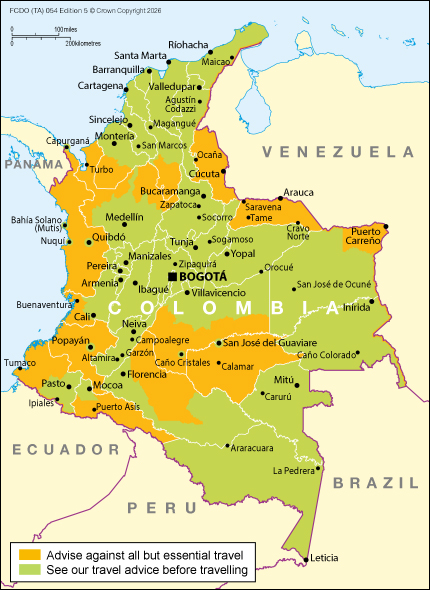
Warnings — Foreign OfficeForeign Office ↗updated 15.10.2026 · read 15.10.2026
Warnings — Foreign Office
Your travel insurance could be invalidated if you travel against advice from the Foreign, Commonwealth & Development Office (FCDO).
Colombia-Venezuela border and northern Colombia
FCDO advises against all but essential travel to:
- all of Norte de Santander Department, including Cúcuta.
- all of Arauca Department
- the municipality of Puerto Carreño in Vichada Department
- within 5km of the rest of the border with Venezuela.
FCDO currently advises against all travel to Venezuela’s border regions with Colombia . You should not use any of the Colombia-Venezuela land crossings.
Pacific coast and Colombia-Panama border
FCDO advises against all but essential travel to:
- Chocó Department, except for the department capital Quibdó, the towns of Nuquí and Bahía Solano and Capurganá
- the western part of Valle del Cauca Department, including Buenaventura
- the municipality of Jamundí, Valle del Cauca
- the South Pacific, Sanquianga and Telembi regions of Nariño Department
- the southern part of Córdoba Department
- the Urabá and Bajo Cauca regions of Antioquia Department
- the southern part of Bolívar Department
Central Colombia
FCDO advises against all but essential travel to:
- all of Guaviare Department, except for the department capital San José del Guaviare
- Cartagena del Chairá, San Vicente del Caguan, Puerto Rico, El Doncello, Paujil and La Montañita in Caquetá Department
- the Ariari region of southern Meta, except for Caño Cristales
If travelling to the tourist site of Caño Cristales, travel by air from the town of La Macarena with a reputable tour company.
Colombia-Ecuador border and southern Colombia
FCDO advises against all but essential travel to within 5km of the border with Ecuador except for:
- all of Cauca Department, except for the department capital Popayán
- the border crossing on the Pan-American highway at the Puente Internacional de Rumichaca
- the city of Ipiales in Nariño Department
FCDO advises against all but essential travel to Orito, San Miguel, Valle del Guamuez, Puerto Caicedo, Puerto Guzmán, Puerto Asis and Puerto Leguizamo in Putumayo Department.
Find out more about why FCDO advises against travel .
Regional risks — Foreign OfficeForeign Office ↗updated 15.10.2026 · read 15.10.2026
Regional risks — Foreign Office
This section has safety advice for regions of Colombia. It only covers regions where the Foreign, Commonwealth & Development Office ( FCDO ) has specific advice.
You should also read FCDO ’s overall travel advice and safety and security advice .
Colombia-Venezuela border and northern Colombia
FCDO advises against all but essential travel to:
- the Catatumbo region of Norte de Santander Department
- all of Arauca Department, except for the department capital, Arauca
- the municipality of Puerto Carreño in Vichada Department, except for the department capital, Puerto Carreño
- within 5km of the rest of the border with Venezuela, except for the city of Cúcuta
FCDO currently advises against all travel to Venezuela’s border regions with Colombia . You should not use any of the Colombia-Venezuela land crossings.
Pacific coast and Colombia-Panama border
FCDO advises against all but essential travel to:
- Chocó Department, except for the department capital Quibdó, the whale-watching towns of Nuquí and Bahía Solano and the tourist site of Capurganá
- the western part of Valle del Cauca Department, including Buenaventura
- the municipality of Jamundí, Valle del Cauca
- the western part of Cauca Department
- the South Pacific, Sanquianga and Telembi regions of Nariño Department
- the southern part of Córdoba Department
- the Urabá and Bajo Cauca regions of Antioquia Department
- the southern part of Bolívar Department
The Pacific coast of Chocó is a popular eco-tourist destination. However, much of Chocó is remote. Illegal armed groups are active and involved in the drugs trade throughout the department and particularly near the border with Panama. If you intend to travel to the whale-watching towns of Bahia Solano and Nuqui, only do so by air and do not travel inland or along the coast out of town.
Darien Gap
The ‘Darien Gap’ is a dangerous area renowned for the presence of several illegal armed groups, illegal migration and drugs trafficking. There’s no road crossing between Colombia and Panama. Avoid crossing between Panama and Colombia by land.
Colombia-Ecuador border and southern Colombia
FCDO advises against all but essential travel to within 5km of the border with Ecuador except for:
- the border crossing on the Pan-American highway at the Puente Internacional de Rumichaca
- the city of Ipiales in Nariño Department
FCDO advises against all but essential travel to Orito, San Miguel, Valle del Guamuez, Puerto Caicedo, Puerto Guzmán, Puerto Asis and Puerto Leguizamo in Putumayo Department.
Central Colombia
FCDO advises against all but essential travel to:
- all of Guaviare Department, except for the department capital San José de Guaviare
- Cartagena del Chairá, San Vicente del Caguan, Puerto Rico, El Doncello, Paujil and La Montañita in Caquetá Department
- the Ariari region of southern Meta, except for Caño Cristales
If travelling to the tourist site of Caño Cristales, travel by air from the town of La Macarena with a reputable tour company.
Ciudad Perdida – ‘Lost City’
If you travel to the ‘Lost City’ in the Sierra Nevada de Santa Marta, only do so as part of an organised tour.
San Agustín Archaeological Park
The San Agustín Archaeological Park (‘Parque Arqueológico de San Agustín’) is in the department of Huila. Enter and leave the park on the main road through Neiva or Popayán.
Safety — Foreign OfficeForeign Office ↗updated 15.10.2026 · read 15.10.2026
Terrorism
There is a high threat of terrorist attack globally affecting UK interests and British nationals, including from groups and individuals who view the UK and British nationals as targets. Stay aware of your surroundings at all times.
UK Counter Terrorism Policing has information and advice on staying safe and what to do in the event of a terrorist attack. Find out how to reduce your risk from terrorism while abroad .
Terrorism in Colombia
Terrorists are very likely to try to carry out attacks in Colombia.
Armed groups
Despite the landmark peace agreement between the government and the Revolutionary Armed Forces of Colombia (FARC) in 2016, many armed groups remain active throughout the country.
These groups may attack with little or no warning. The focus is predominantly in areas where there are active illicit economies and narco-trafficking but attacks have historically targeted some tourist locations, including:
- transportation hubs including airports
- markets and shopping malls
- local government facilities
- hotels, clubs and restaurants
- places of worship
- parks and other public areas
- major sporting and cultural events
- educational institutions
Police and military personnel and installations are frequently targeted, including in large cities.
Past methods of attack have included car bombs, grenade and drone attacks, and explosive devices left in buildings and on main roads. Stay alert and follow the advice of the local security authorities.
Regularly reassess your security arrangements and consider carefully any travel around the country.
Political situation
Colombia has suffered from internal armed conflict for over 50 years. In 2016, Colombia’s then-President Juan Manuel Santos signed a peace agreement with the Revolutionary Armed Forces of Colombia (FARC) movement to end the civil war.
The peace agreement is still in place today, but Colombia remains seriously affected by conflict. Delays in the implementation of the peace agreement have led to a resurgence in violence in parts of the country. Much of this involves armed groups fighting for control of territory, the cocaine trade, and other illicit economies.
Protests
Protests and demonstrations happen regularly throughout the country and often start at short notice. They can turn violent and may lead to an increase in the police and military presence. Road closures and roadblocks can cause travel disruptions for visitors.
Avoid protests, strikes and demonstrations and follow the advice of local authorities or tour operators if you are affected. Allow extra time to reach your destination and monitor local media, including social media channels.
There is a heightened risk of violence across the country when elections are held due to the interference of armed groups and criminal gangs in the electoral process. During national and state elections, avoid large gatherings or political rallies and be alert around polling stations.
Crime
Drugs, organised crime and terrorism are inextricably linked in Colombia. There’s evidence of high levels of coca cultivation in:
- Nariño Department
- Cauca Department
- Putumayo Department
- Caquetá Department
- Meta Department
- Guaviare Department
- the Catatumbo region in Norte de Santander Department
- northern Antioquia Department
- southern Bolivar Department
There’s a risk to your safety in any area where coca, marijuana or opium poppies are cultivated and near to cocaine processing labs.
Illegal armed groups and criminal gangs are active in all of the departments where…
American passport — U.S. Department of State
- The U.S. State Department advises to reconsider travel to Colombia due to crime, terrorism, civil unrest, and kidnapping in some areas. State Department
- Do not travel to Arauca, Cauca (excluding Popayán), and Norte de Santander departments due to crime and terrorism. State Department
- Do not travel to the Colombia-Venezuela border region due to crime, kidnapping, armed group conflict, and detention risk. State Department
- Terrorists and criminal organizations may attack tourist areas, transportation centers, hotels, restaurants, airports, and shopping malls with little or no warning. State Department
- Political demonstrations throughout Colombia can shut down roads and highways without notice, become violent, and result in deaths and injuries. State Department
- Enroll in the Smart Traveler Enrollment Program (STEP) to receive messages and alerts from the U.S. Embassy in case of emergency. State Department
Faithful summary of the official texts below, which prevail.
Colombia - Level 3: Reconsider Travel 2026-03-30travel.state.gov ↗updated 30.03.2026 · read 16.10.2026
Advisory summary
Reconsider travel to Colombia due to crime, terrorism, civil unrest, kidnapping, and natural disasters. Some areas have an increased risk. Read the entire Travel Advisory.
Violent crime is common in many areas of Colombia, including murder, assault, and robbery. Other crimes, such as drugging, extortion, kidnapping, and armed break-ins—including at hotels and other places tourists stay—also occur frequently in some regions.
Street crime occurs throughout Colombia and can quickly become violent. If you are targeted by criminals, do not resist. Police procedures and investigations in Colombia differ from those in the United States, and crimes against tourists are not always prosecuted. This can be a source of frustration for victims.
Terrorism
There is risk of terrorist violence, including terrorist attacks and other activity, in Colombia. Visit the U.S. Department of State’s Country Reports on Terrorism to learn more.
Terrorists in Colombia may attack with little or no warning and target:
- U.S. government facilities
- Local government facilities
- Tourist areas and attractions
- Transportation centers
- Shopping malls and markets
- Military and police facilities
- Hotels
- Clubs
- Restaurants
- Airports
Police, military personnel, and their facilities are often targeted, including in large cities. In the past, attacks have included car bombs, grenades, explosive devices placed in buildings or on main roads, and the use of drones.
Illegal armed groups, including narcotrafficking groups and terrorist organizations, have increased in number and expanded into more regions of Colombia. In remote areas where these groups are fighting with the government, they use improvised explosive devices (IEDs) and landmines against rivals and government forces. These explosives may be hidden in vehicles, attached to drones, or buried in the ground. Truck bombs have also been used to attack police and military installations. Civilians could be unintentionally harmed by IED attacks aimed at rival groups and government targets.
Demonstrations
- Political demonstrations are common throughout Colombia and can:
- Shut down roads and highways without notice or estimated reopening timelines.
- Lead to road closures that reduce access to public transportation.
- Interrupt travel within and between cities.
- Become violent and result in deaths and…
Global Affairs Canada — additional reading
Exercise a high degree of caution (with regional advisories)
Avoid all travel to the following departments and border areas due to the risk of kidnapping and violence posed by the presence of illegal armed groups and other criminal organizations, with exclusions where you should avoid non-essential travel:
- Arauca
- Caquetá, excluding the city of Florencia
- Cauca, excluding the city of Popayan
- Cesar, in the municipalities of González and Río de Oro
- Chocó, excluding the towns of : Bahía Solano ; Capurganá ; Nuquí
- within 50 km of the border with Venezuela, excluding the city of Cúcuta
- within 100 km of the border with Panama
- within 50 km of the border with Ecuador, excluding the border crossing at Ipiales
- Norte de Santander, excluding the city of Cúcuta
- the Port of Tumaco and the city of Buenaventura
Avoid non-essential travel to the following departments, cities and border areas due to drug-related criminal activity by illegal armed groups and other criminal organizations:
- Amazonas, within 20 km of the border with Peru, west of Puerto Narino
- Antioquia, the area along the border with Choco department that is north of highway 60 and west of highway 62 and all areas north of the city of Buriticá
- Córdoba, in the Paramillo National Natural Park
- city of Cúcuta
- city of Florencia
- city of Ipiales and Ipiales border crossing
- city of Popayan
- Guainía
- Guaviare
- Meta, excluding : Caño Cristales ; city of Villavicencio
- Nariño, excluding the city of Pasto
- Putumayo
- the following towns in Chocó : Bahía Solano ; Capurganá ; Nuquí
- Valle del Cauca, excluding the cities of : Buga ; Cali ; Palmira
- Vaupés
- Vichada
Open Government Licence – Canada · October 14, 2026 09:25 EDTtravel.gc.ca ↗updated 14.10.2026 · read 16.10.2026
- You must carry a colour printout of your passport's photo page and visa for identification, keeping your passport secure. Foreign Office
- It is illegal to consume alcohol in public spaces in Colombia. Foreign Office
- Penalties for drug offences are severe, with harsh prison conditions; never transport items for others or exchange money for strangers. Foreign Office
- Photographing military or strategic government sites is illegal. Foreign Office
- Same-sex sexual activity is legal, but same-sex relationships may not be widely accepted, particularly in rural areas. Foreign Office
- You must carry a valid Canadian driver's license, and in case of an accident, remain at the scene unless you feel unsafe. Global Affairs Canada
Faithful summary of the official texts below, which prevail.
Global Affairs Canada — written for Canadian travellers, valid for all
Local laws
You must abide by local laws. Learn about what you should do and how we can help if you are arrested or detained abroad. Penalties for breaking the law in Colombia can be more severe than in Canada, even for similar offences. No transfer of offenders’ treaty exists between Canada and Colombia. If you’re convicted of a serious crime, you must serve your jail sentence in Colombia. You may also have to remain in Colombia for a parole period following your release. Detention conditions may be below the standards of Canadian prisons. Arrest and detention
Drugs
Penalties for possession, use or trafficking of illegal drugs are severe. Convicted offenders can expect lengthy jail sentences and heavy fines.
- Pack your own luggage and monitor it closely at all times
- Never transport other people’s packages, bags or suitcases
- Never exchange money for strangers, as this is a common practice among money launderers
Drugs, alcohol and travel
Firearms
It’s illegal to import firearms into Colombia. Conviction may result in lengthy prison sentences.
Drones
You may only bring drones into Colombia through El Dorado International Airport in Bogotá. You must complete a customs form on arrival to confirm the intended use of the drone. New customs measures to control the import of drones into the country – National Directorate of Taxes and Customs (Spanish only)
Political activities
It’s illegal for foreigners to participate in local political activities, rallies or public demonstrations in Colombia. Political involvement may result in your deportation.
Artifacts
It’s illegal to export certain cultural artifacts with historical value from Colombia, such as:
- original paintings
- sculptures
- fossils
Child sex tourism
It's a serious criminal offence to have sex with minors in Colombia. Conviction may result in a lengthy prison sentence. Child Sex Tourism: It’s a Crime
2SLGBTQI+ persons
Colombian law does not prohibit sexual acts between individuals of the same sex. However, 2SLGBTQI+ persons could be discriminated against based on their sexual orientation, gender identity, gender expression or sex characteristics. Travel and your sexual orientation, gender identity, gender expression and sex characteristics
International Child Abduction
The Hague Convention on the Civil Aspects of International Child Abduction is an international treaty. It can help parents with the return of children who have been removed to or retained in certain countries in violation of custody rights. The convention applies between Canada and Colombia. If your child was wrongfully taken to, or is being held in Colombia, and if the applicable conditions are met, you may apply for the return of your child to the Colombian court. If you are in this situation:
- act as quickly as you can
- contact the Central Authority for your province or territory of residence for information on starting an application under The Hague Convention
- consult a lawyer in Canada and in Colombia to explore all the legal options for the return of your child
- report the situation to the nearest Canadian government office abroad or to the Vulnerable Children's Consular Unit at Global Affairs Canada by calling the Emergency Watch and Response Centre
If your child was removed from a country other than Canada, consult a lawyer to determine if The Hague Convention applies. Be aware that Canadian consular officials cannot interfere in private legal matters or in another country's judicial affairs.
Identification
Local authorities may ask you to show identification at any time.
- Carry photo identification at all times
- Keep a photocopy of your passport and visa or residence permit in a safe place, in case they’re lost or confiscated
Driving
You must carry a valid Canadian driver’s license. Your driver’s license will be accepted within your permitted length of stay. In the event of a car accident:
- remain at the scene
- if there are injuries, don’t move your vehicle until the authorities arrive
- if there are no injuries, move your vehicle to the side of the road to avoid fines
Failure to remain at the site may be considered an admission of guilt under Colombian law. However, some accidents may attract a crowd that could turn hostile. If you feel unsafe:
- ensure your windows and doors are locked
- leave the area
- report the accident to the police and your insurance company as soon as possible
Marriage
To get married in Colombia, you must provide several documents including:
- your birth certificate
- a copy of your passport
- your decree absolute certificate if divorced
- a death certificate for your spouse and a marriage certificate if widowed
All documents must be translated into Spanish and apostilized. Consult the Embassy of Colombia in Canada if you wish to marry in Colombia. You cannot get married at a Canadian embassy or consulate in a foreign country, including Colombia. Canadian consular officials do not perform marriage ceremonies and are not required to attend your marriage. Marriage outside Canada
Money
The currency in Colombia is the peso (COP). You can easily exchange Canadian dollars for pesos in currency exchange bureaus. Credit and debit cards are widely accepted. In rural areas, ATMs may be limited in availability.
Open Government Licence – Canada · October 14, 2026 09:25 EDTtravel.gc.ca ↗updated 14.10.2026 · read 16.10.2026
Foreign Office — laws and cultural differences
Personal ID
Always carry a colour printout of the photo page and Colombian visa from your passport for identification. Keep the passport somewhere safe.
Alcohol
It is illegal to consume alcohol in public spaces.
Illegal drugs and prison sentences
Colombia has severe penalties for possession, use or trafficking of illegal drugs. Colombian drug detection methods are sophisticated and anyone attempting to traffic drugs can expect to be arrested. British nationals have been arrested and detained for trying to smuggle cocaine out of the country. Prison conditions are harsh. Pack your own luggage and keep it with you at all times. Lock your cases to protect them from tampering. Never carry items for other people. Never exchange money for strangers, as this is a common practice among money launderers.
Spiritual cleansing
Traditional hallucinogenic tea, known as Yagé or Ayahuasca, is brewed and marketed to tourists as spiritual cleansing. The various preparations typically contain dimethyltryptamine (DMT), a strong hallucinogen that’s illegal in the UK and many other countries. There are many risks involved. Consumption is not regulated. Intoxicated travellers have been assaulted and robbed. There have also been reports of sexual assaults during these ceremonies. Health risks are not well understood and some people have suffered serious illnesses and in some cases death after taking these drugs. The jungle retreats are often a long way from medical facilities making the risks even greater. Some have basic medical services, but others do not. Some do not have an established plan for how you can access medical facilities in case of an emergency.
Taking photos in secure areas
Photographing military or strategic government sites is illegal.
LGBT+ travellers
Same-sex sexual activity is legal in Colombia, but same-sex relationships are not widely accepted, especially in rural areas. Read more advice for LGBT+ travellers.
Money
You can exchange US dollars and euros at banks and authorised money exchanges. Do not change money on the street. Credit and debit cards are widely accepted in hotels, shops and restaurants. Keep the receipts in case you need to show customs what money you have spent when you leave.
Open Government Licence v3.0gov.uk ↗updated 15.10.2026 · read 15.10.2026
FDFA (Switzerland) — laws and customs, in French
Specific legal provisions
Toute infraction à la loi sur les stupéfiants est sévèrement sanctionnée. Les conditions de détention sont très précaires.
FDFA travel advice, in Frencheda.admin.ch ↗updated 21.09.2026 · read 15.10.2026
What it changes for you: Air acceptable at this hour: nothing special to plan.
Reading 03:00 (America/Bogota)Open-Meteo ↗updated 16.10.2026 · read 16.10.2026
Air quality and UV: Open-Meteo.com (CC BY 4.0), data rounded and formatted by Maximum. Contains modified Copernicus Atmosphere Monitoring Service information 2026. Neither the European Commission nor ECMWF is responsible for any use that may be made of the Copernicus information or data it contains.
Reading: With 2.5 physicians per 1,000 people (44% fewer than Switzerland), the nearest hospital does not always have the capacity for a serious case: evacuation to an adequate centre is the rule, not the exception — that is what unlimited evacuation and repatriation cover. Health spending of 644 USD per person (Switzerland: 11,784) goes with private hospitals that bill foreigners in hard currency and ask for a guarantee before admission: the direct payment guarantee is what avoids the deposit.
World Bank — latest published value, year per indicatordata.worldbank.org ↗read 10.10.2026
What is happening in Colombia right now
Live alerts and level changes, each with its official source. Continuously updated.
What governments have just written
Compte tenu d’opérations militaires en cours dans la plupart des zones indiquées en rouge sur la carte de sécurité de la Colombie, qui sont de nature à exacerber les tensions avec les groupes armés, il est rappelé qu’il est formellement déconseillé de s’y rendre.
France Diplomatie (in French) · posted 8 October 2026diplomatie.gouv.fr ↗updated 21.09.2026 · read 16.10.2026De très nombreux cas d’attaques à la Scopolamine (drogue du zombie/du violeur) sont rapportés à l’Ambassade de France en Colombie. Il est conseillé de se déplacer de jour comme de nuit par un moyen de transport sécurisé. Face au risque de se voir administrer à son insu des drogues ou substances psychotropes (scopolamine), il est déconseillé d’utiliser les applications de rencontres en Colombie. Il convient également de ne pas laisser sa consommation sans surveillance dans…
France Diplomatie (in French) · posted 30 March 2026 · updated 21 September 2026diplomatie.gouv.fr ↗updated 21.09.2026 · read 16.10.2026Le volcan Puracé (département du Cauca) est passé en alerte orange en raison d'une activité accrue (émissions de cendres, niveau élevé de dioxyde de soufre, sismicité en augmentation). Les autorités locales informent d’un risque d'éruption dans les jours ou les semaines à venir. Il est recommandé aux Français de passage ou résidents d’éviter la zone qui est par ailleurs formellement déconseillée en raison de la situation sécuritaire dégradée (zone rouge). Il est recommandé…
France Diplomatie (in French) · posted 1 September 2026 · updated 2 September 2026diplomatie.gouv.fr ↗updated 21.09.2026 · read 16.10.2026Un séisme de magnitude 7.4 s’est produit le 10 août près de San Jose del Palmar, Département de Choco. Il a également affecté la région de l’Eje cafetero (« l’axe caféier ») et les villes de Pereira, Manizales, Armenia et Cali, troisième ville du pays et capitale de la région de Valle del Cauca. Des répliques ont eu lieu et d’autres sont encore susceptibles de se produire. Il est fortement recommandé de s’assurer, personnellement, dans toute la mesure du possible, que les…
France Diplomatie (in French) · posted 10 August 2026 · updated 27 August 2026diplomatie.gouv.fr ↗updated 21.09.2026 · read 16.10.2026Natural disasters and climate section – added information on El Niño
October 14, 2026 09:25 EDTtravel.gc.ca ↗updated 14.10.2026 · read 16.10.2026No level change recorded for this country since the log opened. The live alerts above are updated continuously.
Frequently asked questions — travel insurance Colombia
What is the official risk level in Colombia today?
Level 3/4 — Reconsider Travel, U.S. Department of State, retrieved on 16 October 2026.
- Is the whole country advised against? United States: except for imperative reasons · France: no · United Kingdom: no · Switzerland: no (reading of 27 September 2026).
- Switzerland’s FDFA advises against travel to certain regions (published 21.09.2026).
- Contractually, only an FDFA, FOPH or WHO advisory against the trip opens Module A (art. 18.1) — that is not the case today.
- Read the areas to avoid, inform your company (Duty of Care checklist) and check that your cover has no territorial clause — My cover says it card by card.
- We check these sources every morning and e-mail you the day one changes (Alerts button).
Sourcestravel.state.gov · updated 30.03 · read 16.10France Diplomatie · updated 21.09 · read 16.10DFAE · updated 21.09 · read 15.10207-country comparison
Is the whole of Colombia advised against, or only some areas?
An area advised against does not rule out the country.
- Official answers: United States: except for imperative reasons · France: no · United Kingdom: no · Switzerland: no.
- Foreign Office, regional risks: “This section has safety advice for regions of Colombia. It only covers regions where the Foreign, Commonwealth & Development Office ( FCDO ) has specific advice. You should also read FCDO ’s overall travel advice and safety and security advice .…”
- Keep your country of residence's advisory on booking day and on departure day: that is what your policy's clauses cite.
SourcesFrance Diplomatie · updated 21.09 · read 16.10Foreign Office · updated 15.10 · read 15.10State Department · updated 30.03 · read 16.10
What are the entry requirements for Colombia with my passport?
The rules depend on the passport, not on the destination alone.
- French passport (France Diplomatie): French passport holders may enter Colombia visa-free for up to 90 days with a return ticket, but must complete the Check-Mig migration form before arrival or departure by air or sea. Dual Franco-Colombian nationals must enter and exit Colombia using their Colombian passport; French passport alone is insufficient. Entry and exit stamps go on the Colombian passport. Children with dual nationality traveling alone or with one parent need written authorization from both parents to leave Colombia, obtainable from a notary or the Colombian Consulate in Paris.
- British passport (Foreign Office): British citizens need a passport valid on entry to Colombia; authorities recommend at least six months validity beyond your departure date. British citizens can visit Colombia for up to ninety days without a visa for tourism or business, at the immigration officer's discretion on arrival. You must show an onward or return ticket valid within the ninety-day period when entering Colombia.
- American passport: the requirements are on the State Department country page (travel.state.gov).
- Swiss passport: the FDFA refers you to the destination's embassy in Switzerland.
- Pick your passport at the top of Before you go › Entry: the official text that concerns you comes first, with its “In brief” summary.
SourcesFrance Diplomatie · updated 21.09 · read 16.10Foreign Office · updated 15.10 · read 15.10State Department · updated 30.03 · read 16.10
Do I need an insurance certificate for a Colombia visa?
For a Schengen visa, yes: at least €30,000 of travel medical insurance (Regulation (EC) No 810/2009, art. 15).
- Many other countries ask for it on entry or for a visa, case by case: check Before you go › Entry, with your passport.
- Subscribe: the named certificate arrives by e-mail on payment, with your name, dates and limits (EUR 1.5M medical expenses, unlimited evacuation and repatriation) — the ones consulates check.
- Attach it to the visa file; if in doubt about the format, write to us.
SourcesRegulation (EC) 810/2009, art. 15General conditions, policy 20 00 479
What does Maximum Insurance do in Colombia, concretely?
VIP Pack — €990 for twelve months, unlimited trips.
- EUR 1.5M emergency medical expenses, unlimited medical evacuation and repatriation, search and rescue EUR 50,000, cancellation or change EUR 5,000.
- One 24/7 number, +41 22 ••• •• ••: Maximum sends its direct payment guarantee to the hospital (art. 2.12).
- Network of 45,000 providers (art. 6.9); evacuation is decided, organised and paid by Maximum's medical team if the local facility is not enough (art. 6.2.2).
- Around Bogotá, the nearest hospital read from OpenStreetMap: Centro Médico Uniandes · 1.9 km · +57 601 3394949 · 24/7 emergency room.
- Named certificate by e-mail on payment, no medical questionnaire.
SourcesGeneral conditions, policy 20 00 479OpenStreetMap · read 12.10
How much does a medical repatriation from Colombia cost?
From 37 000 € to 200 000 € depending on severity and distance (ADAC (coûts de rapatriement), 2026).
- Without cover: the hospital asks for a deposit before admission, and the medical flight is paid up front.
- With the VIP Pack: the evacuation is decided and settled by Maximum (art. 6.2.2) — no advance, no cap.
SourcesADAC (coûts de rapatriement), 2026General conditions, policy 20 00 479
What should I do if hospitalised in Colombia?
Six steps, in this order.
- 1. Call +41 22 ••• •• •• before paying anything, or have the front desk call: it is the condition for full cover (otherwise: reduced or refused benefits).
- 2. Ask for a hospital in the Maximum network (art. 6.9) — the nearest: Centro Médico Uniandes · 1.9 km · +57 601 3394949 · 24/7 emergency room.
- 3. See a doctor the same day and leave with the certificate: without an on-the-spot finding, nothing is covered (art. 33).
- 4. Admitted for more than 24 h? The front desk calls Maximum: direct payment guarantee, no deposit (art. 2.12).
- 5. Book no ambulance or flight yourself (art. 6.2.2).
- 6. Once home, file within 30 days (art. 35.7).
- Local emergency services: single number 123.
SourcesSpecial conditions 01.26General conditions, policy 20 00 479
Which emergency numbers in Colombia?
Local emergency services: single number 123
- Maximum, 24/7, before any payment: +41 22 ••• •• ••.
- France — Ambassade de France (8.1 km) · +57 601 6381400
- Switzerland — Ambassade de Suisse (6.1 km) · +57 601 3497230
- United Kingdom — Ambassade du Royaume-Uni (6.4 km)
- United States — Ambassade des États-Unis (3.3 km) · +57 601 2752000
- Save these numbers before leaving; in immediate danger, call local emergency services first, then Maximum.
SourcesEmergencyNumberAPI · Wikidata · read 08.10OpenStreetMap · read 12.10
Is an Amex, Visa or Mastercard enough in Colombia?
At today's level 3/4, card by card:
- Amex Platinum — No area exclusion at this level — but three written limits: deductible and prior approval, 90-day cap, advance under conditions.
- Visa — No express area exclusion — but a €156,000 cap, 90 days, and the war/instability exclusion in the background.
- Mastercard — No exclusion in play at this level — but a €155,000 cap and 90 covered days.
- Three lines to read in your notice: the duration (often 90 days per trip), the settlement (reimbursement afterwards or direct payment of the hospital) and the area exclusion at level 4/4.
SourcesAmex Platinum France T&Cs, 01.2025 — general exclusion n° 11BNP Paribas Visa Infinite notice (policy PT7), 04.2025 — comFortuneo World Elite Mastercard notice, 01.2026 — art. 5.5 '
Are a health plan or a travel policy enough in Colombia?
A health plan reimburses at home; here, the hospital asks for a payment guarantee before admission.
- Health plan — A health plan treats you at home. Here the hospital asks for a guarantee before admission — not a later reimbursement.
- Travel policy — No area exclusion at this level — compare cap, deductible and covered duration.
- A travel policy often has a territorial clause at level 4/4 and a 90-day limit per trip.
- Have your IPID number or the PDF of the terms and ask an expert to call you back: the answer is in the document, not in the brochure.
SourcesGeneral conditions, policy 20 00 479
How do I use the medical network on this page?
Around Bogotá: 80 hospitals and clinics, 40 with a 24/7 emergency room, 40 pharmacies, 40 doctors' practices (OpenStreetMap, hospital list read on 13.10.2026).
- Type your city, hotel or beach: the map re-centres, 24/7 emergency rooms come first.
- Each row gives the phone when the source publishes it, the nearest street, directions and the Google Maps listing.
- The PDF briefing repeats the same places, numbered on a printable map.
- No customer reviews: OpenStreetMap has none, and we invent none.
Which vaccines and health precautions for Colombia?
The sourced detail is under Medical network › Health: vaccines, diseases present, altitude, outbreaks.
- CDC (Travelers' Health), depending on the trip: Routine vaccines, COVID-19, Chikungunya, Hepatitis A, Hepatitis B, Malaria, Measles.
- France Diplomatie reports in the country: dengue, malaria, chikungunya — mosquito protection day and night.
- The chosen point is at 2,594 m: altitude sickness is possible in the first days; descend if symptoms worsen.
- See a doctor or a travel clinic 8 weeks before departure (Foreign Office).
- Carry your medicines in their packaging, with a prescription using international non-proprietary names (France Diplomatie).
SourcesCDC Travelers' Health · read 10.10France Diplomatie · updated 21.09 · read 16.10OMS · read 15.10Foreign Office · updated 15.10 · read 15.10
Can I be treated in Colombia, or will I be evacuated?
2.5 physicians per 1,000 people (2023) versus 4.5 in Switzerland.
- 1.7 hospital beds per 1,000 people versus 4.4 in Switzerland (World Bank).
- With 2.5 physicians per 1,000 people (44% fewer than Switzerland), the nearest hospital does not always have the capacity for a serious case: evacuation to an adequate centre is the rule, not the exception — that is what unlimited evacuation and repatriation cover. Health spending of 644 USD per person (Switzerland: 11,784) goes with private hospitals that bill foreigners in hard currency and ask for a guarantee before admission: the direct payment guarantee is what avoids the deposit.
- When the local facility is not enough, Maximum's medical team decides the evacuation to a suitable centre, and pays for it (art. 6.2.2).
SourcesWorld Bank · read 10.10General conditions, policy 20 00 479
Colombia: safety, in figures?
24.9 homicides per 100,000 people (2023) versus 0.6 in Switzerland and 1.3 in France.
- 15.4 road deaths per 100,000 people versus 2.2 in Switzerland (World Bank, WHO).
- UCDP (Uppsala University): 287 geolocated violent incidents, 581 deaths over the last closed period, each placed on the map.
- The homicide rate is 42 times Switzerland's: violence is a real risk there, concentrated in the areas named by the official advisories. On the road, 7 times more deaths than in Switzerland: road crashes are the leading cause of death of healthy travellers (CDC) — seat belt, no night driving, a driver or a taxi from a rank.
Where is my embassy in Colombia, and why register?
The nearest representations, by passport (OpenStreetMap):
- France — Ambassade de France (8.1 km) · +57 601 6381400
- Switzerland — Ambassade de Suisse (6.1 km) · +57 601 3497230
- United Kingdom — Ambassade du Royaume-Uni (6.4 km)
- United States — Ambassade des États-Unis (3.3 km) · +57 601 2752000
- Register before leaving: France: Ariane · Switzerland: Travel Admin · United Kingdom: Foreign Office alerts · United States: STEP.
- Two minutes, and in a crisis your country's authorities can reach you and count you in an evacuation.
- Pick your passport at the top of Contacts: your embassy comes first.
SourcesOpenStreetMap · read 12.10DFAE · updated 21.09 · read 15.10
Which regions of Colombia should I avoid, precisely?
20 regions advised against, fully or partly, by at least one official reading.
- Your point (Bogotá): country-wide vigilance.
- Advised against — all travel: Arauca, Caquetá, Cauca, Chocó, Norte de Santander.
- Advised against — all but essential travel: Guainía, Guaviare, Meta, Nariño, Putumayo, Valle del Cauca, Vaupés, Vichada.
- Partly advised against: Amazonas, Antioquia, Bolívar, Cesar, Córdoba, Santander, Sucre.
- Maximum does not exclude these areas: the VIP Pack covers care and repatriation there (sanctions, embargoes and a country already at war at departure remain enforceable).
SourcesGlobal Affairs Canada · updated 14.10 · read 16.10Foreign Office · updated 15.10 · read 15.10France Diplomatie · updated 21.09 · read 16.10
Which laws and customs should I know in Colombia?
Local laws apply to every traveller; here is what the official texts say.
- You must carry a colour printout of your passport's photo page and visa for identification, keeping your passport secure.
- It is illegal to consume alcohol in public spaces in Colombia.
- Penalties for drug offences are severe, with harsh prison conditions; never transport items for others or exchange money for strangers.
- Photographing military or strategic government sites is illegal.
- Same-sex sexual activity is legal, but same-sex relationships may not be widely accepted, particularly in rural areas.
SourcesGlobal Affairs Canada · updated 14.10 · read 16.10Foreign Office · updated 15.10 · read 15.10
Who can I call at any hour from Colombia?
Every foreign ministry runs a 24/7 emergency line for its nationals.
- France — Crisis and Support Centre — French Ministry for Europe and Foreign Affairs: +33 1 53 59 11 00. 24/7 emergency line, standard rate. First contact abroad: the French embassy or consulate.
- Switzerland — FDFA Helpline: +41 58 465 33 33 · +41 800 24 7 365. 24/7, 365 days a year — helpline@eda.admin.ch. Beware of scam calls spoofing these numbers.
- United Kingdom — Foreign, Commonwealth & Development Office: +44 20 7008 5000. 24 hours, for British nationals.
- United States — Overseas Citizens Services — U.S. Department of State: +1 202 501 4444 · +1 888 407 4747. From abroad; the second number from the U.S. and Canada.
- On site, Ambassade de France: +57 601 6381400.
Sourcesdiplomatie.gouv.fr · updated 21.09 · read 16.10eda.admin.ch · updated 21.09 · read 15.10
A few useful phrases in Spanish for Colombia?
Emergency phrases, to show if pronunciation fails:
- Help! → ¡Ayuda!
- Call an ambulance! → ¡Llame a una ambulancia!
- I need a doctor. → Necesito un médico.
- Where is the nearest hospital? → ¿Dónde está el hospital más cercano?
- Call the police! → ¡Llame a la policía!
SourcesMaximum Insurance
What should I keep after leaving Colombia, and how do I file a claim?
Keep the entry stamp, the invoices, the prescriptions and the medical report.
- File within 30 days (art. 35.7) from your client area, with the documents; the official forms are pre-filled.
- Costs advanced on site are reimbursed against receipts.
- Fever, persistent diarrhoea or a rash in the following weeks? See a doctor and say where you have been — dengue, malaria, chikungunya circulate in the country (France Diplomatie).
SourcesGeneral conditions, policy 20 00 479
What does the Pack VIP Extreme add?
Cancellation or change up to EUR 20,000, special risk EUR 5,000 per person, crisis management and security, optional Kidnap & Ransom.
- Special risk (Module A): political event, attack, epidemic, natural disaster — opens when the FDFA, the FOPH or WHO advise against the trip (art. 18.1).
- Epidemic: assistance must be requested within 7 days of the WHO or FDFA qualification (art. 36.2).
- Crisis management and security: trip registration, monitoring, extraction, evacuation in case of riot, war, terrorism or disaster; Kidnap & Ransom subject to eligibility (art. 18.4).
- €2,290 a year, unlimited trips.
SourcesGeneral conditions, policy 20 00 479
A question not answered here? Ask Maximum below, or call the support number: every question gets a clear, actionable answer.
In a life-threatening emergency, call local emergency services first, then Maximum: +41 22 ••• •• •• — 24/7 support number, an adviser stays with you to the end.
What Maximum knows
The 207 country pages — hospitals, pharmacies, police, embassies, emergency numbers, official advice from four governments, health, safety in figures, events in progress — read around the city you name. Your policy — benefits, the six steps, claims, articles. The site — prices, certificate, subscription. Nothing else: what it does not know, it says so and hands you to an adviser.
Travelling to Bogotá, Medellín: what changes
The published advisory level is national, but risk is not: business hubs (Bogotá, Medellín) do not share the profile of border areas. The medical network shown on this page is computed around Bogotá — real hospitals, evacuation airport and live alerts. Before a specific trip, always cross-check your country of residence's advisory: that is what your policy cites.
Same advisory level: Qatar · Rwanda · Tanzania · Trinidad and Tobago · Venezuela · United Arab Emirates
The displayed level comes from the State Department, checked every morning. Before departure, always cross-check your country of residence's advisory: that is what your policy cites.
The level shown is the official U.S. Department of State level, checked daily. Maximum Insurance is an insurance distributor — general information, not personal advice.