Maximum Alerts / Rwanda

RwandaLevel 3/4

Level published by the State Department on 03.06.2026 · read 13 October 2026 · source checked daily

Rwanda — official level as of 13 October 2026: Level 3/4 ("Reconsider Travel"), from the U.S. Department of State. Maximum Insurance covers this country: hospital settled directly, unlimited repatriation, USD 1.5M, certificate on payment.

Four official readings
United StatesState Departmentsource ↗Our reference level — the one shown across this site
Is the whole country advised against?Except for imperative reasonsthe whole country is advised against, unless the reason is imperative
Level 3/4 — “Reconsider Travel”
FranceFrance Diplomatiesource ↗Added on top of the U.S. level, under its own rules: red or orange AREAS
Is the whole country advised against?Nono restriction on the whole country
our reading: no area of the country is classified red or orange
United KingdomFCDOsource ↗Added on top of the U.S. level, under its own rules: travel statuses
Is the whole country advised against?Nono restriction on the whole country+ parts of the country
our reading: all but essential travel advised against to parts of the country
source reviewed 4 September 2026
SwitzerlandFDFAsource ↗Advisory cited by the Maximum policy
Is the whole country advised against?Nono restriction on the whole country+ parts of the country
our reading: Switzerland’s FDFA advises against travel to certain regions
advice published 22.08.2025
These readings do not say the same thing. The United States says except for imperative reasons; France, the United Kingdom and Switzerland say no — a 1-band gap on our comparison scale.Our comparison reading: 27 September 2026

All 207 countries compared, advisory by advisory →

How we read these four advisories

Every country has its own scale, so we ask them all the same question: is the whole country advised against?

An advisory covering only areas of the country does not raise the answer: it stays “No”, and the area is shown in the relevant column.

The level shown on this page — and across this site — is the one published by the U.S. State Department, from 1 (normal precautions) to 4 (do not travel). France and the United Kingdom publish their own advisories, with their own rules: they add to that level, they do not replace it.
Get covered — $990/yr
Regional map…
Level 3/4 — Reconsider Travel Checked on 13 October 2026 · U.S. State Department
Country briefing
Get the PDF

Where are you right now in Rwanda?

Doctors — Kigali40
DrHarmony0.5 km

near KN 67 Street

Google MapsDirections
DrAdvanced Medical Diagnostics Clinic, Kigali0.5 km

near KN 4 Avenue

DrIcyizere Psychotherapeutic Center0.6 km
DrUr - Polyclinic0.7 km

near KN 73 Street

DrCHUK Clinic0.9 km

near KN 3 Avenue

Google MapsDirections
DrClinique Bien Naitre1.0 km

near KN 89 Street

DrKanimba Hospital1.0 km
DrLa Life Polyclinic Ent(Orl)1.0 km

near KN 44 Street

DrHarmony Clinic1.0 km

near KN 87 Street

DrMILLO CLINIC1.8 km

near KN 20 Avenue

Google MapsDirections
DrBiryogo Health Centre1.9 km

near KN 128 Street

0788853138Directions
DrClinique Solamer de Kimihurura2.3 km

near KG 637 Street

Google MapsDirections
DrClinique Sainte Elisa2.4 km

near KN 14 Avenue

DrAhn - Kigali Dialysis Center2.7 km

near KG 2 Avenue

DrBon Berger3.0 km

near KK 700 Street

Google MapsDirections
DrKigali Dermatology Centre3.3 km

near KG 5 Avenue

Google MapsDirections
DrClinique Medical Stange3.4 km

near KK 710 Street

DrNyampeta Ladislas3.8 km

near KK 619 Street

DrGirubuzima Health Post4.3 km

near KG 652 Street

Google MapsDirections
DrClinique Du Carrefour Gikondo4.4 km

near KK 724 Street

DrNyarutarama Medical Center4.5 km

near KG 566 Street

DrIneza Physiotherapy Clinic4.8 km

near KG 9 Avenue

DrDeva Medical Center4.9 km

near KG 519 Street

DrLifecare (Multi-Speciality Clinic)4.9 km

near KG 9 Avenue

DrMédecin5.1 km

36 KG 1 Avenue
abortion;allergology;acupuncture;anaesthetics;applied_kinesiology;cardiology;cli

DrSalem Clinic5.1 km

near KG 14 Avenue

DrLe Bon Samaritain5.1 km

near KG 636 Street

DrDeus Est Neuro-Rehabilitation Center And Clinics5.1 km

near KG 1 Avenue

DrPolyclinique La Croix Du Sud5.2 km

near KG 201 Street

DrKigali Psycho-Medical Center5.3 km

near KG 597 Street

DrAvega Clinic5.4 km

near KG 201 Street

Google MapsDirections
DrKigali Adventist Medical Clinic5.4 km

near KN 3 Road

DrHorebu Medical Clinic5.5 km

18 KG 201 Street

Google MapsDirections
DrClinique Don De Dieu5.8 km

near K 365 Street

DrPolyclinique Du Plateau6.0 km

near KG 175 Street

DrMhub Rwanda6.3 km

near KK 370 Street

DrGlamerc Polyclinic6.4 km

near KG 180 Street

DrMax Cure Clinic6.5 km

near KG 180 Street

DrPremium Medical Clinic6.5 km

near KG 19 Avenue

DrPrimo Clinic6.8 km

near KG 31 Avenue

Pharmacies — Kigali40
+City Pharmacy Ltd0.3 km

near KN 2 Street

+Health Link Pharmacy0.4 km

near KN 74 Street

+Kipharma/ Unipharma0.4 km

near KN 74 Street

+Kipharma Pharmacy, Nyarugenge0.4 km

near KN 74 Street

+Le Medical Ltd0.4 km

near KN 76 Street

+Health Link Pharmacy0.4 km

near KN 74 Street

Google MapsDirections
+Pharmacie Fidele0.5 km

near KN 70 Street

Google MapsDirections
+Health Care Pharmacy0.5 km

near KN 74 Street

+Afri Health Care Pharmacy0.5 km

near KN 74 Street

+Ligero Pharmacy Ltd0.5 km

near KN 4 Avenue

+Pharmacie Fidele0.5 km

near KN 70 Street

+Rite Pharmacy0.5 km

near KN 4 Avenue

Google MapsDirections
+Health Care Pharmacy0.5 km

near KN 57 Street

+Diva Pharmacy0.6 km

near KN 76 Street

+Diva Pharmacy0.6 km

near KN 76 Street

+Sana Pharmacy0.6 km

near KN 70 Street

+Abacus Pharma Alam0.6 km

near KN 70 Street

Google MapsDirections
+Nexa0.8 km

near KN 82 Street

Google MapsDirections
+Peace Pharmacy0.9 km

near KN 20 Avenue

Google MapsDirections
+Sunivas Healthcare0.9 km

near KN 2 Avenue

+Pharmacie Marebe0.9 km
+Africa Medical Supplier1.0 km

near KN 2 Avenue

+Dorrie Pharmacy1.1 km

near KN 20 Avenue

+Bora Pharmacy1.3 km

near KN 20 Avenue

+Score Pharmacy1.3 km

near KN 3 Street

+Pharmacie Iriho Limited1.4 km

near KN 91 Street

+Deliza Pharmacy Ltd1.5 km

near KN 20 Avenue

+Maxphar Pharnacy1.5 km

near KN 19 Street

+pharmacie à gaz1.6 km

near KN 12 Avenue

Google MapsDirections
+Farmer'S Choice1.6 km

near KN 12 Avenue

Google MapsDirections
+Sanophar Pharmacy1.6 km

near KN 5 Avenue

Google MapsDirections
+Nathanya Pharmacy Ltd1.6 km

near KN 7 Avenue

+Tramed Pharmacy1.6 km

near KN 7 Avenue

+Pharma Plus1.7 km

near KN 1 Rd

Google MapsDirections
+OMEGA PHARMACY1.7 km

near KN 8 Street

+BOVAN PHARMACY1.7 km

near KN 8 Street

+ATLAS PHARMACY1.7 km

near KN 8 Street

+MIZERIWACU1.7 km

near KN 7 Road

+JOHN'S PHARMACY1.7 km

near KN 7 Road

+GET WELL PHARMACY1.7 km

near KG 5 Avenue

Official — Kigali15
Consulates and embassies 12
AHonorary Consulate of the Czech Republic1.0 km

KN 33 Street

Google MapsDirections
ARésidence de l'Ambassade de Suisse1.1 km

near KN 6 Avenue

Google MapsDirections
AEmbassy of Japan3.3 km

Telecomp house
Mo-Th 08:00-12:30, 13:30-17:30; Fr 08:00-12:45

AEmbassy of Uganda3.4 km

near KG 569 Street

Google MapsDirections
AAmbassade de Suède3.6 km

1st Floor Kigali

Google MapsDirections
ADelegation of the European Union3.6 km
AEmbassy of the Kingdom of the Netherlands3.7 km

Boulevard de l'Umuganda Kigali

AEmbassy of Morocco3.8 km

KG 541 Street Kigali
Mo-Fr 09:00-17:00

AHigh Commission of Nigeria4.5 km

56 KG 13 Avenue Kigali

AHigh commission of Tanzania, office4.9 km

15 KG 9 Av
Mo-Fr 08:30-12:30

Google MapsDirections
AEmbassy of the United Arab Emirates4.9 km

49 KG 9 Avenue Kigali

AEmbassy of Uganda5.0 km

near KG 9 Avenue

Google MapsDirections
Town halls 3
AVillage Urugwiro2.8 km

near KG 7 Avenue

Google MapsDirections
AkLab3.5 km

near KG 7 Avenue

Google MapsDirections
AKicukiro District Office6.3 km

near KK 15 Road

Google MapsDirections
Police — Kigali5
PKimisagara Police Station0.8 km

near KN 20 Avenue

Google MapsDirections
PKimisagara Police Station0.8 km

near KN 20 Avenue

Google MapsDirections
PNyabugogo Police Post1.9 km

near KN 7 Road

Google MapsDirections
PRIB3.4 km

near KK 4 Avenue

Google MapsDirections
PRIB3.4 km

near KK 4 Avenue

Google MapsDirections
Transport — Kigali8
Bus 6
TKigali CBD Bus Station0.7 km

near KN 82 Street

Google MapsDirections
TNyabugogo International and Long Distance Buses1.9 km

near Kigali-Gatuna Road

Google MapsDirections
TKuri Station2.9 km

near KN 3 Road

Google MapsDirections
TGoodyear/Godiar5.7 km

near KN 3 Road

Google MapsDirections
TKwa Gatera5.8 km

near KK 8 Avenue

Google MapsDirections
TPrince House6.0 km

near KN 3 Road

Google MapsDirections
Taxis 2
Ttax rank2.1 km

near KN 166 Street

Google MapsDirections
TNyanza Kicukiro Taxi Park6.7 km

near KK 15 Road

Google MapsDirections

The next 7 days around Kigali Africa/KigaliMET Norway ↗read 13.10.2026

Wed 14 Oct15–29°showers · 1.4 mm
Thu 15 Oct16–30°heavy showers · 8.1 mm
Fri 16 Oct16–26°showers · 8.3 mm
Sat 17 Oct16–24°heavy rain · 10.4 mm
Sun 18 Oct15–24°heavy showers · 13.5 mm
Mon 19 Oct15–24°showers · 5.6 mm
Tue 20 Oct15–24°heavy showers · 14.5 mm

Forecast: MET Norway (Norwegian Meteorological Institute, CC BY 4.0), grouped by day and formatted by Maximum.

Nearest river dischargeOpen-Meteo ↗updated 13.10.2026 · read 13.10.2026

10-13 0.9 · 10-14 0.9 · 10-15 0.7 · 10-16 0.8 · 10-17 1.2 · 10-18 1.5 · 10-19 1.8 m³/s

Simulated discharge: Open-Meteo.com (CC BY 4.0), data rounded and formatted by Maximum. Contains modified Copernicus Emergency Management Service information 2026. For information only: this is not a flood warning; only national or regional authorities issue those.

No geolocated event in this country at this reading.

No geolocated UCDP incident in this country.

No news located around Kigali in this reading.

The country feed →

National numbers (Wikidata, 2026 reading). On site, call local emergency services first, then Maximum: the insurer sends its payment guarantee to the hospital.

Altitude 1,550 mModerate altitude: breathlessness on exertion is possible the first days, especially with a heart or lung condition.

Elevation: MET Norway terrain model (CC BY 4.0), read from its forecast.

Recommended vaccines and medicines11

Routine vaccinesCDC ↗

Make sure you are up-to-date on all routine vaccines before every trip. Some of these vaccines include Chickenpox (Varicella) Diphtheria-Tetanus-Pertussis (DTaP, Tdap, or Td) Flu (influenza) Measles-Mumps-Rubella (MMR) Polio Shingles

COVID-19CDC ↗

All eligible travelers should be up to date with their COVID-19 vaccines. Please see  Your COVID-19 Vaccination  for more information.

CholeraCDC ↗

Areas of active cholera transmission are  localized to Western Province (last case reported 3-6 months ago) in Rwanda. Cholera is rare in travelers.  Certain factors  may increase the risk of getting cholera or having severe disease ( more information ). Avoiding unsafe food and water and washing your hands can also help prevent cholera.

Hepatitis ACDC ↗

Recommended for unvaccinated travelers one year old or older going to Rwanda. Infants 6 to 11 months old should also be vaccinated against Hepatitis A. The dose does not count toward the routine 2-dose series. Travelers allergic to a vaccine component should receive a single dose of immune globulin, which provides effective protection for up to 2 months depending on dosage given.

Hepatitis BCDC ↗

Recommended for unvaccinated travelers younger than 60 years old traveling to Rwanda. Unvaccinated travelers 60 years and older may get vaccinated before traveling to Rwanda.

MalariaCDC ↗

CDC recommends that travelers going to Rwanda take prescription medicine to prevent malaria. Depending on the medicine you take, you will need to start taking this medicine multiple days before your trip, as well as during and after your trip. Talk to your doctor about which malaria medication you should take. Transmission areas All Drug resistance 1 Chloroquine Species P. falciparum (primarily) P. malariae , P.

MeaslesCDC ↗

Cases of measles are on the rise worldwide. Travelers are at risk of measles if they have not been fully vaccinated at least two weeks prior to departure, or have not had measles in the past, and travel internationally to areas where measles is spreading.

MonkeypoxCDC ↗

Monkeypox vaccination is recommended for any adult who anticipates any of the following activities during travel: Sexual or intimate contact with a new partner Sexual or intimate contact at a commercial sex venue, like a sex club or bathhouse Sexual or intimate contact in exchange for money, goods, drugs, or other trade Sexual or intimate contact in association with a large public event, such as a rave, party, or…

RabiesCDC ↗

Dogs infected with rabies are commonly found in Rwanda. Rabies is also present in some terrestrial wildlife species. If rabies exposures occur while in Rwanda, rabies vaccines may only be available in larger suburban/urban medical facilities.

TyphoidCDC ↗

Recommended for most travelers. Typhoid vaccine is not 100% effective. Practicing safe food and water habits , including washing hands at key times , can also help prevent typhoid fever .

Yellow FeverCDC ↗

CDC recommendations: Vaccine is generally not recommended for travel to Rwanda. b Country entry requirements: Direct travel from United States: Vaccine is not required. Travel from countries with risk for YF virus transmission: Vaccine is required for travelers ≥1 year old. 3 Updated April 23, 2025 See footnotes

CDC Travelers' Health, re-read weekly — the recommendation depends on your age, vaccines and itinerary: confirm it with a doctor or a travel clinic 4 to 6 weeks before departure.CDC ↗read 10.10.2026

Diseases without a vaccine — how they spread

Avoid contaminated food and water
  • Leptospirosis — Touching urine or other body fluids from an animal infected with leptospirosis Swimming or wading in urine-contaminated fresh water, or contact with urine-contaminated mud Drinking water or eating foo
  • Schistosomiasis — Wading, swimming, bathing, or washing in contaminated freshwater streams, rivers, ponds, lakes, or untreated pools.
Avoid bugs
  • African Tick-Bite Fever — Tick bite
  • Dengue — Mosquito bite
Airborne & droplet
  • Hantavirus — Breathing in air or accidentally eating food contaminated with the urine, droppings, or saliva of infected rodents Bite from an infected rodent Less commonly, being around someone sick with hantavirus
  • Tuberculosis (TB) — Breathe in TB bacteria that is in the air from an infected and contagious person coughing, speaking, or singing.

Risks in figures

Tuberculosis — cases per 100,000
Rwanda62 2024
Switzerland5 2024
France8 2024

Moderate incidence: nothing special for a short stay.

Children vaccinated against measles (%)
Rwanda97 2024
Switzerland96 2024
France95 2024

High coverage.

Malaria — cases per 1,000 people at risk
Rwanda77.1 2024

Strong transmission: discuss preventive treatment with a doctor before leaving; bed net and repellent on site.

World Bank — latest published valuedata.worldbank.org ↗read 10.10.2026

The official advice, in full

Source: France Diplomatie (health advice, in French).

In brief
  • Consult your doctor or an international vaccination centre at least eight weeks before departure to assess your health and receive vaccination recommendations. France Diplomatie
  • Ensure you are up to date with French vaccination calendar, particularly against diphtheria, tetanus, poliomyelitis, pertussis and measles; yellow fever vaccination is mandatory if travelling from an endemic country. France Diplomatie
  • Carry medications only in original packaging with original labels, accompanied by a prescription listing drugs by international non-proprietary name; verify authorisation in your destination country. France Diplomatie
  • Outside Kigali, medical facilities are not guaranteed; hospitals require cash payment in advance before treatment begins, and serious cases may require air ambulance evacuation to Kenya or South Africa. [Foreign Office]. DFAE
  • Protect against mosquito-borne diseases by wearing long clothing, applying insect repellent to exposed skin, using impregnated mosquito nets, and eliminating standing water around accommodation. France Diplomatie
  • Follow strict food and water hygiene: wash hands regularly, drink only bottled or boiled water, peel fruits and vegetables, avoid raw or undercooked foods, crudités, shellfish and cold buffets. France Diplomatie

Faithful summary of the official texts below, which prevail.

WHO — outbreaks reported for this country (last 24 months)

  • Marburg virus disease - Rwanda20 December 2024 · who.int ↗
    On 20 December 2024, after two consecutive incubation periods (total of 42 days) since the second negative PCR test was conducted on 7 November for the last confirmed Marburg case, and without a new confirmed case reported, the Ministry of Health of Rwanda declared the end of the Marburg virus disease (MVD) outbreak,…
  • Marburg virus disease - Rwanda13 November 2024 · who.int ↗
    On 9 November 2024, the recommended 42-day countdown to declare the end of the Marburg virus disease (MVD) outbreak in Rwanda commenced, the day after the last confirmed patient tested negative for MVD by polymerase chain reaction (PCR). As of 8 November 2024, 66 confirmed cases, including 15 deaths with a case…
  • Marburg virus disease – Rwanda1 November 2024 · who.int ↗
    It has been over a month since the declaration of the Marburg virus disease (MVD) outbreak in Rwanda on 27 September 2024. As of 31 October 2024, 66 confirmed cases, including 15 deaths (CFR: 23%), have been reported including two new confirmed cases since the previous Disease Outbreak News report. WHO continues to…
  • Marburg virus disease – Rwanda25 October 2024 · who.int ↗
    As of 24 October 2024, a total of 64 Marburg virus disease cases, including 15 deaths (case fatality ratio (CFR) 23.4%), have been reported in Rwanda. Among the initial 62 confirmed cases with available data, 70% were males, and 48% were aged between 30 to 39 years. The highest number of new confirmed cases were…
  • Marburg virus disease – Rwanda18 October 2024 · who.int ↗
    As of 17 October 2024, a total of 62 Marburg virus disease cases, including 15 deaths (CFR: 24.2%), have been reported in Rwanda, with forty-three recoveries. Contact tracing is underway, with over 800 contacts under follow-up as of 14 October 2024. In October, a surge team from WHO was deployed to support the…

FDFA (Switzerland) — medical care, in French

Medical care

En dehors de Kigali, les soins médicaux ne sont pas garantis. Les hôpitaux exigent une avance de paiement en espèces avant de commencer un traitement. Il peut s'avérer utile de se munir de pansements et de seringues à usage unique. Si vous prenez régulièrement des médicaments , emportez-en une quantité suffisante avec vous. N’oubliez toutefois pas que l’importation de médicaments contenant des stupéfiants (p. ex. méthadone) ou l'importation de substances utilisées pour traiter des troubles psychiques est soumise à des prescriptions spéciales dans de nombreux pays. Le cas échéant, renseignez-vous à ce sujet, avant le départ, auprès de la représentation étrangère compétente (ambassade ou consulat) et consultez la rubrique Liens voyages , où vous trouverez, entre autres, de plus amples informations sur ce thème ainsi que sur la médecine du voyage en général. Les informations concernant la propagation de maladies et les éventuelles mesures de protection à prendre sont fournies par le personnel médical et les centres de vaccination. Liens voyages

France Diplomatiesource ↗updated 15.09.2026 · read 12.10.2026

Recommandations pour la santé

Consulter si besoin son médecin traitant ou un centre de vaccinations internationales (médecine des voyages) pour faire une évaluation de son état de santé et bénéficier de recommandations sanitaires, notamment sur les vaccinations. Consulter éventuellement son dentiste avant le départ.

Constituer sa pharmacie personnelle en conséquence et n’emporter dans ses bagages que les médicaments strictement nécessaires ; ne jamais consommer de médicaments achetés dans la rue (risque de contrefaçons). Les médicaments doivent être dans leur emballage d’origine avec les étiquettes originales, accompagnés d’une ordonnance portant le nom des médicaments en dénomination commune internationale (DCI). Il est indispensable de vérifier que les médicaments concernés sont autorisés dans le pays visité : pour plus d’informations, consulter la fiche Informations pratiques .

Vaccinations

Les vaccins recommandés en France sont également indispensables lors d’un séjour à l’étranger : les maladies qu’ils préviennent circulent partout dans le monde, parfois même plus fréquemment qu’en France. Avant tout départ, le voyageur (adulte et enfant) doit donc d’abord s’assurer d’être à jour du calendrier vaccinal français, en particulier des vaccins contre la diphtérie, le tétanos, la poliomyélite, la coqueluche mais aussi contre la rougeole. Le carnet de vaccination peut être demandé à l’arrivée de certains pays.

Des vaccinations complémentaires peuvent être nécessaires :

  • Fièvre jaune : la vaccination contre la fièvre jaune est obligatoire pour les voyageurs en provenance d’un pays où elle est endémique (à effectuer avant le départ dans un centre agréé) ;
  • Hépatite A : en fonction des conditions et de la durée de séjour ;
  • Fièvre typhoïde : en fonction des conditions et de la durée de séjour ;
  • Hépatite B : en cas de séjours fréquents ou prolongés ;
  • Méningite ACWY : en cas de séjour pendant la saison sèche (habituellement hiver et printemps) ou d’épidémie signalée ;
  • Tuberculose : chez les enfants de moins de 15 ans en cas de séjours fréquents ou prolongés ;
  • Rage : notamment enfants en bas âge, séjour en milieu rural ou éloigné des villes principales ;
  • Chikungunya : en cas d’épidémie ou de séjour prolongé ;
  • Dengue : en cas d’épidémie active ou de séjour prolongé en zone endémique ;
  • Mpox : en cas d’exposition à risque.

Il est donc conseillé de consulter son médecin traitant ou un centre de vaccinations internationales (médecine des voyages) suffisamment de temps avant le voyage.

Maladies transmises par les moustiques

Chikungunya

La chikungunya est une maladie virale transmise par l’intermédiaire de moustiques infectés. Cette maladie se manifeste par l’apparition de symptômes grippaux (fièvre, douleurs musculaires et articulaires). En cas de signes cliniques, il est impératif de consulter immédiatement un médecin ; le traitement est uniquement symptomatique. Les moyens de prévention reposent sur la vaccination et la protection contre les piqûres de moustiques. Il est conseillé avant le départ de se référer à son médecin traitant et/ou à un centre de vaccination internationale.

Pour plus d’informations , consulter la rubrique risques sanitaires .

Dengue

La dengue est une maladie virale transmise par piqûres de moustiques. Les symptômes sont de type grippal (fièvre, maux de tête, courbatures, parfois éruption cutanée). En cas de signes cliniques, il est impératif de consulter immédiatement un médecin. Il n’existe pas de traitement curatif. La prise en charge médicale repose uniquement sur le traitement des symptômes. Il faut impérativement éviter la prise d’anti-inflammatoire. La prévention individuelle repose essentiellement sur les moyens de protection contre les piqûres de moustiques. La vaccination des voyageurs peut être indiquée dans certains cas. Il est conseillé de se référer, avant son départ, à son médecin traitant et /ou à un centre de vaccination internationale.

Pour plus d’informations, consulter le site du ministère de la Santé et le site de l’Organisation mondiale de la Santé .

La transmission par l’intermédiaire de moustiques infectés du chikungunya ou de la dengue est possible.

Paludisme

Le paludisme (ou malaria) est une maladie parasitaire transmise par piqûres de moustiques infectés. Les formes bénignes associent des symptômes de type grippal :…

Autres maladies

Choléra

Le choléra est une infection digestive bactérienne qui se transmet par ingestion d’aliments mal cuits (fruits de mer, par exemple) ou souillés (fruits et légumes) et/ ou ingestion d’eau contaminée. Cette maladie, dite « des mains sales », se traduit par des troubles digestifs sévères (diarrhée liquide abondante, crampes abdominales, vomissements), un état de faiblesse générale et parfois de la fièvre.

La prévention repose sur la vaccination et le respect des règles d’hygiène alimentaire (se laver régulièrement les mains, ne consommer que de l’eau en bouteille, peler les fruits et légumes, manger de la nourriture cuite ; utilisation des installations sanitaires). Les personnes présentant les signes de la maladie doivent consulter un médecin en urgence.

Pour plus d’informations, consulter le site Santé publique France et le site du ministère de la Santé .

Fièvre typhoïde

La fièvre typhoïde est une maladie infectieuse causée par des bactéries présentes dans l’eau contaminée par des matières fécales d’origine humaine. L’infection résulte le plus souvent de l’ingestion d’eau ou d’aliments contaminés, ou d’une transmission directe de personne à personne. Les symptômes surviennent en moyenne 3 semaines après la contamination et associent fièvre, maux de tête, perte d’appétit, douleurs abdominales avec diarrhée ou constipation, fatigue et parfois, éruption cutanée. Dans les formes plus graves, la fièvre typhoïde peut être fatale en l’absence de traitement.

Les mesures de prévention reposent sur les règles élémentaires d’hygiène générale vis-à-vis de l’eau, des aliments et du lavage des mains ainsi que sur la vaccination.

Pour plus d’informations , consulter le site de l'Institut Pasteur .

Hépatite A

L’hépatite A est une maladie virale du foie…

Mesures générales de prévention des piqûres de moustiques
  • Porter des vêtements longs et couvrants ;
  • Appliquer des produits répulsifs cutanés sur les zones découvertes du corps ;
  • Protéger son logement (moustiquaires imprégnées d’insecticide, diffuseurs électriques, serpentins à l’extérieur, climatisation, etc.) ;
  • Détruire les sites potentiels de reproduction des moustiques (récipients d’eau stagnante comme les soucoupes sous les pots de fleurs, les gouttières, les pneus, etc.).

Pour plus d’informations, consulter le site du ministère en charge de la Santé et le site de l'Assurance Maladie .

Règles d'hygiène alimentaire
  • Se laver les mains régulièrement avec de l’eau et du savon ou des solutions de lavage hydroalcooliques, surtout avant et après les repas et le passage aux toilettes ;
  • Veiller à la qualité des aliments et surtout à leur bonne cuisson ;
  • Éviter la consommation de produits alimentaires (poisson, viande, volaille, lait) crus ou peu cuits ;
  • Peler les fruits et légumes ou les laver soigneusement (à l’eau saine) ;
  • Éviter les crudités, coquillages, plats réchauffés et buffets froids ;
  • Ne boire que de l’eau ou des boissons encapsulées ou de l’eau rendue potable (filtration, ébullition ou à défaut produit désinfectant).

Pour plus d’informations, consulter le site du ministère en charge de la Santé .

Health — Foreign OfficeForeign Office ↗updated 04.09.2026 · read 12.10.2026

Health — Foreign Office

Before you travel check that:

  • your destination can provide the healthcare you may need
  • you have appropriate travel insurance for local treatment or unexpected medical evacuation

This is particularly important if you have a health condition or are pregnant.

Emergency medical number

Call 112 and ask for an ambulance.

Contact your insurance company quickly if you’re referred to a medical facility for treatment.

Vaccine recommendations and health risks

At least 8 weeks before your trip:

  • check the latest information on recommended vaccinations
  • see where to get vaccines and whether you have to pay on the NHS travel vaccinations page

See what health risks you’ll face in Rwanda including mpox.

Altitude sickness is a risk in parts of Rwanda. Read more about altitude sickness on TravelHealthPro .

Ebola

On 15 May the Democratic Republic of Congo Ministry of Health announced an outbreak of Ebola Bundibugyo in the North-Eastern Ituri Province. Read more about the Ebola outbreak on TravelHealth Pro and see information on Ebola and similar diseases. World Health Organisation (WHO) have declared this a Public Health Emergency of International Concern .

Due to the outbreak, you may experience heightened health screening at international borders in the region. Check entry requirements for the country you’re travelling to or transiting.

Marburg virus disease (MVD)

On 20 December 2024, the Government of Rwanda announced the end of the outbreak of Marburg virus disease that began on 27 September 2024. The outbreak was linked to contact with fruit bats in a mine near Kigali.

The last confirmed case of Marburg virus disease was reported on 30 October 2024. There remains a risk of re-emergence of the disease linked to viral persistence in body fluids of recovered patients and the potential animal reservoir in the country, so if visiting or working in caves inhabited by fruit bat colonies, you should wear gloves and other appropriate protective clothing (including face masks).

Check the latest situation with local authorities before travelling. You can find more information on Marburg virus disease from the WHO , and TravelHealthPro .

Medication

The legal status and regulation of some medicines prescribed or bought in the UK can be different in other countries.

Read best practice when travelling with medicines on TravelHealthPro .

Healthcare in Rwanda

Only limited medical facilities are available in Rwanda. If you have a serious accident or illness, you may need to be evacuated by air ambulance to Kenya or South Africa.

FCDO has a list of medical providers in Rwanda where some staff speak English.

There is also guidance on healthcare if you’re living in Rwanda .

Travel and mental health

Read FCDO guidance on travel and mental health . There is also mental health guidance on TravelHealthPro .

TravelHealthPro ↗

Places read from OpenStreetMap, within a circle of about 12 km: phone, email, address, website and hours when the source publishes them. No customer reviews, that source has none. Straight-line distances.

The comparator

What is your current insurance?

The verdict
No area exclusion at this level — but three written limits: deductible and prior approval, 90-day cap, advance under conditions.
Exact wording (official French text): « Des Voyages vers des pays où Votre gouvernement a conseillé de ne pas voyager » — general exclusion n° 11, applying to ALL travel covers.
Line by line
Cover
With your Amex Platinum
Territorial exclusion at this level
No territorial exclusion at this level — the clause targets countries your government advised against travelling to
Covered — the core of the Maximum contract
Medical expenses cap abroad
€2M — but 10% deductible (€150–500), insurer's prior approval, trip paid with the Card
CHF 1.5M emergency medical expenses
Hospital deposit before admission
Advance possible — prior approval required before care
Direct payment guarantee: the insurer settles the hospital
Trip duration covered
Maximum 90 consecutive days per trip
12 months, unlimited trips
Visa certificate (incl. Schengen)
Not provided
Official named certificate, issued on payment

Notices vary by bank and vintage — yours prevails. On the right: the Maximum contract (public documents).

Where to go, where not to

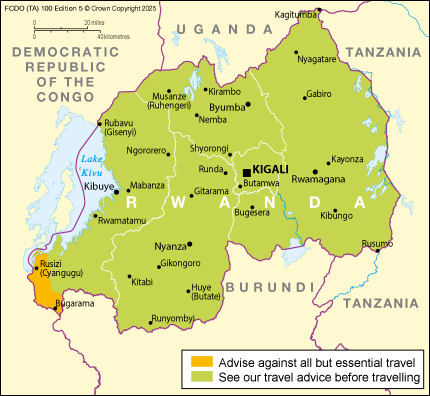
No whole region is advised against, but Foreign Office advises against specific areas (border zone, locality, route…): the map does not draw them, their text is quoted below.

In brief
  • The Foreign Office advises against all but essential travel to areas within 10 kilometres of the DRC border in Rusizi District, including Rwandan islands in Lake Kivu and Kamembe Airport. Foreign Office

Faithful summary of the official texts below, which prevail.

Kigali is in no region these official readings advise against; check that it is not in one of the areas quoted below.The red dot on the map. Change the city at the top of the page to read the map from another point.
Eastern — Country-wide vigilanceSouthern — Country-wide vigilanceWestern — Country-wide vigilanceNorthern — Country-wide vigilanceKigali — Country-wide vigilanceKigali
Country-wide vigilanceKigaliNone of the readings checked (Global Affairs Canada, Foreign Office and France Diplomatie) names a region: the whole country keeps the “country-wide vigilance” colour. Boundaries: Natural Earth. The areas quoted without a region are not drawn: they do not follow regional boundaries.
Advised against — all but essential travel — areas, not drawn1
Foreign Office — FCDO advises against all but essential travel to the parts of Rusizi District which are within 10km of the…
Country-wide vigilance
the whole country, including Kigali
So:

specific areas are advised against; check the itinerary against their text below and record the decision in writing.

US03.06.2026
Level 3 of 4Reconsider travel
FR12.03.2026
No red or orange areaThe security page lists no red or orange area.Your region (Kigali): not covered
GB04.09.2026
Some areas: essential travel onlyYour region (Kigali): not covered
CA09.10.2026
Exercise normal security precautionsHigh degree of caution: Parts of Rusizi and Rubavu districts and Volcanoes National Park.Your region (Kigali): not covered
CH22.08.2025
Some regions advised againstSwitzerland’s FDFA advises against travel to certain regions.

The official text

Official passages not placed on the map1

Foreign Office — Advised against — all but essential travel
FCDO advises against all but essential travel to the parts of Rusizi District which are within 10km of the border with the Democratic Republic of Congo (DRC), including the Rwandan islands in Lake Kivu and Kamembe Airport.

Maximum does not exclude these areas.The VIP Pack covers care and repatriation there. Still enforceable: sanctions and embargoes, and a country already at war at departure. Extraction and security belong to the VIP Pack Extreme, upon eligibility. See My cover

Global Affairs Canada — Open Government Licence – Canada (09.10.2026) · Foreign Office — Open Government Licence v3.0 · France Diplomatie (12.03.2026) · Natural Earth

No located event in this reading.

Last change: New information about vapes and e-cigarette bans in Rwanda and updated information about border measures introduced by the Rwandan Government in response to the Ebola outbreak in the Democratic Republic of Congo ('Entry requirements' and 'S

Rwanda - Level 3: Reconsider TravelState Department ↗updated 03.06.2026 · read 13.10.2026

Updated 03.06.2026

Reconsider travel in Rwanda due to crime , unrest and health risks. Some areas have increased risk. Read the entire Travel Advisory.

The U.S. government has limited ability to provide emergency consular services to U.S. citizens in Rwanda due to the Health situation.

Health

The U.S. Centers for Disease Control and Prevention (CDC) has issued a Travel Health Notice for Ebola for the Democratic Republic of the Congo (DRC).

On May 17, the World Health Organization (WHO) declared the Ebola outbreak in the DRC and Uganda a Public Health Emergency of International Concern .

Crime

Petty crime like pickpocketing is a risk in urban areas. More serious incidents are less common but can happen. This includes burglary or targeted theft. Stay aware of your surroundings.

Unrest

Armed groups, individuals, and military forces often clash in nearby countries. The ongoing violence in these areas has the risk of spilling over into Rwanda.

Do not travel within 10 kilometers of Rwanda’s border with the Democratic Republic of the Congo due to unrest .

Nearest river dischargeOpen-Meteo ↗updated 13.10.2026 · read 13.10.2026

10-13 0.9 · 10-14 0.9 · 10-15 0.7 · 10-16 0.8 · 10-17 1.2 · 10-18 1.5 · 10-19 1.8 m³/s

Simulated discharge: Open-Meteo.com (CC BY 4.0), data rounded and formatted by Maximum. Contains modified Copernicus Emergency Management Service information 2026. For information only: this is not a flood warning; only national or regional authorities issue those.

Where, exactly?

What the national level does not tell you

The level is national. Risk areas are in the state advisories below.

  • U.S. State Department — the full advisory details the regions concerned and the reasons (crime, terrorism, kidnapping, civil unrest) (read the advisory)
  • Foreign, Commonwealth & Development Office (United Kingdom) — the United Kingdom advises against all but essential travel to parts · reviewed 4 September 2026
    Last announced change : « New information about vapes and e-cigarette bans in Rwanda and updated information about border measures introduced by the Rwandan Government in response to the Ebola outbreak in the Democratic Republic of Congo ('Entry requirements' and 'S » (read the advisory)
  • France Diplomatie — France classifies no area of this country as red or orange (see the Security page)

No major event in progress is located in this country at this morning's check.

Safety in figures
Intentional homicides per 100,000 people
Rwanda3.6 2020
Switzerland0.6 2023
France1.3 2023
Road traffic deaths per 100,000 people
Rwanda29.4 2019
Switzerland2.2 2019
France5.1 2019

Reading: The homicide rate is 6 times Switzerland's: violence is a real risk there, concentrated in the areas named by the official advisories. On the road, 13 times more deaths than in Switzerland: road crashes are the leading cause of death of healthy travellers (CDC) — seat belt, no night driving, a driver or a taxi from a rank.

World Bank (UNODC for homicides, WHO for roads) — latest published valuedata.worldbank.org ↗read 10.10.2026

What we locate on the map are events in progress that have real coordinates: USGS earthquakes, GDACS disasters, NOAA storms and open NASA EONET events. Hover a dot for details, click to open it in this briefing.

I travel on a passportEach government writes for its own nationals. The advisory that counts for you — and for your policy's clauses — is your country's.

French passport — France Diplomatie

In brief
  • The entire country is under enhanced vigilance as of 12 March 2026. Road accidents are the primary risk due to poor lighting outside Kigali and limited emergency services capacity. France Diplomatie
  • Nyungwe Forest National Park trekking must be undertaken only through organized tours by professional tourism operators, following registration procedures set by Rwandan tourism authorities. France Diplomatie
  • Exercise particular caution near the Democratic Republic of Congo border due to regular rebel group movements. Border posts at Gisenyi/Goma and Cyangugu/Bukavu operate daytime only and may close without notice. France Diplomatie
  • Virunga mountain range trekking (2400 to 4500 metres altitude) requires verified physical fitness and appropriate equipment. Transborder incidents have been reported at the Burundi border. France Diplomatie
  • Leave valuables and travel documents in hotel safes; carry only a passport photocopy. Avoid walking alone at night in unlit streets and prefer car taxis over motorcycle taxis. Do not drive outside Kigali at night. France Diplomatie
  • Petty theft occurs in high-traffic commercial areas and near craft shops; burglaries happen in Kigali. Natural park visits require an accompanying guide; stay on designated paths. France Diplomatie

Faithful summary of the official texts below, which prevail.

The security page lists no red or orange area.France Diplomatie ↗updated 15.09.2026 · read 12.10.2026

Rwanda

-

-

-

-

-

-

-

-

-

-

-

Zones de vigilance

Dernière actualisation le 12/03/2026, information toujours valable à la date du jour

Zone en vigilance renforcée

L’ensemble du pays est en vigilance renforcée (en jaune).

Toute randonnée dans le Parc national de la forêt de Nyungwe doit être entreprise dans le cadre de tours organisés par des professionnels du tourisme. À défaut et en tout état de cause, il convient de respecter les procédures d’enregistrement donnant accès à ce parc, mises en place par les autorités rwandaises du tourisme.

Les accidents de la route constituent le principal risque au Rwanda, en raison du manque d’éclairage des axes routiers en dehors de Kigali. Ils sont d’autant plus importants que les services de secours n’ont pas toujours la capacité d’intervenir rapidement. Les services de santé, inégalement présents sur l’ensemble du territoire et peu développés, ont une capacité de prise en charge limitée.

Zones frontalières

Avec la RDC

Il convient d’être particulièrement prudent lors de ses déplacements aux abords de la frontière avec la RDC, compte tenu de mouvements réguliers de groupes rebelles. Les postes-frontières à Gisenyi/Goma et Cyangugu/Bukavu sont ouverts uniquement en journée et peuvent être fermés à tout moment et sans préavis.

Avant d’entreprendre une randonnée dans le massif montagneux des Virunga (2400 à 4500m d’altitude), il convient de s’assurer de son aptitude physique et de se munir d’un équipement adapté.

Avec le Burundi

Des incidents transfrontaliers ont été signalés au niveau de la frontière avec le Burundi. Une vigilance particulière lors de déplacements dans cette région est nécessaire.

Terrorisme

Le risque terroriste au Rwanda est faible. Les autorités rwandaises ont cependant pris des mesures préventives : contrôles renforcés à l’aéroport international de Kigali, dans les parcs nationaux, dans les administrations, centres commerciaux, hôtels et lieux publics.

Délinquance

Le taux de criminalité est faible. Toutefois, des vols à l’arraché et des vols commis par des pickpockets dans les zones de forte affluence (rues commerçantes et à proximité des boutiques d’artisanat) peuvent survenir ainsi que des cambriolages, notamment dans la capitale, Kigali.

Risques sociaux

Il convient de suivre les recommandations des autorités locales en cas de manifestations. En cas de troubles, il convient de respecter les injonctions des forces de sécurité.

Recommandations générales

Il est recommandé de :

  • Respecter les consignes des forces de l’ordre.
  • Laisser ses objets de valeur ainsi que ses documents de voyage (passeport, billets d’avion, …) dans des endroits sécurisés comme les coffres des hôtels (n’emporter qu’une photocopie de votre passeport lors de vos déplacements).
  • Ne pas se déplacer avec d’importantes sommes d’argent (les cartes Visa et Mastercard sont acceptées dans de nombreuses boutiques et restaurants et il existe de nombreux distributeurs de billets).
  • Éviter de marcher seul(e) la nuit ou à la tombée de la nuit dans les rues désertes et peu ou pas éclairées.
  • Préférer pour vos déplacements, de jour comme de nuit, les taxis voitures plutôt que les motos taxis.
  • Éviter, autant que possible, de circuler en voiture, la nuit, en dehors de Kigali.
Activités sportives à risque

Lors de visites dans des parcs naturels, il convient d’être accompagné d’un guide et de respecter ses consignes de sécurité. Il est important de ne pas s’éloigner des chemins prédéfinis.

Full text of the Security pagediplomatie.gouv.fr ↗updated 15.09.2026 · read 12.10.2026

Swiss passport — FDFA (Switzerland), in French

In brief
  • Avoid travel to the Rwanda-Democratic Republic of Congo border region due to armed group attacks and security force clashes; national parks are exceptions only with organized tours and trusted local guides. DFAE
  • Do not travel at night within Rwanda due to unpredictable road behaviour, poor traffic compliance, and stray animals significantly increasing accident risks. DFAE
  • Avoid crowds and demonstrations; terrorist attacks cannot be excluded. Stay informed through media about current security situations before and during your trip. DFAE
  • Border crossings may close suddenly for disease control or political tensions; check with local authorities or border posts directly. DFAE
  • Heavy rains cause flooding and landslides that may temporarily disrupt tourist infrastructure and damage roads. DFAE
  • Rwanda is in a seismic zone; volcanic eruptions in Democratic Republic of Congo may affect the border area. Contact Swiss Consular Agency in Kigali if communications with abroad are interrupted. DFAE

Faithful summary of the official texts below, which prevail.

FDFA update note — Le chapitre Risques régionaux spécifiques a été actualisé (Zone frontalière avec la République démocratique du Congo). (published 22.08.2025)

General assessment

Les voyages au Rwanda sont en principe considérés comme sûrs. Les relations avec plusieurs pays voisins sont toutefois tendues (voir chapitre Risques régionaux spécifiques). Dans ce pays comme ailleurs, le risque d’attentats terroristes ne peut être exclu. La rubrique terrorisme et enlèvements attire l'attention sur les risques liés au terrorisme. Terrorisme et enlèvements Avant et pendant le voyage, informez-vous au travers des médias sur la situation sécuritaire actuelle. Faites preuve de prudence. Tenez-vous à l'écart des manifestations et rassemblements de foule de tout genre, étant donné que des débordements ne peuvent pas être exclus.

Specific regional risks

La description des zones à risques repose sur des données approximatives; les risques ne peuvent se restreindre à des zones délimitées. Zone frontalière avec la République démocratique du Congo (Kinshasa) Il est déconseillé de voyager dans la région frontalière avec la République démocratique du Congo (Kinshasa) . L’intensification de la violence dans l’Est de la République démocratique du Congo se répercute également sur la zone frontalière rwandaise. Des échanges de coups de feu entre les forces de sécurité rwandaises et congolaises ont eu lieu à plusieurs reprises, faisant également des victimes. Malgré la signature d'un accord de paix entre le Rwanda et la République démocratique du Congo fin juin 2025, la situation sécuritaire reste instable; il ne peut être exclu que de tels événements se reproduisent. En outre, le risque d’agression par des bandes armées venant de la République démocratique du Congo est réel. Les parcs nationaux constituent une exception à condition que vous visitiez les parcs nationaux exclusivement dans le cadre d'un tour organisé et avec un guide local ou une guide locale de confiance, que vous suiviez les consignes édictées par les services d’administration des parcs et les forces de sécurité et que vous fassiez preuve de la plus grande prudence. Assurez-vous que votre guide se soit renseigné/e sur les conditions de sécurité actuelles. Zone frontalière avec le Burundi Les tensions entre le Rwanda et le Burundi sont élevées. Des affrontements sporadiques entre les forces de sécurité rwandaises et burundaises ne peuvent pas être exclus. Le risque d’agression par des bandes armées venant du Burundi est réel. Le 18 juin 2022, un bus a été attaqué près de Kitabi dans une attaque à motivation politique près du parc national de Nyungwe. Plusieurs personnes ont été tuées ou blessées. Avant le départ et pendant le voyage dans les zones frontalières avec le Burundi, renseignez-vous sur la situation actuelle auprès des autorités locales et faites preuve de prudence. Visitez les parcs nationaux exclusivement dans le cadre d'un tour organisé et avec un guide local ou une guide locale de confiance. Suivez les consignes édictées par les services d’administration des parcs et les forces de sécurité. Faites preuve de la plus grande prudence. Assurez-vous que votre guide se soit renseigné/e sur les conditions de sécurité actuelles. Parcs nationaux dans les autres régions du pays Il est recommandé de visiter les parcs nationaux exclusivement dans le cadre d'un tour organisé et avec un guide local ou une guide locale de confiance. Suivez les…

Crime

Les agressions criminelles sont relativement rares. Des vols à la tire et à l’arraché ainsi que des cambriolages se produisent cependant, en particulier dans les villes. Observez les précautions d'usage et ne vous déplacez jamais à pied la nuit.

Natural hazards

Il faut s'attendre à de fortes pluies. Ces intempéries peuvent provoquer des inondations et des glissements de terrain, pouvant endommager les infrastructures. Le trafic touristique peut s’en trouver temporairement perturbé. Le Rwanda se situe dans une zone sismique. Les éruptions volcaniques en République démocratique du Congo peuvent également affecter la zone frontalière rwandaise. MINEMA Ministry in Charge of Emergency Management Si une catastrophe naturelle devait se produire durant votre séjour, prenez immédiatement contact avec vos proches et suivez les instructions des autorités locales. En cas d’interruption des communications avec l’étranger, vous pouvez vous mettre en liaison avec l'Agence consulaire de Suisse à Kigali.

FDFA travel advice, in French, valid on 12.10.2026eda.admin.ch ↗updated 22.08.2025 · read 12.10.2026

British passport — Foreign Office (UK)

In brief
  • The FCDO advises against all but essential travel to Rusizi District within 10km of the Democratic Republic of Congo border, including Rwandan islands in Lake Kivu and Kamembe Airport. Foreign Office
  • The Rwanda-DRC border crossing may close at short notice; international borders are poorly marked in remote areas and you could unknowingly enter the DRC where fighting may occur. Foreign Office
  • Burundi closed its border to Rwanda in January 2024; be aware of cross-border attack risks near the DRC and Burundi borders due to ongoing eastern DRC conflict. Foreign Office
  • Uganda border crossings have temporarily closed at short notice in recent years; plan accordingly for regional travel disruptions. Foreign Office
  • Possession, use or smuggling of illegal drugs including cannabis carries severe penalties and long jail sentences; airport security uses advanced technology to detect illegal items in all baggage. Foreign Office
  • Vapes and e-cigarettes are banned in Rwanda; bringing them into the country is illegal and they will be confiscated with potential fines imposed. Foreign Office

Faithful summary of the official texts below, which prevail.

Regions covered by the Foreign Officegov.uk ↗updated 04.09.2026 · read 12.10.2026

All but essential travel
  • Rusizi District — FCDO advises against all but essential travel to the parts of Rusizi District which are within 10km of the border with the Democratic Republic of Congo (DRC), including the Rwandan islands in Lake Kivu and Kamembe Airport.
Official Foreign Office map
Foreign Office map — Open Government Licence v3.0

Warnings — Foreign OfficeForeign Office ↗updated 04.09.2026 · read 12.10.2026

Warnings — Foreign Office

Your travel insurance could be invalidated if you travel against advice from the Foreign, Commonwealth & Development Office (FCDO).

Rusizi District

FCDO advises against all but essential travel to the parts of Rusizi District which are within 10km of the border with the Democratic Republic of Congo (DRC), including the Rwandan islands in Lake Kivu and Kamembe Airport.

Rwanda-DRC border

Risks associated with the proximity of potential fighting in Democratic Republic of Congo (DRC) may affect people on the Rwandan side of the border. International borders are often not well marked in remote areas, and you could unknowingly cross into DRC. You may see a presence of military personnel on both sides of the border.

See Democratic Republic of the Congo’s travel advice for more information. Keep up to date with developments through local media.

The border crossings between Rwanda and DRC could close at short notice.

Regional risks — Foreign OfficeForeign Office ↗updated 04.09.2026 · read 12.10.2026

Regional risks — Foreign Office

You should also read FCDO’s overall travel advice and safety and security advice .

Rwanda-DRC border

See advice for the Rwanda-DRC border on the Warnings and insurance page .

Rwanda-Burundi border

Burundi closed the border to Rwanda in January 2024. There might be some tension near the border, as both sides have accused the other of cross-border raids targeting local inhabitants.

Rwanda-Uganda border

Border crossings Uganda have temporarily closed at short notice in recent years. Be aware of the impact that short-notice border closures could have on any travel plans in the region.

Cross-border additional risks

If you’re travelling near the DRC or Burundi borders, be aware of the risk of cross-border attacks and government security operations given the ongoing conflict in eastern DRC.

In recent years, armed incursions have occurred into south-west Rwanda:

  • on 18 June 2023, 2 people were killed and 6 were injured when suspected militants opened fire on a public passenger bus on Nyamagabe-Rusizi road, in Nyungwe Forest, Nyamgabe District
  • on 17 June 2023, a Congolese soldier crossed into Rwanda at Gisenyi and fired on civilians and Rwandan security personnel near the border, injuring 2 Rwandan police officers – the soldier was shot dead
  • in 2022, artillery fire from the DRC hit Rwandan territory, close to the border in Kinigi sector of Musanze District in the north-west

Safety — Foreign OfficeForeign Office ↗updated 04.09.2026 · read 12.10.2026

Safety — Foreign Office

This guide also has safety advice for regions of Rwanda .

Terrorism

There is a high threat of terrorist attack globally affecting UK interests and British nationals, including from groups and individuals who view the UK and British nationals as targets. Stay aware of your surroundings at all times.

UK Counter Terrorism Policing has information and advice on staying safe and what to do in the event of a terrorist attack. Find out how to reduce your risk from terrorism while abroad .

Terrorism in Rwanda

Terrorist attacks in Rwanda cannot be ruled out.

Attacks could be indiscriminate including in places visited by foreigners. Stay aware of your surroundings, keep up to date with local media reports and follow the advice of local authorities.

Protecting yourself and your belongings

Crime levels are relatively low in Rwanda, but there are cases of burglary, theft, bag-snatching and mugging (violent theft) in Kigali.

To reduce your personal risk:

  • take care when walking at night
  • arrange transport in advance
  • lock car doors when driving
  • do not leave valuables in parked cars
  • avoid carrying large amounts of money or other valuables
Personal safety in military zones

Some off-limits military zones in Kigali may not be well lit or signposted. You could be arrested and detained if you enter these areas. Take extra care when walking around less populated zones, particularly at night.

Methanol poisoning

There has been an increase in cases of serious illness caused by alcoholic drinks containing methanol in popular travel destinations around the world.

Even small amounts of methanol can kill. It is not possible to identify methanol in alcoholic drinks by taste or smell. See Travel Aware Drink Spiking and Methanol Poisoning for information about how to reduce the risks.

Seek urgent medical attention if you or someone you are travelling with show the signs of methanol poisoning after drinking.

Illegal drugs

Illegal drugs, including cannabis, carry severe penalties.

You should expect a long jail sentence and heavy fines for possessing, using or smuggling illegal drugs, including when transiting through the airport.

Airports in Rwanda have excellent technology and security for detecting illegal items. This is also used to scan the baggage of transiting passengers.

Using cameras in secure areas

It is illegal to photograph some government buildings. If you use a drone to take photographs of a prohibited area without a permit, you risk being imprisoned or receiving a severe fine.

LGBT+ travellers

Consensual same-sex sexual acts are not illegal in Rwanda, but can be frowned upon by locals.

Rwanda’s laws do not discriminate against sexual orientation, and its constitution prohibits all forms of discrimination. Read more advice for LGBT+ travellers .

Plastic bag ban

There is a ban on plastic bags in Rwanda for environmental reasons. If you have plastic bags when you arrive in the country, they will be confiscated.

Vaporisers, e-cigarette bans

Vapes and e-cigarettes are banned in Rwanda. It is illegal to bring them into the country, including for personal use. If you are found in possession of vapes or e-cigarettes you will have them confiscated and could be fined.

Genocide Memorial Day

The week following Genocide Memorial Day on 7 April is an official week of mourning.

National day of community service (Umuganda)

The last Saturday of each month is Umuganda, a national day of community service. Most normal services close from 7am to…

American passport — U.S. Department of State

In brief
  • Do not travel within 10 kilometers of Rwanda's border with the Democratic Republic of the Congo due to armed group clashes and unrest. State Department
  • Exercise increased caution in Rwanda due to petty crime like pickpocketing in urban areas and occasional burglary or targeted theft incidents. State Department
  • Enroll in the Smart Traveler Enrollment Program (STEP) to receive important updates and alerts from the U.S. embassy in Rwanda. State Department
  • Do not physically resist any robbery attempt and use caution when walking or driving at night in Rwanda. State Department
  • Keep travel documents up to date and easily accessible, and have an emergency departure plan that does not depend on U.S. government assistance. State Department

Faithful summary of the official texts below, which prevail.

Rwanda - Level 3: Reconsider Travel 2026-06-03travel.state.gov ↗updated 03.06.2026 · read 13.10.2026

Advisory summary

Reconsider travel in Rwanda due to crime , unrest and health risks. Some areas have increased risk. Read the entire Travel Advisory.

The U.S. government has limited ability to provide emergency consular services to U.S. citizens in Rwanda due to the Health situation.

Health

The U.S. Centers for Disease Control and Prevention (CDC) has issued a Travel Health Notice for Ebola for the Democratic Republic of the Congo (DRC).

On May 17, the World Health Organization (WHO) declared the Ebola outbreak in the DRC and Uganda a Public Health Emergency of International Concern .

Crime

Petty crime like pickpocketing is a risk in urban areas. More serious incidents are less common but can happen. This includes burglary or targeted theft. Stay aware of your surroundings.

Unrest

Armed groups, individuals, and military forces often clash in nearby countries. The ongoing violence in these areas has the risk of spilling over into Rwanda.

Do not travel within 10 kilometers of Rwanda’s border with the Democratic Republic of the Congo due to unrest .

Global Affairs Canada — additional reading

Exercise normal security precautions (with regional advisories)

Open Government Licence – Canada · October 9, 2026 09:48 EDTtravel.gc.ca ↗updated 09.10.2026 · read 13.10.2026

In brief
  • Carry an International Driving Permit and obtain third-party insurance covering injury damages; accidents causing death may result in jail sentences. Global Affairs Canada
  • Do not import electronic cigarettes, vaporizers, or non-biodegradable plastic bags; these will be confiscated and you may face fines. Global Affairs Canada
  • Illegal drugs, including cannabis, carry severe penalties: expect long jail sentences and heavy fines for possession, use, or trafficking. Foreign Office
  • Do not photograph military sites, government buildings, airports, or border areas; operating drones requires prior permission from Rwanda Civil Aviation Authority. Global Affairs Canada
  • Dress conservatively, behave discreetly, and seek permission before photographing people; same-sex relationships are legal but not widely socially accepted. Global Affairs Canada
  • Denying genocide or promoting genocide ideology carries heavy prison sentences; political criticism is discouraged and may be punishable. DFAE

Faithful summary of the official texts below, which prevail.

Global Affairs Canada — written for Canadian travellers, valid for all

Local laws

You must abide by local laws. Learn about what you should do and how we can help if you are arrested or detained abroad.

Drugs

Penalties for possession, use or trafficking of illegal drugs are severe. Convicted offenders can face heavy fines and imprisonment. Drugs, alcohol and travel

2SLGBTQI+ persons

Rwandan law doesn’t criminalize sexual acts or relationships between persons of the same sex. However, homosexuality is not widely socially accepted. 2SLGBTQI+ persons could be discriminated against based on their sexual orientation, gender identity, gender expression, or sex characteristics. Travel and your sexual orientation, gender identity, gender expression and sex characteristics

Electronic cigarettes and vaporizers

It is illegal to import or use electronic cigarettes or vaporizers in Rwanda. Offenders will have the items confiscated and may face fines.

Non-biodegradable bags

Non-biodegradable bags are prohibited in Rwanda. If you arrive with such bags at the airport in Kigali, they will be confiscated.

Photography

Photography of sensitive installations is prohibited. This includes:

  • military sites
  • government buildings
  • airports
  • border crossing areas
International Child Abduction

The Hague Convention on the Civil Aspects of International Child Abduction is an international treaty. It can help parents with the return of children who have been removed to or retained in certain countries in violation of custody rights. It does not apply between Canada and Rwanda. If your child was wrongfully taken to, or is being held in Rwanda by an abducting parent:

  • act as quickly as you can
  • consult a lawyer in Canada and in Rwanda to explore all the legal options for the return of your child
  • report the situation to the nearest Canadian government office abroad or to Global Affairs Canada by calling the Emergency Watch and Response Centre

If your child was removed from a country other than Canada, consult a lawyer to determine if The Hague Convention applies. Be aware that Canadian consular officials cannot interfere in private legal matters or in another country's judicial affairs.

Dress and behaviour

To avoid offending local sensitivities:

  • dress conservatively
  • behave discreetly
  • respect religious and social traditions
  • seek permission from locals before photographing them
Drones

The recreational and commercial flying of drones is strictly regulated. You must seek the permission from Rwanda Civil Aviation Authority prior to operating a drone. If you don’t comply, you may be fined and your drone confiscated. Drones – Visit Rwanda

Driving

You must carry an International Driving Permit. International Driving Permit

Insurance

Third-party insurance is required to cover damages if you are involved in an accident resulting in injuries even if you are not found to be at fault. If you are suspected of causing an accident, your driver’s licence can be confiscated during the investigation. If the accident results in death, you may be subject to a jail sentence.

Money

The currency of Rwanda is the Rwandan franc (RWF). Rwanda is a cash-based economy. Electronic payments and online banking are becoming more available. Credit cards are usually accepted at:

  • most hotels and lodges
  • most businesses, restaurants and shops in Kigali

ATMs are available in large cities. Some ATMs may not accept foreign bank cards, but you can make withdrawals at the bank counter, using your passport as identification. Expect to handle other expenses in cash. Most shops will not accept or exchange U.S. dollars printed before 2006.

Open Government Licence – Canada · October 9, 2026 09:48 EDTtravel.gc.ca ↗updated 09.10.2026 · read 13.10.2026

Foreign Office — laws and cultural differences

Illegal drugs

Illegal drugs, including cannabis, carry severe penalties. You should expect a long jail sentence and heavy fines for possessing, using or smuggling illegal drugs, including when transiting through the airport. Airports in Rwanda have excellent technology and security for detecting illegal items. This is also used to scan the baggage of transiting passengers.

Using cameras in secure areas

It is illegal to photograph some government buildings. If you use a drone to take photographs of a prohibited area without a permit, you risk being imprisoned or receiving a severe fine.

LGBT+ travellers

Consensual same-sex sexual acts are not illegal in Rwanda, but can be frowned upon by locals. Rwanda’s laws do not discriminate against sexual orientation, and its constitution prohibits all forms of discrimination. Read more advice for LGBT+ travellers.

Plastic bag ban

There is a ban on plastic bags in Rwanda for environmental reasons. If you have plastic bags when you arrive in the country, they will be confiscated.

Vaporisers, e-cigarette bans

Vapes and e-cigarettes are banned in Rwanda. It is illegal to bring them into the country, including for personal use. If you are found in possession of vapes or e-cigarettes you will have them confiscated and could be fined.

Open Government Licence v3.0gov.uk ↗updated 04.09.2026 · read 12.10.2026

FDFA (Switzerland) — laws and customs, in French

Specific legal provisions

Entre autres, sont punissables :

  • la possession et l'utilisation de sacs en plastique;
  • jeter des détritus sur la voie publique;
  • marcher sur les espaces verts en ville;
  • photographier des installations militaires et des bâtiments gouvernementaux.

La négation du génocide ou la promotion de l’idéologie du génocide sont passibles de lourdes peines de prison. Les critiques à caractère politique ne sont guère appréciées; elles risquent de vous mettre en difficulté, vous et la personne avec qui vous êtes en contact, et sont même punissables dans certains cas. Les infractions à la loi sur les stupéfiants, y compris la détention de minimes quantités de drogue quelle qu'elle soit, sont passibles de lourdes peines de prison. Les conditions de détention sont précaires (prisons surpeuplées, conditions d'hygiène médiocres, soins médicaux insuffisants, etc.).

Cultural specificities

Adaptez le comportement et la tenue vestimentaire aux us et coutumes locaux. Souvenez-vous que la population reste traumatisée par le souvenir du génocide en 1994. Dans vos contacts avec la population, faites preuve de respect et de tact. Renseignez-vous dans les guides de voyage, auprès de votre agence ou directement sur place, sur les codes de conduite et les conventions à respecter. Les relations homosexuelles et la transsexualité sont réprouvées de manière générale.

FDFA travel advice, in Frencheda.admin.ch ↗updated 22.08.2025 · read 12.10.2026

Air: Fair 30/100PM2.5 9.8 µg/m³ · PM10 10.0 µg/m³
UV extreme today max 12.2Right now 0.0 · WHO scale 0–11+

What it changes for you: Air acceptable at this hour: nothing special to plan. Very high UV: sunscreen, hat and shade between 11 am and 4 pm; sunstroke and dehydration are travellers' first reasons to see a doctor.

Reading 22:00 (Africa/Kigali)Open-Meteo ↗updated 13.10.2026 · read 13.10.2026

Air quality and UV: Open-Meteo.com (CC BY 4.0), data rounded and formatted by Maximum. Contains modified Copernicus Atmosphere Monitoring Service information 2026. Neither the European Commission nor ECMWF is responsible for any use that may be made of the Copernicus information or data it contains.

Physicians per 1,000 people
Rwanda0.1 2022
Switzerland4.5 2022
France3.3 2022
Hospital beds per 1,000 people
Rwanda0.8 2023
Switzerland4.4 2023
France5.7 2022
Health spending per person (USD)
Rwanda53 2023
Switzerland11,784 2023
France5,327 2024
Life expectancy (years)
Rwanda68.0 2024
Switzerland84.4 2024
France83.0 2024

Reading: With 0.1 physicians per 1,000 people (98% fewer than Switzerland), the nearest hospital does not always have the capacity for a serious case: evacuation to an adequate centre is the rule, not the exception — that is what unlimited evacuation and repatriation cover. Health spending of 53 USD per person (Switzerland: 11,784) goes with private hospitals that bill foreigners in hard currency and ask for a guarantee before admission: the direct payment guarantee is what avoids the deposit.

World Bank — latest published value, year per indicatordata.worldbank.org ↗read 10.10.2026

I travel on a passportVisa, passport validity, entry form: the rules depend on your passport. Each government describes them for its own nationals.

French passport — France Diplomatie

In brief
  • No COVID-19 test is required to enter Rwanda since 1 August 2022, but tests may be requested for official events or national park visits. France Diplomatie
  • A negative COVID-19 test less than 72 hours old is required to visit national parks: PCR test for primate parks (Volcans, Nyungwe, Gishwati-Mukura), rapid antigen test for others and Akagera. France Diplomatie
  • PCR tests cost 50 USD or 50,000 FRW; rapid antigen tests cost 5,000 FRW. Contact Rwanda Biomedical Centre Help Desk at (+250) 787 243 836, (+250) 788 793 446, or (+250) 784 026 239. France Diplomatie
  • French nationals receive free 30-day tourist visas on arrival, renewable twice for maximum 90 days without leaving Rwanda, each extension costing 50 USD. Passport must be valid six months beyond entry. France Diplomatie
  • French nationals with positive COVID-19 tests or symptoms must contact the French Embassy emergency line (+250) 722 152 766 or call 114 for health authorities. France Diplomatie
  • Yellow fever vaccination certificate is not required for French nationals from France but is mandatory for those who have stayed in endemic countries. France Diplomatie

Faithful summary of the official texts below, which prevail.

Rwanda

-

-

-

-

-

-

-

-

-

-

-

Arrivée et départ du Rwanda

Depuis le 1er août 2022, aucun test à la Covid n’est nécessaire pour se rendre au Rwanda.

Au départ de Kigali , aucun test à la COVID n’est nécessaire sauf conditions d’entrée du pays de destination. Les tests COVID peuvent être fait sur demande sur le site du Rwanda biomedical centre (RBC) . Le Help Desk du RBC est joignable au (+250) 787 243 836, (+250) 788 793 446, ou (+250) 784 026 239. Toutes ces informations sont disponibles sur cette notice (PDF - 320 Ko).

Conformément aux instructions des autorités rwandaises, tous les ressortissants rwandais doivent être en mesure de présenter un schéma vaccinal complet (double doses de vaccin + dose de rappel) pour voyager à l’extérieur du pays. Cette mesure s’applique à tous les ressortissants rwandais âgés de plus de 12 ans quel que soit leur lieu de résidence.

Pendant le séjour au Rwanda

Les mesures suivantes restent en vigueur :

  • Un test PCR peut être demandé pour participer à un événement officiel rassemblant du public ou une conférence.
  • Le tourisme à l’intérieur du pays est autorisé aux conditions suivantes :
  • la présentation d’un test négatif à la COVID-19 de moins de 72 heures pour visiter les parcs nationaux : un test PCR est exigé pour aller voir les primates des parcs des Volcans, de Nyungwe et de Gishwati-Mukura, un test antigénique rapide est accepté pour les autres activités et pour le parc de l’Akagera ;
  • Les tests PCR, d’un coût de 50 USD ou de 50 000 FRW (payables sur place par carte bancaire) peuvent être réalisés dans ces centres de test (en anglais) (PDF - 299 Ko). Les tests antigéniques rapides d’un coût de 5 000 FRW (environ 5€) peuvent être réalisés dans ces cliniques (PDF - 293 Ko).

L’ensemble des mesures sanitaires sont susceptibles d’être modifiées par les autorités rwandaises à tout moment.

En cas de symptômes ou d’un résultat positif au test de la COVID-19

En cas de résultat positif au test de la COVID-19 : les personnes dont le test serait positif à l’arrivée ou au départ, seront prises en charge par les autorités sanitaires rwandaises à leurs frais jusqu’à leur rétablissement complet (deux tests PCR négatifs consécutifs).

En cas de symptômes du coronavirus : le numéro d’urgence à appeler en cas de symptômes du coronavirus ou pour des informations complémentaires est le 114. Il est également possible d’envoyer un courriel à covid@rbc.gov.rw , et d’envoyer un message WhatsApp au +250 781 415 724.

Tous les ressortissants français présents au Rwanda présentant des symptômes à la COVID-19, testés positifs ou placés en isolement sont invités à avertir l ’ambassade de France au Rwanda en composant le numéro d’urgence : (+ 250) 722 152 766.

Visa

Depuis le 8 mars 2020, les ressortissants des pays membres de l’Union Africaine, de l’Organisation internationale de la Francophonie et du Commonwealth sont exemptés des frais de visa pour les visas touristiques (entrée simple) pour le Rwanda. Les ressortissants français peuvent obtenir à leur arrivée au Rwanda un visa touristique gratuit d’une validité maximale de 30 jours (entrée simple). Ils doivent renouveler leur demande à chaque sortie du territoire.

Les ressortissants Français (ainsi que des pays membres de l’EAC, Francophonie et Commonwealth) souhaitant prolonger leur séjour touristique au Rwanda peuvent déposer une demande de prolongation de séjour pour une durée de 30 jours au prix de 50 US dollars (renouvelable deux fois pour un séjour d’une durée maximale de 90 jours sans sortie de territoire).

Le passeport doit être valable au moins six mois après la date d’entrée sur le territoire rwandais. Informations disponibles sur le site de la Direction générale de l’émigration et de l’immigration (en anglais).

La présentation du carnet de vaccination international contre la fièvre jaune n’est pas obligatoire pour les ressortissants Français en provenance de France mais reste obligatoire pour les Français ayant séjourné dans un pays où la maladie est endémique.

Les autorités rwandaises sont très strictes sur la régularité des titres de voyage. En cas de sortie du territoire, il est nécessaire de repasser par les services d’immigration à un poste-frontière. Les permis de séjour (19 classes de permis temporaires et 6 classes de permis permanents) sont délivrés par la Direction générale de l’émigration et de l’immigration à Kigali. La liste des pièces à fournir, les tarifs et les formulaires requis sont accessibles sur le site Internet de cette institution (lien…

Entry and stay pagediplomatie.gouv.fr ↗updated 15.09.2026 · read 12.10.2026

Swiss passport — FDFA (Switzerland)

The FDFA does not publish entry requirements: they are set out by the destination's embassy or consulate in Switzerland — check them before booking, passport in hand. As a guide, the French and British requirements below describe the same rules as seen by two other governments.eda.admin.ch ↗updated 22.08.2025 · read 12.10.2026

British passport — Foreign Office (UK)

In brief
  • British passport holders must have at least six months validity beyond arrival date and one blank page for entry stamps. Foreign Office
  • Commonwealth citizens receive a free 30-day visa on arrival; alternatively, apply at the Rwandan High Commission in London. Foreign Office
  • Applicants for resident, business or missionary multiple-entry visas must obtain a UK Police Certificate, requiring at least ten working days processing time. Foreign Office
  • Drones must be declared upon arrival and may be confiscated or held until departure; strict customs rules apply to all goods. Foreign Office
  • Yellow fever vaccination certificate required if arriving from a transmission risk country; health screening measures operate at Kigali International Airport due to DRC Ebola outbreak. Foreign Office
  • Land border crossings with DRC at Gisenyi-Goma and Cyangugu-Bukavu have variable hours; the FCDO advises against all but essential travel to parts of Rusizi District. Foreign Office

Faithful summary of the official texts below, which prevail.

Entry requirements — rules for a British passportForeign Office ↗updated 04.09.2026 · read 12.10.2026

Entry requirements — rules for a British passport

This information is for people travelling on a full ‘British citizen’ passport from the UK. It is based on the UK government’s understanding of Rwanda’s current rules for the most common types of travel.

The authorities in Rwanda set and enforce entry rules. If you’re not sure how these requirements apply to you, contact the Rwandan High Commission in the UK .

Passport validity requirements

To enter Rwanda, your passport must have an ‘expiry date’ at least 6 months after the date you arrive and at least one blank page for entry stamps.

Check with your travel provider that your passport and other travel documents meet requirements. Renew your passport if you need to.

You will be denied entry if you do not have a valid travel document or try to use a passport that has been reported lost or stolen.

Dual nationals

When returning to the UK, British citizens must carry a valid British passport or certificate of entitlement . See Dual citizenship .

Visa requirements

You must have a visa to enter Rwanda as a visitor. As a citizen of a Commonwealth country, you can get a free 30-day visa on arrival.

Rwanda’s immigration department has information on visa requirements .

Applying for a visa

You can also apply for a visa from the Rwandan High Commission in London.

You must get a UK Police Certificate before you travel if you’re applying for a resident, business or missionary multiple-entry visa. It usually takes at least 10 working days to process.

Travel between Rwanda and the Democratic Republic of the Congo

Land border crossing opening hours between Rwanda and the Democratic Republic of the Congo (DRC) at Gisenyi-Goma and Cyangugu-Bukavu vary. The conflict in DRC could further affect border crossings (see  Democratic Republic of the Congo’s travel advice ). The FCDO currently advises against all but essential travel to parts of the Rusizi District.

You may experience immigration difficulties if you do not have residency status and regularly cross between the two countries.

Border measures

In response to the current Ebola outbreak in DRC, the Government of Rwanda has introduced health-screening measures at Kigali International Airport and border restrictions with DRC . These measures may be subject to short notice change. Check the latest advice of local authorities and tour operators ahead of travel.

Customs rules

There are strict rules about goods you can take into or out of Rwanda . You must declare anything that may be prohibited or subject to tax or duty.

You must declare drones when you arrive. They may be confiscated or held until you leave the country.

Vaccine requirements

To enter Rwanda, if you’re coming from a country listed as a transmission risk , you must have a certificate to prove you’ve had a yellow fever vaccination.

For full details about medical entry requirements and recommended vaccinations, see TravelHealthPro’s Rwanda guide .

American passport — U.S. Department of State

The State Department publishes the requirements ("Entry, Exit and Visa Requirements") on its country page, which our servers cannot read. Read it before you go; as a guide, the French and British requirements below describe the same rules as seen by two other governments.travel.state.gov ↗updated 03.06.2026 · read 13.10.2026

Living on site

For each risk, the official texts themselves: what is happening, then, where they say so, what to do.

CrimeMODERATE

What the texts say · Crime levels are relatively low in Rwanda, but there are cases of burglary, theft, bag-snatching and mugging (violent theft) in Kigali. Terrorist attacks in Rwanda cannot be ruled out.

What they advise:
  • Do not physically resist any robbery attempt.
  • Stay aware of your surroundings at all times.
  • Attacks could be indiscriminate including in places visited by foreigners.
Foreign Office · State Department
TransportMODERATE

What the texts say · Shared taxis (mini vans) and motorbike taxis are the most common form of public transport, but are very vulnerable to accidents. After dark, many roads outside of larger urban centres are unlit and driving standards are poor.

What they advise:
  • Arrange transport in advance.
  • Lock car doors when driving.
  • If you choose to drive in Rwanda: avoid travelling after dark.
Foreign Office · Global Affairs Canada
Nature and climateMODERATE

What the texts say · The rainy season runs from February to May and from September to December. Heavy storms can cause disruption and damage, including landslides and floods.

What they advise:
  • Monitor local media reports and follow the advice of local authorities.
  • Stay away from flooded areas.
Foreign Office · Global Affairs Canada
Laws and customsTO KNOW

What the texts say · Illegal drugs, including cannabis, carry severe penalties. Vapes and e-cigarettes are banned in Rwanda.

What they advise:
  • It is illegal to bring them into the country, including for personal use.
  • If you use a drone to take photographs of a prohibited area without a permit, you risk being imprisoned or receiving a severe fine.
Foreign Office
Cyber and dataMODERATE

What the texts say · Criminals can compromise public Wi-Fi networks to steal personal data or credit card information.

What they advise:
  • Avoid online shopping on unencrypted websites.
  • Be wary of unsolicited emails offering attractive business opportunities.
Global Affairs Canada
Crowds and calendarLOW

What the texts say · The last Saturday of each month is Umuganda, a national day of community service.

What they advise: Avoid areas where demonstrations and large gatherings are taking place.
Foreign Office · Global Affairs Canada

Sentences copied word for word from the official texts cited, chosen for the destination; the level is our reading. The full texts, at each source:Foreign Office ↗updated 04.09.2026 · read 12.10.2026 (updated 04.09.2026 · read 04.10.2026)State Department ↗updated 03.06.2026 · read 13.10.2026 (updated 03.06.2026 · read 04.10.2026)Global Affairs Canada ↗updated 09.10.2026 · read 13.10.2026 (updated 09.10.2026 · read 04.10.2026)

Safety in figures
Intentional homicides per 100,000 people
Rwanda3.6 2020
Switzerland0.6 2023
France1.3 2023
Road traffic deaths per 100,000 people
Rwanda29.4 2019
Switzerland2.2 2019
France5.1 2019

Reading: The homicide rate is 6 times Switzerland's: violence is a real risk there, concentrated in the areas named by the official advisories. On the road, 13 times more deaths than in Switzerland: road crashes are the leading cause of death of healthy travellers (CDC) — seat belt, no night driving, a driver or a taxi from a rank.

World Bank (UNODC for homicides, WHO for roads) — latest published valuedata.worldbank.org ↗read 10.10.2026

—:—Local time · Africa/Kigali ·
112Local emergency numbers · Police 112 · Ambulance 912 · Fire 112
Europlug, BS 1363, prise électrique de type E230 V
Drivingon the right

Time zone: IANA and timezone-boundary-builder (ODbL) · RESTCountries · EmergencyNumberAPI · Wikidata · European Central Bank

Places: © OpenStreetMap contributors (ODbL), Photon search by komoot.

FDFA (Switzerland) — transport and specific advice, in French

Transport and infrastructure

Les routes nationales sont en bon état. Cependant, les comportements parfois imprévisibles sur les routes, l'inobservation du code de la route ainsi que des animaux errants augmentent considérablement les risques d'accidents. La nuit, renoncez aux déplacements à travers le pays. Les points de passage des frontières peuvent être fermés à court terme, par exemple afin d’endiguer la propagation de maladies ou en raison de tensions politiques. Informez-vous auprès des autorités locales ou directement auprès des postes-frontières.

Specific remarks

Les camps de réfugiés peuvent être visités seulement avec une autorisation des autorités rwandaises.

FDFA travel advice, in Frencheda.admin.ch ↗updated 22.08.2025 · read 12.10.2026

Public holidaysNager.Date ↗read 25.09.2026

  • Fri 25 Dec — Christmas Day
  • Sat 26 Dec — St. Stephen's Day
ESSENTIAL

Maximum policyholder: before paying anything, call the 24/7 number. If you are admitted for more than 24 h, Maximum sends its direct payment guarantee to the hospital (art. 2.12).

+41 22 ••• •• •• — Full number in your client area

The hospitals to know — Kigali

The hospital list has not been read from OpenStreetMap for this page yet: the medical-network map loads it when opened. Maximum's assistance directs you to the right facility, 24/7. The medical-network map ↗

40pharmacies40doctorsFull map and list ↗

Before you go

  • Routine vaccinesup to date
  • Yellow feverrequired if arriving from a risk area
  • Hepatitis Arecommended
  • Hepatitis Brecommended
  • Malariapreventive medicine recommended
  • Typhoidrecommended
  • Choleradepending on the area

CDC Travelers' Health recommendations, most important first. They depend on your age, vaccines and itinerary: confirm them with a doctor or a travel clinic 4 to 6 weeks before departure. Details, disease by disease ↗cdc.gov ↗read 10.10.2026

On site

DengueMosquitoes bite by day: repellent, long sleeves.
MalariaPresent in some areas: talk to a doctor before leaving.
ChikungunyaMosquito-borne: same protection as for dengue.
SunUV extreme (12): hat, sunscreen, water.
MedicationIn their box, with the prescription — in English if possible.

The health system — With 0.1 physicians per 1,000 people (98% fewer than Switzerland), the nearest hospital does not always have the capacity for a serious case: evacuation to an adequate centre is the rule, not the exception — that is what unlimited evacuation and repatriation cover. Health spending of 53 USD per person (Switzerland: 11,784) goes with private hospitals that bill foreigners in hard currency and ask for a guarantee before admission: the direct payment guarantee is what avoids the deposit.

Back home — a fever in the following weeks should be told to a doctor, naming the country.

The next 7 days Africa/KigaliMET Norway ↗read 13.10.2026

Wed 14 Oct15–29°showers · 1.4 mm
Thu 15 Oct16–30°heavy showers · 8.1 mm
Fri 16 Oct16–26°showers · 8.3 mm
Sat 17 Oct16–24°heavy rain · 10.4 mm
Sun 18 Oct15–24°heavy showers · 13.5 mm
Mon 19 Oct15–24°showers · 5.6 mm
Tue 20 Oct15–24°heavy showers · 14.5 mm

Forecast: MET Norway (Norwegian Meteorological Institute, CC BY 4.0), grouped by day and formatted by Maximum.

I travel on a passportYour embassy, and the service to register with, depend on your passport.

Your country, 24/7, from abroad

FR
Crisis and Support Centre — French Ministry for Europe and Foreign Affairs+33 1 53 59 11 0024/7 emergency line, standard rate. First contact abroad: the French embassy or consulate.www.diplomatie.gouv.fr ↗updated 15.09.2026 · read 12.10.2026
CH
FDFA Helpline+41 58 465 33 33+41 800 24 7 36524/7, 365 days a year — helpline@eda.admin.ch. Beware of scam calls spoofing these numbers.www.eda.admin.ch ↗updated 22.08.2025 · read 12.10.2026
GB
Foreign, Commonwealth & Development Office+44 20 7008 500024 hours, for British nationals.www.gov.uk ↗updated 04.09.2026 · read 12.10.2026
US
Overseas Citizens Services — U.S. Department of State+1 202 501 4444+1 888 407 4747From abroad; the second number from the U.S. and Canada.travel.state.gov ↗updated 03.06.2026 · read 13.10.2026

French passport — French embassy and consulates

FR
Ambassade de Franceembassy · nearest · 0.9 km

3 Rue KN 33

+33 5 24 09 23 79 · France Diplomatie

Useful contacts listed by France Diplomatie (in French)diplomatie.gouv.fr ↗updated 15.09.2026 · read 12.10.2026

Updated: 15 September 2026

OpenStreetMap

Swiss passport — Swiss embassy and consulates

CH
Résidence de l'Ambassade de Suisseembassy · nearest · 1.1 km

phone not published

Useful addresses — FDFA, in French

Numéro d’urgence de la police: 112 Dispositions douanières: Rwanda Revenue Authority Représentations suisses à l’étranger: En cas de situation d’urgence à l’étranger, vous pouvez vous adresser à la représentation suisse la plus proche ou à la Helpline DFAE. Ambassade de Suisse au Rwanda Ambassade de Suisse au Kenya (Services consulaires) Helpline DFAE Représentations étrangères en Suisse: Pour obtenir des informations sur les prescriptions d'entrée (documents d'identité admis, visa, etc.), veuillez vous adresser aux ambassades et consulats étrangers compétents. Ceux-ci peuvent également vous renseigner sur les dispositions douanières pour l'importation et l'exportation d'animaux et de marchandises: appareils électroniques, souvenirs, médicaments, etc. Représentations étrangères en Suisse

OpenStreetMap · DFAE

British passport — British embassy and consulates

OpenStreetMap

American passport — U.S. embassy and consulates

US
Ambassade des États-Unisembassy · nearest · 2.6 km

phone not published

US
Résidence de l'Ambassadeur Américainembassy · 3.3 km

phone not published

OpenStreetMap

Police

  • Kimisagara Police Station · 0.8 km
  • Kimisagara Police Station · 0.8 km
  • Nyabugogo Police Post · 1.9 km
  • RIB · 3.4 km

Town hall

  • Village Urugwiro · 2.8 km
  • kLab · 3.5 km
  • Kicukiro District Office · 6.3 km

OpenStreetMap

Getting help — Foreign OfficeForeign Office ↗updated 04.09.2026 · read 12.10.2026

Getting help — Foreign Office

The Foreign, Commonwealth & Development Office ( FCDO ) cannot provide tailored advice for individual trips. Read this travel advice and carry out your own research before deciding whether to travel.

Emergency services in Rwanda

Ambulance: 112

Police: 112

Fire: 111

Contact your travel provider and your insurer if you are involved in a serious incident or emergency abroad. They will tell you if they can help and what you need to do.

Help abroad

See how to get help from the UK government abroad including in an emergency.

Help in the UK

You can call  FCDO  in London if you need urgent help because something has happened to a friend or relative abroad.

Telephone: 020 7008 5000 (24 hours)

Find out about call charges

Useful phrases

English is an official language in Rwanda: no translated phrases here. No Kinyarwanda phrases yet, though it is widely spoken there.

  • Keep the entry stamp, hospital invoices and the medical report. Without them a claim cannot be rebuilt.
  • File it from the claim form, once back, with those papers.
  • The France Diplomatie health page mentions dengue and malaria and chikungunya. A fever in the weeks after return should be told to a doctor, naming the country.

Actions to take before each professional trip abroad.

1Once — the framework
2For each departure
3During the mission, and after

What is happening in Rwanda right now

Live alerts and level changes, each with its official source. Continuously updated.

What governments have just written

LatestRappel - Affrontements armés dans la région de Goma en République démocratique du Congo

Au regard de la situation sécuritaire et des affrontements armés ayant lieu au Nord Kivu, notamment dans le territoire de Nyiragongo en République démocratique du Congo, il est conseillé aux ressortissants présents au Rwanda de faire preuve de prudence pour tout déplacement dans la zone frontalière dite « zone des trois frontières (Rwanda, RDC, Ouganda) ». Le Parc National des Volcans doit être visité avec un guide.

France Diplomatie (in French) · posted 4 March 2026 · updated 17 September 2026diplomatie.gouv.fr ↗updated 15.09.2026 · read 12.10.2026
LatestEpidémie de maladie à virus Ebola en République Démocratique du Congo et en Ouganda

L’OMS a déclaré le 17 mai une urgence de santé publique de portée internationale face à l’épidémie d’Ebola touchant la République Démocratique du Congo et l’Ouganda. Les autorités rwandaises ont mise en place des mesures de contrôle renforcé au niveau de la frontière avec la République Démocratique du Congo et la frontière terrestre avec Goma (Nord Kivu) a été fermée. Il est recommandé de suivre strictement les consignes de prévention suivantes : • se tenir régulièrement…

France Diplomatie (in French) · posted 18 May 2026diplomatie.gouv.fr ↗updated 15.09.2026 · read 12.10.2026
UpdateGlobal Affairs Canada

The Need help? section was updated.

October 9, 2026 09:48 EDTtravel.gc.ca ↗updated 09.10.2026 · read 13.10.2026

No level change recorded for this country since the log opened. The live alerts above are updated continuously.

⚡ The world feed — every country →

Frequently asked questions — travel insurance Rwanda

24/7 support number — +41 22 ••• •• ••An adviser goes through each question with you until you have an actionable answer: cover, hospital, entry rules, claims. Full number in your client area. You can also ask Maximum directly, just below these questions.
What is the official risk level in Rwanda today?

Level 3/4 — Reconsider Travel, U.S. Department of State, retrieved on 13 October 2026.

  • Is the whole country advised against? United States: except for imperative reasons · France: no · United Kingdom: no · Switzerland: no (reading of 27 September 2026).
  • Switzerland’s FDFA advises against travel to certain regions (published 22.08.2025).
  • Contractually, only an FDFA, FOPH or WHO advisory against the trip opens Module A (art. 18.1) — that is not the case today.
  • Read the areas to avoid, inform your company (Duty of Care checklist) and check that your cover has no territorial clause — My cover says it card by card.
  • We check these sources every morning and e-mail you the day one changes (Alerts button).

Sourcestravel.state.gov · updated 03.06 · read 13.10France Diplomatie · updated 15.09 · read 12.10DFAE · updated 22.08 · read 12.10207-country comparison

Is the whole of Rwanda advised against, or only some areas?

An area advised against does not rule out the country.

  • Official answers: United States: except for imperative reasons · France: no · United Kingdom: no · Switzerland: no.
  • Foreign Office, regional risks: “You should also read FCDO’s overall travel advice and safety and security advice . Rwanda-DRC border See advice for the Rwanda-DRC border on the Warnings and insurance page . Rwanda-Burundi border Burundi closed the border to Rwanda in January 2024. There…”
  • Keep your country of residence's advisory on booking day and on departure day: that is what your policy's clauses cite.

SourcesFrance Diplomatie · updated 15.09 · read 12.10Foreign Office · updated 04.09 · read 12.10State Department · updated 03.06 · read 13.10

What are the entry requirements for Rwanda with my passport?

The rules depend on the passport, not on the destination alone.

  • French passport (France Diplomatie): No COVID-19 test is required to enter Rwanda since 1 August 2022, but tests may be requested for official events or national park visits. A negative COVID-19 test less than 72 hours old is required to visit national parks: PCR test for primate parks (Volcans, Nyungwe, Gishwati-Mukura), rapid antigen test for others and Akagera. PCR tests cost 50 USD or 50,000 FRW; rapid antigen tests cost 5,000 FRW. Contact Rwanda Biomedical Centre Help Desk at (+250) 787 243 836, (+250) 788 793 446, or (+250) 784 026 239.
  • British passport (Foreign Office): British passport holders must have at least six months validity beyond arrival date and one blank page for entry stamps. Commonwealth citizens receive a free 30-day visa on arrival; alternatively, apply at the Rwandan High Commission in London. Applicants for resident, business or missionary multiple-entry visas must obtain a UK Police Certificate, requiring at least ten working days processing time.
  • American passport: the requirements are on the State Department country page (travel.state.gov).
  • Swiss passport: the FDFA refers you to the destination's embassy in Switzerland.
  • Pick your passport at the top of Before you go › Entry: the official text that concerns you comes first, with its “In brief” summary.

SourcesFrance Diplomatie · updated 15.09 · read 12.10Foreign Office · updated 04.09 · read 12.10State Department · updated 03.06 · read 13.10

Do I need an insurance certificate for a Rwanda visa?

For a Schengen visa, yes: at least €30,000 of travel medical insurance (Regulation (EC) No 810/2009, art. 15).

  • Many other countries ask for it on entry or for a visa, case by case: check Before you go › Entry, with your passport.
  • Subscribe: the named certificate arrives by e-mail on payment, with your name, dates and limits (CHF 1.5M medical expenses, unlimited evacuation and repatriation) — the ones consulates check.
  • Attach it to the visa file; if in doubt about the format, write to us.

SourcesRegulation (EC) 810/2009, art. 15General conditions, policy 20 00 479

What does Maximum Insurance do in Rwanda, concretely?

VIP Pack — $990 for twelve months, unlimited trips.

  • CHF 1.5M emergency medical expenses, unlimited medical evacuation and repatriation, search and rescue CHF 50,000, cancellation or change CHF 5,000.
  • One 24/7 number, +41 22 ••• •• ••: Maximum sends its direct payment guarantee to the hospital (art. 2.12).
  • Network of 45,000 providers (art. 6.9); evacuation is decided, organised and paid by Maximum's medical team if the local facility is not enough (art. 6.2.2).
  • Named certificate by e-mail on payment, no medical questionnaire.

SourcesGeneral conditions, policy 20 00 479OpenStreetMap · read 11.10

What should I do if hospitalised in Rwanda?

Six steps, in this order.

  • 1. Call +41 22 ••• •• •• before paying anything, or have the front desk call: it is the condition for full cover (otherwise: reduced or refused benefits).
  • 2. Ask for a hospital in the Maximum network (art. 6.9).
  • 3. See a doctor the same day and leave with the certificate: without an on-the-spot finding, nothing is covered (art. 33).
  • 4. Admitted for more than 24 h? The front desk calls Maximum: direct payment guarantee, no deposit (art. 2.12).
  • 5. Book no ambulance or flight yourself (art. 6.2.2).
  • 6. Once home, file within 30 days (art. 35.7).
  • Local emergency services: police 112 · ambulance 912 · fire 112.

SourcesSpecial conditions 01.26General conditions, policy 20 00 479

Which emergency numbers in Rwanda?

Local emergency services: police 112 · ambulance 912 · fire 112

  • Maximum, 24/7, before any payment: +41 22 ••• •• ••.
  • France — Ambassade de France (0.9 km) · +33 5 24 09 23 79
  • Switzerland — Résidence de l'Ambassade de Suisse (1.1 km)
  • United Kingdom — Haut-commissariat du Royaume-Uni (3.6 km)
  • United States — Ambassade des États-Unis (2.6 km)
  • Save these numbers before leaving; in immediate danger, call local emergency services first, then Maximum.

SourcesEmergencyNumberAPI · Wikidata · read 08.10OpenStreetMap · read 11.10

Is an Amex, Visa or Mastercard enough in Rwanda?

At today's level 3/4, card by card:

  • Amex Platinum — No area exclusion at this level — but three written limits: deductible and prior approval, 90-day cap, advance under conditions.
  • Visa — No express area exclusion — but a €156,000 cap, 90 days, and the war/instability exclusion in the background.
  • Mastercard — No exclusion in play at this level — but a €155,000 cap and 90 covered days.
  • Three lines to read in your notice: the duration (often 90 days per trip), the settlement (reimbursement afterwards or direct payment of the hospital) and the area exclusion at level 4/4.

SourcesAmex Platinum France T&Cs, 01.2025 — general exclusion n° 11BNP Paribas Visa Infinite notice (policy PT7), 04.2025 — comFortuneo World Elite Mastercard notice, 01.2026 — art. 5.5 '

Are a health plan or a travel policy enough in Rwanda?

A health plan reimburses at home; here, the hospital asks for a payment guarantee before admission.

  • Health plan — A health plan treats you at home. Here the hospital asks for a guarantee before admission — not a later reimbursement.
  • Travel policy — No area exclusion at this level — compare cap, deductible and covered duration.
  • A travel policy often has a territorial clause at level 4/4 and a 90-day limit per trip.
  • Have your IPID number or the PDF of the terms and ask an expert to call you back: the answer is in the document, not in the brochure.

SourcesGeneral conditions, policy 20 00 479

How do I use the medical network on this page?

The page reads hospitals, pharmacies and doctors from OpenStreetMap, around the point you choose.

  • Type your city, hotel or beach: the map re-centres, 24/7 emergency rooms come first.
  • Each row gives the phone when the source publishes it, the nearest street, directions and the Google Maps listing.
  • The PDF briefing repeats the same places, numbered on a printable map.
  • No customer reviews: OpenStreetMap has none, and we invent none.

SourcesOpenStreetMap (ODbL) · read 11.10

Which vaccines and health precautions for Rwanda?

The sourced detail is under Medical network › Health: vaccines, diseases present, altitude, outbreaks.

  • CDC (Travelers' Health), depending on the trip: Routine vaccines, COVID-19, Cholera, Hepatitis A, Hepatitis B, Malaria, Measles.
  • France Diplomatie reports in the country: dengue, malaria, chikungunya — mosquito protection day and night.
  • WHO: 5 outbreak alert(s) for this country in the last 24 months, including “Marburg virus disease - Rwanda” (20 December 2024).
  • See a doctor or a travel clinic 8 weeks before departure (Foreign Office).
  • Carry your medicines in their packaging, with a prescription using international non-proprietary names (France Diplomatie).

SourcesCDC Travelers' Health · read 10.10France Diplomatie · updated 15.09 · read 12.10OMS · updated 20.12 · read 12.10Foreign Office · updated 04.09 · read 12.10

Can I be treated in Rwanda, or will I be evacuated?

0.1 physicians per 1,000 people (2022) versus 4.5 in Switzerland.

  • 0.8 hospital beds per 1,000 people versus 4.4 in Switzerland (World Bank).
  • With 0.1 physicians per 1,000 people (98% fewer than Switzerland), the nearest hospital does not always have the capacity for a serious case: evacuation to an adequate centre is the rule, not the exception — that is what unlimited evacuation and repatriation cover. Health spending of 53 USD per person (Switzerland: 11,784) goes with private hospitals that bill foreigners in hard currency and ask for a guarantee before admission: the direct payment guarantee is what avoids the deposit.
  • When the local facility is not enough, Maximum's medical team decides the evacuation to a suitable centre, and pays for it (art. 6.2.2).

SourcesWorld Bank · read 10.10General conditions, policy 20 00 479

Rwanda: safety, in figures?

3.6 homicides per 100,000 people (2020) versus 0.6 in Switzerland and 1.3 in France.

  • 29.4 road deaths per 100,000 people versus 2.2 in Switzerland (World Bank, WHO).
  • The homicide rate is 6 times Switzerland's: violence is a real risk there, concentrated in the areas named by the official advisories. On the road, 13 times more deaths than in Switzerland: road crashes are the leading cause of death of healthy travellers (CDC) — seat belt, no night driving, a driver or a taxi from a rank.

SourcesWorld Bank (UNODC, WHO) · read 10.10UCDP

Where is my embassy in Rwanda, and why register?

The nearest representations, by passport (OpenStreetMap):

  • France — Ambassade de France (0.9 km) · +33 5 24 09 23 79
  • Switzerland — Résidence de l'Ambassade de Suisse (1.1 km)
  • United Kingdom — Haut-commissariat du Royaume-Uni (3.6 km)
  • United States — Ambassade des États-Unis (2.6 km)
  • Register before leaving: France: Ariane · Switzerland: Travel Admin · United Kingdom: Foreign Office alerts · United States: STEP.
  • Two minutes, and in a crisis your country's authorities can reach you and count you in an evacuation.
  • Pick your passport at the top of Contacts: your embassy comes first.

SourcesOpenStreetMap · read 11.10DFAE · updated 22.08 · read 12.10

Which regions of Rwanda should I avoid, precisely?

No whole region is advised against, but Foreign Office advises against specific areas (border zone, locality, route…): the map does not draw them, their text is quoted below.

  • Your point (Kigali): country-wide vigilance.
  • Areas quoted without a region: Foreign Office — FCDO advises against all but essential travel to the parts of Rusizi District which are…
  • Maximum does not exclude these areas: the VIP Pack covers care and repatriation there (sanctions, embargoes and a country already at war at departure remain enforceable).

SourcesGlobal Affairs Canada · updated 09.10 · read 13.10Foreign Office · updated 04.09 · read 12.10France Diplomatie · updated 15.09 · read 12.10

Which laws and customs should I know in Rwanda?

Local laws apply to every traveller; here is what the official texts say.

  • Carry an International Driving Permit and obtain third-party insurance covering injury damages; accidents causing death may result in jail sentences.
  • Do not import electronic cigarettes, vaporizers, or non-biodegradable plastic bags; these will be confiscated and you may face fines.
  • Illegal drugs, including cannabis, carry severe penalties: expect long jail sentences and heavy fines for possession, use, or trafficking.
  • Do not photograph military sites, government buildings, airports, or border areas; operating drones requires prior permission from Rwanda Civil Aviation Authority.
  • Dress conservatively, behave discreetly, and seek permission before photographing people; same-sex relationships are legal but not widely socially accepted.

SourcesGlobal Affairs Canada · updated 09.10 · read 13.10Foreign Office · updated 04.09 · read 12.10

Who can I call at any hour from Rwanda?

Every foreign ministry runs a 24/7 emergency line for its nationals.

  • France — Crisis and Support Centre — French Ministry for Europe and Foreign Affairs: +33 1 53 59 11 00. 24/7 emergency line, standard rate. First contact abroad: the French embassy or consulate.
  • Switzerland — FDFA Helpline: +41 58 465 33 33 · +41 800 24 7 365. 24/7, 365 days a year — helpline@eda.admin.ch. Beware of scam calls spoofing these numbers.
  • United Kingdom — Foreign, Commonwealth & Development Office: +44 20 7008 5000. 24 hours, for British nationals.
  • United States — Overseas Citizens Services — U.S. Department of State: +1 202 501 4444 · +1 888 407 4747. From abroad; the second number from the U.S. and Canada.
  • On site, Ambassade de France: +33 5 24 09 23 79.

Sourcesdiplomatie.gouv.fr · updated 15.09 · read 12.10eda.admin.ch · updated 22.08 · read 12.10

What should I keep after leaving Rwanda, and how do I file a claim?

Keep the entry stamp, the invoices, the prescriptions and the medical report.

  • File within 30 days (art. 35.7) from your client area, with the documents; the official forms are pre-filled.
  • Costs advanced on site are reimbursed against receipts.
  • Fever, persistent diarrhoea or a rash in the following weeks? See a doctor and say where you have been — dengue, malaria, chikungunya circulate in the country (France Diplomatie).

SourcesGeneral conditions, policy 20 00 479

What does the Pack VIP Extreme add?

Cancellation or change up to CHF 20,000, special risk CHF 5,000 per person, crisis management and security, optional Kidnap & Ransom.

  • Special risk (Module A): political event, attack, epidemic, natural disaster — opens when the FDFA, the FOPH or WHO advise against the trip (art. 18.1).
  • Epidemic: assistance must be requested within 7 days of the WHO or FDFA qualification (art. 36.2).
  • Crisis management and security: trip registration, monitoring, extraction, evacuation in case of riot, war, terrorism or disaster; Kidnap & Ransom subject to eligibility (art. 18.4).
  • $2,290 a year, unlimited trips.

SourcesGeneral conditions, policy 20 00 479

A question not answered here? Ask Maximum below, or call the support number: every question gets a clear, actionable answer.

A question? Maximum answers.Answers built from the Rwanda file and your policy.

In a life-threatening emergency, call local emergency services first, then Maximum: +41 22 ••• •• •• — 24/7 support number, an adviser stays with you to the end.

What Maximum knows

The 207 country pages — hospitals, pharmacies, police, embassies, emergency numbers, official advice from four governments, health, safety in figures, events in progress — read around the city you name. Your policy — benefits, the six steps, claims, articles. The site — prices, certificate, subscription. Nothing else: what it does not know, it says so and hands you to an adviser.

Same advisory level: Burundi · Colombia · Guatemala · Guinea-Bissau · Guyana · Honduras

Cross-check with official sources
U.S. State Department → UK FCDO → France Diplomatie → DFAE (Suisse) →

The displayed level comes from the State Department, checked every morning. Before departure, always cross-check your country of residence's advisory: that is what your policy cites.

The level shown is the official U.S. Department of State level, checked daily. Maximum Insurance is an insurance distributor — general information, not personal advice.

Travel covered to Rwanda
Get the Pack VIP — $990/yr Cover a team
Check my current cover in Rwanda

The destination is already Kigali. A few choices, then the reading of your cover, here.

Go further
Insured in an advised-against country →What a repatriation really costs →Who pays the hospital abroad →Where the United States, France and the United Kingdom disagree →An employee is hospitalised abroad: the sequence, seen from the company →Is an employer required to insure an employee on assignment abroad? →

All 13 files, together → · All 207 countries →

Swiss insurer
45 000medical providers — worldwide network
FINMAWinHealth distribution — reg. no F01210623