Maximum Alerts / Ethiopia

EthiopiaLevel 3/4

Level published by the State Department on 26.08.2026 · read 16 October 2026 · source checked daily

Ethiopia — official level as of 16 October 2026: Level 3/4 ("Reconsider Travel"), from the U.S. Department of State. Maximum Insurance covers this country: hospital settled directly, unlimited repatriation, EUR 1.5M, certificate on payment.

Four official readings
United StatesState Departmentsource ↗Our reference level — the one shown across this site
Is the whole country advised against?Except for imperative reasonsthe whole country is advised against, unless the reason is imperative
Level 3/4 — “Reconsider Travel”
FranceFrance Diplomatiesource ↗Added on top of the U.S. level, under its own rules: red or orange AREAS
Is the whole country advised against?Nono restriction on the whole country+ red areas
our reading: some areas are classified red (formally advised against)
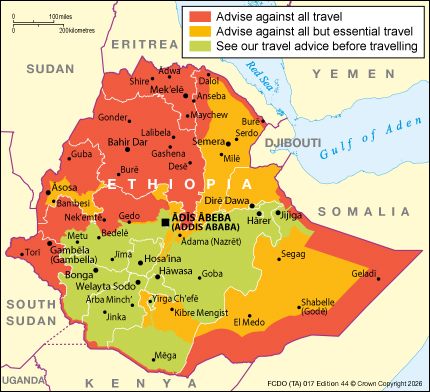
United KingdomFCDOsource ↗Added on top of the U.S. level, under its own rules: travel statuses
Is the whole country advised against?Nono restriction on the whole country+ parts of the country
our reading: all travel advised against to parts of the country · all but essential travel advised against to parts of the country
source reviewed 25 September 2026
SwitzerlandFDFAsource ↗Advisory cited by the Maximum policy
Is the whole country advised against?Nono restriction on the whole country+ parts of the country
our reading: Switzerland’s FDFA advises against travel to certain regions
advice published 01.10.2026
These readings do not say the same thing. The United States says except for imperative reasons; France, the United Kingdom and Switzerland say no — a 1-band gap on our comparison scale.Our comparison reading: 27 September 2026

All 207 countries compared, advisory by advisory →

How we read these four advisories

Every country has its own scale, so we ask them all the same question: is the whole country advised against?

An advisory covering only areas of the country does not raise the answer: it stays “No”, and the area is shown in the relevant column.

The level shown on this page — and across this site — is the one published by the U.S. State Department, from 1 (normal precautions) to 4 (do not travel). France and the United Kingdom publish their own advisories, with their own rules: they add to that level, they do not replace it.
Get covered — €990/yr
Regional map…

120 recorded incidents (UCDP)hover, click to open it in the briefing

Level 3/4 — Reconsider Travel Checked on 16 October 2026 · U.S. State Department
Observed repatriation
45 000 € – 150 000 €
Le Ciel Africain, 2026 ↗
Country briefing
Get the PDF

Where are you right now in Ethiopia?

Doctors — Addis Ababa40
DrDr. Aemiro Higher Clinic0.7 km

near Churchill Avenue

Google MapsDirections
Drሜሪስቶቭስ1.0 km

near Colsen Street

Google MapsDirections
Drውዳሴ1.2 km

near Colsen Street

Google MapsDirections
Dr1st Chiropractic Clinic1.5 km

Addis Ababa

Google MapsDirections
Drአብነት ክሊኒክ ቁ 11.5 km

near Uganda Street

Google MapsDirections
DrMichew Curcumshion Clinic1.7 km

Addis Ababa

Google MapsDirections
DrMerry Hope Medium Clinic2.5 km
Google MapsDirections
DrSunshine Clinic2.5 km
Google MapsDirections
Drላይፍ አዲስ2.6 km
Google MapsDirections
DrDr. Abdurahman Duri Specialized Clinic Internal Medicine2.7 km

near Roosevelt Street

Google MapsDirections
DrInternational Clinical Laboratories2.7 km

Addis Ababa

Google MapsDirections
Drኢንተርናሽናል ክሊኒካል ላቡራቶሪ International Clinical Laburatory2.8 km

near Swaziland Av.

0118400858Directions
DrDagem Yilma Higher Clinic3.0 km

near KR_02_201 Street

Google MapsDirections
Drቢሃም ልዩ የህፃናት ክሊንክ3.4 km

near KR_02_216 Street

DrMarie Stops Clinic3.5 km
Google MapsDirections
DrBGM Mothers and Children Clinic3.5 km

near Gabon Avenue

Google MapsDirections
DrBethesida Higher Clinic3.5 km

near LD_02_0259 Street

Google MapsDirections
DrSwedish Clinic3.8 km
Google MapsDirections
DrMédecin3.8 km

near Kirkos4_826

DrArsho Medical Laboratory3.9 km

near KR_02_206 Street

Google MapsDirections
DrSenay Medical Center4.2 km

near Beyene Aba Sebsib Avenue

Google MapsDirections
DrPanorama Clinic4.3 km
Google MapsDirections
Drሴማህ የእናቶችና የህፃናት ልዩ የጤና ማዕከል4.4 km

near BL_03_534 Street

Google MapsDirections
Drቾይዝ የሕፃናትና የታዳጊዎች ልዩ ክሊኒክ4.5 km

BL_03_613 St.

Drቦናት ክልንክ4.5 km
Google MapsDirections
Drቦኒ-አት ክልንክ4.5 km

near GL_10_2154 St

Google MapsDirections
Drቦናት ክልንክ4.6 km

near GL_10_2188 Av.

Google MapsDirections
Dr“Sitot” Health Center for Mental Care4.6 km

Ring Road Addis Ababa

Google MapsDirections
Drዋጋ የአይን ማዕከል5.0 km

near Ethio-Chinese Friendship Road

DrBole Sub City 17 Health Center5.2 km

near ጂቡቲ መንገድ

DrWashington Medical center5.2 km

Bole, infront of Rwanda Embassy

Drwisdom dental clinic5.2 km

near BL_03_785 Avenue

DrSeyoum Special Eye Clinic Plc ስየዩም ልዩ የዓይን ክሊኒክ5.6 km

near Africa Avenue / Bole Road

Google MapsDirections
DrMédecin5.6 km

near Fikre Mariam Aba Techan Street

DrBlue & White Clinic5.7 km

near BL_02_394 Street

Google MapsDirections
Drየኢትዮጵያ አየር መንገድ የህክምና ማዕከል6.5 km
Google MapsDirections
Drካዛንቺስ ጤና ጣብያ7.7 km
Google MapsDirections
Drአየር ጤና መካከለኛ ክሊኒክ7.8 km

near Jimma Road

Google MapsDirections
DrSeyoum Special Eye Clinic7.9 km

near Jacros

Google MapsDirections
DrSeyoum Special Eye Clinic Plc. ስዩም ልዩ የዓይን ክሊኒክ7.9 km

near Jacros

Google MapsDirections
Pharmacies — Addis Ababa40
+Deraretu Pharmacy0.3 km

near Tesema Aba Kemaw Street

Google MapsDirections
+Tekelehaymanot Pharmacy0.7 km

near Gobena Aba Tigu Street

Google MapsDirections
+Lion Pharmacy አንበሳ ፋርማሲ0.7 km

near Mahtama Gandhi Street

Google MapsDirections
+Kenema No 2 ከነማ መድሃኒት ቤት ቁ.21.1 km

near Cunningham Street

Google MapsDirections
+Adowa Pharmacy1.2 km

near Ras Abebe Aregay Street

Google MapsDirections
+Kenema Pharmacy No 11.2 km

near Kenya Street

Google MapsDirections
+St. Lalibela Pharmacy1.2 km

near Kenya Street

Google MapsDirections
+Rose Pharmacy1.4 km

near Ras Desta Damtew Street

Google MapsDirections
+Ethio Pharmacy1.4 km

near Burundi Street

Google MapsDirections
+Alium Pharmacy1.6 km

near Benin Street

+Kenema Pharmacy1.6 km

near Ras Desta Damtew Street

Google MapsDirections
+Lucy Pharmacy1.6 km

near Liberia Street

+Ghion Pharmacy1.7 km

near Ras Desta Damtew Street

+Solo Da pharmacy1.7 km

near Ras Mekonnen Avenue

Google MapsDirections
+Abyssinia Pharmacy1.8 km

near Chad Street

Google MapsDirections
+Gishen Pharmacy1.9 km

near Roosevelt Street

Google MapsDirections
+Harar Pharmacy2.1 km

Addis Ababa

+St. Markos Pharmacy2.5 km

near Weatherall Street

Google MapsDirections
+Zacshalom Pharmacy2.7 km

near Malawi Street

+Zemuad Pharmaceutical and Medical Supplies2.8 km

9837 Arbegnoch Street

+Beza Pharmacy2.8 km

near AR_06_1036 St.

Google MapsDirections
+Keba Kidus Pharmacy2.8 km

near Russia Av

Google MapsDirections
+Kazanchis Pharmacy2.9 km

near Joseph Tito Street

+Ambercho Pharmacy2.9 km

Addis Ababa

+Alem Pharmacy2.9 km

near AR_06_1003 St.

Google MapsDirections
+ኦልድ ኤርፖርት / አስቴር ፋርማሲ3.2 km

near Democratic Republic of Congo Street

Google MapsDirections
+Zamalik Pharmacy3.3 km

near Ring Road

Google MapsDirections
+El Betel Drug store3.4 km

near Tanzania Street

+Zogdom Pharmacy3.4 km

330/04 Addis Ababa

+Old Airport Pharmacy3.7 km

near ደቡብ አፍሪካ መንገድ

Google MapsDirections
+Robika Pharmacy3.7 km

near Kirkos4_826

Google MapsDirections
+Napoli Pharmacy4.0 km

Haile Gebresellasie Avenue Addis Ababa

Google MapsDirections
+Nile Pharmacy4.1 km

Gabon Av Addis Ababa

Google MapsDirections
+ከተማ መድሀኒት ቤት4.1 km

New Ambo Road
Mo-Su 08:00-21:00

Google MapsDirections
+አሪቲ4.1 km

Mike Leyland Street

Google MapsDirections
+ክነማ ፋርማሲ አዲሱ ገበያ ቅርንጫፍ4.1 km

near Tunisia Av.

Google MapsDirections
+Emanda4.3 km

Addis Ababa

+Haron Pharmacy4.4 km

near Ring Road

Google MapsDirections
+Shifa Drug Store4.4 km

near Gabon Avenue

Google MapsDirections
+Kenema Pharmacy No 54.5 km

near Dej Beyene Merid Street

Official — Addis Ababa13
Consulates and embassies 12
AEmbassy of Sweden0.7 km

891 Addis Abeba

ALibyan Embassy - ሊቢያ ኤምባሲ0.8 km

near Yared Street

ASudan Embassy Visa Section2.1 km

near Ras Lulseged Street

Google MapsDirections
ANew Zealand Embassy2.1 km

Apartment 381 Menelik II Street
Mo-Fr 09:00-17:00

ASerbia Embassy2.4 km

Joseph Tito Street

ANigerian Embassy2.5 km

near Senegal Street

Google MapsDirections
Aየአየርላንድ ኤምባሲ2.6 km

Guinea Conakry Street Addis Ababa
Mo-Fr 08:30-12:00

Aየአፍሪካ ህብረት ዋና መሥሪያ ቤት2.7 km
Google MapsDirections
AEmbassy of Egypt - ግብጽ ኤምባሲ3.0 km
Google MapsDirections
ABurundi Embassy - Residence3.2 km

near KR_02_201 Street

Google MapsDirections
APolish embassy - ፖላንድ ኤምባሲ3.4 km

near Tunisia Av.

Aየህንድ አምባሳደር መኖሪያ3.6 km

510 Addis Ababa

Google MapsDirections
Town halls 1
ASibiseba Maeikel3.7 km

Addis Ababa

Google MapsDirections
Police — Addis Ababa12
PLideta Sub City Community police station0.7 km

near Yared Street

Google MapsDirections
Pፒያሳ አራዳ ፖሊስ ጣቢያ1.1 km

near Dejazemach Jote Street

Google MapsDirections
PLegehar Police Station1.3 km
Pየአብነት አካባቢ ፓሊስ ጣብያ1.4 km

Bekele Weya Street

Google MapsDirections
PBGI area community policing office1.5 km

near Liberia Street

Google MapsDirections
PYohannes Area Police2.3 km

near Dej. Hailesilassie Av

Google MapsDirections
PPopulare Police Station2.3 km
PQuwasmeda Area Police2.3 km

Addis Ababa

Google MapsDirections
PMesalemia Area Police2.5 km
Google MapsDirections
PAddisu Mikael Area Police2.6 km
Google MapsDirections
PDembel Area Police3.3 km
Google MapsDirections
PKazanchiz Area Police3.3 km

near Zewditu Street

Google MapsDirections
Transport — Addis Ababa22
Stations 8
TAtikilt Tera1.1 km

near Fitawrari Gebeyehu Street

Google MapsDirections
TGojam Berenda1.4 km

near Fitawrari Habte Giorgis Street -ፊታዉራሪ ሀብተጊዮርጊስ መንገድ

Google MapsDirections
TAbnet1.5 km

near Dej. Mekonin Demisaw

Google MapsDirections
TLeghar1.6 km

near Ras Mekonnen Avenue

Google MapsDirections
TMexico1.6 km

near Ras Mekonnen Avenue

Google MapsDirections
TSebategna1.6 km

near Dej. Mekonin Demisaw

Google MapsDirections
TMenelik II Square1.6 km

near Hailu Kebede Street

Google MapsDirections
TTegbared1.7 km

near Chad Street

Google MapsDirections
Bus 6
TMojjo/Nazareth/Shashemene/Awassa Minibus Station1.4 km

near Tesema Aba Kemaw Street

Google MapsDirections
TSelam Bus2.2 km

Meskal Sq
Mo-Sa 05:00-17:00

TKasantshis2.9 km

near Zewditu Street

Google MapsDirections
T#41 Bus Round5.2 km

Addis Ababa

Google MapsDirections
Tlomi meda5.7 km
Google MapsDirections
Tali5.8 km
Google MapsDirections
Taxis 8
TAmbassador to Arat Kilo (Tourist Hotel)1.1 km

near Taitu Street

Google MapsDirections
TBeherawi Taxi Stop1.1 km

near Gambia Street

Google MapsDirections
TBole and 4 kilo Taxi Station1.6 km

near Ras Mekonnen Avenue

Google MapsDirections
TKera, Laphto, Sarise, Kirkos1.7 km

near Mozambique Street

Google MapsDirections
TTorhailoch, Abenet1.7 km

near Chad Street

Google MapsDirections
TSt. Joseph School2.1 km

near Sierra Leone Av

Google MapsDirections
TSt. Joseph School2.2 km

near Sierra Leone Av

Google MapsDirections
TCherkos to Mexico Station2.4 km
Google MapsDirections

The next 7 days around Addis Ababa Africa/Addis_AbabaMET Norway ↗read 16.10.2026

Sat 17 Oct11–23°partly cloudy · 0.1 mm
Sun 18 Oct12–23°clear
Mon 19 Oct11–24°clear
Tue 20 Oct10–24°clear
Wed 21 Oct10–24°mainly clear
Thu 22 Oct10–24°overcast
Fri 23 Oct11–24°partly cloudy

Forecast: MET Norway (Norwegian Meteorological Institute, CC BY 4.0), grouped by day and formatted by Maximum.

Nearest river dischargeOpen-Meteo ↗updated 16.10.2026 · read 16.10.2026

10-16 2.5 · 10-17 2.4 · 10-18 2.2 · 10-19 2.2 · 10-20 2.1 · 10-21 2.0 · 10-22 1.9 m³/s

Simulated discharge: Open-Meteo.com (CC BY 4.0), data rounded and formatted by Maximum. Contains modified Copernicus Emergency Management Service information 2026. For information only: this is not a flood warning; only national or regional authorities issue those.

No geolocated event in this country at this reading.

120 incidents recorded in the country, all pinned on the map above (zoom out) — the 40 closest to Addis Ababa are listed here, nearest first.

  • 67.6 km · 7 April 2026 · Degdegela Jeda kebele
    Deadly Drone Strikes in Amhara & Oromia Kill over a Dozen | Allegations against Fano Commanders;The Air Force killed five civilians in Liban Cuqqala d · 5 deaths
    My views on news;ONM-ABO
  • 72.7 km · 23 June 2026 · Werke Welensu kebele
    Strategic Kidnappings, Destruction of Ancestral Lands, and Rural Resistance · 1 deaths
    ONM-ABO
  • 80.0 km · 7 April 2026 · Osole village
    The PP mafia army brutally killed a farmer in Jalduu district · 1 deaths
    ONM-ABO
  • 80.0 km · 4 April 2026 · Osole village
    A farmer was shot dead in Jalduu district · 1 deaths
    ONM-ABO
  • 94.0 km · 26 March 2026 · Gerbe Guracha town
    The PP army is killing youths who have been tortured for a long time in Kuyyuu district;Report 73. Human Rights Abuses in Ethiopia · 2 deaths
    ONM-ABO;Oromiya Support Group
  • 101.6 km · 30 March 2026 · Anigada kebele
    Ethiopian Military Drones Hit Two Armed Groups | One Commander Killed;War updates from Amhara Region, Ethiopia – March 30th to April 5th, 2026 · 3 deaths
    My views on news;Amhara Association of America
  • 118.0 km · 31 March 2026 · Bole town
    A teacher was killed by fascist soldiers in the city of Boole · 1 deaths
    ONM-ABO
  • 129.2 km · 1 February 2026 · Sarana Weba kebele
    The fascist army of the Bilxiginna shot and killed youths in a horrific manner in Asakoo district of East Arsi region and Fantaallee district of East · 3 deaths
    ONM-ABO
  • 130.6 km · 6 April 2026 · North Shewa (Amhara) zone
    Fano Release Graphic Pictures | Mysterious Flight from Ethiopia | Eritrean Activists' Campaign · 2 deaths
    My views on news
  • 144.9 km · 27 March 2026 · Koticha Malole kebele
    The TPLF army shot and killed a civilian and a racing dog in Abaaboo Guduruu district · 1 deaths
    ONM-ABO
  • 148.1 km · 29 January 2026 · Biyo kebele
    The fascist army of the Bilxiginna shot and killed youths in a horrific manner in Asakoo district of East Arsi region and Fantaallee district of East · 5 deaths
    ONM-ABO
  • 152.8 km · 30 January 2026 · Between Jama Didik and Talak Amba kebeles
    War updates from Amhara Region, Ethiopia– January 26th to February 1st, 2026 · 2 deaths
    AAA
  • 155.9 km · 11 February 2026 · Jama Didik kebele
    War updates from Amhara Region, Ethiopia– February 9th to 15th, 2026 · 1 deaths
    AAA
  • 156.6 km · 17 February 2026 · Aya Ber kebele
    Drone Strike | New Ethiopian Military Convoys in Welkait | PM Abiy in Wellega | Fano Surrender;War updates from Amhara Region, Ethiopia– February 16th · 3 deaths
    My views on news;AAA
  • 161.4 km · 8 March 2026 · Robe town
    In Muneessa district, 1 person was killed and a resident's house was demolished in Asako district;There are reports of civilians being killed by the B · 1 deaths
    ONM-ABO;ONM-ABO
  • 164.2 km · 30 May 2026 · Hulet Amiba Dibisa kebele
    War updates from Amhara Region, Ethiopia – May 25th to 31st, 2026 · 2 deaths
    Amhara Association of America
  • 172.4 km · 26 May 2026 · Zinqir Mele kebele
    War updates from Amhara Region, Ethiopia – May 25th to 31st, 2026 · 1 deaths
    Amhara Association of America
  • 174.1 km · 12 May 2026 · Wegedi village
    Deadly Attack by Fano | High Stakes Talks in Somalia;War updates from Amhara Region, Ethiopia – May 11th to 17th, 2026 · 2 deaths
    My views on news;Amhara Assoication of America
  • 174.1 km · 6 May 2026 · Wegedi village
    Drone Strikes | Axum Tigray | Ethiopia France · 2 deaths
    My views on news
  • 179.0 km · 28 March 2026 · Hebenidiba kebele
    Two brothers were killed and seven others were arrested in Munich district · 2 deaths
    ONM-ABO
  • 180.6 km · 22 March 2026 · Tirtira kebele
    First Attack by Fano on Election Staff | Tigray Traders Under Pressure;War updates from Amhara Region, Ethiopia – March 23rd to 29th, 2026 · 2 deaths
    My views on news;Amhara Association of America
  • 180.9 km · 16 April 2026 · Aba Libanos kebele
    War updates from Amhara Region, Ethiopia – April 13th to 19th, 2026 · 3 deaths
    Amhara Association of America
  • 183.2 km · 25 March 2026 · Debre Markos town
    Fano Launch Special Operations | Prosperity Party's Seat Adjustment for Election · 4 deaths
    My views on news
  • 183.2 km · 11 April 2026 · Debre Markos town
    Attack by Fano in a Major City | PM Abiy Ahmed's Interview | UN Confronts China in Middle East;War updates from Amhara Region, Ethiopia – April 6th to · 2 deaths
    My views on news;Amhara Association of America
  • 183.9 km · 26 March 2026 · K'oy town
    War updates from Amhara Region, Ethiopia – March 23rd to 29th, 2026 · 2 deaths
    Amhara Association of America
  • 187.0 km · 27 June 2026 · Gamo Negero kebele
    Kidnappings, Engineered Famines, and Military Conscription Press-Gangs · 1 deaths
    ONM-ABO
  • 187.3 km · 22 March 2026 · Liguama town
    First Attack by Fano on Election Staff | Tigray Traders Under Pressure;War updates from Amhara Region, Ethiopia – March 23rd to 29th, 2026 · 3 deaths
    My views on news;Amhara Association of America
  • 189.8 km · 30 March 2026 · Kenge Abo Amesha kebele
    Ethiopian Military Drones Hit Two Armed Groups | One Commander Killed;War updates from Amhara Region, Ethiopia – March 30th to April 5th, 2026 · 3 deaths
    My views on news;Amhara Association of America
  • 193.8 km · 30 March 2026 · East Gojjam zone
    BBCM Africa Watchlist 10 Apr 26 · 8 deaths
    BBC Monitoring Round-up
  • 193.8 km · 20 May 2026 · East Gojjam zone
    Ethiopian army says killed 19 Fano fighters in Amhara clashes · 7 deaths
    BBC Monitoring News Alert
  • 195.9 km · 25 May 2026 · Sekela town
    Eritrean Alliance Broken | Attack by Oromo Liberation Army (OLA) · 3 deaths
    My views on news
  • 195.9 km · 29 May 2026 · Sekela town
    Eritrean Alliance Broken | Attack by Oromo Liberation Army (OLA);UPDATE—Day One of Operation Future of Orissa · 1 deaths
    My views on news;ONM-ABO
  • 197.1 km · 5 April 2026 · Senbete town
    A farmer was killed and his body disposed of by Amhara rebels in Jiillee Dhummuugga district · 1 deaths
    ONM-ABO
  • 197.7 km · 27 June 2026 · Horo Gudru Welega zone
    Kidnappings, Engineered Famines, and Military Conscription Press-Gangs · 1 deaths
    ONM-ABO
  • 205.7 km · 27 April 2026 · Felege Birhan village
    War updates from Amhara Region, Ethiopia – April 27th to May 3rd, 2026 · 3 deaths
    Amhara Association of America
  • 205.8 km · 6 April 2026 · Sobokumi kebele
    A student was shot dead by the BJP soldiers in Jardagaa Jaartee district · 1 deaths
    ONM-ABO
  • 206.5 km · 22 March 2026 · Kotet 41 kebele
    War updates from Amhara Region, Ethiopia – March 23rd to 29th, 2026 · 2 deaths
    Amhara Association of America
  • 211.4 km · 14 May 2026 · Mertule Mariam town
    War updates from Amhara Region, Ethiopia – May 11th to 17th, 2026 · 3 deaths
    Amhara Assoication of America
  • 211.8 km · 18 April 2026 · Abaydale kebele
    War updates from Amhara Region, Ethiopia – April 13th to 19th, 2026 · 2 deaths
    Amhara Association of America
  • 218.3 km · 27 March 2026 · Geradilomsera kebele
    The soldiers of the BJP in Adaabbaa district displacing farmers with the mouth of a gun, killing one youth, injuring seven and beating 15 others · 1 deaths
    ONM-ABO

Source: UCDP — GEDEvent_v26_01_26_06.csv. Closed period, Clear coding, precise location.

No news located around Addis Ababa in this reading.

The country feed →

National numbers (Wikidata, 2026 reading). On site, call local emergency services first, then Maximum: the insurer sends its payment guarantee to the hospital.

Altitude 2,360 mModerate altitude: breathlessness on exertion is possible the first days, especially with a heart or lung condition.

Elevation: MET Norway terrain model (CC BY 4.0), read from its forecast.

Recommended vaccines and medicines14

Routine vaccinesCDC ↗

Make sure you are up-to-date on all routine vaccines before every trip. Some of these vaccines include Chickenpox (Varicella) Diphtheria-Tetanus-Pertussis (DTaP, Tdap, or Td) Flu (influenza) Measles-Mumps-Rubella (MMR) Polio Shingles

COVID-19CDC ↗

All eligible travelers should be up to date with their COVID-19 vaccines. Please see  Your COVID-19 Vaccination  for more information.

ChikungunyaCDC ↗

All travelers should take steps to prevent mosquito bites. Chikungunya vaccination is generally not recommended. Travelers who wish to consider vaccination can visit “What to consider before traveling” on the chikungunya vaccines page to learn more.

CholeraCDC ↗

Active cholera transmission is  widespread  in Ethiopia. Cholera is rare in travelers.  Certain factors  may increase the risk of getting cholera or having severe disease ( more information ). Avoiding unsafe food and water and washing your hands can also help prevent cholera. Vaccination may be considered for children and adults who are traveling to areas of active cholera transmission.

Hepatitis ACDC ↗

Recommended for unvaccinated travelers one year old or older going to Ethiopia. Infants 6 to 11 months old should also be vaccinated against Hepatitis A. The dose does not count toward the routine 2-dose series. Travelers allergic to a vaccine component should receive a single dose of immune globulin, which provides effective protection for up to 2 months depending on dosage given.

Hepatitis BCDC ↗

Recommended for unvaccinated travelers of all ages traveling to Ethiopia.

MalariaCDC ↗

CDC recommends that travelers going to certain areas of Ethiopia take prescription medicine to prevent malaria. Depending on the medicine you take, you will need to start taking this medicine multiple days before your trip, as well as during and after your trip. Talk to your doctor about which malaria medication you should take.

MeaslesCDC ↗

Cases of measles are on the rise worldwide. Travelers are at risk of measles if they have not been fully vaccinated at least two weeks prior to departure, or have not had measles in the past, and travel internationally to areas where measles is spreading.

Meningococcal diseaseCDC ↗

Recommended for travelers 2 months old or older traveling to  areas of Ethiopia  that are part of the meningitis belt during the dry season (roughly December to June).

MonkeypoxCDC ↗

Monkeypox vaccination is recommended for any adult who anticipates any of the following activities during travel: Sexual or intimate contact with a new partner Sexual or intimate contact at a commercial sex venue, like a sex club or bathhouse Sexual or intimate contact in exchange for money, goods, drugs, or other trade Sexual or intimate contact in association with a large public event, such as a rave, party, or…

PolioCDC ↗

In Ethiopia, poliovirus has been identified in the past year. Travelers to Ethiopia are at increased risk of exposure to poliovirus.

RabiesCDC ↗

Dogs infected with rabies are commonly found in Ethiopia. Rabies is also present in some terrestrial wildlife species. If rabies exposures occur while in Ethiopia, rabies vaccines are typically not readily available.

TyphoidCDC ↗

Recommended for most travelers. Typhoid vaccine is not 100% effective. Practicing safe food and water habits , including washing hands at key times , can also help prevent typhoid fever .

Yellow FeverCDC ↗

CDC recommendations: Vaccine is recommended for all travelers ≥9 months old except as follows. Vaccine is generally not recommended for travel limited to the regions of Afar or Somali. b Country entry requirements: Direct travel from United States: Vaccine is not required.

CDC Travelers' Health, re-read weekly — the recommendation depends on your age, vaccines and itinerary: confirm it with a doctor or a travel clinic 4 to 6 weeks before departure.CDC ↗read 10.10.2026

Diseases without a vaccine — how they spread

Avoid contaminated food and water
  • Leptospirosis — Touching urine or other body fluids from an animal infected with leptospirosis Swimming or wading in urine-contaminated fresh water, or contact with urine-contaminated mud Drinking water or eating foo
  • Schistosomiasis — Wading, swimming, bathing, or washing in contaminated freshwater streams, rivers, ponds, lakes, or untreated pools.
Avoid bugs
  • African Tick-Bite Fever — Tick bite
  • Crimean-Congo Hemorrhagic fever — Tick bite  Touching the body fluids of a person or animal infected with CCHF
  • Dengue — Mosquito bite
  • Leishmaniasis — Sand fly bite
  • Zika — Mosquito bite An infected pregnant woman can spread it to her unborn baby
Airborne & droplet
  • Hantavirus — Breathing in air or accidentally eating food contaminated with the urine, droppings, or saliva of infected rodents Bite from an infected rodent Less commonly, being around someone sick with hantavirus
  • Tuberculosis (TB) — Breathe in TB bacteria that is in the air from an infected and contagious person coughing, speaking, or singing.

Risks in figures

Tuberculosis — cases per 100,000
Ethiopia141 2024
Switzerland5 2024
France8 2024

High incidence: a long stay or time in care settings warrants a test on return.

Children vaccinated against measles (%)
Ethiopia72 2024
Switzerland96 2024
France95 2024

Coverage too low to stop the virus circulating: check your two MMR doses before leaving.

Malaria — cases per 1,000 people at risk
Ethiopia138.5 2024

Strong transmission: discuss preventive treatment with a doctor before leaving; bed net and repellent on site.

World Bank — latest published valuedata.worldbank.org ↗read 10.10.2026

The official advice, in full

Source: France Diplomatie (health advice, in French).

In brief
  • Consult your doctor or an international vaccination centre before departure to assess your health and receive vaccination recommendations. France Diplomatie
  • Carry medications only in original packaging with original labels, accompanied by a prescription listing drugs by international non-proprietary name (INN). Verify medications are authorised in Ethiopia. France Diplomatie
  • Ensure you are up to date with French vaccination schedule, particularly against diphtheria, tetanus, poliomyelitis, pertussis and measles. Yellow fever vaccination is recommended. France Diplomatie
  • At least 8 weeks before travel, check latest vaccine recommendations for Ethiopia and confirm your destination can provide needed healthcare. Foreign Office
  • Malaria is common in areas below 2,000 metres altitude; bilharzia is present in most Ethiopian lakes. Drink only boiled or bottled water. Cholera outbreak ongoing in southern Ethiopia. Foreign Office
  • Altitude sickness risk exists above 2,500 metres. Ascend slowly, maximum 400 metres elevation gain per day above 2,500 metres, and descend immediately if symptoms occur. France Diplomatie

Faithful summary of the official texts below, which prevail.

WHO — outbreaks reported for this country (last 24 months)

  • Marburg virus disease- Ethiopia26 January 2026 · who.int ↗
    On 26 January 2026, the Ministry of Health of Ethiopia declared the end of the Marburg virus disease (MVD) outbreak. This declaration came after two consecutive incubation periods (a total of 42 days) since the last person confirmed with MVD died and was given a safe and dignified burial, in accordance with WHO…
  • Marburg virus disease- Ethiopia21 November 2025 · who.int ↗
    On 12 November 2025, WHO noted a press release from the Ethiopian Ministry of Health (MoH), and the Ethiopian Public Health Institute (EPHI), announcing suspected viral hemorrhagic viral fever (VHF) in Jinka town, South Ethiopia Regional State, Ethiopia. On 14 November 2025, the Ministry of Health of Ethiopia…
  • Malaria - Ethiopia31 October 2024 · who.int ↗
    Between 1 January and 20 October 2024, over 7.3 million malaria cases and 1157 deaths (CFR 0.02%) were reported in Ethiopia. Malaria poses a significant public health challenge in Ethiopia, where approximately 75% of the land mass is considered to be endemic to malaria. Around 69% of the population residing in these…

FDFA (Switzerland) — medical care, in French

Medical care

Les soins médicaux et les services de secours ne sont assurés que partiellement, même à Addis Abeba. Les hôpitaux exigent une garantie financière avant de commencer un traitement (paiement d’avance). Les maladies ou blessures graves devraient, dans la mesure du possible, être traitées hors du pays. Si vous prenez régulièrement des médicaments , emportez-en une quantité suffisante avec vous. Notez toutefois que de nombreux pays appliquent des réglementations restrictives. Cela vaut en particulier, mais pas exclusivement, pour les médicaments contenant des stupéfiants (par exemple la méthadone) et les substances utilisées pour le traitement des troubles psychiques. Avant votre départ, renseignez-vous directement auprès de la représentation étrangère compétente (ambassade ou consulat) et consultez la rubrique Liens voyages , où vous trouverez de plus amples informations sur ce sujet ainsi que sur la médecine du voyage en général. Les informations concernant la propagation de maladies et les éventuelles mesures de protection à prendre sont fournies par le personnel médical et les centres de vaccination. Liens voyages

France Diplomatiesource ↗updated 30.09.2026 · read 16.10.2026

Recommandations pour la santé

Consulter si besoin son médecin traitant ou un centre de vaccinations internationales (médecine des voyages) pour faire une évaluation de son état de santé et bénéficier de recommandations sanitaires, notamment sur les vaccinations. Consulter éventuellement son dentiste avant le départ.

Constituer sa pharmacie personnelle en conséquence et n’emporter dans ses bagages que les médicaments strictement nécessaires ; ne jamais consommer de médicaments achetés dans la rue (risque de contrefaçons). Les médicaments doivent être dans leur emballage d’origine avec les étiquettes originales, accompagnés d’une ordonnance portant le nom des médicaments en dénomination commune internationale (DCI). Il est indispensable de vérifier que les médicaments concernés sont autorisés dans le pays visité : pour plus d’informations, consulter la fiche Informations pratiques .

Les pharmacies en Éthiopie ont un approvisionnement parfois aléatoire et inégal en fonction des zones où on se déplace.

Vaccinations

Les vaccins recommandés en France sont également indispensables lors d’un séjour à l’étranger : les maladies qu’ils préviennent circulent partout dans le monde, parfois même plus fréquemment qu’en France. Avant tout départ, le voyageur (adulte et enfant) doit donc d’abord s’assurer d’être à jour du calendrier vaccinal français, en particulier des vaccins contre la diphtérie, le tétanos, la poliomyélite, la coqueluche mais aussi contre la rougeole. Le carnet de vaccination peut être demandé à l’arrivée de certains pays.

Des vaccinations complémentaires peuvent être nécessaires :

  • Fièvre jaune : la vaccination contre la fièvre jaune est recommandée. Elle peut être exigée à l’entrée du pays pour les voyageurs en provenance d’un pays à risque de transmission ;
  • Hépatite A : en fonction des conditions et de la durée de séjour ;
  • Fièvre typhoïde : en fonction des conditions et de la durée de séjour ;
  • Hépatite B : en cas de séjours fréquents ou prolongés ;
  • Méningite ACWY en cas de séjour pendant la saison sèche (habituellement hiver et printemps) ou d’épidémie signalée ;
  • Tuberculose : chez les enfants de moins de 15 ans en cas de séjours fréquents ou prolongés ;
  • Rage : notamment enfants en bas âge, séjour en milieu rural ou éloigné des villes principales ;
  • Chikungunya : en cas d’épidémie ou de séjour prolongé ;
  • Dengue : en cas d’épidémie active ou de séjour prolongé en zone endémique ;
  • Mpox : en cas d’exposition à risque.

Il est donc conseillé de consulter son médecin traitant ou un centre de vaccinations internationales (médecine des voyages) suffisamment de temps avant le voyage.

Maladies transmises par les moustiques

Chikungunya

La chikungunya est une maladie virale transmise par l’intermédiaire de moustiques infectés. Cette maladie se manifeste par l’apparition de symptômes grippaux (fièvre, douleurs musculaires et articulaires). En cas de signes cliniques, il est impératif de consulter immédiatement un médecin ; le traitement est uniquement symptomatique. Les moyens de prévention reposent sur la vaccination et la protection contre les piqûres de moustiques. Il est conseillé avant le départ de se référer à son médecin traitant et/ou à un centre de vaccination internationale.

Pour plus d’informations , consulter la rubrique risques sanitaires .

Dengue

La dengue est une maladie virale transmise par piqûres de moustiques. Les symptômes sont de type grippal (fièvre, maux de tête, courbatures, parfois éruption cutanée). En cas de signes cliniques, il est impératif de consulter immédiatement un médecin. Il n’existe pas de traitement curatif. La prise en charge médicale repose uniquement sur le traitement des symptômes. Il faut impérativement éviter la prise d’anti-inflammatoire. La prévention individuelle repose essentiellement sur les moyens de protection contre les piqûres de moustiques. La vaccination des voyageurs peut être indiquée dans certains cas. Il est conseillé de se référer, avant son départ, à son médecin traitant et /ou à un centre de vaccination internationale.

Pour plus d’informations, consulter le site du ministère de la Santé et le site de l’Organisation mondiale de la Santé .

La dengue fait partie des risques régionaux en Afrique de l’Est, dont l’Éthiopie.

Fièvre jaune

Il s’agit d’une maladie virale transmise par piqûres de moustiques. Les symptômes sont variables, allant du syndrome pseudo-grippal (fièvre, frissons, douleurs musculaires, maux de…

Mal des montagnes

Le mal aigu des montagnes (MAM) est une maladie survenant en haute altitude (plus de 2 500 mètres de hauteur) lorsque l’organisme n’a pas eu le temps de s’acclimater au manque d’oxygène consécutif à la baisse de pression. Il peut se manifester par des troubles de type respiratoires (essoufflement) et/ou neurologiques (maux de tête, nausées, vomissements, troubles du sommeil) qui peuvent être transitoires ou s’aggraver et conduire au décès.

L’identification des symptômes du mal des montagnes peut être difficile : il est essentiel de communiquer en permanence, sans restriction, sur son état physique. De surcroît, les capacités de réflexion et d’action d’une victime du mal aigu des montagnes peuvent être altérées. En cas de survenue de symptômes il est recommandé d’interrompre l’ascension, de redescendre le plus rapidement possible à une altitude inférieure, au minimum en dessous de 4000 mètres, avec un accompagnant et de consulter un médecin.

Toute personne, quelle que soit sa condition physique et son habitude de la randonnée en altitude, peut être confrontée au mal des montagnes. La prévention repose sur des règles essentielles :

  • Une adaptation progressive à l’altitude en limitant les efforts physiques les premiers jours ;
  • Une ascension lente et progressive (pas plus de 400 m de dénivelé positif entre deux nuits consécutives à partir de 2 500 m) ;
  • Une hydratation régulière en évitant les boissons alcoolisées et repas copieux ;
  • Ne jamais abandonner une personne malade.

Les excursions et randonnées en altitude doivent faire l’objet d’un avis médical spécialisé avant le départ. La haute altitude est déconseillée pour les enfants. La grossesse ainsi que la notion d’antécédents cardiaques, pulmonaires, neurologiques ou rénaux constituent une…

Mesures générales de prévention des piqûres de moustiques
  • Porter des vêtements longs et couvrants ;
  • Appliquer des produits répulsifs cutanés sur les zones découvertes du corps ;
  • Protéger son logement (moustiquaires imprégnées d’insecticide, diffuseurs électriques, serpentins à l’extérieur, climatisation, etc.) ;
  • Détruire les sites potentiels de reproduction des moustiques (récipients d’eau stagnante comme les soucoupes sous les pots de fleurs, les gouttières, les pneus, etc.).

Pour plus d’informations, consulter le site du ministère en charge de la Santé et le site de l'Assurance Maladie .

Règles d'hygiène alimentaire
  • Se laver les mains régulièrement avec de l’eau et du savon ou des solutions de lavage hydroalcooliques, surtout avant et après les repas et le passage aux toilettes ;
  • Veiller à la qualité des aliments et surtout à leur bonne cuisson ;
  • Éviter la consommation de produits alimentaires (poisson, viande, volaille, lait) crus ou peu cuits ;
  • Peler les fruits et légumes ou les laver soigneusement (à l’eau saine) ;
  • Éviter les crudités, coquillages, plats réchauffés et buffets froids ;
  • Ne boire que de l’eau ou des boissons encapsulées ou de l’eau rendue potable (filtration, ébullition ou à défaut produit désinfectant).

Pour plus d’informations, consulter le site du ministère en charge de la Santé .

Health — Foreign OfficeForeign Office ↗updated 07.10.2026 · read 16.10.2026

Health — Foreign Office

Before you travel check that:

  • your destination can provide the healthcare you may need
  • you have appropriate travel insurance for local treatment or unexpected medical evacuation

This is particularly important if you have a health condition or are pregnant.

Emergency medical number

Dial 907 and ask for an ambulance.

Contact your insurance company quickly if you’re referred to a medical facility for treatment.

Vaccine recommendations and health risks

At least 8 weeks before your trip:

  • check the latest vaccine recommendations for Ethiopia
  • see where to get vaccines and whether you have to pay on the NHS travel vaccinations page

See what health risks you’ll face in Ethiopia , including:

  • Yellow fever
  • Malaria and dengue
  • Schistosomiasis
  • Zika virus
  • Mpox

On 26 January 2026, the Ethiopian government and WHO officially declared the end of the Marburg virus disease outbreak. This announcement came after no new confirmed cases were reported for consecutive 42 days.

Malaria is common in areas of the country up to 2,000 metres above sea level. Addis Ababa sits at 2,400m but a number of sites popular with tourists are below 2,000m.

Bilharzia is present in the vast majority of lakes in Ethiopia – check before swimming.

Water-borne diseases are common. Drink or use only boiled or bottled water and avoid ice in drinks.

There is an ongoing outbreak of cholera in the south of Ethiopia, and new cases have been reported in the north-west of the country.

Altitude sickness is a risk in parts of Ethiopia, including Addis Ababa. TravelHealthPro’s altitude sickness guidance has more information.

Medication

The legal status and regulation of some medicines prescribed or bought in the UK can be different in other countries.

Read best practice when travelling with medicines on TravelHealthPro .

Healthcare in Ethiopia

Only private hospitals in Addis Ababa offer a reasonable standard of basic care for minor health problems. Dentistry is especially scarce. Ambulance services are also limited. Outside the capital, medical facilities are extremely poor. Carry a comprehensive medical pack when travelling out of Addis Ababa.

FCDO has a list of medical providers in Ethiopia where some staff will speak English.

Travel and mental health

Read FCDO guidance on travel and mental health . There is also mental health guidance on TravelHealthPro .

TravelHealthPro ↗

Places read from OpenStreetMap, within a circle of about 12 km: phone, email, address, website and hours when the source publishes them. No customer reviews, that source has none. Straight-line distances.

The comparator

What is your current insurance?

The verdict
No area exclusion at this level — but three written limits: deductible and prior approval, 90-day cap, advance under conditions.
Exact wording (official French text): « Des Voyages vers des pays où Votre gouvernement a conseillé de ne pas voyager » — general exclusion n° 11, applying to ALL travel covers.
Line by line
Cover
With your Amex Platinum
Territorial exclusion at this level
No territorial exclusion at this level — the clause targets countries your government advised against travelling to
Covered — the core of the Maximum contract
Medical expenses cap abroad
€2M — but 10% deductible (€150–500), insurer's prior approval, trip paid with the Card
EUR 1.5M emergency medical expenses
Hospital deposit before admission
Advance possible — prior approval required before care
Direct payment guarantee: the insurer settles the hospital
Trip duration covered
Maximum 90 consecutive days per trip
12 months, unlimited trips
Visa certificate (incl. Schengen)
Not provided
Official named certificate, issued on payment

Notices vary by bank and vintage — yours prevails. On the right: the Maximum contract (public documents).

Where to go, where not to

At least one official reading covers the whole country; 8 regions are also named, fully or partly.

In brief
  • Avoid all travel to Tigray, Amhara, Afar, Benishangul-Gumuz, and Gambella regions due to armed conflict, civil unrest, and violence. [Foreign Office]. France Diplomatie
  • Avoid all travel to West Wollega, East Wollega, Kellem Wollega, and Horo Gudru Wollega zones in Oromia region due to armed conflict and violent crime. [Global Affairs Canada] [Foreign Office]. France Diplomatie
  • Avoid all travel within 100 km of the Somalia-Kenya border in Somali region, and within 30 km of the Somalia border in Fafan zone except Wajale town and road C104. [Global Affairs Canada]. Foreign Office
  • Avoid all travel within 20 km of Sudan border, 10 km of South Sudan border, and 20 km of Kenya border due to military activity, banditry, and landmines. [Global Affairs Canada]. Foreign Office
  • Avoid non-essential travel on the A4 highway between Addis Ababa and Ambo in West Shewa zone, Oromia region, due to civil unrest and violent crime. [Global Affairs Canada]. Foreign Office
  • Avoid overnight stays in Moyale, a Kenya border town in Oromia region, due to trafficking activities. France Diplomatie

Faithful summary of the official texts below, which prevail.

Addis Ababa: the whole country is rated “advised against — all but essential travel” (Global Affairs Canada).The red dot on the map. Change the city at the top of the page to read the map from another point.

Global Affairs Canada — advises against all but essential travel to the whole country.

Southern Nations — Advised against — all but essential travelSomali — Advised against — all travelAfar — Advised against — all travelAmhara — Advised against — all travelTigray — Advised against — all travelBenishangul-Gumuz — Advised against — all travelGambela — Advised against — all travelOromia — Advised against — all travelDire Dawa — Advised against — all but essential travelAddis Ababa — Advised against — all but essential travelHarari — Advised against — all but essential travelSouthern NationsSomaliAfarAmharaTigrayGambelaOromiaAddis Ababa
Advised against — all travelAdvised against — all but essential travelAddis AbabaSynthesis of the readings: Global Affairs Canada, Foreign Office, France Diplomatie. Where they differ, the colour keeps the strictest reading; the official text, quoted below region by region, prevails. Boundaries: Natural Earth.
Advised against — all travel7
Afar — the whole region
Amhara — the whole region
Benishangul-Gumuz — the whole region
Gambela — Gambella
Oromia — the following zones in the Oromia region: North Shewa; West Shewa, except the A4…
Somali — 100 km of the Somali region border with Somalia and Kenya
Tigray — the whole region
Advised against — all but essential travel1
Addis Ababa — the whole region, like the rest of the country
Advised against — all but essential travel
the rest of the country (Global Affairs Canada)
So:

an official reading covers the whole country; every trip calls for a written management decision, justified by a pressing reason, with reinforced conditions.

US26.08.2026
Level 3 of 4Reconsider travel
FR30.09.2026
Red areas in the countrySome areas of the country are formally advised against.Your region (Addis Ababa): not covered
GB07.10.2026
Some areas: no travel8 regions covered, fully or partly.Your region (Addis Ababa): partly covered
CA14.10.2026
Avoid non-essential travel7 regions covered.Your region (Addis Ababa): covered, like the whole country
CH01.10.2026
Some regions advised againstSwitzerland’s FDFA advises against travel to certain regions.

The official text, region by region

Advised against — all travel7 regions

AfarCAGBFR

Global Affairs Canada
Afar

Foreign Office
FCDO advises against all but essential travel to the rest of Afar.

France Diplomatie (in French)
Région Afar — Toute la bande frontalière de l’Afar avec l’Erythrée est formellement déconseillée.

AmharaCAGBFR

Global Affairs Canada
Amhara

Foreign Office
FCDO advises against all travel to Amhara region.

France Diplomatie (in French)
Région Amhara — L’ensemble de la région Amhara est formellement déconseillé en raison de combats réguliers et de blocages des axes routiers par les forces gouvernementales ou les mouvements rebelles, y compris les grandes localités, qui sont ponctuellement sujettes à des combats ou des attaques ciblées.

Benishangul-GumuzCAGB

Global Affairs Canada
Benishangul-Gumuz

Foreign Office
FCDO advises against all but essential travel to the rest of Benishangul-Gumuz region.

GambelaCAGBFR

Global Affairs Canada
Gambella

Foreign Office
FCDO advises against all travel to Gambela region.

France Diplomatie (in French)
Région de Gambela

OromiaCAGB

Global Affairs Canada
the following zones in the Oromia region: North Shewa; West Shewa, except the A4 highway, from Addis to and including Ambo where you should avoid non-essential travel; West Wollega; East Wollega

Foreign Office
within 10km of the border with Kenya, except for principal roads and towns

SomaliCAGBFR

Global Affairs Canada
100 km of the Somali region border with Somalia and Kenya

Foreign Office
100km of the Ethiopian border with Somalia and Kenya in Ethiopia’s Somali region, and within 30km of the Ethiopian border with Somalia in Fafan zone, except the border town and crossing at Wajale, and the principal road between Jijiga and Wajale

France Diplomatie (in French)
L’ouest de l’Ogaden (région Somali)

TigrayCAGBFR

Global Affairs Canada
Tigray

Foreign Office
FCDO advises against all travel to Tigray region.

France Diplomatie (in French)
Région du Tigré — La région est formellement déconseillée.

Advised against — all but essential travel1 region

Addis AbabaGB

Foreign Office
West Wollega zone (including the main Addis Ababa to Gambela road), East Wollega zone, Kellem Wollega and Horo Gudru Wollega

Official passages not placed on the map15

Global Affairs Canada — Advised against — all travel
30 km of the border with Somalia in Fafan zone, except for road C104, the town of Wajale and its border crossing where you should avoid non-essential travel

Global Affairs Canada — Advised against — all travel
10 km of the border with Somalia in the Sitti zone

Global Affairs Canada — Advised against — all travel
20 km of the border with Kenya, South Sudan and Sudan

Foreign Office — Advised against — all travel
20km of the border with Sudan

Foreign Office — Advised against — all travel
10km of the border with South Sudan

Foreign Office — Advised against — all travel
10km of the border with Kenya, except for principal roads and towns

Foreign Office — Advised against — all travel
20km of the border with Eritrea

Foreign Office — Advised against — all travel
FCDO advises against all travel to within 10km of the borders with South Sudan and Kenya including the shores of Lake Turkana.

France Diplomatie (in French) — Advised against — all travel
Frontière avec le Soudan du Sud

France Diplomatie (in French) — Advised against — all travel
Frontière avec le Soudan

France Diplomatie (in French) — Advised against — all travel
Frontière avec la Somalie et le Kenya

France Diplomatie (in French) — Advised against — all travel
Ouest de la région Oromo — En raison de violents affrontements intercommunautaires et avec les forces fédérales impliquant différents groupes armés, les woredas West-Wellega, East-Wellega, et Horo Guduru sont formellement déconseillés.

France Diplomatie (in French) — Advised against — all but essential travel
Région Oromo — Les zones situées aux alentours de Fitche sont formellement déconseillées.

France Diplomatie (in French) — Advised against — all but essential travel
Région Oromo — L’axe routier Adama- Mieso, en bordure nord d’une région dans laquelle des foyers de rébellion sont actifs est déconseillé, de même qu’une grande partie des régions Arsi.

France Diplomatie (in French) — Advised against — all but essential travel
Région Oromo — La ville de Moyale, frontalière du Kenya, constitue une plaque tournante pour divers trafics et il est déconseillé d’y passer la nuit.

Maximum does not exclude these areas.The VIP Pack covers care and repatriation there. Still enforceable: sanctions and embargoes, and a country already at war at departure. Extraction and security belong to the VIP Pack Extreme, upon eligibility. See My cover

Global Affairs Canada — Open Government Licence – Canada (14.10.2026) · Foreign Office — Open Government Licence v3.0 · France Diplomatie (30.09.2026) · Natural Earth

No located event in this reading.

Last change: Updated information about conflict and violence (‘Safety and security’ page).

Ethiopia - Level 3: Reconsider TravelState Department ↗updated 26.08.2026 · read 16.10.2026

Updated 26.08.2026

Reconsider travel to Ethiopia due to unrest, crime, kidnapping, terrorism, landmines, communications disruptions, and exit bans. Some areas have increased risk. Read the entire Travel Advisory.

Unrest

  • The security situation in Addis Ababa is stable. However, there is sporadic violent, armed conflict, and civil unrest outside of Addis Ababa.
  • The security situation may worsen suddenly without warning.

Communications disruptions

  • Internet, cellular data, and phone services are often restricted or shut down before, during, and after unrest.
  • These disruptions affect the U.S. embassy’s ability to communicate with Americans in Ethiopia and delay consular services.

Limited consular services for U.S. citizens

  • U.S. government employees working in Ethiopia need special authorization to travel to most locations outside of Addis Ababa due to safety risks.
  • Due to travel restrictions, the U.S. embassy has limited access to U.S. citizens arrested or detained in Ethiopia. Routine consular services are only available at the embassy.
  • Ethiopian law does not recognize dual citizenship. There are often delays in notifying the U.S. embassy of an arrest for dual U.S.-Ethiopia nationals.

Exit bans that prevent departure

  • You are subject to local laws. If you break Ethiopian laws – even by mistake – you could face deportation, fines, imprisonment, or an exit ban. Exit bans prevent travelers from leaving.
  • As noted, Ethiopian law does not recognize dual citizenship. Research Ethiopian entry and exit requirements and immigration law if you travel. Dual citizens who have entered Ethiopia on their Ethiopian passports have been heavily fined after government authorities discovered they also held U.S. passports. Ethiopian law treats dual nationals as foreigners. Individuals who obtain their first U.S. passport while in Ethiopia, including children of U.S. citizens born in Ethiopia and documented with a Consular Report of Birth Abroad, should immediately obtain a visa or residency permit.
  • The Ethiopian government imposes exit bans, including on minors, who have unpaid immigration fines and strictly enforces them.
  • There have been cases where U.S. citizens have been assessed more than $100,000 in immigration fines and prevented from leaving Ethiopia until they resolved the fines.

Crime

  • Petty crime is common, especially in popular tourist…

Ethiopia: Floods and Landslides - Mar 2026ReliefWeb ↗read 15.10.20262026-03-13

Ethiopia: Cholera Outbreak - Sep 2022ReliefWeb ↗read 15.10.20262022-10-05

Ethiopia: Drought - 2015-2026ReliefWeb ↗read 15.10.20262015-06-09

Source: ReliefWeb (OCHA), via HDX — CC BY

Nearest river dischargeOpen-Meteo ↗updated 16.10.2026 · read 16.10.2026

10-16 2.5 · 10-17 2.4 · 10-18 2.2 · 10-19 2.2 · 10-20 2.1 · 10-21 2.0 · 10-22 1.9 m³/s

Simulated discharge: Open-Meteo.com (CC BY 4.0), data rounded and formatted by Maximum. Contains modified Copernicus Emergency Management Service information 2026. For information only: this is not a flood warning; only national or regional authorities issue those.

Where, exactly?

What the national level does not tell you

The level is national. Risk areas are in the state advisories below.

  • U.S. State Department — the full advisory details the regions concerned and the reasons (crime, terrorism, kidnapping, civil unrest) (read the advisory)
  • Foreign, Commonwealth & Development Office (United Kingdom) — the United Kingdom advises against all travel to PARTS of the country and advises against all but essential travel to parts · reviewed 7 October 2026
    Last announced change : « Updated information about conflict and violence (‘Safety and security’ page). » (read the advisory)
  • France Diplomatie — France classifies SOME AREAS of the country as red (travel formally advised against) — the advisory is geographic, check it for your exact destination (read the Security advisory)

No major event in progress is located in this country at this morning's check.

What happened, and where

Over 1 January 2026 → 30 June 2026, UCDP (Uppsala University) recorded 182 geolocated violent incidents in this country, for 668 documented deaths.

Most affected areas
Amhara state 124 · Oromiya state 50 · Tigray state 6 · Benishangul-Gumuz state 2

Most recent incidents

  • 27 June 2026 · Oromiya state · Gamo Negero kebele
    Kidnappings, Engineered Famines, and Military Conscription Press-Gangs · 1 death (range 0–1)Source: ONM-ABO · 29 June 2026 · ONM-ABO · UCDP #634370 ↗
  • 27 June 2026 · Oromiya state · Horo Gudru Welega zone
    Kidnappings, Engineered Famines, and Military Conscription Press-Gangs · 1 death (range 0–1)Source: ONM-ABO · 29 June 2026 · ONM-ABO · UCDP #634378 ↗
  • 27 June 2026 · Oromiya state · West Welega zone
    Kidnappings, Engineered Famines, and Military Conscription Press-Gangs · 1 death (range 0–1)Source: ONM-ABO · 29 June 2026 · ONM-ABO · UCDP #634379 ↗
  • 27 June 2026 · Amhara state · Mecha woreda
    War updates from Amhara Region, Ethiopia – June 22nd to 28th, 2026 · 1 death (range 1–11)Source: Amhara Association of America · 30 June 2026 · AAA · UCDP #634115 ↗
  • 25 June 2026 · Oromiya state · Kutalakusi kebele
    Scorched-Earth Colonial Punishments and Selective Capital Extortions · 1 death (range 0–1)Source: ONM-ABO · 27 June 2026 · ONM-ABO · UCDP #634353 ↗
  • 23 June 2026 · Oromiya state · Werke Welensu kebele
    Strategic Kidnappings, Destruction of Ancestral Lands, and Rural Resistance · 1 death (range 0–1)Source: ONM-ABO · 25 June 2026 · ONM-ABO · UCDP #634325 ↗

Source: UCDP Georeferenced Event Dataset (Uppsala Conflict Data Program), file GEDEvent_v26_01_26_06.csv, CC BY 4.0 licence. We keep only incidents UCDP codes as "Clear" and whose location is precise enough to be placed — about 58% of the dataset. An incident may be revised, moved or withdrawn by UCDP in a later release: these figures describe a closed period, not a live situation.

Safety in figures
Road traffic deaths per 100,000 people
Ethiopia28.2 2019
Switzerland2.2 2019
France5.1 2019

Reading: On the road, 13 times more deaths than in Switzerland: road crashes are the leading cause of death of healthy travellers (CDC) — seat belt, no night driving, a driver or a taxi from a rank.

World Bank (UNODC for homicides, WHO for roads) — latest published valuedata.worldbank.org ↗read 10.10.2026

What we locate on the map are events in progress that have real coordinates: USGS earthquakes, GDACS disasters, NOAA storms and open NASA EONET events. Hover a dot for details, click to open it in this briefing.

I travel on a passportEach government writes for its own nationals. The advisory that counts for you — and for your policy's clauses — is your country's.

French passport — France Diplomatie

In brief
  • The entire Tigray region is formally advised against due to ongoing tensions, disputed areas, unexploded ordnance along the Eritrean border, and clashes in September 2026 at Mekele airport. France Diplomatie
  • The entire Amhara region is formally advised against because of regular fighting and road blockades by government forces or rebel movements, including in major towns. France Diplomatie
  • All border zones with Sudan, South Sudan, Somalia and Eritrea are formally advised against due to armed incursions, human trafficking, refugee influxes and Al Shabaab infiltration risks. France Diplomatie
  • Visa overstays incur fines of USD 3,000 plus USD 30 per day; extensions must be requested at least ten days before expiration from Ethiopia's Immigration and Citizenship Service. France Diplomatie
  • Road travel at night outside major cities is absolutely prohibited; public transport is not recommended due to high accident rates and poor emergency services. France Diplomatie
  • Homosexuality is illegal and punishable by one to fifteen years imprisonment; same-sex couples may be denied shared accommodation and face police surveillance in Addis Ababa. France Diplomatie

Faithful summary of the official texts below, which prevail.

Some areas of the country are formally advised against.France Diplomatie ↗updated 30.09.2026 · read 16.10.2026

Vigilance areas — France Diplomatie (in French) updated 30.09.2026official map ↗updated 30.09.2026 · read 16.10.2026

Formally advised against — red
  • Région du Tigré — La région est formellement déconseillée.
  • Région Afar — Toute la bande frontalière de l’Afar avec l’Erythrée est formellement déconseillée.
  • Région Amhara — L’ensemble de la région Amhara est formellement déconseillé en raison de combats réguliers et de blocages des axes routiers par les forces gouvernementales ou les mouvements rebelles, y compris les grandes localités, qui sont ponctuellement sujettes à des combats ou des attaques ciblées.
  • Frontière avec le Soudan du Sud
  • Frontière avec le Soudan
  • Frontière avec la Somalie et le Kenya
  • Ouest de la région Oromo — En raison de violents affrontements intercommunautaires et avec les forces fédérales impliquant différents groupes armés, les woredas West-Wellega, East-Wellega, et Horo Guduru sont formellement déconseillés.
  • Région de Gambela
Except for imperative reasons — orange
  • Région Afar — En raison des tensions à la frontière djiboutienne (où des frappes de drones ont eu lieu ces derniers mois), cette zone est déconseillée, sauf raison impérative.
  • Région Afar — Suite aux affrontements de novembre 2025 à la frontière avec le Tigré, cette zone est également déconseillée sauf raison impérative.
  • L’ouest de l’Ogaden (région Somali)
  • Région Oromo — Les zones situées aux alentours de Fitche sont formellement déconseillées.
  • Région Oromo — L’axe routier Adama- Mieso, en bordure nord d’une région dans laquelle des foyers de rébellion sont actifs est déconseillé, de même qu’une grande partie des régions Arsi.
  • Région Oromo — La ville de Moyale, frontalière du Kenya, constitue une plaque tournante pour divers trafics et il est déconseillé d’y passer la nuit.
Heightened vigilance — yellow
  • de se rendre à Addis-Abeba en étant vigilant à l’égard de l’augmentation de la petite criminalité. Il est nécessaire d’y circuler en voiture ;
  • de se rendre en régions d’Ethiopie centrale, Ethiopie du Sud-Ouest et Ethiopie du Sud à l’exception de la zone Gedeo, en se renseignant sur la situation locale (tensions interethniques) avant les déplacements, en privilégiant la voie aérienne pour les longues distances car la circulation routière demeure un important facteur de risque ;
  • de se rendre dans le parc national de l’Omo (sauf l’extrême-sud, la zone frontalière avec le Soudan du sud étant formellement déconseillée et déconseillée sauf raison impérative) et d’effectuer des excursions dans la région de la vallée de l’Omo, à l’exception du territoire des Mursi en raison d'incidents récents avec des touristes (les voyageurs sont invités à organiser leur séjour avec des agences de tourisme spéci
  • de se rendre dans la ville-région de Dire Dawa et Harar et jusqu’en région Somalie sur l’axe principal à condition de privilégier le transport par voie aérienne depuis Addis Abeba et d’appliquer les recommandations de sécurité détaillées ci-dessous. Il convient également de se renseigner sur la situation entre Babile et Djidjiga avant d’effectuer un déplacement ;
  • Il est possible de se rendre, y compris par voie routière, d’Addis Abeba à Awassa et Arba Minch et de visiter les lacs. Ponctuellement la situation sécuritaire peut être dégradée. Il est donc fortement conseillé de se renseigner avant de se déplacer dans cette région.
  • De se rendre aux Monts Bale, en se renseignant auparavant sur la situation sécuritaire.
Éthiopie

- Présentation de l’Éthiopie

-

-

-

-

-

-

-

-

-

-

Zones de vigilance

Dernière actualisation le 30/09/2026, information toujours valable à la date du jour

Zones formellement déconseillées (en rouge)

Région du Tigré

La région est formellement déconseillée. Après deux ans de conflit entre l’armée fédérale éthiopienne et le TPLF (Tigray’s People’s Liberation Front) et malgré la signature d’un accord de cessation des hostilités le 2 novembre 2022, certaines zones de la région demeurent contestées (Tigré occidental, frontières avec la région Amhara), de même que toute la bande frontalière avec l’Erythrée (forte militarisation, présence de nombreuses munitions non explosées datant du dernier conflit). Des affrontements ont eu lieu en novembre 2025 et en janvier 2026 au sud du Tigré et à la frontière avec la région Afar, ainsi qu'à l'aéroport de Mekele en septembre 2026.

Région Afar

Toute la bande frontalière de l’Afar avec l’Erythrée est formellement déconseillée. Des tensions ont été constatées à la frontière avec le Tigré.

Région Amhara

L’ensemble de la région Amhara est formellement déconseillé en raison de combats réguliers et de blocages des axes routiers par les forces gouvernementales ou les mouvements rebelles, y compris les grandes localités, qui sont ponctuellement sujettes à des combats ou des attaques ciblées.

Frontière avec le Soudan du Sud

La zone, qui connaît un afflux massif de réfugiés, est dangereuse en raison de la présence possible de groupes armés impliqués dans le conflit sud-soudanais.

Frontière avec le Soudan

La zone est le lieu d’incursions armées de part et d’autre de la frontière, et de trafics, notamment d’êtres humains. La guerre civile en cours actuellement au Soudan interdit toute entrée dans ce pays.

Frontière avec la Somalie et le Kenya

La zone est particulièrement dangereuse en raison du risque de pénétration d’éléments d’Al Shabaab (dernière incursion en juillet 2022), de la présence d’éléments armés non…

Zones déconseillées sauf raison impérative (en orange)

Région Afar

En raison des tensions à la frontière djiboutienne (où des frappes de drones ont eu lieu ces derniers mois), cette zone est déconseillée, sauf raison impérative.

Suite aux affrontements de novembre 2025 à la frontière avec le Tigré, cette zone est également déconseillée sauf raison impérative.

L’ouest de l’Ogaden (région Somali)

Cette région connaît toujours des épisodes de tensions en raison de violences récurrentes entre clans somalis et de la présence de plusieurs centaines de milliers de déplacés internes.

Région Oromo

Des incidents violents entre communautés impliquant plusieurs groupes armés se produisent dans plusieurs parties de cette région.

Les incidents liés à l’insurrection des milices rebelles en région Amhara ont tendance à déborder sur la partie de la région Oromia située à environ 100 km au nord la capitale Addis Abeba.

Les zones situées aux alentours de Fitche sont formellement déconseillées.

L’axe routier Adama- Mieso, en bordure nord d’une région dans laquelle des foyers de rébellion sont actifs est déconseillé, de même qu’une grande partie des régions Arsi.

Les zones de Gedeo et d’une partie de Guji sont le théâtre de violences interethniques entre Oromos et Gedeos.

Les zones Amaro et Burji peuvent être le théâtre d’affrontements tribaux et d’attaques contre des civils.

La ville de Moyale, frontalière du Kenya, constitue une plaque tournante pour divers trafics et il est déconseillé d’y passer la nuit.

Frontière interrégionale entre Oromia et Benishangul-Gumuz et la zone de Metekel dans la région du Benishangul-Gumuz

Depuis l’été 2018, le district Est-Wellega en région Oromo ainsi que le sud de la zone Kamashi en région Benishangul Gumuz sont le théâtre de conflits, et d’affrontements entre des groupes armés non…

Zones en vigilance renforcée (en jaune)

Les conditions générales de sécurité en Éthiopie permettent :

  • de se rendre à Addis-Abeba en étant vigilant à l’égard de l’augmentation de la petite criminalité. Il est nécessaire d’y circuler en voiture ;
  • de se rendre en régions d’Ethiopie centrale, Ethiopie du Sud-Ouest et Ethiopie du Sud à l’exception de la zone Gedeo, en se renseignant sur la situation locale (tensions interethniques) avant les déplacements, en privilégiant la voie aérienne pour les longues distances car la circulation routière demeure un important facteur de risque ;
  • de se rendre dans le parc national de l’Omo (sauf l’extrême-sud, la zone frontalière avec le Soudan du sud étant formellement déconseillée et déconseillée sauf raison impérative) et d’effectuer des excursions dans la région de la vallée de l’Omo, à l’exception du territoire des Mursi en raison d'incidents récents avec des touristes (les voyageurs sont invités à organiser leur séjour avec des agences de tourisme spécialisées et à privilégier le transport par voie aérienne entre Addis Abeba et Jinka) ;
  • de se rendre dans la ville-région de Dire Dawa et Harar et jusqu’en région Somalie sur l’axe principal à condition de privilégier le transport par voie aérienne depuis Addis Abeba et d’appliquer les recommandations de sécurité détaillées ci-dessous. Il convient également de se renseigner sur la situation entre Babile et Djidjiga avant d’effectuer un déplacement ;
  • Il est possible de se rendre, y compris par voie routière, d’Addis Abeba à Awassa et Arba Minch et de visiter les lacs. Ponctuellement la situation sécuritaire peut être dégradée. Il est donc fortement conseillé de se renseigner avant de se déplacer dans cette région.
  • De se rendre aux Monts Bale, en se renseignant auparavant sur la situation sécuritaire.
Cas spécifique de la dépression des Danakil

Il est possible de se rendre en région Afar, notamment dans la dépression des Danakil, depuis Semera (déplacement en avion depuis Addis Abeba jusqu’à Semera), accompagné exclusivement de professionnels du tourisme.

Avant son départ, et au regard des conditions climatiques extrêmes, il est également recommandé de s’assurer auprès de son médecin traitant que son état de santé permet l’excursion. Elle est formellement déconseillée aux enfants de moins de 15 ans et aux personnes âgées, enceinte ou cardiaques. Il est préférable de se rendre dans la zone au cours de la période la moins chaude qui s’étend d’octobre à mars.

Même parmi les agences spécialisées dans les voyages « extrêmes », en France comme en Éthiopie, les services offerts sont de qualité inégale. Parmi les critères de référence qui peuvent servir de repères pour sélectionner les agences, il paraît impératif de retenir au moins les points suivants :

  • déplacement avec au moins deux véhicules en bon état et emport de pièces mécaniques de rechange ;
  • signaler à l’ambassade de France tout déplacement dans la zone (la zone du Erta Ale ne bénéficie d’aucune couverture téléphonique à moins de 15 km) ;
  • ressources suffisantes en vivres, en eau et en carburant ;
  • emport d’un nécessaire médical approprié à la zone (cachets de sel, vitamines, anti-diarrhéiques…) ;
  • des recommandations précises de sécurité lors des visites du Dallol et du cratère du volcan du Erta Ale, encore en activité ;
  • un encadrement professionnel des touristes impliquant un temps de séjour sur le site limité à quelques heures et des itinéraires de visite sécurisés et encadrés par les autorités locales.
Conflits armés

L’Ethiopie est en proie à plusieurs conflits armés, notamment en régions Amhara et Oromia. Il est donc formellement déconseillé de se rendre dans toute la région Amhara et dans plusieurs parties de la région Oromia.

Malgré la signature en novembre 2022 de l’accord de cessation des hostilités de Pretoria, la situation reste tendue dans la région du Tigré. Suite aux affrontements de novembre 2025 et de janvier 2026, il est formellement déconseillé de se rendre dans la région.

Suite à une recrudescence d’épisodes de violences intercommunautaires en région Gambella, il est également déconseillé de se rendre dans la région.

En raison des conflits dans les pays voisins de l’Ethiopie (Soudan, Soudan du Sud, Somalie) et des fortes tensions avec l’Erythrée, les zones frontalières sont formellement déconseillées.

De manière générale, avant tout déplacement, il convient de vérifier quelles sont les zones formellement déconseillées (rouge), déconseillées sauf raison impérative (orange) et en vigilance renforcée (jaune) et les recommandations associées (cf. ci-dessus).

Risques socio-politiques

Les tensions et violences interethniques et intercommunautaires, impliquant parfois des groupes armés, touchent de nombreuses parties du pays, en particulier les frontières inter-régionales, qui correspondent souvent à des zones de contact entre communautés. Des épisodes de violence, des manifestations et des blocages de route sont possibles partout dans le pays.

Dans les zones classées en vigilance renforcée, il est très fortement conseillé de faire appel à des professionnels du tourisme et d’être accompagné de guides et chauffeurs professionnels, notamment lors de circuits de visite traversant plusieurs régions.

Risques liés au droit au séjour en Éthiopie (voir également la rubrique Entrée / Séjour) :
  • Français de passage :

Tout dépassement de la durée du visa accordé par les autorités éthiopiennes est passible d’une amende de 3.000 USD et de 30 USD par jour de dépassement. Cette amende et les pénalités associées ne sont acquittables qu’en USD, alors même que la détention injustifiée de devises étrangères est passible de poursuites en Éthiopie. Il est donc conseillé de respecter scrupuleusement la durée de votre visa. En cas de besoin d’extension de cette durée, il est impératif de se rendre dans les locaux de l’Immigration and Citizenship Service éthiopien au moins 10 jours avant l’expiration du visa.

2. Français résidents :

Les ressortissants français résidant en Éthiopie ou souhaitant s’y installer doivent être conscients du durcissement des pratiques en matière d’établissement ou de renouvellement de titres de séjour auprès de l’Immigration and Citizenship Service éthiopien :

  • Hausse des tarifs (entre 150 et 1.500 USD selon le titre considéré),
  • Multiplication des justificatifs demandés selon les types de titres considérés (notamment, pour les demandes des conjoints d’Éthiopiens, un relevé bancaire dudit conjoint provisionné à hauteur de 500.000 ETB),
  • Amendes systématiques en cas de retard, justifié ou non, et beaucoup plus élevées qu’auparavant (3.000 USD d’amende et 30 USD de pénalités par jour de dépassement).

Il est donc recommandé de faire preuve de la plus grande prudence :

  • Ne pas perdre de temps pour accomplir les démarches.
  • Identifier des solutions pour s’approvisionner en dollars : Identifier des bureaux de change susceptibles d’en fournir le moment venu, tout en veillant à ne pas en faire l’acquisition avant d’avoir un justificatif d’ICS à présenter. La détention injustifiée de devises étrangères est en effet passible de poursuites en…
Sécurité routière (voir également la rubrique « Infos utiles »)

Le risque d’accident de la route est très élevé sur l’ensemble du territoire du fait de la vétusté du parc automobile, des infrastructures et du comportement dangereux des conducteurs comme des piétons. Le taux de mortalité des accidents est accentué par l’absence de moyens de secours et la faible qualité des infrastructures médicales. Il est recommandé d’éviter les transports publics (mini-bus notamment) et de faire appel à des chauffeurs privés auprès d’agences de voyage ou de location reconnues.

A Addis Abeba, des applications permettent de commander des courses, il convient toutefois de bien vérifier que le chauffeur qui stationne près du point de départ est bien celui commandé (en vérifiant sa plaque d’immatriculation).

En dehors des grandes villes, la conduite de nuit est à proscrire absolument. Même dans les grandes villes, il convient d’éviter de rouler trop vite, y compris sur les grands axes du fait du comportement imprévisible des piétons.

Terrorisme

Le risque terroriste existe en Éthiopie, compte tenu de la situation régionale et des actions du mouvement terroriste Al Shabaab en Somalie (attaques en région Somali en juillet 2022). Il convient de faire preuve de vigilance dans les lieux publics et d’éviter les rassemblements.

Délinquance

La criminalité se développe dans les grandes villes du pays, surtout à Addis Abeba depuis quelques années, et cible particulièrement les étrangers (touristes comme expatriés).

Il existe un risque d'agression, parfois violente, de nuit comme de jour, y compris dans des rues très passantes du centre-ville.

Les collines boisées du nord de la ville (Yeka, Entoto), les quartiers de Bole Atlas, de Meskel Square et Piassa concentrent le plus grand nombre d’agressions de même que les différents carrefours d’Addis Abeba.

Il convient, autant que possible, d’éviter de se déplacer seul de nuit à pied. En voiture, il est recommandé de verrouiller les portières et de relever les vitres pour éviter d’éventuels vols à l’arrachée.

En cas de vol ou d’agression, il est conseillé de porter plainte immédiatement auprès du commissariat le plus proche et de signaler le cas auprès de la section consulaire, via le numéro de permanence consulaire.

Risques spécifiques pour les personnes LGBTQIA+

L’homosexualité est interdite et passible de condamnation à des peines allant d’un à quinze ans de prison. Suite à un renforcement de la législation à l’encontre des personnes LGBTQI+, des contrôles systématiques peuvent être menés dans Addis Abeba dans des bars, hôtels ou restaurants suspectés d’être liés à cette communauté. Les couples de même sexe peuvent ne pas pouvoir partager une même chambre ou faire l’objet de filatures dans la rue et de contrôles policiers renforcés. Il est préférable de faire preuve d’une grande discrétion.

Risque sismique

L’Éthiopie se situe dans une région d’activité sismique élevée , comme en témoignent les multiples tremblements de terre ressentis jusqu’à Addis Abeba en 2024 et 2025.

Pour plus d’informations, consulter le guide de sécurité de l’ambassade.

Full text of the Security pagediplomatie.gouv.fr ↗updated 30.09.2026 · read 16.10.2026

Swiss passport — FDFA (Switzerland), in French

In brief
  • Do not travel to Tigré, Amhara regions, or Afar zones 1, 2, and 4 due to armed conflict, violence, and landmines along the Eritrean border. DFAE
  • Avoid travel after dark anywhere in Ethiopia due to bandit attacks; use individual taxis rather than public transport or shared minibuses. DFAE
  • In Addis Abeba, do not walk alone and travel only by car or taxi at night; armed robbery and kidnapping for ransom occur, especially near parks and banks. DFAE
  • Travel only on main roads and hire a local guide or driver; do not drive yourself. Domestic flights are recommended for long distances in northern Ethiopia. DFAE
  • Expect frequent checkpoints and possible home searches; Ethiopian authorities may declare emergency states restricting movement, imposing curfews, and making arrests without warrants. DFAE
  • During rainy seasons, unpaved roads become impassable; earthquakes occur frequently in Afar region near the active Erta Ale volcano; contact Swiss Embassy in Addis Abeba if disaster occurs. DFAE

Faithful summary of the official texts below, which prevail.

FDFA update note — Les chapitres Situation générale et Risques régionaux spécifiques ont été actualisés. Toujours valable: Il est déconseillé de se rendre dans certaines parties du pays. (published 01.10.2026)

General assessment

Une attention particulière doit être accordée à la sécurité personnelle. Il est déconseillé de se rendre dans certaines parties du pays. Voir le chapitre Risques régionaux spécifiques. La situation sécuritaire dans le nord de l'Éthiopie s'est détériorée. Des affrontements armés ont lieu dans les régions d'Afar, d'Amhara et du Tigré. De nouveaux combats et incidents violents ne peuvent être exclus. Les axes routiers, les voies d'approvisionnement ainsi que les réseaux Internet et de téléphonie mobile peuvent être perturbés. La situation peut évoluer rapidement. Voir le chapitre « Risques régionaux spécifiques ». Les contrôles aux points de passage sont fréquents. Il peut également arriver que des perquisitions de domicile soient effectuées. Des tensions politiques, ethniques et sociales existent sur l’ensemble du territoire. Elles peuvent dégénérer en affrontements violents et localisés sans préavis. De ce fait, les conditions de sécurité peuvent changer rapidement dans certaines régions. Les autorités éthiopiennes peuvent imposer des restrictions de voyage à court terme. Le gouvernement peut, en cas de troubles et à brève échéance, déclarer l’état d’urgence dans les régions concernées. L'état d'urgence autorise les autorités, entre autres, à restreindre la liberté de réunion, à imposer des couvre-feux ou à procéder à des arrestations sans mandat d’arrêt. En cas de manifestations et de grèves occasionnelles, il existe un risque de barrages routiers, débordements et d'affrontements violents. A plusieurs reprises, des personnes ont perdu la vie ou ont été blessées lors de tels d’événements. Les barrages routiers peuvent occasionner des perturbations du trafic. Dans l’éventualité de barrages routiers, les personnes en voyage doivent se renseigner sur place sur les autres possibilités de déplacement ou attendre le cas échéant que la situation se normalise. En cas de barrages, il est très difficile pour l’Ambassade de Suisse à Addis Abeba – voire impossible selon les cas – d’aider les personnes suisses à sortir des régions concernées. Il y a un risque d’attentats terroristes sur tout le territoire. La rubrique terrorisme et enlèvements attire l’attention sur les risques liés au terrorisme. Terrorisme et enlèvements Planifiez votre voyage par l’intermédiaire d’une agence de voyage disposant de bonnes relations ou d’une personne de confiance sur place. Faites-vous accompagner par des guides ayant une expertise des lieux ou de votre personne de confiance sur place. Assurez-vous que la situation actuelle en matière de sécurité a été vérifiée. Conformez-vous aux…

Specific regional risks

La description des zones à risques repose sur des données approximatives; les risques ne peuvent se restreindre à des zones délimitées. La situation peut changer rapidement à tout moment – même dans des zones qui ne sont pas explicitement mentionnées. Région du Tigré Il est déconseillé de se rendre dans la région du Tigré. Dans la région du Tigré, des affrontements armés ont lieu. La situation est confuse et peut évoluer rapidement. D’autres combats et actes de violence peuvent survenir à tout moment. Les axes routiers sont perturbés. Les liaisons aériennes peuvent être suspendues à bref délai. Des restrictions et des interruptions des réseaux Internet et de téléphonie mobile peuvent se produire. Le long de la frontière avec l’Érythrée, les anciennes zones de combats sont fortement minées . La présence de mines et d’autres restes explosifs de guerre ne peut pas être exclue, y compris en dehors des champs de mines connus. Région d'Amhara Il est déconseillé de se rendre dans la région d’Amhara. Dans la région de l’Amhara, des affrontements armés ont lieu. La situation sécuritaire est tendue et peut évoluer rapidement. Les combats peuvent s’étendre à d’autres parties de la région. Des actes de violence ne peuvent être exclus. Les axes routiers peuvent être perturbés ou fermés à bref délai. Des restrictions et des interruptions des réseaux Internet et de téléphonie mobile peuvent se produire. Dans la région frontalière avec le Soudan, des groupes armés, des milices locales et des bandes criminelles sont actifs. Région d’Afar ll est déconseillé de se rendre dans les zones 1 (Awsi Rasu), 2 (Kilbet Rasu) et 4 (Fanti Rasu). Les voyages touristiques et tout autre voyage qui ne présente pas un caractère d'urgence aux autres zones de la région sont déconseillés. Dans certaines parties de la région d’Afar, des affrontements armés ont lieu. Les combats peuvent s’étendre à d’autres parties de la région. Des actes de violence ne peuvent être exclus, y compris en dehors des zones directement touchées. La situation peut évoluer rapidement. Les axes routiers et les voies d’approvisionnement peuvent être perturbés. Des restrictions des réseaux Internet et de téléphonie mobile sont possibles. Le long de la frontière avec l’Érythrée, les anciennes zones de combat sont fortement minées. La présence de mines et d’autres restes explosifs de guerre ne peut être exclue, y compris en dehors des champs de mines connus. Régions d'Oromia, de Harar et de Dire Dawa Dans la région d'Oromia, il est déconseillé de se rendre dans les zones de Kelam Welega, Welega Ouest et Est, Horo…

Crime

La petite criminalité est répandue dans les villes. Des attaques et des enlèvements contre rançon peuvent se produire dans les villes, surtout dans les parcs et devant les agences bancaires. Les taux de criminalité peuvent fortement varier d'une ville ou d'un quartier à l'autre. Renseignez-vous sur place auprès de vos personnes de contact ou du personnel de l'hôtel sur la situation locale et les quartiers réputés sûrs. Des vols à main armée se produisent également. À l’aéroport de Bole, des vols d’objets de valeur par le personnel lors des contrôles de sécurité peuvent se produire. Il convient de prendre des précautions d'usage contre le vol, notamment le vol à l'arraché, et d'observer les points suivants:

  • il est préférable d’utiliser des taxis individuels plutôt que les transports en commun ou des taxis collectifs (minibus);
  • une fois la nuit tombée, abstenez-vous de circuler dans le pays pour ne pas risquer de vous faire attaquer par des bandits;
  • à Addis Abeba, il est recommandé de ne pas se promener seul, et de se déplacer uniquement en voiture ou en taxi la nuit;
  • n’opposez aucune résistance en cas d’agression, car les assaillants n'hésitent pas à recourir à la violence.
Natural hazards

Des incendies de forêt à caractère saisonnier se produisent régulièrement sur l'ensemble du territoire. Après de fortes pluies, il faut s'attendre à des inondations. Ces intempéries peuvent provoquer des glissements de terrains et endommager les infrastructures. La circulation peut s’en trouver temporairement perturbée. L'Ethiopie compte plusieurs volcans. L'Erta Ale, dans la région d’Afar, est l'un des volcans les plus actifs au monde. Dans cette région, des tremblements de terre se produisent fréquemment; cependant, ils sont aussi possibles dans les autres parties du pays. Si une catastrophe naturelle devait se produire pendant votre séjour, prenez immédiatement contact avec vos proches et suivez les instructions des autorités. Si les communications avec l'étranger sont interrompues, vous pouvez vous mettre en liaison avec l'Ambassade de Suisse à Addis Abeba. Disaster Risk Management

FDFA travel advice, in French, valid on 16.10.2026eda.admin.ch ↗updated 01.10.2026 · read 16.10.2026

British passport — Foreign Office (UK)

In brief
  • The Foreign Office advises against all travel to Tigray region and to Amhara region due to armed conflict, clashes and violence. All civilian flights to and from Tigray have been suspended since 22 September 2026. Foreign Office
  • The Foreign Office advises against all travel within 20 kilometres of the Sudan border, 10 kilometres of the South Sudan border, and 20 kilometres of the Eritrea border. Foreign Office
  • The Foreign Office advises against all travel to Gambela region due to large-scale violence and inter-communal clashes occurring regularly, though foreigners have not been targeted. Foreign Office
  • Terrorists are very likely to try to carry out attacks in Ethiopia targeting westerners including British nationals at restaurants, hotels, markets, airports, places of worship and tourist attractions at any time. Foreign Office
  • Al-Shabaab, based in Somalia, poses a terrorist threat across East Africa including Ethiopia and has stated its intention to commit further attacks near the Ethiopia-Somalia border. Foreign Office
  • The Foreign Office advises against all but essential travel to Afar region except within 20 kilometres of the Eritrea border and 50 kilometres of the Tigray boundary where all travel is advised against. Foreign Office

Faithful summary of the official texts below, which prevail.

Regions covered by the Foreign Officegov.uk ↗updated 07.10.2026 · read 16.10.2026

Advise against all travel
  • Border areas — FCDO advises against all travel to within: 20km of the border with Sudan 10km of the border with South Sudan 100km of the Ethiopian border with Somalia and Kenya in Ethiopia’s Somali region, and within 30km of the Ethiopian border with Somalia in Fafan zone, except the border town and crossing at Wajale, and the principal road between Jijiga and Wajale
  • Tigray region — FCDO advises against all travel to Tigray region.
  • Amhara region — FCDO advises against all travel to Amhara region.
  • Afar region — FCDO advises against all travel to within 20km of the border with Eritrea FCDO advises against all travel to within 50km of the boundary with Tigray region.
  • Gambela region — FCDO advises against all travel to Gambela region.
  • Oromia region — FCDO advises against all travel to: within 10km of the border with Kenya, except for principal roads and towns north of (but not including) the A4 road in West Shewa zone south and west of the A3 road in North Shewa zone, including the A3 road itself in North Shewa
  • Somali region — FCDO advises against all travel to within: 30km of the Ethiopia-Somalia border in Fafan zone, except the border town and crossing at Wajale, and the principal road between Jijiga and Wajale 100km of the Ethiopian border with Somalia and Kenya in the rest of the region
  • Central, Southern, Sidama and South West regions (formerly SNNPR) — FCDO advises against all travel to within 10km of the borders with South Sudan and Kenya including the shores of Lake Turkana.
  • Benishangul-Gumuz region — FCDO advises against all travel to: within 20km of the border with Sudan the Metekel zone the Maokomo special zone
All but essential travel
  • Afar region — FCDO advises against all but essential travel to the rest of Afar.
  • Oromia region — FCDO advises against all but essential travel to: all of East Shewa zone except the Addis Ababa to Adama Expressway, 10km either side of the Addis Ababa to Adaba expressway between Addis Ababa and Bishoftu, and the A7 from junction with the Addis Ababa to Adama expressway down to Hawassa the A4 road between Addis Ababa and Cheliya, except for the section in
  • Somali region — FCDO advises against all but essential travel to: the Siti zone the Nogob (previously Fik) Jarar (previously Degehabur)
  • Benishangul-Gumuz region — FCDO advises against all but essential travel to the rest of Benishangul-Gumuz region.
Official Foreign Office map
Foreign Office map — Open Government Licence v3.0

Warnings — Foreign OfficeForeign Office ↗updated 07.10.2026 · read 16.10.2026

Border areas

FCDO advises against all travel to within:

  • 20km of the border with Sudan
  • 10km of the border with South Sudan
  • 100km of the Ethiopian border with Somalia and Kenya in Ethiopia’s Somali region, and within 30km of the Ethiopian border with Somalia in Fafan zone, except the border town and crossing at Wajale, and the principal road between Jijiga and Wajale
  • 10km of the border with Kenya, except for principal roads and towns
  • 20km of the border with Eritrea
Tigray region

FCDO advises against all travel to Tigray region.

Amhara region

FCDO advises against all travel to Amhara region.

Afar region

FCDO advises against all travel to within 20km of the border with Eritrea

FCDO advises against all travel to within 50km of the boundary with Tigray region.

FCDO advises against all but essential travel to the rest of Afar.

Gambela region

FCDO advises against all travel to Gambela region.

Oromia region

FCDO advises against all travel to:

  • within 10km of the border with Kenya, except for principal roads and towns
  • north of (but not including) the A4 road in West Shewa zone
  • south and west of the A3 road in North Shewa zone, including the A3 road itself in North Shewa
  • West Wollega zone (including the main Addis Ababa to Gambela road), East Wollega zone, Kellem Wollega and Horo Gudru Wollega

FCDO advises against all but essential travel to:

  • all of East Shewa zone except the Addis Ababa to Adama Expressway, 10km either side of the Addis Ababa to Adaba expressway between Addis Ababa and Bishoftu, and the A7 from junction with the Addis Ababa to Adama expressway down to Hawassa
  • the A4 road between Addis Ababa and Cheliya, except for the section in the Finfine special zone
  • the remainder of North Shewa zone
  • West Guji and Guji zones (except the Hawassa to Mega road)
Somali region

FCDO advises against all travel to within:

  • 30km of the Ethiopia-Somalia border in Fafan zone, except the border town and crossing at Wajale, and the principal road between Jijiga and Wajale
  • 100km of the Ethiopian border with Somalia and Kenya in the rest of the region

FCDO advises against all but essential travel to:

  • the Siti zone
  • the Nogob (previously Fik)
  • Jarar (previously Degehabur)
  • Shabelle (previously Gode)
  • Korahe and Dollo (previously Warder)
  • areas of Liben and Afder zones more than 100km from the Somalia and Kenya borders
Central, Southern, Sidama and South West regions (formerly SNNPR)

FCDO advises against all travel to within 10km of the borders with South Sudan and Kenya including the shores of Lake Turkana.

Benishangul-Gumuz region

FCDO advises against all travel to:

  • within 20km of the border with Sudan
  • the Metekel zone
  • the Maokomo special zone

FCDO advises against all but essential travel to the rest of Benishangul-Gumuz region.

Find out more about why FCDO advises against travel to these regions .

Suspended flights to and from Tigray region

All civilian flights to and from Tigray region were suspended on 22 September 2026. Flights to and from northern Ethiopia could be suspended or cancelled at short notice.

If you are in the Tigray region you should shelter in place:

  • Stay indoors whenever possible
  • Obey any local restrictions such as curfews
  • Monitor the media for developments that would allow you to leave safely
  • Stay in touch with your airline for updates.
  • As soon as you judge it is safe to do so you should leave the Tigray region using commercial means.

Read FCDO advice on how to deal with a crisis overseas .

Support from FCDO

Staff at the British Embassy in Addis Ababa cannot offer support in person in areas of Ethiopia where FCDO advises against travel.

If you need urgent help from the UK government, for example if you’ve been arrested or you’re concerned about forced marriage, contact the British Embassy in Addis Ababa .

If you’re in the UK and are concerned about a British national in Ethiopia, call FCDO on 020 7008 5000.

Regional risks — Foreign OfficeForeign Office ↗updated 07.10.2026 · read 16.10.2026

Regional risks — Foreign Office

This section has safety advice for regions of Ethiopia. It only covers regions where FCDO has specific advice.

You should also read FCDO ’s overall travel advice and safety and security advice for Ethiopia.

Travel Restrictions

All civilian flights to and from Tigray region have been suspended. Foreign nationals are currently unable to travel to airports in Afar regional state due to restrictions by the Ethiopian authorities. Check with your operator before travel.

The Ethiopian authorities may implement travel restrictions anywhere in the country at short notice.

Border areas

FCDO advises against all travel to within:

  • 20km of the border with Sudan
  • 10km of the border with South Sudan
  • 100km of the Ethiopian border with Somalia and Kenya in Ethiopia’s Somali region, and within 30km of the Ethiopian border with Somalia in Fafan zone, except the border town and crossing at Wajale, and the principal road between Jijiga and Wajale
  • 10km of the border with Kenya, except for principal roads and towns
  • 20km of the border with Eritrea

FCDO advises against all but essential travel to:

  • Areas between 10-15km from the border with Eritrea
Tigray region

FCDO advises against all travel to Tigray region.

Since 26 January, clashes have occurred in Tigray, northern Ethiopia, between Tigray People’s Liberation Front (TPLF) aligned forces and the Ethiopian military, reportedly including drone strikes which have killed at least one civilian.

Amhara region

FCDO advises against all travel to all of Amhara regional state.

There have been violent protests and clashes between security forces in Amhara since April 2023, resulting in an unknown number of deaths including of 11 aid workers.

Violence has increased due to conflict between local militia groups (Fano) and the security forces. Since spring 2023 there has been significant conflict in Amhara region, between Amhara militia groups (Fano) and the Ethiopian authorities, as well as opportunistic crime and banditry. Movement is heavily restricted, arbitrary detention is a risk and the security situation is very volatile.

There have been reports of incidents along the Addis Ababa to Bahir Dar (A3) road, including armed men attacking vehicles. Attacks usually take place in the early hours when visibility is poor. Be highly cautious and avoid travelling when visibility is poor. The A3 road can be subject to increased checkpoints and closure by the Ethiopian National Defense Force ( ENDF ).

Some flights across northern Ethiopia could be suspended or cancelled at short notice. Domestic and international land borders may be closed. Mobile networks and internet connections may be disrupted. You should monitor local media for further information and comply with local authority instructions.

There have been sporadic, violent clashes between armed groups in Amhara and in areas bordering Oromia region, including in urban centres. As these are not contained to specific areas, be cautious when travelling throughout Amhara. Situations can escalate quickly.

Political disputes in the districts (‘woredas’) of Tsegede, Mirab Armacho and Tach Armacho have previously turned violent. Clashes have occurred around Chilga Woreda and Central Gondar zone, with reports of fatalities including civilians. While attacks are mostly related to inter-ethnic disputes and foreigners have not been targeted, attacks can occur at any time with significant risk of being caught up in violence. If you’re travelling in the area, monitor local media and follow the advice of local authorities and your tour operator.

There has been an increase in roadblocks across Amhara region.

Afar region

FCDO advises against all travel to the parts of Afar region within 20km of the border with Eritrea and within 50km of the Tigray region, and advises against all but essential travel to the rest of Afar..

There are irregular armed clashes between ethnic groups in Afar region and Somali Regional State, in particular along the main Addis Ababa to Djibouti road (A1) and the surrounding areas. Attacks are sporadic and infrequent, but may involve roadblocks and vehicles being targeted.

Gambela region

FCDO advises against all travel to Gambela region.

Large-scale violence, inter-communal clashes and armed attacks occur regularly. While foreigners have not been targeted, there’s a significant risk of being caught up in violence.

Oromia region

FCDO advises against all travel to:

  • within 10km of the border with Kenya, except for principal roads and towns
  • north of (but not including) the A4 road in West Shewa zone
  • south and west of the A3 road in North Shewa zone including the A3 road itself in North Shewa
  • West Wollega zone (including the main Addis Ababa to Gambella road), East Wollega zone, Kellem Wollega and Horo Gudru Wollega

FCDO advises against all but essential travel to:

  • all of East Shewa zone except the Addis Ababa to Adama Expressway and 10km either side of the expressway between Addis Ababa and Bishoftu and the Addis Ababa to Hawassa Expressway
  • the A4 road between Addis Ababa and Cheliya, except for the section in the Finfine special zone
  • the remainder…

Safety — Foreign OfficeForeign Office ↗updated 07.10.2026 · read 16.10.2026

Terrorism

There is a high threat of terrorist attack globally affecting UK interests and British nationals, including from groups and individuals who view the UK and British nationals as targets. Stay aware of your surroundings at all times.

UK Counter Terrorism Policing has information and advice on staying safe and what to do in the event of a terrorist attack. Find out how to reduce your risk from terrorism while abroad .

Terrorism in Ethiopia

Terrorists are very likely to try to carry out attacks in Ethiopia.

There is a threat of terrorism across Ethiopia. Attacks could target westerners, including British nationals. These could occur at any time including at religious events, public holidays or celebrations. Attacks could be indiscriminate and occur in places visited by foreign nationals, such as:

  • restaurants, hotels, bars, nightclubs and markets
  • supermarkets and shopping centres
  • stations and airports
  • places of worship and tourist attractions
  • festivals and sports venues or events

Large crowds are common on key national and religious dates, including:

  • Ethiopian Christmas on 7 January
  • Epiphany or ‘Timket’ in January
  • Victory of Adawa on 2 March
  • Ethiopian Patriots’ Victory Day on 5 May
  • Downfall of the Derg Regime on 28 May
  • Ethiopian New Year from 11 to 12 September
  • Birthday of the Prophet Mohammed on 27 September
  • Finding of the True Cross or ‘Meskel’ on 28 September
  • Irreecha (Oromo thanksgiving festival) in early October (weekend of 3-4 October).
  • Ethiopian (Orthodox) Easter
  • Eid Al Fitr
  • Eid Al Arafa

Parts of the country also have local festivals (often celebrating saints’ days) which can lead to large gatherings.

Terrorist group Al-Shabaab, based in Somalia, poses a threat across East Africa. The group threatens all countries who have military forces in Somalia, including Ethiopia. In 2022, Al-Shabaab attacked the Somali towns of Aato, Yeed and Washaaqo, near the border with Ethiopia. Al-Shabaab has said it intends to commit further attacks in the area.

Conflict and violence

There have been reports of attacks, including possible drone attacks, on military installations in several locations across Ethiopia, including Addis Ababa. Further attacks are possible. Do not approach debris resulting from military activity, or touch unusual objects. Stay away from military sites and installations, and follow the advice of local authorities.

Unrest can start with no notice. There are ongoing armed clashes between ethnic groups and with security forces in much of the country. Foreigners have not been targeted, but can get caught up in events. You should:

  • monitor local media
  • follow the advice of local authorities and your tour operator
  • reconsider travel to affected areas
  • stay away from large gatherings and demonstrations
  • stay away from military sites and installations

The security situation in northern Ethiopia may deteriorate quickly. There have been renewed clashes between insurgent groups and the Ethiopian military in parts of Afar, and Tigray, including reports of drone strikes which have increased in frequency since August 2026.

Since spring 2023 there has been significant conflict in Amhara region, between Amhara militia groups (Fano) and the Ethiopian authorities, as well as opportunistic crime and banditry.

There have been increased tensions and violence between armed groups and the security forces across Oromia region.

Strikes and protests

Civil unrest, including protests and strikes, may happen with little or no notice.…

American passport — U.S. Department of State

In brief
  • Do not travel to Tigray region, Afar region, Amhara region, Gambella region, Benishangul Gumuz region, and most of Oromia region due to armed conflict, crime, kidnapping, and terrorism. State Department
  • Do not travel to borders with Eritrea, Somalia, Sudan, South Sudan, and Kenya due to armed conflict, terrorism, kidnapping, landmines, and unrest. State Department
  • Internet, cellular data, and phone services are frequently restricted or shut down before, during, and after unrest, hampering embassy communication with Americans. State Department
  • The U.S. embassy has limited consular services and restricted access to U.S. citizens arrested or detained outside Addis Ababa due to safety risks. State Department
  • Security in Addis Ababa is stable, but the situation may worsen suddenly without warning outside the capital. State Department

Faithful summary of the official texts below, which prevail.

Ethiopia - Level 3: Reconsider Travel 2026-08-26travel.state.gov ↗updated 26.08.2026 · read 16.10.2026

Advisory summary

Reconsider travel to Ethiopia due to unrest, crime, kidnapping, terrorism, landmines, communications disruptions, and exit bans. Some areas have increased risk. Read the entire Travel Advisory.

Unrest

  • The security situation in Addis Ababa is stable. However, there is sporadic violent, armed conflict, and civil unrest outside of Addis Ababa.
  • The security situation may worsen suddenly without warning.

Communications disruptions

  • Internet, cellular data, and phone services are often restricted or shut down before, during, and after unrest.
  • These disruptions affect the U.S. embassy’s ability to communicate with Americans in Ethiopia and delay consular services.

Limited consular services for U.S. citizens

  • U.S. government employees working in Ethiopia need special authorization to travel to most locations outside of Addis Ababa due to safety risks.
  • Due to travel restrictions, the U.S. embassy has limited access to U.S. citizens arrested or detained in Ethiopia. Routine consular services are only available at the embassy.
  • Ethiopian law does not recognize dual citizenship. There are often delays in notifying the U.S. embassy of an arrest for dual U.S.-Ethiopia nationals.

Exit bans that prevent departure

  • You are subject to local laws. If you break Ethiopian laws – even by mistake – you could face deportation, fines, imprisonment, or an exit ban. Exit bans prevent travelers from leaving.
  • As noted, Ethiopian law does not recognize dual citizenship. Research Ethiopian entry and exit requirements and immigration law if you travel. Dual citizens who have entered Ethiopia on their Ethiopian passports have been heavily fined after government authorities discovered they also held U.S. passports. Ethiopian law treats dual nationals as foreigners. Individuals who obtain their first U.S. passport while in Ethiopia, including children of U.S. citizens born in Ethiopia and documented with a Consular Report of Birth Abroad, should immediately obtain a visa or residency permit.
  • The Ethiopian government imposes exit bans, including on minors, who have unpaid immigration fines and strictly enforces them.
  • There have been cases where U.S. citizens have been assessed more than $100,000 in immigration fines and prevented from leaving Ethiopia until they resolved the fines.

Crime

  • Petty crime is common, especially in popular tourist…

Global Affairs Canada — additional reading

Avoid non-essential travel (with regional advisories)

ETHIOPIA - AVOID NON-ESSENTIAL TRAVEL

Avoid non-essential travel to Ethiopia due to armed conflict, civil unrest, violence, potential fuel shortages and crime. The security situation can deteriorate further without warning.

  • ETHIOPIA — Avoid non-essential travel to Ethiopia due to armed conflict, civil unrest, violence, potential fuel shortages and crime. The security situation can deteriorate further without warning.
Northern regions - Avoid all travel

Avoid all travel to the following northern regions due to ongoing armed conflict, civil unrest, disruptions to flights and communications, and the unpredictable security situation:

  • Afar
  • Amhara
  • Benishangul-Gumuz
  • Tigray
Central regions - Avoid all travel

Avoid all travel to the following areas in the central regions due to civil unrest, violent crime, kidnapping, armed conflict and airstrikes:

  • Gambella
  • the following zones in the Oromia region : North Shewa ; West Shewa, except the A4 highway, from Addis to and including Ambo where you should avoid non-essential travel ; West Wollega ; East Wollega ; Kellem Wollega
Border areas - Avoid all travel

Avoid all travel to the following border areas due to persistent instability, military activity, banditry, the high risk of terrorist attacks, kidnapping, violence and landmines:

  • 100 km of the Somali region border with Somalia and Kenya
  • 30 km of the border with Somalia in Fafan zone, except for road C104, the town of Wajale and its border crossing where you should avoid non-essential travel
  • 10 km of the border with Somalia in the Sitti zone
  • 20 km of the border with Kenya, South Sudan and Sudan

Open Government Licence – Canada · October 14, 2026 15:53 EDTtravel.gc.ca ↗updated 14.10.2026 · read 15.10.2026

In brief
  • Always carry valid identification, your residence permit, or a valid visa, and keep a photocopy or digital copy of your passport in a safe place. Global Affairs Canada
  • It is illegal to photograph military installations, personnel, government buildings, and infrastructure; operating a drone requires permits and is prohibited in Addis Ababa and surrounding areas. Global Affairs Canada
  • Penalties for drug offences are severe, with lengthy jail sentences and heavy fines; while khat is legal in Ethiopia, it cannot be exported, and attempting to do so can lead to jail and fines. Global Affairs Canada
  • Same-sex acts are illegal and punishable by 1 to 15 years in prison; foreign nationals are subject to these laws, and public displays of affection may attract unwanted attention. Foreign Office
  • Possession of pornographic material is illegal and can result in up to 15 years imprisonment; it is also illegal to own or export ivory, authentic antiques, religious items, animal skins, or wildlife products without a permit. Global Affairs Canada

Faithful summary of the official texts below, which prevail.

Global Affairs Canada — written for Canadian travellers, valid for all

Local laws

You must abide by local laws. Learn about what you should do and how we can help if you are arrested or detained abroad.

Death penalty

Ethiopian authorities may apply the death penalty for serious offences.

Drugs

Penalties for possession, use or trafficking of illegal drugs are severe. Convicted offenders can expect lengthy jail sentences and heavy fines. Khat, a local stimulant, is legal in Ethiopia. However, it is not permitted to take khat out of the country. Attempting to carry khat through Ethiopian airports could lead to jail sentences and fines.

  • Pack your own luggage
  • Don’t agree to carry packages that are not your own

Drugs, alcohol and travel

International Child Abduction

The Hague Convention on the Civil Aspects of International Child Abduction is an international treaty. It can help parents with the return of children who have been removed to or retained in certain countries in violation of custody rights. It does not apply between Canada and Ethiopia. If your child was wrongfully taken to, or is being held in Ethiopia by an abducting parent:

  • act as quickly as you can
  • consult a lawyer in Canada and in Ethiopia to explore all the legal options for the return of your child
  • report the situation to the nearest Canadian government office abroad or to Global Affairs Canada by calling the Emergency Watch and Response Centre

If your child was removed from a country other than Canada, consult a lawyer to determine if The Hague Convention applies. Be aware that Canadian consular officials cannot interfere in private legal matters or in another country's judicial affairs.

Identification

Local authorities may request to see your identification, residence permit or visa at any time.

  • Always carry valid identification, your residence permit or a valid visa
  • Keep a photocopy of your passport in a safe place in case it’s lost or seized
  • Keep a digital copy of your identification and travel documents
Photography and drones

It’s strictly prohibited to photograph:

  • military installations
  • police and military personnel
  • industrial facilities
  • government buildings and infrastructure, including roads, bridges, dams and airfields

Never stop near a restricted area, no matter the reason, on foot or in a vehicle. You must obtain a permit from the Ethiopian Civil Aviation Authority and Information Network and Security Agency to operate a drone in Ethiopia. Due to security concerns related to the ongoing armed conflict, the use of drones is strictly prohibited in Addis Ababa and surrounding areas. Failure to comply may result in severe penalties, including arrest, detention and the confiscation of equipment.

Pornography

Possession of pornographic material is illegal. Convicted offenders could face up to 15 years of imprisonment.

Restricted items

It’s illegal to:

  • own or export any amount of ivory, including in jewellery
  • export authentic antiques or religious items, such as Ethiopian crosses, without a permit
  • export animal skins or other wildlife products without a permit
  • export precious stones and minerals beyond a certain limit

Tourist souvenirs are often copies of Ethiopian antiques or religious items. If you choose to buy such items, ensure that you receive a receipt that clearly states the item is a souvenir and not an authentic artifact. Even with such a receipt, authorities may still confiscate certain items, especially ceremonial knives.

Street vendors

It is illegal to give money to, or purchase something from, people who approach vehicles stopped in traffic, including children. If caught, both the beggar/vendor and the vehicle operator face fines.

Ramadan

In 2027, the lunar month of Ramadan is expected to begin on or around February 7. In public, between sunrise and sunset, be discreet when:

  • drinking
  • eating
  • smoking
Dress and behaviour

To avoid offending local sensitivities:

  • always obtain permission from religious authorities before visiting churches and mosques
  • dress conservatively
  • behave discreetly
  • respect social and religious traditions
Camouflage clothing

It’s illegal for civilians to wear military uniforms in Ethiopia. You should avoid wearing or carrying any clothing with camouflage patterns.

Ethiopian clock

Many people in Ethiopia use the Ethiopian clock, which differs from the system used worldwide. According to the Ethiopian clock, the day begins at dawn, not at midnight. Daytime hours are counted starting from what would be 6:00 am on the global clock. For instance, the time at one hour after dawn – 7 a.m. – would be 1 a.m. on the Ethiopian clock. Most hotels and larger organizations, including all airlines, use the global clock. However, many individuals or smaller businesses and traffic signs continue to use the Ethiopian clock. Check with your host if you are unsure which clock is being used for a meeting or an event.

Driving

You can drive in Ethiopia with your Canadian driver’s licence alongside an International Driving Permit (IDP) for up to 45 days. Local authorities may request that you provide proof of your arrival date, such as an immigration entry stamp in your passport. After 45 days, you must obtain an Ethiopian driver’s licence. Advice in case of a traffic accident International Driving Permit

Open Government Licence – Canada · October 14, 2026 15:53 EDTtravel.gc.ca ↗updated 14.10.2026 · read 15.10.2026

Foreign Office — laws and cultural differences

Personal ID

Always carry a copy of the photo page of your passport and your visa and entry stamp. It is not a legal requirement to carry the original.

Religious customs

Ethiopia is religiously diverse and largely tolerant. However, many people are devout in their faith. Take care to not offend local traditions, customs, laws and religions. Dress conservatively and observe local customs. Take particular care if travelling:

  • during the Islamic holy month of Ramadan
  • to religious sites of the Ethiopian Orthodox Church
  • outside Addis Ababa, particularly in rural areas

Ramadan is individually observed but there are no official regulations imposed.

Health and safety

Health and safety precautions like life jackets in boats or protective railings at historical sites are rarely in place in Ethiopia.

Date and time

Traditionally Ethiopia has a different calendar and way of expressing time than are widely used internationally. Most documents issued by hotels and larger organisations, including airline tickets, use the international calendar and clock. However:

  • official documents are often dated using the Ethiopian calendar
  • individuals and smaller organisations might use the Ethiopian clock
Money

Ethiopia is a cash-based society. Banking facilities, including card payments and ATMs are limited, and unreliable, especially outside of cities. Make sure you have enough cash before leaving cities.

Illegal drugs and prison sentences

Drug offences are treated seriously in Ethiopia. Possession of drugs can lead to prison sentences of 5 to 10 years and potentially large fines. Khat is legal in Ethiopia, but it is illegal to take it out of the country. If you’re found with it in your baggage, the authorities are likely to prosecute you.

Alcohol

There are no restrictions on buying or possessing alcohol. This includes the predominantly Muslim regions although it may be more difficult to obtain.

Dress code

Women are expected to dress conservatively, especially when visiting religious sites.

LGBT+ travellers

Same-sex acts (applying to both sexes) are illegal and carry penalties of between 1 and 15 years in prison. Local authorities intimidate and detain owners and clients of hotels, bars and restaurants in Addis Ababa where same-sex activity is alleged to take place. The public are not generally accepting of same-sex relationships. Some religious leaders have called for violence against the LGBT+ community. Showing affection in public may receive unwanted attention. It is dangerous to be openly (or covertly) LGBT+ in Ethiopia, and can lead to great personal risk. Read more advice for LGBT+ travellers.

Using cameras or drones in secure areas

It is illegal to take photos:

  • near military zones or of military personnel
  • near the Presidential Palace in Addis Ababa
  • anywhere that there are signs prohibiting photography

The use of drones is subject to permission from the Ethiopian Civil Aviation Authority and Information Network and Security Agency.

Open Government Licence v3.0gov.uk ↗updated 07.10.2026 · read 16.10.2026

FDFA (Switzerland) — laws and customs, in French

Specific legal provisions

Il est interdit de photographier des personnes en uniforme, des installations militaires et des bâtiments ou ouvrages publics (aéroports, ponts, etc.). Les actes à caractère homosexuel sont punissables. Sur de simples soupçons, une détention est possible. Les personnes étrangères sont concernées au même titre que les personnes locales. La loi éthiopienne juge toujours coupable la conductrice ou le conducteur de voiture qui a commis un accident, lors duquel une personne à pied, à vélo ou à moto a subi un dommage. En règle générale, les conductrices et les conducteurs inculpés sont emprisonnés jusqu’à la fin des investigations judiciaires et jusqu’à ce que le procès soit terminé, ce qui peut durer pendant des mois. Les infractions aux dispositions douanières sont sanctionnées très sévèrement et peuvent être punies par des peines de prison. Conformez-vous aux consignes des autorités douanières de l'Ethiopie et renseignez-vous auprès de l'Ambassade de la République fédérale démocratique d’Éthiopie à Genève sur les dispositions applicables à l’importation et à l’exportation

  • d’argent liquide (en devise nationale ou étrangère);
  • d’appareils électroniques;
  • de jumelles;
  • d’objets relevant du patrimoine culturel éthiopien (p. ex. croix, icônes, objets en bois travaillé, bibles, livres, etc.), ainsi que de matières naturelles;
  • de métaux précieux (or, argent, etc.).

Ethiopian Revenues and Customs Authority Les jumelles, les drones radio-télécommandés, les GPS et autres appareils électroniques doivent être enregistrés auprès de l'Information Network Security Agency. Les infractions à la loi sur les stupéfiants sont punies de lourdes peines d'emprisonnement. Les conditions de détention sont précaires (prisons surpeuplées, manque d'hygiène et insuffisance des soins médicaux, etc.). L’Éthiopie ne reconnaît pas la double nationalité . Les personnes possédant la double nationalité suisse et éthiopienne sont traitées par les autorités éthiopiennes exclusivement comme des ressortissants éthiopiens. Par conséquent, les possibilités d’assistance consulaire de la Suisse peuvent être limitées, y compris pour les personnes ayant auparavant possédé la nationalité éthiopienne.

Cultural specificities

La population se compose de nombreux groupes ethniques. Renseignez-vous dans les guides de voyages, auprès de votre agence ou directement sur place, sur les codes de conduite et les conventions à respecter. Adaptez votre tenue vestimentaire et votre comportement aux us et coutumes locaux. Ne photographiez des personnes qu'avec leur consentement.

FDFA travel advice, in Frencheda.admin.ch ↗updated 01.10.2026 · read 16.10.2026

Air: Fair 29/100PM2.5 9.6 µg/m³ · PM10 21.6 µg/m³
UV high today max 7.5Right now 7.5 · WHO scale 0–11+

What it changes for you: Air acceptable at this hour: nothing special to plan. High UV at midday: sun protection.

Reading 11:00 (Africa/Addis_Ababa)Open-Meteo ↗updated 16.10.2026 · read 16.10.2026

Air quality and UV: Open-Meteo.com (CC BY 4.0), data rounded and formatted by Maximum. Contains modified Copernicus Atmosphere Monitoring Service information 2026. Neither the European Commission nor ECMWF is responsible for any use that may be made of the Copernicus information or data it contains.

Physicians per 1,000 people
Ethiopia0.1 2023
Switzerland4.5 2022
France3.3 2022
Hospital beds per 1,000 people
Ethiopia0.3 2016
Switzerland4.4 2023
France5.7 2022
Health spending per person (USD)
Ethiopia35 2023
Switzerland11,784 2023
France5,327 2024
Life expectancy (years)
Ethiopia67.6 2024
Switzerland84.4 2024
France83.0 2024

Reading: With 0.1 physicians per 1,000 people (98% fewer than Switzerland), the nearest hospital does not always have the capacity for a serious case: evacuation to an adequate centre is the rule, not the exception — that is what unlimited evacuation and repatriation cover. Health spending of 35 USD per person (Switzerland: 11,784) goes with private hospitals that bill foreigners in hard currency and ask for a guarantee before admission: the direct payment guarantee is what avoids the deposit.

World Bank — latest published value, year per indicatordata.worldbank.org ↗read 10.10.2026

I travel on a passportVisa, passport validity, entry form: the rules depend on your passport. Each government describes them for its own nationals.

French passport — France Diplomatie

In brief
  • An e-Visa obtained online before departure is mandatory for Ethiopia; travellers must carry a printed copy to enter the country. Obtaining a visa on arrival is unreliable and strongly discouraged. France Diplomatie
  • Visa extensions cost 100 USD for one month (tourism), 160 USD (business), or up to 300 USD for three months and must be obtained from immigration services in Addis Ababa before expiry. France Diplomatie
  • Overstaying a visa incurs a 3,000 USD fine plus 30 USD per day penalty; all fines must be paid in foreign currency before departure. France Diplomatie
  • Foreign travellers may import up to 10,000 USD (or equivalent) in foreign currency without customs declaration, but carrying unjustified amounts risks prosecution and police harassment. France Diplomatie
  • The Ethiopia-Djibouti border crossing by road or train is formally discouraged; the Djibouti Embassy in Ethiopia no longer issues visas without an air ticket, and the route traverses conflict zones. France Diplomatie

Faithful summary of the official texts below, which prevail.

Éthiopie

- Présentation de l’Éthiopie

-

-

-

-

-

-

-

-

-

-

Formalités d’entrée et de sortie du territoire

L’obtention d’un visa est obligatoire pour visiter l’Éthiopie quel que soit le motif de la visite. Avant de partir, les visas doivent impérativement être obtenus par Internet avec la procédure d’e-Visa . Les voyageurs doivent être en possession d’une copie papier de leur e-Visa pour entrer sur le territoire éthiopien.

L’obtention d’un visa à l’arrivée est aléatoire et est fortement déconseillée.

Pour tout renseignement complémentaire, il est recommandé d’interroger l’ambassade d’Éthiopie à Paris. Celle-ci n’est compétente que pour les visas sur passeports officiels, mais pourra néanmoins donner des orientations.

Le visa peut également être demandé via la plateforme en ligne des autorités éthiopiennes.

Les voyageurs dont le visa de séjour expire avant leur départ d’Éthiopie doivent impérativement obtenir une extension de ce visa avant sa fin de validité auprès des services de l’immigration à Addis Abeba. Cette formalité est payante : 100 USD pour un mois supplémentaire pour un visa de tourisme, 160 USD pour un visa d’affaires, jusqu’à 300 USD pour une extension de visa pour trois mois.

En cas de dépassement de la durée de validité du visa, les voyageurs sont passibles d’une amende de 3.000 USD et de pénalités de 30 USD par jour de dépassement avant d’être autorisés à quitter l’Éthiopie. Toutes ces amendes ne peuvent être payées qu’en devises étrangères, malgré les difficultés locales à s’en procurer.

Le passage de la frontière entre l’Ethiopie et Djibouti, que ce soit par la route ou en train, est formellement déconseillé : l’a A mbassade de Djibouti en Ethiopie ne délivre plus de visas sans présentation d’un billet d’avion, et la route menant d’Addis Abeba à Dire Dawa ainsi que le chemin de fer entre les deux villes traversent des zones en proie à des conflits…

Réglementation douanière / contrôle des changes

Tous les voyageurs étrangers (séjour de 3 mois maximum) peuvent importer des devises étrangères dans la limite de 10 000 USD (ou équivalent) sans déclaration auprès des douanes éthiopiennes. Ces consignes peuvent s’appliquer pour les passagers en transit long amenés à sortir temporairement de l’aéroport.

Cependant, le fait d’être appréhendé en possession injustifiée de devises étrangères est passible de poursuites en Éthiopie. Si les voyageurs sont techniquement autorisés à posséder de telles sommes, ils pourraient néanmoins faire l’objet de tracasseries en cas de contrôle policier.

Délégation de la France auprès de l’Organisation de l’Union africaine (OUA) | Addis Abeba

OUA

Ambassade de France

Quartier Kabana

1464 Addis Abeba

Éthiopie

Tel : (251) 011 140 00 00

Délégation de la France auprès de l’Organisation de l’Union africaine (

Entry and stay pagediplomatie.gouv.fr ↗updated 30.09.2026 · read 16.10.2026

Swiss passport — FDFA (Switzerland)

The FDFA does not publish entry requirements: they are set out by the destination's embassy or consulate in Switzerland — check them before booking, passport in hand. As a guide, the French and British requirements below describe the same rules as seen by two other governments.eda.admin.ch ↗updated 01.10.2026 · read 16.10.2026

British passport — Foreign Office (UK)

In brief
  • British passport holders must ensure their passport is valid for at least six months beyond arrival and is machine-readable to enter Ethiopia. Foreign Office
  • All British tourists and business visitors require a visa; apply online via the official Ethiopian e-visa platform for a 30-day single entry tourist visa before arrival. Foreign Office
  • Tourists on a tourist visa cannot take any employment, including voluntary work; violations result in heavy fines or imprisonment. Foreign Office
  • Yellow fever vaccination certificate required if arriving from a transmission risk country; overstaying incurs a penalty of 30 US dollars per day and exit is prohibited until full payment. Foreign Office
  • Journalists must obtain Media Arrival entry clearance via the Arrival Clearance Portal; visa extensions of 30 or 90 days require in-person application at the Immigration and Citizenship Service Head Office in Addis Ababa. Foreign Office
  • Some travellers must complete an Ethiopian Ministry of Health mpox survey before arrival and a health declaration form depending on their country of origin; check with your airline. Foreign Office

Faithful summary of the official texts below, which prevail.

Entry requirements — rules for a British passportForeign Office ↗updated 07.10.2026 · read 16.10.2026

Entry requirements — rules for a British passport

This information is for people travelling on a full ‘British citizen’ passport from the UK. It is based on the UK government’s understanding of Ethiopia’s current rules for the most common types of travel.

The authorities in Ethiopia set and enforce entry rules. If you’re not sure how Ethiopia’s entry requirements apply to you, contact the Ethiopian Embassy in the UK .

Passport validity requirements

Your passport must be:

  • valid for at least 6 months after the date you arrive in Ethiopia
  • machine-readable
Dual nationals

When returning to the UK, British citizens must carry a valid British passport or certificate of entitlement . See Dual citizenship .

Visa requirements

You must have a visa to visit Ethiopia for tourism or business.

You do not need a visa if you have a valid Ethiopian Diplomatic ID Card, Ethiopian Temporary Residents Permit or Ethiopian Origin ID (Yellow Cards).

Applying for a visa

We recommend UK nationals apply online for tourist and business visas before arrival.

You will need to provide a scanned colour copy of your passport and a colour passport sized photo. Get a 30-day single entry tourist visa from the official Ethiopian e-visa platform .

If you visit Ethiopia on a tourist visa, you cannot take employment, including voluntary employment. If you break the rules, you can get heavy fines or be imprisoned.

Check what type of visa you need for business, work, study or other reasons. Journalists will also need to obtain Media Arrival entry clearance via the Arrival Clearance Portal .

You can apply for an official extension of 30 or 90 more days before your visa expires. You need to go in person to the Head Office of the Immigration and Citizenship Service in Addis Ababa.

Leave the country before your visa or your extension expires. The penalty for overstaying is 30 US dollars a day. You will not be allowed to leave until you pay in full.

Vaccine requirements

To enter Ethiopia, you must have a certificate to prove you’ve had a yellow fever vaccination if you’re coming from a country listed as a transmission risk .

For full details about medical entry requirements and recommended vaccinations, see TravelHealthPro’s Ethiopia guide.

You may need a yellow fever certificate for onward travel to some other countries, due to the risk of yellow fever in Ethiopia.

Mpox screening

Travellers arriving from some countries are required to complete an Ethiopian Ministry of Health survey before arrival, if they are visiting Ethiopia or making a transit stop which includes movement outside of the airport. Check with your airline if the country you are traveling from requires this.

You could be required to undergo testing or treatment if you have symptoms.

Health screening

Travellers from some countries may be required to complete a health declaration form if they are visiting or transiting through Ethiopia. Check with the airline if the country you are travelling from requires this.

Customs rules

There are strict rules about goods that you can take into or out of Ethiopia.

If you plan to take in specialist equipment, such as filming or audio equipment, the Ethiopian Embassy in London…

American passport — U.S. Department of State

The State Department publishes the requirements ("Entry, Exit and Visa Requirements") on its country page, which our servers cannot read. Read it before you go; as a guide, the French and British requirements below describe the same rules as seen by two other governments.travel.state.gov ↗updated 26.08.2026 · read 16.10.2026

Living on site

For each risk, the official texts themselves: what is happening, then, where they say so, what to do.

CrimeMODERATE

What the texts say · There is a risk of petty theft around Bole International Airport, particularly pickpockets and bag-snatchers. Attacks have included knifepoint robberies and victims being choked unconscious.

What they advise:
  • Take care of your belongings when visiting crowded public places, especially at night.
  • Be vigilant if strangers approach you.
  • Do not travel alone in these areas if possible.
Foreign Office
TransportMODERATE

What the texts say · Only use buses or taxis from the airport that have been organised by your hotel or travel company. Driving standards and vehicle maintenance are often poor and there are frequent traffic accidents, especially in Addis Ababa and on the Addis Ababa-Djibouti road.

What they advise:
  • If you are booking your own taxi, choose yellow or app-based taxis rather than the blue and white ones.
  • Be cautious if travelling on foot.
  • Consider using road transport where possible, especially after dark.
Foreign Office
Nature and climateMODERATE

What the texts say · There is a risk of earthquakes and earth tremors.

What they advise:
  • You should: familiarise yourself with safety procedures in the event of an earthquake.
  • Follow advice given by the local authorities.
Foreign Office
Laws and customsTO KNOW

What the texts say · Same-sex acts (applying to both sexes) are illegal and carry penalties of between 1 and 15 years in prison. It is illegal to take photos: near military zones or of military personnel - near the Presidential Palace in Addis Ababa - anywhere that there are signs prohibiting photography.

What they advise:
  • The use of drones is subject to permission from the Ethiopian Civil Aviation Authority and Information Network and Security Agency.
  • Always carry valid identification, your residence permit or a valid visa.
Foreign Office · Global Affairs Canada
Cyber and dataMODERATE

What the texts say · Internet, cellular data, and phone services are often restricted or shut down before, during, and after unrest.

What they advise: Always leave details of your travel itinerary with a reliable person.
State Department · Foreign Office

Sentences copied word for word from the official texts cited, chosen for the destination; the level is our reading. The full texts, at each source:Foreign Office ↗updated 07.10.2026 · read 16.10.2026 (updated 07.10.2026 · read 02.10.2026)Global Affairs Canada ↗updated 14.10.2026 · read 15.10.2026 (updated 14.10.2026 · read 02.10.2026)State Department ↗updated 26.08.2026 · read 16.10.2026 (updated 26.08.2026 · read 02.10.2026)

Safety in figures
Road traffic deaths per 100,000 people
Ethiopia28.2 2019
Switzerland2.2 2019
France5.1 2019

Reading: On the road, 13 times more deaths than in Switzerland: road crashes are the leading cause of death of healthy travellers (CDC) — seat belt, no night driving, a driver or a taxi from a rank.

World Bank (UNODC for homicides, WHO for roads) — latest published valuedata.worldbank.org ↗read 10.10.2026

—:—Local time · Africa/Addis_Ababa ·
911Local emergency numbers · Single number 911 · Police 991 · Ambulance 907 · Fire 939
Schuko, Europlug, Type L, SN 441011220 V
Drivingon the right

Time zone: IANA and timezone-boundary-builder (ODbL) · RESTCountries · EmergencyNumberAPI · Wikidata · European Central Bank

Places: © OpenStreetMap contributors (ODbL), Photon search by komoot.

FDFA (Switzerland) — transport and specific advice, in French

Transport and infrastructure

Sur les axes principaux, l'état des routes peut varier considérablement. Le comportement imprévisible des autres personnes usagères de la route ainsi que la présence d’animaux errants sur la chaussée (vaches, ânes, chèvres, etc.) présentent des risques d’accident supplémentaires. Il est de ce fait déconseillé de voyager à travers le pays une fois la nuit tombée. Pendant la saison des pluies, les routes non asphaltées peuvent être impraticables même pour les véhicules tout terrain. Lors de déplacements à travers le pays, restez sur les principaux axes routiers et informez-vous auprès des autorités locales sur les conditions de sécurité prévalant le long de l’itinéraire envisagé. Il est recommandé de se faire accompagner par une personne locale digne de confiance qui connaît bien les lieux et de ne pas conduire soi-même, mais de louer une voiture avec chauffeur. Les liaisons aériennes intérieures sont une bonne option pour les longs trajets, surtout dans la partie nord du pays, la plus touristique, où elles sont bien développées. Des pénuries de carburant peuvent se produire. En particulier dans les zones rurales, les liaisons par téléphone mobile et l’accès à Internet ne sont pas toujours assurés. Les points de passage des frontières peuvent être fermés à court terme, par exemple afin d’endiguer la propagation de maladies. Informez-vous auprès des autorités locales ou directement auprès des postes-frontières.

FDFA travel advice, in Frencheda.admin.ch ↗updated 01.10.2026 · read 16.10.2026

ESSENTIAL

Maximum policyholder: before paying anything, call the 24/7 number. If you are admitted for more than 24 h, Maximum sends its direct payment guarantee to the hospital (art. 2.12).

+41 22 ••• •• •• — Full number in your client area

The hospitals to know — Addis Ababa

The hospital list has not been read from OpenStreetMap for this page yet: the medical-network map loads it when opened. Maximum's assistance directs you to the right facility, 24/7. The medical-network map ↗

40pharmacies40doctorsFull map and list ↗

Before you go

  • Routine vaccinesup to date
  • Hepatitis Arecommended
  • Hepatitis Brecommended
  • Typhoidrecommended
  • Malariadepending on the area
  • Meningococcal diseasedepending on the area
  • Yellow feverdepending on the area

CDC Travelers' Health recommendations, most important first. They depend on your age, vaccines and itinerary: confirm them with a doctor or a travel clinic 4 to 6 weeks before departure. Details, disease by disease ↗cdc.gov ↗read 10.10.2026

On site

DengueMosquitoes bite by day: repellent, long sleeves.
MalariaPresent in some areas: talk to a doctor before leaving.
ChikungunyaMosquito-borne: same protection as for dengue.
SunUV high (7): hat, sunscreen, water.
MedicationIn their box, with the prescription — in English if possible.

The health system — With 0.1 physicians per 1,000 people (98% fewer than Switzerland), the nearest hospital does not always have the capacity for a serious case: evacuation to an adequate centre is the rule, not the exception — that is what unlimited evacuation and repatriation cover. Health spending of 35 USD per person (Switzerland: 11,784) goes with private hospitals that bill foreigners in hard currency and ask for a guarantee before admission: the direct payment guarantee is what avoids the deposit.

Back home — a fever in the following weeks should be told to a doctor, naming the country.

The next 7 days Africa/Addis_AbabaMET Norway ↗read 16.10.2026

Sat 17 Oct11–23°partly cloudy · 0.1 mm
Sun 18 Oct12–23°clear
Mon 19 Oct11–24°clear
Tue 20 Oct10–24°clear
Wed 21 Oct10–24°mainly clear
Thu 22 Oct10–24°overcast
Fri 23 Oct11–24°partly cloudy

Forecast: MET Norway (Norwegian Meteorological Institute, CC BY 4.0), grouped by day and formatted by Maximum.

I travel on a passportYour embassy, and the service to register with, depend on your passport.

Your country, 24/7, from abroad

FR
Crisis and Support Centre — French Ministry for Europe and Foreign Affairs+33 1 53 59 11 0024/7 emergency line, standard rate. First contact abroad: the French embassy or consulate.www.diplomatie.gouv.fr ↗updated 30.09.2026 · read 16.10.2026
CH
FDFA Helpline+41 58 465 33 33+41 800 24 7 36524/7, 365 days a year — helpline@eda.admin.ch. Beware of scam calls spoofing these numbers.www.eda.admin.ch ↗updated 01.10.2026 · read 16.10.2026
GB
Foreign, Commonwealth & Development Office+44 20 7008 500024 hours, for British nationals.www.gov.uk ↗updated 07.10.2026 · read 16.10.2026
US
Overseas Citizens Services — U.S. Department of State+1 202 501 4444+1 888 407 4747From abroad; the second number from the U.S. and Canada.travel.state.gov ↗updated 26.08.2026 · read 16.10.2026

French passport — French embassy and consulates

Useful contacts listed by France Diplomatie (in French)diplomatie.gouv.fr ↗updated 30.09.2026 · read 16.10.2026

Updated: 30 September 2026

OpenStreetMap

Swiss passport — Swiss embassy and consulates

Useful addresses — FDFA, in French

Représentations suisses à l'étranger: En cas de situation d'urgence à l'étranger, vous pouvez vous adresser à la représentation suisse la plus proche ou à la Helpline DFAE. Ambassade de Suisse en Éthiopie Helpline DFAE

Représentations étrangères en Suisse: Pour obtenir des informations sur les prescriptions d'entrée (documents d'identité admis, visa, etc.), veuillez vous adresser aux ambassades et consulats étrangers compétents. Ceux-ci peuvent également vous renseigner sur les dispositions douanières pour l'importation et l'exportation d'animaux et de marchandises: appareils électroniques, souvenirs, médicaments, etc. Représentations étrangères en Suisse eVisum

OpenStreetMap · DFAE

British passport — British embassy and consulates

OpenStreetMap

American passport — U.S. embassy and consulates

OpenStreetMap

Police

  • Lideta Sub City Community police station · 0.7 km
  • ፒያሳ አራዳ ፖሊስ ጣቢያ · 1.1 km
  • Legehar Police Station · 1.3 km
    +251115546267
  • የአብነት አካባቢ ፓሊስ ጣብያ · 1.4 km
    Bekele Weya Street

Town hall

  • Sibiseba Maeikel · 3.7 km
    Addis Ababa

OpenStreetMap

Getting help — Foreign OfficeForeign Office ↗updated 07.10.2026 · read 16.10.2026

Getting help — Foreign Office

The Foreign, Commonwealth & Development Office ( FCDO ) cannot provide tailored advice for individual trips. Read this travel advice and carry out your own research before deciding whether to travel.

Emergency services in Ethiopia

Police and emergency: 911

Ambulance (Addis Ababa): 907

Contact your travel provider and insurer

Contact your travel provider and your insurer if you are involved in a serious incident or emergency abroad. They will tell you if they can help and what you need to do.

Help abroad

See how to get help from the UK government abroad including in an emergency.

The current political and security situation means the British Embassy in Addis Ababa may only be able to provide limited support in person.

Help in the UK

You can call FCDO in London if you need urgent help because something has happened to a friend or relative abroad.

Telephone: 020 7008 5000 (24 hours)

Find out about call charges

Ten phrases in Amharic

For emergencies. If pronunciation fails, show the screen — or the printed page.

Help!እርዱኝ!Irdugn!
Call an ambulance!እባክዎ አምቡላንስ ይጥሩልኝ!Ibakwo ambulans yitrulign!
I need a doctor.ሐኪም ያስፈልገኛል።Hakim yasfeligegnal.
Where is the nearest hospital?በአቅራቢያ ያለው ሆስፒታል የት ነው?Be-akrabiya yalew hospital yet new?
Call the police!እባክዎ ፖሊስ ይጥሩልኝ!Ibakwo polis yitrulign!
I am allergic to penicillin.ለፔኒሲሊን አለርጂ አለብኝ።Le-penisilin alerji alebign.
I have international medical insurance.ዓለም አቀፍ የሕክምና ኢንሹራንስ አለኝ።Alem akef ye-hikmina inshurans alegn.
I want to contact my embassy.የአገሬን ኤምባሲ ማነጋገር እፈልጋለሁ።Ye-ageren embasi manegager ifeligalehu.
Please take me to this address.እባክዎ ወደዚህ አድራሻ ይውሰዱኝ።Ibakwo wede-zih adrasha yiwsedugn.
Do you speak English?እንግሊዝኛ ይናገራሉ?Inglizigna yinageralu?

Translations by Maximum Insurance, original script and transliteration.

  • Keep the entry stamp, hospital invoices and the medical report. Without them a claim cannot be rebuilt.
  • File it from the claim form, once back, with those papers.
  • The France Diplomatie health page mentions dengue and malaria and chikungunya. A fever in the weeks after return should be told to a doctor, naming the country.

Actions to take before each professional trip abroad.

1Once — the framework
2For each departure
3During the mission, and after

What is happening in Ethiopia right now

Live alerts and level changes, each with its official source. Continuously updated.

What governments have just written

LatestAffrontements dans le Tigré et la région Afar

Les affrontements entre forces membres de l’Alliance For Survival (AFS) et forces fédérales se poursuivent en particulier en dans la zone d’Alamata/Kobo à la frontière entre le Tigré et la région Amhara, ainsi que dans la région Afar. L’offensive des forces de l’AFS en région Afar a notamment pénétré la localité d’Erebti le 27 septembre et se poursuivrait en direction du lac salé d’Afdera et pourrait menacer la région du Danakil. Face à ces développements tout déplacement…

France Diplomatie (in French) · posted 30 September 2026diplomatie.gouv.fr ↗updated 30.09.2026 · read 16.10.2026
LatestTigré – situation sécuritaire

A la suite de la prise de contrôle de l’aéroport de la capitale régionale du Tigré, Mekele, le 23 septembre 2026, par les forces de défense du Tigré (TDF), les vols depuis et vers la région du Tigré sont suspendus. Les tensions entre les forces en présence sont accompagnées de frappes de drones sur le territoire du Tigré, y compris dans la capitale Mekele. Dans ce contexte, tout déplacement vers l’ensemble de la région du Tigré ainsi que dans les zones de la région Afar…

France Diplomatie (in French) · posted 23 September 2026diplomatie.gouv.fr ↗updated 30.09.2026 · read 16.10.2026
LatestSituation sécuritaire au Tigré

La situation dans la région du Tigré est très instable. Les tensions politiques sont vives et des mouvements de troupes et des affrontements entre les Forces de défense du Tigré et les forces armées éthiopiennes ont été signalés à plusieurs reprises depuis la fin d’année 2025. Fin janvier 2026, et sans préavis, tous les vols vers et depuis cette région ont été suspendus pendant 5 jours par le gouvernement. Dans ces conditions il est rappelé que tout déplacement dans la…

France Diplomatie (in French) · posted 29 January 2026 · updated 18 August 2026diplomatie.gouv.fr ↗updated 30.09.2026 · read 16.10.2026
UpdateGlobal Affairs Canada

Natural disasters and climate section – added information on El Niño

October 14, 2026 15:53 EDTtravel.gc.ca ↗updated 14.10.2026 · read 15.10.2026

No level change recorded for this country since the log opened. The live alerts above are updated continuously.

⚡ The world feed — every country →

Frequently asked questions — travel insurance Ethiopia

24/7 support number — +41 22 ••• •• ••An adviser goes through each question with you until you have an actionable answer: cover, hospital, entry rules, claims. Full number in your client area. You can also ask Maximum directly, just below these questions.
What is the official risk level in Ethiopia today?

Level 3/4 — Reconsider Travel, U.S. Department of State, retrieved on 16 October 2026.

  • Is the whole country advised against? United States: except for imperative reasons · France: no · United Kingdom: no · Switzerland: no (reading of 27 September 2026).
  • Switzerland’s FDFA advises against travel to certain regions (published 01.10.2026).
  • Contractually, only an FDFA, FOPH or WHO advisory against the trip opens Module A (art. 18.1) — that is not the case today.
  • Read the areas to avoid, inform your company (Duty of Care checklist) and check that your cover has no territorial clause — My cover says it card by card.
  • We check these sources every morning and e-mail you the day one changes (Alerts button).

Sourcestravel.state.gov · updated 26.08 · read 16.10France Diplomatie · updated 30.09 · read 16.10DFAE · updated 01.10 · read 16.10207-country comparison

Is the whole of Ethiopia advised against, or only some areas?

An area advised against does not rule out the country.

  • Official answers: United States: except for imperative reasons · France: no · United Kingdom: no · Switzerland: no.
  • Foreign Office, regional risks: “This section has safety advice for regions of Ethiopia. It only covers regions where FCDO has specific advice. You should also read FCDO ’s overall travel advice and safety and security advice for Ethiopia. Travel Restrictions All civilian flights to and from…”
  • Keep your country of residence's advisory on booking day and on departure day: that is what your policy's clauses cite.

SourcesFrance Diplomatie · updated 30.09 · read 16.10Foreign Office · updated 07.10 · read 16.10State Department · updated 26.08 · read 16.10

What are the entry requirements for Ethiopia with my passport?

The rules depend on the passport, not on the destination alone.

  • French passport (France Diplomatie): An e-Visa obtained online before departure is mandatory for Ethiopia; travellers must carry a printed copy to enter the country. Obtaining a visa on arrival is unreliable and strongly discouraged. Visa extensions cost 100 USD for one month (tourism), 160 USD (business), or up to 300 USD for three months and must be obtained from immigration services in Addis Ababa before expiry. Overstaying a visa incurs a 3,000 USD fine plus 30 USD per day penalty; all fines must be paid in foreign currency before departure.
  • British passport (Foreign Office): British passport holders must ensure their passport is valid for at least six months beyond arrival and is machine-readable to enter Ethiopia. All British tourists and business visitors require a visa; apply online via the official Ethiopian e-visa platform for a 30-day single entry tourist visa before arrival. Tourists on a tourist visa cannot take any employment, including voluntary work; violations result in heavy fines or imprisonment.
  • American passport: the requirements are on the State Department country page (travel.state.gov).
  • Swiss passport: the FDFA refers you to the destination's embassy in Switzerland.
  • Pick your passport at the top of Before you go › Entry: the official text that concerns you comes first, with its “In brief” summary.

SourcesFrance Diplomatie · updated 30.09 · read 16.10Foreign Office · updated 07.10 · read 16.10State Department · updated 26.08 · read 16.10

Do I need an insurance certificate for a Ethiopia visa?

For a Schengen visa, yes: at least €30,000 of travel medical insurance (Regulation (EC) No 810/2009, art. 15).

  • Many other countries ask for it on entry or for a visa, case by case: check Before you go › Entry, with your passport.
  • Subscribe: the named certificate arrives by e-mail on payment, with your name, dates and limits (EUR 1.5M medical expenses, unlimited evacuation and repatriation) — the ones consulates check.
  • Attach it to the visa file; if in doubt about the format, write to us.

SourcesRegulation (EC) 810/2009, art. 15General conditions, policy 20 00 479

What does Maximum Insurance do in Ethiopia, concretely?

VIP Pack — €990 for twelve months, unlimited trips.

  • EUR 1.5M emergency medical expenses, unlimited medical evacuation and repatriation, search and rescue EUR 50,000, cancellation or change EUR 5,000.
  • One 24/7 number, +41 22 ••• •• ••: Maximum sends its direct payment guarantee to the hospital (art. 2.12).
  • Network of 45,000 providers (art. 6.9); evacuation is decided, organised and paid by Maximum's medical team if the local facility is not enough (art. 6.2.2).
  • Named certificate by e-mail on payment, no medical questionnaire.

SourcesGeneral conditions, policy 20 00 479OpenStreetMap · read 12.10

How much does a medical repatriation from Ethiopia cost?

From 45 000 € to 150 000 € depending on severity and distance (Le Ciel Africain, 2026).

  • Without cover: the hospital asks for a deposit before admission, and the medical flight is paid up front.
  • With the VIP Pack: the evacuation is decided and settled by Maximum (art. 6.2.2) — no advance, no cap.

SourcesLe Ciel Africain, 2026General conditions, policy 20 00 479

What should I do if hospitalised in Ethiopia?

Six steps, in this order.

  • 1. Call +41 22 ••• •• •• before paying anything, or have the front desk call: it is the condition for full cover (otherwise: reduced or refused benefits).
  • 2. Ask for a hospital in the Maximum network (art. 6.9).
  • 3. See a doctor the same day and leave with the certificate: without an on-the-spot finding, nothing is covered (art. 33).
  • 4. Admitted for more than 24 h? The front desk calls Maximum: direct payment guarantee, no deposit (art. 2.12).
  • 5. Book no ambulance or flight yourself (art. 6.2.2).
  • 6. Once home, file within 30 days (art. 35.7).
  • Local emergency services: single number 911 · police 991 · ambulance 907 · fire 939.

SourcesSpecial conditions 01.26General conditions, policy 20 00 479

Which emergency numbers in Ethiopia?

Local emergency services: single number 911 · police 991 · ambulance 907 · fire 939

  • Maximum, 24/7, before any payment: +41 22 ••• •• ••.
  • France — Ambassade de France (4.1 km) · + 251 11 140 0000
  • Switzerland — Ambassade de Suisse (3.8 km) · +251 11 371 05 77
  • United Kingdom — Ambassade du Royaume-Uni (4.4 km)
  • United States — Ambassade des États-Unis (4.2 km) · +251 111 30-6000
  • Save these numbers before leaving; in immediate danger, call local emergency services first, then Maximum.

SourcesEmergencyNumberAPI · Wikidata · read 08.10OpenStreetMap · read 12.10

Is an Amex, Visa or Mastercard enough in Ethiopia?

At today's level 3/4, card by card:

  • Amex Platinum — No area exclusion at this level — but three written limits: deductible and prior approval, 90-day cap, advance under conditions.
  • Visa — No express area exclusion — but a €156,000 cap, 90 days, and the war/instability exclusion in the background.
  • Mastercard — No exclusion in play at this level — but a €155,000 cap and 90 covered days.
  • Three lines to read in your notice: the duration (often 90 days per trip), the settlement (reimbursement afterwards or direct payment of the hospital) and the area exclusion at level 4/4.

SourcesAmex Platinum France T&Cs, 01.2025 — general exclusion n° 11BNP Paribas Visa Infinite notice (policy PT7), 04.2025 — comFortuneo World Elite Mastercard notice, 01.2026 — art. 5.5 '

Are a health plan or a travel policy enough in Ethiopia?

A health plan reimburses at home; here, the hospital asks for a payment guarantee before admission.

  • Health plan — A health plan treats you at home. Here the hospital asks for a guarantee before admission — not a later reimbursement.
  • Travel policy — No area exclusion at this level — compare cap, deductible and covered duration.
  • A travel policy often has a territorial clause at level 4/4 and a 90-day limit per trip.
  • Have your IPID number or the PDF of the terms and ask an expert to call you back: the answer is in the document, not in the brochure.

SourcesGeneral conditions, policy 20 00 479

How do I use the medical network on this page?

The page reads hospitals, pharmacies and doctors from OpenStreetMap, around the point you choose.

  • Type your city, hotel or beach: the map re-centres, 24/7 emergency rooms come first.
  • Each row gives the phone when the source publishes it, the nearest street, directions and the Google Maps listing.
  • The PDF briefing repeats the same places, numbered on a printable map.
  • No customer reviews: OpenStreetMap has none, and we invent none.

SourcesOpenStreetMap (ODbL) · read 12.10

Which vaccines and health precautions for Ethiopia?

The sourced detail is under Medical network › Health: vaccines, diseases present, altitude, outbreaks.

  • CDC (Travelers' Health), depending on the trip: Routine vaccines, COVID-19, Chikungunya, Cholera, Hepatitis A, Hepatitis B, Malaria.
  • France Diplomatie reports in the country: dengue, malaria, chikungunya — mosquito protection day and night.
  • The chosen point is at 2,355 m: altitude sickness is possible in the first days; descend if symptoms worsen.
  • WHO: 3 outbreak alert(s) for this country in the last 24 months, including “Marburg virus disease- Ethiopia” (26 January 2026).
  • See a doctor or a travel clinic 8 weeks before departure (Foreign Office).
  • Carry your medicines in their packaging, with a prescription using international non-proprietary names (France Diplomatie).

SourcesCDC Travelers' Health · read 10.10France Diplomatie · updated 30.09 · read 16.10OMS · updated 26.01 · read 16.10Foreign Office · updated 07.10 · read 16.10

Can I be treated in Ethiopia, or will I be evacuated?

0.1 physicians per 1,000 people (2023) versus 4.5 in Switzerland.

  • 0.3 hospital beds per 1,000 people versus 4.4 in Switzerland (World Bank).
  • With 0.1 physicians per 1,000 people (98% fewer than Switzerland), the nearest hospital does not always have the capacity for a serious case: evacuation to an adequate centre is the rule, not the exception — that is what unlimited evacuation and repatriation cover. Health spending of 35 USD per person (Switzerland: 11,784) goes with private hospitals that bill foreigners in hard currency and ask for a guarantee before admission: the direct payment guarantee is what avoids the deposit.
  • When the local facility is not enough, Maximum's medical team decides the evacuation to a suitable centre, and pays for it (art. 6.2.2).

SourcesWorld Bank · read 10.10General conditions, policy 20 00 479

Ethiopia: safety, in figures?

Comparable figures (homicides, roads, incidents) are under Safety & risks › Incidents.

  • 28.2 road deaths per 100,000 people versus 2.2 in Switzerland (World Bank, WHO).
  • UCDP (Uppsala University): 182 geolocated violent incidents, 668 deaths over the last closed period, each placed on the map.
  • On the road, 13 times more deaths than in Switzerland: road crashes are the leading cause of death of healthy travellers (CDC) — seat belt, no night driving, a driver or a taxi from a rank.

SourcesWorld Bank (UNODC, WHO) · read 10.10UCDP

Where is my embassy in Ethiopia, and why register?

The nearest representations, by passport (OpenStreetMap):

  • France — Ambassade de France (4.1 km) · + 251 11 140 0000
  • Switzerland — Ambassade de Suisse (3.8 km) · +251 11 371 05 77
  • United Kingdom — Ambassade du Royaume-Uni (4.4 km)
  • United States — Ambassade des États-Unis (4.2 km) · +251 111 30-6000
  • Register before leaving: France: Ariane · Switzerland: Travel Admin · United Kingdom: Foreign Office alerts · United States: STEP.
  • Two minutes, and in a crisis your country's authorities can reach you and count you in an evacuation.
  • Pick your passport at the top of Contacts: your embassy comes first.

SourcesOpenStreetMap · read 12.10DFAE · updated 01.10 · read 16.10

Which regions of Ethiopia should I avoid, precisely?

At least one official reading covers the whole country; 8 regions are also named, fully or partly.

  • Your point (Addis Ababa): advised against — all but essential travel.
  • Advised against — all travel: Afar, Amhara, Benishangul-Gumuz, Gambela, Oromia, Somali, Tigray.
  • Advised against — all but essential travel: Addis Ababa.
  • Global Affairs Canada covers the whole country.
  • Maximum does not exclude these areas: the VIP Pack covers care and repatriation there (sanctions, embargoes and a country already at war at departure remain enforceable).

SourcesGlobal Affairs Canada · updated 14.10 · read 15.10Foreign Office · updated 07.10 · read 16.10France Diplomatie · updated 30.09 · read 16.10

Which laws and customs should I know in Ethiopia?

Local laws apply to every traveller; here is what the official texts say.

  • Always carry valid identification, your residence permit, or a valid visa, and keep a photocopy or digital copy of your passport in a safe place.
  • It is illegal to photograph military installations, personnel, government buildings, and infrastructure; operating a drone requires permits and is prohibited in Addis Ababa and surrounding areas.
  • Penalties for drug offences are severe, with lengthy jail sentences and heavy fines; while khat is legal in Ethiopia, it cannot be exported, and attempting to do so can lead to jail and fines.
  • Same-sex acts are illegal and punishable by 1 to 15 years in prison; foreign nationals are subject to these laws, and public displays of affection may attract unwanted attention.
  • Possession of pornographic material is illegal and can result in up to 15 years imprisonment; it is also illegal to own or export ivory, authentic antiques, religious items, animal skins, or wildlife products without a permit.

SourcesGlobal Affairs Canada · updated 14.10 · read 15.10Foreign Office · updated 07.10 · read 16.10

Who can I call at any hour from Ethiopia?

Every foreign ministry runs a 24/7 emergency line for its nationals.

  • France — Crisis and Support Centre — French Ministry for Europe and Foreign Affairs: +33 1 53 59 11 00. 24/7 emergency line, standard rate. First contact abroad: the French embassy or consulate.
  • Switzerland — FDFA Helpline: +41 58 465 33 33 · +41 800 24 7 365. 24/7, 365 days a year — helpline@eda.admin.ch. Beware of scam calls spoofing these numbers.
  • United Kingdom — Foreign, Commonwealth & Development Office: +44 20 7008 5000. 24 hours, for British nationals.
  • United States — Overseas Citizens Services — U.S. Department of State: +1 202 501 4444 · +1 888 407 4747. From abroad; the second number from the U.S. and Canada.
  • On site, Ambassade de France: + 251 11 140 0000.

Sourcesdiplomatie.gouv.fr · updated 30.09 · read 16.10eda.admin.ch · updated 01.10 · read 16.10

A few useful phrases in Amharic for Ethiopia?

Emergency phrases, transliterated; the original script, to show if pronunciation fails, is under Useful phrases.

  • Help! → Irdugn!
  • Call an ambulance! → Ibakwo ambulans yitrulign!
  • I need a doctor. → Hakim yasfeligegnal.
  • Where is the nearest hospital? → Be-akrabiya yalew hospital yet new?
  • Call the police! → Ibakwo polis yitrulign!

SourcesMaximum Insurance

What should I keep after leaving Ethiopia, and how do I file a claim?

Keep the entry stamp, the invoices, the prescriptions and the medical report.

  • File within 30 days (art. 35.7) from your client area, with the documents; the official forms are pre-filled.
  • Costs advanced on site are reimbursed against receipts.
  • Fever, persistent diarrhoea or a rash in the following weeks? See a doctor and say where you have been — dengue, malaria, chikungunya circulate in the country (France Diplomatie).

SourcesGeneral conditions, policy 20 00 479

What does the Pack VIP Extreme add?

Cancellation or change up to EUR 20,000, special risk EUR 5,000 per person, crisis management and security, optional Kidnap & Ransom.

  • Special risk (Module A): political event, attack, epidemic, natural disaster — opens when the FDFA, the FOPH or WHO advise against the trip (art. 18.1).
  • Epidemic: assistance must be requested within 7 days of the WHO or FDFA qualification (art. 36.2).
  • Crisis management and security: trip registration, monitoring, extraction, evacuation in case of riot, war, terrorism or disaster; Kidnap & Ransom subject to eligibility (art. 18.4).
  • €2,290 a year, unlimited trips.

SourcesGeneral conditions, policy 20 00 479

A question not answered here? Ask Maximum below, or call the support number: every question gets a clear, actionable answer.

A question? Maximum answers.Answers built from the Ethiopia file and your policy.

In a life-threatening emergency, call local emergency services first, then Maximum: +41 22 ••• •• •• — 24/7 support number, an adviser stays with you to the end.

What Maximum knows

The 207 country pages — hospitals, pharmacies, police, embassies, emergency numbers, official advice from four governments, health, safety in figures, events in progress — read around the city you name. Your policy — benefits, the six steps, claims, articles. The site — prices, certificate, subscription. Nothing else: what it does not know, it says so and hands you to an adviser.

Travelling to Addis-Abeba: what changes

The published advisory level is national, but risk is not: business hubs (Addis-Abeba) do not share the profile of border areas. The medical network shown on this page is computed around Addis Ababa — real hospitals, evacuation airport and live alerts. Before a specific trip, always cross-check your country of residence's advisory: that is what your policy cites.

Same advisory level: Mauritania · Nicaragua · Nigeria · Oman · Pakistan · Papua New Guinea

Cross-check with official sources
U.S. State Department → UK FCDO → France Diplomatie → DFAE (Suisse) →

The displayed level comes from the State Department, checked every morning. Before departure, always cross-check your country of residence's advisory: that is what your policy cites.

The level shown is the official U.S. Department of State level, checked daily. Maximum Insurance is an insurance distributor — general information, not personal advice.

Travel covered to Ethiopia
Get the Pack VIP — €990/yr Cover a team
Check my current cover in Ethiopia

The destination is already Addis Ababa. A few choices, then the reading of your cover, here.

Go further
Insured in an advised-against country →What a repatriation really costs →Who pays the hospital abroad →Where the United States, France and the United Kingdom disagree →An employee is hospitalised abroad: the sequence, seen from the company →Is an employer required to insure an employee on assignment abroad? →

All 13 files, together → · All 207 countries →