Maximum Alerts / Mexico
MexicoLevel 2/4
Level published by the State Department on 28.05.2026 · read 16 October 2026 · source checked daily
Mexico — official level as of 16 October 2026: Level 2/4 ("Exercise Increased Caution"), from the U.S. Department of State. Maximum Insurance covers this country: hospital settled directly, unlimited repatriation, EUR 1.5M, certificate on payment.
How we read these four advisories
Every country has its own scale, so we ask them all the same question: is the whole country advised against?
An advisory covering only areas of the country does not raise the answer: it stays “No”, and the area is shown in the relevant column.
The level shown on this page — and across this site — is the one published by the U.S. State Department, from 1 (normal precautions) to 4 (do not travel). France and the United Kingdom publish their own advisories, with their own rules: they add to that level, they do not replace it.
7 events in progress120 recorded incidents (UCDP)hover, click to open it in the briefing
In a life-threatening emergency, call local emergency services first, then Maximum: +41 22 ••• •• •• — 24/7 support number, an adviser stays with you to the end.
What Maximum knows
The 207 country pages — hospitals, pharmacies, police, embassies, emergency numbers, official advice from four governments, health, safety in figures, events in progress — read around the city you name. Your policy — benefits, the six steps, claims, articles. The site — prices, certificate, subscription. Nothing else: what it does not know, it says so and hands you to an adviser.
What I say on the phone
- I am insured with Maximum, here is my policy number. Where should I go? Send me to a hospital in the Maximum network.
- Send the payment guarantee to the hospital: I do not want to pay anything up front.
- For non-urgent transport or repatriation, tell me what you authorise and arrange. In a life-threatening emergency, I call local emergency services immediately.
What to do, in this order
1Contact assistance without delay›
In immediate danger, call local emergency services first. Then contact assistance without delay; before engaging a service, seek approval under your policy. Cover is confirmed by the insurer.
2Ask where to get care›
Ask assistance where to get care and whether direct cover can be arranged. It confirms the facility and seeks the insurer's approval under your policy. In immediate danger, call local emergency services first.
3See a doctor the same day›
Even for a pain you meant to shrug off. Without a medical certificate written on the spot, the same day, the insurer cannot cover the event — a certificate written after you return does not count.
4Admitted? Have the hospital front desk call Maximum›
The hospital desk sends the request to assistance. Direct payment depends on the insurer's approval and the policy; the call alone does not guarantee it. Have the response confirmed before relying on no up-front payment.
5For non-urgent transport, seek assistance approval›
In a life-threatening emergency, call local emergency services immediately. For an arranged transfer or repatriation, contact assistance: the insurer's medical team decides on measures under the policy. A medical flight booked without approval may not be reimbursed.
6Once home, report the claim within 30 days›
Even if everything went well on the ground. Send your invoices and the medical report within 30 days; after that, compensation may be reduced or refused.
Places read from OpenStreetMap, within a circle of about 12 km: phone, email, address, website and hours when the source publishes them. No customer reviews, that source has none. Straight-line distances.
What is your current insurance?
Notices vary by bank and vintage — yours prevails. On the right: the Maximum contract (public documents).
Where to go, where not to
The country is not uniform: 22 regions advised against, fully or partly, by at least one official reading.
- Avoid non-essential travel to Chiapas state, except Palenque city and ruins via highway 186, Tuxtla Gutiérrez city and airport, and San Cristobal de las Casas via toll highway 190D. Global Affairs Canada
- Avoid non-essential travel to Chihuahua state, except Chihuahua City. Global Affairs Canada
- Avoid non-essential travel to Guerrero state, except Ixtapa/Zihuatanejo cities if accessed by air only. Global Affairs Canada
- Avoid non-essential travel to Sinaloa state, except Los Mochis city, specific Mazatlán areas, and resorts on Playa Estrella del Mar if accessed by air or sea only. Global Affairs Canada
- Avoid non-essential travel to Tamaulipas state, except Tampico city if accessed by air or sea only. Global Affairs Canada
- Avoid all but essential travel to Tijuana city in Baja California, except airside transit, Cross Border Xpress bridge, federal toll road 1D and Via Rápida to the border. Foreign Office
Faithful summary of the official texts below, which prevail.
“(France Diplomatie)”: the level comes from its text, in French, quoted below region by region.
part of the region is advised against; check the exact address against the official text below, and record the decision in writing.
The official text, region by region
Advised against — all travel3 regions
ColimaCAGBFR
France Diplomatie (in French)
l’Etat du Colima,
Global Affairs Canada
Colima, excluding the city of Manzanillo only if accessed by air
Foreign Office
FCDO advises against all but essential travel to the state of Colima, except the city of Manzanillo accessed by sea or air via the Manzanillo-Costalegre International Airport, and direct travel via road 200 from the airport to Manzanillo.
GuerreroCAGBFR
France Diplomatie (in French)
l’État de Guerrero (seules les stations balnéaires d’Ixtapa-Zihuatanejo et d’Acapulco ne présentent pas le même niveau de dangerosité, à la condition expresse de s’y rendre par la voie aérienne),
Global Affairs Canada
Guerrero, excluding the cities of Ixtapa/Zihuatanejo only if accessed by air
Foreign Office
FCDO advises against all but essential travel to the state of Guerrero, except the town of Zihuatanejo/Ixtapa accessed by air.
TamaulipasCAGBFR
France Diplomatie (in French)
l’État du Tamaulipas, (à l’exception de la partie sud-ouest de l’État qui est déconseillée sauf raison impérative) ;
Global Affairs Canada
Tamaulipas, excluding the city of Tampico only if accessed by air or sea
Foreign Office
FCDO advises against all but essential travel to the state of Tamaulipas, except:
Advised against — all but essential travel11 regions
Baja CaliforniaGBFR
France Diplomatie (in French)
Basse-Californie du Nord (à l’exception de la ville de Tijuana et de Tecate, qui sont formellement déconseillées) ;
Foreign Office
FCDO advises against all but essential travel to the city of Tijuana, except:
ChiapasCAGBFR
Global Affairs Canada
Chiapas, excluding: the city and ruins of Palenque (and highway 186 leading there); the city of Tuxtla Gutiérrez (and its airport and the main road leading there); the city of San Cristobal de las Casas (and toll highway 190D between this city and Tuxtla Gutiérrez)
Foreign Office
FCDO advises against all but essential travel to within 40km of the Guatemalan border between the Pacific Coast up to and including the border crossing at Gracias a Dio.
France Diplomatie (in French)
au Chiapas, à l’exception des localités de Tuxtla Gutiérrez et de San Cristobal de las Casas ainsi que du site archéologique de Palenque, accessible par l’autoroute 186 depuis Villahermosa. . A noter qu’en raison de l’insécurité constatée dans cet Etat ces derniers mois, les déplacements requièrent une vigilance particulièrement renforcée. Pour se rendre au
ChihuahuaCAGBFR
Global Affairs Canada
Chihuahua, excluding Chihuahua City
Foreign Office
FCDO advises against all but essential travel to the state of Chihuahua, except:
France Diplomatie (in French)
Chihuahua (à l’exception de la ville de Chihuahua qui est en vigilance renforcée) ;
DurangoFR
France Diplomatie (in French)
Durango ;
MichoacánCAGBFR
Global Affairs Canada
Michoacán, excluding the cities of Morelia and Patzcuaro
Foreign Office
FCDO advises against all but essential travel to the state of Michoacán, except the:
France Diplomatie (in French)
le sud de l’État de Michoacán (depuis la ville d’Uruapán et jusqu’à la côte),
MorelosCAFR
France Diplomatie (in French)
Morelos.
Global Affairs Canada
Lagunas de Zempoala National Park in Morelos
NayaritCAFR
France Diplomatie (in French)
Nayarit ;
Global Affairs Canada
Nayarit, within 20 km of the border with the states of Sinaloa and Durango
Nuevo LeónCAFR
Global Affairs Canada
Nuevo León, excluding the city of Monterrey
France Diplomatie (in French)
Monterrey (État de Nuevo León)-Reynosa (État de Tamaulipas)), route 40 ;
SinaloaCAGBFR
Global Affairs Canada
Sinaloa, excluding the following areas, and only if accessed by air or sea: the city of Los Mochis; specific areas in and around the city of Mazatlán: Centro Histórico south of Avenida Gutiérrez Najera; the road connecting Centro Histórico to the airport
Foreign Office
FCDO advises against all but essential travel to the state of Sinaloa, except:
France Diplomatie (in French)
Sinaloa (à l’exception de Culiacan et de ses alentours, formellement déconseillés), en raison du niveau élevé de violence. La situation sécuritaire y est fortement dégradée ;
SonoraCAFR
Global Affairs Canada
Sonora, excluding the cities of Hermosillo, Guaymas/San Carlos and Puerto Peñasco
France Diplomatie (in French)
Nogales et Ciudad Obregón (État de Sonora) ;
ZacatecasCAGBFR
Global Affairs Canada
Zacatecas, excluding the city of Zacatecas
Foreign Office
FCDO advises against all but essential travel to the state of Zacatecas.
France Diplomatie (in French)
Zacatecas ;
Partly advised against8 regions
CoahuilaFR
France Diplomatie (in French)
Ville de Piedras Negras (État de Coahuila) ;
GuanajuatoCAGBFR
Global Affairs Canada
Guanajuato, in all areas south of and including highways 43D and 45D
Foreign Office
FCDO advises against all but essential travel to the areas south-west of road 45D.
France Diplomatie (in French)
le Sud de l’État de Guanajuato ;
JaliscoCAGBFR
Global Affairs Canada
Jalisco, within 50 km of the border with Michoacán state, excluding: Mazamitla (and highway 405 leading there); the area around Lake Chapala between highway 15 and 15D
Foreign Office
FCDO advises against all but essential travel to the areas south and south-west of Lake Chapala to the border with the state of Colima.
France Diplomatie (in French)
la région sud-ouest de l’État de Jalisco et los Altos (correspondant à la zone montagneuse de la Sierra Madre del Sur jusqu’à la côte Pacifique), à l’exception de la station balnéaire de Puerto Vallarta placée en vigilance renforcée. S’agissant des déplacements dans cette station balnéaire, il est recommandé de s’y rendre par la voie aérienne et de rester da
MexicoFR
France Diplomatie (in French)
Ville de Mexico – Cuernavaca (libre), route 95 ;
OaxacaFR
France Diplomatie (in French)
Oaxaca - Santo Domingo Tehuantepec, route 190 ;
PueblaFR
France Diplomatie (in French)
Martinez de la Torre-Tlapacoyan (État de Veracruz) - Teziutlán (État de Puebla), route 129 ;
State of MexicoFR
France Diplomatie (in French)
Ville de Toluca (État de Mexico) ;
VeracruzFR
France Diplomatie (in French)
Martinez de la Torre-Tlapacoyan (État de Veracruz) - Teziutlán (État de Puebla), route 129 ;
Official passages not placed on the map9
France Diplomatie (in French) — Advised against — all travel
la ville de Culiacan et ses alentours.
France Diplomatie (in French) — Advised against — all travel
Il est formellement déconseillé de se rendre dans la zone située dans le triangle formé par les villes de Celaya, Irapuato, Salamanca et de leurs environs.
France Diplomatie (in French) — Advised against — all but essential travel
San Cristobal de Las Casas – Palenque, route 199.
France Diplomatie (in French) — Advised against — all but essential travel
Naucalpan de Juárez
France Diplomatie (in French) — Advised against — all but essential travel
Nezahualcóoyotl
France Diplomatie (in French) — Advised against — all but essential travel
Cuautitlán
France Diplomatie (in French) — Advised against — all but essential travel
Tultitlán
France Diplomatie (in French) — Advised against — all but essential travel
Izcalli del Valle
France Diplomatie (in French) — Advised against — all but essential travel
Tlalnepantla de Baz
Global Affairs Canada — Open Government Licence – Canada (15.10.2026) · Foreign Office — Open Government Licence v3.0 · France Diplomatie (11.03.2026) · Natural Earth
What is flagged right nowForeign Office ↗updated 13.10.2026 · read 15.10.2026
Hurricane Simon
- Hurricane Simon is bringing heavy rain to Mexico’s Pacific Southwest, particularly in coastal areas of Jalisco and Nayarit states
- this could result in life-threatening flooding and landslides, very high winds and dangerous ocean conditions. Hurricane Simon is forecast to make landfall around Mazatlan on 15 October
- post storm environments can remain hazardous, including due to damage to infrastructure, flooding, possible power outages and limited communications
- monitor local and international weather updates, including US National Hurricane Center and Mexican Meteorological Service (in Spanish)
- follow advice from local authorities and your tour operator. Flights could be affected. The Jalisco Authorities have an application for local residents
- sign up to get email notifications when this travel advice is updated.
- see extreme weather and natural hazards for advice about how to prepare for travel during hurricane season and what to do ahead of a storm
Last change: Updated information about Hurricane Simon ('Warnings and insurance' page).
Mexico Travel Advisory - Level 2: Exercise Increased CautionState Department ↗updated 28.05.2026 · read 16.10.2026
Updated 28.05.2026
Exercise increased caution in Mexico due to terrorism, crime, and kidnapping. Some areas have increased risk. Read the entire Travel Advisory.
- Many violent crimes take place in Mexico. They include homicide, kidnapping, carjacking, sexual assault, and robbery. There is a risk of terrorist violence, including terrorist attacks and other activity in Mexico. Visit the U.S. Department of State’s country reports on terrorism to learn more.
- The U.S. government has limited ability to help in many parts of Mexico, a large country in which conditions can vary widely from state to state and even within a state. U.S. government employees may not travel to certain high-risk areas, which may be within states that include low-risk areas.
- Due to security risks, U.S. citizens should follow the same restrictions as U.S. government employees while traveling.
- Emergency services are limited or unavailable in remote or rural areas.
- If you encounter a road checkpoint, you should comply. Fleeing or ignoring instructions can lead to you being hurt or killed.
- Check the maps of restricted areas .
U.S. government employee travel restrictions (U.S. citizens are strongly advised to follow):
- May not travel between cities after dark.
- Must rely on dispatched vehicles from regulated taxi stands or app-based services like Uber or Cabify and may not wave down taxis on the street.
- Should avoid traveling alone, especially in remote areas.
- May not drive between Mexican border cities and the interior of Mexico, with limited exceptions.
Map of restricted areas: https://mx.usembassy.gov/maps-of-restricted-areas
NASA EONET — événements ouverts, posés sur la carte
Nearest river dischargeOpen-Meteo ↗updated 16.10.2026 · read 16.10.2026
10-16 11.0 · 10-17 11.2 · 10-18 30.3 · 10-19 17.3 · 10-20 13.0 · 10-21 12.6 · 10-22 21.3 m³/s
Simulated discharge: Open-Meteo.com (CC BY 4.0), data rounded and formatted by Maximum. Contains modified Copernicus Emergency Management Service information 2026. For information only: this is not a flood warning; only national or regional authorities issue those.
What the national level does not tell you
The level is national. Risk areas are in the state advisories below.
- U.S. State Department — the full advisory details the regions concerned and the reasons (crime, terrorism, kidnapping, civil unrest) (read the advisory)
- Foreign, Commonwealth & Development Office (United Kingdom) — the United Kingdom advises against all but essential travel to parts · reviewed 13 October 2026
Last announced change : « Updated information about Hurricane Simon ('Warnings and insurance' page). » (read the advisory) - France Diplomatie — France classifies SOME AREAS of the country as red (travel formally advised against) — the advisory is geographic, check it for your exact destination (read the Security advisory)
5 events located on the map
- Hurricane Trudy — Mexico — 105 kt · NOAA / NHC (source)
- Tropical storm Simon — Mexico — 40 kt · NOAA / NHC (source)
- Severe Storms — Mexico — Hurricane Simon (source)
- Cyclone — Mexico — orange alert in progress — UN / European Commission (source)
- Cyclone — Mexico — orange alert in progress — UN / European Commission (source)
Over 1 January 2026 → 30 June 2026, UCDP (Uppsala University) recorded 693 geolocated violent incidents in this country, for 654 documented deaths.
Most affected areas
Sinaloa state 293 · Guanajuato state 194 · Baja California state 121 · Chihuahua state 52 · Guerrero state 29 · Tabasco state 3
Most recent incidents
- 30 June 2026 · Baja California state · Tijuana municipality
Lifeless man found inside an SUV in Divina Providencia · 1 deathSource: El Sol de Tijuana · 30 June 2026 · El Sol de Tijuana · UCDP #635404 ↗ - 30 June 2026 · Guanajuato state · Celaya town
Armed men storm a house and kill a man in Los Olivos. · 1 deathSource: El Sol del Bajío · 30 June 2026 · El Sol del Bajío · UCDP #635319 ↗ - 29 June 2026 · Baja California state · Tijuana town
Man found executed and bound under the Punta Bandera bridge. · 1 deathSource: El Sol de Tijuana · 29 June 2026 · El Sol de Tijuana · UCDP #635409 ↗ - 28 June 2026 · Guanajuato state · Apaseo El Grande town
Three men found dead in Apaseo el Grande · 3 deathsSource: El Sol del Bajío · 28 June 2026 · El Sol del Bajío · UCDP #635316 ↗ - 28 June 2026 · Guanajuato state · Pueblo Nuevo town
Man shot dead just meters from the Pueblo Nuevo Municipal Hall.Source: El Sol de Irapuato · 28 June 2026 · El Sol de Irapuato · UCDP #635327 ↗ - 28 June 2026 · Sinaloa state · Culiacán town
Another man found murdered and wrapped in a blanket near Stanza, Cantabria · 1 deathSource: El Sol de Sinaloa · 28 June 2026 · El Sol de Sinaloa · UCDP #635496 ↗
Source: UCDP Georeferenced Event Dataset (Uppsala Conflict Data Program), file GEDEvent_v26_01_26_06.csv, CC BY 4.0 licence. We keep only incidents UCDP codes as "Clear" and whose location is precise enough to be placed — about 58% of the dataset. An incident may be revised, moved or withdrawn by UCDP in a later release: these figures describe a closed period, not a live situation.
Reading: The homicide rate is 42 times Switzerland's: violence is a real risk there, concentrated in the areas named by the official advisories. On the road, 6 times more deaths than in Switzerland: road crashes are the leading cause of death of healthy travellers (CDC) — seat belt, no night driving, a driver or a taxi from a rank.
World Bank (UNODC for homicides, WHO for roads) — latest published valuedata.worldbank.org ↗read 09.10.2026
What we locate on the map are events in progress that have real coordinates: USGS earthquakes, GDACS disasters, NOAA storms and open NASA EONET events. Hover a dot for details, click to open it in this briefing.
French passport — France Diplomatie
- Do not travel to Tamaulipas state, Guerrero state, Colima state, southern Michoacán, Tijuana, Tecate, or Culiacán and surroundings; avoid the triangle formed by Celaya, Irapuato, and Salamanca in Guanajuato due to armed cartel violence. France Diplomatie
- Avoid travel except for imperative reasons to the Mexico-US border zone and the states of Baja California Norte, Chihuahua, Sinaloa, Durango, Nayarit, Zacatecas, and Morelos due to high violence levels. France Diplomatie
- Do not drive at night in Mexico; road accidents are the leading cause of death for French residents and visitors, with drivers potentially detained until investigations conclude. France Diplomatie
- In Mexico City, avoid colonies Centro, Morelos, Tepito, Nicolás Bravo, Lagunilla, and Popular Rastro north and northeast of the Zócalo; stay within the city centre and use metro or Metrobus. France Diplomatie
- In Cancún, Playa del Carmen, and Tulum, avoid nightlife venues where criminal gang disputes occur; do not pay fines to isolated police officers without receipts; contact emergency number 911 for extortion attempts. France Diplomatie
- Cyclone season runs mid-May to end November on the Pacific coast and early June to end November on the Atlantic coast; consult CENAPRED and local authorities for warnings. France Diplomatie
Faithful summary of the official texts below, which prevail.
Some areas of the country are formally advised against.France Diplomatie ↗updated 15.09.2026 · read 15.10.2026
Vigilance areas — France Diplomatie (in French) updated 11.03.2026official map ↗updated 15.09.2026 · read 15.10.2026
- l’État du Tamaulipas, (à l’exception de la partie sud-ouest de l’État qui est déconseillée sauf raison impérative) ;
- l’État de Guerrero (seules les stations balnéaires d’Ixtapa-Zihuatanejo et d’Acapulco ne présentent pas le même niveau de dangerosité, à la condition expresse de s’y rendre par la voie aérienne),
- l’Etat du Colima,
- le sud de l’État de Michoacán (depuis la ville d’Uruapán et jusqu’à la côte),
- les villes de Tijuana et de Tecate en Basse-Californie du Nord,
- la ville de Culiacan et ses alentours.
- Monterrey (État de Nuevo León)-Reynosa (État de Tamaulipas)), route 40 ;
- Martinez de la Torre-Tlapacoyan (État de Veracruz) - Teziutlán (État de Puebla), route 129 ;
- Tapacoyan-Perote (État de Veracruz), route 131 ;
- le réseau routier secondaire partant de Martinez de la Torre vers Papantla (État du Veracruz), route 180.
- Il est formellement déconseillé de se rendre dans la zone située dans le triangle formé par les villes de Celaya, Irapuato, Salamanca et de leurs environs.
- Basse-Californie du Nord (à l’exception de la ville de Tijuana et de Tecate, qui sont formellement déconseillées) ;
- Chihuahua (à l’exception de la ville de Chihuahua qui est en vigilance renforcée) ;
- Sinaloa (à l’exception de Culiacan et de ses alentours, formellement déconseillés), en raison du niveau élevé de violence. La situation sécuritaire y est fortement dégradée ;
- Durango ;
- Nayarit ;
- Zacatecas ;
- Morelos.
- le sud-ouest du Tamaulipas ;
- le sud-ouest de l’État de Michoacán ;
- le Sud de l’État de Guanajuato ;
- la région sud-ouest de l’État de Jalisco et los Altos (correspondant à la zone montagneuse de la Sierra Madre del Sur jusqu’à la côte Pacifique), à l’exception de la station balnéaire de Puerto Vallarta placée en vigilance renforcée. S’agissant des déplacements dans cette station balnéaire, il est recommandé de s’y rendre par la voie aérienne et de rester dans la zone hôtelière ;
- l’est du Nuevo León, à la frontière avec l’Etat du Tamaulipas. Il convient d’éviter les excursions non préparées et encadrées dans les zones de montagne de l’État : les pistes sont rarement balisées et les routes dangereuses.
- le Nord de l’état de Veracruz, à partir de Martinez de la Torre ;
- au Chiapas, à l’exception des localités de Tuxtla Gutiérrez et de San Cristobal de las Casas ainsi que du site archéologique de Palenque, accessible par l’autoroute 186 depuis Villahermosa. . A noter qu’en raison de l’insécurité constatée dans cet Etat ces derniers mois, les déplacements requièrent une vigilance particulièrement renforcée. Pour se rendre au site touristique de Palenque, le transport accompagné par de
- Ville de Chihuahua ;
- Station balnéaire de Puerto Vallarta (État de Jalisco) ;
- Station balnéaire d’Ixtapa - Zihuatanejo (État de Guerrero) où il est fortement recommandé de se rendre par voie aérienne uniquement. Également, en raison du contexte sécuritaire dégradé observé dans l’Etat de Tabasco ces derniers mois, il est recommandé de faire preuve d’une vigilance renforcée lors de tout déplacement, notamment dans la ville de Villahermosa et sa périphérie.
Zones de vigilance
Dernière actualisation le 11/03/2026, information toujours valable à la date du jour
Zones formellement déconseillées (en rouge sur la carte)
Il est formellement déconseillé de se rendre dans :
- l’État du Tamaulipas, (à l’exception de la partie sud-ouest de l’État qui est déconseillée sauf raison impérative) ;
- l’État de Guerrero (seules les stations balnéaires d’Ixtapa-Zihuatanejo et d’Acapulco ne présentent pas le même niveau de dangerosité, à la condition expresse de s’y rendre par la voie aérienne),
- l’Etat du Colima,
- le sud de l’État de Michoacán (depuis la ville d’Uruapán et jusqu’à la côte),
- les villes de Tijuana et de Tecate en Basse-Californie du Nord,
- la ville de Culiacan et ses alentours.
Il est formellement déconseillé de circuler sur les axes routiers suivants :
- Monterrey (État de Nuevo León)-Reynosa (État de Tamaulipas)), route 40 ;
- Martinez de la Torre-Tlapacoyan (État de Veracruz) - Teziutlán (État de Puebla), route 129 ;
- Tapacoyan-Perote (État de Veracruz), route 131 ;
- le réseau routier secondaire partant de Martinez de la Torre vers Papantla (État du Veracruz), route 180.
Il est formellement déconseillé de se rendre dans la zone située dans le triangle formé par les villes de Celaya, Irapuato, Salamanca et de leurs environs. En effet, dans l’État de Guanajuato, les affrontements pour le contrôle du commerce illégal du pétrole, et le contrôle territorial de cet État sont particulièrement violents. Des affrontements réguliers et armés entre la principale organisation criminelle (Cartel Jalisco Nueva Generacion) et l’organisation rivale (Cartel Santa Rosa de Lima) éclatent de manière soutenue. Au-delà de la délinquance ordinaire toujours très active sur place, les fusillades auxquelles donnent lieu ces affrontements sont susceptibles de provoquer des victimes collatérales.
Zones déconseillées sauf raison impérative (en orange sur la carte)
Il est déconseillé sauf raison impérative de se rendre ou de séjourner dans la zone frontalière entre le Mexique et les États-Unis ainsi que dans les États de :
- Basse-Californie du Nord (à l’exception de la ville de Tijuana et de Tecate, qui sont formellement déconseillées) ;
- Chihuahua (à l’exception de la ville de Chihuahua qui est en vigilance renforcée) ;
- Sinaloa (à l’exception de Culiacan et de ses alentours, formellement déconseillés), en raison du niveau élevé de violence. La situation sécuritaire y est fortement dégradée ;
- Durango ;
- Nayarit ;
- Zacatecas ;
- Morelos.
Il est fortement déconseillé de sortir des zones urbaines. Les zones rurales et montagneuses sont les lieux de fabrication et de culture de plusieurs drogues, donc particulièrement contrôlées par le crime organisé.
Il est déconseillé, sauf raison impérative, de se rendre dans une partie des États suivants :
- le sud-ouest du Tamaulipas ;
- le sud-ouest de l’État de Michoacán ;
- le Sud de l’État de Guanajuato ;
- la région sud-ouest de l’État de Jalisco et los Altos (correspondant à la zone montagneuse de la Sierra Madre del Sur jusqu’à la côte Pacifique), à l’exception de la station balnéaire de Puerto Vallarta placée en vigilance renforcée. S’agissant des déplacements dans cette station balnéaire, il est recommandé de s’y rendre par la voie aérienne et de rester dans la zone hôtelière ;
- l’est du Nuevo León, à la frontière avec l’Etat du Tamaulipas. Il convient d’éviter les excursions non préparées et encadrées dans les zones de montagne de l’État : les pistes sont rarement balisées et les routes dangereuses.
- le Nord de l’état de Veracruz, à partir de Martinez de la Torre ;
- au Chiapas, à l’exception des localités de Tuxtla Gutiérrez et de San Cristobal de las Casas…
Zones de vigilance renforcée (en jaune sur la carte)
Le reste du pays est en vigilance renforcée. Attention toutefois aux points placés en vigilance renforcée entourés de zones formellement déconseillées ou déconseillées sauf raison impérative :
- Ville de Chihuahua ;
- Station balnéaire de Puerto Vallarta (État de Jalisco) ;
- Station balnéaire d’Ixtapa - Zihuatanejo (État de Guerrero) où il est fortement recommandé de se rendre par voie aérienne uniquement.
Également, en raison du contexte sécuritaire dégradé observé dans l’Etat de Tabasco ces derniers mois, il est recommandé de faire preuve d’une vigilance renforcée lors de tout déplacement, notamment dans la ville de Villahermosa et sa périphérie.
Mexico
Certains secteurs de la ville de Mexico ne sont pas sûrs. Il est déconseillé, sauf raison impérative, de se rendre dans les colonies au nord et nord-est du Zocalo, pourtant facilement accessibles à pied depuis l’hyper centre : les colonies Centro, Morelos, Tepito, Nicolas Bravo, Lagunilla et Popular rastro sont parmi les plus dangereuses de la capitale en matière de délinquance. Il convient de se montrer prudent lors de la visite du centre, et de ne pas s’écarter du Zocalo.
Les délégations par ailleurs les plus touchées par les homicides sont Gustavo Madero et Iztapalapa (plus précisément le quartier Desarrollo Urbano Quetzalcoatl). De manière générale, il ne faut pas s’attarder dans les zones non desservies par le métro ou le Métrobus, et où les commerces sont rares.
Monterrey
Certains quartiers affichent encore des niveaux de délinquance relativement élevés, qui sont d’abord le résultat de règlements de compte internes au sein du crime organisé. Il est recommandé de privilégier la zone de San Pedro Garza Garcia pour les sorties nocturnes et d’éviter les déplacements à pied (qui ne sont de toute façon pas habituels dans la métropole compte tenu des conditions géographiques et climatiques).
Michoacan
L’Etat du Michoacan connait une situation sécuritaire préoccupante en raison du niveau très élevé de criminalité et d’affrontements armés récurrents entre forces de sécurité et groupes criminels. La zone de Tierra Caliente est à proscrire et de manière générale éviter tout déplacement non essentiel dans l’Etat. La prudence reste de mise pour la capitale Morelia dont les zones périphériques sont à éviter.
Cancún et la Riviera Maya
Il convient d’être particulièrement vigilant dans tous les établissements fréquentés par les touristes à Cancun, Playa del Carmen et Tulum, particulièrement les établissements nocturnes, lieux de disputes territoriales et par conséquent d’affrontements violents et parfois armés entre cellules du crime organisé. Des affrontements entre bandes criminelles rivales ont lieu à proximité immédiate des zones hôtelières. Il est fortement conseillé de se tenir à l'écart de toute activité illégale, y compris l'achat ou l'usage de drogues. Par ailleurs, il convient d’être vigilant dans les zones touristiques (plages, bars et boîtes de nuit) où les vols à la tire sont fréquents. A Tulum, une recrudescence d’extorsions par la police locale est à signaler. Il est rappelé qu’aucune amende ne doit être payée à un agent isolé ne pouvant établir de reçu. Dans cette éventualité, il est recommandé de contacter immédiatement le numéro d’urgence 911 afin de signaler une possible tentative d’extorsion.
Les principaux risques rencontrés au Mexique sont de quatre ordres :
- risques liés à l’insécurité routière ;
- risques liés à la criminalité et à la délinquance ;
- risques naturels (cyclones, séismes, éruptions volcaniques) ;
- risques liés aux activités sportives.
L’insécurité routière
Les déplacements par la route au Mexique comportent plusieurs risques, qu’ils soient dans un véhicule individuel ou un transport collectif. Ces risques sont de trois types :
- le risque d’accidents de de la route ;
- le risque lié aux agressions ;
- le risque liée aux blocages.
Les accidents de la route
Les accidents de la route sont la première cause de mortalité des Français résidents et de passage au Mexique.
La majorité des accidents impliquant des Français est constatée dans les régions les plus fréquentées par les touristes (péninsule du Yucatán, Chiapas, régions littorales).
Dans certains cas, les conducteurs peuvent être mis à la disposition de la justice jusqu’à conclusion de l’enquête. En cas d’insolvabilité, ils peuvent être placés en garde à vue et le véhicule peut être saisi. S’il y a des blessés graves, le juge peut écrouer les automobilistes jusqu’à ce que les responsabilités respectives soient déterminées ;
La conduite au Mexique requiert une vigilance extrême pour les motifs de risques suivants :
- état dégradé du réseau routier (nombreux nids-de-poule, même sur autoroute ou en ville, nombreux ralentisseurs de hauteur variable, parfois non ou mal signalés, chaussées de largeurs très inégales) ;
- usagers parfois démunis de permis de conduire
- conducteurs parfois dépourvus d’assurance
- respect très aléatoire du code la route (usage du clignotant, respect des passages piétons dans les agglomérations, règles de dépassement ou de priorité, signalement de travaux ou de véhicules accidentés, présence de deux roues ou de bicyclettes sur les autoroutes y compris la nuit et sans éclairage, éclairage des véhicules la nuit en particulier les poids lourds) ;
Recommandations
- s’abstenir de conduire la nuit ;
- disposer d’une assurance…
Criminalité et délinquance
Les actes de violence relèvent généralement de la délinquance de droit commun (agressions armées, vols, escroqueries) ou peuvent être liés au trafic de drogue et au crime organisé, et sont observés en règle générale dans les zones touristiques et balnéaires.
Vols et enlèvements
Les vols (avec ou sans armes) sont fréquents. Les enlèvements, sous toutes leurs formes, continuent de représenter une menace :
- enlèvement « express » (rétention dans un véhicule pendant quelques heures pour faire le tour des distributeurs automatiques de banques) ;
- enlèvement « virtuel » (forme d’extorsion téléphonique détaillée ci-dessous dans le paragraphe « cybercriminalité »).
Recommandations
- n’opposer aucune résistance en cas d’agression ou de menaces, garder son calme, baisser les yeux afin d’éviter de laisser penser aux agresseurs qu’ils pourraient être reconnus ;
- éviter de se promener dans les rues et les quartiers isolés et éviter tout déplacement la nuit ;
- pour les femmes, éviter de visiter seules les sites archéologiques et parcs naturels peu fréquentés, les réserves écologiques ou les jardins publics isolés ;
- laisser vos objets de valeur et la copie de tout document important (passeport, permis de conduire, coordonnées de l’assurance et du contrat correspondant. …etc) dans le coffre-fort de l’hôtel ou en lieu sûr ;
- être vigilant lors de retraits d’argent à un guichet automatique, se faire accompagner et de procéder au retrait de préférence dans la journée et à l’intérieur d’une banque ou d’un centre commercial ;
- faire preuve de la plus grande précaution lors de l’utilisation de ce moyen de paiement et de toujours garder un contact visuel avec sa carte bancaire, des fraudes à la carte bancaire étant fréquemment constatées, notamment par clonage.
##…
Risques naturels
Les cyclones
Pendant la saison des pluies, les côtes du Mexique peuvent être battues par des cyclones (en général et sauf exception, de mi-mai à fin novembre sur la côte Pacifique, et de début juin à fin novembre sur la côte Atlantique).
Recommandations
- prendre connaissance des avis et recommandations des autorités locales compétentes, généralement repris par les médias et les établissements hôteliers ;
- Consulter les sites internet suivants :
- National Hurricane Center (site en anglais).
- Centre national de prévention des désastres du gouvernement mexicain (CENAPRED) (site en espagnol).
- Protection civile mexicaine (site en espagnol).
- consulter la fiche Risques climatiques pour plus d’informations sur la conduite à tenir.
Les séismes
L’activité sismique est permanente au Mexique, en particulier sur la côte Pacifique (États du Guerrero, d’Oaxaca et du Chiapas) et dans la capitale.
La force de ces tremblements de terre est très variable et il est possible d’en obtenir la liste sur le site Internet (en espagnol) du Servicio sismológico nacional (service sismologique du Mexique) avec les indications suivantes : jour - heure - latitude et longitude – profondeur - magnitude - zone.
Recommandations
- consulter la fiche séismes pour plus d’informations sur la conduite à tenir ;
- télécharger une des applications d’alerte disponibles au Mexique.
Le risque volcanique
- Le volcan Popocatépetl connaît une activité importante et régulière. Depuis cette date, de nombreuses explosions ont eu lieu, certaines provoquant des colonnes de gaz, de fumée et de cendres de plusieurs kilomètres de hauteur au-dessus du cratère. Selon le sens du vent, les poussières et les cendres peuvent atteindre les agglomérations environnantes, dont les plus importantes sont…
Risques liés aux activités sportives
Baignade : les plages sont souvent dangereuses et très rarement surveillées par des maîtres-nageurs ou des sauveteurs. Il est recommandé d’éviter les plages désertes ou non surveillées, en raison de la présence possible de courants et de lames de fond. Les vagues de l’océan Pacifique peuvent aisément déstabiliser les nageurs, même les plus confirmés, et il est fortement déconseillé de faire de la plongée en solitaire (de nombreux décès par noyade sont signalés chaque année). Dans tous les cas, il est nécessaire de se conformer aux consignes de sécurité délivrées par les établissements hôteliers.
Plongée sous-marine : afin d’éviter d’éventuels accidents, il est recommandé, pour les activités subaquatiques, de s’assurer de l’état du matériel de plongée proposé par le prestataire.
Alpinisme et sports extrêmes : il convient d’être vigilant dans le choix des opérateurs touristiques qui proposent des activités sportives risquées, en lisant attentivement les termes du contrat signé et en veillant à bénéficier d’une assurance couvrant les risques encourus.
Full text of the Security pagediplomatie.gouv.fr ↗updated 15.09.2026 · read 15.10.2026
Swiss passport — FDFA (Switzerland), in French
- Violent crime is very high nationwide; armed drug traffickers and criminal gangs frequently engage in shootouts, and bystanders may be caught in crossfire. DFAE
- Kidnappings for ransom or political motives occur countrywide, including express kidnappings where victims are forced to withdraw cash, and virtual kidnappings conducted by phone. DFAE
- In Mexico City, kidnappings, organized extortion and armed exchanges occur even in supposedly safe areas; exercise particular caution at night and weekends. DFAE
- Avoid driving at night due to increased risk of aggression, car theft and traffic accidents; drivers involved in serious accidents may be detained until judicial investigation concludes. DFAE
- Do not carry valuables or large amounts of cash; use only supervised ATMs inside banks, as machines may be tampered with for criminal purposes. DFAE
- Earthquakes, volcanic eruptions and tsunamis occur; hurricanes affect Atlantic and Pacific coasts with risk of flooding and landslides; monitor local weather forecasts and follow evacuation orders. DFAE
Faithful summary of the official texts below, which prevail.
FDFA update note — Le chapitre Derniers développements a été enlevé (Coupe du Monde de Football 2026). (published 20.07.2026)
General assessment
Une attention particulière doit être accordée à la sécurité personnelle. La criminalité violente est très élevée sur tout le territoire. L’état lutte contre le crime organisé avec l'armée et la police. Selon les régions, les fusillades entre forces de sécurité et trafiquants de drogue sont fréquentes. Plusieurs bandes de trafiquants de drogue et autres groupes criminels s’affrontent. Des personnes non impliquées peuvent être également touchées, voir chapitre Risques régionaux spécifiques. Les enlèvements avec demande de rançon ou à motivation politique existent, voir chapitre Criminalité. Dans ce pays comme ailleurs, le risque d’attentats terroristes ne peut être exclu. La rubrique terrorisme et enlèvements attire l'attention sur les risques liés au terrorisme. Terrorisme et enlèvements Dans la capitale, des manifestations et des protestations se produisent souvent et peuvent être accompagnées de violence. En raison de tensions sociales et politiques, des grèves, des manifestations et des barrages routiers locaux peuvent avoir lieu dans tout le pays. Des retards, des perturbations de la circulation ainsi que des problèmes d’approvisionnement en carburant sont possibles. Il est conseillé aux personnes en voyage de se renseigner sur place sur les autres possibilités d’atteindre leur destination ou d’attendre que la situation se normalise. L’Ambassade de Suisse à Mexico City n’a que des possibilités très limitées – voire aucune selon la situation – d’aider les personnes de nationalité suisse à quitter le pays ou à poursuivre leur voyage. Faites preuve de la plus grande prudence dans tout le pays. Informez-vous sur la situation sécuritaire actuelle auprès d’une personne de confiance sur place ou des autorités locales et conformez-vous à leurs directives. Faites-vous accompagner par une personne de confiance lors de vos voyages et excursions. Tenez-vous à l'écart des manifestations de tout genre.
Specific regional risks
La description des zones à risques repose sur des données approximatives; les risques ne peuvent se restreindre à des zones et des États fédéraux délimitées. Mexico City : Des trafiquants de drogue et des groupes criminels sont actifs dans la zone métropolitaine de Mexico City. Des enlèvements, des rackets organisés et des échanges de tirs se produisent même dans des zones considérées comme sûres de la ville. Il est recommandé de faire preuve de prudence et de vigilance particulièrement la nuit et le week-end. États fédéraux: Des affrontements armés entre des bandes de trafiquants de drogues et d’autres groupes criminels se produisent dans les États fédéraux suivants . Le risque de violence criminelle et d’agression y est élevé. Faites preuve d’une prudence et d’une vigilance accrues.
- Baja California Norte (y compris Tijuana);
- Baja California Sur: surtout dans les régions rurales, à cause de la criminalité locale;
- Estado de Mexico: criminalité locale élevée, surtout le long des axes routiers;
- Nuevo León, Coahuila, Sonora: Dans ces États, en particulier dans les zones frontalières avec les États-Unis, plusieurs gangs violents de contrebande et de drogues sévissent;
- San Luis Potosì: surtout le long des corridors logistiques;
- Veracruz: des risques élevés existent en dehors des zones touristiques, en particulier le long des axes routiers;
- Oaxaca : En particulier dans l’arrière-pays et sur les routes isolées, les personnes en voyage sont quelquefois la cible d’attaques à main armée, entraînant parfois la mort;
- Chiapas : Les affrontements entre bandes de trafiquants de drogue sont fréquents. Des personnes non-impliquées peuvent également être affectées. Des risques existent le long des axes routiers en direction des régions frontaliers, où des groupes criminels installent parfois des barrages routiers afin d’extorquer de l’argent aux personnes en voyage;
- Quintana Roo (Chetumal, Cancùn): De plus en plus de personnes en voyage sont victimes d’enlèvements et de crimes violents locaux, pouvant entraîner la mort;
- Guanajuato: les risques élevés existent en dehors des zones touristiques, en particulier dans les zones peu fréquentés.
Régions frontalières:
- Régions frontalières avec les États Unis d’Amérique (en particulier dans les États fédéraux de Baja California, Sonora, Chihuahua, Coahuila et Tamaulipas).
Les affrontements armés entre les forces de sécurité et les gangs de drogues, ainsi qu'entre des gangs de drogues et d'autres groupes criminels, sont particulièrement intenses et brutaux. Le risque de crimes violents et…
Crime
En raison du taux de criminalité très élevé , il est conseillé de faire preuve de la plus grande prudence. La criminalité violente est très élevée dans tout le pays. La possession d’ armes à feu est répandue et les criminels s'en servent souvent. Les actes de violence sont commis à la fois par des gangs organisés et par des personnes individuelles. La criminalité et la violence sexuelle contre les femmes sont très élevées , en particulier dans les grandes villes. Les vols à la tire et à l’arraché ainsi que les agressions armées sur la voie publique et dans les transports publics sont fréquents, particulièrement pendant les heures de pointe. Les vols de voitures avec violence ont fortement augmenté. Les criminels mettent en place des barrages routiers, surtout la nuit, afin d’extorquer de l’argent et des objets de valeurs. Ils se font passer pour des policiers ou des militaires. Des cambriolages de voitures de location se produisent régulièrement. Surtout les lieux touristiques populaires sont touchés. Les tentatives d’extorsion de fonds et les enlèvements sont fréquents dans tout le pays, en particulier à Mexico City et dans d’autres grandes villes. Les personnes de nationalités étrangères peuvent être également ciblées. Les ravisseurs ne reculent pas devant l’homicide. Lors des nombreux cas d’ enlèvements express , la victime est contrainte de prélever de l’argent liquide avec sa carte de crédit. Dans les cas des enlèvements dits virtuels (secuestros virtuales), simulés par téléphone, les proches de la victime sont contraints de payer immédiatement une rançon. Sur l’ensemble du territoire, il est recommandé d'observer les mesures de précaution suivantes:
- renseignez-vous sur place auprès des personnes de contact locales ou à l'hôtel sur la situation et, en particulier, sur les quartiers à éviter;
- ne portez pas des objets de valeur (montres, bijoux, etc.) et ne transportez que peu d'argent sur vous. Déposez vos objets de valeur dans le coffre-fort de l'hôtel;
- évitez les quartiers isolés et les plages peu fréquentées;
- Des stupéfiants sont parfois utilisés. Ils peuvent être administrés de différentes manières (dans les aliments, les boissons, les cigarettes, etc.). La prudence est donc de mise;
- soyez prudent si vous utilisez les distributeurs automatiques d’argent , car ils peuvent être manipulés à des fins criminelles. Utilisez exclusivement des guichets automatiques placés sous surveillance à l'intérieur de banques;
- lorsque vous réglez votre note à l’hôtel, au restaurant, dans un magasin etc., ne laissez jamais votre carte de crédit…
Natural hazards
Le Mexique compte plusieurs volcans et des tremblements de terre se produisent. Outre les dévastations causées sur la terre ferme, les tremblements de terre et les éruptions volcaniques peuvent aussi provoquer des tsunamis. Les tsunamis provoqués par des éruptions volcaniques ou des tremblements de terre dans la région du Pacifique peuvent également atteindre le Mexique. Servicio Sismológico Nacional Des ouragans sont possibles sur les côtes atlantique et pacifique et il faut s’attendre des fortes pluies sur l’ensemble du territoire. Dans les cas extrêmes, de telles tempêtes peuvent provoquer des inondations et des glissements de terrain et causer des dommages aux infrastructures. Le trafic touristique peut s’en trouver perturbé temporairement. Il existe un important risque d’incendie de forêt à de nombreux endroits. Consultez les prévisions météorologiques et suivez les avertissements et les instructions des autorités locales, p. ex. zones interdites autour des volcans actifs, ordres d’évacuation. Centro Nacional de Prevención de Desastres Secretaria de Gestión Integral de Riesgos y Protección Civil Servicio Meteorológico Nacional Si une catastrophe naturelle devait se produire durant votre séjour, prenez immédiatement contact avec vos proches et suivez les instructions des autorités locales. Si les liaisons internationales devaient être interrompues, vous pouvez vous mettre en liaison avec l'Ambassade de Suisse à Mexico City.
FDFA travel advice, in French, valid on 15.10.2026eda.admin.ch ↗updated 20.07.2026 · read 15.10.2026
British passport — Foreign Office (UK)
- Travel insurance may be invalidated if you travel against FCDO advice. Do not travel to Tijuana except for airport transit, the Cross Border Xpress bridge, or federal toll roads 1D and Via Rápida. Foreign Office
- Do not travel to Tecate in Baja California or roads between Tijuana and Tecate. If crossing by toll road 1D, travel during daylight hours or exercise extreme caution after dark. Foreign Office
- Avoid all but essential travel to Chihuahua state except: the city of Chihuahua, Ciudad Juárez border crossing via federal toll road 45, federal toll road 45D, Copper Canyon rail route, and specified roads via Creel and San Pedro. Foreign Office
- Do not travel alone in Copper Canyon or stray from tourist trails. Complete all activities within daylight hours due to risk of conflicts between organised crime groups. Foreign Office
- Avoid all but essential travel to Sinaloa except: Los Mochis and Mazatlán cities, road 32 between El Fuerte and Los Mochis, federal toll road 15D, and Copper Canyon rail route. Do not drive at night between El Fuerte and Los Mochis. Foreign Office
- Do not participate in political demonstrations in Mexico; foreign nationals may be detained and deported. Avoid all demonstrations and move away if you encounter protests. Foreign Office
Faithful summary of the official texts below, which prevail.
Regions covered by the Foreign Officegov.uk ↗updated 13.10.2026 · read 15.10.2026
- State of Chiapas — Find out more about why FCDO advises against travel to these areas.
- State of Baja California — FCDO advises against all but essential travel to the city of Tijuana, except: FCDO advises against all but essential travel to the city of Tecate in Baja California, including roads between Tijuana and Tecate.
- State of Chihuahua — FCDO advises against all but essential travel to the state of Chihuahua, except:
- State of Sinaloa — FCDO advises against all but essential travel to the state of Sinaloa, except:
- State of Tamaulipas — FCDO advises against all but essential travel to the state of Tamaulipas, except:
- State of Zacatecas — FCDO advises against all but essential travel to the state of Zacatecas.
- State of Guanajuato — FCDO advises against all but essential travel to the areas south-west of road 45D.
- State of Michoacán — FCDO advises against all but essential travel to the state of Michoacán, except the:
- State of Jalisco — FCDO advises against all but essential travel to the areas south and south-west of Lake Chapala to the border with the state of Colima. FCDO advises against all but essential travel to the northern municipalities of: Bolaños Chimaltitán
- State of Colima — FCDO advises against all but essential travel to the state of Colima, except the city of Manzanillo accessed by sea or air via the Manzanillo-Costalegre International Airport, and direct travel via road 200 from the airport to Manzanillo.
- State of Guerrero — FCDO advises against all but essential travel to the state of Guerrero, except the town of Zihuatanejo/Ixtapa accessed by air.
- State of Chiapas — FCDO advises against all but essential travel to within 40km of the Guatemalan border between the Pacific Coast up to and including the border crossing at Gracias a Dio. FCDO advises against all but essential travel on Federal Highway 199 (Carretera Federal 199) between Rancho Nuevo (just outside San Cristobal de las Casas) and the Chancalá junction just out
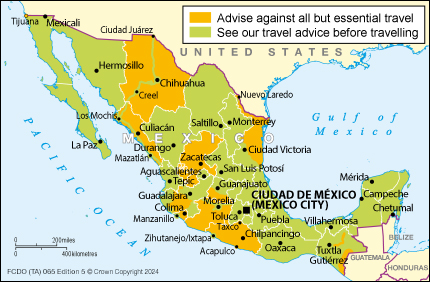
Warnings — Foreign OfficeForeign Office ↗updated 13.10.2026 · read 15.10.2026
Warnings — Foreign Office
Your travel insurance could be invalidated if you travel against advice from the Foreign, Commonwealth and Development Office (FCDO).
State of Baja California
FCDO advises against all but essential travel to the city of Tijuana, except:
- airside transit through Tijuana airport
- the Cross Border Xpress bridge from the airport linking terminals across the Mexican-US border
- the federal toll road 1D and Via Rápida through Tijuana to the border
FCDO advises against all but essential travel to the city of Tecate in Baja California, including roads between Tijuana and Tecate.
There is another state called Baja California Sur that is unaffected by these warnings.
State of Chihuahua
FCDO advises against all but essential travel to the state of Chihuahua, except:
- the city of Chihuahua
- the border crossing in Ciudad Juárez (accessed by federal toll road 45)
- federal toll road 45D connecting the cities of Chihuahua and Ciudad Juárez
- the Copper Canyon rail route to and from Chihuahua and towns immediately on this route including Creel
- the road from Creel via San Juanito to San Pedro
- state highway 16 from San Pedro to Chihuahua
State of Sinaloa
FCDO advises against all but essential travel to the state of Sinaloa, except:
- the cities of Los Mochis and Mazatlán
- road 32 that runs between El Fuerte and Los Mochis
- the 15D federal toll road that runs the length of the state
- the Copper Canyon rail route to and from Los Mochis, El Fuerte and the towns immediately on this route
State of Tamaulipas
FCDO advises against all but essential travel to the state of Tamaulipas, except:
- the border crossing at Nuevo Laredo accessed by federal toll road 85D from Monterrey
- federal highways 80, 81 and 85 between Tampico, Ciudad de Victoria and Magueyes, and the entire area of Tamaulipas south of these highways
State of Zacatecas
FCDO advises against all but essential travel to the state of Zacatecas.
State of Guanajuato
FCDO advises against all but essential travel to the areas south-west of road 45D.
State of Michoacán
FCDO advises against all but essential travel to the state of Michoacán, except the:
- city of Morelia accessed by federal toll roads 15D, 126 and 43; and the federal toll road 48D between the city of Morelia and the General Francisco Mujica airport
- town of Pátzcuaro accessed by federal toll roads 14D and 15 from Morelia, and boat trips out to islands on Lake Pátzcuaro
- Federal Highway 15D
State of Jalisco
FCDO advises against all but essential travel to the areas south and south-west of Lake Chapala to the border with the state of Colima.
FCDO advises against all but essential travel to the northern municipalities of:
- Bolaños
- Chimaltitán
- Colotlán
- Hostotipaquillo
- Huejúcar
- Huequilla el Alto
- Mezquitic
- San Martin de Bolaños
- Santa Maria de los Ángeles
- Totatiche
- Villa Guerrero
State of Colima
FCDO advises against all but essential travel to the state of Colima, except the city of Manzanillo accessed by sea or air via the Manzanillo-Costalegre International Airport, and direct travel via road 200 from the airport to Manzanillo.
State of Guerrero
FCDO advises against all but essential travel to the state of Guerrero, except the town of Zihuatanejo/Ixtapa accessed by air.
State of Chiapas
FCDO advises against all but essential travel to within 40km of the Guatemalan border between the Pacific Coast up to and including the border crossing at Gracias a Dio.
FCDO advises against all but essential travel on Federal Highway 199 (Carretera Federal 199) between Rancho Nuevo (just outside San Cristobal de las Casas) and the Chancalá junction just outside Palenque (where Federal Highway 199 meets Federal Highway 307).
Find out more about why FCDO advises against travel to these areas .
Regional risks — Foreign OfficeForeign Office ↗updated 13.10.2026 · read 15.10.2026
Regional risks — Foreign Office
This section has safety advice for regions of Mexico. It only covers regions where FCDO has specific advice.
You should also read FCDO ’s overall travel advice and safety and security advice .
North
Drug-related violence affects the northern states of Sonora, Chihuahua, Coahuila, Nuevo Leon, Tamaulipas, Sinaloa and Durango.
Many fatalities are suspected gang members killed in violent clashes between the different organisations competing for control of trafficking routes into the USA. Armed clashes between security forces and drug groups can happen at any time without warning. Take extreme care outside tourist areas in all these states.
Baja California, including Tijuana
FCDO advises against all but essential travel to the city of Tijuana, except:
- airside transit through Tijuana airport
- the Cross Border Xpress bridge from the airport linking terminals across the Mexican-US border
- the federal toll road 1D and Via Rápida through Tijuana to the border
FCDO advises against all but essential travel to the city of Tecate in Baja California, including roads between Tijuana and Tecate.
If you cross the border by toll road 1D, try to do so during daylight hours or be very cautious after dark. Tijuana is an extremely violent city. Criminals could target you or you could get caught up in conflicts between rival groups.
Many businesses, including shops, follow an unofficial curfew, only opening during daylight hours due to the security threat. Organised crime groups are fighting for control over the city’s drug trade and trafficking routes. There are high rates of kidnapping, murder and organised crime activity, particularly drug, human and arms trafficking.
Armed attacks and targeted killings happen across the state. Violent robberies are a particular issue in the urban centres of Tijuana, Mexicali and Ensenada. Be careful in Tijuana, Mexicali, Ensenada and Rosarito – armed criminals in these towns have targeted stores and bystanders in response to disputes with the government. There have also been incidents of vehicles being targeted by armed attacks. Stick to established tourist routes and destinations across the state and always stay aware of your surroundings.
Take care in Ciudad Juárez or other cities in northern states. Travel during daylight hours when possible, tell relatives or friends of your travel plans and only use reputable hotels.
Take the same precautions in the state of Baja California, including Tijuana. There is drug-related crime in Baja California Sur, including Los Cabos.
Chihuahua
FCDO advises against all but essential travel to the state of Chihuahua, except:
- the city of Chihuahua
- the border crossing in Ciudad Juárez (accessed by federal toll road 45)
- federal toll road 45D connecting the cities of Chihuahua and Ciudad Juárez
- the Copper Canyon rail route to and from Chihuahua and towns immediately on this route including Creel
- the road from Creel via San Juanito to San Pedro
- state highway 16 from San Pedro to Chihuahua
There are high levels of organised crime activity, particularly human and drugs trafficking. There is illegal drug cultivation in rural areas of the state, with associated criminal activity.
If you visit the Copper Canyon rail route, do not walk alone in the canyon or stray from the tourist trail. Complete all your activities within daylight hours. There is a risk you could be caught up in conflicts between rival organised crime groups operating in the area.
Sinaloa
FCDO advises against all but essential travel to the state of Sinaloa, except:
- the cities of Los Mochis and Mazatlán
- road 32 that runs between El Fuerte and Los Mochis
- the 15D federal toll road that runs the length of the state
- the Copper Canyon rail route to and from Los Mochis, El Fuerte and the towns immediately on this route
Armed robbery and vehicle theft has happened in El Fuerte. Avoid driving at night on the route between El Fuerte and Los Mochis.
There are high levels of drug cultivation in rural areas, leading to conflict between organised crime groups fighting for control.
Due to the presence of organised crime, there are high levels of drug-related violence. There are frequent gun battles between government security forces and organised crime groups, including in the city of Culiacán, leading to deaths and the destruction of security infrastructure.
Criminals do not usually target tourists, but you could be a victim of violence due to mistaken identity or on suspicion of spying for other organised criminal gangs – particularly if you are off the beaten tourist track.
Tamaulipas
FCDO advises against all but essential travel to the state of Tamaulipas, except:
- the border crossing at Nuevo Laredo accessed from Monterrey by federal toll road 85D – you should travel during daylight hours
- federal highways 80, 81 and 85 between Tampico, Ciudad de Victoria and Magueyes, and the entire area of Tamaulipas south of these highways
Tamaulipas is dangerous due to the presence of many organised crime groups who fight for control of drug trafficking routes. There is a risk of armed robbery and kidnap.
Zacatecas
FCDO advises…
Safety — Foreign OfficeForeign Office ↗updated 13.10.2026 · read 15.10.2026
Safety — Foreign Office
This guide also has safety advice for regions of Mexico .
Terrorism
There is a high threat of terrorist attack globally affecting UK interests and British nationals, including from groups and individuals who view the UK and British nationals as targets. Stay aware of your surroundings at all times.
UK Counter Terrorism Policing has information and advice on staying safe and what to do in the event of a terrorist attack. Find out how to reduce your risk from terrorism while abroad .
Terrorism in Mexico
Terrorist attacks in Mexico cannot be ruled out.
Political situation
Political demonstrations are common in Mexico City and can happen across the country. Demonstrations can be tense, confrontational and potentially violent. Onlookers can be quickly drawn in.
There have also been ongoing protests blocking vehicle access to Oaxaca airport. If you are flying to Oaxaca, check the status of your flight and monitor local media for updates. Allow more time to get to and from Oaxaca airport.
It is illegal for foreign nationals to participate in political activities in Mexico. If you join demonstrations, the Mexican authorities may detain and deport you.
Since July 2025 there have been protests against gentrification in Mexico City, which have taken place in central and tourist areas.
Monitor local media and avoid all demonstrations. If you come across protests, move away from the area.
Crime
Crime is a risk to foreign nationals in Mexico, particularly in major cities and tourist resort areas. Street crime is a serious issue in these places.
Many Mexican and foreign businesses choose to hire private security. You should:
- research your destination thoroughly
- only travel during daylight hours when possible
- monitor local media
- tell trusted contacts your travel plans
If you want to report a crime, do so immediately at the nearest branch of the state prosecutor’s office (‘Agencia del Ministerio Público’). A criminal investigation is not possible without a formal complaint to the Mexican authorities. You must make a complaint in person before you leave Mexico.
The Mexico City Command and Control Centre (‘Centro de Atención a Emergencias y Protección Ciudadana de la Ciudad de México’) has information and advice on safety in Mexico City in Spanish.
Using ATMs
Take care withdrawing money from ATMs or using exchange offices (bureau de change). Criminals have targeted people using these services. It’s generally safer to use ATMs during daylight hours inside shops or malls. Avoid withdrawing large amounts and watch who is around you while you are at an ATM.
Protecting your belongings
Pickpocketing and theft are common, including on public transport. You should:
- avoid wearing expensive-looking clothing, jewellery or watches
- limit the amount of cash or credit and debit cards you carry
- watch your luggage, even in apparently secure places like the lobby of your hotel
Scams
Be wary of criminals posing as police officers and trying to fine or arrest you for no reason. They have targeted travellers driving rental cars.
Some genuine police officers have extorted money from tourists for alleged minor offences or traffic violations. If this happens:
- do not hand over money or your passport
- ask for a copy of the fine, which is payable later
- ask for ID
- try to note the officer’s name, badge number and patrol car number
Criminals may try to get your friends or relatives to transfer money to Mexico. This can happen if your phone is stolen or hacked. Before you travel, agree how you will contact…
American passport — U.S. Department of State
- The U.S. State Department advises Level 2 caution for Mexico due to terrorism, crime, and kidnapping, with limited U.S. government ability to assist in many areas. State Department
- Do not travel to Colima state due to terrorism, crime, and kidnapping; U.S. citizens have been kidnapping victims there. State Department
- In Manzanillo, Colima, travel only to central tourist areas including the historic city center, Malecon, hotel zone, and Peninsula Santiago. State Department
- Follow U.S. government employee restrictions: do not travel between cities after dark, use only regulated taxis or Uber/Cabify, avoid traveling alone in remote areas. State Department
- Do not drive between Mexican border cities and Mexico's interior; comply with road checkpoints or risk serious injury or death. State Department
- Emergency services are limited or unavailable in remote or rural areas; consult the restricted areas map at mx.usembassy.gov/maps-of-restricted-areas. State Department
Faithful summary of the official texts below, which prevail.
Mexico Travel Advisory - Level 2: Exercise Increased Caution 2026-05-28travel.state.gov ↗updated 28.05.2026 · read 16.10.2026
Advisory summary
Exercise increased caution in Mexico due to terrorism, crime, and kidnapping. Some areas have increased risk. Read the entire Travel Advisory.
- Many violent crimes take place in Mexico. They include homicide, kidnapping, carjacking, sexual assault, and robbery. There is a risk of terrorist violence, including terrorist attacks and other activity in Mexico. Visit the U.S. Department of State’s country reports on terrorism to learn more.
- The U.S. government has limited ability to help in many parts of Mexico, a large country in which conditions can vary widely from state to state and even within a state. U.S. government employees may not travel to certain high-risk areas, which may be within states that include low-risk areas.
- Due to security risks, U.S. citizens should follow the same restrictions as U.S. government employees while traveling.
- Emergency services are limited or unavailable in remote or rural areas.
- If you encounter a road checkpoint, you should comply. Fleeing or ignoring instructions can lead to you being hurt or killed.
- Check the maps of restricted areas .
U.S. government employee travel restrictions (U.S. citizens are strongly advised to follow):
- May not travel between cities after dark.
- Must rely on dispatched vehicles from regulated taxi stands or app-based services like Uber or Cabify and may not wave down taxis on the street.
- Should avoid traveling alone, especially in remote areas.
- May not drive between Mexican border cities and the interior of Mexico, with limited exceptions.
Map of restricted areas: https://mx.usembassy.gov/maps-of-restricted-areas
Global Affairs Canada — additional reading
Exercise a high degree of caution (with regional advisories)
Avoid non-essential travel to the following states due to high levels of violence and organized crime:
- Chiapas, excluding : the city and ruins of Palenque (and highway 186 leading there) ; the city of Tuxtla Gutiérrez (and its airport and the main road leading there) ; the city of San Cristobal de las Casas (and toll highway 190D between this city and Tuxtla Gutiérrez)
- Chihuahua, excluding Chihuahua City
- Colima, excluding the city of Manzanillo only if accessed by air
- Guanajuato, in all areas south of and including highways 43D and 45D
- Guerrero, excluding the cities of Ixtapa/Zihuatanejo only if accessed by air
- Jalisco, within 50 km of the border with Michoacán state, excluding : Mazamitla (and highway 405 leading there) ; the area around Lake Chapala between highway 15 and 15D
- Lagunas de Zempoala National Park in Morelos
- Michoacán, excluding the cities of Morelia and Patzcuaro
- Nayarit, within 20 km of the border with the states of Sinaloa and Durango
- Nuevo León, excluding the city of Monterrey
- Sinaloa, excluding the following areas, and only if accessed by air or sea : the city of Los Mochis ; specific areas in and around the city of Mazatlán: Centro Histórico south of Avenida Gutiérrez Najera ; the road connecting Centro Histórico to the airport ; the main coastal roads from Centro Histórico to Playa Delfines, including Zona Cerritos and Zona Dorada (the Golden Zone)
- Sonora, excluding the cities of Hermosillo, Guaymas/San Carlos and Puerto Peñasco
- Tamaulipas, excluding the city of Tampico only if accessed by air or sea
- Zacatecas, excluding the city of Zacatecas
Open Government Licence – Canada · October 15, 2026 07:44 EDTtravel.gc.ca ↗updated 15.10.2026 · read 16.10.2026
- Police may detain you for up to 72 hours for petty crimes including public urination, failure to pay bills, or disorderly behaviour. Detention conditions are below Canadian prison standards. Global Affairs Canada
- Drug possession, use, or trafficking carry severe penalties including lengthy prison sentences up to 25 years. Cannabis laws are unclear; you could be arrested for possession or transport. [Global Affairs Canada]. Foreign Office
- You must carry your original passport and entry stamp at all times. Mexican authorities do not accept copies or photos. Failure to produce correct documents may result in detention or deportation. Foreign Office
- Do not bring electronic cigarettes, vaping devices, or solutions into Mexico; customs will confiscate them. Smoking or vaping in public places incurs fines up to 3,000 Mexican pesos (approximately £150). [Global Affairs Canada]. Foreign Office
- Enter Mexico with a vehicle or boat only with proper import permit and insurance obtained beforehand; present a paper vehicle registration document, not digital. Failure results in fines or seizure. Global Affairs Canada
- Do not bring firearms, ammunition, or knives with blades longer than 6 centimetres without prior written Mexican authorization. Illegal entry with weapons results in imprisonment. Global Affairs Canada
Faithful summary of the official texts below, which prevail.
Global Affairs Canada — written for Canadian travellers, valid for all
Local laws
You must abide by local laws. Penalties for breaking the law in Mexico can be more severe than in Canada, even for similar offences. Foreign nationals are often held in pre-trial detention and there can be lengthy delays before a trial. Police may detain you for up to 72 hours for many petty crimes including:
- public urination
- failure to pay a bill
- disorderly behaviour
Detention conditions are below the standards of Canadian prisons. Arrest and detention
Drugs
Penalties for possession, use or trafficking of illegal drugs are severe. Convicted offenders can expect lengthy prison sentences. Mexican laws and their enforcement related to the possession and use of recreational and medical cannabis are unclear. You could be arrested or extorted for possession, use or transport of cannabis. Drugs, alcohol and travel
Imports and exports
You must declare goods worth more than $500 USD. Mexico has strict rules on the importation of weapons, vehicles, cigarettes and alcohol.
Weapons
Anyone entering Mexico with a firearm or ammunition without prior written authorization from Mexican authorities is subject to imprisonment. It is illegal to enter the country with knives with blades longer than 6 cm.
Vehicles and boats
You must enter Mexico with the proper import permit and insurance since they cannot be obtained once you’re in Mexico. If you fail to provide the proper documents, you could:
- face a fine
- have your vehicle or boat seized
You must present a paper document of your vehicle registration to obtain a vehicle importation permit from Mexican authorities. If you present a digital version of your vehicle registration, your vehicle may be refused entry into Mexico.
Cigarettes and alcohol
If you’re 18 or older, you can bring into Mexico up to:
- 20 packs of cigarettes
- 25 cigars or 200 grams of tobacco
- 3 litres of alcoholic beverages
- 6 litres of wine
If you bring more than the allowed quantities, even if you declare or hand them over to authorities, you will have to pay a hefty import tax.
Artifacts
It’s illegal to remove archaeological artifacts or to export such items from Mexico.
Smoking and vaping
Smoking and vaping are prohibited in all public places except for clearly marked designated smoking areas. This includes the following places:
- beaches
- hotels
- markets
- parks
- restaurants
You may be fined or arrested if you’re caught smoking or vaping in public.
Electronic cigarettes
It’s illegal to bring, sell or distribute:
- electronic cigarettes
- vaping devices
- vaping solutions
Customs officials could confiscate these items if you have them in your possession upon arrival. You could also be fined or detained.
International Child Abduction
The Hague Convention on the Civil Aspects of International Child Abduction is an international treaty. It can help parents with the return of children who have been removed to or retained in certain countries in violation of custody rights. The convention applies between Canada and Mexico. If your child was wrongfully taken to, or is being held in Mexico, and if the applicable conditions are met, you may apply for the return of your child to the Mexico court. If you are in this situation:
- act as quickly as you can
- contact the Central Authority for your province or territory of residence for information on starting an application under The Hague Convention
- consult a lawyer in Canada and in Mexico to explore all the legal options for the return of your child
- report the situation to the nearest Canadian government office abroad or to the Vulnerable Children's Consular Unit at Global Affairs Canada by calling the Emergency Watch and Response Centre
If your child was removed from a country other than Canada, consult a lawyer to determine if The Hague Convention applies. Be aware that Canadian consular officials cannot interfere in private legal matters or in another country's judicial affairs.
Identification
Local authorities may request to see your identification at any time, including proof of your legal status in Mexico. Always carry your original identification.
Identity documents
The names on your identification must match those on your birth certificate to obtain official Mexican documents, including:
- a marriage certificate
- immigration documents
Middle names are often not included in Canadian identity documents. This has caused significant difficulties for many Canadians planning to move to Mexico or dealing with the Mexican Civil Registry. Obtain a Canadian passport that will meet Mexican requirements before applying for residency in Mexico.
Investments
Mexican real estate agents are not licensed or regulated. Disputes related to property acquisition or other investments are costly and take time to resolve. If you plan to buy property or make other investments in Mexico:
- seek legal advice in Canada and in Mexico before making commitments
- choose your own lawyer
- avoid hiring a lawyer recommended by a seller
Rental accommodations
In Mexico, rental agreements between two individuals are considered a private matter and are not regulated by the government. If you encounter difficulties with a rental agreement, you must consult a local lawyer.
Open Government Licence – Canada · October 15, 2026 07:44 EDTtravel.gc.ca ↗updated 15.10.2026 · read 16.10.2026
Foreign Office — laws and cultural differences
Local laws
For information on procedures, local laws or social services, you can contact Mexico City’s public telephone service LOCATEL on 5658 1111 (English-speaking staff available).
Spiritual cleansing ceremonies
Traditional hallucinogenic tea, ceremonies and practices such as Yagé, Ayahuasca, and Bufo are organised and marketed to tourists as spiritual cleansing. These various preparations typically contain dimethyltryptamine (DMT) or 5-metoxi-N, N-dimetiltriptamina (5-MeO-DMT), strong hallucinogens that are illegal in the UK and many other countries. There are many risks involved. Consumption is not regulated. Intoxicated travellers have been assaulted and robbed. There have also been reports of sexual assaults during these ceremonies. Health risks are not well understood, and some people have suffered serious illnesses and, in some cases, mental breakdowns or death after taking these drugs. The jungle retreats are often a long way from medical facilities making the risks even greater. Some have basic medical services, but others do not. Some do not have an established plan for how you can access medical facilities in case of an emergency.
Personal ID
The Mexican authorities can ask to see your passport and entry stamp to prove your entrance and stay. They do not accept copies or photos. To prove your visa status, you can get a digital registry of your entry documents from the Portal de Servicios INM (in Spanish). If you cannot show the correct documents, immigration officers may question and detain you while they check your immigration status. Depending on the outcome, they can deport you. If you are a resident, the police may ask to see your Mexican residency card. They have detained British people for not having the correct documents.
Smoking and e-cigarette bans
It is illegal to bring e-cigarettes, vaping devices and solutions into Mexico or to buy and sell them. Customs officials will confiscate these items; and they could fine or detain you. If you smoke or vape in a public place, you can get a fine of up to 3,000 Mexican pesos (about £150).
Illegal drugs and prison sentences
Do not become involved with drugs of any kind. Penalties for drug offences are severe and convictions carry sentences of up to 25 years.
LGBT+ travellers
Same-sex relations in Mexico are generally tolerated, rather than accepted. Civil unions between same-sex partners are legal in Mexico. People may frown on same-sex couples showing affection in public. Read more advice for LGBT+ travellers.
Surrogacy in Mexico
Only some Mexican states legally recognise assisted human reproduction, including surrogacy. Before you consider a surrogacy arrangement in Mexico, make sure you:
- learn and follow the relevant laws and regulations
- meet all legal requirements to take the child out of Mexico
- get independent legal advice
For more information, see surrogacy overseas.
Hotel balconies
In some hotels, balcony railings are low and there is a risk of falling.
Open Government Licence v3.0gov.uk ↗updated 13.10.2026 · read 15.10.2026
FDFA (Switzerland) — laws and customs, in French
Specific legal provisions
Il est interdit de photographier les personnes en uniforme et les installations militaires. Toute activité politique est interdite aux personnes étrangères. Il est interdit de consommer de l’alcool et de fumer dans les lieux publics (rues, places, parcs, etc.). Il est punissable d'uriner sur la voie publique. Les infractions sont passibles d'une amende ou d'une peine d'emprisonnement. Les infractions à la loi sur les stupéfiants sont passibles de peines d’emprisonnement de plusieurs années. Les conditions de détention sont précaires: cellules surpeuplées, violence entre les personnes détenues, mauvaises conditions d'hygiène, etc.
Cultural specificities
Adaptez votre comportement aux usages locaux. En dehors des stations balnéaires, le port de vêtements trop provocants peut être perçu comme inapproprié dans certaines circonstances. Ne photographiez pas des personnes ou des groupes de personnes sans leur autorisation. Renseignez-vous dans les guides de voyages, auprès de votre agence ou directement sur place, sur les codes de conduite et les conventions à respecter.
FDFA travel advice, in Frencheda.admin.ch ↗updated 20.07.2026 · read 15.10.2026
What it changes for you: Poor air: asthma, COPD, allergies — bring your prescription and regular treatment, limit outdoor exertion; persistent breathing trouble goes to a doctor, or to the 24/7 number. High UV at midday: sun protection.
Reading 00:00 (America/Mexico_City)Open-Meteo ↗updated 16.10.2026 · read 16.10.2026
Air quality and UV: Open-Meteo.com (CC BY 4.0), data rounded and formatted by Maximum. Contains modified Copernicus Atmosphere Monitoring Service information 2026. Neither the European Commission nor ECMWF is responsible for any use that may be made of the Copernicus information or data it contains.
Reading: With 2.6 physicians per 1,000 people (42% fewer than Switzerland), the nearest hospital does not always have the capacity for a serious case: evacuation to an adequate centre is the rule, not the exception — that is what unlimited evacuation and repatriation cover. Health spending of 761 USD per person (Switzerland: 11,784) goes with private hospitals that bill foreigners in hard currency and ask for a guarantee before admission: the direct payment guarantee is what avoids the deposit.
World Bank — latest published value, year per indicatordata.worldbank.org ↗read 09.10.2026
What is happening in Mexico right now
Live alerts and level changes, each with its official source. Continuously updated.
What governments have just written
L’ouragan Trudy approche de la côte ouest du Mexique. Il pourrait atteindre dès vendredi 16 les côtes du Guerrero, du Michoacan, du Colima, du Jalisco et du Nayarit, sous la forme d’un ouragan. De fortes pluies et des vents violents sont à prévoir tout le long de la côte. Il convient de ne pas sortir en mer ni sur les plages, de prendre connaissance des recommandations des autorités locales, via les médias et en s’informant auprès des établissements hôteliers, et de se…
France Diplomatie (in French) · posted 15 October 2026diplomatie.gouv.fr ↗updated 15.09.2026 · read 15.10.2026The Need help? section was updated.
October 15, 2026 07:44 EDTtravel.gc.ca ↗updated 15.10.2026 · read 16.10.2026No level change recorded for this country since the log opened. The live alerts above are updated continuously.
Frequently asked questions — travel insurance Mexico
What is the official risk level in Mexico today?
Level 2/4 — Exercise Increased Caution, U.S. Department of State, retrieved on 16 October 2026.
- Is the whole country advised against? United States: no · France: no · United Kingdom: no · Switzerland: no (reading of 27 September 2026).
- Switzerland’s FDFA advises against travel to certain regions (published 20.07.2026).
- Contractually, only an FDFA, FOPH or WHO advisory against the trip opens Module A (art. 18.1) — that is not the case today.
- International medical cover, 24/7 number saved, and a read of the areas named under Safety & risks before booking the itinerary.
- We check these sources every morning and e-mail you the day one changes (Alerts button).
Sourcestravel.state.gov · updated 28.05 · read 16.10France Diplomatie · updated 15.09 · read 15.10DFAE · updated 20.07 · read 15.10207-country comparison
Is the whole of Mexico advised against, or only some areas?
An area advised against does not rule out the country.
- Official answers: United States: no · France: no · United Kingdom: no · Switzerland: no.
- Foreign Office, regional risks: “This section has safety advice for regions of Mexico. It only covers regions where FCDO has specific advice. You should also read FCDO ’s overall travel advice and safety and security advice . North Drug-related violence affects the northern states of Sonora,…”
- Keep your country of residence's advisory on booking day and on departure day: that is what your policy's clauses cite.
SourcesFrance Diplomatie · updated 15.09 · read 15.10Foreign Office · updated 13.10 · read 15.10State Department · updated 28.05 · read 16.10
What are the entry requirements for Mexico with my passport?
The rules depend on the passport, not on the destination alone.
- French passport (France Diplomatie): French nationals need no visa for tourist stays up to 180 days in Mexico, but any paid or volunteer work during this period risks immediate expulsion and entry bans lasting up to two years. Arrive by air rather than land at Mexico's northern or southern borders when possible. Present all required documents listed on the Mexican Consulate in Paris website upon arrival. Always carry a valid passport during your stay due to increased police checks. Verify the duration of stay granted by migration authorities at entry.
- British passport (Foreign Office): Your British passport must be valid for at least 180 days to enter Mexico as a tourist, as this is the maximum stay duration permitted. British tourists do not need a visa for Mexico, but those entering by land must complete an online immigration form and will receive a stamp indicating allowed stay duration. If transiting through the USA to or from Mexico, you must obtain an ESTA visa waiver or appropriate visa; without it, entry to the USA will be denied.
- American passport: the requirements are on the State Department country page (travel.state.gov).
- Swiss passport: the FDFA refers you to the destination's embassy in Switzerland.
- Pick your passport at the top of Before you go › Entry: the official text that concerns you comes first, with its “In brief” summary.
SourcesFrance Diplomatie · updated 15.09 · read 15.10Foreign Office · updated 13.10 · read 15.10State Department · updated 28.05 · read 16.10
Do I need an insurance certificate for a Mexico visa?
For a Schengen visa, yes: at least €30,000 of travel medical insurance (Regulation (EC) No 810/2009, art. 15).
- Many other countries ask for it on entry or for a visa, case by case: check Before you go › Entry, with your passport.
- Subscribe: the named certificate arrives by e-mail on payment, with your name, dates and limits (EUR 1.5M medical expenses, unlimited evacuation and repatriation) — the ones consulates check.
- Attach it to the visa file; if in doubt about the format, write to us.
SourcesRegulation (EC) 810/2009, art. 15General conditions, policy 20 00 479
What does Maximum Insurance do in Mexico, concretely?
VIP Pack — €990 for twelve months, unlimited trips.
- EUR 1.5M emergency medical expenses, unlimited medical evacuation and repatriation, search and rescue EUR 50,000, cancellation or change EUR 5,000.
- One 24/7 number, +41 22 ••• •• ••: Maximum sends its direct payment guarantee to the hospital (art. 2.12).
- Network of 45,000 providers (art. 6.9); evacuation is decided, organised and paid by Maximum's medical team if the local facility is not enough (art. 6.2.2).
- Around Mexico City, the nearest hospital read from OpenStreetMap: Hospital General Balbuena · 1.4 km · 01 55 5552 0360 · 24/7 emergency room.
- Named certificate by e-mail on payment, no medical questionnaire.
SourcesGeneral conditions, policy 20 00 479OpenStreetMap · read 09.10
How much does a medical repatriation from Mexico cost?
From 14 000 € to 200 000 € depending on severity and distance (Mexperience, 2026).
- Without cover: the hospital asks for a deposit before admission, and the medical flight is paid up front.
- With the VIP Pack: the evacuation is decided and settled by Maximum (art. 6.2.2) — no advance, no cap.
SourcesMexperience, 2026General conditions, policy 20 00 479
What should I do if hospitalised in Mexico?
Six steps, in this order.
- 1. Call +41 22 ••• •• •• before paying anything, or have the front desk call: it is the condition for full cover (otherwise: reduced or refused benefits).
- 2. Ask for a hospital in the Maximum network (art. 6.9) — the nearest: Hospital General Balbuena · 1.4 km · 01 55 5552 0360 · 24/7 emergency room.
- 3. See a doctor the same day and leave with the certificate: without an on-the-spot finding, nothing is covered (art. 33).
- 4. Admitted for more than 24 h? The front desk calls Maximum: direct payment guarantee, no deposit (art. 2.12).
- 5. Book no ambulance or flight yourself (art. 6.2.2).
- 6. Once home, file within 30 days (art. 35.7).
- Local emergency services: single number 911.
SourcesSpecial conditions 01.26General conditions, policy 20 00 479
Which emergency numbers in Mexico?
Local emergency services: single number 911
- Maximum, 24/7, before any payment: +41 22 ••• •• ••.
- France — Ambassade de France (7.5 km) · +52 55 91 71 97 00
- Switzerland — Ambassade de Suisse (8.8 km) · +52 55 9178 4370
- United Kingdom — Ambassade du Royaume-Uni (4.0 km)
- United States — Embassy of the United States of America (8.5 km)
- Save these numbers before leaving; in immediate danger, call local emergency services first, then Maximum.
SourcesEmergencyNumberAPI · Wikidata · read 08.10OpenStreetMap · read 09.10
Is an Amex, Visa or Mastercard enough in Mexico?
At today's level 2/4, card by card:
- Amex Platinum — No area exclusion at this level — but three written limits: deductible and prior approval, 90-day cap, advance under conditions.
- Visa — No express area exclusion — but a €156,000 cap, 90 days, and the war/instability exclusion in the background.
- Mastercard — No exclusion in play at this level — but a €155,000 cap and 90 covered days.
- Three lines to read in your notice: the duration (often 90 days per trip), the settlement (reimbursement afterwards or direct payment of the hospital) and the area exclusion at level 4/4.
SourcesAmex Platinum France T&Cs, 01.2025 — general exclusion n° 11BNP Paribas Visa Infinite notice (policy PT7), 04.2025 — comFortuneo World Elite Mastercard notice, 01.2026 — art. 5.5 '
Are a health plan or a travel policy enough in Mexico?
A health plan reimburses at home; here, the hospital asks for a payment guarantee before admission.
- Health plan — A health plan treats you at home. Here the hospital asks for a guarantee before admission — not a later reimbursement.
- Travel policy — No area exclusion at this level — compare cap, deductible and covered duration.
- A travel policy often has a territorial clause at level 4/4 and a 90-day limit per trip.
- Have your IPID number or the PDF of the terms and ask an expert to call you back: the answer is in the document, not in the brochure.
SourcesGeneral conditions, policy 20 00 479
How do I use the medical network on this page?
Around Mexico City: 80 hospitals and clinics, 69 with a 24/7 emergency room, 40 pharmacies, 27 doctors' practices (OpenStreetMap, hospital list read on 15.10.2026).
- Type your city, hotel or beach: the map re-centres, 24/7 emergency rooms come first.
- Each row gives the phone when the source publishes it, the nearest street, directions and the Google Maps listing.
- The PDF briefing repeats the same places, numbered on a printable map.
- No customer reviews: OpenStreetMap has none, and we invent none.
Which vaccines and health precautions for Mexico?
The sourced detail is under Medical network › Health: vaccines, diseases present, altitude, outbreaks.
- CDC (Travelers' Health), depending on the trip: Routine vaccines, COVID-19, Chikungunya, Hepatitis A, Hepatitis B, Malaria, Measles.
- France Diplomatie reports in the country: dengue, chikungunya — mosquito protection day and night.
- The chosen point is at 2,240 m: altitude sickness is possible in the first days; descend if symptoms worsen.
- WHO: 1 outbreak alert(s) for this country in the last 24 months, including “Avian Influenza A(H5N1) - Mexico” (17 April 2025).
- See a doctor or a travel clinic 8 weeks before departure (Foreign Office).
- Carry your medicines in their packaging, with a prescription using international non-proprietary names (France Diplomatie).
SourcesCDC Travelers' Health · read 09.10France Diplomatie · updated 15.09 · read 15.10OMS · updated 17.04 · read 15.10Foreign Office · updated 13.10 · read 15.10
Can I be treated in Mexico, or will I be evacuated?
2.6 physicians per 1,000 people (2022) versus 4.5 in Switzerland.
- 1.0 hospital beds per 1,000 people versus 4.4 in Switzerland (World Bank).
- With 2.6 physicians per 1,000 people (42% fewer than Switzerland), the nearest hospital does not always have the capacity for a serious case: evacuation to an adequate centre is the rule, not the exception — that is what unlimited evacuation and repatriation cover. Health spending of 761 USD per person (Switzerland: 11,784) goes with private hospitals that bill foreigners in hard currency and ask for a guarantee before admission: the direct payment guarantee is what avoids the deposit.
- When the local facility is not enough, Maximum's medical team decides the evacuation to a suitable centre, and pays for it (art. 6.2.2).
SourcesWorld Bank · read 09.10General conditions, policy 20 00 479
Mexico: safety, in figures?
24.9 homicides per 100,000 people (2023) versus 0.6 in Switzerland and 1.3 in France.
- 12.8 road deaths per 100,000 people versus 2.2 in Switzerland (World Bank, WHO).
- UCDP (Uppsala University): 693 geolocated violent incidents, 654 deaths over the last closed period, each placed on the map.
- The homicide rate is 42 times Switzerland's: violence is a real risk there, concentrated in the areas named by the official advisories. On the road, 6 times more deaths than in Switzerland: road crashes are the leading cause of death of healthy travellers (CDC) — seat belt, no night driving, a driver or a taxi from a rank.
Where is my embassy in Mexico, and why register?
The nearest representations, by passport (OpenStreetMap):
- France — Ambassade de France (7.5 km) · +52 55 91 71 97 00
- Switzerland — Ambassade de Suisse (8.8 km) · +52 55 9178 4370
- United Kingdom — Ambassade du Royaume-Uni (4.0 km)
- United States — Embassy of the United States of America (8.5 km)
- Register before leaving: France: Ariane · Switzerland: Travel Admin · United Kingdom: Foreign Office alerts · United States: STEP.
- Two minutes, and in a crisis your country's authorities can reach you and count you in an evacuation.
- Pick your passport at the top of Contacts: your embassy comes first.
SourcesOpenStreetMap · read 09.10DFAE · updated 20.07 · read 15.10
Which regions of Mexico should I avoid, precisely?
22 regions advised against, fully or partly, by at least one official reading.
- Your point (Mexico): partly advised against.
- Advised against — all travel: Colima, Guerrero, Tamaulipas.
- Advised against — all but essential travel: Baja California, Chiapas, Chihuahua, Durango, Michoacán, Morelos, Nayarit, Nuevo León, Sinaloa, Sonora, Zacatecas.
- Partly advised against: Coahuila, Guanajuato, Jalisco, Mexico, Oaxaca, Puebla, State of Mexico, Veracruz.
- Maximum does not exclude these areas: the VIP Pack covers care and repatriation there (sanctions, embargoes and a country already at war at departure remain enforceable).
SourcesGlobal Affairs Canada · updated 15.10 · read 16.10Foreign Office · updated 13.10 · read 15.10France Diplomatie · updated 15.09 · read 15.10
Which laws and customs should I know in Mexico?
Local laws apply to every traveller; here is what the official texts say.
- Police may detain you for up to 72 hours for petty crimes including public urination, failure to pay bills, or disorderly behaviour. Detention conditions are below Canadian prison standards.
- Drug possession, use, or trafficking carry severe penalties including lengthy prison sentences up to 25 years. Cannabis laws are unclear; you could be arrested for possession or transport. [Global Affairs Canada].
- You must carry your original passport and entry stamp at all times. Mexican authorities do not accept copies or photos. Failure to produce correct documents may result in detention or deportation.
- Do not bring electronic cigarettes, vaping devices, or solutions into Mexico; customs will confiscate them. Smoking or vaping in public places incurs fines up to 3,000 Mexican pesos (approximately £150). [Global Affairs Canada].
- Enter Mexico with a vehicle or boat only with proper import permit and insurance obtained beforehand; present a paper vehicle registration document, not digital. Failure results in fines or seizure.
SourcesGlobal Affairs Canada · updated 15.10 · read 16.10Foreign Office · updated 13.10 · read 15.10
Who can I call at any hour from Mexico?
Every foreign ministry runs a 24/7 emergency line for its nationals.
- France — Crisis and Support Centre — French Ministry for Europe and Foreign Affairs: +33 1 53 59 11 00. 24/7 emergency line, standard rate. First contact abroad: the French embassy or consulate.
- Switzerland — FDFA Helpline: +41 58 465 33 33 · +41 800 24 7 365. 24/7, 365 days a year — helpline@eda.admin.ch. Beware of scam calls spoofing these numbers.
- United Kingdom — Foreign, Commonwealth & Development Office: +44 20 7008 5000. 24 hours, for British nationals.
- United States — Overseas Citizens Services — U.S. Department of State: +1 202 501 4444 · +1 888 407 4747. From abroad; the second number from the U.S. and Canada.
- On site, Ambassade de France: +52 55 91 71 97 00.
Sourcesdiplomatie.gouv.fr · updated 15.09 · read 15.10eda.admin.ch · updated 20.07 · read 15.10
A few useful phrases in Spanish for Mexico?
Emergency phrases, to show if pronunciation fails:
- Help! → ¡Ayuda!
- Call an ambulance! → ¡Llame a una ambulancia!
- I need a doctor. → Necesito un médico.
- Where is the nearest hospital? → ¿Dónde está el hospital más cercano?
- Call the police! → ¡Llame a la policía!
SourcesMaximum Insurance
What should I keep after leaving Mexico, and how do I file a claim?
Keep the entry stamp, the invoices, the prescriptions and the medical report.
- File within 30 days (art. 35.7) from your client area, with the documents; the official forms are pre-filled.
- Costs advanced on site are reimbursed against receipts.
- Fever, persistent diarrhoea or a rash in the following weeks? See a doctor and say where you have been — dengue, chikungunya circulate in the country (France Diplomatie).
SourcesGeneral conditions, policy 20 00 479
What does the Pack VIP Extreme add?
Cancellation or change up to EUR 20,000, special risk EUR 5,000 per person, crisis management and security, optional Kidnap & Ransom.
- Special risk (Module A): political event, attack, epidemic, natural disaster — opens when the FDFA, the FOPH or WHO advise against the trip (art. 18.1).
- Epidemic: assistance must be requested within 7 days of the WHO or FDFA qualification (art. 36.2).
- Crisis management and security: trip registration, monitoring, extraction, evacuation in case of riot, war, terrorism or disaster; Kidnap & Ransom subject to eligibility (art. 18.4).
- €2,290 a year, unlimited trips.
SourcesGeneral conditions, policy 20 00 479
A question not answered here? Ask Maximum below, or call the support number: every question gets a clear, actionable answer.
In a life-threatening emergency, call local emergency services first, then Maximum: +41 22 ••• •• •• — 24/7 support number, an adviser stays with you to the end.
What Maximum knows
The 207 country pages — hospitals, pharmacies, police, embassies, emergency numbers, official advice from four governments, health, safety in figures, events in progress — read around the city you name. Your policy — benefits, the six steps, claims, articles. The site — prices, certificate, subscription. Nothing else: what it does not know, it says so and hands you to an adviser.
Travelling to Mexico, Cancún: what changes
The published advisory level is national, but risk is not: business hubs (Mexico, Cancún) do not share the profile of border areas. The medical network shown on this page is computed around Mexico City — real hospitals, evacuation airport and live alerts. Before a specific trip, always cross-check your country of residence's advisory: that is what your policy cites.
Same advisory level: New Caledonia · Nepal · Panama · Netherlands · Philippines · Peru
The displayed level comes from the State Department, checked every morning. Before departure, always cross-check your country of residence's advisory: that is what your policy cites.
The level shown is the official U.S. Department of State level, checked daily. Maximum Insurance is an insurance distributor — general information, not personal advice.