Make sure you are up-to-date on all routine vaccines before every trip. Some of these vaccines include Chickenpox (Varicella) Diphtheria-Tetanus-Pertussis (DTaP, Tdap, or Td) Flu (influenza) Measles-Mumps-Rubella (MMR) Polio Shingles
Maximum Alerts / Peru
Level published by the State Department on 03.09.2026 · read 13 October 2026 · source checked daily
Peru — official level as of 13 October 2026: Level 2/4 ("Exercise Increased Caution"), from the U.S. Department of State. Maximum Insurance covers this country: hospital settled directly, unlimited repatriation, USD 1.5M, certificate on payment.
Every country has its own scale, so we ask them all the same question: is the whole country advised against?
An advisory covering only areas of the country does not raise the answer: it stays “No”, and the area is shown in the relevant column.
The level shown on this page — and across this site — is the one published by the U.S. State Department, from 1 (normal precautions) to 4 (do not travel). France and the United Kingdom publish their own advisories, with their own rules: they add to that level, they do not replace it.
You will be alerted only on the day the official level of this country changes.
In a life-threatening emergency, call local emergency services first, then Maximum: +41 22 ••• •• •• — 24/7 support number, an adviser stays with you to the end.
The 207 country pages — hospitals, pharmacies, police, embassies, emergency numbers, official advice from four governments, health, safety in figures, events in progress — read around the city you name. Your policy — benefits, the six steps, claims, articles. The site — prices, certificate, subscription. Nothing else: what it does not know, it says so and hands you to an adviser.
What I say on the phone
What to do, in this order
In immediate danger, call local emergency services first. Then contact assistance without delay; before engaging a service, seek approval under your policy. Cover is confirmed by the insurer.
Ask assistance where to get care and whether direct cover can be arranged. It confirms the facility and seeks the insurer's approval under your policy. In immediate danger, call local emergency services first.
Even for a pain you meant to shrug off. Without a medical certificate written on the spot, the same day, the insurer cannot cover the event — a certificate written after you return does not count.
The hospital desk sends the request to assistance. Direct payment depends on the insurer's approval and the policy; the call alone does not guarantee it. Have the response confirmed before relying on no up-front payment.
In a life-threatening emergency, call local emergency services immediately. For an arranged transfer or repatriation, contact assistance: the insurer's medical team decides on measures under the policy. A medical flight booked without approval may not be reimbursed.
Even if everything went well on the ground. Send your invoices and the medical report within 30 days; after that, compensation may be reduced or refused.
Reading hospitals, doctors and pharmacies around this point…
809 Jirón Ancash Cercado de Lima
733 Avenida Nicolás de Pierola
near Avenida República de Venezuela
near Jirón Loreto
700 Avenida Manco Capac La Victoria
general
Mo-Sa 07:00-19:00
near Avenida República de Venezuela
Avenida Brasil
San Martin de Porres
223 Jirón Coronel Cipriano Zegarra Jesús María
417 Jirón Coronel Cipriano Zegarra Jesús María
cardiology
near Jirón Bartolomé Herrera
339 Jose Bazzochi
near Avenida Arnaldo Márquez
Carlos Villaran La Victoria
2161 Avenida Circunvalación San Luis
general
Mo-Sa 06:00-19:00; Su 09:00-13:00
Paseo de la República Lince
650 Avenida Gregorio Escobedo Jesús María
near Avenida Ramon Herrera
1401 Avenida Simón Bolívar Pueblo Libre
3058 Avenida Paseo de la República San Isidro
206 Cabo Gutarra
Mo-Sa 10:00-22:00
near Avenida Javier Prado Este
Avenida Brasil
375 Avenida La Marina Magdalena del Mar
1656 Avenida Manuel Cipriano Dulanto
Mo-Fr 09:00-20:00; Sa 09:00-13:00
655 Avenida Guardia Civil San Isidro
fertility
Mo-Fr 07:00-20:00; Sa 08:00-13:00
near Tontódromo
near Avenida Perú
near Jirón Crane
Avenida La Marina
410 Calle Los Halcones Surquillo
general
170 Calle Manuel Raygada San Miguel
general
24/7
near Boulevard José Gálvez
near Avenida Carlos Alberto Izaguirre
ophthalmology
T160 Pasillo Cinemark Santiago de Surco
general
Mo-Su 10:00-21:00
near Calle Violetas
near Jirón Mariscal Ramon Castilla
Brigida Silva de Ochoa San Miguel
near Prolongación Cajamarca
San Miguel
Cercado de Lima
Mo-Fr 08:30-20:00
Cercado de Lima
Mo-Fr 08:30-20:00
Cercado de Lima
Cercado de Lima
805 Jirón de la Unión Cercado de Lima
Mo-Fr 08:30-20:00
Jirón de la Unión Cercado de Lima
Mo-Fr 08:30-20:00
near Jirón de la Unión
Mo-Fr 08:30-20:00
near Avenida Emancipación
near Avenida Abancay
near Metropolitano
Avenida Emancipación
near Jirón Andahuaylas
Cercado de Lima
near Jirón Andahuaylas
near Jirón Lampa
near Avenida Abancay
near Metropolitano
near Jirón Pomabamba
near Jirón Recuay
near Avenida República de Venezuela
Avenida República de Venezuela
near Jirón Iquique
Avenida República de Venezuela
near Avenida Manco Cápac
near Avenida República de Venezuela
near Jirón General Varela
Avenida República de Venezuela Lima
Jirón Zorritos
near Jirón Yauyos
near Avenida República de Venezuela
near Jirón Jorge Chávez
298 Avenida Giuseppe Garibaldi Jesús María
Javier Prado Este La Victoria
325 Guillermo Marconi San Isidro
311 Guillermo Marconi San Isidro
356 Calle Las Palmeras San Isidro
165 Guillermo Marconi San Isidro
155 Vía Principal San Isidro
396 Calle Carlos Porras Osores San Isidro
355 Calle Clement X San Isidro
Mo-Fr 08:00-13:00
3006 Avenida Salaverry San Isidro
Mo-Fr 09:00-13:00, 13:30-17:30
110 Avenida Coronel Pedro Portillo San Isidro
1163 Aurelio Miro Quesada San Isidro
500 Iquitos La Victoria
179 Alfredo Mendiola San Martín de Porres
Mo-Fr 8:00 - 18:00
3501 Avenida Brasil Magdalena del Mar
Mo-Fr 8:00-17:00
862 Jirón Huallaga Cercado de Lima
Los Cibeles
Mo-Su 08:00-17:00
600 Avenida Bauzate y Meza La Victoria
15 de Abril El Agustino
Jirón Restauracion Breña
Santa Beatriz
near Avenida Eduardo de Habich
Horacio Cachay Diaz La Victoria
Mo-Sa 08:00-17:00
near Calle Luis Felipe Villarán
San Hilaron Este San Juan de Lurigancho
near Ica
Avenida Aviación La Victoria
Mo-Sa 05:00-22:00; Su 05:30-22:00
Avenida Próceres de la Independencia San Juan de Lurigancho
Mo-Sa 05:00-22:00; Su 05:30-22:00
Avenida Fernando Wiese San Juan de Lurigancho
Mo-Sa 05:00-22:00; Su 05:30-22:00
near Metropolitano
Emancipación
near Metropolitano
near Metropolitano
near Metropolitano
near Avenida Carlos Zavala
near Avenida Alfredo Mendiola
Forecast: MET Norway (Norwegian Meteorological Institute, CC BY 4.0), grouped by day and formatted by Maximum.
10-13 42.6 · 10-14 42.9 · 10-15 42.9 · 10-16 43.1 · 10-17 43.9 · 10-18 44.6 · 10-19 44.8 m³/s
Simulated discharge: Open-Meteo.com (CC BY 4.0), data rounded and formatted by Maximum. Contains modified Copernicus Emergency Management Service information 2026. For information only: this is not a flood warning; only national or regional authorities issue those.
No geolocated event in this country at this reading.
No geolocated UCDP incident in this country.
No news located around Lima in this reading.
National numbers (Wikidata, 2026 reading). On site, call local emergency services first, then Maximum: the insurer sends its payment guarantee to the hospital.
Make sure you are up-to-date on all routine vaccines before every trip. Some of these vaccines include Chickenpox (Varicella) Diphtheria-Tetanus-Pertussis (DTaP, Tdap, or Td) Flu (influenza) Measles-Mumps-Rubella (MMR) Polio Shingles
All eligible travelers should be up to date with their COVID-19 vaccines. Please see Your COVID-19 Vaccination for more information.
There is elevated chikungunya risk in Peru. Chikungunya vaccination may be considered for people traveling or moving to this location if they are planning to stay for an extended period of time (for example, 6 months or more).
Recommended for unvaccinated travelers one year old or older going to Peru. Infants 6 to 11 months old should also be vaccinated against Hepatitis A. The dose does not count toward the routine 2-dose series. Travelers allergic to a vaccine component should receive a single dose of immune globulin, which provides effective protection for up to 2 months depending on dosage given.
Recommended for unvaccinated travelers younger than 60 years old traveling to Peru. Unvaccinated travelers 60 years and older may get vaccinated before traveling to Peru.
CDC recommends that travelers going to certain areas of Peru take prescription medicine to prevent malaria. Depending on the medicine you take, you will need to start taking this medicine multiple days before your trip, as well as during and after your trip. Talk to your doctor about which malaria medication you should take.
Cases of measles are on the rise worldwide. Travelers are at risk of measles if they have not been fully vaccinated at least two weeks prior to departure, or have not had measles in the past, and travel internationally to areas where measles is spreading.
Monkeypox vaccination is recommended for any adult who anticipates any of the following activities during travel: Sexual or intimate contact with a new partner Sexual or intimate contact at a commercial sex venue, like a sex club or bathhouse Sexual or intimate contact in exchange for money, goods, drugs, or other trade Sexual or intimate contact in association with a large public event, such as a rave, party, or…
Dogs infected with rabies are sometimes found in Peru. Rabies is also commonly found in some terrestrial wildlife species and bats. If rabies exposures occur while in Peru, rabies vaccines may only be available in larger suburban/urban medical facilities.
Consider getting a typhoid vaccine if you might: Travel to areas with poor sanitation and unsafe water, including rural areas Spend a long time in Peru, such as a month or more Visit friends or relatives Typhoid vaccine is not 100% effective. Practicing safe food and water habits , including washing hands at key times , can also help prevent typhoid fever .
CDC recommendations: Vaccine is recommended for all travelers ≥9 months old going to areas <2,300 m (7,550 ft) elevation in the regions of Amazonas, Cusco, Huánuco, Junín, Loreto, Madre de Dios, Pasco, Puno, San Martín, and Ucayali, and designated areas of Ancash (far northeast), Apurímac (far north), Ayacucho (north and northeast), Cajamarca (north and east), Huancavelica (far north), La Libertad (east), and Piura…
CDC Travelers' Health, re-read weekly — the recommendation depends on your age, vaccines and itinerary: confirm it with a doctor or a travel clinic 4 to 6 weeks before departure.CDC ↗read 10.10.2026
High incidence: a long stay or time in care settings warrants a test on return.
Average coverage: two up-to-date MMR doses remain the rule.
Transmission limited to some areas: repellent, and the CDC says which.
World Bank — latest published valuedata.worldbank.org ↗read 10.10.2026
Source: France Diplomatie (health advice, in French).
Faithful summary of the official texts below, which prevail.
WHO: no outbreak reported for this country in the last 24 months (Disease Outbreak News).who.int ↗read 13.10.2026
FDFA (Switzerland) — medical care, in French
En dehors des grandes villes, l'assistance médicale est insuffisante. En règle générale, les hôpitaux exigent une garantie financière avant de commencer un traitement (preuve d’une assurance maladie, carte de crédit ou paiement d’avance). Si vous prenez régulièrement des médicaments , emportez-en une quantité suffisante avec vous. N’oubliez toutefois pas que l’importation de médicaments contenant des stupéfiants (p. ex. méthadone) ou l'importation de substances utilisées pour traiter des troubles psychiques est soumise à des prescriptions spéciales dans de nombreux pays. Le cas échéant, renseignez-vous à ce sujet, avant le départ, auprès de la représentation étrangère compétente (Ambassade ou Consulat) et consultez la rubrique Liens voyages , où vous trouverez, entre autres, de plus amples informations sur ce thème ainsi que sur la médecine du voyage en général. Les informations concernant la propagation de maladies et les éventuelles mesures de protection à prendre sont fournies par le personnel médical et les centres de vaccination. Liens voyages
France Diplomatiesource ↗updated 21.09.2026 · read 13.10.2026
Consulter si besoin son médecin traitant ou un centre de vaccinations internationales (médecine des voyages) pour faire une évaluation de son état de santé et bénéficier de recommandations sanitaires, notamment sur les vaccinations. Consulter éventuellement son dentiste avant le départ.
Constituer sa pharmacie personnelle en conséquence et n’emporter dans ses bagages que les médicaments strictement nécessaires ; ne jamais consommer de médicaments achetés dans la rue (risque de contrefaçons). Les médicaments doivent être dans leur emballage d’origine avec les étiquettes originales, accompagnés d’une ordonnance portant le nom des médicaments en dénomination commune internationale (DCI). Il est indispensable de vérifier que les médicaments concernés sont autorisés dans le pays visité : pour plus d’informations, consulter la fiche Informations pratiques .
Les vaccins recommandés en France sont également indispensables lors d’un séjour à l’étranger : les maladies qu’ils préviennent circulent partout dans le monde, parfois même plus fréquemment qu’en France. Avant tout départ, le voyageur (adulte et enfant) doit donc d’abord s’assurer d’être à jour du calendrier vaccinal français, en particulier des vaccins contre la diphtérie, le tétanos, la poliomyélite, la coqueluche mais aussi contre la rougeole. Le carnet de vaccination peut être demandé à l’arrivée de certains pays.
Des vaccinations complémentaires peuvent être nécessaires :
Il est donc conseillé de consulter son médecin traitant ou un centre de vaccinations internationales (médecine des voyages) suffisamment de temps avant le voyage.
La chikungunya est une maladie virale transmise par l’intermédiaire de moustiques infectés. Cette maladie se manifeste par l’apparition de symptômes grippaux (fièvre, douleurs musculaires et articulaires). En cas de signes cliniques, il est impératif de consulter immédiatement un médecin ; le traitement est uniquement symptomatique. Les moyens de prévention reposent sur la vaccination et la protection contre les piqûres de moustiques. Il est conseillé avant le départ de se référer à son médecin traitant et/ou à un centre de vaccination internationale.
Pour plus d’informations , consulter la rubrique risques sanitaires .
La dengue est une maladie virale transmise par piqûres de moustiques. Les symptômes sont de type grippal (fièvre, maux de tête, courbatures, parfois éruption cutanée). En cas de signes cliniques, il est impératif de consulter immédiatement un médecin. Il n’existe pas de traitement curatif. La prise en charge médicale repose uniquement sur le traitement des symptômes. Il faut impérativement éviter la prise d’anti-inflammatoire. La prévention individuelle repose essentiellement sur les moyens de protection contre les piqûres de moustiques. La vaccination des voyageurs peut être indiquée dans certains cas. Il est conseillé de se référer, avant son départ, à son médecin traitant et /ou à un centre de vaccination internationale.
Pour plus d’informations, consulter le site du ministère de la Santé et le site de l’Organisation mondiale de la Santé .
Une épidémie de dengue se déclare chaque année dans certaines zones au moment de l’été austral (décembre à avril), notamment dans le nord et l’ouest du pays. Il convient de se protéger en cas de déplacement dans les régions du nord et de l’ouest du pays
Il s’agit…
Le mal aigu des montagnes (MAM) est une maladie survenant en haute altitude (plus de 2 500 mètres de hauteur) lorsque l’organisme n’a pas eu le temps de s’acclimater au manque d’oxygène consécutif à la baisse de pression. Il peut se manifester par des troubles de type respiratoires (essoufflement) et/ou neurologiques (maux de tête, nausées, vomissements, troubles du sommeil) qui peuvent être transitoires ou s’aggraver et conduire au décès.
L’identification des symptômes du mal des montagnes peut être difficile : il est essentiel de communiquer en permanence, sans restriction, sur son état physique. De surcroît, les capacités de réflexion et d’action d’une victime du mal aigu des montagnes peuvent être altérées. En cas de survenue de symptômes il est recommandé d’interrompre l’ascension, de redescendre le plus rapidement possible à une altitude inférieure, au minimum en dessous de 4000 mètres, avec un accompagnant et de consulter un médecin.
Toute personne, quelle que soit sa condition physique et son habitude de la randonnée en altitude, peut être confrontée au mal des montagnes. La prévention repose sur des règles essentielles :
Les excursions et randonnées en altitude doivent faire l’objet d’un avis médical spécialisé avant le départ. La haute altitude est déconseillée pour les enfants. La grossesse ainsi que la notion d’antécédents cardiaques, pulmonaires, neurologiques ou rénaux constituent une…
Pour plus d’informations, consulter le site du ministère en charge de la Santé et le site de l'Assurance Maladie .
Pour plus d’informations, consulter le site du ministère en charge de la Santé .
Health — Foreign OfficeForeign Office ↗updated 09.10.2026 · read 13.10.2026
Before you travel check that:
This is particularly important if you have a health condition or are pregnant.
Call 106 and ask for an ambulance.
Contact your insurance company quickly if you are referred to a medical facility for treatment.
At least 8 weeks before your trip:
See what health risks you’ll face in Peru including:
Altitude sickness is a serious risk in parts of Peru, including Cusco, Puno, the Colca Canyon and Kuelap. Read more about altitude sickness on TravelHealthPro .
Diarrhoea caused by contaminated food or water is common and is potentially serious. See more about food and water hygiene .
Peru is experiencing a major dengue outbreak following floods. See the ‘Outbreaks’ page of the TravelHealthPro Peru guide for more information.
The legal status and regulation of some medicines prescribed or bought in the UK can be different in other countries. Many medications are available over the counter in Peru, but local prescriptions will be required for some.
Read best practice when travelling with medicines on TravelHealthPro .
Medical treatment is not easily available and can be more difficult to access outside of Lima. Make sure you have appropriate travel health insurance and accessible funds to cover the cost of any medical treatment abroad and repatriation.
If you need emergency medical assistance during your trip in Lima, dial one of the following numbers: +51 1 416 6767 (Lima - Alerta Med), or +51 1 467 4861 (Lima - Clave Medica) and ask for an ambulance. These services are private, so you will need to pay for them.
FCDO has a list of medical providers in Peru where some staff will speak English.
Read FCDO guidance on travel and mental health . There is also mental health guidance on TravelHealthPro .
Places read from OpenStreetMap, within a circle of about 12 km: phone, email, address, website and hours when the source publishes them. No customer reviews, that source has none. Straight-line distances.
Notices vary by bank and vintage — yours prevails. On the right: the Maximum contract (public documents).
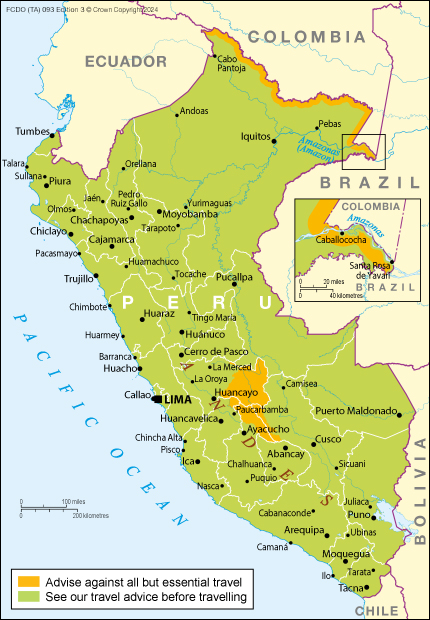
The country is not uniform: 10 regions advised against, fully or partly, by at least one official reading. Lima is not one of them.
Faithful summary of the official texts below, which prevail.
the trip stays outside the advised-against regions. Any move into a red or orange region calls for a new, written decision.
Global Affairs Canada
in the Department of Apurímac: Province of Abancay; Province of Andahuaylas; Province of Chincheros
Foreign Office
FCDO advises against all but essential travel to the Valley of the Apurímac, Ene, and Mantaro Rivers, also known as the VRAEM region.
France Diplomatie (in French)
le centre du pays, connu sous l’acronyme VRAEM (Vallée des Rivières Apurímac, Ene y Mantaro), région sous contrôle militaire ;
Global Affairs Canada
in the Department of Ayacucho: Province of Huanta; Province of La Mar
Global Affairs Canada
in the Department of Huancavelica: Province of Churcampa; Province of Tayacaja
Global Affairs Canada
in the Department of Junin: Province of Conceptión; Province of Satipo
Global Affairs Canada
in the department of Huánuco: District of Marias in the Province of Dos de Mayo; Province of Huacaybamba; Province of Humalíes; District of Chinchao and District of Churubamba in the Province of Huánuco
France Diplomatie (in French)
la région de Huánuco (« Cordillère Azul ») : la région, qui a été le théâtre de nombreux faits délictuels ou criminels et d’activités narcoterroristes, a fait l’objet d’actions de pacification par les forces de sécurité péruviennes. La situation reste néanmoins tendue.
Global Affairs Canada
in the department of San Martín: Province of Huallaga; District of Campanilla in the Province of Mariscal Caceres; Province of Tocache
Global Affairs Canada
in the department of Ucayali: Province of Padre Abad
Global Affairs Canada
in the Province of Convención in the Department of Cusco: District of Pichari; District of Quimbiri; District of Vilcabamba
Foreign Office
FCDO advises against all but essential travel to areas within 20km south of the Putumayo River and the border between Peru and Colombia (Loreto region) except for:
Global Affairs Canada
Avoid non-essential travel to areas within 20 km of the border with Ecuador, except for Tumbes border crossing and the Panamerican Highway, due to the presence of landmines and unmarked minefields.
Global Affairs Canada — Advised against — all but essential travel
Avoid non-essential travel to areas within 20 km of the border with Colombia due to gang-related violence and organized crime linked to drug trafficking and illegal mining.
France Diplomatie (in French) — Advised against — all travel
la zone amazonienne frontalière avec la Colombie, notamment le long du fleuve Putumayo.
France Diplomatie (in French) — Advised against — all but essential travel
Abancay : la ville est située à proximité de la VRAEM. il s’agit d’une zone de transit pour certaines activités criminelles.
Global Affairs Canada — Open Government Licence – Canada (09.10.2026) · Foreign Office — Open Government Licence v3.0 · France Diplomatie (11.03.2026) · Natural Earth
No located event in this reading.
Last change: Removal of information about local elections ('Warnings and insurance' page).
Updated 03.09.2026
Exercise increased caution in Peru due to risk of crime, unrest, kidnapping , and terrorism . Some areas have increased risk. Read the entire Travel Advisory.
Crime
Crime is common in Peru.
Unrest
Demonstrations occur regularly throughout the country. Public demonstrations can take place for political and economic issues.
Restrictions for U.S. government employees
Due to road safety risks, U.S. government employees working in Peru are prohibited from nighttime driving. The only exception is within cities, between Lima and Huacho (to the north), and Lima and Paracas (to the south).
Terrorism
There is risk of terrorist violence, including terrorist attacks and other activity in Peru. Visit the U.S. Department of State's Country Reports on Terrorism to learn more.
Kidnapping
Kidnapping in Peru, which could lead to prolonged detentions for ransom, are relatively uncommon but remains a notable security concern. Visitors should…
Peru: Floods and Landslides - Feb 2026ReliefWeb ↗read 13.10.20262026-02-24
Source: ReliefWeb (OCHA), via HDX — CC BY
10-13 42.6 · 10-14 42.9 · 10-15 42.9 · 10-16 43.1 · 10-17 43.9 · 10-18 44.6 · 10-19 44.8 m³/s
Simulated discharge: Open-Meteo.com (CC BY 4.0), data rounded and formatted by Maximum. Contains modified Copernicus Emergency Management Service information 2026. For information only: this is not a flood warning; only national or regional authorities issue those.
The level is national. Risk areas are in the state advisories below.
No major event in progress is located in this country at this morning's check.
Reading: The homicide rate is 14 times Switzerland's: violence is a real risk there, concentrated in the areas named by the official advisories. On the road, 6 times more deaths than in Switzerland: road crashes are the leading cause of death of healthy travellers (CDC) — seat belt, no night driving, a driver or a taxi from a rank.
World Bank (UNODC for homicides, WHO for roads) — latest published valuedata.worldbank.org ↗read 10.10.2026
What we locate on the map are events in progress that have real coordinates: USGS earthquakes, GDACS disasters, NOAA storms and open NASA EONET events. Hover a dot for details, click to open it in this briefing.
French passport — France Diplomatie
Faithful summary of the official texts below, which prevail.
Some areas of the country are formally advised against.France Diplomatie ↗updated 21.09.2026 · read 13.10.2026
Vigilance areas — France Diplomatie (in French) updated 11.03.2026official map ↗updated 21.09.2026 · read 13.10.2026
-
-
-
-
-
-
-
-
-
-
-
Dernière actualisation le 11/03/2026, information toujours valable à la date du jour
Zones formellement déconseillées en raison de la présence de groupes armés liés au narcotrafic :
Il est dangereux de se promener le soir (et a fortiori de dormir) sur les plages qui bordent la capitale, où sévissent des délinquants.
De manière générale, le Pérou est moins soumis au risque criminel que d’autres zones d’Amérique latine. On y constate néanmoins des agressions, qui impliquent de suivre quelques règles de sécurité.
Lors des déplacements en bus et dans les terminaux terrestres, il est recommandé de garder en permanence sur soi son argent ainsi que ses cartes de paiement et documents d’identité et d’être attentif à ses affaires.
Des jeunes femmes touristes ont été victimes d’agressions sexuelles, notamment lors de séjours dans des auberges de jeunesse, ou lors de retraites spirituelles. Il est recommandé en particulier aux femmes d’éviter de voyager seules, d’éviter les hébergements collectifs mixtes, et de bien se renseigner avant toute prestation "bien-être" (massages, reiki, etc.).
A Lima, une vigilance toute particulière est recommandée dans certains districts excentrés et plus défavorisés (San Juan de Lurigancho, Callao, San Martin de Porres, El Augustino, Rimac, Independencia, Los Olivos, Comas).
D’une manière générale, il est impératif de ne pas se déplacer seul(e) la nuit et d’éviter les zones isolées.
Par ailleurs, dans les bars et discothèques, il est rappelé qu’il convient, face au risque d’introduction, à son insu, de drogue ou produits faisant baisser la vigilance, de ne pas laisser sa consommation sans surveillance, en particulier lors de rencontres avec des inconnu(e)s.
Des agressions armées et vols à l’arraché sont parfois rapportés, y compris dans les quartiers festifs ou résidentiels de Lima (Miraflores, San Isidro, Barranco). Il est recommandé de ne pas circuler à pied et seul(e) la nuit, en dehors des zones les plus fréquentées.
Face à la recrudescence d’agressions violentes la nuit dans des faux taxis, il est fortement recommandé, pour tout déplacement au Pérou, d’utiliser uniquement des compagnies de taxi officielles (vérifiez que le taxi a son numéro de plaque minéralogique affiché à l’avant, à l’arrière et sur les deux côtés du véhicule et que l’accréditation du chauffeur de taxi avec sa photo est bien visible à l’intérieur du véhicule) ou à des applications de VTC et de taxis. Il est déconseillé de héler un taxi dans la rue.
À…
Les accidents routiers sont fréquents, en raison de l’état des routes et du respect aléatoire du code de la route. Il convient de faire preuve de la plus grande prudence et d’éviter de circuler la nuit dans les zones rurales et montagneuses. Il est recommandé de recourir uniquement aux compagnies de bus ou taxi officiellement enregistrées, de proscrire tout transport informel ou douteux (taxis collectifs, taxis sans numéros ou signalisation, minibus en mauvais état et surchargés).
Des mouvements sociaux donnent fréquemment lieu à des débordements et bloquent les circuits touristiques. Il est donc conseillé d’éviter les zones où des rassemblements sont susceptibles de se tenir et de se renseigner au préalable sur les préavis de grève annoncés.
Il est possible de poser des questions par Whatsapp au site d’informations touristiques I-Peru , qui s’engage à y répondre dans les 24h (+51 944 492 314).
Il est recommandé de rester à l’écart des manifestations, respecter les consignes des autorités locales, et se tenir informé de l’évolution de la situation.
Le Pérou est situé dans une zone de forte activité sismique. Pour obtenir plus d’informations sur la conduite à tenir en cas de séisme, consulter la fiche Séismes .
En cas de tremblement de terre lors d’un séjour touristique, il est recommandé aux ressortissants français de contacter immédiatement leur famille ou leurs proches ou, en cas de problème de communication avec l’extérieur, de prendre contact avec la Section consulaire de l’ambassade de France à Lima.
Les zones montagneuses peuvent être soumises aux inondations et aux glissements de terrain lors de la saison des pluies (janvier-mai). En cas de fortes pluies, il convient de faire preuve de prudence et de se tenir éloigné des cours d’eau.
Le risque d’incendies forestiers étant élevé dans les régions d’Apurimac, Amazonas, Lima, Cajamarca et Tumbes, il est recommandé d’éviter, lors de treks ou de déplacements dans la nature, de brûler des déchets, de fumer ou d’allumer des feux de camp.
De nombreuses zones de randonnée se situent en haute altitude, souvent au-delà de 2 500 mètres. Le « mal des montagnes » (nausées, fatigue, maux de tête, essoufflement – voir rubrique Santé ) peut y intervenir. Il est également possible de se perdre ou de faire une chute grave.
Dans ces conditions, et en s’étant assuré que son état de santé le permet, il est conseillé de préparer toute sortie en montagne (signalement de son départ et de son itinéraire, eau, nourriture, vêtements chauds etc…). Il convient également d’être accompagné d’un guide expérimenté.
Le tourisme individuel sur des circuits peu fréquentés est déconseillé, en raison de leur difficulté d’accès en cas de problème.
Full text of the Security pagediplomatie.gouv.fr ↗updated 21.09.2026 · read 13.10.2026
Swiss passport — FDFA (Switzerland), in French
Faithful summary of the official texts below, which prevail.
FDFA update note — Ces conseils pour les voyages ont été révisés. La description de la situation a été actualisée. (published 02.03.2026)
Une attention particulière doit être accordée à la sécurité personnelle. Depuis la transition du gouvernement en septembre 2025, la situation continue d’être tendue, notamment dans le contexte d’élections. Le niveau d’insatisfaction d’une grande partie de la population envers le gouvernement et le Parlement est grand. Dans l'ensemble du pays, y compris les régions touristiques, il faut s'attendre à des grèves, des manifestations et à des blocages du trafic (routier, ferroviaire et fluvial) . Dans ce contexte, des affrontements violents entre manifestants et les forces de sécurité sont possibles. Dans certaines régions, l’état d’urgence et/ou au couvre-feu sont en vigueur. L’état d’urgence pour la région métropolitaine peut être prolongé régulièrement. Les autorités imposent souvent de telles mesures à court terme à l’échelle locale ou nationale. L'état d'urgence autorise le gouvernement, entre autres, à effectuer des perquisitions à domicile sans mandat, à restreindre la liberté de réunion ou de mouvement et à procéder à des arrestations sans mandat. Vous trouverez des informations sur les l’états d’urgence actuellement en vigueur sous: El Peruano: estado de emergencia Les barrages routiers et les grèves peuvent causer des perturbations et des retards dans le trafic des personnes en voyage. Les barrages routiers paralysent parfois pendant plusieurs jours la circulation sur les axes principaux. Le blocage de certaines voies ferroviaires, aériennes et fluviales est également possible. Dans l’éventualité de barrages ou de grèves, il est conseillé aux personnes en voyage de se renseigner sur place sur les autres possibilités de déplacement et d’attendre le cas échéant que la situation se normalise. Il est très difficile – voire impossible selon les cas – à l’Ambassade de Suisse à Lima d’aider les personnes de nationalité suisse à sortir des régions concernées. N'essayez pas de traverser des blocages du trafic car les réactions peuvent être violentes. Informations sur des barrages routiers: Superintendencia de Transporte Terrestre de Personas, Carga y Mercanicías Le taux de criminalité est élevé. Les risques sont particulièrement importants dans les régions où sont cultivées des plantes servant à produire des drogues et qui sont souvent contrôlées par des groupes de trafiquants de drogue, ainsi que les régions où est pratiquée l’exploitation minière illégale. Voir chapitre Risques régionaux spécifiques . Dans ce pays comme ailleurs, le risque d’attentats terroristes ne peut être exclu. La rubrique terrorisme et enlèvements attire l'attention sur les risques…
La description des zones à risques repose sur des données approximatives; les risques ne peuvent se restreindre à des zones délimitées. Vallée des rivières Ene, Apurímac et Mantaro dans les régions d’Ayacucho, Junín et de Huancavelica (région de VRAEM) Il est déconseillé de se rendre dans ces régions. La situation sécuritaire dans cette vallée est précaire en raison de la culture de plantes destinées à la fabrication de drogue. Des attaques par des groupes armés se produisent. Région frontalière avec la Colombie Il est déconseillé de se rendre dans la région frontalière avec la Colombie. Des groupes de contrebande sévissent dans les régions frontalières avec la Colombie, surtout le long du Río Putumayo. Est de la région de Huánuco Les voyages touristiques/non urgents dans les zones isolées et situées à l’est de la ville de Huánuco sont déconseillés. Une grande prudence est de mise dans le reste de la région. A plusieurs reprises des touristes ont été victimes d’agressions brutales de la part de bandes armées. Des agressions isolées ont également été signalées dans d’autres zones de la région de Huánuco. Lima Le taux de criminalité est élevé à Lima, y compris dans les lieux fréquentés par les touristes et surtout la nuit. Il est conseillé de faire preuve d’une prudence particulière . Région de La Libertad Faites preuve d'une grande prudence. A Trujillo , en particulier dans les quartiers périphériques, des attentats à l'explosif se produisent qui peuvent être liés à la criminalité organisé et à l'extorsion. Évitez de vous déplacer après la tombée de la nuit et conformez-vous aux instructions des autorités locales. Région de Pataz : cette région est régulièrement le théâtre d'incidents violents liés à l'exploitation minière illégale. Des bandes criminelles sont actives; des affrontements entre ces groupes ou entre des bandes et les forces de sécurité se produisent. Région amazonienne (régions de Loreto, d’Amazonas, de San Martín, d’Ucayali et de Madre de Dios, et certaines zones de la région de Pasco) Le conflit opposant la population indigène et le gouvernement entraîne régulièrement des blocages du trafic routier et fluvial dans la région amazonienne, ainsi que des affrontements entre manifestants et forces de sécurité. Lors de voyages dans la région amazonienne, faites-vous accompagner par des guides connaissant bien la région et assurez-vous que la situation actuelle en matière de sécurité a été vérifiée. Faites preuve d’une prudence particulière . Cuzco et les itinéraires vers Machu Picchu À Cuzco et dans ses environs, les manifestations et les…
Le nombre d’agressions violentes est élevé, en particulier dans les agglomérations des villes comme Lima, Trujillo, Arequipa, Ica ou Cusco. Les vols à la tire et les vols à l'arraché, parfois par des bandes organisées, sont fréquents. Des personnes de nationalité étrangère peuvent être concernées. Les détournements de voitures et les attaques à main armée (par ex. dans les autocars interurbains) se produisent. Des agressions contre les personnes à bord des taxis et dans des hôtels ont également lieu; les victimes sont retenues de façon momentanée, dévalisées et contraintes à retirer de l’argent avec leur carte de crédit. À Lima et dans les autres villes touristiques, la police a créé des points de contact destinées à accueillir les visiteurs étrangers (Policía de Turismo). Observez notamment les mesures de précaution suivantes:
Le pays se caractérise par des régions où les conditions géologiques et climatiques sont extrêmes: désert, forêt vierge, haute montagne, volcans (dans le sud du pays). Dans les Andes, les symptômes du mal des montagnes ne devraient pas être sous-estimés. Le Pérou se trouve dans une zone d’activité sismique. Outre les dévastations causées sur la terre ferme, les tremblements de terre et les éruptions volcaniques peuvent aussi provoquer des tsunamis. Les tsunamis provoqués par des éruptions volcaniques ou des tremblements de terre dans la région du Pacifique peuvent également atteindre le Pérou. Il faut s'attendre à de fortes pluies régionales . Elles peuvent provoquer des inondations et des glissements de terrain, et endommager les infrastructures. Le trafic touristique peut s’en trouver perturbé temporairement. Il existe un important risque d’incendies de forêt à de nombreux endroits. Faites-vous accompagner par des guides ayant une expertise des lieux lors de vos promenades, randonnées en montagne ou lors de la pratique de sports à risque. Consultez les prévisions météorologiques et suivez les avertissements et les instructions des autorités locales (p. ex. zones interdites autour des volcans actifs, ordres d’évacuation). Servicio nacional de meteorología e hidrología Instituto Geofisico del Perú Si une catastrophe naturelle devait se produire pendant votre séjour, suivez les instructions des autorités et contactez votre famille dans les meilleurs délais. Dans le cas où les liaisons avec l'étranger seraient interrompues, contactez l'Ambassade de Suisse à Lima.
FDFA travel advice, in French, valid on 13.10.2026eda.admin.ch ↗updated 02.03.2026 · read 13.10.2026
British passport — Foreign Office (UK)
Faithful summary of the official texts below, which prevail.
Regions covered by the Foreign Officegov.uk ↗updated 09.10.2026 · read 13.10.2026

Warnings — Foreign OfficeForeign Office ↗updated 09.10.2026 · read 13.10.2026
Your travel insurance could be invalidated if you travel against advice from the Foreign, Commonwealth & Development Office (FCDO).
FCDO advises against all but essential travel to areas within 20km south of the Putumayo River and the border between Peru and Colombia (Loreto region) except for:
FCDO advises against all but essential travel to the Valley of the Apurímac, Ene, and Mantaro Rivers, also known as the VRAEM region.
We advise against all but essential travel to these two areas for safety and security reasons.
Find out more about why FCDO advises against travel .
Regional risks — Foreign OfficeForeign Office ↗updated 09.10.2026 · read 13.10.2026
This section has safety advice for regions of Peru. It only covers regions where the Foreign, Commonwealth & Development Office ( FCDO ) has specific advice.
You should also read FCDO ’s overall travel advice and safety and security advice .
FCDO advises against all but essential travel to areas within 20km south of the Putumayo River and the border between Peru and Colombia (Loreto region) except for:
This is due to a high level of violence from organised criminal gangs who produce and traffic illegal drugs.
The advice against all but essential travel applies to the Peruvian side of the Putumayo riverbank, though not on the river itself. If you are planning to leave a boat on the Colombian side of the river, check Colombia travel advice .
The Putumayo River forms most of Peru’s border with Colombia. The area is known for intensive cocaine and marijuana production. Drug trafficking and other violent organised crime takes place on and around the river.
FCDO advises against all but essential travel to the Valley of the Apurímac, Ene and Mantaro Rivers, also known as the VRAEM region.
Remnants of the Shining Path guerrilla group occasionally attack the police, military forces and local authorities in this area. They do not usually target tourists. However, you could be a victim of violence due to mistaken identity or by getting caught up in a security incident involving others.
There is little assistance available in this area from the Peruvian authorities, and any British Embassy assistance is severely limited.
Note that some parts of the Apurimac River in the Departments of Cusco and Arequipa are not within the VRAEM .
Armed criminals operate along the Amazon River and have targeted solo travellers and foreign nationals. These include:
Travel with a reputable commercial or travel company if you are visiting the Amazon River. Stay on your boat where it passes through areas where FCDO advises against all but essential travel.
There is little assistance available in this area from the Peruvian authorities, and any British Embassy assistance is severely limited.
States of emergency have been declared in some parts of Peru. You can read a list of the areas with a state of emergency in El Peruano official newspaper (in Spanish). For more information on your destination, contact the iPeru information service .
In these areas you may notice an increased security presence. You should:
The Peruvian government has taken preventive measures in northern Peru in response to the security situation in Ecuador. You may notice an increased security presence.
If you are travelling to northern Peru or plan to cross land border checkpoints, ensure you follow the advice of local authorities.
If you wish to enter Ecuador by crossing a land border from Peru, you must show the Ecuadorean authorities certain documents. See Ecuador travel advice .
Only cross the Peru-Ecuador land border at official checkpoints. Other parts of the border may still have unexploded landmines. Some tourists have been robbed by fake taxi drivers. Be extremely vigilant in these areas.
There is little assistance available in this area from the Peruvian authorities, and any British Embassy assistance is severely limited.
Only basic medical services are available at Machu Picchu. Several climbers have died or suffered serious injuries after falling while climbing Huayna Picchu, a peak near Machu Picchu.
You should:
The ‘Inca Jungle Trail’ can be difficult for vehicles due to poor road conditions. There have been fatal road accidents.
Armed robbers have attacked travellers walking on their own. You should:
If you are planning to fly over the Nazca Lines, check the airline company is licensed and has a good safety record before you book. There have been several fatal accidents in recent years.
You can ask the iPeru information service for advice about booking flights.
Safety — Foreign OfficeForeign Office ↗updated 09.10.2026 · read 13.10.2026
This guide also has safety advice for regions of Peru .
There is a high threat of terrorist attack globally affecting UK interests and British nationals, including from groups and individuals who view the UK and British nationals as targets. Stay aware of your surroundings at all times.
UK Counter Terrorism Policing has information and advice on staying safe and what to do in the event of a terrorist attack. Find out how to reduce your risk from terrorism while abroad .
Terrorist attacks in Peru cannot be ruled out.
Attacks could be indiscriminate, including in places visited by foreign nationals. Stay aware of your surroundings, keep up to date with local media reports and follow the advice of local authorities.
Political protests in Peru are unpredictable and can escalate quickly. Demonstrations can become violent and lead to roadblocks, travel disruption, including trains, and suspension of immigration services at land borders. This is often without notice or notification of estimated re-opening timelines.
Local groups can announce strike action, with little or no notice, particularly in areas connected to mining. These may quickly spill over from one region to another.
It’s illegal for foreigners in Peru to participate in political activities, including demonstrations against the government. You may face detention or deportation if you take part in a demonstration. To reduce any risk:
Protests in Lima often happen in the historic centre, where access can be restricted, but they can also spread to other areas. Other regions that have seen recent protests include Arequipa, Ayacucho, Cusco, La Libertad, Madre de Dios and Puno.
Some train services in the south, including those to and from Machu Picchu, are occasionally suspended or disrupted because of protests. Contact your travel provider for further advice on disruptions, and check if changes need to be made to your journey.
Contact the iPeru information service for help with issues travelling to different regions of Peru.
The British Embassy’s ability to provide help will be very limited where protests or criminal activity disrupt travel or damage infrastructure.
Help from local authorities, including police and emergency services, will also be very limited, especially if airports, roads and railroads are affected.
There is a higher risk to your safety in areas where there is serious organised crime linked to drug production. This includes the border areas with Ecuador, Colombia and Brazil and the Valley of Apurímac, Ene and Mantaro rivers ( VRAEM ). Remnants of the Shining Path guerrilla group are still active in some of the main coca growing areas in central Peru (Alto Huallaga, Aguaytia and VRAEM river basins).
Street crime, including muggings and thefts, is a significant problem in Lima, Cusco, Arequipa and other major cities. Be alert in public places and when withdrawing cash from ATMs.
It is safer to use ATMs inside banks, supermarkets or large commercial buildings during business hours. Do not walk on your own in quiet areas or at night.
There…
American passport — U.S. Department of State
Faithful summary of the official texts below, which prevail.
Peru - Level 2: Exercise Increased Caution 2026-09-03travel.state.gov ↗updated 03.09.2026 · read 13.10.2026
Exercise increased caution in Peru due to risk of crime, unrest, kidnapping , and terrorism . Some areas have increased risk. Read the entire Travel Advisory.
Crime
Crime is common in Peru.
Unrest
Demonstrations occur regularly throughout the country. Public demonstrations can take place for political and economic issues.
Restrictions for U.S. government employees
Due to road safety risks, U.S. government employees working in Peru are prohibited from nighttime driving. The only exception is within cities, between Lima and Huacho (to the north), and Lima and Paracas (to the south).
Terrorism
There is risk of terrorist violence, including terrorist attacks and other activity in Peru. Visit the U.S. Department of State's Country Reports on Terrorism to learn more.
Kidnapping
Kidnapping in Peru, which could lead to prolonged detentions for ransom, are relatively uncommon but remains a notable security concern. Visitors should…
Global Affairs Canada — additional reading
Exercise a high degree of caution (with regional advisories)
Avoid all travel to the Valley of the Apurímac, Ene and Mantaro Rivers (VRAEM) and surroundings due to the risk of terrorism, drug trafficking and associated crime, and limited law enforcement presence.
Avoid non-essential travel to the Upper Huallaga River Valley and surroundings due to instances of domestic terrorism and criminal activity such as drug trafficking, robberies, kidnappings, extortion and raids.
Avoid non-essential travel to areas within 20 km of the border with Colombia due to gang-related violence and organized crime linked to drug trafficking and illegal mining.
Avoid non-essential travel to areas within 20 km of the border with Ecuador, except for Tumbes border crossing and the Panamerican Highway, due to the presence of landmines and unmarked minefields.
Open Government Licence – Canada · October 9, 2026 15:20 EDTtravel.gc.ca ↗updated 09.10.2026 · read 13.10.2026
Faithful summary of the official texts below, which prevail.
Global Affairs Canada — written for Canadian travellers, valid for all
You must abide by local laws. Learn about what you should do and how we can help if you are arrested or detained abroad.
Penalties for possession, use or trafficking of illegal drugs are severe. Convicted offenders can expect lengthy jail sentences and heavy fines. If you are arrested in Peru, you should expect lengthy delays to resolve your case, preventive detention of several months and significant related expenses.
Drugs, alcohol and travel
You must carry photo identification at all times. Keep a photocopy of your passport in a safe place, in case it's lost or confiscated. Failure to show identification could result in detention.
Peruvian authorities may impose fines and other penalties for any action considered to be disrespectful at historical and archaeological sites. To avoid offending local sensitivities:
Peruvian law strictly prohibits the export of:
Only purchase reproductions of colonial or pre-colonial art from reputable dealers and obtain documentation from Peru's National Institute of Culture. Prohibited exports – National Superintendence of Customs and Tax Administration (Spanish only)
It is forbidden to photograph military installations.
The Hague Convention on the Civil Aspects of International Child Abduction is an international treaty. It can help parents with the return of children who have been removed to or retained in certain countries in violation of custody rights. The convention applies between Canada and Peru. If your child was wrongfully taken to, or is being held in Peru, and if the applicable conditions are met, you may apply for the return of your child to the Peruvian court. If you are in this situation:
If your child was removed from a country other than Canada, consult a lawyer to determine if The Hague Convention applies. Be aware that Canadian consular officials cannot interfere in private legal matters or in another country's judicial affairs.
Police officers often request drivers to pull over and present their documents. Carry identification and vehicle registration at all times. As a tourist, you may use your Canadian driver's licence for the duration of your authorized stay. If a police officer stops you for violating traffic rules, you will receive a written document indicating the offence. Don’t pay the fine to the police directly but at a tax administration service, ‘Servicio de Administración Tributaria’, or any agency of ‘Banco de la Nación.’ If a police officer asks you to pay a percentage of the fine in cash, don’t pay it. Inform the police officer that you will pay the fine at the appropriate entity. You can check the fine online with your license plate number. Traffic regulation is different from Canada, the legal age to drive is 18.
The currency of Peru is the Peruvian sol (PEN). The U.S. dollar is widely accepted. You must declare upon arrival and departure if you carry more than US$10,000 or equivalent in other currencies. Credit cards are not commonly accepted outside major cities. Many establishments will request to see a passport to confirm the identity of the person using the credit card. ATMs are not easily accessible in small towns and they often have limits on the amount and number of daily withdrawals.
Open Government Licence – Canada · October 9, 2026 15:20 EDTtravel.gc.ca ↗updated 09.10.2026 · read 13.10.2026
Foreign Office — laws and cultural differences
Always carry ID with you. The Peruvian police may ask to see ID; if you do not have it with you, you may be required to go to the nearest police station.
Illegal drug use and drug trafficking in Peru carry lengthy jail sentences. Prison conditions in Peru are extremely poor and the British Embassy cannot intervene in police or judicial matters, or secure more favourable conditions. You should:
Drug couriers have targeted British nationals with email scams. These criminals will try to get you to travel to Peru to pick up items containing drugs. You’ll face detention for drug trafficking if convicted.
Do not take photographs of anything of a military nature, it is illegal and you could face a prison sentence of two to five years.
Same-sex sexual activity is legal in Peru, but social attitudes are generally conservative. Crimes against the LGBT+ community are not included in hate crime legislation and same-sex partnerships are not formally recognised. Same-sex couples showing affection in public may receive unwanted and negative attention. Read more advice for LGBT+ travellers.
Open Government Licence v3.0gov.uk ↗updated 09.10.2026 · read 13.10.2026
FDFA (Switzerland) — laws and customs, in French
Les infractions à la loi sur les stupéfiants, y compris la détention de minimes quantités de drogue quelle qu'elle soit , sont sanctionnées par de lourdes peines de prison. Les conditions de détention sont précaires. Toute activité politique est interdite aux personnes de nationalité étrangère. En quittant le pays, n'oubliez pas que l'importation des produits à base de coca est interdite en Suisse (et dans nombre d'autres pays).
Ne visitez la population indigène qu'avec leur consentement et respectez les us et coutumes locaux. Ne photographiez les gens qu'avec leur accord. Montrez-vous également respectueux lorsque vous visitez des sites historiques et culturels. Renseignez-vous dans les guides de voyages, auprès de votre agence ou directement sur place, sur les codes de conduite et les conventions à respecter. Lors des cérémonies spirituelles, des boissons contenant des substances hallucinogènes dangereuses peuvent être servies qui présentent des graves risques pour la santé. Il est déconseillé de participer à de telles cérémonies.
FDFA travel advice, in Frencheda.admin.ch ↗updated 02.03.2026 · read 13.10.2026
What it changes for you: Air acceptable at this hour: nothing special to plan. Very high UV: sunscreen, hat and shade between 11 am and 4 pm; sunstroke and dehydration are travellers' first reasons to see a doctor.
Reading 17:00 (America/Lima)Open-Meteo ↗updated 13.10.2026 · read 13.10.2026
Air quality and UV: Open-Meteo.com (CC BY 4.0), data rounded and formatted by Maximum. Contains modified Copernicus Atmosphere Monitoring Service information 2026. Neither the European Commission nor ECMWF is responsible for any use that may be made of the Copernicus information or data it contains.
Reading: With 1.7 physicians per 1,000 people (62% fewer than Switzerland), the nearest hospital does not always have the capacity for a serious case: evacuation to an adequate centre is the rule, not the exception — that is what unlimited evacuation and repatriation cover. Health spending of 446 USD per person (Switzerland: 11,784) goes with private hospitals that bill foreigners in hard currency and ask for a guarantee before admission: the direct payment guarantee is what avoids the deposit.
World Bank — latest published value, year per indicatordata.worldbank.org ↗read 10.10.2026
French passport — France Diplomatie
Faithful summary of the official texts below, which prevail.
-
-
-
-
-
-
-
-
-
-
-
Les ressortissants français n’ont pas besoin de visa pour un séjour touristique de moins de 3 mois au Pérou. Il est indispensable d’être en possession d’un passeport ayant une validité d’au moins 6 mois à compter de l’arrivée sur le territoire péruvien, les autorités appliquant cette règle strictement et sans possibilité de dérogation. L’entrée au Pérou est systématiquement refusée en cas de non-respect, avec obligation de prendre un vol retour aux frais du voyageur.
Le dépassement du nombre de jours attribués (de 1 à 90 jours maximum sur une période de 183 jours) n’est pas autorisé. Dans le cas contraire, le voyageur sera considéré en situation irrégulière et les formalités de sortie seront longues et accompagnées d’une amende au montant égal à 4,40 Soles/ jour de dépassement.
Il est recommandé de s’inscrire sur l’application Fil d’Ariane et de signaler sa présence, soit en se rendant directement au Consulat de France à Lima, soit par courriel : contact.amba-lima @ diplomatie.gouv.fr
Les séjours touristiques d’une durée supérieure à 90 jours sont soumis à l’obtention d’un visa, qu’il convient de solliciter auprès du Consulat général du Pérou en France .
Pour tout séjour supérieur à 6 mois, il est recommandé de s’inscrire au Registre des Français établis hors de France , ou de contacter le consulat (adresse : Consulat de France, Avenida Arequipa 3415, San Isidro, Lima ; courriel : contact.lima-amba@diplomatie.gouv.fr ).
En cas de séjour au Pérou pour un autre motif que le tourisme, il convient de s’informer sur les conditions d’entrée et de séjour auprès du Consulat général du Pérou en France .
Depuis le 29 mai 2023, les autorités migratoires péruviennes ont cessé de tamponner physiquement les passeports des voyageurs empruntant des vols internationaux, afin de réguler les flux de passagers dans les aéroports suivants : Jorge Chávez (Callao), Alfredo Rodríguez Ballón (Arequipa), Alejandro Velasco Astete (Cusco), Capitán FAP José A. Quiñones (Chiclayo) et Capitán FAP Carlos Martínez de Pinillos (Trujillo). Les tampons physiques ne seront utilisés qu’en cas d’urgence.
Le tampon étant à présent « virtuel », les mouvements migratoires des voyageurs internationaux sont enregistrés dans la base de données du service migratoire péruvien (TAM) et peuvent être consultés en ligne à l’adresse suivante : cel.migraciones.gob.pe .
En revanche, l’entrée par voie terrestre est toujours soumise à passage obligatoire par un poste frontière et apposition d’un tampon physique. Il est impératif de s’assurer et d’insister pour avoir un tampon de sortie du pays frontalier puis d’entrée au Pérou. Certains bus ne marquent pas l’arrêt au poste frontière et ceux-ci peuvent être sans personnel de garde, selon l’heure de passage. En aucun cas, ces situations n’exemptent le voyageur de tampon, au risque de se retrouver en situation irrégulière dans le pays et d’être placé en rétention administrative (pouvant aller jusqu’à 3 semaines) avant expulsion du territoire, assortie d’une interdiction de retour (pouvant aller jusqu’à 15 ans).
Pour obtenir une autorisation d’entrée par voie maritime, il convient de s’adresser à la "Superintendencia Nacional de Migraciones" afin de demander un permis d’entrée. De plus, il convient de remettre au poste frontière le formulaire de demande disponible ici et de réaliser un règlement des frais en ligne.
Si un tampon n’est plus systématiquement apposé sur les passeports à l’arrivée et au départ des aéroports internationaux, l’entrée comme la sortie du territoire par voie terrestre continuent d’être soumises au passage obligatoire par un poste frontière et à l’apposition d’un tampon physique sur les passeports.
Aussi, il est impératif pour le voyageur de s’assurer qu’un tampon est bien apposé sur son passeport lors de chaque franchissement de frontière terrestre (et d’insister, si nécessaire, pour qu’il le soit). Le fait qu’un bus ne marque pas l’arrêt à un poste frontière n’exempte pas le voyageur de solliciter l’apposition d’un tampon sur son passeport auprès des autorités locales.
En cas de manquement, le voyageur risque en effet de se retrouver en situation irrégulière dans le pays et d’être placé en position de rétention administrative (pouvant aller jusqu’à 3 semaines) avant expulsion du territoire assortie d’une interdiction de retour (pouvant aller jusqu’à 15 ans).
En cas de perte ou de vol de votre passeport, l’ambassade est en mesure de délivrer un document de voyage (laissez-passer ou passeport d’urgence). Il sera nécessaire de solliciter le transfert du cachet d’entrée au Pérou sur ce nouveau document auprès de la Supertintendencia Nacional de Migraciones, sur présentation de la déclaration de perte ou de vol émise par les autorités locales.
En cas de perte ou de vol, il sera possible de rejoindre Lima par voie terrestre, les compagnies de bus acceptant les passagers munis de la copie de leur passeport accompagnée de la plainte émise par la police locale. Cette facilitation n’est en revanche pas possible par voie aérienne, excepté pour les vols Iquitos-Lima.
La…
Entry and stay pagediplomatie.gouv.fr ↗updated 21.09.2026 · read 13.10.2026
Swiss passport — FDFA (Switzerland)
The FDFA does not publish entry requirements: they are set out by the destination's embassy or consulate in Switzerland — check them before booking, passport in hand. As a guide, the French and British requirements below describe the same rules as seen by two other governments.eda.admin.ch ↗updated 02.03.2026 · read 13.10.2026
British passport — Foreign Office (UK)
Faithful summary of the official texts below, which prevail.
Entry requirements — rules for a British passportForeign Office ↗updated 09.10.2026 · read 13.10.2026
This information is for people travelling on a full ‘British citizen’ passport from the UK. It is based on the UK government’s understanding of Peru’s current rules for the most common types of travel.
The authorities in Peru set and enforce entry rules. If you are not sure how these requirements apply to you, contact the Peruvian Consulate General in the UK (in Spanish).
To enter Peru, your passport must have an ‘expiry date’ at least 6 months after the date you arrive.
Check with your travel provider that your passport and other travel documents meet requirements. Renew your passport if you need to.
You will be denied entry if you do not have a valid travel document or try to use a passport that has been reported lost or stolen.
When returning to the UK, British citizens must carry a valid British passport or certificate of entitlement . See Dual citizenship .
You can travel to Peru without a visa for tourism or short visits. If you are travelling for any other reason, check requirements with the Peruvian Consulate General in the UK (in Spanish).
When you arrive in Peru, you will normally get permission to stay for up to 90 days in a 180 day period. The 180 day period is calculated from the date of your first entry into Peru. Immigration officials can grant you a maximum of 183 days in a 365 day period as a visitor or tourist.
If you overstay, you will get a fine and you could be detained.
If you arrive in Peru at an international airport, authorities will register your entry digitally through a Tarjeta Andina de Migración (TAM) - a virtual immigration control document.
You can check how long you are allowed to stay in Peru on the Superintendencia Nacional de Migraciones website (in Spanish).
From 7 December, passengers transiting or connecting through Lima (Jorge Chávez International) Airport will be required to pay a fee, known as a TUUA (Tarifa Unica por Uso de Aeropuerto, or Airport Use Fee).
This fee is not currently included in airline tickets.
To avoid delays, travellers are encouraged to pay in advance via the Lima Airport online platform or use available on-site payment options, including mobile POS (Point of Sale) agents, dedicated payment modules, and QR codes.
Land entry: make sure you get your passport stamped.
If you enter Peru by land from a neighbouring country, get a passport entry stamp at the immigration checkpoint. You cannot leave Peru without one. If you did not get a stamp, apply to get a passport entry stamp online (form in Spanish) and:
The British Embassy can help you to apply for an entry stamp. You should start this process as soon as possible.
If you cannot give the information needed, you must apply for an exit order or expulsion order to leave Peru in person at the Immigration Office in Lima . These orders may stop you from re-entering Peru for a number of years. The British Embassy…
American passport — U.S. Department of State
The State Department publishes the requirements ("Entry, Exit and Visa Requirements") on its country page, which our servers cannot read. Read it before you go; as a guide, the French and British requirements below describe the same rules as seen by two other governments.travel.state.gov ↗updated 03.09.2026 · read 13.10.2026
For each risk, the official texts themselves: what is happening, then, where they say so, what to do.
What the texts say · Tourists, especially those travelling alone, are at risk of ‘express kidnapping’.
What the texts say · Incidents often involve armed criminals posing as taxi drivers, or taxi drivers working for organised gangs. Criminals target cars stopped at traffic lights.
What the texts say · In 2026-2027, El Niño is expected to generate heavy rainfall, flooding, landslides and mudslides. Peru is in an active earthquake zone and there are frequent tremors.
What the texts say · Illegal drug use and drug trafficking in Peru carry lengthy jail sentences. You must carry photo identification at all times.
What the texts say · Criminals can also fake kidnappings by contacting the numbers from a stolen mobile phone and claiming to have kidnapped the owner.
What the texts say · Protests in Lima often happen in the historic centre, where access can be restricted, but they can also spread to other areas. Demonstrations can become violent and lead to roadblocks, travel disruption, including trains, and suspension of immigration services at land borders.
Sentences copied word for word from the official texts cited, chosen for the destination; the level is our reading. The full texts, at each source:Foreign Office ↗updated 09.10.2026 · read 13.10.2026 (updated 09.10.2026 · read 28.09.2026)Global Affairs Canada ↗updated 09.10.2026 · read 13.10.2026 (updated 09.10.2026 · read 28.09.2026)
Reading: The homicide rate is 14 times Switzerland's: violence is a real risk there, concentrated in the areas named by the official advisories. On the road, 6 times more deaths than in Switzerland: road crashes are the leading cause of death of healthy travellers (CDC) — seat belt, no night driving, a driver or a taxi from a rank.
World Bank (UNODC for homicides, WHO for roads) — latest published valuedata.worldbank.org ↗read 10.10.2026
Time zone: IANA and timezone-boundary-builder (ODbL) · RESTCountries · EmergencyNumberAPI · Wikidata · European Central Bank
Places: © OpenStreetMap contributors (ODbL), Photon search by komoot.
FDFA (Switzerland) — transport and specific advice, in French
Le mauvais état d'une partie du réseau routier, les véhicules mal entretenus et la conduite dangereuse constituent des risques d'accidents de la circulation. À l'intérieur du pays en particulier, les accidents de bus sont fréquents. Pour des raisons de sécurité, les bus de la classe de luxe sont préférables. Les déplacements interurbains sont si possibles à proscrire la nuit. Pour les voyages à l’intérieur du pays et surtout pour effectuer de longs trajets, il est préférable de prendre l’avion. Compte tenu des dangers de la circulation routière et des barrages routiers fréquents, les personnes qui ne sont pas familiarisées avec le pays devraient s’abstenir de voyager en voiture de location. L’entretien des avions pour les vols internes et touristiques ne correspond pas toujours aux normes européennes et internationales. La qualité des mesures de sécurité et du matériel utilisé est très variable dans le domaine des sports à risque (vol en parapente, tour en buggy dans les dunes, rafting, alpinisme, etc.). Informez-vous de ce fait auprès des entreprises fournisseuses locales sur les mesures de sécurité et contrôlez le matériel de sport mis à disposition. Des pénuries d’alimentation électrique se produisent. Les points de passage des frontières peuvent être fermés à court terme, par exemple afin d’endiguer la propagation de maladies. Informez-vous auprès des autorités locales ou directement auprès des postes-frontières.
L’importance des tampons d'entrée et de sortie ne doit pas être sous-estimée. Lors du passage de la frontière par voie terrestre, l’annonce auprès du bureau de migration est obligatoire. Les personnes dont l'entrée sur le territoire n’a pas été correctement enregistrée se verront refuser la sortie. Dans les aéroports internationaux, les données relatives à l’entrée et au séjour sont désormais saisies exclusivement sous forme électronique par les autorités frontalières. Les informations concernant l’entrée et la durée de séjour autorisée peuvent être consultées en ligne sur le site: Tarjeta Andina de Migraciones TAM Virtual . Renseignez-vous sur les dispositions exactes auprès des autorités locales ou directement aux postes-frontières.
FDFA travel advice, in Frencheda.admin.ch ↗updated 02.03.2026 · read 13.10.2026
Maximum policyholder: before paying anything, call the 24/7 number. If you are admitted for more than 24 h, Maximum sends its direct payment guarantee to the hospital (art. 2.12).
+41 22 ••• •• •• — Full number in your client areaThe hospital list has not been read from OpenStreetMap for this page yet: the medical-network map loads it when opened. Maximum's assistance directs you to the right facility, 24/7. The medical-network map ↗
CDC Travelers' Health recommendations, most important first. They depend on your age, vaccines and itinerary: confirm them with a doctor or a travel clinic 4 to 6 weeks before departure. Details, disease by disease ↗cdc.gov ↗read 10.10.2026
The health system — With 1.7 physicians per 1,000 people (62% fewer than Switzerland), the nearest hospital does not always have the capacity for a serious case: evacuation to an adequate centre is the rule, not the exception — that is what unlimited evacuation and repatriation cover. Health spending of 446 USD per person (Switzerland: 11,784) goes with private hospitals that bill foreigners in hard currency and ask for a guarantee before admission: the direct payment guarantee is what avoids the deposit.
Back home — a fever in the following weeks should be told to a doctor, naming the country.
Forecast: MET Norway (Norwegian Meteorological Institute, CC BY 4.0), grouped by day and formatted by Maximum.
French passport — French embassy and consulates
3415 Avenida Arequipa, 15046, San Isidro
302 Avenida Coronel Pedro Portillo, San Isidro
phone not published
208 Santa Catalina, Arequipa
phone not published
Useful contacts listed by France Diplomatie (in French)diplomatie.gouv.fr ↗updated 21.09.2026 · read 13.10.2026
Updated: 21 September 2026
OpenStreetMap
Swiss passport — Swiss embassy and consulates
3240 Avenida Salaverry, Lima 27, San Isidro
+51 1 264 03 05
https://www.eda.admin.ch/lima ↗updated 02.03.2026 · read 13.10.2026
563 Ahuacpinta, Cusco
phone not published
https://www.eda.admin.ch/countries/peru/es ↗updated 02.03.2026 · read 13.10.2026
Numéro d'urgence: 105 Police des touristes: tél. +511 980 122 335 Iperu: +51 15 74 80 00 / +51 944 492 314 (WhatsApp) Dispositions douanières péruviennes: Aduanas (SUNAT) Représentations suisses à l’étranger: En cas de situation d’urgence à l’étranger, vous pouvez vous adresser à la représentation suisse la plus proche ou à la Helpline DFAE. Ambassade de Suisse au Pérou Centre Consulaire Régional des Andes à Lima, Pérou Helpline DFAE Représentations étrangères en Suisse: Pour obtenir des informations sur les prescriptions d'entrée (documents d'identité admis, visa, etc.), veuillez vous adresser aux ambassades et consulats étrangers compétents. Ceux-ci peuvent également vous renseigner sur les dispositions douanières pour l'importation et l'exportation d'animaux et de marchandises: appareils électroniques, souvenirs, médicaments, etc. Représentations étrangères en Suisse
OpenStreetMap · DFAE
British passport — British embassy and consulates
1301 Avenida José Larco, 1301, Miraflores
phone not published
https://www.gov.uk/world/organisations/bri ↗updated 09.10.2026 · read 13.10.2026
OpenStreetMap
American passport — U.S. embassy and consulates
200 Natalio Sanchez
phone not published
Avenida Encalada, Santiago de Surco
+51 1 6182000
https://pe.usembassy.gov/es/ ↗updated 03.09.2026 · read 13.10.2026
OpenStreetMap
OpenStreetMap
Getting help — Foreign OfficeForeign Office ↗updated 09.10.2026 · read 13.10.2026
The Foreign, Commonwealth & Development Office ( FCDO ) cannot provide tailored advice for individual trips. Read this travel advice and carry out your own research before deciding whether to travel.
Ambulance: 106
Fire: 116
Police: 105
Contact your travel provider and your insurer if you are involved in a serious incident or emergency abroad. They will tell you if they can help and what you need to do.
See how to get help from the UK government abroad including in an emergency.
You can call FCDO in London if you need urgent help because something has happened to a friend or relative abroad.
Telephone: 020 7008 5000 (24 hours)
Find out about call charges
For emergencies. If pronunciation fails, show the screen — or the printed page.
| Help! | ¡Ayuda! |
| Call an ambulance! | ¡Llame a una ambulancia! |
| I need a doctor. | Necesito un médico. |
| Where is the nearest hospital? | ¿Dónde está el hospital más cercano? |
| Call the police! | ¡Llame a la policía! |
| I am allergic to penicillin. | Soy alérgico (alérgica) a la penicilina. |
| I have international medical insurance. | Tengo un seguro médico internacional. |
| I want to contact my embassy. | Quiero ponerme en contacto con mi embajada. |
| Please take me to this address. | Lléveme a esta dirección, por favor. |
| Do you speak English? | ¿Habla inglés? |
Translations by Maximum Insurance, original script and transliteration.
Actions to take before each professional trip abroad.
Live alerts and level changes, each with its official source. Continuously updated.
De fortes pluies sont enregistrées et prévues dans plusieurs régions du Pérou, pouvant, selon les endroits, provoquer des débordements de cours d'eau, des coulées de boue et des inondations, occasionnant des dégâts importants et des accidents graves. Les transports terrestres par bus peuvent par ailleurs être affectés, allongeant les temps de trajet. Les régions suivantes sont notamment concernées : Apurímac, Arequipa, Ayacucho, Cusco, Huancavelica, Huánuco, Junín, La…
France Diplomatie (in French) · posted 18 August 2026diplomatie.gouv.fr ↗updated 21.09.2026 · read 13.10.2026Natural disasters and climate section – removed information on a tsunami threat
October 9, 2026 15:20 EDTtravel.gc.ca ↗updated 09.10.2026 · read 13.10.2026No level change recorded for this country since the log opened. The live alerts above are updated continuously.
Level 2/4 — Exercise Increased Caution, U.S. Department of State, retrieved on 13 October 2026.
Sourcestravel.state.gov · updated 03.09 · read 13.10France Diplomatie · updated 21.09 · read 13.10DFAE · updated 02.03 · read 13.10207-country comparison
An area advised against does not rule out the country.
SourcesFrance Diplomatie · updated 21.09 · read 13.10Foreign Office · updated 09.10 · read 13.10State Department · updated 03.09 · read 13.10
The rules depend on the passport, not on the destination alone.
SourcesFrance Diplomatie · updated 21.09 · read 13.10Foreign Office · updated 09.10 · read 13.10State Department · updated 03.09 · read 13.10
For a Schengen visa, yes: at least €30,000 of travel medical insurance (Regulation (EC) No 810/2009, art. 15).
SourcesRegulation (EC) 810/2009, art. 15General conditions, policy 20 00 479
VIP Pack — $990 for twelve months, unlimited trips.
SourcesGeneral conditions, policy 20 00 479OpenStreetMap · read 12.10
From 14 000 € to 200 000 € depending on severity and distance (Holafly, 2026).
SourcesHolafly, 2026General conditions, policy 20 00 479
Six steps, in this order.
SourcesSpecial conditions 01.26General conditions, policy 20 00 479
Local emergency services: single number 911 / 111 · police 105 · ambulance 106 / 117 · fire 116
SourcesEmergencyNumberAPI · Wikidata · read 08.10OpenStreetMap · read 12.10
At today's level 2/4, card by card:
SourcesAmex Platinum France T&Cs, 01.2025 — general exclusion n° 11BNP Paribas Visa Infinite notice (policy PT7), 04.2025 — comFortuneo World Elite Mastercard notice, 01.2026 — art. 5.5 '
A health plan reimburses at home; here, the hospital asks for a payment guarantee before admission.
SourcesGeneral conditions, policy 20 00 479
The page reads hospitals, pharmacies and doctors from OpenStreetMap, around the point you choose.
The sourced detail is under Medical network › Health: vaccines, diseases present, altitude, outbreaks.
SourcesCDC Travelers' Health · read 10.10France Diplomatie · updated 21.09 · read 13.10OMS · read 13.10Foreign Office · updated 09.10 · read 13.10
1.7 physicians per 1,000 people (2023) versus 4.5 in Switzerland.
SourcesWorld Bank · read 10.10General conditions, policy 20 00 479
8.6 homicides per 100,000 people (2021) versus 0.6 in Switzerland and 1.3 in France.
The nearest representations, by passport (OpenStreetMap):
SourcesOpenStreetMap · read 12.10DFAE · updated 02.03 · read 13.10
10 regions advised against, fully or partly, by at least one official reading.
SourcesGlobal Affairs Canada · updated 09.10 · read 13.10Foreign Office · updated 09.10 · read 13.10France Diplomatie · updated 21.09 · read 13.10
Local laws apply to every traveller; here is what the official texts say.
SourcesGlobal Affairs Canada · updated 09.10 · read 13.10Foreign Office · updated 09.10 · read 13.10
Every foreign ministry runs a 24/7 emergency line for its nationals.
Sourcesdiplomatie.gouv.fr · updated 21.09 · read 13.10eda.admin.ch · updated 02.03 · read 13.10
Emergency phrases, to show if pronunciation fails:
SourcesMaximum Insurance
Keep the entry stamp, the invoices, the prescriptions and the medical report.
SourcesGeneral conditions, policy 20 00 479
Cancellation or change up to CHF 20,000, special risk CHF 5,000 per person, crisis management and security, optional Kidnap & Ransom.
SourcesGeneral conditions, policy 20 00 479
A question not answered here? Ask Maximum below, or call the support number: every question gets a clear, actionable answer.
In a life-threatening emergency, call local emergency services first, then Maximum: +41 22 ••• •• •• — 24/7 support number, an adviser stays with you to the end.
The 207 country pages — hospitals, pharmacies, police, embassies, emergency numbers, official advice from four governments, health, safety in figures, events in progress — read around the city you name. Your policy — benefits, the six steps, claims, articles. The site — prices, certificate, subscription. Nothing else: what it does not know, it says so and hands you to an adviser.
The published advisory level is national, but risk is not: business hubs (Lima) do not share the profile of border areas. The medical network shown on this page is computed around Lima — real hospitals, evacuation airport and live alerts. Before a specific trip, always cross-check your country of residence's advisory: that is what your policy cites.
Same advisory level: Netherlands · Philippines · United Kingdom · Dominican Republic · Saint Lucia · Serbia
The displayed level comes from the State Department, checked every morning. Before departure, always cross-check your country of residence's advisory: that is what your policy cites.
The level shown is the official U.S. Department of State level, checked daily. Maximum Insurance is an insurance distributor — general information, not personal advice.
The destination is already Lima. A few choices, then the reading of your cover, here.
Destination · Lima
Travel Insurtech. 24/7 worldwide.
Swiss insurer · Worldwide medical network