Maximum Alerts / Egypt

EgyptLevel 2/4

Level published by the State Department on 14.07.2025 · read 16 October 2026 · source checked daily

Egypt — official level as of 16 October 2026: Level 2/4 ("Exercise Increased Caution"), from the U.S. Department of State. Maximum Insurance covers this country: hospital settled directly, unlimited repatriation, EUR 1.5M, certificate on payment.

Four official readings
United StatesState Departmentsource ↗Our reference level — the one shown across this site
Is the whole country advised against?Nono restriction on the whole country
Level 2/4 — “Exercise Increased Caution”levels 1 and 2 are advice to be careful, not travel restrictions
FranceFrance Diplomatiesource ↗Added on top of the U.S. level, under its own rules: red or orange AREAS
Is the whole country advised against?Nono restriction on the whole country+ red areas
our reading: some areas are classified red (formally advised against)
United KingdomFCDOsource ↗Added on top of the U.S. level, under its own rules: travel statuses
Is the whole country advised against?Nono restriction on the whole country+ parts of the country
our reading: all travel advised against to parts of the country · all but essential travel advised against to parts of the country
source reviewed 4 August 2026
SwitzerlandFDFAsource ↗Advisory cited by the Maximum policy
Is the whole country advised against?Nono restriction on the whole country+ parts of the country
our reading: Switzerland’s FDFA advises against travel to certain regions
advice published 24.06.2026
The four readings on record agree: no restriction on the whole country — France still flags red areas; the United Kingdom still flags parts of the country; Switzerland still flags parts of the country.Our comparison reading: 27 September 2026

All 207 countries compared, advisory by advisory →

How we read these four advisories

Every country has its own scale, so we ask them all the same question: is the whole country advised against?

An advisory covering only areas of the country does not raise the answer: it stays “No”, and the area is shown in the relevant column.

The level shown on this page — and across this site — is the one published by the U.S. State Department, from 1 (normal precautions) to 4 (do not travel). France and the United Kingdom publish their own advisories, with their own rules: they add to that level, they do not replace it.
Get covered — €990/yr
Regional map…
Level 2/4 — Exercise Increased Caution Checked on 16 October 2026 · U.S. State Department
Country briefing
Get the PDF

Where are you right now in Egypt?

Doctors — Cairo40
Drمعمل د.إيليا أنيس إسحق0.4 km

شارع رمسيس القاهرة

Google MapsDirections
Drهشام ابو النصر0.9 km

near شارع الجمهوريه

Google MapsDirections
Dr205 عيادة الدكتور أحمد عبدالعزيز أبو زيد/استاذ الجراحة/ جامعة عين شمس1.4 km

شارع الجيش

Google MapsDirections
Drمكتب صحة - عابدين2.1 km

197 شارع التحرير القاهرة

Google MapsDirections
Drدكتور حسام قنديل2.1 km

near شارع عبد السلام عارف - البستان سابقا
cardiology

Google MapsDirections
DrMédecin2.5 km

26 شارع السرجاني
Tu-We, Sa 18:00-21:00

Drالبسط2.5 km

near شارع مجمع التحرير

Google MapsDirections
Drمركز طبي عابدين (ابو طبل)2.6 km

near شارع المدبح
general
Sa-Th 09:00-20:00

Google MapsDirections
Drمكتب صحة - الدرب الاحمر2.6 km

75 شارع القلعه

Google MapsDirections
DrDFC مركز القدم السكري3.0 km

near شارع احمد فؤاد عبد العزيز

Google MapsDirections
Drعيادة اد عبد العظيم الحفني3.2 km

79 شارع مصر والسودان

Google MapsDirections
Drمستشفي الكاتب3.8 km

near شارع لطفي حسونة
24/7

Google MapsDirections
Drمستشفى ستار3.9 km

11 شارع عبدالله الكاتب

Google MapsDirections
Drعيادة كريم سعيد3.9 km

near شارع الديوان
cardiology

Google MapsDirections
Drابوزهرة4.2 km

near شارع دكتور احمد الحوفى

Google MapsDirections
Drوحدة الملك فهد4.2 km

near شارع الملك عبد العزيز آل سعود

Google MapsDirections
DrEl Fouly ENT Clinic دكتور محمود الفولى أنف و أذن4.4 km

near شارع التحرير
Mo-Su 18:00-21:00; Th,Fr off

Drمركز سفنكس4.4 km

near شارع 26 يوليو

Google MapsDirections
DrDr Ahmed Abdelsalam Obesity Clinic4.4 km

46 شارع البطل احمد عبد العزيز Giza Governorate

Google MapsDirections
Drد. إيهاب عامر (المنيل)4.5 km

near شارع صدقي عبد اللطيف

Google MapsDirections
Drعيادة الدكتور "الأيمن فتحي حسين"4.7 km

near شارع كسرى
We-Th 19:00-23:00; Tu 17:00-23:00

Google MapsDirections
Drمركز الدقي للأشعة4.7 km

near شارع التحرير

Google MapsDirections
Drكيوتس عيادة الجلدية4.7 km

near شارع الشهيد صالح موسى شرف
dermatology

Drمركز دكتورة منى العقاد4.8 km

95 شارع المنيل
Mo, Th, Sa 18:00-20:00

Google MapsDirections
Drد. عمرو عنتر أخصائي التخاطب4.9 km

near شارع الدكتور حلمي حسين

Google MapsDirections
Drمركز جزيرة العرب للعيون والليزك5.0 km

24 شارع حلمى محمد حسن

01128467698Directions
Drمكتب صحة - المنيل5.0 km

15 شارع ابراهيم ماهر زغلول

Google MapsDirections
Drمركز القلب والشرائين للرعاية الطبية5.1 km

شارع الدقى

Google MapsDirections
Drليزك مصر5.2 km

near شارع سوريا

Google MapsDirections
DrDr. Hamed Kadry Plastic Surgery Clinic عيادة أ.د حامد قدري لجراحات التجميل5.3 km

شارع المدينه المنوره القاهرة
surgery;plastic_surgery

Google MapsDirections
DrDr.Ahmed Elbassiony5.6 km

2A شارع الخليفه المأمون
مخ_واعصاب_·_نفسي_اطفال_·_نفسي_بالغين_·_مخ_واعصاب_بالغين_·_مخ_واعصاب_اطفال;brain_
Mo-Su 10:00-21:00

Google MapsDirections
Drامل احمد موسى غراب5.7 km

القاهرة

Google MapsDirections
Drدكتور محمود ناجي استشاري جراحة العظام و المفاصل5.7 km

17 شارع المقريزى
Mo, Sa 14:30-16:30; We 17:30-19:30

Drمركز الربيع لعلاج آلام العمود الفقري و الغضروف5.7 km

near حارة التوفيق

Google MapsDirections
Drمركز مصر للأشعة5.8 km

8 شارع الخليفه المأمون
diagnostic_radiology;radiology

Drعيادة جراحة اورام العظام اد/ محمد عبدالرحمن مصطفى الننى5.8 km

17 b عمارات حدائق العبور
Mo, We, Sa 18:30-21:00

Drعيادة جراحة اورام العظام اد/ محمد عبدالرحمن مصطفى الننى5.8 km

17 b عمارات حدائق العبور
Mo, We, Sa 18:30-21:00

Google MapsDirections
Drمستشفى المروة5.9 km

near محور الفريق كمال عامر

Google MapsDirections
DrMédecin6.0 km

near شارع صلاح سالم الجانبي
24/7

Drاستشاري جراحة الأطفال - دكتور/ خالد صلاح - Dr/ Khaled Salah6.3 km

7 شارع جامعه القاهره ميدان الجيزة
paediatric_surgery
Mo-Fr 09:00-17:00

Google MapsDirections
Pharmacies — Cairo40
+elezaby0.3 km

القاهرة
24/7

Google MapsDirections
+صيدلية رشدى0.6 km

القاهرة

Google MapsDirections
+صيدلية الاسعاف برمسيس1.5 km

near شارع عبد الخالق ثروت

Google MapsDirections
+Dr George Anwar ferig1.8 km

near شارع الجمهوريه

Google MapsDirections
+Al Azaby2.0 km

near شارع طلعت حرب

Google MapsDirections
+فضل2.0 km

near شارع محمد صبري ابو علم
Mo-Su 09:30-21:30

Google MapsDirections
+elezaby2.1 km

near سكه البادستان

Google MapsDirections
+صيدلية صفوت2.4 km

347 شارع بورسعيد
24/7

+صيدلية د. نورهان2.5 km

near شارع الشهيد منصور
24/7

+Nagui2.6 km

near شارع عزيز أباظة

Google MapsDirections
+New Universal Pharmacy2.6 km

near شارع البرازيل

Google MapsDirections
+Mohamed Salama Pharmacy2.6 km

near شارع السيد البكري

Google MapsDirections
+صيدلية الخليج2.6 km

270 شارع بورسعيد
24/7

+صيدلية حسنين2.6 km

1 حارة التمساح
09:00-02:00

+صيدلية د. طارق العلكي (عوني سابقا)2.6 km

335 شارع بورسعيد
24/7

+Gomhouria Pharmacy2.7 km

near شارع العزيز عثمان

Google MapsDirections
+Mira Pharmacy3.2 km

near شارع الجزيرة الوسطى

Google MapsDirections
+ص.رنا3.9 km

near شارع محمود الفار

Google MapsDirections
+صيدلية أبو العز4.0 km

near شارع القصر العيني

Google MapsDirections
+البدري4.3 km

near شارع عمر الجزاوي

Google MapsDirections
+صيدلية محمود4.5 km

near شارع مسجد أسامة بن زيد

Google MapsDirections
+صيدلية4.6 km

near شارع علي حسن

Google MapsDirections
+صيدلية مروة الكردي4.6 km

7 شارع هارون
We-Th 09:00-12:00; Su, Tu 09:00-12:00; Mo, Fr-Sa 09:00-12:00

01011304011Directions
+Pharmacy 24/74.8 km

near شارع الدقى

Google MapsDirections
+صلاح الدين5.0 km

near شارع بابل

Google MapsDirections
+السمني5.1 km

near ميدان عمان

Google MapsDirections
+Dawa2y5.1 km

near شارع بابل

Google MapsDirections
+Qandil Dokki Pharmacy5.1 km

2 Al Ghazali Street Giza - Dokki

Google MapsDirections
+ايهاب سمير5.2 km

near شارع يوسف شريف

Google MapsDirections
+صيدلية محمد صلاح5.4 km

القاهرة

Google MapsDirections
+صيدلية جامعة الدول العربية5.4 km

القاهرة

Google MapsDirections
+صيدلية المنى5.5 km

near شارع المروه

Google MapsDirections
+سالم5.6 km

near شارع محمد ذو الفقار

Google MapsDirections
+صيدلية الحكمة5.6 km

45 شارع المنيل
24/7

Google MapsDirections
+صيدليات سيف5.8 km

34A شارع الروضة
24/7

+صيدلية اللواء5.9 km

near شارع ترعه الزمر
24/7

Google MapsDirections
+صيدلية المماليك5.9 km

28 شارع المنيل
09:00-03:00

+Al-Isaaf6.0 km

near شارع الطيار حسن لطفي

Google MapsDirections
+صيدلية د. آمال بدران6.0 km

12 شارع المماليك البحريه

+صيدلية الإخلاص6.0 km

16 شارع المماليك البحريه

Official — Cairo14
Consulates and embassies 12
Aقنصلية فرنسا1.7 km

near شارع الفضل

Google MapsDirections
Aسفارة أستراليا2.1 km

شارع كورنيش النيل

AEmbassy of New Zealand2.3 km

2005c شارع كورنيش النيل القاهرة
Su-We 09:00-15:00; Th 09:00-13:00

Aبعثة الاتحاد الأوروبي2.3 km

2005 C شارع كورنيش النيل القاهرة
Su-Th 08:00-15:30

Aسفارة البرازيلية2.3 km

2005C شارع كورنيش النيل

Aسفارة الدنمارك2.3 km

2005C شارع كورنيش النيل

Aسفارة مالطا2.3 km

2005C شارع كورنيش النيل
Su-Th 08:00-15:30

Aسفارة رسولية2.5 km

5 شارع محمد مظهر القاهرة

Google MapsDirections
Aدار سكن السفير العراقي2.5 km

9 شارع محمد مظهر القاهرة

Google MapsDirections
Aسفارة السويد2.6 km

13 شارع محمد مظهر القاهرة

Google MapsDirections
Aسفارة العراق في القاهرة2.6 km

9 شارع محمد مظهر
Su-Th 09:00-15:00

Aسفارة ليتوانيا2.7 km

23 شارع محمد مظهر القاهرة
Su-Th 08:00-12:00, 12:30-16:30

Town halls 2
Aمحافظه الجيزه(سابقآ)7.7 km

near شارع الاهرام

Google MapsDirections
AMairie7.8 km

37 شارع حامد عبد العظيم

Police — Cairo12
Pشرطة العسكرية0.3 km

near كوبرى 6 أكتوبر

Google MapsDirections
Pقسم شرطة الازبكية0.6 km

القاهرة

Google MapsDirections
Pقسم شرطة الموسكي1.4 km

near شارع الضبطيه

Google MapsDirections
Pالادارة العامة لأندية وفنادق الشرطة2.7 km

near شارع اداره المرور

Google MapsDirections
Pقسم شرطة الدرب الاحمر2.8 km

near شارع احمد عمر

Google MapsDirections
Pقسم شرطة إمبابة3.0 km

near شارع كورنيش النيل

Google MapsDirections
Pديزاينوبيا زون3.2 km

6 شارع يشبك
Fr-We 10:00-22:00; Th 10:00-16:00

Google MapsDirections
Pقسم شرطه السيده زينب3.5 km

near شارع زين العابدين

Google MapsDirections
Pالادارة العامة للجوازات والهجرة والجنسية3.5 km

near شارع شفيق

Google MapsDirections
PImbaba Traffic Police3.6 km

near شارع السودان

Google MapsDirections
Pقسم شرطة العجوزة3.6 km

near شارع حسن محمد الرزاز

Google MapsDirections
Pقسم شرطة قصر النيل3.6 km

near شارع عائشه التيموريه

Google MapsDirections
Transport — Cairo16
Airports 2
Tمطار غرب القاهرة العسكري32.6 km
Google MapsDirections
TSheikh Zayed City Military Airstrip35.1 km
Google MapsDirections
Stations 8
Tمحطة رمسيس0.4 km
Google MapsDirections
Tالشهداء0.4 km

near كوبرى الليمون

Google MapsDirections
Tعرابي0.9 km

near شارع عرابي

Google MapsDirections
Tمسره1.0 km

near شارع شبرا

Google MapsDirections
Tباب الشعرية1.2 km

near شارع الجيش

Google MapsDirections
Tالعتبة1.2 km

near شارع الجمهوريه

Google MapsDirections
Tناصر1.5 km

near شارع 26 يوليو

Google MapsDirections
Tغمرة1.6 km

near محور روكسى رمسيس

Google MapsDirections
Bus 6
THigh Jet (Hurghada & Sharm el-Sheikh)0.4 km

near شارع احمد حلمي

Google MapsDirections
THigh Jet0.6 km

near شارع التعاون

Google MapsDirections
Tموقف الترجمان1.2 km
Google MapsDirections
TGo Bus5.0 km

near طريق النصر

Google MapsDirections
THigh Jet (Hurghada & Sharm el-Sheikh)5.0 km

near طريق النصر

Google MapsDirections
Tنادي السكة الحديد5.3 km

near طريق النصر

Google MapsDirections

The next 7 days around Cairo Africa/CairoMET Norway ↗read 16.10.2026

Sat 17 Oct19–28°clear
Sun 18 Oct18–30°mainly clear
Mon 19 Oct17–28°mainly clear
Tue 20 Oct16–28°mainly clear
Wed 21 Oct17–28°partly cloudy
Thu 22 Oct16–29°clear
Fri 23 Oct17–30°partly cloudy

Forecast: MET Norway (Norwegian Meteorological Institute, CC BY 4.0), grouped by day and formatted by Maximum.

Nearest river dischargeOpen-Meteo ↗updated 16.10.2026 · read 16.10.2026

10-16 0.4 · 10-17 0.5 · 10-18 0.4 · 10-19 0.4 · 10-20 0.4 · 10-21 0.4 · 10-22 0.4 m³/s

Simulated discharge: Open-Meteo.com (CC BY 4.0), data rounded and formatted by Maximum. Contains modified Copernicus Emergency Management Service information 2026. For information only: this is not a flood warning; only national or regional authorities issue those.

No geolocated event in this country at this reading.

No geolocated UCDP incident in this country.

No news located around Cairo in this reading.

The country feed →

National numbers (Wikidata, 2026 reading). On site, call local emergency services first, then Maximum: the insurer sends its payment guarantee to the hospital.

Recommended vaccines and medicines9

Routine vaccinesCDC ↗

Make sure you are up-to-date on all routine vaccines before every trip. Some of these vaccines include Chickenpox (Varicella) Diphtheria-Tetanus-Pertussis (DTaP, Tdap, or Td) Flu (influenza) Measles-Mumps-Rubella (MMR) Polio Shingles

COVID-19CDC ↗

All eligible travelers should be up to date with their COVID-19 vaccines. Please see  Your COVID-19 Vaccination  for more information.

Hepatitis ACDC ↗

Recommended for unvaccinated travelers one year old or older going to Egypt. Infants 6 to 11 months old should also be vaccinated against Hepatitis A. The dose does not count toward the routine 2-dose series. Travelers allergic to a vaccine component should receive a single dose of immune globulin, which provides effective protection for up to 2 months depending on dosage given.

Hepatitis BCDC ↗

Recommended for unvaccinated travelers younger than 60 years old traveling to Egypt. Unvaccinated travelers 60 years and older may get vaccinated before traveling to Egypt.

MeaslesCDC ↗

Cases of measles are on the rise worldwide. Travelers are at risk of measles if they have not been fully vaccinated at least two weeks prior to departure, or have not had measles in the past, and travel internationally to areas where measles is spreading.

MonkeypoxCDC ↗

Monkeypox vaccination is recommended for any adult who anticipates any of the following activities during travel: Sexual or intimate contact with a new partner Sexual or intimate contact at a commercial sex venue, like a sex club or bathhouse Sexual or intimate contact in exchange for money, goods, drugs, or other trade Sexual or intimate contact in association with a large public event, such as a rave, party, or…

RabiesCDC ↗

Dogs infected with rabies are commonly found in Egypt. Rabies is also present in some terrestrial wildlife species. If rabies exposures occur while in Egypt, rabies vaccines may only be available in larger suburban/urban medical facilities.

TyphoidCDC ↗

Recommended for most travelers. Typhoid vaccine is not 100% effective. Practicing safe food and water habits , including washing hands at key times , can also help prevent typhoid fever .

Yellow FeverCDC ↗

CDC recommendations: Vaccine is not recommended. Country entry requirements: Direct travel from United States: Vaccine is not required. Travel from countries with risk for YF virus transmission: Vaccine is required for travelers ≥9 months old; this includes >12-hour airport transits or layovers in countries with risk for YF virus transmission. 3 Updated April 23, 2025 See footnotes

CDC Travelers' Health, re-read weekly — the recommendation depends on your age, vaccines and itinerary: confirm it with a doctor or a travel clinic 4 to 6 weeks before departure.CDC ↗read 10.10.2026

Diseases without a vaccine — how they spread

Avoid contaminated food and water
  • Leptospirosis — Touching urine or other body fluids from an animal infected with leptospirosis Swimming or wading in urine-contaminated fresh water, or contact with urine-contaminated mud Drinking water or eating foo
  • Melioidosis — Contact with contaminated fresh water, mud, or soil, especially after heavy rains   Drinking contaminated water Breathing in contaminated dust or water droplets, especially during severe weather  Meli
  • Schistosomiasis — Wading, swimming, bathing, or washing in contaminated freshwater streams, rivers, ponds, lakes, or untreated pools.
Avoid bugs
  • African Tick-Bite Fever — Tick bite
  • Crimean-Congo Hemorrhagic fever — Tick bite  Touching the body fluids of a person or animal infected with CCHF
  • Dengue — Mosquito bite
  • Leishmaniasis — Sand fly bite
Avoid animals
  • Rift Valley Fever — Touching blood, body fluids, or tissue of infected livestock Mosquito bite
Airborne & droplet
  • Hantavirus — Breathing in air or accidentally eating food contaminated with the urine, droppings, or saliva of infected rodents Bite from an infected rodent Less commonly, being around someone sick with hantavirus
  • Tuberculosis (TB) — Breathe in TB bacteria that is in the air from an infected and contagious person coughing, speaking, or singing.

Risks in figures

Tuberculosis — cases per 100,000
Egypt10 2024
Switzerland5 2024
France8 2024

Low incidence, comparable to Europe.

Children vaccinated against measles (%)
Egypt97 2024
Switzerland96 2024
France95 2024

High coverage.

Malaria — cases per 1,000 people at risk
Egypt0.0 2024

Very low or no transmission.

World Bank — latest published valuedata.worldbank.org ↗read 10.10.2026

The official advice, in full

Source: France Diplomatie (health advice, in French).

In brief
  • Consult your doctor or an international vaccination centre before departure to assess your health and receive vaccination recommendations. France Diplomatie
  • Pack only necessary medications in original packaging with labels and an international non-proprietary name prescription; verify they are authorised in Egypt. France Diplomatie
  • Ensure you are up to date with French vaccination calendar, particularly diphtheria, tetanus, poliomyelitis, pertussis and measles vaccines. France Diplomatie
  • Yellow fever vaccination is mandatory for travellers from endemic zones; those without proof may be quarantined for up to six days. France Diplomatie
  • Protect against mosquito bites by wearing long clothing, applying repellent, using insecticide-treated nets, and eliminating standing water sources. France Diplomatie
  • Drink only bottled, boiled or treated water; avoid raw or undercooked food, cold buffets and shellfish; wash hands regularly with soap. France Diplomatie

Faithful summary of the official texts below, which prevail.

WHO: no outbreak reported for this country in the last 24 months (Disease Outbreak News).who.int ↗read 16.10.2026

FDFA (Switzerland) — medical care, in French

Medical care

En dehors du Caire, d’Alexandrie et des sites touristiques connus, les soins médicaux ne sont pas garantis. Dans tout le pays, les hôpitaux exigent une garantie financière avant de commencer un traitement (carte de crédit ou paiement d’avance). Si vous prenez régulièrement des médicaments , emportez-en une quantité suffisante avec vous. Notez toutefois que de nombreux pays appliquent des réglementations restrictives. Cela vaut en particulier, mais pas exclusivement, pour les médicaments contenant des stupéfiants (par exemple la méthadone) et les substances utilisées pour le traitement des troubles psychiques. Avant votre départ, renseignez-vous directement auprès de la représentation étrangère compétente (ambassade ou consulat) et consultez la rubrique Liens voyages , où vous trouverez de plus amples informations sur ce sujet ainsi que sur la médecine du voyage en général. Les informations concernant la propagation de maladies et les éventuelles mesures de protection à prendre sont fournies par le personnel médical et les centres de vaccination. Liens voyages

France Diplomatiesource ↗updated 21.09.2026 · read 16.10.2026

Recommandations pour la santé

Consulter si besoin son médecin traitant ou un centre de vaccinations internationales (médecine des voyages) pour faire une évaluation de son état de santé et bénéficier de recommandations sanitaires, notamment sur les vaccinations. Consulter éventuellement son dentiste avant le départ.

Constituer sa pharmacie personnelle en conséquence et n’emporter dans ses bagages que les médicaments strictement nécessaires ; ne jamais consommer de médicaments achetés dans la rue (risque de contrefaçons). Les médicaments doivent être dans leur emballage d’origine avec les étiquettes originales, accompagnés d’une ordonnance portant le nom des médicaments en dénomination commune internationale (DCI). Il est indispensable de vérifier que les médicaments concernés sont autorisés dans le pays visité : pour plus d’informations, consulter la fiche Informations pratiques .

Les grandes pharmacies du Caire offrent des médicaments de base à des prix très inférieurs à ceux de l’Europe mais les pénuries ne sont pas rares.

Vaccinations

Les vaccins recommandés en France sont également indispensables lors d’un séjour à l’étranger : les maladies qu’ils préviennent circulent partout dans le monde, parfois même plus fréquemment qu’en France. Avant tout départ, le voyageur (adulte et enfant) doit donc d’abord s’assurer d’être à jour du calendrier vaccinal français, en particulier des vaccins contre la diphtérie, le tétanos, la poliomyélite, la coqueluche mais aussi contre la rougeole. Le carnet de vaccination peut être demandé à l’arrivée de certains pays.

Des vaccinations complémentaires peuvent être nécessaires :

  • Diphtérie-tétanos-poliomyélite (DTP) : obligatoire, quels que soient l’âge et le statut vaccinal, pour les voyageurs en provenance :
  • d’Afghanistan, du Nigéria, du Pakistan, de Papouasie-Nouvelle-Guinée ou de Somalie avec un vaccin administré depuis moins d’un an et plus d’un mois ;
  • du Kénya, du Niger, de République démocratique du Congo ou de Syrie.
  • Fièvre jaune : o bligatoire pour les voyageurs en provenance de zones d’endémie. Les voyageurs qui n’ont pas de preuve de vaccination sont susceptibles d’être mis en quarantaine pour une période maximale de 6 jours.
  • Hépatite A : en fonction des conditions et de la durée de séjour ;
  • Fièvre typhoïde : en fonction des conditions et de la durée de séjour ;
  • Méningite ACWY : en cas de séjour pendant la saison sèche (habituellement hiver et printemps) ou d’épidémie signalée ;
  • Rage : notamment enfants en bas âge, séjour en milieu rural ou éloigné des villes principales ;
  • Hépatite B : en cas de séjours fréquents ou prolongés ;
  • Mpox : en cas d’exposition à risque.

Il est donc conseillé de consulter son médecin traitant ou un centre de vaccinations internationales (médecine des voyages) suffisamment de temps avant le voyage.

Maladies transmises par les moustiques

Dengue

La dengue est une maladie virale transmise par piqûres de moustiques. Les symptômes sont de type grippal (fièvre, maux de tête, courbatures, parfois éruption cutanée). En cas de signes cliniques, il est impératif de consulter immédiatement un médecin. Il n’existe pas de traitement curatif. La prise en charge médicale repose uniquement sur le traitement des symptômes. Il faut impérativement éviter la prise d’anti-inflammatoire. La prévention individuelle repose essentiellement sur les moyens de protection contre les piqûres de moustiques. La vaccination des voyageurs peut être indiquée dans certains cas. Il est conseillé de se référer, avant son départ, à son médecin traitant et /ou à un centre de vaccination internationale.

Pour plus d’informations, consulter le site du ministère de la Santé et le site de l’Organisation mondiale de la Santé .

Zika

Il s’agit d’une maladie due à un virus transmis principalement par piqûre de moustiques et dans certains cas par voie sexuelle. Les symptômes sont généralement absents ou modérés (fièvre, maux de tête, douleurs articulaires, éruptions cutanées). La survenue de complications graves telle que des atteintes neurologiques (syndrome de Guillain Barré) et des microcéphalies chez des nouveau-nés de femmes enceintes infectées par le virus est attestée.

La prévention repose uniquement sur la protection contre les piqûres de moustiques.

Il est conseillé aux femmes enceintes ou ayant un projet de grossesse de consulter au préalable un médecin avant tout déplacement dans une zone infectée. En cas de maintien du voyage, il est impératif de se protéger des piqûres de moustiques et d’appliquer les mesures adaptées contre la transmission sexuelle.

Consulter un médecin en cas de fièvre survenant pendant le voyage ou dans…

Autres maladies

Fièvre typhoïde

La fièvre typhoïde est une maladie infectieuse causée par des bactéries présentes dans l’eau contaminée par des matières fécales d’origine humaine. L’infection résulte le plus souvent de l’ingestion d’eau ou d’aliments contaminés, ou d’une transmission directe de personne à personne. Les symptômes surviennent en moyenne 3 semaines après la contamination et associent fièvre, maux de tête, perte d’appétit, douleurs abdominales avec diarrhée ou constipation, fatigue et parfois, éruption cutanée. Dans les formes plus graves, la fièvre typhoïde peut être fatale en l’absence de traitement.

Les mesures de prévention reposent sur les règles élémentaires d’hygiène générale vis-à-vis de l’eau, des aliments et du lavage des mains ainsi que sur la vaccination.

Pour plus d’informations , consulter le site de l'Institut Pasteur .

Grippe aviaire ou zoonotique

Le terme regroupe l’ensemble des infections de type grippal causées par différents virus influenza d’origine animale (oiseaux sauvages, volailles, porcs). La survenue de cas chez l’être humain est exceptionnelle. La transmission résulte soit d’un contact direct notamment avec les sécrétions respiratoires et les matières fécales des animaux malades, soit de façon indirecte par l’exposition à des matières contaminées. Les symptômes sont similaires à ceux de la grippe saisonnière (fièvre, toux, courbatures…) mais peuvent se compliquer de difficultés respiratoires, de troubles digestifs, d’atteintes neurologiques, voire de décès.

Pour plus d’informations , consulter la rubrique risques sanitaires .

Bien que la grippe aviaire reste endémique en Égypte, l’incidence et la propagation dans la population avicole ont fortement diminué et aucun cas d’infection n’a été détecté chez l’être humain depuis 2017.

##…

Mesures générales de prévention des piqûres de moustiques
  • Porter des vêtements longs et couvrants ;
  • Appliquer des produits répulsifs cutanés sur les zones découvertes du corps ;
  • Protéger son logement (moustiquaires imprégnées d’insecticide, diffuseurs électriques, serpentins à l’extérieur, climatisation, etc.) ;
  • Détruire les sites potentiels de reproduction des moustiques (récipients d’eau stagnante comme les soucoupes sous les pots de fleurs, les gouttières, les pneus, etc.).

Pour plus d’informations, consulter le site du ministère en charge de la Santé et le site de l'Assurance Maladie .

Règles d'hygiène alimentaire
  • Se laver les mains régulièrement avec de l’eau et du savon ou des solutions de lavage hydroalcooliques, surtout avant et après les repas et le passage aux toilettes ;
  • Veiller à la qualité des aliments et surtout à leur bonne cuisson ;
  • Éviter la consommation de produits alimentaires (poisson, viande, volaille, lait) crus ou peu cuits ;
  • Peler les fruits et légumes ou les laver soigneusement (à l’eau saine) ;
  • Éviter les crudités, coquillages, plats réchauffés et buffets froids ;
  • Ne boire que de l’eau ou des boissons encapsulées ou de l’eau rendue potable (filtration, ébullition ou à défaut produit désinfectant).

Pour plus d’informations, consulter le site du ministère en charge de la Santé .

Health — Foreign OfficeForeign Office ↗updated 04.08.2026 · read 16.10.2026

Health — Foreign Office

Before you travel check that:

  • your destination can provide the healthcare you may need
  • you have appropriate travel insurance for local treatment or unexpected medical evacuation

This is particularly important if you have a health condition or are pregnant.

Emergency medical number

Call 123 and ask for an ambulance.

Contact your insurance or medical assistance company quickly if you’re referred to a medical facility for treatment.

Vaccine recommendations and health risks

At least 8 weeks before your trip:

  • check the latest vaccine recommendations for Egypt
  • see where to get vaccines and whether you have to pay on the NHS travel vaccinations page

See what health risks you’ll face in Egypt , including:

  • dengue
  • tick-borne diseases such as Crimean-Congo haemorrhagic fever

Altitude sickness is a risk in parts of Egypt. Read more about altitude sickness on TravelHealthPro .

Medication

The legal status and regulation of some medicines prescribed or bought in the UK can be different in other countries.

Read best practice when travelling with medicines on TravelHealthPro .

Some prescribed and over-the-counter medicines may be controlled substances in Egypt. You may need permission from Egypt’s Ministry of Health before you arrive. If you do not have prior permission or the required documentation, you will not be allowed to take the medication into Egypt and you may be prosecuted.

If you travel with prescription medication, carry a letter from your GP stating the:

  • condition you’re being treated for
  • amount of medication you will be carrying
  • medication is for your personal use only

For further information, contact the Egyptian Consulate General in the UK .

Healthcare in Egypt

Some hotel doctors have overcharged for treatment and medicines. Pharmacies outside hotels will often supply medication at lower prices. FCDO has a list of medical providers in Egypt where some staff will speak English.

Access to specialised treatment for psychiatric illness is limited and may not be available outside major cities.

Travel and mental health

Read FCDO guidance on travel and mental health . There is also mental health guidance on TravelHealthPro .

TravelHealthPro ↗

Places read from OpenStreetMap, within a circle of about 12 km: phone, email, address, website and hours when the source publishes them. No customer reviews, that source has none. Straight-line distances.

The comparator

What is your current insurance?

The verdict
No area exclusion at this level — but three written limits: deductible and prior approval, 90-day cap, advance under conditions.
Exact wording (official French text): « Des Voyages vers des pays où Votre gouvernement a conseillé de ne pas voyager » — general exclusion n° 11, applying to ALL travel covers.
Line by line
Cover
With your Amex Platinum
Territorial exclusion at this level
No territorial exclusion at this level — the clause targets countries your government advised against travelling to
Covered — the core of the Maximum contract
Medical expenses cap abroad
€2M — but 10% deductible (€150–500), insurer's prior approval, trip paid with the Card
EUR 1.5M emergency medical expenses
Hospital deposit before admission
Advance possible — prior approval required before care
Direct payment guarantee: the insurer settles the hospital
Trip duration covered
Maximum 90 consecutive days per trip
12 months, unlimited trips
Visa certificate (incl. Schengen)
Not provided
Official named certificate, issued on payment

Notices vary by bank and vintage — yours prevails. On the right: the Maximum contract (public documents).

Where to go, where not to

The country is not uniform: 9 regions advised against, fully or partly, by at least one official reading. Cairo is not one of them.

In brief
  • Avoid all travel to North Sinai Governorate and parts of Port Said, Ismailia, and Suez governorates east of the Suez Canal due to terrorist activity and military operations. Global Affairs Canada
  • Avoid all travel within 50 kilometres of the Libya border, the Western Desert west of the Giza-Luxor-Aswan-Abu Simbel road, and the oases of Siwa, Bahariya, Farafra, and Bawati except via specified roads only. Global Affairs Canada
  • Avoid non-essential travel to northern South Sinai north of the St. Catherine–Nuweiba–El Tor Road, including Dahab–Nuweiba–Taba road and towns of Nuweiba and Taba, due to terrorism threat. Global Affairs Canada
  • British nationals must avoid all travel to North Sinai Governorate and within 20 kilometres of the Egypt-Libya border, except essential travel to El Salloum. Foreign Office
  • French nationals must avoid all travel to the northern Sinai peninsula north of the Suez-Taba line, the western desert border zone with Libya, and all access to Gaza including via Rafah crossing. France Diplomatie
  • French nationals must avoid non-essential travel to the zone between the forbidden desert area and south and west of Marsa Matruh, west of Medinet el Fayyoum, and west of Abu Simbel due to security gaps and trafficking. France Diplomatie

Faithful summary of the official texts below, which prevail.

Cairo is in no region these official readings advise against; check that it is not in one of the areas quoted below.The red dot on the map. Change the city at the top of the page to read the map from another point.
North Sinai — Advised against — all travelAswan — Partly advised againstRed Sea — Country-wide vigilanceMatrouh — Partly advised againstNew Valley — Country-wide vigilanceSuez — Partly advised againstSouth Sinai — Partly advised againstPort Said — Partly advised againstDakahlia — Country-wide vigilanceAl Sharqia — Country-wide vigilanceIsmailia — Partly advised againstDamietta — Country-wide vigilanceKafr el-Sheikh — Country-wide vigilanceBeheira — Country-wide vigilanceAlexandria — Country-wide vigilanceCairo — Country-wide vigilanceGiza — Partly advised againstMinya — Country-wide vigilanceFaiyum — Country-wide vigilanceBeni Suef — Country-wide vigilanceMonufia — Country-wide vigilanceQalyubia — Country-wide vigilanceGharbia — Country-wide vigilanceSohag — Country-wide vigilanceQena — Country-wide vigilanceAsyut — Country-wide vigilanceLuxor — Partly advised againstNorth SinaiCairo
Advised against — all travelPartly advised againstCountry-wide vigilanceCairoSynthesis of the readings: Global Affairs Canada, Foreign Office, France Diplomatie. Where they differ, the colour keeps the strictest reading; the official text, quoted below region by region, prevails. Boundaries: Natural Earth. The areas quoted without a region are not drawn: they do not follow regional boundaries.
Advised against — all travel1
North Sinai — the whole region
Advised against — all travel — areas, not drawn1
Global Affairs Canada — Within 50 kilometres of the border with Libya
Partly advised against8
Aswan — the Western Desert, west of the Giza-Luxor-Aswan-Abu Simbel road, including the oasis…
Giza — the Western Desert, west of the Giza-Luxor-Aswan-Abu Simbel road, including the oasis…
Ismailia — northern Sinai: Ismailia
Luxor — the Western Desert, west of the Giza-Luxor-Aswan-Abu Simbel road, including the oasis…
Matrouh — the Western Desert, west of the Giza-Luxor-Aswan-Abu Simbel road, including the oasis…
Port Said — northern Sinai: Port Said
South Sinai — the northern part of the Governorate of South Sinai, north…, with exceptions (see text)
Suez — northern Sinai: Suez
Country-wide vigilance
the rest of the country, including Cairo
So:

the trip stays outside the advised-against regions. Any move into a red or orange region calls for a new, written decision. The areas quoted without a region (border, routes, localities) call for the same decision.

US14.07.2025
Level 2 of 4Exercise increased caution
FR05.03.2026
Red areas in the countrySome areas of the country are formally advised against.Your region (Cairo): not covered
GB04.08.2026
Some areas: no travel5 regions covered, fully or partly.Your region (Cairo): not covered
CA14.10.2026
Exercise a high degree of caution8 regions covered.Your region (Cairo): not covered
CH24.06.2026
Some regions advised againstSwitzerland’s FDFA advises against travel to certain regions.

The official text, region by region

Advised against — all travel1 region

North SinaiGB

Foreign Office
FCDO advises against all travel to the North Sinai Governorate.

Partly advised against8 regions

AswanCA

Global Affairs Canada
the Western Desert, west of the Giza-Luxor-Aswan-Abu Simbel road, including the oasis of Dakhla

GizaCA

Global Affairs Canada
the Western Desert, west of the Giza-Luxor-Aswan-Abu Simbel road, including the oasis of Dakhla

IsmailiaCAGB

Global Affairs Canada
Avoid all travel to northern Sinai: Ismailia

Foreign Office
FCDO advises against all but essential travel to the Ismailiyah Governorate east of the Suez Canal.

LuxorCA

Global Affairs Canada
the Western Desert, west of the Giza-Luxor-Aswan-Abu Simbel road, including the oasis of Dakhla

MatrouhCAGBFR

Global Affairs Canada
the Western Desert, west of the Giza-Luxor-Aswan-Abu Simbel road, including the oasis of Dakhla

Foreign Office
FCDO advises against all but essential travel to the area west of the Nile Valley and Nile Delta regions, except for:

France Diplomatie (in French)
La zone située entre d’une part, la zone désertique interdite aux civils, et d’autre part le sud et l’ouest de la ville de Marsa Matroûh, l’ouest de la ville de Medinet el Fayyoum et à l’ouest du site d’Aboû Simbel est déconseillée, sauf raison impérative, compte tenu d’un moindre maillage sécuritaire par les forces armées et de trafics.

Port SaidCA

Global Affairs Canada
Avoid all travel to northern Sinai: Port Said

South SinaiCAGB

Global Affairs Canada
Avoid non-essential travel to the northern part of the Governorate of South Sinai, north of St. Catherine – Nuweiba – El Tor Road. This advisory excludes the following locations, where you should exercise a high degree of caution: the Dahab – Nuweiba – Taba road; the towns of Nuweiba and Taba; the Al Qantra Shark – Ras Sedr road up to the border with the…

Foreign Office
FCDO advises against all but essential travel to the northern part of the South Sinai Governorate, beyond the St Catherine-Nuweibaa road, except for the coastal areas along the west and east of the peninsula.

SuezCAGBFR

Global Affairs Canada
Avoid all travel to northern Sinai: Suez

Foreign Office
FCDO advises against all but essential travel to the Ismailiyah Governorate east of the Suez Canal.

France Diplomatie (in French)
Le nord de la péninsule du Sinaï — Dans la péninsule du Sinaï, la partie au nord d’une ligne reliant les villes de Suez et de Taba, est formellement déconseillée en raison du risque terroriste et de la situation à la frontière avec la Bande de Gaza.

Official passages not placed on the map6

Global Affairs Canada — Advised against — all travel
within 50 kilometres of the border with Libya

Foreign Office — Advised against — all but essential travel
FCDO advises against all travel to within 20km of the Egypt-Libya border, except for the town of El Salloum, where we advise against all but essential travel.

Foreign Office — Advised against — all but essential travel
FCDO advises against all but essential travel to the Hala’ib Triangle and the Bir Tawil Trapezoid.

France Diplomatie (in French) — Advised against — all travel
Zone frontalière du désert occidental — Les déplacements dans la zone désertique, en direction de la frontière libyenne sont formellement déconseillés, à l’exception de ceux dans la zone couvrant un triangle dont les trois angles sont Le Caire, Farafra et El Kharga (désert blanc), qui nécessitent une vigilance renforcée.

France Diplomatie (in French) — Advised against — all travel
Frontière avec le Soudan — L’ensemble de la zone frontalière avec le Soudan, y compris la route menant vers le Soudan au sud d’Abou Simbel, est également déconseillé compte tenu de la situation de conflit et des affrontements depuis avril 2023.

France Diplomatie (in French) — Advised against — all travel
Accès à Gaza — Les déplacements vers et dans Gaza, ainsi que dans le nord de la péninsule du Sinaï, sont formellement déconseillés à toute période de l’année, y compris pour transiter vers Gaza à travers le point de passage de Rafah.

Maximum does not exclude these areas.The VIP Pack covers care and repatriation there. Still enforceable: sanctions and embargoes, and a country already at war at departure. Extraction and security belong to the VIP Pack Extreme, upon eligibility. See My cover

Global Affairs Canada — Open Government Licence – Canada (14.10.2026) · Foreign Office — Open Government Licence v3.0 · France Diplomatie (05.03.2026) · Natural Earth

No located event in this reading.

Last change: Updated information about entry requirements and regional tensions ('Warnings and insurance' and 'Entry requirements' pages).

Egypt - Level 2: Exercise Increased CautionState Department ↗updated 14.07.2025 · read 16.10.2026

Updated 14.07.2025

Exercise increased caution in Egypt due to terrorism , crime , and health . Some areas have increased risk.

  • The U.S. Embassy has limited ability to help dual national U.S.-Egyptian citizens who are arrested or detained.
  • Egyptian law considers dual citizens to be solely Egyptian citizens.

Terrorism

There is risk of terrorist violence, including terrorist attacks and other activity in Northern and Middle Sinai Peninsula. Visit the U.S. Department of State's country reports on terrorism to learn more. Terrorists may attack with little or no warning:

Egyptian authorities generally offer effective security protection. However, extremists continue to express interest in planning and carrying out attacks. Security is generally present at potential targets, which include:

  • Religious sites (mosques, churches, monasteries, and buses traveling there)
  • Local government buildings, and diplomatic facilities (embassies)
  • Tourist sites
  • Transportation centers
  • Shopping malls
  • Restaurants and foreign businesses
  • Resorts
  • Roadside checkpoints
  • Urban areas in Cairo

Crime

Most crimes against foreigners are crimes of opportunity, like purse snatching and pickpocketing. Harassment of women, including foreigners, is a problem in Egypt. It can include vulgar comments, gestures, indecent exposure, and unwanted physical contact. Tourists should beware of overcharging and scams in tourist areas. Review the  Country Security Report for Egypt for further details.

Health

Emergency and intensive care facilities are limited in Egypt and may be unavailable in remote areas. Ambulances are rare, unreliable in most areas, and don’t have advanced medical equipment.

Global polio

Some international destinations, including Egypt, have circulating poliovirus. Before traveling to Egypt, make sure you are up to date on your polio vaccines. Check the CDC website for current vaccination recommendations .

Demonstrations

Protests or demonstrations may occur suddenly:

  • Individuals have been arrested for being in the vicinity of protests in Egypt, even when not actively participating.
  • U.S. citizens have been arrested for participating in protests.
  • You may be detained for posting anything on social media seen as critical of Egypt or its allies, or for disrespecting its cultural sites.
  • Local law prohibits protesting or demonstrating without a permit.

Do not…

Nearest river dischargeOpen-Meteo ↗updated 16.10.2026 · read 16.10.2026

10-16 0.4 · 10-17 0.5 · 10-18 0.4 · 10-19 0.4 · 10-20 0.4 · 10-21 0.4 · 10-22 0.4 m³/s

Simulated discharge: Open-Meteo.com (CC BY 4.0), data rounded and formatted by Maximum. Contains modified Copernicus Emergency Management Service information 2026. For information only: this is not a flood warning; only national or regional authorities issue those.

Where, exactly?

What the national level does not tell you

The level is national. Risk areas are in the state advisories below.

  • U.S. State Department — the full advisory details the regions concerned and the reasons (crime, terrorism, kidnapping, civil unrest) (read the advisory)
  • Foreign, Commonwealth & Development Office (United Kingdom) — the United Kingdom advises against all travel to PARTS of the country and advises against all but essential travel to parts · reviewed 4 August 2026
    Last announced change : « Updated information about entry requirements and regional tensions ('Warnings and insurance' and 'Entry requirements' pages). » (read the advisory)
  • France Diplomatie — France classifies SOME AREAS of the country as red (travel formally advised against) — the advisory is geographic, check it for your exact destination (read the Security advisory)

No major event in progress is located in this country at this morning's check.

Safety in figures
Intentional homicides per 100,000 people
Egypt1.3 2017
Switzerland0.6 2023
France1.3 2023
Road traffic deaths per 100,000 people
Egypt10.1 2019
Switzerland2.2 2019
France5.1 2019

Reading: The homicide rate is above Switzerland's, without being out of range. On the road, 5 times more deaths than in Switzerland: road crashes are the leading cause of death of healthy travellers (CDC) — seat belt, no night driving, a driver or a taxi from a rank.

World Bank (UNODC for homicides, WHO for roads) — latest published valuedata.worldbank.org ↗read 10.10.2026

What we locate on the map are events in progress that have real coordinates: USGS earthquakes, GDACS disasters, NOAA storms and open NASA EONET events. Hover a dot for details, click to open it in this briefing.

I travel on a passportEach government writes for its own nationals. The advisory that counts for you — and for your policy's clauses — is your country's.

French passport — France Diplomatie

In brief
  • Travel to northern Sinai north of the Suez-Taba line is formally advised against due to terrorism risk and Gaza border situation. France Diplomatie
  • The western desert border zone with Libya is formally advised against; civilians are banned from the area between Sihah and Jebel Uweinat since 2014, with risk of arrest. France Diplomatie
  • The entire Sudan border zone, including the road south of Abu Simbel, is advised against due to conflict since April 2023 and militia activity. France Diplomatie
  • Travel to Gaza and transits via Rafah crossing are formally advised against year-round; the crossing frequently closes without notice, risking being stranded. France Diplomatie
  • Night driving outside urban centres and tourist sites is formally advised against; for long daytime journeys, hire a local guide who speaks Arabic. France Diplomatie
  • Decompression chambers exist in Hurghada (2), El Gouna (1), Safaga (1), Marsa Alam (1), Sharm El-Sheikh (2), and Dahab (2); accidents at Nuweiba and Taba require evacuation to Eilat, Israel. France Diplomatie

Faithful summary of the official texts below, which prevail.

Some areas of the country are formally advised against.France Diplomatie ↗updated 21.09.2026 · read 16.10.2026

Vigilance areas — France Diplomatie (in French) updated 05.03.2026official map ↗updated 21.09.2026 · read 16.10.2026

Formally advised against — red
  • Zone frontalière du désert occidental — Les déplacements dans la zone désertique, en direction de la frontière libyenne sont formellement déconseillés, à l’exception de ceux dans la zone couvrant un triangle dont les trois angles sont Le Caire, Farafra et El Kharga (désert blanc), qui nécessitent une vigilance renforcée.
  • Frontière avec le Soudan — L’ensemble de la zone frontalière avec le Soudan, y compris la route menant vers le Soudan au sud d’Abou Simbel, est également déconseillé compte tenu de la situation de conflit et des affrontements depuis avril 2023.
  • Le nord de la péninsule du Sinaï — Dans la péninsule du Sinaï, la partie au nord d’une ligne reliant les villes de Suez et de Taba, est formellement déconseillée en raison du risque terroriste et de la situation à la frontière avec la Bande de Gaza.
  • Accès à Gaza — Les déplacements vers et dans Gaza, ainsi que dans le nord de la péninsule du Sinaï, sont formellement déconseillés à toute période de l’année, y compris pour transiter vers Gaza à travers le point de passage de Rafah.
Except for imperative reasons — orange
  • La zone située entre d’une part, la zone désertique interdite aux civils, et d’autre part le sud et l’ouest de la ville de Marsa Matroûh, l’ouest de la ville de Medinet el Fayyoum et à l’ouest du site d’Aboû Simbel est déconseillée, sauf raison impérative, compte tenu d’un moindre maillage sécuritaire par les forces armées et de trafics.
Heightened vigilance — yellow
  • Dans le Fayoum, il est possible de visiter la vallée des baleines.
Égypte

- Présentation de l’Égypte

-

-

-

-

-

-

-

-

-

-

Zones de vigilance

Dernière actualisation le 05/03/2026, information toujours valable à la date du jour

Zones formellement déconseillées (rouge sur la carte)

Zone frontalière du désert occidental

Les déplacements dans la zone désertique, en direction de la frontière libyenne sont formellement déconseillés, à l’exception de ceux dans la zone couvrant un triangle dont les trois angles sont Le Caire, Farafra et El Kharga (désert blanc), qui nécessitent une vigilance renforcée. La zone frontalière du désert occidental est une zone à risque où les forces armées mènent régulièrement des opérations contre divers trafics. L’infiltration d’éléments terroristes depuis la Libye n’est pas à exclure, avec un risque d’enlèvements.

Au sud de l’oasis de Siwa, une zone interdite aux civils et à la circulation des véhicules dans le désert occidental est en place depuis 2014 (entre Sihah et Jebel Uweinat). Il convient de respecter cette interdiction d’accès mise en place par l’armée égyptienne sous peine d’arrestation ou d’être pris à partie par les forces de sécurité égyptiennes.

Frontière avec le Soudan

L’ensemble de la zone frontalière avec le Soudan, y compris la route menant vers le Soudan au sud d’Abou Simbel, est également déconseillé compte tenu de la situation de conflit et des affrontements depuis avril 2023. La frontière soudanaise est également un lieu de passage de nombreux trafics et d’activités des milices du fait de la forte dégradation de la situation sécuritaire.

Le nord de la péninsule du Sinaï

Dans la péninsule du Sinaï, la partie au nord d’une ligne reliant les villes de Suez et de Taba, est formellement déconseillée en raison du risque terroriste et de la situation à la frontière avec la Bande de Gaza. Des restrictions d’accès sont appliquées par les autorités égyptiennes dans cette zone.

Zones déconseillées sauf raison impérative (orange sur la carte)

La zone située entre d’une part, la zone désertique interdite aux civils, et d’autre part le sud et l’ouest de la ville de Marsa Matroûh, l’ouest de la ville de Medinet el Fayyoum et à l’ouest du site d’Aboû Simbel est déconseillée, sauf raison impérative, compte tenu d’un moindre maillage sécuritaire par les forces armées et de trafics.

Zone de vigilance renforcée (jaune sur la carte)

Zone des oasis du désert occidental (Siwa / désert blanc)

Les contrôles sécuritaires des autorités égyptiennes dans ces zones touristiques sont renforcés avec une présence policière et des check-points occasionnels.

Il convient de s’y rendre en respectant scrupuleusement l’itinéraire routier par les axes sécurisés vers les oasis. L’oasis de Siwa est également accessible et desservie par un aéroport qui assure une liaison avec Le Caire.

La zone du désert occidental couvrant un triangle dont les trois angles sont Le Caire, Farafra et El Kharga (désert blanc) est compatible avec une activité touristique en faisant preuve d’une vigilance renforcée. En plus d’être en bonne condition physique, il est fortement recommandé de recourir aux services d’une agence de voyage ou d’un guide touristique reconnu localement et de disposer d’un équipement approprié (moyens de communication, eau en grande quantité, nourriture, vêtements adaptés).

Territoire égyptien hors désert occidental

Dans le reste du pays, les déplacements sont possibles, sous réserve d’observer les recommandations générales figurant ci-dessous.

Dans les grandes villes, notamment au Caire et à Alexandrie, il convient de faire preuve de vigilance sur les sites très fréquentés et d’éviter les éventuels rassemblements et manifestations.

Dans le Fayoum, il est possible de visiter la vallée des baleines. En revanche, il est déconseillé de se rendre plus en avant dans le désert en dehors des limites de ce site touristique.

Dans le sud Sinaï, il convient sur la zone côtière (Charm El Cheikh, Dahab, Taba, Nuweiba) de privilégier les hébergements dans des hôtels sécurisés. La visite du monastère Sainte-Catherine est possible. Il est cependant recommandé de ne pas faire de nuit le trajet entre le monastère et la…

Accès à Gaza

Lire impérativement les prescriptions figurant sur ce point dans la Fiche « Conseils aux voyageurs » Israël/Palestine de ce même site.

Les déplacements vers et dans Gaza, ainsi que dans le nord de la péninsule du Sinaï, sont formellement déconseillés à toute période de l’année , y compris pour transiter vers Gaza à travers le point de passage de Rafah. Même en temps normal, ce dernier fait l’objet de restrictions d’accès fréquentes conduisant à une fermeture quasi complète. Les Français qui parviendraient à se rendre à Gaza lors d’une période d’ouverture du point de passage prennent le risque d’y rester bloqués, les décisions de fermeture étant généralement annoncées sans préavis et sans indication de durée.

Il est par ailleurs exclu d’envisager une traversée par les tunnels sous la frontière susceptibles d’exister entre le Sinaï et la bande de Gaza : celle-ci est illégale et comporte des risques de sécurité majeurs . Les autorités égyptiennes estiment qu’une entrée sur leur territoire par ce moyen est irrégulière, et considèrent ceux qui y recourraient comme des clandestins.

Terrorisme

Même si les derniers attentats ayant touché Le Caire remontent à 2018-2019 et que le risque terroriste est globalement contenu, la menace terroriste demeure permanente et diffuse en Égypte. Au cours des dernières années, plusieurs actes terroristes ont visé en particulier des sites confessionnels, des lieux touristiques mais surtout les forces de sécurité.

Dans ce contexte, il importe, pour tout voyage dans les zones en vigilance renforcée, de se conformer strictement aux recommandations figurant dans cette fiche « Conseils aux voyageurs ». Même si les contrôles policiers sont dûment effectués à l’entrée des sites touristiques et des hôtels, un passage à l’acte isolé ne peut être totalement exclu.

Risque routier

Le réseau routier est convenable sur les grands axes mais de médiocre qualité sur les voies secondaires. La signalisation reste, par ailleurs, insuffisante. Le non-respect du code de la route et l’état du parc automobile doivent également inciter à l’extrême prudence. La fréquence d’accidents mortels est très élevée et la circulation de nuit est particulièrement dangereuse.

En dehors des centres urbains et des sites touristiques, il est formellement déconseillée de circuler de nuit, que ce soit au volant d’un véhicule privé ou à bord d’un bus, même réservé auprès d’une agence de bonne réputation. Pour les longs trajets de jour, il est recommandé de ne pas conduire sur les routes égyptiennes sans un accompagnateur connaissant les itinéraires et sachant parler arabe.

L’incivisme routier, très largement répandu, peut donner lieu à des échauffourées. Il ne faut en aucun cas répondre à d’éventuelles provocations ou prises à partie. Certaines zones restent mal matérialisées par la signalisation mais sont interdites à la circulation en Égypte, et plus particulièrement dans le désert. Les voyageurs sont invités à tenir compte des recommandations relatives aux zones « formellement déconseillées » (en rouge sur la carte de la fiche Conseils aux voyageurs) et à interroger les autorités de police égyptiennes en cas de doute. Méconnaître l’interdiction de circulation dans ces zones peut avoir des conséquences d’une extrême gravité.

Les distances entre stations-essence peuvent être très importantes : veiller à rouler avec un réservoir plein.

Les déplacements en taxis nécessitent souvent la définition préalable du prix de la course avec le chauffeur (les compteurs peuvent être défectueux ou volontairement non activés). Le recours aux applications de réservation de taxis est…

Risque lié aux mines

Les déplacements hors des axes routiers sont formellement déconseillés. Le risque lié à la présence de mines est élevé dans les zones désertiques. Une zone non signalisée peut être dangereuse. S’ils devaient intervenir, les déplacements en dehors du réseau routier ou de pistes balisées doivent être précédés d’une recherche d’informations sur l’existence éventuelle de champs de mines dans la région.

Risque sismique

L’ensemble du pays est situé dans une zone d’activité sismique. Le dernier tremblement de terre significatif au Caire remonte à 1992. Pour obtenir plus d’informations sur la conduite à tenir en cas de séisme, consulter la fiche Infos pratiques " Séismes ".

Si un tremblement de terre se produisait, il est recommandé aux ressortissants français de prendre rapidement contact avec leurs familles ou leurs proches afin de les rassurer, de préférence par messages écrits plutôt que par communication téléphonique afin de ne pas encombrer les lignes téléphoniques, qui doivent pouvoir être utilisées par les services d’urgence.

Recommandations générales
  • Suivre avec attention l’évolution de l’actualité intérieure en Égypte et éviter en particulier les manifestations et les rassemblements dans les agglomérations ;
  • Se conformer aux instructions données par les autorités égyptiennes, qui peuvent temporairement interdire ou restreindre l’accès à certaines zones ;
  • Être en permanence joignable par téléphone et détenir sur soi le courriel d’urgence du consulat général de France au Caire, qui figurent dans la partie droite de cette fiche ;
  • Communiquer les éléments essentiels de ses itinéraires à une personne de confiance ne participant pas au voyage et s’inscrire sur le portail Ariane ;
  • Ne pas conduire sur les routes égyptiennes sans un accompagnateur connaissant les itinéraires et sachant parler arabe, tout particulièrement la nuit ;
  • Ne pas sortir des axes routiers importants en raison du risque accru d’accidents ;
  • Respecter les conseils vestimentaires et de comportement indiqués dans la rubrique « Infos utiles » de cette fiche ;
  • Éviter les conversations d’ordre politique avec les interlocuteurs égyptiens ;
  • Faire preuve de la plus grande prudence dans l’usage des appareils photographiques et des caméras, strictement encadré par les autorités locales (interdiction de photographier certains lieux ou bâtiments sensibles comme les bâtisses et terrains militaires, les commissariats, les ministères et les ambassades, certaines infrastructures telles que les aéroports, le canal de Suez, les centrales électriques ou les réservoirs d’eau, certains événements ou manifestations à caractère religieux ou familial, ainsi que les militaires et les policiers) ;
  • L’usage de drones ou de téléphones satellites est interdit en Égypte sauf autorisation spéciale. L’usager non expressément autorisé s’expose à des…
Plongée sous-marine

La plongée sous-marine est très répandue sur le littoral de la mer Rouge. Il est recommandé aux amateurs de faire preuve de prudence, en particulier s’ils sont peu expérimentés ou si la structure d’accueil est modeste. Une attention particulière doit être portée au professionnalisme de l’équipe d’encadrement et à la fiabilité du matériel utilisé (notamment en matière d’hygiène).

Il est crucial de veiller à détenir une assurance de plongée mais aussi une assurance médicale et de rapatriement pour couvrir les accidents en dehors de la pratique de la plongée. En cas de croisière plongée, il est important de vérifier que le bateau et ses passagers sont couverts par une police d’assurance.

Chaque année, plusieurs accidents mortels liés à une mauvaise évaluation de la capacité physique des plongeurs sont déplorés. Avant de pratiquer ce sport, il y a lieu de s’assurer de la présence d’un caisson de décompression à proximité.

Localisation / nombre de caissons de décompression :

  • Hourghada : 2
  • El Gouna : 1
  • Safaga : 1
  • Marsa Alam : 1
  • Charm El Cheikh : 2
  • Dahab : 2

Il n’existe pas de caissons de décompression sur les sites de Noueiba et de Taba. En cas d’accident, le ressortissant étranger est évacué à Eilat (Israël).

L’attention des plongeurs est appelée sur le fait que la mer Rouge abrite une population de requins, dont certaines espèces sont dangereuses. Les accidents sont rares mais, quand ils surviennent, ils peuvent être mortels. Il convient d’observer strictement les recommandations des responsables de centres de plongée à cet égard.

Les blessures par du corail doivent être traitées très sérieusement et faire l’objet d’un suivi médical rigoureux. Les toxines en surface du corail peuvent infecter les plaies même superficielles et même si elles…

Full text of the Security pagediplomatie.gouv.fr ↗updated 21.09.2026 · read 16.10.2026

Swiss passport — FDFA (Switzerland), in French

In brief
  • Avoid all crowd gatherings; violent clashes between protesters and security forces may occur, with tear gas and live ammunition used. Expect enhanced security checks and traffic disruptions. DFAE
  • Do not travel to North Sinai Governorate or north of the line connecting Suez and Taba; Egyptian authorities have imposed access restrictions due to very unstable security and kidnapping risks. DFAE
  • In South Sinai, join organized groups with experienced local guides for inter-city travel, excursions and trekking outside beach resorts; unidentified drones may crash causing casualties. DFAE
  • Road accidents are frequent due to poor road conditions and dangerous driving; avoid long minibus or taxi journeys and inter-city travel at night. Train accidents are frequent; use only Egyptian-approved water sports companies with insurance. DFAE

Faithful summary of the official texts below, which prevail.

FDFA update note — Ces conseils pour les voyages ont été contrôlés et adaptés. Le chapitre Derniers développements (Risques régionaux) a été enlevé. (published 24.06.2026)

General assessment

Évitez les rassemblements de foule de tout genre. Lors de manifestations et de protestations, des affrontements violents peuvent éclater entre les manifestants et les forces de sécurité. Des gaz lacrymogènes et des balles réelles peuvent être utilisés. Il faut s'attendre à des contrôles renforcés de la part des forces de sécurité ainsi qu’à des perturbations de la circulation. Des tensions latentes existent entre diverses communautés religieuses qui peuvent conduire à des actes de violence isolés. La situation au Proche et au Moyen-Orient reste tendue et l'évolution demeure incertaine. Malgré le renforcement des mesures de sécurité, le risque d’ attentats terroristes persiste dans tout le pays. Aussi bien les minorités religieuses que les installations et les voitures des forces de l’ordre, les infrastructures touristiques et les transports publics peuvent être les cibles d’attentats. À plusieurs reprises, des attentats ont été commis, au cours desquels des touristes ont été tués ou blessés. Faites preuve de prudence, surtout dans les lieux très fréquentés tels que:

  • les gares routières, les stations de métro et les marchés;
  • à proximité des bâtiments du gouvernement, des postes de police, des bâtiments militaires;
  • les lieux de culte (notamment pendant les jours religieux fériés);
  • les musées et d’autres attractions touristiques.

Dans certaines régions du pays, il existe un risque d’enlèvement. Voir chapitre « Risques régionaux spécifiques ». Prenez également en considération la rubrique Terrorisme et enlèvements Depuis le 10 octobre 2025, un cessez-le-feu entre Israël et le Hamas est en vigueur à Gaza. À Gaza, les combats se poursuivent en partie. Les événements en Libye et au Soudan , où la situation est complexe et la sécurité précaire, peuvent également entraîner des répercussions sur la zone frontalière égyptienne. Une attention particulière doit être accordée à la sécurité personnelle. Tenez-vous à l’écart des rassemblements de foule de tout genre et conformez-vous aux recommandations et instructions des forces de l’ordre (zones interdites, couvre-feux, etc.) ainsi que de votre guide de voyage. Adoptez une attitude réservée en toutes circonstances.

Specific regional risks

La description des zones à risques repose sur des données approximatives; les risques ne peuvent se restreindre à des zones délimitées. Gouvernorat (province) du Sinaï Nord Il est déconseillé de se rendre dans le gouvernorat du Sinaï Nord. Il est déconseillé de se rendre au nord de la ligne reliant les villes de Suez et de Taba. Les autorités égyptiennes ont imposé des restrictions d'accès dans cette zone. La situation sécuritaire est très instable, y compris dans la zone limitrophe de la bande de Gaza et d’Israël. Des attentats isolés sont perpétrés et des affrontements entre les forces de sécurité et des groupes terroristes ou d’autres bandes armées peuvent éclater. Il existe également un risque d'enlèvement. Gouvernorat (province) du Sinaï Sud Le risque d’actes terroristes existe, y compris dans les stations balnéaires. En relation avec le contexte du conflit au Proche-Orient des drones non identifiés peuvent s'écraser et causer des victimes. A proximité du monastère Sainte-Catherine, des affrontements violents entre les forces de sécurité et des contrebandiers présumés peuvent avoir lieu. Il est impératif de se joindre à un groupe organisé et de se faire accompagner d’un/e guide local/e expérimenté/e pour les voyages interurbains, les excursions, les trekkings et autres déplacements effectués en dehors des sites balnéaires. Assurez-vous que la situation actuelle en matière de sécurité ait été évaluée. Désert occidental Dans le désert occidental sévissent des contrebandiers et des factions terroristes, qui sont pourchassés et combattus par les forces de l'ordre. Il existe un risque que les affrontements entre les forces de l'ordre et les groupes criminels/terroristes fassent des victimes collatérales. Par ailleurs, des actes terroristes peuvent se produire et le risque d'enlèvement ne peut être exclu. L’accès aux régions désertiques est soumis à autorisation et est contrôlé par les forces de sécurité égyptiennes. Celles-ci interdisent par moment l’accès au désert pour les personnes de nationalité étrangère. Renseignez-vous auprès des autorités locales sur la faisabilité d’un voyage. Même accompagné/e par un guide local expérimenté ou une guide locale expérimentée, et même après s'être dûment informé/e auprès des autorités locales, un danger accru ne peut pas être exclu; faites preuve d'une grande prudence . Voir également le paragraphe «Sud-ouest du pays et région frontalière avec le Soudan et la Libye». Sud-ouest du pays et région frontalière avec le Soudan et la Libye Les voyages sont déconseillés dans la région où se rejoignent les frontières de…

Crime

La petite délinquance, notamment les vols à la tire et à l’arraché, est fréquente, en particulier au Caire et dans les autres grandes villes. Même si les infractions violentes visant des personnes de nationalité étrangère sont relativement rares, ce risque ne peut pas être exclu. Des cas d’agressions sexuelles ont été signalés ainsi que des enlèvements contre rançon. Les ressortissants étrangers peuvent également être concernés. Il est notamment recommandé de prendre les précautions suivantes:

  • faites preuve d’une vigilance particulière dans les grandes villes en général et surtout la nuit;
  • il est recommandé aux femmes de faire preuve de prudence accrue et de réserve.
  • privilégiez les taxis stationnés aux stations situées à proximité des hôtels, des centres commerciaux et des aéroports, ou ceux que vous avez réservés.
  • renseignez-vous auprès d’une personne de contact locale ou à l’hôtel sur les quartiers à éviter;
  • déposez vos documents (passeport, ticket d’avion etc.) dans le coffre de l’hôtel; gardez toutefois toujours une photocopie de votre passeport sur vous.
Natural hazards

L'Egypte se situe dans une zone sismique. Dans le bassin méditerranéen, il n’est pas exclu qu’un séisme ou une éruption volcanique provoque un tsunami qui atteigne toutes les zones côtières de la Méditerranée. Si une secousse sismique devait se produire durant votre séjour, prenez immédiatement contact avec vos proches et suivez les instructions des autorités. En cas d’interruption des communications avec l’étranger, vous pouvez vous mettre en liaison avec l’Ambassade de Suisse au Caire.

FDFA travel advice, in French, valid on 16.10.2026eda.admin.ch ↗updated 24.06.2026 · read 16.10.2026

British passport — Foreign Office (UK)

In brief
  • British nationals' travel insurance may be invalidated if they travel against Foreign Office advice. Do not travel to within 20km of the Egypt-Libya border except El Salloum, or to North Sinai Governorate. Foreign Office
  • British nationals must avoid all but essential travel to Ismailiyah Governorate east of the Suez Canal and to the Hala'ib Triangle and Bir Tawil Trapezoid due to military operations and disputed territory. Foreign Office
  • The Rafah border crossing from Gaza is currently closed. The Taba border crossing between Israel and Egypt may close at short notice. British nationals in Gaza seeking to leave should contact the British Embassy in Cairo at +20 (0)2 2791 6000. Foreign Office

Faithful summary of the official texts below, which prevail.

Regions covered by the Foreign Officegov.uk ↗updated 04.08.2026 · read 16.10.2026

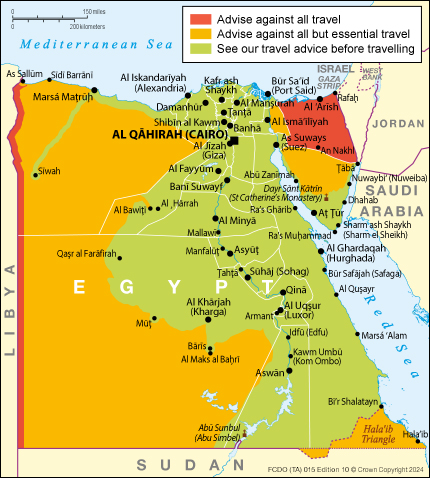
Advise against all travel
  • North Sinai — FCDO advises against all travel to the North Sinai Governorate.
  • Hala’ib Triangle and Bir Tawil Trapezoid — Find out more about why FCDO advises against travel.
All but essential travel
  • Egypt-Libya border — FCDO advises against all travel to within 20km of the Egypt-Libya border, except for the town of El Salloum, where we advise against all but essential travel.
  • Northern part of South Sinai — FCDO advises against all but essential travel to the northern part of the South Sinai Governorate, beyond the St Catherine-Nuweibaa road, except for the coastal areas along the west and east of the peninsula.
  • Eastern part of Ismailiyah Governorate — FCDO advises against all but essential travel to the Ismailiyah Governorate east of the Suez Canal.
  • Western Desert — FCDO advises against all but essential travel to the area west of the Nile Valley and Nile Delta regions, except for:
  • Hala’ib Triangle and Bir Tawil Trapezoid — FCDO advises against all but essential travel to the Hala’ib Triangle and the Bir Tawil Trapezoid.
Official Foreign Office map
Foreign Office map — Open Government Licence v3.0

Warnings — Foreign OfficeForeign Office ↗updated 04.08.2026 · read 16.10.2026

Warnings — Foreign Office

Your travel insurance could be invalidated if you travel against advice from the Foreign, Commonwealth & Development Office (FCDO).

Egypt-Libya border

FCDO advises against all travel to within 20km of the Egypt-Libya border, except for the town of El Salloum, where we advise against all but essential travel.

North Sinai

FCDO advises against all travel to the North Sinai Governorate.

Northern part of South Sinai

FCDO advises against all but essential travel to the northern part of the South Sinai Governorate, beyond the St Catherine-Nuweibaa road, except for the coastal areas along the west and east of the peninsula.

Eastern part of Ismailiyah Governorate

FCDO advises against all but essential travel to the Ismailiyah Governorate east of the Suez Canal.

Western Desert

FCDO advises against all but essential travel to the area west of the Nile Valley and Nile Delta regions, except for:

  • Luxor, Qina, Aswan, Abu Simbel and the Valley of the Kings
  • the Faiyum Governorate
  • the coastal areas between the Nile Delta and Marsa Matruh
  • the Marsa Matruh-Siwa road
  • the oasis town of Siwa
  • the Giza Governorate north-east of the Bahariya Oasis
  • the White Desert and Black Desert
  • the oasis towns of Bahariya, Farafra, Dakhla (Mut) and Kharga
  • the following roads and the desert area between them and the Nile valley:
  • the road between Giza and Farafra and within 50km either side of this road (but FCDO advises against all but essential travel on the road between Bahariya and Siwa)
  • the road between Farafra, Dakhla (Mut) and Kharga
  • the road between Kharga and Baris
  • the road between Baris and Luxor
Hala’ib Triangle and Bir Tawil Trapezoid

FCDO advises against all but essential travel to the Hala’ib Triangle and the Bir Tawil Trapezoid.

Find out more about why FCDO advises against travel .

Regional tensions

The US and Iran announced a memorandum of understanding (MOU) on 17 June in relation to the conflict in the Middle East, however the situation in the region remains unpredictable. Before the ceasefire, the Iranian regime had stated its intention to target locations associated with the US and Israel, including organisations, businesses, facilities, and institutions.

Since 8 July there have been strikes and retaliatory attacks in a number of locations across the region against US military and civilian infrastructure. There is a risk of more attacks and unforeseen escalation in the region. On 29 July, an apparent drone strike and fire caused damage to two ships moored off Damietta, in northern Egypt.

Conflict in Israel and Palestine

International borders in Israel and Palestine could close at short notice, including the Taba border crossing between Israel and Egypt. Check with local authorities and read Israel travel advice and Palestine travel advice before trying to cross.

Entering Egypt from Gaza

The Rafah border crossing is currently closed. When re-opened, Israel, Egypt and the authorities in Gaza may determine procedures for who is permitted to cross and when.

If you are a British national in Gaza who wants to leave Gaza, see Israel travel advice and Palestine travel advice .

Concern for friends and family

If you are concerned about friends or family, or need support from the UK government, call the British Embassy in Cairo.

Telephone: + 20 (0)2 2791 6000

If you have technical difficulties using this number, call +44 1767 667 600 (UK number).

Regional risks — Foreign OfficeForeign Office ↗updated 04.08.2026 · read 16.10.2026

Regional risks — Foreign Office

This section has safety advice for regions of Egypt. It only covers regions where FCDO has specific advice.

You should also read FCDO ’s overall travel advice and safety and security advice .

Egypt-Libya border

FCDO advises against all travel to within 20km of the Egypt-Libya border, except for the town of El Salloum, where we advise against all but essential travel. There are active military operations targeting criminal activity in this area.

North Sinai

FCDO advises against all travel to North Sinai Governate due to continuing criminal activity and terrorist attacks on police and security forces that have resulted in deaths. See Terrorism in Egypt .

Northern part of South Sinai

FCDO  advises against all but essential travel to the northern part of South Sinai Governate, beyond the St Catherine-Nuweibaa road, except for the coastal areas along the west and east of the peninsula.

We advise against all but essential travel due to criminal activity and terrorist attacks on police and security forces that have resulted in deaths. See  Terrorism .

If you plan to travel in a 4-wheel-drive vehicle from mainland Egypt through the Suez crossing, you must get a permit from Travel Permits Department of the Egyptian Ministry of the Interior. You should book any activities outside of resort areas through approved agents or tour operators.

Travel to Red Sea tourist areas in the southern part of the Sinai Peninsula is generally low risk. Security forces carry out routine checks on vehicles and at airports to protect resorts such as Sharm El Sheikh, Hurghada and Marsa Alam.

Eastern part of Ismailiyah Governorate

FCDO advises against all but essential travel to the parts of the Ismailiyah Governorate which are east of the Suez Canal, due to ongoing military operations against terrorists and criminals. Egyptian authorities at checkpoints may prevent onward travel to this region. See Terrorism .

Western Desert

FCDO advises against all but essential travel to the area west of the Nile Valley and Nile Delta regions due to risks from criminal activity and military operations, except for:

  • Luxor, Qina, Valley of the Kings, Aswan and Abu Simbel
  • the Faiyum Governorate
  • the coastal areas between the Nile Delta and Marsa Matruh
  • the Marsa Matruh-Siwa road
  • the oasis town of Siwa
  • the Giza Governorate north-east of the Bahariya Oasis
  • the White Desert and Black Desert
  • the oasis towns of Bahariya, Farafra, Dakhla (Mut) and Kharga
  • the following roads and the desert area between them and the Nile valley:
  • the road between Giza and Farafra and within 50km either side of this road (but FCDO advises against all but essential travel on the road between Bahariya and Siwa)
  • the road between Farafra, Dakhla (Mut) and Kharga
  • the road between Kharga and Baris
  • the road between Baris and Luxor

Tourists who enter the Western Desert areas of Bahariya Oasis, Farafra, the White Desert and Black Desert must apply for permits in advance and use an official guide. There is limited phone reception and poor medical facilities. Monitor travel advice and follow guidance from official guides and local authorities.

FCDO advises against all but essential travel on the road between Al Bawiti and Siwa, including the desert areas near the start of the road in Bahariya. The road is closed and there are military checkpoints.

If you travel to the south-west corner of Egypt near the border with Sudan or Libya, you will need a permit from the Ministry of Interior . Bandits and armed groups operate in these areas.

Be extremely cautious in all border areas.

Hala’ib Triangle and Bir Tawil Trapezoid

FCDO advises against all but essential travel to the Hala’ib Triangle and Bir Tawil Trapezoid.

The Hala’ib Triangle remains disputed territory between Egypt and Sudan. If you’re in the Hala’ib Triangle and need urgent UK government support, contact the British Embassy in Cairo .

The Bir Tawil Trapezoid is unclaimed by either Egypt or Sudan. If you’re in this area and need urgent UK government support, contact FCDO in the last country you travelled through.

Safety — Foreign OfficeForeign Office ↗updated 04.08.2026 · read 16.10.2026

Safety — Foreign Office

Approximately one million British people travel to Egypt each year. Most visits are trouble-free. This guide also has safety advice for regions of Egypt .

Terrorism

There is a high threat of terrorist attack globally affecting UK interests and British nationals, including from groups and individuals who view the UK and British nationals as targets. Stay aware of your surroundings at all times.

UK Counter Terrorism Policing has information and advice on staying safe and what to do in the event of a terrorist attack. Find out how to reduce your risk from terrorism while abroad .

Terrorism in Egypt

Terrorists are likely to try to carry out attacks in Egypt.

Terrorist attacks could be indiscriminate including in places visited by foreign nationals. Stay aware of your surroundings, keep up to date with local media reports and follow the advice of local authorities. Be vigilant in crowds and large gatherings.

Targets might include:

  • Egyptian security forces
  • religious sites
  • large public gatherings
  • places visited by foreign nationals

The authorities in Egypt have a significant security presence across the country. Extra measures are in place at tourist sites.

Examples of recent attacks include:

- In 2024, one Israeli-Canadian national was killed in a shooting attack in Alexandria

- In 2023, 2 Israeli tourists and an Egyptian tour guide were killed in a shooting attack in Alexandria

- In 2022, 4 police officers and one insurgent killed in an attack on a police checkpoint in Ismailiya City

Political situation

The political environment in Egypt is restrictive. Avoid large gatherings, demonstrations and protests as the situation could change quickly and without warning. Security forces have responded forcefully to protests and disturbances.

Foreign nationals involved in any political activity or activities critical of the government may be at risk of detention. This includes posting negative comments on social media.

Crime

The crime rate is generally low, but visitors should take sensible precautions as they would in the UK.

To report a crime, phone the tourist police on 126. If you do not report a crime before you leave Egypt, it will be difficult to prosecute later.

Sexual assault and harassment

A number of sexual assaults have been reported to the British Embassy, including cases involving minors.

The majority of cases that have been reported took place in tourist resorts in the Red Sea region, often committed by someone the victim had already met, including hotel workers and excursion staff. There have also been reports of hotel staff discouraging incidents being reported to local police.

Female travellers should exercise caution when travelling alone, particularly at night, in taxis.

Take extra precautions:

- do not leave children unaccompanied

- do not allow hotel staff to enter your room when you are alone – try to ensure a friend or relative is present

- avoid travelling in a taxi alone – if this is not possible, apply extra security by sharing the details of your driver, trip and live location with a friend

- use reputable providers for any services and excursions, and carry out research beforehand

- avoid sharing personal contact or social media details

Protecting your belongings

Pickpocketing is rare in Egypt. Take the same precautions as you would in the UK.

It might be helpful to make photocopies of your passport, visa and flight ticket to keep separately from originals when travelling. If your passport is lost or stolen, tell the police immediately and get a police report.…

American passport — U.S. Department of State

In brief
  • Do not travel to Northern and Middle Sinai Peninsula due to terrorism risk, or to Western Desert unless with a professionally licensed tour company. State Department
  • Do not travel to Egyptian border areas due to military zones. State Department
  • Terrorists may attack religious sites, government buildings, embassies, tourist sites, transportation centers, shopping malls, restaurants, resorts, checkpoints, and urban Cairo with little warning. State Department
  • Most crimes against foreigners are opportunistic theft and pickpocketing; harassment of women is common. Beware of overcharging and scams in tourist areas. State Department
  • Emergency and intensive care facilities are limited; ambulances are rare and lack advanced medical equipment. Ensure polio vaccination is current before travel. State Department
  • The U.S. Embassy has limited ability to assist dual U.S.-Egyptian citizens arrested or detained, as Egyptian law considers them solely Egyptian citizens. State Department

Faithful summary of the official texts below, which prevail.

Egypt - Level 2: Exercise Increased Caution 2025-07-14travel.state.gov ↗updated 14.07.2025 · read 16.10.2026

Advisory summary

Exercise increased caution in Egypt due to terrorism , crime , and health . Some areas have increased risk.

  • The U.S. Embassy has limited ability to help dual national U.S.-Egyptian citizens who are arrested or detained.
  • Egyptian law considers dual citizens to be solely Egyptian citizens.

Terrorism

There is risk of terrorist violence, including terrorist attacks and other activity in Northern and Middle Sinai Peninsula. Visit the U.S. Department of State's country reports on terrorism to learn more. Terrorists may attack with little or no warning:

Egyptian authorities generally offer effective security protection. However, extremists continue to express interest in planning and carrying out attacks. Security is generally present at potential targets, which include:

  • Religious sites (mosques, churches, monasteries, and buses traveling there)
  • Local government buildings, and diplomatic facilities (embassies)
  • Tourist sites
  • Transportation centers
  • Shopping malls
  • Restaurants and foreign businesses
  • Resorts
  • Roadside checkpoints
  • Urban areas in Cairo

Crime

Most crimes against foreigners are crimes of opportunity, like purse snatching and pickpocketing. Harassment of women, including foreigners, is a problem in Egypt. It can include vulgar comments, gestures, indecent exposure, and unwanted physical contact. Tourists should beware of overcharging and scams in tourist areas. Review the  Country Security Report for Egypt for further details.

Health

Emergency and intensive care facilities are limited in Egypt and may be unavailable in remote areas. Ambulances are rare, unreliable in most areas, and don’t have advanced medical equipment.

Global polio

Some international destinations, including Egypt, have circulating poliovirus. Before traveling to Egypt, make sure you are up to date on your polio vaccines. Check the CDC website for current vaccination recommendations .

Demonstrations

Protests or demonstrations may occur suddenly:

  • Individuals have been arrested for being in the vicinity of protests in Egypt, even when not actively participating.
  • U.S. citizens have been arrested for participating in protests.
  • You may be detained for posting anything on social media seen as critical of Egypt or its allies, or for disrespecting its cultural sites.
  • Local law prohibits protesting or demonstrating without a permit.

Do not…

Global Affairs Canada — additional reading

Exercise a high degree of caution (with regional advisories)

Northern Sinai - Avoid all travel

Avoid all travel to northern Sinai due to terrorist activity and ongoing military operations by the Egyptian Armed Forces. This advisory includes all of the Governorate of North Sinai and parts of the following governorates east of the Suez Canal :

  • Port Said
  • Ismailia
  • Suez
The Western desert and Libyan border area - Avoid all travel

Avoid all travel to the following areas, due to smuggling, terrorist activities, the presence of armed groups and ongoing military operations:

  • within 50 kilometres of the border with Libya
  • the Western Desert, west of the Giza-Luxor-Aswan-Abu Simbel road, including the oasis of Dakhla

This advisory excludes the following areas where you should exercise a high degree of caution:

  • Marsa Matruh via the Marsa Matruh Road only
  • The White and Black deserts via the Oasis Road only
  • The oases of : Siwa via the Masra Matruh-Siwa Road only ; Bahariya, Farafra and Bawati via the Oasis and the Farafra-Dairut Roads only
Northern part of the Governorate of South Sinai - Avoid non-essential travel

Avoid non-essential travel to the northern part of the Governorate of South Sinai, north of St. Catherine – Nuweiba – El Tor Road, due to the threat of terrorism.

This advisory excludes the following locations, where you should exercise a high degree of caution:

  • the Dahab – Nuweiba – Taba road
  • the towns of Nuweiba and Taba
  • the Al Qantra Shark – Ras Sedr road up to the border with the Governorate of Suez
  • cities between Ras Sedr and El Tor

Open Government Licence – Canada · October 14, 2026 09:16 EDTtravel.gc.ca ↗updated 14.10.2026 · read 16.10.2026

In brief
  • You must carry an international driving permit when driving in Egypt.
  • Possession, use, or trafficking of illegal drugs carries strict penalties, including lengthy jail sentences, heavy fines, and potentially capital punishment.
  • Importing or using drones without prior authorization from the Egyptian Ministry of Defence is illegal and can result in lengthy jail terms, deportation, or charges similar to espionage.
  • It is illegal to photograph bridges, canals, government buildings, police or embassy vehicles, and military personnel or establishments.
  • Public displays of affection are frowned upon, and same-sex couples may receive negative attention.
  • You must declare currency equivalent to US$10,000 or more upon entry or exit; a maximum of E£5,000 can be brought in or out of Egypt.

Faithful summary of the official texts below, which prevail.

Global Affairs Canada — written for Canadian travellers, valid for all

Local laws

You must abide by local laws. Learn about what you should do and how we can help if you are arrested or detained abroad.

Driving

You should carry an international driving permit. International Driving Permit

Drugs

The use of drugs and open consumption of alcohol (other than in licensed facilities such as hotels and restaurants) are prohibited. Transgressions could be punished by detention or other penalties. Penalties for possession, use or trafficking of illegal drugs are strict. Convicted offenders can expect jail sentences and heavy fines. Capital punishment is a sentencing option for certain drug-related crimes. Drugs, alcohol and travel

Demonstrations

Local law prohibits protests without a permit. Being near anti-government protests may subject you to scrutiny from Egyptian police and security forces. Mass gatherings (large-scale events)

Drones

Drones are strictly prohibited in Egypt; anyone convicted of unauthorized import or use of drone technology could be subject to lengthy jail terms and deportation. Unauthorized possession and usage of drones in Egypt may carry similar charges to espionage.

Electronic devices

Egyptian officials will likely confiscate electronic devices upon entry if you did not obtain prior approval to import them. This includes:

  • large video cameras
  • filming equipment
  • satellite phones
  • radios
  • certain equipment like binoculars

You may face interrogation on the intended use of your devices due to their potential use for military and surveillance purposes. Contact the nearest Embassy of the Arab Republic of Egypt for further information on regulations and requirements on electronic devices. Foreign Representatives in Canada

Photography

Photography of bridges, canals (including the Suez Canal), government, police and embassy buildings and vehicles, as well as military personnel and establishments is prohibited.

Social media

Publishing or posting social media or other content that could be perceived as critical of Egyptian society, government, security forces or the President may be considered illegal under Egyptian law. Convictions can carry heavy fines and lengthy prison sentences. There is a high risk of arrest in connection to social media posts considered critical of Egypt.

Behaviour

Due to the current security context and political sensitivities, be conscious of your behaviour and how it may be interpreted by Egyptian authorities. Visitors including researchers, journalists, activists and development workers could encounter problems with authorities, if their activities are perceived as suspicious. Meeting with members of or expressing support for organizations banned in Egypt could be perceived as criminal behaviour. Suspects may be detained without charges or access to immediate legal counsel during investigative stages of a criminal case.

Customs

Strict duties apply on the importation of expensive electronics, including video and photographic equipment, laptops, and computer software and hardware. Such equipment should be for personal use and you should list it (model and serial number) and check it upon arrival and departure, in which case no duty will be collected. Appropriate permits and authorizations are required for the commercial importation of any type of electronics. It is prohibited to export any antiquity or any item older than 100 years without a licence. Contact the Embassy of the Arab Republic of Egypt in Ottawa for further information regarding customs requirements.

Money

The currency is the Egyptian pound (EGP, E£). A maximum of E£5,000 can be brought into or taken out of Egypt. You must declare any amount of currency equivalent to US$10,000 or more. Traveller’s cheques and foreign currency are easily exchanged in hotels and banks. U.S. dollars are preferred, particularly at tourist sites. Some travel agents and tour operators request payment in U.S. cash only. Major credit cards are accepted in larger stores and for larger purchases, but many merchants will only accept cash or may charge a fee for payment by credit card.

Forced marriages

There are reports of Canadian citizens being forced into marriage without their prior knowledge or consent. Marriage Overseas

International Child Abduction

The Hague Convention on the Civil Aspects of International Child Abduction is an international treaty. It can help parents with the return of children who have been removed to or retained in certain countries in violation of custody rights. It does not apply between Canada and Egypt. If your child was wrongfully taken to, or is being held in Egypt by an abducting parent:

  • act as quickly as you can
  • consult a lawyer in Canada and in Egypt to explore all the legal options for the return of your child
  • report the situation to the nearest Canadian government office abroad or to Global Affairs Canada by calling the Emergency Watch and Response Centre

If your child was removed from a country other than Canada, consult a lawyer to determine if The Hague Convention applies. Be aware that Canadian consular officials cannot interfere in private legal matters or in another country's judicial affairs.

Culture

The work week is Sunday through Thursday. Egypt’s customs, laws and regulations adhere closely to Islamic practices and beliefs. Exercise common sense and discretion in dress and behaviour. Dress conservatively: for women, knee-length or longer dresses and long sleeves are preferable, and men should not wear shorts outside tourist areas. Respect religious and social traditions to avoid offending local sensitivities. Overt public displays of intimate affection are frowned upon in Egyptian culture. In 2027, the lunar month of Ramadan is expected to begin on or around February 7. In public, between sunrise and sunset, be discreet when:

  • drinking
  • eating
  • smoking

Open Government Licence – Canada · October 14, 2026 09:16 EDTtravel.gc.ca ↗updated 14.10.2026 · read 16.10.2026

Foreign Office — laws and cultural differences

Local laws

Egypt is predominantly an Islamic country. Take care to respect local traditions, customs, laws and religions. Seek to avoid offence, especially during Ramadan or when you visit religious areas.

Religion

It is illegal to encourage people to convert to Christianity or any other religion.

Ramadan

Ramadan is a holy month for Muslims. The dates vary by year and country and you should check this before you travel. During this time, it is culturally insensitive to eat, drink or smoke in public during daylight hours. It is advisable not to play loud music, dance or swear in public. Get more advice when you arrive from your tour guide, hotel or business contacts. You should also:

  • check opening hours of shops and restaurants
  • be aware that if hotels and restaurants are providing food or drink in fasting hours, they may separate non-fasting guests, for example with screens
  • follow local dress codes – clothing that does not meet local dress codes may cause more offence at this time
  • be aware that driving may be erratic, particularly when people are trying to get home at dusk
  • be patient and show tolerance
Personal ID

Police check ID regularly and will ask to see your passport. They may detain you if you cannot show your ID and your visa (or a digital/paper copy).

Dress code

Dress modestly, especially in rural areas, mosques and souqs (markets).

Behaviour in public

Couples showing physical affection in public is frowned upon. Holding hands is generally fine. Behaviour accepted in tourist resort areas may not be accepted elsewhere.

Alcohol laws

Drinking alcohol anywhere other than licensed restaurants, bars, or private homes or certain tourist resorts is illegal and can lead to arrest.

Illegal drugs penalties

Possession, use or trafficking of illegal drugs is a serious offence and can, even for small amounts, lead to life imprisonment or the death penalty. People who get a life sentence on drugs charges normally spend the rest of their lives in prison with no chance of parole or a pardon. Khat is illegal in Egypt.

Photography and filming restrictions

You must get a permit to enter Egypt with professional photography or film equipment. This includes photography umbrellas, artificial outdoor lighting gear and any equipment that occupies or blocks public roads. It is illegal to take or share photos that could be considered damaging to the country’s image. Ministry of Tourism regulations on photography say that you must get an Egyptian citizen’s written permission before you take their photo. Taking pictures of children is prohibited. Do not photograph officials without their consent. It is illegal to take photos of, or near, military property. This includes the Suez Canal. If you are in any doubt, get permission before taking photos. There are sensitivities about taking photographs of:

  • embassies
  • government buildings and infrastructure
  • religious buildings
Drones

It is illegal to use radio-controlled helicopters or drones to take photos near sensitive sites. Do not import, use or produce drones in Egypt unless the Egyptian Ministry of Defence gives you permission beforehand. Anyone who uses or imports drones without permission could get a prison sentence of up to 7 years or a fine of 5,000 to 50,000 Egyptian pounds.

LGBT+ travellers

Same-sex sexual activity is not explicitly criminalised in Egypt. However, the Egyptian authorities have prosecuted LGBT+ people under ‘debauchery’ laws, including people flying rainbow flags at public events. There is little public acceptance of same-sex relationships in Egypt. Same-sex couples showing affection in public are likely to receive negative attention. Be cautious about sharing content or having discussions of a sexual nature on social media, especially about sexual acts that are considered illegal. Some travellers have been arrested and imprisoned for this. You may be denied entry if your gender expression or physical appearance does not match the sex marker in your passport or your passport photograph. Read more advice for LGBT+ travellers.

Child custody law

Egyptian family law is very different from UK law, particularly around child custody. See International parental child abduction for information and how to get assistance.

Open Government Licence v3.0gov.uk ↗updated 04.08.2026 · read 16.10.2026

FDFA (Switzerland) — laws and customs, in French

Specific legal provisions

Les prescriptions légales sont basées sur des normes strictes et des règles morales rigides. Entre autres, les délits suivants sont punissables:

  • la cohabitation hors mariage (étranger/ère avec un/e Egyptien/ne).
  • tout comportement provocant et les gestes affectifs entre personnes adultes dans la sphère publique;
  • les actes à caractère homosexuel;
  • l’alcool au volant ainsi que la consommation d'alcool dans les lieux publics;
  • les insultes et critiques exprimées publiquement (y compris sur les réseaux sociaux) à l’encontre de l’État égyptien ou de la religion ;
  • les remarques contraires aux bonnes mœurs;
  • photographier des personnes en uniforme, des installations militaires et des édifices publics (aéroports, gares, ponts, installations d’antenne, ambassades étrangères, etc.).

De nombreux produits sont soumis à des restrictions ou interdictions d’importation et d’exportation, par exemple:

  • l’importation ou l’utilisation de drones radiocommandés et de certains autres appareils électroniques. Des informations peuvent être obtenues auprès de l'Ambassade de la République arabe d'Égypte à Berne.
  • l’exportation de biens culturels (antiquités, objets anciens, fossiles, coraux, etc.). Ces objets sont parfois proposés à la vente sur les marchés locaux. Les articles visés par cette interdiction ne peuvent pas être exportés, même s’ils ont été importés ou acquis légalement. Les copies d’objets du patrimoine culturel ne peuvent être exportées que si elles ont été certifiées par le Ministère des Antiquités . Elles ne peuvent être acquises légalement qu’auprès dudit ministère ou dans des musées.

Les infractions à la loi sur les stupéfiants, même pour des quantités minimes et pour tout type de drogue, sont passibles de longues années de prison. La peine de mort est même possible. Les conditions de détention sont précaires .

Cultural specificities

Adaptez le comportement et la tenue vestimentaire aux us et coutumes locaux. Renoncez aux visites des mosquées durant les heures de prières le vendredi. Renseignez-vous dans les guides de voyages, auprès de votre agence ou directement sur place, sur les codes de conduite et les conventions à respecter. Pendent le mois du Ramadan et dans les lieux religieux, des règles et des prescriptions particulières doivent être respectées. Lors d’un mariage entre un étranger/une étrangère et un Égyptien/une Egyptienne de confession musulmane, une attention toute particulière doit être vouée au respect des us et coutumes islamiques et aux lois égyptiennes, y compris en ce qui concerne le droit de garde et l’autorité parentale pour les enfants communs.

FDFA travel advice, in Frencheda.admin.ch ↗updated 24.06.2026 · read 16.10.2026

Air: Fair 34/100PM2.5 9.3 µg/m³ · PM10 15.7 µg/m³
UV high today max 6.2Right now 5.1 · WHO scale 0–11+

What it changes for you: Air acceptable at this hour: nothing special to plan. High UV at midday: sun protection.

Reading 11:00 (Africa/Cairo)Open-Meteo ↗updated 16.10.2026 · read 16.10.2026

Air quality and UV: Open-Meteo.com (CC BY 4.0), data rounded and formatted by Maximum. Contains modified Copernicus Atmosphere Monitoring Service information 2026. Neither the European Commission nor ECMWF is responsible for any use that may be made of the Copernicus information or data it contains.

Physicians per 1,000 people
Egypt0.7 2020
Switzerland4.5 2022
France3.3 2022
Hospital beds per 1,000 people
Egypt1.1 2021
Switzerland4.4 2023
France5.7 2022
Health spending per person (USD)
Egypt141 2023
Switzerland11,784 2023
France5,327 2024
Life expectancy (years)
Egypt71.8 2024
Switzerland84.4 2024
France83.0 2024

Reading: With 0.7 physicians per 1,000 people (84% fewer than Switzerland), the nearest hospital does not always have the capacity for a serious case: evacuation to an adequate centre is the rule, not the exception — that is what unlimited evacuation and repatriation cover. Health spending of 141 USD per person (Switzerland: 11,784) goes with private hospitals that bill foreigners in hard currency and ask for a guarantee before admission: the direct payment guarantee is what avoids the deposit.

World Bank — latest published value, year per indicatordata.worldbank.org ↗read 10.10.2026

I travel on a passportVisa, passport validity, entry form: the rules depend on your passport. Each government describes them for its own nationals.

French passport — France Diplomatie

In brief
  • French nationals may enter Egypt with a valid passport or national identity card, both valid for at least six months after their return to France. Carry two identity photos for the visa. France Diplomatie
  • A tourism visa is mandatory and costs 30 USD for single entry or 60 USD for multiple entries, payable in cash (USD or EUR) at airport counters open 24/7. Visa can be obtained on arrival or at French Egyptian consulates. France Diplomatie
  • Travellers may enter Egypt with maximum 5000 Egyptian pounds or 10000 USD in foreign currency. Amounts exceeding these limits will be seized at the border. France Diplomatie
  • Respiratory barrier measures remain recommended to protect against MERS, endemic to the Middle East. Consult the French Embassy in Cairo website and social media for updates. France Diplomatie

Faithful summary of the official texts below, which prevail.

Égypte

- Présentation de l’Égypte

-

-

-

-

-

-

-

-

-

-

Mesures liées à la Covid-19

L’ensemble des restrictions liées à l’épidémie de Covid-19 pour l’entrée sur le territoire égyptien ont été levées et l’épidémie de Covid 19 est terminée en Égypte. Il reste néanmoins recommandé d’observer les gestes barrières, qui protègent également contre d’autres maladies respiratoires, comme le MERS, endémique au Proche-Orient.

Il est recommandé de se tenir informé de l’évolution de la situation et de consulter régulièrement le site Internet et les réseaux sociaux de l’Ambassade de France au Caire.

Pièce d’identité

Les ressortissants français voyageant individuellement ou en groupe peuvent entrer en Égypte munis d’un passeport valide encore au moins six mois après la date de retour en France.

Les ressortissants français peuvent également entrer en Égypte avec une carte nationale d’identité valide encore au moins six mois après la date de retour en France. Il est impératif de prendre avec soi deux photos d’identité pour le visa (cf. infra).

En cas d’entrée en Égypte avec une carte nationale d’identité (CNIS), un document cartonné est remis aux voyageurs à leur arrivée, portant le visa sur une face et les données personnelles sur l’autre : il convient de vérifier que le fonctionnaire orthographie correctement le nom et le prénom et indique intégralement le numéro de la CNIS, sous peine de très importantes difficultés au moment de quitter le territoire égyptien.

Les voyageurs sont invités à veiller à tout instant sur leurs papiers d’identité : les voyageurs souhaitant déposer plainte pour vol ou perte au commissariat avant de faire appliquer le cachet indiquant la date de dernière entrée sur un document de voyage d’urgence, auprès du Mogamma’aa (service des étrangers du ministère de l’Intérieur) rencontrent des obstacles qui peuvent se révéler insurmontables. Ils sont alors susceptibles de se retrouver en dépassement du temps de séjour et de se voir infliger une amende.

Visa

Le visa est obligatoire. Le visa de tourisme peut être obtenu auprès d’un consulat égyptien en France (demande à déposer très en amont de la date de départ souhaitée) ou à l’arrivée en Égypte (préférable). D’une durée initiale d’un mois, le visa peut être prolongé auprès du bureau de l’immigration pour les titulaires d’un passeport en cours de validité (au Caire, "Mogamma’aa" à Abbasseya). Les voyageurs munis uniquement d’une carte nationale d’identité ne pourront pas demander le prolongement de leur visa de trente jours.

Le visa est payant (30 USD, ou équivalent en Euros, pour une entrée simple, 60 USD, ou équivalent en Euros, pour un visa à entrées multiples). La vignette visa peut être achetée dans tous les aéroports internationaux d’Égypte dans des guichets ouverts vingt-quatre heures sur vingt-quatre. Le paiement se fait alors exclusivement en espèces en devises étrangères (USD ou Euros).

Pour les porteurs d’une carte d’identité, le visa est apposé, à l’arrivée, sur un formulaire fourni par les autorités locales. Les voyageurs doivent impérativement se munir avant leur départ de deux photos d’identité qui seront jointes à ce formulaire.

Les voyageurs arrivant directement à l’aéroport de Charm el Cheikh et souhaitant rester sur le territoire du gouvernorat pendant la durée de leur séjour peuvent solliciter un visa spécial Sinaï. S’ils souhaitent sortir du gouvernorat il convient de solliciter un visa Égypte . Il en est de même pour les voyageurs arrivant par voie terrestre depuis Israël (frontière de Taba). Il n’est pas possible de modifier le visa spécial Sinaï une fois entré sur le territoire égyptien du Sinaï.

Les détenteurs de passeports officiels (passeports de service et diplomatique) doivent impérativement demander un visa biométrique auprès de…

Obligations militaires pour les binationaux

Les hommes âgés de 18 à 30 ans détenant à la fois la nationalité égyptienne et la nationalité française sont tenus de se mettre préalablement en règle avec leurs obligations relatives au service militaire s’ils souhaitent se rendre en Égypte, même pour un bref séjour. A défaut, ils ne seront pas autorisés à ressortir d’Égypte. La procédure à suivre une fois en Égypte peut être longue et coûteuse.

Depuis le 14 août 2023, il est possible aux Egyptiens de 18 à 30 ans résidant à l’étranger de régulariser leur situation au regard du service militaire égyptien en versant la somme de 5000$ sur le site public égyptien en ligne : https://www.tagneedinit.gov.eg/HomePage.html .

Il est rappelé que le renouvellement d’un passeport égyptien nécessite la régularisation préalable de la situation du demandeur au regard du service militaire.

Réglementation douanière

Les voyageurs sont autorisés à entrer sur le territoire égyptien en possession de la somme de 5 000 livres égyptiennes. Au-delà de ce montant, ils s’exposeraient à une saisie sur place du montant excédant cette somme. Ils sont également autorisés à entrer sur le territoire égyptien en possession de devises pour un montant maximal de 10 000 USD.

Entry and stay pagediplomatie.gouv.fr ↗updated 21.09.2026 · read 16.10.2026

Swiss passport — FDFA (Switzerland)

The FDFA does not publish entry requirements: they are set out by the destination's embassy or consulate in Switzerland — check them before booking, passport in hand. As a guide, the French and British requirements below describe the same rules as seen by two other governments.eda.admin.ch ↗updated 24.06.2026 · read 16.10.2026

British passport — Foreign Office (UK)

In brief
  • Your passport must be valid for at least six months beyond your arrival date and have one blank page, or you will be denied entry. Foreign Office
  • British citizens need a visa for Egypt, except those flying to Sharm El-Sheikh for under 15 days at specific resorts, who receive a free entry stamp on arrival. Foreign Office
  • Obtain a visa online as an e-visa valid up to three months, in person through the Egyptian Consulate General in the UK, or on arrival for 30 US dollars cash at approved airports. Foreign Office
  • From 1 August 2026, digital visas on arrival are available at Cairo International Airport via self-service machines for 36 US dollars including a six-dollar service fee, with card payment only. Foreign Office
  • Visa extensions are available at Egyptian Passport and Immigration Offices; overstaying by more than 14 days may result in fines. Foreign Office
  • Do not purchase visas from airport agents, who charge more than the official 30 US dollars; report harassment to airport tourist police. Foreign Office

Faithful summary of the official texts below, which prevail.

Entry requirements — rules for a British passportForeign Office ↗updated 04.08.2026 · read 16.10.2026

Entry requirements — rules for a British passport

This information is for people travelling on a full ‘British citizen’ passport from the UK. It is based on the UK government’s understanding of Egypt’s current rules for the most common types of travel.

The authorities in Egypt set and enforce entry rules. If you’re not sure how these requirements apply to you, contact the Egyptian Consulate General in the UK .

Passport validity requirements

To enter Egypt, your passport must have an ‘expiry date’ at least 6 months after the date you arrive and have at least one blank page.

Check with your travel provider that your passport and other travel documents meet requirements. Renew your passport if you need to.

You will be denied entry if you do not have a valid travel document.

Dual nationals

When returning to the UK, British citizens must carry a valid British passport or certificate of entitlement . See Dual citizenship .

Visa requirements

British passport holders travelling to Egypt normally need a visa.

If you are arriving by air to Sharm El-Sheikh and staying for less than 15 days at resorts in Sharm El Sheikh, Dahab, Nuweiba or Taba, you do not need a visa. You will get a free entry permission stamp on arrival at Sharm El-Sheikh Airport. If you plan to travel outside the resorts or stay more than 15 days, you must get a visa. You can get a visa at Sharm El-Sheikh Airport or online.

If you arrive in South Sinai by land through the Taba Border Crossing, see ‘Entering Egypt from Israel’.

Applying for a visa

You can apply for a visa:

  • online – getting an e-visa in advance can help to prevent delays, tourist e-visas are valid for up to 3 months
  • in person or by post – apply through the Egyptian Consulate General in the UK
  • on arrival in Egypt – approved airports have kiosks before you reach the immigration counters where you can buy a physical visa for 30 US dollars (cash only). Visas on arrival are valid for up to 30 days.

Starting from 1 August 2026, travellers arriving at Cairo International Airport can also purchase digital visas on arrival (card payment only) via self-service machines or the Visa on Arrival portal for 36 US dollars, including a 6 US dollar digital service fee.

British passport holders from British Overseas Territories and Crown Dependencies cannot apply online.

Visa extensions

You can apply for a visa extension at the Egyptian Passport and Immigration Offices. If you try to leave Egypt on an expired visa, you may face difficulties, including a fine if your visa has expired by more than 14 days. Contact the Egyptian Consulate General in the UK for more information.

Visa agents in airports

You do not need to buy a visa from an agent. Agents often charge more than the required 30 US dollars. If an agent harasses you, report the incident to the tourist police in the airport terminal.

Gender expression

You may be denied entry if your gender expression or physical appearance does not match the sex marker in your passport or your passport photograph. See general advice for LGBT+ travellers

Entering Egypt from Israel

If you plan to cross the border from Israel into Egypt at Taba, we recommend you bring at least 170 US dollars…

American passport — U.S. Department of State

The State Department publishes the requirements ("Entry, Exit and Visa Requirements") on its country page, which our servers cannot read. Read it before you go; as a guide, the French and British requirements below describe the same rules as seen by two other governments.travel.state.gov ↗updated 14.07.2025 · read 16.10.2026

Living on site

For each risk, the official texts themselves: what is happening, then, where they say so, what to do.

CrimeMODERATE

What the texts say · Terrorists are likely to try to carry out attacks in Egypt. Crimes such as pickpocketing, bag and purse snatching and home invasion, while rare, have become more common.

What they advise:
  • Terrorist attacks could be indiscriminate including in places visited by foreign nationals.
  • If you find yourself in such a situation, do not resist as carjackers are typically after the vehicle and, if the carjacking is successful, will leave the driver unharmed.
  • If you are a victim of crime, report it to the Tourist Police, whose officers usually wear a distinctive arm band, or at a nearby police station as soon as possible.
Foreign Office · Global Affairs Canada
TransportMODERATE

What the texts say · Female travellers should exercise caution when travelling alone, particularly at night, in taxis.

What they advise: Avoid travelling in a taxi alone – if this is not possible, apply extra security by sharing the details of your driver, trip and live location with a friend.
Foreign Office
Nature and climateMODERATE

What the texts say · Sand storms and dust storms can occur in the spring. Heavy rains can cause severe flooding and landslides, especially in low-lying areas in northern Egypt.

What they advise:
  • During a storm: stay indoors - keep windows closed - follow the instructions of local authorities - monitor local media for the latest information.
  • Follow the instructions of local authorities, including evacuation orders.
Global Affairs Canada
Laws and customsTO KNOW

What the texts say · Possession, use or trafficking of illegal drugs is a serious offence and can, even for small amounts, lead to life imprisonment or the death penalty. Foreign nationals involved in any political activity or activities critical of the government may be at risk of detention.

What they advise:
  • Drinking alcohol anywhere other than licensed restaurants, bars, or private homes or certain tourist resorts is illegal and can lead to arrest.
  • You should carry an international driving permit.
  • Publishing or posting social media or other content that could be perceived as critical of Egyptian society, government, security forces or the President may be considered illegal under Egyptian law.
Foreign Office · Global Affairs Canada
Crowds and calendarMODERATE

What the texts say · While the size and frequency of demonstrations has decreased significantly in recent years, they can still occur anywhere at any time without warning, but are most likely to occur on Fridays following noon prayers.

What they advise:
  • Avoid all demonstrations or large public gatherings.
  • Security forces have responded forcefully to protests and disturbances.
Global Affairs Canada · Foreign Office

Sentences copied word for word from the official texts cited, chosen for the destination; the level is our reading. The full texts, at each source:Foreign Office ↗updated 04.08.2026 · read 16.10.2026 (updated 04.08.2026 · read 28.09.2026)Global Affairs Canada ↗updated 14.10.2026 · read 16.10.2026 (updated 14.10.2026 · read 28.09.2026)

Safety in figures
Intentional homicides per 100,000 people
Egypt1.3 2017
Switzerland0.6 2023
France1.3 2023
Road traffic deaths per 100,000 people
Egypt10.1 2019
Switzerland2.2 2019
France5.1 2019

Reading: The homicide rate is above Switzerland's, without being out of range. On the road, 5 times more deaths than in Switzerland: road crashes are the leading cause of death of healthy travellers (CDC) — seat belt, no night driving, a driver or a taxi from a rank.

World Bank (UNODC for homicides, WHO for roads) — latest published valuedata.worldbank.org ↗read 10.10.2026

—:—Local time · Africa/Cairo ·
122Local emergency numbers · Police 122 · Ambulance 123 · Fire 180
Schuko, Europlug220 V
Drivingon the right

Time zone: IANA and timezone-boundary-builder (ODbL) · RESTCountries · EmergencyNumberAPI · Wikidata · European Central Bank

Places: © OpenStreetMap contributors (ODbL), Photon search by komoot.

FDFA (Switzerland) — transport and specific advice, in French

Transport and infrastructure

Les accidents de la route sont fréquents en raison du mauvais état des routes, de la conduite dangereuse et du non-respect des règles de circulation. Les accidents mortels dus à des excès de vitesse et à des infractions du code de la route sont fréquents sur les grands axes routiers et sur l'autoroute qui relie le Caire à Alexandrie. Il est préférable de ne pas effectuer de longs trajets en minibus ou en taxi, dans la mesure du possible. De manière générale, les déplacements interurbains sont à proscrire la nuit. Sur certains trajets, les personnes étrangères en voyage privé sont systématiquement accompagnées d'escortes policières. Avant de se déplacer d’une ville à l’autre, informez-vous auprès de la police au sujet des prescriptions de sécurité. Le réseau ferroviaire est vétuste et les rails sont parfois en mauvais état. Les accidents de train sont fréquents et font des victimes et des blessés. Des normes de sécurité insuffisantes et la surcharge des bateaux en mer Rouge ont causé des accidents faisant des victimes et des blessés. Les accidents de plongée sont fréquents. La qualité des mesures de sécurité et du matériel utilisé est très variable dans le domaine des sports aquatiques. Adressez-vous exclusivement à des sociétés agréées par les autorités égyptiennes et couvertes par une assurance. Pour voyager dans le désert sans emprunter les routes asphaltées, il est recommandé de circuler uniquement en convoi de plusieurs véhicules tout-terrain et accompagné par un/e guide connaissant bien la région. Il est vital de se munir d’un instrument de navigation et d’une provision suffisante d’eau, de nourriture et de carburant, ainsi que de pièces de rechange.

Specific remarks

Les excursions dans certaines régions ne peuvent se faire qu'avec une autorisation du Ministère égyptien de l'Intérieur et doivent être accompagnées par des guides locaux. L'Ambassade de la République arabe d'Égypte à Berne fournit de plus amples renseignements. L’accès aux régions désertiques est sporadiquement restreint par les forces de sécurité égyptiennes. Renseignez-vous auprès des autorités locales au sujet de la possibilité de réaliser le voyage dans ces régions.

FDFA travel advice, in Frencheda.admin.ch ↗updated 24.06.2026 · read 16.10.2026

ESSENTIAL

Maximum policyholder: before paying anything, call the 24/7 number. If you are admitted for more than 24 h, Maximum sends its direct payment guarantee to the hospital (art. 2.12).

+41 22 ••• •• •• — Full number in your client area

The hospitals to know — Cairo

The hospital list has not been read from OpenStreetMap for this page yet: the medical-network map loads it when opened. Maximum's assistance directs you to the right facility, 24/7. The medical-network map ↗

40pharmacies40doctorsFull map and list ↗

Before you go

  • Routine vaccinesup to date
  • Yellow feverrequired if arriving from a risk area
  • Hepatitis Arecommended
  • Hepatitis Brecommended
  • Typhoidrecommended
  • Mpoxdepending on the trip
  • Rabiesdepending on the trip

CDC Travelers' Health recommendations, most important first. They depend on your age, vaccines and itinerary: confirm them with a doctor or a travel clinic 4 to 6 weeks before departure. Details, disease by disease ↗cdc.gov ↗read 10.10.2026

On site

DengueMosquitoes bite by day: repellent, long sleeves.
SunUV high (6): hat, sunscreen, water.
MedicationIn their box, with the prescription — in English if possible.

The health system — With 0.7 physicians per 1,000 people (84% fewer than Switzerland), the nearest hospital does not always have the capacity for a serious case: evacuation to an adequate centre is the rule, not the exception — that is what unlimited evacuation and repatriation cover. Health spending of 141 USD per person (Switzerland: 11,784) goes with private hospitals that bill foreigners in hard currency and ask for a guarantee before admission: the direct payment guarantee is what avoids the deposit.

Back home — a fever in the following weeks should be told to a doctor, naming the country.

The next 7 days Africa/CairoMET Norway ↗read 16.10.2026

Sat 17 Oct19–28°clear
Sun 18 Oct18–30°mainly clear
Mon 19 Oct17–28°mainly clear
Tue 20 Oct16–28°mainly clear
Wed 21 Oct17–28°partly cloudy
Thu 22 Oct16–29°clear
Fri 23 Oct17–30°partly cloudy

Forecast: MET Norway (Norwegian Meteorological Institute, CC BY 4.0), grouped by day and formatted by Maximum.

I travel on a passportYour embassy, and the service to register with, depend on your passport.

Your country, 24/7, from abroad

FR
Crisis and Support Centre — French Ministry for Europe and Foreign Affairs+33 1 53 59 11 0024/7 emergency line, standard rate. First contact abroad: the French embassy or consulate.www.diplomatie.gouv.fr ↗updated 21.09.2026 · read 16.10.2026
CH
FDFA Helpline+41 58 465 33 33+41 800 24 7 36524/7, 365 days a year — helpline@eda.admin.ch. Beware of scam calls spoofing these numbers.www.eda.admin.ch ↗updated 24.06.2026 · read 16.10.2026
GB
Foreign, Commonwealth & Development Office+44 20 7008 500024 hours, for British nationals.www.gov.uk ↗updated 04.08.2026 · read 16.10.2026
US
Overseas Citizens Services — U.S. Department of State+1 202 501 4444+1 888 407 4747From abroad; the second number from the U.S. and Canada.travel.state.gov ↗updated 14.07.2025 · read 16.10.2026

French passport — French embassy and consulates

FR
Consulat de Francenearest · 1.7 km

phone not published

FR
Consulat Général de France181.1 km

phone not published

Useful contacts listed by France Diplomatie (in French)diplomatie.gouv.fr ↗updated 21.09.2026 · read 16.10.2026

Updated: 21 September 2026

OpenStreetMap

Swiss passport — Swiss embassy and consulates

CH
Ambassade de Suisseembassy · nearest · 1.6 km

10 شارع عبد الخالق ثروت, 11511, القاهرة

phone not published
https://www.eda.admin.ch/cairo ↗updated 24.06.2026 · read 16.10.2026

Useful addresses — FDFA, in French

Numéro d'urgence de la police touristique: 126 Numéro d’urgence de la police: 122 Numéro d’urgence des ambulances: 123 Représentations suisses à l’étranger: En cas de situation d’urgence à l’étranger, vous pouvez vous adresser à la représentation suisse la plus proche ou à la Helpline DFAE. Ambassade de Suisse en Egypte Helpline DFAE Représentations étrangères en Suisse: Pour obtenir des informations sur les prescriptions d'entrée (documents d'identité admis, visa, etc.), veuillez vous adresser aux ambassades et consulats étrangers compétents. Ceux-ci peuvent également vous renseigner sur les dispositions douanières pour l'importation et l'exportation d'animaux et de marchandises: appareils électroniques, souvenirs, médicaments, etc. Représentations étrangères en Suisse

OpenStreetMap · DFAE

British passport — British embassy and consulates

GB
British Consul178.9 km

phone not published

OpenStreetMap

American passport — U.S. embassy and consulates

OpenStreetMap

Police

  • شرطة العسكرية · 0.3 km
  • قسم شرطة الازبكية · 0.6 km
    القاهرة
  • قسم شرطة الموسكي · 1.4 km
  • الادارة العامة لأندية وفنادق الشرطة · 2.7 km

Town hall

  • محافظه الجيزه(سابقآ) · 7.7 km
  • Mairie · 7.8 km
    37 شارع حامد عبد العظيم

OpenStreetMap

Getting help — Foreign OfficeForeign Office ↗updated 04.08.2026 · read 16.10.2026

Getting help — Foreign Office

The Foreign, Commonwealth & Development Office ( FCDO ) cannot provide tailored advice for individual trips. Read this travel advice and carry out your own research before deciding whether to travel.

Emergency services in Egypt

Ambulance: 123

Fire: 180

Police: 122

Tourist police: 126

Contact your travel provider and insurer

Contact your travel provider and your insurer if you are involved in a serious incident or emergency abroad. They will tell you if they can help and what you need to do.

Help abroad

See how to get help from the UK government abroad including in an emergency.

Help in the UK

You can call  FCDO  in London if you need urgent help because something has happened to a friend or relative abroad.

Telephone: 020 7008 5000 (24 hours)

Find out about call charges

Ten phrases in Arabic

For emergencies. If pronunciation fails, show the screen — or the printed page.

Help!النجدة!an-najda!
Call an ambulance!اتصلوا بالإسعاف!ittasilu bil-is'af!
I need a doctor.أحتاج إلى طبيب.ahtaju ila tabib.
Where is the nearest hospital?أين أقرب مستشفى؟ayna aqrab mustashfa?
Call the police!اتصلوا بالشرطة!ittasilu bish-shurta!
I am allergic to penicillin.عندي حساسية من البنسلين.'indi hassasiyya min al-binisilin.
I have international medical insurance.لدي تأمين طبي دولي.ladayya ta'min tibbi dawli.
I want to contact my embassy.أريد الاتصال بسفارتي.urid al-ittisal bi-safarati.
Please take me to this address.خذني إلى هذا العنوان من فضلك.khudhni ila hadha al-'unwan min fadlak.
Do you speak English?هل تتكلم الإنجليزية؟hal tatakallam al-injiliziya?

Translations by Maximum Insurance, original script and transliteration.

  • Keep the entry stamp, hospital invoices and the medical report. Without them a claim cannot be rebuilt.
  • File it from the claim form, once back, with those papers.
  • The France Diplomatie health page mentions dengue. A fever in the weeks after return should be told to a doctor, naming the country.

Actions to take before each professional trip abroad.

1Once — the framework
2For each departure
3During the mission, and after

What is happening in Egypt right now

Live alerts and level changes, each with its official source. Continuously updated.

What governments have just written

LatestSituation en Israël et à Gaza

En raison de la situation en Israël et à Gaza, il est rappelé que la zone frontalière entre l’Égypte et Israël est située en zone rouge. Il est formellement déconseillé de s’y rendre, comme dans tout le Nord-Sinaï, qui reste en tout état de cause interdit aux étrangers.

France Diplomatie (in French) · posted 12 December 2025 · updated 7 April 2026diplomatie.gouv.fr ↗updated 21.09.2026 · read 16.10.2026
LatestZones interdites à la circulation

Certaines zones, mal matérialisées par la signalisation, sont interdites à la circulation en Égypte, et plus particulièrement dans le désert. Les voyageurs sont invités à respecter strictement les recommandations relatives aux zones indiquées en rouge sur la carte de la fiche Conseils aux voyageurs et à interroger les autorités de police égyptiennes en cas de doute. Contrevenir à ces règles peut avoir des conséquences d’une extrême gravité. Il est par ailleurs rappelé que la…

France Diplomatie (in French) · posted 12 December 2025 · updated 7 April 2026diplomatie.gouv.fr ↗updated 21.09.2026 · read 16.10.2026
LatestSécurité maritime en Mer Rouge et dans le détroit de Bab-el-Mandeb

Compte tenu des menaces visant les bâtiments civils qui passent par le détroit de Bab-el-Mandeb et d’activités militaires en Mer Rouge et dans le nord du Golfe d’Aden, il est instamment recommandé aux navigateurs de plaisance de reporter sine die leurs déplacements dans cette zone. En outre, une recrudescence récente des actes de piraterie le long des côtes de la Somalie a été enregistrée et est susceptible d’affecter les bateaux ayant besoin de faire d’escale dans la…

France Diplomatie (in French) · posted 1 October 2025 · updated 4 March 2026diplomatie.gouv.fr ↗updated 21.09.2026 · read 16.10.2026
UpdateGlobal Affairs Canada

Health – editorial change

October 14, 2026 09:16 EDTtravel.gc.ca ↗updated 14.10.2026 · read 16.10.2026

No level change recorded for this country since the log opened. The live alerts above are updated continuously.

⚡ The world feed — every country →

Frequently asked questions — travel insurance Egypt

24/7 support number — +41 22 ••• •• ••An adviser goes through each question with you until you have an actionable answer: cover, hospital, entry rules, claims. Full number in your client area. You can also ask Maximum directly, just below these questions.
What is the official risk level in Egypt today?

Level 2/4 — Exercise Increased Caution, U.S. Department of State, retrieved on 16 October 2026.

  • Is the whole country advised against? United States: no · France: no · United Kingdom: no · Switzerland: no (reading of 27 September 2026).
  • Switzerland’s FDFA advises against travel to certain regions (published 24.06.2026).
  • Contractually, only an FDFA, FOPH or WHO advisory against the trip opens Module A (art. 18.1) — that is not the case today.
  • International medical cover, 24/7 number saved, and a read of the areas named under Safety & risks before booking the itinerary.
  • We check these sources every morning and e-mail you the day one changes (Alerts button).

Sourcestravel.state.gov · updated 14.07 · read 16.10France Diplomatie · updated 21.09 · read 16.10DFAE · updated 24.06 · read 16.10207-country comparison

Is the whole of Egypt advised against, or only some areas?

An area advised against does not rule out the country.

  • Official answers: United States: no · France: no · United Kingdom: no · Switzerland: no.
  • Foreign Office, regional risks: “This section has safety advice for regions of Egypt. It only covers regions where FCDO has specific advice. You should also read FCDO ’s overall travel advice and safety and security advice . Egypt-Libya border FCDO advises against all travel to within 20km…”
  • Keep your country of residence's advisory on booking day and on departure day: that is what your policy's clauses cite.

SourcesFrance Diplomatie · updated 21.09 · read 16.10Foreign Office · updated 04.08 · read 16.10State Department · updated 14.07 · read 16.10

What are the entry requirements for Egypt with my passport?

The rules depend on the passport, not on the destination alone.

  • French passport (France Diplomatie): French nationals may enter Egypt with a valid passport or national identity card, both valid for at least six months after their return to France. Carry two identity photos for the visa. A tourism visa is mandatory and costs 30 USD for single entry or 60 USD for multiple entries, payable in cash (USD or EUR) at airport counters open 24/7. Visa can be obtained on arrival or at French Egyptian consulates. Travellers may enter Egypt with maximum 5000 Egyptian pounds or 10000 USD in foreign currency. Amounts exceeding these limits will be seized at the border.
  • British passport (Foreign Office): Your passport must be valid for at least six months beyond your arrival date and have one blank page, or you will be denied entry. British citizens need a visa for Egypt, except those flying to Sharm El-Sheikh for under 15 days at specific resorts, who receive a free entry stamp on arrival. Obtain a visa online as an e-visa valid up to three months, in person through the Egyptian Consulate General in the UK, or on arrival for 30 US dollars cash at approved airports.
  • American passport: the requirements are on the State Department country page (travel.state.gov).
  • Swiss passport: the FDFA refers you to the destination's embassy in Switzerland.
  • Pick your passport at the top of Before you go › Entry: the official text that concerns you comes first, with its “In brief” summary.

SourcesFrance Diplomatie · updated 21.09 · read 16.10Foreign Office · updated 04.08 · read 16.10State Department · updated 14.07 · read 16.10

Do I need an insurance certificate for a Egypt visa?

For a Schengen visa, yes: at least €30,000 of travel medical insurance (Regulation (EC) No 810/2009, art. 15).

  • Many other countries ask for it on entry or for a visa, case by case: check Before you go › Entry, with your passport.
  • Subscribe: the named certificate arrives by e-mail on payment, with your name, dates and limits (EUR 1.5M medical expenses, unlimited evacuation and repatriation) — the ones consulates check.
  • Attach it to the visa file; if in doubt about the format, write to us.

SourcesRegulation (EC) 810/2009, art. 15General conditions, policy 20 00 479

What does Maximum Insurance do in Egypt, concretely?

VIP Pack — €990 for twelve months, unlimited trips.

  • EUR 1.5M emergency medical expenses, unlimited medical evacuation and repatriation, search and rescue EUR 50,000, cancellation or change EUR 5,000.
  • One 24/7 number, +41 22 ••• •• ••: Maximum sends its direct payment guarantee to the hospital (art. 2.12).
  • Network of 45,000 providers (art. 6.9); evacuation is decided, organised and paid by Maximum's medical team if the local facility is not enough (art. 6.2.2).
  • Named certificate by e-mail on payment, no medical questionnaire.

SourcesGeneral conditions, policy 20 00 479OpenStreetMap · read 13.10

What should I do if hospitalised in Egypt?

Six steps, in this order.

  • 1. Call +41 22 ••• •• •• before paying anything, or have the front desk call: it is the condition for full cover (otherwise: reduced or refused benefits).
  • 2. Ask for a hospital in the Maximum network (art. 6.9).
  • 3. See a doctor the same day and leave with the certificate: without an on-the-spot finding, nothing is covered (art. 33).
  • 4. Admitted for more than 24 h? The front desk calls Maximum: direct payment guarantee, no deposit (art. 2.12).
  • 5. Book no ambulance or flight yourself (art. 6.2.2).
  • 6. Once home, file within 30 days (art. 35.7).
  • Local emergency services: police 122 · ambulance 123 · fire 180.

SourcesSpecial conditions 01.26General conditions, policy 20 00 479

Which emergency numbers in Egypt?

Local emergency services: police 122 · ambulance 123 · fire 180

  • Maximum, 24/7, before any payment: +41 22 ••• •• ••.
  • France — Consulat de France (1.7 km)
  • Switzerland — Ambassade de Suisse (1.6 km)
  • United Kingdom — British Embassy (3.1 km)
  • United States — Ambassade des États-Unis (2.9 km) · +20-2 2797 3300
  • Save these numbers before leaving; in immediate danger, call local emergency services first, then Maximum.

SourcesEmergencyNumberAPI · Wikidata · read 08.10OpenStreetMap · read 13.10

Is an Amex, Visa or Mastercard enough in Egypt?

At today's level 2/4, card by card:

  • Amex Platinum — No area exclusion at this level — but three written limits: deductible and prior approval, 90-day cap, advance under conditions.
  • Visa — No express area exclusion — but a €156,000 cap, 90 days, and the war/instability exclusion in the background.
  • Mastercard — No exclusion in play at this level — but a €155,000 cap and 90 covered days.
  • Three lines to read in your notice: the duration (often 90 days per trip), the settlement (reimbursement afterwards or direct payment of the hospital) and the area exclusion at level 4/4.

SourcesAmex Platinum France T&Cs, 01.2025 — general exclusion n° 11BNP Paribas Visa Infinite notice (policy PT7), 04.2025 — comFortuneo World Elite Mastercard notice, 01.2026 — art. 5.5 '

Are a health plan or a travel policy enough in Egypt?

A health plan reimburses at home; here, the hospital asks for a payment guarantee before admission.

  • Health plan — A health plan treats you at home. Here the hospital asks for a guarantee before admission — not a later reimbursement.
  • Travel policy — No area exclusion at this level — compare cap, deductible and covered duration.
  • A travel policy often has a territorial clause at level 4/4 and a 90-day limit per trip.
  • Have your IPID number or the PDF of the terms and ask an expert to call you back: the answer is in the document, not in the brochure.

SourcesGeneral conditions, policy 20 00 479

How do I use the medical network on this page?

The page reads hospitals, pharmacies and doctors from OpenStreetMap, around the point you choose.

  • Type your city, hotel or beach: the map re-centres, 24/7 emergency rooms come first.
  • Each row gives the phone when the source publishes it, the nearest street, directions and the Google Maps listing.
  • The PDF briefing repeats the same places, numbered on a printable map.
  • No customer reviews: OpenStreetMap has none, and we invent none.

SourcesOpenStreetMap (ODbL) · read 13.10

Which vaccines and health precautions for Egypt?

The sourced detail is under Medical network › Health: vaccines, diseases present, altitude, outbreaks.

  • CDC (Travelers' Health), depending on the trip: Routine vaccines, COVID-19, Hepatitis A, Hepatitis B, Measles, Monkeypox, Rabies.
  • France Diplomatie reports in the country: dengue — mosquito protection day and night.
  • See a doctor or a travel clinic 8 weeks before departure (Foreign Office).
  • Carry your medicines in their packaging, with a prescription using international non-proprietary names (France Diplomatie).

SourcesCDC Travelers' Health · read 10.10France Diplomatie · updated 21.09 · read 16.10OMS · read 16.10Foreign Office · updated 04.08 · read 16.10

Can I be treated in Egypt, or will I be evacuated?

0.7 physicians per 1,000 people (2020) versus 4.5 in Switzerland.

  • 1.1 hospital beds per 1,000 people versus 4.4 in Switzerland (World Bank).
  • With 0.7 physicians per 1,000 people (84% fewer than Switzerland), the nearest hospital does not always have the capacity for a serious case: evacuation to an adequate centre is the rule, not the exception — that is what unlimited evacuation and repatriation cover. Health spending of 141 USD per person (Switzerland: 11,784) goes with private hospitals that bill foreigners in hard currency and ask for a guarantee before admission: the direct payment guarantee is what avoids the deposit.
  • When the local facility is not enough, Maximum's medical team decides the evacuation to a suitable centre, and pays for it (art. 6.2.2).

SourcesWorld Bank · read 10.10General conditions, policy 20 00 479

Egypt: safety, in figures?

1.3 homicides per 100,000 people (2017) versus 0.6 in Switzerland and 1.3 in France.

  • 10.1 road deaths per 100,000 people versus 2.2 in Switzerland (World Bank, WHO).
  • The homicide rate is above Switzerland's, without being out of range. On the road, 5 times more deaths than in Switzerland: road crashes are the leading cause of death of healthy travellers (CDC) — seat belt, no night driving, a driver or a taxi from a rank.

SourcesWorld Bank (UNODC, WHO) · read 10.10UCDP

Where is my embassy in Egypt, and why register?

The nearest representations, by passport (OpenStreetMap):

  • France — Consulat de France (1.7 km)
  • Switzerland — Ambassade de Suisse (1.6 km)
  • United Kingdom — British Embassy (3.1 km)
  • United States — Ambassade des États-Unis (2.9 km) · +20-2 2797 3300
  • Register before leaving: France: Ariane · Switzerland: Travel Admin · United Kingdom: Foreign Office alerts · United States: STEP.
  • Two minutes, and in a crisis your country's authorities can reach you and count you in an evacuation.
  • Pick your passport at the top of Contacts: your embassy comes first.

SourcesOpenStreetMap · read 13.10DFAE · updated 24.06 · read 16.10

Which regions of Egypt should I avoid, precisely?

9 regions advised against, fully or partly, by at least one official reading.

  • Your point (Cairo): country-wide vigilance.
  • Advised against — all travel: North Sinai.
  • Partly advised against: Aswan, Giza, Ismailia, Luxor, Matrouh, Port Said, South Sinai, Suez.
  • Areas quoted without a region: Global Affairs Canada — Within 50 kilometres of the border with Libya.
  • Maximum does not exclude these areas: the VIP Pack covers care and repatriation there (sanctions, embargoes and a country already at war at departure remain enforceable).

SourcesGlobal Affairs Canada · updated 14.10 · read 16.10Foreign Office · updated 04.08 · read 16.10France Diplomatie · updated 21.09 · read 16.10

Which laws and customs should I know in Egypt?

Local laws apply to every traveller; here is what the official texts say.

  • You must carry an international driving permit when driving in Egypt.
  • Possession, use, or trafficking of illegal drugs carries strict penalties, including lengthy jail sentences, heavy fines, and potentially capital punishment.
  • Importing or using drones without prior authorization from the Egyptian Ministry of Defence is illegal and can result in lengthy jail terms, deportation, or charges similar to espionage.
  • It is illegal to photograph bridges, canals, government buildings, police or embassy vehicles, and military personnel or establishments.
  • Public displays of affection are frowned upon, and same-sex couples may receive negative attention.

SourcesGlobal Affairs Canada · updated 14.10 · read 16.10Foreign Office · updated 04.08 · read 16.10

Who can I call at any hour from Egypt?

Every foreign ministry runs a 24/7 emergency line for its nationals.

  • France — Crisis and Support Centre — French Ministry for Europe and Foreign Affairs: +33 1 53 59 11 00. 24/7 emergency line, standard rate. First contact abroad: the French embassy or consulate.
  • Switzerland — FDFA Helpline: +41 58 465 33 33 · +41 800 24 7 365. 24/7, 365 days a year — helpline@eda.admin.ch. Beware of scam calls spoofing these numbers.
  • United Kingdom — Foreign, Commonwealth & Development Office: +44 20 7008 5000. 24 hours, for British nationals.
  • United States — Overseas Citizens Services — U.S. Department of State: +1 202 501 4444 · +1 888 407 4747. From abroad; the second number from the U.S. and Canada.
  • On site, Ambassade de France au Caire: +20235673200.

Sourcesdiplomatie.gouv.fr · updated 21.09 · read 16.10eda.admin.ch · updated 24.06 · read 16.10

A few useful phrases in Arabic for Egypt?

Emergency phrases, transliterated; the original script, to show if pronunciation fails, is under Useful phrases.

  • Help! → an-najda!
  • Call an ambulance! → ittasilu bil-is'af!
  • I need a doctor. → ahtaju ila tabib.
  • Where is the nearest hospital? → ayna aqrab mustashfa?
  • Call the police! → ittasilu bish-shurta!

SourcesMaximum Insurance

What should I keep after leaving Egypt, and how do I file a claim?

Keep the entry stamp, the invoices, the prescriptions and the medical report.

  • File within 30 days (art. 35.7) from your client area, with the documents; the official forms are pre-filled.
  • Costs advanced on site are reimbursed against receipts.
  • Fever, persistent diarrhoea or a rash in the following weeks? See a doctor and say where you have been — dengue circulate in the country (France Diplomatie).

SourcesGeneral conditions, policy 20 00 479

What does the Pack VIP Extreme add?

Cancellation or change up to EUR 20,000, special risk EUR 5,000 per person, crisis management and security, optional Kidnap & Ransom.

  • Special risk (Module A): political event, attack, epidemic, natural disaster — opens when the FDFA, the FOPH or WHO advise against the trip (art. 18.1).
  • Epidemic: assistance must be requested within 7 days of the WHO or FDFA qualification (art. 36.2).
  • Crisis management and security: trip registration, monitoring, extraction, evacuation in case of riot, war, terrorism or disaster; Kidnap & Ransom subject to eligibility (art. 18.4).
  • €2,290 a year, unlimited trips.

SourcesGeneral conditions, policy 20 00 479

A question not answered here? Ask Maximum below, or call the support number: every question gets a clear, actionable answer.

A question? Maximum answers.Answers built from the Egypt file and your policy.

In a life-threatening emergency, call local emergency services first, then Maximum: +41 22 ••• •• •• — 24/7 support number, an adviser stays with you to the end.

What Maximum knows

The 207 country pages — hospitals, pharmacies, police, embassies, emergency numbers, official advice from four governments, health, safety in figures, events in progress — read around the city you name. Your policy — benefits, the six steps, claims, articles. The site — prices, certificate, subscription. Nothing else: what it does not know, it says so and hands you to an adviser.

Travelling to Le Caire: what changes

The published advisory level is national, but risk is not: business hubs (Le Caire) do not share the profile of border areas. The medical network shown on this page is computed around Cairo — real hospitals, evacuation airport and live alerts. Before a specific trip, always cross-check your country of residence's advisory: that is what your policy cites.

Same advisory level: Panama · Netherlands · Philippines · Peru · United Kingdom · Dominican Republic

Cross-check with official sources
U.S. State Department → UK FCDO → France Diplomatie → DFAE (Suisse) →

The displayed level comes from the State Department, checked every morning. Before departure, always cross-check your country of residence's advisory: that is what your policy cites.

The level shown is the official U.S. Department of State level, checked daily. Maximum Insurance is an insurance distributor — general information, not personal advice.

Travel covered to Egypt
Get the Pack VIP — €990/yr Cover a team
Check my current cover in Egypt

The destination is already Cairo. A few choices, then the reading of your cover, here.

Go further
Insured in an advised-against country →What a repatriation really costs →Who pays the hospital abroad →Where the United States, France and the United Kingdom disagree →Insuring a team that travels: you cover a headcount, not names →What is duty of care? →

All 13 files, together → · All 207 countries →