Make sure you are up-to-date on all routine vaccines before every trip. Some of these vaccines include Chickenpox (Varicella) Diphtheria-Tetanus-Pertussis (DTaP, Tdap, or Td) Flu (influenza) Measles-Mumps-Rubella (MMR) Polio Shingles
Maximum Alerts / Ghana
Level published by the State Department on 06.07.2026 · read 16 October 2026 · source checked daily
Ghana — official level as of 16 October 2026: Level 2/4 ("Exercise Increased Caution"), from the U.S. Department of State. Maximum Insurance covers this country: hospital settled directly, unlimited repatriation, EUR 1.5M, certificate on payment.
Every country has its own scale, so we ask them all the same question: is the whole country advised against?
An advisory covering only areas of the country does not raise the answer: it stays “No”, and the area is shown in the relevant column.
The level shown on this page — and across this site — is the one published by the U.S. State Department, from 1 (normal precautions) to 4 (do not travel). France and the United Kingdom publish their own advisories, with their own rules: they add to that level, they do not replace it.
You will be alerted only on the day the official level of this country changes.
5 recorded incidents (UCDP)hover, click to open it in the briefing
In a life-threatening emergency, call local emergency services first, then Maximum: +41 22 ••• •• •• — 24/7 support number, an adviser stays with you to the end.
The 207 country pages — hospitals, pharmacies, police, embassies, emergency numbers, official advice from four governments, health, safety in figures, events in progress — read around the city you name. Your policy — benefits, the six steps, claims, articles. The site — prices, certificate, subscription. Nothing else: what it does not know, it says so and hands you to an adviser.
What I say on the phone
What to do, in this order
In immediate danger, call local emergency services first. Then contact assistance without delay; before engaging a service, seek approval under your policy. Cover is confirmed by the insurer.
Ask assistance where to get care and whether direct cover can be arranged. It confirms the facility and seeks the insurer's approval under your policy. In immediate danger, call local emergency services first.
Even for a pain you meant to shrug off. Without a medical certificate written on the spot, the same day, the insurer cannot cover the event — a certificate written after you return does not count.
The hospital desk sends the request to assistance. Direct payment depends on the insurer's approval and the policy; the call alone does not guarantee it. Have the response confirmed before relying on no up-front payment.
In a life-threatening emergency, call local emergency services immediately. For an arranged transfer or repatriation, contact assistance: the insurer's medical team decides on measures under the policy. A medical flight booked without approval may not be reimbursed.
Even if everything went well on the ground. Send your invoices and the medical report within 30 days; after that, compensation may be reduced or refused.
Reading hospitals, doctors and pharmacies around this point…
List read from OpenStreetMap on 09.10.2026, not read again since: these facilities may have changed.
Country dial code: +233
OpenStreetMap list read on 09.10.2026, straight-line distances. In an emergency: +41 22 ••• •• ••.
1 Examination Road North Ridge, Accra
Mo-Fr 08:00-13:00
near Angola Avenue
near Sunkwa Road
near Nyanyo Lane
near Asafoatse Oman Street
near Josif Broz Tito Avenue
near Labone Crescent
near Akushie Street
near Gbon Lane
near Liberation Road
Mo-Su 06:00-00:00
near La Road
near Naadu Mills Road
Mo-Fr 07:00-18:00; Sa 09:00-12:00
near Odupon Street
near Nortei Ababio Road
near Trotro Road
near Nortei Ababio Road
near Airport Road
near Dodi Link
near Airport Road
near Wackstone
near Yiyiwa Drive
near Pension Drive
near Independence Avenue
near Castle Road
near Examination Drive
near Angola Avenue
near Kojo Thompson Avenue
near Asafoatse Tempong Street
near Gamel Abdul Naser Avenue
near Station Road
near 28th February Road
near Kwame Nkrumah Avenue
near Hall Street
Mo-Sa 08:00-17:00
near Dr. Isert Street
near Mango Tree Road
near Asafoatse Djateng Lane
near H. P. Nyemetei Street
near Oxford Street
near Derby Avenue
near 28th February Road
near G.Y. Oddoi Street
near Farrar Avenue
near Nuumo Gua Street
Kwame Nkrumah Avenue
near Adumuah Bossman Street
near Ring Road East
Kwame Nkrumah Avenue
near Ocquaye Street
near Ring Road Central
near Klannaa Street
near Presidential Drive
Al-Waleed Bin-Talal Highway Accra
near North Labone Avenue
near Nsawam Road
Oku Street Accra
near 4th Norla Street
Mo-Sa 07:00-22:00; Su 12:00-22:00
near Ndabaningi Sithole Road
near Adjuma Crescent
near Jomo Kenyatta Road
near Liberia Avenue
near Independence Avenue
Julius Nyerere Link Accra
"Appointment only"; PH off
F676/1 Angola Avenue Accra
Mo-Fr 09:00-17:00
6 Ridge Street Accra
Mo-Fr 09:00-12:00
C952/3 Ridge Close Accra
Mo-Fr 08:00-11:30
near Dr. Isert Street
near Nyadji Crescent
near Afram Road
near Independence Avenue
near Kwame Nkrumah Avenue
near Otsokrikri Street
near Ring Road Central
near Cantonments Road
near Kotobabi Road
near Mantse Akrama Close
near Guggisberg Avenue
near Nii Kpakpo Oti Street
near Onyasia Crescent
near Namoahle Street
near Kwame Nkrumah Avenue
near Kinbu Street
near Kinbu Street
near Kinbu Street
near Kojo Thompson Avenue
near Prof. Atta Mills High Street
near Prof. Atta Mills Close
near Eduardo Mohdlana Road
near Spintex Road
Forecast: MET Norway (Norwegian Meteorological Institute, CC BY 4.0), grouped by day and formatted by Maximum.
10-16 0.2 · 10-17 0.2 · 10-18 0.1 · 10-19 0.1 · 10-20 0.1 · 10-21 0.1 · 10-22 0.2 m³/s
Simulated discharge: Open-Meteo.com (CC BY 4.0), data rounded and formatted by Maximum. Contains modified Copernicus Emergency Management Service information 2026. For information only: this is not a flood warning; only national or regional authorities issue those.
No geolocated event in this country at this reading.
5 incidents recorded in the country, all pinned on the map above (zoom out) — the 5 closest to Accra are listed here, nearest first.
Source: UCDP — GEDEvent_v26_01_26_06.csv. Closed period, Clear coding, precise location.
No news located around Accra in this reading.
National numbers (Wikidata, 2026 reading). On site, call local emergency services first, then Maximum: the insurer sends its payment guarantee to the hospital.
Make sure you are up-to-date on all routine vaccines before every trip. Some of these vaccines include Chickenpox (Varicella) Diphtheria-Tetanus-Pertussis (DTaP, Tdap, or Td) Flu (influenza) Measles-Mumps-Rubella (MMR) Polio Shingles
All eligible travelers should be up to date with their COVID-19 vaccines. Please see Your COVID-19 Vaccination for more information.
All travelers should take steps to prevent mosquito bites. Chikungunya vaccination is generally not recommended. Travelers who wish to consider vaccination can visit “What to consider before traveling” on the chikungunya vaccines page to learn more.
Areas of active cholera transmission are localized to the regions of Ashanti (last case reported 9-12 months ago), Central (last case reported 9-12 months ago), Greater Accra (last case reported 9-12 months ago), Northern (last case reported 9-12 months ago), and Western (last case reported 9-12 months ago) in Ghana. Cholera is rare in travelers.
Recommended for unvaccinated travelers one year old or older going to Ghana. Infants 6 to 11 months old should also be vaccinated against Hepatitis A. The dose does not count toward the routine 2-dose series. Travelers allergic to a vaccine component should receive a single dose of immune globulin, which provides effective protection for up to 2 months depending on dosage given.
Recommended for unvaccinated travelers of all ages traveling to Ghana.
CDC recommends that travelers going to Ghana take prescription medicine to prevent malaria. Depending on the medicine you take, you will need to start taking this medicine multiple days before your trip, as well as during and after your trip. Talk to your doctor about which malaria medication you should take. Transmission areas All Drug resistance 1 Chloroquine Species P. falciparum (primarily) P. malariae, P.
Cases of measles are on the rise worldwide. Travelers are at risk of measles if they have not been fully vaccinated at least two weeks prior to departure, or have not had measles in the past, and travel internationally to areas where measles is spreading.
Recommended for travelers 2 months old or older traveling to areas of Ghana that are part of the meningitis belt during the dry season (roughly December to June).
Monkeypox vaccination is recommended for any adult who anticipates any of the following activities during travel: Sexual or intimate contact with a new partner Sexual or intimate contact at a commercial sex venue, like a sex club or bathhouse Sexual or intimate contact in exchange for money, goods, drugs, or other trade Sexual or intimate contact in association with a large public event, such as a rave, party, or…
Dogs infected with rabies are commonly found in Ghana. If rabies exposures occur while in Ghana, rabies vaccines may only be available in larger suburban/urban medical facilities.
Recommended for most travelers. Typhoid vaccine is not 100% effective. Practicing safe food and water habits , including washing hands at key times , can also help prevent typhoid fever .
CDC recommendations: Vaccine is recommended for all travelers ≥9 months old. Country entry requirements: Vaccine is required for all arriving travelers ≥9 months old Updated April 23, 2025
CDC Travelers' Health, re-read weekly — the recommendation depends on your age, vaccines and itinerary: confirm it with a doctor or a travel clinic 4 to 6 weeks before departure.CDC ↗read 10.10.2026
High incidence: a long stay or time in care settings warrants a test on return.
Average coverage: two up-to-date MMR doses remain the rule.
Strong transmission: discuss preventive treatment with a doctor before leaving; bed net and repellent on site.
World Bank — latest published valuedata.worldbank.org ↗read 10.10.2026
Source: France Diplomatie (health advice, in French).
Faithful summary of the official texts below, which prevail.
WHO: no outbreak reported for this country in the last 24 months (Disease Outbreak News).who.int ↗read 15.10.2026
FDFA (Switzerland) — medical care, in French
Les soins médicaux ne sont que partiellement assurés, même dans la capitale Accra. Les hôpitaux exigent un paiement d'avance (en espèces) avant de commencer un traitement. En cas de maladie ou de blessure grave, il faut se faire soigner à l'étranger (Europe). Si vous prenez régulièrement des médicaments , emportez-en une quantité suffisante avec vous. Notez toutefois que de nombreux pays appliquent des réglementations restrictives. Cela vaut en particulier, mais pas exclusivement, pour les médicaments contenant des stupéfiants (par exemple la méthadone) et les substances utilisées pour le traitement des troubles psychiques. Avant votre départ, renseignez-vous directement auprès de la représentation étrangère compétente (ambassade ou consulat) et consultez la rubrique Liens voyages , où vous trouverez de plus amples informations sur ce sujet ainsi que sur la médecine du voyage en général. Les informations concernant la propagation de maladies et les éventuelles mesures de protection à prendre sont fournies par le personnel médical et les centres de vaccination. Liens voyages
France Diplomatiesource ↗updated 15.09.2026 · read 15.10.2026
Consulter si besoin son médecin traitant ou un centre de vaccinations internationales (médecine des voyages) pour faire une évaluation de son état de santé et bénéficier de recommandations sanitaires, notamment sur les vaccinations. Consulter éventuellement son dentiste avant le départ.
Constituer sa pharmacie personnelle en conséquence et n’emporter dans ses bagages que les médicaments strictement nécessaires ; ne jamais consommer de médicaments achetés dans la rue (risque de contrefaçons). Les médicaments doivent être dans leur emballage d’origine avec les étiquettes originales, accompagnés d’une ordonnance portant le nom des médicaments en dénomination commune internationale (DCI). Il est indispensable de vérifier que les médicaments concernés sont autorisés dans le pays visité : pour plus d’informations, consulter la fiche Informations pratiques .
Il est vivement conseillé de consulter son médecin avant le départ pour le Ghana et de se constituer une pharmacie personnelle, notamment si l’on souffre d’une pathologie particulière. La plupart des médicaments usuels sont toutefois disponibles dans les pharmacies de la capitale. Certaines d’entre elles sont ouvertes 24h/24h et 7/7j
Les vaccins recommandés en France sont également indispensables lors d’un séjour à l’étranger : les maladies qu’ils préviennent circulent partout dans le monde, parfois même plus fréquemment qu’en France. Avant tout départ, le voyageur (adulte et enfant) doit donc d’abord s’assurer d’être à jour du calendrier vaccinal français, en particulier des vaccins contre la diphtérie, le tétanos, la poliomyélite, la coqueluche mais aussi contre la rougeole. Le carnet de vaccination peut être demandé à l’arrivée de certains pays.
Des vaccinations complémentaires peuvent être nécessaires :
Il est…
La chikungunya est une maladie virale transmise par l’intermédiaire de moustiques infectés. Cette maladie se manifeste par l’apparition de symptômes grippaux (fièvre, douleurs musculaires et articulaires). En cas de signes cliniques, il est impératif de consulter immédiatement un médecin ; le traitement est uniquement symptomatique. Les moyens de prévention reposent sur la vaccination et la protection contre les piqûres de moustiques. Il est conseillé avant le départ de se référer à son médecin traitant et/ou à un centre de vaccination internationale.
Pour plus d’informations , consulter la rubrique risques sanitaires .
La dengue est une maladie virale transmise par piqûres de moustiques. Les symptômes sont de type grippal (fièvre, maux de tête, courbatures, parfois éruption cutanée). En cas de signes cliniques, il est impératif de consulter immédiatement un médecin. Il n’existe pas de traitement curatif. La prise en charge médicale repose uniquement sur le traitement des symptômes. Il faut impérativement éviter la prise d’anti-inflammatoire. La prévention individuelle repose essentiellement sur les moyens de protection contre les piqûres de moustiques. La vaccination des voyageurs peut être indiquée dans certains cas. Il est conseillé de se référer, avant son départ, à son médecin traitant et /ou à un centre de vaccination internationale.
Pour plus d’informations, consulter le site du ministère de la Santé et le site de l’Organisation mondiale de la Santé .
Des cas de dengue sont recensés au Ghana.
Il s’agit d’une maladie virale transmise par piqûres de moustiques. Les symptômes sont variables, allant du syndrome pseudo-grippal (fièvre, frissons, douleurs musculaires, maux de tête…) à des formes plus graves…
Le choléra est une infection digestive bactérienne qui se transmet par ingestion d’aliments mal cuits (fruits de mer, par exemple) ou souillés (fruits et légumes) et/ ou ingestion d’eau contaminée. Cette maladie, dite « des mains sales », se traduit par des troubles digestifs sévères (diarrhée liquide abondante, crampes abdominales, vomissements), un état de faiblesse générale et parfois de la fièvre.
La prévention repose sur la vaccination et le respect des règles d’hygiène alimentaire (se laver régulièrement les mains, ne consommer que de l’eau en bouteille, peler les fruits et légumes, manger de la nourriture cuite ; utilisation des installations sanitaires). Les personnes présentant les signes de la maladie doivent consulter un médecin en urgence.
Pour plus d’informations, consulter le site Santé publique France et le site du ministère de la Santé .
Les épidémies de choléra sont récurrentes au Ghana, en particulier dans le sud du pays, et pendant la saison des pluies.
La fièvre de Lassa est une maladie hémorragique virale, semblable à Ebola. La maladie se transmet aux humains par contact avec l’urine ou les excréments des rongeurs infectés ou par ingestion de nourriture contaminée. La transmission interhumaine est également possible par voie sexuelle et par contact direct avec les liquides et sécrétions humaines. Souvent asymptomatique, la maladie peut être grave et potentiellement mortelle. La durée d’incubation est de 2 à 21 jours après l’infection. Les principaux signes et symptômes sont : fièvre, vomissements, nausées, douleurs abdominales, céphalées, douleurs musculaires et articulaires, fatigue intense. Dans les cas sévères peuvent apparaitre des saignements et des atteintes neurologiques (encéphalite). Il n’existe aucun…
Pour plus d’informations, consulter le site du ministère en charge de la Santé et le site de l'Assurance Maladie .
Pour plus d’informations, consulter le site du ministère en charge de la Santé .
Health — Foreign OfficeForeign Office ↗updated 02.07.2026 · read 15.10.2026
Before you travel check that:
This is particularly important if you have a health condition or are pregnant.
Call 999 or 112 and ask for an ambulance.
Contact your insurance company quickly if you’re referred to a medical facility for treatment.
At least 8 weeks before your trip:
See what health risks you’ll face in Ghana , including:
In September 2022, Ghana declared an end to the Marburg virus disease outbreak that was first reported in July 2022. See more details about the outbreak and more information on Marburg virus and similar diseases .
The legal status and regulation of some medicines prescribed or bought in the UK can be different in other countries.
Read best practice when travelling with medicines on TravelHealthPro .
Medical facilities are poor outside towns. For serious medical treatment, medical evacuation will be necessary. Make sure you have adequate travel health insurance and accessible funds to cover the cost of any medical treatment abroad and repatriation.
FCDO has a list of medical providers in Ghana .
Read FCDO guidance on travel and mental health . There is also mental health guidance on TravelHealthPro .
Places read from OpenStreetMap, within a circle of about 12 km: phone, email, address, website and hours when the source publishes them. No customer reviews, that source has none. Straight-line distances.
Notices vary by bank and vintage — yours prevails. On the right: the Maximum contract (public documents).
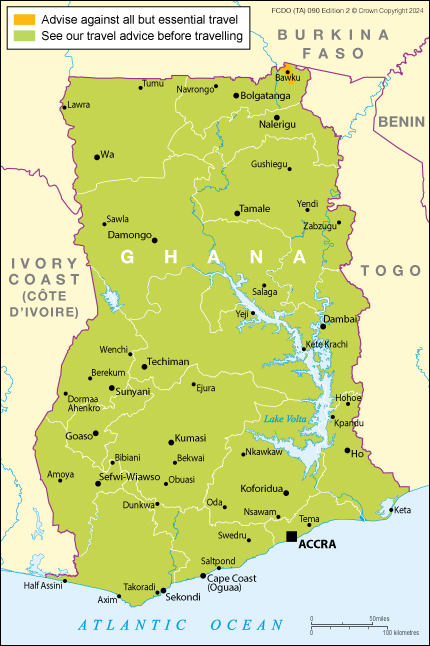
The country is not uniform: 1 region advised against, fully or partly, by at least one official reading. Accra is not one of them.
Faithful summary of the official texts below, which prevail.
the trip stays outside the advised-against regions. Any move into a red or orange region calls for a new, written decision. The areas quoted without a region (border, routes, localities) call for the same decision.
Foreign Office
FCDO advises against all but essential travel to the Bawku Municipal area in the Upper East region of Ghana.
Global Affairs Canada — Advised against — all but essential travel
Avoid non-essential travel to within 25 km of the border with Burkina Faso due to the risk of inter-communal disputes and terrorist activity.
France Diplomatie (in French) — Advised against — all travel
1. A la frontière nord du Ghana avec le Burkina Faso, y compris dans les localités de Tumu, Navrongo et Bawku, où des couvre-feux sont actuellement en vigueur
France Diplomatie (in French) — Advised against — all but essential travel
Parc national de Gbelé au nord-ouest du pays
France Diplomatie (in French) — Advised against — all but essential travel
Compte tenu de la présence de groupes criminels, il est déconseillé de se rendre dans le parc de Gbelé et ses environs.
France Diplomatie (in French) — Advised against — all but essential travel
Zone frontalière avec le Burkina Faso — Compte tenu de la situation sécuritaire au Burkina Faso, et notamment de la présence de cellules terroristes, la frontière ouest du Ghana avec le Burkina Faso est déconseillée sauf raison impérative.
France Diplomatie (in French) — Advised against — all but essential travel
Zone frontalière avec la Côte d’Ivoire — Compte tenu de la présence de cellules terroristes dans le nord-est de la Côte d’Ivoire, notamment dans le parc national de la Comoé, il est déconseillé, sauf raison impérative, de se rendre dans la partie nord-ouest de la zone frontière avec la Côte d’Ivoire.
France Diplomatie (in French) — Advised against — all but essential travel
dans la zone comprise entre le nord-est de Gambaga et le sud de Chunbawso sur une bande de 5 à 10km ;
France Diplomatie (in French) — Advised against — all but essential travel
dans la zone comprise entre Bimbila et la frontière ghanéo-togolaise.
Global Affairs Canada — Open Government Licence – Canada (24.09.2026) · Foreign Office — Open Government Licence v3.0 · France Diplomatie (05.03.2026) · Natural Earth
No located event in this reading.
Last change: Removal of information about flooding in parts of Ghana, including Accra and surrounding areas (‘Warnings and insurance’ page).
Updated 06.07.2026
Exercise increased caution when traveling to Ghana due to crime, poor health infrastructure, violence against women, and violence against lesbian and gay travelers . Some areas have increased risk. Read the entire Travel Advisory.
Crime
Violent crime, such as carjacking, street mugging, assault, and rape occurs in Ghana. These crimes often happen at night and in remote locations. Criminal groups may use blockades to slow down or stop vehicles. Stay aware of your surroundings, especially when walking or driving at night. Do not physically resist any robbery attempt.
Crimes of opportunity, including petty theft, are a serious problem in Ghana. Thieves often target people who seem wealthy or vulnerable. These crimes usually happen at night and in remote places. Always stay aware of your surroundings, especially if you are walking by yourself.
Sexual assault, such as rape, is significantly underreported in Ghana. Domestic violence is a crime in Ghana, but police rarely respond to reports of domestic violence. Female genital mutilation and cutting (FGM/C) and child marriage under the age of 18 is illegal in Ghana. However, both remain a serious problem for girls younger than 18 in some regions.
Poor health infrastructure
Medical infrastructure is limited in Ghana. There are limited emergency medical services outside of Accra. Serious medical emergencies in Ghana require medical evacuation. Make sure your insurance includes medical evacuation coverage.
Violence involving Sexual Orientation
Ghanaian law makes it illegal for people of the same sex to have sexual relationships. This law is mostly enforced against men.
Punishments can include fines or incarceration for up to 3 years. In recent years, there has been more criticism of, and violence against, people because of their sexual orientation. There are also reports of practices pressuring gay and lesbian people to “recant” their identities.
Reconsider travel to the northern border in the Upper East Region, the Northeast Region, the Upper West Region, and areas west of the N12 highway in the Savannah Region due to crime.
Ghana: Cholera Outbreak - Oct 2024ReliefWeb ↗read 15.10.20262025-01-19
Source: ReliefWeb (OCHA), via HDX — CC BY
10-16 0.2 · 10-17 0.2 · 10-18 0.1 · 10-19 0.1 · 10-20 0.1 · 10-21 0.1 · 10-22 0.2 m³/s
Simulated discharge: Open-Meteo.com (CC BY 4.0), data rounded and formatted by Maximum. Contains modified Copernicus Emergency Management Service information 2026. For information only: this is not a flood warning; only national or regional authorities issue those.
The level is national. Risk areas are in the state advisories below.
No major event in progress is located in this country at this morning's check.
Over 1 January 2026 → 30 June 2026, UCDP (Uppsala University) recorded 5 geolocated violent incidents in this country, for 28 documented deaths.
Most affected areas
Upper East region 2 · North East region 1 · Oti region 1 · Bono region 1
Most recent incidents
Source: UCDP Georeferenced Event Dataset (Uppsala Conflict Data Program), file GEDEvent_v26_01_26_06.csv, CC BY 4.0 licence. We keep only incidents UCDP codes as "Clear" and whose location is precise enough to be placed — about 58% of the dataset. An incident may be revised, moved or withdrawn by UCDP in a later release: these figures describe a closed period, not a live situation.
Reading: The homicide rate is 3 times Switzerland's: violence is a real risk there, concentrated in the areas named by the official advisories. On the road, 12 times more deaths than in Switzerland: road crashes are the leading cause of death of healthy travellers (CDC) — seat belt, no night driving, a driver or a taxi from a rank.
World Bank (UNODC for homicides, WHO for roads) — latest published valuedata.worldbank.org ↗read 10.10.2026
What we locate on the map are events in progress that have real coordinates: USGS earthquakes, GDACS disasters, NOAA storms and open NASA EONET events. Hover a dot for details, click to open it in this briefing.
French passport — France Diplomatie
Faithful summary of the official texts below, which prevail.
Some areas of the country are formally advised against.France Diplomatie ↗updated 15.09.2026 · read 15.10.2026
Vigilance areas — France Diplomatie (in French) updated 05.03.2026official map ↗updated 15.09.2026 · read 15.10.2026
-
-
-
-
-
-
-
-
-
-
-
Dernière actualisation le 05/03/2026, information toujours valable à la date du jour
Bien que la majorité du territoire soit en zone de vigilance renforcée (jaune), dans le contexte de l’expansion de la menace terroriste vers le Golfe de Guinée, une vigilance accrue est nécessaire, en particulier dans le nord du Ghana et à la frontière ghanéo-togolaise.
En raison d’activités possibles de cellules armées, il est formellement déconseillé de se rendre :
1. A la frontière nord du Ghana avec le Burkina Faso, y compris dans les localités de Tumu, Navrongo et Bawku, où des couvre-feux sont actuellement en vigueur :
Compte tenu de la présence de groupes criminels, il est déconseillé de se rendre dans le parc de Gbelé et ses environs.
Compte tenu de la situation sécuritaire au Burkina Faso, et notamment de la présence de cellules terroristes, la frontière ouest du Ghana avec le Burkina Faso est déconseillée sauf raison impérative.
Compte tenu de la présence de cellules terroristes dans le nord-est de la Côte d’Ivoire, notamment dans le parc national de la Comoé, il est déconseillé, sauf raison impérative, de se rendre dans la partie nord-ouest de la zone frontière avec la Côte d’Ivoire.
Il est également déconseillé de se rendre, sauf raison impérative :
Le reste du pays est placé en zone de vigilance renforcée. Il convient toutefois d’être particulièrement attentif dans les zones suivantes :
Les heurts entre chefferies, parfois violents, sont récurrents dans le nord-est du pays (Nord Volta, Northern and Upper-East Regions ). Il est conseillé de se renseigner préalablement auprès de l’ambassade de France sur l’état de la situation avant de se rendre dans ces zones.
Dans le Grand Accra (Accra et ses environs), il est recommandé d’éviter de circuler à pied ou en taxi la nuit, dans les quartiers populaires comme Nima ou Jamestown. Dans les rues commerçantes (Osu) et dans les zones résidentielles ( Cantonments, Ridge, Airport Residential, East Legon ), les vols à la tire ou à l’arraché, parfois violents, sont relativement fréquents. D’une manière générale, il est déconseillé de circuler à pied de nuit dans ces quartiers.
Plusieurs vols avec agressions et viols ont été signalés ces dernières années sur la plage de Kokrobite située à 25 km à l’ouest d’Accra, y compris en journée. Il est recommandé de ne pas s’éloigner de la zone des hôtels et restaurants. De manière générale, et particulièrement pour les femmes se déplaçant seules, il est conseillé d’éviter de se rendre sur les plages isolées.
À l’aéroport international d’Accra (KIA) et aux postes-frontières (Ghana-Togo, Ghana-Côte d’Ivoire), il est conseillé de protéger ses documents de voyage et ses bagages. À l’aéroport, il est recommandé de n’accepter l’aide que des porteurs en uniforme munis d’un badge officiel et de n’emprunter que les taxis officiellement répertoriés ou des véhicules commandés via les applications dédiées (qui permettent d’identifier facilement le conducteur).
##…
Dans le contexte de l’évolution de la menace terroriste en Afrique de l’Ouest (attaques au Burkina Faso, au Togo et au Bénin, enlèvement au Bénin, présence de cellules armées en Côte d’Ivoire), il convient d’en tenir compte y compris au Ghana. La surveillance des zones frontalières avec le Burkina Faso, la Côte d’Ivoire et le Togo a été sensiblement renforcée, mais une vigilance accrue est nécessaire, en particulier dans le nord et le centre du pays.
Le sentiment de sécurité au Ghana et la bienveillance des Ghanéens peut amener à réduire sa vigilance. Or des vols, braquages de véhicules, vols à l’arraché, cambriolages, braquages parfois avec violence, sont fréquemment recensés, y compris dans les quartiers résidentiels – en particulier lors de la période des fêtes. Les axes routiers et les lieux fréquentés par les touristes et les personnels expatriés, dans les grandes villes (Accra, Tamale, Takoradi, Kumasi) ou sur les plages, sont également visés.
Plusieurs enlèvements avec demande de rançon ont eu lieu ces dernières années dans les grandes villes du pays. Il est recommandé d’exercer une vigilance renforcée dans les déplacements et la vie quotidienne : séjourner dans un logement sécurisé (avec gardien et barreaudage) et éviter de circuler à pied la nuit.
Le réseau routier est globalement de bonne qualité mais saturé et endommagé par endroits. Les accidents de la route sont fréquents (état variable des routes, comportement risqué de nombreux conducteurs). Il est donc recommandé d’être extrêmement attentif et prudent. La circulation de nuit est particulièrement dangereuse (piétons marchant le long des routes, animaux, véhicules mal éclairés), et donc totalement déconseillée. Quelques attaques à main armée à l’encontre de transports en commun (autobus, « trotros ») ainsi que de véhicules particuliers ont été signalées dans le pays, généralement après la tombée de la nuit, y compris sur les grands axes.
Lors de la saison des pluies (fin avril à fin juillet, puis septembre et octobre), le Ghana peut subir d’importantes inondations.
Le sud-est du pays se trouve dans une zone sismique, même s’il n’a connu aucun tremblement de terre d’importance depuis 1939. La dernière secousse ressentie (4 sur l’échelle de Richter) date du 12 décembre 2022 et n’a entrainé aucun dommage d’ampleur.
Le Ghana est un pays très « cyber-développé ». Les taux de pénétration de la téléphonie et d’internet au Ghana font du cyberespace une zone de criminalité courante, par messages électroniques, réseaux sociaux ou sites de rencontre : arnaques aux sentiments ; propositions frauduleuses d’affaires avec usurpation d’identité. Il est conseillé de ne pas répondre aux messages électroniques douteux et de ne jamais verser d’argent ni communiquer ses références bancaires ou de carte de paiement en cas de sollicitation commerciale ou d’un particulier en détresse alléguée (demande de paiement du billet d’avion, frais d’hospitalisation, frais de caution après une arrestation, etc.). Les personnes saisies de ce type de demande sont invitées à prendre l’attache de l’ambassade de France .
Bien que les eaux territoriales ghanéennes soient éloignées des zones habituelles de piraterie dans le Golfe de Guinée, des attaques, y compris violentes et avec prise d’otages, ne sont plus à exclure au large des côtes. A titre d’exemple, un chalutier ghanéen a été attaqué en mai 2021 au large des côtes du pays. Une prudence toute particulière est donc indispensable, ainsi que l’application stricte des « Bonnes pratiques de conduite » de l’Organisation maritime internationale.
La navigation de plaisance comportant des risques élevés, il convient d’éviter cette zone.
Pour plus d’informations, consulter la fiche thématique Piraterie et brigandage maritimes .
La baignade est dangereuse le long de la côte ghanéenne, en raison des forts courants et marées. Les plages ne sont pas surveillées.
Full text of the Security pagediplomatie.gouv.fr ↗updated 15.09.2026 · read 15.10.2026
Swiss passport — FDFA (Switzerland), in French
Faithful summary of the official texts below, which prevail.
FDFA update note — Ces conseils pour les voyages ont été publiés avec des modifications marginales. L’appréciation de la situation reste valable de manière inchangée. (published 05.08.2026)
Les tensions politiques, sociales et économiques peuvent donner lieu à des manifestations et des grèves. Lors de manifestations, des débordements violents ainsi que des barrages routiers sont possibles. De plus, des personnes ont été blessées ou tuées lors de troubles survenus ponctuellement. En cas de troubles, le gouvernement peut décréter le couvre-feu. Certains indices laissent penser que des groupes terroristes de la zone sahélienne profitent de la porosité des frontières et pourraient également être présents au Ghana. Ils opèrent de part et d’autre des frontières et entretiennent parfois des liens avec des réseaux criminels. Dans ce pays comme ailleurs, le risque d’attentats terroristes ne peut être exclu. Prenez également en considération la rubrique. Terrorisme et enlèvements Avant et pendant le voyage, informez-vous au travers des médias et par le biais de votre tour-opérateur sur la situation sécuritaire actuelle. Tenez-vous à l'écart des manifestations et rassemblements de foule de tout genre et conformez-vous aux directives des autorités locales (couvre-feu, etc.).
La description des zones à risques repose sur des données approximatives; les risques ne peuvent se restreindre à des zones délimitées. Zones rurales: dans les zones rurales, des tensions dues, entre autres, à d’anciennes rivalités entre tribus dégénèrent régulièrement en conflit. Des affrontements violents peuvent se produire. À plusieurs reprises, des personnes ont été tuées et blessées lors de tels actes de violence. En cas de troubles, les autorités peuvent décréter des couvre-feux et prendre d’autres mesures de sécurité dans les endroits concernés. Faites preuve de prudence, en particulier dans les régions Upper West, Upper East, North East, Savannah, Northern, Bono et Bono East. Renseignez-vous avant et pendant le voyage auprès des autorités locales sur la situation actuelle. Conformez-vous aux directives des autorités locales (couvre-feu, etc.) Région frontalière avec le Burkina Faso: Dans les régions Upper West et Upper East, il est déconseillé de se rendre dans la zone frontalière avec le Burkina Faso, qui est à éviter largement. Des bandes armées et des groupes terroristes sévissent au Burkina Faso. Il existe un risque d’attentats et d’enlèvements du côté ghanéen de la frontière. Consultez les informations spécifiques: Risque d’enlèvement dans le Sahara et le Sahel Des conflits liés à des différends traditionnels entre communautés surviennent également. Dans la région de Bawku (Upper East), des affrontements violents opposant différents groupes ethniques se produisent régulièrement. Ils font régulièrement des victimes et des blessés. Les forces de sécurité ont renforcé leur présence dans les zones concernées. Les autorités peuvent décréter à court terme des couvre-feux et d'autres mesures de sécurité.
Les vols à la tire et à l'arraché surviennent surtout dans les villes, sur les plages et à l'aéroport d'Accra. Les vols à l’arraché sont souvent commis par des personnes à moto. En outre, il existe un risque de crime violent, notamment des délits sexuels et des agressions à main armée. Les délinquants suivent parfois les véhicules jusqu’à ce que l’occasion se présente de voler les personnes à bord, ou érigent des barrages routiers pour obliger les victimes à s'arrêter. De temps en temps, des vols et des vols de voitures surviennent lors de l’embarquement ou du débarquement. Les enlèvements avec demande de rançon ont surtout lieu dans les grandes villes. Il est notamment recommandé de prendre les précautions suivantes:
Des escroqueries en provenance d’Afrique de l’Ouest se produisent…
De fortes pluies peuvent survenir. Ces intempéries peuvent provoquer des inondations et des glissements de terrain, pouvant endommager les infrastructures. La circulation peut s’en trouver temporairement perturbée. Des tremblements de terre peuvent survenir occasionnellement, surtout dans le sud du pays. Si une secousse sismique devait se produire durant votre séjour, prenez immédiatement contact avec vos proches et suivez les instructions des autorités locales. En cas d’interruption des communications avec l’étranger, vous pouvez vous mettre en liaison avec l’Ambassade de Suisse à Accra. Ghana Meteorological Agency (GMet) National Disaster Management Organisation
FDFA travel advice, in French, valid on 15.10.2026eda.admin.ch ↗updated 05.08.2026 · read 15.10.2026
British passport — Foreign Office (UK)
Faithful summary of the official texts below, which prevail.
Regions covered by the Foreign Officegov.uk ↗updated 02.07.2026 · read 15.10.2026

Warnings — Foreign OfficeForeign Office ↗updated 02.07.2026 · read 15.10.2026
Your travel insurance could be invalidated if you travel against advice from the Foreign, Commonwealth and Development Office (FCDO).
FCDO advises against all but essential travel to the Bawku Municipal area in the Upper East region of Ghana.
Find out why FCDO advises against travel to Bawku Municipality .
No travel can be guaranteed safe. Read all the advice in this guide. You may also find it helpful to:
If you choose to travel, research your destinations and get appropriate travel insurance . Insurance should cover your itinerary, planned activities and expenses in an emergency.
Regional risks — Foreign OfficeForeign Office ↗updated 02.07.2026 · read 15.10.2026
This section has safety advice for regions of Ghana. It only covers regions where FCDO has specific advice.
You should also read FCDO ’s overall travel advice and safety and security advice .
Civil unrest in specific local regions of Ghana can build up at short notice and may become violent, sometimes involving weapons. Avoid large crowds and political protests. Take local advice if you’re in an area with heightened political tension. Local police may impose curfews to contain the situation. Curfews usually run from 7pm to 5am but times can vary. The authorities may put out a press release which is usually posted on the Ministry of the Interior’s website .
FCDO advises against all but essential travel to the Bawku Municipal area in the Upper East region of Ghana. This is due to the number of violent incidents. The Ghanaian military have deployed additional military to the region to strengthen security.
If you must travel to Bawku, you are strongly advised to contact the regional police headquarters in Bolgatanga town before travelling. Frequent curfews have been put in place in Bawku, with requirements and times changing. Security checks, including roadblocks, are often in effect and you should be prepared to show identification if asked. Be prepared for the security response to change without notice.
Since October there have been a number of attacks related to the conflict in Bawku on the Nasia -Walewale-Bolgatanga road (Northeast) and the Bolgatanga- Zebilla – Bawku – Pulmankom road (Upper East). Many people are arranging police escorts when travelling along these roads. British citizens should take this into consideration including any precautionary measures before deciding to travel along these roads.
In August, tribal conflict broke out in the western part of Savannah Region, near the Cote d’Ivoire and Burkina Faso borders. This has resulted in a number of deaths and displacement of communities. Visitors travelling in that region should keep informed about the situation, seek local advice and take precautions.
Safety — Foreign OfficeForeign Office ↗updated 02.07.2026 · read 15.10.2026
This guide also has safety advice for regions of Ghana .
There is a high threat of terrorist attack globally affecting UK interests and British nationals, including from groups and individuals who view the UK and British nationals as targets. Stay aware of your surroundings at all times.
UK Counter Terrorism Policing has information and advice on staying safe and what to do in the event of a terrorist attack. Find out how to reduce your risk from terrorism while abroad .
Terrorist attacks in Ghana cannot be ruled out. Attacks could be indiscriminate, including in places visited by foreign nationals, such as:
Several terrorist groups operate in neighbouring Burkina Faso near to Ghana’s northern border, including Jama’a Nusrat ul-Islam wa al-Muslimin (JNIM) and Islamic State. JNIM regularly conducts attacks in southern Burkina Faso near to the Ghanaian border. There have also been JNIM attacks in the northern region of Togo, which borders Ghana to the east.
Stay aware of your surroundings, keep up to date with local media reports, and follow the advice of local authorities.
Demonstrations in the capital Accra are normally well policed and peaceful, but sometimes they occur at short notice and can cause disruption. Protests may result in restriction of movement. Follow local media for updates on planned routes.
Disputes can occur between local tribes. This can lead to inter-ethnic violence and civil unrest. Seek local advice and take precautions in areas where political tensions are heightened. If you encounter any type of demonstration or disturbance leave the area quickly and do not attempt to watch or photograph any demonstration or disturbance. See Regional risks .
Cases of robbery, burglary and serious assault have become more common since 2021, and in some cases involve the use of weapons. Foreign nationals have been attacked and robbed at gunpoint. Street crime like pickpocketing and bag-snatching is on the increase in Accra. To reduce your personal risk:
Theft is the main problem at beaches, but there have been isolated incidents of violent crime and sexual assault in areas popular with tourists. Do not visit beaches alone and take care on public beaches.
There are reports of a small number of thefts of luggage and travel documents at Kotoka International Airport. Make sure your passport is always secure and do not leave your bags unattended. Be wary of offers of help except from uniformed porters or officials. All permanent staff at the airport wear an ID card showing their name and a photo. ID cards without a photo are not valid.
If you’re being collected at the airport, confirm the identity of your driver by asking for ID. British nationals have been robbed by impostors who have approached them around the main arrivals area pretending to be their driver.
American passport — U.S. Department of State
Faithful summary of the official texts below, which prevail.
Ghana - Level 2: Exercise Increased Caution 2026-07-06travel.state.gov ↗updated 06.07.2026 · read 16.10.2026
Exercise increased caution when traveling to Ghana due to crime, poor health infrastructure, violence against women, and violence against lesbian and gay travelers . Some areas have increased risk. Read the entire Travel Advisory.
Crime
Violent crime, such as carjacking, street mugging, assault, and rape occurs in Ghana. These crimes often happen at night and in remote locations. Criminal groups may use blockades to slow down or stop vehicles. Stay aware of your surroundings, especially when walking or driving at night. Do not physically resist any robbery attempt.
Crimes of opportunity, including petty theft, are a serious problem in Ghana. Thieves often target people who seem wealthy or vulnerable. These crimes usually happen at night and in remote places. Always stay aware of your surroundings, especially if you are walking by yourself.
Sexual assault, such as rape, is significantly underreported in Ghana. Domestic violence is a crime in Ghana, but police rarely respond to reports of domestic violence. Female genital mutilation and cutting (FGM/C) and child marriage under the age of 18 is illegal in Ghana. However, both remain a serious problem for girls younger than 18 in some regions.
Poor health infrastructure
Medical infrastructure is limited in Ghana. There are limited emergency medical services outside of Accra. Serious medical emergencies in Ghana require medical evacuation. Make sure your insurance includes medical evacuation coverage.
Violence involving Sexual Orientation
Ghanaian law makes it illegal for people of the same sex to have sexual relationships. This law is mostly enforced against men.
Punishments can include fines or incarceration for up to 3 years. In recent years, there has been more criticism of, and violence against, people because of their sexual orientation. There are also reports of practices pressuring gay and lesbian people to “recant” their identities.
Reconsider travel to the northern border in the Upper East Region, the Northeast Region, the Upper West Region, and areas west of the N12 highway in the Savannah Region due to crime.
Global Affairs Canada — additional reading
Exercise a high degree of caution
Avoid non-essential travel to within 25 km of the border with Burkina Faso due to the risk of inter-communal disputes and terrorist activity.
Open Government Licence – Canada · September 24, 2026 08:53 EDTtravel.gc.ca ↗updated 24.09.2026 · read 15.10.2026
Faithful summary of the official texts below, which prevail.
Global Affairs Canada — written for Canadian travellers, valid for all
You must abide by local laws. Learn about what you should do and how we can help if you are arrested or detained abroad.
Penalties for possession, use or trafficking of illegal drugs are severe. Convicted offenders can expect jail sentences and heavy fines. Drugs, alcohol and travel
The Hague Convention on the Civil Aspects of International Child Abduction is an international treaty. It can help parents with the return of children who have been removed to or retained in certain countries in violation of custody rights. It does not apply between Canada and Ghana. If your child was wrongfully taken to, or is being held in Ghana by an abducting parent:
If your child was removed from a country other than Canada, consult a lawyer to determine if The Hague Convention applies. Be aware that Canadian consular officials cannot interfere in private legal matters or in another country's judicial affairs.
Authorities can ask you to show identification at any time. You should carry a photocopy of your travel documents and keep the originals in a secure place.
Gold, diamonds and other precious natural resources are subject to strict import and export regulations. Only agents licensed by the Ghana’s Minerals Commission are authorized to handle import-export transactions of these natural resources. Individuals who commit offences may face prosecution, and penalties include imprisonment.
Smoking is prohibited in public areas. It’s sometimes permitted in private businesses, such as bars or restaurants.
Wearing military clothing or clothing that has military elements is prohibited.
Photography of sensitive installations is prohibited. This includes:
Seek permission before taking photos of official buildings and individuals.
Ghana is a conservative society. To avoid offending local sensitivities:
You must carry an international driving permit. You can use it for up to 12 months. After 12 months, you will need to obtain a Ghanaian license. If you have resident status in Ghana, you should request your Ghanaian license as soon as possible. All cars must be equipped with:
Vehicles with temporary license plates are prohibited from travelling anywhere in Ghana between 6 p.m. and 6 a.m. Vehicles may be seized for the night and fines imposed for non-compliance. International Driving Permit
The currency of Ghana is the Ghanaian cedi (GHS). There are no restrictions on the import and export of foreign currencies. They must be declared upon arrival and exchanged for local currency at banks or foreign exchange bureaus only. Upon arrival, you will receive an Exchange Control Form T-5. If not, you should request it. You must record foreign currency and all transactions made while in the country on this form. The T-5 declaration form must show that the money obtained while in Ghana were from an authorized dealer in foreign exchange. Currency transactions with private citizens are illegal. Keep the form in a safe place to avoid trouble upon departure. The export of cedis is prohibited. Before departure, you must spend unused cedis or reconvert them into foreign currency.
Open Government Licence – Canada · September 24, 2026 08:53 EDTtravel.gc.ca ↗updated 24.09.2026 · read 15.10.2026
Foreign Office — laws and cultural differences
Ghana is a conservative and deeply religious country. Although attitudes are largely modern and progressive, you should show respect for traditional values and morals.
Dress modestly in public. Shorts and t-shirts are acceptable for both males and females, but it is best not to wear anything too revealing. Wearing military clothing including camouflage is illegal.
It is advisable to carry ID. A copy of your passport’s photo page is acceptable. Keep the original in a safe place such as a hotel safe.
The possession of Illegal drugs, including cannabis, carry severe penalties. Bail is not normally granted. You should expect a long jail sentence and heavy fines for possessing, using or smuggling illegal drugs, including when transiting through the airport. Even possession of small amounts of cannabis can lead to a prison sentence of more than 5 years, usually after a long and expensive legal process. Airports in Ghana have excellent technology and security for detecting illegal items. This is also used to scan the baggage of transiting passengers. Class A drugs like cocaine are likely to be laced with other substances. Foreign visitors, including British nationals, have died after taking these drugs.
Photography near sensitive sites like military installations or the airport is illegal. Ask permission if you want to take a photograph of a building where there are guards on duty. Beware of self-appointed officials trying to charge fees to let you take pictures of well-known sites of interest.
Some same-sex sexual acts could lead to a prison sentence of between 3 and 25 years. Although there are no records of this being enforced, there were arrests at a gathering of the LGBT+ community in 2021. Ghanaian society is intolerant of people of the same sex showing affection in public. Many Ghanaians do not accept that such relationships exist. The Human Sexual Rights and Family Values Bill is not law, but its passage through Ghana’s Parliament could increase the risk of violence and other threats (such as blackmail and intimidation) to the LGBT+ community and their allies. Rhetoric by some politicians, religious leaders, and local media can incite violence and psychological abuse of the LGBT+ community. FCDO are aware of reported attacks against LGBT+ individuals. Read more advice for LGBT+ travellers.
Ghanaian family law is very different from UK law, particularly when child custody becomes an issue. Ghana is not a signatory to the Hague Convention. This means:
While ATMs are common in large towns, they may not be available in rural areas. Many hotels, guesthouses and shops accept credit cards except for Mastercard, which is not widely accepted. Check ahead that you can make payment, and have back-up funds. Contact your card issuer before you travel in case they put a block on your account.
Open Government Licence v3.0gov.uk ↗updated 02.07.2026 · read 15.10.2026
FDFA (Switzerland) — laws and customs, in French
Entre autres, sont punissables:
Les infractions à la loi sur les stupéfiants, y compris la détention de quantités minimes de drogue quelle qu'elle soit, sont passibles de longues peines de prison. Les conditions de détention sont précaires.
En particulier dans les régions rurales, le mode de vie reste très marqué par des valeurs traditionnelles. Adaptez votre comportement aux us et coutumes locaux. Les personnes qui affichent en public leur homosexualité sont susceptibles d’être la cible d’agressions. Ne photographiez des personnes ou des groupes de personnes uniquement après avoir obtenu leur accord. Renseignez-vous sur les codes de conduite dans les guides de voyages, auprès de votre agence ou directement sur place.
FDFA travel advice, in Frencheda.admin.ch ↗updated 05.08.2026 · read 15.10.2026
What it changes for you: Air acceptable at this hour: nothing special to plan. Very high UV: sunscreen, hat and shade between 11 am and 4 pm; sunstroke and dehydration are travellers' first reasons to see a doctor.
Reading 05:00 (Africa/Accra)Open-Meteo ↗updated 16.10.2026 · read 16.10.2026
Air quality and UV: Open-Meteo.com (CC BY 4.0), data rounded and formatted by Maximum. Contains modified Copernicus Atmosphere Monitoring Service information 2026. Neither the European Commission nor ECMWF is responsible for any use that may be made of the Copernicus information or data it contains.
No value published by the World Bank in the last eight years for Ghana: hospital beds per 1,000 people.
Reading: With 0.3 physicians per 1,000 people (93% fewer than Switzerland), the nearest hospital does not always have the capacity for a serious case: evacuation to an adequate centre is the rule, not the exception — that is what unlimited evacuation and repatriation cover. Health spending of 70 USD per person (Switzerland: 11,784) goes with private hospitals that bill foreigners in hard currency and ask for a guarantee before admission: the direct payment guarantee is what avoids the deposit.
World Bank — latest published value, year per indicatordata.worldbank.org ↗read 10.10.2026
French passport — France Diplomatie
Faithful summary of the official texts below, which prevail.
-
-
-
-
-
-
-
-
-
-
-
Les ressortissants français qui souhaitent se rendre au Ghana pour un séjour de moins de trois mois doivent demander un visa de court séjour à l’ambassade du Ghana à Paris. Il est impératif d’avoir obtenu son visa avant l’arrivée au Ghana, au risque de se voir immédiatement refuser l’entrée sur le territoire ghanéen. Le tampon d’entrée au Ghana permet un séjour de 60 jours maximum (quel que soit le type de visa, « entrée simple » ou « entrées multiples »). Il est possible d’obtenir une extension du séjour touristique jusqu’à trois mois maximum auprès des services ghanéens de l’immigration à Accra (tel : +233 302 224 445/ +233 302 213 401/ +233 302 226 731 ; info@immigration.gov.gh ; Adresse : Kanda Crescent, Kanda, Accra). Pour un séjour de plus de trois mois, un permis de résidence est exigé. Le dépôt de la demande de visa peut se faire en personne directement auprès de la section consulaire de l’ambassade du Ghana à Paris, après avoir pris rendez-vous sur le portail en ligne.
Depuis le 28 mars 2022, l’ensemble des frontières aériennes, terrestres et maritimes sont à nouveau ouvertes. Les horaires d’ouverture des postes-frontières sont :
Toutes les informations utiles pour effectuer vos démarches sont accessibles aux adresses internet suivantes :
Toutes les mesures de restriction sanitaire pour l’entrée sur le territoire ont été levées.
Au préalable à l’arrivée de l’animal dans le pays, il convient de solliciter auprès des autorités vétérinaires une autorisation d’entrée, à laquelle sera jointe la documentation médicale de l’animal. Une fois validé par ces services, l’original de l’autorisation devra être présenté lors de l’arrivée de l’animal à l’aéroport. A défaut, une quarantaine de 15 jours sera en principe imposée.
Une assistance pour l’obtention des certificats nécessaires peut être trouvée auprès des sociétés spécialisées présentes à Accra (ex : VET PLACE, Achimota, Accra, Tel : +233 30 397 2668) – info@thevetsplaceghana.net ; thevetsplace@gmail.com ; Worldwide Movers, +233 302 971 258).
Entry and stay pagediplomatie.gouv.fr ↗updated 15.09.2026 · read 15.10.2026
Swiss passport — FDFA (Switzerland)
The FDFA does not publish entry requirements: they are set out by the destination's embassy or consulate in Switzerland — check them before booking, passport in hand. As a guide, the French and British requirements below describe the same rules as seen by two other governments.eda.admin.ch ↗updated 05.08.2026 · read 15.10.2026
British passport — Foreign Office (UK)
Faithful summary of the official texts below, which prevail.
Entry requirements — rules for a British passportForeign Office ↗updated 02.07.2026 · read 15.10.2026
This information is for people travelling on a full ‘British citizen’ passport from the UK. It is based on the UK government’s understanding of Ghana’s current rules for the most common types of travel.
The authorities in Ghana set and enforce entry rules. If you’re not sure how these requirements apply to you, contact the Ghana High Commission in the UK .
To enter Ghana, your passport must have an expiry date at least 6 months after the date you arrive.
Check with your travel provider that your passport and other travel documents meet requirements. Renew your passport if you need to.
You will be denied entry if you do not have a valid travel document or try to use a passport that has been reported lost or stolen.
When returning to the UK, British citizens must carry a valid British passport or certificate of entitlement . See Dual citizenship .
You must have a visa to visit Ghana.
Complete the online visa application form on the Ghana High Commission website and make the online payment.
You need to upload your supporting documents (including a yellow fever certificate) and provide hard copies. Print out the form, add supporting documents and send them by post as directed on the website. The visa processing time is 10 to 15 days.
To get a visa in around 3 days, check if you can use the express service available in person from the Ghana Premium Application Centre in London .
To extend your stay, take the visa extension form and photos in person to the Ghana Immigration Service (GIS) office on Independence Avenue in Accra.
To enter Ghana, you must have a certificate to prove you’ve had a yellow fever vaccination.
For full details about health entry requirements and recommended vaccinations, see TravelHealthPro’s Ghana guide .
If you live in Ghana, you must register with the National Identification Authority (NIA) of Ghana and get a non-citizen Ghana card . You must register all foreign nationals aged 6 years and above in your family who are either:
There are strict rules about goods you can take into or out of Ghana . You must declare anything that may be prohibited or subject to tax or duty.
You must declare all hard currency, using the declaration form provided on arrival. You can bring in up to a maximum Ghanaian cedi equivalent of 10,000 US dollars.
Do not carry more than 10,000 dollars in value in any foreign currency. The Ghanaian authorities can confiscate the entire amount if you are carrying cash of this value or more.
Ghana recognises dual nationality. Ghanaian-British dual nationals can register with the Interior Ministry in Ghana and get a dual nationality card. You can produce this card when entering Ghana to show that you do not need a visa.
American passport — U.S. Department of State
The State Department publishes the requirements ("Entry, Exit and Visa Requirements") on its country page, which our servers cannot read. Read it before you go; as a guide, the French and British requirements below describe the same rules as seen by two other governments.travel.state.gov ↗updated 06.07.2026 · read 16.10.2026
For each risk, the official texts themselves: what is happening, then, where they say so, what to do.
What the texts say · Cases of robbery, burglary and serious assault have become more common since 2021, and in some cases involve the use of weapons.
What the texts say · Attacks on vehicles are increasing, sometimes involving the use of weapons. There have been isolated incidents of crime taking place in all types of taxis, including licensed taxis, minibuses (‘tro tros’) and app-based taxi services.
What the texts say · Heavy rainfall can also cause flooding in other parts of Ghana, including urban areas such as Accra and its surroundings. Earthquakes and tremors are a risk in Ghana.
What the texts say · Some same-sex sexual acts could lead to a prison sentence of between 3 and 25 years. Wearing military clothing including camouflage is illegal.
What the texts say · Credit card and ATM fraud is widespread. Warn your friends and family to be sceptical if they’re asked to transfer funds to you in Ghana.
What the texts say · Demonstrations in the capital Accra are normally well policed and peaceful, but sometimes they occur at short notice and can cause disruption.
Sentences copied word for word from the official texts cited, chosen for the destination; the level is our reading. The full texts, at each source:Foreign Office ↗updated 02.07.2026 · read 15.10.2026 (updated 02.07.2026 · read 27.09.2026)Global Affairs Canada ↗updated 24.09.2026 · read 15.10.2026 (updated 24.09.2026 · read 27.09.2026)
Reading: The homicide rate is 3 times Switzerland's: violence is a real risk there, concentrated in the areas named by the official advisories. On the road, 12 times more deaths than in Switzerland: road crashes are the leading cause of death of healthy travellers (CDC) — seat belt, no night driving, a driver or a taxi from a rank.
World Bank (UNODC for homicides, WHO for roads) — latest published valuedata.worldbank.org ↗read 10.10.2026
Time zone: IANA and timezone-boundary-builder (ODbL) · RESTCountries · EmergencyNumberAPI · Wikidata · European Central Bank
Places: © OpenStreetMap contributors (ODbL), Photon search by komoot.
FDFA (Switzerland) — transport and specific advice, in French
En-dehors du centre des grandes villes, les routes sont souvent en mauvais état. Le risque d'accidents est élevé, même en voyageant en autocar. Les accidents de la route font chaque année de nombreuses victimes, en raison d’une conduite dangereuse et du mauvais entretien technique de nombreux véhicules. Si vous êtes impliqué dans un accident et que vous ne pouvez pas résoudre l'affaire sur place, allez directement au poste de police le plus proche. La nuit, renoncez aux déplacements à travers le pays. Les standards de sécurité des moyens de transports publics et des taxis ne correspondent pas aux normes européennes. Il arrive que les passages de frontières soient temporairement fermés à court terme, par exemple afin d’endiguer la propagation de maladies. Informez-vous auprès des autorités locales ou directement auprès des postes-frontières. Des pénuries d’électricité surviennent parfois.
FDFA travel advice, in Frencheda.admin.ch ↗updated 05.08.2026 · read 15.10.2026
Maximum policyholder: before paying anything, call the 24/7 number. If you are admitted for more than 24 h, Maximum sends its direct payment guarantee to the hospital (art. 2.12).
+41 22 ••• •• •• — Full number in your client areaNone of these facilities is a Maximum Insurance “partner”, and none is presented as waiving upfront payment: this list is a reading of public map data, nothing more. A direct payment guarantee is arranged CASE BY CASE by our assistance desk, facility by facility and when the need arises — one number, +41 22 ••• •• ••.
List read from OpenStreetMap on 09.10.2026, not read again since: these facilities may have changed.
CDC Travelers' Health recommendations, most important first. They depend on your age, vaccines and itinerary: confirm them with a doctor or a travel clinic 4 to 6 weeks before departure. Details, disease by disease ↗cdc.gov ↗read 10.10.2026
The health system — With 0.3 physicians per 1,000 people (93% fewer than Switzerland), the nearest hospital does not always have the capacity for a serious case: evacuation to an adequate centre is the rule, not the exception — that is what unlimited evacuation and repatriation cover. Health spending of 70 USD per person (Switzerland: 11,784) goes with private hospitals that bill foreigners in hard currency and ask for a guarantee before admission: the direct payment guarantee is what avoids the deposit.
Back home — a fever in the following weeks should be told to a doctor, naming the country.
Forecast: MET Norway (Norwegian Meteorological Institute, CC BY 4.0), grouped by day and formatted by Maximum.
French passport — French embassy and consulates
4th Circular Road, Accra
Useful contacts listed by France Diplomatie (in French)diplomatie.gouv.fr ↗updated 15.09.2026 · read 15.10.2026
Updated: 15 September 2026
OpenStreetMap
Swiss passport — Swiss embassy and consulates
Accra
phone not published
https://www.eda.admin.ch/accra ↗updated 05.08.2026 · read 15.10.2026
Numéro d'urgence général: 112 ou 999 Numéro d'urgence police: 191 Numéro d'urgence pompiers: 192 Numéro d'urgence ambulance: 193 Représentations suisses à l’étranger: En cas de situation d’urgence à l’étranger, vous pouvez vous adresser à la représentation suisse la plus proche ou à la Helpline DFAE. Ambassade de Suisse au Ghana Helpline DFAE Représentations étrangères en Suisse: Pour obtenir des informations sur les prescriptions d'entrée (documents d'identité admis, visa, etc.), veuillez-vous adresser aux ambassades et consulats étrangers compétents. Ceux-ci peuvent également vous renseigner sur les dispositions douanières pour l'importation et l'exportation d'animaux et de marchandises: appareils électroniques, souvenirs, médicaments, etc. Représentations étrangères en Suisse eVisa
OpenStreetMap · DFAE
British passport — British embassy and consulates
Julius Nyerere Link, 00233, Accra
phone not published
https://www.gov.uk/world/organisations/bri ↗updated 02.07.2026 · read 15.10.2026
OpenStreetMap
American passport — U.S. embassy and consulates
4th Circular Road
+233 (0) 30 274 1000
https://gh.usembassy.gov ↗updated 06.07.2026 · read 16.10.2026
OpenStreetMap
OpenStreetMap
Getting help — Foreign OfficeForeign Office ↗updated 02.07.2026 · read 15.10.2026
The Foreign, Commonwealth & Development Office ( FCDO ) cannot provide tailored advice for individual trips. Read this travel advice and carry out your own research before deciding whether to travel.
Telephone:
Contact your travel provider and your insurer if you are involved in a serious incident or emergency abroad. They will tell you if they can help and what you need to do.
See how to get help from the UK government abroad including in an emergency.
You can call FCDO in London if you need urgent help because something has happened to a friend or relative abroad.
Telephone: 020 7008 5000 (24 hours)
Find out about call charges
English is an official language in Ghana: no translated phrases here.
Actions to take before each professional trip abroad.
Live alerts and level changes, each with its official source. Continuously updated.
Health – editorial change
September 24, 2026 08:53 EDTtravel.gc.ca ↗updated 24.09.2026 · read 15.10.2026No level change recorded for this country since the log opened. The live alerts above are updated continuously.
Level 2/4 — Exercise Increased Caution, U.S. Department of State, retrieved on 16 October 2026.
Sourcestravel.state.gov · updated 06.07 · read 16.10France Diplomatie · updated 15.09 · read 15.10DFAE · updated 05.08 · read 15.10207-country comparison
An area advised against does not rule out the country.
SourcesFrance Diplomatie · updated 15.09 · read 15.10Foreign Office · updated 02.07 · read 15.10State Department · updated 06.07 · read 16.10
The rules depend on the passport, not on the destination alone.
SourcesFrance Diplomatie · updated 15.09 · read 15.10Foreign Office · updated 02.07 · read 15.10State Department · updated 06.07 · read 16.10
For a Schengen visa, yes: at least €30,000 of travel medical insurance (Regulation (EC) No 810/2009, art. 15).
SourcesRegulation (EC) 810/2009, art. 15General conditions, policy 20 00 479
VIP Pack — €990 for twelve months, unlimited trips.
SourcesGeneral conditions, policy 20 00 479OpenStreetMap · read 14.10
Six steps, in this order.
SourcesSpecial conditions 01.26General conditions, policy 20 00 479
Local emergency services: single number 999 · police 191 · ambulance 193 · fire 192
SourcesEmergencyNumberAPI · Wikidata · read 08.10OpenStreetMap · read 14.10
At today's level 2/4, card by card:
SourcesAmex Platinum France T&Cs, 01.2025 — general exclusion n° 11BNP Paribas Visa Infinite notice (policy PT7), 04.2025 — comFortuneo World Elite Mastercard notice, 01.2026 — art. 5.5 '
A health plan reimburses at home; here, the hospital asks for a payment guarantee before admission.
SourcesGeneral conditions, policy 20 00 479
Around Accra: 80 hospitals and clinics, 48 with a 24/7 emergency room, 40 pharmacies, 40 doctors' practices (OpenStreetMap, hospital list read on 09.10.2026).
The sourced detail is under Medical network › Health: vaccines, diseases present, altitude, outbreaks.
SourcesCDC Travelers' Health · read 10.10France Diplomatie · updated 15.09 · read 15.10OMS · read 15.10Foreign Office · updated 02.07 · read 15.10
0.3 physicians per 1,000 people (2023) versus 4.5 in Switzerland.
SourcesWorld Bank · read 10.10General conditions, policy 20 00 479
1.8 homicides per 100,000 people (2022) versus 0.6 in Switzerland and 1.3 in France.
The nearest representations, by passport (OpenStreetMap):
SourcesOpenStreetMap · read 14.10DFAE · updated 05.08 · read 15.10
1 region advised against, fully or partly, by at least one official reading.
SourcesGlobal Affairs Canada · updated 24.09 · read 15.10Foreign Office · updated 02.07 · read 15.10France Diplomatie · updated 15.09 · read 15.10
Local laws apply to every traveller; here is what the official texts say.
SourcesGlobal Affairs Canada · updated 24.09 · read 15.10Foreign Office · updated 02.07 · read 15.10
Every foreign ministry runs a 24/7 emergency line for its nationals.
Sourcesdiplomatie.gouv.fr · updated 15.09 · read 15.10eda.admin.ch · updated 05.08 · read 15.10
Keep the entry stamp, the invoices, the prescriptions and the medical report.
SourcesGeneral conditions, policy 20 00 479
Cancellation or change up to EUR 20,000, special risk EUR 5,000 per person, crisis management and security, optional Kidnap & Ransom.
SourcesGeneral conditions, policy 20 00 479
A question not answered here? Ask Maximum below, or call the support number: every question gets a clear, actionable answer.
In a life-threatening emergency, call local emergency services first, then Maximum: +41 22 ••• •• •• — 24/7 support number, an adviser stays with you to the end.
The 207 country pages — hospitals, pharmacies, police, embassies, emergency numbers, official advice from four governments, health, safety in figures, events in progress — read around the city you name. Your policy — benefits, the six steps, claims, articles. The site — prices, certificate, subscription. Nothing else: what it does not know, it says so and hands you to an adviser.
Same advisory level: Congo · Costa Rica · Cuba · Ivory Coast · Denmark · Djibouti
The displayed level comes from the State Department, checked every morning. Before departure, always cross-check your country of residence's advisory: that is what your policy cites.
The level shown is the official U.S. Department of State level, checked daily. Maximum Insurance is an insurance distributor — general information, not personal advice.
The destination is already Accra. A few choices, then the reading of your cover, here.
Destination · Accra
Travel Insurtech. 24/7 worldwide.
Swiss insurer · Worldwide medical network