Make sure you are up-to-date on all routine vaccines before every trip. Some of these vaccines include Chickenpox (Varicella) Diphtheria-Tetanus-Pertussis (DTaP, Tdap, or Td) Flu (influenza) Measles-Mumps-Rubella (MMR) Polio Shingles
Maximum Alerts / Mozambique
Level published by the State Department on 20.08.2026 · read 16 October 2026 · source checked daily
Mozambique — official level as of 16 October 2026: Level 2/4 ("Exercise Increased Caution"), from the U.S. Department of State. Maximum Insurance covers this country: hospital settled directly, unlimited repatriation, EUR 1.5M, certificate on payment.
Every country has its own scale, so we ask them all the same question: is the whole country advised against?
An advisory covering only areas of the country does not raise the answer: it stays “No”, and the area is shown in the relevant column.
The level shown on this page — and across this site — is the one published by the U.S. State Department, from 1 (normal precautions) to 4 (do not travel). France and the United Kingdom publish their own advisories, with their own rules: they add to that level, they do not replace it.
You will be alerted only on the day the official level of this country changes.
29 recorded incidents (UCDP)hover, click to open it in the briefing
In a life-threatening emergency, call local emergency services first, then Maximum: +41 22 ••• •• •• — 24/7 support number, an adviser stays with you to the end.
The 207 country pages — hospitals, pharmacies, police, embassies, emergency numbers, official advice from four governments, health, safety in figures, events in progress — read around the city you name. Your policy — benefits, the six steps, claims, articles. The site — prices, certificate, subscription. Nothing else: what it does not know, it says so and hands you to an adviser.
What I say on the phone
What to do, in this order
In immediate danger, call local emergency services first. Then contact assistance without delay; before engaging a service, seek approval under your policy. Cover is confirmed by the insurer.
Ask assistance where to get care and whether direct cover can be arranged. It confirms the facility and seeks the insurer's approval under your policy. In immediate danger, call local emergency services first.
Even for a pain you meant to shrug off. Without a medical certificate written on the spot, the same day, the insurer cannot cover the event — a certificate written after you return does not count.
The hospital desk sends the request to assistance. Direct payment depends on the insurer's approval and the policy; the call alone does not guarantee it. Have the response confirmed before relying on no up-front payment.
In a life-threatening emergency, call local emergency services immediately. For an arranged transfer or repatriation, contact assistance: the insurer's medical team decides on measures under the policy. A medical flight booked without approval may not be reimbursed.
Even if everything went well on the ground. Send your invoices and the medical report within 30 days; after that, compensation may be reduced or refused.
Reading hospitals, doctors and pharmacies around this point…
List read from OpenStreetMap on 14.10.2026, not read again since: these facilities may have changed.
Country dial code: +258
OpenStreetMap list read on 14.10.2026, straight-line distances. In an emergency: +41 22 ••• •• ••.
near Av. Patrice Lumumba
382 Avenida 24 de Julho
Mo-Fr 07:00-198:00
Av. Agostinho Neto
Avenida Karl Marx
24/7
637 Av. Mao Tsé Tung Maputo
1156 Avenida Patrice Lubumba Maputo
763 Avenida Karl Marx
222/226 Av. Mao Tsé Tung Maputo
near Av. Vladimir Lenine
Avenida Karl Marx
Avenida Karl Marx
Avenida Julius Nyerere
11 Avenida Julius Nyerere
Avenida Karl Marx
near Rua da Goa
Avenida Eduardo Mondlane
Mo-Fr 08:00-18:30; Sa 08:00-14:30
near Rua do Comandante Baeta Neves
near Avenida 24 de Julho
4649 Avenida Vladimir Lenine
Mo-Su 08:00-20:45
near Rua B
near Rua Her-is de Angola
near R. Eng. Carlos Morgado
near Av. Amaral Matos
near Luis Cabral
near Rua 4.665
near Rua dos Caminhos de Ferro de Moçambique
Avenida da Marginal Maputo
24/7
Rua 5343 Maputo
near Av. Cardeal dos Santos
near Av. de Moçambique
near Rua do Brado Africano
Avenida Mao Tsé Tung
303 Avenida Eduardo Mondlane Maputo
Rua 1.301
Mo-Fr 08:30-15:00
833 Rua dos Desportistas
Mo-Fr 09:00-17:00
1128 Av. Julius Nyerere Maputo
1162 Avenida Julius Nyerere Maputo
760 Avenida Julius Nyerere
720 / 730 Av. Julius Nyerere Maputo
Mo-Fr 08:00-12:30, 13:30-17:00
762 Avenida Keneth Kaunda Maputo
347 Rua Damião de Góis
near Rua António Simbine
94 John Issa
Mo-Fr 07:30-15:30
33 Rua John Issa Maputo
Av. Fernão Magalhães, 88 Maputo
24/7
Avenida Fernão de Magalhães Cidade de Maputo
Mo-Fr 08:00-15:30
near Rua da Goa
near Praça da Munhuana
Avenidas das Forças Populares de Libertação de Moçambique (FPLM)
24/7
Rua Augusto Macamo
near Av. 19 de Outubro
near Rua A
near Rua 4.119
near Rua Major General Cândido Mondlane (Dona Alice)
near Av. Albert Lithuli
near R. Eng. Carlos Morgado
near Avenida de Moçambique
Av.Julius Nyerere
Forecast: MET Norway (Norwegian Meteorological Institute, CC BY 4.0), grouped by day and formatted by Maximum.
No geolocated event in this country at this reading.
29 incidents recorded in the country, all pinned on the map above (zoom out) — the 29 closest to Maputo are listed here, nearest first.
Source: UCDP — GEDEvent_v26_01_26_06.csv. Closed period, Clear coding, precise location.
No news located around Maputo in this reading.
National numbers (Wikidata, 2026 reading). On site, call local emergency services first, then Maximum: the insurer sends its payment guarantee to the hospital.
Make sure you are up-to-date on all routine vaccines before every trip. Some of these vaccines include Chickenpox (Varicella) Diphtheria-Tetanus-Pertussis (DTaP, Tdap, or Td) Flu (influenza) Measles-Mumps-Rubella (MMR) Polio Shingles
All eligible travelers should be up to date with their COVID-19 vaccines. Please see Your COVID-19 Vaccination for more information.
Active cholera transmission is widespread in Mozambique. Cholera is rare in travelers. Certain factors may increase the risk of getting cholera or having severe disease ( more information ). Avoiding unsafe food and water and washing your hands can also help prevent cholera. Vaccination may be considered for children and adults who are traveling to areas of active cholera transmission.
Recommended for unvaccinated travelers one year old or older going to Mozambique. Infants 6 to 11 months old should also be vaccinated against Hepatitis A. The dose does not count toward the routine 2-dose series. Travelers allergic to a vaccine component should receive a single dose of immune globulin, which provides effective protection for up to 2 months depending on dosage given.
Recommended for unvaccinated travelers of all ages traveling to Mozambique.
CDC recommends that travelers going to Mozambique take prescription medicine to prevent malaria. Depending on the medicine you take, you will need to start taking this medicine multiple days before your trip, as well as during and after your trip. Talk to your doctor about which malaria medication you should take. Transmission areas All Drug resistance 1 Chloroquine Species P. falciparum (primarily) P. malariae , P.
Cases of measles are on the rise worldwide. Travelers are at risk of measles if they have not been fully vaccinated at least two weeks prior to departure, or have not had measles in the past, and travel internationally to areas where measles is spreading.
Monkeypox vaccination is recommended for any adult who anticipates any of the following activities during travel: Sexual or intimate contact with a new partner Sexual or intimate contact at a commercial sex venue, like a sex club or bathhouse Sexual or intimate contact in exchange for money, goods, drugs, or other trade Sexual or intimate contact in association with a large public event, such as a rave, party, or…
Dogs infected with rabies are commonly found in Mozambique. Rabies is also present in some terrestrial wildlife species. If rabies exposures occur while in Mozambique, rabies vaccines may only be available in larger suburban/urban medical facilities.
Recommended for most travelers. Typhoid vaccine is not 100% effective. Practicing safe food and water habits , including washing hands at key times , can also help prevent typhoid fever .
CDC recommendations: Vaccine is not recommended. Country entry requirements: Direct travel from United States: Vaccine is not required. Travel from countries with risk for YF virus transmission: Vaccine is required for travelers ≥1 year old; this includes >12-hour airport transits or layovers in countries with risk for YF virus transmission. 3 Updated April 23, 2025 See footnotes
CDC Travelers' Health, re-read weekly — the recommendation depends on your age, vaccines and itinerary: confirm it with a doctor or a travel clinic 4 to 6 weeks before departure.CDC ↗read 10.10.2026
High incidence: a long stay or time in care settings warrants a test on return.
Coverage too low to stop the virus circulating: check your two MMR doses before leaving.
Strong transmission: discuss preventive treatment with a doctor before leaving; bed net and repellent on site.
World Bank — latest published valuedata.worldbank.org ↗read 10.10.2026
Source: France Diplomatie (health advice, in French).
Faithful summary of the official texts below, which prevail.
WHO: no outbreak reported for this country in the last 24 months (Disease Outbreak News).who.int ↗read 15.10.2026
FDFA (Switzerland) — medical care, in French
Les soins médicaux sont mauvais et ne correspondent pas aux standards européens. Des pénuries de médicaments et d'autres biens médicaux sont possibles. Les hôpitaux privés exigent un paiement d'avance avant de commencer un traitement. En cas de maladie ou de blessure grave, il faut se faire soigner hors du pays (Afrique du Sud ou Europe). Si vous prenez régulièrement des médicaments , emportez-en une quantité suffisante avec vous. Notez toutefois que de nombreux pays appliquent des réglementations restrictives. Cela vaut en particulier, mais pas exclusivement, pour les médicaments contenant des stupéfiants (par exemple la méthadone) et les substances utilisées pour le traitement des troubles psychiques. Avant votre départ, renseignez-vous directement auprès de la représentation étrangère compétente (ambassade ou consulat) et consultez la rubrique Liens voyages , où vous trouverez de plus amples informations sur ce sujet ainsi que sur la médecine du voyage en général. Les informations concernant la propagation de maladies et les éventuelles mesures de protection à prendre sont fournies par le personnel médical et les centres de vaccination. Liens voyages
France Diplomatiesource ↗updated 11.03.2026 · read 15.10.2026
Consulter si besoin son médecin traitant ou un centre de vaccinations internationales (médecine des voyages) pour faire une évaluation de son état de santé et bénéficier de recommandations sanitaires, notamment sur les vaccinations. Consulter éventuellement son dentiste avant le départ.
Constituer sa pharmacie personnelle en conséquence et n’emporter dans ses bagages que les médicaments strictement nécessaires ; ne jamais consommer de médicaments achetés dans la rue (risque de contrefaçons). Les médicaments doivent être dans leur emballage d’origine avec les étiquettes originales, accompagnés d’une ordonnance portant le nom des médicaments en dénomination commune internationale (DCI). Il est indispensable de vérifier que les médicaments concernés sont autorisés dans le pays visité : pour plus d’informations, consulter la fiche Informations pratiques .
Les vaccins recommandés en France sont également indispensables lors d’un séjour à l’étranger : les maladies qu’ils préviennent circulent partout dans le monde, parfois même plus fréquemment qu’en France. Avant tout départ, le voyageur (adulte et enfant) doit donc d’abord s’assurer d’être à jour du calendrier vaccinal français, en particulier des vaccins contre la diphtérie, le tétanos, la poliomyélite, la coqueluche mais aussi contre la rougeole. Le carnet de vaccination peut être demandé à l’arrivée de certains pays.
Voyager avec son carnet de vaccinations, qui peut être demandé et contrôlé lors du passage de la frontière à l’aéroport.
Des vaccinations complémentaires peuvent être nécessaires :
-…
La chikungunya est une maladie virale transmise par l’intermédiaire de moustiques infectés. Cette maladie se manifeste par l’apparition de symptômes grippaux (fièvre, douleurs musculaires et articulaires). En cas de signes cliniques, il est impératif de consulter immédiatement un médecin ; le traitement est uniquement symptomatique. Les moyens de prévention reposent sur la vaccination et la protection contre les piqûres de moustiques. Il est conseillé avant le départ de se référer à son médecin traitant et/ou à un centre de vaccination internationale.
Pour plus d’informations , consulter la rubrique risques sanitaires .
La dengue est une maladie virale transmise par piqûres de moustiques. Les symptômes sont de type grippal (fièvre, maux de tête, courbatures, parfois éruption cutanée). En cas de signes cliniques, il est impératif de consulter immédiatement un médecin. Il n’existe pas de traitement curatif. La prise en charge médicale repose uniquement sur le traitement des symptômes. Il faut impérativement éviter la prise d’anti-inflammatoire. La prévention individuelle repose essentiellement sur les moyens de protection contre les piqûres de moustiques. La vaccination des voyageurs peut être indiquée dans certains cas. Il est conseillé de se référer, avant son départ, à son médecin traitant et /ou à un centre de vaccination internationale.
Pour plus d’informations, consulter le site du ministère de la Santé et le site de l’Organisation mondiale de la Santé .
Il s’agit d’une maladie virale transmise par piqûres de moustiques. Les symptômes sont variables, allant du syndrome pseudo-grippal (fièvre, frissons, douleurs musculaires, maux de tête…) à des formes plus graves (vomissements de sang, jaunisse, convulsions, coma…)…
Le choléra est une infection digestive bactérienne qui se transmet par ingestion d’aliments mal cuits (fruits de mer, par exemple) ou souillés (fruits et légumes) et/ ou ingestion d’eau contaminée. Cette maladie, dite « des mains sales », se traduit par des troubles digestifs sévères (diarrhée liquide abondante, crampes abdominales, vomissements), un état de faiblesse générale et parfois de la fièvre.
La prévention repose sur la vaccination et le respect des règles d’hygiène alimentaire (se laver régulièrement les mains, ne consommer que de l’eau en bouteille, peler les fruits et légumes, manger de la nourriture cuite ; utilisation des installations sanitaires). Les personnes présentant les signes de la maladie doivent consulter un médecin en urgence.
Pour plus d’informations, consulter le site Santé publique France et le site du ministère de la Santé .
Il existe un risque de contamination dans les banlieues et les régions les plus défavorisées et isolées, avec des poussées cycliques en particulier dans la province de Sofala (Beira), de Maputo et à Nampula. Le choléra est une infection digestive bactérienne qui se transmet par ingestion d’aliments mal cuits (fruits de mer, par exemple) ou souillés (fruits et légumes) et ingestion d’eau contaminée.
La fièvre typhoïde est une maladie infectieuse causée par des bactéries présentes dans l’eau contaminée par des matières fécales d’origine humaine. L’infection résulte le plus souvent de l’ingestion d’eau ou d’aliments contaminés, ou d’une transmission directe de personne à personne. Les symptômes surviennent en moyenne 3 semaines après la contamination et associent fièvre, maux de tête, perte d’appétit, douleurs abdominales avec diarrhée ou constipation, fatigue et parfois, éruption…
Pour plus d’informations, consulter le site du ministère en charge de la Santé et le site de l'Assurance Maladie .
Pour plus d’informations, consulter le site du ministère en charge de la Santé .
Health — Foreign OfficeForeign Office ↗updated 20.08.2026 · read 15.10.2026
Before you travel check that:
This is particularly important if you have a health condition or are pregnant.
Mozambique is currently experiencing a cholera outbreak in central and northern areas of the country. See information on cholera .
Call 848888 or 823388 and ask for an ambulance.
Contact your insurance company quickly if you’re referred to a medical facility for treatment.
At least 8 weeks before your trip:
See what health risks you’ll face in Mozambique including:
The legal status and regulation of some medicines prescribed or bought in the UK can be different in other countries.
Read best practice when travelling with medicines on TravelHealthPro .
FCDO has a list of medical providers in Mozambique where some staff will speak English.
Hospital facilities are of a lower standard compared to the UK, especially in the north of the country. In cases of serious illness or injury, medical evacuation to South Africa or the UK may be necessary.
Make sure you have adequate travel health insurance and accessible funds to cover the cost of any medical treatment abroad and repatriation.
Read FCDO guidance on travel and mental health . There is also mental health guidance on TravelHealthPro .
Places read from OpenStreetMap, within a circle of about 12 km: phone, email, address, website and hours when the source publishes them. No customer reviews, that source has none. Straight-line distances.
Notices vary by bank and vintage — yours prevails. On the right: the Maximum contract (public documents).
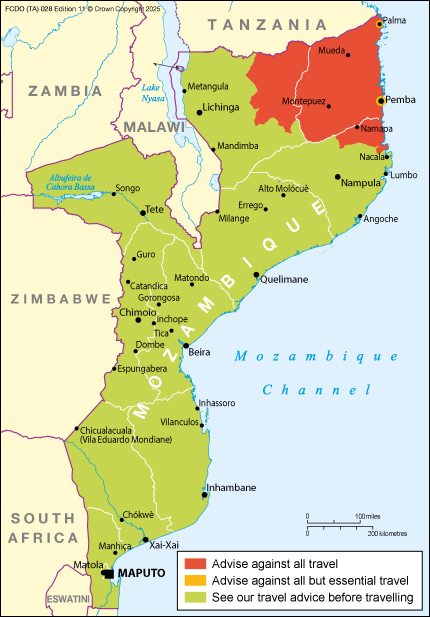
The country is not uniform: 3 regions advised against, fully or partly, by at least one official reading. Maputo is not one of them.
Faithful summary of the official texts below, which prevail.
“(France Diplomatie)”: the level comes from its text, in French, quoted below region by region.
the trip stays outside the advised-against regions. Any move into a red or orange region calls for a new, written decision.
Global Affairs Canada
Avoid all travel to to Cabo Delgado Province due to ongoing insurgency by militants.
Foreign Office
FCDO advises against all travel to Cabo Delgado Province, except for Palma town and the area around Pemba and Afungi.
France Diplomatie (in French)
Par conséquent, il est formellement déconseillé de se rendre dans l’ensemble de la province du Cabo Delgado, y compris son chef-lieu Pemba, ainsi que dans le tiers Est de la province du Niassa et le long de la frontière avec la Tanzanie, jusqu’au Malawi.
France Diplomatie (in French)
les districts de Nacala (Sud), Monapo (Sud), Mossuril, Muecate (Nord), , Nampula (Sud), Ribaue et Malima (y compris les villes de Nampula et Nacala) dans la province de Nampula.
Foreign Office
FCDO advises against all travel to the districts of Memba and Eráti in Nampula Province.
Foreign Office
FCDO advises against all travel to the districts of Mecula and Marrupa in Niassa Province.
France Diplomatie (in French)
Par conséquent, il est formellement déconseillé de se rendre dans l’ensemble de la province du Cabo Delgado, y compris son chef-lieu Pemba, ainsi que dans le tiers Est de la province du Niassa et le long de la frontière avec la Tanzanie, jusqu’au Malawi.
Global Affairs Canada — Advised against — all travel
Erati
Global Affairs Canada — Advised against — all travel
Memba
Global Affairs Canada — Advised against — all but essential travel
Marrupa
Global Affairs Canada — Advised against — all but essential travel
Mecula
Global Affairs Canada — Advised against — all but essential travel
Avoid non-essential travel to Pemba City due to the risk that the insurgency expands to this area.
France Diplomatie (in French) — Advised against — all but essential travel
Des incursions djihadistes ont eu lieu dans les provinces limitrophes de Niassa et de Nampula.
Global Affairs Canada — Open Government Licence – Canada (15.10.2026) · Foreign Office — Open Government Licence v3.0 · France Diplomatie (11.03.2026) · Natural Earth
No located event in this reading.
Last change: New information about requirement for Electronic Travel Authorisation (ETA) ('Entry requirements' page).
Updated 20.08.2026
Exercise increased caution to Mozambique due to terrorism, crime, health, and unrest . Some areas have increased risk. Read the entire Travel Advisory.
Terrorism
Terrorist groups in northern Mozambique are active. Attackers may strike public areas and tourist destinations with little or no warning, sometimes taking hostages. Terrorists have targeted upscale lodges in remote areas where international big-game hunters stay. Security and police forces may be slow to respond.
There is risk of terrorist violence, including terrorist attacks and other activity in Mozambique. Visit the U.S. Department of State's country reports on terrorism to learn more.
Crime
Violent crime, such as mugging, is common. Petty crime is common in popular tourist locations. Stay aware of your surroundings.
Health
Mozambique’s health infrastructure is weak. Medicine availability is variable and often in short supply. Local medical facilities may lack basic resources and supplies. Some health facilities may ask for cash payment up front.
Medical services for routine and emergency procedures are limited. Read the Health section of the Travel Guidance for more information.
Unrest
Unplanned protests are possible throughout the country. They can quickly become violent. Protests may temporarily block major roads, including toll booths and border crossings.
Do Not Travel to the following areas due to terrorism :
Tropical Cyclone Gezani - Feb 2026ReliefWeb ↗read 16.10.20262026-02-10
Tropical Cyclone Fytia - Jan 2026ReliefWeb ↗read 16.10.20262026-02-02
Mozambique: Floods - Dec 2025ReliefWeb ↗read 16.10.20262025-12-30
Tropical Cyclone Jude - Mar 2025ReliefWeb ↗read 16.10.20262025-03-10
Mozambique: Drought - May 2024ReliefWeb ↗read 16.10.20262024-05-27
Source: ReliefWeb (OCHA), via HDX — CC BY
The level is national. Risk areas are in the state advisories below.
No major event in progress is located in this country at this morning's check.
Over 1 January 2026 → 30 June 2026, UCDP (Uppsala University) recorded 29 geolocated violent incidents in this country, for 77 documented deaths.
Most affected areas
Cabo Delgado province 27 · Manica province 1 · Gaza province 1
Most recent incidents
Source: UCDP Georeferenced Event Dataset (Uppsala Conflict Data Program), file GEDEvent_v26_01_26_06.csv, CC BY 4.0 licence. We keep only incidents UCDP codes as "Clear" and whose location is precise enough to be placed — about 58% of the dataset. An incident may be revised, moved or withdrawn by UCDP in a later release: these figures describe a closed period, not a live situation.
Reading: On the road, 14 times more deaths than in Switzerland: road crashes are the leading cause of death of healthy travellers (CDC) — seat belt, no night driving, a driver or a taxi from a rank.
World Bank (UNODC for homicides, WHO for roads) — latest published valuedata.worldbank.org ↗read 10.10.2026
What we locate on the map are events in progress that have real coordinates: USGS earthquakes, GDACS disasters, NOAA storms and open NASA EONET events. Hover a dot for details, click to open it in this briefing.
French passport — France Diplomatie
Faithful summary of the official texts below, which prevail.
Some areas of the country are formally advised against.France Diplomatie ↗updated 11.03.2026 · read 15.10.2026
Vigilance areas — France Diplomatie (in French) updated 11.03.2026official map ↗updated 11.03.2026 · read 15.10.2026
Dernière actualisation le 11/03/2026, information toujours valable à la date du jour
L’extrême nord du pays connait, depuis octobre 2017, un grand nombre d’attaques terroristes, d’inspiration islamiste, revendiquées par l’Etat Islamique au Mozambique. Des opérations militaires sont menées sur une large portion du territoire du Cabo Delgado. En dépit des offensives des forces de l’ordre mozambicaines et des forces armées du Rwanda, des groupes restent actifs, se déplaçant régulièrement et changeant régulièrement de mode opératoire.
Plusieurs attaques visent autant les symboles de l’État (bâtiments publics, forces de sécurité) que les populations civiles (massacres, pillages, kidnappings…). Mais leurs actions concernent également les axes principaux de jour comme de nuit, et la zone de cabotage maritime.
Par conséquent, il est formellement déconseillé de se rendre dans l’ensemble de la province du Cabo Delgado, y compris son chef-lieu Pemba, ainsi que dans le tiers Est de la province du Niassa et le long de la frontière avec la Tanzanie, jusqu’au Malawi. Il est également formellement déconseillé de séjourner dans les îles au large de ces districts (Ibo et Quirimbas).
Dans la province de Nampula, il est formellement déconseillé de se rendre dans les districts de Memba, Errâti, Mecuburi, Lalaua et Nacaroa ainsi que la partie nord des districts de Nampula, Monapo, Meconta et Nacala, et la partie sud de Muecate.
Des incursions djihadistes ont eu lieu dans les provinces limitrophes de Niassa et de Nampula.
Sont déconseillés sauf raison impérative :
En cas de déplacement pour raison impérative, il convient de prendre des mesures de sécurité adaptées à ce type de menace.
En dehors des zones mentionnées ci-dessus, le reste du pays est en vigilance renforcée.
Dans les parcs et réserves naturelles, des accidents peuvent survenir en raison de la présence d’animaux dangereux. Les risques routiers (comportements imprudents de certains automobilistes, état du réseau routier dégradé en dehors des grandes villes) sont d’autant plus importants que les services de secours ne sont pas en capacité d’intervenir rapidement. Les services de santé, insuffisamment présents sur l’ensemble du territoire et peu développés, ont une capacité de prise en charge limitée.
Le risque terroriste et d’enlèvement au Mozambique est élevé dans le nord-est du pays. Depuis octobre 2017, de nombreuses attaques de nature terroriste, menées par le mouvement armé djihadiste « Etat islamique au Mozambique », ont lieu dans la province de Cabo Delgado. Après les opérations de grande ampleur menées en 2021, notamment contre les villes de Mocimboa da Praia et de Palma, et la poursuite depuis lors des actions terroristes dans plusieurs zones de la province du Cabo Delgado et du nord de Nampula, la situation sécuritaire reste dégradée. Ces violences se sont étendues sporadiquement aux provinces voisines de Niassa et de Nampula.
En raison de la dégradation de la situation économique, les agressions et les vols à main armée, de jour comme de nuit, ainsi que les cambriolages, sont en nette augmentation à Maputo depuis 2025, en particulier dans le centre-ville et dans les quartiers fréquentés par la communauté internationale. Les principaux centres urbains du pays sont également concernés par cette hausse de la délinquance. Il est recommandé de ne pas se déplacer sur la voie publique avec des objets ou bijoux de valeurs, comme d’être attentif à l’utilisation de son téléphone portable.
La pratique des enlèvements contre rançon est récurrente à Maputo et dans les principaux centres urbains (notamment à Beira). À ce stade, les étrangers résidant au Mozambique et les touristes ne sont pas visés, mais le risque d’être victime de ce type de crime ne peut pas être écarté. Il est recommandé aux Français de signaler à l’ambassade de France tout incident ou toute menace dont eux ou leurs proches pourraient faire l’objet au Mozambique (appels anonymes, SMS, courriels). Des mesures de précaution (variation des itinéraires, renforcement de la protection personnelle, communication des déplacements à des proches) sont recommandées.
Les accidents graves de la circulation, dus au mauvais état du réseau routier, à l’imprudence des conducteurs, au manque d’entretien de certains véhicules ou à la traversée d’animaux domestiques ou sauvages, sont nombreux. Les dépassements sont souvent dangereux, en raison du non-respect de la distance de sécurité, d’un usage rare des clignotants et des risques inconsidérés pris par les automobilistes (dépassements malgré la présence de véhicules en face, forçant les autres automobilistes à rouler sur la bande d’arrêt d’urgence). Pour rappel, la conduite est à gauche au Mozambique.
La conduite de nuit est à éviter absolument en dehors des agglomérations (nombreux piétons et animaux traversant la route). Pour voyager en toute sécurité, il est recommandé de ne pas envisager d’étapes de plus de 500 km en une seule journée, de manière à arriver à destination avant la tombée de la nuit. De juin à août, la nuit tombe vers 17h30. Il est également conseillé d’éviter d’emprunter les « chapas », transports collectifs privés, tant pour le mauvais état des véhicules que pour la conduite dangereuse de leurs chauffeurs.
La présence de nombreux camions non bâchés transportant des matériaux de construction entraîne un risque important d’impact ou de fissure sur le pare-brise des véhicules. Il est conseillé de garder ses distances par rapport aux poids lourds et autres véhicules, en particulier sur les routes jonchées de petites pierres ou en travaux.
La pratique du vélo sur les routes du Mozambique, hors agglomérations, est fortement déconseillée sur tout type de route.
Les attaques de pirates sont un phénomène rare dans le canal du Mozambique. Plusieurs cas ont toutefois été recensés à l’encontre de voiliers. Il est recommandé à tous les bateaux de se conformer aux « Best Management Practices » et de s’enregistrer auprès du Centre de sécurité maritime de l’océan Indien (MSCIO) d’EUNAVFOR.
La navigation vers l’océan Indien en général demeure dangereuse, notamment à cause d’actes ponctuels de piraterie. Il est recommandé de signaler tout projet de déplacement par voie maritime dans la région et de rejoindre la coopération maritime volontaire en transmettant sa position et ses intentions à :
État-major ALINDIEN COMFOR EAU : par téléphone +971 74 265 21 265 ou par courriel à alindien-comfor-eau-marsec.contact.fct@intradef.gouv.fr ou alindien-marsec.operateur.fct@def.gouv.fr
Voir également la fiche thématique Piraterie maritime de ce site.
Par ailleurs, les archipels de Quirimba (Ibo) et au large de Palma (province du Cabo Delgado) ont fait l’objet de plusieurs attaques meurtrières et provoqué la fuite de dizaines de milliers d’habitants (cf. risque terroriste).
La saison cyclonique court généralement du mois de décembre à mars au Mozambique et concerne toute la côte. Pendant cette période, les inondations sont fréquentes dans les vallées des principaux fleuves, le Zambèze, le Save et le Limpopo notamment. Il convient de se tenir informé de la situation et de suivre les recommandations de la fiche risque climatique. Il est également conseillé de s’informer des conditions météorologiques sur l’ensemble du territoire auprès de l’ Agence nationale de météorologie (en portugais).
Il est recommandé de :
La baignade n’est en général pas surveillée au Mozambique, alors qu’elle est souvent dangereuse (courants forts, vagues en rouleaux). Il est conseillé aux baigneurs de rester le plus près possible des côtes. Des attaques de requins peuvent se produire exceptionnellement.
Full text of the Security pagediplomatie.gouv.fr ↗updated 11.03.2026 · read 15.10.2026
Swiss passport — FDFA (Switzerland), in French
Faithful summary of the official texts below, which prevail.
FDFA update note — Le chapitre Risques régionaux spécifiques a été entièrement révisé. Toujours valable: il est de manière générale déconseillé de se rendre dans certaines parties du pays. (published 05.10.2026)
La plus grande attention doit être accordée à la sécurité personnelle. Il est de manière générale déconseillé de se rendre dans certaines parties du pays. Voir le chapitre Risques régionaux spécifiques. La situation politique, sociale et économique est tendue. Des manifestations, des barrages routiers ainsi que des affrontements violents entre manifestants et forces de l’ordre peuvent avoir lieu. Des munitions réelles peuvent également être utilisées. La situation sécuritaire peut se détériorer rapidement. Le risque d’ actes terroristes est réel dans tout le pays. Il est particulièrement élevé dans les provinces de Cabo Delgado, Nampula et Niassa où le risque d’enlèvement est également important. A Maputo également, des cas d'enlèvements sont signalés. Prenez en considération le chapitre Risques régionaux spécifiques et la rubrique Terrorisme et enlèvements . Avant et pendant le voyage, informez-vous sur l'évolution de la situation à travers des médias, par le biais de votre tour-opérateur et auprès des autorités locales. Conformez-vous aux directives des autorités locales (couvre-feux, etc.) et tenez-vous à l'écart des manifestations et rassemblements de foule de tout genre.
La description des zones à risques repose sur des données approximatives; les risques ne peuvent se restreindre à des zones délimitées. Province de Cabo Delgado: Les voyages à destination de la Province de Cabo Delgado sont déconseillés, y compris les îles à son large. Dans cette province, des attaques armées menées par des groupes terroristes se produisent régulièrement. Lors de ces attaques, des villages sont pris d’assaut, des maisons incendiées et des personnes tuées ou enlevées. La population peut également être mise en danger lors d’opérations menées par les forces de sécurité contre ces groupes. Il existe en outre un risque d’attentats à l’explosif et d’utilisation d’engins explosifs improvisés. La situation est volatile et peut se détériorer à tout moment. Provinces de Nampula et Niassa: Il est déconseillé de se rendre dans les districts d’Erati et de Memba (province de Nampula) ainsi que dans les districts de Marrupa et de Mecula (province de Niassa). Il existe un risque accru d'attaques armées et d'enlèvements perpétrés par des groupes terroristes dans le cadre du conflit qui sévit dans la province de Cabo Delgado. À plusieurs reprises, des personnes ont été tuées, blessées ou enlevées lors d'attaques contre des villages. Il faut s'attendre à de nouveaux incidents de ce type.
La criminalité violente constitue un risque important. Des vols, des cambriolages, des vols de véhicules et des attaques à main armée se produisent. Ces actes s'accompagnent parfois de menaces de violence ou de recours à la violence. Des enlèvements contre rançon se produisent également. Les personnes locales comme les personnes de nationalité étrangère peuvent en être victimes. Il est notamment recommandé de prendre les mesures de précaution suivantes:
Des actes de piraterie ont été commis à de multiples reprises dans l'océan Indien et de manière ponctuelle dans les eaux de Mozambique. Consultez les informations spécifiques: Risques maritimes et piraterie
De légers tremblements de terre se produisent parfois, principalement dans les régions montagneuses et dans la vallée du Rift. Pendant la saison des pluies, des inondations se produisent régulièrement, notamment dans la vallée du Zambèze et son bassin versant. Les inondations et les cyclones peuvent causer de lourds dégâts et perturber considérablement les déplacements. Tenez compte de ce fait lors de l’organisation de votre voyage, et restez en contact avec votre agent de voyage. Institut national de météorologie (en portugais) World Meteorological Organization Si une catastrophe naturelle devait se produire durant votre séjour, prenez immédiatement contact avec vos proches et suivez les instructions des autorités locales.
FDFA travel advice, in French, valid on 15.10.2026eda.admin.ch ↗updated 05.10.2026 · read 15.10.2026
British passport — Foreign Office (UK)
Faithful summary of the official texts below, which prevail.
Regions covered by the Foreign Officegov.uk ↗updated 20.08.2026 · read 15.10.2026

Warnings — Foreign OfficeForeign Office ↗updated 20.08.2026 · read 15.10.2026
Your travel insurance could be invalidated if you travel against advice from the Foreign, Commonwealth & Development Office (FCDO).
FCDO advises against all travel to Cabo Delgado Province, except for Palma town and the area around Pemba and Afungi.
FCDO advises against all but essential travel to Palma town and the area around Pemba and Afungi.
FCDO advises against all travel to the districts of Memba and Eráti in Nampula Province.
FCDO advises against all travel to the districts of Mecula and Marrupa in Niassa Province.
Find out more about why FCDO advises against travel .
If you choose to travel, research your destinations and get appropriate travel insurance . Insurance should cover your itinerary, planned activities and expenses in an emergency.
Regional risks — Foreign OfficeForeign Office ↗updated 20.08.2026 · read 15.10.2026
This section has safety advice for regions of Mozambique. It only covers regions where the Foreign, Commonwealth & Development Office ( FCDO ) has specific advice.
You should also read FCDO ’s overall travel advice and safety and security advice .
FCDO advises against all travel to Cabo Delgado, except Palma town and the area around Pemba and Afungi, due to attacks by groups with links to Islamist extremism and clashes between insurgents, armed vigilante groups and Mozambican security forces.
Security forces have set up roadblocks throughout the province.
There are no direct flights between Palma town and Maputo and we advise against travelling there by road.
FCDO advises against all travel to the districts of Memba and Eráti in Nampula Province due to attacks by groups with links to Islamist extremism.
Groups with links to Islamist extremism have previously carried out attacks in the Mecula, Mavago and Marrupa districts of Niassa Province.
FCDO advise against all travel to the Mecula and Marrupa districts of Niassa Province. There have been recent lethal attacks there within Niassa Special Reserve at hunting lodges visited by international tourists. Groups with links to Islamic extremism have previously carried out attacks in the Mavago district as well, stay aware of your surroundings in this area, as the situation may change without warning.
Safety — Foreign OfficeForeign Office ↗updated 20.08.2026 · read 15.10.2026
This guide also has safety advice for regions of Mozambique .
There is a high threat of terrorist attack globally affecting UK interests and British nationals, including from groups and individuals who view the UK and British nationals as targets. Stay aware of your surroundings at all times.
UK Counter Terrorism Policing has information and advice on staying safe and what to do in the event of a terrorist attack. Find out how to reduce your risk from terrorism while abroad .
Terrorists are very likely to try to carry out attacks in Mozambique.
The main threat is from IS-Mozambique (IS-M), a terrorist group with links to Daesh (formerly known as Islamic State) that is mainly active in Cabo Delgado Province, and has carried out attacks in neighbouring districts of Niassa and Nampula Provinces.
IS-M militants have conducted violent attacks using explosives, machetes and firearms across Cabo Delgado, resulting in hundreds of deaths, including civilians and security personnel. They have also engaged in burning vehicles and homes, robberies, looting and threats. In 2021, dozens of people were killed in a large scale attack in Palma, Cabo Delgado Province. In these incidents, security forces have not been able to reach these areas quickly.
See regional risks .
Attacks could be indiscriminate, including in places frequented by foreign nationals, such as:
Stay aware of your surroundings, stay up to date with local media reports, and follow the advice of local authorities.
Due to the presence of groups with links to Islamist extremism, there is a threat of kidnap in Mozambique. The threat is particularly acute in Cabo Delgado Province, as well as neighbouring districts of Niassa and Nampula Provinces.
British nationals are seen as legitimate targets, including tourists, humanitarian aid workers, journalists and business travellers. If you are kidnapped, the reason for your presence is unlikely to protect you or secure your safe release.
The long-standing policy of the British government policy is not to make substantive concessions to hostage takers. The British government considers that paying ransoms and releasing prisoners builds the capability of terrorist groups and finances their activities. This can, in turn, increase the risk of further hostage-taking. The Terrorism Act (2000) makes payments to terrorists illegal.
If you work in Mozambique, you should follow your employer’s security guidelines. Employers are strongly advised to take professional security advice, be vigilant at all times and review security measures regularly. Keep others informed of your travel plans and vary your routines. Make sure your accommodation is secure and consider pre-deployment training or travelling under close protection, particularly if working in Cabo Delgado.
In Mozambique, protests can occur at short notice and even peaceful protests can become violent. Road toll gates are particularly vulnerable.
Access to land borders can be affected at short notice, along with public services and transport.
To reduce your personal risk:
Street crime is common in Maputo and is increasing in other cities and tourist destinations. This has involved knives and firearms. There are some…
American passport — U.S. Department of State
Faithful summary of the official texts below, which prevail.
Mozambique - Level 2: Exercise Increased Caution 2026-08-20travel.state.gov ↗updated 20.08.2026 · read 16.10.2026
Exercise increased caution to Mozambique due to terrorism, crime, health, and unrest . Some areas have increased risk. Read the entire Travel Advisory.
Terrorism
Terrorist groups in northern Mozambique are active. Attackers may strike public areas and tourist destinations with little or no warning, sometimes taking hostages. Terrorists have targeted upscale lodges in remote areas where international big-game hunters stay. Security and police forces may be slow to respond.
There is risk of terrorist violence, including terrorist attacks and other activity in Mozambique. Visit the U.S. Department of State's country reports on terrorism to learn more.
Crime
Violent crime, such as mugging, is common. Petty crime is common in popular tourist locations. Stay aware of your surroundings.
Health
Mozambique’s health infrastructure is weak. Medicine availability is variable and often in short supply. Local medical facilities may lack basic resources and supplies. Some health facilities may ask for cash payment up front.
Medical services for routine and emergency procedures are limited. Read the Health section of the Travel Guidance for more information.
Unrest
Unplanned protests are possible throughout the country. They can quickly become violent. Protests may temporarily block major roads, including toll booths and border crossings.
Do Not Travel to the following areas due to terrorism :
Global Affairs Canada — additional reading
Exercise a high degree of caution (with regional advisories)
Avoid all travel to to Cabo Delgado Province due to ongoing insurgency by militants.
Avoid all travel to the following districts of Nampula Province due to an increase in insurgency by militants:
Avoid non-essential travel to the following districts of Niassa province due to increased attacks by militants:
Avoid non-essential travel to Pemba City due to the risk that the insurgency expands to this area.
Open Government Licence – Canada · October 15, 2026 05:06 EDTtravel.gc.ca ↗updated 15.10.2026 · read 16.10.2026
Faithful summary of the official texts below, which prevail.
Global Affairs Canada — written for Canadian travellers, valid for all
You must abide by local laws. Learn about what you should do and how we can help if you are arrested or detained abroad.
Penalties for possession, use or trafficking of illegal drugs are severe. Convicted offenders can expect jail sentences and heavy fines. Drugs, alcohol and travel
Photography of sensitive installations is prohibited. This includes:
Seek permission before taking photos of official buildings and individuals.
Local authorities may request to see your ID at any time.
The Hague Convention on the Civil Aspects of International Child Abduction is an international treaty. It can help parents with the return of children who have been removed to or retained in certain countries in violation of custody rights. It does not apply between Canada and Mozambique. If your child was wrongfully taken to, or is being held in Mozambique by an abducting parent:
If your child was removed from a country other than Canada, consult a lawyer to determine if The Hague Convention applies. Be aware that Canadian consular officials cannot interfere in private legal matters or in another country's judicial affairs.
Traffic drives on the left. You must have third-party insurance, which you can obtain at any port of entry. All cars must be equipped with:
You must carry an International Driving Permit. International Driving Permit
To avoid offending local sensitivities:
The currency in Mozambique is the metical (MZN). The import or export of local currency is limited to a small amount of MZN. When entering Mozambique, you must declare the amounts exceeding 10,000.00 USD or 10000 meticals in your possession. This includes:
The U.S. dollar and South African rand are the easiest currencies to exchange in banks or exchange bureaus. Only use authorized currency exchange bureaus. Credit cards are widely accepted in larger cities. However, most businesses outside major cities only accept payment in meticals, U.S. dollars or South African rand. Hotels often only accept foreign currency.
Open Government Licence – Canada · October 15, 2026 05:06 EDTtravel.gc.ca ↗updated 15.10.2026 · read 16.10.2026
Foreign Office — laws and cultural differences
As a foreigner, you must always have your passport with you. Police patrols and checkpoints are common, and they will not accept copies or photos. Do not hand over your passport to anyone other than an official. Ask to see their ID if in doubt.
It is illegal to drink alcohol on public beaches.
If you are convicted of drug use, possession or trafficking, you can expect to get a long prison sentence and a fine.
All known minefields in Mozambique have been cleared. In the central and southern provinces of Sofala, Tete, Manica, Gaza, Inhambane and Maputo, mines may still exist in remote areas away from main routes. Get advice from district authorities if you plan to travel in these areas.
It is illegal to photograph government offices, airports, military establishments, residences and police or officials without special permission. If in doubt, do not take pictures.
There are no laws against same-sex sexual activity. Attitudes in Maputo tend to be more liberal than in more remote rural areas of the country. Read more advice for LGBT+ travellers.
Make sure you can access money in a variety of ways. Travellers’ cheques are not commonly accepted, Mastercard is not always accepted across the country. US dollars and South African rand are the main exchange currencies. Credit cards, are increasingly accepted in the larger cities. You should tell your bank before using your card in Mozambique.
Open Government Licence v3.0gov.uk ↗updated 20.08.2026 · read 15.10.2026
FDFA (Switzerland) — laws and customs, in French
Il est interdit de photographier des installations publiques et militaires, des personnes en uniforme, etc. La consommation d’alcool est interdite sur les plages publiques. Les infractions à la loi sur les stupéfiants, y compris la détention de minimes quantités de drogue quelle qu'elle soit, sont durement réprimées. Les conditions de détention sont très dures.
FDFA travel advice, in Frencheda.admin.ch ↗updated 05.10.2026 · read 15.10.2026
What it changes for you: Air acceptable at this hour: nothing special to plan. Very high UV: sunscreen, hat and shade between 11 am and 4 pm; sunstroke and dehydration are travellers' first reasons to see a doctor.
Reading 04:00 (Africa/Maputo)Open-Meteo ↗updated 16.10.2026 · read 16.10.2026
Air quality and UV: Open-Meteo.com (CC BY 4.0), data rounded and formatted by Maximum. Contains modified Copernicus Atmosphere Monitoring Service information 2026. Neither the European Commission nor ECMWF is responsible for any use that may be made of the Copernicus information or data it contains.
Reading: With 0.2 physicians per 1,000 people (96% fewer than Switzerland), the nearest hospital does not always have the capacity for a serious case: evacuation to an adequate centre is the rule, not the exception — that is what unlimited evacuation and repatriation cover. Health spending of 53 USD per person (Switzerland: 11,784) goes with private hospitals that bill foreigners in hard currency and ask for a guarantee before admission: the direct payment guarantee is what avoids the deposit.
World Bank — latest published value, year per indicatordata.worldbank.org ↗read 10.10.2026
French passport — France Diplomatie
Faithful summary of the official texts below, which prevail.
Le passeport doit être valide 6 mois au-delà de la date de fin de séjour et disposer d’ au moins 2 pages vierges à la demande des autorités mozambicaines. Les autorités mozambicaines sont intransigeantes sur ce point.
Pour les courts séjours, touristiques et affaires (réunion/conférence/stage..), de moins 30 jours au maximum au Mozambique, il est fait obligation de solliciter une autorisation en ligne via le portail evisa.gov.mz , choisir « visa de turismo » ou « visto de negócio » (« tourist Visa » ou « Business Visa » en anglais). Cette démarche est à initier entre 5 à 7 jours avant le voyage, son accusé de réception peut être demandé à l’embarquement par les compagnies aériennes.
Les justificatifs (photo d’identité, copie du passeport, billet d’avion A/R, moyen de subsistance, réservations hôtelières, lettre d’invitation professionnelle..) doivent être scannés et apportés à l’appui de la procedure. Attention, les réservations hôtelières doivent être payées .
Le paiement d’environ 40 € (frais de visa de 650 MZN + frais de service de 2400 MZN) peut être effectué directement à travers le site. Bien garder le justificatif qui sera demandé au comptoir de l’immigration.
Cette démarche (octroi d’un tampon d’entrée apposé sur le passeport) est finalisée à l’arrivée, au comptoir de l’Immigration. Outre l’autorisation evisa, les voyageurs français doivent être en possession des mêmes justificatifs que ceux précédemment mentionnés et présentés à l’immigration.
Dans l’hypothèse où la procédure ne pourrait être menée à son terme, la délivrance du visa pourra être effectuée directement au point d’entrée aéroportuaire sous réserve de justifier de son incapacité à obtenir l’autorisation attendue.
Pour les visites à des proches, un visa visiteur doit être demandé avant le départ à l’ambassade mozambicaine compétente pour votre pays de résidence. Conformément au…
Les voyageurs peuvent entrer librement sur le territoire mozambicain avec les biens suivants :
Les autres articles et biens doivent être déclarés. Les narcotiques et le matériel pornographique sont interdits. Le transport d’armes nécessite une licence spéciale.
Les voyageurs se rendant au Mozambique doivent obtenir à la frontière une licence d’importation temporaire de leur véhicule , à conserver tout au long de leur séjour.
Entry and stay pagediplomatie.gouv.fr ↗updated 11.03.2026 · read 15.10.2026
Swiss passport — FDFA (Switzerland)
The FDFA does not publish entry requirements: they are set out by the destination's embassy or consulate in Switzerland — check them before booking, passport in hand. As a guide, the French and British requirements below describe the same rules as seen by two other governments.eda.admin.ch ↗updated 05.10.2026 · read 15.10.2026
British passport — Foreign Office (UK)
Faithful summary of the official texts below, which prevail.
Entry requirements — rules for a British passportForeign Office ↗updated 20.08.2026 · read 15.10.2026
This information is for people travelling on a full ‘British citizen’ passport from the UK. It is based on the UK government’s understanding of Mozambique’s current rules for the most common types of travel.
The authorities in Mozambique set and enforce entry rules. If you’re not sure how these requirements apply to you, contact the Mozambican High Commission in the UK .
To enter Mozambique, your passport must have an ‘expiry date’ at least 6 months after the date you arrive.
Check with your travel provider that your passport and other travel documents meet requirements. Renew your passport if you need to.
You will be denied entry if you do not have a valid travel document or try to use a passport that has been reported lost or stolen.
Make sure you get your passport stamped with the correct dates before leaving the immigration desk.
You need at least 2 blank pages for entry stamps.
When returning to the UK, British citizens must carry a valid British passport or certificate of entitlement . See Dual citizenship .
If you’re entering Mozambique with a child under the age of 18, you will need to present an unabridged birth certificate listing both parents. Where the child is travelling with one parent, or without either parent, a notarised parental consent affidavit (not older than three months) is required.
British passport holders must get an Electronic Travel Authorisation (ETA) before travelling to Mozambique for tourism or business visits of up to 30 days.
You can apply for an ETA through the official Mozambique eVisa portal at least 5 working days before you travel. You must pay online when you apply. You cannot pay on arrival at the border.
The fee is approximately 47 US dollars, including a 37 US dollars visa fee and a 650 Mozambican Metical processing fee. Processing can take at least 5 working days. You should apply well in advance of your travel date.
When you arrive in Mozambique, you may be asked to show:
You should carry a printed copy of your approved ETA and payment confirmation, as immigration officials may ask to see them when you enter or leave Mozambique.
Not all lands borders are open 24 hours a day 7 days a week. Check the opening times directly online . Land border crossings into neighbouring countries can be restricted, blocked or closed at short notice.
It can take a long time to clear border formalities at the Lebombo-Ressano Garcia land crossing from South Africa, especially during holiday periods. There can be delays if you are travelling on public transport. Allow time to get to your destination before nightfall.
There have been armed robberies close to the Lebombo border in Nelspruit. These often take place in the queue for the border, mainly after dark. When you stop at junctions or in queues, stay alert and ensure you have space to turn and drive off.
If you’re planning to enter South Africa…
American passport — U.S. Department of State
The State Department publishes the requirements ("Entry, Exit and Visa Requirements") on its country page, which our servers cannot read. Read it before you go; as a guide, the French and British requirements below describe the same rules as seen by two other governments.travel.state.gov ↗updated 20.08.2026 · read 16.10.2026
For each risk, the official texts themselves: what is happening, then, where they say so, what to do.
What the texts say · Street crime is common in Maputo and is increasing in other cities and tourist destinations. There have been kidnappings for ransom reported in Mozambique, mainly in the capital of Maputo.
What the texts say · Traffic accidents are common in Mozambique due to poor road conditions and low driving standards. Some visitors to Mozambique report being victims of police harassment and intimidation, including robbery and requests for bribes.
What the texts say · Cyclones and floods are common during the rainy season from November to April. Low-lying areas around major rivers flood regularly and at short notice during the rainy season from November to April, making many roads impassable including in the capital, Maputo.
What the texts say · It is illegal to photograph government offices, airports, military establishments, residences and police or officials without special permission. It is illegal to drink alcohol on public beaches.
What the texts say · In Mozambique, protests can occur at short notice and even peaceful protests can become violent. Demonstrations and civil unrest can lead to violence and confrontations with security forces, especially during election periods.
Sentences copied word for word from the official texts cited, chosen for the destination; the level is our reading. The full texts, at each source:Foreign Office ↗updated 20.08.2026 · read 15.10.2026 (updated 20.08.2026 · read 27.09.2026)Global Affairs Canada ↗updated 15.10.2026 · read 16.10.2026 (updated 15.10.2026 · read 27.09.2026)
Reading: On the road, 14 times more deaths than in Switzerland: road crashes are the leading cause of death of healthy travellers (CDC) — seat belt, no night driving, a driver or a taxi from a rank.
World Bank (UNODC for homicides, WHO for roads) — latest published valuedata.worldbank.org ↗read 10.10.2026
Time zone: IANA and timezone-boundary-builder (ODbL) · RESTCountries · EmergencyNumberAPI · Wikidata · European Central Bank
Places: © OpenStreetMap contributors (ODbL), Photon search by komoot.
FDFA (Switzerland) — transport and specific advice, in French
La conduite s'effectue à gauche. Les axes entre Maputo et l'Afrique du Sud sont en bon état. L’état des autres routes est variable et peut être mauvais, en particulier en dehors des centres urbains. Les comportements parfois imprévisibles sur les routes et le mauvais entretien technique de nombreux véhicules constituent des risques supplémentaires. Faites preuve de la plus grande prudence. Les déplacements à travers le pays sont strictement déconseillés la nuit. Des restrictions de l’approvisionnement en carburant ainsi que des interruptions des réseaux Internet et de téléphonie mobile sont possibles. Les standards de sécurité des avions pour les vols internes ne correspondent pas aux normes européennes ou internationales. Les points de passage des frontières peuvent être fermés à court terme, par exemple afin d’endiguer la propagation de maladies. Informez-vous auprès des autorités locales ou directement auprès des postes-frontières.
Au Mozambique, vous avez l’obligation de pouvoir vous identifier avec l’original de votre passeport ou votre carte d’identité à tout moment. Les contrôles de police sont fréquents. Toute personne n’étant pas en mesure de s’identifier au moyen de documents originaux peut être placée en détention préventive.
FDFA travel advice, in Frencheda.admin.ch ↗updated 05.10.2026 · read 15.10.2026
Maximum policyholder: before paying anything, call the 24/7 number. If you are admitted for more than 24 h, Maximum sends its direct payment guarantee to the hospital (art. 2.12).
+41 22 ••• •• •• — Full number in your client areaNone of these facilities is a Maximum Insurance “partner”, and none is presented as waiving upfront payment: this list is a reading of public map data, nothing more. A direct payment guarantee is arranged CASE BY CASE by our assistance desk, facility by facility and when the need arises — one number, +41 22 ••• •• ••.
List read from OpenStreetMap on 14.10.2026, not read again since: these facilities may have changed.
CDC Travelers' Health recommendations, most important first. They depend on your age, vaccines and itinerary: confirm them with a doctor or a travel clinic 4 to 6 weeks before departure. Details, disease by disease ↗cdc.gov ↗read 10.10.2026
The health system — With 0.2 physicians per 1,000 people (96% fewer than Switzerland), the nearest hospital does not always have the capacity for a serious case: evacuation to an adequate centre is the rule, not the exception — that is what unlimited evacuation and repatriation cover. Health spending of 53 USD per person (Switzerland: 11,784) goes with private hospitals that bill foreigners in hard currency and ask for a guarantee before admission: the direct payment guarantee is what avoids the deposit.
Back home — a fever in the following weeks should be told to a doctor, naming the country.
Forecast: MET Norway (Norwegian Meteorological Institute, CC BY 4.0), grouped by day and formatted by Maximum.
French passport — French embassy and consulates
2361 Avenida Julius Nyerere, Maputo
OpenStreetMap
Swiss passport — Swiss embassy and consulates
637 Av. Ahmed Sékou Touré, Maputo
phone not published
Numéro d’urgence de la police: 119 Numéro d’urgence de l’ambulance: 117 E-Visa Mozambique Représentations suisses à l’étranger: En cas de situation d’urgence à l’étranger, vous pouvez vous adresser à la représentation suisse la plus proche (centre consulaire à Pretoria/Afrique du Sud) ou à la Helpline DFAE. Ambassade de Suisse au Mozambique Centre consulaire régional pour l’Afrique australe à Pretoria, Afrique du Sud Helpline DFAE Représentations étrangères en Suisse: Pour obtenir des informations sur les prescriptions d'entrée (documents d'identité admis, visa, etc.), veuillez-vous adresser aux ambassades et consulats étrangers compétents. Ceux-ci peuvent également vous renseigner sur les dispositions douanières pour l'importation et l'exportation d'animaux et de marchandises: appareils électroniques, souvenirs, médicaments, etc. Représentations étrangères en Suisse
OpenStreetMap · DFAE
British passport — British embassy and consulates
310 Av. Vladimir Lenine, Maputo
phone not published
https://www.gov.uk/world/organisations/bri ↗updated 20.08.2026 · read 15.10.2026
OpenStreetMap
American passport — U.S. embassy and consulates
5467 Av. da Marginal, Maputo
+258840958000
https://mz.usembassy.gov/ ↗updated 20.08.2026 · read 16.10.2026
OpenStreetMap
OpenStreetMap
Getting help — Foreign OfficeForeign Office ↗updated 20.08.2026 · read 15.10.2026
The Foreign, Commonwealth & Development Office ( FCDO ) cannot provide tailored advice for individual trips. Read this travel advice and carry out your own research before deciding whether to travel.
Call 112 (ambulance, fire, police)
If the call does not connect, use the country-based numbers or contact your nearest police station or medical facility.
Ambulance: 848888 or 823388
Fire: 198
Police: 112
Contact your travel provider and your insurer if you are involved in a serious incident or emergency abroad. They will tell you if they can help and what you need to do.
Follow and contact FCDO travel on Twitter , Facebook and Instagram . You can also sign up to get email notifications when this travel advice is updated.
You can also contact FCDO online .
If you’re in Mozambique and you need emergency help from the UK government, contact the British High Commission in Maputo .
## FCDO in London
You can call FCDO in London if you need urgent help because something has happened to a friend or relative abroad.
Telephone: 020 7008 5000 (24 hours)
Find out about call charges
For emergencies. If pronunciation fails, show the screen — or the printed page.
| Help! | Socorro! |
| Call an ambulance! | Chame uma ambulância! |
| I need a doctor. | Preciso de um médico. |
| Where is the nearest hospital? | Onde fica o hospital mais próximo? |
| Call the police! | Chame a polícia! |
| I am allergic to penicillin. | Sou alérgico (alérgica) à penicilina. |
| I have international medical insurance. | Tenho seguro médico internacional. |
| I want to contact my embassy. | Quero falar com a minha embaixada. |
| Please take me to this address. | Leve-me a este endereço, por favor. |
| Do you speak English? | Fala inglês? |
Translations by Maximum Insurance, original script and transliteration.
Actions to take before each professional trip abroad.
Live alerts and level changes, each with its official source. Continuously updated.
Des attaques terroristes ont été récemment perpétrées dans plusieurs localités et infrastructures touristiques situées dans la réserve spéciale de Niassa et ses environs. Compte tenu du risque persistant d’attaques et d’enlèvements, il est rappelé que les déplacements sont formellement déconseillés dans l’ensemble du Cabo Delgado et le tiers est de la province de Niassa. Ils sont par ailleurs déconseillés sauf raison impérative dans le reste de la province de Niassa.
France Diplomatie (in French) · posted 3 March 2026 · updated 4 September 2026diplomatie.gouv.fr ↗updated 11.03.2026 · read 15.10.2026Natural disasters and climate section – added information on El Niño
October 15, 2026 05:06 EDTtravel.gc.ca ↗updated 15.10.2026 · read 16.10.2026No level change recorded for this country since the log opened. The live alerts above are updated continuously.
Level 2/4 — Exercise Increased Caution, U.S. Department of State, retrieved on 16 October 2026.
Sourcestravel.state.gov · updated 20.08 · read 16.10France Diplomatie · updated 11.03 · read 15.10DFAE · updated 05.10 · read 15.10207-country comparison
An area advised against does not rule out the country.
SourcesFrance Diplomatie · updated 11.03 · read 15.10Foreign Office · updated 20.08 · read 15.10State Department · updated 20.08 · read 16.10
The rules depend on the passport, not on the destination alone.
SourcesFrance Diplomatie · updated 11.03 · read 15.10Foreign Office · updated 20.08 · read 15.10State Department · updated 20.08 · read 16.10
For a Schengen visa, yes: at least €30,000 of travel medical insurance (Regulation (EC) No 810/2009, art. 15).
SourcesRegulation (EC) 810/2009, art. 15General conditions, policy 20 00 479
VIP Pack — €990 for twelve months, unlimited trips.
SourcesGeneral conditions, policy 20 00 479OpenStreetMap · read 10.10
Six steps, in this order.
SourcesSpecial conditions 01.26General conditions, policy 20 00 479
Local emergency services: police 119 · ambulance 198 · fire 117
SourcesEmergencyNumberAPI · Wikidata · read 08.10OpenStreetMap · read 10.10
At today's level 2/4, card by card:
SourcesAmex Platinum France T&Cs, 01.2025 — general exclusion n° 11BNP Paribas Visa Infinite notice (policy PT7), 04.2025 — comFortuneo World Elite Mastercard notice, 01.2026 — art. 5.5 '
A health plan reimburses at home; here, the hospital asks for a payment guarantee before admission.
SourcesGeneral conditions, policy 20 00 479
Around Maputo: 28 hospitals and clinics, 21 with a 24/7 emergency room, 33 pharmacies, 9 doctors' practices (OpenStreetMap, hospital list read on 14.10.2026).
The sourced detail is under Medical network › Health: vaccines, diseases present, altitude, outbreaks.
SourcesCDC Travelers' Health · read 10.10France Diplomatie · updated 11.03 · read 15.10OMS · read 15.10Foreign Office · updated 20.08 · read 15.10
0.2 physicians per 1,000 people (2022) versus 4.5 in Switzerland.
SourcesWorld Bank · read 10.10General conditions, policy 20 00 479
Comparable figures (homicides, roads, incidents) are under Safety & risks › Incidents.
The nearest representations, by passport (OpenStreetMap):
SourcesOpenStreetMap · read 10.10DFAE · updated 05.10 · read 15.10
3 regions advised against, fully or partly, by at least one official reading.
SourcesGlobal Affairs Canada · updated 15.10 · read 16.10Foreign Office · updated 20.08 · read 15.10France Diplomatie · updated 11.03 · read 15.10
Local laws apply to every traveller; here is what the official texts say.
SourcesGlobal Affairs Canada · updated 15.10 · read 16.10Foreign Office · updated 20.08 · read 15.10
Every foreign ministry runs a 24/7 emergency line for its nationals.
Sourcesdiplomatie.gouv.fr · updated 11.03 · read 15.10eda.admin.ch · updated 05.10 · read 15.10
Emergency phrases, to show if pronunciation fails:
SourcesMaximum Insurance
Keep the entry stamp, the invoices, the prescriptions and the medical report.
SourcesGeneral conditions, policy 20 00 479
Cancellation or change up to EUR 20,000, special risk EUR 5,000 per person, crisis management and security, optional Kidnap & Ransom.
SourcesGeneral conditions, policy 20 00 479
A question not answered here? Ask Maximum below, or call the support number: every question gets a clear, actionable answer.
In a life-threatening emergency, call local emergency services first, then Maximum: +41 22 ••• •• •• — 24/7 support number, an adviser stays with you to the end.
The 207 country pages — hospitals, pharmacies, police, embassies, emergency numbers, official advice from four governments, health, safety in figures, events in progress — read around the city you name. Your policy — benefits, the six steps, claims, articles. The site — prices, certificate, subscription. Nothing else: what it does not know, it says so and hands you to an adviser.
Same advisory level: Liberia · Madagascar · Malawi · Maldives · Morocco · Mexico
The displayed level comes from the State Department, checked every morning. Before departure, always cross-check your country of residence's advisory: that is what your policy cites.
The level shown is the official U.S. Department of State level, checked daily. Maximum Insurance is an insurance distributor — general information, not personal advice.
The destination is already Maputo. A few choices, then the reading of your cover, here.
Destination · Maputo
Travel Insurtech. 24/7 worldwide.
Swiss insurer · Worldwide medical network