Maximum Alerts / Georgia

GeorgiaLevel 1/4

Level published by the State Department on 12.03.2025 · read 13 October 2026 · source checked daily

Georgia — official level as of 13 October 2026: Level 1/4 ("Exercise Normal Precautions"), from the U.S. Department of State. Maximum Insurance covers this country: hospital settled directly, unlimited repatriation, USD 1.5M, certificate on payment.

Four official readings
United StatesState Departmentsource ↗Our reference level — the one shown across this site
Is the whole country advised against?Nono restriction on the whole country
Level 1/4 — “Exercise Normal Precautions”levels 1 and 2 are advice to be careful, not travel restrictions
FranceFrance Diplomatiesource ↗Added on top of the U.S. level, under its own rules: red or orange AREAS
Is the whole country advised against?Nono restriction on the whole country+ red areas
our reading: some areas are classified red (formally advised against)
United KingdomFCDOsource ↗Added on top of the U.S. level, under its own rules: travel statuses
Is the whole country advised against?Nono restriction on the whole country+ parts of the country
our reading: all travel advised against to parts of the country
source reviewed 15 September 2026
SwitzerlandFDFAsource ↗Advisory cited by the Maximum policy
Is the whole country advised against?Nono restriction on the whole country+ parts of the country
our reading: Switzerland’s FDFA advises against travel to certain regions
advice published 09.09.2026
The four readings on record agree: no restriction on the whole country — France still flags red areas; the United Kingdom still flags parts of the country; Switzerland still flags parts of the country.Our comparison reading: 27 September 2026

All 207 countries compared, advisory by advisory →

How we read these four advisories

Every country has its own scale, so we ask them all the same question: is the whole country advised against?

An advisory covering only areas of the country does not raise the answer: it stays “No”, and the area is shown in the relevant column.

The level shown on this page — and across this site — is the one published by the U.S. State Department, from 1 (normal precautions) to 4 (do not travel). France and the United Kingdom publish their own advisories, with their own rules: they add to that level, they do not replace it.
Get covered — $990/yr
Regional map…
Level 1/4 — Exercise Normal Precautions Checked on 13 October 2026 · U.S. State Department
Country briefing
Get the PDF

Where are you right now in Georgia?

Doctors — Tbilisi40
Drდავით მეტრეველის სამედიცინო ცენტრი0.5 km

near გუთნის ქუჩა

Google MapsDirections
Drალერგიისა და იმუნოლოგიის ცენტრი0.6 km

near ლავრენტი მანაგაძის ქუჩა

Google MapsDirections
Drსეუ კლინიკა0.6 km

2 წინანდალის ქუჩა თბილისი

Google MapsDirections
Drავერსის კლინიკა0.9 km

near ნავთლუღის ქუჩა

Google MapsDirections
Drსტომატოლოგიური კაბინეტი (ედელ-დენტ)1.2 km

73 მესხეთის ქუჩა

Drნუმა დენტი2.1 km

near მარშალ იოზეფ პილსუდსკის გამზირი

Google MapsDirections
DrMédecin3.5 km

153ა ბერი გაბრიელ სალოსის გამზირი

Drმედსი4.0 km

18 ლეო კიაჩელის ქუჩა

Google MapsDirections
DrElle ესთეტიკური კლიპები4.1 km

near ნიკო ნიკოლაძის ქუჩა
Mo off; Tu-Sa 10:00-22:00; Su 10:00-18:00

Google MapsDirections
Drორსულობისა და ჰემოსტაზის პათოლოგიის ცენტრი4.3 km

78 დიმიტრი უზნაძის ქუჩა

Google MapsDirections
Drმეთიკლინიკა4.9 km

13 თევდორე მღვდლის ქუჩა თბილისი

Drთოდუას კლინიკა5.0 km

13 თევდორე მღვდლის ქუჩა თბილისი

Drმედკაპიტალი5.2 km

near მოსკოვის გამზირი

Google MapsDirections
Drმედიქალ ჰაუსი5.3 km

10 ბერბუკის ქუჩა
Mo-Fr 10:00-18:00; Sa 10:00-15:00

Google MapsDirections
DrDeaMed - თმის გადანერგვა5.3 km

8 ბერბუკის ქუჩა თბილისი
трихология;endocrinology;пересадка_волос;dermatology
Mo-Fr 10:00-19:00; Sa 10:00-17:00

DrLima Medi5.5 km

near მცხეთის ქუჩა

Google MapsDirections
DrPolyclinic5.6 km

near მარიამ ლორთქიფანიძის ქუჩა

Google MapsDirections
Drმედალპია5.7 km

61 ნინო ჟვანიას ქუჩა
plastic_surgery

DrEnmedic5.9 km

2 არაყიშვილის ქუჩა

Drციტო5.9 km

near დიმიტრი არაყიშვილის ქუჩა

Google MapsDirections
Drდავით აბულაძის ქართულ-იტალიური კლინიკა6.0 km

near ზაქარია ფალიაშვილის ქუჩა
surgery
Mo-Fr 9:00-18:00; Sa 9:00-15:00; Su off

DrMy Family Clinic6.1 km

near ილია ჭავჭავაძის გამზირი

Google MapsDirections
Drმედი6.1 km

near აკაკი წერეთლის გამზირი

Google MapsDirections
DrHelio Dent6.2 km

17 პეკინის გამზირი

Google MapsDirections
DrEvex Express Clinic6.2 km

14 ჟიული შარტავას ქუჩა თბილისი
Mo-Fr 09:00-20:00, Sa 09:00-17:00

DrLazaris6.5 km

near სულხან ცინცაძის ქუჩა

Google MapsDirections
DrEnmedic Vake6.6 km

near ილო მოსაშვილის ქუჩა

Google MapsDirections
Drდავით ტატიშვილის სამედიცინო ცენტრი6.7 km

near თენგიზ აბულაძის ქუჩა

Google MapsDirections
Drქალი და ჯანმრთელობა6.7 km

near ილო მოსაშვილის ქუჩა
plastic_surgeon;dermatology;cosmetic
Mo-Sa 10:00-18:00

Drახალი მზერა6.7 km

near ლევან მიქელაძის ქუჩა
ophthalmology
09:00-21:00

Google MapsDirections
Drჟორდანიას კლინიკა6.8 km

near ილო მოსაშვილის ქუჩა
gynaecology

Google MapsDirections
Drკლინიკა ხერხემალი6.8 km

near სულხან ცინცაძის ქუჩა

Google MapsDirections
Drმედიქეა6.8 km

20 მიხეილ ბურძგლას ქუჩა თბილისი
gynaecology;endocrinology;radiology;abortion;fertility

Drმრჩეველი6.9 km

9 ალექსანდრე ყაზბეგის გამზირი

Drპრევენციული მედიცინის და იმუნიზაციის ცენტრი ცენტრი6.9 km

10ა ტაშკენტის ქუჩა თბილისი
Mo-Fr 10:00-17:00 open "Other vaccinations"; Mo-Su 00:00-21:00 open "Urgent vacc

Drთვალის კლინიკა დავინჩი7.0 km

თბილისი

Drსი ეს აი7.0 km

near ადამ მიცკევიჩის ქუჩა

Google MapsDirections
DrDavid Vashadze Phyto-balneotherapy7.0 km

near სულხან ცინცაძის ქუჩა

Google MapsDirections
Drპრემიუმ მედი7.0 km

160 ცოტნე დადიანის ქუჩა

Drპირველი პოლიკლინიკა7.0 km

23 ეკა ბეჟანიშვილის ქუჩა თბილისი
dermatology;family_medicine;vaccination;paediatrics

Pharmacies — Tbilisi40
+ფარმადეპო0.5 km

near ლავრენტი მანაგაძის ქუჩა
Mo-Su 08:30-22:00

Google MapsDirections
+ფარმადეპო0.5 km

88 წმინდა ქეთევან დედოფლის გამზირი
Mo-Su 08:30-23:00

+ავერსი0.6 km

near წინანდალის ქუჩა

+პსპ0.6 km

near მღვდელი თეოდორე ჩიხლაძის ქუჩა

+ავერსი0.9 km

near ნავთლუღის ქუჩა
Mo-Su 08:30-22:00

+ჯპს1.1 km

near ნავთლუღის ქუჩა

+ავერსი1.6 km

near ლაგოდეხის ქუჩა
08:30-23:00

+ფარმადეპო1.6 km

near ვახტანგ გორგასლის ქუჩა
Mo-Su 08:00-23:00

+ავერსი1.8 km

near მეველეს ქუჩა

+ავერსი1.8 km

near თეოფანე დავითაიას ქუჩა
24/7

+პსპ1.8 km

near თეოფანე დავითაიას ქუჩა

+იმპექსი1.8 km

near წმინდა ქეთევან დედოფლის გამზირი

+ფარმადეპო1.8 km

near ბოლნისის ქუჩა
Mo-Su 08:30-23:00

+ავერსი1.8 km

near ვახტანგ გორგასლის ქუჩა
24/7

+პსპ1.8 km

near ბოლნისის ქუჩა
Mo-Su 08:30-23:45

+ავერსი2.3 km

near შანდორ პეტეფის ქუჩა

+ჯპს2.3 km

near ჯუმბერ ლეჟავას I გასასვლელი

+ავერსი2.5 km

near კოსტა ხეთაგუროვის ქუჩა
Mo-Su 08:30-22:00

+Chemist's2.5 km

near კოტე აფხაზის ქუჩა

Google MapsDirections
+პსპ2.6 km

თბილისი
24/7

+პსპ2.7 km

near შანდორ პეტეფის ქუჩა
24/7

+ავერსი2.7 km

near შალვა დადიანის ქუჩა
Mo-Su 08:30-23:00

+ჯპს2.7 km

near გრიგოლ ორბელიანის მოედანი
08:30-23:45

+იმპექსი2.7 km

near ალექსანდრე დიუმას I ჩიხი

+ავერსი2.8 km

near გიორგი მელიქიშვილის ქუჩა

+ფარმადეპო2.8 km

2/4 ივანე მაჩაბლის ქუჩა
24/7

+ჯპს2.8 km

near მოსე გოგიბერიძის ქუჩა
08:30-23:45

+პსპ2.8 km

near დავით აღმაშენებლის გამზირი
08:30-23:00

+ფარმადეპო2.8 km

near 17 შინდისელი გმირის ქუჩა
Mo-Su 08:30-23:00

+ჯპს2.8 km

near შოთა რუსთაველის გამზირი

+პსპ2.8 km

near შოთა რუსთაველის გამზირი

+პსპ3.0 km

გიორგი ლეონიძის ქუჩა
08:30-23:00

+ფარმადეპო3.0 km

near არნოლდ ჩიქობავას ქუჩა
Mo-Su 09:00-23:00

+პსპ3.1 km

2 რომანოზ ხომლელის ქუჩა თბილისი

+პსპ3.2 km

near ამაღლების ქუჩა
08:30-23:45

+ჯპს3.2 km

near ბესიკის ქუჩა
08:30-02:00

+პსპ3.2 km

near 9 აპრილის ქუჩა
08:30-22:00

+პსპ3.3 km

გ. ჩუბინაშვილის ქუჩა
08:30-22:00

+ავერსი3.3 km

გიორგი ჩიტაიას ქუჩა
08:30-22:00

+ფარმადეპო3.3 km

გიორგი ჩიტაიას ქუჩა
Mo-Su 08:00-23:00

Official — Tbilisi13
Consulates and embassies 12
Aლატვიის საელჩო0.7 km

46 ალექსანდრე ხახანაშვილის ქუჩა თბილისი
08:30-17:00

Aბულგარეთის საელჩო2.1 km

15 გიორგი გურამიშვილის I შესახვევი თბილისი

ABotschaft der Bundesrepublik Deutschland Tiflis2.3 km

38 ნინო ჩხეიძის ქუჩა თბილისი
Mo-Th 08:30-17:30; Fr 08:30-14:30; Sa-Su off

AEuropean Union Monitoring Mission2.3 km

near ნინო ჩხეიძის ქუჩა

Google MapsDirections
Aბელარუსის საელჩო2.3 km

18 კრწანისის ქუჩა თბილისი
Mo-Th 10:00-14:00, 14:45-19:00; Fr 10:00-14:00, 14:45-17:45

Aსან მარინოს რესპუბლიკის საკონსულო საქართველოში2.8 km

4 თავისუფლების მოედანი თბილისი

Aიტალიის საელჩო3.2 km

3ა შიო ჩიტაძის ქუჩა თბილისი
Mo-Fr 09:30-12:30; Mo,Tu,Th 15:00-16:00

Aკანადის საპატიო საკონსულო3.5 km

34 შოთა რუსთაველის გამზირი თბილისი

Aსომხეთის საელჩო3.9 km

4 გია ტეტელაშვილის ქუჩა თბილისი
Mo-Th 10:00-15:00; Fr-Su off

Aავსტრიის საელჩო4.1 km

4 თამარ ჭოველიძის ქუჩა
Mo-Fr 09:00-18:00; Sa,Su,PH off

Aისრაელის საელჩო4.6 km

154 დავით აღმაშენებლის გამზირი თბილისი

AEmbassy of Slovakia5.4 km

near მცხეთის ქუჩა

Google MapsDirections
Town halls 1
Aთელეთის გამგეობა5.7 km
Google MapsDirections
Police — Tbilisi2
PPolice4.0 km

113 დავით აღმაშენებლის გამზირი
24/7

Pთელეთის პოლიციის განყოფილება7.4 km

near ფონიჭალა — მარნეული — გუგუთი

Google MapsDirections
Transport — Tbilisi10
Stations 8
Tისანი0.7 km

near ოდისეი დიმიტრიადის ქუჩა
Mo-Su 06:00-24:00

Google MapsDirections
T300 არაგველი0.8 km

near წმინდა ქეთევან დედოფლის გამზირი
Mo-Su 06:00-24:00

Google MapsDirections
Tავლაბარი1.5 km

near ავლაბრის მოედანი
Mo-Su 06:00-24:00

Google MapsDirections
Tსამგორი1.8 km

near წმინდა ქეთევან დედოფლის გამზირი
Mo-Su 06:00-24:00

Google MapsDirections
Tნავთლუღი1.8 km

near წმინდა ქეთევან დედოფლის გამზირი
Mo-Su 06:00-24:00

Google MapsDirections
Tთავისუფლების მოედანი2.8 km

near შოთა რუსთაველის გამზირი
Mo-Su 06:00-24:00

Google MapsDirections
Tვარკეთილი3.1 km

near ჯავახეთის ქუჩა
Mo-Su 06:00-24:00

Google MapsDirections
Tვილნიუსის მოედანი3.5 km

near დანიელ ჭონქაძის ქუჩა
Mo-Su 06:00-24:00

Google MapsDirections
Bus 2
Tდედაქალაქი4.5 km

near ცოტნე დადიანის ქუჩა

Google MapsDirections
TBus to Mestia4.5 km

near სადგურის მოედანი
Mo-Su 06:30-07:00

Google MapsDirections

The next 7 days around Tbilisi Asia/TbilisiMET Norway ↗read 13.10.2026

Wed 14 Oct14–25°partly cloudy
Thu 15 Oct17–23°overcast · 0.2 mm
Fri 16 Oct16–25°overcast
Sat 17 Oct18–25°overcast
Sun 18 Oct16–27°partly cloudy
Mon 19 Oct15–21°showers · 1.0 mm
Tue 20 Oct13–18°heavy showers · 26.5 mm

Forecast: MET Norway (Norwegian Meteorological Institute, CC BY 4.0), grouped by day and formatted by Maximum.

Nearest river dischargeOpen-Meteo ↗updated 14.10.2026 · read 13.10.2026

10-13 161.2 · 10-14 147.2 · 10-15 138.3 · 10-16 131.1 · 10-17 123.2 · 10-18 116.0 · 10-19 109.2 m³/s

Simulated discharge: Open-Meteo.com (CC BY 4.0), data rounded and formatted by Maximum. Contains modified Copernicus Emergency Management Service information 2026. For information only: this is not a flood warning; only national or regional authorities issue those.

No geolocated event in this country at this reading.

No geolocated UCDP incident in this country.

No news located around Tbilisi in this reading.

The country feed →

National numbers (Wikidata, 2026 reading). On site, call local emergency services first, then Maximum: the insurer sends its payment guarantee to the hospital.

Recommended vaccines and medicines8

Routine vaccinesCDC ↗

Make sure you are up-to-date on all routine vaccines before every trip. Some of these vaccines include Chickenpox (Varicella) Diphtheria-Tetanus-Pertussis (DTaP, Tdap, or Td) Flu (influenza) Measles-Mumps-Rubella (MMR) Polio Shingles

COVID-19CDC ↗

All eligible travelers should be up to date with their COVID-19 vaccines. Please see  Your COVID-19 Vaccination  for more information.

Hepatitis ACDC ↗

Recommended for unvaccinated travelers one year old or older going to Georgia. Infants 6 to 11 months old should also be vaccinated against Hepatitis A. The dose does not count toward the routine 2-dose series. Travelers allergic to a vaccine component should receive a single dose of immune globulin, which provides effective protection for up to 2 months depending on dosage given.

Hepatitis BCDC ↗

Recommended for unvaccinated travelers younger than 60 years old traveling to Georgia. Unvaccinated travelers 60 years and older may get vaccinated before traveling to Georgia.

MeaslesCDC ↗

Cases of measles are on the rise worldwide. Travelers are at risk of measles if they have not been fully vaccinated at least two weeks prior to departure, or have not had measles in the past, and travel internationally to areas where measles is spreading.

MonkeypoxCDC ↗

Monkeypox vaccination is recommended for any adult who anticipates any of the following activities during travel: Sexual or intimate contact with a new partner Sexual or intimate contact at a commercial sex venue, like a sex club or bathhouse Sexual or intimate contact in exchange for money, goods, drugs, or other trade Sexual or intimate contact in association with a large public event, such as a rave, party, or…

RabiesCDC ↗

Dogs infected with rabies are commonly found in Georgia. Rabies is also present in some terrestrial wildlife species. If rabies exposures occur while in Georgia, rabies vaccines are typically available throughout most of the country.

Yellow FeverCDC ↗

CDC recommendations: Vaccine is not recommended. Country entry requirements: Vaccine is not required. Updated April 23, 2025

CDC Travelers' Health, re-read weekly — the recommendation depends on your age, vaccines and itinerary: confirm it with a doctor or a travel clinic 4 to 6 weeks before departure.CDC ↗read 10.10.2026

Diseases without a vaccine — how they spread

Avoid contaminated food and water
  • Leptospirosis — Touching urine or other body fluids from an animal infected with leptospirosis Swimming or wading in urine-contaminated fresh water, or contact with urine-contaminated mud Drinking water or eating foo
Avoid bugs
  • Crimean-Congo Hemorrhagic fever — Tick bite  Touching the body fluids of a person or animal infected with CCHF
  • Leishmaniasis — Sand fly bite
Airborne & droplet
  • Hantavirus — Breathing in air or accidentally eating food contaminated with the urine, droppings, or saliva of infected rodents Bite from an infected rodent Less commonly, being around someone sick with hantavirus
  • Tuberculosis (TB) — Breathe in TB bacteria that is in the air from an infected and contagious person coughing, speaking, or singing.

Risks in figures

Tuberculosis — cases per 100,000
Georgia45 2024
Switzerland5 2024
France8 2024

Moderate incidence: nothing special for a short stay.

Children vaccinated against measles (%)
Georgia90 2024
Switzerland96 2024
France95 2024

Average coverage: two up-to-date MMR doses remain the rule.

Malaria — cases per 1,000 people at risk
Georgia0.0 2024

Very low or no transmission.

World Bank — latest published valuedata.worldbank.org ↗read 10.10.2026

The official advice, in full

Source: France Diplomatie (health advice, in French).

In brief
  • Consult a doctor or international vaccination center for health assessments and recommendations, including vaccinations, at least 8 weeks before travel.
  • Carry necessary personal medications in their original packaging with an International Nonproprietary Name prescription, and verify their legality in Georgia.
  • Ensure your French vaccination schedule is up-to-date, particularly for diphtheria, tetanus, polio, pertussis, and measles, as vaccination records may be requested.
  • Be aware that basic and emergency medical care is only available in urban centers; remote areas lack guaranteed rapid medical assistance.
  • Travel insurance is essential as the UK has no reciprocal healthcare agreement with Georgia, and you will pay for all treatment.
  • Altitude sickness is a risk in specific Georgian locations like Gudauri ski resort, Mount Kazbegi, and Mount Tetnuldi.

Faithful summary of the official texts below, which prevail.

WHO: no outbreak reported for this country in the last 24 months (Disease Outbreak News).who.int ↗read 13.10.2026

FDFA (Switzerland) — medical care, in French

Medical care

Les soins médicaux de base et d'urgence ne sont assurés que dans les centres urbains. Dans les régions reculées, une assistance médicale rapide et efficace n’est pas garantie en cas de maladie ou d’accident. Les hôpitaux exigent une garantie financière avant de commencer un traitement (carte de crédit ou paiement d’avance). Il peut s'avérer utile d'avoir son propre matériel de pansement et ses propres seringues à usage unique. En cas de maladie ou de blessure grave, il est recommandé de rentrer en Suisse pour se faire soigner. Si vous prenez régulièrement des médicaments , emportez-en une quantité suffisante avec vous. Notez toutefois que de nombreux pays appliquent des réglementations restrictives. Cela vaut en particulier, mais pas exclusivement, pour les médicaments contenant des stupéfiants (par exemple la méthadone) et les substances utilisées pour le traitement des troubles psychiques. Avant votre départ, renseignez-vous directement auprès de la représentation étrangère compétente (ambassade ou consulat) et consultez la rubrique Liens voyages , où vous trouverez de plus amples informations sur ce sujet ainsi que sur la médecine du voyage en général. Les informations concernant la propagation de maladies et les éventuelles mesures de protection à prendre sont fournies par le personnel médical et les centres de vaccination. Liens voyages

France Diplomatiesource ↗updated 15.09.2026 · read 13.10.2026

Recommandations pour la santé

Consulter si besoin son médecin traitant ou un centre de vaccinations internationales (médecine des voyages) pour faire une évaluation de son état de santé et bénéficier de recommandations sanitaires, notamment sur les vaccinations. Consulter éventuellement son dentiste avant le départ.

Constituer sa pharmacie personnelle en conséquence et n’emporter dans ses bagages que les médicaments strictement nécessaires ; ne jamais consommer de médicaments achetés dans la rue (risque de contrefaçons). Les médicaments doivent être dans leur emballage d’origine avec les étiquettes originales, accompagnés d’une ordonnance portant le nom des médicaments en dénomination commune internationale (DCI). Il est indispensable de vérifier que les médicaments concernés sont autorisés dans le pays visité : pour plus d’informations, consulter la fiche Informations pratiques .

Les voyageurs prévoyant d’emporter des médicaments en Géorgie devront impérativement consulter l’avertissement figurant dans la rubrique Entrée/Séjour ainsi que la page afférente du site de l’ambassade de France en Géorgie .

Vaccinations

Les vaccins recommandés en France sont également indispensables lors d’un séjour à l’étranger : les maladies qu’ils préviennent circulent partout dans le monde, parfois même plus fréquemment qu’en France. Avant tout départ, le voyageur (adulte et enfant) doit donc d’abord s’assurer d’être à jour du calendrier vaccinal français, en particulier des vaccins contre la diphtérie, le tétanos, la poliomyélite, la coqueluche mais aussi contre la rougeole. Le carnet de vaccination peut être demandé à l’arrivée de certains pays.

Des vaccinations complémentaires peuvent être nécessaires :

  • Hépatite A : en fonction des conditions et de la durée de séjour ;
  • Fièvre typhoïde : en fonction des conditions et de la durée de séjour ;
  • Tuberculose : chez les enfants de moins de 15 ans en cas de séjours fréquents ou prolongés ;
  • Rage : notamment enfants en bas âge, séjour en milieu rural ou éloigné des villes principales ;
  • Hépatite B : en cas de séjours fréquents ou prolongés ;
  • Mpox : en cas d’exposition à risque.

Il est donc conseillé de consulter son médecin traitant ou un centre de vaccinations internationales (médecine des voyages) suffisamment de temps avant le voyage.

Autres maladies

Fièvre typhoïde

La fièvre typhoïde est une maladie infectieuse causée par des bactéries présentes dans l’eau contaminée par des matières fécales d’origine humaine. L’infection résulte le plus souvent de l’ingestion d’eau ou d’aliments contaminés, ou d’une transmission directe de personne à personne. Les symptômes surviennent en moyenne 3 semaines après la contamination et associent fièvre, maux de tête, perte d’appétit, douleurs abdominales avec diarrhée ou constipation, fatigue et parfois, éruption cutanée. Dans les formes plus graves, la fièvre typhoïde peut être fatale en l’absence de traitement.

Les mesures de prévention reposent sur les règles élémentaires d’hygiène générale vis-à-vis de l’eau, des aliments et du lavage des mains ainsi que sur la vaccination.

Pour plus d’informations , consulter le site de l'Institut Pasteur .

Grippe aviaire ou zoonotique

Le terme regroupe l’ensemble des infections de type grippal causées par différents virus influenza d’origine animale (oiseaux sauvages, volailles, porcs). La survenue de cas chez l’être humain est exceptionnelle. La transmission résulte soit d’un contact direct notamment avec les sécrétions respiratoires et les matières fécales des animaux malades, soit de façon indirecte par l’exposition à des matières contaminées. Les symptômes sont similaires à ceux de la grippe saisonnière (fièvre, toux, courbatures…) mais peuvent se compliquer de difficultés respiratoires, de troubles digestifs, d’atteintes neurologiques, voire de décès.

Pour plus d’informations , consulter la rubrique risques sanitaires .

Rage

La rage est une maladie virale mortelle affectant le système nerveux et présent dans la salive des animaux infectés, tels que chiens, chats, chauves-souris et autres mammifères sauvages. Le virus se…

Mesures générales de prévention des piqûres de moustiques
  • Porter des vêtements longs et couvrants ;
  • Appliquer des produits répulsifs cutanés sur les zones découvertes du corps ;
  • Protéger son logement (moustiquaires imprégnées d’insecticide, diffuseurs électriques, serpentins à l’extérieur, climatisation, etc.) ;
  • Détruire les sites potentiels de reproduction des moustiques (récipients d’eau stagnante comme les soucoupes sous les pots de fleurs, les gouttières, les pneus, etc.).

Pour plus d’informations, consulter le site du ministère en charge de la Santé et le site de l'Assurance Maladie .

Règles d'hygiène alimentaire
  • Se laver les mains régulièrement avec de l’eau et du savon ou des solutions de lavage hydroalcooliques, surtout avant et après les repas et le passage aux toilettes ;
  • Veiller à la qualité des aliments et surtout à leur bonne cuisson ;
  • Éviter la consommation de produits alimentaires (poisson, viande, volaille, lait) crus ou peu cuits ;
  • Peler les fruits et légumes ou les laver soigneusement (à l’eau saine) ;
  • Éviter les crudités, coquillages, plats réchauffés et buffets froids ;
  • Ne boire que de l’eau ou des boissons encapsulées ou de l’eau rendue potable (filtration, ébullition ou à défaut produit désinfectant).

Pour plus d’informations, consulter le site du ministère en charge de la Santé .

Health — Foreign OfficeForeign Office ↗updated 15.09.2026 · read 13.10.2026

Health — Foreign Office

Before you travel check that:

  • your destination can provide the healthcare you may need
  • you have appropriate travel insurance for local treatment or unexpected medical evacuation

This is particularly important if you have a health condition or are pregnant.

Emergency medical number

Dial 112 and ask for an ambulance.

Contact your insurance company quickly if you’re referred to a medical facility for treatment.

Vaccine recommendations and health risks

At least 8 weeks before your trip:

  • check the latest vaccine recommendations for Georgia
  • see where to get vaccines and whether you have to pay on the NHS travel vaccinations page

Altitude sickness is a risk in parts of Georgia, including Gudauri ski resort, Mount Kazbegi, and Mount Tetnuldi. Read more about altitude sickness on TravelHealthPro .

Health risks include:

  • rabies – treatment is available in Tbilisi and major towns. If you’re bitten or scratched by a dog, get medical attention immediately.
  • venomous snakes (vipers), particularly in early summer – few medical facilities outside major towns have anti-venom
  • varying water quality – bottled water is widely available
Medication

The legal status and regulation of some medicines prescribed or bought in the UK can be different in other countries.

Read best practice when travelling with medicines on TravelHealthPro .

For more information on travelling with medicines to Georgia, see Entry requirements . For information on the legal status of a specific medicine, contact the Georgian Embassy in the UK .

Healthcare in Georgia

The UK does not have a reciprocal healthcare agreement with Georgia. You or your travel insurer will need to pay for all treatment as it’s provided.

Medical facilities in Tbilisi are available but can be expensive. Outside Tbilisi, medical facilities are limited.

FCDO has a list of medical providers in Georgia where some staff will speak English.

There is also guidance on healthcare if you’re living in Georgia .

Travel and mental health

Read FCDO guidance on travel and mental health . There is also mental health guidance on TravelHealthPro .

TravelHealthPro ↗

Places read from OpenStreetMap, within a circle of about 12 km: phone, email, address, website and hours when the source publishes them. No customer reviews, that source has none. Straight-line distances.

The comparator

What is your current insurance?

The verdict
No area exclusion at this level — but three written limits: deductible and prior approval, 90-day cap, advance under conditions.
Exact wording (official French text): « Des Voyages vers des pays où Votre gouvernement a conseillé de ne pas voyager » — general exclusion n° 11, applying to ALL travel covers.
Line by line
Cover
With your Amex Platinum
Territorial exclusion at this level
No territorial exclusion at this level — the clause targets countries your government advised against travelling to
Covered — the core of the Maximum contract
Medical expenses cap abroad
€2M — but 10% deductible (€150–500), insurer's prior approval, trip paid with the Card
CHF 1.5M emergency medical expenses
Hospital deposit before admission
Advance possible — prior approval required before care
Direct payment guarantee: the insurer settles the hospital
Trip duration covered
Maximum 90 consecutive days per trip
12 months, unlimited trips
Visa certificate (incl. Schengen)
Not provided
Official named certificate, issued on payment

Notices vary by bank and vintage — yours prevails. On the right: the Maximum contract (public documents).

Where to go, where not to

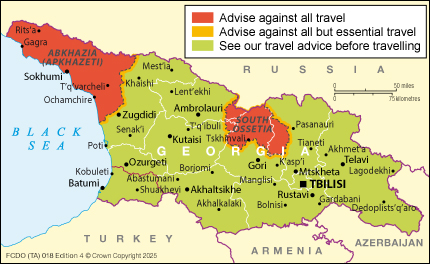
The country is not uniform: 1 region advised against, fully or partly, by at least one official reading. Tbilisi is not one of them.

In brief
  • Avoid all travel to the occupied regions of South Ossetia and Abkhazia due to military activity, crime, detention risk and landmines. Global Affairs Canada
  • Avoid all travel within 5 km of the administrative boundary line with South Ossetia and Abkhazia, except on Highway E60. Global Affairs Canada
  • The Foreign Office advises against all travel to Russian-occupied South Ossetia and Abkhazia. Foreign Office
  • The Foreign Office advises against all but essential travel to areas immediately adjacent to the administrative boundary lines with South Ossetia and Abkhazia. Foreign Office

Faithful summary of the official texts below, which prevail.

Tbilisi is in no region these official readings advise against.The red dot on the map. Change the city at the top of the page to read the map from another point.
Abkhazia — Advised against — all travelSamegrelo-Zemo Svaneti — Country-wide vigilanceShida Kartli — Country-wide vigilanceRacha-Lechkhumi and Kvemo Svaneti — Country-wide vigilanceMtskheta-Mtianeti — Country-wide vigilanceKakheti — Country-wide vigilanceSamtskhe–Javakheti — Country-wide vigilanceAdjara — Country-wide vigilanceKvemo Kartli — Country-wide vigilanceGuria — Country-wide vigilanceTbilisi — Country-wide vigilanceImereti — Country-wide vigilanceAbkhaziaTbilisi
Advised against — all travelCountry-wide vigilanceTbilisiSynthesis of the readings: Global Affairs Canada, Foreign Office, France Diplomatie. Where they differ, the colour keeps the strictest reading; the official text, quoted below region by region, prevails. Boundaries: Natural Earth.
Advised against — all travel1
Abkhazia — the occupied regions of Abkhazia and South Ossetia
Country-wide vigilance
the rest of the country, including Tbilisi
So:

the trip stays outside the advised-against regions. Any move into a red or orange region calls for a new, written decision.

US12.03.2025
Level 1 of 4Exercise normal precautions
FR05.03.2026
Red areas in the countrySome areas of the country are formally advised against.Your region (Tbilisi): not covered
GB15.09.2026
Some areas: no travel1 region covered, fully or partly.Your region (Tbilisi): not covered
CA24.09.2026
Exercise normal security precautions1 region covered.Your region (Tbilisi): not covered
CH09.09.2026
Some regions advised againstSwitzerland’s FDFA advises against travel to certain regions.

The official text, region by region

Advised against — all travel1 region

AbkhaziaCAGBFR

Global Affairs Canada
the occupied regions of Abkhazia and South Ossetia

Foreign Office
Abkhazia

France Diplomatie (in French)
Les déplacements sont formellement déconseillés en Abkhazie et en Ossétie du sud qui échappent au contrôle du pouvoir central et dans lesquelles sont stationnées des troupes militaires russes, ainsi que dans les zones proches de ces deux régions, les limites n’étant pas toujours matérialisées sur le terrain.

Maximum does not exclude these areas.The VIP Pack covers care and repatriation there. Still enforceable: sanctions and embargoes, and a country already at war at departure. Extraction and security belong to the VIP Pack Extreme, upon eligibility. See My cover

Global Affairs Canada — Open Government Licence – Canada (24.09.2026) · Foreign Office — Open Government Licence v3.0 · France Diplomatie (05.03.2026) · Natural Earth

No located event in this reading.

Last change: Updated information about the political situation and driving conditions ('Safety and security' page).

Georgia - Level 1: Exercise Normal PrecautionsState Department ↗updated 12.03.2025 · read 13.10.2026

Updated 12.03.2025

Exercise normal precaution in Georgia .

Georgia is generally a safe destination for travelers.

  • Review our Travel Guidance for Georgia to learn how to prepare for a safe trip.

Do Not Travel To:

  • The Russian-occupied Georgian regions of South Ossetia and Abkhazia due to risk of crime , unrest , and landmines .

Georgia: Floods - Jun 2026ReliefWeb ↗read 13.10.20262026-07-08

Source: ReliefWeb (OCHA), via HDX — CC BY

Nearest river dischargeOpen-Meteo ↗updated 14.10.2026 · read 13.10.2026

10-13 161.2 · 10-14 147.2 · 10-15 138.3 · 10-16 131.1 · 10-17 123.2 · 10-18 116.0 · 10-19 109.2 m³/s

Simulated discharge: Open-Meteo.com (CC BY 4.0), data rounded and formatted by Maximum. Contains modified Copernicus Emergency Management Service information 2026. For information only: this is not a flood warning; only national or regional authorities issue those.

Where, exactly?

What the national level does not tell you

The level is national. Risk areas are in the state advisories below.

  • U.S. State Department — the full advisory details the regions concerned and the reasons (crime, terrorism, kidnapping, civil unrest) (read the advisory)
  • Foreign, Commonwealth & Development Office (United Kingdom) — the United Kingdom advises against all travel to PARTS of the country · reviewed 15 September 2026
    Last announced change : « Updated information about the political situation and driving conditions ('Safety and security' page). » (read the advisory)
  • France Diplomatie — France classifies SOME AREAS of the country as red (travel formally advised against) — the advisory is geographic, check it for your exact destination (read the Security advisory)

No major event in progress is located in this country at this morning's check.

Safety in figures
Intentional homicides per 100,000 people
Georgia2.0 2019
Switzerland0.6 2023
France1.3 2023
Road traffic deaths per 100,000 people
Georgia12.4 2019
Switzerland2.2 2019
France5.1 2019

Reading: The homicide rate is 3 times Switzerland's: violence is a real risk there, concentrated in the areas named by the official advisories. On the road, 6 times more deaths than in Switzerland: road crashes are the leading cause of death of healthy travellers (CDC) — seat belt, no night driving, a driver or a taxi from a rank.

World Bank (UNODC for homicides, WHO for roads) — latest published valuedata.worldbank.org ↗read 10.10.2026

What we locate on the map are events in progress that have real coordinates: USGS earthquakes, GDACS disasters, NOAA storms and open NASA EONET events. Hover a dot for details, click to open it in this briefing.

I travel on a passportEach government writes for its own nationals. The advisory that counts for you — and for your policy's clauses — is your country's.

French passport — France Diplomatie

In brief
  • French nationals are strongly advised against travel to Abkhazia and South Ossetia due to Russian military presence and potential detention by de facto authorities.
  • Entering Abkhazia or South Ossetia from Russia may lead to criminal prosecution under Georgian law.
  • The French Embassy in Tbilisi cannot assist French citizens in Abkhazia and South Ossetia.
  • While most of Georgia is safe, ordinary crime like theft occurs, and caution is advised in crowded areas and on the Black Sea coast.
  • Drivers should exercise extreme caution due to high road insecurity and non-compliance with traffic laws, especially at night.
  • Travelers should register on the Ariane platform for security updates and carry insurance contact details.

Faithful summary of the official texts below, which prevail.

Some areas of the country are formally advised against.France Diplomatie ↗updated 15.09.2026 · read 13.10.2026

Vigilance areas — France Diplomatie (in French) updated 05.03.2026official map ↗updated 15.09.2026 · read 13.10.2026

Formally advised against — red
  • Les déplacements sont formellement déconseillés en Abkhazie et en Ossétie du sud qui échappent au contrôle du pouvoir central et dans lesquelles sont stationnées des troupes militaires russes, ainsi que dans les zones proches de ces deux régions, les limites n’étant pas toujours matérialisées sur le terrain.
Géorgie

- Présentation de la Géorgie

-

-

-

-

-

-

-

-

-

-

Zones de vigilance

Dernière actualisation le 05/03/2026, information toujours valable à la date du jour

Zones formellement déconseillées (en rouge sur la carte sécuritaire)

Les déplacements sont formellement déconseillés en Abkhazie et en Ossétie du sud qui échappent au contrôle du pouvoir central et dans lesquelles sont stationnées des troupes militaires russes, ainsi que dans les zones proches de ces deux régions, les limites n’étant pas toujours matérialisées sur le terrain. Les voyageurs se déplaçant dans ces zones risquent ainsi d’être arrêtés et placés en détention par les autorités contrôlant de facto ces régions. En outre, au regard de la loi géorgienne, toute personne pénétrant dans ces régions depuis le territoire de la Fédération de Russie s’expose à des poursuites pénales en Géorgie.

En Abkhazie et en Ossétie du Sud, l’ambassade de France à Tbilissi ne peut apporter son aide aux ressortissants français.

Le point de passage de Lars qui relie les villes de Kazbegi - Stepantsminda (Géorgie) et Vladikavkaz (Russie) est le seul point de passage terrestre entre la Géorgie et la Russie. Dans le contexte de la guerre d’agression menée par la Russie en Ukraine, il est toutefois formellement déconseillé de se rendre dans l’ensemble du territoire de la Russie.

Zone en vigilance renforcée (en jaune sur la carte sécuritaire)

L’ensemble du pays, dont la capitale Tbilissi, ne posent pas de problèmes de sécurité majeurs, même si la délinquance ordinaire (vols, cambriolages) n’épargne pas la Géorgie.

Pour les personnes désirant se rendre dans la vallée de Pankissi, il est recommandé de respecter les coutumes vestimentaires locales, en privilégiant les vêtements longs et couvrant les épaules.

Impact de la guerre en Ukraine sur la société géorgienne

À la suite de la guerre en Ukraine, de nombreux ressortissants russes sont arrivés en Géorgie. Cette cohabitation peut mener à des tensions localement.

Risques encourus et recommandations associées

La Géorgie est, dans son ensemble, un pays sûr, dans lequel il est possible de voyager sans grande difficulté à l’exception des zones déconseillées qui apparaissent en rouge sur la carte sécuritaire ci-dessous.

Il convient toutefois d’appliquer des règles de prudence élémentaire (voir rubrique « Recommandations générales » ci-dessous), en particulier pendant la période d’été, dans les zones de forte affluence et sur la côte de la Mer noire (présence notamment de pickpockets).

Risque sismique

La Géorgie est située dans une région d’activité sismique. Pour plus d’informations sur la conduite à tenir en cas de séisme, consulter les recommandations sur la fiche dédiée « conduite à tenir ».

Dans tous les cas, il convient de conserver son calme, suivre les instructions données par les autorités locales, et attendre les secours si nécessaire. Tout séisme important est suivi d’une série de secousses secondaires.

Dans l’hypothèse d’un séisme, il est recommandé de prendre immédiatement contact avec sa famille ou ses proches afin de les rassurer ou, en cas de problème de communication avec l’extérieur, avec l’ambassade de France.

Risque lié aux transports

L’insécurité sur les routes est élevée, en raison du non-respect des règles élémentaires du code de la route. La capitale concentre près de la moitié des accidents. Ces éléments plaident pour la plus grande prudence sur les routes géorgiennes.

La Géorgie est par ailleurs un pays d’élevage sans clôtures. Une extrême vigilance est donc recommandée aux conducteurs, en ville comme à la campagne, notamment en cas de circulation de nuit et au passage des tunnels.

Risques d’avalanches et de glissements de terrain

Lors de séjours en montagne, prendre en considération les risques de chute de pierres, d’avalanches et de glissements de terrain, notamment liés à la fonte des neiges et aux pluies intenses du printemps. Les routes de montagne sont alors particulièrement dangereuses. Il convient d’éviter de prendre la route en montagne sous la pluie et d’être, en tout temps, particulièrement vigilant dans les secteurs abrupts.

Recommandations générales

De manière générale, il est recommandé de :

  • conserver des photocopies de ses documents d’identité ;
  • laisser les objets de valeur en sécurité à l’hôtel ; ne prendre sur soi que l’argent nécessaire pendant la journée ;
  • être particulièrement vigilant dans les transports en commun et garder sur soi documents personnels et argent.

Afin de mieux anticiper les situations d’urgence :

  • S’enregistrer sur le fil Ariane du ministère de l’Europe et des Affaires étrangères, pour recevoir les informations en matière de sécurité et pouvoir être facilement contacté par les autorités françaises en cas de besoin.
  • Conserver sur soi le numéro de votre compagnie d’assurance.
Expéditions en montagne

L’instabilité du manteau neigeux et les changements climatiques particulièrement rapides en montagne appellent à une grande prudence dans ces expéditions. Compte tenu du risque d’avalanches, il est fortement recommandé de prendre les services d’un guide professionnel connaissant le site, de consulter les conditions météorologiques sur place avant le départ, de signaler son projet aux hôtels et maison d’hôtes avant les ascensions et de respecter les itinéraires connus.

Il convient par ailleurs de noter que les frais de recherches, de secours et d’assistance hospitalière sont à la charge du visiteur ou d’une police d’assurance spécifique à laquelle il est conseillé de souscrire (type Club Alpin).

Le grimpeur doit veiller à observer les précautions propres à ce type d’activités (équipement, communications, accompagnement par des guides chevronnés connaissant bien le terrain).

Pour plus d’informations, consulter les recommandations à la rubrique Haute montagne .

Full text of the Security pagediplomatie.gouv.fr ↗updated 15.09.2026 · read 13.10.2026

Swiss passport — FDFA (Switzerland), in French

In brief
  • Political and social situations remain tense with demonstrations and potential clashes; stay informed and avoid crowds.
  • Travel to Abkhazia and South Ossetia is discouraged due to conflict and lack of Georgian state control.
  • Entering or exiting Abkhazia or South Ossetia via Russia is illegal and carries penalties.
  • Be cautious of potential terrorist attacks and exercise vigilance against petty crime, especially at night.
  • Road conditions outside main routes are poor, and unpredictable driving increases accident risk; avoid intercity travel at night.
  • Be aware of natural risks including earthquakes, floods, landslides, and forest fires; follow local authority instructions.

Faithful summary of the official texts below, which prevail.

FDFA update note — Le chapitre Dispositions légales particulières a été complété (port de couteaux). (published 09.09.2026)

General assessment

La situation politique et sociale reste tendue. Des manifestations, parfois accompagnées de violents affrontements entre manifestants et forces de l'ordre, ont lieu à Tbilissi et dans d'autres villes du pays. Des personnes blessées et des arrestations ont été signalées. Le risque d'être soudainement exposé à de violents affrontements ne peut être exclu. Avant et pendant le voyage, informez-vous au travers des médias et par le biais de votre tour-opérateur ou d’une personne de contact locale sur la situation actuelle. Conformez-vous aux directives des autorités locales. Tenez-vous à l'écart des rassemblements de foule et des manifestations de tout genre. Faites preuve de prudence. Les deux régions sécessionnistes géorgiennes d'Abkhazie et d'Ossétie du Sud demeurent des zones de conflit (voir Risques régionaux spécifiques). Par ailleurs, les tensions dans la région restent élevées en raison de la guerre menée par la Russie contre l'Ukraine. Le risque d'attentats terroristes ne peut pas être exclu en Géorgie non plus. La rubrique terrorisme et enlèvements attire l'attention sur les risques liés au terrorisme. Terrorisme et enlèvements

Specific regional risks

La description des zones à risques repose sur des données approximatives; les risques ne peuvent se restreindre à des zones délimitées. Abkhazie: Il est déconseillé de se rendre en Abkhazie. Evitez également la zone proche de la frontière administrative (ABL) entre l'Abkhazie et le reste de la Géorgie. La région sécessionniste géorgienne d’Abkhazie n’est pas sous contrôle de l’Etat géorgien. Malgré le fait que l’Abkhazie ait été déclarée comme libérée de mines, des risques d’obus non éclatés persistent cependant, principalement le long de la frontière administrative (Administrative Boundary Line ABL). Malgré un apaisement apparent, il ne peut pas être exclu que le conflit entre la Géorgie et l’Abkhazie s’aggrave de nouveau. En raison de la situation particulière de l’Abkhazie, il est impossible pour la Suisse, de porter assistance en cas d’urgence ou de soutenir le départ de cette région . L’entrée via l’ Abkhazie depuis la Russie et la sortie de Géorgie via l’Abkhazie vers la Russie est considérée en Géorgie comme illégale et il en résulte des peines d'emprisonnement et des amendes conséquentes. Ossétie du Sud: Il est déconseillé de se rendre en Ossétie du Sud. Evitez également la zone proche de la frontière administrative (ABL) entre l'Ossétie du Sud et le reste de la Géorgie. La région sécessionniste géorgienne d’Ossétie du Sud n’est pas sous contrôle de l’Etat géorgien. Malgré un apaisement apparent, des violences armées ne peuvent pas être exclues. En raison de la situation particulière de l’Ossétie du Sud, il est impossible pour la Suisse, de porter assistance en cas d’urgence ou de soutenir le départ de cette région. L’entrée via l’ Ossétie du Sud depuis la Russie et la sortie de Géorgie via l’ Ossétie du Sud vers la Russie est considérée en Géorgie comme illégale et il en résulte des peines d'emprisonnement et des amendes conséquentes. Zones frontalières avec la Russie, dans la partie qui touche la République tchétchène, et avec l’Azerbaïdjan (en particulier Red Bridge): Ces zones frontalières sont partiellement minées. Empruntez exclusivement les routes les plus fréquentées et informez-vous auprès des autorités locales et/ou de la population en cas de doute.

Crime

Observez les précautions d'usage contre la petite délinquance et faites preuve d’une vigilance particulière après la tombée de la nuit. Les personnes qui affichent en public leur homosexualité sont susceptibles d’être la cible d’agressions. Des délits sexuels ont également été signalés. Si vous ne connaissez pas bien le pays, il est préférable que vous vous joigniez à un groupe de voyage organisé.

Natural hazards

La Géorgie se trouve en zone d'activité sismique. National Seismic Monitoring Centre Les fortes pluies peuvent provoquer des inondations et des glissements de terrain et endommager les infrastructures . National Environmental Agency: Meteo Georgia En été, il existe un important risque d’incendie de forêt à de nombreux endroits. Si une catastrophe naturelle devait se produire durant votre séjour, prenez immédiatement contact avec vos proches et suivez les instructions des autorités locales. En cas d’interruption des communications avec l’étranger, vous pouvez vous mettre en liaison avec l'Ambassade de Suisse à Tbilissi.

FDFA travel advice, in French, valid on 13.10.2026eda.admin.ch ↗updated 09.09.2026 · read 13.10.2026

British passport — Foreign Office (UK)

In brief
  • The FCDO advises British nationals against all travel to South Ossetia and Abkhazia for security reasons.
  • British nationals should avoid all but essential travel to areas bordering South Ossetia and Abkhazia due to unmarked administrative boundary lines.
  • Entering Georgia from Russia via South Ossetia or Abkhazia is illegal and may result in heavy fines or a prison sentence of up to four years.
  • British nationals should be aware of the risk of unexploded weapons along administrative boundary lines and near the Azerbaijan border.
  • Travel insurance may be invalidated if British nationals travel against FCDO advice, and consular support is unavailable in South Ossetia and Abkhazia.
  • British nationals should monitor local and international media for travel disruptions caused by Middle East escalations and check airline updates before travelling.

Faithful summary of the official texts below, which prevail.

Regions covered by the Foreign Officegov.uk ↗updated 15.09.2026 · read 13.10.2026

Advise against all travel
  • South Ossetia and Abkhazia — For security reasons, FCDO advises against all travel to the Russian occupied regions of: South Ossetia Abkhazia Find out more about why FCDO advises against travel.
All but essential travel
  • South Ossetia and Abkhazia — FCDO also advises against all but essential travel to areas immediately next to the administrative boundary lines with South Ossetia and Abkhazia.
Official Foreign Office map
Foreign Office map — Open Government Licence v3.0

Warnings — Foreign OfficeForeign Office ↗updated 15.09.2026 · read 13.10.2026

Warnings — Foreign Office

Your travel insurance could be invalidated if you travel against advice from the Foreign, Commonwealth & Development Office (FCDO).

South Ossetia and Abkhazia

For security reasons, FCDO advises against all travel to the Russian occupied regions of:

  • South Ossetia
  • Abkhazia

FCDO also advises against all but essential travel to areas immediately next to the administrative boundary lines with South Ossetia and Abkhazia.

FCDO cannot provide face-to-face support to British nationals travelling in South Ossetia and Abkhazia, as UK government employees are restricted from travelling there.

Find out more about why FCDO advises against travel .

Global travel impacts due to escalation in the Middle East

Escalation in the Middle East has caused widespread travel disruption, including airspace closures, delayed and cancelled flights.

Your travel plans may be affected, even if your destination is not in the Middle East. Before you travel:

  • check travel advice for any countries or territories you are transiting through
  • check for the latest updates from your airline or tour operator
  • review your travel insurance policy for coverage
  • monitor local and international media for the latest information and sign up for travel advice email alerts

If you have been impacted by travel disruption and need to review your visa contact the Ministry of Foreign Affairs of Georgia .

Regional risks — Foreign OfficeForeign Office ↗updated 15.09.2026 · read 13.10.2026

Regional risks — Foreign Office

This section has safety advice for regions of Georgia. It only covers regions where FCDO has specific advice.

You should also read FCDO ’s overall travel advice and safety and security advice .

South Ossetia and Abkhazia

For security reasons, FCDO advises against all travel to the Russian occupied regions of:

  • South Ossetia
  • Abkhazia

FCDO  also advises against all but essential travel to areas immediately next to the administrative boundary lines with South Ossetia and Abkhazia.

The administrative boundary lines with the Russian occupied regions of Abkhazia and South Ossetia are generally unmarked and away from roads. Take care not to cross the lines – you could be arrested by the region’s self-declared authorities.

The Georgia and UK governments do not recognise the unilateral declarations of independence by the Russian occupied regions of South Ossetia and Abkhazia. Following international law, the Georgian government claims the right to exercise sovereignty in these territories. The UK government, along with almost all other states, recognises Georgia’s right to do this.

Consular support is not available in Abkhazia and South Ossetia.

Buying property in South Ossetia and Abkhazia

Ownership of many properties in these regions is disputed. There are thousands of claims to property ownership from people displaced by conflicts following the collapse of the USSR.

Buying these properties could have serious financial and legal implications, including legal proceedings in Georgia’s courts and enforcement of court judgements elsewhere in Europe. If territorial disputes are settled, this could have consequences. For example, property may need to be returned to its original owners (property restitution).

Travel to and from Russia

It is illegal under Georgian law to enter Georgia from Russia through South Ossetia or Abkhazia. If you do this, you could get heavy fines or a prison sentence of up to 4 years. If your passport has entry or exit stamps from the self-declared authorities in these regions, Georgian authorities may see this as illegal entry through an unrecognised border crossing.

If you’re considering entering Russia by crossing Georgia-Russia land borders, check Russia travel advice . FCDO advises against all travel to Russia.

Unexploded weapons in border and boundary areas

There is some risk from unexploded weapons:

  • along the administrative boundary lines with South Ossetia and Abkhazia
  • near the border with Azerbaijan (Red Bridge area in particular)

Areas where there might be unexploded weapons are not always marked. Go with a local guide or tour group if visiting these areas.

Border with Azerbaijan

The land border with Azerbaijan has been closed since the start of the COVID-19 pandemic.

If you visit the Udabno caves at the Davit Gareja monastery site, take care not to cross the Georgia-Azerbaijan border. It is unmarked in this area and disputed. There are border guides in the area – seek their advice if you’re unsure.

Safety — Foreign OfficeForeign Office ↗updated 15.09.2026 · read 13.10.2026

Safety — Foreign Office

This guide also has safety advice for regions of Georgia .

Terrorism

There is a high threat of terrorist attack globally affecting UK interests and British nationals, including from groups and individuals who view the UK and British nationals as targets. Stay aware of your surroundings at all times.

UK Counter Terrorism Policing has information and advice on staying safe and what to do in the event of a terrorist attack. Find out how to reduce your risk from terrorism while abroad .

Terrorism in Georgia

Terrorist attacks in Georgia cannot be ruled out. Attacks could happen anywhere and affect western interests and places visited by foreigners, such as tourist sites and cultural events.

Political situation

9 September marked the 650th consecutive day of protests. Some of these have led to violent confrontation between police and protesters. In Tbilisi the demonstrations are now mainly focused on the Parliament building on Rustaveli Avenue, but they can spread to other areas, particularly on Saturday evenings/nights and on the anniversaries of significant political events. Demonstrations also take place in other cities and towns. Demonstrations may lead to travel disruption.

Tensions can escalate without warning. You should:

  • check local media
  • avoid large gatherings and demonstrations
  • follow the advice of local authorities

If you participate or engage in political demonstrations, you may face additional questioning on exit or be refused re-entry to Georgia.

If you have unpaid fines, you may be refused exit until these are paid.

Crime

Crime levels are low. You should:

  • take sensible precautious to avoid pick-pocketing, particularly in crowded places
  • not leave valuables unattended
  • stay aware of your surroundings
  • always keep your mobile phone charged and with you

Georgian law protects everyone’s human rights and equality, but ethnic minorities and LGBT+ people may face discrimination. Harassment and assault based on race does take place. Those perceived as being part of or supporting the LGBT+ community may face harassment and assault.

If someone attempts to assault you or you feel threatened, call the emergency number 112 and ask for the police.

Drink spiking

There have been reports of drink spiking in Georgia. Be wary of strangers approaching you to take you to a restaurant or nightclub. If strangers offer you food and drink these items may contain drugs that could put you at risk. Buy your own drinks and always keep sight of them to avoid them being spiked.

For more information about spiking, read Travel Aware’s information on Spiking and methanol poisoning .

Personal ID

You are not legally required to always carry ID, but if the police or a service provider (hotel, bank etc) ask you for ID you are expected to show your passport.

Dress codes and behaviour in public

Tbilisi is a cosmopolitan city. There can be more conservative attitudes in rural areas. When travelling outside cities, be aware of cultural sensitivities around modest dress (particularly in places of worship) and showing affection in public.

Money

Prices may be quoted in US dollars and euros, but goods and services must be paid for in local currency (lari).

Travellers’ cheques are rarely accepted. Outside major towns, you may not find ATMs or be able to use credit and debit cards. Take enough cash in lari if travelling to rural or remote areas.

Illegal drugs

Illegal drugs, including cannabis, carry severe penalties. You should expect a long jail sentence of 5 to 25…

American passport — U.S. Department of State

In brief
  • Exercise normal precautions when traveling to Georgia, which is generally a safe destination.
  • Review the specific Travel Guidance for Georgia to prepare for a safe trip.
  • Do not travel to the Russian-occupied regions of South Ossetia and Abkhazia due to risks of crime, unrest, and landmines.

Faithful summary of the official texts below, which prevail.

Georgia - Level 1: Exercise Normal Precautions 2025-03-12travel.state.gov ↗updated 12.03.2025 · read 13.10.2026

Advisory summary

Exercise normal precaution in Georgia .

Georgia is generally a safe destination for travelers.

  • Review our Travel Guidance for Georgia to learn how to prepare for a safe trip.

Do Not Travel To:

  • The Russian-occupied Georgian regions of South Ossetia and Abkhazia due to risk of crime , unrest , and landmines .

Global Affairs Canada — additional reading

Exercise normal security precautions (with regional advisories)

The occupied regions of Abkhazia and South Ossetia and surrounding areas - Avoid all travel

Avoid all travel to the following areas due to crime, military activity, the risk of detention and the presence of landmines:

  • the occupied regions of Abkhazia and South Ossetia
  • within 5 km of the administrative boundary line with the occupied regions of Abkhazia and South Ossetia, excluding Highway E60

Open Government Licence – Canada · September 24, 2026 11:19 EDTtravel.gc.ca ↗updated 24.09.2026 · read 13.10.2026

In brief
  • You must abide by local laws, including strict regulations on medication and severe penalties for drug offenses, even when transiting.
  • Carry your passport for identification when requested by police or service providers, and be aware that carrying certain knives is illegal.
  • Photography of military installations, airports, or government buildings is prohibited without permission, and drone usage requires registration.
  • Georgia has a zero-tolerance policy for drinking and driving, with penalties including heavy fines and driving bans.
  • When exchanging money, avoid unlicensed facilities and always have cash, as credit cards may not be widely accepted in rural areas.
  • If planning surrogacy, be aware that only married heterosexual couples are permitted, and foreign couples may soon be banned.

Faithful summary of the official texts below, which prevail.

Global Affairs Canada — written for Canadian travellers, valid for all

Local laws

You must abide by local laws. Learn about what you should do and how we can help if you are arrested or detained abroad.

Identification

If the police or a service provider, such as a hotel or bank employee, asks you for identification, you are expected to show your passport.

Drugs

Penalties for possession, use or trafficking of illegal drugs are severe, including when transiting through the airport. Convicted offenders can expect long jail sentences and heavy fines. Possession of even small amounts of cannabis can be punished with imprisonment. Drugs, alcohol and travel

Medication

Some prescription medication may not be available in Georgia. If you take prescription medications and plan to travel to Georgia, you are responsible for determining their legality and the required documentation, even if you are only transiting. Georgian authorities strictly regulate the possession and importation of some medication under special control, including narcotic drugs and psychotropic substances, and some over-the-counter medication that is commonly available in Canada. If you attempt to enter Georgia with prescription medication for personal use that is illegal under Georgian law, and do not carry supporting documentation approved by Georgian authorities, you could face criminal prosecution resulting in deportation, a jail sentence and/or a heavy fine. For information on the legal status of a specific medication, you should contact the Revenue Service of Georgia and/or the Embassy of Georgia to Canada.

  • Bring enough medication for your stay
  • Pack your medication in your carry-on luggage with relevant supporting medical documents requested by Georgian authorities
  • Always keep your medication in the original container and carry a copy of your prescriptions in English
  • Declare all medications in your possession to customs officials upon entry
Knives

It’s illegal to carry certain types of knives in Georgia. If you are caught carrying one, you could be detained or fined.

Imports and exports

You may need to obtain a permit from the Ministry of Education, Science, Culture and Sports of Georgia to import or export cultural valuables. These include:

  • archeological items
  • coins, old inscriptions and seals
  • handmade canvas, paintings and drawings
  • sculptures

Cultural valuables – Revenue service of Georgia

Photography

Taking photographs of military installations, airports or government buildings may result in a penalty. You should seek permission from local authorities before taking photographs of these facilities.

Military service

Male Canadian citizens who are also citizens of Georgia and are between the ages of 18 and 27 may be subject to military service.

International Child Abduction

The Hague Convention on the Civil Aspects of International Child Abduction is an international treaty. It can help parents with the return of children who have been removed to or retained in certain countries in violation of custody rights. The convention applies between Canada and Georgia. If your child was wrongfully taken to, or is being held in Georgia, and if the applicable conditions are met, you may apply for the return of your child to the Georgian court. If you are in this situation:

  • act as quickly as you can
  • contact the Central Authority for your province or territory of residence for information on starting an application under The Hague Convention
  • consult a lawyer in Canada and in Georgia to explore all the legal options for the return of your child
  • report the situation to the nearest Canadian government office abroad or to the Vulnerable Children's Consular Unit at Global Affairs Canada by calling the Emergency Watch and Response Centre

If your child was removed from a country other than Canada, consult a lawyer to determine if The Hague Convention applies. Be aware that Canadian consular officials cannot interfere in private legal matters or in another country's judicial affairs.

Driving

Georgia has a zero-tolerance policy for drinking and driving. Penalties for drinking and driving include:

  • heavy fines
  • detention
  • prohibition from driving for several months or years

If you plan to use your Canadian driver's licence in Georgia, it is recommended that you obtain a notarized translation of your driver's licence into Georgian. Furthermore, an International Driving Permit is recommended as some car rental agencies or insurance providers may require it. International Driving Permit

Priority to the right

The "priority to the right" system is in effect in Georgia. Drivers must yield to vehicles coming from the right at intersections if they are not in a priority lane, and to vehicles entering roundabouts.

Surrogacy

If you’re planning to visit Georgia for the purpose of commissioning surrogacy arrangements, you should consider the potential challenges involved in pursuing international surrogacy and seek legal advice on Georgian and Canadian laws and citizenship procedures prior to making any arrangements. Only married heterosexual couples are allowed to use surrogacy services in Georgia; same-sex couples and single individuals are not permitted. The timelines to receive a birth certification may be long. The Embassy of Canada to Türkiye in Ankara and Consulate of Canada to Georgia in Tbilisi are unable to provide recommendations on surrogacy arrangements or intervene with local authorities on your behalf.

Money

The currency of Georgia is the lari (GEL). Credit cards may not be widely accepted in rural areas.

  • Avoid exchanging money in unlicensed facilities
  • Make sure you have cash at all times for payment
Currency declaration

There are restrictions on the import and export of currency. You must declare to customs officials if you have more than 30,000 GEL or its equivalent in your possession. This requirement applies to:

  • cash
  • traveller's cheques
  • any other type of financial instrument

Failure to comply with this requirement could result in fines and confiscation. Movement of currency – Revenue service of Georgia

Open Government Licence – Canada · September 24, 2026 11:19 EDTtravel.gc.ca ↗updated 24.09.2026 · read 13.10.2026

Foreign Office — laws and cultural differences

Personal ID

You are not legally required to always carry ID, but if the police or a service provider (hotel, bank etc) ask you for ID you are expected to show your passport.

Dress codes and behaviour in public

Tbilisi is a cosmopolitan city. There can be more conservative attitudes in rural areas. When travelling outside cities, be aware of cultural sensitivities around modest dress (particularly in places of worship) and showing affection in public.

Money

Prices may be quoted in US dollars and euros, but goods and services must be paid for in local currency (lari). Travellers’ cheques are rarely accepted. Outside major towns, you may not find ATMs or be able to use credit and debit cards. Take enough cash in lari if travelling to rural or remote areas.

Illegal drugs

Illegal drugs, including cannabis, carry severe penalties. You should expect a long jail sentence of 5 to 25 years and heavy fines for possessing, using, or smuggling of illegal drugs, including when transiting through the airport. Airports in Georgia have excellent technology and security for detecting illegal items. This is also used to scan the baggage of transiting passengers.

Using cameras

Do not photograph sensitive sites like military bases and power installations. Be aware of cultural sensitivities when photographing churches and other religious sites.

Using Drones

You must register any drone with a video or audio recording system at the Georgian Civil Aviation Agency before it can be used in a public place. To register you need your passport and a valid email address. Foreign nationals cannot register drones online, so you will need to do this in person at the Civil Aviation Agency office. You must get a special licence from the Civil Aviation Authority for any drone that weighs more than 250g but less than 25kg, even if it does not have a video or audio system.

LGBT+ travellers

Same-sex sexual activity is legal in Georgia, and there are anti-discrimination laws, but same-sex relationships are still not widely accepted. Showing affection in public may result in discrimination or harassment. Homophobic harassment and assault take place. Pride marches in 2019 and 2021 were cancelled because the police did not guarantee security. In 2023, a Pride event was cancelled after a violent protest. Read more advice for LGBT+ travellers.

Surrogacy

The Georgian Parliament is expected to adopt a law banning surrogacy for foreign couples soon. Keep up to date and get emails when we update Georgia travel advice. If you’re visiting Georgia to arrange an international surrogacy, consider the risks and challenges involved. Surrogacy is a complex, lengthy process. You should:

  • make sure you’re aware of the facts and well-prepared before starting the process
  • get specialist legal advice on Georgian and UK laws before making any arrangements
  • read FCDO and Home Office guidance on surrogacy overseas
  • research clinics and hospitals thoroughly to make sure they are safe and reputable

The British Embassy cannot get involved in surrogacy arrangements or recommend hospitals or clinics. Commissioning a surrogacy will not automatically mean that the child holds British citizenship. To bring your child born through surrogacy from Georgia to the UK, you must apply for a full British passport. You need a Georgian birth certificate for this. Check the Public Service Hall and Service Development Agency websites and research the rules for leaving the country with children (some legal details are in Georgian only). You can stay visa-free in Georgia for a continuous period of up to one year. The Georgian Ministry of Foreign Affairs has more information.

Trade with South Ossetia and Abkhazia

Anyone trading with Abkhazia and South Ossetia must have a licence issued by the Georgia government. This includes buying and selling property and most financial transactions. Anyone trading without a licence may face penalties under Georgian civil and criminal law.

Open Government Licence v3.0gov.uk ↗updated 15.09.2026 · read 13.10.2026

FDFA (Switzerland) — laws and customs, in French

Specific legal provisions

L'alcool au volant est interdit (taux maximum d'alcoolémie toléré: 0 pour mille). Les infractions à la loi sur les stupéfiants, quelle que soit la nature de la drogue, sont punies de lourdes peines de prison (pouvant aller jusqu'à la perpétuité). Porter sur soi certaines sortes armes et de couteaux (y compris, par exemple, un couteau de poche ) est interdit et passible de sanctions pénales. Il est recommandé de renoncer de manière générale à emporter de tels objets ou, en cas de besoin, de se renseigner avant le départ auprès de l'Ambassade de la Géorgie à Berne sur les règlementations exactes. Les conditions de détention sont précaires (cellules surpeuplées, équipements sanitaires et soins médicaux insuffisants, risque de contamination par la tuberculose, etc.).

FDFA travel advice, in Frencheda.admin.ch ↗updated 09.09.2026 · read 13.10.2026

Air: Fair 33/100PM2.5 11.7 µg/m³ · PM10 15.8 µg/m³
UV moderate today max 4.5Right now 0.0 · WHO scale 0–11+

What it changes for you: Air acceptable at this hour: nothing special to plan.

Reading 01:00 (Asia/Tbilisi)Open-Meteo ↗updated 14.10.2026 · read 13.10.2026

Air quality and UV: Open-Meteo.com (CC BY 4.0), data rounded and formatted by Maximum. Contains modified Copernicus Atmosphere Monitoring Service information 2026. Neither the European Commission nor ECMWF is responsible for any use that may be made of the Copernicus information or data it contains.

Physicians per 1,000 people
Georgia5.6 2023
Switzerland4.5 2022
France3.3 2022
Hospital beds per 1,000 people
Georgia4.0 2023
Switzerland4.4 2023
France5.7 2022
Health spending per person (USD)
Georgia554 2023
Switzerland11,784 2023
France5,327 2024
Life expectancy (years)
Georgia74.7 2024
Switzerland84.4 2024
France83.0 2024

Reading: Medical density comparable to Switzerland: the local network handles most cases; repatriation remains a question of convalescence and cost. Health spending of 554 USD per person (Switzerland: 11,784) goes with private hospitals that bill foreigners in hard currency and ask for a guarantee before admission: the direct payment guarantee is what avoids the deposit.

World Bank — latest published value, year per indicatordata.worldbank.org ↗read 10.10.2026

I travel on a passportVisa, passport validity, entry form: the rules depend on your passport. Each government describes them for its own nationals.

French passport — France Diplomatie

In brief
  • French nationals do not require a visa for stays up to one year in Georgia, but must carry a valid passport or ID card.
  • French ID cards issued between 2004 and 2013 are valid for five years beyond their expiry date, but carrying a passport is recommended.
  • Vehicle owners entering Georgia by land must present a driving licence, vehicle registration, proof of ownership, and insurance valid for at least 15 days.
  • Georgia has strict drug laws; possession, consumption, or trafficking of narcotics can result in severe prison sentences of five to twenty years.
  • Bringing personal medication into Georgia requires a detailed prescription in English, a sworn translator's certification, and is limited to ten boxes for non-controlled substances.
  • Medications containing controlled substances like benzodiazepines or codeine are prohibited unless specific conditions and documentation are met upon entry.

Faithful summary of the official texts below, which prevail.

Géorgie

- Présentation de la Géorgie

-

-

-

-

-

-

-

-

-

-

Visa et formalités d’entrée

Les ressortissants français sont exemptés de visa pour un séjour égal ou inférieur à un an en Géorgie. Ils doivent toutefois être munis d’un passeport individuel ou d’une carte nationale d’identité sécurisée d’une validité suffisante pour la totalité de leur séjour.

Les cartes nationales d’identité françaises (CNI) délivrées à des personnes majeures entre le 1er janvier 2004 et le 31 décembre 2013 sont encore valables 5 ans après la date de fin de validité indiquée au verso, mais aucune modification matérielle de la carte plastifiée n’atteste de cette prorogation. Toutefois, de façon à éviter tout désagrément pendant le voyage, il est fortement recommandé de préférer l’utilisation d’un passeport valide à celle d’une CNI portant une date de fin de validité dépassée, même si elle est considérée par les autorités françaises comme étant toujours en cours de validité. Si un voyageur se déplace uniquement avec une CNI, il convient de télécharger et d’imprimer la notice multilingue (PDF - 417 Ko) expliquant ces nouvelles règles.

Tout séjour continu supérieur à un an nécessite l’obtention d’un visa de long séjour, puis d’un permis de résidence. Ce visa de long séjour peut être demandé avant le départ auprès des consulats ou ambassades géorgiens à l’étranger, ou en cours de séjour auprès du ministère géorgien des Affaires étrangères à Tbilissi. Le permis de résidence est ensuite demandé sur place auprès de l’Agence de développement des services publics.

Lors de l’accès au territoire géorgien, les agents de police chargés des contrôles aux frontières peuvent vérifier l’objet du séjour, la possession de moyens de paiement couvrant la durée du séjour, l’existence d’une réservation d’hôtel ou d’une invitation par une personne physique ou morale résidente, d’une réservation de…

Assurance véhicule

Au passage de la frontière terrestre géorgienne, il convient de présenter :

  • son permis de conduire (un permis international est fortement recommandé, même si le permis de conduire français est toléré par la police pour un court séjour) ;
  • le certificat d’immatriculation de son véhicule ;
  • le cas échéant, un document certifiant que le voyageur est le propriétaire du véhicule ;
  • un certificat d’assurance du véhicule valable au moins 15 jours civils sur l’ensemble du territoire géorgien pendant toute la durée du séjour. L’assurance peut être achetée auprès du centre d’assurance obligatoire ou via son site internet : https://tpl.ge/en (site en anglais).

La prime d’assurance varie selon le type de véhicule.

Pour plus d’informations, se rendre sur le site web de l’assurance obligatoire : https://tpl.ge/en (site en anglais).

Pour plus d’informations sur la réglementation routière, voir la rubrique Infos utiles .

Avertissement concernant les stupéfiants

Les autorités géorgiennes appliquent une politique parmi les plus répressives en matière de lutte contre la drogue. La détention, la consommation et le commerce de stupéfiants sont très sévèrement punis, indépendamment du type de produit et de la quantité concernée. De lourdes peines de prison allant de 5 à 20 ans sont régulièrement prononcées à l’encontre des personnes appréhendées.

Avertissement concernant les médicaments

La réglementation géorgienne réprime sévèrement la détention et le trafic de stupéfiants ainsi que certains produits utilisés dans les traitements de substitution ou contre les douleurs importantes.

Certaines substances contrôlées contenues dans des médicaments délivrés sur ordonnance en Europe ne sont pas autorisées à l’import par des particuliers en Géorgie. Ceci concerne notamment les benzodiazépines et les opiacés, dont fait partie la codéine. L’entrée avec ce type de médicaments pour usage personnel n’est tolérée que dans de strictes conditions comprenant un dossier complet à présenter en douane à l’entrée. Une information sur la liste des substances et la procédure à suivre est disponible sur le site de l'ambassade de France en Géorgie .

Il est possible d’entrer en Géorgie avec les médicaments ne comportant pas ces substances contrôlées, pour consommation personnelle uniquement, dans une limite de 10 boîtes. Ces médicaments doivent être intégralement déclarés à l’occasion du passage en douane à l’entrée dans le pays et accompagnés de l’original et de la copie d’une ordonnance détaillée correspondant à la durée du voyage. La prescription devra préciser la dénomination commune internationale (nom de molécule) plutôt que le nom commercial du médicament et être accompagnée d’une traduction en anglais, effectuée par un traducteur assermenté.

Entry and stay pagediplomatie.gouv.fr ↗updated 15.09.2026 · read 13.10.2026

Swiss passport — FDFA (Switzerland)

The FDFA does not publish entry requirements: they are set out by the destination's embassy or consulate in Switzerland — check them before booking, passport in hand. As a guide, the French and British requirements below describe the same rules as seen by two other governments.eda.admin.ch ↗updated 09.09.2026 · read 13.10.2026

British passport — Foreign Office (UK)

In brief
  • British citizens visiting Georgia must ensure their passport is valid for the entire duration of their stay.
  • British citizens can visit Georgia visa-free for up to one year; longer stays require a visa application.
  • Work in Georgia, including remote work, requires a work permit issued for one year, obtained from the State Employment Support Agency.
  • Visitors must possess health and accident insurance with a minimum coverage of 30,000 Georgian Lari for their entire stay.
  • Entry may be denied to British citizens if their child's passport photo no longer matches their appearance.
  • British citizens returning to the UK must carry a valid British passport or certificate of entitlement.

Faithful summary of the official texts below, which prevail.

Entry requirements — rules for a British passportForeign Office ↗updated 15.09.2026 · read 13.10.2026

Entry requirements — rules for a British passport

This information is for people travelling on a full ‘British citizen’ passport from the UK. It is based on the UK government’s understanding of Georgia’s current rules for the most common types of travel.

The authorities in Georgia set and enforce entry rules. If you’re not sure how these requirements apply to you, contact the Georgian Embassy in the UK .

Passport validity requirements

If you’re visiting Georgia, your passport should be valid for the duration of your stay.

Check with your travel provider to make sure your passport and other travel documents meet their requirements. Renew your passport if you need to.

You will be denied entry if you do not have a valid travel document or try to use a passport that has been reported lost or stolen.

Dual nationals

When returning to the UK, British citizens must carry a valid British passport or certificate of entitlement . See Dual citizenship .

Visa requirements

You can visit Georgia without a visa for up to one year.

To stay longer or to travel for work or study, you must apply for a longer-term visa. Contact the Georgian Ministry of Foreign Affairs for more information.

The rules on who can work in Georgia were changed on 1 March 2026. If you are a foreign national and want to work in Georgia, including working remotely or running a business, you must have a work permit.

A work permit is issued for one year and only for a specific job and a specific employer.

Once the work permit is approved, you must then apply for the appropriate visa and/or a worker’s residence permit.

To apply for a work permit or get more information, contact the State Employment Support Agency under the Ministry of Internally Displaced Persons from the Occupied Territories, Labour, Health and Social Affairs of Georgia.

If you’re in Georgia for more than 183 days and do any paid employment, you’re automatically liable for income tax and must tell the Revenue Service of Georgia . You’ll be fined if you do not comply.

Entering or leaving Georgia

A small number of British citizens have either been denied entry to Georgia or had trouble leaving. These cases appear to be linked to alleged presence at or participation in political demonstrations, and unpaid fines.

Some families have reported being denied entry to Georgia due to their child’s passport photo no longer matching their current appearance.

Insurance upon entry

All visitors must have appropriate health and accident insurance to cover all healthcare needs during your visit. You may be asked for evidence of this, either by your airline at check-in or by immigration authorities when you arrive in Georgia. You may face difficulties if you do not have this evidence.

Make sure you have appropriate travel health insurance and accessible funds to cover the cost of any medical treatment abroad and repatriation. The insurance coverage amount must be no less than 30 000 Georgian Lari. The insurance policy may be issued by either a Georgian or a foreign insurance company.

The insurance policy needs to cover the full period of your stay in Georgia, including both arrival and departure dates.

See Georgian Visa information for full details,…

American passport — U.S. Department of State

The State Department publishes the requirements ("Entry, Exit and Visa Requirements") on its country page, which our servers cannot read. Read it before you go; as a guide, the French and British requirements below describe the same rules as seen by two other governments.travel.state.gov ↗updated 12.03.2025 · read 13.10.2026

Living on site

For each risk, the official texts themselves: what is happening, then, where they say so, what to do.

CrimeMODERATE

What the texts say · Crime levels are low. Violent crimes targeting foreigners occur occasionally.

What they advise:
  • You should: take sensible precautious to avoid pick-pocketing, particularly in crowded places - not leave valuables unattended - stay aware of your surroundings - always keep your mobile phone charged and with you.
  • During your trip: keep your personal belongings, including your passport and other travel documents, in a secure place - do not show signs of affluence or wear expensive jewellery - do not carry large sums of cash or valuables unnecessarily - keep doors and windows closed and locked at all times.
  • There have been reports of drink spiking in Georgia.
Foreign Office · Global Affairs Canada
TransportMODERATE

What the texts say · Take care when driving, especially at night.

What they advise: To stay safe using taxis: do not flag taxis in the street - try to pre-book taxis through an app - check the taxi has working seatbelts.
Foreign Office
Nature and climateMODERATE

What the texts say · There are frequent small earthquakes in Georgia. The rainy season usually extends from April to July.

What they advise: The US Federal Emergency Management Agency website has advice about what to do before, during and after an earthquake.
Foreign Office · Global Affairs Canada
Laws and customsTO KNOW

What the texts say · If the police or a service provider, such as a hotel or bank employee, asks you for identification, you are expected to show your passport. You should expect a long jail sentence of 5 to 25 years and heavy fines for possessing, using, or smuggling of illegal drugs, including when transiting through the airport.

What they advise:
  • If someone attempts to assault you or you feel threatened, call the emergency number 112 and ask for the police.
  • Do not photograph sensitive sites like military bases and power installations.
Global Affairs Canada · Foreign Office
Crowds and calendarMODERATE

What the texts say · 9 September marked the 650th consecutive day of protests. In Tbilisi the demonstrations are now mainly focused on the Parliament building on Rustaveli Avenue, but they can spread to other areas, particularly on Saturday evenings/nights and on the anniversaries of significant political events. Demonstrations also take place in other cities and towns.

What they advise: You should: check local media - avoid large gatherings and demonstrations - follow the advice of local authorities.
Foreign Office

Sentences copied word for word from the official texts cited, chosen for the destination; the level is our reading. The full texts, at each source:Foreign Office ↗updated 15.09.2026 · read 13.10.2026 (updated 15.09.2026 · read 28.09.2026)Global Affairs Canada ↗updated 24.09.2026 · read 13.10.2026 (updated 24.09.2026 · read 28.09.2026)

Safety in figures
Intentional homicides per 100,000 people
Georgia2.0 2019
Switzerland0.6 2023
France1.3 2023
Road traffic deaths per 100,000 people
Georgia12.4 2019
Switzerland2.2 2019
France5.1 2019

Reading: The homicide rate is 3 times Switzerland's: violence is a real risk there, concentrated in the areas named by the official advisories. On the road, 6 times more deaths than in Switzerland: road crashes are the leading cause of death of healthy travellers (CDC) — seat belt, no night driving, a driver or a taxi from a rank.

World Bank (UNODC for homicides, WHO for roads) — latest published valuedata.worldbank.org ↗read 10.10.2026

—:—Local time · Asia/Tbilisi ·
112Local emergency numbers · Single number 112 · Police 122 · Ambulance 113 · Fire 111
Schuko, Europlug220 V
Drivingon the right

Time zone: IANA and timezone-boundary-builder (ODbL) · RESTCountries · EmergencyNumberAPI · Wikidata · European Central Bank

Places: © OpenStreetMap contributors (ODbL), Photon search by komoot.

FDFA (Switzerland) — transport and specific advice, in French

Transport and infrastructure

En dehors des principaux axes routiers, de nombreuses routes sont en mauvais état et les régions reculées ne sont souvent accessibles qu'en véhicule tout-terrain. Les comportements imprévisibles sur les routes, les fréquentes infractions au code de la route (non-respect des feux de signalisation, etc.) ou le mauvais entretien de nombreux véhicules (y compris des voitures de location) augmentent les risques d'accident. Les déplacements interurbains sont donc à proscrire la nuit. La qualité des mesures de sécurité et du matériel utilisé est très variable dans le domaine des activités en plein air: (héli-)ski, trekking d’aventure, alpinisme. etc. Informez-vous de ce fait auprès des entreprises fournisseuses locales sur les mesures de sécurité et contrôlez le matériel de sport mis à disposition.

Specific remarks

Portez toujours votre passeport sur vous afin de pouvoir prouver votre identité lors des contrôles de sécurité.

FDFA travel advice, in Frencheda.admin.ch ↗updated 09.09.2026 · read 13.10.2026

Public holidaysNager.Date ↗read 25.09.2026

  • Wed 14 Oct — Day of Svetitskhoveli Cathedra
  • Mon 23 Nov — Saint George's Day
ESSENTIAL

Maximum policyholder: before paying anything, call the 24/7 number. If you are admitted for more than 24 h, Maximum sends its direct payment guarantee to the hospital (art. 2.12).

+41 22 ••• •• •• — Full number in your client area

The hospitals to know — Tbilisi

The hospital list has not been read from OpenStreetMap for this page yet: the medical-network map loads it when opened. Maximum's assistance directs you to the right facility, 24/7. The medical-network map ↗

40pharmacies40doctorsFull map and list ↗

Before you go

  • Routine vaccinesup to date
  • Hepatitis Arecommended
  • Hepatitis Brecommended
  • Mpoxdepending on the trip
  • Yellow fevernot recommended

CDC Travelers' Health recommendations, most important first. They depend on your age, vaccines and itinerary: confirm them with a doctor or a travel clinic 4 to 6 weeks before departure. Details, disease by disease ↗cdc.gov ↗read 10.10.2026

On site

MedicationIn their box, with the prescription — in English if possible.

The health system — Medical density comparable to Switzerland: the local network handles most cases; repatriation remains a question of convalescence and cost. Health spending of 554 USD per person (Switzerland: 11,784) goes with private hospitals that bill foreigners in hard currency and ask for a guarantee before admission: the direct payment guarantee is what avoids the deposit.

Back home — a fever in the following weeks should be told to a doctor, naming the country.

The next 7 days Asia/TbilisiMET Norway ↗read 13.10.2026

Wed 14 Oct14–25°partly cloudy
Thu 15 Oct17–23°overcast · 0.2 mm
Fri 16 Oct16–25°overcast
Sat 17 Oct18–25°overcast
Sun 18 Oct16–27°partly cloudy
Mon 19 Oct15–21°showers · 1.0 mm
Tue 20 Oct13–18°heavy showers · 26.5 mm

Forecast: MET Norway (Norwegian Meteorological Institute, CC BY 4.0), grouped by day and formatted by Maximum.

I travel on a passportYour embassy, and the service to register with, depend on your passport.

Your country, 24/7, from abroad

FR
Crisis and Support Centre — French Ministry for Europe and Foreign Affairs+33 1 53 59 11 0024/7 emergency line, standard rate. First contact abroad: the French embassy or consulate.www.diplomatie.gouv.fr ↗updated 15.09.2026 · read 13.10.2026
CH
FDFA Helpline+41 58 465 33 33+41 800 24 7 36524/7, 365 days a year — helpline@eda.admin.ch. Beware of scam calls spoofing these numbers.www.eda.admin.ch ↗updated 09.09.2026 · read 13.10.2026
GB
Foreign, Commonwealth & Development Office+44 20 7008 500024 hours, for British nationals.www.gov.uk ↗updated 15.09.2026 · read 13.10.2026
US
Overseas Citizens Services — U.S. Department of State+1 202 501 4444+1 888 407 4747From abroad; the second number from the U.S. and Canada.travel.state.gov ↗updated 12.03.2025 · read 13.10.2026

French passport — French embassy and consulates

OpenStreetMap

Swiss passport — Swiss embassy and consulates

Useful addresses — FDFA, in French

Numéro d'urgence pour Tbilissi et alentours: 112 Dispositions douanières de la Géorgie: Customs Department Représentations suisses à l’étranger: En cas de situation d’urgence à l’étranger, vous pouvez vous adresser à la représentation suisse la plus proche ou à la Helpline DFAE. Ambassade de Suisse en Géorgie Helpline DFAE Représentations étrangères en Suisse: Pour obtenir des informations sur les prescriptions d'entrée (documents d'identité admis, visa, etc.), veuillez vous adresser aux ambassades et consulats étrangers compétents. Ceux-ci peuvent également vous renseigner sur les dispositions douanières pour l'importation et l'exportation d'animaux et de marchandises: appareils électroniques, souvenirs, médicaments, etc. Représentations étrangères en Suisse

OpenStreetMap · DFAE

British passport — British embassy and consulates

OpenStreetMap

American passport — U.S. embassy and consulates

US
Ambassade des États-Unisembassy · nearest · 11.8 km

29 ქართულ-ამერიკული მეგობრობის გამზირი, 0131, თბილისი

+995 32 227 70 00
https://ge.usembassy.gov/ ↗updated 12.03.2025 · read 13.10.2026

OpenStreetMap

Police

  • Police · 4.0 km
    113 დავით აღმაშენებლის გამზირი
  • თელეთის პოლიციის განყოფილება · 7.4 km

Town hall

  • თელეთის გამგეობა · 5.7 km

OpenStreetMap

Getting help — Foreign OfficeForeign Office ↗updated 15.09.2026 · read 13.10.2026

Getting help — Foreign Office

The Foreign, Commonwealth & Development Office ( FCDO ) cannot provide tailored advice for individual trips. Read this travel advice and carry out your own research before deciding whether to travel.

Emergency services in Georgia

Telephone: 112 (ambulance, fire, police)

Contact your travel provider and insurer

Contact your travel provider and your insurer if you are involved in a serious incident or emergency abroad. They will tell you if they can help and what you need to do.

Help abroad

See how to get help from the UK government abroad including in an emergency.

Help in the UK

You can call FCDO in London if you need urgent help because something has happened to a friend or relative abroad.

Telephone: 020 7008 5000 (24 hours)

Find out about call charges

Ten phrases in Georgian

For emergencies. If pronunciation fails, show the screen — or the printed page.

Help!მიშველეთ!Mishvelet!
Call an ambulance!გამოიძახეთ სასწრაფო დახმარება!Gamoidzakhet sasts'rapo dakhmareba!
I need a doctor.ექიმი მჭირდება.Ekimi mch'irdeba.
Where is the nearest hospital?სად არის უახლოესი საავადმყოფო?Sad aris uakhloesi saavadmq'opo?
Call the police!გამოიძახეთ პოლიცია!Gamoidzakhet p'olitsia!
I am allergic to penicillin.პენიცილინზე ალერგია მაქვს.P'enitsilinze alergia makvs.
I have international medical insurance.საერთაშორისო სამედიცინო დაზღვევა მაქვს.Saertashoriso sameditsino dazghveva makvs.
I want to contact my embassy.მინდა დავუკავშირდე ჩემი ქვეყნის საელჩოს.Minda davuk'avshirde chemi kveq'nis saelchos.
Please take me to this address.გთხოვთ, წამიყვანეთ ამ მისამართზე.Gtkhovt, ts'amiq'vanet am misamartze.
Do you speak English?ინგლისური იცით?Inglisuri itsit?

Translations by Maximum Insurance, original script and transliteration.

  • Keep the entry stamp, hospital invoices and the medical report. Without them a claim cannot be rebuilt.
  • File it from the claim form, once back, with those papers.

Actions to take before each professional trip abroad.

1Once — the framework
2For each departure
3During the mission, and after

What is happening in Georgia right now

Live alerts and level changes, each with its official source. Continuously updated.

What governments have just written

LatestManifestations

Depuis le 28 novembre 2024, des manifestations, parfois de grande ampleur, ont lieu quotidiennement à Tbilissi ainsi que dans plusieurs villes de Géorgie. La participation à ces manifestations, particulièrement l’obstruction de la voie publique, peut être sanctionnée par des amendes de 5000 laris ou par une détention administrative pouvant aller jusqu’à 14 jours. En cas de récidive les manifestants peuvent faire l’objet de poursuites pénales conduisant à une peine d’un an de…

France Diplomatie (in French) · posted 27 February 2026 · updated 19 August 2026diplomatie.gouv.fr ↗updated 15.09.2026 · read 13.10.2026
LatestPannes d’électricité et dysfonctionnements dans les réseaux de transports et de communication

Une nouvelle panne d'électricité majeure a frappé la quasi-totalité du territoire géorgien au cours de la soirée du 5 août. La coupure a entraîné l'interruption des transports ferroviaires, l'arrêt complet du réseau de métro à Tbilissi ainsi que des dysfonctionnements sur les réseaux Internet et de téléphonie mobile. Il s’agit de la troisième panne d'ampleur nationale enregistrée en l'espace de deux semaines dans le pays. Face à la répétition de ces pannes d’électricité, des…

France Diplomatie (in French) · posted 6 August 2026diplomatie.gouv.fr ↗updated 15.09.2026 · read 13.10.2026
LatestAssurance voyage

A compter du 1er janvier 2026, les visiteurs étrangers souhaitant entrer en Géorgie doivent obligatoirement disposer d’une assurance maladie et accident valide pour la durée de leur séjour. Elle doit être rédigée en anglais (ou en géorgien). La couverture doit être au minimum de 30 000 GEL (environ 9 500€). Chaque voyageur devra être en mesure de justifier de cette assurance en cas de contrôle à la frontière.

France Diplomatie (in French) · posted 27 February 2026diplomatie.gouv.fr ↗updated 15.09.2026 · read 13.10.2026
LatestEntrée des mineurs sur le territoire géorgien

Récemment, plusieurs cas de familles voyageant avec des enfants mineurs se sont vu refuser l’entrée en Géorgie au motif que les photos figurant sur les passeports délivrés ne correspondaient plus à l’âge apparent des jeunes voyageurs, ne permettant pas à la police aux frontières géorgienne de les identifier formellement. Dans cette situation il est recommandé aux ressortissants français souhaitant voyager en Géorgie avec de jeunes enfants de solliciter le renouvellement par…

France Diplomatie (in French) · posted 27 February 2026diplomatie.gouv.fr ↗updated 15.09.2026 · read 13.10.2026
UpdateGlobal Affairs Canada

Editorial change

September 24, 2026 11:19 EDTtravel.gc.ca ↗updated 24.09.2026 · read 13.10.2026

No level change recorded for this country since the log opened. The live alerts above are updated continuously.

⚡ The world feed — every country →

Frequently asked questions — travel insurance Georgia

24/7 support number — +41 22 ••• •• ••An adviser goes through each question with you until you have an actionable answer: cover, hospital, entry rules, claims. Full number in your client area. You can also ask Maximum directly, just below these questions.
What is the official risk level in Georgia today?

Level 1/4 — Exercise Normal Precautions, U.S. Department of State, retrieved on 13 October 2026.

  • Is the whole country advised against? United States: no · France: no · United Kingdom: no · Switzerland: no (reading of 27 September 2026).
  • Switzerland’s FDFA advises against travel to certain regions (published 09.09.2026).
  • Contractually, only an FDFA, FOPH or WHO advisory against the trip opens Module A (art. 18.1) — that is not the case today.
  • Travel with international medical cover and the 24/7 number (+41 22 ••• •• ••) saved: here the risk is not the advisory, it is the hospital bill.
  • We check these sources every morning and e-mail you the day one changes (Alerts button).

Sourcestravel.state.gov · updated 12.03 · read 13.10France Diplomatie · updated 15.09 · read 13.10DFAE · updated 09.09 · read 13.10207-country comparison

Is the whole of Georgia advised against, or only some areas?

An area advised against does not rule out the country.

  • Official answers: United States: no · France: no · United Kingdom: no · Switzerland: no.
  • Foreign Office, regional risks: “This section has safety advice for regions of Georgia. It only covers regions where FCDO has specific advice. You should also read FCDO ’s overall travel advice and safety and security advice . South Ossetia and Abkhazia For security reasons, FCDO advises…”
  • Keep your country of residence's advisory on booking day and on departure day: that is what your policy's clauses cite.

SourcesFrance Diplomatie · updated 15.09 · read 13.10Foreign Office · updated 15.09 · read 13.10State Department · updated 12.03 · read 13.10

What are the entry requirements for Georgia with my passport?

The rules depend on the passport, not on the destination alone.

  • French passport (France Diplomatie): French nationals do not require a visa for stays up to one year in Georgia, but must carry a valid passport or ID card. French ID cards issued between 2004 and 2013 are valid for five years beyond their expiry date, but carrying a passport is recommended. Vehicle owners entering Georgia by land must present a driving licence, vehicle registration, proof of ownership, and insurance valid for at least 15 days.
  • British passport (Foreign Office): British citizens visiting Georgia must ensure their passport is valid for the entire duration of their stay. British citizens can visit Georgia visa-free for up to one year; longer stays require a visa application. Work in Georgia, including remote work, requires a work permit issued for one year, obtained from the State Employment Support Agency.
  • American passport: the requirements are on the State Department country page (travel.state.gov).
  • Swiss passport: the FDFA refers you to the destination's embassy in Switzerland.
  • Pick your passport at the top of Before you go › Entry: the official text that concerns you comes first, with its “In brief” summary.

SourcesFrance Diplomatie · updated 15.09 · read 13.10Foreign Office · updated 15.09 · read 13.10State Department · updated 12.03 · read 13.10

Do I need an insurance certificate for a Georgia visa?

For a Schengen visa, yes: at least €30,000 of travel medical insurance (Regulation (EC) No 810/2009, art. 15).

  • Many other countries ask for it on entry or for a visa, case by case: check Before you go › Entry, with your passport.
  • Subscribe: the named certificate arrives by e-mail on payment, with your name, dates and limits (CHF 1.5M medical expenses, unlimited evacuation and repatriation) — the ones consulates check.
  • Attach it to the visa file; if in doubt about the format, write to us.

SourcesRegulation (EC) 810/2009, art. 15General conditions, policy 20 00 479

What does Maximum Insurance do in Georgia, concretely?

VIP Pack — $990 for twelve months, unlimited trips.

  • CHF 1.5M emergency medical expenses, unlimited medical evacuation and repatriation, search and rescue CHF 50,000, cancellation or change CHF 5,000.
  • One 24/7 number, +41 22 ••• •• ••: Maximum sends its direct payment guarantee to the hospital (art. 2.12).
  • Network of 45,000 providers (art. 6.9); evacuation is decided, organised and paid by Maximum's medical team if the local facility is not enough (art. 6.2.2).
  • Named certificate by e-mail on payment, no medical questionnaire.

SourcesGeneral conditions, policy 20 00 479OpenStreetMap · read 13.10

What should I do if hospitalised in Georgia?

Six steps, in this order.

  • 1. Call +41 22 ••• •• •• before paying anything, or have the front desk call: it is the condition for full cover (otherwise: reduced or refused benefits).
  • 2. Ask for a hospital in the Maximum network (art. 6.9).
  • 3. See a doctor the same day and leave with the certificate: without an on-the-spot finding, nothing is covered (art. 33).
  • 4. Admitted for more than 24 h? The front desk calls Maximum: direct payment guarantee, no deposit (art. 2.12).
  • 5. Book no ambulance or flight yourself (art. 6.2.2).
  • 6. Once home, file within 30 days (art. 35.7).
  • Local emergency services: single number 112 · police 122 · ambulance 113 · fire 111.

SourcesSpecial conditions 01.26General conditions, policy 20 00 479

Which emergency numbers in Georgia?

Local emergency services: single number 112 · police 122 · ambulance 113 · fire 111

  • Maximum, 24/7, before any payment: +41 22 ••• •• ••.
  • France — Ambassade de France (3.0 km) · +995 32 272 14 90;+995 706 777 393
  • Switzerland — Ambassade de Suisse en Géorgie (5.7 km) · +995 32 275 30 01;+995 32 275 30 02
  • United Kingdom — Ambassade du Royaume-Uni (2.6 km)
  • United States — Ambassade des États-Unis (11.8 km) · +995 32 227 70 00
  • Save these numbers before leaving; in immediate danger, call local emergency services first, then Maximum.

SourcesEmergencyNumberAPI · Wikidata · read 08.10OpenStreetMap · read 13.10

Is an Amex, Visa or Mastercard enough in Georgia?

At today's level 1/4, card by card:

  • Amex Platinum — No area exclusion at this level — but three written limits: deductible and prior approval, 90-day cap, advance under conditions.
  • Visa — No express area exclusion — but a €156,000 cap, 90 days, and the war/instability exclusion in the background.
  • Mastercard — No exclusion in play at this level — but a €155,000 cap and 90 covered days.
  • Three lines to read in your notice: the duration (often 90 days per trip), the settlement (reimbursement afterwards or direct payment of the hospital) and the area exclusion at level 4/4.

SourcesAmex Platinum France T&Cs, 01.2025 — general exclusion n° 11BNP Paribas Visa Infinite notice (policy PT7), 04.2025 — comFortuneo World Elite Mastercard notice, 01.2026 — art. 5.5 '

Are a health plan or a travel policy enough in Georgia?

A health plan reimburses at home; here, the hospital asks for a payment guarantee before admission.

  • Health plan — A health plan treats you at home. Here the hospital asks for a guarantee before admission — not a later reimbursement.
  • Travel policy — No area exclusion at this level — compare cap, deductible and covered duration.
  • A travel policy often has a territorial clause at level 4/4 and a 90-day limit per trip.
  • Have your IPID number or the PDF of the terms and ask an expert to call you back: the answer is in the document, not in the brochure.

SourcesGeneral conditions, policy 20 00 479

How do I use the medical network on this page?

The page reads hospitals, pharmacies and doctors from OpenStreetMap, around the point you choose.

  • Type your city, hotel or beach: the map re-centres, 24/7 emergency rooms come first.
  • Each row gives the phone when the source publishes it, the nearest street, directions and the Google Maps listing.
  • The PDF briefing repeats the same places, numbered on a printable map.
  • No customer reviews: OpenStreetMap has none, and we invent none.

SourcesOpenStreetMap (ODbL) · read 13.10

Which vaccines and health precautions for Georgia?

The sourced detail is under Medical network › Health: vaccines, diseases present, altitude, outbreaks.

  • CDC (Travelers' Health), depending on the trip: Routine vaccines, COVID-19, Hepatitis A, Hepatitis B, Measles, Monkeypox, Rabies.
  • See a doctor or a travel clinic 8 weeks before departure (Foreign Office).
  • Carry your medicines in their packaging, with a prescription using international non-proprietary names (France Diplomatie).

SourcesCDC Travelers' Health · read 10.10France Diplomatie · updated 15.09 · read 13.10OMS · read 13.10Foreign Office · updated 15.09 · read 13.10

Can I be treated in Georgia, or will I be evacuated?

5.6 physicians per 1,000 people (2023) versus 4.5 in Switzerland.

  • 4.0 hospital beds per 1,000 people versus 4.4 in Switzerland (World Bank).
  • Medical density comparable to Switzerland: the local network handles most cases; repatriation remains a question of convalescence and cost. Health spending of 554 USD per person (Switzerland: 11,784) goes with private hospitals that bill foreigners in hard currency and ask for a guarantee before admission: the direct payment guarantee is what avoids the deposit.
  • When the local facility is not enough, Maximum's medical team decides the evacuation to a suitable centre, and pays for it (art. 6.2.2).

SourcesWorld Bank · read 10.10General conditions, policy 20 00 479

Georgia: safety, in figures?

2.0 homicides per 100,000 people (2019) versus 0.6 in Switzerland and 1.3 in France.

  • 12.4 road deaths per 100,000 people versus 2.2 in Switzerland (World Bank, WHO).
  • The homicide rate is 3 times Switzerland's: violence is a real risk there, concentrated in the areas named by the official advisories. On the road, 6 times more deaths than in Switzerland: road crashes are the leading cause of death of healthy travellers (CDC) — seat belt, no night driving, a driver or a taxi from a rank.

SourcesWorld Bank (UNODC, WHO) · read 10.10UCDP

Where is my embassy in Georgia, and why register?

The nearest representations, by passport (OpenStreetMap):

  • France — Ambassade de France (3.0 km) · +995 32 272 14 90;+995 706 777 393
  • Switzerland — Ambassade de Suisse en Géorgie (5.7 km) · +995 32 275 30 01;+995 32 275 30 02
  • United Kingdom — Ambassade du Royaume-Uni (2.6 km)
  • United States — Ambassade des États-Unis (11.8 km) · +995 32 227 70 00
  • Register before leaving: France: Ariane · Switzerland: Travel Admin · United Kingdom: Foreign Office alerts · United States: STEP.
  • Two minutes, and in a crisis your country's authorities can reach you and count you in an evacuation.
  • Pick your passport at the top of Contacts: your embassy comes first.

SourcesOpenStreetMap · read 13.10DFAE · updated 09.09 · read 13.10

Which regions of Georgia should I avoid, precisely?

1 region advised against, fully or partly, by at least one official reading.

  • Your point (Tbilisi): country-wide vigilance.
  • Advised against — all travel: Abkhazia.
  • Maximum does not exclude these areas: the VIP Pack covers care and repatriation there (sanctions, embargoes and a country already at war at departure remain enforceable).

SourcesGlobal Affairs Canada · updated 24.09 · read 13.10Foreign Office · updated 15.09 · read 13.10France Diplomatie · updated 15.09 · read 13.10

Which laws and customs should I know in Georgia?

Local laws apply to every traveller; here is what the official texts say.

  • You must abide by local laws, including strict regulations on medication and severe penalties for drug offenses, even when transiting.
  • Carry your passport for identification when requested by police or service providers, and be aware that carrying certain knives is illegal.
  • Photography of military installations, airports, or government buildings is prohibited without permission, and drone usage requires registration.
  • Georgia has a zero-tolerance policy for drinking and driving, with penalties including heavy fines and driving bans.
  • When exchanging money, avoid unlicensed facilities and always have cash, as credit cards may not be widely accepted in rural areas.

SourcesGlobal Affairs Canada · updated 24.09 · read 13.10Foreign Office · updated 15.09 · read 13.10

Who can I call at any hour from Georgia?

Every foreign ministry runs a 24/7 emergency line for its nationals.

  • France — Crisis and Support Centre — French Ministry for Europe and Foreign Affairs: +33 1 53 59 11 00. 24/7 emergency line, standard rate. First contact abroad: the French embassy or consulate.
  • Switzerland — FDFA Helpline: +41 58 465 33 33 · +41 800 24 7 365. 24/7, 365 days a year — helpline@eda.admin.ch. Beware of scam calls spoofing these numbers.
  • United Kingdom — Foreign, Commonwealth & Development Office: +44 20 7008 5000. 24 hours, for British nationals.
  • United States — Overseas Citizens Services — U.S. Department of State: +1 202 501 4444 · +1 888 407 4747. From abroad; the second number from the U.S. and Canada.
  • On site, Ambassade de France: +995 32 272 14 90;+995 706 777 393.

Sourcesdiplomatie.gouv.fr · updated 15.09 · read 13.10eda.admin.ch · updated 09.09 · read 13.10

A few useful phrases in Georgian for Georgia?

Emergency phrases, to show if pronunciation fails:

  • Help! → მიშველეთ! (Mishvelet!)
  • Call an ambulance! → გამოიძახეთ სასწრაფო დახმარება! (Gamoidzakhet sasts'rapo dakhmareba!)
  • I need a doctor. → ექიმი მჭირდება. (Ekimi mch'irdeba.)
  • Where is the nearest hospital? → სად არის უახლოესი საავადმყოფო? (Sad aris uakhloesi saavadmq'opo?)
  • Call the police! → გამოიძახეთ პოლიცია! (Gamoidzakhet p'olitsia!)

SourcesMaximum Insurance

What should I keep after leaving Georgia, and how do I file a claim?

Keep the entry stamp, the invoices, the prescriptions and the medical report.

  • File within 30 days (art. 35.7) from your client area, with the documents; the official forms are pre-filled.
  • Costs advanced on site are reimbursed against receipts.
  • Fever, persistent diarrhoea or a rash in the following weeks? See a doctor and say where you have been.

SourcesGeneral conditions, policy 20 00 479

What does the Pack VIP Extreme add?

Cancellation or change up to CHF 20,000, special risk CHF 5,000 per person, crisis management and security, optional Kidnap & Ransom.

  • Special risk (Module A): political event, attack, epidemic, natural disaster — opens when the FDFA, the FOPH or WHO advise against the trip (art. 18.1).
  • Epidemic: assistance must be requested within 7 days of the WHO or FDFA qualification (art. 36.2).
  • Crisis management and security: trip registration, monitoring, extraction, evacuation in case of riot, war, terrorism or disaster; Kidnap & Ransom subject to eligibility (art. 18.4).
  • $2,290 a year, unlimited trips.

SourcesGeneral conditions, policy 20 00 479

A question not answered here? Ask Maximum below, or call the support number: every question gets a clear, actionable answer.

A question? Maximum answers.Answers built from the Georgia file and your policy.

In a life-threatening emergency, call local emergency services first, then Maximum: +41 22 ••• •• •• — 24/7 support number, an adviser stays with you to the end.

What Maximum knows

The 207 country pages — hospitals, pharmacies, police, embassies, emergency numbers, official advice from four governments, health, safety in figures, events in progress — read around the city you name. Your policy — benefits, the six steps, claims, articles. The site — prices, certificate, subscription. Nothing else: what it does not know, it says so and hands you to an adviser.

Same advisory level: Hungary · Ireland · Iceland · Japan · Kazakhstan · Kyrgyzstan

Cross-check with official sources
U.S. State Department → UK FCDO → France Diplomatie → DFAE (Suisse) →

The displayed level comes from the State Department, checked every morning. Before departure, always cross-check your country of residence's advisory: that is what your policy cites.

The level shown is the official U.S. Department of State level, checked daily. Maximum Insurance is an insurance distributor — general information, not personal advice.

Travel covered to Georgia
Get the Pack VIP — $990/yr Cover a team
Check my current cover in Georgia

The destination is already Tbilisi. A few choices, then the reading of your cover, here.

Go further
Insured in an advised-against country →What a repatriation really costs →Who pays the hospital abroad →Where the United States, France and the United Kingdom disagree →What insurance do you need for an assignment abroad? →Insuring a team that travels: you cover a headcount, not names →

All 13 files, together → · All 207 countries →

Swiss insurer
45 000medical providers — worldwide network
FINMAWinHealth distribution — reg. no F01210623