Maximum Alerts / Ecuador

EcuadorLevel 2/4

Level published by the State Department on 17.08.2026 · read 16 October 2026 · source checked daily

Ecuador — official level as of 16 October 2026: Level 2/4 ("Exercise Increased Caution"), from the U.S. Department of State. Maximum Insurance covers this country: hospital settled directly, unlimited repatriation, EUR 1.5M, certificate on payment.

Four official readings
United StatesState Departmentsource ↗Our reference level — the one shown across this site
Is the whole country advised against?Nono restriction on the whole country
Level 2/4 — “Exercise Increased Caution”levels 1 and 2 are advice to be careful, not travel restrictions
FranceFrance Diplomatiesource ↗Added on top of the U.S. level, under its own rules: red or orange AREAS
Is the whole country advised against?Nono restriction on the whole country+ red areas
our reading: some areas are classified red (formally advised against)
United KingdomFCDOsource ↗Added on top of the U.S. level, under its own rules: travel statuses
Is the whole country advised against?Nono restriction on the whole country+ parts of the country
our reading: all but essential travel advised against to parts of the country
source reviewed 16 September 2026
SwitzerlandFDFAsource ↗Advisory cited by the Maximum policy
Is the whole country advised against?Nono restriction on the whole country+ parts of the country
our reading: Switzerland’s FDFA advises against travel to certain regions
advice published 25.03.2026
The four readings on record agree: no restriction on the whole country — France still flags red areas; the United Kingdom still flags parts of the country; Switzerland still flags parts of the country.Our comparison reading: 27 September 2026

All 207 countries compared, advisory by advisory →

How we read these four advisories

Every country has its own scale, so we ask them all the same question: is the whole country advised against?

An advisory covering only areas of the country does not raise the answer: it stays “No”, and the area is shown in the relevant column.

The level shown on this page — and across this site — is the one published by the U.S. State Department, from 1 (normal precautions) to 4 (do not travel). France and the United Kingdom publish their own advisories, with their own rules: they add to that level, they do not replace it.
Get covered — €990/yr
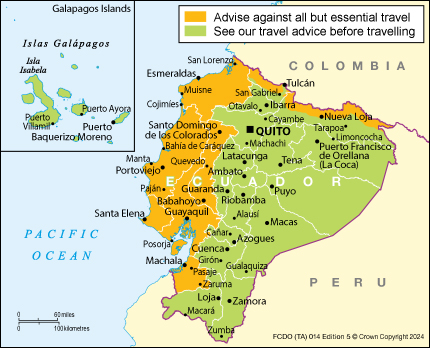
Regional map…

34 recorded incidents (UCDP)hover, click to open it in the briefing

Level 2/4 — Exercise Increased Caution Checked on 16 October 2026 · U.S. State Department
Observed repatriation
37 000 € – 200 000 €
export.gov (officiel US), 2019 ↗
Country briefing
Get the PDF

Where are you right now in Ecuador?

Doctors — Quito40
DrFisioterapia0.6 km

General Alberto Enriquez Quito

Google MapsDirections
DrCentro Clínico Podológico0.9 km

Avenida Mariscal Sucre Quito

Google MapsDirections
DrLaboratorio Clinico1.4 km

Oe5-75 Simón Bolívar Quito

Google MapsDirections
DrConsultorio de Neurologica1.4 km

near Viracocha

Google MapsDirections
DrJema Dental 8:30 - 171.4 km

Av. Mariscal Sucre Quito

Google MapsDirections
DrDoportólogo1.4 km

Av. Mariscal Sucre Quito

Google MapsDirections
DrConsultorio Médica Dr. Manolo Cano S.1.5 km

Venezuela

Google MapsDirections
DrClínica Panamericana Consulta Externa1.5 km

Pedro de Alfaro Quito

Google MapsDirections
DrFresenius Medical Care1.5 km

Avenida Jaime del Castillo Quito

Google MapsDirections
DrObstetriz Planificación Familiar1.7 km

N3-47 Flores Quito

Google MapsDirections
DrAcupuntura Coreana1.9 km

Avenida Pedro Vicente Maldonado

Google MapsDirections
DrCentro de Salud Villaflora1.9 km

near Avenida Pedro Vicente Maldonado

Google MapsDirections
DrConsultorio Medico Mamita Lale1.9 km

near Avenida Napo

Google MapsDirections
DrCentro Integral de Osteoporosis1.9 km

Avenida Alonso de Angulo Quito

Google MapsDirections
DrCentro Medico Dr. Enrique Robles Ginecología2.0 km

near García Moreno
gynaecology

Google MapsDirections
DrClínica Bolivar2.0 km

Avenida Napo

Google MapsDirections
DrConsultorio Medico2.0 km

near Juan Borgoñón

Google MapsDirections
DrMoncayo2.2 km

near Francisco Coronel

Google MapsDirections
DrClínica Santa Barbara2.2 km

N9-01 García Moreno Quito

Google MapsDirections
DrDr. Armendáriz2.2 km

Juan Del Valle

Google MapsDirections
DrConsultorio de Especialidades Medicas2.3 km

Juan Alczázar

Google MapsDirections
DrDr. Carlos Enrique Vega V.2.3 km

Avenida Juan de Alcazar

Google MapsDirections
DrCentro Medico2.3 km

near Avenida Gualberto Pérez

Google MapsDirections
DrDr. Carlos Cañizález2.3 km

near Avenida Alpahuasi

Google MapsDirections
DrClínica De Salud Oral2.4 km

10-86 Venezuela Quito

Google MapsDirections
DrCentro De Cultura Y Gastronomia2.4 km

10-76 Venezuela Quito

Google MapsDirections
DrLaboratorio Clinico Hermano Miguel2.4 km

Oe3-22 Oriente Quito

Google MapsDirections
DrCentro Médico2.4 km

Gonzalo Martín

Google MapsDirections
DrSan Marcos2.4 km

near Pedro Collazos

Google MapsDirections
DrDr. Jaime Espanza2.5 km

Gonzalo Martín

Google MapsDirections
DrDr. Pico Olmedo S.2.5 km

near Alonso Gomez

Google MapsDirections
DrLaboratorio Clínico2.5 km

near Juan Bautista Aguirre

Google MapsDirections
DrFundación Medica Dr. Carlos Mosquera B.2.7 km

near Juan Cueva

Google MapsDirections
DrMédico por las Noches2.9 km

Oe9-73

Google MapsDirections
DrLaboratorio Clinco3.0 km

near Avenida Gran Colombia

Google MapsDirections
DrCentro Ortopédico Ecuador3.2 km

N16-44 Venezuela Quito

Google MapsDirections
DrCooperativa Chibuleo3.2 km

Avenida 10 de Agosto Quito

Google MapsDirections
DrDoctor Guillermo Albuja B. Abogado3.3 km

near Avenida 10 de Agosto

Google MapsDirections
DrPazmiño Narvaez3.3 km

near Avenida Gran Colombia

Google MapsDirections
DrCentro Médico Espejo3.3 km

near Avenida Gran Colombia

Google MapsDirections
Pharmacies — Quito40
+Farmacia Rios0.3 km

near General Paya

Google MapsDirections
+SanaSana0.8 km

Avenida Mariscal Sucre Quito

Google MapsDirections
+SANA SANA1.0 km

near Avenida Mariscal Sucre

Google MapsDirections
+Farmacias Economicas1.0 km

Avenida Mariscal Sucre Quito

Google MapsDirections
+Super Farmacia1.3 km

S1-21 Imbabura Quito

Google MapsDirections
+Farmacias Cruz Azul1.4 km

N1-01 Venezuela

Google MapsDirections
+Super Farmacia1.4 km

N1-43 Imbabura Quito

Google MapsDirections
+Centro Naturista Ecuafarma Natural1.4 km

Sebastián de Benalcázar

Google MapsDirections
+Farmacias Cruz Azul1.4 km

Avenida Mariscal Sucre Quito

Google MapsDirections
+Farmacias Rocafuerte1.5 km

E1-157 Vicente Rocafuerte

Google MapsDirections
+Su Farmacia Alianza1.5 km

N2-89 Imbabura Quito

Google MapsDirections
+Farmacia SanaSana1.5 km

Venezuela

Google MapsDirections
+Farmacias FarmaRED's1.5 km

García Moreno

Google MapsDirections
+Farmacia San Gregorio1.5 km

Avenida Pedro Vicente Maldonado Quito

Google MapsDirections
+Farmacias Económicas1.5 km

Av. Mariscal Sucre Quito

Google MapsDirections
+V&H1.6 km

E1-191 Vicente Rocafuerte

Google MapsDirections
+Farmacia Reino Unido1.7 km

Cuenca

Google MapsDirections
+Farmacia Denver1.7 km

near Flores

Google MapsDirections
+Farmacias el Descuento1.7 km

Avenida Jaime Del Castillo Quito

Google MapsDirections
+Farma Ahorro1.8 km

Corazón Quito

Google MapsDirections
+Sana Sana1.9 km

near Alonso de Mendoza

Google MapsDirections
+Farmacias SanaSana1.9 km

N6-07

Google MapsDirections
+Farmacias Santa Martha1.9 km

Avenida Napo

Google MapsDirections
+Farmacias San Francisco1.9 km

Avenida Napo

Google MapsDirections
+Farmacia Memo's2.0 km

Oe7-62 José Olmedo Quito

Google MapsDirections
+Farmacias Económicas2.0 km

Avenida Napo

Google MapsDirections
+Farmacias Sana Sana2.1 km

N3-73 Avenida Pichincha

Google MapsDirections
+GlobalFarma2.2 km

near Galo Molina

Google MapsDirections
+Cruz Azul2.2 km

near Avenida Mariscal Sucre

Google MapsDirections
+Farmacia Boston2.2 km

Guayaquil

Google MapsDirections
+FarmaRed's2.2 km

Juan Alczázar

Google MapsDirections
+Farmacias Fybeca2.3 km

near Esmeraldas

Google MapsDirections
+Sana Sana2.3 km

Juan Alczázar

Google MapsDirections
+SanFrancisco2.3 km

near Avenida Gualberto Pérez

Google MapsDirections
+Farmacias Económicas2.4 km

Avenida Pedro Vicente Maldonado
Mo-Su 09:00+

Google MapsDirections
+Pharmacie2.5 km

Avenida Hugo Ortiz Quito

+Farmacias SanaSana2.7 km

near Sebastián de Benalcázar

Google MapsDirections
+Farmacias SanaSana2.8 km

near Avenida Gran Colombia

Google MapsDirections
+Farmacias Atención Professional2.8 km

near José Peralta

Google MapsDirections
+Farmacias Sana Sana2.8 km

near Juan Bautista Aguirre

Google MapsDirections
Official — Quito7
Consulates and embassies 6
AEmbajada de Polonia5.1 km

N24-423 General Leonidas Plaza Gutierrez

Google MapsDirections
AEmbajada de Venezuela5.9 km

N30-240 Avenida Río Amazonas Quito
Mo-Fr 08:00-13:00,14:00-17:00

AEmbajada de Nicaragua5.9 km

Avenida Río Amazonas Quito

AEmbajada de Chile7.0 km

3617 Juan Pablo Sanz

AEmbajada de Suiza7.0 km

Juan Pablo Sanz Quito

AEmbajada del Japón8.0 km

N39-123 Avenida Río Amazonas Quito
Mo-Fr 08:45-12:45, 13:45-17:30

Town halls 1
AEdificio New Corp5.8 km

near Muros

Google MapsDirections
Police — Quito12
PRetén Policía0.7 km

near Avenida Mariscal Sucre

Google MapsDirections
PPolicia de Turismo1.3 km

near Calle de la Ronda

Google MapsDirections
PPolicia Comunitaria Santo Domingo1.5 km

E1-35 Vicente Rocafuerte

2571 155Directions
PCapacitación Aspirantes F.F.A.A.-Policia2.1 km

Juan Alczázar

Google MapsDirections
PUPC La Tola2.2 km

near Juan de Oviedo

Google MapsDirections
PPAI La Santiago3.0 km

near Punta Arenas

Google MapsDirections
PLos Arrayanes3.1 km

near Miguel Ángel Pontón

Google MapsDirections
PPolicia Chiriyacu3.1 km

near Mocha

Google MapsDirections
PRetén Policial de La Biloxi4.1 km

Angamarca

Google MapsDirections
P(PAI) Obrero Independiente4.1 km

near Ricardo Izurieta del Castillo

Google MapsDirections
PUPC PAMBACHUPA4.5 km

near Fernandez de Recalde

Google MapsDirections
PSanta Bárbara Alta5.2 km

near Via a Lloa

Google MapsDirections
Transport — Quito11
Stations 1
TChimbacalle1.4 km

near Quilotoa

Google MapsDirections
Bus 6
TTerminal Playón de la Marin2.0 km

near Avenida Pichincha

Google MapsDirections
TTransportes Occidentales3.8 km

near 18 de Septiembre

Google MapsDirections
TEstación Flota Imbabura3.8 km

near Portoviejo

Google MapsDirections
TTransportes Ecuador4.3 km

General Francisco Robles

Google MapsDirections
TSolanda4.6 km

near Solanda

Google MapsDirections
TSanta Rosa 36.3 km

Quito

Google MapsDirections
Taxis 4
TFASTLINE4.8 km

near Mariano Pastor

Google MapsDirections
TTaxi6.0 km

Alpallana

Google MapsDirections
TQuicentro Sur6.5 km

near Avenida Quitumbe Ñan

Google MapsDirections
TVista Real8.0 km

near Pedro Rodeña

Google MapsDirections

The next 7 days around Quito America/GuayaquilMET Norway ↗read 16.10.2026

Fri 16 Oct10–19°rain · 2.4 mm
Sat 17 Oct9–20°heavy rain · 13.1 mm
Sun 18 Oct10–20°heavy rain · 12.0 mm
Mon 19 Oct11–19°heavy rain · 9.6 mm
Tue 20 Oct10–17°heavy showers · 82.8 mm
Wed 21 Oct10–19°showers · 47.2 mm
Thu 22 Oct11–18°heavy rain · 14.7 mm

Forecast: MET Norway (Norwegian Meteorological Institute, CC BY 4.0), grouped by day and formatted by Maximum.

Nearest river dischargeOpen-Meteo ↗updated 16.10.2026 · read 16.10.2026

10-16 31.3 · 10-17 29.4 · 10-18 37.3 · 10-19 46.3 · 10-20 41.9 · 10-21 81.8 · 10-22 159.7 m³/s

Simulated discharge: Open-Meteo.com (CC BY 4.0), data rounded and formatted by Maximum. Contains modified Copernicus Emergency Management Service information 2026. For information only: this is not a flood warning; only national or regional authorities issue those.

No geolocated event in this country at this reading.

34 incidents recorded in the country, all pinned on the map above (zoom out) — the 34 closest to Quito are listed here, nearest first.

  • 118.8 km · 9 March 2026 · Cantón El Carmen
    ATTENTION | What is behind the murder of a grandmother and her son in the canton of El Carmen, in Manabí
    Manabi Noticias
  • 181.9 km · 24 February 2026 · Chone town
    EVENTS | The unstoppable violence in Manabí. Chone was the scene of the criminal attack against El Negro Abel;ATTENTION | The murder of Negro Abel in · 1 deaths
    Manabi Noticias;Manabi Noticias
  • 189.4 km · 23 February 2026 · Cantón Jama
    TERRIBLE | Seven people were killed in the canton of Jama, Manabí. This is known so far about the fact · 7 deaths
    Manabi Noticias
  • 189.4 km · 12 January 2026 · Cantón Jama
    URGENTE | Triple crimen en la playa El Matal del cantón Jama, en Manabí · 3 deaths
    Manabi Noticias
  • 207.8 km · 27 March 2026 · Babahoyo town
    Ataque armado en un billar de Babahoyo dejó dos muertos y un herido · 2 deaths
    Radio Pichincha
  • 212.9 km · 11 February 2026 · Cantón San Vicente
    ATTENTION | North of Manabí on alert after armed attack that left two dead and was recorded on cameras · 5 deaths
    Manabi Noticias
  • 212.9 km · 23 February 2026 · Cantón San Vicente
    ATTENTION | Three people were killed in San Vicente, during two armed attacks that occurred in a few hours · 2 deaths
    Manabi Noticias
  • 215.2 km · 17 March 2026 · Bahía de Caráquez town
    ATTENTION | Who were the two men who were killed outside the Bahía de Caráquez hospital? · 2 deaths
    Manabi Noticias
  • 215.5 km · 11 February 2026 · Cantón Sucre
    ATTENTION | North of Manabí on alert after armed attack that left two dead and was recorded on cameras · 2 deaths
    Manabi Noticias
  • 229.0 km · 4 February 2026 · Cantón Rocafuerte
    REGRETTABLE | What is behind the murder of a mother and her daughter on the Rocafuerte-Tosagua road, in Manabí · 2 deaths
    Manabi Noticias
  • 229.0 km · 1 March 2026 · Cantón Rocafuerte
    REGRETTABLE | A man was killed by hitmen in the middle of the road in the Resbalón de Rocafuerte site · 1 deaths
    Manabi Noticias
  • 233.3 km · 25 March 2026 · Portoviejo town
    REGRETTABLE | Two people were shot dead in the Picoazá parish, Portoviejo canton · 2 deaths
    Manabi Noticias
  • 233.3 km · 18 March 2026 · Portoviejo town
    ATTENTION | This was the murder of a woman in a beauty salon in the heart of Portoviejo, in Manabí
    Manabi Noticias
  • 235.1 km · 31 March 2026 · Cantón Santa Lucía
    Violencia en Guayas: Este martes se registró un triple asesinato en Santa Lucía · 1 deaths
    Radio Pichincha
  • 254.0 km · 28 March 2026 · Montecristi town
    Terror en Manta: Cuatro asesinatos en menos de siete horas · 1 deaths
    Radio Pichincha
  • 254.0 km · 6 January 2026 · Montecristi town
    REGRETTABLE | Two families were marked by violence in Manabí at the beginning of 2026 · 1 deaths
    Manabi Noticias
  • 256.5 km · 25 January 2026 · Manta town
    TERRIFYING | Eight dead left several armed attacks that occurred last night in the Manta district · 1 deaths
    Manabi Noticias
  • 256.5 km · 17 January 2026 · Manta town
    Asesinan a hermano de presunto cabecilla de Los Lobos en Manta · 1 deaths
    Radio Pichincha
  • 256.7 km · 25 January 2026 · Cantón Montecristi
    TERRIFYING | Eight dead left several armed attacks that occurred last night in the Manta district · 4 deaths
    Manabi Noticias
  • 256.7 km · 25 January 2026 · Cantón Montecristi
    TERRIFYING | Eight dead left several armed attacks that occurred last night in the Manta district · 2 deaths
    Manabi Noticias
  • 258.3 km · 29 March 2026 · Cantón Manta
    Terror en Manta: Cuatro asesinatos en menos de siete horas · 1 deaths
    Radio Pichincha
  • 258.3 km · 28 March 2026 · Cantón Manta
    Terror en Manta: Cuatro asesinatos en menos de siete horas · 1 deaths
    Radio Pichincha
  • 258.3 km · 28 March 2026 · Cantón Manta
    Terror en Manta: Cuatro asesinatos en menos de siete horas · 1 deaths
    Radio Pichincha
  • 258.3 km · 6 January 2026 · Cantón Manta
    REGRETTABLE | Two families were marked by violence in Manabí at the beginning of 2026 · 1 deaths
    Manabi Noticias
  • 261.8 km · 30 January 2026 · Cantón Durán
    Nueva masacre en Durán dejó cinco personas asesinadas · 5 deaths
    Radio Pichincha
  • 261.8 km · 8 March 2026 · Cantón Durán
    Masacre en Durán: cuatro muertos tras ataque en la cooperativa Héctor Cobos El hecho se registró la tarde del domingo 8 de marzo. Una de las víctimas · 4 deaths
    Expreso
  • 265.9 km · 28 March 2026 · Guayaquil town
    Balacera fuera de centro comercial del norte de Guayaquil deja 3 víctimas La mañana de este sábado se registró un nuevo ataque violento en una zona co · 1 deaths
    Expreso
  • 265.9 km · 23 March 2026 · Guayaquil town
    Crimen de menor de edad en Pascuales: ¿En qué se movilizaba la víctima del asesinato? El menor de edad fue interceptado en Quevedo y La Misericordia, · 1 deaths
    Expreso
  • 265.9 km · 19 March 2026 · Guayaquil town
    Hallan muerto a alias ‘La Perris’ en la Penitenciaría del Litoral tras su detención durante el toque de queda · 1 deaths
    Radio Pichincha
  • 265.9 km · 16 March 2026 · Guayaquil town
    Joven asesinado en Guayaquil tras levantarse el toque de queda La violencia vuelve al norte de Guayaquil con un homicidio tras el fin de la medida dur · 1 deaths
    Expreso
  • 265.9 km · 9 March 2026 · Guayaquil town
    Sur de Guayaquil: Mujer fue hallada sin vida en la avenida 25 de Julio La ciudadana fue encontrada sin vida por agentes policiales, la noche del lunes · 1 deaths
    Expreso
  • 366.7 km · 10 April 2026 · Cantón Guabo
    Masacre en El Guabo: familia es asesinada dentro de un centro de sanación ancestral · 3 deaths
    Radio Pichincha
  • 366.7 km · 2 March 2026 · Cantón Guabo
    El Oro: Hallan una cabeza dentro de una hielera · 1 deaths
    Radio Pichincha
  • 375.2 km · 25 April 2026 · Puerto Bolivar town
    Policía capturó a dos integrantes de Los Lobos, presuntos vinculados a ataque que dejó 5 muertos en Machala Para hacer uso de este contenido cite la f · 5 deaths
    Radio Pichincha

Source: UCDP — GEDEvent_v26_01_26_06.csv. Closed period, Clear coding, precise location.

No news located around Quito in this reading.

The country feed →

National numbers (Wikidata, 2026 reading). On site, call local emergency services first, then Maximum: the insurer sends its payment guarantee to the hospital.

Altitude 2,820 mAbove 2,500 m: acute mountain sickness affects one traveller in four on the first day (headache, nausea, breathlessness). Ascend gradually, drink, no alcohol the first evening; worsening symptoms go to a doctor or the 24/7 number.

Elevation: MET Norway terrain model (CC BY 4.0), read from its forecast.

Recommended vaccines and medicines11

Routine vaccinesCDC ↗

Make sure you are up-to-date on all routine vaccines before every trip. Some of these vaccines include Chickenpox (Varicella) Diphtheria-Tetanus-Pertussis (DTaP, Tdap, or Td) Flu (influenza) Measles-Mumps-Rubella (MMR) Polio Shingles

COVID-19CDC ↗

All eligible travelers should be up to date with their COVID-19 vaccines. Please see  Your COVID-19 Vaccination  for more information.

ChikungunyaCDC ↗

All travelers should take steps to prevent mosquito bites. Chikungunya vaccination is generally not recommended. Travelers who wish to consider vaccination can visit “What to consider before traveling” on the chikungunya vaccines page to learn more.

Hepatitis ACDC ↗

Recommended for unvaccinated travelers one year old or older going to Ecuador. Infants 6 to 11 months old should also be vaccinated against Hepatitis A. The dose does not count toward the routine 2-dose series. Travelers allergic to a vaccine component should receive a single dose of immune globulin, which provides effective protection for up to 2 months depending on dosage given.

Hepatitis BCDC ↗

Recommended for unvaccinated travelers younger than 60 years old traveling to Ecuador. Unvaccinated travelers 60 years and older may get vaccinated before traveling to Ecuador.

MalariaCDC ↗

CDC recommends that travelers going to certain areas of Ecuador take prescription medicine to prevent malaria. Depending on the medicine you take, you will need to start taking this medicine multiple days before your trip, as well as during and after your trip. Talk to your doctor about which malaria medication you should take.

MeaslesCDC ↗

Cases of measles are on the rise worldwide. Travelers are at risk of measles if they have not been fully vaccinated at least two weeks prior to departure, or have not had measles in the past, and travel internationally to areas where measles is spreading.

MonkeypoxCDC ↗

Monkeypox vaccination is recommended for any adult who anticipates any of the following activities during travel: Sexual or intimate contact with a new partner Sexual or intimate contact at a commercial sex venue, like a sex club or bathhouse Sexual or intimate contact in exchange for money, goods, drugs, or other trade Sexual or intimate contact in association with a large public event, such as a rave, party, or…

RabiesCDC ↗

Dogs infected with rabies are sometimes found in Ecuador. Rabies is also present in bats. If rabies exposures occur while in Ecuador, rabies vaccines may only be available in larger suburban/urban medical facilities.

TyphoidCDC ↗

Consider getting a typhoid vaccine if you might: Travel to areas with poor sanitation and unsafe water, including rural areas Spend a long time in Ecuador, such as a month or more Visit friends or relatives Typhoid vaccine is not 100% effective. Practicing safe food and water habits , including washing hands at key times , can also help prevent typhoid fever .

Yellow FeverCDC ↗

CDC recommendations: Vaccine is recommended for travelers ≥9 months old going to areas <2,300 m (7,550 ft) elevation, east of the Andes Mountains, in the provinces of Morona-Santiago, Napo, Orellana, Pastaza, Sucumbíos, Tungurahua, and Zamora-Chinchipe.

CDC Travelers' Health, re-read weekly — the recommendation depends on your age, vaccines and itinerary: confirm it with a doctor or a travel clinic 4 to 6 weeks before departure.CDC ↗read 10.10.2026

Diseases without a vaccine — how they spread

Avoid contaminated food and water
  • Leptospirosis — Touching urine or other body fluids from an animal infected with leptospirosis Swimming or wading in urine-contaminated fresh water, or contact with urine-contaminated mud Drinking water or eating foo
  • Melioidosis — Contact with contaminated fresh water, mud, or soil, especially after heavy rains   Drinking contaminated water Breathing in contaminated dust or water droplets, especially during severe weather
Avoid bugs
  • Chagas disease (American Trypanosomiasis) — Accidentally rub feces (poop) of the triatomine bug into the bug bite, other breaks in the skin, your eyes, or mouth From pregnant woman to her baby, contaminated blood products (transfusions), or con
  • Dengue — Mosquito bite
  • Leishmaniasis — Sand fly bite
  • New World Screwworm Myiasis — Eggs of the New World screwworm fly
  • Zika — Mosquito bite An infected pregnant woman can spread it to her unborn baby
Airborne & droplet
  • Hantavirus — Breathing in air or accidentally eating food contaminated with the urine, droppings, or saliva of infected rodents Bite from an infected rodent Less commonly, being around someone sick with hantavirus
  • Tuberculosis (TB) — Breathe in TB bacteria that is in the air from an infected and contagious person coughing, speaking, or singing.

Risks in figures

Tuberculosis — cases per 100,000
Ecuador66 2024
Switzerland5 2024
France8 2024

Moderate incidence: nothing special for a short stay.

Children vaccinated against measles (%)
Ecuador74 2024
Switzerland96 2024
France95 2024

Coverage too low to stop the virus circulating: check your two MMR doses before leaving.

Malaria — cases per 1,000 people at risk
Ecuador0.0 2024

Very low or no transmission.

World Bank — latest published valuedata.worldbank.org ↗read 10.10.2026

The official advice, in full

Source: France Diplomatie (health advice, in French).

In brief
  • Consult your doctor or an international vaccination centre before departure to assess your health and receive vaccination recommendations. France Diplomatie
  • Ensure you are up to date with French vaccination calendar, particularly against diphtheria, tetanus, poliomyelitis, pertussis and measles. France Diplomatie
  • Yellow fever vaccination is mandatory for travellers from Peru, Colombia, Bolivia and Brazil after minimum ten days in these countries, administered at least ten days before travel. France Diplomatie
  • Carry medications only in original packaging with original labels, accompanied by a prescription with international non-proprietary names; verify authorisation in your destination country. France Diplomatie
  • Drink only boiled, filtered or bottled water; avoid ice in drinks, raw or undercooked food, and cold buffets to prevent waterborne and foodborne illnesses. France Diplomatie
  • In Ecuador, private hospitals require credit card guarantee before admission; medical facilities are limited outside major cities and extremely basic on Isabela Island in the Galapagos. Foreign Office

Faithful summary of the official texts below, which prevail.

WHO: no outbreak reported for this country in the last 24 months (Disease Outbreak News).who.int ↗read 15.10.2026

FDFA (Switzerland) — medical care, in French

Medical care

En dehors des grandes villes ainsi que sur les îles Galapagos, les soins médicaux ne sont pas toujours assurés. Dans les cas d’urgence, des hôpitaux privés exigent une garantie financière (carte de crédit ou paiement d’avance) avant de commencer un traitement. Le matériel nécessaire au traitement, ainsi que les médicaments doivent habituellement être fournis par la personne suivie médicalement (respectivement par ses proches). Si vous prenez régulièrement des médicaments , emportez-en une quantité suffisante avec vous. N'oubliez toutefois pas que l'importation de médicaments contenant des stupéfiants (p. ex. méthadone) ou l'importation de substances utilisées pour traiter des troubles psychiques est soumise à des prescriptions spéciales dans de nombreux pays. Le cas échéant, renseignez-vous à ce sujet, avant le départ, auprès de la représentation étrangère compétente (ambassade ou consulat) et consultez la rubrique Liens voyages , où vous trouverez, entre autres, de plus amples informations sur ce thème ainsi que sur la médecine du voyage en général. Les informations concernant la propagation de maladies et les éventuelles mesures de protection à prendre sont fournies par le personnel médical et les centres de vaccination. Liens voyages

France Diplomatiesource ↗updated 05.03.2026 · read 15.10.2026

Recommandations pour la santé

Consulter si besoin son médecin traitant ou un centre de vaccinations internationales (médecine des voyages) pour faire une évaluation de son état de santé et bénéficier de recommandations sanitaires, notamment sur les vaccinations. Consulter éventuellement son dentiste avant le départ.

Constituer sa pharmacie personnelle en conséquence et n’emporter dans ses bagages que les médicaments strictement nécessaires ; ne jamais consommer de médicaments achetés dans la rue (risque de contrefaçons). Les médicaments doivent être dans leur emballage d’origine avec les étiquettes originales, accompagnés d’une ordonnance portant le nom des médicaments en dénomination commune internationale (DCI). Il est indispensable de vérifier que les médicaments concernés sont autorisés dans le pays visité : pour plus d’informations, consulter la fiche Informations pratiques .

Vaccinations

Les vaccins recommandés en France sont également indispensables lors d’un séjour à l’étranger : les maladies qu’ils préviennent circulent partout dans le monde, parfois même plus fréquemment qu’en France. Avant tout départ, le voyageur (adulte et enfant) doit donc d’abord s’assurer d’être à jour du calendrier vaccinal français, en particulier des vaccins contre la diphtérie, le tétanos, la poliomyélite, la coqueluche mais aussi contre la rougeole. Le carnet de vaccination peut être demandé à l’arrivée de certains pays.

Des vaccinations complémentaires peuvent être nécessaires :

  • Fièvre jaune : la vaccination contre la fièvre jaune est fortement recommandée et est par ailleurs obligatoire à l’entrée du pays pour les voyageurs en provenance de pays ou la maladie est endémique. Depuis mai 2025, elle est aussi obligatoire pour tout voyageur en provenance du Pérou, de la Colombie, de la Bolivie et du Brésil, dès lors qu’il aura passé au minimum 10 jours dans un de ces pays. Le vaccin devra avoir été administré au moins 10 jours avant le voyage.
  • Hépatite A : en fonction des conditions et de la durée de séjour ;
  • Fièvre typhoïde : en fonction des conditions et de la durée de séjour ;
  • Hépatite B : en cas de séjours fréquents ou prolongés ;
  • Méningite ACWY : en cas de séjour pendant la saison sèche (habituellement hiver et printemps) ou d’épidémie signalée ;
  • Tuberculose : chez les enfants de moins de 15 ans en cas de séjours fréquents ou prolongés ;
  • Rage : notamment enfants en bas âge, séjour en milieu rural ou éloigné des villes principales ;
  • Chikungunya : en cas d’épidémie ou de séjour prolongé ;
  • Dengue : en cas d’épidémie active ou de séjour prolongé en zone endémique.

Il est donc conseillé de consulter son médecin traitant ou un centre de…

Maladies transmises par les moustiques

Chikungunya

La chikungunya est une maladie virale transmise par l’intermédiaire de moustiques infectés. Cette maladie se manifeste par l’apparition de symptômes grippaux (fièvre, douleurs musculaires et articulaires). En cas de signes cliniques, il est impératif de consulter immédiatement un médecin ; le traitement est uniquement symptomatique. Les moyens de prévention reposent sur la vaccination et la protection contre les piqûres de moustiques. Il est conseillé avant le départ de se référer à son médecin traitant et/ou à un centre de vaccination internationale.

Pour plus d’informations , consulter la rubrique risques sanitaires .

Dengue

La dengue est une maladie virale transmise par piqûres de moustiques. Les symptômes sont de type grippal (fièvre, maux de tête, courbatures, parfois éruption cutanée). En cas de signes cliniques, il est impératif de consulter immédiatement un médecin. Il n’existe pas de traitement curatif. La prise en charge médicale repose uniquement sur le traitement des symptômes. Il faut impérativement éviter la prise d’anti-inflammatoire. La prévention individuelle repose essentiellement sur les moyens de protection contre les piqûres de moustiques. La vaccination des voyageurs peut être indiquée dans certains cas. Il est conseillé de se référer, avant son départ, à son médecin traitant et /ou à un centre de vaccination internationale.

Pour plus d’informations, consulter le site du ministère de la Santé et le site de l’Organisation mondiale de la Santé .

Les autorités sanitaires locales attirent l’attention de la population en raison de la multiplication des cas de dengue. Depuis plusieurs mois, les cas de dengue ont connu une augmentation importante sur le littoral du pays, et s’étendent désormais aux provinces d’Esmeraldas, de…

Autres maladies

Choléra

Le choléra est une infection digestive bactérienne qui se transmet par ingestion d’aliments mal cuits (fruits de mer, par exemple) ou souillés (fruits et légumes) et/ ou ingestion d’eau contaminée. Cette maladie, dite « des mains sales », se traduit par des troubles digestifs sévères (diarrhée liquide abondante, crampes abdominales, vomissements), un état de faiblesse générale et parfois de la fièvre.

La prévention repose sur la vaccination et le respect des règles d’hygiène alimentaire (se laver régulièrement les mains, ne consommer que de l’eau en bouteille, peler les fruits et légumes, manger de la nourriture cuite ; utilisation des installations sanitaires). Les personnes présentant les signes de la maladie doivent consulter un médecin en urgence.

Pour plus d’informations, consulter le site Santé publique France et le site du ministère de la Santé .

Fièvre typhoïde

La fièvre typhoïde est une maladie infectieuse causée par des bactéries présentes dans l’eau contaminée par des matières fécales d’origine humaine. L’infection résulte le plus souvent de l’ingestion d’eau ou d’aliments contaminés, ou d’une transmission directe de personne à personne. Les symptômes surviennent en moyenne 3 semaines après la contamination et associent fièvre, maux de tête, perte d’appétit, douleurs abdominales avec diarrhée ou constipation, fatigue et parfois, éruption cutanée. Dans les formes plus graves, la fièvre typhoïde peut être fatale en l’absence de traitement.

Les mesures de prévention reposent sur les règles élémentaires d’hygiène générale vis-à-vis de l’eau, des aliments et du lavage des mains ainsi que sur la vaccination.

Pour plus d’informations , consulter le site de l'Institut Pasteur .

Grippe aviaire ou zoonotique

Le terme regroupe l’ensemble des…

Mesures générales de prévention des piqûres de moustiques
  • Porter des vêtements longs et couvrants ;
  • Appliquer des produits répulsifs cutanés sur les zones découvertes du corps ;
  • Protéger son logement (moustiquaires imprégnées d’insecticide, diffuseurs électriques, serpentins à l’extérieur, climatisation, etc.) ;
  • Détruire les sites potentiels de reproduction des moustiques (récipients d’eau stagnante comme les soucoupes sous les pots de fleurs, les gouttières, les pneus, etc.).

Pour plus d’informations, consulter le site du ministère en charge de la Santé et le site de l'Assurance Maladie .

Règles d'hygiène alimentaire
  • Se laver les mains régulièrement avec de l’eau et du savon ou des solutions de lavage hydroalcooliques, surtout avant et après les repas et le passage aux toilettes ;
  • Veiller à la qualité des aliments et surtout à leur bonne cuisson ;
  • Éviter la consommation de produits alimentaires (poisson, viande, volaille, lait) crus ou peu cuits ;
  • Peler les fruits et légumes ou les laver soigneusement (à l’eau saine) ;
  • Éviter les crudités, coquillages, plats réchauffés et buffets froids ;
  • Ne boire que de l’eau ou des boissons encapsulées ou de l’eau rendue potable (filtration, ébullition ou à défaut produit désinfectant).

Pour plus d’informations, consulter le site du ministère en charge de la Santé .

Health — Foreign OfficeForeign Office ↗updated 02.10.2026 · read 15.10.2026

Health — Foreign Office

Before you travel check that:

  • your destination can provide the healthcare you may need
  • you have appropriate travel insurance for local treatment or unexpected medical evacuation

This is particularly important if you have a health condition or are pregnant.

Emergency medical number

Call 911 and ask for an ambulance.

Contact your insurance company quickly if you’re referred to a medical facility for treatment.

You can get emergency assistance and register medical issues using the ECU 911 smartphone application .

Vaccine recommendations and health risks

At least 8 weeks before your trip:

  • check the latest vaccine recommendations for Ecuador
  • where to get vaccines and whether you have to pay on the NHS travel vaccinations page

See what health risks you’ll face in Ecuador , including Oropouche virus.

Altitude sickness is a risk in parts of Ecuador. Read more about altitude sickness on TravelHealthPro .

Ultraviolet radiation is a risk in Ecuador. Read more about sun protection on TravelHealthPro .

Drinking water

To avoid getting sick, drink boiled, filtered or bottled water and avoid ice in drinks.

Medication

The legal status and regulation of some medicines prescribed or bought in the UK can be different in other countries.

Read best practice when travelling with medicines on TravelHealthPro .

Pharmacies in Ecuador may accept some UK prescriptions. They will accept antimicrobial prescriptions up to 3 days old and narcotic or psychotropic prescriptions up to 5 days old.

Healthcare in Ecuador

The Ecuadorean public healthcare system provides the same level of care to locals and foreigners free of charge. However, it is currently facing challenges, including delays in obtaining appointments and limited access to medicines, due to funding constraints, increased demand and potential staff shortages. Private treatment can be very expensive, and private hospitals require a credit card guarantee for admission. Healthcare standards and access to specialised treatment can vary, and may be limited outside major cities.

FCDO has a list of medical providers in Ecuador where some staff will speak English.

See hospitalisation information pack for further details on healthcare in Ecuador, including a list of hospitals .

Healthcare in the Galapagos Islands

There are limited medical facilities in the Galapagos Islands. You should ensure that your travel insurance includes air ambulance evacuation.

If you travel to the Galapagos Islands by boat, you may be asked to supply information such as your blood group and emergency contacts when you board.

Healthcare provision varies across the islands. San Cristóbal has a relatively well-equipped public hospital, although it may face the same constraints as mainland facilities. Santa Cruz has a basic hospital that is currently undergoing refurbishment. Isabela Island only has a very small and extremely basic health centre.

Travel and mental health

Read FCDO guidance on travel and mental health . There is also mental health guidance on TravelHealthPro . You can find information about mental health support for British nationals in Ecuador.

TravelHealthPro ↗

Places read from OpenStreetMap, within a circle of about 12 km: phone, email, address, website and hours when the source publishes them. No customer reviews, that source has none. Straight-line distances.

The comparator

What is your current insurance?

The verdict
No area exclusion at this level — but three written limits: deductible and prior approval, 90-day cap, advance under conditions.
Exact wording (official French text): « Des Voyages vers des pays où Votre gouvernement a conseillé de ne pas voyager » — general exclusion n° 11, applying to ALL travel covers.
Line by line
Cover
With your Amex Platinum
Territorial exclusion at this level
No territorial exclusion at this level — the clause targets countries your government advised against travelling to
Covered — the core of the Maximum contract
Medical expenses cap abroad
€2M — but 10% deductible (€150–500), insurer's prior approval, trip paid with the Card
EUR 1.5M emergency medical expenses
Hospital deposit before admission
Advance possible — prior approval required before care
Direct payment guarantee: the insurer settles the hospital
Trip duration covered
Maximum 90 consecutive days per trip
12 months, unlimited trips
Visa certificate (incl. Schengen)
Not provided
Official named certificate, issued on payment

Notices vary by bank and vintage — yours prevails. On the right: the Maximum contract (public documents).

Where to go, where not to

The country is not uniform: 9 regions advised against, fully or partly, by at least one official reading. Quito is not one of them.

In brief
  • Avoid all travel within 20 km of the Colombia border in Carchi, Esmeraldas, and Sucumbíos provinces; the Panamerican Highway to Tulcán/Ipiales crossing is excepted. Global Affairs Canada
  • Avoid all travel within 2 km of the Peru border in Chinchipe, El Pangui, Nangaritza, and Yantzaza cantons in Zamora-Chinchipe province due to landmines and unmarked minefields. Global Affairs Canada
  • Avoid all but essential travel to the coastal provinces of Esmeraldas, Manabí, Santa Elena, Guayas, El Oro, Los Ríos, and Santo Domingo de los Tsáchilas. Foreign Office
  • Avoid all but essential travel within 20 km of the Ecuador-Colombia border except for El Ángel Ecological Reserve, Rumichaca crossing, Tulcán town, and the Pan-American Highway in Carchi. Foreign Office
  • Travel is formally advised against throughout the Ecuador-Colombia border zone to Esmeraldas city due to armed groups linked to drug trafficking, except the Tulcán corridor which requires imperative reasons. France Diplomatie
  • Avoid travel to Nueva Loja (Lago Agrío) except for organized transit to Cuyabeno and Yasuni parks under tour operator responsibility; coastal provinces require imperative reasons and careful planning. France Diplomatie

Faithful summary of the official texts below, which prevail.

Quito (Pichincha) is in no region these official readings advise against; check that it is not in one of the areas quoted below.The red dot on the map. Change the city at the top of the page to read the map from another point.
Esmeraldas — Advised against — all but essential travelCarchi — Partly advised againstSucumbíos — Partly advised againstOrellana — Country-wide vigilancePastaza — Country-wide vigilanceMorona-Santiago — Country-wide vigilanceZamora Chinchipe — Country-wide vigilanceLoja — Country-wide vigilanceEl Oro — Advised against — all but essential travelGuayas — Advised against — all but essential travelGalápagos — Country-wide vigilanceSanta Elena — Advised against — all but essential travelManabí — Advised against — all but essential travelAzuay — Country-wide vigilanceCañar — Country-wide vigilanceNapo — Country-wide vigilanceTungurahua — Country-wide vigilanceChimborazo — Country-wide vigilanceBolívar — Country-wide vigilanceImbabura — Country-wide vigilanceCotopaxi — Country-wide vigilanceLos Ríos — Advised against — all but essential travelPichincha — Country-wide vigilanceSanto Domingo de los Tsáchilas — Advised against — all but essential travelEsmeraldasEl OroGuayasManabíQuito
Advised against — all but essential travelPartly advised againstCountry-wide vigilanceQuitoSynthesis of the readings: Global Affairs Canada, Foreign Office, France Diplomatie. Where they differ, the colour keeps the strictest reading; the official text, quoted below region by region, prevails. Boundaries: Natural Earth. The areas quoted without a region are not drawn: they do not follow regional boundaries. Off the map: Galápagos (not named by these readings).
Advised against — all travel — areas, not drawn4
Global Affairs Canada — Avoid all travel to within 2 km of the border with Peru in the following cantons in the province…: Chinchipe
Global Affairs Canada — Avoid all travel to within 2 km of the border with Peru in the following cantons in the province…: El Pangui
Global Affairs Canada — Avoid all travel to within 2 km of the border with Peru in the following cantons in the…: Nangaritza
Global Affairs Canada — Avoid all travel to within 2 km of the border with Peru in the following cantons in the province…: Yantzaza
Advised against — all but essential travel7
El Oro — the whole region
Esmeraldas — the whole region
Guayas — the whole region
Los Ríos — the whole region
Manabí — the whole region
Santa Elena — the whole region
Santo Domingo de los Tsáchilas — the whole region
Partly advised against2
Carchi — the area within 20 km of the border with Colombia in the following provinces: Carchi…
Sucumbíos — the area within 20 km of the border with Colombia
Country-wide vigilance
the rest of the country, including Quito
So:

the trip stays outside the advised-against regions. Any move into a red or orange region calls for a new, written decision. The areas quoted without a region (border, routes, localities) call for the same decision.

US17.08.2026
Level 2 of 4Exercise increased caution
FR05.03.2026
Red areas in the countrySome areas of the country are formally advised against.Your region (Pichincha): not covered
GB02.10.2026
Some areas: essential travel only8 regions covered, fully or partly.Your region (Pichincha): not covered
CA14.10.2026
Exercise a high degree of caution3 regions covered.Your region (Pichincha): not covered
CH25.03.2026
Some regions advised againstSwitzerland’s FDFA advises against travel to certain regions.

The official text, region by region

Advised against — all but essential travel7 regions

El OroGBFR

Foreign Office
El Oro

France Diplomatie (in French)
Les déplacements dans les provinces côtières (Esmeraldas, Manabi, Santa Elena, Guayas et El Oro) ainsi que celles de Los Ríos et de Santo Domingo de los Tsáchilas sont déconseillés sauf raison impérative et planification minutieuse, au regard des niveaux de violence très élevés qui y prévalent et des risques encourus lors des transferts par voie terrestre.

EsmeraldasCAGBFR

Foreign Office
Esmeraldas

Global Affairs Canada
Avoid all travel to the area within 20 km of the border with Colombia in the following provinces: Esmeraldas

France Diplomatie (in French)
En raison de la présence de groupes armés, notamment liée au narcotrafic, les voyages sont formellement déconseillés sur toute la zone frontalière entre l’Équateur et la Colombie (hormis le couloir de Tulcan déconseillé sauf raison impérative) jusqu’à la ville d’Esmeraldas.

GuayasGBFR

Foreign Office
Guayas

France Diplomatie (in French)
Les déplacements dans les provinces côtières (Esmeraldas, Manabi, Santa Elena, Guayas et El Oro) ainsi que celles de Los Ríos et de Santo Domingo de los Tsáchilas sont déconseillés sauf raison impérative et planification minutieuse, au regard des niveaux de violence très élevés qui y prévalent et des risques encourus lors des transferts par voie terrestre.

Los RíosGBFR

Foreign Office
Los Ríos

France Diplomatie (in French)
Les déplacements dans les provinces côtières (Esmeraldas, Manabi, Santa Elena, Guayas et El Oro) ainsi que celles de Los Ríos et de Santo Domingo de los Tsáchilas sont déconseillés sauf raison impérative et planification minutieuse, au regard des niveaux de violence très élevés qui y prévalent et des risques encourus lors des transferts par voie terrestre.

ManabíGBFR

Foreign Office
Manabí

France Diplomatie (in French)
Les déplacements dans les provinces côtières (Esmeraldas, Manabi, Santa Elena, Guayas et El Oro) ainsi que celles de Los Ríos et de Santo Domingo de los Tsáchilas sont déconseillés sauf raison impérative et planification minutieuse, au regard des niveaux de violence très élevés qui y prévalent et des risques encourus lors des transferts par voie terrestre.

Santa ElenaGBFR

Foreign Office
Santa Elena

France Diplomatie (in French)
Les déplacements dans les provinces côtières (Esmeraldas, Manabi, Santa Elena, Guayas et El Oro) ainsi que celles de Los Ríos et de Santo Domingo de los Tsáchilas sont déconseillés sauf raison impérative et planification minutieuse, au regard des niveaux de violence très élevés qui y prévalent et des risques encourus lors des transferts par voie terrestre.

Santo Domingo de los TsáchilasGBFR

Foreign Office
Santo Domingo de los Tsáchilas

France Diplomatie (in French)
Les déplacements dans les provinces côtières (Esmeraldas, Manabi, Santa Elena, Guayas et El Oro) ainsi que celles de Los Ríos et de Santo Domingo de los Tsáchilas sont déconseillés sauf raison impérative et planification minutieuse, au regard des niveaux de violence très élevés qui y prévalent et des risques encourus lors des transferts par voie terrestre.

Partly advised against2 regions

CarchiCAGB

Global Affairs Canada
Avoid all travel to the area within 20 km of the border with Colombia in the following provinces: Carchi (except for the Panamerican Highway which connects to the official border crossing with Colombia at Tulcán/Ipiales)

Foreign Office
FCDO advises against all but essential travel to areas within 20km of the Ecuador-Colombia border, except for these areas in Carchi province:

SucumbíosCA

Global Affairs Canada
Avoid all travel to the area within 20 km of the border with Colombia in the following provinces: Sucumbíos

Official passages not placed on the map9

Global Affairs Canada — Advised against — all travel
Avoid all travel to within 2 km of the border with Peru in the following cantons in the province of Zamora-Chinchipe: Chinchipe

Global Affairs Canada — Advised against — all travel
Avoid all travel to within 2 km of the border with Peru in the following cantons in the province of Zamora-Chinchipe: El Pangui

Global Affairs Canada — Advised against — all travel
Avoid all travel to within 2 km of the border with Peru in the following cantons in the province of Zamora-Chinchipe: Nangaritza

Global Affairs Canada — Advised against — all travel
Avoid all travel to within 2 km of the border with Peru in the following cantons in the province of Zamora-Chinchipe: Yantzaza

Foreign Office — Advised against — all but essential travel
FCDO advises against all but essential travel to areas within 20km of the Ecuador-Colombia border, except for these areas in Carchi province: El Ángel Ecological Reserve

Foreign Office — Advised against — all but essential travel
FCDO advises against all but essential travel to areas within 20km of the Ecuador-Colombia border, except for these areas in Carchi province: Rumichaca border crossing

Foreign Office — Advised against — all but essential travel
FCDO advises against all but essential travel to areas within 20km of the Ecuador-Colombia border, except for these areas in Carchi province: the town of Tulcán

Foreign Office — Advised against — all but essential travel
FCDO advises against all but essential travel to areas within 20km of the Ecuador-Colombia border, except for these areas in Carchi province: the Pan-American Highway

France Diplomatie (in French) — Advised against — all but essential travel
La ville de Nueva Loja (autrement appelée Lago Agrío), qui attire des trafiquants et contrebandiers, est déconseillée sauf pour le transit vers les parcs de Cuyabeno et Yasuni, dans le cadre de déplacements organisés et sous la responsabilité d’un tour opérateur.

Maximum does not exclude these areas.The VIP Pack covers care and repatriation there. Still enforceable: sanctions and embargoes, and a country already at war at departure. Extraction and security belong to the VIP Pack Extreme, upon eligibility. See My cover

Global Affairs Canada — Open Government Licence – Canada (14.10.2026) · Foreign Office — Open Government Licence v3.0 · France Diplomatie (05.03.2026) · Natural Earth

No located event in this reading.

Last change: New information about the 2026–2027 El Niño weather event ('Safety and security' page).

Ecuador - Level 2: Exercise Increased CautionState Department ↗updated 17.08.2026 · read 16.10.2026

Updated 17.08.2026

Exercise increased caution in Ecuador due to risk of crime , terrorism , unrest , and kidnapping . Some areas have increased risk. Read the entire Travel Advisory.

U.S. government employees working in Ecuador are not allowed to travel to these areas due to safety risks:

  • In Guayaquil, Nueva Prosperina and Pascuales districts, and all areas south of Portete de Tarqui Avenue.
  • Huaquillas and Arenillas, in El Oro province.
  • Quevedo, Quinsaloma, and Pueblo Viejo, in Los Rios province.
  • Duran, in Guayas province.
  • Esmeraldas City and all areas north of Esmeraldas City, in Esmeraldas province.
  • The area north of Esmeraldas City to the Colombian border and east to Carchi province.
  • The U.S. government has limited ability to offer emergency services to U.S. citizens in these areas due to the safety risks .

Crime and kidnapping.

Crime is a widespread problem in Ecuador. Violent crime connected to drug trafficking is common, including murder, assault, kidnapping, and armed robbery.

  • Areas with transnational criminal organizations have much higher rates of violent crime.
  • U.S. citizens and U.S. lawful permanent residents have been victims of kidnapping and extortion.

Terrorism

  • There is risk of terrorist violence, including terrorist attacks and other activity in Ecuador.
  • Visit the U.S. Department of State's country reports on terrorism to learn more.

Unrest

Demonstrations happen across the country. They are usually driven by political or economic reasons.

  • Demonstrators often block local roads and major highways without warning.
  • Demonstrations can also disrupt transportation and other essential services.

Local and U.S. government assistance

  • Most of Ecuador’s land is empty and remote, especially outside big towns and cities.
  • Help from local authorities the U.S. government may be very limited in remote areas, causing delays.

Do Not Travel to these areas due to crime and terrorism :

  • In Guayaquil, Nueva Prosperina and Pascuales districts , and all areas south of Portete de Tarqui Avenue .
  • Huaquillas and Arenillas , in El Oro province.
  • Quevedo , Quinsaloma , and Pueblo Viejo , in Los Rios province.
  • Duran , in Guayas province.
  • Esmeraldas City and all areas north of Esmeraldas City , in Esmeraldas province.
  • The area north of Esmeraldas City to the Colombian border and east to Carchi province…

Ecuador: Floods - Jan 2026ReliefWeb ↗read 15.10.20262026-03-02

Ecuador: Yellow Fever Outbreak - May 2025ReliefWeb ↗read 15.10.20262025-05-15

Ecuador: Oil Spill - Mar 2025ReliefWeb ↗read 15.10.20262025-03-21

Source: ReliefWeb (OCHA), via HDX — CC BY

Nearest river dischargeOpen-Meteo ↗updated 16.10.2026 · read 16.10.2026

10-16 31.3 · 10-17 29.4 · 10-18 37.3 · 10-19 46.3 · 10-20 41.9 · 10-21 81.8 · 10-22 159.7 m³/s

Simulated discharge: Open-Meteo.com (CC BY 4.0), data rounded and formatted by Maximum. Contains modified Copernicus Emergency Management Service information 2026. For information only: this is not a flood warning; only national or regional authorities issue those.

Where, exactly?

What the national level does not tell you

The level is national. Risk areas are in the state advisories below.

  • U.S. State Department — the full advisory details the regions concerned and the reasons (crime, terrorism, kidnapping, civil unrest) (read the advisory)
  • Foreign, Commonwealth & Development Office (United Kingdom) — the United Kingdom advises against all but essential travel to parts · reviewed 2 October 2026
    Last announced change : « New information about the 2026–2027 El Niño weather event ('Safety and security' page). » (read the advisory)
  • France Diplomatie — France classifies SOME AREAS of the country as red (travel formally advised against) — the advisory is geographic, check it for your exact destination (read the Security advisory)

No major event in progress is located in this country at this morning's check.

What happened, and where

Over 1 January 2026 → 30 June 2026, UCDP (Uppsala University) recorded 34 geolocated violent incidents in this country, for 67 documented deaths.

Most affected areas
Manabí province 22 · Guayas province 8 · El Oro province 3 · Los Ríos province 1

Most recent incidents

  • 25 April 2026 · El Oro province · Puerto Bolivar town
    Policía capturó a dos integrantes de Los Lobos, presuntos vinculados a ataque que dejó 5 muertos en Machala Para hacer uso de este contenido cite la f · 5 deathsSource: Radio Pichincha · 26 April 2026 · Primicias · UCDP #628121 ↗
  • 10 April 2026 · El Oro province · Cantón Guabo
    Masacre en El Guabo: familia es asesinada dentro de un centro de sanación ancestral · 3 deathsSource: Radio Pichincha · 11 April 2026 · Radio Pichincha · UCDP #628060 ↗
  • 31 March 2026 · Guayas province · Cantón Santa Lucía
    Violencia en Guayas: Este martes se registró un triple asesinato en Santa Lucía · 1 deathSource: Radio Pichincha · 31 March 2026 · witnesses · UCDP #626797 ↗
  • 29 March 2026 · Manabí province · Cantón Manta
    Terror en Manta: Cuatro asesinatos en menos de siete horas · 1 deathSource: Radio Pichincha · 29 March 2026 · Radio Pichincha · UCDP #626802 ↗
  • 28 March 2026 · Manabí province · Cantón Manta
    Terror en Manta: Cuatro asesinatos en menos de siete horas · 1 deathSource: Radio Pichincha · 29 March 2026 · Radio Pichincha · UCDP #626804 ↗
  • 28 March 2026 · Manabí province · Montecristi town
    Terror en Manta: Cuatro asesinatos en menos de siete horas · 1 deathSource: Radio Pichincha · 29 March 2026 · Radio Pichincha · UCDP #626805 ↗

Source: UCDP Georeferenced Event Dataset (Uppsala Conflict Data Program), file GEDEvent_v26_01_26_06.csv, CC BY 4.0 licence. We keep only incidents UCDP codes as "Clear" and whose location is precise enough to be placed — about 58% of the dataset. An incident may be revised, moved or withdrawn by UCDP in a later release: these figures describe a closed period, not a live situation.

Safety in figures
Intentional homicides per 100,000 people
Ecuador45.7 2023
Switzerland0.6 2023
France1.3 2023
Road traffic deaths per 100,000 people
Ecuador20.1 2019
Switzerland2.2 2019
France5.1 2019

Reading: The homicide rate is 76 times Switzerland's: violence is a real risk there, concentrated in the areas named by the official advisories. On the road, 9 times more deaths than in Switzerland: road crashes are the leading cause of death of healthy travellers (CDC) — seat belt, no night driving, a driver or a taxi from a rank.

World Bank (UNODC for homicides, WHO for roads) — latest published valuedata.worldbank.org ↗read 10.10.2026

What we locate on the map are events in progress that have real coordinates: USGS earthquakes, GDACS disasters, NOAA storms and open NASA EONET events. Hover a dot for details, click to open it in this briefing.

I travel on a passportEach government writes for its own nationals. The advisory that counts for you — and for your policy's clauses — is your country's.

French passport — France Diplomatie

In brief
  • Travel is formally advised against in the Ecuador-Colombia border zone to Esmeraldas due to armed groups linked to drug trafficking and multiple fatal attacks. The Tulcan corridor is discouraged except for imperative reasons. France Diplomatie
  • Coastal provinces (Esmeraldas, Manabí, Santa Elena, Guayas, El Oro) and Los Ríos and Santo Domingo de los Tsáchilas are advised against except for imperative reasons due to very high violence levels and dangerous overland transfers. France Diplomatie
  • Guayaquil and surroundings accounted for nearly 40 percent of national homicides in 2024 from criminal gang confrontations over drug trafficking, with rising armed robbery, kidnapping and extortion in public spaces, bars and restaurants. France Diplomatie
  • Use only registered and clearly identified taxis or Uber; avoid informal taxis entirely. Tourists have been robbed by taxi drivers in daylight. Reserve taxis by phone rather than hailing in the street, especially at night. France Diplomatie
  • Do not accept drinks or cigarettes from strangers; criminals administer benzodiazepines, GHB or scopolamine without victims' knowledge, causing obedience and memory loss. Effects are intensified by alcohol or cannabis consumption. France Diplomatie

Faithful summary of the official texts below, which prevail.

Some areas of the country are formally advised against.France Diplomatie ↗updated 05.03.2026 · read 15.10.2026

Vigilance areas — France Diplomatie (in French) updated 05.03.2026official map ↗updated 05.03.2026 · read 15.10.2026

Formally advised against — red
  • En raison de la présence de groupes armés, notamment liée au narcotrafic, les voyages sont formellement déconseillés sur toute la zone frontalière entre l’Équateur et la Colombie (hormis le couloir de Tulcan déconseillé sauf raison impérative) jusqu’à la ville d’Esmeraldas.
Except for imperative reasons — orange
  • Les déplacements dans les provinces côtières (Esmeraldas, Manabi, Santa Elena, Guayas et El Oro) ainsi que celles de Los Ríos et de Santo Domingo de los Tsáchilas sont déconseillés sauf raison impérative et planification minutieuse, au regard des niveaux de violence très élevés qui y prévalent et des risques encourus lors des transferts par voie terrestre.
  • La ville de Nueva Loja (autrement appelée Lago Agrío), qui attire des trafiquants et contrebandiers, est déconseillée sauf pour le transit vers les parcs de Cuyabeno et Yasuni, dans le cadre de déplacements organisés et sous la responsabilité d’un tour opérateur.
Heightened vigilance — yellow
  • Se montrer prudent lors de son choix de taxi (cf. supra). Des touristes circulant en taxi ont été victimes d’agressions, y compris en pleine journée. Les conducteurs de taxis peuvent également être complices de ces attaques. La présence de pickpockets est fréquente dans les transports en commun.
  • Ne pas traverser les parcs une fois la nuit tombée (risques d’agressions, de vols et de viols).
  • Se montrer prudent dans le quartier de la Mariscal et dans l’immédiate périphérie du centre historique, qui peuvent être dangereux, surtout de nuit. De jour comme de nuit, circuler à pied dans le quartier du Panecillo est déconseillé.
Équateur

- Présentation de l’Équateur

-

-

-

-

-

-

-

-

-

Zones de vigilance

Dernière actualisation le 05/03/2026, information toujours valable à la date du jour

Zones formellement déconseillées (en rouge sur la carte)

En raison de la présence de groupes armés, notamment liée au narcotrafic, les voyages sont formellement déconseillés sur toute la zone frontalière entre l’Équateur et la Colombie (hormis le couloir de Tulcan déconseillé sauf raison impérative) jusqu’à la ville d’Esmeraldas. Plusieurs attaques mortelles ont été perpétrées dans cette zone et l’insécurité y est extrêmement élevée.

Zones déconseillées sauf raison impérative (en orange sur la carte)

Les déplacements dans les provinces côtières (Esmeraldas, Manabi, Santa Elena, Guayas et El Oro) ainsi que celles de Los Ríos et de Santo Domingo de los Tsáchilas sont déconseillés sauf raison impérative et planification minutieuse, au regard des niveaux de violence très élevés qui y prévalent et des risques encourus lors des transferts par voie terrestre.

La ville de Guayaquil et ses environs ne font pas exception, concentrant en 2024 près de 40 % du total des homicides enregistrés dans le pays, résultant notamment d’affrontements entre groupes criminels impliqués dans le narcotrafic. On constate par ailleurs une multiplication de cas d’agressions avec vol par confrontation directe et sous la contrainte dans l’espace public, les bars ou les restaurants. Les enlèvements et autres actes d’extorsion sont en augmentation.

La ville de Santo Domingo de los Tsáchilas et ses environs présentent également des niveaux de délinquance particulièrement élevés.

La ville de Nueva Loja (autrement appelée Lago Agrío), qui attire des trafiquants et contrebandiers, est déconseillée sauf pour le transit vers les parcs de Cuyabeno et Yasuni, dans le cadre de déplacements organisés et sous la responsabilité d’un tour opérateur.

Zones de vigilance renforcée (en jaune sur la carte)

Le reste du pays est placé en zone de vigilance renforcée (sauf l’archipel des Galápagos, zone de vigilance normale – en vert sur la carte).

Quito

Il convient de :

  • Se montrer prudent lors de son choix de taxi (cf. supra). Des touristes circulant en taxi ont été victimes d’agressions, y compris en pleine journée. Les conducteurs de taxis peuvent également être complices de ces attaques. La présence de pickpockets est fréquente dans les transports en commun.
  • Ne pas traverser les parcs une fois la nuit tombée (risques d’agressions, de vols et de viols).
  • Se montrer prudent dans le quartier de la Mariscal et dans l’immédiate périphérie du centre historique, qui peuvent être dangereux, surtout de nuit. De jour comme de nuit, circuler à pied dans le quartier du Panecillo est déconseillé.

Notification des incidents de sécurité : l’Équateur offre la possibilité aux touristes qui visitent le pays de s’enregistrer dans une base de données depuis l’application ECU911. Ils peuvent ainsi rapporter aux autorités des problèmes de toutes natures (agression, accident…). L’application, téléchargeable sur smartphone, existe en anglais et espagnol.

Risques naturels

Risque volcanique

L’Équateur recense plusieurs volcans sur le continent et dans les îles Galápagos. Certains sont en activité.

Pour plus d’informations, avant tout déplacement dans ces zones, consulter le site de l’ Institut géophysique équatorien (en espagnol) et prendre connaissance de la fiche pratique des Conseils aux voyageurs sur le risque volcanique .

Il est recommandé aux voyageurs de faire preuve de la plus grande prudence et de respecter les mesures de sécurité prises par les autorités locales.

Les volcans Sangay et Reventador restent toujours très actifs. Leur ascension est à proscrire, ainsi que toute approche du cône terminal. Les volcans Cotopaxi et Tungurahua connaissent également des périodes d’activité fréquentes qui peuvent conduire les autorités à restreindre l’accès à leurs abords.

Risque sismique

L’Équateur est situé sur une zone de forte et régulière activité sismique. Consulter la fiche « Séismes » .

Risque de tsunami

En raison de l’activité sismique constatée le long de la côte, des risques de tsunami sont à prendre en compte, y compris à la suite de séismes qui interviendraient dans d’autres pays de la région.

Délinquance/criminalité

La grande criminalité est très prégnante dans le pays, elle est en particulier liée au narcotrafic, à la contrebande et à l’extraction minière illégale.

La délinquance atteint des niveaux très importants, ce qui doit entraîner une très grande vigilance face aux risques élevés de vols avec violence.

Des attaques et agressions sexuelles contre des étrangers ont été signalées partout dans le pays, notamment dans les zones les plus touristiques. Les femmes sont en particulier invitées à la vigilance et à ne pas se déplacer seules, surtout de nuit.

Les touristes peuvent aisément être victimes de vols au moment d’un retrait d’espèces à un distributeur. Il est recommandé de privilégier les distributeurs des grands centres commerciaux, mieux sécurisés que ceux de rue. Il est déconseillé de retirer de fortes sommes d’argent aux distributeurs automatiques ou aux guichets des banques. Une baisse du plafond de retrait pendant le voyage en Équateur peut opportunément être opérée auprès de la banque française.

  • En cas d’agression à main armée, il est recommandé de ne pas tenter de résister.
  • Des viols et/ou extorsions après usage de médicaments ou de drogues sont recensés. Ces produits peuvent être administrés à l’insu de la victime et entraînent l’obéissance aux « consignes » données par l’agresseur, ainsi que des troubles du comportement (confusion, désorientation, amnésie, hallucinations…). Les produits utilisés sont multiples (benzodiazépines, GHB, scopolamine…) et leurs effets peuvent être renforcés par la prise d’alcool ou de cannabis. Il est donc fortement déconseillé d’accepter une boisson de la part d’un inconnu. Il est également important de bien surveiller son verre. De plus, il est recommandé de ne pas toucher des objets ou papiers tendus par un inconnu vous…
Risques liés aux transports

La conduite en Équateur peut être dangereuse et n’obéit pas aux mêmes standards qu’en France. Le code de la route est peu respecté, en l’absence de contrôles de police réguliers et les conducteurs sont imprévisibles. Beaucoup roulent sans assurance.

Les piétons sont invités à la plus grande prudence au moment de traverser les axes de circulation, y compris sur les passages protégés.

En ville, notamment à Quito et à Guayaquil, la circulation est dense et risquée.

Le transport en commun interurbain n’est pas toujours fiable et est déconseillé : les chauffeurs de bus conduisent souvent de manière dangereuse, occasionnant de nombreux accidents de la route. Les passagers peuvent être volés, plusieurs touristes rapportent notamment le vol de leurs papiers d’identité.

Les transports publics urbains sont régulièrement le théâtre d’agressions et de vols. L’utilisation de taxis enregistrés et clairement identifiés ou de VTC (Uber) est recommandée. L’usage de taxis informels doit absolument être évité. De nuit en particulier, il est préférable de réserver un taxi plutôt que de le héler dans la rue. Il est recommandé de verrouiller les portes de l’intérieur pour éviter les vols à l’arraché quand le véhicule est arrêté.

Recommandations générales

Il est recommandé :

  • en cas d’agression, de ne jamais regarder les agresseurs dans les yeux et d’obtempérer sans tenter de résister ;
  • de circuler avec peu d’argent et une copie de son passeport ;
  • d’éviter de circuler de nuit, en véhicule particulier comme en transports en commun ;
  • d’être prudent au volant, la conduite pouvant être dangereuse ;
  • de surveiller ses bagages dans les transports en commun et les aéroports ;
  • d’être vigilant lors de rencontres dans les bars, les discothèques et les lieux publics, ne pas accepter de cigarette ou de boisson offerte par un inconnu ;
  • en cas de vol ou de perte d’objets ou de documents personnels, il convient de se rendre auprès du poste de Police le plus proche dans les plus brefs délais pour établir une déclaration de vol ou de perte (les unités de police dédiées au tourisme dans certaines villes peuvent en particulier être sollicitées ; pour Quito, la géographie et les coordonnées de ces unités sont disponibles ici ) ;
  • ne jamais faire de camping sauvage.
Surf, planche à voile et natation

Les courants marins étant potentiellement dangereux tant sur la côte pacifique qu’aux Galápagos, il est fortement recommandé de respecter les indications et conseils donnés par les autorités et les populations locales.

Tourisme d’altitude

Il est nécessaire de faire preuve de prudence et de progressivité. Il est recommandé de prendre préalablement l’avis de son médecin, en particulier pour les enfants, les seniors et les personnes peu habituées aux efforts. Dans tous les cas, une bonne forme physique est nécessaire. Il convient également de prévoir le matériel et l’équipement adaptés et de se prémunir des brusques changements du climat et des températures. Il est conseillé d’informer au préalable son entourage (ou son hôtel) afin de faciliter d’éventuels secours.

Le manque de moyens et d’équipements des secours, particulièrement dans les régions isolées ou de haute montagne, entraîne des délais d’intervention qui peuvent être longs. Il est vivement recommandé de recourir aux services de guides de haute-montagne.

Full text of the Security pagediplomatie.gouv.fr ↗updated 05.03.2026 · read 15.10.2026

Swiss passport — FDFA (Switzerland), in French

In brief
  • A state of emergency is declared across much of Ecuador, allowing authorities to impose curfews, restrict movement and assembly, and conduct warrantless home searches. DFAE
  • Do not travel for tourism to Guayaquil, Durán, Esmeraldas, or Machala due to frequent shootouts and violence from drug trafficking gangs; transit through Guayaquil airport is excepted. DFAE
  • Avoid the entire Colombia border region due to high risk of criminal activity and kidnapping by guerrilla groups and illegal armed organizations. DFAE
  • Use only official yellow or white taxis with orange license plates reserved by phone; express kidnappings are increasing, often involving taxi drivers who force victims to withdraw cash. DFAE
  • Do not travel on interurban roads at night even by bus due to ambush danger; avoid night walks and unpopulated areas; never resist robbery as attackers use lethal force. DFAE
  • Ecuador experiences frequent earthquakes and active volcanoes that can cause tsunamis and ash disrupting flights; consult Instituto Geofísico for volcano and seismic information. DFAE

Faithful summary of the official texts below, which prevail.

FDFA update note — Le chapitre Risques régionaux spécifiques a été révisé (régions côtières). (published 25.03.2026)

General assessment

La plus prudence particulière doit être accordée à la sécurité personnelle. Dans une grande partie du pays, l'état d'urgence a été déclaré afin de lutter contre les groupes criminels ainsi qu’en raison des manifestations violentes. L'état d'urgence autorise notamment les autorités à imposer des couvre-feux, à restreindre la liberté de réunion ou de mouvement, ou à effectuer des perquisitions à domicile sans mandat de perquisition. Des informations supplémentaires sont disponibles sur: Gobierno de la República del Ecuador: Comunicación de la Presidencia Le taux de criminalité est très élevé. Des Bandes de trafiquants de drogue et autres groupes criminels s’affrontent. Des affrontements violents ainsi que des fusillades entre les forces de l'ordre et les bandes criminelles se produisent dans l’ensemble du pays. Des enlèvements, en particulier des enlèvements express, arrivent également. Des attentats à l’aide d’armes explosives perpétrés par des bandes de trafiquants de drogue et d'autres groupes criminels sont par exemple fréquents dans les provinces de Guayas et d'El Oro. Ils peuvent se produire dans des lieux publics, les infrastructures routières ou les ponts, ils visent souvent les autorités responsables de la sécurité, les responsables politiques ainsi que les journalistes. Des personnes non impliquées peuvent en également être affectées. Le gouvernement implique les forces de l’ordre et l’armée dans la lutte contre la criminalité. Certaines zones peuvent à court terme devenir des zones de sécurité sous contrôle militaire. La situation économique, sociale et politique est très tendue. Dans l'ensemble du pays, des grèves, des manifestations, ainsi que des affrontements entre contestataires et forces de l’ordre et des barrages ont lieu, pouvant être accompagnés de dégâts matériels et de violences. La liberté de circulation peut être temporairement affectée ou rendu impossible. Des difficultés d'approvisionnement ne sont pas à exclure. Si des manifestations, des barrages routiers ou des grèves venaient à perturber le trafic, il est recommandé de se renseigner sur place sur d’autres possibilités de déplacement ou attendre le cas échéant que la situation se normalise. En cas de perturbations du trafic, il est impossible pour l’Ambassade de Suisse à Quito d’aider les personnes suisses à quitter le pays ou à poursuivre leur voyage. Informations sur les barrages routiers: Servicio Integrado de Seguridad ECU 911 En raison de problèmes d'approvisionnement en électricité, des coupures de courant de plusieurs heures peuvent survenir. Suivez l'évolution de la…

Specific regional risks

La description des zones à risques repose sur des données approximatives; les risques ne peuvent se restreindre à des zones délimitées. Il est déconseillé de se rendre pour des voyages touristiques ou autres qui ne présentent pas un caractère d'urgence à:

  • Les villes de Guayaquil e Duràn (Province Guayas). Les voyages de transit par l’aéroport de Guayaquil constituent une exception;
  • La ville d’Esmeraldas (Province Esmeraldas);
  • La ville de Machala (Province El Oro).

Des bandes de trafiquants de drogue et autres groupes criminels sévissent fortement dans la ville de Guayaquil et son agglomération, dans la ville de Duràn ainsi que dans les villes côtières d’Esmeraldas et Machala. Des fusillades et d’autres actes de violence éclatent régulièrement. Le risque d’être soudainement exposé à de violents affrontements est élevé. Des explosions surviennent sporadiquement. Région frontalière avec la Colombie Il est déconseillé de se rendre dans l’ensemble de la région frontalière. Des groupes de guérilleros et d’autres organisations armées illégales de Colombie sont actifs dans la région frontalière avec la Colombie . Il existe un risque élevé d’être victime d’agissements criminels ou d’être enlevé. Prudence particulière : provinces des régions côtières et des zones du centre-est:

  • Esmeraldas;
  • Manabi;
  • Santo Domingo de los Tsachilas;
  • Los Ríos;
  • Guayas;
  • Santa Elena;
  • El Oro, en particulier dans la ville côtière de Machala .

En raison d’une nette recrudescence de la violence liée aux gangs de trafiquants de drogue, il est recommandé de faire preuve d’une prudence particulière . Il est préférable de privilégier les voyages organisés par des agences reconnues plutôt que les voyages individuels dans ces régions. Région frontalière avec le Pérou La région frontalière avec le Pérou (surtout à proximité des installations militaires) est en partie encore minée. Restez sur les routes asphaltées les plus fréquentées et, en cas de doute, de informez-vous auprès des autorités locales et/ou de la population.

Crime

Le taux de criminalité est très élevé. Des vols, des agressions à main armée, des meurtres, ainsi que de viols et d’autres délits sexuels sont régulièrement commis. Ce phénomène touche surtout Quito et la province correspondante Pichincha , Guayaquil, Cuenca ainsi que toute la région côtière. Dans les logements touristiques non surveillés et dans les autobus , les vols sont fréquents. Les personnes victimes d’ enlèvements express sont contraintes d’effectuer des retraits bancaires et des achats avec leur carte de crédit (en particulier à Quito et à Guayaquil). Le nombre d’enlèvements-express est en augmentation, souvent avec la complicité de conductrices et conducteurs de taxi. Il est notamment recommandé de prendre les précautions suivantes:

  • renseignez-vous auprès de vos personnes de contact ou du personnel de l'hôtel sur la situation sur place et, en particulier, sur les quartiers à éviter. Pensez également à informer une ou plusieurs personnes de vos déplacements;
  • ne pas utiliser le téléphone portable dans la rue;
  • soyez particulièrement attentif à l'aspect sécuritaire lors du choix de votre hébergement et restaurants ;
  • renoncez aux promenades nocturnes et évitez même de jour les localités ou les quartiers urbains peu fréquentés ;
  • ne portez pas sur vous d'objets de valeur (montre, bijoux, caméras, laptop etc.) ou de grosses sommes d'argent;
  • ne circulez pas la nuit sur les routes interurbaines, même en bus, en raison du danger d'embuscades;
  • Ne prenez que des taxis officiels (couleur jaune ou blanche et avec plaque d’immatriculation orange) que vous pouvez trouver à une station de taxis ou que vous avez-vous-même réservés par téléphone;
  • des drogues sont parfois utilisées. Elles peuvent être administrées de différentes manières (dans les aliments, les boissons, les cigarettes, etc.). La prudence est donc de mise;
  • le cyclotourisme et le camping sauvage sont déconseillés;
  • ne laissez pas de bagages dans le véhicule s'il reste sans surveillance.
  • n'opposez aucune résistance en cas d'agression, car les assaillants n'hésitent pas à recourir à la violence. Les agresseurs ne reculent pas devant l'homicide;
  • Si possible, voyagez toujours en accompagnement;
  • faites-vous accompagner de guides ou de personnes de confiance ayant une expertise des lieux pour les randonnées et pour toutes excursions à l'intérieur du pays , y compris dans la partie septentrionale de l'Amazonie.
Natural hazards

L'Equateur se trouve dans une région d' activité sismique et compte de nombreux volcans en activité. Des séismes de différentes magnitudes se produisent fréquemment dans les Andes et dans les régions côtières. Outre les dévastations causées sur la terre ferme, les tremblements de terre et les éruptions volcaniques peuvent aussi provoquer des tsunamis. Les tsunamis provoqués par des éruptions volcaniques ou des tremblements de terre dans la région du Pacifique peuvent également atteindre l’Équateur. Lors des éruptions, une pluie de cendres peut occasionner des retards dans le trafic aérien ou des annulations de vol de dernière minute. Une prudence particulière est de mise lors des excursions sur des volcans. Faites-vous accompagner de guides ayant une expertise des lieux et suivez les instructions des autorités locales. L’institut géophysique de Quito (Instituto Geofísico) fournit des informations sur les volcans actifs et les séismes. Instituto Geofísico Quito Il existe un risque d'incendie de forêt à de nombreux endroits. Après des pluies abondantes , des glissements de terrain et des inondations peuvent entraîner des perturbations du trafic. Instituto Nacional de Meteorología e Hidrología Si une catastrophe naturelle devait se produire pendant leur séjour, il est recommandé aux voyageurs de suivre les instructions des autorités et de prendre contact avec leurs proches le plus rapidement possible. En cas d'interruption des communications avec l'étranger, se mettre en liaison avec l'Ambassade de Suisse à Quito. Servicio nacional de Gestión de Riesgos y Emergencias (Centre de gestion de crises)

FDFA travel advice, in French, valid on 15.10.2026eda.admin.ch ↗updated 25.03.2026 · read 15.10.2026

British passport — Foreign Office (UK)

In brief
  • The Foreign Office advises against all but essential travel to seven coastal provinces: Esmeraldas, Manabí, Santa Elena, Guayas, El Oro, Los Ríos, and Santo Domingo de los Tsáchilas, due to gang-related violence linked to drug trafficking. Foreign Office
  • The Foreign Office advises against all but essential travel within 20 kilometres of the Ecuador-Colombia border, except for El Ángel Ecological Reserve, Rumichaca border crossing, Tulcán town, and the Pan-American Highway in Carchi province. Foreign Office
  • Ecuador's government declared a 60-day state of emergency as of 15 September affecting eight provinces and three cantons, with curfews from midnight to 5am in El Oro, Guayas, Los Ríos, and Manabí provinces from 17 to 30 September. Foreign Office
  • On 14 October 2025, a car bomb exploded near Mall del Sol and the Sheraton Hotel in northern Guayaquil, causing multiple injuries and at least one fatality, with secondary explosions reported on 15 October 2025. Foreign Office
  • Express kidnappings occur in Guayas province, where individuals are taken to ATMs to withdraw money and then abandoned; tourists are not usually targeted but can be caught up in security incidents. Foreign Office
  • Travel to border areas and ecolodges only during daylight hours with a reputable official guide, maintain emergency communication systems, and be aware that some lodges are far from major hospitals. Foreign Office

Faithful summary of the official texts below, which prevail.

Regions covered by the Foreign Officegov.uk ↗updated 02.10.2026 · read 15.10.2026

Advise against all travel
  • Within 20km of the Ecuador-Colombia border — Find out more about why FCDO advises against travel.
All but essential travel
  • Coastal Region — FCDO advises against all but essential travel to the Coastal Region provinces of: Esmeraldas Manabí Santa Elena
  • Within 20km of the Ecuador-Colombia border — FCDO advises against all but essential travel to areas within 20km of the Ecuador-Colombia border, except for these areas in Carchi province:
Official Foreign Office map
Foreign Office map — Open Government Licence v3.0

Warnings — Foreign OfficeForeign Office ↗updated 02.10.2026 · read 15.10.2026

Warnings — Foreign Office

Your travel insurance could be invalidated if you travel against advice from the Foreign, Commonwealth & Development Office (FCDO).

Coastal Region

FCDO advises against all but essential travel to the Coastal Region provinces of:

  • Esmeraldas
  • Manabí
  • Santa Elena
  • Guayas
  • El Oro
  • Los Ríos
  • Santo Domingo de los Tsáchilas

This does not apply to airside transit within Guayaquil Airport in Guayas province.

Within 20km of the Ecuador-Colombia border

FCDO advises against all but essential travel to areas within 20km of the Ecuador-Colombia border, except for these areas in Carchi province:

  • El Ángel Ecological Reserve
  • Rumichaca border crossing
  • the town of Tulcán
  • the Pan-American Highway

Find out more about why FCDO advises against travel .

State of Emergency

The Ecuadorean government has declared a 60-day state of emergency as of 15 September, for security reasons in the following 8 provinces:

- Guayas

- Manabí

- Santa Elena

- Los Ríos

- El Oro

- Pichincha

- Esmeraldas

- Santo Domingo de los Tsáchilas

The state of emergency includes the following cantons:

- La Maná (Cotopaxi province)

- Las Naves (Bolívar province)

- Camilo Ponce Enriquez (Azuay province)

The State of Emergency will mean greater police and military presence on the streets. It includes curfew hours (from 12am to 5am) for the provinces of El Oro, Guayas, Los Rios and Manabi, from 17 to 30 September. Follow the advice of local authorities and monitor local media.

Regional risks — Foreign OfficeForeign Office ↗updated 02.10.2026 · read 15.10.2026

Regional risks — Foreign Office

This section has safety advice for regions of Ecuador. It only covers regions where FCDO has specific advice.

You should also read FCDO ’s overall travel advice and safety and security advice .

Coastal regions

FCDO advises against all but essential travel to the Coastal Region provinces of:

  • Esmeraldas
  • Manabi
  • Santa Elena
  • El Oro
  • Los Ríos
  • Santo Domingo de los Tsáchilas

This is due to a high level of gang-related violence linked to the presence of organised crime relating to the production and trafficking of illegal drugs.

Tourists are not usually targeted. However, you could be a victim of violence due to mistaken identity or be caught up in a security incident involving others.

Guayas

FCDO advises against all but essential travel to the Coastal Region province of Guayas, except:

  • airside transit within Guayaquil Airport in Guayas province.

If you are travelling to or from the Galápagos Islands via Guayaquil airport you should check with the airline before booking to ensure you will remain airside at Guayaquil Airport.

This is due to a high level of gang-related violence linked to the presence of organised crime relating to the production and trafficking of illegal drugs.

There are instances of express kidnapping, where individuals have been kidnapped for a short period of time, and are often driven to an ATM to withdraw money and then abandoned.

There have been several security incidents in and around the city of Guayaquil in Guayas province since 2023 including an increase in murders and small explosions. There have also been fatal armed attacks against the police and prosecutors.

Tourists are not usually targeted. However, you could be a victim of violence due to mistaken identity or caught up in a security incident involving others.

Within 20km of the Ecuador-Colombia border

FCDO advises against all but essential travel to areas within 20km of the Ecuador-Colombia border, except for these areas in Carchi province:

  • El Ángel Ecological Reserve
  • Rumichaca border crossing
  • the town of Tulcán
  • the Pan-American Highway

This is due to the presence of organised crime linked to the production and trafficking of drugs.

The security situation can change quickly in areas outside the 20km border zone, including Esmeraldas, Carchi and Sucumbíos provinces. There are illegal armed groups and criminal gangs in these areas. If you are travelling to these areas, including Cuyabeno, the Napo River, and the El Ángel Ecological Reserve, where there are ecolodges, you should:

  • stay alert and take local advice
  • pay close attention to warnings issued by the Ecuadorean authorities
  • travel during daylight hours with a reputable, official guide
  • have an emergency plan and good communication systems in place
  • be aware some lodges are far from a major hospital

If you cross the northern border at Tulcán (Rumichaca official land border point), enter and exit the town on the Pan-American Highway.

Lago Agrio (also known as Nueva Loja) the main town in Sucumbíos province, and San Lorenzo, in Esmeraldas province, are both within the 20km border zone where FCDO advises against all but essential travel.

Safety — Foreign OfficeForeign Office ↗updated 02.10.2026 · read 15.10.2026

Safety — Foreign Office

You should also read FCDO ’s overall travel advice and regional risks advice .

Terrorism

There is a high threat of terrorist attack globally affecting UK interests and British nationals, including from groups and individuals who view the UK and British nationals as targets. Stay aware of your surroundings at all times.

UK Counter Terrorism Policing has information and advice on staying safe and what to do in the event of a terrorist attack. Find out how to reduce your risk from terrorism while abroad .

Terrorism in Ecuador

Terrorist attacks in Ecuador cannot be ruled out.

Political situation

Due to the current State of Emergency, expect heightened police and military presence nationwide without previous notice, and potential travel disruptions due to extra security checks.

Exercise caution around large gatherings. Street demonstrations, protests and strikes are common and can occur without warning. While most are peaceful, they can turn violent. You should:

  • stay alert and monitor local media
  • avoid large gatherings
  • follow updates from the ECU 911 emergency services
  • be wary of unverified information
  • allow extra time to reach your destination

- check road conditions (in Spanish) on the Ecuadorean government website

Even peaceful protests can lead to travel disruption.

Protecting yourself and your belongings

Mugging and pickpocketing are common, take care in Quito’s old town and at transport hubs. The methods criminals use include:

  • distraction techniques (for example, requests for assistance, squirting liquids on to you, staged fights and pushing or shoving)
  • bag snatching at knife or gunpoint by a passenger on a motorbike

To reduce your risk:

  • stay alert in public places
  • avoid walking alone in quiet areas or at night
  • do not wear expensive jewellery in public
  • carry only the money you need for the day
  • take care of your credit cards
  • watch your bags on public transport and wear your rucksack on the front of your body
  • carry a colour copy of your passport, including the visa entry stamp page – keep the original safe
  • use a money belt or secure inside pocket to keep your passport, credit cards and money safe

For more information on general travel safety in Ecuador, check the Ministry of Tourism website .

Violent crime and armed robbery

On 14 October 2025, a car bomb exploded near the Mall del Sol shopping centre and the Sheraton Hotel in northern Guayaquil, resulting in multiple injuries and at least one fatality. Secondary explosions were reported on 15 October 2025 on a road connecting the provinces of Guayas and El Oro.

Armed robbery is a risk throughout Ecuador. Crimes with the threat of violence, such as gunpoint robbery and home invasion, can happen throughout Ecuador.

Take particular care in Esmeraldas, Guayas and Manabi provinces (currently the FCDO advises against all but essential travel to those provinces) and get local advice on where to visit. Armed thieves have stopped vehicles and threatened passengers.

Most violent crime is gang-related, but tourists can be affected. The murder rate in Guayaquil is very high, but is mainly gang-related. Be particularly cautious in Guayaquil city centre, southern parts of the city and port areas.

Since March 2023, organised crime gangs have caused small explosions and made false bomb threats in Quito and Guayaquil. If you’re near an incident, follow the instructions of police and local authorities.

Get local advice about the area you’re visiting and travel in a group when possible.

American passport — U.S. Department of State

In brief
  • Do not travel to southern Guayaquil south of Portete de Tarqui Avenue, Huaquillas, Arenillas, Quevedo, Quinsaloma, Pueblo Viejo, Duran canton, Esmeraldas City, and areas north to the Colombian border due to terrorism and crime. State Department
  • Violent crime including murder, assault, kidnapping, and armed robbery associated with narcotrafficking is common, particularly in areas with transnational criminal organizations. State Department
  • Demonstrations driven by political or economic reasons frequently block local roads and major highways without warning, disrupting access to infrastructure. State Department
  • Foreign citizens entering Ecuador by land from Colombia or Peru must present an apostilled certificate of no criminal record. State Department
  • Local and U.S. government assistance is very limited in remote areas, which may cause delays for U.S. citizens requiring help. State Department

Faithful summary of the official texts below, which prevail.

Ecuador - Level 2: Exercise Increased Caution 2026-08-17travel.state.gov ↗updated 17.08.2026 · read 16.10.2026

Advisory summary

Exercise increased caution in Ecuador due to risk of crime , terrorism , unrest , and kidnapping . Some areas have increased risk. Read the entire Travel Advisory.

U.S. government employees working in Ecuador are not allowed to travel to these areas due to safety risks:

  • In Guayaquil, Nueva Prosperina and Pascuales districts, and all areas south of Portete de Tarqui Avenue.
  • Huaquillas and Arenillas, in El Oro province.
  • Quevedo, Quinsaloma, and Pueblo Viejo, in Los Rios province.
  • Duran, in Guayas province.
  • Esmeraldas City and all areas north of Esmeraldas City, in Esmeraldas province.
  • The area north of Esmeraldas City to the Colombian border and east to Carchi province.
  • The U.S. government has limited ability to offer emergency services to U.S. citizens in these areas due to the safety risks .

Crime and kidnapping.

Crime is a widespread problem in Ecuador. Violent crime connected to drug trafficking is common, including murder, assault, kidnapping, and armed robbery.

  • Areas with transnational criminal organizations have much higher rates of violent crime.
  • U.S. citizens and U.S. lawful permanent residents have been victims of kidnapping and extortion.

Terrorism

  • There is risk of terrorist violence, including terrorist attacks and other activity in Ecuador.
  • Visit the U.S. Department of State's country reports on terrorism to learn more.

Unrest

Demonstrations happen across the country. They are usually driven by political or economic reasons.

  • Demonstrators often block local roads and major highways without warning.
  • Demonstrations can also disrupt transportation and other essential services.

Local and U.S. government assistance

  • Most of Ecuador’s land is empty and remote, especially outside big towns and cities.
  • Help from local authorities the U.S. government may be very limited in remote areas, causing delays.

Do Not Travel to these areas due to crime and terrorism :

  • In Guayaquil, Nueva Prosperina and Pascuales districts , and all areas south of Portete de Tarqui Avenue .
  • Huaquillas and Arenillas , in El Oro province.
  • Quevedo , Quinsaloma , and Pueblo Viejo , in Los Rios province.
  • Duran , in Guayas province.
  • Esmeraldas City and all areas north of Esmeraldas City , in Esmeraldas province.
  • The area north of Esmeraldas City to the Colombian border and east to Carchi province…

Global Affairs Canada — additional reading

Exercise a high degree of caution (with regional advisories)

Border areas - Avoid all travel

Avoid all travel to the area within 20 km of the border with Colombia in the following provinces due to drug trafficking and criminal activty:

  • Carchi (except for the Panamerican Highway which connects to the official border crossing with Colombia at Tulcán/Ipiales)
  • Esmeraldas
  • Sucumbíos
Minefields near the southern portion of the border with Peru - Avoid all travel

Avoid all travel to within 2 km of the border with Peru in the following cantons in the province of Zamora-Chinchipe, due to the presence of landmines and unmarked minefields:

  • Chinchipe
  • El Pangui
  • Nangaritza
  • Yantzaza

Open Government Licence – Canada · October 14, 2026 09:59 EDTtravel.gc.ca ↗updated 14.10.2026 · read 15.10.2026

In brief
  • Carry valid identification or a photocopy of your passport at all times; keep a digital copy in a safe place. Global Affairs Canada
  • Pack your own luggage, never transport others' packages, and avoid hitchhikers; drug possession penalties include lengthy jail sentences and heavy fines. Global Affairs Canada
  • You can drive up to 6 months with a valid Canadian driver's licence, but Quito has traffic restrictions by licence plate number on weekdays; carry an international driving permit. Global Affairs Canada
  • If detained in a road accident causing injuries, you will be temporarily held regardless of fault until responsibility is assigned and all parties are satisfied. Global Affairs Canada
  • Do not consume traditional hallucinogens like Ayahuasca or San Pedro; they contain illegal substances, pose serious health risks, and ceremonies often occur in remote locations without medical help. Foreign Office
  • Foreign nationals facing financial disputes or minor offences may be prohibited from leaving Ecuador or detained during investigations; judicial procedures are lengthy and lack transparency. DFAE

Faithful summary of the official texts below, which prevail.

Global Affairs Canada — written for Canadian travellers, valid for all

Local laws

You must abide by local laws. Learn about what you should do and how we can help if you are arrested or detained abroad.

Drugs

Penalties for possession, use or trafficking of illegal drugs are severe. Convicted offenders can expect lengthy jail sentences and heavy fines. You may also be found guilty by association if they have criminal associates. For instance, drivers could be held responsible for passengers carrying drugs in their luggage.

  • Pack your own luggage and monitor it closely at all times
  • Never transport other people’s packages, bags or suitcases
  • Avoid picking up hitchhikers

Drugs, alcohol and travel

Identification

Local authorities may request to see your ID at any time.

  • Carry valid identification or a photocopy of it at all times
  • Keep a photocopy of your passport in a safe place in case it’s lost or seized
  • Keep a digital copy of your ID and travel documents
2SLGBTQI+ persons

Many legal protections are in place and same-sex marriage is legal in Ecuador. Attitudes toward same-sex couples may vary in different communities. Travel and your sexual orientation, gender identity, gender expression and sex characteristics

Indigenous justice

The justice systems of Ecuador’s indigenous peoples and nations have full legal value. They generally operate independently from the Republic of Ecuador’s justice system of police, prosecutors, courts, and prisons. Communities may or may not allow lawyers to intervene in their justice systems. Most cases are resolved through dialogue. In a minority of cases, the accused person may receive a corporal punishment. If you are accused of an offence in an indigenous community, you should:

  • ask to speak to community leaders or authorities
  • request that the Embassy of Canada be advised as soon as possible

Be respectful and follow the guidelines of your host or tour guide when visiting an indigenous community. Ask about the rules and regulations before visiting or engaging with the community.

Investments

Disputes related to property acquisition or other investments are costly and take time to resolve. If you plan to buy property, or making other investments in Ecuador:

  • seek legal advice in Canada and in Ecuador before making commitments
  • choose your own lawyer
  • avoid hiring a lawyer recommended by a seller
International Child Abduction

The Hague Convention on the Civil Aspects of International Child Abduction is an international treaty. It can help parents with the return of children who have been removed to or retained in certain countries in violation of custody rights. The convention applies between Canada and Ecuador. If your child was wrongfully taken to, or is being held in Ecuador, and if the applicable conditions are met, you may apply for the return of your child to the Ecuadorian court. If you are in this situation:

  • act as quickly as you can
  • contact the Central Authority for your province or territory of residence for information on starting an application under The Hague Convention
  • consult a lawyer in Canada and in Ecuador to explore all the legal options for the return of your child
  • report the situation to the nearest Canadian government office abroad or to the Vulnerable Children's Consular Unit at Global Affairs Canada by calling the Emergency Watch and Response Centre

If your child was removed from a country other than Canada, consult a lawyer to determine if The Hague Convention applies. Be aware that Canadian consular officials cannot interfere in private legal matters or in another country's judicial affairs.

Driving

You can drive up to 6 months with your valid Canadian driver’s licence. There is a traffic restriction based on the last digit of the vehicle licence plate number in Quito. You may be heavily fined and your vehicle temporarily seized if you fail to respect the restricted part of the city on the weekday (Monday to Friday) corresponding to your plate number. If you are involved in a road accident-causing injuries, you will be temporarily detained, regardless of culpability. Detention may last until responsibility for the accident has been assigned and all parties are satisfied. You should carry an international driving permit. International Driving Permit

Money

The currency of Ecuador is the U.S. dollar (USD). Credit cards are accepted by many businesses.

Open Government Licence – Canada · October 14, 2026 09:59 EDTtravel.gc.ca ↗updated 14.10.2026 · read 15.10.2026

Foreign Office — laws and cultural differences

Personal ID

By law you must carry ID. Always carry a printed copy of your passport, including the pages with your photograph and Ecuadorean entry stamp.

Illegal drugs and prison sentences

The penalties for drug trafficking or drug use are harsh, and prison conditions are very basic.

‘Spiritual cleansing’ hallucinogens

In Ecuador people use traditional hallucinogens such as Ayahuasca or San Pedro. These substances are marketed to tourists for ‘spiritual cleansing’ rituals. They often contain dimethyltryptamine (DMT), a strong hallucinogen that is illegal in the UK. There are many risks when taking these substances including:

  • serious illness and death
  • assault and robbery while intoxicated
  • lack of nearby medical help as these ceremonies often take place in remote locations

Consumption of traditional hallucinogens is unregulated.

LGBT+ travellers

Same-sex relations are legal in Ecuador. However, local attitudes towards the LGBT+ community can be conservative and there is still societal discrimination. People may be less tolerant of same-sex couples showing affection in public than they are in the UK. Showing affection may attract negative attention, especially in small towns. Transgender people in particular could face unwanted attention. Read more advice for LGBT+ travellers.

Money

US dollars and 5, 10, 25 and 50 centavos coins minted in Ecuador are the only legal currencies. Credit cards and travellers cheques are generally accepted in cities but not elsewhere in the country.

Open Government Licence v3.0gov.uk ↗updated 02.10.2026 · read 15.10.2026

FDFA (Switzerland) — laws and customs, in French

Specific legal provisions

Des délits mineurs sont passibles de peines de détention. Les procédures judiciaires peuvent être longues et peu transparentes. En cas de doute, une personne de nationalité étrangère n'est pas autorisée à quitter le pays pendant l'enquête/l'instruction. Il arrive aussi, en cas de litige financier, que des personnes de nationalité étrangère soient interdites de sortie du territoire ou mises en détention, à la demande de la partie adverse. Les infractions à la loi sur les stupéfiants (possession, commerce, transport) y compris la détention de minimes quantités de drogue quelle qu'elle soit , sont passibles de lourdes peines de prison. Les conditions de détention sont précaires: cellules surpeuplées, alimentation et soins médicaux insuffisants, mauvaises conditions d'hygiène, violences entre les personnes détenues, etc.

Cultural specificities

Adaptez votre comportement aux usages locaux. Ne pas photographier de personnes sans leur accord explicite. Renseignez-vous dans les guides de voyages, auprès de votre agence ou directement sur place, sur les codes de conduite et les conventions à respecter.

FDFA travel advice, in Frencheda.admin.ch ↗updated 25.03.2026 · read 15.10.2026

Air: Fair 26/100PM2.5 6.0 µg/m³ · PM10 6.0 µg/m³
UV moderate today max 4.9Right now 0.0 · WHO scale 0–11+

What it changes for you: Air acceptable at this hour: nothing special to plan.

Reading 03:00 (America/Guayaquil)Open-Meteo ↗updated 16.10.2026 · read 16.10.2026

Air quality and UV: Open-Meteo.com (CC BY 4.0), data rounded and formatted by Maximum. Contains modified Copernicus Atmosphere Monitoring Service information 2026. Neither the European Commission nor ECMWF is responsible for any use that may be made of the Copernicus information or data it contains.

Physicians per 1,000 people
Ecuador2.3 2020
Switzerland4.5 2022
France3.3 2022
Hospital beds per 1,000 people
Ecuador1.3 2023
Switzerland4.4 2023
France5.7 2022
Health spending per person (USD)
Ecuador509 2023
Switzerland11,784 2023
France5,327 2024
Life expectancy (years)
Ecuador77.6 2024
Switzerland84.4 2024
France83.0 2024

Reading: With 2.3 physicians per 1,000 people (49% fewer than Switzerland), the nearest hospital does not always have the capacity for a serious case: evacuation to an adequate centre is the rule, not the exception — that is what unlimited evacuation and repatriation cover. Health spending of 509 USD per person (Switzerland: 11,784) goes with private hospitals that bill foreigners in hard currency and ask for a guarantee before admission: the direct payment guarantee is what avoids the deposit.

World Bank — latest published value, year per indicatordata.worldbank.org ↗read 10.10.2026

I travel on a passportVisa, passport validity, entry form: the rules depend on your passport. Each government describes them for its own nationals.

French passport — France Diplomatie

In brief
  • Your passport must be valid for more than six months beyond your departure date, or Ecuador will refuse entry. France Diplomatie
  • French nationals need no visa for tourist stays up to ninety days within a rolling twelve-month period; exceeding this risks heavy fines and administrative detention. France Diplomatie
  • You may extend your stay for ninety additional days by paying four hundred dollars for visa extension to competent authorities. France Diplomatie
  • Comprehensive travel insurance covering all medical expenses is mandatory, as private hospital stays cost very high amounts. France Diplomatie
  • When crossing land borders by night bus to or from Colombia or Peru, you must complete passport control with migration authorities at the border post, or leaving Ecuador becomes difficult. France Diplomatie
  • You must declare cash of ten thousand US dollars or equivalent in other currencies to customs authorities using the Customs Registration Form before customs control. France Diplomatie

Faithful summary of the official texts below, which prevail.

Équateur

- Présentation de l’Équateur

-

-

-

-

-

-

-

-

-

Passeports

Le voyageur doit être en possession d’un passeport dont la validité est de plus de 6 mois après la date de sortie. En cas de non-respect de cette condition, le voyageur risque de se voir refuser l’entrée dans le pays.

Visa

Le visa n’est pas nécessaire pour un séjour touristique d’une durée égale ou inférieure à 90 jours (cette période maximum étant calculée sur douze mois glissants). En cas de dépassement du temps de séjour autorisé (90 jours), tout étranger s’exposera à une lourde amende et pourra se voir placé en rétention administrative. La loi de mobilité humaine (2017) précise qu’un étranger qui souhaite prolonger son séjour a la possibilité de le faire pour une durée de 90 jours supplémentaires après s’être acquitté de l’extension de visa (400$) auprès des autorités compétentes .

Assurances

Une hospitalisation dans un établissement privé engendre des coûts très élevés. Afin de faire face aux frais d’hospitalisation et, de manière générale, aux dépenses de santé qui peuvent être très élevées à l’étranger, il est impératif de disposer d’un contrat d’assistance ou d’une assurance permettant de couvrir tous les frais médicaux.

Les mineurs

Les mineurs voyageant seuls ou en compagnie d’une personne n’étant pas un parent doivent être en possession d’un permis d’entrée et de sortie du territoire équatorien .

Franchissement des frontières terrestres

L’accès à la plupart des régions frontalières et des points de passage terrestres est, selon les cas (cf. carte dans l’onglet sécurité), formellement déconseillé ou déconseillé sauf raison impérative. Les contrôles aux frontières terrestres sont plus stricts depuis le début de l’année 2024 mais l’obligation de présenter un extrait de casier judiciaire traduit en espagnol par un traducteur certifié et dûment apostillé a été allégée : un nouveau dispositif informatique, le SIMIEC, permet désormais aux services migratoires d’effectuer des contrôles automatisés.

Il reste possible que les formalités de contrôle des passeports des passagers voyageant en bus de nuit ne soient pas accomplies aux postes frontières séparant la Colombie ou le Pérou de l’Équateur. C’est pourquoi, en cas d’arrêt à ces postes frontières, les voyageurs doivent impérativement veiller à effectuer les démarches auprès des autorités migratoires. Dans le cas contraire, il leur sera compliqué de quitter le territoire équatorien.

Réglementation en vigueur pour l’accès des bateaux étrangers au parc national Galápagos

Les bateaux étrangers non commerciaux, avec moins de 10 personnes à bord, sont autorisés à visiter tous les ports habités du parc national Galápagos pendant un maximum de 20 jours.

Pour effectuer une visite sur les lieux touristiques du parc national des Galápagos, les voyageurs pourront débarquer dans l’un des ports et utiliser les services d’un canot local.

Si les voyageurs désirent visiter ces lieux touristiques avec leur propre embarcation, ils devront solliciter, avec un préavis minimum de 60 jours, un permis d’entrée dans les eaux territoriales, auprès des organismes appropriés (ministère des Relations extérieures et ministère de la Défense). Les représentations diplomatiques de l’Équateur à l’étranger peuvent relayer la demande de permis auprès de ces organismes. À leur arrivée dans les îles, ils devront en avertir la capitainerie du port et acquitter les droits applicables. Ils devront accomplir également diverses formalités auprès de la police de l’immigration.

Le bateau et son équipage doivent s’acquitter des taxes (entrée à la capitainerie, à l’immigration, aux chenaux, mouillage, phares et balises, environnement, sortie du territoire etc.). Le montant dépend de la taille du bateau. Par exemple, pour un voilier de 40 pieds, le prix est d’environ 140$. Chaque personne à bord du voilier qui souhaite visiter une partie du parc national des Galápagos doit payer 100$ à la Chambre de tourisme des Galápagos.

Toutes les embarcations devront adopter un itinéraire respectant le plan de charge des sites visités. Les services d’un guide agréé sont obligatoires.

Toutes les embarcations qui entrent aux Galápagos doivent se soumettre à des inspections de quarantaine et présenter des certificats de fumigation émis par le dernier port visité.

Le changement d’équipage…

Argent

Tout passager entrant ou sortant du pays avec de l’argent en espèces, pour un montant égal ou supérieur à 10 000 USD (dix mille dollars) ou l’équivalent en d’autres devises, a l’obligation de le déclarer aux autorités compétentes , conformément à la Loi organique sur la prévention, la détection et l’éradication du délit de blanchiment d’argent et du financement d’activités illicites.

À cet effet, avant de se soumettre au contrôle douanier , le passager devra remplir le Formulaire d’Enregistrement Douanier (Formulario de Registro Aduanero) (FRA) , qu’il peut compléter de manière électronique (remplir le FRA).

Il convient de préciser que la déclaration du montant ne donne lieu à aucun paiement de taxes sur le commerce extérieur. De plus, si le montant a été déclaré correctement, aucune sanction ne sera appliquée.

Cette déclaration n’est pas liée à l’Impôt sur la Sortie des Devises (ISD).

Animaux

Seuls les chiens et les chats sont considérés comme des animaux domestiques. La règlementation d’importation d’un chien ou d’un chat en Équateur est contraignante. L’entrée en Équateur d’un chien ou d’un chat est conditionnée à l’obtention du Certificat sanitaire d’exportation de chiens et de chats du Service vétérinaire officiel du pays d’origine. Ce certificat doit remplir les conditions sanitaires exigées par l’Équateur. Plus d’informations sur le site du gouvernement (en espagnol).

Selon la règlementation équatorienne :

  • L’animal domestique ayant voyagé en bagage à main est immédiatement autorisé à entrer sur le territoire avec son propriétaire. Le propriétaire n’a pas besoin d’obtenir le permis sanitaire d’importation mais doit être en mesure de présenter le Certificat sanitaire d’exportation obtenu dans le pays d’origine.
  • Le propriétaire du chien ou du chat ayant voyagé en soute doit présenter un certificat sanitaire d’exportation obtenu dans le pays d’origine (rédigé en espagnol) et obtenir à son arrivée sur le territoire auprès des inspecteurs d’Agrocalidad le permis sanitaire d’importation.

Pour plus de renseignements concernant la procédure et les animaux autres que les chiens et les chats, consulter le site Internet d’Agrocalidad (site en espagnol) ou contacter l’ ambassade de France à Quito .

Entry and stay pagediplomatie.gouv.fr ↗updated 05.03.2026 · read 15.10.2026

Swiss passport — FDFA (Switzerland)

The FDFA does not publish entry requirements: they are set out by the destination's embassy or consulate in Switzerland — check them before booking, passport in hand. As a guide, the French and British requirements below describe the same rules as seen by two other governments.eda.admin.ch ↗updated 25.03.2026 · read 15.10.2026

British passport — Foreign Office (UK)

In brief
  • If you cannot provide a legalised criminal record certificate at the land or river border, Ecuadorean immigration authorities can check the SIMIEC system for travel prohibitions or INTERPOL alerts instead. Foreign Office
  • Children under 18, holders of valid Ecuadorean visas, diplomatic passport holders, and trafficking victims are exempt from presenting a criminal record certificate at land or river borders. Foreign Office
  • Your British passport must be valid for at least six months beyond your arrival date in Ecuador, or you will be denied entry. Foreign Office
  • British citizens can visit Ecuador visa-free for up to 90 days in any 12-month period; extensions of an additional 90 days must be applied for before the first period ends or you face fines. Foreign Office
  • Overstaying your visa incurs a fine payable before departure, and you cannot return to Ecuador unless the fine is paid before leaving the country. Foreign Office

Faithful summary of the official texts below, which prevail.

Entry requirements — rules for a British passportForeign Office ↗updated 02.10.2026 · read 15.10.2026

Entry requirements — rules for a British passport

This information is for people travelling on a full ‘British citizen’ passport from the UK. It is based on the UK government’s understanding of Ecuador’s current rules for the most common types of travel.

The authorities in Ecuador set and enforce entry rules. If you’re not sure how these requirements apply to you, contact the Ecuadorean Embassy in the UK .

Documents required to enter via land or river border

If you wish to enter Ecuador via a land or river border from Peru or Colombia, you must present a criminal record certificate from the country where you lived for the last 5 years. The certificate must be legalised with the Hague Apostille and translated into Spanish if issued in another language. This mandatory requirement was announced on 11 January 2024 for implementation with immediate effect.

Alternatively, if you do not have a legalised criminal record certificate, you can ask the Ecuadorean immigration authorities at the border to carry out a check on their ’SIMIEC’ Ecuadorean Immigration System (which flags any travel prohibitions or INTERPOL alerts). The following people are exempt from the presentation of the criminal record certificate:

  • Holders of a valid Ecuadorean visa
  • Holders of diplomatic passports
  • Children and adolescents under 18
  • Victims of human trafficking or those seeking international protection under the Ecuadorean Human Mobility Law.

There are no restrictions in place for anyone flying into Ecuador.

To obtain a UK Police Criminal Record Certificate, check the ACRO website . For information about legalising the document with the Hague apostille check the Foreign, Commonwealth and Development Office’s Legalisation Office website site.

Passport validity requirements

To enter Ecuador, your passport must have an ‘expiry date’ at least 6 months after the date you arrive.

Check with your travel provider that your passport and other travel documents meet requirements. Renew your passport if you need to.

You will be denied entry if you do not have a valid travel document or try to use a passport that has been reported lost or stolen.

Dual nationals

When returning to the UK, British citizens must carry a valid British passport or certificate of entitlement . See Dual citizenship .

Visa requirements

You can visit Ecuador without a visa for up to 90 days in any 12-month period.

If you’re already in Ecuador and want to stay longer than 90 days, you can pay to extend your stay (in Spanish) by an extra 90 days. You must apply for an extension before the first 90-day period ends or you could be fined.

If you overstay your visa, you will get a fine when you leave. You will not be allowed to return to Ecuador unless you pay the fine before you leave the country.

For immigration information, see Ecuador Migration .

To stay longer, to work or study, for business travel or for other reasons, you must meet the Ecuadorean government’s entry requirements (in Spanish).

Applying for a visa

Ecuador’s Ministry of Foreign Affairs and Human Mobility (MFAHM) has an e-visa application process (in Spanish). Find the relevant MFAHM district zone offices .

For general guidance contact…

American passport — U.S. Department of State

The State Department publishes the requirements ("Entry, Exit and Visa Requirements") on its country page, which our servers cannot read. Read it before you go; as a guide, the French and British requirements below describe the same rules as seen by two other governments.travel.state.gov ↗updated 17.08.2026 · read 16.10.2026

Living on site

For each risk, the official texts themselves: what is happening, then, where they say so, what to do.

CrimeHIGH

What the texts say · The Ecuadorean government has declared a 60-day state of emergency as of 15 September, for security reasons in the following 8 provinces: Guayas Manabí Santa Elena Los Ríos El Oro Pichincha Esmeraldas Santo Domingo de los Tsáchilas. Kidnapping rates have risen in Ecuador.

What they advise:
  • If you are robbed, do not resist attackers or do anything that puts you at greater risk.
  • Be aware of your surroundings and always let someone you trust know your whereabouts, especially after dark.
  • If you are a victim of kidnapping, follow the kidnapper’s instructions.
Foreign Office
TransportMODERATE

What the texts say · There is a risk of robbery and pickpocketing on interstate transport and at bus stations, including on routes commonly used by tourists. Many cases involve victims who have hailed taxis (registered or illegal) from the street.

What they advise:
  • To reduce your risk: avoid road travel after dark.
  • Report the incident to the police as soon as possible.
Foreign Office
Nature and climateMODERATE

What the texts say · Forest fires happen in many areas, especially in Pichincha, Loja, Azuay and Cotopaxi provinces, due to high temperatures, strong winds, dry conditions and arson. There is a high risk of earthquakes across Ecuador.

What they advise:
  • Call 911 if you see a fire.
  • If there is an earthquake, follow instructions from the authorities and keep essential belongings, such as your passport and money, with you.
Foreign Office
Laws and customsTO KNOW

What the texts say · The penalties for drug trafficking or drug use are harsh, and prison conditions are very basic.

What they advise:
  • If you are in Ecuador: expect an increased police and military presence - always carry your identification - follow the instructions of local authorities.
  • Carry valid identification or a photocopy of it at all times.
Foreign Office · Global Affairs Canada
Cyber and dataMODERATE

What the texts say · Take care when withdrawing money from a bank or ATM.

What they advise: Where possible use ATMs inside banks or shopping centres, and avoid withdrawing money after dark.
Foreign Office
Crowds and calendarMODERATE

What the texts say · Street demonstrations, protests and strikes are common and can occur without warning. Due to the current State of Emergency, expect heightened police and military presence nationwide without previous notice, and potential travel disruptions due to extra security checks.

What they advise: You should: stay alert and monitor local media - avoid large gatherings - follow updates from the ECU 911 emergency services - be wary of unverified information - allow extra time to reach your destination.
Foreign Office

Sentences copied word for word from the official texts cited, chosen for the destination; the level is our reading. The full texts, at each source:Foreign Office ↗updated 02.10.2026 · read 15.10.2026 (updated 02.10.2026 · read 04.10.2026)Global Affairs Canada ↗updated 14.10.2026 · read 15.10.2026 (updated 14.10.2026 · read 04.10.2026)

Safety in figures
Intentional homicides per 100,000 people
Ecuador45.7 2023
Switzerland0.6 2023
France1.3 2023
Road traffic deaths per 100,000 people
Ecuador20.1 2019
Switzerland2.2 2019
France5.1 2019

Reading: The homicide rate is 76 times Switzerland's: violence is a real risk there, concentrated in the areas named by the official advisories. On the road, 9 times more deaths than in Switzerland: road crashes are the leading cause of death of healthy travellers (CDC) — seat belt, no night driving, a driver or a taxi from a rank.

World Bank (UNODC for homicides, WHO for roads) — latest published valuedata.worldbank.org ↗read 10.10.2026

—:—Local time · America/Guayaquil ·
911Local emergency numbers · Single number 911 · Police 101 · Ambulance 131 · Fire 102
NEMA 1-15, NEMA 5-15120 V
Drivingon the right
1 EUR = 1.12 USD1 CHF = 1.20 USD · 2026-10-15

Time zone: IANA and timezone-boundary-builder (ODbL) · RESTCountries · EmergencyNumberAPI · Wikidata · European Central Bank

Places: © OpenStreetMap contributors (ODbL), Photon search by komoot.

FDFA (Switzerland) — transport and specific advice, in French

Transport and infrastructure

Le réseau routier est relativement bon, mais le risque d'accidents dus à une signalisation défectueuse est élevé, particulièrement la nuit. La conduite dangereuse constitue un risque supplémentaire. Il est déconseillé d’effectuer des trajets interurbains de nuit (même en bus). La qualité des mesures de sécurité et du matériel utilisé est très variable dans le domaine des sports à risque (canopying, canyoning, rafting, alpinisme, etc.). Informez-vous de ce fait auprès des fournisseurs locaux sur les mesures de sécurité et contrôlez le matériel de sport mis à disposition. Les prescriptions de sécurité dans les compagnies de navigations locales peuvent être insuffisantes (ceci inclut les îles Galápagos). Les points de passage des frontières peuvent être fermés à court terme, par exemple afin d’endiguer la propagation de maladies. Informez-vous auprès des autorités locales ou directement auprès des postes-frontières.

Specific remarks

Vous êtes obligé de pouvoir vous identifier avec votre passeport à tout moment. Pour l’entrée par voie terrestre , des dispositions particulières s'appliquent aux personnes de nationalité étrangère. Des renseignements concernant les dispositions actuelles sont donnés par les autorités locales et l’Ambassade de la République de l’Équateur à Berne. Ambassade de la République de l'Équateur à Berne

FDFA travel advice, in Frencheda.admin.ch ↗updated 25.03.2026 · read 15.10.2026

Public holidaysNager.Date ↗read 25.09.2026

  • Mon 2 Nov — All Souls' Day
  • Tue 3 Nov — Independence of Cuenca
  • Fri 25 Dec — Christmas Day
ESSENTIAL

Maximum policyholder: before paying anything, call the 24/7 number. If you are admitted for more than 24 h, Maximum sends its direct payment guarantee to the hospital (art. 2.12).

+41 22 ••• •• •• — Full number in your client area

The hospitals to know — Quito

The hospital list has not been read from OpenStreetMap for this page yet: the medical-network map loads it when opened. Maximum's assistance directs you to the right facility, 24/7. The medical-network map ↗

40pharmacies40doctorsFull map and list ↗

Before you go

  • Routine vaccinesup to date
  • Hepatitis Arecommended
  • Hepatitis Brecommended
  • Malariadepending on the area
  • Yellow feverdepending on the area
  • Mpoxdepending on the trip
  • Typhoiddepending on the trip

CDC Travelers' Health recommendations, most important first. They depend on your age, vaccines and itinerary: confirm them with a doctor or a travel clinic 4 to 6 weeks before departure. Details, disease by disease ↗cdc.gov ↗read 10.10.2026

On site

DengueMosquitoes bite by day: repellent, long sleeves.
ChikungunyaMosquito-borne: same protection as for dengue.
MedicationIn their box, with the prescription — in English if possible.

The health system — With 2.3 physicians per 1,000 people (49% fewer than Switzerland), the nearest hospital does not always have the capacity for a serious case: evacuation to an adequate centre is the rule, not the exception — that is what unlimited evacuation and repatriation cover. Health spending of 509 USD per person (Switzerland: 11,784) goes with private hospitals that bill foreigners in hard currency and ask for a guarantee before admission: the direct payment guarantee is what avoids the deposit.

Back home — a fever in the following weeks should be told to a doctor, naming the country.

The next 7 days America/GuayaquilMET Norway ↗read 16.10.2026

Fri 16 Oct10–19°rain · 2.4 mm
Sat 17 Oct9–20°heavy rain · 13.1 mm
Sun 18 Oct10–20°heavy rain · 12.0 mm
Mon 19 Oct11–19°heavy rain · 9.6 mm
Tue 20 Oct10–17°heavy showers · 82.8 mm
Wed 21 Oct10–19°showers · 47.2 mm
Thu 22 Oct11–18°heavy rain · 14.7 mm

Forecast: MET Norway (Norwegian Meteorological Institute, CC BY 4.0), grouped by day and formatted by Maximum.

I travel on a passportYour embassy, and the service to register with, depend on your passport.

Your country, 24/7, from abroad

FR
Crisis and Support Centre — French Ministry for Europe and Foreign Affairs+33 1 53 59 11 0024/7 emergency line, standard rate. First contact abroad: the French embassy or consulate.www.diplomatie.gouv.fr ↗updated 05.03.2026 · read 15.10.2026
CH
FDFA Helpline+41 58 465 33 33+41 800 24 7 36524/7, 365 days a year — helpline@eda.admin.ch. Beware of scam calls spoofing these numbers.www.eda.admin.ch ↗updated 25.03.2026 · read 15.10.2026
GB
Foreign, Commonwealth & Development Office+44 20 7008 500024 hours, for British nationals.www.gov.uk ↗updated 02.10.2026 · read 15.10.2026
US
Overseas Citizens Services — U.S. Department of State+1 202 501 4444+1 888 407 4747From abroad; the second number from the U.S. and Canada.travel.state.gov ↗updated 17.08.2026 · read 16.10.2026

French passport — French embassy and consulates

OpenStreetMap

Swiss passport — Swiss embassy and consulates

Useful addresses — FDFA, in French

Numéro d’urgence (général) : 911 Servicio integrado de seguridad ECU 911 Dispositions douanières: Aduana del Ecuador SENAE Représentations suisses à l’étranger : En cas de situation d’ urgence à l’étranger, vous pouvez vous adresser à la représentation suisse la plus proche ou à la Helpline DFAE. Ambassade de Suisse en Equateur Helpline DFAE Représentations étrangères en Suisse: Pour obtenir des informations sur les prescriptions d'entrée (documents d'identité admis, visa, etc.), veuillez vous adresser aux ambassades et consulats étrangers compétents. Ceux-ci peuvent également vous renseigner sur les dispositions douanières pour l'importation et l'exportation d'animaux et de marchandises: appareils électroniques, souvenirs, médicaments, etc. Représentations étrangères en Suisse

OpenStreetMap · DFAE

British passport — British embassy and consulates

OpenStreetMap

American passport — U.S. embassy and consulates

OpenStreetMap

Police

  • Retén Policía · 0.7 km
  • Policia de Turismo · 1.3 km
  • Policia Comunitaria Santo Domingo · 1.5 km
    E1-35 Vicente Rocafuerte
    2571 155
  • Capacitación Aspirantes F.F.A.A.-Policia · 2.1 km
    Juan Alczázar

Town hall

  • Edificio New Corp · 5.8 km

OpenStreetMap

Getting help — Foreign OfficeForeign Office ↗updated 02.10.2026 · read 15.10.2026

Getting help — Foreign Office

The Foreign, Commonwealth & Development Office ( FCDO ) cannot provide tailored advice for individual trips. Read this travel advice and carry out your own research before deciding whether to travel.

Emergency services in Ecuador

Telephone: 911 (ambulance, fire, police)

Tourism police

Quito has a tourism police unit with branches in the north, old town, airport and at bus terminals. There are also tourism police units in the cities of Guayaquil, Cuenca, Santa Elena and Galapagos provinces. Read more information on the tourism police from their website .

Reporting robbery and theft online

You can report robbery and theft online in English to the Ecuador Attorney General’s Office (‘Fiscalía General’). This report is valid for insurance claims, however, once you leave Ecuador, following up a case report through this link may be complicated.

Complaining about tourism services

To complain about tourism services, email the Ministry of Tourism: denuncias@produccion.gob.ec.

Contact your travel provider and insurer

Contact your travel provider and your insurer if you are involved in a serious incident or emergency abroad. They will tell you if they can help and what you need to do.

Ten phrases in Spanish

For emergencies. If pronunciation fails, show the screen — or the printed page.

Help!¡Ayuda!
Call an ambulance!¡Llame a una ambulancia!
I need a doctor.Necesito un médico.
Where is the nearest hospital?¿Dónde está el hospital más cercano?
Call the police!¡Llame a la policía!
I am allergic to penicillin.Soy alérgico (alérgica) a la penicilina.
I have international medical insurance.Tengo un seguro médico internacional.
I want to contact my embassy.Quiero ponerme en contacto con mi embajada.
Please take me to this address.Lléveme a esta dirección, por favor.
Do you speak English?¿Habla inglés?

Translations by Maximum Insurance, original script and transliteration.

  • Keep the entry stamp, hospital invoices and the medical report. Without them a claim cannot be rebuilt.
  • File it from the claim form, once back, with those papers.
  • The France Diplomatie health page mentions dengue and chikungunya. A fever in the weeks after return should be told to a doctor, naming the country.

Actions to take before each professional trip abroad.

1Once — the framework
2For each departure
3During the mission, and after

What is happening in Ecuador right now

Live alerts and level changes, each with its official source. Continuously updated.

What governments have just written

LatestRestrictions aux frontières terrestres avec la Colombie

Seul le poste frontière de Rumichaca est actuellement ouvert.

France Diplomatie (in French) · posted 27 February 2026 · updated 15 October 2026diplomatie.gouv.fr ↗updated 05.03.2026 · read 15.10.2026
LatestIntempéries en Equateur – Appel à la vigilance

De fortes pluies sont enregistrées et prévues dans plusieurs régions d’Équateur, notamment sur la côte et entre la côte et la cordillère centrale . Ces précipitations peuvent notamment provoquer des débordements de cours d'eau, des inondations, des coulées de boue, des glissements de terrain, mais aussi des coupures de courant. Les transports peuvent également être affectés. Il est recommandé de se tenir informé de la situation (https://servicios.inamhi.gob.ec/ ,…

France Diplomatie (in French) · posted 25 September 2026diplomatie.gouv.fr ↗updated 05.03.2026 · read 15.10.2026
LatestÉtat d’exception

Dans le cadre de la lutte contre le crime organisé, un état d’exception a été décrété le 15 septembre 2026, pour une durée de 60 jours, dans les provinces de Santa Elena, Guayas, Los Ríos, Manabí, El Oro, Esmeraldas, Pichincha, Santo Domingo, ainsi que dans les cantons Camilo Ponce Enríquez de la province d’Azuay, La Maná de la province de Cotopaxi ainsi que Las Naves de la province de Bolívar. Cet état d’exception implique notamment l’intervention de l’armée, la suspension…

France Diplomatie (in French) · posted 17 September 2026diplomatie.gouv.fr ↗updated 05.03.2026 · read 15.10.2026
UpdateGlobal Affairs Canada

Natural disasters and climate section – added information on El Niño

October 14, 2026 09:59 EDTtravel.gc.ca ↗updated 14.10.2026 · read 15.10.2026

No level change recorded for this country since the log opened. The live alerts above are updated continuously.

⚡ The world feed — every country →

Frequently asked questions — travel insurance Ecuador

24/7 support number — +41 22 ••• •• ••An adviser goes through each question with you until you have an actionable answer: cover, hospital, entry rules, claims. Full number in your client area. You can also ask Maximum directly, just below these questions.
What is the official risk level in Ecuador today?

Level 2/4 — Exercise Increased Caution, U.S. Department of State, retrieved on 16 October 2026.

  • Is the whole country advised against? United States: no · France: no · United Kingdom: no · Switzerland: no (reading of 27 September 2026).
  • Switzerland’s FDFA advises against travel to certain regions (published 25.03.2026).
  • Contractually, only an FDFA, FOPH or WHO advisory against the trip opens Module A (art. 18.1) — that is not the case today.
  • International medical cover, 24/7 number saved, and a read of the areas named under Safety & risks before booking the itinerary.
  • We check these sources every morning and e-mail you the day one changes (Alerts button).

Sourcestravel.state.gov · updated 17.08 · read 16.10France Diplomatie · updated 05.03 · read 15.10DFAE · updated 25.03 · read 15.10207-country comparison

Is the whole of Ecuador advised against, or only some areas?

An area advised against does not rule out the country.

  • Official answers: United States: no · France: no · United Kingdom: no · Switzerland: no.
  • Foreign Office, regional risks: “This section has safety advice for regions of Ecuador. It only covers regions where FCDO has specific advice. You should also read FCDO ’s overall travel advice and safety and security advice . Coastal regions FCDO advises against all but essential travel to…”
  • Keep your country of residence's advisory on booking day and on departure day: that is what your policy's clauses cite.

SourcesFrance Diplomatie · updated 05.03 · read 15.10Foreign Office · updated 02.10 · read 15.10State Department · updated 17.08 · read 16.10

What are the entry requirements for Ecuador with my passport?

The rules depend on the passport, not on the destination alone.

  • French passport (France Diplomatie): Your passport must be valid for more than six months beyond your departure date, or Ecuador will refuse entry. French nationals need no visa for tourist stays up to ninety days within a rolling twelve-month period; exceeding this risks heavy fines and administrative detention. You may extend your stay for ninety additional days by paying four hundred dollars for visa extension to competent authorities.
  • British passport (Foreign Office): If you cannot provide a legalised criminal record certificate at the land or river border, Ecuadorean immigration authorities can check the SIMIEC system for travel prohibitions or INTERPOL alerts instead. Children under 18, holders of valid Ecuadorean visas, diplomatic passport holders, and trafficking victims are exempt from presenting a criminal record certificate at land or river borders. Your British passport must be valid for at least six months beyond your arrival date in Ecuador, or you will be denied entry.
  • American passport: the requirements are on the State Department country page (travel.state.gov).
  • Swiss passport: the FDFA refers you to the destination's embassy in Switzerland.
  • Pick your passport at the top of Before you go › Entry: the official text that concerns you comes first, with its “In brief” summary.

SourcesFrance Diplomatie · updated 05.03 · read 15.10Foreign Office · updated 02.10 · read 15.10State Department · updated 17.08 · read 16.10

Do I need an insurance certificate for a Ecuador visa?

For a Schengen visa, yes: at least €30,000 of travel medical insurance (Regulation (EC) No 810/2009, art. 15).

  • Many other countries ask for it on entry or for a visa, case by case: check Before you go › Entry, with your passport.
  • Subscribe: the named certificate arrives by e-mail on payment, with your name, dates and limits (EUR 1.5M medical expenses, unlimited evacuation and repatriation) — the ones consulates check.
  • Attach it to the visa file; if in doubt about the format, write to us.

SourcesRegulation (EC) 810/2009, art. 15General conditions, policy 20 00 479

What does Maximum Insurance do in Ecuador, concretely?

VIP Pack — €990 for twelve months, unlimited trips.

  • EUR 1.5M emergency medical expenses, unlimited medical evacuation and repatriation, search and rescue EUR 50,000, cancellation or change EUR 5,000.
  • One 24/7 number, +41 22 ••• •• ••: Maximum sends its direct payment guarantee to the hospital (art. 2.12).
  • Network of 45,000 providers (art. 6.9); evacuation is decided, organised and paid by Maximum's medical team if the local facility is not enough (art. 6.2.2).
  • Named certificate by e-mail on payment, no medical questionnaire.

SourcesGeneral conditions, policy 20 00 479OpenStreetMap · read 10.10

How much does a medical repatriation from Ecuador cost?

From 37 000 € to 200 000 € depending on severity and distance (export.gov (officiel US), 2019).

  • Without cover: the hospital asks for a deposit before admission, and the medical flight is paid up front.
  • With the VIP Pack: the evacuation is decided and settled by Maximum (art. 6.2.2) — no advance, no cap.

Sourcesexport.gov (officiel US), 2019General conditions, policy 20 00 479

What should I do if hospitalised in Ecuador?

Six steps, in this order.

  • 1. Call +41 22 ••• •• •• before paying anything, or have the front desk call: it is the condition for full cover (otherwise: reduced or refused benefits).
  • 2. Ask for a hospital in the Maximum network (art. 6.9).
  • 3. See a doctor the same day and leave with the certificate: without an on-the-spot finding, nothing is covered (art. 33).
  • 4. Admitted for more than 24 h? The front desk calls Maximum: direct payment guarantee, no deposit (art. 2.12).
  • 5. Book no ambulance or flight yourself (art. 6.2.2).
  • 6. Once home, file within 30 days (art. 35.7).
  • Local emergency services: single number 911 · police 101 · ambulance 131 · fire 102.

SourcesSpecial conditions 01.26General conditions, policy 20 00 479

Which emergency numbers in Ecuador?

Local emergency services: single number 911 · police 101 · ambulance 131 · fire 102

  • Maximum, 24/7, before any payment: +41 22 ••• •• ••.
  • France — Ambassade de France (4.1 km) · (+593) 2 294 38 00
  • Switzerland — Ambassade de Suisse (7.0 km) · +593 2 243 49 49
  • United Kingdom — Ambassade de Grande-Bretagne (7.7 km)
  • United States — Ambassade des États-Unis (12.0 km) · +593-2-398-5000
  • Save these numbers before leaving; in immediate danger, call local emergency services first, then Maximum.

SourcesEmergencyNumberAPI · Wikidata · read 08.10OpenStreetMap · read 10.10

Is an Amex, Visa or Mastercard enough in Ecuador?

At today's level 2/4, card by card:

  • Amex Platinum — No area exclusion at this level — but three written limits: deductible and prior approval, 90-day cap, advance under conditions.
  • Visa — No express area exclusion — but a €156,000 cap, 90 days, and the war/instability exclusion in the background.
  • Mastercard — No exclusion in play at this level — but a €155,000 cap and 90 covered days.
  • Three lines to read in your notice: the duration (often 90 days per trip), the settlement (reimbursement afterwards or direct payment of the hospital) and the area exclusion at level 4/4.

SourcesAmex Platinum France T&Cs, 01.2025 — general exclusion n° 11BNP Paribas Visa Infinite notice (policy PT7), 04.2025 — comFortuneo World Elite Mastercard notice, 01.2026 — art. 5.5 '

Are a health plan or a travel policy enough in Ecuador?

A health plan reimburses at home; here, the hospital asks for a payment guarantee before admission.

  • Health plan — A health plan treats you at home. Here the hospital asks for a guarantee before admission — not a later reimbursement.
  • Travel policy — No area exclusion at this level — compare cap, deductible and covered duration.
  • A travel policy often has a territorial clause at level 4/4 and a 90-day limit per trip.
  • Have your IPID number or the PDF of the terms and ask an expert to call you back: the answer is in the document, not in the brochure.

SourcesGeneral conditions, policy 20 00 479

How do I use the medical network on this page?

The page reads hospitals, pharmacies and doctors from OpenStreetMap, around the point you choose.

  • Type your city, hotel or beach: the map re-centres, 24/7 emergency rooms come first.
  • Each row gives the phone when the source publishes it, the nearest street, directions and the Google Maps listing.
  • The PDF briefing repeats the same places, numbered on a printable map.
  • No customer reviews: OpenStreetMap has none, and we invent none.

SourcesOpenStreetMap (ODbL) · read 10.10

Which vaccines and health precautions for Ecuador?

The sourced detail is under Medical network › Health: vaccines, diseases present, altitude, outbreaks.

  • CDC (Travelers' Health), depending on the trip: Routine vaccines, COVID-19, Chikungunya, Hepatitis A, Hepatitis B, Malaria, Measles.
  • France Diplomatie reports in the country: dengue, chikungunya — mosquito protection day and night.
  • The chosen point is at 2,816 m: altitude sickness is possible in the first days; descend if symptoms worsen.
  • See a doctor or a travel clinic 8 weeks before departure (Foreign Office).
  • Carry your medicines in their packaging, with a prescription using international non-proprietary names (France Diplomatie).

SourcesCDC Travelers' Health · read 10.10France Diplomatie · updated 05.03 · read 15.10OMS · read 15.10Foreign Office · updated 02.10 · read 15.10

Can I be treated in Ecuador, or will I be evacuated?

2.3 physicians per 1,000 people (2020) versus 4.5 in Switzerland.

  • 1.3 hospital beds per 1,000 people versus 4.4 in Switzerland (World Bank).
  • With 2.3 physicians per 1,000 people (49% fewer than Switzerland), the nearest hospital does not always have the capacity for a serious case: evacuation to an adequate centre is the rule, not the exception — that is what unlimited evacuation and repatriation cover. Health spending of 509 USD per person (Switzerland: 11,784) goes with private hospitals that bill foreigners in hard currency and ask for a guarantee before admission: the direct payment guarantee is what avoids the deposit.
  • When the local facility is not enough, Maximum's medical team decides the evacuation to a suitable centre, and pays for it (art. 6.2.2).

SourcesWorld Bank · read 10.10General conditions, policy 20 00 479

Ecuador: safety, in figures?

45.7 homicides per 100,000 people (2023) versus 0.6 in Switzerland and 1.3 in France.

  • 20.1 road deaths per 100,000 people versus 2.2 in Switzerland (World Bank, WHO).
  • UCDP (Uppsala University): 34 geolocated violent incidents, 67 deaths over the last closed period, each placed on the map.
  • The homicide rate is 76 times Switzerland's: violence is a real risk there, concentrated in the areas named by the official advisories. On the road, 9 times more deaths than in Switzerland: road crashes are the leading cause of death of healthy travellers (CDC) — seat belt, no night driving, a driver or a taxi from a rank.

SourcesWorld Bank (UNODC, WHO) · read 10.10UCDP

Where is my embassy in Ecuador, and why register?

The nearest representations, by passport (OpenStreetMap):

  • France — Ambassade de France (4.1 km) · (+593) 2 294 38 00
  • Switzerland — Ambassade de Suisse (7.0 km) · +593 2 243 49 49
  • United Kingdom — Ambassade de Grande-Bretagne (7.7 km)
  • United States — Ambassade des États-Unis (12.0 km) · +593-2-398-5000
  • Register before leaving: France: Ariane · Switzerland: Travel Admin · United Kingdom: Foreign Office alerts · United States: STEP.
  • Two minutes, and in a crisis your country's authorities can reach you and count you in an evacuation.
  • Pick your passport at the top of Contacts: your embassy comes first.

SourcesOpenStreetMap · read 10.10DFAE · updated 25.03 · read 15.10

Which regions of Ecuador should I avoid, precisely?

9 regions advised against, fully or partly, by at least one official reading.

  • Your point (Pichincha): country-wide vigilance.
  • Advised against — all but essential travel: El Oro, Esmeraldas, Guayas, Los Ríos, Manabí, Santa Elena, Santo Domingo de los Tsáchilas.
  • Partly advised against: Carchi, Sucumbíos.
  • Areas quoted without a region: Global Affairs Canada — Avoid all travel to within 2 km of the border with Peru in the following…: Chinchipe; Global Affairs Canada — Avoid all travel to within 2 km of the border with Peru in the following…: El Pangui; Global Affairs Canada — Avoid all travel to within 2 km of the border with Peru in the following…: Nangaritza; Global Affairs Canada — Avoid all travel to within 2 km of the border with Peru in the following…: Yantzaza.
  • Maximum does not exclude these areas: the VIP Pack covers care and repatriation there (sanctions, embargoes and a country already at war at departure remain enforceable).

SourcesGlobal Affairs Canada · updated 14.10 · read 15.10Foreign Office · updated 02.10 · read 15.10France Diplomatie · updated 05.03 · read 15.10

Which laws and customs should I know in Ecuador?

Local laws apply to every traveller; here is what the official texts say.

  • Carry valid identification or a photocopy of your passport at all times; keep a digital copy in a safe place.
  • Pack your own luggage, never transport others' packages, and avoid hitchhikers; drug possession penalties include lengthy jail sentences and heavy fines.
  • You can drive up to 6 months with a valid Canadian driver's licence, but Quito has traffic restrictions by licence plate number on weekdays; carry an international driving permit.
  • If detained in a road accident causing injuries, you will be temporarily held regardless of fault until responsibility is assigned and all parties are satisfied.
  • Do not consume traditional hallucinogens like Ayahuasca or San Pedro; they contain illegal substances, pose serious health risks, and ceremonies often occur in remote locations without medical help.

SourcesGlobal Affairs Canada · updated 14.10 · read 15.10Foreign Office · updated 02.10 · read 15.10

Who can I call at any hour from Ecuador?

Every foreign ministry runs a 24/7 emergency line for its nationals.

  • France — Crisis and Support Centre — French Ministry for Europe and Foreign Affairs: +33 1 53 59 11 00. 24/7 emergency line, standard rate. First contact abroad: the French embassy or consulate.
  • Switzerland — FDFA Helpline: +41 58 465 33 33 · +41 800 24 7 365. 24/7, 365 days a year — helpline@eda.admin.ch. Beware of scam calls spoofing these numbers.
  • United Kingdom — Foreign, Commonwealth & Development Office: +44 20 7008 5000. 24 hours, for British nationals.
  • United States — Overseas Citizens Services — U.S. Department of State: +1 202 501 4444 · +1 888 407 4747. From abroad; the second number from the U.S. and Canada.
  • On site, Ambassade de France: (+593) 2 294 38 00.

Sourcesdiplomatie.gouv.fr · updated 05.03 · read 15.10eda.admin.ch · updated 25.03 · read 15.10

A few useful phrases in Spanish for Ecuador?

Emergency phrases, to show if pronunciation fails:

  • Help! → ¡Ayuda!
  • Call an ambulance! → ¡Llame a una ambulancia!
  • I need a doctor. → Necesito un médico.
  • Where is the nearest hospital? → ¿Dónde está el hospital más cercano?
  • Call the police! → ¡Llame a la policía!

SourcesMaximum Insurance

What should I keep after leaving Ecuador, and how do I file a claim?

Keep the entry stamp, the invoices, the prescriptions and the medical report.

  • File within 30 days (art. 35.7) from your client area, with the documents; the official forms are pre-filled.
  • Costs advanced on site are reimbursed against receipts.
  • Fever, persistent diarrhoea or a rash in the following weeks? See a doctor and say where you have been — dengue, chikungunya circulate in the country (France Diplomatie).

SourcesGeneral conditions, policy 20 00 479

What does the Pack VIP Extreme add?

Cancellation or change up to EUR 20,000, special risk EUR 5,000 per person, crisis management and security, optional Kidnap & Ransom.

  • Special risk (Module A): political event, attack, epidemic, natural disaster — opens when the FDFA, the FOPH or WHO advise against the trip (art. 18.1).
  • Epidemic: assistance must be requested within 7 days of the WHO or FDFA qualification (art. 36.2).
  • Crisis management and security: trip registration, monitoring, extraction, evacuation in case of riot, war, terrorism or disaster; Kidnap & Ransom subject to eligibility (art. 18.4).
  • €2,290 a year, unlimited trips.

SourcesGeneral conditions, policy 20 00 479

A question not answered here? Ask Maximum below, or call the support number: every question gets a clear, actionable answer.

A question? Maximum answers.Answers built from the Ecuador file and your policy.

In a life-threatening emergency, call local emergency services first, then Maximum: +41 22 ••• •• •• — 24/7 support number, an adviser stays with you to the end.

What Maximum knows

The 207 country pages — hospitals, pharmacies, police, embassies, emergency numbers, official advice from four governments, health, safety in figures, events in progress — read around the city you name. Your policy — benefits, the six steps, claims, articles. The site — prices, certificate, subscription. Nothing else: what it does not know, it says so and hands you to an adviser.

Same advisory level: Morocco · Mexico · Moldova · Mozambique · Namibia · New Caledonia

Cross-check with official sources
U.S. State Department → UK FCDO → France Diplomatie → DFAE (Suisse) →

The displayed level comes from the State Department, checked every morning. Before departure, always cross-check your country of residence's advisory: that is what your policy cites.

The level shown is the official U.S. Department of State level, checked daily. Maximum Insurance is an insurance distributor — general information, not personal advice.

Travel covered to Ecuador
Get the Pack VIP — €990/yr Cover a team
Check my current cover in Ecuador

The destination is already Quito. A few choices, then the reading of your cover, here.

Go further
Insured in an advised-against country →What a repatriation really costs →Who pays the hospital abroad →Where the United States, France and the United Kingdom disagree →Is an employer required to insure an employee on assignment abroad? →What insurance do you need for an assignment abroad? →

All 13 files, together → · All 207 countries →